Hubbry Logo
SuinaSuinaMain
Open search
Suina
Community hub
Suina
logo
8 pages, 0 posts
0 subscribers
Be the first to start a discussion here.
Suina
Suina
from Wikipedia

Suina
Temporal range: Late Eocene to Holocene, 33.9–0 Ma
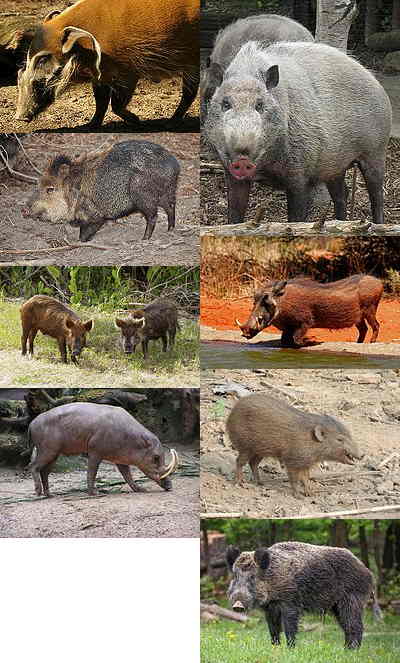
Eight suine species (counter-clockwise from top left): red river hog (Potamochoerus porcus), collared peccary (Dicotyles tajacu), pigs (Sus scrofa domesticus), north Sulawesi babirusa (Babyrousa celebensis), wild boar (Sus scrofa), pygmy hog (Porcula salvanius), common warthog (Phacochoerus africanus), and Bornean bearded pig (Sus barbatus)
Scientific classification Edit this classification
Kingdom: Animalia
Phylum: Chordata
Class: Mammalia
Order: Artiodactyla
Clade: Artiofabula
Suborder: Suina
Gray, 1868
Genera and families

Suina (also known as Suiformes) is a suborder of omnivorous, non-ruminant artiodactyl mammals that includes the domestic pig and peccaries. A member of this clade is known as a suine. Suina includes the family Suidae, termed suids, known in English as pigs or swine, as well as the family Tayassuidae, termed tayassuids or peccaries. Suines are largely native to Africa, South America, and Southeast Asia, with the exception of the wild boar, which is additionally native to Europe and Asia and introduced to North America and Australasia, including widespread use in farming of the domestic pig subspecies. Suines range in size from the 55 cm (22 in) long pygmy hog to the 210 cm (83 in) long giant forest hog, and are primarily found in forest, shrubland, and grassland biomes, though some can be found in deserts, wetlands, or coastal regions. Most species do not have population estimates, though approximately two billion domestic pigs are used in farming, while several species are considered endangered or critically endangered with populations as low as 100. One species, Heude's pig, is considered by the International Union for Conservation of Nature to have gone extinct in the 20th century.

Classification

[edit]

Suina's placement within Artiodactyla can be represented in the following cladogram:[1][2][3][4][5]

Artiodactyla

Tylopoda (camels)

Artiofabula

Suina (pigs)

Cetruminantia

Ruminantia (ruminants)

Cetancodonta/Whippomorpha

Hippopotamidae (hippopotamuses)

Cetacea (whales)

The suborder Suina consists of 21 extant species in nine genera. These are split between the Suidae family, containing 18 species belonging to 6 genera, and the Tayassuidae family, containing 3 species in 3 genera. This does not include hybrid species such as boar–pig hybrids or extinct prehistoric species. Additionally, one species, Heude's pig, went extinct in the 20th century.

References

[edit]
Revisions and contributorsEdit on WikipediaRead on Wikipedia
from Grokipedia
Suina is a monophyletic , also recognized as a suborder, within the mammalian order Artiodactyla, encompassing the families (pigs and hogs) and Tayassuidae (peccaries) as its sole extant members. These non-ruminant, even-toed ungulates are distinguished by their robust builds, bristle-like coats in suids, and in peccaries, with diets ranging from primarily omnivorous in suids to more herbivorous tendencies in peccaries, though both families exhibit flexible feeding habits including roots, fruits, and small animals. The clade excludes hippopotamids, which form a separate lineage () alongside cetaceans based on molecular and morphological evidence. The evolutionary origins of Suina trace back to the Eocene epoch, with early fossil records indicating diversification in and subsequent migrations; suids appeared prominently in the across and , while peccaries dispersed to the via the Panamanian during the . Phylogenetic analyses confirm the close relationship between and Tayassuidae within the superfamily Suoidea, supported by shared cranial features such as the position of the orbits and dental morphology adapted for grinding vegetation. The fossil record highlights a rich radiation, but modern Suina represent a streamlined survival of this ancient lineage amid mass extinctions. Comprising approximately 18 to 19 species in Suidae across six genera (such as Sus for pigs and Phacochoerus for warthogs) and three to four species in Tayassuidae (including Pecari tajacu and Tayassu pecari), Suina exhibits a global but disjunct distribution. Suidae are native to Eurasia, Africa, and parts of Southeast Asia, with human-mediated introductions expanding their range to the Americas, Australia, and oceanic islands, while Tayassuidae are endemic to the Neotropics from the southwestern United States to northern Argentina. These mammals inhabit diverse ecosystems, from forests and grasslands to savannas, often in social groups, and play key ecological roles as ecosystem engineers through rooting behaviors that aerate soil and promote plant regeneration.

Taxonomy and phylogeny

Classification

Suina is a suborder of omnivorous, non-ruminant artiodactyl mammals within the order Artiodactyla, class Mammalia, phylum Chordata, and kingdom Animalia. The name Suina was coined by British zoologist in 1868 to describe this group, with Suiformes recognized as a historical . Cladistic analyses based on molecular phylogenomics position Suina as a key component of the clade within Artiodactyla, sister to the . Suina encompasses two extant families: (pigs), comprising six genera—Sus, Porcula, Phacochoerus, , Hylochoerus, and Babyrousa—and 17 species (though counts vary from 17 to 19 due to taxonomic debates, such as the status of Babyrousa subspecies); and Tayassuidae (peccaries), comprising three genera—Pecari, Tayassu, and Catagonus—and three species, yielding a total of 20 extant species across the suborder.

Evolutionary relationships

Suina represents a monophyletic within the order Artiodactyla, specifically embedded in the larger group Cetartiodactyla, where it forms the alongside . In this phylogenetic framework, Suina is positioned as the to , which itself comprises Ruminantia (ruminants such as cattle and deer) and (hippopotamids and cetaceans). This arrangement places as the sister to (camels and relatives), with the basal divergence of from the rest of Cetartiodactyla estimated around 66–52 million years ago (Ma), marking the early radiation of even-toed ungulates following the Cretaceous-Paleogene boundary. Molecular phylogenomic analyses, incorporating nuclear and mitochondrial data, strongly support this topology, with Bayesian posterior probabilities of 100% for key nodes including and . The origins of Suina trace back to the late Eocene, approximately 37.8–33.9 Ma, when the diverged from other lineages in , coinciding with global climatic shifts toward warmer conditions that facilitated diversification. Earliest evidence includes primitive suoids like Eocenchoerus from Asian deposits, indicating that Suina had already begun to differentiate from ancestors shared with tylopods and ruminants-ceaceans by this period. This divergence is supported by both morphological traits, such as dental and cranial features adapted for omnivorous diets, and estimates placing the Suina stem around 56–64 Ma, though crown-group Suina likely solidified in the Eocene. The record documents a progressive expansion, with suine remains appearing in European strata by the early , reflecting migratory patterns across . Key evolutionary milestones within Suina include the emergence of its two modern families. Tayassuidae (peccaries) first appeared in the (approximately 33–23 Ma) in and , with fossils indicating an initial distribution before dispersal to by the early . Suidae (pigs) originated slightly earlier in the late Eocene to in , but underwent significant diversification and radiation during the (around 23–5 Ma), particularly with the rise of subfamilies like around 20 Ma, adapting to forested and habitats amid Miocene climatic cooling. Molecular studies have revealed hybridization events within Suidae, such as interbreeding between (Sus scrofa) and (Porcula salvania) lineages approximately 2 million years ago, which influenced and genetic diversity during Pleistocene expansions. The record of Suina spans from late Eocene deposits in , through Oligocene-Miocene diversifications across and , to Pliocene-Pleistocene adaptations in the and , culminating in the with extant forms surviving major extinction events like the megafaunal turnover. This continuous record highlights Suina's resilience, with over 100 extinct genera documented, primarily from fluvial and lacustrine sediments that preserve dental and postcranial evidence of their ecological roles as engineers.

Physical characteristics

Morphology

Suina, comprising the families (pigs) and Tayassuidae (peccaries), exhibit a distinctive body structure as non-ruminant even-toed ungulates, featuring robust, barrel-shaped torsos, large heads, and relatively short limbs that support their weight on four toes per foot, though peccaries show reduction in the outer hind toes. Their elongated snouts, equipped with a mobile, disk-like tip and a prenasal , facilitate precise manipulation of the environment, while prominent tusks—formed by enlarged, continuously growing upper and lower canines that curve upward and outward—occur in many species, particularly males, for tasks such as digging and defense. Sensory adaptations in Suina prioritize olfaction over vision, with a keen sense of smell enabling detection of food and conspecifics from afar, contrasted by poor eyesight that limits visual acuity to close-range identification. The nostrils, positioned at the snout's tip and capable of closing, protect against soil inhalation during rooting, enhancing the efficacy of their . The of Suina is bunodont and adapted for an omnivorous diet, with a typical dental formula of I33:C11:P44:M33=44I \frac{3}{3} : C \frac{1}{1} : P \frac{4}{4} : M \frac{3}{3} = 44 in many suids like the wild boar (Sus scrofa), though peccaries such as the (Pecari tajacu) vary to I23:C11:P33:M33=38I \frac{2}{3} : C \frac{1}{1} : P \frac{3}{3} : M \frac{3}{3} = 38. The canines, especially the upper ones, grow continuously throughout life, forming the tusks that distinguish the . Skin in Suina is typically thick and tough, covered in coarse, bristly that provides ; for instance, wild boars have dense bristles along the spine, while peccaries feature a grizzled pelage of stiff hairs. Specialized , including mandibular, preputial, and anal types in suids, and a unique dorsal rump in peccaries, secrete odorous substances for marking territory and individuals.

Size and variation

Suina species exhibit a wide range of body sizes, from the diminutive (Porcula salvania, formerly Sus salvanius) to the massive (Hylochoerus meinertzhageni). The , the smallest suid, measures 55–71 cm in head-body length with a shoulder height of approximately 25 cm and weighs 6.6–9.7 kg. In contrast, the , the largest wild suid, reaches a head-body length of up to 210 cm, a shoulder height of 76–110 cm, and weights of 100–275 kg. Peccaries (Tayassuidae) are generally smaller than pigs (), with adults typically weighing 20–40 kg and measuring 90–130 cm in length. Pigs show greater size diversity, with wild boars (Sus scrofa) capable of reaching weights up to 320 kg in exceptional cases, though averages are lower at 44–200 kg depending on population and sex. in size and morphology is pronounced in several species, particularly warthogs (Phacochoerus spp.), where males are larger than females and possess more prominent tusks for combat and display. This dimorphism becomes evident by 12–18 months of age, with adult males averaging 20–30% heavier than females. Intraspecific variation in Suina body size is influenced by age, sex, and geographic factors, including observed in isolated populations. For instance, wild pigs on islands like and exhibit reduced body sizes compared to mainland conspecifics, a pattern linked to constraints and evolutionary . Age-related growth continues into adulthood, with males often attaining maximum size later than females across .

Distribution and habitat

Geographic range

The Suidae family, encompassing pigs and hogs, is native to the Old World, with its natural distribution spanning Europe, Africa, Asia, and the East Indies. Species such as the wild boar (Sus scrofa) are found across Eurasia from the Iberian Peninsula to Japan, while African representatives like warthogs (Phacochoerus) and bushpigs (Potamochoerus) occupy diverse regions south of the Sahara. In Asia, suids range from the forests of India and Southeast Asia to the islands of Indonesia, including Sulawesi and the Philippines. In contrast, the Tayassuidae family, or peccaries, is endemic to the , primarily Central and , extending from southern through the to central . The (Pecari tajacu) reaches into the , marking the northernmost extent of the family today, while white-lipped (Tayassu pecari) and Chacoan peccaries (Catagonus wagneri) are confined to habitats. There is no natural overlap between and Tayassuidae distributions, as the former is restricted to and the latter to the . Introduced populations have significantly expanded the range of , particularly the wild boar (Sus scrofa), which was brought to starting in the by European explorers and later through deliberate releases in the for hunting; feral populations now occur in at least 35 U.S. states and parts of . In and , wild boars were introduced in the 18th and 19th centuries as livestock, establishing widespread feral herds across diverse landscapes. These introductions have created non-native overlaps among suid species in regions like , where multiple Sus taxa coexist due to both natural and human-mediated dispersals. Historically, peccaries exhibited broader distributions, with extinct genera like and Mylohyus widespread across during the Pleistocene epoch, from to , until their around 12,000 years ago at the end of the epoch. This contraction left only the surviving Tayassuidae species in southern ranges, while remained absent from the until modern introductions.

Ecological preferences

Suina exhibit a broad range of ecological preferences, occupying diverse habitats that reflect their adaptability as omnivorous ungulates. Members of the family Suidae, including wild pigs such as the Eurasian (Sus scrofa), are found in tropical rainforests, temperate forests, grasslands, shrublands, wetlands, savannas, and even arid deserts across , , and . In contrast, the family Tayassuidae, comprising peccaries, primarily inhabits tropical forests, dry woodlands, scrublands, and grasslands in the Americas, from the to central , with species like the (Pecari tajacu) showing particular tolerance for disturbed and arid environments. These habitat choices are driven by the availability of cover, resources, and proximity, enabling Suina to thrive in both dense and open landscapes. Key adaptations enhance Suina's suitability for these environments, particularly their robust snouts and limbs suited for navigating dense undergrowth and soft soils. Both and Tayassuidae engage in rooting , using their disc-like snouts to excavate soil for tubers and , which not only aids but also shapes microhabitats by creating disturbed patches that influence plant succession. Additionally, in mud is a widespread thermoregulatory , as Suina lack efficient sweat glands; this cools the body, protects against sunburn, and removes ectoparasites, with individuals often selecting near water sources in forested or grassy areas. Preference for microhabitats close to streams, rivers, or ponds is common, providing essential hydration and cooling opportunities while minimizing predation risk in vegetated cover. Altitudinal preferences vary by taxon, with Suidae demonstrating greater elevational flexibility; for instance, some Asian pig species occupy ranges from to over 4,000 meters in highland forests and grasslands, adapting to cooler climates through denser fur and behavioral adjustments. Tayassuidae, however, are more restricted to lowland and mid-elevation zones up to approximately 2,000 meters, favoring warmer tropical and subtropical conditions in forested or habitats. These preferences underscore Suina's role as engineers, influencing turnover and dynamics across their preferred niches.

Behavior and ecology

Diet and foraging

Suina exhibit an omnivorous diet dominated by plant matter, including roots, tubers, fruits, leaves, grasses, and forbs, with opportunistic consumption of such as and earthworms, small vertebrates like frogs and lizards, and carrion. In Suidae, wild pigs such as Sus scrofa primarily forage on vegetation like acorns, bulbs, and herbaceous , comprising 62–100% of their diet by volume, supplemented by animal matter during favorable conditions. Tayassuidae, including peccaries, are largely frugivorous, with fruits making up about 62% of observed intake for like the (Tayassu pecari), alongside underground storage organs (29%), other plant parts (8%), and minimal animal material (0.1%). Foraging techniques center on rooting , where individuals use their specialized, muscular snouts—equipped with a keen —to excavate and uncover buried food items like tubers, roots, and . This method is prevalent across , allowing efficient access to subsurface resources in varied habitats, though species like warthogs may also kneel on their forelegs to graze surface vegetation such as short grasses. Peccaries similarly root for underground matter but show a preference for fruits when available, shifting to stems and leaves as fallback options. Dietary composition varies seasonally in response to resource availability, with Suina increasing intake of animal matter or less preferred plants during lean periods to meet nutritional needs. For instance, warthogs (Phacochoerus africanus) rely heavily on C4 grasses year-round but shift toward bulbs, roots, bark, and tubers in the when grass quality declines, maintaining dietary stability with minimal isotopic shifts in δ¹³C values. In Tayassuidae, white-lipped peccaries consume more leaves and stems during fruit scarcity at the end of the (October–December), while favoring high-availability fruits like Ficus spp. during peaks in the . Suidae such as show greater dietary divergence from other suids in dry seasons, converging on shared resources in rainy periods. The digestive systems of Suina are monogastric, featuring a simple for initial breakdown, followed by hindgut fermentation in the enlarged and colon, where microbes degrade fibrous plant material to produce volatile fatty acids for energy. This system supports their omnivorous habits by efficiently processing high-fiber diets, though peccaries possess a regionally divided enabling limited , which enhances fiber digestibility compared to but remains less efficient than in true ruminants.

Social behavior

Suina exhibit diverse social structures that vary between the families and Tayassuidae, reflecting adaptations to their environments. Members of , such as wild boars (Sus scrofa), typically form matriarchal groups known as sounders, consisting of related females and their offspring, with average sizes ranging from 6 to 20 individuals. These sounders provide protection and cooperative foraging opportunities, while adult males are often solitary outside the breeding season, occasionally joining groups temporarily. In contrast, Tayassuidae, including collared peccaries (Pecari tajacu) and white-lipped peccaries (Tayassu pecari), live in stable, cohesive herds that emphasize female and kinship, with group sizes varying from 5 to 15 for collared peccaries to as many as 300 for white-lipped peccaries in resource-rich areas. These herds exhibit matriarchal elements, where females maintain dominance hierarchies based on age and size, fostering cooperative defense against predators. Communication among Suina relies on a combination of vocalizations, scent marking, and body postures to convey information about identity, status, and threats. Both families produce a range of vocal signals, including grunts for contact and reassurance during group movement, squeals to express alarm or submission, and aggressive growls or roars in confrontations. Peccaries additionally use teeth-clacking sounds to signal agitation or warnings within the herd. Scent marking plays a crucial role, with suids utilizing such as preputial, anal, and mandibular types to deposit odors on vegetation and conspecifics, reinforcing social bonds and group cohesion. Peccaries employ a prominent dorsal rump to rub scents on objects and members, aiding in recognition and individual identification. Dominance is often displayed through postural cues, such as elevated heads, stiff-legged walks, or shoulder shoving, establishing hierarchies that minimize intra-group conflict, particularly among females. Territoriality in Suina is more pronounced in peccaries than in pigs, with males of both families showing heightened defense during breeding periods. herds maintain defined home ranges, marked by and dung piles, which they defend collectively against intruders using coordinated charges and displays. typically involves slashing with tusks or bluff charges, effective for deterring rivals without frequent injury. In suids, territorial behavior is less rigid, with sounders overlapping ranges extensively, though dominant males may aggressively patrol core areas using vocal threats and physical confrontations via tusks to secure access. Daily activity patterns in Suina are often crepuscular or nocturnal, particularly in warmer climates, to minimize exposure to heat stress and predation. Wild pigs display peak activity at dawn and in temperate regions, shifting to predominantly nocturnal in arid or human-impacted areas to avoid daytime disturbances. Peccaries show more variable patterns, with collared peccaries active during early morning and late afternoon in forested habitats, while larger herds of white-lipped peccaries may extend into nocturnal periods for group travel and predator avoidance. These rhythms facilitate social interactions, such as synchronized resting in shaded areas during midday heat.

Reproduction and life cycle

Suina exhibit polygynous systems, in which dominant males mate with multiple females, though also occurs in some populations. In , wild boars (Sus scrofa) display socio-genetic structures supporting , with males competing for access to females in matrilineal groups. Similarly, in Tayassuidae, collared peccaries (Pecari tajacu) and white-lipped peccaries (Tayassu pecari) form hierarchies where alpha males monopolize within herds, leading to strong male-male competition. in is spontaneous, occurring mid- to late-estrus approximately 24-48 hours after onset, while breeding in both families can be polyestrous but often shows seasonality; wild boars in temperate regions peak in autumn-winter, and peccaries align with rainy seasons for peaks in February and July in some habitats. Gestation periods in Suina last 3-5 months, with Suidae averaging 112-175 days (e.g., 114 days in domestic pigs, up to 163 days in babirusas) and Tayassuidae around 140-150 days (e.g., 142 days in collared peccaries). Litter sizes vary by family and species; Suidae typically produce 2-12 young per litter (e.g., 3-4 in red river hogs, up to 10 in some wild boars), while Tayassuidae have smaller litters of 1-4 (usually 2 in collared peccaries). Newborns are precocial, born with open eyes, functional mobility, and protective stripes in most species (absent in warthogs and babirusas), enabling immediate foraging and predator evasion shortly after birth. Life stages progress rapidly in Suina: young are weaned at 2-4 months (e.g., 3 months in bearded pigs, 6 weeks in collared peccaries), is reached at 1-2 years (5-36 months in , 8-24 months in Tayassuidae), and wild lifespans average 5-10 years but can extend to 15-20 years under favorable conditions. is provided primarily by females, who construct nests for parturition, nurse offspring for immunity and nutrition, and aggressively protect them from threats; males typically become solitary post-mating and do not participate in rearing. In white-lipped peccaries, communal suckling among females enhances group cohesion during early development.

Species

Suidae

Suidae is the family of pigs, consisting of 18 extant species classified into six genera, all native to , , and . These suids are characterized by their omnivorous diets, robust builds with elongated snouts for rooting, and adaptations ranging from secretive forest-dwellers to more open-habitat grazers, reflecting their evolutionary success in diverse ecosystems across the . Unlike their counterparts in Tayassuidae, suids lack and exhibit straight tusks that grow continuously throughout life. The genus Sus is the most species-rich, encompassing eight species primarily distributed across Eurasia and parts of Southeast Asia. Notable examples include the Eurasian wild boar (Sus scrofa), a highly adaptable species found from Western Europe to Japan and North Africa, often inhabiting woodlands, grasslands, and agricultural areas; the Palawan bearded pig (Sus ahoenobarbus), endemic to Palawan Island in the Philippines; the bearded pig (Sus barbatus), native to the Malay Peninsula, Sumatra, and Borneo, favoring swampy forests; and the Visayan warty pig (Sus cebifrons), endemic to the forests of six islands in the central Philippines, where it is critically endangered due to habitat loss. Other Sus species include the Philippine warty pig (Sus philippensis) on Mindanao and surrounding islands, the Celebes warty pig (Sus celebensis) restricted to Sulawesi, the Javan warty pig (Sus verrucosus) on Java and Bawean, and the Flores warty pig (Sus florensis) on Flores. The genus Potamochoerus includes two species of bushpigs, both confined to : the red river hog (Potamochoerus porcus), which inhabits rainforests and riverine areas from to and south to and , noted for its striking reddish coat and white facial markings; and the (Potamochoerus larvatus), distributed across a broader range from to and as far east as , preferring moist woodlands and grasslands. The genus Hylochoerus contains a single species, the (Hylochoerus meinertzhageni), the largest extant suid, weighing up to 275 kg and endemic to montane forests and bamboo zones in East and , from to eastern . Warthogs are represented by the genus Phacochoerus with two species: the common warthog (Phacochoerus africanus), widespread in savannas and woodlands across sub-Saharan Africa south of the Sahara, distinguished by its prominent facial warts and upright mane; and the desert warthog (Phacochoerus aethiopicus), limited to arid and semi-arid regions in northern Kenya, Somalia, and Ethiopia. The genus Babyrousa comprises four species of babirusas, all endemic to the Indonesian islands of Sulawesi and its satellites, including the North Sulawesi babirusa (Babyrousa celebensis), lowland babirusa (Babyrousa babyrussa), Togian babirusa (Babyrousa togeianus), and Bola Batu babirusa (Babyrousa bolabatuensis), inhabiting rainforests and showing unique tusks that curve upward from the snout. Finally, the genus Porcula has one species, the pygmy hog (Porcula salvania), the smallest suid at under 10 kg, restricted to tall grasslands in a tiny area of northwest India and southern Nepal's Terai region. Suidae species display remarkable habitat diversity, with forms like the forest-specialized and babirusas contrasting grassland inhabitants such as warthogs, enabling occupancy from tropical rainforests and montane zones to semi-deserts and wetlands across their range. is pronounced in insular , exemplified by the , which survives in fragmented forests on , , and , highlighting vulnerability to isolation and . Recent taxonomic revisions, informed by genetic analyses, have clarified distinctions within Sus—such as multiple races of S. scrofa across its vast range—and documented hybridization between Sus species in contact zones, like between S. scrofa and S. verrucosus in , influencing conservation strategies for island populations.

Tayassuidae

Tayassuidae, commonly known as peccaries, is a family of mammals endemic to the , comprising three extant genera and that diverged from suid ancestors approximately 35 million years ago. These include Pecari tajacu (), found from the to northern ; Tayassu pecari (), distributed across central and northern ; and Catagonus wagneri (), restricted to the region of , , and . Unlike their counterparts in , peccaries exhibit a more streamlined morphology suited to diverse American habitats, from deserts to rainforests. Distinctive anatomical features set Tayassuidae apart, including long, slender limbs with small hooves that enhance mobility and a prominent dorsal located on the rump, which secretes a pungent used for territorial marking and social bonding. This gland, absent in suids, allows individuals to rub against each other or objects in a head-to-tail manner, reinforcing group cohesion. also possess a three-chambered adapted for , enabling efficient of fibrous vegetation, and lack a , further differentiating their from pigs. Socially, peccaries are highly gregarious, forming stable herds known as sounders that vary by species: collared peccaries typically in groups of 6–50, white-lipped peccaries in larger aggregations of 50–400, and Chacoan peccaries in smaller units of 2–20 individuals. Communication within herds relies on vocalizations like grunts and barks, alongside scent marking from the dorsal gland. The , in particular, displays migratory behavior, undertaking large-scale movements across landscapes in response to resource availability and seasonal changes, sometimes covering hundreds of kilometers in cyclic patterns. The , presumed extinct based on subfossil remains, was rediscovered alive in Paraguay's Chaco region in , marking a significant zoological event that expanded knowledge of Tayassuidae diversity. This finding, documented through field surveys confirming living populations, highlighted the species' adaptation to arid thorn forests and its vulnerability to habitat loss.

Extinct suines

The , often referred to as "hell pigs" due to their robust, pig-like build and predatory adaptations, represent an extinct family of within Suina that thrived from the late Eocene to the early , primarily in and . These omnivorous mammals, characterized by massive skulls, powerful jaws, and bunodont teeth suited for crushing bone and vegetation, were apex predators or scavengers in forested and open habitats. A prominent genus, , from the late Eocene to Oligocene of , reached lengths of about 2 meters and weights up to 450 kg, with fossils indicating a diet that included both plant matter and small vertebrates. Another key extinct family, Kubanochoeridae, flourished during the across and , comprising large, long-legged suids adapted to environments. These herbivores featured elongated limbs for locomotion and prominent cranial ornamentation, such as horns in some , suggesting possible display functions. Fossils from sites in and highlight their diversity, with the family emerging around 17 million years ago and declining by the . Among extinct suids, giant forms like Kubanochoerus from exemplify the evolutionary peak in body size for the Suidae family, with species such as K. gigas estimated to weigh up to 500 kg and stand 1.2 meters at the shoulder. These massive, horned pigs likely foraged in mixed forests, relying on their size for defense and access to browse. In , native suids were absent during the Pleistocene, with the continent's suine diversity limited to peccaries until introductions of Old World pigs in the . Extinct peccaries include several Pleistocene genera in , such as Platygonus, which formed large herds and inhabited grasslands and woodlands across the continent. The flat-headed peccary (P. compressus), weighing around 100 kg, featured a depressed for enhanced olfactory capabilities and went extinct at the end of the Pleistocene approximately 11,000 years ago, coinciding with broader megafaunal losses possibly driven by and human activity. studies confirm its close relation to modern peccaries, underscoring its role in late Ice Age ecosystems. A more recent case involves Heude's pig (Sus bucculentus), a warty pig from Indochina described in 1892, which was presumed extinct by the early due to lack of sightings after its initial discovery. Known from limited specimens indicating a forest-dwelling with distinctive , but a 1995 skull from is disputed, its taxonomic status is debated (possibly synonymous with S. scrofa), and it is considered likely extinct with no confirmed living populations as of 2024. This highlights the vulnerability of insular and fragmented suine taxa to habitat loss and hunting.

Conservation

Threats

Habitat loss represents one of the most significant threats to Suina populations worldwide, primarily driven by for in and . In , the conversion of dipterocarp forests to oil palm plantations has fragmented habitats essential for species like the bearded pig (Sus barbatus), disrupting their migratory patterns and reducing available foraging areas. Similarly, in , agricultural encroachment and have degraded grasslands and s critical for warthogs (Phacochoerus africanus) and forest hogs (Hylochoerus meinertzhageni), leading to range contractions in regions such as the and . For peccaries in the Americas, habitat destruction in the and through soybean cultivation and cattle ranching has isolated populations of white-lipped peccaries (Tayassu pecari), which require large continuous tracts of over 300 km² to sustain social groups. Hunting pressure, particularly through the trade, exacerbates population declines across Suina taxa. In , warthogs are heavily targeted for meat and tusks, contributing to local extirpations in areas like and where non-Muslim communities drive demand. Peccaries face similar threats in , with white-lipped and collared peccaries (Pecari tajacu) hunted for subsistence and commercial purposes, resulting in reduced group sizes and altered social structures in the Amazon and . In , endemic warty pigs such as the (Sus cebifrons) are vulnerable to unregulated hunting in fragmented forests, further compounding habitat pressures. Diseases and competition from pose additional risks to Suina survival. African swine fever (ASF), a highly contagious with up to 100% mortality in affected populations, has spread rapidly since 2018, decimating wild pig communities in and threatening all 11 endemic species there, including bearded and Sulawesi warty pigs (Sus celebensis). Outbreaks continued into 2025, with 198 incidents reported in wild boars in September alone. In , feral pigs (Sus scrofa) introduced from compete with native peccaries for resources in overlapping niches, potentially displacing collared and white-lipped peccaries through interference and resource depletion in wetlands like the ; their range continues to expand into biodiversity hotspots as of 2023. Other pathogens, such as trypanosomes (Trypanosoma evansi and T. cruzi), transmitted via livestock or vectors, have been documented in Brazilian peccary populations, increasing vulnerability in altered landscapes. Climate change further compounds these pressures by altering rainfall patterns and habitats for Suina. In African savannas, irregular rainfall and prolonged droughts reduce grass and root availability for warthogs, forcing shifts in behavior and increasing exposure to human-dominated areas. For wild boars in temperate regions, hotter and drier conditions decrease overall activity levels, limiting efficiency unless mitigated by rain, which could disrupt seasonal resource use as variability intensifies. These changes may indirectly heighten conflicts with and transmission in fragmented habitats.

Status of species

The conservation status of Suina species varies widely across the suborder, with assessments by the International Union for Conservation of Nature (IUCN) reflecting differences in population sizes, habitat pressures, and geographic distributions. While some species, such as the wild boar (Sus scrofa), are classified as Least Concern due to their extensive range and estimated global population exceeding millions of individuals, others face severe declines. Among the most threatened suids, the (Porcula salvania) is listed as Critically Endangered, with a population estimated at fewer than 250 mature individuals confined to a single location in , ; recent reintroduction efforts have increased the total population (wild and captive) to around 440-515 individuals as of 2025. The (Sus verrucosus) is Endangered, experiencing rapid population declines due to habitat loss and hunting, though precise numbers remain unavailable. In peccaries, the (Catagonus wagneri) is Endangered, with current estimates of approximately 3,000 individuals (range 2,000-3,200) across its restricted range in the region, and ongoing declines reported. Conversely, the (Hylochoerus meinertzhageni) is Least Concern but has low population estimates of under 15,000 individuals, primarily in fragmented African forests. Recovery initiatives include programs for the (Babyrousa spp.), which support genetic diversity and potential reintroductions for Vulnerable species like the Sulawesi babirusa (Babyrousa celebensis), with at least 60 founders targeted for breeding to reach viable populations of around 300 individuals. For peccaries, protected areas in the , such as Ñembi Guasu in spanning over 12,000 km², provide critical refuges for the and other species, aiding population stabilization through habitat preservation and measures. Data gaps persist, particularly for many Asian suid species like the (Sus cebifrons), which is Critically Endangered with unknown population trends due to incomplete surveys amid ongoing . The IUCN Wild Pig Specialist Group highlights the need for enhanced monitoring to address these uncertainties and inform targeted conservation.

Relationship to humans

Domestication and farming

The domestication of pigs, derived from the wild boar Sus scrofa, occurred independently in two primary regions approximately 9,000 years ago: the , including and the , and , particularly . Archaeological and genetic evidence indicates that early management practices transitioned from to and , leading to morphological changes such as reduced body size and altered suited to human-controlled environments. In contrast, peccaries of the family Tayassuidae have not undergone , remaining primarily wild or managed in limited captive settings without the genetic and behavioral adaptations seen in suids. Modern pig farming supports an estimated global population of approximately 1 billion domestic pigs, with numbers continuing to grow to meet demand; projections suggest around 1.3 billion by 2025 driven by population increases in . has produced specialized breeds like the Large White (also known as ), valued for rapid growth, high lean yield, and efficient feed conversion, making it a staple in commercial meat production worldwide. Domestic pigs serve multiple economic purposes beyond meat: their hides provide for goods such as and upholstery, while manure acts as a nutrient-rich , enhancing soil fertility in systems. Pig farming encompasses a range of systems, from intensive confinement operations—where animals are housed indoors with controlled environments to maximize growth rates and minimize space—to free-range methods that allow outdoor access for natural and movement, often prioritizing and sustainable . Intensive systems dominate global production due to higher but raise concerns over and environmental impacts, whereas free-range approaches, though less common, support and reduce reliance on synthetic feeds. Genetic management in farming is complicated by ongoing introgression from wild boars into domestic lines, particularly in regions with overlapping populations, which can introduce disease resistance but also hybrid vigor dilution through .

Cultural significance

Suina, encompassing pigs and peccaries, have held profound symbolic roles across human cultures, often embodying themes of prosperity, impurity, and the natural world. In East Asian traditions, the occupies the twelfth position in the , representing wealth, good fortune, and diligence, as its plump form evokes abundance and fertility in dating back to ancient lunar calendars. Conversely, in , pigs symbolize impurity; Judaism's in Leviticus prohibits their consumption as unclean animals lacking split hooves and cud-chewing, a dietary law that archaeologically distinguished from pig-revering around 1200 BCE, reinforcing ethnic and ritual identity. Similarly, Islam's Qur'an deems haram (forbidden) due to its perceived impurity, a rule aimed at spiritual and physical purity that has persisted for over 1,400 years. Among Amazonian indigenous groups, peccaries feature in myths reflecting and , where they blur boundaries between nature and culture, as in Guianese tales portraying them as transformative beings in origin stories of self and other. Depictions of Suina in art trace human-animal bonds to prehistoric times, with pigs prominent in cave paintings; a 45,500-year-old warty pig figure in Sulawesi's Leang Tedongnge cave, , provides significant evidence of early artistic expression, likely tied to hunting rituals or spiritual significance. In literature and modern media, pigs challenge utilitarian views, as exemplified by Babe in Dick King-Smith's 1983 children's novel The Sheep-Pig, adapted into the 1995 , where the intelligent porcine protagonist fosters empathy and subverts stereotypes of pigs as . Beyond sustenance, Suina served ritual purposes in ancient European societies; in , pigs were sacrificed to chthonic deities like during fertility and purification rites, with piglets symbolizing ceremonial pollution to expel miasma from communities. Roman funerary customs included offerings in the silicernium for the deceased, evidenced by concentrated deposits in 2nd–3rd century CE legionary cemeteries, underscoring their role in honoring the dead and communal feasting. Today, Suina evoke mixed sentiments globally: domesticated pigs remain icons of rural life and companionship in pet , yet feral populations are reviled as invasive pests, uprooting ecosystems and threatening across 54 countries, prompting cultural narratives of conflict in affected regions like the .

Hunting and management

Hunting of wild Suina has deep historical roots, particularly in where wild boar (Sus scrofa) hunts were a prominent activity among the during the medieval period. These hunts served not only as a means of provisioning but also as displays of power and social status, often involving elaborate rituals and specialized equipment like spears and hounds, as documented in Carolingian-era texts and later aristocratic treatises. In the , indigenous groups such as the Matsigenka in the Peruvian Amazon and the Huaorani in have long relied on hunting collared peccaries (Pecari tajacu) for subsistence, using traditional methods like spears and blowguns to target herds in forested areas, integrating the practice into their cultural and economic systems. In modern contexts, management of wild Suina populations emphasizes controlled hunting to mitigate overpopulation and associated damages. In the United States, feral hog populations, estimated at over 6 million across at least 35 states, are addressed through the National Feral Swine Damage Management Program, which employs professional trapping, shooting, and incentivized public hunts to remove 40-60% of individuals annually in targeted areas, aiming to curb agricultural and ecological harm. Similarly, in African savannas, regulated hunting of species like the common warthog (Phacochoerus africanus) involves quotas in game-controlled areas, such as those in Zambia's Lunda-Mkwambi region, where annual limits on bushpig (Potamochoerus larvatus) and warthog harvests help maintain sustainable populations while supporting local economies and controlling crop raiding. Efforts to control invasive Suina extend to eradication programs in regions where introduced populations threaten . In , the Threat Abatement Plan for predation and habitat degradation by feral pigs employs a approach, including aerial shooting, ground , and baiting, which has reduced densities by up to 50% in high-priority areas like national parks during periods to protect native and . In , similar strategies under the National Pest Plant and Animal Biosecurity Framework target feral pigs through coordinated hunting and , with reviews indicating that integrated control can achieve long-term suppression or local eradication on islands and mainland sites. International regulations play a key role in managing threatened Suina species through trade restrictions. The (Porcula salvania), critically endangered with a wild population of approximately 420 individuals (as of 2024), is listed in Appendix I, prohibiting commercial in specimens to prevent further decline from and habitat loss in its restricted range in , , and . Recent reintroduction efforts, including the release of captive-bred individuals, have contributed to population recovery, with plans to rewild 60 hogs by 2025.

References

Add your contribution
Related Hubs
User Avatar
No comments yet.