Hubbry Logo
Java mouse-deerJava mouse-deerMain
Open search
Java mouse-deer
Community hub
Java mouse-deer
logo
8 pages, 0 posts
0 subscribers
Be the first to start a discussion here.
Contribute something
Java mouse-deer
Java mouse-deer
from Wikipedia

Java mouse-deer
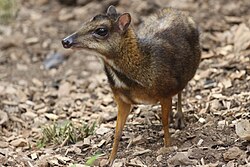
At the Jerusalem zoo
Scientific classification Edit this classification
Kingdom: Animalia
Phylum: Chordata
Class: Mammalia
Order: Artiodactyla
Family: Tragulidae
Genus: Tragulus
Species:
T. javanicus
Binomial name
Tragulus javanicus
(Osbeck, 1765)
Synonyms[2]
List
    • Tragulus indicus Brisson, 1762
    • Cervus javanicus (Osbeck, 1765)
    • Tragulus Javensis Pallas, 1779
    • Moschus indicus (Gmelin, 1788)
    • Moschus javanicus (Gmelin], 1788)
    • Moschus Jasanicus (C. H. Smith, 1826)
    • Tragulus javanicus Cantor, 1846
    • Tragulus focalinus G. S. Miller, 1903

The Java mouse-deer (Tragulus javanicus)[3] is a species of even-toed ungulate in the family Tragulidae. When it reaches maturity it is about the size of a rabbit, making it the smallest living ungulate. It is found in forests in Java and perhaps Bali, although sightings there have not been verified.[1]

This mouse-deer is depicted in Indonesian folklore as Sang Kancil.

Nomenclature

[edit]
By Gustav Mützel

The Java mouse-deer has many common names, including Javan chevrotain,[2] Javan mousdeer, or Java Mouse Deer.[4]

Taxonomy

[edit]

The Java mouse-deer's current scientific name is Tragulus javanicus, although other names for it exist, including Tragulus javanica (fem.), Cervus javanicus (basionym), and Tragulus fuscatus (heterotypic synonym).[1][5][6][7]

The taxonomic history of the Java mouse-deer is convoluted; previously, the Java mouse-deer (Tragulus javanicus) was commonly thought to encompass a group of small-bodied chevrotains, but after revisions it was found that this species name should only apply to mouse-deer specimens from Java.[8]

Recent craniometric analyses have begun to shed light on the taxonomic discrepancies. Three species groups of Tragulus have been identified based on craniometric skull analyses and coat coloration patterns. These three species groups are Tragulus javanicus, Tragulus napu, and Tragulus versicolor. Based upon these craniometric analyses, Tragulus javanicus was then further separated based on the organisms' known geographic locations: Tragulus williamsoni (found in northern Thailand and possibly southern China), Tragulus kanchil (found in Borneo, Sumatra, the Thai–Malay Peninsula, islands within the Greater Sunda region, and continental Southeast Asia), and Tragulus javanicus (found in Java).[9] Thus, because of its endemism to the island of Java, the Java mouse-deer is now considered a distinct species, although this fact has not significantly affected its current classification.[clarification needed][10]

Description

[edit]
Skeletal mount; Yale Peabody Museum

Mouse-deer possess triangular-shaped heads, arched backs, and rounded bodies with elevated rear ends. The thin, short legs which support the mouse-deer are about the diameter of an average pencil.[citation needed] Unlike the antlered true deer, or horned bovids, but akin to Moschus musk deer, male Java mouse-deer have elongated, tusk-like upper canines which protrude downward from the upper jaw along the sides of their mouth. Males use these "tusks" to defend themselves and their mates against rivals.[11] Females can be distinguished from males because they lack these prominent canines, and they are slightly smaller than the males.[4] Java mouse-deer can be further distinguished by their lack of upper incisors, similar to bovids. The coat coloration of the Java mouse-deer is reddish-brown with a white underside, and pale white spots or vertical markings are also present on the animal's neck.[4]

With an average length of 45 cm (18 in) and an average height of 30 cm (12 in), the Java mouse-deer is the smallest extant (living) ungulate or hoofed mammal, as well as the smallest extant even-toed ungulate.[4][12][13] The weight of the Java mouse-deer ranges from 1 to 2 kilograms (2.2 to 4.4 lb), with males being heavier than females. It has an average tail length of about 5 cm (2.0 in). Mouse-deer are thought to be the most primitive ruminants based on their behaviour and the fossil record, thus they are the living link between ruminants and non-ruminants.[14][13]

Physiology

[edit]

The Java mouse-deer is endothermic and homoeothermic, and has an average basal metabolic rate of about 4.883 watts.[4] It also has the smallest red blood cells (erythrocytes) of any mammal, and about 12.8% of the cells have pits on them. The pits range in diameter from 68 to 390 nanometres. Red blood cells with pits are unique and have not been reported before either physiologically or pathologically.[12]

Habitat

[edit]
Moving through undergrowth; Frankfurt Zoo

Tragulus javanicus is usually considered to be endemic to Java, Indonesia. There have been unverified reports of sightings on Bali.[1]

The Java mouse-deer prefers higher elevations and tropical forest regions of Java, although it does appear at lower elevations between 400–700 metres (1,300–2,300 ft) above sea level.[4][15] During the day, Java mouse-deer can be seen roaming in crown-gap areas with dense undergrowth of creeping bamboo, through which they make tunnels through the thick vegetation which lead to resting places and feeding areas.[11] At night, the Java mouse-deer moves to higher and drier ridge areas.[4] It has been argued that Java mouse-deer are an "edge" species, favoring areas of dense vegetation along riverbanks.[4] Additionally, Java mouse-deer have been found to be more prevalent in logged areas than in the more mature forests, and their densities tended to decrease proportionately as the logged forests matured.

Biology

[edit]

It was previously believed that Java mouse-deer were nocturnal, but more recent studies have shown that they are neither truly nocturnal nor diurnal, instead being crepuscular, or preferring to be active during the dim light of dawn and dusk.[11] This behavior has been observed in both wild and captive Java mouse-deer.[16]

Ecology

[edit]

Java mouse-deer are primarily herbivores, although in captivity they have been observed to eat insects as well as foliage. Their diet consists primarily of that which they find on the ground in the dense vegetation they inhabit, and they prefer the plants of the faster-growing gap species over the closed forest understory species, likely due to the increased richness of secondary protective compounds which the gap species provide.[4] They are often classified as folivores, eating primarily leaves, shrubs, shoots, buds, and fungi, in addition to fruits which have fallen from trees.[4][11] The fruits which Java mouse-deer commonly consume range from 1–5 grams (0.035–0.176 oz), while the seeds range from 0.01–0.5 g (0.00035–0.01764 oz).[4]

Because of the small size of the Java mouse-deer, they are vulnerable to dogs, crocodiles, wild cats such as panthers, birds of prey, and snakes.[17]

Social behavior

[edit]
Sitting, with upper canines visible; Antwerp Zoo

Groups of Java mouse-deer are commonly referred to as "herds", while females are termed "does", "hinds", or "cows". Males are referred to as either "bucks", "stags", or "bulls"; and their young are commonly called "fawns" or "asses".[11] Although Java mouse-deer form monogamous family groups, they are usually shy, solitary animals. They are also usually silent; the only noise they make is a shrill cry when they are frightened.

The territories of Tragulus javanicus males and females have been observed to overlap considerably, yet individuals of the same sex do not share their territories.[4] Male Java mouse-deer are territorial, marking their territory and their mates with secretions from an intermandibular scent gland under their chin.[11] This territorial marking usually includes urinating or defecating to mark their area. To protect themselves and their mates or to defend their territory, mouse-deer slash rivals with their sharp, protruding canine "tusks." It has also been observed that, when threatened, the Java mouse-deer will beat its hooves quickly against the ground, reaching speeds of up to 7 beats per second, creating a "drum roll" sound.[17] When giving birth, however, females tend to establish a new home range. Female Java mouse-deer have an estimated home range of 4.3 hectares (11 acres), while males inhabit, on average, 5.9 hectares (15 acres). Additionally, male Java mouse-deer, in nature, were observed to travel distances of 519 metres (1,703 ft) daily on average, while females average 574 metres (1,883 ft) daily.[4]

Reproduction

[edit]
Mating; Singapore Zoo

Java mouse-deer are capable of breeding at any time during the year, and this has been observed during captivity.[4][15] However, some sources have observed that the breeding season for the Java mouse-deer in nature occurs from November to December.[18] Additionally, female mouse-deer have the potential to be pregnant throughout most of their adult life, and they are capable of conceiving 85–155 minutes after giving birth.[15] The Java mouse-deer's gestation period usually lasts 4.5 months, or 144 days.[4][15]

Typical litters consist of a single fawn, which resembles a miniature adult, although the tusk-like canines prevalent in males are not visible in the young mouse-deer.[4] The average mass of a newborn fawn is 370 grams (13 oz), and these precocial young are capable of standing within 30 minutes after birth. Fawns are capable of eating solid food within two weeks, yet it takes around 12 weeks to completely wean the fawns.[11] On average, it takes the young, both male and female, 167 days (~5 months) to reach sexual maturity.[19] Mouse-deer have been observed to live up to 14 years in captivity, but their lifespan in nature is still an open question.[4]

Diseases

[edit]

Although research into the diseases and parasites which affect the Java mouse-deer are still nascent, bovine viral diarrhea virus (BVDV 1), a pestivirus of the family Flaviviridae has been detected in Java mouse-deer. Mouse-deer acquire this virus through fetal infection during early pregnancy. Once acquired, individuals with BVDV can gain lifelong immune tolerance.[20]

Relation to humans

[edit]
Sang Kancil as depicted in a Wayang show

Indonesian folklore

[edit]

Historically, the mouse-deer has featured prominently in Malay and Indonesian folklore, where it is considered a wise creature. This character, Sang Kancil (pronounced "Kahn-cheel"), is a diminutive but wise mouse-deer; despite being tiny in comparison to other animals, his cunning and intelligence allows him to prevail over his larger opponents.[21][22]

Conservation

[edit]

Java mouse-deer is currently categorized as "Data Deficient" on the International Union for Conservation of Nature's Red List.[1] This data deficiency is due to the inconclusiveness regarding the distinct separation of Tragulus species, in addition to the lack of information on Tragulus javanicus. Even comparison of past observed numbers of Java mouse-deer with those presently observed does not greatly aid researchers because of the high likelihood of inaccuracy in past observations. Although listed as "Data Deficient," it is highly probable that a decline in the numbers of Java mouse-deer is occurring, and upon further investigation of this issue, the Red List status of Tragulus javanicus could easily change to "Vulnerable".[1]

One of the main predators that the Java mouse-deer faces are humans. Through the destruction of their habitat, as well as from hunting and trapping the mouse-deer for food, their pelts, and as pets, humans have considerably reduced the Java mouse-deer population. Mouse-deer are particularly vulnerable to being hunted by humans at night because of their tendency to freeze when illuminated by having a spotlight shone on them.[1]

Some conservation actions which have been implemented include legally protecting the species, which, although it has been in effect since 1931, makes no significant difference since hunting of Java mouse-deer still occurs.[citation needed] Additionally, some areas of Java which the Java mouse-deer frequents have been protected, yet enforcement of these regulations is still needed. One of the greatest conservation efforts needed is simply more information about the species: a more complete definition of its taxonomy, as well as more information on its habitat and behavior.

References

[edit]
[edit]
Revisions and contributorsEdit on WikipediaRead on Wikipedia
from Grokipedia
The Java mouse-deer (Tragulus javanicus) is a diminutive even-toed in the family Tragulidae, endemic to the tropical forests of , , and recognized as the world's smallest hoofed . Adults typically measure 40–45 cm in head-body length, stand 25–30 cm at the shoulder, and weigh 2–2.5 kg, with a slender build, short tail, and reddish-brown coat marked by white throat patches and spots. Males possess elongated upper canines functioning as tusks for defense and territorial disputes, while females lack these; neither sex develops antlers, distinguishing chevrotains from true deer. This solitary, nocturnal species inhabits dense undergrowth near streams in primary and secondary forests, relying on its keen senses and alarm barking to evade predators such as and . Primarily folivorous, it consumes fallen leaves, fruits, shoots, and fungi, aided by a multi-chambered for microbial despite its primitive physiology. Classified as by the owing to scant ecological data and unverified population estimates amid ongoing habitat loss from logging and agriculture, the Java mouse-deer exemplifies the vulnerabilities of understudied Southeast Asian endemics.

Taxonomy

Nomenclature and etymology

The binomial name Tragulus javanicus was established with the basionym Cervus javanicus by Swedish naturalist Peter Osbeck in 1765, based on specimens collected from during his voyage to the . Subsequent synonyms include Tragulus javensis proposed by in 1779, Moschus javanicus by Johann Friedrich Gmelin in 1788, and Tragulus fuscatus by Edward Blyth in 1858, reflecting taxonomic revisions amid confusion with similar species across . The genus Tragulus originates from the trāgos ("he-goat") combined with the Latin -ulus, evoking a small, goat-like due to its cud-chewing habit and agile, hornless form. The species epithet javanicus denotes its type locality on , , where early European explorers first documented the animal's elusive presence in dense forests. The vernacular "mouse-deer" emerged in 18th- and 19th-century accounts to describe its mouse-sized stature (typically under 50 cm in length) and deer-like body plan, including slender legs and a wedge-shaped head, without implying phylogenetic ties to or cervids.

Classification and phylogeny

The Java mouse-deer, Tragulus javanicus, belongs to the family Tragulidae within the order , the even-toed ungulates, which encompasses a diverse array of hoofed mammals including ruminants like deer and . Tragulidae is the sole extant family of the infraorder , comprising small, secretive forest-dwellers that diverged early from other artiodactyl lineages; the Tragulus includes several Southeast Asian , with T. javanicus restricted to as a distinct endemic . No are currently recognized for T. javanicus, despite historical descriptions of forms such as T. j. focalinus and T. j. pelandoc, which lack sufficient validation through modern craniometric or genetic assessment. Phylogenetically, Tragulidae occupies a basal position among ruminants (suborder Ruminantia), serving as the to —the clade containing advanced ruminants like bovids and cervids—and retaining numerous primitive traits absent in derived lineages, such as the lack of a true multi-chambered , instead possessing a simpler system akin to ancestral . Molecular analyses, including sequencing and genome surveys, confirm this early divergence, with Tragulidae splitting from other ruminants approximately 30–40 million years ago during the late Eocene to , a timeline supported by evidence of early tragulid-like forms in Eocene deposits. This positioning underscores the family's status as a "living " lineage, preserving morphological and digestive features that illuminate the evolutionary transition from non-ruminant to , though T. javanicus itself clusters within the Tragulus separately from congeners like the widespread T. kanchil based on and craniometric data.

Physical description

Size, morphology, and appearance

The Java mouse-deer (Tragulus javanicus) measures 40–48 cm in head-body length, with a shoulder height of 20–25 cm and a tail length of 2–3 cm; adults weigh 1.3–2.5 kg, rendering it the smallest extant . Its body features a triangular head, rounded with elevated hindquarters, and slender legs roughly the diameter of a . The short pelage is uniformly reddish-brown dorsally, paler ventrally, and includes a distinctive throat patch. is limited, primarily manifested in males' elongated upper canines that protrude as tusks, exceeding those of females in length; no antlers are present in either sex. Juveniles exhibit spotting on the coat that diminishes with age, while overall remains proportionally smaller than adults.

Anatomical features

The digestive system of the Java mouse-deer (Tragulus javanicus) features a complex, multi-chambered adapted for , though differing from that of advanced ruminants. Light microscopic examinations identify distinct regions including a , with a reticular groove, a small transition zone, and , without a prominent . Gross morphological studies describe an S-shaped with enlarged ventral and caudoventral sacs that are spirally twisted and lined with large papillae, structures associated with microbial sites. Radiographic analyses confirm an extremely large complex occupying much of the left , supporting initial microbial breakdown of fibrous vegetation. Unlike pecoran ruminants, which possess preorbital and other facial glands for territorial marking, tragulids like the Java mouse-deer primarily utilize an intermandibular gland located under the for secretion-based demarcation, reflecting a divergent glandular . The limbs end in elongated, flexible hooves comprising four digits per foot, structurally suited to distribute weight on soft substrates, as evidenced by osteological specimens showing slender metapodials and phalanges. Sensory structures include large eyes positioned laterally for a broad visual field, potentially aiding detection in dim environments, though behavioral studies suggest primary reliance on olfaction and audition over vision in navigation. No specialized olfactory organs beyond standard mammalian nasal structures have been documented, and auditory adaptations remain unquantified in available dissections.

Distribution and habitat

Geographic range

The Java mouse-deer (Tragulus javanicus) is endemic to the island of , , with no verified populations elsewhere. Unsubstantiated reports of occurrences on persist, but lack photographic or specimen confirmation. Records span from to elevations of at least 1,150 meters, encompassing lowlands and montane zones across the island. Documented sites include fragmented forests in , such as the Cisokan area, where camera traps captured individuals in 2012, 2017, 2020, and 2022. These detections, spanning a decade amid regional development pressures, affirm ongoing presence in western Java patches. Prior surveys and collections indicate a historical footprint likely wider than current fragmented holdings, predating 20th-century deforestation that reduced suitable areas by over 90% island-wide.

Habitat preferences and adaptations

The Java mouse-deer primarily occupies the dense of primary and secondary tropical rainforests, favoring areas with thick creeping (Dinochloa spp.) growth, brushy vegetation, and proximity to rocks, hollow trees, or riverine zones for cover. Radiotracking studies indicate a strong preference for crown-gap habitats during daytime foraging, shifting to ridge areas for resting, which supports efficient resource use in heterogeneous forest structures. This selection of vegetated undergrowth provides essential concealment from predators, leveraging the species' small size and cryptic coloration for evasion rather than flight. The species occurs across an elevation gradient from to mid-montane forests up to about 1,150 m, with records extending into humid, overgrown at lower altitudes (400–700 m). Preference for moist, shaded microhabitats aids in tropical climates, where dense foliage buffers against heat stress and maintains levels conducive to the animal's physiological needs. Observations in logged and fragmented landscapes, including forest edges and patches within modified areas, demonstrate resilience to disturbance, with diel activity patterns adapting toward increased to mitigate encounters. This tolerance contrasts with assumptions of strict dependence on pristine forests for congeneric , as evidenced by persistent detections in selectively logged , suggesting lower vulnerability to fragmentation than larger sympatric ungulates.

Behavior and life history

Activity patterns and social behavior

The Java mouse-deer displays primarily diurnal activity patterns, with radio-tracking data indicating that individuals allocate about 70% of their active period to hours, transitioning to rest in sheltered sites such as dry ridges at night. Observations of captive individuals corroborate this rhythm, showing similar daily cycles without strict nocturnal confinement. Java mouse-deer exhibit a solitary , lacking herds or cohesive groups beyond brief encounters, as evidenced by long-term radio-tracking that recorded no sustained associations between individuals. Both sexes maintain exclusive territories throughout the year, with adult males holding expansive ranges averaging 1.8 hectares that overlap and encompass multiple smaller female territories of about 0.8 hectares, though intersexual encounters show no documented . Males enforce territorial boundaries using secretions from the intermandibular beneath the chin for marking and elongated upper canines, resembling tusks, for defense against rival males. This system reflects a primitive organization, prioritizing individual ranging over complex social hierarchies.

Diet and foraging

The Java mouse-deer (Tragulus javanicus) is a selective browser with a herbivorous diet primarily consisting of fallen fruits, leaves, shoots, and fungi found on the . Observations and dietary studies indicate a preference for soft, nutrient-rich vegetation with low fiber content and reduced concentrations of secondary compounds, such as those from pioneer plants in forest gaps, while avoiding tougher grasses and fibrous materials. Foraging occurs opportunistically at ground level within dense , targeting accessible, high-quality items without evidence of pronounced seasonal dietary shifts. In periods of fruit masting, intake of fallen fruits increases, reflecting availability-driven opportunism rather than active selection for variety. As a small fermenter with a simplified digestive system—including , , and but lacking an —the exhibits high digestibility for low-fiber diets but reduced efficiency in processing lignified or high-fiber plant matter. Experimental feeding trials demonstrate that digestibility declines sharply with increasing , from approximately 70-80% for low-fiber feeds to below 50% for fibrous ones, underscoring reliance on easily fermentable, nutrient-dense foods for energy extraction via microbial in the . This anatomical constraint favors selective over bulk ingestion, aligning with observed preferences for soft foliage and fruits over abrasive or toxin-laden alternatives.

Reproduction and development

The Java mouse-deer (Tragulus javanicus) exhibits breeding throughout the year in captivity, with females undergoing estrous cycles approximately every 14 days. Gestation period averages 134–144 days, producing litters of one precocial fawn, rarely two. Sexual maturity is reached at 4–6 months for females and similarly for males, with the earliest recorded at 125 days in females and 166 days in males under captive conditions. Fawns are weaned at about 84 days and achieve independence soon after, reflecting their precocial nature. Males possess enlarged canine tusks utilized in agonistic behaviors, potentially aiding in mate defense during breeding. No post-mating paternal care occurs, consistent with the species' solitary habits. Lifespan in captivity reaches up to 14 years, though wild estimates suggest 5–10 years due to environmental pressures. Low fecundity, marked by single offspring per litter and interbirth intervals of around 200 days, defines their reproductive strategy.

Ecology

Interspecific interactions

The Java mouse-deer (Tragulus javanicus) participates in mutualistic interactions with understory flora by consuming small fruits (typically 1–5 g) and dispersing their seeds (0.01–0.5 g) through defecation, thereby facilitating plant regeneration in tropical forest gaps and low vegetation layers. This role is particularly relevant in fragmented habitats where larger frugivores are scarce, allowing the species to contribute to seed deposition near the forest floor where it forages. Competition with sympatric ungulates, such as barking deer (Muntiacus muntjak) or (Sus scrofa), remains limited owing to niche partitioning driven by body size disparities and behavioral differences; the Java mouse-deer's small stature (under 2 kg) enables exploitation of fallen fruits and short vegetation inaccessible or uneconomical for larger herbivores. Temporal segregation further mitigates overlap, with the mouse-deer exhibiting crepuscular or diurnal peaks contrasting the nocturnal tendencies of co-occurring species like sambar deer (Rusa unicolor), as observed in analogous small assemblages. Neutral coexistence prevails in mixed forest assemblages alongside other small ruminants, such as the (Tragulus napu), without indications of the Java mouse-deer exerting keystone effects on community structure; shared use of dense thickets for cover supports passive spatial overlap rather than active facilitation or antagonism. No verified symbiotic dependencies on for gut microbial support have been established, though general digestion relies on independent of such vectors.

Predation and natural threats

The Java mouse-deer (Tragulus javanicus) is preyed upon by a range of medium to large predators in its Southeast Asian habitats, including , leopards, jungle cats, dholes, mongooses, such as the , and large reptiles like pythons. These predators exploit the mouse-deer's small size (adults weigh 1.5–2.5 kg and measure 40–55 cm in length) and primarily nocturnal or crepuscular activity, with attacks often occurring during foraging in undergrowth. Anti-predator adaptations include via its reddish-brown pelage that blends with leaf litter and dense vegetation, prolonged immobility or "freezing" upon detecting threats to avoid detection, and bursts of rapid flight into thickets or narrow soil crevices where larger predators cannot follow. These behaviors, observed in both wild and captive individuals, reflect evolutionary pressures favoring solitary, elusive habits over grouping, as social aggregation would increase visibility to stalkers. Abiotic natural threats are less documented but include seasonal flooding in riparian zones, which can temporarily inundate areas; the shows some resilience through its ability to navigate shallow waters and exploit flooded for escape. No large-scale epizootics or outbreaks have been recorded in populations, suggesting inherent adaptability or low susceptibility, though vigilance traits like fragmented patterns (totaling 2–3 hours nightly in related ) likely mitigate risks from opportunistic infections during immobility. Overall, predation remains the dominant selective force, with no evidence of population-level crashes attributable to non-predatory natural factors in recent assessments.

Human relations

Cultural significance and folklore

The Java mouse-deer, locally known as kancil in Bahasa Indonesia, features prominently in as a clever figure, particularly in Javanese and broader Malayo- tales. These narratives portray the diminutive animal as embodying cunning and resourcefulness, using intellect to evade and outwit larger predators like tigers and crocodiles, despite its small size and vulnerability. In traditional fables such as "Sang Kancil and the Crocodiles," the mouse-deer tricks a group of crocodiles into lining up across a river by promising to count them for a reward, thereby crossing safely while avoiding being eaten; this story, rooted in oral traditions from and surrounding regions, highlights themes of wits triumphing over brute strength. Such depictions position the kancil as a symbolic of the underdog's victory through guile, appearing in children's stories and moral tales across , where it serves as a cultural emblem of adaptability in the environment, though not as a totemic or spiritual entity in major myths. Historical accounts note the mouse-deer's elusive nature inspiring its role, with references in Malayo- tracing back to at least the , underscoring its status as a wise yet mischievous forest dweller in local imagination.

Direct utilization by humans

The Java mouse-deer is occasionally hunted in rural areas of Java, , for subsistence using snares and traps, a common method for small ungulates in the region, though its body mass of 1.5–3 kg and elusive, primarily nocturnal behavior result in low harvest yields and infrequent consumption. Captures are sometimes sold in local markets, such as those in , as novelty pets due to the ' tameness potential, but captive keeping remains rare outside zoos and lacks widespread documentation. No significant commercial trade exists, with the absent from major wildlife market surveys or -monitored exports; incidental utilization, such as from or in other traps, occurs but is opportunistic and unquantified. Claims of medicinal uses, including for tusks in traditional remedies, are unverified for this species and lack empirical support in ethnographic or pharmacological studies.

Conservation status

The Java mouse-deer (Tragulus javanicus) is classified as on the , with the most recent assessment conducted in 2015, reflecting taxonomic uncertainties and a lack of comprehensive data on distribution, abundance, and trends. No island-wide population estimates exist, complicating efforts to quantify overall numbers or viability. Recent field surveys provide evidence of localized persistence rather than broad-scale monitoring. In the Cisokan forest patches of , , individuals were documented via sign surveys, camera traps, and direct observations in 2012, 2017, 2020, and 2022, demonstrating occupancy in fragments over a decade. data from such efforts reveal consistent detections without indications of local extirpation, though these represent opportunistic rather than systematic density sampling. Quantitative density estimates remain unavailable across the species' range, with existing studies limited to home range data from radiotracking small samples rather than scalable population metrics. Trends are inferred as likely decreasing due to ongoing on , yet the species' adaptability to degraded and secondary forests suggests resilience in patches, absent baseline surveys to confirm rates of change or imminent collapse. Evidential gaps persist, as most records derive from detections rather than replicated, long-term protocols.

Anthropogenic threats and mitigation

The primary anthropogenic threat to the Java mouse-deer (Tragulus javanicus) is habitat loss and fragmentation driven by for , , and development, including projects. These activities reduce understory and connectivity in tropical forests, potentially limiting and dispersal, though empirical data on population-level impacts remain limited due to the species' status on the , reflecting uncertainties in distribution, abundance, and threat quantification. Hunting for bushmeat occurs locally and opportunistically, particularly in areas with human encroachment, but lacks evidence of widespread or epidemic-scale that would drive significant declines; behavioral studies indicate minimal disruption to daily patterns from hunting pressure in surveyed sites. The demonstrates resilience in modified landscapes, with records of persistent occurrence in fragmented patches amid agricultural expansion and hydropower construction, such as the Upper Cisokan Pumped Storage (UCPS) sites in , where individuals have been detected over a decade despite ongoing development activities. This suggests potential compatibility with selective retention rather than absolute bans on change, countering unsubstantiated projections of imminent collapse absent robust trend data. Mitigation efforts emphasize enforcement within protected areas, where the species is most frequently encountered, alongside reduced disturbance in remnant fragments to support regeneration. Conservation prioritizes enhanced monitoring via camera traps and genetic surveys to address data deficiencies, rather than overly restrictive policies, given observed adaptability to edge habitats and the absence of quantified epidemics. Long-term population tracking in development-impacted zones, such as vicinities, could inform balanced strategies that preserve key patches without halting necessary .

References

Add your contribution
Related Hubs
Contribute something
User Avatar
No comments yet.