Hubbry Logo
Al-Sahlah MosqueAl-Sahlah MosqueMain
Open search
Al-Sahlah Mosque
Community hub
Al-Sahlah Mosque
logo
8 pages, 0 posts
0 subscribers
Be the first to start a discussion here.
Al-Sahlah Mosque
Al-Sahlah Mosque
from Wikipedia

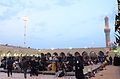
The Al-Sahlah Mosque (Arabic: مَسْجِد ٱلسَّهْلَة, romanizedMasjid as-Sahlah) is a Twelver Shi'ite mosque and shrine, located in the city of Kufa, in the Najaf Governorate of Iraq. The mosque is of great importance to Twelver Shia Muslims, and it is believed that the mosque was initially established in Kufa as a neighborhood mosque for the followers of Ali, the early members of the Shia.[2] The mosque is also said to be the future home of the Twelfth Shia Imam, Hujjat-Allah al-Mahdi.[3]: 48–50 

Key Information

History

[edit]

The mosque is believed to have been established during the 7th century CE. It has been reconstructured many times in the intervening years, including in 750 AH (1349/1350 CE), in the later part of the 20th century, and between 2011 and 2018.[1][4][5] A new sahn, named "The Sahn of Sayyidah Nargis", was opened to the public in July 2013.[6]

Significance

[edit]

The mosque is revered from narrations according to Twelver belief. These beliefs include that the mosque is where the twelfth Imam, Hujjat-Allah al-Mahdi, will reside upon his return.[3]: 48–50  It is also believed that the mosque served as a home for the Prophets and figures in Islam: Ibrahim (Abraham), Idris (Enoch), and Khidr.[3]: 48–50  Every Prophet is said to have established prayers within the mosque.[3]: 48–50  The establishment of two Rakats of Islamic Prayer in the mosque is believed to grant a person safety and protection for an entire year.[3]: 48–50  It is believed that the trumpet announcing the Day of Judgement will be blown from the mosque.[3]: 48–50  Seventy thousand people will be resurrected at the mosque, according to narrations and Twelver beliefs, and can enter Heaven without questioning.[3]: 48–50  The first Shia Imam, Ali ibn Abi Talib has also stated that, "No anguished person goes to this mosque, prays in it, and supplicates to God, without God relieving him of his grief and granting him his request."[3]: 53 

Shrines

[edit]

The mosque is believed to contain seven shrines of Twelver prophets and imams, namely:[5]

  1. Imam Ja'afar Bin Mohammad As-Sadiq, in the middle of the mosque
  2. Prophet Abraham, in the northwest corner of the mosque
  3. Prophet Edris, in the southwest corner of the mosque
  4. Prophet Al-Kidher, in the corner between the southern and the eastern sides
  5. Prophet As-saleheen, or Salih Prophet's shrine, in the corner of the northern and the eastern sides; to the right of the main entrance of the mosque
  6. Imam Zain Al-Abedeen and Ali Bin Al-Hussein, in the middle of the mosque
  7. Imam Muhammad Al-Mahdi, the 12th Imam, in the middle of the southern side (future home).
[edit]

See also

[edit]

References

[edit]

Further reading

[edit]
[edit]
Revisions and contributorsEdit on WikipediaRead on Wikipedia
from Grokipedia
The Al-Sahlah Mosque (Arabic: مَسْجِد ٱلسَّهْلَة, Masjid al-Sahlah), also known historically as Al-Zafar Mosque, is a revered Shia Islamic mosque situated in the ancient city of Kufa, Iraq, approximately 2 kilometers northwest of the Great Mosque of Kufa and 10 kilometers from the Imam Ali Shrine in Najaf. Constructed in the 7th century CE during the era of Imam Ali ibn Abi Talib, it ranks as the second oldest mosque in Kufa after the Great Mosque and was originally built by the Banu Zafar tribe, a clan of the Ansar, on a site believed to have been a residence for prophets such as Ibrahim (Abraham), Idris, and al-Khidr. Of profound religious importance in Shia tradition, the mosque is associated with several Imams, including Zayn al-Abidin, Ja’far al-Sadiq, and , whose shrines are housed within its premises, alongside those of the aforementioned prophets; it is particularly venerated as the prophesied future abode of Imam Muhammad al-Mahdi, the twelfth Imam, upon his reappearance to establish divine justice. Medieval Shi’i texts elevate its sanctity, integrating it into the broader fada'il al-Kufa (virtues of Kufa) literature that portrays — and by extension al-Sahlah—as a holy center rivaling , , and in early Islamic and Shi’i thought, with traditions emphasizing its role in eschatological events and spiritual rewards such as extended life through . The site draws pilgrims for its historical ties to early , including its function as a gathering place for ’s followers, and continues to serve as a key destination in , contributing to local economic and . Architecturally, the mosque features a large rectangular layout spanning approximately 140 meters by 125 meters (17,500 square meters), with high walls (22 meters tall) punctuated by semicircular towers, multiple entrances (up to 17), and a prominent minaret rebuilt in 1958; its interior includes an open courtyard, a deep well, various mihrabs, and a modern domed chamber adorned with colorful faience tiles. In June 2024, a new structure for the Mihrab of Imam al-Hujjah was inaugurated, coinciding with Eid al-Ghadeer. Over centuries, it has undergone expansions and renovations, including a major rebuild in the late 14th century and a comprehensive redesign from 2011 to 2018 by architects Shubber Falah and Wael Ajam, which preserved historical elements while enhancing its sacred ambiance at a cost of about $8.2 million USD. These developments underscore its enduring role as a spiritual and architectural landmark in Iraqi heritage.

Location and Overview

Geographical Position

The Al-Sahlah Mosque is situated in the city of , within the of central . Its exact coordinates are 32°2′20″N 44°22′47″E. As part of Kufa's urban fabric, the mosque lies approximately 10 kilometers northeast of and about 170 kilometers south of , integrated into the historic core of the city along its ancient street grid. It is positioned near the River, specifically on the Hindiyyah branch, which historically shaped Kufa's development as a riverside settlement. The surrounding landscape features the arid desert environment typical of southern , characterized by hot, dry lowlands with minimal vegetation and frequent dust storms that pose ongoing preservation challenges for structures like the mosque. This harsh has influenced the use of durable local materials, such as baked brick and , in traditional Iraqi to withstand erosion and extreme temperatures. The mosque is roughly two kilometers northwest of the nearby . Accessibility to the site is facilitated by its proximity to major highways, including the route connecting to , allowing easy vehicular access from both cities via well-maintained roads through the urban expanse.

Role in Kufa

was founded in 638 CE (17 AH) as a military garrison town by Caliph ibn al-Khattab, under the command of , following victories at the battles of al-Qadisiyyah and Jalula, and strategically located on the western bank of the near al-Hira to accommodate Arab settlers organized into tribal groups. Over time, evolved into a prominent center of Shia scholarship and intellectual activity, particularly after Imam Ali's relocation there in 656 CE (36 AH), where it served as the stage for key Shi'i events such as the battles of al-Jamal and Siffin, fostering a population with strong pro-Shia inclinations due to its diverse demographic of , , and companions of the Prophet . The Al-Sahlah Mosque is situated within the old city of , approximately two kilometers northwest of the , enhancing the area's status as a major pilgrimage hub for Shia Muslims due to its deep religious associations and proximity to other historic sites. This positioning integrates the mosque into Kufa's urban fabric, where it has functioned as a since the earliest days of , serving the local community as a venue for daily prayers while also accommodating its role as a visited by devotees. The influx of pilgrims to the Al-Sahlah Mosque significantly contributes to Kufa's local economy by stimulating trade in religious artifacts, accommodation, and related services, with at sites like the mosque and the generating substantial economic benefits and supporting community sustainability through coordinated local and governmental efforts.

History

Early Establishment

The Al-Sahlah Mosque was established in the CE, shortly after the founding of as a Muslim in 638 CE under the of . Located in the Sahlah neighborhood approximately two kilometers northwest of the , it originated as a simple hall constructed by the Banu Zafar , a of the Ansar, among the early Muslim settlers. This initial structure served primarily as a local congregational site for worship and community gatherings in the burgeoning Islamic urban center. Historical accounts link the mosque's early development to the period of 's residence in from 656 to 661 CE, during which it functioned as a key gathering place for his Shi'a followers (Shi'at ). Narrations describe 's visits to the site, emphasizing its role in fostering early Shi'i devotional practices amid the political and religious tensions of the time. The location may have been built upon pre-Islamic sites of significance, with traditions associating it with the residences or prayer spots of prophetic figures such as Abraham, Idris (), and al-Khidr, transforming a potentially ancient sacred area into an Islamic holy space. The first documented rebuild of the mosque occurred in the first century AH (7th century CE), when it was enlarged to accommodate growing congregations. These modifications included structural enhancements to the prayer hall, reflecting the mosque's increasing prominence as a neighborhood mosque (masjid al-hara) within Kufa's tribal quarters.

Reconstructions and Renovations

The Al-Sahlah Mosque, originally established in the early as a basic prayer space, has undergone multiple reconstructions and renovations to preserve its structure and accommodate growing religious use. During the Ilkhanid period and its lingering influence in the late 13th and 14th centuries, the mosque was substantially rebuilt, marking a significant phase of expansion that enhanced its capacity for worshippers. It was further reconstructed in 1767 CE (1181 AH) by Bahr al-Ulum, particularly for the shrine associated with Imam Muhammad al-. The was reconstructed in 1967 CE, featuring an inscription noting the work. In recent decades, the has seen thorough rebuilding efforts, including the incorporation of adjacent historical structures like Khan al-Zuwwar and the addition of modern tiled portals on its western side. A comprehensive overhaul from 2011 to 2018, designed by architects Shubber Falah and Wael Ajam following initial planning in 2006 and revisions in 2009, cost an estimated US$8,224,000 and focused on site expansion while respecting sacred traditions. These modern renovations employed traditional Islamic tiles to maintain aesthetic and cultural integrity.

Architecture

Overall Layout

The Al-Sahlah Mosque features a rectangular overall layout measuring 140 meters in length by 125 meters in width, encompassing a total area of 17,500 square meters. This expansive design centers around a large open known as the sahn, which serves as the primary gathering area for worshippers. The measures 125 meters by 140 meters and is surrounded by 22-meter-high walls punctuated by semicircular towers on all four sides. At the southern end of the prayer hall, the is prominently oriented toward , marking the direction in accordance with Islamic architectural conventions; multiple mihrabs are present in the . The mosque's grounds are fully enclosed, incorporating auxiliary buildings dedicated to accommodating pilgrims, such as rest areas and ablution facilities, alongside administrative offices for managing site operations and visitors. The entire complex is aligned with the axis, ensuring proper ritual orientation, and features up to 17 entrances, with the main gate on the eastern side. A deep well is located within the interior. These expansions were notably enhanced during the 2011–2018 renovation, which rebuilt core structures while preserving the traditional layout.

Key Structural Features

The Al-Sahlah Mosque is distinguished by its modern domed chamber, which crowns a main area and is adorned with colorful tiles. This dome serves as a focal point for worshippers and pilgrims, evoking spiritual elevation and divine presence. Located on the eastern wall adjacent to the main entrance is one , approximately 30 meters tall, rebuilt in 1958 to enhance the mosque's silhouette against the skyline. This tower facilitates the mu'adhdhin's , resonating across the surrounding urban landscape and underscoring the mosque's role as a communal spiritual hub. The mosque's decorations feature intricate tilework in and gold, adorned with Quranic verses that line the walls and arches, creating a visually immersive environment for reflection. The is paved with polished floors, providing a serene open space for gatherings and ablutions amid the mosque's expansive layout. The structure reflects traditional Islamic architectural elements, with modern reinforcements incorporated during the 2011–2018 expansions to include seismic-resistant materials safeguarding the site against earthquakes in the region.

Religious Significance

Ties to

In , Al-Sahlah Mosque is revered for its central role in eschatological beliefs, particularly as the anticipated residence of the Twelfth , , following his reappearance (zuhoor). This association underscores the mosque's position as a pivotal site in the establishment of divine justice at the end of times, where the is expected to base his . Key narrations from Imam Ja'far al-Sadiq emphasize the mosque's end-times significance. In one recorded in al-Kafi, he states: "That is the house of our Sahib (Hadrat al-Mahdi); there will be a time when he will stay there with his family," portraying Al-Sahlah as the Imam's familial abode during his uprising. Another narration from the same source describes a visionary scene: "It is as if I can see the Qa’im of ’s Progeny along with his family descending upon the Sahlah Mosque," linking it directly to the Imam's arrival and prophetic legacy, as no prophet was appointed without praying there. These traditions, drawn from authoritative Shia collections like al-Kafi and , affirm the mosque's doctrinal primacy in Mahdist theology. Al-Sahlah integrates deeply into Twelver Shia rituals as a dedicated site for supplications hastening al-Mahdi's return. Devotees perform specific acts of worship (a'mal), including two-unit prayers and recitations like al-Faraj, especially on Tuesday nights or during , believing these invocations at the mosque invoke the 's intercession and accelerate zuhoor. Such practices draw from traditions where scholars have reportedly witnessed the praying there, reinforcing its role in communal pleas for relief from . Theologically, Al-Sahlah's status as one of the earliest mosques tied to Imam al-Mahdi—originating in the 7th century during the formative period of Shia thought—amplifies its sanctity, positioning it as a timeless beacon of hope and continuity in Twelver doctrine.

Prophetic and Miraculous Associations

The Al-Sahlah Mosque holds profound prophetic associations in Islamic tradition, particularly within Twelver Shiism, as a site linked to several biblical prophets. It is believed to have served as the residence and place of worship for Prophet Ibrahim (Abraham), who resided there and from which he set out to fight giants in Yemen. Similarly, Prophet Idris (Enoch) is said to have lived in the mosque, where he engaged in sewing clothes and worship, marking it as a center for his teachings and devotion. Prophet al-Khidr is also associated with the site, where traditions recount his encounters and residence, including the location of the rock near which he appeared to Prophet Musa (Moses). Miraculous beliefs further elevate the mosque's sanctity, including the presence of a green rock embedded in its structure that bears the images of all prophets and the clay from which they were created, as narrated by Imam Ja'far al-Sadiq. Key narrations from Imam Ali emphasize the mosque's spiritual efficacy in prayer. Another narration from Imam Ali states that such prayers in the mosque provide protection equivalent to a year's safeguard from harm. Imam Ja'far al-Sadiq further elaborated that supplications offered there between Maghrib and Isha prayers bring relief to the distressed. Annual traditions reinforce these apocalyptic ties, such as the practice of visiting the every Tuesday night for forty consecutive weeks, based on a prophetic narration promising a vision of al-Mahdi, who is expected to reappear and establish justice from this site as his future residence. These commemorations, often involving collective prayers and supplications, connect the mosque to end-times events like the Imam's descent with his family.

Shrines and Tombs

Enumerated Shrines

The Al-Sahlah Mosque complex houses several shrines dedicated to prophets and Shia Imams, integrated into its architectural framework without disrupting the primary prayer areas. These sites, revered in , are believed to mark locations of historical residence, prayer, or symbolic presence, drawing from prophetic traditions and narrations. The seven primary shrines are distributed across the mosque's central areas, walls, and courtyards, emphasizing the site's sanctity as a nexus of divine figures, though traditions vary on exact locations and inclusions. The central shrine is dedicated to Imam Ja’far al-Sadiq, the sixth Shia , located in the middle of the mosque. This tomb serves as a focal point for , where the Imam is said to have frequently prayed. The shrine of Prophet Ibrahim (Abraham) is situated in the northwest corner, marking his former residence in the structure. It is associated with the prophet's campaigns, including the starting point for his confrontation with the Amalekites in . The maqam of Prophet Yunus (Jonah) is located in the southwestern part of the mosque, between the southern and western walls, according to some traditions. Prophet Idris ()'s shrine occupies the northeast area, between the eastern and northern walls (also known as Bayt al-Khidr), identified as his former house within the mosque's historical layout. Traditions hold that the site functioned as a for early prophets like him. The of al-Khidr is positioned at the corner between the southern and eastern sides, commemorating his prophetic activities at the location. It is linked to narratives of divine encounters, including his meeting with . A collective known as that of As-Saliheen (the righteous ones), associated with , stands at the corner of the northern and eastern sides, to the right of the main entrance. This site honors the prophet's role in divine missions, serving as a symbolic marker for the righteous predecessors. The of Imam Zayn al-Abidin (Ali ibn Husayn), the fourth Shia , is located in the middle of the mosque, behind the shrine of Imam al-Sadiq and near the prayer hall. It underscores the Imam's devotional legacy in the site's sacred geography. A dedicated to Imam Ali al-Hadi, the tenth Shia , is enclosed within the mosque grounds. The symbolic maqam of Imam Muhammad al-, the twelfth Shia Imam, is positioned in the middle of the southern side, facing the , making it the largest among the shrines. This site represents his anticipated future presence and residence upon reappearance, as per eschatological traditions in . It was reconstructed in 1181 AH (1767 CE) by Muhammad Mahdi Bahr al-Ulum. These shrines are seamlessly incorporated into the mosque's walls, corners, and open courtyards, preserving the integrity of the main space while enhancing the complex's spiritual depth.

Pilgrimage Practices

to Al-Sahlah Mosque engage in daily rituals centered on supplicatory s and recitations seeking divine protection and , often performed between the Maghrib and Isha s. Upon entering, visitors typically offer a two-rakat followed by reciting Ayah al-Kursi once, al-Falaq and al-Nas seven times each, and concluding with seven recitations of "Subhan Allah, wal Hamdu Lillah, wa la ilaha illallah, wallahu akbar" to shield against worldly afflictions and hardships. At specific sacred locations within the mosque, such as the site linked to Prophet Khizr on the eastern side, pilgrims perform another two-rakat and recite a targeted invoking : "O , I beseech You by the right of this place and those who are in it, to grant my request and respond to my supplication," believed to ensure the fulfillment of needs and relief from distress. These practices, drawn from established Shia traditions, emphasize spiritual safeguarding and connection to prophetic legacies. Pilgrimage activity intensifies during Arba'een and Ramadan, drawing substantial crowds to the mosque amid regional devotional fervor. Arba'een, marking the 40th day after , sees thousands of pilgrims passing through en route to , where large mourning gatherings occur at Al-Sahlah, including processions and recitations honoring Imam Husayn. In 2025, over 21 million participated in the broader Arba'een events across , with the al-Abbas Holy Shrine reporting 21,103,524 visitors. During Ramadan, the mosque hosts heightened nightly prayers and communal worship, as seen in gatherings for and recitations, amplifying the site's role in fasting observances. Key customs include circumambulating the shrines in a devotional circuit, offering nadhr (vows) for blessings, and sharing communal to build . Pilgrims often circle the seven enumerated shrines in a tawaf-like manner, reciting and personal intentions to honor the site's holy figures. Nadhr involves pledging acts of or charity in exchange for , commonly fulfilled through additional prayers at the mosque. During , organized meals unite visitors in breaking the fast, reinforcing themes of charity and community as per Shia . Modern enhancements, such as dedicated pilgrim rest areas established around 2013, provide respite and include guides who elucidate these traditions for newcomers. Post-2018 security measures, including coordinated checkpoints and by Iraqi authorities, ensure safer access during peak events to mitigate risks from large assemblies.

References

Add your contribution
Related Hubs
User Avatar
No comments yet.