Hubbry Logo
Sat-IPSat-IPMain
Open search
Sat-IP
Community hub
Sat-IP
logo
8 pages, 0 posts
0 subscribers
Be the first to start a discussion here.
Sat-IP
Sat-IP
from Wikipedia
The SAT>IP logo
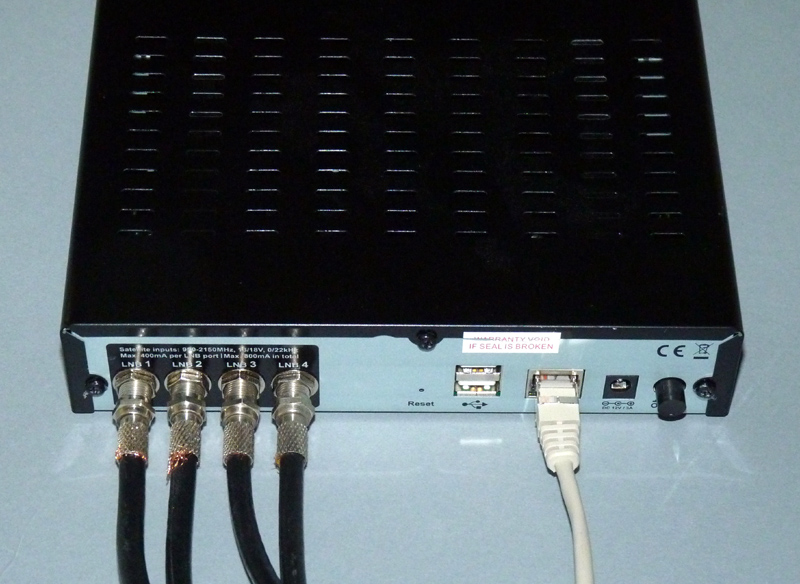
Example of a SAT>IP server: Telestar R1 A connecting to four satellite LNB feeds and an Ethernet connection to distribute satellite TV programs around the network.
SAT>IP reception over a Wi-Fi home network from a Telestar R1 server and fixed dish on a Nexus 7 Android tablet using Elgato SAT>IP app.

SAT>IP (or Sat-IP) specifies an IP-based client–server communication protocol for a TV gateway in which SAT>IP servers, connected to one or more DVB broadcast sources, send the program selected and requested by an SAT>IP client over an IP-based local area network in either unicast for the one requesting client or multicast in one datastream for several SAT>IP clients.[1]

While the system, originating from the DBS satellite operator SES, is originally geared towards receiving and distributing satellite broadcasts in DVB-S or DVB-S2 encoding, SAT>IP also specifies formats for the SAT>IP client request to specify programs broadcast via DVB-C[1]: AppendixD  and DVB-T.[1]: AppendixC 

Only the SAT>IP servers need tuning hardware and software specific to the DVB-broadcast system(s) being used; SAT>IP clients can be any IP-enabled client multimedia device – Tablets, PCs, laptops, Smartphones, “connected” TVs, video game consoles, media players or others.[2]

The main difference of SAT>IP to other IP-based multi-media distribution systems such as IP-TV and DLNA is that the SAT>IP client does not select a program from a server specific list, but has to specify the DVB reception parameters such as the signal source (typically the satellite number in a DiSEqC switch), frequency, polarisation, Modulation system and type, the wanted PIDs and others.[1]: Chap.3.5.10  The SAT>IP client would rely for this on an Extended M3U Channel list.[1]: p.60, 62 [3]

The SAT>IP protocol is standardized as CENELEC EN50585.[4][5]

History

[edit]

SES unveiled and demonstrated SAT>IP at the fifth annual SES Industry Days conference 2012, showing the distribution of satellite programmes over CAT5 Ethernet, Power Line, plastic optical fibre and WiFi networks.[6] The first devices implementing the SAT>IP protocol became available in 2012.

In February 2021 the alliance announced it was putting activities on hold.[7] As of July 2024 the official SAT>IP website has gone offline along with its services providing metadata to SAT>IP clients.

Overview

[edit]

SAT>IP is particularly aimed at satellite TV distribution in the home but can be applied to large multi-dwelling and hospitality reception systems too.

Conventional satellite TV reception systems convert the received transmissions to an intermediate frequency (IF) for distribution via dedicated coaxial cables to one or more satellite tuners and demodulators in set-top boxes. SAT>IP allows the satellite TV distribution to share a data network and enables display and viewing of the signals on any multimedia IP device equipped with suitable software. Multiple SAT>IP servers and clients can operate on the same network with both free-to-air and encrypted pay-TV transmissions.

The intention of the SAT>IP Project is to make SAT>IP an international standard that can be widely implemented worldwide and compatible across manufacturers and operators.

The SAT>IP protocol was developed jointly by the SAT>IP Project partners, satellite operator SES, UK broadcaster BSkyB, and Danish TV software company Craftwork.[8] Prototype SAT>IP equipment and the first certified SAT>IP converter was developed by Inverto Digital Labs, a Luxembourg-based Set Top Box and software designer.[9] SAT>IP is a license free technology available to all manufacturers.[10]

SAT>IP Alliance

[edit]

In April 2015, at the Las Vegas NAB Show, six satellite operators and equipment manufacturers announced the formation of the SAT>IP Alliance, a coalition to develop compatible hardware and software for SAT>IP technology. At this time, the SAT>IP Alliance founding members were SES, Hispasat, Panasonic, Nagra, ALi Corporation, and MaxLinear.[11]

In September 2015, Eutelsat joined the SAT>IP Alliance as a founder member and the third satellite operator.[12] In May 2017 Irdeto and Verimatrix joined.[13] As of April 2019, the SAT>IP Alliance members are:[14]

The SAT>IP Alliance's declared aim is to an open, non-profit industry alliance to promote and further develop SAT>IP.[15]

In September 2017, the DVB consortium of broadcasters, manufacturers, network operators, software developers, and regulators announced an agreement with the SAT>IP Alliance on the future development of the SAT>IP specification and that future promotion of the technology will be conducted jointly, allowing the overall DVB community to contribute to SAT>IP features and services.[5][16]

In February 2021 the SAT>IP Alliance announced that as the SAT>IP technology is well established and technical development now forms part of the DVB Home Broadcasting Standard, it has "put its activities on hold", although the SAT>IP Alliance website would remain open as an information resource for manufacturers and operators.[17]

SAT>IP server

[edit]
The Telestar B1 client receiver displays SAT>IP channels from a SAT>IP server as well as acting as a media player for data from the USB and SD sockets in the side of the unit.
The rear panel of the Telestar B1 client receiver showing the HDMI, S/PDIF, and AV jack outputs, USB for PVR recording and the Ethernet connection to the IP network.

The SAT>IP server removes the RF tuner and demodulator from the client device, providing their functions as a common resource of the IP network. The server will typically contain two or more tuners to serve several clients with different channels simultaneously. It converts the satellite TV signals to IP in their broadcast quality, transparently without any transcoding, effectively removing the DVB-S/S2 layer and replacing it with an IP transport layer.[2]

This process can happen in a master STB (even as an addition to conventional receiver operation), in a distribution device analogous to an IF multiswitch positioned close to the antenna, or even at the antenna itself in the LNB (an IP-LNB).

SAT>IP protocol

[edit]

Converted to IP, the satellite TV signals can be distributed over any IP network, depending on the configuration of the server, using wired Ethernet, wireless (WLAN, 4G), “Power Line” home networks, optical fibre, plastic fibre, coax, twisted pair (xDSL) or visible light technologies.[2] The SAT>IP protocol is independent of manufacturers and was developed to enable SAT>IP client devices to communicate with SAT>IP servers.

SAT>IP protocol is a remote tuner protocol based on existing protocols such as IP, UPnP, RTSP, HTTP, which have been complemented with extensions for satellite TV where necessary.

The SAT>IP protocol is split into a media plane and a control plane. In the media plane, the SAT>IP server produces media streams in industry standard unicast or multicast RTP/UDP.[2]

In the control plane, clients request access to satellites, transponders and MPEG streams using RTSP or HTTP. Only those transport stream packages needed for the TV transmission requested are carried over the IP network.

The full protocol description (v1.2.2) is publicly available at SAT>IP Protocol.

Encrypted pay-TV transmission

[edit]

The SAT>IP protocol doesn't provide any specific support for encrypted services. The specification only targets the tuner, and how to access to DVB streams over the network. So if the client wants access to encrypted feeds, it needs to have the correct support for them. This is easy when the client is a device with CAS/CAM hardware support (like a television or set-top-box), but it's unclear how to do it in a PC, mobile or tablet.

Products

[edit]

Two categories of SAT>IP products exist: SAT>IP clients and servers.

SAT>IP clients

[edit]

Software applications to use computers and display devices as SAT>IP clients have been produced by a number of companies.

  • DVBViewer.com:

DVBViewer Pro is a digital TV viewer and recorder software application for Windows PCs which has been extended to use SAT>IP. The SAT>IP Viewer Android app is available and DVBViewer also produces an Android app for SAT>IP dish alignment, combining a dish angle calculator and signal strength/quality meter.

  • Elgato:
The Android Elgato SAT>IP app running on a Nexus 7 receiving channels and EPG data from a Telesar R1 SAT>IP server.

Elgato Systems produces an app for Android tablets and phones, and an iOS app for iPad and iPhone as a SAT>IP client.[18]

  • Tara Systems

The Inaris SAT>IP viewer is available as an app for both Android and iOS devices.

  • tivizen:

The tvizen SAT>IP app is available free of charge for Android devices.

SAT>IP servers

[edit]
  • Inverto:

The first certified SAT>IP equipment to be produced for commercial sale was the IDL400S Multibox server from Inverto. The Linux-based Multibox can tune to four satellite signals and stream selected TV/Radio programs to four users' tablets, smart phones, smart TVs, game consoles or connected video devices over a wired and/or wireless home network.[19]

Clients supported by IDL400S Multibox includes iOS and Android Tablets and Smart phones, UPnP/DLNA compliant connected media players and video streamers (e.g. Xtreamer, Boxee), UPnP/DLNA compliant Smart TVs (e.g. Sony, Samsung, Loewe, Philips, LG), PC client (Windows Media Player, VLC player, TVersity, XBMC or Boxee), Connected game consoles, Proprietary Inverto clients (Volksbox Essential, Volksbox 2, Volksbox Movie) and others SAT>IP compliant Clients.

  • Zinwell:

The Zinwell ZIM-1800 SAT>IP switch/server is the second to be certified to the new standard. The ZIM-1800 offers an opportunity for portable and IP device users to watch rich satellite programmes on their favourite devices, such as iPads, iPhones, Android tablets, smartphones, laptops, smart TVs or any networking devices. The installation and distribution cost can also be significantly reduced by using the Multicast and Unicast features in SMATV systems in hotels and flats.[20]

  • Triax:

TSS400 server[21]

  • GSS:

DSI400 server[22]

  • Schwaiger:

MS41IP server and DSR41IP client receiver[23]

  • Telestar:

Digibit R1 server and Digibit B1 client receiver[24]

  • Blankom:

SIA-108 professional headend streamer[25]

  • Digital Devices:

Servers producing SAT>IP compatible output over a connected network from cable (DVB-C) and digital terrestrial (DVB-T) tuners have been developed by Digital Devices.[26]

  • Minisatip

Minisatip is an open source software implementing a SAT>IP server application that runs under Linux. It was tested with DVB-S, DVB-S2, DVB-T, DVB-T2, DVB-C, DVB-C2, ATSC DVB cards.

  • SatPI:

SatPI is an open source project that implements a SAT>IP server application that runs under Linux. It currently supports DVB-S/S2/T/C cards.

IP-LNB active head for satellite dish

[edit]

In April 2013, SES announced the development by Inverto, Abilis and MaxLinear Inc of a prototype SAT>IP LNB (IP-LNB), which was demonstrated at a conference held at SES' headquarters in Luxembourg. The IP-LNB incorporates eight-channel satellite-to-IP bridging technology to deliver eight concurrent channels via IP unicast or multicast to fixed and portable client devices. By combining satellite reception and IP bridging at the dish, the IP-LNB enables satellite content distribution to the home over a single Ethernet cable, which carries both the IP TV and power for the LNB through Power over Ethernet (PoE) technology, reducing the overall system cost and power consumption. As of July 2012, the prototype IP-LNB was being developed into a commercial product.[27]

In September 2013 at the International Broadcasting Convention in Amsterdam, SES demonstrated a prototype IP-LNB, that is a SAT>IP server integrated into an LNB that can deliver eight concurrent HD channels via IP unicast or multicast from its Ethernet output.[28] In June 2015, Triax launched its IP-LNB, providing eight channels in SAT>IP protocol on a single Ethernet cable, powered over that same cable through Power over Ethernet (PoE) technology.[29]

In May 2015, Korean company I DO IT produced the first flat plate antenna with a built-in SAT>IP server. The Selfsat>IP antenna is 566 mm × 300 mm in size and includes two conventional LNB outputs and an Ethernet output to stream eight different satellite channels around a home network.[30]

Industry support

[edit]

The SAT>IP website recognises the following companies as supporters of the SAT>IP standard:[31]

See also

[edit]

References

[edit]
[edit]
Revisions and contributorsEdit on WikipediaRead on Wikipedia
from Grokipedia
SAT>IP (Satellite over ) is an open-standard communications protocol that enables the conversion and distribution of satellite broadcast signals, such as DVB-S/S2 television feeds, into IP-based streams for delivery over local networks like Ethernet or , allowing multiple IP-enabled devices to access live content without requiring traditional cabling or connectivity. Developed collaboratively by satellite operator SES, broadcaster BSkyB, and technology firm Craftwork in the early 2010s, SAT>IP was formalized as a license-free, manufacturer-independent standard under CENELEC EN 50585 in 2014 to bridge traditional satellite reception with the rise of IP-connected households. The protocol gained broader industry support through the formation of the SAT>IP Alliance in 2015, which at its peak included major players like Eutelsat, Panasonic, and over 40 manufacturers, covering more than 95% of the global satellite market and enabling compatibility across over 100 products. The alliance placed its activities on hold in 2021 as the technology became well-established, with further development shifting to the DVB Project; its official website went offline by 2024. In 2017, the Digital Video Broadcasting (DVB) Project established a formal liaison with the SAT>IP Alliance to integrate and extend the technology, incorporating support for additional broadcast standards like DVB-C2 and DVB-T2 while maintaining backward compatibility with existing SAT>IP implementations. At its core, SAT>IP operates via a client-server model where SAT>IP servers—typically integrated into low-noise block downconverters (LNBs), multiswitches, or set-top boxes—receive radio frequency (RF) signals from a satellite dish and transcode them into IP packets using protocols like RTP over UDP for media transport and RTSP for control signaling. Clients, such as smart TVs, tablets, smartphones, or media players running SAT>IP-compatible software, discover available servers via SSDP (Simple Service Discovery Protocol) on the local network and request specific transponders or channels, receiving unicast streams for individual viewing or multicast for efficient shared distribution to up to eight simultaneous devices. This setup preserves the original broadcast quality, including support for high-definition, 4K UHD, free-to-air, and encrypted pay-TV content with conditional access systems (CAS) or digital rights management (DRM), while minimizing latency and bandwidth usage on home networks. The technology addresses key challenges in modern TV distribution by eliminating the need for extensive wiring in multi-room setups, enabling seamless multi-screen experiences in bandwidth-constrained environments, and facilitating personalized subscriptions for pay- operators without relying on external . Primarily adopted in for residential and applications, SAT>IP enhances viewer flexibility—such as watching on mobile devices within a home or —while allowing broadcasters to monetize premium content across diverse platforms and reach over 1 billion potential viewers globally. Extensions through integrations have further evolved the technology as of 2025, including its incorporation into Home standards and the DVB-NIP (Native IP ) specification for end-to-end IP-based delivery over and terrestrial networks, supporting hybrid broadcast- services and deployments like Eutelsat's Sat.tv Connect in 2024.

Introduction and Overview

Definition and Core Functionality

Sat-IP is an IP-based client-server communication protocol designed for distributing satellite, cable, or terrestrial television signals compliant with DVB-S/S2, DVB-C, or DVB-T standards over Ethernet/IP networks within homes or buildings. It enables the transposition of radio frequency (RF) signals, such as those in the satellite intermediate frequency (SAT-IF) range, into IP-compatible formats, allowing access by devices without built-in broadcast tuners. At its core, a Sat-IP server—typically a device with tuners connected to an antenna, LNB () for reception, or cable/terrestrial inputs—captures RF signals and converts them into IP or streams for transmission over the local network. Clients, such as televisions, set-top boxes, or software applications on mobile devices, discover available servers and request specific content by specifying parameters including the orbital position, frequency, polarization, and for signals, or equivalent tuning details for cable or terrestrial broadcasts. This process facilitates multi-device access to broadcast content without requiring traditional cabling throughout the premises. The protocol integrates established standards for seamless operation: UPnP AV (Universal Plug and Play Audio/Video) for automatic device discovery and control point-client interactions, RTSP (Real Time Streaming Protocol) for session management including setup, playback, and teardown of streams, and RTP (Real-time Transport Protocol) or HTTP for the actual media transport. In a typical workflow, an antenna or LNB feeds the RF signal to the Sat-IP server, which processes and encodes it into IP packets; these are then distributed via the IP network to multiple clients that decode and render the streams independently. The SAT>IP Alliance oversees the standardization of this protocol to ensure interoperability.

Benefits and Use Cases

SAT>IP offers several key advantages over traditional satellite distribution methods, primarily by converting DVB-S/S2 signals to IP packets directly at the reception point, such as in an IP-LNB or server, which eliminates the need for extensive cabling and enables distribution over existing IP networks like or Ethernet. This shift allows for wireless transmission of high-quality satellite content to multiple rooms and devices simultaneously, bypassing the limitations of signal splitters and degradation associated with conventional RF splitting. As a result, installation costs are significantly reduced through simplified infrastructure, with no requirement for additional wiring or multiple dedicated tuners per device. Furthermore, SAT>IP integrates seamlessly with home networks, supporting multi-room viewing on compatible IP-enabled devices without compromising broadcast quality or overloading connections. In residential use cases, SAT>IP enhances home entertainment by enabling simultaneous streaming of live TV to various screens, including TVs, smartphones, tablets, and laptops, allowing family members to watch different programs independently across the household. For multi-dwelling units (MDUs) such as apartments, it facilitates centralized satellite headends that distribute content efficiently to numerous units via a single IP , simplifying management and maintenance for property operators. In settings like hotels, SAT>IP supports uniform TV distribution to guest rooms, enabling high-definition viewing on in-room TVs or personal devices while reducing visible cabling for a cleaner aesthetic and supporting personalized content access. Additionally, it serves as a hybrid solution for cord-cutters by integrating feeds with IPTV systems, combining reliable live broadcasts with on-demand streaming over the same network. SAT>IP demonstrates strong scalability, with multiple servers and clients able to coexist on a single network in mode, efficiently delivering streams to dozens of devices while maintaining low latency essential for live applications. Regarding energy efficiency, IP-LNBs consolidate multiple tuner functions into a single unit powered over the existing cable, potentially lowering overall power consumption compared to traditional setups requiring separate set-top boxes for each viewing location. This plug-and-play approach further contributes to reduced energy use by streamlining hardware needs without sacrificing performance.

History and Development

Origins and Early Adoption

Sat-IP emerged as a response to the evolving demands of home entertainment in the early , particularly the shift toward multi-screen ecosystems fueled by the proliferation of smart TVs, tablets, and mobile devices. The collaboration between SES, BSkyB (), and Craftwork began in early 2010 to develop the protocol. It was driven by the need to distribute high-quality satellite TV signals over IP networks, enabling seamless access across multiple devices without traditional RF cabling constraints. This innovation addressed the limitations of conventional distribution systems, which struggled with signal degradation over distance and the increasing bandwidth requirements of emerging content formats. The protocol was formalized as the license-free standard CENELEC EN 50585 in 2014. SES Astra unveiled Sat-IP on April 27, 2012, during the annual SES Industry Days conference in , positioning it as a solution for IP-based TV distribution that converts DVB-S/S2 signals directly into IP streams at the point of reception. The announcement featured live demonstrations of prototypes, showcasing the protocol's ability to stream content over Ethernet cables to IP-enabled devices, marking the first public prototype showcases of the technology. This debut highlighted Sat-IP's integration with established standards, ensuring compatibility with existing satellite tuners while leveraging IP for flexible in-home delivery. Early accelerated later in with the commercial launch of the first Sat-IP-enabled devices, including Inverto's Multibox SAT>IP LNB and converter, certified by SES in as the industry's inaugural implementation. These devices enabled practical deployment by converting signals to IP at the LNB level, facilitating multi-room and multi-device viewing without additional wiring. The key enabler was the convergence of broadcasting and IP networking, which overcame RF distribution challenges in modern households, such as signal loss in multi-story homes and the need for centralized tuners. This timing aligned with the market context of surging HDTV in by and the onset of UHD content trials, which demanded bandwidth exceeding traditional coax capacities of 1 GHz, pushing satellite operators toward IP solutions for efficient scaling.

Formation and Activities of the SAT>IP Alliance

The SAT>IP Alliance was established in April 2015 as a non-profit organization headquartered in , aimed at promoting the adoption and standardization of the SAT>IP protocol for delivering satellite broadcast content over IP networks. The alliance formalized a coalition initially driven by SES to ensure compatibility across devices and networks, focusing on extending satellite broadcasting to multiscreen ecosystems. Its founding members included leading satellite operators SES and , along with manufacturers , NAGRA (now part of the Kudelski Group), , and . Subsequent additions strengthened the group's scope, with joining in September 2015, followed by Irdeto and Verimatrix in 2017. The primary objectives of the centered on developing and updating SAT>IP specifications to enhance , launching programs for compliant devices, educating industry stakeholders, and demonstrating practical implementations. Key activities included the release of specification updates to support advanced features like compatibility for higher-efficiency transmissions. In 2016, the alliance initiated its program, introducing logos for verified SAT>IP servers and clients to assure seamless integration across ecosystems. Further efforts involved high-profile demonstrations at trade shows, such as the International Broadcasting Convention (IBC), where members showcased multiscreen satellite TV delivery using SAT>IP hardware. A significant milestone came in September 2017 with a formal liaison agreement with the Project, enabling alignment on future developments for indoor broadcast distribution over IP. Alliance activities were suspended in February 2021, attributed to evolving market dynamics favoring broader IP-based standards that diminished the need for SAT>IP-specific promotion. By July 2024, the organization's website had gone offline, marking the end of its operational phase.

Technical Specifications

Protocol Mechanics

The SAT>IP protocol is defined in the CENELEC EN 50585:2014, which specifies the communication framework for forwarding satellite-delivered signals from a SAT>IP server to SAT>IP clients over IP networks. This standard builds on established protocols, including TCP/IP for reliable control messaging and UDP in conjunction with RTP for efficient media streaming. The protocol's design ensures compatibility with DVB-S/S2 satellite broadcasts by encapsulating transport stream (TS) data while abstracting physical layer details into IP-based operations. The operates through a layered approach for device discovery and session management. Discovery is handled via UPnP's (SSDP), allowing clients to locate SAT>IP servers on the local network without prior configuration. Once discovered, session setup and tuning use the (RTSP) over TCP, incorporating DVB-specific parameters such as satellite frequency (in MHz), (in Msym/s), polarization, and modulation settings including features like pilot insertion and factors. Key RTSP commands include DESCRIBE to retrieve service descriptions, SETUP to negotiate transport parameters, and PLAY to initiate tuning and streaming, with all requests formatted as RTSP URIs that embed the necessary DVB tuning information. In the media plane, satellite TS packets are encapsulated in RTP packets and transmitted over UDP, supporting both unicast for dedicated client sessions and multicast for efficient shared distribution across multiple clients. The server responds to a client's PLAY command with a Session Description Protocol (SDP) payload detailing the RTP stream attributes, such as payload type for MPEG-TS (typically 33 per RFC 3551) and port assignments, before commencing the RTP stream. This data flow enables real-time delivery of DVB-S2 modulated content, with the protocol handling parameters like frame structure and code rates to maintain signal integrity over IP. Error handling and network efficiency are addressed through integrated mechanisms. RTP supports optional Forward Error Correction (FEC) as defined in RFC 5109 to mitigate packet loss in UDP transmissions, while RTCP provides periodic feedback on stream quality, including sender and receiver reports for jitter and loss statistics. For multicast operations, bandwidth management relies on IGMP (Internet Group Management Protocol) to enable clients to join or leave multicast groups dynamically, optimizing resource use in multi-client environments. RTSP responses include standardized status codes (e.g., 200 OK for successful operations or 404 Not Found for invalid tuning parameters) to facilitate robust error recovery and session teardown via the TEARDOWN command.

Network Architecture and Components

The SAT>IP system employs a client-server architecture in which the server functions as an IP gateway that receives radio frequency (RF) satellite signals, demodulates them, and converts them into IP streams for distribution over a local network. This model allows the server to handle the initial signal processing from the satellite dish, while clients request and receive the streams without needing dedicated tuners, enabling flexible distribution to multiple devices within a home or building. The architecture supports hybrid configurations by integrating satellite inputs with other sources, such as terrestrial antennas, through multi-input servers that combine DVB-S/S2 with DVB-T/T2 signals for unified IP delivery. Core components include the SAT>IP server, which can be a standalone tuner box connected to the satellite outdoor unit (ODU) or embedded directly in the (LNB) for simplified installation, and SAT>IP clients such as set-top boxes (STBs), software applications on mobile devices, smart TVs, or media players that decode the IP streams. The network infrastructure typically involves a router or switch to manage traffic, with recommended for optimal performance, though a minimum of 100 Mbps is sufficient for high-definition (HD) streaming in small setups supporting 4-5 simultaneous streams. Servers may incorporate multiple tuners—up to 8 in common implementations—to serve multi-user households, ensuring concurrent access without bottlenecks. Integration relies on SSDP multicast for automatic discovery of servers by clients on the local network, allowing seamless detection without manual configuration. Session management coordinates tuner allocation, assigning one tuner per to prevent conflicts when multiple clients request channels from the same band, thereby optimizing resource use in shared environments. The protocol uses RTSP for basic control of stream setup and teardown. For secure deployments in multi-dwelling units (MDUs), support isolates traffic, though this depends on the underlying IP network configuration. Performance characteristics include low latency under 100 ms for live TV delivery over local IP networks, preserving near-real-time viewing comparable to traditional setups. Up to 8 tuners per server accommodate multi-user scenarios, with overall system capacity limited by network bandwidth rather than the satellite link. Prerequisites encompass IPv4 and compatibility for addressing and connectivity, along with QoS prioritization to ensure video streams receive preferential treatment over other traffic, minimizing and in congested environments.

Implementation and Products

SAT>IP Servers and Hardware

SAT>IP servers are hardware devices that convert signals into IP streams, enabling distribution over or building networks. These servers typically include tuners that receive DVB-S/S2 signals from dishes and encode them for IP transmission, supporting multiple concurrent streams to clients. Commercial implementations vary in form factor, from standalone units to integrated LNB designs, and are designed for residential or multi-dwelling applications. One common type is the standalone tuner server, such as the Inverto iLNB series, which integrates signal reception and conversion in a compact unit connected to a . These devices support universal Ku-band frequencies (10.7-12.75 GHz) and can handle up to eight DVB-S/S2 transponders simultaneously, allowing multiple users to access different channels without interference. For example, the Inverto 8-channel SAT>IP LNB with PoE adapter enables or streaming to up to eight compatible clients, with web-based management for configuration and software upgrades. Multi-tuner boxes represent another server category, offering scalability for higher user counts by incorporating multiple inputs. The Inverto IDL400S, launched in 2013, is a quad-tuner SAT>IP server that streams live SD/HD TV and radio to up to four clients concurrently, certified for interoperability by the SAT>IP Alliance. These boxes often include features like 2.0 support for motorized dish control and fallback HDMI outputs for direct TV connections, ensuring compatibility with legacy setups. IP-LNBs integrate the tuner directly into the at the dish, minimizing cabling by converting L-band signals to IP streams on-site. This design supports (PoE) for simplified installation, with power consumption under 10W, and is ideal for extending satellite reception over Ethernet networks. The Inverto iLNB series exemplifies this, providing noise figures as low as 1.3 dB and conversion gains of 40-50 dB for reliable Ku-band reception. In larger installations, active headends use IP-LNB designs to replace traditional multiswitches, converting signals at for cascaded distribution in multi-tenant buildings. The Unitron/Johansson Model 5400 SAT>IP SMATV server, certified by the SAT>IP Alliance, is a rack-mountable unit that processes inputs from up to four bands, supporting aggregate throughputs suitable for dozens of users via IP distribution. These systems ensure seamless integration with existing IP networks, with compatibility for multi- setups. All mentioned hardware undergoes verification for protocol compliance, guaranteeing interoperability with certified clients across networks. Examples like the Inverto products remain available as of 2025, with the SAT>IP having certified over 100 compatible products in recent years.

SAT>IP Clients and Software

SAT>IP clients encompass a range of devices and applications designed to receive and decode streams distributed over IP networks from compatible servers. These clients primarily support DVB-S/S2 standards, enabling users to access live TV without traditional cabling. Common types include set-top boxes such as TechniSat's DIGIT ISIO Sx series, which integrate SAT>IP functionality for networked viewing, and VU+ receivers like the VU+ Zero, featuring satellite-to-IP client support via software plugins for multiroom streaming. Smart TVs, particularly models with TV>IP support, allow direct integration of SAT>IP streams into the home entertainment system. Mobile apps further extend accessibility, with options like the EyeTV app for devices turning smartphones and tablets into portable viewers. Software features in SAT>IP clients emphasize ease of use and integration with home networks. Channel scanning typically occurs through automatic server discovery protocols, allowing clients to detect available SAT>IP servers and populate channel lists dynamically. (EPG) integration pulls scheduling data from the server, providing users with searchable and filterable program information. Recording capabilities are supported via RTSP-based pausing and functions, enabling users to capture content on demand or schedule recordings remotely. Playback focuses on efficient decoding of H.264/AVC video streams, ensuring smooth rendering of high-definition satellite broadcasts on various devices. Compatibility is a core aspect of SAT>IP clients, requiring (UPnP) for seamless device discovery and network integration. Clients handle unicast streams for individual users, delivering personalized content with low latency, while options support group viewing across multiple devices without bandwidth duplication. Many applications are free to download or bundled with hardware, such as the EyeTV app, which operates without additional costs beyond the server setup. This design promotes broad adoption in home networks, though support is generally limited to DVB-S/S2 tuners, excluding or in most implementations. Notable examples illustrate the versatility of SAT>IP clients. The Elgato EyeTV app, introduced in 2013, supports connection to multiple SAT>IP servers, allowing users to switch between tuners for extended channel access and features like live pausing and recording directly on mobile devices. VU+ receivers incorporate SAT>IP plugins for enhanced functionality, enabling IP-based multiroom distribution alongside traditional RF outputs. Integration in the Kodi media center, via add-ons such as the SAT>IP PVR plugin or Octopus NET, provides a customizable interface for channel management, EPG viewing, and playback within a unified media library. User experience in hybrid SAT>IP devices, such as certain set-top boxes and receivers, benefits from seamless switching between IP-delivered streams and conventional RF connections. This flexibility allows users to view content on networked devices like tablets or TVs while maintaining compatibility with legacy satellite dishes, minimizing setup disruptions and enhancing mobility within the home.

Challenges and Applications

Encrypted Content Handling

Satellite pay-TV services predominantly rely on Digital Video Broadcasting () standards, utilizing either hardware-based (DVB-CI) modules or software-based conditional access systems (CAS) such as Nagra and Viaccess to secure content. In the Sat-IP ecosystem, a primary challenge arises from the need to maintain this encryption integrity during IP transport, ensuring that decryption occurs exclusively on the client device to prevent unauthorized access and comply with content protection regulations. Sat-IP servers address this by streaming the original encrypted (TS) packets unaltered over RTP via RTSP, preserving the embedded entitlement control messages (ECMs) and entitlement management messages (EMMs) from the signal. Clients, such as IP-enabled televisions or set-top boxes, then perform decryption locally using inserted smartcards or embedded modules (CAMs), which interface with the CAS to obtain decryption keys. This client-side approach mirrors traditional receivers, with Sat-IP acting as a transparent conduit for the secured stream. The protocol integrates with established encryption standards, including the Common Scrambling Algorithm (CSA) for video and audio streams, as well as newer AES-based systems supported in advanced CAS implementations. While core Sat-IP specifications do not define proprietary key exchange mechanisms, the RTSP framework facilitates session setup that accommodates CAS signaling, allowing clients to process ECMs in real-time without server intervention. Key limitations include the prohibition of server-side decryption to mitigate risks, which necessitates that each client possess its own licensed CAM or soft-CAS credentials, potentially increasing deployment costs for multi-device households. Additionally, compatibility challenges emerge with (HDCP) when rendering decrypted streams to outputs, as non-compliant displays may block protected high-definition content. Prominent examples of secure integrations include collaborations with Irdeto and Verimatrix, both of which joined the SAT>IP Alliance in 2017 to enable encrypted multiscreen pay-TV delivery, leveraging their DRM solutions for seamless client-side authorization across IP networks.

Industry Adoption and Limitations

Sat-IP has seen its strongest adoption in , particularly in countries like and the , where satellite broadcasting remains a dominant platform for television delivery. In , satellite serves as the leading TV reception method, with over 15 million HD households relying on it as of 2024, facilitating the integration of Sat-IP for multi-device streaming in homes and settings. In the , providers such as were involved in the early development of Sat-IP in the to enable IP-based distribution of linear content across devices. By 2020, more than 50 vendors had certified Sat-IP technologies, supporting widespread deployment in European markets through compatible tuners, gateways, and set-top boxes. In contrast, Sat-IP adoption has been limited , where cable networks dominate pay-TV households. The decline in traditional satellite subscriptions—from 63% to 49% of U.S. households between 2020 and 2023—further constrained Sat-IP's market entry, as consumers shifted toward over-the-top (OTT) services rather than hybrid satellite-IP setups. The technology's development and rollout were supported by key industry players, including satellite operators SES and , chipmaker , and security providers such as Nagra and Irdeto, all founding or early members of the SAT>IP Alliance. Integrations in platforms, like ALi Corporation's S-series chips, enabled Sat-IP compatibility in consumer devices, enhancing secure multi-screen delivery for broadcasters. Despite initial promise, Sat-IP faces significant limitations that have hindered broader uptake. The SAT>IP Alliance paused its activities in 2021, citing the technology's maturity and the integration of its advancements into the Home Broadcasting Standard, shifting focus toward DVB-I for unified IP discovery and delivery. This pause reflected growing competition from pure OTT platforms like , which captured by offering on-demand content without requiring specialized hardware. Additionally, high initial costs for IP-enabled low-noise blocks (IP-LNBs)—often exceeding €300 per unit—posed barriers for consumers and installers, particularly when compared to traditional setups. Delivering 4K content via Sat-IP demands substantial bandwidth, with minimum requirements of 25 Mbps per stream to avoid buffering, straining many residential connections. No major updates to Sat-IP have emerged since , raising concerns about its obsolescence amid the rise of and low-Earth orbit (LEO) satellite networks, which integrate directly with cellular infrastructure for low-latency, broadband-like delivery without legacy home gateways. The 2024 introduction of DVB-NIP, an ETSI-standardized IP broadcast protocol, further signals a transition, enabling native OTT over satellite and terrestrial networks as a more efficient successor to Sat-IP by reducing complexity and supporting converged broadcast-IP ecosystems. Looking ahead, Sat-IP is likely to retain a niche role in hybrid satellite-IP configurations for resilient media distribution, such as error recovery in broadcast chains, but its relevance is declining as IP-native standards like DVB-NIP and OTT platforms dominate, prioritizing seamless, device-agnostic delivery over specialized adaptations.

References

Add your contribution
Related Hubs
User Avatar
No comments yet.