Hubbry Logo
Security printingSecurity printingMain
Open search
Security printing
Community hub
Security printing
logo
8 pages, 0 posts
0 subscribers
Be the first to start a discussion here.
Security printing
Security printing
from Wikipedia
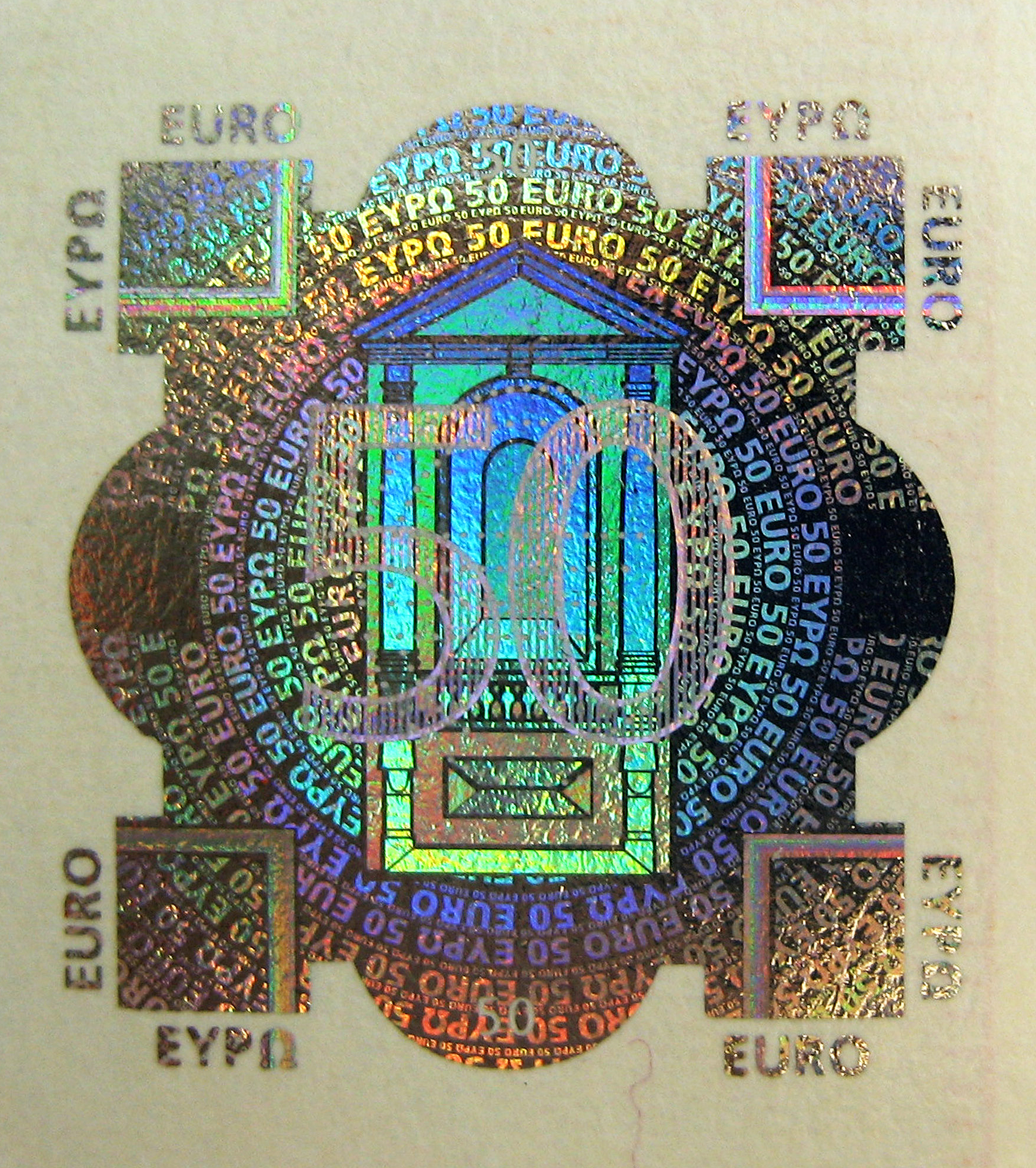
A hologram on a Series 1 (ES1) 50 Euro banknote

Security printing is the field of the printing industry that deals with the printing of items such as banknotes, cheques, passports, tamper-evident labels, security tapes, product authentication, stock certificates, postage stamps, and identity cards. The main goal of security printing is to prevent forgery, tampering, or counterfeiting. More recently many of the techniques used to protect these high-value documents have become more available to commercial printers, whether they are using the more traditional offset and flexographic presses or the newer digital platforms. Businesses are protecting their lesser-value documents such as transcripts, coupons and prescription pads by incorporating some of the features listed below to ensure that they cannot be forged or that alteration of the data cannot occur undetected.

A number of technical methods are used in the security printing industry.[1] Security printing is most often done on security paper, but it can also occur on plastic materials.

Features detectable by humans

[edit]

Secured documents, such as banknotes, use visible and tactile features to allow humans to verify their authenticity without tools. The European Central Bank (ECB) recommends feel, look, and tilt:[2] First check the tactility of the banknote (including the substrate), then look at the optical design and finally the characteristics of certain optical features when tilting the banknote in relation to the incident light.

Mobile app SwissBanknotes displaying animated seeds of hawkbit for a 50 Swiss franc on a PC screen

In general, the introduction of a new banknote series is accompanied by information campaigns describing the design and the security features. Several central banks also provide mobile apps explaining the characteristics by interactive methods and enrich them by animated effects. In general, they use the camera of a mobile device to explain the features of a presented banknote. As they do not support the direct verification of authenticity they also work with simple printouts or screen displays.

Substrate

[edit]

Paper

[edit]

The substrate of most banknotes is made of paper, almost always from cotton fibres for strength and durability; in some cases linen or specially coloured or forensic fibres are added to give the paper added individuality and protect against counterfeiting. Paper substrate may also include windows based on laser-cut holes covered by a security foil with holographic elements. All of this makes it difficult to reproduce using common counterfeiting techniques.

Polymer

[edit]

Some countries, including Canada, Nigeria, Romania, Mexico, Hong Kong, New Zealand, Israel, Singapore, Malaysia, United Kingdom, and Australia, produce polymer (plastic) banknotes, to improve longevity and to make counterfeiting more difficult. Polymer can include transparent windows, diffraction grating, and raised printing.[7]

Format

[edit]
Differing length and width of euro banknotes (series ES2)

Most currencies use different dimensions of length, width, or both for the different denominations, with smaller formats for the lower denominations and larger formats for the higher denominations, to hinder reuse of the substrate with embedded security features for counterfeiting higher denominations.

Blind and visually impaired people may also rely on the format for distinguishing between the denominations.

Visible security features

[edit]

Watermark

[edit]

True watermark

A true watermark is a recognizable image or pattern in paper that appears lighter or darker than surrounding paper when viewed with a light from behind the paper, due to paper density variations. A watermark is made by impressing a water coated metal stamp or dandy roll onto the paper during manufacturing. Watermarks were first introduced in Bologna, Italy in 1282; as well as their use in security printing, they have also been used by paper makers to identify their product. For proofing the authenticity, the thinner part of the watermark will shine brighter with a light source in the background and darker with a dark background. The watermark is a proven anti-counterfeit technology because most counterfeits only simulate its appearance by using a printing pattern.

Simulated watermark

Printed with white ink, simulated watermarks have a different reflectance than the base paper and can be seen at an angle. Because the ink is white, it cannot be photocopied or scanned.[8] A similar effect can be achieved by iriodin varnish which creates reflections under certain viewing angles only and is transparent otherwise.

Watermarks are sometimes simulated on polymer currency by printing an according pattern, but with little anti-counterfeiting effect. For example, the Australian dollar has its coat of arms watermarked on all its plastic bills. A Diffractive Optical Element (DOE) within the transparent window can create a comparable effect but requires a laser beam for its verification.

See-through register

[edit]

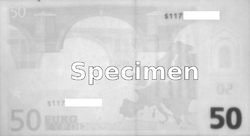
See-through registers are based on complementary patterns on the obverse and reverse of the banknote and constitute a complete pattern under backlight conditions. Examples are the D of the Deutsche Mark (1989 series, BBk III) and the value number of the first series of euro banknotes (ES1). Counterfeiting is difficult because the printing registration requires an extremely high printing accuracy on both sides and minor deviations are easily detectable.

See-through window

[edit]

Polymer banknotes which are printed on a basically transparent substrate easily provide clear areas by sparing the white coating. This window may be overprinted by patterns. Initially this was the main human security feature for polymer banknotes which cannot use watermark or security threads. It attracted counterfeiting of large volumes when printing technology for polymer substrate became commonly available. Therefore new designs additionally laminate this window with an ultra-thin security foil, e.g., on the Frontier series of the Canadian dollar which was issued from 2011, and the Australian dollar (2nd series) issued from 2016.

A very similar security feature is achieved with banknotes on paper substrate. For this an area of up to 300 mm² is punched out and sealed with a partially transparent security foil. The ES2 series of euro banknotes is using this feature for the higher denominations (EUR 20 and above) and calls it portrait window. The European Central Bank (ECB) recommends to look at the banknote against the light – the window in the hologram becomes transparent and reveals a portrait of Europa on both sides of the note.[9]

Micro-perforation

[edit]

Micro-perforation is used as Microperf in the Swiss franc and the Romanian leu. Very small holes are punched or laser-engraved into the substrate or a foil application without generating a crater. In backlight illumination, the holes form a pattern, e.g., the value numeral like in the SFR 20 (eighth series).

Geometric lathe work

[edit]

A guilloché is an ornamental pattern formed of two or more curved bands that interlace to repeat a circular design. They are made with a geometric lathe.

A guilloché

Microprinting

[edit]

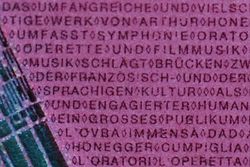
This involves the use of extremely small text, and is most often used on currency and bank checks. The text is generally small enough to be indiscernible to the naked eye without either close inspection or the use of a magnifying glass. Cheques, for example, use microprint as the signature line.

Optically variable ink

[edit]

Optically Variable Ink (OVI) displays different colors depending on the angle at which it is viewed. It uses mica-based glitter.[10] As an example, the euro banknotes use this feature as the emerald number on the ES2 series. The ECB recommends to "tilt the banknote". The shiny number in the bottom left corner displays an effect of the light that moves up and down. The number also changes colour from emerald green to deep blue. The EUR 100 and EUR 200 banknotes also show € symbols inside the number.[11]

Coloured magnetizable inks are prepared by including chromatic pigments of high colour strength. The magnetic pigments’ strong inherent colour generally reduces the spectrum of achievable shades. Generally, pigments should be used at high concentrations to ensure that sufficient magnetizable material is applied even in thin offset coats. Some magnetic pigment are best suited for coloured magnetizable inks due to their lower blackness.

Homogeneous magnetization (no preferred orientation) is easily obtained on pigment made of spherical particles. Best results are achieved when remanence and coercive field strength are very low and the saturating magnetization is high.

When pearlescent pigments are viewed at different angles the angle of the light as it's perceived makes the colour appear to change as the magnetic fields within the particles shift direction.

Holograms

[edit]

A hologram may be embedded either via hot-stamping foil, wherein an extremely thin layer of only a few micrometers of depth is bonded into the paper or a plastic substrate by means of a hot-melt adhesive (called a size coat) and heat from a metal die, or it may be directly embossed as holographic paper, or onto the laminate of a card itself. When incorporated with a custom design pattern or logo, hologram hot stamping foils become security foils that protect credit cards, passports, bank notes and value documents from counterfeiting. Holograms help in curtailing forging, and duplication of products hence are very essential for security purposes. Once stamped on a product, they cannot be removed or forged, enhancing the product at the same time. Also from a security perspective, if stamped, a hologram is a superior security device as it is virtually impossible to remove from its substrate.[citation needed]

Security threads

[edit]

Metal threads and foils, from simple iridescent features to foil colour copying to foils with additional optically variable effects are often used.

There are two kinds of security threads. One is a thin aluminum coated and partly de-metallized polyester film thread with microprinting which is embedded in the security paper as banknote or passport paper. The other kind of security thread is the single or multicolour sewing thread made from cotton or synthetic fibers, mostly UV fluorescent, for the bookbinding of passport booklets. In recent designs the security thread was enhanced with other security features such as holograms or three-dimensional effects when tilted.

On occasion, the banknote designers succumb to the Titanic effect (excess belief in the latest technology), and place too much faith in some particular trick. An example is the forgery of British banknotes in the 1990s. British banknotes in the 1990s featured a "windowed" metal strip through the paper about 1 mm wide that comes to the paper surface every 8 mm. When examined in reflected light, it appears to have a dotted metallic line running across it, but when viewed through transmitted light, the metal strip is dark and solid.

Duplicating this was thought to be difficult, but a criminal gang was able to reproduce it quickly. They used a cheap hot-stamping process to lay down a metal strip on the surface of the paper, then printed a pattern of solid bars over it using white ink to leave the expected metal pattern visible. At their trial, they were found to have forged tens of millions of pounds’ worth of notes over a period of years.[12]

Prismatic colouration

[edit]

The use of colour can greatly assist the prevention of forgeries. By including a colour on a document, a colour photocopier must be used in attempting to make a copy. However, the use of these machines also tends to enhance the effectiveness of other technologies such as Void Pantographs and Verification Grids (see: § Copy-evidence, below).

By using two or more colors in the background and blending them together, a prismatic effect can be created. This can be done on either a traditional or a digital press. When a document using this technique is attempted to be photocopied, the scanning and re-creation by a colour copier is inexact, usually resulting in banding or blotching, and thereby immediate recognition of the document as being a copy.

A frequent example of prismatic colouring is on checks where it is combined with other techniques such as the void pantograph, to increase the difficulty of successful counterfeiting.[13]

Copy-evidence

[edit]

Sometimes only the original document has value. An original, signed cheque for example has value but a photocopy of it does not. An original prescription script can be filled but a photocopy of it should not be. Copy-evident technologies provide security to hard copy documents by helping distinguish between the original document and the copy.

The most common technology to help differentiate originals from copies is the void pantograph. Void pantographs are essentially invisible to the untrained, naked eye on an original but when scanned or copied the layout of lines, dots and dashes will reveal a word (frequently VOID and hence the name) or symbol that clearly allows the copy to be identified. This technology is available on both traditional presses (offset and flexographic) and on the newer digital platforms. The advantage of a digital press is that in a single pass through the printer a void pantograph with all the variable data can be printed on plain paper.

Copy-evident paper, sometimes marketed as ‘security paper’, is pre-printed void pantograph paper that was usually produced on an offset or flexographic press. The quality of the void pantograph is usually quite good because it was produced on a press with a very high resolution, and, when only a small number of originals are to be printed, it can be a cost-effective solution; however, the advent of the digital printer has rapidly eroded this benefit.

A second technology which complements and enhances the effectiveness of the void pantograph is the Verification Grid. This technology is visible on the original, usually as fine lines or symbols, but when photocopied these lines and images disappear‌the inverse reaction of the void pantograph. The most common examples of this technology are on the fine lines at the edge of a cheque which will disappear when copied or on a coupon when a symbol, such as a shopping cart, disappears when an unauthorized copy is made. Verification Grid is available for either traditional or digital presses.

Together the void pantograph and the Verification Grid complement each other because the reactions to copying are inverse, resulting in a higher degree of assurance that a hard copy document is an original.

Registration of features on both sides

[edit]

Banknotes are typically printed with fine alignment (so-called see-through registration window) between the offset printing on each side of the note. This allows the note to be examined for this feature, and provides opportunities to unambiguously align other features of the note with the printing. Again, this is difficult to imitate accurately enough in most print shops.

Thermochromic ink

[edit]

Several types of ink are available which change colour with temperature. Security ink with a normal "trigger" temperature of 88 °F (31 °C), which will either disappear or change colors when the ink is rubbed, usually by the fingertips. This is based on a thermochromic effect.

Serial numbers

[edit]

Serial numbers help make legitimate documents easier to track and audit. However, they are barely useful as a security feature because duplicates of an existing serial number are not easily detectable, except for a series of identical counterfeits.

To support correct identification serial numbers normally have a check digit to verify the correct reading of the serial number. In banknote printing the unique serial number provides effective means for the monitoring and verification of the production volume. In some cases the recording of serial numbers may help to track and identify banknotes from blackmail or robbery.

In most currencies the serial number is printed on two edges of the banknotes to aggravate the making of so-called composed banknotes by combining parts of different banknotes. Even if made from genuine banknotes, most central banks consider such items as manipulated banknotes without value if the serial numbers do not match.

Tactile security features

[edit]

Paper feeling

[edit]

Security paper for banknotes is different from standard paper due to special ingredients like fibers from cotton, linen or abaca. Together with intaglio printing crisp feeling provides an excellent tactile perception (crisp feeling) to reject counterfeits which are based on standard paper with cellulose fibers. Polymer substrates and limp banknotes on paper substrate do not offer this tactile characteristic.

Intaglio printing

[edit]
Tactile intaglio printing on 1,000 Hungarian forint (series 2018)

Intaglio printing is a technique in which the image is incised into a surface. Normally, copper or zinc plates are used, and the incisions are created by etching or engraving the image, but one may also use mezzotint. In printing, the surface is covered in ink, and then rubbed vigorously with tarlatan cloth or newspaper to remove the ink from the surface, leaving it in the incisions. A damp piece of paper is placed on top, and the plate and paper are run through a printing press that, through pressure, transfers the ink to the paper.

The very sharp printing obtained from the intaglio process is hard to imitate by other means. Intaglio also allows for the creation of latent images which are only visible when the document is viewed at a very shallow angle.

The mobile app ValiCash from Koenig & Bauer evaluates specific characteristics of the intaglio printing of euro banknotes printed on paper substrate.[14] It is available for iOS devices and takes a picture of the banknote. Within a few seconds it determines abnormality by a message "not successful" but cannot finally identify counterfeits.

Embossing

[edit]

The substrate may be embossed to create raised designs as tactile security feature. It may be combined with intaglio printing. As an example, the euro series ES2 has a different pattern of lines at the short edges of the banknote to support blind people in distinguishing the denominations.

Security features detectable with simple tools

[edit]

Test pen

[edit]

A counterfeit banknote detection pen can be used to quickly determine the starch in wood-based paper substrate. While genuine banknotes hardly change color at all, counterfeits turn black or blue immediately. This method, which is not very reliable – there is no color change on newsprint – is often used in the retail trade for reasons of cost and time.

Halo

[edit]

Carefully created images can be hidden in the background or in a picture on a document. These images cannot be seen without the help of an inexpensive lens of a specific line screening. When placed over the location of the image and rotated the image becomes visible. If the document is photocopied the Halo image is lost. A known implementation is Scrambled Indicia.[15]

Halo can be printed on traditional or digital presses. The advantage of traditional presses is that multiple images can be overlaid in the same location and become visible in turn as the lens is rotated.

Halo is used as a technique to authenticate the originality of the document and may be used to verify critical information within the document. For example, the value of a coupon might be encoded as a Halo image that could be verified at the time of redemption or similarly the seat number on a sporting event ticket.

Latent images

[edit]

Pressure-sensitive or hot stamped labels characterized with a normal (gray or colored) appearance. When viewed via a special filter (such as a polarizer) an additional, normally latent, image appears. With intaglio printing, a similar effect may be achieved for viewing the banknote from a slanted angle.

False-positive testing

[edit]

False-positive testing derives its name because the testing requires both a false and a positive reaction to authenticate a document. The most common instance is the widely available counterfeit detector marker seen in many banks and stores.

Counterfeit detector markers use a chemical interaction with the substrate, usually paper, of a document turning it a particular color. Usually a marker turns newsprint black and leaves currency or specially treated areas on a document clear or gold. The reaction and coloring varies depending upon the formulation. Banknotes, being a specially manufactured substrate, usually behave differently than standard newsprint or other paper and this difference is how counterfeits are detected by the markers.

False-positive testing can also be done on documents other than currencies as a means to test their authenticity. With the stroke of a marker a symbol, word or value can be revealed that will allow the user to quickly verify the document, such as a coupon. In more advanced applications the marker creates a barcode which can be scanned for verification or reference to other data within the document resulting in a higher degree of assurance of authenticity.

Photocopied documents will lack the special characteristics of the substrate, and so are easily detectable. False-positive testing generally is a one-time test, because once done, the results remain visible, so while useful as part of a coupon, this technique is not suitable for ID badges, for example.

Fluorescent dyes

[edit]

Fluorescent dyes react with fluorescence under ultraviolet light or other unusual lighting. These show up as words, patterns or pictures and may be visible or invisible under normal lighting. This feature is also incorporated into many banknotes and other documents - e.g. Northern Ireland NHS prescriptions show a picture of local '8th wonder' the Giant's Causeway in UV light. Some producers include multi-frequency fluorescence, such that different elements fluoresce under specific frequencies of light. Phosphorescence may accompany fluorescence and shows an after-glow when the UV light is switched off.

Infrared characteristics

[edit]

Inks may have identical color characteristics in the visible spectrum, but may differ in the infrared spectrum.

Machine-readable security features

[edit]

Machine-readable features are used in passports for border control and in banknote processing.

  • The commercial market is using Level 2 features (L2) which are partly disclosed by the central banks. This applies for cash handling machines, such as automated teller machines and ticket machines.
  • The central banks are additionally using Level 3 features (L3) which are kept completely secret. They are necessary to maintain the integrity of cash in circulation and isolate professional counterfeiting.

Following is a partial list of machine-readable security features:

Magnetic ink

[edit]

Because of the speed with which they can be read by computer systems, magnetic ink character recognition is used extensively in banking, primarily for personal checks. The ink used in magnetic ink character recognition (MICR) technology is also used to greatly reduce errors in automated (or computerized) reading. The pigment is dispersed in a binder system (resin, solvent) or a wax compound and applied either by pressing or by hot melt to a carrier film (usually polyethylene).[16]

Some people believe that the magnetic ink was intended as a fraud prevention concept, yet the original intent was to have a non-optical technology so that writing on the cheque, like signatures, would not interfere with reading. The main magnetic fonts (E13-B and CMC7) are downloadable for a small fee and in addition magnetic toner is available for many printers. Some higher resolution toners have sufficient magnetic properties for magnetic reading to be successful without special toner.

Phosphorescent dyes

[edit]

Phosphorescence may accompany fluorescence and shows an after-glow when the UV light is switched off.

Anti-copying marks

[edit]

In the late twentieth century advances in computer and photocopy technology made it possible for people without sophisticated training to easily copy currency. In an attempt to prevent this, banks have sought to add filtering features to the software and hardware available to the public that senses features of currency, and then locks out the reproduction of any material with these marks. One known example of such a system is the EURion constellation.

Electronic devices

[edit]

With the advent of Radio Frequency Identification (RFID) which is based on smart card technology, it is possible to insert extremely small RF-active devices into the printed product to enhance document security. This is most apparent in modern biometric passports, where an RFID chip mirrors the printed information. Biometric passports additionally include data for the verification of an individual's fingerprint or face recognition at automated border control gates.

Copy detection pattern and digital watermark

[edit]

A copy detection pattern or a digital watermark can be inserted into a digital image before printing the security document. These security features are designed to be copy-sensitive[17] and authenticated with an imaging device.[18]

Level 3 features

[edit]

Most central banks also implement so-called Level 3 (L3) security features which are kept totally secret for their ingredients as well as their sophisticated measurement. Such covert features may be embedded within the substrate and/or the printing ink and are not commercially available. They are the ultimate safeguard in banknote security and restricted to the use of central banks. The machine-readable M-Feature from Giesecke+Devrient is the worldwide leading L3 feature and currently used by more than 70 central banks and more than 100 billion banknotes in circulation.[19] Other products are ENIGMA from De La Rue[20] and Level III Authentication from Spectra Systems.[21]

See also

[edit]

References

[edit]
[edit]
Revisions and contributorsEdit on WikipediaRead on Wikipedia
from Grokipedia
Security printing is a specialized branch of the industry that employs advanced techniques, materials, and processes to produce documents and products resistant to , counterfeiting, and tampering, such as banknotes, passports, cheques, identity cards, and tamper-evident labels. These methods integrate visible, hidden, and machine-readable features to authenticate items of high value, ensuring public trust in financial systems, personal identification, and product safety. The practice traces its origins to over 5,000 years ago in ancient , where clay bullae served as early seals for document authentication, evolving through and in with rudimentary stamping methods. In , wax seals dominated until the for securing official documents, but by the mid-20th century, the focus shifted to printed seals and packaging due to rising tampering incidents, including a U.S. epidemic with 235 reported cases of product adulteration. A pivotal modern milestone occurred in 1982 when the U.S. mandated tamper-resistant packaging following the cyanide-laced Tylenol poisonings, accelerating the integration of security features into labels and seals. Key techniques in security printing include intaglio printing, a centuries-old process that creates raised ink impressions for intricate details on s and passports; letterpress for precise numbering; and simultan presses for accurate front-to-back alignment, such as see-through registers. Additional features encompass watermarks embedded in during , holograms and optically variable inks that shift appearance with angle or light, too fine for casual replication, and security threads woven into substrates. Contemporary advancements incorporate UV-fluorescent inks, encrypted QR codes, and RFID tags for machine verification, enhancing layers of protection against sophisticated threats. Applications of security printing span government-issued documents like passports and , where features such as holograms and window threads deter , as seen in British banknotes targeted in 1990s counterfeiting attempts. In the financial sector, it secures cheques and stock certificates with intricate designs and numbering to prevent . Beyond documents, it protects pharmaceutical and cosmetic packaging with tamper-evident seals and serialized labels, while also authenticating via holographic stickers and enabling traceability in supply chains through RFID and integration. These measures are critical for mitigating economic losses from counterfeiting, estimated at hundreds of billions of dollars annually as of 2019, and safeguarding public health and security.

History and Evolution

Origins and Early Techniques

Security printing originated with ancient efforts to authenticate valuable items and prevent counterfeiting, beginning with the invention of coinage in the kingdom of around 630 BCE. Lydian rulers stamped ingots—natural alloys of gold and silver—with official symbols using signet ring-like tools, guaranteeing their weight and purity to facilitate trade and deter imitation. This stamping technique marked the earliest known anti-counterfeiting measure, as counterfeiting emerged almost immediately after the introduction of standardized coins. In , during the in the 8th century CE, the precursors to appeared as "" (feiqian), government-issued certificates designed to replace cumbersome copper coins for long-distance trade. These promissory notes were authenticated through official seals from the imperial treasury, providing basic verification of legitimacy and reducing the risk of by limiting private issuance. By the (10th–13th centuries), this evolved into printed banknotes with more elaborate seals and multicolored designs, further enhancing security against replication. The intaglio printing technique, which involves incising designs into a plate to hold ink in recessed lines, emerged in during the 15th-century , initially for artistic prints and maps. By the late , it was adapted for banknotes, with Sweden's Stockholms Banco issuing the first European paper currency in 1661 using copper-plate intaglio to create fine, intricate details that were labor-intensive to copy. This method's raised ink and complex vignettes became a cornerstone of security printing, making unauthorized reproductions detectable through inferior line quality. In 19th-century Britain, guilloché patterns—intricate, interlocking geometric designs produced by mechanical lathes—were innovated as a key anti-counterfeiting feature for banknotes and documents. Firms like those associated with the , under influences such as governor Thomson Hankey in the , incorporated these fine-line rosettes and spirals, which required specialized equipment and skill to replicate accurately. This technique deterred forgers by creating visually complex backgrounds that blurred when photocopied or poorly printed. A pivotal development occurred in the United States during the Civil War, when the Legal Tender Act of 1862 authorized the first federal banknotes—known as Notes—to finance the war effort amid rampant counterfeiting of state bank currency. These notes employed , a durable advancement over that allowed for sharper, more detailed vignettes and portraits, such as those of and . By the war's end, an estimated one-third of circulating currency was fake, prompting the establishment of in 1865 specifically to combat this issue, with steel engraving proving instrumental in elevating U.S. security printing standards.

20th-Century Developments

The marked a significant shift in security printing toward industrialization, enabling of secure documents like banknotes while incorporating more sophisticated anti-counterfeiting measures. Offset , developed in the early 1900s, gained widespread adoption during the 1920s and 1930s for high-volume printing applications, including security features such as background patterns on and bonds, due to its efficiency in reproducing fine details and colors compared to earlier intaglio methods. This technique allowed printers to produce larger quantities at lower costs, facilitating the expansion of national systems post-World War I. A key innovation in substrate security emerged in the 1930s through collaboration between the Printing Works and Portals Paper Mill, leading to the development of embedded metallic threads designed to deter counterfeiting. These threads, initially continuous metal strips incorporated during papermaking, were first introduced in British £1 s in 1940 amid concerns over wartime forgery attempts by . Portals' expertise in cylinder-moulded paper enabled the seamless integration of these covert features, which became visible when held to light and set a precedent for global banknote . Post-World War II, advancements in optical technologies drove the creation of optically variable inks (OVI) in the 1970s, based on thin-film interference pigments, with the first use on banknotes occurring in the late 1980s. The U.S. (BEP) later adopted OVI in the 1990s as part of enhanced currency features; the first implementation appeared on the $100 in 1996, where the ink shifts color (e.g., from green to black) depending on viewing angle, providing a dynamic human-detectable safeguard against reproduction. This built on earlier intaglio roots but emphasized color-shifting effects for mass-produced notes. By the late , holograms emerged as a high-impact overt feature, prompting the formation of the International Hologram Manufacturers Association (IHMA, now the International Optical Technologies Association or ) in to standardize and promote their integration in security printing. The IHMA, established by leading producers, focused on anti-counterfeiting applications for banknotes and documents, fostering global collaboration on hologram quality and authentication amid rising digital threats. This organization played a pivotal role in embedding diffractive into designs worldwide during the 1990s.

Modern Innovations and Standards

One of the most significant advancements in security printing since the late has been the transition to substrates for banknotes, which offer enhanced durability, resistance to counterfeiting, and environmental benefits compared to traditional paper. pioneered this shift with the issuance of the world's first circulating , a commemorative $10 note in January 1988, marking the bicentenary and incorporating advanced plastic-based materials developed by the in collaboration with Note Printing Australia. By the 2010s, adoption became widespread globally, exemplified by the 's introduction of polymer £5 notes in 2016, featuring improved security elements like transparent windows and tactile prints, as announced by the to replace aging paper series and reduce circulation wear. This material innovation has since been embraced by over 70 countries (as of 2025), including and the , contributing to longer note lifespans—up to 2.5 times that of paper equivalents—and lower replacement costs for central banks. In parallel, the saw the rise of nano-optic features, leveraging nanoscale structures to create sophisticated 3D visual effects without relying on traditional holograms, thereby complicating replication through high-precision . These features, such as nano-optical images integrated into security holograms, manipulate at the nanometer scale to produce dynamic, parallax-driven animations and color shifts visible under normal viewing conditions, enhancing for documents and banknotes. For instance, technologies like those from Nanotech Security Corp. introduced multi-color, full-parallax depth effects in the mid-, applied to high-security applications including passports and to deter sophisticated forgers by requiring specialized nanofabrication equipment. International standards have formalized these innovations to ensure consistency and reliability in security printing processes. The ISO 14298 series, first published in and updated in 2021, establishes requirements for security printing management systems, including , personnel vetting, and supply chain controls to certify printers handling sensitive items like banknotes and IDs. Complementing this, the European Central Bank's guidelines for banknotes, outlined in the Europa series roadmap since , mandate advanced features such as enhanced watermarks, holograms, and optically variable inks, with all notes produced under strict quality protocols to maintain integrity across member states. Emerging digital integrations, such as for serial number tracking, have entered pilot explorations by central banks in the 2020s to combat counterfeiting and monitor circulation in real-time. Research proposals from 2020 onward describe systems for localizing and verifying serial numbers during exchanges, enabling immutable ledgers that central banks could integrate into pilot programs for enhanced traceability without altering physical notes. While full-scale adoption remains in early stages, these initiatives build on CBDC pilots to potentially link physical and digital asset tracking, as explored in academic and industry frameworks.

Substrates and Materials

Paper Substrates

Paper substrates form the foundational material in traditional security printing, particularly for banknotes and high-value documents, due to their cellulose-based composition derived from natural fibers. These substrates are typically made from a blend of and rag fibers, with currency paper consisting of 75% cotton and 25% linen to provide exceptional durability and a distinctive crisp texture without incorporating wood pulp or , which could compromise tests. The high cotton content, often ranging from 75% to 100% in various security papers, ensures long fiber length that enhances tensile strength and resistance to tearing during handling. Additives such as cationic polymers or specialized agents may be incorporated during pulping to further bolster dry strength and prevent fiber separation, though formulations avoid common fillers like starch to maintain authenticity verification properties. A key security aspect of paper substrates lies in the integration of embedded elements during the manufacturing process, which deter counterfeiting by adding verifiable physical characteristics. Visible colored fibers, such as red and blue strands, are randomly distributed throughout the paper sheet to create an irregular pattern that is difficult to replicate precisely, as seen in genuine U.S. currency where these fibers are randomly embedded throughout the . Metallic or fluorescent fibers, often invisible under normal light but glowing under (UV) examination, provide an additional layer of , with the metallic variants offering a subtle sheen that enhances tamper detection. Complementing these are planchettes—small, disc-shaped particles (typically 2-4 mm in diameter) with a metallic or iridescent coating—that are interspersed within the pulp, creating sparkling inclusions visible to the and reactive under UV light for machine-readable verification. Watermarks, another integral security feature, are formed directly into the paper substrate during the papermaking process using a dandy roll or cylinder mold that varies the fiber density to produce translucent images or patterns, such as portraits or denominations, visible when held against light. This technique dates back to colonial U.S. currency in the 18th century and was reintroduced in modern federal notes starting with the 1996 series to enhance security against counterfeiting. The process involves feeding the cotton-linen pulp onto a wire mesh screen with a relief design, allowing excess water to drain unevenly and embed the watermark as a permanent, integral part of the substrate rather than a printed overlay. Paper substrates offer distinct advantages in security printing, including a premium tactile feel that users associate with authenticity—characterized by a crisp, non-porous surface that resists ink bleeding—and compatibility with traditional printing methods like intaglio for raised ink effects. However, they are susceptible to wear from , folding, and moisture, with average circulation lifetimes varying by denomination from about 5.8 years for $5 notes to 22.9 years for $100 notes in high-use scenarios, according to estimates as of 2023. Recycling poses challenges due to the embedded security elements, such as metallic fibers and planchettes, which can contaminate standard streams and require specialized de-inking processes to separate fibers without damaging authenticity features.

Polymer and Hybrid Substrates

substrates represent a significant advancement in security printing, utilizing synthetic materials to enhance and incorporate unique optical security elements that are difficult to replicate. These substrates are primarily composed of biaxially oriented (BOPP), a thin, flexible that provides resistance to wear, tearing, and moisture compared to traditional . BOPP is produced by sheets in both longitudinal and transverse directions, resulting in a strong, transparent base that can be opacified with white or colored layers for printing while retaining areas of clarity for specialized features. The development of substrates for applications originated from research by Australia's , which filed the first for polymer banknotes in 1973 to address rising counterfeiting threats following the introduction of color photocopiers. This innovation laid the foundation for modern polymer notes, with the first issuance occurring in in 1988. In addition to full polymer substrates, hybrid variants combine with polymer layers, such as laminates where a is fused to paper cores, offering a balance of tactile familiarity and enhanced protection. These hybrids are particularly used in passports, where the polymer component strengthens pages against tampering and environmental damage while allowing integration of paper-based elements like watermarks. Key security features in and hybrid substrates exploit their transparency and multi-layer structure. Transparent windows, often positioned at edges or centrally, enable see-through registers where printed elements on both sides of the note align precisely when held to light, creating intricate patterns or images that verify authenticity. In hybrids, the polymer core facilitates crystal-clear windows like Thrusafe™ or Viewsafe™, which can incorporate diffractive or threads visible only from specific angles, adding layers of machine-readable security. Unlike , which excels in providing a distinctive tactile feel, polymer's smooth surface prioritizes optical verification over texture. Notable examples include Canada's polymer $20 note, introduced in 2012 as part of the Frontiers series, featuring a holographic stripe with a metallic portrait of Queen Elizabeth II that shifts colors and a frosted maple leaf transparent window for see-through alignment. Durability tests demonstrate that polymer notes withstand circulation approximately 2.5 times longer than paper equivalents, reducing replacement frequency and associated costs over time. Recent advancements as of 2025 include bio-based polymer alternatives and advanced film concepts, such as Covestro's polymeric substrates, aimed at improving sustainability and recyclability while maintaining security. Despite these advantages, and hybrid substrates face challenges, including higher initial production costs due to specialized and processes, which can exceed those of by 20-50% per unit. Environmental concerns also arise from recyclability issues, as BOPP-based polymers are derived from and require energy-intensive sorting and processing at end-of-life, unlike paper's more straightforward pulping. Ongoing research aims to improve bio-based alternatives and methods to mitigate these impacts.

Specialized Formats and Coatings

Specialized formats in security printing deviate from standard rectangular shapes to incorporate tactile variations and complicate automated replication or scanning processes. For instance, some identification documents feature rounded corners, which enhance durability by reducing wear at edges while subtly altering the document's profile to disrupt scanner alignment algorithms designed for uniform rectangular inputs. This format choice aids in human verification through feel and makes high-fidelity counterfeiting more challenging, as precise edge replication requires advanced die-cutting equipment. Variable thickness formats further contribute to tactile security by creating uneven surfaces that can be discerned by touch, integrating seamlessly with raised printing elements for enhanced authenticity checks. These variations, often achieved through layered substrates or embossing, provide a subtle dimensional profile that resists flat-bed scanning and promotes manual inspection. In integration with tactile printing techniques, such formats amplify detectability without relying on optical aids. Coatings applied post-substrate production play a critical role in bolstering by adding protective and interactive layers that deter tampering and . UV-curable varnishes, which polymerize rapidly under light, offer superior scratch resistance to printed security elements, preserving intricate patterns like guilloches or microtext during circulation. These varnishes are particularly valued in high-security applications for their ability to maintain print integrity under mechanical stress, as seen in formulations tailored for offset and flexographic processes. Anti-soiling coatings, such as those developed through trials in the mid-2000s and applied to later series (e.g., Europa series from 2019 onward), form a thin protective barrier that repels dirt, oils, and moisture, extending note lifespan and reducing replacement costs. Applied via high-speed coaters, these layers—often polymer-based—enhance circulation durability by up to 200% in some implementations, while maintaining the note's aesthetic and functional qualities. For example, trials on 20 and 50 denominations demonstrated improved soil impermeability, addressing common vulnerabilities in soiled conditions. Tamper-evident coatings represent another specialized application, designed to reveal latent images or warning patterns upon abrasion or attempted removal, thereby exposing alterations. These interactive layers, typically comprising micro-encapsulated inks or fragile films, activate under to display hidden motifs like "VOID" or symbols, serving as a forensic deterrent against . Such coatings are integral to documents requiring post-issuance , ensuring that any surface manipulation compromises the security feature visibly. A notable example of innovative format integration is the 2019 Eastern Caribbean polymer banknotes, which employ a flexible, foldable design allowing repeated bending without creasing or , thereby enhancing portability and resistance to wear. This format, issued in denominations from $5 to $100, combines with durable coatings to achieve a circulation life approximately three times longer than traditional paper equivalents, while the foldability itself acts as a subtle cue against rigid attempts.

Human-Detectable Security Features

Visible Features

Visible features in security printing encompass overt elements designed for easy public using the , typically by holding the document to light or tilting it to observe dynamic effects. These features deter counterfeiting by incorporating complex that are difficult to replicate without specialized equipment. Common examples include watermarks, security threads, optically variable inks, and diffractive devices like holograms and kinegrams, each contributing to layered visual verification. Watermarks are translucent, multi-tonal images or patterns embedded into the paper substrate during the manufacturing process by varying the thickness and density of fibers, creating lighter and darker areas visible when the document is held against light. This technique, originating from traditional , produces a three-dimensional effect that integrates seamlessly with the substrate, making it resistant to photocopying or scanning replication. For instance, bills feature portrait watermarks, such as the faint image of on the $100 note, positioned to the right of the main and discernible from both sides when backlit. Security threads consist of narrow metallic, plastic, or strips embedded or windowed into the substrate, appearing as a continuous dark line when held to light and often incorporating microprinted text or holographic elements for added visibility. These threads enhance authenticity checks by their precise placement and material properties, which cause them to shimmer or reveal hidden patterns under normal viewing conditions. In , the is a metallized strip with a holographic effect, displaying the denomination value and "" in microtext, visible as a dark stripe across the note when backlit. Optically variable ink (OVI) employs interference pigments that produce color-shifting effects based on the angle of light incidence and observation, appearing as one color straight-on and transforming to another when tilted. This overt feature relies on thin-film multilayer coatings, typically using materials like titanium dioxide and silica, to create iridescent shifts that are challenging for counterfeiters to mimic accurately. The United States $100 Federal Reserve Note, redesigned in 1996, introduced OVI on the lower-right numeral "100," which shifts from green to black, enhancing public verification of high-denomination bills. Holograms and kinegrams are diffractive optically variable image devices (DOVIDs) that generate three-dimensional, motion-based illusions through light diffraction on microstructured surfaces, revealing animated patterns, depth, or flipping images upon tilting. Holograms, often produced via laser interference, are foil-based patches or stripes that display kinetic effects like moving stars or portraits, while kinegrams utilize advanced diffractive gratings for smoother, customizable animations exclusive to secure applications. These DOVIDs are integrated into banknotes and identity documents for vivid, public-facing ; for example, Australian polymer banknotes incorporate holographic patches with dynamic bird motifs, and kinegrams appear on Swiss identity cards as tilting seals with color transitions.

Tactile Features

Tactile features in security printing are designed to be detectable by touch, providing an accessible method for authenticity verification, particularly for visually impaired individuals. These elements create distinct textures or raised surfaces that differ from common counterfeits, enhancing public confidence in documents like banknotes and passports. By relying on the sense of touch, they complement visual inspections and serve as a first-line defense against forgery. Intaglio printing is a cornerstone tactile feature, achieved through high-pressure engraving where ink is forced into recessed plate areas, resulting in raised relief on the substrate. This technique produces portraits and other motifs on banknotes with a height typically between 0.05 and 0.1 mm, allowing users to feel the distinct elevation by running a finger across the surface. For instance, the portraits on Australian banknotes feature this raised intaglio texture for easy identification. The process not only imparts a premium feel but also makes replication challenging due to the specialized equipment required. Embossing provides another key tactile element, involving the creation of raised or recessed impressions without ink, either as blind embossing or registered with printed designs. In passports, blind embossing is often used for subtle textures, such as intricate patterns on covers or data pages, which can be felt but not easily seen. Examples include the galaxy motif blind-embossed on certain pages by manufacturers like , adding a layer of through verifiable texture. This method is particularly effective for personal documents, where the embossed elements protect sensitive areas like portraits from tampering. The substrate material significantly influences the overall tactile experience. Traditional cotton rag paper, composed of high-quality cotton fibers, imparts a crisp, firm feel to banknotes, distinguishing them from smoother counterfeits or alternative materials. This texture is a trusted for users, as noted in the production of many national currencies. In contrast, polymer substrates offer a smoother, more flexible touch, which, while durable, provides a different but intentional tactile profile to aid differentiation in polymer-based notes. Micro-perforation introduces tactile patterns through laser-drilled micro-holes that form images or symbols detectable by touch in certain configurations. These perforations create subtle raised or uneven surfaces around the holes, enhancing security in banknotes like the series, where they combine visual transmission effects with a faint tactile quality. Such features, often integrated near demetalized windows in polymer notes, allow for basic manual verification while maintaining aesthetic integrity.

Auditory and Olfactory Features

Auditory features in security printing provide a subtle yet effective means for human verification of documents like banknotes, relying on the distinctive sounds generated during handling. Traditional substrates, composed primarily of fibers (often 75% and 25% in currencies such as the U.S. dollar), produce a characteristic crisp rustle or snap when flicked or rubbed between fingers. This sharper, high-pitched sound arises from the paper's density and fiber structure, making it difficult for counterfeiters using standard wood-pulp paper to replicate accurately. In comparison, polymer or hybrid substrates yield a duller, more muted rustle due to their plastic-like composition and smoother surface, which lacks the fibrous texture of . This auditory difference aids public familiarity checks, particularly in regions transitioning from to polymer notes, such as the United Kingdom's polymer series introduced in 2016. While not as overt as visual features, the sound complements tactile sensations, enhancing overall sensory authentication without requiring tools. Olfactory features remain rare in security printing, primarily explored in experimental contexts rather than widespread production. Modern trials with scented inks face challenges like fading over time and environmental variability, rendering them subjective and less reliable for practical use. Research acknowledges potential in olfactory cues for detection, though implementation focuses more on machine-based sensors than human perception. Both auditory and olfactory elements are inherently subjective, influenced by factors like humidity, user hearing or smell sensitivity, and note condition, which can complicate verification. Consequently, production emphasizes consistency in substrate materials to standardize these sensory traits, prioritizing them as supplementary to more robust features.

Features Detectable with Simple Tools

Chemical and Optical Tests

Chemical tests for security printing primarily involve simple reactions using everyday tools to distinguish genuine documents from counterfeits. Counterfeit detection pens, which contain iodine-based ink, exploit the composition of substrate materials in secure prints. When applied to genuine currency paper—typically composed of cotton and linen without added starch—the pen produces a light yellow mark due to the absence of a starch-iodine complex formation. In contrast, counterfeits made from bleached ordinary paper containing starch react to form a dark brown or black mark, indicating fakery. This method, while effective for initial screening, has limitations such as false positives from starch contamination on genuine notes or false negatives from coatings on fakes. Optical tests rely on basic or light manipulation to reveal subtle characteristics. The , observed under a , appears as a diffuse glow or outline around printed areas in techniques like intaglio or letterpress, resulting from excess ink being squeezed out and partially absorbed into the substrate. This feature is prominent in documents such as banknotes and , where the ink's interaction with the fibers creates a subtle spread not easily replicated by copiers or low-quality printers. Forensic examiners use 10x to confirm the halo's presence, which aids in authenticity verification without specialized equipment. Latent images constitute another low-tech optical and tactile test, becoming visible through or application. These patterns, printed with thermochromic or friction-sensitive inks, remain invisible under normal conditions but darken or change color when rubbed, generating localized . For instance, certain silver-based formulations oxidize slightly upon friction, revealing hidden motifs like denominations or symbols on banknotes and . This rub-and-reveal mechanism allows quick verification using only finger , enhancing public-level security without advanced tools. Copy-evident features target reproduction attempts by incorporating elements that degrade or activate during photocopying. Fine-line patterns, consisting of intricate lines thinner than typical scanner resolution, appear sharp on originals but blur or fill in on copies due to the device's inability to resolve micro-details. Similarly, void pantographs embed latent words like "VOID" or "COPY" in the background; these remain camouflaged in the original but emerge prominently when photocopied, as the fine microdots forming the message are selectively lost in reproduction. These designs, common in checks and certificates, provide a clear visual cue of tampering using standard office equipment.

UV and IR Basic Detection

Ultraviolet (UV) and (IR) basic detection relies on the of specialized inks and materials in security printing, which become apparent only under specific wavelengths of using simple handheld devices. These features are designed to be covert under normal visible , aiding in the of documents like banknotes by revealing hidden patterns or colors that counterfeiters often fail to replicate accurately. UV features commonly incorporate fluorescent dyes embedded in security threads or inks that emit visible light when exposed to ultraviolet radiation, typically from a blacklight source around 365 nm . For instance, in U.S. dollar banknotes, the embedded glows in a denomination-specific color under UV light: blue for $5 bills, orange for $10, for $20, yellow for $50, and pink for $100. This arises from photoluminescent compounds that absorb UV energy and re-emit it at longer visible , creating a bright glow absent in fakes using standard inks. In contrast, IR characteristics exploit absorption or transparency differences in the near-infrared (around 700–1100 nm), where certain inks become invisible or selectively opaque. , for example, use printing inks formulated to drop out under IR illumination, rendering most of the front-side architectural motif transparent except for a sharp vertical split on the right-hand side; on the reverse, the is fully transparent, with only the upper (and the value numeral on higher denominations like €50 and above) appearing dark due to IR-absorbing properties. This selective visibility stems from pigments that do not reflect IR light, unlike common black inks in counterfeits that may remain fully opaque. Fluorescent fibers, often randomly embedded in the substrate during paper manufacturing, provide another layer of UV-detectable security. These thin threads, invisible under white light, fluoresce in distinct colors—such as red, blue, or green—when illuminated by UV, confirming the document's authenticity through their irregular distribution and spectral response. In production, these fibers are incorporated to mimic natural variations while ensuring machine-invisible complexity for basic checks. Testing with UV and IR involves portable, battery-powered lamps or viewers, which are inexpensive and user-friendly for non-experts like retailers. A handheld UV lamp reveals glowing threads, fibers, or patterns on genuine items, while an IR viewer exposes transparent zones or absorbing elements, highlighting discrepancies in counterfeits where features either fail to appear or exhibit incorrect behaviors. These tools enable quick, on-site verification without advanced equipment, focusing on spectral mismatches that basic replication cannot achieve.

Mechanical and Pattern-Based Tests

Mechanical and pattern-based tests form a cornerstone of basic authentication for security-printed documents, relying on physical handling and simple aids like sources, magnifiers, or rulers to inspect alignments, fine details, and intricate designs that resist replication by unauthorized means. These methods empower users without specialized equipment to detect counterfeits by exploiting the precision of professional processes, such as intaglio and offset , which produce features beyond the capabilities of consumer devices. By examining how patterns interact under or , individuals can verify the document's integrity, distinguishing genuine items from reproductions that often exhibit blurring, misalignment, or coarseness. The see-through register exemplifies precise front-to-back alignment, where complementary graphical elements—such as guilloche rosettes, architectural motifs, or symbolic icons—merge seamlessly when the document is held against transmitted to form a unified, continuous image. This feature demands sub-millimeter registration accuracy during production, achieved through multi-layer on high-tension presses, making it exceptionally difficult for counterfeiters to achieve without industrial-scale equipment. In , for instance, the Europa series incorporates see-through registers in the architectural illustrations, where windows and portals on opposite sides align to create a coherent European viewable only under . Similarly, Thai baht notes feature aligned numerical registers, like the embossed "20" visible through a clear from both sides. Verification involves tilting the document to and observing the flawless superposition; any offset or signals a fake. Microprinting employs minuscule alphanumeric text or line work, typically under 0.3 mm in height, rendering it illegible to the unaided eye and appearing as uniform strokes or borders, but resolvable as sharp, readable script under 10x magnification. Introduced to counter advancing digital reproduction technologies, this feature capitalizes on the limited resolution of scanners and printers, which blur or fill in the fine characters during copying. On U.S. $100 notes since the 1990 Series, microprinting includes repeated phrases like "USA 100" encircling Benjamin Franklin's collar and along the edges of the seal, verifiable with a to confirm crisp legibility without bleeding. Australian banknotes similarly integrate microprint in borders and portraits, such as tiny "5" numerals on the $5 note, emphasizing its role in public scrutiny. Geometric lathe work consists of elaborate, mechanically engraved interlacing patterns—known as guilloche—generated by 19th-century that rotate and oscillate a cutting tool against a plate to produce thousands of variably curved, fine lines, often tens of micrometers wide, impossible to forge manually or digitally without artifacts. These hypnotic, non-repeating designs serve as tamper-evident backgrounds, with their complexity deterring photographic or inkjet replication due to moiré effects or line inconsistencies. U.S. Demand Notes from pioneered this in , featuring dense lathe-turned borders and vignettes for anti-forgery protection. Modern applications persist in intaglio-raised elements on banknotes, where a reveals the smooth gradients and unbroken continuity; the describes the process as rocking a metal plate to vary line depth subtly, ensuring patterns withstand casual inspection while challenging precise duplication. False-positive testing incorporates intentional anomalies or misalignments in control samples to rigorously evaluate mechanical verification methods, confirming that detection tools do not erroneously validate flawed documents as authentic. This approach simulates subtle counterfeits, using rulers for dimensional checks or magnifiers for line to calibrate sensitivity thresholds and reduce errors in field use. In security printing workflows, such tests ensure -based features like microtext or registers trigger correct rejections, maintaining system reliability against evolving threats.

Machine-Readable and Advanced Features

Magnetic and Electronic Elements

Magnetic and electronic elements in security printing incorporate materials and technologies that enable automated detection and verification by machines, enhancing anti-counterfeiting measures in documents like banknotes and identification cards. These features rely on magnetic properties or embedded electronics to store and transmit data, allowing for rapid, non-visual in high-volume processing environments such as banking and . One foundational application is (MICR), which uses ink formulated with ferromagnetic iron oxide particles, such as (Fe₃O₄), to create readable characters on negotiable instruments like . This ink's magnetic properties allow sorting machines to detect and interpret the encoded information even if the print is smudged or overlaid. The E-13B font, consisting of 14 standardized characters including digits and control symbols, was developed in the 1950s and adopted as the (ABA) standard in 1958 for check processing, with subsequent international under ISO 1004:1995. MICR lines typically appear at the bottom of , encoding account details for automated clearinghouse operations. Magnetic threads represent another key element, embedded within the substrate of banknotes to provide machine-readable . These thin strips, often metallized polymers with incorporated magnetic pigments, generate detectable signals under magnetic sensors, aiding in denomination verification and detection in automated systems like vending machines and sorters. For instance, feature such threads with magnetic properties that allow devices to confirm the note's authenticity by sensing specific magnetic signatures during processing. This integration ensures the thread's presence and orientation are verifiable without altering the document's tactile feel. Advancing beyond passive magnetic features, electronic elements like (RFID) chips introduce active data storage in high-security documents. These thin, contactless tags, compliant with ISO/IEC 14443 standards for proximity cards, are embedded in e-passports to hold biometric and personal data in a secure, encrypted format. The (ICAO) established global standards for these e-Machine Readable Travel Documents (eMRTDs) in Doc 9303, Part 1, with standards established in 2006, leading to widespread implementation for new passports to facilitate automated border management and identity verification. The chips operate at 13.56 MHz, allowing short-range reading (up to 10 cm) without physical contact, and include for data integrity. Verification of these magnetic and electronic elements often involves specialized readers that analyze unique signal patterns for authenticity. Magnetic stripe readers, for example, detect the irregular distribution of magnetic particles in encoded stripes, creating a "magnetic " or that is compared against expected profiles to identify alterations or forgeries. This dynamic method, leveraging low-coercivity or high-coercivity stripes, is widely used in access cards and financial instruments to ensure matches predefined patterns during swiping or insertion. Similarly, RFID readers interrogate chips via electromagnetic fields, retrieving and validating digitally signed groups like images or MRZ .

Digital and Phosphorescent Markers

Digital and phosphorescent markers represent advanced optical and algorithmic elements in security printing, designed for machine-readable verification that enhances authenticity checks beyond human perception. Phosphorescent inks, a type of -emitting , absorb () and continue to emit visible after the excitation source is removed, providing a delayed glow that is difficult for counterfeiters to replicate accurately. These inks are commonly integrated into security threads or patterns on banknotes, where they produce specific colors, such as a afterglow lasting several seconds when excited by UV at 365 nm. For example, the 500 from 2019 exhibits UV that fades within a few seconds, serving as a covert marker detectable by specialized scanners. This property stems from the material's ability to store energy in excited states longer than fluorescent counterparts, making it a reliable forensic tool in high-security applications. Machine-readable zones (MRZ) and algorithmic serial numbers further enable automated authentication through standardized encoding. The MRZ, mandated by the (ICAO), consists of two or three lines of alphanumeric characters at the bottom of passports and other travel documents, formatted for (OCR) scanning by machines at border controls. This zone encodes personal details like number, , and , with fixed dimensions ensuring compatibility across global systems; for TD3 passports, it features two 44-character lines within a defined effective reading zone. Serial numbers on security documents, such as banknotes, often incorporate algorithms to detect transcription errors or forgeries during verification. A common example is the , a modulus 10 where digits are weighted (doubling every second from the right, summing digits if doubled value exceeds 9), and the total sum 10 equals 0 for validity. This method, while simple, catches common input mistakes and is applied in various identification systems, including some financial instruments. In , a similar 9 validates the by matching the remainder of the numeric part to the prefix letter's position in the alphabet. At the forensic level, known as Level 3 security features, digital watermarks integrate cryptographic elements for tamper-proof analysis. These imperceptible markers embed hidden data into printed images or substrates using techniques like spread-spectrum modulation, allowing extraction only with . Public-private key enhances their security by signing the watermark payload, enabling authenticated verification where the private key embeds the mark and the public key confirms during forensic examination. This approach is particularly valuable in identity documents, where watermarks can link to chip data or serial numbers, deterring counterfeiting through traceable, encrypted . For instance, schemes combining with asymmetric ensure that alterations to the document invalidate the signature, facilitating post-incident investigations. Such features prioritize robustness against removal or , providing high-impact in applications like passports and high-value certificates.

Anti-Copying and Forensic Features

Anti-copying and forensic features in security printing incorporate covert elements designed to reveal duplication attempts or facilitate during investigations. These features often rely on patterns and materials that degrade or alter predictably when subjected to unauthorized reproduction processes, such as scanning and reprinting, while remaining imperceptible to the . They enable through specialized software or analytical equipment, enhancing the security of documents like banknotes and passports by deterring counterfeiters and aiding forensic . Copy detection patterns (CDPs) consist of microdots or steganographic data embedded within printed images, typically as small areas filled with randomized pixel values that are invisible without magnification or digital processing. These patterns exploit the noise and distortions introduced during the print-scan cycle, such as moiré effects or geometric shifts, to signal reproduction; original prints maintain a consistent signature, while copies exhibit detectable anomalies when analyzed by software. For instance, the system integrates CDPs into digital watermarks that use AI-driven detection to identify subtle alterations indicative of copying, allowing instant verification of authenticity in high-value printed materials. Digital watermarks embed imperceptible data signals into the printed substrate, engineered to survive mechanical transformations like and scanning through robust encoding techniques. These watermarks often utilize phase-shift patterns, where subtle variations in dot placement or create hidden information that persists despite degradation from reproduction devices. In security applications, such watermarks can encode identifiers or data, enabling scanners to detect and decode the signal even after photocopy-induced blurring or , thus confirming the document's originality. Forensic taggants involve chemical isotopes or compounds integrated into inks and substrates to provide unique markers for origin verification and counterfeiter prosecution. These taggants, often comprising rare earth elements like lanthanides, are covertly added in precise ratios that can be analyzed using techniques such as inductively coupled plasma mass spectrometry (LA-ICP-MS). By linking the elemental signature to a specific batch or facility, authorities can track illicit reproductions, as the taggants remain stable through but are difficult and costly to replicate accurately. Anti-Stokes inks represent up-converting luminescent materials that absorb lower-energy light and emit higher-energy visible , creating machine-detectable responses without visible glow under standard illumination. Activated by near- sources (typically 970-980 nm), these inks produce a brighter emission than the input , allowing differentiation from standard dyes via specialized detectors that confirm authenticity in printed security features. This property ensures the inks are suitable for offset or flexographic on documents, where forensic scanners can verify the up-conversion effect to rule out counterfeits lacking the precise luminescent response.

Production Processes and Techniques

Printing Methods

Security printing employs specialized techniques to embed protective features into documents like banknotes and passports, ensuring resistance to counterfeiting through precise ink application and substrate interaction. These methods leverage mechanical pressure, ink transfer mechanisms, and material properties to produce elements that are difficult to replicate with standard equipment. Core processes include intaglio, offset lithography, gravure, , and letterpress, each contributing unique security attributes such as tactile relief, intricate patterns, and color-shifting effects. Intaglio printing involves incising designs into recessed metal plates, which are then inked and pressed against the substrate under —typically around 1 to 2 tons per square centimeter—to force into fine lines and create a raised, tactile surface. This method is particularly suited for portraits and value numerals on banknotes, where the embossed provides a distinctive "feel" that aids public verification and resists flatbed replication by consumer printers. stems from the ability to produce ultra-fine lines narrower than 0.1 mm, along with micro-text and guilloche patterns that blur or distort under low-resolution scanning, as the high-pressure process compresses the paper fibers for enhanced durability. Originating in the for artistic engravings, intaglio remains a of modern security due to its overt tactile feature, detectable by touch without tools. Letterpress printing uses raised type or plates to apply pressure directly to the substrate, transferring ink in a way that produces sharp, precise impressions ideal for serial numbering and fine text on cheques and certificates. In security applications, it ensures accurate, non-reproducible numbering sequences that are difficult to alter without detection, often combined with perforations for added tamper evidence. Its simplicity and control over ink density make it suitable for high-security personalization. Offset utilizes a planographic where images are transferred from a flat aluminum plate to a rubber blanket before being applied to the substrate, allowing for high-speed, multi-color of uniform, non-raised layers. In applications, it excels at creating complex backgrounds, vignettes, and anti-copy patterns on banknotes, where precise registration between front and back sides enables see-through features that align perfectly under . The technique's benefits include subtle color bleeding and moiré effects that scanners misinterpret as , preventing faithful digital reproduction, while its efficiency supports large-scale production without compromising detail in guilloche designs. Presses often operate in perfecting mode, both sides simultaneously to maintain alignment tolerances below 0.1 mm. Gravure printing, also known as , employs engraved cylinders where cells of varying depths hold , which is then transferred directly to the substrate under controlled pressure, ideal for high-volume runs with consistent . This cylinder-based method is used in printing for embedding security threads and producing fine-line patterns on substrates like polymer notes, where the deep-etch cells (up to 50 microns) enable precise deposition of metallic or fluorescent that integrate seamlessly during . Its advantage lies in the difficulty of replicating the uniform fill and sharp edges of engraved cells, which standard offset or digital methods cannot match, thus deterring high-fidelity counterfeits in mass-produced documents. Gravure's high setup cost ensures economic viability only for authorized, large-scale operations. Screen printing applies viscous inks through a stretched over a frame, forcing the material onto the substrate with a to deposit thick layers (10-25 microns) that conventional methods cannot achieve. In security contexts, it is essential for applying optically variable inks (OVI), such as those used in euro banknote denominations, where the ink's flake pigments create angle-dependent color shifts visible to the but challenging to photocopy due to loss. This technique accommodates metallic and iridescent formulations for guilloche overprints or patches, enhancing anti-counterfeiting by producing non-reproducible sheen and opacity gradients. Screen printing's versatility allows integration with other processes, like overprinting intaglio elements, for multi-layered protection.

Quality Control and Verification

Quality control and verification in security printing encompass rigorous inspection protocols implemented during and to maintain the integrity of security features, ensuring that documents such as banknotes and identification papers resist counterfeiting effectively. These processes involve real-time monitoring and systematic audits to detect deviations in material properties, alignment, and overall feature performance, minimizing the risk of defective outputs that could compromise security. Adherence to international standards like ISO 14298:2021 guides these efforts, establishing a framework for security printing management systems that prioritize , process control, and continuous improvement. Inline plays a crucial role in real-time , particularly for verifying ink consistency during production. Techniques such as near-infrared (NIR) enable non-destructive, inline scanning to assess and uniformity of inks, including those with UV or IR-responsive properties essential for security features. For instance, UV and IR scanning systems integrated into printing lines detect variations in pigment distribution or fluorescence, ensuring that specialized inks maintain their covert optical behaviors without halting operations. These methods allow for immediate adjustments, preventing inconsistencies that could weaken anti-counterfeiting measures. Automated vision systems further enhance precision by performing camera-based checks for registration alignment across multiple print layers, a critical aspect for features like see-through registers and intricate patterns. High-resolution line-scan cameras, often combined with multi-spectral illumination, monitor tolerances as tight as 0.05 mm to ensure perfect overlay of front and back impressions, identifying misalignments that could expose vulnerabilities. These systems process images in real time, flagging defects such as shifts in guilloche lines or holographic alignments, thereby upholding the structural of the printed product. Machine-readable features, such as magnetic inks, are similarly validated through these vision protocols to confirm their positional accuracy. Sampling protocols under ISO 14298 Level 3 provide comprehensive oversight, mandating third-party audits for high-security applications like production. This highest certification level requires accredited bodies to conduct initial and recurring audits—typically every three years with annual surveillance—to evaluate the entire , from substrate preparation to final . These audits assess compliance with , including defect detection rates and risk mitigation, ensuring that only verified processes are used for sensitive documents. Such independent testing reinforces trust in the output quality and helps combat risks. Defect handling protocols emphasize proactive rejection to achieve minimal error propagation, with automated systems diverting faulty sheets during high-volume runs. For critical issues like watermark misalignment, rejection rates are maintained at levels below 1% through stringent inline checks, preventing circulation of compromised items. This approach not only safeguards feature integrity but also optimizes production efficiency, as rejected materials are recycled or reprocessed under controlled conditions. Overall, these verification measures ensure that security printing outputs meet exacting standards for authenticity and .

Integration of Multiple Features

Security printing employs a defense-in-depth strategy by integrating multiple layers of security features—overt (visible to the ), covert (requiring simple tools like UV light), and forensic (detectable only with specialized equipment)—to create overlapping protections that deter counterfeiters across varying levels of sophistication. This layered approach ensures that while overt features like watermarks provide immediate public verification, covert elements such as UV-reactive inks add machine-readable checks, and forensic taggants enable tracing, collectively raising the barriers to replication. Precise registration techniques are essential for combining these features effectively, particularly in multi-axis alignment where elements from different printing processes must overlay accurately. For instance, see-through registration aligns front and back images—such as a Swiss cross on banknotes—to form a cohesive pattern visible when held to light, often using fiducial marks during production to ensure sub-millimeter precision in intaglio and . These methods prevent misalignment that could compromise security, as even minor offsets would reveal counterfeits under scrutiny. A prominent example of such integration is the Swiss National Bank's ninth series banknotes, introduced with the 100-franc note in , which incorporate numerous distinct features including tactile intaglio, security strips, and microperforations, all layered on a three-layer Durasafe substrate for enhanced durability and authenticity. This redesign exemplifies how overt elements like tilt-dependent color shifts complement covert UV features and forensic markers, providing comprehensive protection without altering the note's usability. However, integrating multiple features presents challenges, including balancing production costs against gains—advanced substrates and alignments can increase expenses significantly, estimated in the tens of millions for large-scale issuance—and ensuring compatibility across diverse materials like or to maintain print quality and feature efficacy.

Applications and Challenges

Currency and Financial Instruments

Security printing plays a crucial role in the production of banknotes, incorporating multiple layers of features to deter counterfeiting and ensure authenticity in high-value financial transactions. These designs typically combine overt elements visible to the public, such as holograms and color-shifting inks, with covert markers detectable only by specialized equipment. For instance, the Europa series €20 banknote features a hologram that displays a and the denomination numeral upon tilting, enhancing visual verification. It also includes an emerald number printed in optically variable ink (OVI), which shifts from green to deep blue when tilted, providing an additional anti-counterfeiting measure. Cheques, as negotiable financial instruments, rely on security printing to prevent during processing and clearing. A key feature is the (MICR) line at the bottom, printed with iron oxide-based ink that allows automated sorting and reading by banking machines while resisting alteration. backgrounds further protect against photocopying or scanning; these intricate patterns reveal the word "VOID" or similar warnings on reproductions, rendering copies invalid. Such features are standardized in check stock paper, often combined with along borders that blurs into lines when duplicated. A notable case study is the 2013 redesign of the U.S. $100 banknote, which introduced advanced features like a blue 3D security ribbon woven into the paper, displaying bells and "100s" that shift with movement. This overhaul, developed in collaboration with the U.S. Secret Service, incorporated intaglio printing, microprinting, and color-shifting ink to address evolving threats. Post-redesign, counterfeit $100 notes have declined by over 85% compared to pre-2013 levels, significantly reducing passed counterfeits in circulation. Many modern banknotes utilize substrates to improve and integrate embedded elements, such as transparent windows for holograms.

Identification Documents and Passports

printing plays a critical role in identification documents and passports, where the need for and long-term is paramount to prevent and ensure border . These documents incorporate layered features that combine visible, tactile, and machine-readable elements to authenticate the holder's identity while withstanding environmental stresses like wear, heat, and tampering attempts. Unlike mass-produced items, identification documents require individualized production processes that integrate biographical data, photographs, and unique identifiers directly into robust substrates, making replication exceedingly difficult. Modern passports adhere to the (ICAO) standards for electronic Machine Readable Travel Documents (eMRTDs), which were established in 2006 to incorporate biometric data and enhanced security. A key feature is the use of data pages, a durable, tamper-evident that resists and chemical alteration. These pages are personalized through , which etches variable information such as the holder's name, photograph, and passport number into the substrate, creating a permanent, high-contrast that cannot be easily removed or altered without visible damage. Many eMRTDs also integrate electronic chips for biometric storage, briefly referenced here as a complementary machine-readable layer embedded within the structure. Identification cards, such as national ID cards and driving licenses, employ similar principles but emphasize laminate-based protections suited to card formats. In the , driving licenses feature holographic laminates that overlay the personalized data, producing optically variable effects like shifting colors and images when tilted, which deter counterfeiting. UV portraits and microtext are additional safeguards; under light, invisible fluorescent inks reveal secondary images of the holder's face or intricate text lines finer than 0.3 mm, verifiable only with or specialized . For instance, EU driving licenses include microtext integrated into borders and backgrounds, reading phrases like "DRIVING LICENCE" in repeating patterns that blur under scanning attempts. Personalization in these documents relies on techniques to embed unique elements like photographs and serial numbers during production. Inkjet systems, particularly drop-on-demand (DOD) variants with secure inks, enable high-resolution printing of full-color portraits and alphanumeric data directly onto the substrate or laminate, allowing for efficient, on-demand issuance without compromising . This method supports rapid customization for each document while maintaining durability against fading or smudging, often combined with UV-curable inks for enhanced adhesion. A primary threat to these documents is forgery through page substitution, where fraudsters replace the genuine biographical data page with a falsified one to assume another identity. Countermeasures include rainbow printing, a gradient color transition technique using offset lithography that creates seamless blends difficult to replicate on consumer printers, integrated into the data page background to match the passport's binding and stitching. This, alongside unique page numbering and microprinted alignment markers, ensures that substitutions disrupt the document's cohesive design, enabling detection during inspection.

Emerging Threats and Future Directions

The advent of technologies since the 2010s has significantly amplified counterfeiting risks in security printing, enabling the production of high-fidelity fakes for documents and currency with reduced barriers to entry and lower costs. This rise is evidenced by reports highlighting how additive manufacturing facilitates unlicensed replication of complex security features, posing threats to financial instruments and identification documents. Similarly, (AI) has emerged as a potent tool for generating designs that evade traditional security patterns, such as by analyzing authentic packaging or holograms to replicate visual effects before physical printing occurs. AI-driven counterfeits, including deepfakes and manipulated images, further complicate detection in printed media, with instances of AI-generated fake IDs demonstrating the technology's ability to bypass forensic markers. Looking ahead, s represent a promising advancement in technology, offering physically unclonable functions (PUFs) for unbreakable in security printing. These nanoscale semiconductors enable inkjet-printed fluorescent labels with unique, random patterns that are optically verifiable yet difficult to replicate, as demonstrated in studies on RGB-emitting quantum dot inks for anti-counterfeiting. Their size-tunable emission properties allow integration into substrates for invisible, tamper-proof markers, enhancing protection across applications like and passports. Complementing this, serialization of physical s is being piloted to link unique serial numbers with digital ledgers for real-time verification, as seen in initiatives like Fastex's crypto banknote project, which incorporates NFTs and blockchain for secure tracking. Sustainability efforts in security printing are gaining traction through bio-based inks and recyclable polymers, addressing environmental concerns without compromising security. Bio-based inks, derived from renewable sources like or soy, reduce and while maintaining print quality on secure substrates. Recyclable single-polymer materials, such as Covestro's CERTEVO®, enable practices in production by allowing full material recovery post-use. By 2030, industry forecasts predict widespread adoption of digital-physical hybrid systems in and documents, blending central bank digital currencies (CBDCs) with physical features for seamless verification via and . principles emphasize that such hybrids must prioritize , , and , with projections indicating at least 15 CBDCs in circulation to support this transition. These developments, per reports from the , could transform payments into instant, decentralized ecosystems integrating physical tokens with digital ledgers.

References

Add your contribution
Related Hubs
User Avatar
No comments yet.