


Community hub
Skyroot Aerospace
View on Wikipedia
Skyroot Aerospace Private Limited is a private Indian aerospace manufacturer and commercial launch service provider headquartered in Hyderabad, Telangana. The company was founded by former engineers and scientists from ISRO.
Key Information


The company specialises in small-lift launch vehicles such as Vikram-I, especially crafted for the small satellite market. The company was started in a small setup in Kondapur in 2018 with a team of ten individuals. Incubated in T–Hub and supported by T–Works, Skyroot became the first private space-tech company in India to launch a suborbital rocket.[3][4]
History
[edit]

Skyroot Aerospace was formed in July 2018 by former ISRO scientists Pawan Kumar Chandana, Naga Bharath Daka through the support of Vasudevan Gnanagandhi as well as a small group of entrepreneurs including CureFit founders Mukesh Bansal and Ankit Nagor.[6] Skyroot has initially raised US$4.3 million, including from space and defence contractor Solar Industries.[7] The company has been developing its first launch vehicle, the Vikram-I, which is on track for its initial launch around the mid of 2025.[8][9]
On 6 October 2020, the National Startup Awards 2020 were declared by the Union minister of commerce and industry Piyush Goyal, where Skyroot Aerospace emerged as the winner. The National Startup Awards are given in recognition of startups across several categories that offer novel solutions for complex problems in the country, and creating businesses that are scalable and sustainable.[10] On 20 November 2020, Skyroot Aerospace entered into a memorandum of understanding with Dhruva Space, an Indian private satellite manufacturer.[11]
On 2 February 2021, ISRO and Skyroot Aerospace signed a non-disclosure agreement (NDA). The NDA will allow Skyroot Aerospace to access the facilities and technical expertise in ISRO centers to develop their launch vehicles.[12] On 8 February 2021, Skyroot Aerospace announced that they partnered with Bellatrix Aerospace to use the Orbital Transfer Vehicle of Bellatrix Aerospace with their Vikram series of Launch Vehicles.[13] In March 2021, Skyroot Aerospace team won the Aegis Graham Bell Award for Jury choice award under innovation category for the year 2020.[14]
On 20 May 2021, Skyroot Aerospace had raised $11 million in Series A funding round led by promoters of renewable energy firm Greenko Group (Anil Chalamalasetty and Mahesh Kolli), with participation of investors including Solar Industries and former WhatsApp Chief Business Office (CBO) Neeraj Arora, Mukesh Bansal founder of Myntra & Curefit, Worldquant Ventures, Graph Ventures, Sutton Capital, Vedanshu Investments and few other angels. Skyroot Aerospace will be deploying these funds to grow its team and complete the full development and testing of all subsystems of 'Vikram-I' launch vehicle. Skyroot has already started bookings for launches starting end 2022 and are actively engaging global customers[15]
The Department of Space (DoS) has signed an agreement with Skyroot Aerospace for providing it access to ISRO's facilities and expertise towards testing of sub-systems and systems of launch vehicles. Skyroot Aerospace has, therefore, become the first Indian startup to formally enter into an agreement with ISRO for using its assets since the announcement of the new policy decision of the Government of India in May 2020, when finance minister opened up the space sector and ISRO's facilities for private players. Finally on 11 September 2021, ISRO's scientific secretary and chairman of interim IN-SPACe (Indian National Space Promotion and Authorisation Centre) committee R Umamaheswaran, who represented Department of Space, Skyroot Aerospace CEO Pawan Kumar Chandana and COO Naga Bharath Daka signed this framework MoU.[16] On 22 September 2021, the list of "The 2021 LinkedIn Top Startups" was revealed with 25 young, emerging companies where India wants to work. Skyroot Aerospace was ranked 7th on this LinkedIn's 2021 Top Startups List in India.[17]
On 27 January 2022, Skyroot Aerospace raised of $4.5 million in a bridge round to Series B funding led by Google's founding board member Ram Shriram's Sherpalo Ventures. The bridge round also witnessed participation by Wami Capital, existing investors – former WhatsApp chief business officer Neeraj Arora and ex-Google executive Amit Singhal. Skyroot plans to use the fund to build the infrastructure required to launch space vehicles. This round aids Skyroot to build critical infrastructure early on and helps accelerate towards their launch of 'Vikram-I' in 2022. This fresh investment round brought up the total capital raised by the startup to around $17 million, which was the largest raised by an Indian space start-up as of January 2022.[18]
New logo  |
Old logo |
|---|

On 10 May 2022, Skyroot Aerospace announced their new identity reflecting their ambition to reach the stars with a goal of "Opening Space for all." Their logo subtly crystallizes the acronym 'SR' of SKYROOT into a rocket-plane, while the sharp edges represent their "cutting-edge tech."[19] On 11 May 2022, Skyroot Aerospace was recognized with a National Award at the National Technology Day 2022. The Technology Startup Award was won by Skyroot Aerospace for Cryogenic, Liquid and Solid Propulsion Technologies catering to the needs of small satellite launch vehicle market. Jitendra Singh, Union Minister of State, Science and Technology Minister, has given this award.[20]
On 18 November 2022 Skyroot Aerospace performed the maiden launch of its Vikram-S suborbital rocket from Indian soil, becoming the first Indian private company to reach outer space (apogee was 89.5 km).[21][22]
In October 2023, the company announced it had raised $27.5 million in a pre-Series C funding round led by Temasek Holdings, bringing the total amount raised since its inception to about $95 million. According to the company, the funding is intended to accelerate launches planned for the next two years.[23][24]
The Government of Telangana has signed an agreement with Skyroot Aerospace in January 2025 at the World Economic Forum to establish an integrated private rocket manufacturing, integration, and testing facility in Telangana with an estimated investment of ₹500 crores.[25]
On 7 May 2026, with its latest funding round of approximately $60 million, the company achieved the distinction of becoming India's first space-tech unicorn, crossing the $1.1 billion valuation mark.[26]
Facilities
[edit]MAX-Q
[edit]The largest private integrated rocket development facility in India was unveiled by Skyroot Aerospace on 24 October 2023.[27][28] It is situated next to the Rajiv Gandhi International Airport and spans 60,000 square feet. With space for about 300 personnel, this facility will host Skyroot's integrated design, manufacturing, and testing infrastructure for developing rockets.[29][30]
Infinity Campus
[edit]Prime Minister Narendra Modi inaugurated the Infinity Campus of Skyroot Aerospace on 27 November 2025. Spread across 200,000 square feet in Hyderabad, this facility will be able to design, manufacture, integrate, and test a number of launch vehicles and produce one orbital rocket each month.[31][32]
Launch vehicles
[edit]Skyroot Aerospace has been working on its Vikram series of expendable small-lift launchers. Rockets are designed for very quick assemblies.[33]

Vikram-I
[edit]Vikram-I is a four-stage, expendable orbital small-lift launch vehicle. Its first three stages are solid stages, while the fourth stage is a liquid stage. The company is planning the maiden launch of Vikram-I by the second quarter of 2026.[34]
| Launch Vehicle | Payload capacity | First flight | Last flight | Total launches | |
|---|---|---|---|---|---|
| SSPO (500 km) |
Low Earth orbit (500 km; 45°) | ||||
| Vikram-S (suborbital) | – | – | 18 November 2022 | 18 November 2022 | 1 |
| Vikram-I | 260 kg (570 lb) | 350 kg (770 lb) | 2026 (planned) | 0 | |
| Vikram-II | 600 kg (1,300 lb) | 900 kg (2,000 lb) | 2027 (planned) | 0 | |
Rocket engines
[edit]Skyroot has produced several different classes of rocket engines for each of their rockets.
Earth-storable rocket engine
[edit]Raman-1
[edit]In August 2020, Skyroot first came into the limelight when it test-fired the Raman-1 (named after Sir C. V. Raman) hypergolic-fuel upper stage engine. This liquid-fuel upper stage is a component of Vikram-I and Skyroot was the first Indian private entity to test such an engine.[35][36][37][38]
Solid rocket motor
[edit]Kalam-5
[edit]On 22 December 2020, Skyroot tested the solid-fuel rocket engine Kalam-5 (named after A. P. J. Abdul Kalam), the first of five planned carbon-composite Kalam rocket motors which are expected to power its launch vehicles.[39][40][41] The test happened in Nagpur at a private test facility owned by Solar Industries, which is also an investor in Skyroot. In the name 'Kalam-5', the 5 refers to the peak sea level thrust of 5.3 kN.[42] The final engine in the series will be four times the size of Kalam-5.
Kalam-100
[edit]On 19 May 2022, Skyroot announced the successful completion of a full duration test-firing of its Vikram-I rocket stage, representing a major milestone for the company. Named Kalam-100 after former president and the renowned Indian rocket scientist A.P.J. Abdul Kalam, the third stage of Vikram-I produces a peak vacuum thrust of 100 kN (or ~10 Tons) and has a burn time of 108 sec. The rocket stage has been built with high-strength carbon fiber structure, solid fuel, novel thermal protection system, and carbon ablative nozzle. This testing will help Skyroot in development of orbital vehicle Vikram-I and gives great confidence for the other rocket stages planned to be tested soon. This is largest rocket stage ever designed, manufactured, and tested completely in the private sector. There was a good match of test results with the design predictions in the very first attempt, which is a testimony to the team's capabilities. The state-of-the-art technology like carbon composite case, high propellant volumetric loading up to 94%, lighter EPDM based thermal protection system, and submerged nozzle have been validated through the successful static test.[43][44] The video of the firing[45]
Cryogenic rocket engine
[edit]Dhawan-1
[edit]On 25 September 2020, Skyroot Aerospace unveiled the Dhawan-1 (named after Satish Dhawan) upper stage cryogenic engine that will power heavier-lift systems such as Vikram-II.[46][47] This is the first cryogenic engine in India that will use liquefied natural gas (LNG) as fuel; this fuel has the advantages of being clean, renewable and suited for long duration space missions. Dhawan-1 is 3D printed and designed with a regenerative cooling configuration.[48]
On 25 November 2021, Skyroot successfully test fired India's first privately developed small cryogenic engine called Dhawan-1 running on LNG and liquid oxygen (LOX) with pressure-fed engine cycle. It was a technology demonstration experiment for the upper stage of Vikram-II rocket that is under active development. Solar Industries provided the test site. The engine made by 3D printing process and using super alloys.[49]
Industry collaboration
[edit]An agreement has been signed by Nibe Space, a division of Nibe Defence and Aerospace on 9 September 2024, with Skyroot Aerospace, AgniKul Cosmos, Centum Electronics, SpaceFields, Sisir Radar, CYRAN AI Solutions, and Larsen & Toubro for the launch of India's first constellation of multi-sensor, all-weather, high-revisit Earth observation satellites.[50]
On 25 June 2025, Skyroot Aerospace and Axiom Space signed an MoU to work together to increase access to low-Earth orbit (LEO).[51] Skyroot Aerospace and Axiom Space will look into orbital and launch systems that are integrated for next trips to Axiom Station and beyond.[52] The two businesses intend to look into potential joint ventures for the construction of space infrastructure.[53] By connecting Axiom's under-construction commercial space station and other LEO projects with Skyroot's upcoming Vikram-I launch capability, the partnership hopes to create a new logistics corridor for research payloads, orbital data-center nodes, and upcoming commercial missions.[54]
Gallery
[edit]-
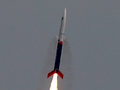 Vikram-S rocket. The first ever privately launched rocket of India.
.png)
See also
[edit]


References
[edit]- ^ "Skyroot Aerospace posts Rs 55 Cr loss in FY23". Entrackr.
- ^ "About Skyroot". www.skyroot.in. Retrieved 19 November 2025.
- ^ Madhok, Swati Gupta,Diksha (18 November 2022). "India's first private rocket Vikram-S is launched into space | CNN Business". CNN. Retrieved 4 September 2025.
{{cite web}}: CS1 maint: multiple names: authors list (link) - ^ "India's Private Space Race Lifts Off with Singapore". The Straits Times. 29 September 2025. ISSN 0585-3923. Retrieved 15 November 2025.
- ^ "Skyroot | Opening Space For All". skyroot.in. Retrieved 19 November 2022.
- ^ Kumar, CR; Krishnan, Raghu (17 April 2019). "With a simpler rocket, Skyroot is eyeing the space". The Economic Times. Retrieved 21 August 2020.
- ^ Chowdhury, Shubhangi (11 September 2021). "Skyroot Aerospace becomes first private company to formally enter into an agreement with ISRO". IndianStartupNews. Archived from the original on 11 September 2021. Retrieved 18 April 2022.
- ^ Etherington, Darrell (12 August 2020). "India's first private space launch startup Skyroot succeeds with upper-stage engine fire test". Tech Crunch. Retrieved 21 August 2020.
- ^ "India's first private player to successfully test a homegrown rocket engine is on track for its first full rocket launch by 2021". Business Insider. Retrieved 12 August 2020.
- ^ "3 Hyderabad firms bag top startup awards | Hyderabad News - Times of India". The Times of India. 7 October 2020.
- ^ Dhruva Space [@DhruvaSpace] (20 November 2020). "Broadening the value of our Space and Launch Services we entered into an MoU with @SkyrootA today, India's very own Private Launch Provider. #NewSpace #Satellite #Launch #NewSpaceIndia #skyroot #DhruvaSpace https://t.co/cT0aWdX25h" (Tweet). Retrieved 11 January 2021 – via Twitter.
- ^ "Non-Disclosure Agreement signed with M/S Skyroot - ISRO". Archived from the original on 14 February 2021. Retrieved 18 February 2021.
- ^ @SkyrootA (8 February 2021). "We are delighted to announce our..." (Tweet) – via Twitter.
- ^ @AegisGrahamBell (1 March 2021). "Congratulations Pawan K Chandana and Skyroot team for winning the Aegis Graham Bell Jury's Choice Award" (Tweet). Archived from the original on 1 March 2021 – via Twitter.
- ^ "Skyroot Aerospace raises $11 million in Series-A round led by Greenko founders - Times of India". The Times of India. 21 May 2021.
- ^ "In a first, space dept signs pact with Hyderabad startup to provide access to Isro facilities | Hyderabad News - Times of India". The Times of India. 13 September 2021.
- ^ "LinkedIn Top Startups 2021: The 25 Indian companies on the rise".
- ^ "Skyroot raises funding led by Google's Ram Shriram". 27 January 2022.
- ^ "Rebranding". Twitter. 10 May 2022. Retrieved 10 May 2022.
- ^ "National Award for Technology Startups". Twitter. 11 May 2022. Retrieved 11 May 2022.
- ^ Bhattacharjee, Nivedita (18 November 2022). "India successfully launches first privately made rocket". Reuters. Retrieved 28 August 2023.
- ^ Madhok, Swati Gupta, Diksha (18 November 2022). "India's first private rocket Vikram-S is launched into space | CNN Business". CNN. Retrieved 20 November 2022.
{{cite web}}: CS1 maint: multiple names: authors list (link) - ^ "India's Skyroot Raises $27.5 Million In Fresh Funding Round | Aviation Week Network". aviationweek.com. Retrieved 2 November 2023.
- ^ Sadam, Rishika (30 October 2023). "Skyroot raises $27.5 mln, heating up India's private sector space race". Reuters. Retrieved 2 November 2023.
- ^ "Telangana inks pact with Skyroot to launch India's first integrated rocket facility with ₹500 crore investment". The Hindu. 25 January 2025.
- ^ "Skyroot Aerospace Hits Unicorn Status: What It Means for Indian Space Stocks". welthwest.com. 7 May 2026. Retrieved 8 May 2026.
- ^ "India's 1st pvt sector rocket facility in unveiled Hyderabad". The Times of India. 25 October 2023. ISSN 0971-8257. Retrieved 29 November 2025.
- ^ Madanapalle, Aditya (1 November 2023). "Skyroot Aerospace provides glimpse of Kalam-1200 motor ahead of Vikram I launch". News9live. Retrieved 29 November 2025.
- ^ "Isro chief visits Skyroot's Max-Q facility, briefed on Vikram-I developments". India Today. 3 April 2024. Retrieved 29 November 2025.
- ^ Kurmanath, K. V. (18 August 2025). "Inside Skyroot's Max-Q Campus: Crafting India's next rocket". BusinessLine. Retrieved 29 November 2025.
- ^ Bharadwaj, Swati; Singh, Surendra (28 November 2025). "Modi unveils Skyroot's Infinity campus, India's 1st pvt commercial rocket; says India set to be global leader in sat launch ecosystem". The Times of India. ISSN 0971-8257. Retrieved 29 November 2025.
- ^ Sharma, Kirti (27 November 2025). "What is Skyroot Infinity Campus? PM Modi Unveils India's Private Orbital Rocket Vikram-I". jagranjosh.com. Retrieved 29 November 2025.
- ^ "Launch Vehicle". Skyroot Aerospace. 10 January 2019. Archived from the original on 15 December 2020. Retrieved 21 August 2020.
- ^ "With Skyroot at the head of the class, India's private space industry seeks to take off". Ars Technica. 11 May 2026. Retrieved 20 May 2026.
- ^ PTI (13 August 2020). "Hyderabad startup Skyroot Aerospace test-fires upper stage rocket engine 'Raman'". The Times of India. Archived from the original on 9 January 2022. Retrieved 16 August 2020.
- ^ Pandey, Ashish (14 August 2020). "Hyderabad-based startup Skyroot Aerospace's Raman: India's first homegrown rocket engine". India Today. Retrieved 16 August 2020.
- ^ Goyal, Shikha (17 August 2020). "First Indian start-up firm Skyroot Aerospace to test fire rocket engine 'Raman': All you need to know". Jagran Josh. Retrieved 21 August 2020.
- ^ "Skyroot Aerospace becomes first Indian startup to test upper-stage rocket engine". The Asian Age. 13 August 2020. Retrieved 14 December 2020.
- ^ "Skyroot tests solid propulsion rocket engine, aims at a rocket by 2021 end". The Economic Times. 28 December 2020. Retrieved 31 December 2020.
- ^ Etherington, Darrell (29 December 2020). "Skyroot successfully test fires India's first privately-made solid rocket stage". TechCrunch. Archived from the original on 10 November 2021.
- ^ Skyroot Aerospace: Kalam-5 Solid Rocket Motor Test Fire, 27 December 2020, retrieved 25 November 2021
- ^ "Skyroot Aerospace becomes first Indian company to test-fire solid-fueled rocket engine". 28 December 2020.
- ^ "Skyroot successfully test fires space launch vehicle 'Vikram-1' rocket stage", The Hindu, 19 May 2022, retrieved 19 May 2022
- ^ Indian launch startup Skyroot successfully completes full-duration stage test, retrieved 19 May 2022
- ^ Static Fire Test, Vikram-1 Stage 3, Kalam-100, 18 May 2022, retrieved 19 May 2022
- ^ Burgess, Molly (25 September 2020). "Skyroot Aerospace unveils cryogenic rocket engine". gasworld. Retrieved 26 September 2020.
- ^ Siddarth MP (25 September 2020). "Startup Skyroot Aerospace unveils India's first privately developed Cryogenic Rocket engine". Zee News. Archived from the original on 25 September 2020. Retrieved 25 September 2020.
- ^ "Space startup unveils India's first privately developed Cryogenic Rocket engine". WION. 25 September 2020. Retrieved 25 September 2020.
- ^ Kumar, Chethan (25 November 2021). "Cryogenic: India's first private cryogenic engine test fired by Skyroot". The Times of India. Archived from the original on 27 November 2021. Retrieved 25 November 2021.
- ^ Shukla, Ajai (11 September 2024). "Nibe shoots for stars with Earth observation satellite constellation". Business Standard. Retrieved 18 September 2024.
- ^ Kumar, Chethan (26 June 2025). "Axiom partners with India's skyroot to boost access to low-earth orbit". The Times of India. ISSN 0971-8257. Retrieved 27 June 2025.
- ^ Gupta, Sanjana (26 June 2025). "Axiom Space Partners with India's Skyroot Aerospace to Boost Space Exploration". Analytics India Magazine. Retrieved 27 June 2025.
- ^ "Axiom Space ties up with Hyderabad-based Skyroot". BusinessLine. 25 June 2025. Retrieved 27 June 2025.
- ^ Ketkar, Swati (26 June 2025). "Skyroot Aerospace, Axiom Space join hands for low-earth-orbit access". english.mathrubhumi.com. Retrieved 27 June 2025.
External links
[edit]
| Organisations |
|  | |||||
|---|---|---|---|---|---|---|---|
| Programmes | |||||||
| Satellites | |||||||
| Space observatories |
| ||||||
| Lunar and planetary spacecraft |
| ||||||
| Human spaceflight | |||||||
| Launch vehicles |
| ||||||
| Engines |
| ||||||
| Spaceports | |||||||
| Research facilities | |||||||
| Communications | |||||||
| Legislation and policy | |||||||
| Private companies | |||||||
| Related |
| ||||||
| Satellites |
|  | ||||||||||
|---|---|---|---|---|---|---|---|---|---|---|---|---|
| Space probes |
| |||||||||||
| Human spaceflight | ||||||||||||
| ||||||||||||
Skyroot Aerospace
View on GrokipediaOverview
Founding and Leadership
Skyroot Aerospace was established on June 12, 2018, in Hyderabad, India, by Pawan Kumar Chandana and Naga Bharath Daka, both former scientists at the Indian Space Research Organisation (ISRO).[12] The company emerged from the founders' ambition to develop India's first privately built orbital launch vehicle, aiming to provide cost-effective access to space for small satellites and democratize space technology.[13] Chandana serves as co-founder and chief executive officer (CEO), while Daka holds the positions of co-founder and chief operating officer (COO).[2] Prior to founding Skyroot, Chandana and Daka gained extensive experience at ISRO, contributing to critical launch vehicle programs such as the Polar Satellite Launch Vehicle (PSLV) and Geosynchronous Satellite Launch Vehicle (GSLV).[14][13] Chandana, an IIT Kharagpur alumnus with degrees in mechanical engineering and thermal science, worked on systems engineering for solid rocket boosters and cryogenic stages in these projects, honing expertise in propulsion and integration.[14] Daka, similarly, applied his ISRO background in rocket development to support the startup's early technical foundation.[13] The leadership structure has evolved significantly since inception, with strategic hires from ISRO and other aerospace organizations bolstering the team's capabilities through 2025.[2] Key additions include experts in propulsion, avionics, and operations, drawn from ISRO's Vikram Sarabhai Space Centre and international firms, enabling the company to scale its workforce to over 500 professionals.[15] In June 2025, former ISRO Chairman S. Somanath joined as honorary chief technical advisor, bringing his launch vehicle expertise from missions like Chandrayaan-3 to guide Skyroot's orbital ambitions.[16] The board of directors further supports this structure, featuring industry leaders such as Mukesh Bansal, founder of Myntra and CureFit, and Mayank Rawat, managing director at GIC India.[2]Mission and Operations
Skyroot Aerospace's mission is to democratize access to space by developing responsive, reliable, and cost-effective launch vehicles that enable on-demand small satellite deployments, ultimately making spaceflight as routine and accessible as air travel.[2] This objective addresses key barriers in the space industry, such as high costs and long lead times, by focusing on innovative technologies tailored for the small satellite market, thereby fostering broader participation in space activities.[1] The founders' prior experience at the Indian Space Research Organisation (ISRO) has informed this mission, emphasizing practical innovation drawn from public sector expertise.[7] Operationally, Skyroot prioritizes rapid prototyping and iterative testing to accelerate development cycles, leveraging advanced manufacturing techniques like 3D printing for components in its Vikram series rockets.[17] The company pursues vertical integration by handling in-house design, fabrication, and testing of critical systems, which minimizes dependencies on external suppliers and enhances control over quality and timelines.[18] As a key player in India's private space sector, Skyroot contributes to the national ecosystem by aligning with government reforms that promote commercial innovation and self-reliance in space technology.[5] Skyroot's infrastructure supports these operations through its headquarters and research and development center in Hyderabad, Telangana, which serve as hubs for engineering and prototyping activities. In January 2025, the company signed an agreement with the Telangana government to establish India's first integrated private rocket manufacturing, integration, and testing facility, backed by an investment of ₹500 crore to scale production capabilities.[19] As of November 2025, Skyroot employs approximately 500 professionals, underscoring its emphasis on building a skilled in-house team dedicated to the end-to-end design and realization of the Vikram launch vehicles.[5]History
Early Development
Skyroot Aerospace was founded in June 2018 by former ISRO scientists Pawan Kumar Chandana and Naga Bharath Daka in Hyderabad, Telangana, with the goal of developing affordable launch vehicles to enable on-demand access to space.[20] The company was established as India's first private space launch provider, initially operating from a modest setup and focusing on leveraging indigenous space expertise combined with agile startup methodologies to design and prototype rocket systems.[2] Under the founders' leadership, early research and development efforts emphasized in-house innovation in propulsion and structural technologies, laying the groundwork for scalable launch capabilities. In the following years, Skyroot advanced its initial prototypes, conceptualizing the Vikram-S as a single-stage, solid-propellant sounding rocket to validate key subsystems such as carbon-composite structures and spin stabilization mechanisms.[21] This suborbital vehicle served as a technology demonstrator, with design and integration work progressing through 2019 and 2020 to test flight-critical components ahead of full-scale missions. Concurrently, the company conducted its first major propulsion validation in August 2020 by successfully test-firing the Raman-1, a hypergolic liquid upper-stage engine capable of precise orbital insertion maneuvers for small satellites.[22] This hot test at their Hyderabad facility marked India's first private-sector demonstration of a full-scale liquid engine technology, confirming ignition reliability and thrust performance.[23] By 2021, Skyroot secured essential regulatory milestones, including recognition from the Indian National Space Promotion and Authorization Centre (IN-SPACe) as one of the inaugural private entities authorized for space activities.[20] This paved the way for formal collaborations with ISRO, culminating in a September 2021 Framework Memorandum of Understanding (MoU) between the Department of Space and Skyroot, granting access to ISRO's testing facilities and technical know-how for prototype qualification. The agreement facilitated shared expertise in areas like propulsion testing and launch infrastructure, enabling Skyroot to accelerate validations without duplicating national assets.Key Milestones and Funding
Skyroot Aerospace achieved a historic milestone on November 18, 2022, with the successful suborbital launch of its Vikram-S rocket from the Satish Dhawan Space Centre in Sriharikota, marking India's first privately developed rocket flight.[24] The single-stage, solid-propellant vehicle reached an apogee of 89.5 km, surpassing its target altitude of over 80 km, and carried three payloads while demonstrating key technologies like telemetry and separation systems.[12] This launch, named Mission Prarambh, was conducted in collaboration with ISRO under IN-SPACe authorization, validating the company's capabilities in private spaceflight.[25] The company's growth was bolstered by significant funding rounds, beginning with a $11 million Series A investment in May 2021 led by Greenko Group promoters, which supported Vikram-1 development and talent acquisition.[26] In September 2022, Skyroot raised $51 million in a Series B funding round led by GIC.[27] In October 2023, Skyroot secured $27.5 million in a pre-Series C round led by Temasek Holdings, with participation from existing investors including GIC and Chiratae Ventures, bringing total funding to over $95 million at the time.[28] As of November 2025, total funding raised is approximately $99.8 million.[29] These investments highlighted investor confidence in Skyroot's role in India's burgeoning private space sector. Skyroot received notable recognitions for its innovations, including the 2023 Excellence Award at the Indian Space Conclave for contributions to aerospace technology.[30] It was also acknowledged by IN-SPACe as a pioneer in private space activities, being the first to launch from ISRO facilities post-2020 reforms.[31] Earlier accolades, such as the National Startup Award in 2020 for propulsion technologies, further underscored its impact.[2] In 2025, Skyroot advanced toward orbital capabilities with key tests and partnerships. On October 14, it completed a full stage-level test of the Orbital Adjustment Module (OAM) for Vikram-1, firing over 1,000 thruster pulses to validate precise orbital maneuvers and attitude control.[9] Earlier in January, the company signed a Memorandum of Understanding (MoU) with the Telangana government to establish an integrated private rocket manufacturing, integration, and testing facility, backed by an investment of approximately ₹500 crore to create over 1,000 jobs and boost local space infrastructure.[19] These developments positioned Skyroot for its inaugural orbital mission later in the year.Technology and Products
Launch Vehicles
Skyroot Aerospace's Vikram family of launch vehicles consists of small-lift rockets designed for suborbital and orbital missions, emphasizing lightweight carbon composite structures and a modular architecture to enable rapid assembly and scalability. These vehicles aim to provide cost-effective access to space for small satellites, supporting dedicated and rideshare launches with customizable orbital insertions. The family integrates in-house propulsion technologies, prioritizing reliability and performance for commercial operations.[1] The inaugural vehicle, Vikram-S, is a single-stage suborbital sounding rocket developed for technology demonstration and system validation. Standing 6 meters tall with a diameter of 0.375 meters and a launch mass of approximately 545 kg, it features an all-carbon fiber composite structure for enhanced strength-to-weight ratio. Launched successfully on November 18, 2022, from Sriharikota, it achieved a peak altitude of 89.5 km and a maximum velocity of Mach 5.07 during a 301-second flight, carrying three customer payloads to test avionics, telemetry, and recovery systems critical for future orbital vehicles.[25][32][33] Vikram-I represents the family's first orbital-class vehicle, a two-stage rocket capable of delivering payloads to low Earth orbit (LEO). With an all-carbon composite airframe and modular design allowing assembly in under 24 hours, it supports multi-satellite deployments. It can carry up to 260 kg to a 500 km sun-synchronous orbit (SSO) or 350 kg to LEO, though some analyses specify 290 kg to SSO and 480 kg to a 45° inclination LEO at 500 km. As of late 2025, Vikram-I remains in advanced development, with its maiden flight targeted for early 2026 following ground tests and integration milestones.[1][34][35] Vikram-II is an enhanced two-stage variant building on Vikram-I's architecture, incorporating advanced propulsion for increased performance. It features a carbon composite structure and is designed to handle up to 600 kg to SSO or 900 kg to LEO, enabling broader commercial applications for constellation deployments. Development is ongoing, with the first flight planned for 2026-2027 to demonstrate higher payload capacities and refined orbital precision.[1] Vikram-III is a conceptual reusable launch vehicle under early development, aimed at further scaling the family's capabilities with recoverable stages to reduce costs for frequent launches. While specific specifications remain preliminary, it targets payloads exceeding those of Vikram-II, potentially up to 800 kg or more to LEO, focusing on sustainability and higher mission rates. As of 2025, it is in the design phase, with reusability features drawing from lessons in the earlier Vikram models.[36][37]| Vehicle | Type | Height | Launch Mass | Payload to SSO (500 km) | Payload to LEO (500 km) | Status (as of Nov 2025) |
|---|---|---|---|---|---|---|
| Vikram-S | Suborbital | 6 m | 545 kg | N/A | N/A | Launched 2022 |
| Vikram-I | Orbital (2-stage) | ~18-21 m (7 storeys) | N/A | 260-290 kg | 350-480 kg | Maiden flight 2026 |
| Vikram-II | Orbital (2-stage) | N/A | N/A | 600 kg | 900 kg | In development, flight 2026-2027 |
| Vikram-III | Reusable Orbital | N/A | N/A | >600 kg (est.) | >900 kg (est.) | Conceptual |