



Community hub
Recent from talks
Contribute something
Nothing was collected or created yet.
Sliding (motion)
View on Wikipedia| Part of a series on |
| Classical mechanics |
|---|


Sliding is a type of motion between two surfaces in contact. This can be contrasted to rolling motion. Both types of motion may occur in bearings.
The relative motion or tendency toward such motion between two surfaces is resisted by friction. This means that the force of friction always acts on an object in the direction opposite to its velocity (relative to the surface it's sliding on). Friction may damage or "wear" the surfaces in contact. However, wear can be reduced by lubrication. The science and technology of friction, lubrication, and wear is known as tribology.
Sliding may occur between two objects of arbitrary shape, whereas rolling friction is the frictional force associated with the rotational movement of a somewhat disclike or other circular object along a surface. Generally, the frictional force of rolling friction is less than that associated with sliding kinetic friction.[1] Typical values for the coefficient of rolling friction are less than that of sliding friction.[2] Correspondingly sliding friction typically produces greater sound and thermal bi-products. One of the most common examples of sliding friction is the movement of braking motor vehicle tires on a roadway, a process which generates considerable heat and sound, and is typically taken into account in assessing the magnitude of roadway noise pollution.[3]
Sliding friction
[edit]Sliding friction (also called kinetic friction) is a contact force that resists the sliding motion of two objects or an object and a surface. Sliding friction is almost always less than that of static friction; this is why it is easier to move an object once it starts moving rather than to get the object to begin moving from a rest position.

Where Fk, is the force of kinetic friction. μk is the coefficient of kinetic friction, and N is the normal force.
Examples of sliding friction
[edit]
- Sledding
- Pushing an object across a surface
- Rubbing one's hands together (The friction force generates heat.)
- A car sliding on ice
- A car skidding as it turns a corner
- Opening a window
- Almost any motion where there is contact between an object and a surface

- Falling down a bowling lane
Motion of sliding friction
[edit]The motion of sliding friction can be modelled (in simple systems of motion) by Newton's second law


Where is the external force.

- Acceleration occurs when the external force is greater than the force of kinetic friction.
- Slowing Down (or Stopping) occurs when the force of kinetic friction is greater than that of the external force.
- This also follows Newton's first law of motion as there exists a net force on the object.
- Constant Velocity occurs when there is no net force on the object, that is the external force is equal to force of kinetic friction.
Motion on an inclined plane
[edit]
A common problem presented in introductory physics classes is a block subject to friction as it slides up or down an inclined plane. This is shown in the free body diagram to the right.
The component of the force of gravity in the direction of the incline is given by:[4]
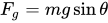
The normal force (perpendicular to the surface) is given by:

Therefore, since the force of friction opposes the motion of the block,

To find the coefficient of kinetic friction on an inclined plane, one must find the moment where the force parallel to the plane is equal to the force perpendicular; this occurs when the block is moving at a constant velocity at some angle

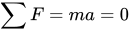
or


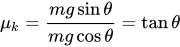
Here it is found that:
where is the angle at which the block begins moving at a constant velocity[5]
References
[edit]- ^ Benjamin Silliman, Principles of Physics, Or Natural Philosophy, Ivison, Blakeman, Taylor & company publishers, 710 pages (1871)
- ^ Hans-Jürgen Butt, Karlheinz Graf, Michael Kappl, Physics and Chemistry of Interfaces, Wiley Publishers, 373 pages, ISBN 3-527-40413-9 (2006)
- ^ Hogan, C. Michael (1973). "Analysis of highway noise". Water, Air, and Soil Pollution. 2 (3): 387–392. Bibcode:1973WASP....2..387H. doi:10.1007/BF00159677. S2CID 109914430.
- ^ "New Page 1". www.pstcc.edu. Retrieved 2017-04-10.
- ^ "Friction". hyperphysics.phy-astr.gsu.edu. Retrieved 2017-04-10.
Sliding (motion)
View on GrokipediaFundamentals of Sliding Motion
Definition and Characteristics
Sliding motion is defined as the relative tangential displacement of one body over another while the surfaces remain in continuous contact, encompassing both linear and curvilinear paths under kinetic conditions where motion has been initiated.[8] This type of motion occurs in tribological systems, where the interacting surfaces experience relative movement without separation, distinguishing it from other forms of contact dynamics.[9] Key characteristics of sliding motion include the maintenance of persistent contact at the interface, accompanied by shear deformation of the material at the points of interaction.[10] Microscopically, this deformation arises from the behavior of surface asperities—protrusions on rough surfaces—that initially interlock under load before yielding to enable the relative displacement.[11] During sliding, mechanical energy is dissipated primarily as heat through processes at the interface, contributing to the thermodynamic aspects of the motion.[12] In contrast to intermittent motions like bouncing, which involve repeated separation and impact, sliding features unbroken contact throughout the displacement.[8] Early observations of sliding motion trace back to the late 15th century, when Leonardo da Vinci systematically studied it in the context of mechanical devices such as axles and screw threads, recognizing its role in rotational resistance and establishing foundational insights into tribological phenomena.[13] These investigations highlighted sliding as a core interaction in engineering systems, influencing later developments in the science of interacting surfaces.[14] This motion is inherently opposed by friction, a tangential force that resists the relative movement, though detailed analysis of such forces lies beyond the qualitative description here.[15]Comparison with Other Motions
Sliding motion fundamentally differs from static friction, where no relative motion occurs between contacting surfaces, as sliding involves continuous relative displacement opposed by kinetic friction. In static friction, the frictional force adjusts up to a maximum value to prevent motion, whereas in sliding, the kinetic frictional force remains constant and opposes the direction of motion once sliding begins.[3] This distinction highlights sliding's role in dissipative processes, where energy is lost as heat due to surface interactions.[16] Compared to rolling motion, sliding lacks rotational components, leading to higher energy dissipation through direct surface shearing without the friction-minimizing effect of rotation. Rolling relies on static friction at the point of contact to enable pure rotation without slipping, resulting in lower overall resistance, while sliding converts kinetic energy primarily into thermal losses via kinetic friction.[17] Sliding also contrasts with fluid motion, such as in viscous flows, where resistance arises from shear within the fluid rather than direct solid-solid contact, avoiding the wear associated with sliding's asperity interactions.[4] The transition from static to sliding occurs at the yield point, or impending motion, where the applied force exceeds the maximum static friction, initiating kinetic friction and relative sliding. This boundary is characterized by a drop in frictional force, often abrupt in dry contacts, marking the onset of energy dissipation through sliding.[18]| Aspect | Sliding Motion | Rolling Motion |
|---|---|---|
| Friction Type | Kinetic (opposes sliding) | Static (prevents slipping at contact) |
| Energy Efficiency | Low; high dissipation as heat | High; minimal losses due to rotation |
| Wear Characteristics | High; direct surface abrasion | Low; reduced contact deformation |
| Setup Complexity | Simple (flat surfaces) | Complex (requires rounded objects) |
Principles of Sliding Friction
Kinetic Friction Force
Kinetic friction is the tangential force that opposes the relative motion between two surfaces in contact while sliding occurs. This force, denoted as , is empirically described by Amontons' first law of friction, which states that , where is the coefficient of kinetic friction (a dimensionless material-dependent constant) and is the normal force pressing the surfaces together.[22] Amontons formulated this relationship in 1699 based on experiments with sliding wooden blocks, establishing that the frictional resistance is independent of the apparent contact area but proportional to the load.[22] The coefficient typically ranges from 0.1 to 1.0 for dry engineering surfaces, reflecting the efficiency of energy dissipation during motion.[23] At the microscopic level, kinetic friction arises from interactions at the asperities— the microscopic peaks and valleys on contacting surfaces— leading to energy loss through several mechanisms. Adhesion occurs when clean surface atoms form junctions that must be sheared during sliding, contributing significantly to the frictional force as described in the adhesion theory developed by Bowden and Tabor in the 1930s and 1940s. Plowing involves the harder asperities indenting and displacing the softer material, creating grooves that require work to overcome, while asperity deformation encompasses elastic and plastic straining at contact points, all resulting in irreversible energy dissipation as heat or vibrations.[24] These processes collectively explain why kinetic friction converts mechanical work into thermal energy, with the real contact area (much smaller than the apparent area) determining the scale of interactions.[25] The direction of the kinetic friction force is always opposite to the direction of the relative velocity between the sliding surfaces, ensuring it acts to impede motion.[26] For dry sliding at low speeds (typically below 1 m/s), the magnitude of remains approximately constant, independent of velocity, as per Amontons' second law, which aligns with the steady-state nature of asperity interactions.[22] However, in lubricated conditions, slight velocity dependence can emerge due to changes in lubricant film thickness and shear behavior, where higher speeds may reduce through hydrodynamic effects.[27] This empirical law and its microscopic basis have been verified experimentally using tribometers, which measure lateral forces during controlled sliding under varying loads.[28] Pin-on-disk or ball-on-flat tribometers, for instance, confirm the linear load dependence and near-constant velocity independence for dry contacts, with precision force sensors detecting to within 0.01 N.[29] In lubricated systems, such as those with oils, tribometer tests reveal modest increases or decreases in with velocity, attributed to viscous shearing in the lubricant layer.[30]Factors Influencing Friction
The magnitude of sliding friction is primarily determined by surface roughness, the properties of the interacting materials, and the applied normal load. Surface roughness affects friction through interactions between asperities, the microscopic peaks and valleys on contacting surfaces; the effect on the kinetic friction coefficient (μ_k) varies depending on the dominant mechanism—in dry contacts where plowing or mechanical interlocking prevails, rougher surfaces can increase μ_k, while in adhesion-dominated regimes, they may decrease it by reducing the real contact area. For instance, in dry metal contacts, the influence of roughness depends on the specific material pair and conditions. The specific combination of materials also plays a key role, as different pairs exhibit characteristic μ_k values due to variations in adhesion, hardness, and surface chemistry. Typical μ_k for dry steel on steel ranges from 0.3 to 0.6, reflecting strong metallic bonding and deformation under load.[31] Similarly, ice on ice yields a low μ_k of approximately 0.03, attributed to minimal adhesion and easy shear at the interface.[31] The following table summarizes representative μ_k values for common dry material pairs, measured under standard conditions:| Material 1 | Material 2 | Approximate μ_k (dry) |
|---|---|---|
| Steel | Steel | 0.3 |
| Ice | Ice | 0.03 |
| Wood | Wood | 0.3 |
| Rubber | Concrete | 0.7 |
| Teflon | Steel | 0.04 |