Hubbry Logo
SwabiaSwabiaMain
Open search
Swabia
Community hub
Swabia
logo
8 pages, 0 posts
0 subscribers
Be the first to start a discussion here.
Swabia
Swabia
from Wikipedia
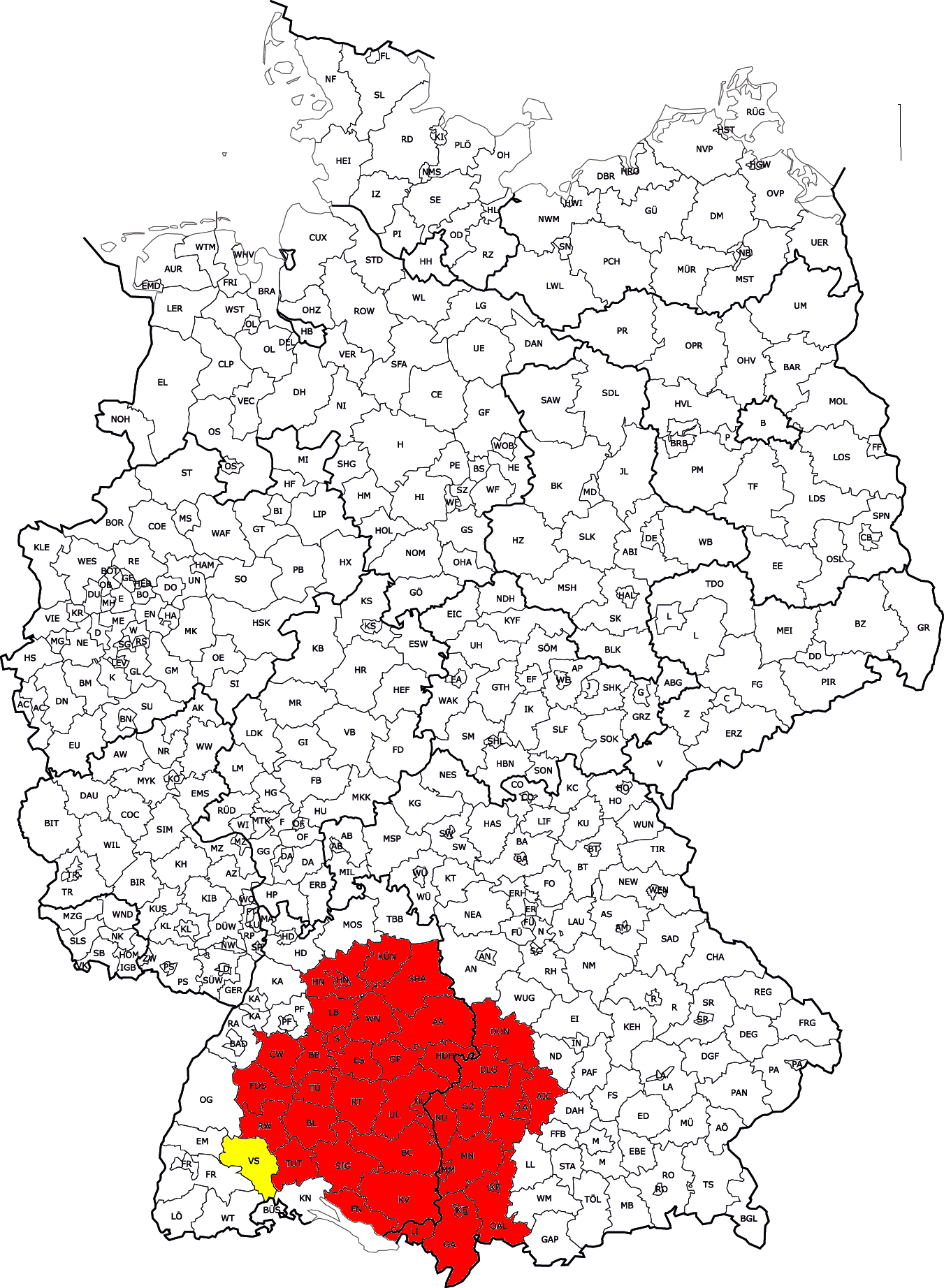
Today's Swabia within Germany. The Schwarzwald-Baar-Kreis (yellow) is at the transitional area of the Swabian, Upper Rhenish and Lake Constance dialects of Alemannic. The western Bodenseekreis district is not considered a part of modern Swabia. The dividing line is between Baden-Württemberg (west) and Bavaria (east).
The coat of arms of Baden-Württemberg: Or, three lions passant sable, the arms of the Duchy of Swabia, in origin the arms of the House of Hohenstaufen. Also used for Swabia (and Württemberg-Baden, 1945–1952) are the three antlers of the coat of arms of Württemberg.

Swabia[nb 1] is a cultural, historic and linguistic region in southwestern Germany. The name is ultimately derived from the medieval Duchy of Swabia, one of the German stem duchies, representing the historic settlement area of the Germanic tribe alliances named Alemanni and Suebi.

This territory would include all of the Alemannic German area, but the modern concept of Swabia is more restricted, due to the collapse of the duchy of Swabia in the thirteenth century. Swabia as understood in modern ethnography roughly coincides with the Swabian Circle of the Holy Roman Empire as it stood during the early modern period, now divided between the states of Bavaria and Baden-Württemberg.

Swabians (Schwaben, singular Schwabe) are the natives of Swabia and speakers of Swabian German. Their number was estimated at close to 800,000 by SIL Ethnologue as of 2006, out of a total population of 7.5 million in the regions of Tübingen, Stuttgart and Bavarian Swabia.

Geography

[edit]

Like many cultural regions of Europe, Swabia's borders are not clearly defined. However, today it is normally thought of as comprising the former Swabian Circle, or equivalently the former state of Württemberg (with the Prussian Hohenzollern Province), or the modern districts of Tübingen (excluding the former Baden regions of the Bodenseekreis district), Stuttgart, and the administrative region of Bavarian Swabia.

In the Middle Ages, the term Swabia indicated a larger area, covering all the lands associated with the Frankish stem duchy of Alamannia stretching from the Vosges Mountains in the west to the broad Lech river in the east:

History

[edit]
Duchy of Swabia around AD 1000 shown in gold yellow including (present-day) Alsace, the southern part of Baden-Württemberg, Bavarian Swabia, Vorarlberg in Austria, Liechtenstein, eastern Switzerland and small parts of northern Italy. In green: Upper Burgundy.

Early history

[edit]

Like all of Southern Germany, what is now Swabia was part of the La Tène culture; as such, it has a Celtic (Gaulish) substrate. In the Roman era, it was part of the Raetia province.

The name Suebia is derived from that of the Suebi. It is used already by Tacitus in the 1st century, albeit in a different geographical sense: He calls the Baltic Sea the Mare Suevicum ("Suebian Sea") after the Suiones, and ends his description of the Suiones and Sitones with "Here Suebia ends" (Hic Suebiae finis).[1] By the mid-3rd century, groups of the Suebi form the core element of the new tribal alliance known as the Alamanni, who expanded towards the Roman Limes east of the Rhine and south of the Main. The Alamanni were sometimes referred to as Suebi even at this time, and their new area of settlement came to be known as Suebia. In the migration period, the Suebi (Alamanni) crossed the Rhine in 406 and some of them established the Kingdom of the Suebi in Galicia. Another group settled in parts of Pannonia, after the Huns were defeated in 454 in the Battle of Nedao.

The Alemanni were ruled by independent kings throughout the 4th to 5th centuries but fell under Frankish domination in the 6th (Battle of Tolbiac 496).[2] By the late 5th century, the area settled by the Alemanni extended to Alsace and the Swiss Plateau, bordering on the Bavarii to the east, the Franks to the north, the remnants of Roman Gaul to the west, and the Lombards and Goths, united in the Kingdom of Odoacer, to the south.

The name Alamannia was used by the 8th century, and from the 9th century, Suebia was occasionally used for Alamannia, while Alamannia was increasingly used to refer to Alsace specifically. By the 12th century, Suebia rather than Alamannia was used consistently for the territory of the Duchy of Swabia.[3]

Duchy of Swabia

[edit]

Swabia was one of the original stem duchies of East Francia, the later Holy Roman Empire, as it developed in the 9th and 10th centuries. Due to the foundation of the important abbeys of St. Gallen and Reichenau, Swabia became an important center of Old High German literary culture during this period.

In the later Carolingian period, Swabia became once again de facto independent, by the early 10th century mostly ruled by two dynasties, the Hunfriding counts in Raetia Curiensis and the Ahalolfings ruling the Baar estates around the upper Neckar and Danube rivers. The conflict between the two dynasties was decided in favour of Hunfriding Burchard II at the Battle of Winterthur (919).[4] Burchard's rule as duke was acknowledged as such by the newly elected king Henry the Fowler, and in the 960s the duchy under Burchard III was incorporated in the Holy Roman Empire under Otto I.

The Hohenstaufen dynasty, which ruled the Holy Roman Empire in the 12th and 13th centuries, arose out of Swabia, but following the execution of Conradin, the last Hohenstaufen, on 29 October 1268, the duchy was not reappointed during the Great Interregnum. In the following years, the original duchy gradually broke up into many smaller units.

Rudolf I of Habsburg, elected in 1273 as emperor, tried to restore the duchy, but met the opposition of the higher nobility who aimed to limit the power of the emperor. Instead, he confiscated the former estates of the Hohenstaufen as imperial property of the Holy Roman Empire, and declared most of the cities formerly belonging to Hohenstaufen to be Free Imperial Cities, and the more powerful abbeys within the former duchy to be Imperial Abbeys.

The rural regions were merged into the Imperial Shrievalty (Reichslandvogtei) of Swabia, which was given as Imperial Pawn to Duke Leopold III of Austria in 1379 and again to Sigismund, Archduke of Austria, in 1473/1486. He took the title of a "Prince of Swabia" and integrated the Shrievalty of Swabia in the realm of Further Austria.

Later medieval period

[edit]

The Swabian League of Cities was first formed on 20 November 1331, when twenty-two imperial cities of the former Duchy of Swabia banded together in support of the Emperor Louis IV, who in return promised not to mortgage any of them to any imperial vassal. Among the founding cities were Augsburg, Heilbronn, Reutlingen, and Ulm. The counts of Württemberg, Oettingen, and Hohenberg were induced to join in 1340.

The defeat of the city league by Count Eberhard II of Württemberg in 1372 led to the formation of a new league of fourteen Swabian cities on 4 July 1376. The emperor refused to recognise the newly revitalised Swabian League, seeing it as a rebellion, and this led to an "imperial war" against the league. The renewed league defeated an imperial army at the Battle of Reutlingen on 14 May 1377. Burgrave Frederick V of Hohenzollern finally defeated the league in 1388 at Döffingen. The next year the city league disbanded according to the resolutions of the Reichstag at Eger.

The major dynasties that arose out of medieval Swabia were the Habsburgs and the Hohenzollerns, who rose to prominence in Northern Germany. Also stemming from Swabia are the local dynasties of the dukes of Württemberg and the margraves of Baden. The Welf family went on to rule in Bavaria and Hanover, and are ancestral to the British Royal Family that has ruled since 1714. Smaller feudal dynasties eventually disappeared, however; for example, branches of the Montforts and Hohenems lived until modern times, and the Fürstenberg survive still. The region proved to be one of the most divided in the empire, containing, in addition to these principalities, numerous free cities, ecclesiastical territories, and fiefdoms of lesser counts and knights.

Early modern history

[edit]
Map of the Swabian Circle (1756)

A new Swabian League (Schwäbischer Bund) was formed in 1488, opposing the expansionist Bavarian dukes from the House of Wittelsbach and the revolutionary threat from the south in the form of the Swiss.[5] In 1519, the League conquered Württemberg and sold it to Charles V after its duke Ulrich seized the Free Imperial City of Reutlingen during the interregnum that followed the death of Maximilian I. It helped to suppress the Peasants' Revolt in 1524–26 and defeat an alliance of robber barons in the Franconian War. The Reformation caused the league to be disbanded in 1534.[5]

The territory of Swabia as understood today emerges in the early modern period. It corresponds to the Swabian Circle established in 1512. The Old Swiss Confederacy was de facto independent from Swabia from 1499 as a result of the Swabian War, while the Margraviate of Baden had been detached from Swabia since the twelfth century.

Fearing the power of the greater princes, the cities and smaller secular rulers of Swabia joined to form the Swabian League in the fifteenth century. The League was quite successful, notably expelling the Duke of Württemberg in 1519 and putting in his place a Habsburg governor, but the league broke up a few years later over religious differences inspired by the Reformation, and the Duke of Württemberg was soon restored.

The region was quite divided by the Reformation. While secular princes such as the Duke of Württemberg and the Margrave of Baden-Durlach, as well as most of the Free Cities, became Protestant, the ecclesiastical territories (including the bishoprics of Augsburg, Konstanz and the numerous Imperial abbeys) remained Catholic, as did the territories belonging to the Habsburgs (Further Austria), the Sigmaringen branch of the House of Hohenzollern, and the Margrave of Baden-Baden.

Modern history

[edit]

In the wake of the territorial reorganization of the empire of 1803 by the Reichsdeputationshauptschluss, the shape of Swabia was entirely changed. All the ecclesiastical estates were secularized, and most of the smaller secular states, and almost all of the free cities, were mediatized, leaving only the Kingdom of Württemberg, the Grand Duchy of Baden, and the Principality of Hohenzollern-Sigmaringen as sovereign states. Much of Eastern Swabia became part of Bavaria, forming what is now the Swabian administrative region of Bavaria. The Kings of Bavaria assumed the title Duke in Swabia, with the in indicating that only parts of the Swabian territory was ruled by them, unlike their other title Duke of Franconia which made clear that the whole of Franconia had become part of their kingdom.

In contemporary usage, Schwaben is sometimes taken to refer to Bavarian Swabia exclusively, correctly however it includes the larger Württemberg part of Swabia. Its inhabitants attach great importance to calling themselves Swabians. Baden, historically part of the duchy of Swabia and also of the Swabian Circle, is no longer commonly included in the term. Baden's residents mostly refer to themselves as Alemanni (versus the Swabians).

Swabian people

[edit]

Language

[edit]
The traditional distribution area of Western Upper German ( = Alemannic) dialect features in the nineteenth and twentieth century

SIL Ethnologue cites an estimate of 819,000 Swabian speakers as of 2006. This corresponds to roughly 10% of the total population of the Swabian region, or roughly 1% of the total population of Germany.

As an ethno-linguistic group, Swabians are closely related to other speakers of Alemannic German, i.e. Badeners, Alsatians, and German-speaking Swiss.[6]

Swabian German is traditionally spoken in the upper Neckar basin (upstream of Heilbronn), along the upper Danube between Tuttlingen and Donauwörth, in Upper Swabia, and on the left bank of the Lech, in an area centered on the Swabian Alps roughly stretching from Stuttgart to Augsburg.

Many Swabian surnames end with the suffixes -le, -(l)er, -el, -ehl, and -lin, typically from the Middle High German diminutive suffix -elîn (Modern Standard German -lein). Examples would be: Schäuble, Egeler, Rommel, and Gmelin. The popular German surname Schwab as well as Svevo in Italy are derived from this area, both meaning literally "Swabian".

See also

[edit]

Notes

[edit]

References

[edit]

Sources

[edit]
  • Laffan, R. G. D. (1975). "The Empire under Maximilian I". The New Cambridge Modern History. Vol. I.
  • Minahan, James (2000). One Europe, Many Nations: A Historical Dictionary of European National Groups. Greenwood Publishing Group, Ltd. ISBN 978-0313309847.
[edit]
Revisions and contributorsEdit on WikipediaRead on Wikipedia
from Grokipedia
Swabia (German: Schwaben) is a cultural, historical, and linguistic region situated primarily in southwestern , encompassing significant portions of the modern states of and , with extensions into , western , and . The name originates from the medieval , a of the established around the 10th century and lasting until 1313, which covered much of the upper and basins. This duchy represented the core territory of the earlier Alemannia, settled by the , a confederation of Germanic tribes first attested in Roman sources around 213 AD along the River. The region's defining linguistic feature is the prevalence of dialects, including Swabian variants spoken in areas like and Bavarian Swabia, which differ markedly from and neighboring dialects such as Franconian or Bavarian. These dialects, part of the group, reflect the enduring influence of the Alemannic tribal legacy and contribute to a strong regional identity marked by distinct customs, festivals, and cuisine, including staples like noodles and Maultaschen dumplings. Historically, Swabia played a pivotal role in medieval German through dynasties like the , who produced emperors such as , fostering economic prosperity via trade routes and craftsmanship that laid foundations for later industrial strengths in and . Today, Swabia remains economically vibrant, with clusters of high-tech industries, while preserving a cultural often characterized by thriftiness and community-oriented traditions.

Geography

Physical Features and Climate

Swabia encompasses a varied landscape shaped by geological processes, ranging from elevated plateaus to lacustrine lowlands. The northern portion features the , a geologically ancient, relatively flat upland range formed primarily of , exhibiting a pronounced with a steep drop to the north and gentler slopes toward the southeast along the River valley. This plateau is marked by topography, including dolines, fossil-rich reefs, springs, and Germany's highest concentration of caves, which result from subterranean drainage and dissolution of soluble bedrock. In the south, the terrain transitions to Upper Swabia, a region of rolling hills and basins between the Swabian Jura and the Lech River, descending to approximately 395 meters above sea level at the shores of Lake Constance (Bodensee), Germany's largest inland lake by surface area at 536 square kilometers. Lake Constance, shared with Switzerland and Austria, influences local hydrology and provides a transitional zone to pre-alpine foothills, with the Danube originating nearby and flowing eastward through Swabia's eastern fringes. The region's is classified as temperate oceanic with continental influences, varying by elevation and proximity to water bodies. In the , annual mean temperatures average 6–7 °C, roughly 2 °C cooler than surrounding lowlands due to cliffy terrain trapping cold air in basins, with harsher winters and moderate summers featuring average highs around 23 °C and January lows near -3 °C. totals approximately 800–1,000 mm annually across much of Swabia, concentrated in summer thunderstorms, though features lead to irregular and higher groundwater dependency. Near , the moderates slightly, with lake-effect moderation reducing risk and supporting longer growing seasons, though the broader area remains prone to föhn winds from the exacerbating dry spells.

Boundaries and Subregions

Swabia's boundaries as a cultural and linguistic region remain imprecise, evolving from the medieval Duchy of Swabia to encompass primarily southwestern Germany, with extensions into eastern Switzerland and western Austria. In contemporary terms, the core area lies within Baden-Württemberg and the administrative district of Swabia in Bavaria, roughly delimited westward by the Black Forest and Upper Rhine, eastward by the Lech River, northward by the Swabian Jura and Neckar River basin, and southward by Lake Constance and the northern Alpine fringes. These limits align with the historical Swabian Circle of the Holy Roman Empire, though modern administrative divisions fragment the region across federal states. The region divides traditionally into three subregions: Upper Swabia, Middle Swabia, and Lower Swabia, reflecting variations in terrain, dialect, and historical development. (Oberschwaben) forms the southern zone, spanning from to the , including southeastern districts like and , and southwestern Bavarian areas such as and Oberallgäu; this subregion features undulating hills, wetlands like the Upper Swabian Route, and strong Alemannic influences. Middle Swabia (Mittelschwaben) centers on the area in , incorporating districts of , , Unterallgäu, and Dillingen, marked by the fertile and Lech valleys conducive to agriculture and industry. Lower Swabia (Niederschwaben or Schwäbisches Unterland) occupies the northern extent in , around and extending into the Bauland and areas, where Swabian dialects transition toward Franconian, with flatter landscapes and . These subregions correspond loosely to dialect isoglosses, with Upper and Middle Swabia retaining core Swabian speech patterns, while Lower Swabia shows hybrid traits; administrative overlaps, such as Bavarian Swabia's westward bound by the Iller River and eastward by the Lech, further define local identities within the broader cultural framework.

Administrative Divisions

Swabia does not constitute a unified administrative entity in contemporary but is distributed across the states of and . In , it aligns with the Schwaben, an administrative district established after 1945 with its seat in , covering approximately 10,000 square kilometers and encompassing ten rural districts and four independent cities as of 2023. The rural districts include Aichach-Friedberg, , Dillingen an der Donau, Donau-Ries, , Landkreis Lindau (Bodensee), , Oberallgäu, Ostallgäu, and Unterallgäu. The independent cities are , , (Allgäu), and .
CategoryUnits
Rural Districts (Landkreise)Aichach-Friedberg, , Dillingen an der Donau, Donau-Ries, , Landkreis Lindau (Bodensee), , Oberallgäu, Ostallgäu, Unterallgäu
Independent Cities (Kreisfreie Städte), , (Allgäu),
In , no formal administrative designation exists for Swabia, though the region's cultural and historical core falls within the Regierungsbezirke of and , which together include districts such as Alb-Donau-Kreis, Biberach, , , , , and Zollernalbkreis, primarily associated with , as well as central areas around linked to Lower Swabia. These divisions reflect post-World War II state reorganizations, with Bezirk overseeing much of southeastern 's Swabian territories bordering and . Smaller historical Swabian influences extend into Austrian and , but these lack integration into German administrative frameworks.

History

Origins and Early Settlement

The Swabian Jura preserves some of Europe's earliest evidence of modern human activity, with sites in caves such as Geissenklösterle, , and Vogelherd yielding artifacts from around 43,000 to 33,000 years ago, including the world's oldest known musical instruments (flutes carved from vulture bone and mammoth ivory) and figurative sculptures like the Löwenmensch figurine. These culture remains indicate groups adapted to post-glacial environments, with recent stratigraphic data pushing continuous reoccupation dates back beyond the previously estimated 16,500 years ago. Later prehistoric phases included agricultural settlements circa 5500–2200 BC, Urnfield cremation practices (c. 1300–750 BC), and Celtic oppida and ritual enclosures on the Heuberg plateau during the pre-Roman and La Tène periods (c. 800–15 BC), reflecting a substrate of Celtic tribal organization before deeper Roman penetration. Roman expansion incorporated the core Swabian territories into the ("Ten Cantons"), a wedge-shaped frontier zone spanning the , basin, and Swabian Alb, initially probed by Drusus in 12–9 BC and annexed under around 83–90 AD to secure Rhine-Danube communications and tax revenues from local decumates (tithes). This province featured limes fortifications, villas, and urban centers like Arae Flaviae (modern ), fostering partial Romanization amid Celtic holdouts, until sustained Alemannic incursions from 213 AD culminated in the capture of the in 260 AD during the imperial crisis, prompting partial Roman evacuation east of the . The Alemanni, a loose confederation of West Germanic tribes including Juthungi and Lentienses elements derived partly from Suebic groups, originated near the Main River and Upper Rhine before systematically raiding and resettling Roman territories in southwestern Germany, Alsace, and northern Switzerland from the 3rd to 5th centuries AD. Their establishment displaced Romano-Celtic populations and laid the ethnographic foundation for Swabian identity, with the region's Latin name Alemannia persisting into Frankish times; full subjugation under Clovis I's victory at Tolbiac in 496 AD integrated them into Merovingian Francia, preserving Germanic customs amid Christianization. This Alemannic substrate, rather than direct Suebic continuity, defined early medieval Swabia's tribal character, as evidenced by toponymic and dialectal legacies.

Formation and Peak of the Duchy of Swabia

The Duchy of Swabia originated as a stem duchy of East Francia following the fragmentation of Carolingian authority after the Treaty of Ribemont in 880, which divided the realm and left Alemannia under nominal royal oversight. In 915, King Conrad I, elected after the extinction of the Conradine royal line in 911, invested Burchard I—a local noble with ties to Raetia and Thurgau—as the first duke, granting him consolidated control over the disparate counties of Alemannia to counter threats from Bavaria and Magyars. Burchard I's military successes, including victories over Bavarian Duke Arnulf in 917 and defenses against Hungarian raids, expanded ducal authority eastward into the Breisgau and Ortenau regions by his death in 926. Burchard II succeeded his father in 926 and strengthened ties to the Ottonian kings through his marriage to Hedwig, sister of Otto I, which integrated Swabia into the emerging German kingdom's power structure. After Burchard II's death without male heirs in 973, Otto II appointed his brother-in-law Conrad the Red (son of the previous Conrad I of ), initiating Conradine rule that lasted until 1002, marked by internal revolts but also administrative consolidation under emperors like Otto III. Dynastic shifts followed, including brief and Babenberg interludes, before Herman II of held the duchy from 1002 to 1012; these transitions reflected the duchy's role as a royal to secure loyalty amid Saxon-Ottonian rivalries. The duchy reached its zenith under the dynasty, which acquired it in 1079 when Emperor Henry IV rewarded Frederick I for support during the and Saxon revolts. From this base, the Hohenstaufen elevated Swabia to imperial centrality: Conrad III became king in 1138, Frederick I Barbarossa (duke 1147–1152) expanded territories through conquests in and alliances, and Henry VI (duke 1191–1197) controlled via marriage, amassing over 20,000 square kilometers of core Swabian lands including the , basin, and Upper valley. This period saw peak ducal influence, with emperors leveraging Swabia's resources—estimated at 300 castles and fortified monasteries—for campaigns that briefly unified the Holy Roman Empire's fractious elements, producing six emperors from 1138 to 1254 and fostering economic growth via silver mines and trade routes. The duchy's cohesion under figures like (1198–1208), who suppressed Zähringen rivals, exemplified its military and administrative prowess before strains from imperial overreach foreshadowed later fragmentation.

Medieval Decline and Fragmentation

The decline of centralized ducal authority in Swabia accelerated during the under Emperor Henry IV in the late , when rival dukes were appointed, including Berthold of Rheinfelden in 1079 challenging Frederick of , and later Berthold of Zähringen in 1092 opposing claims, leading to coexisting ducal lines and eroded control. Despite the dynasty's consolidation of the from 1079 onward, the death of Emperor Frederick II in 1250 triggered the Great Interregnum, a period of imperial vacancy and conflict that further undermined Swabian unity. The execution of , the last duke and claimant to imperial titles, on October 29, 1268, in following his defeat at Tagliacozzo, effectively terminated the as a cohesive under a single ruler. With no heir to inherit the ducal title intact, the crown lands escheated to the empire, prompting immediate seizures by local nobles rather than regranting as a unified entity. In the ensuing fragmentation, Swabia dissolved into a of approximately 60 to 100 petty lordships, counties such as —which absorbed key former estates—and ecclesiastical territories, alongside a proliferation of imperial knights and ministeriales holding immediate fiefs from the emperor. The gained territorial predominance in eastern and southern fringes through acquisitions like the in 1363, while the Wittelsbachs of claimed some western possessions inherited from Conradin's uncle Louis II in 1268. Free peasants, once the economic backbone of the , faced ruin as hereditary bailiffs commuted labor services to rents and anarchy enabled land enclosures, shifting power to a new class of unfree knights elevated to aristocratic status. Urban centers capitalized on the vacuum, with many achieving status by circa 1300, including , , and Esslingen, thereby escaping feudal overlordship and answering directly to the emperor. This autonomy fostered economic growth but intensified regional divisions, culminating in the formation of the of Cities in 1331, when 22 such polities allied to defend privileges against noble encroachments. The absence of a dominant territorial prince perpetuated this decentralized structure, embedding Swabia's medieval fragmentation into the Holy Roman Empire's feudal mosaic.

Early Modern Era and Imperial Integration

Following the medieval fragmentation of the , its successor territories were incorporated into the Holy Roman Empire's administrative structure through the creation of the in 1500 at the . This encompassed the region's patchwork of duchies, margraviates, counties, free cities such as and , and ecclesiastical principalities, totaling over 300 entities by the mid-16th century. The Circle's formation under Emperor Maximilian I aimed to centralize fiscal and military obligations, enabling the Empire to levy taxes and troops more efficiently while enforcing imperial law and maintaining internal peace. The Swabian Circle was subdivided into five cantons—Donau, Hegau-Allgäu-Bodensee, Kocher, Kraichgau, and —for localized administration of defense and justice, with serving as the initial capital. Prominent secular rulers included the Dukes of , elevated to ducal status in 1495, and the Margraves of , alongside the Prince-Bishoprics of and Constance. This integration fostered regional cooperation, as evidenced by the Circle's role in executing the 1555 , which delegated enforcement of religious coexistence to the circles amid Protestant advances in Swabian cities and principalities. However, confessional tensions contributed to the dissolution of the earlier in 1534, highlighting persistent rivalries among . The 16th century saw social upheavals, including the of 1524–1525, where Swabian territories experienced widespread revolts against feudal lords, suppressed by imperial forces under the Swabian League's remnants. The (1618–1648) inflicted catastrophic damage, with Swedish, Imperial, and French armies ravaging the region, leading to population declines estimated at 30–50% in affected areas through combat, , and . Post-Westphalian recovery in the 17th and 18th centuries saw principalities like consolidate absolutist rule and economic reforms, yet the Circle's decentralized nature perpetuated political fragmentation while binding Swabia to imperial institutions until the Empire's dissolution in 1806.

Napoleonic Dissolution and 19th-Century Reorganization

The political fragmentation of Swabia, characterized by numerous ecclesiastical principalities, free imperial cities, and minor secular estates under the , underwent radical consolidation during the . The of February 25, 1803, enacted under French pressure, mandated the of church lands and mediatization of over 100 small territories across the , with Swabia's densely packed states—such as the bishoprics of Constance, , and numerous abbeys—bearing a disproportionate share of the losses, as larger rulers like the Duke of and of annexed their lands to form more viable entities. This reduced the number of sovereign entities in the region from dozens to a handful, prioritizing administrative efficiency and French strategic interests over imperial traditions. Napoleon's subsequent reforms accelerated this process: on December 26, 1805, the was elevated to the , with Frederick I assuming the title on January 1, 1806, after gaining extensive Swabian territories including former Habsburg enclaves and mediatized counties; similarly, the became a in March 1806, incorporating lands from dissolved entities like the County of . The , an imperial formed in 1500 to coordinate defense and taxation among its members, effectively ceased operations with these changes and was formally abolished alongside the on August 6, 1806, when Emperor Francis II abdicated. These states joined the in July 1806, aligning with France militarily and economically until Napoleon's defeat. Following the in 1815, Swabia's core territories were integrated into the as autonomous members—the Kingdom of and —without further boundary alterations, preserving monarchical rule while submitting to collective defense obligations under Austrian and Prussian oversight. Throughout the period and , these states implemented limited constitutional reforms, such as 's 1819 charter granting a bicameral , amid tensions between absolutist crowns and emerging liberal assemblies, though conservative forces suppressed radical demands for unification. Economic integration advanced via the Prussian-led customs union, with adhering in 1834 and in 1836, fostering industrial growth in Swabia's textile and machinery sectors despite political fragmentation. The of 1866 dissolved the Confederation, but Swabia's states remained independent until the prompted their accession: entered the in November 1870 via treaty, followed by in February 1871, culminating in the on January 18, 1871, under Prussian hegemony, whereby Swabia's regional identity persisted culturally within these federal components.

20th-Century Wars and Reconstruction

During , the Kingdom of , encompassing much of Swabia, contributed significantly to the German war effort as part of the , with Duke Albrecht of Württemberg commanding the 4th Army from 1914 to 1917 in major operations on the Western Front. The region's troops suffered heavy casualties, reflective of Germany's overall losses exceeding 2 million dead, leading to economic strain and social unrest that culminated in the monarchy's abolition in , transforming Württemberg into the Free People's State within the . Similarly, the Grand Duchy of Baden, another Swabian core area, participated through its contingent forces, facing postwar territorial adjustments and reparations under the that hampered industrial recovery in metalworking and machinery sectors. In the , Swabia's economy grappled with in 1923 and the , but Nazi consolidation from 1933 integrated the region administratively, with falling under the Gau Württemberg-Hohenzollern and parts of Bavarian Swabia under Gau Swabia, fostering rearmament-driven growth in automotive and engineering industries around . During , Swabian cities endured intense Allied bombing; , a key hub for Daimler-Benz production, faced 53 raids between 1940 and 1945, resulting in nearly 68% of the city destroyed, over 4,500 civilian deaths, and 1.5 million cubic meters of rubble from 39,000 damaged or ruined buildings. Other centers like and saw repeated attacks targeting industrial sites, contributing to widespread devastation across and , though rural Swabian areas experienced less direct impact. Postwar occupation divided Swabia: northern Württemberg and Baden in the American zone formed in 1945, while southern parts in the French zone became , with and initial dismantling of industries under Allied policies giving way to the 1948 currency reform that ended shortages and ignited recovery. The , championed by , propelled the , with Swabia's export-oriented firms—particularly in automobiles via and in —driving industrial output to double national averages by the mid-1950s. On April 25, 1952, a merged these entities with remaining Baden territories into the state of , consolidating administrative reconstruction and enabling focused infrastructure rebuilding, including modern urban redesign in bombed cities like under mayor Arnulf Klett. This integration facilitated rapid GDP growth, transforming war-torn Swabia into West Germany's industrial powerhouse by the 1960s, supported by aid totaling over 1.4 billion Deutsche Marks for the region.

Post-1945 Economic and Social Evolution

In the years following , Swabia, primarily situated in the American occupation zone and later the Federal Republic of West Germany, underwent rapid economic reconstruction amid widespread devastation, with industrial output in the region benefiting from the 1948 currency reform and infusions that spurred the broader . Local governments in and Bavarian Swabia prioritized attracting manufacturing, leading to accelerated industrial growth compared to other German areas; for instance, efforts to foster and machinery sectors transformed previously agrarian districts into hubs. By the 1950s, emerged as a focal point for high-quality and automotive production, with firms like Daimler-Benz expanding operations and contributing to national surges. The Swabian economy's post-war trajectory hinged on the —a network of mid-sized, family-owned enterprises emphasizing precision manufacturing and innovation—which propelled the once-underdeveloped south into Germany's economic powerhouse. In Bavarian Swabia alone, approximately 128,000 such firms operated by the early , with 95% under control and strong orientations sustaining growth through global markets. This model, rooted in vocational training and decentralized decision-making, yielded sustained productivity gains; , encompassing core Swabian territories, achieved GDP per capita levels consistently above the national average, with dipping to 3.7% by 1991 before minor recessions. Unlike northern industrial belts reliant on heavy state subsidies, Swabia's resilience stemmed from causal factors like dependency and restrained public spending, averting the debt traps seen elsewhere in during the 1970s crises. Socially, the region absorbed a massive influx of ethnic German refugees and expellees from and the post-1945, numbering in the hundreds of thousands for , which bolstered labor pools but strained housing and integration amid wartime losses. This demographic shift, coupled with internal rural-to-urban migration, accelerated modernization, eroding traditional agrarian structures while reinforcing Swabian virtues of thrift and —traits empirically linked to lower and higher savings rates relative to urban centers like . From the , recruitment of Gastarbeiter (guest workers), primarily from and , filled factory labor gaps in automotive and industries, with over 14 million foreign workers entering by 1973, many settling in southern zones including Swabia. These inflows diversified communities but sparked debates on assimilation, as Swabia's Protestant-Catholic cultural homogeneity faced pressures from non-European migration, though economic mitigated overt conflicts compared to less affluent regions. By the late 20th century, Swabia's social fabric evolved toward affluence and stability, with family-oriented policies and regional cohesion preserving higher fertility rates and civic participation than national averages, even as secularization advanced. Unemployment in Baden-Württemberg remained structurally low—rising only to 8.7% during the 1990s downturn—underpinning social continuity amid EU integration and globalization. This evolution reflects causal interplay between export-led growth and cultural pragmatism, yielding a polity resistant to the fiscal profligacy that plagued other post-war economies, though recent demographic aging poses challenges to sustaining the Mittelstand's labor-intensive model.

Demographics and Identity

Population Composition

The population of Swabia is predominantly composed of ethnic Germans, with Swabians—a subgroup characterized by their Alemannic heritage and use of Swabian dialects—forming the historical core. In the broader regions encompassing Swabia, such as Baden-Württemberg, foreign nationals constituted 18.5% of the population as of December 31, 2023, totaling approximately 2.1 million individuals out of 11.3 million residents. Around 40% of these non-German residents hail from EU countries, primarily Italy and Greece, while the largest non-EU migrant group stems from Turkey, followed by more recent inflows from the Middle East and Eastern Europe due to asylum policies and labor migration. Overall, persons with a migration background—defined as those born abroad or with at least one parent born abroad—account for about 30% of the population in these areas, though this proportion is lower in rural Swabian districts compared to urban centers like Stuttgart. Religiously, Swabia's composition reflects historical fragmentation: (primarily Lutheran) dominates in the northern areas, a legacy of the , while Catholicism prevails in southern and eastern parts, including Bavarian Swabia, where church membership exceeds two-thirds of the population and is mostly Roman Catholic. This divide stems from the region's medieval structure and post- settlements, though both denominations have seen membership erode due to , with non-adherents now comprising a plurality in surveys across . Muslim residents, largely from Turkish and Arab migrant communities, represent around 6-7% regionally, aligned with national estimates, while smaller Jewish and other faith groups persist amid overall declining religiosity.

Migration Patterns and Diaspora

The primary historical migration pattern originating from Swabia involved the settlement of ethnic in southeastern during the , known as the "Great Swabian Migration" or "Schwabenstreich." This occurred in three waves: the first from 1722 to 1726 under Habsburg Emperor Charles VI, recruiting settlers to repopulate Ottoman-devastated lands in the and Batschka regions; the second from 1763 to the early 1770s under , drawing approximately 75,000 Germans primarily from Swabia, , and related areas to the basin; and the third in 1782–1787 under Joseph II, focusing on agricultural colonization. These migrants, later termed (Donauschwaben), numbered over 1.5 million by the early 20th century across modern-day , , , and , maintaining Alemannic dialects and Protestant or Catholic traditions amid ethnic Hungarian or Romanian majorities. Post-World War II displacement reversed much of this outward pattern, as ethnic Germans faced expulsion or flight from communist regimes in . Between 1945 and 1950, around 250,000 to 300,000 were deported to Soviet labor camps, with survivors repatriating to or ; of the roughly one million refugees who reached these countries, approximately 250,000 subsequently emigrated overseas due to economic hardship and integration challenges. Emigration to the intensified from the 1950s, with clusters forming in industrial cities like , , and Milwaukee, Wisconsin, where communities preserved customs through churches and clubs; , , and also absorbed tens of thousands, often via sponsored family reunifications under the U.S. of 1948. Smaller-scale direct emigration from Swabia proper to occurred in the , driven by rural and crop failures, with Swabian farmers settling in Michigan's Washtenaw County around the 1840s–1850s, establishing "" enclaves focused on and . In contemporary times, Swabia's migration patterns reflect Germany's broader trends: net positive internal inflows from and since the guest worker programs, but limited outward due to the region's economic prosperity in , with only modest expatriate communities in the U.S. and maintaining cultural ties via dialect groups and festivals. Danube Swabian organizations worldwide, such as the Donauschwaben societies in the U.S., number in the dozens but are declining with generational assimilation, preserving heritage through archives, folk dances, and like Schwäbische Küche despite among youth. This persistence underscores a diasporic identity rooted in historical victimhood from expulsions, contrasting with Swabia's modern role as a low-emigration hub within the EU's free movement framework.

Regional Identity and Cohesion

Swabian identity persists as a cultural and linguistic construct independent of modern administrative boundaries, encompassing areas in , , and beyond, where residents prioritize regional affiliation over state loyalty. This cohesion derives from shared Alemannic dialects, which serve as markers of belonging, with studies showing dialect use correlating positively with self-reported regional attachment among speakers in central Swabia. A 35-year panel study of Swabian speakers revealed sustained dialect loyalty, particularly among those in semi-rural settings, linking linguistic practices to enduring place-based identity despite increasing standardization pressures. Key self-perceived traits include and industriousness, reinforced by historical economic necessities and evident in surveys where Bavarian rated themselves highest in thrift among regional groups. These stereotypes, evolving from 19th-century industrial contexts, contribute to social cohesion by framing a of and hard work, often celebrated in local narratives and exhibitions exploring "typical Swabian" characteristics. In the Schwäbische Alb, high regional identity supports flexible, non-institutional networks that preserve cultural continuity amid demographic shifts. Challenges to cohesion arise from and migration, yet countervailing forces like dialect-oriented indices demonstrate resilient identity metrics, with Swabian Orientation Index scores indicating strong allegiance in traditional communities. Trans-border initiatives and cultural associations further knit the fragmented region, maintaining unity through shared historical memory and practices rather than political structures.

Culture and Society

Language and Dialects

The primary language of Swabia is (Hochdeutsch), used in official, educational, and media contexts throughout the region. However, the vernacular is (), classified as a northern variant within the Alemannic group of . This extends across southwestern , with Swabian specifically predominant in central and southeastern —including and the —and the Swabian administrative districts of around . Swabian exhibits distinct phonological, morphological, and lexical traits differentiating it from Standard German. Phonologically, certain varieties feature nasal vowels arising from historical nasalization processes, as observed in southwestern implementations like that of Horb, where oral and nasal vowel contrasts persist unlike in most High German forms. Morphologically, it favors the diminutive suffix -le (e.g., Häusle for "little house") over Standard German's -chen, reflecting conservative Upper German patterns. Syntactic peculiarities include variable negation strategies, such as the use of ed and edda particles influenced by prosody and word order, as analyzed in interface linguistics studies. Dialectal variation within Swabia divides into subgroups like Central, West, and Southeast Swabian, with transitions to adjacent Franconian or Bavarian influences at borders. Despite and dominance, Swabian remains vital in rural areas, family interactions, and cultural expressions, though younger urban speakers often code-switch or converge toward . Historical migrations have carried Swabian variants abroad, including to communities in and the , preserving archaic features.

Religious Traditions

Swabia's religious landscape was shaped by early medieval , with monastic foundations such as , established around 724, serving as key centers for evangelization and learning under the influence of Irish and Anglo-Saxon missionaries. The region fell primarily under the Catholic Archbishopric of , which administered religious affairs from the 8th century onward. The Protestant Reformation profoundly divided Swabia confessionally. In the , Duke adopted in 1534 following his return from exile, with theologian Johannes Brenz drafting the territory's church order and establishing a state Lutheran church that emphasized congregational oversight and scriptural authority. This move aligned with the and solidified Protestant dominance in its core Swabian lands, enduring through the despite Catholic Habsburg pressures. In contrast, the largely retained Catholicism, with two-thirds of its population professing the faith by the early , bolstered by Jesuit missions and efforts. Jewish communities, documented in Swabian towns like from the early 13th century, faced expulsions and pogroms, such as those during the in 1348–49, limiting their continuity until emancipation in the . Today, the modern states encompassing Swabia—primarily —exhibit a confessional balance, with roughly equal shares of Roman Catholics and Protestants (primarily Lutherans via the Württemberg Regional Church), reflecting the historical split between Baden's Catholic south and 's Protestant east. has declined sharply since the mid-20th century, with atheists and non-affiliates comprising the largest group (around 47% nationally by 2023), a trend accelerated in southern states by and . , numbering about 800,000 in as of 2023, represent a growing minority, often integrated through state-recognized communities. Distinct traditions persist amid this pluralism. The , observed from November through , features masked parades, satirical figures, and rituals to expel winter spirits, blending pre-Christian with Christian Lenten preparation in both Catholic and Protestant areas. Catholic Swabia emphasizes pilgrimage sites like Birnau Basilica, while Protestant practices highlight hymnody from the tradition, including chorales by local composers. Interfaith tensions from the era have largely subsided, though regional identity retains subtle confessional markers in architecture and festivals.

Customs, Cuisine, and Festivals

Swabian customs emphasize communal responsibility and seasonal rituals rooted in agrarian and Alemannic heritage. One longstanding practice is the , or "sweeping week," where households in southern German towns rotate responsibility for cleaning streets and public spaces, fostering neighborhood cohesion and reflecting a cultural value of orderliness. Another tradition, Christbaum loben, involves ritually praising the between December 25 and Epiphany to avert misfortune, often through humorous verses recited by family members. Swabian cuisine features hearty, flour-based dishes adapted to local agriculture and historical monastic influences. Maultaschen, pocket-shaped dumplings stuffed with minced meat, spinach, and onions, originated as a Lenten food to conceal fillings from clerical oversight and are typically boiled in broth or pan-fried with onions. Spätzle, soft egg noodles scraped into boiling water, form a staple often served with cheese (Käsespätzle) or paired with vinegar-laced lentils and bacon (Linsen mit Spätzle), emphasizing simple, flavorful combinations using potatoes, grains, and preserved meats. Festivals in Swabia highlight Alemannic folklore, particularly the Swabian-Alemannic Fastnacht (Fasnet), a pre-Lenten carnival from January 6 to that culminates in masked parades, satirical speeches, and bonfires to expel winter spirits. In areas like the and , participants don hand-carved wooden masks representing archetypes such as witches or forest demons, with events drawing thousands for their preservation of pagan-tinged customs dating to . Other observances include autumnal harvest thanksgivings and the Schlachtfest, a family-centered pig slaughtering event preparing preserved meats for winter, though less formalized in modern urban settings.

Stereotypes, Achievements, and Criticisms

Swabians are frequently stereotyped in as exceptionally frugal and debt-averse, a trait encapsulated in the archetype of the "Swabian housewife" (Schwäbische Hausfrau), who meticulously manages household budgets to avoid borrowing and prioritizes saving for major purchases like homes. This perception draws from historical necessities of resource-scarce agrarian life in the Swabian Alb, fostering habits of thrift that persist in modern . They are also viewed as industrious and inventive, with a strong reflected in the post-World War II slogan "Schaffe, schaffe, Häusle baue" (Work, work, build a little house), symbolizing diligent saving for property ownership. Additional traits include orderliness, tidiness, and a penchant for , often likened to the "Scots of " for their reputed penny-pinching and precision. The region's achievements underscore these stereotypes' empirical roots, particularly in industrial innovation and economic resilience. Swabia, encompassing core areas of , hosts a dense cluster of family-owned firms that drive Germany's export economy, with about 95% of its 128,000 such companies being family-run and contributing significantly to national output. Notable inventions include the Linotype machine by Ottmar Mergenthaler (born 1854 in Hachtel, Swabia), which revolutionized printing in 1886 by enabling rapid composition of metal type for newspapers and books. Wilhelm Haller (1935–2004), from Esslingen, pioneered Flexitime in 1962, introducing flexible working hours adopted globally to boost productivity. The area's engineering prowess is evident in automotive giants like and Daimler, founded in (a Swabian hub), alongside Bosch, fueling the post-1945 through precision and incremental innovation. Criticisms of Swabian identity often stem from resentment toward their economic success and migration patterns, manifesting as "Schwabenhass" (Swabian hatred), a term coined for animosity toward the roughly 300,000 who relocated to since the 1990s, particularly affluent professionals gentrifying neighborhoods like and . This backlash attributes rising rents—'s average up 120% from 2000 to 2018—and erosion of bohemian culture to ' renovation of rundown properties and preference for tidy, orderly living, clashing with 's alternative, anti-commercial ethos. Such portrays as culturally rigid or materialistic yuppies, though it overlooks their role in stabilizing 's economy via startups and investments; regional rivalries amplify these views, with non-Swabian Germans sometimes mocking the as incomprehensible or grating. Empirical data on causation remains contested, as broader market forces like and EU migration also contribute, but the persists in media and targeting "Schwaben" as invaders.

Economy

Historical Economic Bases

The economy of Swabia during the was fundamentally agrarian, centered on the cultivation of cereals such as (Secale cereale) and (Triticum spelta), which dominated crop production from the High Medieval period through the post-medieval era, particularly in the northern regions up to the River. In the southern and Swiss portions of the region, spelt prevailed, supplemented by and other grains adapted to the hilly terrain and higher altitudes of , where also emerged as a key activity due to pasture suitability. in the and valleys provided wine as a staple , while livestock rearing—focusing on for and —supported local self-sufficiency and limited . From the thirteenth century, production began to diversify the economic base, particularly in , where and developed into the region's leading non-agricultural sector, persisting as a proto-industrial activity into the . This shift involved rural putting-out systems, where merchants supplied raw materials like to peasant households for processing, fostering supplemental income amid fragmented landholdings resulting from practices that divided farms equally among heirs, thereby encouraging off-farm crafts to sustain families. By the fifteenth century, processing integrated into Swabian and adjacent Swiss networks, linking local production to broader European markets via mercenary labor reservoirs and trade routes. Free imperial cities such as , , and served as economic anchors, leveraging their autonomy within the to promote commerce, guilds, and early , with Augsburg's merchants engaging in and long-distance . The of Cities, formed in 1376 by fourteen such urban centers, enhanced economic resilience through mutual defense against feudal threats and coordinated market protections, facilitating textile exports and grain surpluses. This urban-rural interplay, strained by events like the 1525 Peasants' War over tithes and enclosures, underscored Swabia's reliance on balanced agrarian and foundations, which later evolved amid pressures and inheritance-driven fragmentation into more intensive household production.

Industrial Development and Key Sectors

Swabia's industrial foundations emerged in the medieval period with textile production in , which became the region's dominant sector from the thirteenth century and evolved into export-oriented proto-industries by the early . In , rural crafts and high densities of —such as and —supported early economic specialization, with one of Europe's highest concentrations of such activities by 1800. The nineteenth century saw broader industrialization through machinery and , influenced by Germany's overall economic shifts, though Swabia's growth remained tied to decentralized, family-run operations rather than large-scale urban factories. Post-World War II reconstruction accelerated development, as state policies in and prioritized industrial attraction, yielding higher growth rates than national averages through the 1950s and 1960s. This era emphasized export-focused , with mid-sized firms driving recovery; by the 1970s, accounted for over 40% of employment in , the core Swabian territory. Today, constitutes 33.3% of the regional economy, underpinned by sustained investment in high-value production. Dominant sectors include automotive production, centered in with headquarters of Daimler AG and AG, alongside suppliers like Bosch, which together form integrated clusters employing hundreds of thousands. Mechanical and plant engineering prevail as the largest , particularly in Swabian subregions like Neckar-Alb and Bavarian Swabia, where firms specialize in precision machinery and tools. complements these, with strengths in and components, while emerging niches like medical technology and additive manufacturing bolster diversification. In 2024, these technology-oriented branches—automotive, mechanical, and electrical—remain preeminent, supported by 5.7% of GDP allocated to .

Mittelstand Model and Innovation Culture

The in Swabia, encompassing small and medium-sized enterprises (SMEs) primarily in and Bavarian Swabia, exemplifies a decentralized economic structure dominated by family-owned firms specializing in high-precision and niches. These enterprises, often termed "," prioritize long-term stability over short-term profits, fostering resilience through conservative financing and aversion to leveraged debt. In , over 99% of companies qualify as SMEs, contributing more than half of the region's economic output via specialized sectors like and automotive suppliers. Swabia's thrives on export orientation, with firms in Bavarian Swabia producing indirectly for global markets through integrated supply chains, particularly in machine tools and precision components. Approximately 200 companies from have established operations in Taicang, —dubbed "Little Swabia"—since the early , securing niche dominance in industrial and generating sustained revenue streams abroad. This model correlates with superior performance metrics: German SMEs, including Swabian exemplars, achieve export quotas exceeding 50% in subsectors, outperforming EU averages due to quality-focused production and customer-specific customization. Innovation culture in Swabia integrates vocational apprenticeships with applied R&D, yielding Europe's highest regional density. allocates 5.7% of GDP to and development as of recent data, surpassing national and EU benchmarks, supported by clusters around where SMEs collaborate with institutions like the Fraunhofer Society for and process optimization. The Swabian subregion exemplifies this through dense networks of start-ups and centers, emphasizing iterative improvements over disruptive ventures, which has propelled the area to third globally in innovation strength per a 2023 study.

Fiscal Prudence and Policy Influence

Swabia's cultural emphasis on thrift and balanced budgeting, rooted in its historical experiences of economic hardship and Protestant-influenced , has profoundly shaped regional and national fiscal policies. This ethos manifests in the archetype of the Schwäbische Hausfrau (Swabian housewife), a metaphor popularized by Chancellor in 2008 to advocate for household-like discipline in public finances, arguing against excessive borrowing during the . The stereotype draws from Swabia's agrarian past and avoidance of debt, promoting principles of living within one's means that influenced Germany's constitutional debt brake (Schuldenbremse), enacted in 2009 to cap structural deficits at 0.35% of GDP. In Baden-Württemberg, encompassing much of modern Swabia, this prudence translates to empirically strong fiscal outcomes. As of 2023, the state's per capita debt index ranked among the lowest in Germany at 717 (on SCHUFA's payment value index), surpassing Bavaria's 659 and far below national averages in debtier states like Saxony-Anhalt. The Land maintains an AAA rating from Scope Ratings, with debt comprising only a low share of operating revenue compared to peers—below all but two other Länder—and a smooth debt profile enabling excellent capital market access. Budgetary performance allowed early redemption of €942 million in pandemic-related borrowings by 2022, reflecting consistent surpluses driven by export-oriented industries and restrained spending. This regional model exerts influence on broader German and EU policy, embedding cultural into discourse on public . Swabian-inspired arguments prioritize deficit reduction and restraint, contributing to Germany's achievement of the "black zero" (zero deficit) under Finance Minister in 2014 and 2015, and sustaining a national of 62% in 2023—well below the EU average of 82%. Proponents attribute long-term stability to such policies, evidenced by low borrowing costs and resilience to shocks, though critics argue rigidity may constrain and green investments. In EU contexts, Swabia's thrift paradigm frames northern advocacy for fiscal rules, as seen in resistance to mutualized during crises, prioritizing causal links between spending discipline and economic credibility over expansive stimulus.

Notable Figures and Contributions

Historical Leaders and Nobles

The emerged in the early under rulers from the Hunfriding family, including Burkhard I, who held the title from 909 until his death in battle in 911, and Burkhard II, reigning from 917 to 926 before perishing in . Hermann I of the Conradine dynasty succeeded as duke from 926 to 949, appointed by King Henry I to stabilize the region amid Frankish consolidation. Later early dukes, such as Konrad I (983–997) and Hermann II (997–1003), navigated succession disputes and imperial loyalties within the Ottonian framework. The Hohenstaufen dynasty assumed dominance in 1079 with Frederick I, appointed duke by Emperor Henry IV and founder of the family's Swabian power base at Staufen Castle until his death in 1105. Frederick II followed from 1105 to 1147, father to future king Conrad III and bridging Salian and Hohenstaufen eras. Frederick III Barbarossa, duke from 1147 to 1190, integrated Swabian resources into his imperial ambitions, including Italian campaigns, while his brother Conrad III briefly held ducal authority before ascending as king in 1138. Subsequent Hohenstaufen dukes, such as (1196–1208) and Conrad IV (1237–1254), faced escalating conflicts, culminating in the execution of young in 1268, which dissolved centralized ducal rule. Post-1268 fragmentation empowered regional nobles, notably the Counts of , a dynasty established by the late 11th century that expanded holdings from the mid-12th onward through strategic acquisitions and alliances. Eberhard I, count from around 1272 and elevated to 's first duke in 1495, reformed ecclesiastical institutions, founded the in 1477, and doubled territorial extent via inheritance and conquest. Other influential Swabian counts included those of Zähringen, like Berthold II (1092–1111), who briefly claimed ducal rights amid rivalries. These families shaped local governance through feudal networks, often allying in leagues against imperial overreach.

Modern Innovators and Entrepreneurs

Swabia's engineering heritage has fueled modern entrepreneurship, particularly through spin-offs and family-led firms innovating in precision technologies and manufacturing. In 2016, Helmut Fedder, Michael Schlagmüller, and Markus Wick founded Swabian Instruments GmbH in as a spin-off, developing high-speed time-tagging electronics for single-photon detection. These tools enable real-time analysis of quantum events, supporting applications in , , and , with the company's Time Tagger series achieving sub-nanosecond precision. The firm reached finalist status in the 2019 German Founder Award, highlighting its role in bridging academia and industry for next-generation . In manufacturing, Wolfgang Grupp exemplifies resilient Swabian , assuming leadership of Trigema AG in Burladingen in 1976 and expanding it into Germany's largest domestic producer. By prioritizing local production—100% of goods —Trigema achieved €143 million in 2021 revenue while innovating in sustainable textiles and , resisting trends amid pressures. Grupp's approach, rooted in cost control and quality focus, sustained over 1,300 jobs in a rural Swabian setting, underscoring the Mittelstand's adaptability. Emerging talents continue this legacy, as seen with Paul Belthle, who in 2023 launched an artisanal oil mill in Beuron using traditional stone milling for regional oils, securing the 2024 German Founder Award in the "Young Innovator" category despite being only 18. His venture emphasizes and local sourcing, generating early revenue through direct sales and reflecting Swabia's blend of heritage craftsmanship with modern viability. These figures illustrate Swabia's ongoing production of pragmatic innovators who prioritize technical excellence and fiscal discipline over speculative ventures.

Cultural and Intellectual Figures

Swabia has produced several influential figures in , , and , particularly during the medieval and Romantic periods, reflecting the region's Protestant intellectual traditions and proximity to theological centers like . (c. 1200–1280), born in Lauingen in the Swabian region of the , advanced Aristotelian and natural sciences through empirical observation, authoring works on , , and logic that bridged and reason.60570-9/fulltext) His integration of Greek into influenced and later scientists, earning him recognition as a Doctor Universalis. In the late 18th century, Swabia's Duchy of Württemberg fostered key Romantic thinkers. Georg Wilhelm Friedrich Hegel (1770–1831), born in Stuttgart, developed dialectical idealism in works like Phenomenology of Spirit (1807), positing history as the unfolding of absolute spirit through thesis-antithesis-synthesis, shaping modern philosophy on state, ethics, and consciousness. Friedrich Schiller (1759–1805), born in Marbach am Neckar, contributed to aesthetics and drama with plays like The Robbers (1781) and essays on moral freedom, emphasizing art's role in elevating human sensibility beyond mere reason. His collaboration with Goethe advanced Weimar Classicism, blending Enlightenment rationalism with emotional depth. Poet (1770–1843), born in Lauffen am Neckar, explored themes of divinity, nature, and in odes like Hyperions Schicksalslied, innovating Pindaric forms in German while grappling with mental instability that confined him for decades. His work anticipated existential and modernist concerns, influencing Heidegger's . In the 20th century, (1877–1962), raised in the Swabian town of , drew on regional Pietist roots for novels like Siddhartha (1922) and Steppenwolf (1927), earning the 1946 for probing spiritual alienation and self-realization amid industrialization. These figures underscore Swabia's legacy in synthesizing rational inquiry with poetic intuition, often amid personal or regional upheavals.

References

Add your contribution
Related Hubs
User Avatar
No comments yet.