Hubbry Logo
Compressed teaCompressed teaMain
Open search
Compressed tea
Community hub
Compressed tea
logo
8 pages, 0 posts
0 subscribers
Be the first to start a discussion here.
Compressed tea
Compressed tea
from Wikipedia
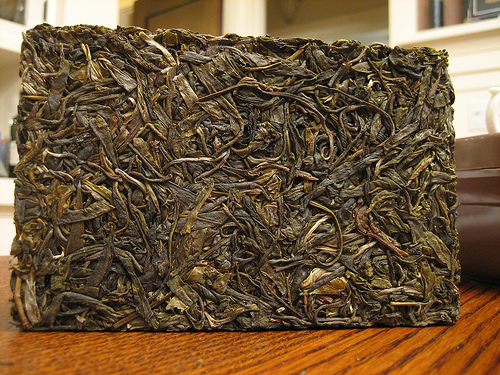
A compressed brick of pu-erh tea. Individual leaves can be seen on the surface of the brick.
Compressed tea
Chinese name
Traditional Chinese緊壓茶
Simplified Chinese紧压茶
Literal meaningtight press tea
Transcriptions
Standard Mandarin
Hanyu Pinyinjǐnyāchá
Wade–Gileschin3-ya1-ch'a2
Korean name
Hangul고형차
Hanja固形茶
Literal meaningsolid tea
Transcriptions
Revised Romanizationgohyeong-cha
McCune–Reischauerkohyŏng-ch'a
Japanese name
Kanji緊圧茶
Kanaきんあつちゃ
Transcriptions
Revised Hepburnkin'atsucha
Tea brick
Chinese name
Traditional Chinese磚茶
Simplified Chinese砖茶
Literal meaningbrick tea
Transcriptions
Standard Mandarin
Hanyu Pinyinzhuānchá
Wade–Gilesch'uan1-ch'a2
Korean name
Hangul벽돌차 / 전차
Hanja甓돌茶 / 磚茶
Literal meaningbrick tea
Transcriptions
Revised Romanizationbyeokdol-cha / jeoncha
McCune–Reischauerpyŏktol-ch'a / chŏnch'a
Japanese name
Kanji磚茶
Kanaひちゃ、とうちゃ、せんちゃ
Transcriptions
Revised Hepburnhicha, tōcha, sencha
Tea cake
Chinese name
Traditional Chinese餅茶
Simplified Chinese饼茶
Literal meaningcake tea
Transcriptions
Standard Mandarin
Hanyu Pinyinbǐngchá
Wade–Gilesping3-ch'a2
Korean name
Hangul떡차 / 병차
Hanja떡茶 / 餠茶
Literal meaningcake tea
Transcriptions
Revised Romanizationtteokcha / byeongcha
McCune–Reischauerttŏkch'a / pyŏngch'a
Japanese name
Kanji餅茶
Kanaへいちゃ、もちちゃ
Transcriptions
Revised Hepburnheicha, mochicha
Tea lump
Chinese name
Traditional Chinese團茶
Simplified Chinese团茶
Literal meaninglump tea
Transcriptions
Standard Mandarin
Hanyu Pinyintuánchá
Wade–Gilest'uan2-ch'a2
Korean name
Hangul덩이차 / 단차
Hanja덩이茶 / 團茶
Literal meaninglump tea
Transcriptions
Revised Romanizationdeongi-cha / dancha
McCune–Reischauertŏngi-ch'a / tanch'a
Japanese name
Kanji団茶
Kanaだんちゃ
Transcriptions
Revised Hepburndancha

Compressed tea, called tea bricks, tea cakes or tea lumps, and tea nuggets according to the shape and size, are blocks of whole or finely ground black tea, green tea, or post-fermented tea leaves that have been packed in molds and pressed into block form. This was the most commonly produced and used form of tea in ancient China prior to the Ming Dynasty. Although tea bricks are less commonly produced in modern times, many post-fermented teas, such as pu-erh, are still commonly found in bricks, discs, and other pressed forms. Tea bricks can be made into beverages like tea or eaten as food, and were also used in the past as a form of currency.

Production

[edit]
Tea brick, on display at Old Fort Erie
Porters laden with "brick tea" in a 1908 photo by Ernest Henry "Chinese" Wilson, an explorer botanist

In ancient China, compressed teas were usually made with thoroughly dried and ground tea leaves that were pressed into various bricks or other shapes, although partially dried and whole leaves were also used. Some tea bricks were also mixed with binding agents such as flour, blood, or manure to better preserve their form so they could withstand physical use as currency.[1] Newly formed tea bricks were then left to cure, dry, and age prior to being sold or traded. Tea bricks were preferred in Asian trade prior to the 19th century, since they were more compact and less susceptible to physical damage than loose leaf tea. This was important during transportation over land by caravans on the Tea Horse Road.

Tea bricks are still currently manufactured for drinking, as in pu-erh teas, as well as for souvenirs and novelty items, though most compressed teas produced in modern times are usually made from whole leaves. The compressed tea can take various traditional forms, many of them still being produced. A dome-shaped nugget of 100 g (standard size) is simply called tuóchá (沱茶), which is translated several ways, sometimes as "bird's nest tea" or "bowl tea". A small dome-shaped nugget with a dimple underneath just enough to make one pot or cup of tea is called a xiǎo tuóchá (; the first word meaning 'small') which usually weighs 3 g–5 g. A larger piece around 357 g, which may be a disc with a dimple, is called bǐngchá (饼茶, literally 'biscuit tea' or 'cake tea'). A large, flat, square brick is called fāngchá (方茶, literally 'square tea').

To produce a tea brick, ground or whole tea is first steamed, then placed into one of a number of types of press and compressed into a solid form. Such presses may leave an intended imprint on the tea, such as an artistic design or simply the pattern of the cloth with which the tea was pressed. Many powdered tea bricks are moistened with rice water in pressing to assure that the tea powder sticks together. The pressed blocks of tea are then left to dry in storage until a suitable degree of moisture has evaporated.

Although the Chinese regard it as an inferior product, [tea bricks are] greatly esteemed by the Tibetans for [their] powerful flavor, which harmonizes particularly well with that of the rancid yak's butter which they mix with their tea. Brick tea comprises not only what we call tea leaves, but also the coarser leaves and some of the twigs of the shrub, as well as the leaves and fruit of other plants and trees (the alder, for instance). This amalgam is steamed, weighed, and compressed into hard bricks, which are packed up in coarse matting in subunits of four. These rectangular parcels weigh between twenty-two and twenty-six pounds—the quality of the tea makes a slight difference to the weight—and are carried to Kangting by coolies.[2]

The brick tea is packaged [in Kangting] either in the courtyard or in the street outside, and it is quite a complicated process. When the coolies bring it in from Ya'an, it has to be repacked before being consigned upcountry, for in a coolie's load the standard subunit is four bricks lashed together, and these would be the wrong shape for animal transport. So they are first cut in two, then put together in lots of three, leaving what they call a gam, which is half a yak's load. Tea which is going to be consumed reasonably soon is done up in a loose case of matting, but the gams, which are bound for remote destinations, perhaps even for Lhasa, are sewn up in yakhides.[3]

— André Migot, Tibetan Marches

Consumption

[edit]
A brick of Hubei mǐ zhūan chá (米磚茶), made of powdered black tea

Due to their density and toughness tea bricks were consumed after they were broken into small pieces and boiled. Traditionally, in the Tang Dynasty, they were consumed being ground to a fine powder. The legacy of using tea bricks in powdered form can be seen in modern Japanese matcha tea powders as well as the pulverized tea leaves used in the lei cha (擂茶) eaten by the Hakka people and some people in Hunan province.

Beverage

[edit]

In ancient China the use of tea bricks involved three separate steps:

  1. Toasting: A piece was broken from the tea brick and usually first toasted over a fire. This was probably done to sanitize the tea brick and destroy any mold or insect infestation that may have occurred when the bricks were stored uncovered in warehouses and storerooms or in covered jars underground. Toasting also imparted a pleasant flavor to the resulting beverage.
  2. Grinding: The toasted tea brick was broken up and ground to a fine powder.
  3. Whisking: The powdered tea was mixed into hot water and frothed with a whisk before serving. The color and patterns formed by the powdered tea were enjoyed while the mixture was being drunk.

In modern times bricks of pu-erh type teas are flaked, chipped, or broken and directly steeped after thorough rinsing; the process of toasting, grinding, and whisking to make tea from tea bricks has become uncommon.

Tteokcha (떡차; lit. 'cake tea'), also called byeongcha (병차; 餠茶; lit. 'cake tea'), was the most commonly produced and consumed type of tea in pre-modern Korea.[4][5][6] Pressed tea made into the shape of yeopjeon, the coins with holes, was called doncha (돈차; lit. 'money tea'), jeoncha (전차; 錢茶; lit. 'money tea'), or cheongtaejeon (청태전; 靑苔錢; lit. 'green moss coin').[7][8][9] Borim-cha (보림차; 寶林茶) or Borim-baengmo-cha (보림백모차; 寶林白茅茶), named after its birthplace, the Borim temple in Jangheung, South Jeolla Province, is a popular tteokcha variety.[10]

Food

[edit]

Tea bricks are used as a form of food in parts of Central Asia and Tibet in the past as much as in modern times. In Tibet pieces of tea are broken from tea bricks, and boiled overnight in water, sometimes with salt. The resulting concentrated tea infusion is then mixed with butter, cream or milk and a little salt to make butter tea, a staple of Tibetan cuisine.[1]

The tea mixed with tsampa is called Pah. Individual portions of the mixture are kneaded in a small bowl, formed into balls and eaten. Some cities of the Fukui prefecture in Japan have food similar to tsampa, where concentrated tea is mixed with grain flour. However, the tea may or may not be made of tea bricks.

In parts of Mongolia and central Asia, a mixture of ground tea bricks, grain flours and boiling water is eaten directly. It has been suggested[by whom?] that tea eaten whole provides needed roughage normally lacking in the diet.

Use as currency

[edit]
A brick of tea presented to Tsar Nicholas II, 1891

Due to the high value of tea in many parts of Asia, tea bricks were used as a form of currency throughout China, Tibet, Mongolia, and Central Asia. This is quite similar to the use of salt bricks as currency in parts of Africa. Tea bricks were in fact the preferred form of currency over metallic coins for the nomads of Mongolia and Siberia. The tea could not only be used as money and eaten as food in times of hunger but also brewed as allegedly beneficial medicine for treating coughs and colds. Until World War II, tea bricks were still used as a form of edible currency in Siberia.[1]

Tea bricks for Tibet were mainly produced in the area of Ya'an (formerly Yachou-fu) in Sichuan province. The bricks were produced in five different qualities and valued accordingly. The kind of brick which was most commonly used as currency in the late 19th and early 20th century was that of the third quality which the Tibetans called brgyad pa ('eighth'), because at one time it was worth eight Tibetan tangkas (standard silver coin of Tibet which weighs about 5.4 grams) in Lhasa. Bricks of this standard were also exported by Tibet to Bhutan and Ladakh.[11]

Health effects

[edit]

All tea plant tissues accumulate fluorine to some extent. Tea bricks that are made from old tea leaves and stems can accumulate large amounts of this element, which can make them unsafe for consumption in large quantities or over prolonged periods. Use of such teas has led to fluorosis, a form of fluoride poisoning that affects the bones and teeth, in areas of high brick tea consumption such as Tibet.[12]

References

[edit]
[edit]
Revisions and contributorsEdit on WikipediaRead on Wikipedia
from Grokipedia
Compressed tea, also known as tea bricks, tea cakes, or tuocha, refers to whole or ground leaves that are steamed, compressed into dense blocks, discs, or other shapes, and dried to create a compact form suitable for long-term storage, transportation, and trade. This processing method originated in ancient and transforms loose tea leaves into durable products that were historically valued for their portability and , often lasting years without spoiling due to the compression that limits oxidation and moisture exposure. Primarily made from , , or post-fermented teas like pu-erh, compressed tea has been essential in regions with challenging terrain, serving not only as a beverage but also as a form of and sustenance in various cultures. The history of compressed tea dates back to the (618–907 CE) in , where it was developed to facilitate trade along routes such as the Ancient Tea-Horse Road, exchanging tea for horses with Tibetan and other ethnic groups. By the (960–1279 CE), it evolved into powdered forms whisked for consumption among the aristocracy, influencing practices like the , though the (1368–1644 CE) shifted preferences toward loose-leaf tea, leading to a decline in elite use but persistence in border trade. For centuries, compressed tea functioned as legal tender in , the , and , where bricks were scored for subdivision and used to barter for goods like livestock; this role continued into the 20th century, including during in some areas like . Production of compressed tea involves harvesting mature leaves, steaming them to make them pliable, pressing the softened mass into molds using manual or mechanical force, and then air-drying or baking the forms to set the shape, sometimes incorporating binders like flour for cohesion. In modern times, while traditional methods persist in Province for pu-erh varieties, compressed tea is often produced as ornamental souvenirs with decorative imprints or in smaller doses for convenience, though it remains a staple in Tibetan butter tea preparations and among nomadic communities for its nutritional and caloric value during travel.

History

Origins and early development

Compressed tea, also known as tea bricks or cake tea, emerged in ancient during the (618–907 CE) as a practical innovation for preserving and transporting tea leaves over long distances. Early references describe the process of steaming fresh tea leaves, pounding them into a paste, and compressing the mixture into durable cakes, which were then dried by fire and stored in new paper bags to maintain freshness. This method facilitated trade and storage in a time when tea was transitioning from a medicinal to a widespread beverage, with the cakes often ground into powder for boiling with additives like salt or ginger. The foundational text on these practices is 's Cha Jing (The Classic of Tea), compiled between 760 and 780 CE, which provides the earliest detailed monograph on tea cultivation, processing, and consumption. In it, outlines the compression of tea into bricks or molds as essential for imperial and civilian use, emphasizing in steaming and pressing to avoid bitterness. These Tang-era compressed teas were particularly valued for their , allowing them to withstand humid conditions and extended journeys without spoiling. By the (960–1279 CE), compressed evolved into a standardized product integral to the state's economy and administration. The government established a monopoly system known as chafa ( administration), classifying teas into quality levels and imposing a 10% tax that generated substantial revenue exceeding 1 million strings of cash annually, with collections reaching over 3 million strings by the late 11th century—while regulating production and distribution to curb . Detailed historical records from this period, including imperial edicts and logs, document the of uniform tea cakes for taxation purposes, with factories in regions like and churning out millions of catties yearly under strict oversight. Compressed tea also served as and diplomatic during the era, where its compact form made it ideal for provisioning armies and negotiating with nomadic groups. For instance, in 1044 CE, the Song court delivered 30,000 pounds of tea bricks to the Xi Xia to secure peace along northern borders, highlighting its role in sustaining troops and as a non-perishable staple in rations. This marked a shift toward compressed tea as a national commodity, with production techniques refined to include precise molding and firing for consistency. In province, early compressed teas resembling pu-erh developed under the influence of post- techniques, where large-leaf varieties were sun-dried, compressed into bricks, and allowed to naturally age during transport. Historical accounts trace these practices to the , when merchants packed 's wild teas into cakes for trade routes to , initiating a microbial process that enhanced flavor over time. The shaping of Pu'er tea into cakes was primarily for historical transportation convenience along ancient tea horse trade routes originating in the Tang and Song dynasties, with popularity increasing during the Ming and Qing eras; these compressed cakes, typically 357 grams each and bundled in groups of seven (a tong), reduced volume, prevented breakage, and eased packing on horses over rugged terrain. By the Song period, these bricks were recognized for their durability and unique earthy profile, laying the groundwork for pu-erh's distinct category without formal imperial processing.

Spread along trade routes

Compressed tea, particularly in the form of durable bricks or cakes, facilitated the expansion of tea consumption beyond China's borders through ancient and medieval trade networks. The Tea Horse Road, which had developed since the Tang and Song dynasties, emerged as a vital conduit during the Ming Dynasty (1368–1644)—known as Chama Gudao—linking the tea-producing regions of Yunnan and Sichuan to Tibet via arduous mountain passes and high-altitude plateaus. Caravans of yaks and mules transported compressed tea, often stitched into yak-hide wrappers for protection against the elements, covering distances that could take four to six months. This trade was formalized through imperial agencies that bartered tea for Tibetan warhorses, with the compressed format enabling efficient exchange and military supply; by the dynasty's height, such transactions supported thousands of horses annually acquired for border defense. By the 17th to 19th centuries, compressed tea bricks extended along extensions of the and the Great Tea Road, reaching , , and as portable commodities ideal for overland . These bricks, pressed from ground leaves and sometimes bound with additives like or yak dung for added resilience, were loaded onto Bactrian camels that traversed the and Siberian s, forming a semi-regular network recognized in treaties like the 1689 Russia-Qing agreement. In , the route from (Kalgan) to Urga (modern ) served as a key hub, where tea bricks not only fueled but also functioned as among nomads and merchants due to their compactness and value. This dissemination adapted to steppe cultures, where bricks were shaved for or even consumed as sustenance during harsh journeys. In the , British commercial interests dominated the global tea trade through maritime channels, exporting loose-leaf varieties from Chinese ports to via clipper ships like the , which raced to deliver fresh cargoes valued in millions. This sea-based focus contrasted sharply with the overland routes, where compressed tea remained essential for inner Asian trade due to its durability against physical damage and weather. British involvement, driven by the Company's monopoly until 1833, prioritized high-volume, perishable loose tea for Western markets, leaving compressed forms to sustain caravan economies in regions inaccessible by ship. As maritime shipments surged following the Second Opium War (1856–1860) and the opening of new , the resilient bricks continued to provision caravan travelers across , providing a lightweight, nutrient-dense staple—sometimes edible when mixed with binders—for endurance on remote routes where loose tea would spoil. This adaptation underscored compressed tea's enduring role in bridging cultural and economic exchanges along terrestrial paths.

Production

Traditional processing

The traditional processing of compressed tea involved a series of manual steps designed to transform loose tea leaves into durable, compact forms suitable for storage and transport, primarily using mature leaves harvested from tea plants in regions like Yunnan. Workers selected coarser, mature leaves, which were then withered slightly and sometimes roasted over low heat to remove excess moisture and initiate flavor development. The leaves were subsequently steamed briefly to soften them and make them pliable for molding, a technique rooted in Tang Dynasty practices as described by Lu Yu in the Cha Jing, where steaming was essential for compressing unoxidized tea into cakes. Following steaming, the leaves were often pounded or layered to break them down without fully pulverizing them into powder, allowing for a denser structure while preserving some whole-leaf integrity; this step varied by region but emphasized manual labor to ensure even distribution. The softened leaves were then placed into wooden or stone molds—simple rectangular or circular frames—and pressed using body weight on lever systems or heavy stones to compact them firmly, creating shapes like bricks, cakes, or discs that could withstand long journeys. In some historical accounts from the Ming and Qing eras, larger bricks were pressed with the aid of animal power, such as oxen pulling levers, to achieve uniform pressure on massive batches destined for trade routes. To enhance binding and durability, particularly for arid transport conditions, additives were incorporated during pressing; or water served as natural binders to hold the leaves together, while in regions exporting to and , ox blood was mixed in for added cohesion and resistance to crumbling, as noted in historical trade descriptions. These practices, documented in sources from the Tang period onward, ensured the tea's integrity over extended periods. Regional variations in compression techniques reflected local resources and purposes during the ; in , hand-molding prevailed for smaller, artisanal cakes using lightweight wooden presses to craft delicate shapes from oolong or bases, prioritizing finesse over . In contrast, producers employed more robust pressing methods, akin to early hydraulic systems with weighted levers and wrapping, to form compressed dark teas like Liu'an Cha, which were piled and pressed into baskets for and durability. These differences arose from 's focus on export-oriented brick teas versus 's emphasis on premium, handcrafted forms. After pressing, the compressed forms were dried slowly in shaded areas or over gentle fires to set the shape and prevent cracking, followed by storage to facilitate aging; for pu-erh bricks specifically, they were stacked in humid caves or warehouses with controlled around 70% relative , allowing microbial to develop complex, earthy flavors over years or decades. This aging process, integral to pu-erh's character, transformed the raw compressed tea into a mellow, therapeutic product prized in and daily rituals.

Modern manufacturing

Modern manufacturing of compressed tea, particularly pu-erh varieties from Yunnan Province, , has evolved to incorporate mechanized processes in state-run and private factories since the mid-20th century, blending traditional with industrial efficiency. In these facilities, tea leaves are first softened using to make them pliable, a step that replaces older manual methods and allows for uniform compression without the historical use of binding additives like . This is followed by pressing with hydraulic machines, which apply precise pressure to form dense bricks, cakes, or other shapes, enabling large-scale production that can handle thousands of kilograms daily. Such , pioneered in Yunnanese factories like those in Menghai and during the post-1949 collectivization era, marked a shift from labor-intensive hand-pressing to automated systems that improved consistency and output. Chinese national standards, such as GB/T 22111-2008 for geographical indication pu-erh tea, enforce rigorous quality controls in modern production to ensure product integrity. This regulation defines pu-erh types (raw sheng and ripe shou), establishes grading systems based on leaf maturity and integrity—referencing GB/T 8304 for detailed leaf classification into categories like special, first, second, and third grades—and mandates limits on moisture (≤13%), impurities, and sensory attributes to control fermentation outcomes. Fermentation is monitored through standardized microbial and chemical testing, including references to GB/T 4789.3 for bacteria and GB/T 5009 series for residues, preventing over-fermentation or contamination while preserving the tea's post-fermentation profile. These standards, effective since December 2008, apply to factory outputs and have standardized leaf selection, where higher grades use tender buds and young leaves for premium compressed products. Since the early 2000s, a notable shift toward organic and sustainable practices has emerged in compressed tea production, driven by global demand and environmental concerns, with certified farms in reducing or eliminating synthetic additives entirely. under standards like EU Organic or Organic (GB/T 19630) has grown, with pu-erh acreage expanding by over 35% in certified operations since 2018, emphasizing natural composting, promotion, and avoidance of chemical pesticides that could affect purity. Farms in , for instance, have adopted agroecological methods such as with shade trees, which enhance and yield cleaner leaves for compression, contrasting with earlier conventional approaches that sometimes incorporated non-organic binders. This transition not only minimizes environmental impact but also aligns with export requirements for additive-free products. Export-oriented manufacturing in the 21st century has further propelled machine-compressed tea bricks, optimized for durability during long-distance shipping to international markets like , , and . Factories produce standardized bricks weighing 250–3000 grams using automated hydraulic presses, targeting regions such as , , and the EU, where pu-erh exports from reached approximately 1,700 tons in 2023 under strict quality compliance.

Types and varieties

Chinese forms

Compressed tea in China encompasses several traditional forms, primarily developed for storage, transport, and trade along ancient routes. These varieties are typically made from the leaves of var. assamica, processed through steaming, pressing, and sometimes fermentation, originating from regions like , , and . The shapes—such as discs, nests, squares, and rectangles—facilitate durability and portioning, reflecting centuries of adaptation to nomadic and mercantile needs. Pu-erh bingcha, or disc-shaped Pu-erh cakes, is one of the most iconic compressed teas, produced in Province from large-leaf varietals. These cakes are formed by steaming sun-dried leaves to make them pliable, which also increases microbial activity, then pressing them with stone or hydraulic tools into flat, round molds, followed by drying; this process serves practical needs including storage and aging. The standard weight is 357 grams, equivalent to seven liang (a traditional Chinese unit of about 50 grams each) for efficient stacking in bamboo-wrapped of seven cakes. Bingcha exists in two main types: raw sheng Pu-erh, which undergoes natural post-fermentation aging over years, developing complex flavors, and ripe shou Pu-erh, accelerated through microbial fermentation in a 40- to 60-day wet-piling process to yield a smoother, earthier profile immediately. This form's compression allows for long-term storage by minimizing air exposure and aroma loss, promotes balanced post-fermentation aging via a stable anaerobic or micro-oxygen environment that supports microbial activity and substance conversion (e.g., polyphenols to mellow flavors), and holds cultural symbolism of roundness representing unity and harmony in Chinese tradition; it also enables appreciation as it matures, often becoming a collectible among enthusiasts. Tuocha, known for its bowl- or nest-like shape, is another specialty designed for portability, typically weighing 100 grams or less per piece. The tea leaves, often Pu-erh or similar dark varieties, are steamed and pressed into concave bamboo molds, creating a durable, stackable form that resists breakage during travel. This shape, resembling an inverted bowl, facilitates easy breaking into smaller portions for brewing and was historically favored by traders and nomads for its compact size and protective curvature. Both raw and ripe versions are common, with the compression enhancing the tea's aging potential in humid environments. Fangcha, or square brick tea, originates from provinces like and , where it is often produced from leaves for export markets. These flat, square blocks are created by grinding or whole-leaf pressing after steaming, resulting in dense forms suitable for long-distance trade, such as to and . Unlike fermented Pu-erh varieties, fangcha retains a brighter, vegetal character due to minimal oxidation, with sizes varying but typically around 100 to 500 grams for practicality in transport. Its geometric shape optimizes space in caravans and storage, making it a staple in historical commerce. Historical zhuan cha, or rectangular brick tea, represents an early evolution of compressed forms, dating back to the and peaking in use during the Ming and Qing eras as currency and provisions. Produced across , including , these bricks were made by steaming and compressing black or leaves into elongated rectangular molds, often imprinted with factory marks for authenticity. Over time, zhuan cha transitioned from utilitarian goods to modern collectibles, with aged examples valued for their , inscriptions, and refined flavors developed through pile-fermentation. Factories like those in Yiyang continue this tradition, blending historical techniques with contemporary quality controls.

Regional and international variants

In , compressed known as zang cha or Tibetan brick is typically formed into dense blocks, often encased in or wrapped in traditional materials for durability during transport across high-altitude regions. These s, produced primarily from fermented dark leaves, are grated or crumbled before brewing into po cha, a salted where is vigorously churned in to create a rich, emulsified beverage suited to the harsh climate and nomadic lifestyle. The compression process enhances preservation, allowing the to withstand long journeys, and some variants feature intricate patterns, such as sesame-seed imprints (zhima dancha), which aid in identification and add cultural aesthetic value. Mongolian adaptations of compressed tea, used in suutei tsai (salted tea), involve larger, coarser bricks sourced mainly from to suit the demands of nomadic herders who require portable, long-lasting supplies. These bricks, made from lower-grade stems and leaves, are boiled with and salt to produce a warming staple consumed multiple times daily for hydration and in the steppes. The robust compression ensures the tea remains intact during extended travel by horse or camel, reflecting adaptations for mobility in vast, arid landscapes. During the , Russian caravan trade popularized compressed tea bricks imported from via Siberian routes, where they served as a compact and source for merchants enduring months-long overland journeys. These bricks, often produced from tea dust and low-grade leaves in province, were sometimes smoked over pine fires to inhibit mold and extend amid damp conditions and limited storage. By the mid-1800s, annual imports reached millions of pounds, influencing with blends evoking the smoky essence of campfire preservation. In modern times, international innovations have emerged beyond traditional Asian forms, including Japanese compressed blocks derived from tencha leaves pressed into dense forms before grinding, echoing historical compressed teas but adapted for ceremonial use in urban settings. Similarly, post-2010 Western productions of pu-erh mini cakes—small, 100-200g discs fermented and compressed by vendors in the U.S. and —cater to collectors seeking affordable, space-efficient aging options without compromising the tea's earthy profile. These variants blend global accessibility with experimental scaling, often using organic sourcing to appeal to contemporary wellness markets.

Consumption

Beverage preparation

Compressed tea, particularly in the form of bricks, is traditionally prepared for beverage consumption by first breaking the compact mass into smaller pieces to facilitate . In , where compressed bricks are a staple, the process begins by crumbling the brick and simmering the pieces in a large pot of water for several hours to create a concentrated tea base known as chaku. This base is then diluted with boiling water, and , milk, and salt are added before churning the mixture vigorously in a traditional vessel called a chandong to produce a frothy, creamy beverage called po cha or , which is served piping hot to provide warmth and sustenance in high-altitude environments. Historically, during the (960–1279 CE), compressed tea cakes (tuánchá) were ground into powder and prepared using a whisking technique known as diǎn chá. The powdered was sifted, placed in a , and whisked vigorously with a tool called a cháxiǎn—a with numerous tines—along with hot to create a frothy, creamy often flavored with salt or other additives. This method emphasized the creation of a fine and was a refined art form among literati, but it evolved significantly in the (1368–1644 CE) with an imperial edict promoting loose-leaf over powdered whisking, leading to the decline of the bamboo in mainstream Chinese practice. By modern times, preparation has shifted to simpler methods using strainers or teapots to separate leaves from , allowing for easier handling of compressed forms without the labor-intensive grinding and whisking. In contemporary , compressed pu-erh tea—often in cake or form—is commonly brewed using the gongfu cha style, which involves multiple short to extract evolving flavors. The process starts with rinsing the broken pieces of the compressed tea: hot water (around 95–100°C or 203–212°F) is poured over the leaves for 10–30 seconds and discarded to remove surface dust, impurities, and to awaken the leaves by partially opening them. or near-boiling water is then used for the , with recommended times beginning at 5–20 seconds for the first few rounds and gradually increasing by 5–10 seconds per subsequent infusion to avoid over-extraction. Aged pu-erh can yield 10–15 or more , revealing layers of earthy, complex notes that deepen with each .

Culinary applications

In , —roasted flour—is mixed with (brewed from bricks), , salt, or other ingredients to form a known as pah or similar dough-like preparations. This mixture provides a nutrient-dense, portable sustenance, often combined with , salt, or pine nuts to create porridges (spags) or gruels (ja-ldur) that sustain high-altitude nomads and laborers. Archaeological evidence from a 2nd-century AD site in western confirms early practices of blending with and other grains for caloric support. Compressed tea also features in savory dishes across , where its robust, fermented flavors enhance meats and salads. In , tea leaves contribute to the smoking process for dishes like zhangcha ya (tea-smoked ), imparting a caramelized, aromatic smokiness to the meat through a blend of tea, sugar, and rice in the smoking mixture. Historically, compressed tea served as emergency rations during 18th- and 19th-century famines in , particularly in , , and , where bricks were eaten directly for their caloric value or boiled into nourishing porridges with minimal ingredients. Travelers and nomads valued their durability and edibility, allowing survival in harsh conditions when other foods were scarce. Since the , crumbled tuocha—a nest-shaped compressed —has inspired modern fusion recipes, incorporating its earthy notes into desserts like pu'er-infused tortes, cheesecakes, or ice creams, and snacks such as tea-dusted nuts or brittle. These innovations blend traditional with global techniques, appearing in cookbooks and culinary blogs for both sweet and savory applications.

Cultural and economic roles

Use in trade and as currency

Compressed tea, particularly in the form of bricks, served as a vital in historical networks across , especially in regions where metallic was scarce or impractical. In 18th-century Tibet, the value of a standard tea brick was equivalent to eight Tibetan tangkas, a weighing approximately 5.4 grams, facilitating transactions in and surrounding areas. Valuation varied by quality, with standardized grades such as "dragon" and "phoenix" tea cakes denoting premium compressed forms produced during the , often molded with intricate designs to signify their superior status and higher worth in barter. For livestock , approximately 12 to 15 high-quality bricks could purchase one sheep in around 1900, underscoring the brick's role as a portable and divisible unit of value comparable to fractional silver equivalents. In the trans-Himalayan economy, tea bricks were integral to the Tea Horse Road, a network linking China to Tibet and beyond, where they were subject to strict taxation under the Qing dynasty's tea monopoly system (quecha). This system regulated production, transport, and sales through government oversight, imposing levies that could reach significant portions of the trade value to fund imperial administration and military needs. Counterfeiting emerged as a persistent issue, with fake or adulterated aged tea bricks infiltrating markets, prompting increased imperial controls and edicts to standardize production and curb illicit practices during the Qing era. These measures aimed to maintain the integrity of tea bricks as reliable currency in cross-border exchanges, where they often supplemented or replaced coinage in remote highland commerce. The 19th-century caravan trade amplified the economic significance of compressed tea, with annual exports from to via the border post reaching up to 10,000 tons by mid-century, predominantly in form for over long overland routes. This volume, peaking around at approximately 28 million pounds (over 12,000 metric tons), dominated Sino-Russian , accounting for more than 90% of imports and fueling Siberian and Central Asian markets. Tea bricks' portability made them ideal for such vast , enabling for furs, horses, and other goods along the way. By the , the widespread adoption of paper and modern transportation diminished the role of tea bricks as formal , rendering them obsolete in most organized by . However, in remote areas of and , their use persisted in informal systems, where standardized weight and edibility continued to provide practical value amid limited access to monetary alternatives.

Social and ritual significance

In Tibetan Buddhist rituals, compressed tea bricks play a central role in practices, where they are offered as symbols of to guests and deities, fostering communal bonds and spiritual harmony. These offerings, often prepared as , are integral to daily monastic routines and ceremonial events, such as the serkyem ritual, which involves pouring to invoke and generate merit for practitioners by pacifying obstacles and accumulating positive karma. Among Mongolian nomadic communities, compressed tea bricks hold significance in wedding customs and social exchanges, where they are presented as gifts by the groom's to the bride's mother during negotiations, wrapped in ceremonial blue fabric and placed on the to symbolize the integration of new kin. These bricks also serve as tokens in forging alliances, such as filial gifts from children to mothers during festivals like the Mongolian , reinforcing familial and communal ties through reciprocal exchanges that affirm respect and continuity in nomadic life. In Chinese traditions, compressed tea forms like Pu-erh are incorporated into tea ceremonies for ancestral worship, where they are offered on altars to honor forebears, embodying spiritual reverence and cultural continuity. These rituals adapt compressed tea's enduring form to emphasize longevity and familial piety, blending everyday consumption with solemn observances. The 21st-century revival of compressed tea's cultural role is evident in events like Yunnan's Pu-erh Tea and Horse Caravan Festival, initiated in 2010, which celebrates the heritage of tea bricks through exhibitions, performances, and tastings that promote ethnic customs and along the ancient trade routes. This annual gathering draws visitors to experience the historical and social dimensions of compressed tea, revitalizing its place in contemporary identity and community pride.

Health effects

Potential benefits

Compressed tea, particularly post-fermented varieties like pu-erh, exhibits properties primarily due to catechins and theaflavins, which contribute to reduction in clinical settings. Studies from the , including a randomized placebo-controlled trial involving subjects with borderline hypercholesterolemia, demonstrated that daily consumption of Chinese extract significantly lowered total and () levels after three months, with reductions observed in serum . A later randomized trial on pu-erh tea extract in hyperlipidemic individuals also showed significant reductions in and triglycerides over 20 weeks. These compounds help mitigate and , supporting overall lipid profile improvements in hyperlipidemic populations. The process in compressed tea bricks fosters modulation of the that benefits by aiding . Research from the 2010s highlighted how pu-erh tea's bioactive components, such as theabrownins, alter composition, promoting beneficial bacteria like those involved in short-chain fatty acid production while suppressing harmful pathogens, which enhances intestinal barrier function and reduces inflammation in the digestive tract. Clinical and indicate that regular intake improves , leading to better nutrient absorption and relief from digestive discomfort. Prolonged storage of compressed tea enhances its anti-inflammatory potential through the accumulation of compounds like , derived from the breakdown of catechins during aging. Investigations show that levels increase significantly over time in pu-erh teas stored under controlled conditions, contributing to reduced inflammatory markers by inhibiting pro-inflammatory cytokines and enzymes such as . This temporal change underscores the therapeutic value of aged compressed teas in managing chronic inflammation. Most studies on the effects of compressed focus on post-fermented varieties like pu-erh, which may differ from those of or compressed teas. Compressed tea supports cardiovascular , including regulation, as evidenced by meta-analyses up to 2023 linking regular tea consumption to lower systolic and reduced risk. For pu-erh specifically, its polyphenols may facilitate and inhibit , contributing to overall cardioprotection in moderate consumers.

Associated risks

Compressed tea, particularly aged brick varieties, can accumulate high levels of during prolonged storage and processing, leading to fluorosis in heavy consumers. In Tibetan regions, where brick tea is a dietary staple, studies from the 1980s onward have documented brick tea-type fluorosis, with median daily intake reaching 24.73 mg—far exceeding the national standard of 3.5 mg—primarily from consuming 3–6 liters of strong infusions daily. This excessive intake, often surpassing 10 mg per day among herdsmen, correlates with prevalence of up to 46% in adults, manifesting as bone pain, joint stiffness, and deformities that impair mobility. Poor storage conditions for compressed teas, such as exposure to humidity and improper fermentation, heighten risks of microbial contamination. Analysis of 36 Pu-erh tea samples revealed fungal loads ranging from 10¹ to 2.6 × 10⁶ CFU/g, dominated by Aspergillus species, which can produce mycotoxins like ochratoxin A in 11% of cases. These contaminants may lead to bacterial or fungal infections, gastrointestinal issues, or mycotoxicosis upon consumption, especially in immunocompromised individuals, underscoring the need for hygienic handling in post-fermented products. Heavy metal leaching poses another concern, particularly in teas sourced from contaminated soils in production areas like . Recent assessments indicate average lead levels in Chinese teas, including Pu-erh varieties, at 1.09 mg/kg, with elevated concentrations in southwestern regions attributable to soil pollution from and . For a 70 kg adult consuming 15 g of Pu-erh daily, this can contribute to chronic lead exposure, potentially causing neurological effects, though non-carcinogenic health index remains low (0.04) nationally. Environmental reports from 2020 highlight ongoing monitoring needs for such leaching in 's tea gardens. Overconsumption of strong brick tea brews, common in ritualistic or daily use, can result in overload due to high intake volumes. Pu-erh compressed teas contain 30–70 mg per 240 mL cup, and Tibetan consumption patterns of multiple liters daily may exceed 300 mg, triggering symptoms like , anxiety, and heart . These effects are exacerbated in aged bricks prepared via , where extraction is maximized, contrasting with moderate loose infusions.

References

Add your contribution
Related Hubs
User Avatar
No comments yet.