


Community hub
Recent from talks
Contribute something
Nothing was collected or created yet.
Airgíalla
View on Wikipedia
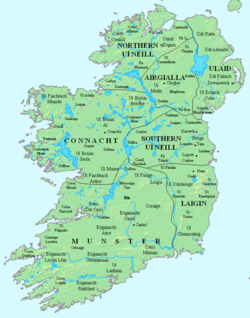
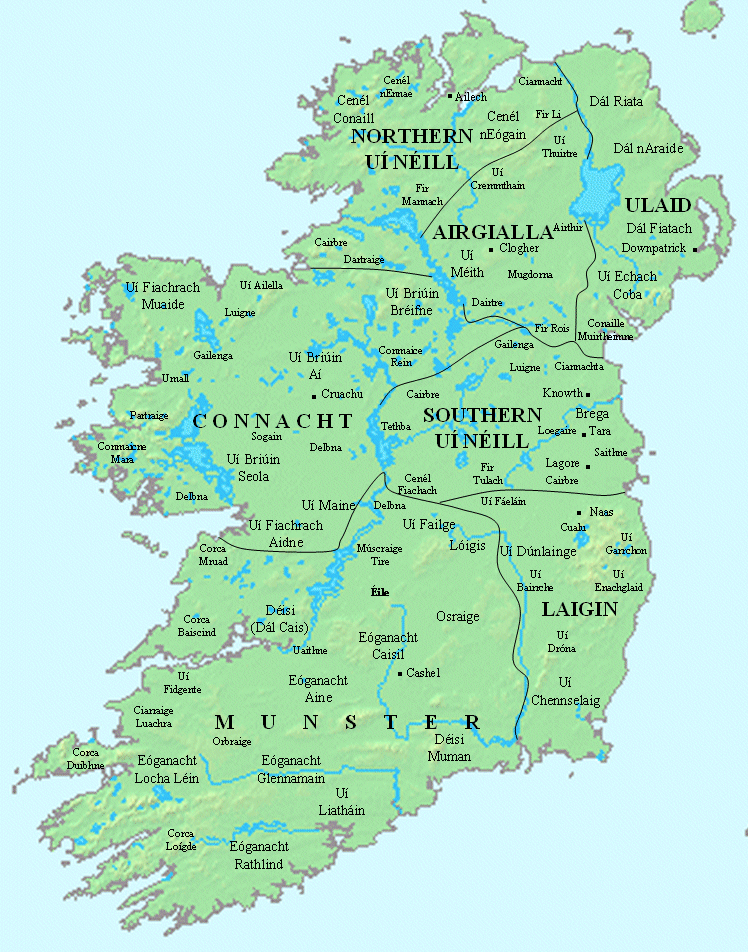
Airgíalla (Old Irish pronunciation: [ˈœɾʲɣʲiːa̯l̪a]; Modern Irish: Oirialla, English: Oriel,[1] Latin: Ergallia) was a medieval Irish over-kingdom and the collective name for the confederation of tribes that formed it. The confederation consisted of nine minor kingdoms, all independent of each other but paying nominal suzerainty to an overking, usually from the most powerful dynasty.[2] Airgíalla at its peak roughly matched the modern dioceses of Armagh and Clogher, spanning parts of counties Armagh, Monaghan, Louth, Fermanagh, Tyrone and Londonderry.[2] Its main towns were Armagh and Clogher. The name's usage survives as a cultural area of folk tradition in South East Ulster and adjoining areas of County Louth.
Key Information


According to legend, Airgíalla was founded by the Three Collas,[2] who are said to have conquered what is now central Ulster from the Ulaid. The decisive victory was the battle of Achadh Leithdheirg, said to have been fought around the year 331. However, this tale is thought to be mostly fiction, and the actual year and circumstances of how the Airgíalla confederation came about is unknown.
Originally thought to have been under the dominance of the neighbouring Ulaid to the east, the territory of the Airgíalla from the 6th century onwards was gradually eroded by the encroachment of their northern neighbours, the Cenél nEógain of the Northern Uí Néill,[3] as well as the Southern Uí Néill to their south. From 735 they fell under the dominance of the Cenél nEógain, and by 827 had become their vassals.[3] The kingdom of Airgíalla was at its peak in the 12th century, under king Donnchad Ua Cerbaill. The later constricted kingdom of Airgíalla survived in Monaghan—which was known as Oirghialla and Oriel after the Norman Invasion of Ireland—under the Mac Mathghamhna, until the end of the Gaelic order in Ireland.[2]
Etymology
[edit]Airgíalla, referring to both the Irish over-kingdom of Airgíalla, and the confederation of tribes that formed it, may mean 'those who give hostages' or 'hostage givers',[2][4] presumably in reference to the included territories' vassalage. It is commonly anglicised as Oriel; however, archaic anglicisations include Uriel, Orial, Orgialla, Orgiall, and Oryallia, along with the latinisation Ergallia.[citation needed]
After the Anglo-Norman invasion, the anglicisation Uriel became the name of the part of Airgíalla that had extended into modern-day County Louth.[2] Similarly, the portion of Airgíalla that survived in modern-day County Monaghan, became known as Oirghialla,[2] from which derives the anglicisation Oriel.
In early manuscripts, the Bishop of Clogher was styled "Bishop of Oirialla".
History
[edit]Origins
[edit]According to legend
[edit]In the beginning of the 4th century, three warlike brothers, known as the Three Collas, made a conquest of a great part of Ulster, which they wrested from the Ulaid. It was the after the battle of Achadh Leithdheirg, fought around 331, that they founded Airgíalla.[5][6] In this battle the forces of the Three Collas defeated the forces of Fergus Foga, king of Ulster, who was slain, and the victors burned to the ground Emain Macha, the ancient capital of Ulaid.
However, in general it can be shown that the origin legend was written (or composed) in the second quarter of the 8th century to seal their alliance with the Northern Uí Néill.[attribution needed]
Historical emergence
[edit]The earliest reference to the Airgíalla occurs in the Annals of Tigernach under the year 677, where the death of Dunchad mac Ultan, "Rí Oigriall", is noted. However, it is suspected of being a retrospective interpolation. On the other hand, the entry in the Annals of Ulster under the year 697 which lists Mael Fothataig mac Mael Dub as "Rex na nAirgialla" may indeed be genuine. Both Mael Fothatag and his son, Eochu Lemnae (died 704), are listed among the guarantors of the "Cáin Adomnáin" in 697. Thus it is believed that the Airgíalla were probably in existence as an entity by then, or certainly by the opening years of the 8th century.

8th–12th centuries
[edit]![[icon]](https://en.wikipedia.org/wiki/File:Wiki_letter_w_cropped.svg) | This section needs expansion. You can help by adding missing information. (March 2017) |
13th–16th centuries
[edit] | This section needs expansion. You can help by adding missing information. (March 2017) |
Downfall of the Realm
[edit]
The Kingdom of Airgíalla came to an end in 1585 when Rossa Boy MacMahon agreed to surrender and regrant his territories to the English Crown in Ireland, with his territory becoming County Monaghan in the Tudor Kingdom of Ireland. Rossa Buidhe had ascended to the Airgíalla kingship in 1579 and found himself geopolitically in an undesirable position; wedged between an expanding Tudor kingdom and Tír Eoghain under the O'Neill. Initially, Rossa Boy made moves which suggested an alliance with Tír Eoghain, as he married the daughter of Hugh O'Neill, Earl of Tyrone. However, evidently hoping to be left alone to run affairs locally, while pledging allegiance to a distant monarch in Elizabeth I, the MacMahon met with John Perrot, then Lord Deputy of Ireland (according to some, a natural son of Tudor monarch Henry VIII) and agreed to join their Kingdom of Ireland.[7] Airgíalla, now known as Monaghan, was divided into five baronies under native Gaelic chiefs, mostly from the MacMahon themselves.
This was not the end of the matter, however. Fearing the encroachment of the English, moving in closer and closer to his own territories, Hugh O'Neill turned to Brian Mac Hugh Og MacMahon of Dartree and married off another daughter to him. Brian Mac Hugh Og was then the tanist to the chieftainship of his people according to the native Brehon laws and O'Neill was hoping to bring the "phantom" Airgíalla realm back into his camp on the death of Rossa Buidhe through this pact. For his part, Ross Buidhe was trying to engineer a pro-English succession through his brother Hugh Roe MacMahon. When the new Lord Deputy, William FitzWilliam began to pressure the acceptance of an English High Sheriff of Monaghan, O'Neill used his influence to exact opposition to it from clansmen in Monaghan (the same policy was promoted in Leitrim, Fermanagh and Donegal to encircle Tyrone). As a consequence, a military force led by Henry Bagenal was sent into the county in early 1589 to impose the sheriff and by the summer of that year, Rossa Boy was dead[how?].
Dynastic groups
[edit]Airgíalla was composed of nine minor-kingdoms, each named after their ruling dynasty. These were:[3]
- Uí Tuirtri, also spelt as Uí Tuirtre, meaning "descendants of Tort". They were based east of the Sperrin Mountains in eastern County Londonderry and Tyrone. From 776, the Uí Thuirtri had moved east of the River Bann and into the over-kingdom of Ulaid, and by 919 they had lost all links to the Airgíalla.[3]
- Uí Maic Cairthinn, meaning "descendants of Cairthend". Based south of Lough Foyle in north-western County Londonderry.
- Uí Fiachrach Arda Sratha, meaning "descendants of Fiachrach of Ard Straw". Based at Ardstraw in modern-day County Tyrone. They became subject to the Cenél nEógain by the 12th century, and expanded southwards into Fir Luírg, in County Fermanagh.[8]
- Uí Cremthainn, based in what is now parts of modern-day County Fermanagh, Monaghan, and Tyrone.
- Uí Méith, based in modern-day County Monaghan.
- Airthir, meaning "Easterners".[3] They were based around the city of Armagh, and held control of the offices of the church in Armagh, which had preeminence in Ireland.[3]
- Mugdorna, or Crích Mughdornd, based in County Monaghan (Cremorne barony), however by the 12th-century had settled the territory of Bairrche, located in southern County Down, and named it after themselves.[9] Their name lives on as "Mourne", the present-day name for the area and the Mourne Mountains.[9]
- Fir Chraíbe, also known as the Fir na Chraíbe,[10] meaning "men of the branch". They were located west of the River Bann in north-eastern County Londonderry. By the 9th century they were a subject-people of the Cenél nEógain.[10]
- Fir Lí, also known as the Fir Lee, meaning "people of Lí". They were located west of the River Bann in mid-eastern County Londonderry. By the 9th century they were a subject-people of the Cenél nEógain.[10]
Uí Moccu Úais
[edit]The Uí Tuirtri, Uí Maic Cairthinn, and Uí Fiachrach Arda Sratha, were collectively known as the Uí Moccu Úais as they claimed descent from Colla Uais.[3] The pedigrees in the Book of Leinster states that Colla Uais had two sons, Erc and Fiachra Tort. From Fiachra Tort came the Uí Tuirtri. From Erc, came Cairthend and Fiachrach, who were respectively the ancestors of the Uí Maic Cairthinn and the Uí Fiachrach Arda Sratha. The Fir Lí are also claimed as being descended from Fiachra Tort, though other sources claim they descend from another son of Colla Uais called Faradach.
The Uí Moccu Uais were also found in counties Meath and Westmeath.[3] They were known as Uí Moccu Uais Midi and Uí Moccu Uais Breg, meaning the Uí Moccu Uais of Meath and Brega, respectively.
List of kings
[edit]- Colga mac Loite mac Cruinn, died 513
- Cairpre Daim Argat, died 514
- Daimine Daim Argat, died 565
- Conall Derg mac Daimine
- Bec mac Cuanu, died 594
- Aed mac Colgan, died 606
- Mael Odhar Macha, died 636
- Dunchad mac Ultan, died 677?
- Mael Fothartaig mac Mael Dubh, alive 697
- Cu Masach mac Cathal, died 825
- Gofraidh mac Fearghus, fl. 835
- Foghartaigh mac Mael Breasal, died 850/852
- Congalach mac Finnachta, died 874
- Mael Padraig mac Mael Curarada, died 882
- Maol Craoibh ua Duibh Sionach, died 917
- Fogarthach mac Donnegan, died 947
- Egneach mac Dalach, died 961
- Donnacan mac Maelmuire, died 970
- Mac Eiccnigh mac Dalagh, died 998
- Mac Leiginn mac Cerbaill, died 1022
- Cathalan Ua Crichain, died 1027
- Gilla Coluim ua Eichnech, died 1048
- Leathlobair Ua Laidhgnen, died 1053
- Leathlobair Ua Laidhgnen, died 1078
- Aodh Ua Baoigheallain, died 1093
- Ua Ainbhigh, died 1094
- Cu Caishil Ua Cerbaill, died 1101
- Giolla Crist Ua hEiccnigh, died 1127
- Donnchadh Ua Cearbaill, 1130–1168/1169
- Murchard Ua Cerbaill, 1168–1189
- Muirchertach, 1189–1194
- ?, died 1196
- Ua Eichnigh, died 1201
- Giolla Pádraig Ó hAnluain, 1201–1243
Mac Mathghamhna chiefs, 1243–1590
[edit]- Eochaid mac Mathgahamna mac Neill, died 1273
- Brian mac Eochada, 1283–1311
- Ralph/Roolb mac Eochada, 1311–1314
- Mael Sechlainn mac Eochada, 1314–?
- Murchad Mór mac Briain, ?–1331
- Seoan mac Maoilsheachlainn, 1331–1342
- Aodh mac Roolb, 1342–1344
- Murchadh Óg mac Murchada, 1344–1344
- Maghnus mac Eochadha, 1344–1357
- Pilib mac Rooilbh, 1357–1362
- Brian Mór mac Aodh, 1362–1365
- Niall mac Murchadha, 1365–1368
- Brian Mór mac Aodh, 1368–1371
- Pilib Ruadh mac Briain, 1371–1403
- Ardghal mac Briain, 1403–February 1416
- Brian mac Ardghail, 1416–1442
- Ruaidhri mac Ardghail, 1442–1446
- Aodh Ruadh mac Ruaidhri, 1446–31 March 1453
- Feidhlimidh mac Briain, 1453–1466
- Eochan mac Ruaidhri, 1466–1467
- Reamonn mac Ruaidhri, 1467–November 1484
- Aodh Óg mac Aodha Ruaidh, 1485–16 September 1496
- Brian mac Reamoinn, 1496–1497
- Rossa mac Maghnusa, 1497–1513
- Reamonn mac Glaisne, 1513–c.1 April 1521
- Glaisne Óg mac Reamoinn, 1521–1551?
- Art Maol mac Reamoinn, 1551–1560
- Aodh mac Briain, 1560–1562
- Art Ruadh mac Briain, 1562–1578
- Sir Rossa Buidhe mac Airt, 1579–August 1589
- Hugh Roe McMahon (Irish: Aodh Ruadh mac Airt), 1589–September/October 1590.
See also
[edit]Bibliography
[edit]References
[edit]- ^ Ulster Irish to English Dictionary
- ^ a b c d e f g Connolly, p. 12.
- ^ a b c d e f g h Duffy, p. 14.
- ^ Duffy, p. 13.
- ^ John O'Donovan (1856). Annala Rioghachta Éireann: Introductory remarks. Annals, to A.D. 902. Hodges, Smith, and Company. pp. 124–.
- ^ Michael O'Cleary (1 March 2003). The Annals of Ireland by the Four Masters Translated into English by Owen Connellan. Irish Roots Cafe. p. 3. ISBN 978-0-940134-77-5.
- ^ "The Fall of the MacMahons and the End of Oriel". Jim McMahon. 21 July 2015.
- ^ Cosgrove, p. .
- ^ a b Magoo - The Mughdorna
- ^ a b c Warner, p. 60.
Bibliography
[edit]- Connolly, S.J., ed. (2007). Oxford Companion to Irish History. Oxford University Press. ISBN 978-0-19-923483-7.
- Cosgrove, Art, ed. (2008). A New History of Ireland, II Medieval Ireland 1169-1534. Oxford University Press. ISBN 978-019-953970-3.
- Duffy, Seán (2005). Medieval Ireland an Encyclopedia. Routledge. ISBN 978-0-4159-4052-8.
- MacCaffrey, Wallace T (1994). Elizabeth I: War and Politics, 1588-1603. Princeton University Press. ISBN 0691036519.
- Morgan, Hiram (1999). Tyrone's Rebellion: The Outbreak of the Nine Years War in Tudor Ireland. Boydell & Brewer. ISBN 0851156835.
- Palmer, William (1994). The Problem of Ireland in Tudor Foreign Policy, 1485-1603. Boydell & Brewer. ISBN 0851155626.
- Smith, Brendan (1999). "The Ua Cerbaill kingdom of Airgialla". Colonisation and Conquest in Medieval Ireland. Cambridge University Press.
- Warner, R. (1973–1974). "The Re-Provenancing of Two Important Penannular Brooches of the Viking Period". Ulster Journal of Archaeology. Third Series. 36–37. Ulster Archaeological Society: 58–70.
- MacMahons of Oriel: Mac Mathghamna, Kings of Oirghialla to 1590, in A New History of Ireland, pp. 215–16, volume IX, ed. Byrne, Martin, Moody. Dublin, 1984.
- The "Airgialla Charter Poem", Ailbhe Mac Shamhrain and Paul Byrne, in The Kingship and Landscape of Tara, Edel Bhreathnach, pp. 213–224, Four Courts Press, Dublin, 2005.
External links
[edit]- Pronunciation of Airgíalla
- The Kingship and Landscape of Tara, ed. Edel Bhreathnach, 2005; ISBN 1-85182-954-7
- "A Hidden Ulster" by Pádraigín Ní Ullacháin, 2003, Four Courts Press 1-85182-685-8 & 1-85182-738-2.
- "Songs From A Hidden Ulster", broadcast by RTÉ Radio 1 in 2006, presented by Pádraigín Ní Ullacháin.
- Early Modern Ireland
- The Three Collas

| General history |
| ||||
|---|---|---|---|---|---|
| Gaelic culture |
| ||||
| Language | |||||
| Clans |
| ||||
| Related organisations | |||||
| Related subjects | |||||
| History | |
|---|---|
| General and events |
|
| Acts of Parliament | |
| Gaelic conquests |
|
| Politics and society |
|
| Monarchs and rulers |
|


Airgíalla
View on GrokipediaEtymology
Linguistic Origins and Interpretations
The name Airgíalla, attested in Old Irish sources from the early medieval period, is a compound term referring to a confederation of tribes in Ulster.[5] It consists of the prefix air- (possibly intensive or locative, akin to "eastern" or "before" in spatial contexts) combined with gíalla, the plural form of giall, meaning "hostage" or "pledge".[6] This etymological structure yields interpretations such as "those who give hostages" or "hostage givers," underscoring the political subordination of the constituent groups to dominant powers like the Uí Néill.[7] [8] Historical linguists, including Eoin MacNeill, note that the name's formation appears relatively late, likely emerging in the 7th century or later as the Airgíalla coalesced amid conquests attributed to the legendary Three Collas.[5] MacNeill posits that Airgíalla reflects a tributary arrangement where the eastern territories' inhabitants provided hostages (gíalla) to a western overking, distinguishing them from free tribes and aligning with practices of clientage in early Irish kingship.[9] This interpretation is corroborated by annals and genealogies portraying the Airgíalla as vassals who yielded pledges to secure autonomy under overlords, such as after defeats by the Uí Néill around 331 AD in pseudo-historical reckonings.[6] By the Middle Irish period, the name evolved to Oirghialla or Oirialla, with anglicizations like Oriel (from Latin Ergallia) and Uriel persisting into the Norman era, denoting shrunken remnants in modern County Monaghan.[5] Alternative derivations, such as direct ties to personal names or unrelated Gaelic roots, lack substantiation in primary linguistic evidence and are dismissed in favor of the hostage-based reading, which aligns with documented overkingship dynamics.[10] No credible sources propose non-tributary origins, emphasizing instead the term's role in signaling federated status rather than ethnic unity.[9]Geography
Territorial Extent
Airgíalla's territory at its peak encompassed central Ulster, roughly aligning with the modern dioceses of Armagh and Clogher, spanning significant portions of counties Armagh, Monaghan, Fermanagh, Tyrone, Louth, and smaller areas in Derry and Meath.[1] Its boundaries extended west of the River Bann, east of the River Foyle to the River Finn, north to Lower Lough Erne, and south along the Monaghan-Cavan border into northern Louth and Meath.[11] This extent resulted from the conquests of the Three Collas around AD 331, who seized lands from the Ulaid, establishing Airgíalla as a federation of subordinate tuatha.[1] The kingdom comprised numerous component tribes and petty kingdoms, reflecting its confederated structure rather than a unified realm. Key tuatha included Uí Thuirtri (northern areas, modern Tyrone), Mugdorna (Farney barony, County Monaghan), Airthir (eastern Orior baronies, County Armagh), Uí Meith (between Ballybay and Monaghan), and Fír Rois (associated with Fermanagh regions).[1][11] Other groups were Uí Fiachrach Arda Sratha and Uí Maic Cáirthinn (west and east of Upper Lough Erne, extending toward Lough Foyle), Uí Crémthainn, Uí Breasail Máche (Clanbrassil areas), and Uí Eathach (barony of Armagh).[12][11]- Cladach (Truagh, County Monaghan)[11]
- Clann Ceallaigh (Clankelly, County Monaghan)[11]
- Dairtrey (County Monaghan)[11]
- Feara Monach (County Fermanagh)[11]
- Magh Leamhna (around Blackwater, County Tyrone)[11]
- Muintir Pheodachain (County Fermanagh)[11]
- Uí Léigaire (barony of Lurg, County Tyrone)[11]
- Uí Seghain (County Meath)[11]
Key Settlements and Features
The territory of Airgíalla featured a varied topography, including low-lying fertile plains suitable for agriculture, upland areas such as the Fews Mountains in modern County Armagh, and river systems like the Blackwater which marked boundaries with neighboring regions.[13] These geographical elements supported dispersed settlement patterns typical of early medieval Gaelic society, with ringforts and ecclesiastical establishments as focal points.[14] Prominent settlements included Armagh, a major ecclesiastical hub that served as a monastic town and spiritual center exerting influence over the confederation's tribes. Clogher functioned as the primary royal site, hosting the residences and assemblies of Airgíalla's over-kings from dynasties like Uí Chremthainn, with archaeological evidence of hilltop fortifications and ceremonial structures dating to the early medieval period.[15][16] The kingdom's structure as a confederation highlighted additional localized centers tied to its constituent tuatha, such as those of Uí Thuirtri in northern Monaghan, Mughdorna in the Muckno area, and Fir Rois along the shores of Lough Neagh, each maintaining semi-autonomous leadership and defensive sites amid the broader over-kingdom.[11][1] These tuatha territories, spanning parts of modern counties Armagh, Monaghan, Louth, Fermanagh, and Tyrone, reflected the political fragmentation underlying Airgíalla's unity under periodic overlordship.[1]Origins
Legendary Foundation
According to medieval Irish legendary tradition, Airgíalla originated from the conquests of the Three Collas—Colla Uais ("the noble"), Colla da Crích ("of the two territories"), and Colla Menn ("the famous")—in the early fourth century. These brothers were sons of Eochaid Doimlén, a figure linked to the Airgíalla dynasty, and grandsons of Cairbre Lifechair, a purported High King of Ireland circa 300 CE. Exiled following the murder of their uncle Fiachu (likely Fiachu Sroibtine), the Collas received support from High King Fiachu Finnolach and launched raids into Ulster, targeting the Ulaid-dominated regions.[17][18] The pivotal event in this foundation myth was the Battle of Achadh Leithdheirg (modern Augher, County Tyrone) around 331 CE, where the Collas defeated Ulaid king Fergus Foga, slaying him and his forces. Emboldened, they burned Emain Macha, the ancient ceremonial capital of the Ulaid near Armagh, symbolizing the eclipse of Ulaid power. The victors then partitioned the conquered lands east of the River Bann and north of the River Blackwater, establishing Airgíalla as a composite kingdom of tributary tuatha (tribes or petty kingdoms) that provided hostages—hence the name Airgíalla, interpreted as "pledge-hostage" or "eastern hostages"—to the High King in Tara. Colla Uais assumed the high kingship briefly from 322 to 327 CE per later annals, with his descendants, the Uí Cholla, claiming overlordship.[19][1] This narrative, preserved in texts like the Lebor Gabála Érenn and later genealogies, portrays the Collas as warlike princes who shifted Ulster's political center inland, away from coastal Ulaid strongholds, and integrated disparate groups under a new hegemony. While the accounts blend myth with euhemerized history—potentially reflecting later dynastic justifications by families like the Uí Néill—their recurrence across pedigrees underscores a foundational role in Airgíalla's identity, linking it to broader invasions from Connacht or Leinster lineages rather than native Ulaid stock.[20][21]Historical and Archaeological Evidence
The earliest surviving historical reference to Airgíalla as a political entity appears in the Annals of Tigernach for the year 677, recording the death of Dunchad mac Ultan as rí Oigriall (king of Oriel). This entry implies the confederation's existence by the late 7th century, potentially as an overkingdom uniting tribes such as the Mugdorna, Fir Lí, and Uí Thuirtri, but provides no details on its formation. Irish annals prior to the 8th century are largely retrospective compilations, blending contemporary notices with later interpolations, limiting their utility for tracing origins before this period; no contemporary records from the 4th–6th centuries explicitly document Airgíalla's emergence. Genealogical tracts and synthetic histories, such as those in the 11th-century Lebor na Cert, posit an earlier foundation through conquest by the Three Collas—Eochaid, Fiachra, and Colla Uais—from the Ulaid around 331 AD, but these derive from tribal origin legends without corroboration from independent sources like Roman or British chronicles. Archaeological evidence for Airgíalla's territorial core centers on sites like Clogher (Clochar), traditionally linked as an early royal seat of the overkings. Excavations from 1955–1960 and 1969–1977 revealed a multivallate hillfort enclosing approximately 4 hectares, with phases of occupation traceable to the late Bronze Age (c. 1000–700 BC), including ramparts and enclosures, followed by Iron Age reuse and early medieval expansion marked by souterrains, metalworking debris, and imported pottery shards indicative of Mediterranean trade contacts by the 5th–6th centuries AD. These findings demonstrate long-term settlement continuity and economic integration in mid-Ulster, aligning with the region's role as a contested frontier between Ulaid and northern Connachta polities, but do not yield artifacts or structures uniquely diagnostic of a unified Airgíalla confederation—such political coalescences likely manifested through alliances rather than monumental changes visible in the material record.[16][22] Broader regional surveys in counties Armagh, Tyrone, and Monaghan uncover ringforts and crannógs from the 5th–7th centuries, reflecting dispersed tribal economies focused on agriculture, stock-raising, and craft production, consistent with the client-kingdom structure later attributed to Airgíalla. However, the absence of centralized elite burials or inscriptions prior to the 7th century underscores the challenges in archaeologically pinpointing the confederation's origins, which scholars infer from shifts in power dynamics evidenced in saintly vitae and ecclesiastical foundations, such as those tied to Armagh's expansion amid Airgíalla territories by the 6th century.[14]Early History
Formation and 7th–9th Centuries
The Airgíalla emerged as a confederation of tribes in central Ulster during the late 6th and early 7th centuries, comprising groups such as the Uí Thuirtri, Uí Chremthainn, and Airthir, which had previously been subordinate to the Ulaid kingdom. The name Airgíalla, meaning "hostage-givers," reflects their status as tributary peoples providing hostages to overlords, initially likely the Ulaid and later the Uí Néill.[1] The earliest historical attestation of an overking appears in the Annals of Tigernach for 677, recording the death of Dunchad mac Ultan, described as rí Airgialla (king of Airgíalla). In the 7th century, the confederation asserted greater independence amid regional power struggles. The Annals of Ulster note a battle in 697 between the Airgíalla and the Cenél Conaill branch of the Uí Néill, indicating early conflicts with northern overkings. Overkings were typically drawn from dominant septs like the Uí Thuirtri, with leadership often rotating or contested among sub-kingdoms, fostering a loose federal structure rather than centralized rule.[1] By the mid-8th century, Airgíalla forces achieved victories against the Ulaid, as in 750 when they defeated Ulaid forces at Sliabh Fuith, consolidating control over territories in modern counties Armagh, Monaghan, and parts of Down and Louth. The 9th century brought increasing pressure from the expanding Uí Néill, particularly the Cenél nÉogain, leading to Airgíalla's partial subjugation. The Annals of Ulster record a decisive Uí Néill victory over Airgíalla at the Battle of Leth Cam in 827, after which many Airgíalla territories acknowledged Uí Néill overlordship and provided hostages. Despite these setbacks, internal cohesion persisted through shared resistance to external domination, with sub-kings maintaining autonomy under nominal overkings from families like the Uí Cherbaill emerging later. Archaeological evidence from ringforts and ecclesiastical sites in the region supports the presence of a warrior aristocracy sustaining this tribal federation during the period.[23]Relations with Neighboring Powers
Airgíalla's relations with the Uí Néill kingdoms, particularly the Cenél nEógain branch of the Northern Uí Néill, were characterized by subjugation and tributary obligations during the 7th to 9th centuries. Following defeats in key battles, such as the encounter at Irros Foichnae in 727 where Airgíalla forces suffered losses against allies of Dál Riata, the confederation increasingly acknowledged Cenél nEógain overlordship. By the mid-8th century, Airgíalla had become vassals, providing military support and tribute to Cenél nEógain kings, as evidenced in contemporary annals and later historical analyses of Irish kingship structures.[24][25] Interactions with the Ulaid, from whom Airgíalla territories were originally seized in legendary accounts of the 4th century, remained tense but occasionally cooperative against mutual threats like Uí Néill expansion. In the Battle of Mag Itha around 731, Airgíalla and Ulaid forces allied but were decisively defeated by Áed Allán of Cenél nEógain, reinforcing Uí Néill dominance in Ulster. This event underscored Airgíalla's precarious position, often allying with Ulaid remnants while facing pressure from northern powers.[26] To the north, border skirmishes with Dál Riata involved Airgíalla in regional power struggles, including the 727 conflict where Selbach of Dál Riata's forces inflicted casualties on Airgíalla. Such engagements reflected competition for control over Ulster's northern fringes, with Airgíalla sometimes serving as a buffer between Dál Riata and Uí Néill interests. Overall, these relations positioned Airgíalla as a subordinate entity, reliant on alliances to maintain autonomy amid dominant neighboring overkingdoms.[24][27]Medieval Development
10th–12th Centuries
During the 10th and 11th centuries, the over-kingship of Airgíalla rotated among leading families ruling sub-kingdoms such as Fearnmhagh, Airthir, and Fernmag, with frequent successions marked by violence and external pressures from neighboring powers. Éicnech ua hAilella, king of Airgíalla, and his son Dubhdara were killed in 961, followed by fratricide as Éicnech's brother Murchad was slain shortly after. Donnacán, another king, fell at the Battle of Cell Móna in 970 against forces including Cenél Conaill. In 1022, Mac Léiginn, lord of Oirghialla, died, amid defeats by Uí Néill at Sliabh Fuaid. These events reflect internal instability and subjugation attempts by the Northern Uí Néill, particularly Cenél nEógain. Military engagements with the Ulaid persisted, yielding mixed results; Airgíalla forces defeated Ulidians at Druim Beannchair in 1032, but faced raids and alliances shifting with Uí Néill branches against common foes. By the mid-11th century, rulers like Gillacoluim ua hEignigh of Airgíalla died in 1048, and Leathlobhair ua Laidhgnen, over-king, was killed in 1078 by Ruaidrí ua Ruadacáin of Airthir, who ruled until 1099. Cucaisill ua Cerbaill of Fernmag emerged prominently around 1101, defeating raiders, signaling the rising influence of the Ua Cerbaill dynasty amid ongoing confederation dynamics. In the early 12th century, Airgíalla maintained autonomy through tactical alliances, such as with Cenél nEógain and Cenél Conaill against Ulaid incursions in 1113 and later, while sub-kings like Flaithbertach ua Laidhgnen of Fernmag died in 1119 and Cucaisill ua Cerbaill in 1123. Gillachrist ua hEignigh, king of Feara Manach and Airgíalla, passed in 1127. These decades saw persistent border conflicts and ecclesiastical ties, including support for reforms, setting the stage for greater cohesion under emerging leadership. The annals record no single dominant over-king until later Ua Cerbaill ascendancy, underscoring Airgíalla's resilience as a fragmented yet strategically vital Ulster polity.Peak under Ua Cerbaill
Donnchad Ua Cerbaill ascended as king of Airgíalla in 1125, marking the onset of the dynasty's most expansive phase, during which the kingdom achieved its territorial and political zenith in the 12th century.[4] His rule consolidated control over core regions like Fernmag and extended influence southward into modern County Louth, capitalizing on the instability following the decline of Uí Néill dominance in Ulster.[28] By 1130, Donnchad had conquered the southern Ulaid territory of Conaille Muirtheimne, incorporating it into Airgíalla's sphere and enhancing its strategic depth against neighboring powers like Ulaid and Cenél nEógain.[29] This expansion positioned Airgíalla as a pivotal buffer state, with Ua Cerbaill authority reaching as far as Drogheda near the Boyne River mouth.[30] Militarily, Donnchad navigated alliances and conflicts adeptly, including participation in the 1147 invasion of Ulaid alongside High King Muirchertach Mac Lochlainn, securing spoils and hostages that bolstered Airgíalla's resources.[31] He later contributed to Mac Lochlainn's overthrow in 1166, exploiting the high king's violation of oaths to assert greater autonomy, though this maneuver reflected pragmatic power-balancing rather than outright rebellion.[4] Domestically, Donnchad fostered stability by integrating sub-kingdoms under Ua Cerbaill oversight, leveraging the confederative structure of Airgíalla to maintain loyalty among tribes like the Fernmag and Mughdorna. His son's succession, Murchad Ua Cerbaill (r. 1168–1189), sustained these gains through continued alliances, such as with Connacht's Uí Conchobair, preserving the kingdom's influence amid rising provincial rivalries.[32] Parallel to territorial ambitions, Donnchad championed ecclesiastical reforms, aligning with the 12th-century continental-influenced movement led by figures like Malachy of Armagh. In 1142, he co-founded Mellifont Abbey, Ireland's inaugural Cistercian house, donating land, timber, and stone for its construction and thereby elevating Airgíalla's prestige in European monastic networks.[33] This patronage not only secured clerical support for Ua Cerbaill legitimacy but also introduced reformed practices that strengthened internal governance and cultural ties, underscoring the dynasty's role in bridging Gaelic traditions with emerging Roman-oriented Christianity. The combined military expansions and institutional reforms under Donnchad represented Airgíalla's high-water mark, enabling it to project power until Anglo-Norman incursions eroded these foundations post-1170.[4]Late Medieval Period
13th–15th Centuries under Mac Mathghamhna
The Mac Mathghamhna (MacMahon) dynasty rose to prominence in Airgíalla during the 13th century, assuming the kingship amid the fragmentation caused by Anglo-Norman incursions following their conquest of Ulster territories after 1194. Eochaidh Mac Mathghamhna became the first recorded king of the line in 1250, establishing authority over a diminished territory centered on modern County Monaghan, as northern and eastern parts of Oriel fell under Norman control or were contested by Gaelic neighbors like the Uí Néill. His reign involved resistance to O'Neill overlordship, notably in 1264 when he opposed Aodh Ó Néill's claims to suzerainty over Airgíalla.[34] Succession alternated among descendants of Eochaidh's sons through the 14th century, marked by internal violence under Brehon tanistry, which favored eligible male kin and fostered rivalries. Brian Mac Mathghamhna ruled from 1273 to 1311, fortifying positions such as Lough Ec (Leck) by 1297, while Murchadh Mór (1311–1331) was slain by his cousin Séan Mac Mathghamhna, who briefly seized power in 1331 with Anglo-Norman assistance before being ousted by Aodh Mac Mathghamhna (1342–1344).[34] Further strife included raids and killings among branches, as recorded in contemporary annals, reflecting the dynasty's efforts to consolidate amid raids from O’Reillys, Maguires, and lingering Norman lords in Louth and Armagh.[35] By the 15th century, the Mac Mathghamhna achieved relative stabilization under stronger rulers like Brian Mór (1372–1403), Ardghall (1406–1427), and Ruaidhrí (1427–1446), whose numerous sons spawned enduring septs in Farney, Dartry, and Lucht Tighe, perpetuating leadership disputes. Aodh Ruadh Mac Mathghamhna (d. 1453) exemplified ongoing martial leadership, navigating alliances and conflicts with the Uí Néill and English Pale, though the kingdom remained vulnerable to cattle raids and territorial erosion.[36] Brian Mac Ardghail (d. 1442) similarly contended with familial rivals and external incursions, underscoring the dynasty's reliance on martial prowess to maintain semi-autonomy.[37] Despite these efforts, Airgíalla under Mac Mathghamhna contracted further, confined largely to Monaghan by mid-century, as Anglo-Norman settlements and Gaelic expansions hemmed in their influence.[1]Internal Conflicts and External Pressures
During the 13th to 15th centuries, the Mac Mathghamhna dynasty faced persistent internal conflicts stemming from the Gaelic system of tanistry, where eligible kin vied for kingship, often resulting in fratricide and factionalism.[38] In 1314, for instance, Roalbh Mac Mathghamhna was slain by his own brethren, exemplifying the violent succession disputes that fragmented leadership.[39] By 1355, Niall Mac Mathghamhna met a similar fate at the hands of the sons of John Mac Mathghamhna, highlighting ongoing kin-based rivalries that undermined centralized authority. These feuds contributed to the division of Airgíalla into rival branches by the late 15th century, including the families of Eoghan MacMahon in Dartry and others controlling sub-regions like Truagh and Farney, each asserting claims to overlordship. The confederation's loose structure, comprising multiple tuatha, exacerbated these divisions, as subordinate clans such as the MacCarthails and MacGilla Phádraigs occasionally challenged Mac Mathghamhna dominance, though the latter generally prevailed through force.[34] In the early 15th century, under Ardghal Mac Mathghamhna (r. c. 1406–1427), one branch consolidated power amid competition from at least three major lines, but succession after his death in 1427 reignited disputes, with his son Brian entangled in rival claims.[40] Such infighting weakened military cohesion, as resources were diverted to intra-clan warfare rather than unified defense. Externally, Airgíalla endured mounting pressures from the Northern Uí Néill, who exacted tribute and intervened in Mac Mathghamhna successions to maintain vassalage, as seen in the killing of Emher Mac Mathghamhna by Eoghan Ua Néill in 1444.[38] The rising Mag Uidhir (Maguire) power in Fermanagh encroached on southern territories, leading to border skirmishes and raids that strained resources.[41] To the east, Anglo-Norman lordships in Louth and Meath posed threats through punitive expeditions; in response, Mac Mathghamhna forces launched counter-raids in the 1420s and 1430s, targeting English settlements and prompting defensive castle-building in Louth.[40] These incursions, while initially successful, invited retaliatory campaigns and fostered opportunistic alliances between English authorities and dissident Irish factions, gradually eroding Airgíalla's autonomy.[42]Downfall
16th-Century English Encroachment
In the mid-16th century, under the policies of surrender and regrant initiated by Henry VIII and continued by his successors, several Gaelic lords in Ireland, including elements within Airgíalla, nominally submitted to English overlordship in exchange for recognition of their titles and lands under English law. However, the MacMahon lordship of Monaghan, which dominated Airgíalla's core territories, resisted full integration, maintaining tanistry-based succession and tribute systems that conflicted with English feudal tenure. This tension escalated under Elizabeth I, as Lord Deputies sought to fragment Gaelic power structures to enable direct crown administration.[43] A pivotal event occurred following the death of the MacMahon chief, Sir Rossa MacMahon, in August 1589, which sparked a succession dispute between his nephew Aodh Rua MacMahon and rival claimant Brian MacMahon. Aodh Rua, elected tanist by the derbfhine assembly, traveled to Dublin in 1590 at the invitation of Lord Deputy Sir William Fitzwilliam, ostensibly to affirm his position, but was arrested, tried for complicity in his uncle's death—allegedly poisoned—and executed by hanging on October 8, 1590. This judicial intervention, described by contemporaries as a "legal murder," exploited internal divisions to eliminate a resistant leader and assert English legal authority over Gaelic customs.[44][45] Fitzwilliam capitalized on the ensuing instability, where Brian MacMahon briefly assumed leadership but faced military setbacks against English forces allied with Hugh O'Neill. In 1591, the Lord Deputy orchestrated the partition of Monaghan into four baronies—Monaghan, Truagh, Cremorne, and Farney—allocating fixed freeholds totaling approximately 200,000 Irish acres among seven MacMahon gentlemen, a McKenna, and English servitors, while reserving crown rents and abolishing collective tanistry in favor of primogeniture and individual inheritance. This "Book of Division" imposed the English shire system, subdivided territories into townlands for taxation, and introduced sheriffs, effectively dismantling the centralized MacMahon over-lordship that had sustained Airgíalla's cohesion.[46][47][45] The fragmentation weakened Airgíalla's military capacity, as sub-septs like the MacMahons of Dartree and Truagh now held divided loyalties and reduced resources, paving the way for further encroachments amid the broader Tudor conquest. By subordinating local elites to crown oversight and eroding tributary networks, these measures integrated former Airgíalla lands into the Pale's administrative orbit, though sporadic resistance persisted until the Nine Years' War.[48]Final Submission and Dissolution
In 1585, Rós Bóy Mac Mathghamhna, the reigning lord of Airgíalla centered in modern County Monaghan, submitted to Sir John Perrot, the English Lord Deputy of Ireland, as part of the Tudor policy of surrender and regrant.[49] This agreement, termed the Composition of Monaghan, involved the surrender of traditional Gaelic territories, which Perrot then reorganized into a shired county with defined baronies and townlands held under English common law tenure rather than Brehon custom.[50] The composition fixed rents and military obligations, aiming to integrate the region into the Kingdom of Ireland and undermine the autonomous structure of the Mac Mathghamhna lordship.[49] The submission marked the effective dissolution of Airgíalla as an independent confederation, reducing it from a federation of sub-kingdoms to crown-administered lands. Perrot's survey divided the former overkingdom into six baronies—Monaghan, Truagh, Cremorne, Dartree, Clankee, and Donaghmoyne—each with apportioned cess payments to replace tanistry-based succession and tribute systems.[50] Rós Bóy's heirs received patents confirming limited estates, but the loss of overlordship fragmented authority among cadet branches, exacerbating kin-strife. Subsequent events accelerated the erosion of residual Gaelic power. In 1590, Aodh Ruadh Mac Mathghamhna, a rival claimant, was arrested and executed in Dublin for alleged treason against the crown, illustrating English intolerance for challenges to the new order.[44] During the Nine Years' War (1594–1603), Mac Mathghamhna factions aligned variably with Hugh O'Neill, but Monaghan's shired status excluded it from the Ulster Plantation, preserving some native landholding under English sovereignty.[51] By 1603, Airgíalla's political identity had fully dissolved, its territories absorbed into the centralized administration of the Kingdom of Ireland.[49]Political Structure
Confederation and Sub-Kingdoms
Airgíalla functioned as a loose confederation of tribal kingdoms in early medieval Ireland, centered in the region of modern Ulster and formed through conquests attributed to the Three Collas around AD 331, who defeated the Ulaid and established dominance over territories including southern Tyrone, Armagh, Monaghan, and Fermanagh.[1] The name Airgíalla, translating to "hostage-givers," reflected its status as a client federation to the Northern Uí Néill, involving the provision of hostages, tribute, and military levies, though internal autonomy persisted among its components.[1] Clogher served as a primary royal inauguration site for over-kings, underscoring the confederation's centralized yet decentralized governance under rotating leadership from prominent dynasties.[1] The confederation comprised nine primary sub-kingdoms (túatha), each ruled by distinct dynasties and contributing to the over-kingdom's military and political framework:- Uí Thuirtri: Located in northern Monaghan and Tyrone, known for early prominence in the federation.[1]
- Uí Chremthainn: Encompassing Fermanagh and parts of Monaghan, with branches like Fir Manach and Fernmag holding significant influence.[1]
- Uí Méith: Situated in southern Armagh, often allied with eastern elements.[1]
- Mugdorna: Centered in Monaghan, a core western túath with enduring local power.[1]
- Airthir (or Ind Airthir): Eastern territories including Louth and Armagh, focused on border regions.[1]
- Uí Meic Cairthinn: A dynasty-linked group in central areas, contributing to over-kingship claims.[1]
- Uí Cruinn: Associated with Louth septs, involved in early confederation politics.[1]
- Uí Fiachrach Arda Sratha: Northern branch tied to Airgíalla expansion.[1]
- Uí Moccu Uais (or Uí Meic Uais): Early ruling lineage, with records of kings like Mael Craibe mac Duibsinig dying in 917.[1]
Governance and Military Organization
The governance of Airgíalla operated as a loose confederation of sub-kingdoms, each ruled by local dynasties that owed fealty to an overking, who coordinated collective defense, tribute collection, and external alliances. The overkingship, often held by families such as the Uí Thuirtri in the 7th–8th centuries or the Uí Chremthainn thereafter, followed the Gaelic tanistry system, wherein a tánaiste (deputy or heir-designate) was selected from the derbfhine (extended patrilineal kin group) to minimize succession disputes and maintain dynastic continuity.[52] This structure emphasized personal loyalties and clientage ties over centralized administration, with the overking's authority reinforced by rituals, law tracts, and the symbolic giving of hostages from sub-kings, reflecting the etymological sense of "Airgíalla" as those bound by pledges of fidelity.[4] Sub-kingdoms, numbering around nine in traditional reckonings, included entities like Uí Nialláin, Uí Bresail Airthir, and Muinter Toirdelbaig, each functioning as semi-autonomous tuatha with their own assemblies and legal jurisdictions under Brehon law.[25] The overking convened provincial assemblies (óenach) for major decisions, such as military musters or dispute resolutions, but internal rivalries among dynasties frequently undermined unity, as seen in cycles of overking depositions recorded in annals from the 8th century onward.[53] Militarily, Airgíalla relied on a hosting (cóiced) system inherent to Gaelic polities, whereby the overking summoned levies from constituent tuatha proportional to their land holdings and client obligations, typically mustering seasonal forces of several thousand for raids or defenses against Ulaid or Uí Néill incursions.[54] Warriors comprised chiefly lightly armed infantry—nobles with spears, shields, and occasional mail, supported by freemen and clients—drawn from tribal retinues rather than a standing army, with logistics emphasizing rapid cattle raids (crech) for sustenance and prestige.[54] Elite elements included the overking's personal gillae (followers) and, by the 10th century, nascent cavalry influences from Viking contacts, though core tactics remained infantry-based skirmishes and ambushes suited to the region's terrain. Sub-kingdoms fulfilled mandatory military service as "hostage-givers," providing contingents for overking-led campaigns, such as the Uí Chremthainn victories over Ulaid in 735 and 819.[26] This decentralized model proved effective for localized conflicts but vulnerable to fragmentation during broader threats, contributing to Airgíalla's eventual subordination to Northern Uí Néill dominance by the 9th century.[52]Dynasties and Rulers
Major Dynastic Groups
The major dynastic groups within Airgíalla originated from the legendary conquests attributed to the Three Collas around AD 330, whose descendants formed the core lineages of the confederation's sub-kingdoms, including Uí Thuirtri, Uí Chremthainn, and Cenél Fergusa.[1] These groups provided local kings and occasionally over-kings, with power shifting based on military success and alliances rather than fixed inheritance, as evidenced by annals recording frequent successions through conquest.[1] The Uí Chremthainn, tracing descent from Críthenn Liath (a great-grandson of Colla da Crich), emerged as a pivotal dynasty, particularly in western territories like Fermanagh and Monaghan; by the 10th century, they had consolidated influence, and from the 13th century onward, the Mac Mathghamhna (MacMahons) branch dominated as over-kings of much of Airgíalla, ruling from Clones and Truagh until English encroachments in the 1590s.[1] Similarly, the Uí Thuirtri, descendants of Tort (linked to Colla Uais), held early over-kingships in the 6th–8th centuries and controlled areas in northern Monaghan and southern Tyrone; their lineage later connected to the Mag Uidhir (Maguire) sept, which ruled Fermanagh as a semi-autonomous lordship from circa 1202 to 1607, maintaining Airgíalla ties through tribute and military pacts.[1][18] In eastern Airgíalla, the Ua Cearbhaill (O'Carroll) dynasty of Fernmag (modern Monaghan) asserted overlordship in the 11th–12th centuries, with figures like Donnchadh Ua Cearbhaill serving as arch-king until his death in 1168, after which they yielded primacy to the MacMahons amid Norman pressures.[1] The Uí Nialláin (O'Hanlons) dominated Orior (south Armagh and parts of Louth) from the 10th century, providing tanists and resisting Uí Néill incursions, with their rule persisting into the 16th century through alliances with English forces post-submission.[20] Other groups, such as the Uí Meic Cairthinn and Cenél Meic Duib, contributed lesser kings but rarely over-kings, often subsumed under dominant coalitions.[1] These dynasties' interactions, marked by kin-slaughters and external threats from Cenél nÉogain, underscored Airgíalla's loose federal structure, where no single lineage monopolized power until the late medieval MacMahon ascendancy.[1]List of Over-Kings
The over-kings of Airgíalla exercised authority over its constituent sub-kingdoms, though the confederation's leadership was often decentralized, with regional dynasties like Uí Chremthainn, Uí Thuirtri, and later Uí Cerbaill and Mac Mathghamhna dominating at different periods. Primary records from the Annals of Ulster document specific instances of over-kingship, particularly from the 5th century onward, amid conflicts with neighboring Ulaid and Uí Néill powers. Earlier rulers, linked to the legendary Three Collas conquest around the 4th century, blend myth and history, with verifiable kings emerging post-500 AD.[24][1]| Name | Dates | Dynasty/Notes |
|---|---|---|
| Colla Dá Crích | fl. c. 331 | Legendary founder-king, son of Eochaid Doimlén; associated with conquest of Ulaid territories to establish Airgíalla.[1] |
| Colga mac Loite | d. 513 | Early chief of Airgíalla; descendant of Colla Dá Crích.[55] |
| Cairpre Daim Airgit | d. 514 | King of Airgíalla; son of Eochaid, noted in annals for regional rule.[24] |
| Daimíne Daim Airgit | d. 565 | King of Airgíalla; continuation of early dynasty.[24] |
| Béc mac Cúanu | d. 598 | King of Airgíalla; fell in battle, progenitor of Cenél mBécc.[24] |
| Máel Dúin mac Furudráin | d. 662 | King of Airgíalla; from Uí Moccu Uais branch.[24] |
| Gilla Críst Ua hÉicnigh | d. 1127 | King of Fir Manach and over-king of Airgíalla; died in penance at Clogher.[24] |
| Donnchadh Ua Cerbaill | fl. 1130–1168 | Arch-king of Airgíalla; led against Ulaid, killed by own retainer.[24] |
| Murchad Ua Cerbaill | fl. 1168–1189 | King of Airgíalla; succeeded brother Donnchadh, died after penance.[24] |
| Eochaid Mac Mathgamma | d. 1273 | Inaugurated as king of Airgíalla; start of Mac Mathghamhna dominance in Monaghan core.[1] |
| Brian Mac Mathgamma | fl. 1283–1311 | King of Airgíalla; expanded influence amid Norman pressures.[1] |