


Community hub
Recent from talks
Contribute something
Nothing was collected or created yet.
United States Holocaust Memorial Museum
View on Wikipedia | This article may contain excessive or inappropriate references to self-published sources. (February 2025) |
The United States Holocaust Memorial Museum (USHMM) is the United States' official memorial to the Holocaust, dedicated to the documentation, study, and interpretation of the Holocaust. Opened in 1993, the museum explores the Holocaust through permanent and traveling exhibitions, educational programs, survivor testimonies and archival collections. The USHMM was created to help leaders and citizens of the world confront hatred, prevent genocide, promote human dignity, and strengthen democracy.[2]
Key Information


Overview
[edit]In 2008, the museum had an operating budget of $120.6 million,[3] a staff of about 400 employees, 125 contractors, 650 volunteers, 91 Holocaust survivors, and 175,000 members. It has local offices in New York City, Boston, Boca Raton, Chicago, Los Angeles, and Dallas.[4]
Since its dedication on April 22, 1993, the museum has had nearly 40 million visitors, including more than 10 million school children, 120 heads of state, and more than 3,500 foreign officials from over 132 countries and territories.[5] The museum's visitors came from all over the world, and less than 10 percent are Jewish. In 2024, its website had 33.9 million visits from 243 countries and territories. Fifty-seven percent of these visits were from outside the United States.[5]
The USHMM's collections contain more than 12,750 artifacts, 49 million pages of archival documents, 85,000 historical photographs, a list of over 200,000 registered survivors and their families, 1,000 hours of archival footage, 93,000 library items, and 9,000 oral history testimonies. Currently, USHMM's Teacher Fellowship Program has 268 fellows representing 49 states in the United States, the District of Colombia, and 11 countries.[5] Since 1994, the museum has had almost 400 university fellows from 26 countries.[4]
Researchers at the United States Holocaust Memorial Museum have documented 42,500 ghettos and concentration camps created by the Nazis throughout German-controlled areas of Europe from 1933 to 1945.[6]
The museum is located geographically in the same cluster as the Smithsonian museums.
.jpg)
History
[edit]_(53831937253).jpg)
On November 1, 1978, President Jimmy Carter established the President's Commission on the Holocaust, chaired by Elie Wiesel, a prominent author, activist, and Holocaust survivor.[8] Its mandate was to investigate the creation and maintenance of a memorial to victims of the Holocaust and an appropriate annual commemoration to them. The mandate was a joint effort of Wiesel and Richard Krieger[9] (the original papers are on display at the Jimmy Carter Museum). On September 27, 1979, the commission presented its report to the President, recommending the establishment of a national Holocaust memorial museum in Washington, D.C., with three main components: a national museum/memorial, an educational foundation, and a Committee on Conscience.[10]
After a unanimous vote by the United States Congress in 1980 to establish the museum,[11] the federal government made available 1.9 acres (0.77 ha) of land adjacent to the Washington Monument for construction. Under the founding director Richard Krieger, subsequent director Jeshajahu Weinberg and Chairman Miles Lerman, nearly $190 million was raised from private sources for building design, artifact acquisition, and exhibition creation. In October 1988, President Ronald Reagan helped lay the cornerstone of the building, designed by architect James Ingo Freed.[12] Dedication ceremonies on April 22, 1993, included speeches by American President Bill Clinton, Israeli President Chaim Herzog, Chairman Harvey Meyerhoff, and Elie Wiesel.[13] On April 26, 1993, the museum opened to the general public. Its first visitor was the 14th Dalai Lama of Tibet.[14]
Attacks
[edit]In 2002, a federal jury convicted white supremacists Leo Felton and Erica Chase of planning to bomb a series of institutions associated with American Black and Jewish communities, including the USHMM.[15]
On June 10, 2009, 88-year-old James von Brunn, an antisemite, shot Museum Special Police Officer Stephen Tyrone Johns. Special Police Officer Johns and von Brunn were seriously wounded and transported by ambulance to the George Washington University Hospital. Special Police Officer Johns later died of his injuries; he is permanently honored in an official memorial at the USHMM. Von Brunn, who had a previous criminal record, died before the conclusion of his federal criminal trial,[16] in Butner federal prison in North Carolina.[17]
Exhibitions
[edit]The USHMM houses two exhibitions open continuously since 1993 as well as rotating exhibitions on topics related to the Holocaust and human rights.
Hall of Remembrance
[edit]
The Hall of Remembrance is the USHMM's official memorial to the victims and survivors of the Holocaust. Visitors can light candles and view the eternal flame in the hexagonal hall.[18]
Permanent Exhibition
[edit]Using more than 900 artifacts, 70 video monitors, and four theaters showing historic film footage and eyewitness testimonies, the USHMM's Permanent Exhibition is the most visited exhibit at the Museum.[19] Upon entering large industrial elevators on the first floor, visitors are given identification cards, each of which tells the story of a person such as a random victim or survivor of the Holocaust. Upon exiting these elevators on the fourth floor, visitors walk through a chronological history of the Holocaust, starting with the Nazi rise to power led by Adolf Hitler during 1933 to 1939. Topics dealt with include Aryan ideology, Kristallnacht, antisemitism, and the American response to Nazi Germany. Visitors continue walking to the third floor, where they learn about ghettos and the Final Solution – the Nazis's plan for the genocide of the Jews of Europe – during which the Nazis murdered six million Jews, many in gas chambers. The Permanent Exhibition ends on the second floor with the liberation of Nazi concentration camps by Allied forces; it includes a continuously looped film of Holocaust survivor testimony.[20] First-time visitors spend an average of two to three hours in this self-guided exhibition. Due to certain images and subject matter, it is recommended for visitors 11 years of age and older.[19]
Remember the Children: Daniel's Story
[edit]Remember the Children: Daniel's Story is an exhibition designed to explain the Holocaust to elementary and middle school children.[13] Opened in 1993, it follows true stories about children during the Holocaust. Daniel is named after the son of Isaiah Kuperstein, who was the original curator of the exhibit. He worked together with Ann Lewin and Stan Woodward to create the exhibit. Because of its popularity with families, it is still open to the public today.[21][22][23]
Stephen Tyrone Johns Memorial
[edit]In October 2009, the USHMM unveiled a memorial plaque in honor of Special Police Officer Stephen Tyrone Johns.[24][25][26] In response to the outpouring of grief and support after the shooting on June 10, 2009, it has also established the Stephen Tyrone Johns Summer Youth Leadership Program. Each year, 50 outstanding young people from the Washington, D.C. area will be invited to the USHMM to learn about the Holocaust in honor of Johns' memory.[27][better source needed]
A Dangerous Lie (2006)
[edit]A Dangerous Lie: The Protocols of the Elders of Zion was a special exhibition about the 1903 Russian antisemitic canard, The Protocols of the Elders of Zion.[28] The exhibit was curated by Daniel Greene.[29][30][31]
The exhibit explained that in the early 20th century and during Hitler's rise to power in Germany, it was widely accepted that the Protocols documented an actual conspiracy by a small cabal of Jews to control the world for nefarious purposes, and that government and media in some countries continue to promote the Protocols as proof that such a Jewish conspiracy to control the world exists.[31] It details the manner in which Henry Ford was responsible for popularizing the fake Protocols in his newspaper, The Dearborn Independent.[32]
Permanent collection
[edit]The Museum's holdings included art, books, pamphlets, advertisements, maps, film and video historical footage, audio and video oral testimonies, music and sound recordings, furnishings, architectural fragments, models, machinery, tools, microfilm and microfiche of government documents and other official records, personal effects, personal papers, photographs, photo albums, and textiles.[13] This information can be accessed through online databases or by visiting the USHMM. Researchers from all over the world come to the USHMM Library and Archives and the Benjamin and Vladka Meed Registry of Holocaust Survivors.[33] In March 2024, the museum announced that it acquired the Centropa collection, a collection that contains rare testimonies of Holocaust survivors living in post-war communist countries.[34]
Museum gallery
[edit]-
 "State of Deception" Nazi propaganda exhibition at the museum in 2011
 -
 (Interior) An A2 railcar, one of several types used as Holocaust trains by Nazi Germany to transport victims
 -
 Tower of Faces
 -
 This uniform on display was worn by prisoners in Nazi concentration camps.
 -
![(Exterior) A2 railcar owned by Deutsche Reichsbahn and donated by the Chief Commission for the Prosecution of Crimes against the Polish Nation in 1991[35][36]](//upload.wikimedia.org/wikipedia/commons/thumb/7/71/Railroad_Car.jpg/330px-Railroad_Car.jpg) (Exterior) A2 railcar owned by Deutsche Reichsbahn and donated by the Chief Commission for the Prosecution of Crimes against the Polish Nation in 1991[35][36]
(Exterior) A2 railcar owned by Deutsche Reichsbahn and donated by the Chief Commission for the Prosecution of Crimes against the Polish Nation in 1991[35][36] -
 Photo Wall at the Holocaust Memorial Museum


![(Exterior) A2 railcar owned by Deutsche Reichsbahn and donated by the Chief Commission for the Prosecution of Crimes against the Polish Nation in 1991[35][36]](https://en.wikipedia.org/wiki/File:Railroad_Car.jpg)

Architecture
[edit]Designed by the architect James Ingo Freed of Pei Cobb Freed & Partners, in association with Finegold Alexander & Associates, the USHMM is created to be a "resonator of memory." Born to a Jewish family in Germany, Freed came to the United States at the age of nine in 1939 with his parents, who fled the Nazi regime.[37] The outside of the building disappears into the neoclassical, Georgian, and modern architecture of Washington, D.C. Upon entering, each architectural feature becomes a new element of allusion to the Holocaust.[38] In designing the building, Freed researched post-World War II German architecture and visited Holocaust sites throughout Europe. The Museum building and the exhibitions within are intended to evoke deception, fear, and solemnity, in contrast to the comfort and grandiosity usually associated with Washington, D.C., public buildings.[39]
Other partners in the construction of the USHMM included Weiskopf & Pickworth, Cosentini Associates LLP, Jules Fisher, and Paul Marantz, all from New York City. The structural engineering firm was Severud Associates. The Museum's Meyerhoff Theatre and Rubenstein Auditorium were constructed by Jules Fisher Associates of New York City. The Permanent Exhibition was designed by Ralph Appelbaum Associates.[40]
-
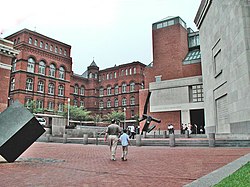 Raoul Wallenberg Place Entrance with Dwight Eisenhower Plaza in the Foreground
 -
 Bridges in the USHMM. Blue glass etched with names and places lost during the Holocaust.
 -
 Glass bridge over the Hall of Witness


Financial administration
[edit]The USHMM is primarily funded by charitable contributions and government grants. For the 2021–2022 fiscal year, the museum reported total revenues of $184.7 million and total expenses of $143.1 million.[41] Net assets totaled $696.9 million as of September 30, 2022.[41]
Center for Advanced Holocaust Studies
[edit]In 1998, the museum established the Center for Advanced Holocaust Studies (CAHS).[13] Working with the Academic Committee of the United States Holocaust Memorial Council, the CAHS supports research projects and publications about the Holocaust (including a partnership with Oxford University Press to publish the scholarly journal Holocaust and Genocide Studies), helps make accessible collections of Holocaust-related archival material, supports fellowship opportunities for pre- and post- doctoral researchers, and hosts seminars, summer research workshops for academics, conferences, lectures, and symposia. The CAHS's Visiting Scholars Program and other events have made the USHMM one of the world's principal venues for Holocaust scholarship.[42]

Committee on Conscience
[edit]The Museum contains the offices of the Committee on Conscience (CoC), a joint United States government and privately funded think tank, which by presidential mandate engages in global human rights research. Using the Convention on the Prevention and Punishment of the Crime of Genocide, approved by the United Nations in 1948 and ratified by the United States in 1988, the CoC has established itself as a leading non-partisan commenter on the Darfur genocide, as well as the war-torn region of Chechnya in Russia, a zone that the CoC believes could produce genocidal atrocities. The CoC does not have policy-making powers and serves solely as an advisory institution to the American and other governments.[43]
National Days of Remembrance of the Victims of the Holocaust
[edit]
In addition to coordinating the National Civic Commemoration, events are held during the week of the Days of Remembrance of the Victims of the Holocaust on a theme designated each year by the USHMM.
National Institute for Holocaust Education
[edit]The USHMM conducted several programs devoted to improving Holocaust education. The Arthur and Rochelle Belfer Conference for Teachers, conducted in Washington, D.C., attracted around 200 middle school and secondary teachers from around the United States each year. The Education Division offered workshops around the United States for teachers to learn about the Holocaust, to participate in the Museum Teacher Fellowship Program (MTFP), and to join a national corps of educators who served as leaders in Holocaust education in their schools, communities, and professional organizations. Some MTFP participants also participated in the Regional Education Corps, an initiative to implement Holocaust education on a national level.[44]
Since 1999, the USHMM also provided public service professionals, including law enforcement officers, military personnel, civil servants, and federal judges with ethics lessons based in Holocaust history. In partnership with the Anti-Defamation League, more than 21,000 law enforcement officers from worldwide and local law enforcement agencies such as the FBI and local police departments have been trained to act in a professional and democratic manner.[45]
Encyclopedia of Camps and Ghettos
[edit]
The Encyclopedia of Camps and Ghettos, 1933–1945 is a seven-part encyclopedia series that explores the history of the concentration camps and the ghettos in German-occupied Europe during the Nazi era. The series is produced by the USHMM and published by the Indiana University Press. The work on the series began in 2000 by the researchers at the USHMM's Center for Advanced Holocaust Studies. Its general editor and project directory is the American historian Geoffrey P. Megargee. As of 2017, two volumes have been issued, with the third being planned for 2018.[46]
Volume I covers the early camps that the SA and SS set up in the first year of the Nazi regime, and the camps later run by the SS Economic Administration Main Office and their numerous sub-camps. The volume contains 1,100 entries written by 150 contributors. The bulk of the volume is dedicated to cataloguing the camps, including locations, duration of operation, purpose, perpetrators and victims.[47] Volume II is dedicated to the ghettos in German-occupied Eastern Europe and was published in 2012.[48] In some cases, archival material now housed at the Center has allowed the post-mortem reconstruction of considerable achievements, such as the work of Lodz ghetto artist Melania Fogelbaum and others, which would otherwise have been lost to Nazi extermination and total war terror.
Outreach
[edit]
Through its online exhibitions,[49] the Museum published the Holocaust Encyclopedia—an online, multilingual encyclopedia detailing the events surrounding the Holocaust.[50] It is published in all six of the official languages of the United Nations—Arabic, Mandarin, English, French, Russian, and Spanish, as well as in Greek, Portuguese, Persian, Turkish, and Urdu. It contains thousands of entries and includes copies of the identification card profiles that visitors receive at the Permanent Exhibition.[51]
The Genocide Prevention Mapping Initiative is a collaboration between the USHMM and Google Earth. It seeks to collect, share, and visually present to the world critical information on emerging crises that may lead to genocide or related crimes against humanity.[52]
Elie Wiesel Award
[edit]The United States Holocaust Memorial Museum Award, established in 2011, "recognizes internationally prominent individuals whose actions have advanced the Museum’s vision of a world where people confront hatred, prevent genocide, and promote human dignity."[53] It has been renamed the Elie Wiesel Award in honor of its first recipient. Winners include:
- 2011: Elie Wiesel
- 2012: Aung San Suu Kyi (rescinded in 2018 due to the ongoing Rohingya genocide[54])
- 2013: Władysław Bartoszewski and the Veterans of World War II
- 2014: Lieutenant-General Roméo Dallaire
- 2015: Judge Thomas Buergenthal and Benjamin Ferencz
- 2016: US Representative John Lewis
- 2017: German Chancellor Angela Merkel[55]
- 2018: All Holocaust survivors
- 2019: Serge and Beate Klarsfeld and Syria Civil Defense
- 2020: Maziar Bahari
- 2021: Ambassador Stuart Eizenstat and DOJ Office of Special Investigations[56]
- 2022: The Ritchie Boys[57]
- 2023: Museum Partners[58]
Governance
[edit]The museum is overseen by the United States Holocaust Memorial Council, which includes 55 private citizens appointed by the President of the United States, five members of the United States Senate, and five members of the House of Representatives, and three ex-officio members from the Departments of State, Education, and the Interior.[59][60]
Since being established by an act of Congress in 1980,[60] the council has been led by the following officers.[59]
- Chairman Elie Wiesel; 1980–1986
- Chairman Harvey M. Meyerhoff, appointed by President Ronald Reagan; 1987–1993[61]
- Chairman Miles Lerman and Vice Chairman Ruth B. Mandel, appointed by President Bill Clinton; 1993–2000
- Chairman Rabbi Irving Greenberg, appointed by President Clinton; 2000–2002
- Chairman Fred S. Zeidman, appointed by President George W. Bush in 2002; and Vice Chairman Joel M. Geiderman, appointed by President Bush, 2005–2010
- Chairman Tom A. Bernstein; 2010–2017[62]
- Chairman Howard M. Lorber, appointed by President Donald J. Trump; 2017–2022[63][64]
- Chairman Stuart Eizenstat, 2022–present[65][66]
The council has appointed the following as directors of the museum:[59]
- Jeshajahu Weinberg, 1987–94
- Walter Reich, 1995–98
- Sara J. Bloomfield, 1999–present[67]
Controversy
[edit]The museum was criticized for refusal to address alleged incidents of genocide in non-Jewish contexts, such as the Syrian civil war.[68][69] In June 2019, the USHMM took part in a public debate about the inappropriate use of Holocaust-related terminology after U.S. Representative Alexandria Ocasio-Cortez called the detention camps along the Mexico–United States border "concentration camps", and used the phrase "Never Again".[70] The USHMM published a statement declaring that it "unequivocally rejects efforts to create analogies between the Holocaust and other events, whether historical or contemporary."[71] A group of historians and scholars responded with an open letter portraying the stance of the museum as "a radical position that is far removed from mainstream scholarship on the Holocaust and genocide." They claimed it "made learning from the past almost impossible."[72]
The USHMM received sharp criticism from Norman Finkelstein, who asked why the victims of the Holocaust have a national museum but not the victims of slavery in the U.S. or the Native American genocide. He also argued that the non-Jewish victims of the Holocaust—especially the victims of the Romani Holocaust, or Porajmos—got only token recognition in the museum. In his 2000 book The Holocaust Industry, Finkelstein argued that the museum's leadership is committed to political support of the Israeli state, pointing to its praise of pro-Zionist literature and its condemnation of anti-Zionist literature.[73][74]
See also
[edit]- Auschwitz-Birkenau State Museum
- Austrian Holocaust Memorial Service
- Culture of Remembrance
- Ghetto Fighters' House
- Holocaust Memorial Center
- Illinois Holocaust Museum and Education Center
- List of Holocaust memorials and museums
- List of museums in Washington, D.C.
- Memorial to the Murdered Jews of Europe
- Montreal Holocaust Memorial Centre
- POLIN Museum of the History of Polish Jews
- Stephen Roth Institute
- Task Force for International Cooperation on Holocaust Education, Remembrance, and Research
- The Holocaust and the United Nations Outreach Programme
- Raoul Wallenberg
- Simon Wiesenthal Center
- Yad Vashem
- Yom HaShoah
References
[edit]- ^ "TEA-AECOM 2016 Theme Index and Museum Index: The Global Attractions Attendance Report" (PDF). Themed Entertainment Association. pp. 68–73. Archived (PDF) from the original on January 27, 2018. Retrieved March 23, 2018.
- ^ "Holocaust Memorial Museum | EBSCO Research Starters". www.ebsco.com. Retrieved May 4, 2025.
- ^ "2018 Financial Statements" (PDF). Archived (PDF) from the original on April 20, 2021. Retrieved October 24, 2019.
- ^ a b "Press Kit". Ushmm.org. Archived from the original on July 5, 2012. Retrieved May 3, 2012.
- ^ a b c "Museum Press Kit - United States Holocaust Memorial Museum". www.ushmm.org. Retrieved April 13, 2025.
- ^ Lichtblau, Eric. "The Holocaust Just Got More Shocking." The New York Times. March 3, 2013.
- ^ "America and the Holocaust | Facing History & Ourselves". www.facinghistory.org. February 26, 2021. Retrieved April 27, 2025.
- ^ "President's Commission on the Holocaust Appointment of the Membership and Advisers to the Commission. | The American Presidency Project". www.presidency.ucsb.edu. Retrieved May 5, 2025.
- ^ "President's Commission on the Holocaust Appointment of the Membership and Advisers to the Commission. | The American Presidency Project". www.presidency.ucsb.edu. Archived from the original on August 29, 2022. Retrieved August 29, 2022.
- ^ Wiesel, Elie (September 27, 1979). "Report to the President: President's Commission on the Holocaust" (PDF). Retrieved May 4, 2025.
- ^ "36 USC 2301: Establishment of the United States Holocaust Memorial Museum; functions". uscode.house.gov. Retrieved May 5, 2025.
- ^ "Remarks at the Site of the Future Holocaust Memorial Museum | Ronald Reagan". www.reaganlibrary.gov. Retrieved May 5, 2025.
- ^ a b c d "United States Holocaust Memorial Museum". www.jewishvirtuallibrary.org. Retrieved May 5, 2025.
- ^ "History of the United States Holocaust Memorial Museum". Secure.ushmm.org. Archived from the original on August 27, 2023. Retrieved May 3, 2012.
- ^ Haskell, Dave (July 26, 2002). "Jury convicts white supremacists". UPI. Archived from the original on December 13, 2011. Retrieved October 31, 2009.
- ^ Wilgoren, Debbi; Branigin, William (June 10, 2009). "2 People Shot at U.S. Holocaust Museum". The Washington Post. Archived from the original on August 26, 2009. Retrieved June 11, 2009.
- ^ "Accused Holocaust museum shooter dies". Los Angeles Times. Associated Press. January 6, 2010. Archived from the original on August 27, 2023. Retrieved September 8, 2025.
- ^ "Remarks by Joel Geiderman and Memorial Candle Lighting — United States Holocaust Memorial Museum". www.ushmm.org. Archived from the original on September 26, 2018. Retrieved December 9, 2016.
- ^ a b "What's Inside". Ushmm.org. Archived from the original on May 11, 2012. Retrieved May 3, 2012.
- ^ "The Holocaust: History and Memory". Google Arts & Culture. Retrieved May 5, 2025.
- ^ "Exhibitions". Ushmm.org. Archived from the original on November 4, 2009. Retrieved May 3, 2012.
- ^ Berger, Deborah (October 30, 1997). "Remember the Children: Daniel's Story". Jewish Journal. Retrieved February 4, 2025.
- ^ "Darcie C. Fohrman » Daniel's Story: Remember the Children". Retrieved February 4, 2025.
- ^ "US Holocaust Memorial Museum Marks First Anniversary of the Loss of Officer Stephen Tyrone Johns — United States Holocaust Memorial Museum". www.ushmm.org. Archived from the original on June 7, 2019. Retrieved June 7, 2019.
- ^ admin (June 11, 2009). "Remembering Stephen Tyrone Johns". National Law Enforcement Officers Memorial Fund. Retrieved February 4, 2025.
- ^ "Monday marks 10 years since fatal shooting at U.S. Holocaust Memorial Museum". wusa9.com. June 10, 2019. Retrieved February 4, 2025.
- ^ "Stephen Tyrone Johns Summer Youth Leadership Program — United States Holocaust Memorial Museum". www.ushmm.org. Archived from the original on June 7, 2019. Retrieved June 7, 2019.
- ^ Rothstein, Edward (April 21, 2006). "The Anti-Semitic Hoax That Refuses to Die". The New York Times. Archived from the original on May 24, 2019. Retrieved May 23, 2019.
- ^ Rothstein, Edward (April 21, 2006). "The Anti-Semitic Hoax That Refuses to Die". New York Times. Retrieved May 23, 2019.
- ^ Levenson, Gabe (September 29, 2006). "Show Puts 'Protocols' In The Spotlight". New York Jewish Week.
- ^ a b Mattingly, Terry. "There's more than 1 conspiracy theory afoot". Daily Breeze. Scripps Howard.
- ^ Weissman Joselit, Jenna (May 12, 2006). "Henry Ford: The Change-Averse Revolutionary". The Forward.
- ^ "Collections". Ushmm.org. Archived from the original on May 5, 2012. Retrieved May 3, 2012.
- ^ "Museum Acquires the Centropa Collection, a Unique Project that Features Rare Testimonies of Holocaust Survivors Living under Post-War Communism". USHMM. March 6, 2024. Retrieved September 26, 2024.
- ^ "Double-door railroad freight car with brakeman's cabin of the type used to transport victims throughout the Nazi camp system". United States Holocaust Memorial Museum. Retrieved September 2, 2023.
- ^ "Railroad Car Used to Deport Jews is Donated by Poland to Museum". Jewish Telegraph Agency. March 20, 2015. Retrieved September 2, 2023.
- ^ "James Ingo Freed". www.pcf-p.com. Retrieved May 5, 2025.
- ^ "Art and Architecture". Ushmm.org. Archived from the original on November 12, 2013. Retrieved May 3, 2012.
- ^ "The Architecture of the Holocaust". Xroads.virginia.edu. October 16, 1985. Archived from the original on March 5, 2013. Retrieved May 3, 2012.
- ^ Pei, Cobb, Freed and Partners. Karl Kaufman was the Director of Architecture. Pcfandp.com Archived 13 January 2017 at the Wayback Machine
- ^ a b "Form 990: Return of Organization Exempt From Income Tax". The United States Holocaust Memorial Museum. Internal Revenue Service. September 30, 2022.
- ^ "About the Center". Ushmm.org. March 22, 2001. Archived from the original on May 5, 2012. Retrieved May 3, 2012.
- ^ "About the Committee on Conscience". Ushmm.org. Archived from the original on May 5, 2012. Retrieved May 3, 2012.
- ^ "Professional Development". Ushmm.org. Archived from the original on May 11, 2012. Retrieved May 3, 2012.
- ^ "Law Enforcement and Society". Ushmm.org. Archived from the original on January 19, 2012. Retrieved May 3, 2012.
- ^ JTA Staff (June 5, 2017). "First Two Volumes of 'Encyclopedia of Camps and Ghettos' Released". The Jerusalem Post. Archived from the original on June 15, 2017. Retrieved July 20, 2017.
- ^ Hesse, Monica (June 4, 2009). "U.S. Holocaust Memorial Museum's Encyclopedia on Concentration Camps". Washington Post. Archived from the original on December 29, 2016. Retrieved July 20, 2017.
- ^ Silver, Marc (April 10, 2010). "Creating a New Map of the Holocaust". National Geographic. Archived from the original on April 15, 2018. Retrieved July 20, 2017.
- ^ "Online Exhibitions". Ushmm.org. Archived from the original on November 4, 2009. Retrieved May 3, 2012.
- ^ Libraries, Indiana University Bloomington (April 2, 2010). "Holocaust Encyclopedia | Indiana University Libraries". libraries.indiana.edu. Retrieved January 26, 2024.
- ^ "Holocaust Encyclopedia". Ushmm.org. June 12, 1929. Archived from the original on February 23, 2011. Retrieved May 3, 2012.
- ^ "Mapping Initiatives". Ushmm.org. Archived from the original on February 12, 2009. Retrieved May 3, 2012.
- ^ "The Elie Wiesel Award". Archived from the original on March 8, 2018. Retrieved March 7, 2018.
- ^ "Museum Rescinds Award to Daw Aung San Suu Kyi". March 6, 2018. Archived from the original on March 7, 2018. Retrieved March 7, 2018.
- ^ "German Chancellor Merkel to Receive Museum's 2017 Elie Wiesel Award". United States Holocaust Memorial Museum. March 23, 2017. Retrieved April 8, 2024.
- ^ "Ambassador Eizenstat, DOJ Special Investigations Office to Receive Museum's 2021 Elie Wiesel Award" (Press release). United States Holocaust Memorial Museum. March 24, 2021. Retrieved March 27, 2021.
- ^ "2022 Elie Wiesel Award - United States Holocaust Memorial Museum". www.ushmm.org. Retrieved May 5, 2025.
- ^ "The Elie Wiesel Award - United States Holocaust Memorial Museum". www.ushmm.org. Retrieved May 5, 2025.
- ^ a b c "United States Holocaust Memorial Museum". Encyclopaedia Judaica. Gale. 2007. HighBeam Research. 14 April 2013
- ^ a b "United States Holocaust Memorial Council (Board of Trustees)". United States Holocaust Memorial Museum. Retrieved April 29, 2025.
- ^ "Holocaust panel chief named". Tampa Bay Times. February 5, 1987. p. 6A.
- ^ "United States Holocaust Memorial Council (Board of Trustees) — United States Holocaust Memorial Museum". www.ushmm.org. Archived from the original on October 29, 2021. Retrieved March 8, 2021.
- ^ Hernandez, Laura Figueroa (August 16, 2018). "Trump due Friday for LI fundraiser". Newsday. p. A4.
- ^ "Howard M. Lorber — United States Holocaust Memorial Museum". www.ushmm.org. Archived from the original on May 21, 2021. Retrieved May 21, 2021.
- ^ "Amb. Stuart Eizenstat Appointed Museum Chairman". www.ushmm.org. January 26, 2022. Archived from the original on December 31, 2022. Retrieved December 31, 2022.
- ^ House, The White (January 26, 2022). "President Biden Announces Appointees for the United States Holocaust Memorial Council". The White House. Archived from the original on December 31, 2022. Retrieved December 31, 2022.
- ^ "Sara J. Bloomfield — United States Holocaust Memorial Museum". www.ushmm.org. Archived from the original on May 21, 2021. Retrieved May 21, 2021.
- ^ Deb, Sopan; Fisher, Max (September 17, 2017). "The Holocaust Museum Sought Lessons on Syria. What It Got Was a Political Backlash". The New York Times. Archived from the original on June 20, 2022. Retrieved September 17, 2017.
- ^ "Holocaust Museum Pulls Study Absolving Obama Administration for Inaction in Face of Syrian Genocide". Tablet Magazine. Archived from the original on September 25, 2021. Retrieved September 17, 2017.
- ^ Stolberg, Cheryl Gay (June 18, 2019). "Ocasio-Cortez Calls Migrant Detention Centers 'Concentration Camps,' Eliciting Backlash". The New York Times. New York Times. Archived from the original on June 13, 2020. Retrieved December 29, 2020.
- ^ "Statement Regarding the Museum's Position on Holocaust Analogies". U.S. Holocaust Memorial Museum. June 24, 2019. Archived from the original on June 1, 2022. Retrieved December 29, 2020.
- ^ "An Open Letter to the Director of the US Holocaust Memorial Museum". New York Review of Books. July 1, 2019. Archived from the original on May 14, 2022. Retrieved December 29, 2020.
- ^ Sridhar, C. R. (2006). "Historical Amnesia: The Romani Holocaust". Economic and Political Weekly. 41 (33): 3569–3571. ISSN 0012-9976. JSTOR 4418585.
- ^ Norman G. Finkelstein (17 October 2003). The Holocaust Industry: Reflections on the Exploitation of Jewish Suffering. Verso Books. ISBN 978-1-84467-487-9.
Further reading
[edit]- Belau, L. M. 1998. "Viewing the Impossible: The U.S. Holocaust Memorial Museum". Reference Librarian. (61/62): 15–22.
- Berenbaum, Michael, and Arnold Kramer. 2006. The world must know: the history of the Holocaust as told in the United States Holocaust Memorial Museum. Washington, D.C.: United States Holocaust Memorial Museum.
- Charny, Israel W. (April 10, 2000). "Manuscript rejection". Letter to Michael Gelb. Jerusalem, Israel: Institute on the Holocaust and Genocide. Retrieved February 8, 2024.
- Freed, James Ingo. 1990. The United States Holocaust Memorial Museum: what can it be? Washington, D.C.: U.S. Holocaust Memorial Council.
- Hasian, Jr, Marouf. 2004. "Remembering and forgetting the "Final Solution": a rhetorical pilgrimage through the U.S. Holocaust Memorial Museum". Critical Studies in Media Communication. 21 (1): 64–92.
- Linenthal, Edward Tabor. 1995. Preserving memory: the struggle to create America's Holocaust Museum. New York: Viking.
- Pieper, Katrin. 2006. Die Musealisierung des Holocaust: das Jüdische Museum Berlin und das U.S. Holocaust Memorial Museum in Washington D.C.: ein Vergleich. Europäische Geschichtsdarstellungen, Bd. 9. Köln: Böhlau.
- Strand, J. 1993. "Jeshajahu Weinberg of the U.S. Holocaust Memorial Museum". Museum News – Washington. 72 (2): 40.
- Timothy, Dallen J. 2007. Managing heritage and cultural tourism resources: critical essays. Critical essays, v. 1. Aldershot, Hants, England: Ashgate.
- United States Holocaust Memorial Museum. 2001. Teaching about the Holocaust: a resource book for educators. Washington, D.C.: U.S. Holocaust Memorial Museum.
- United States Holocaust Memorial Museum. 2007. You are my witnesses: selected quotations at the United States Holocaust Memorial Museum. Washington, D.C.: United States Holocaust Memorial Museum.
- Weinberg, Jeshajahu, and Rina Elieli. 1995. The Holocaust Museum in Washington. New York, N.Y.: Rizzoli International Publications.
- Young, James E, and John R Gillis. 1996. "The Texture of Memory: Holocaust Memorials and Meaning". The Journal of Modern History. 68 (2): 427.
External links
[edit]
- United States Holocaust Memorial Museum
- United States Holocaust Memorial Museum at Google Cultural Institute
- YouTube Channel – USHMM
- Facebook – United States Holocaust Memorial Museum
- Twitter – U.S. Holocaust Memorial Museum
- DCinsiderGuide – U.S. Holocaust Memorial Museum Archived 13 March 2022 at the Wayback Machine
- United States Holocaust Memorial Museum Collection at the American Jewish Historical Society
- Holocaust Encyclopedia in English


United States Holocaust Memorial Museum
View on GrokipediaEstablishment and Purpose
Founding Legislation and Mandate
The United States Holocaust Memorial Council, the precursor entity to the museum, was established by Public Law 96-388, signed into law by President Jimmy Carter on October 7, 1980.[8] This legislation followed recommendations from the President's Commission on the Holocaust, appointed by Carter in 1978 to examine ways to commemorate victims of Nazi persecution and develop educational programs.[9] The act authorized the council as a federally chartered body to coordinate national observances and develop a memorial institution, reflecting congressional intent to institutionalize remembrance amid growing public awareness post-World War II.[10] Under the founding mandate in Public Law 96-388, the council was directed to fulfill three primary functions: first, to devise methods for the United States to observe annual Days of Remembrance for Victims of the Holocaust, including ceremonies and educational initiatives; second, to plan, construct, and manage a permanent living memorial museum dedicated to Holocaust victims, situated on federal land in Washington, D.C.; and third, to collect and disseminate information on the Holocaust for scholarly and public use.[8][11] The legislation emphasized the museum's role as a "living memorial" to preserve artifacts, survivor testimonies, and historical records, while promoting awareness to prevent recurrence of such atrocities.[12] The council's composition included 65 members appointed by the President with Senate advice and consent, comprising congressional representatives, Holocaust survivors, and public figures, ensuring diverse oversight.[8] Funding provisions allowed the council to accept private donations while authorizing federal appropriations for construction, up to $40 million adjusted for inflation, underscoring a public-private partnership model.[8] This mandate laid the groundwork for the museum's evolution, later refined by Public Law 106-292 in 2000, which restructured the council into the museum as a standalone federal establishment with expanded educational and research duties.[13]Core Mission and Objectives
The United States Holocaust Memorial Museum derives its core mission from Public Law 96-388, enacted on October 7, 1980, which established the United States Holocaust Memorial Council as the museum's board of trustees.[8] The legislation mandates the Council to commemorate the Days of Remembrance of the Holocaust through appropriate national observances, to plan, construct, and oversee a permanent living memorial museum dedicated to the victims—including the six million Jews and millions of others murdered by Nazi Germany and its collaborators—and to sponsor research by collecting and disseminating information on the Holocaust's history, causes, and consequences.[14] This framework positions the museum not merely as a repository of artifacts but as an active institution for historical accountability and prevention of similar atrocities. The museum articulates its objectives as advancing and disseminating factual knowledge of the Holocaust to preserve the memory of victims and survivors, while educating citizens and leaders to recognize the mechanisms of hatred, genocide, and totalitarian regimes that enabled it.[1] Key activities include curating exhibitions and collections for public education, conducting scholarly research into primary sources and survivor testimonies, and developing programs to apply Holocaust lessons to contemporary threats against human rights and democratic principles.[15] Through these efforts, the museum seeks to foster vigilance against antisemitism, ethnic cleansing, and mass violence by emphasizing empirical historical analysis over ideological narratives.[16]Location and Site Selection
The United States Holocaust Memorial Museum occupies 1.9 acres of federal land at 100 Raoul Wallenberg Place SW, Washington, D.C., positioned adjacent to the National Mall south of Independence Avenue SW, between 14th Street SW and Raoul Wallenberg Place.[17][18] This location places the museum within view of the Washington Monument and Jefferson Memorial, integrating it among symbols of American democracy and history.[19] Site selection originated from the President's Commission on the Holocaust, established by Executive Order on January 16, 1978, under President Jimmy Carter, which recommended in its September 27, 1979, report a living memorial including a museum in the nation's capital to educate on the Holocaust's lessons.[17] Public Law 96-388, signed October 7, 1980, created the United States Holocaust Memorial Council—a 65-member body including presidential appointees and congressional representatives—to plan and erect the memorial museum in the District of Columbia, with the Council responsible for selecting the precise site.[8][11] The Council opted for the southwest quadrant adjacent to the Mall to maximize public visibility, accessibility via the Smithsonian Metro station, and symbolic resonance as a national institution confronting genocide amid democratic landmarks, despite debates over allocating prime federal space to a foreign-focused historical event.[4][20] The chosen site's federal ownership facilitated private funding for construction without taxpayer expense, aligning with the law's mandate that no federal funds support building or operations beyond land provision.[17] Groundbreaking occurred October 16, 1985, after Council approval and coordination with the National Capital Planning Commission for compliance with federal site development standards.[17]Historical Development
Legislative Origins and Planning (1979-1980s)
The President's Commission on the Holocaust, chaired by Elie Wiesel, submitted its report to President Jimmy Carter on September 27, 1979, recommending the creation of a national memorial comprising a museum to preserve artifacts and testimonies, an archive for scholarly research, and an educational center to foster awareness of the Holocaust's lessons.[17] The report emphasized a "living memorial" focused primarily on Jewish victims while acknowledging other persecuted groups, with implementation requiring congressional action to allocate federal land and establish oversight.[17] In response, Congress passed H.R. 8081, signed into law by President Carter as Public Law 96-388 on October 7, 1980, establishing the United States Holocaust Memorial Council as a federally chartered, independent body with 65 members appointed by the President and congressional leaders. The Council's mandate included planning and constructing the memorial museum on federal property in Washington, D.C., using exclusively private funds; administering annual Days of Remembrance; and developing educational programs, with no federal appropriations authorized for operations beyond initial planning support. Elie Wiesel served as the Council's first chairman, guiding its bipartisan composition to ensure focus on commemoration without partisan influence.[17] During the 1980s, the Council initiated comprehensive planning, selecting a 1.9-acre site adjacent to the National Mall near the Bureau of Engraving and Printing by 1984, secured through coordination with the National Capital Planning Commission to integrate with federal landmarks.[17] Fundraising efforts, led by private sector volunteers, amassed over $189 million by decade's end, enabling detailed master planning for exhibitions, architecture, and collections acquisition without taxpayer burden.[17] Symbolic groundbreaking occurred on October 16, 1985, involving the burial of soil and ashes from European concentration camps, marking the transition from conceptual to preparatory phases, including formation of subcommittees for design competitions and artifact procurement.[17] By 1988, the Council had finalized site dedications, such as renaming 15th Street to Raoul Wallenberg Place, honoring the diplomat's wartime rescues, and laid the cornerstone during a ceremony addressed by President Ronald Reagan.[17]Construction and Opening (1990-1993)
Construction of the United States Holocaust Memorial Museum continued through the early 1990s under the direction of architect James Ingo Freed of Pei Cobb Freed & Partners, following the project's initiation in July 1989 on 1.9 acres of federally donated land adjacent to the National Mall in Washington, D.C.[21] [17] The endeavor, which encompassed both the structure and exhibitions, was funded exclusively by private donations totaling approximately $168 million, with no federal taxpayer contributions allocated to building costs.[21] [22] A notable development during this period occurred on February 9, 1991, when workers installed a preserved railcar from the era of Nazi deportations at the site, serving as a key artifact integrated into the museum's design to evoke the mechanics of Holocaust-era transports.[17] Freed's architectural approach drew from his visits to European Holocaust sites, incorporating materials like steel and brick reminiscent of concentration camp structures to create a disorienting spatial experience for visitors.[23] Construction concluded in April 1993 after nearly four years, yielding a six-story facility spanning over 265,000 square feet.[21] [24] The museum's dedication ceremony on April 22, 1993, featured principal addresses by President Bill Clinton, who emphasized the imperative of remembrance to prevent future atrocities; Israeli President Chaim Herzog; museum council chairman and Holocaust survivor Elie Wiesel, who invoked moral witness; and outgoing chairman Harvey Meyerhoff.[17] [25] [26] The event underscored the institution's role as the United States' official memorial to the Holocaust's six million Jewish victims and millions of others targeted by Nazi persecution.[25] The facility opened to the general public four days later on April 26, 1993, with the Dalai Lama as its inaugural visitor.[17]Post-Opening Expansions and Incidents
Following its opening on April 22, 1993, the museum undertook several initiatives to expand its facilities and update its offerings. In 1994, it dedicated Eisenhower Plaza on Raoul Wallenberg Place to General Dwight D. Eisenhower and the soldiers under his command who liberated concentration camps.[17] In 2015, the museum broke ground on the David and Fela Shapell Family Collections, Conservation, and Research Center, a $40 million facility designed to house and preserve expanding collections of Holocaust-era documents, artifacts, and records while supporting scholarly research and public education; the center opened in 2019, featuring climate-controlled storage for diverse materials.[27] [17] The museum also initiated a multi-year revitalization of its permanent exhibition, which had remained largely unchanged since 1993. Announced around 2018 as part of a $1 billion fundraising campaign targeting the institution's 30th anniversary, the project incorporates recent historical scholarship, newly accessible archives from Eastern Europe, and advanced digital technologies to enhance narrative relevance for contemporary audiences without altering core facts.[28] [29] By 2023, the museum selected Casson Mann as design partner, with significant funding including a $20 million gift from donors Allan and Shelley Holt dedicated to refurbishing exhibit elements focused on the American response to Nazi persecution.[30] [31] This effort addresses visitor data showing average dwell times exceeding expectations and aims to integrate over three decades of acquired collections, though it has prompted internal discussions on balancing historical fidelity with interpretive updates amid evolving political sensitivities.[32] [33] A notable incident occurred on June 10, 2009, when 88-year-old James W. von Brunn, a convicted white supremacist with documented Holocaust denial views and prior anti-government extremism, entered the museum armed with a .22-caliber rifle and handgun.[34] [35] He fired at security personnel near the entrance, fatally wounding Special Police Officer Stephen Tyrone Johns, a 39-year-old guard, before being shot and critically injured by other officers; von Brunn died in federal custody on January 6, 2010, while awaiting trial on charges including murder and hate crimes.[36] [37] The attack, classified as a domestic terrorism incident motivated by anti-Semitic ideology, prompted enhanced security protocols at the museum, including stricter weapon screening, but did not result in broader structural changes to operations.[38] No other major physical incidents or expansions beyond programmatic updates have been recorded through 2025.[17]Architectural Design
Design Philosophy and Symbolism
The architectural design of the United States Holocaust Memorial Museum embodies a philosophy of experiential immersion, aiming to evoke the disorientation, confinement, and moral unease associated with the Holocaust rather than providing a conventional monumental aesthetic. Architect James Ingo Freed drew from historical research into Nazi-era structures, incorporating elements such as guard tower-like forms, barbed wire motifs, and utilitarian materials to simulate the banality of industrialized evil without direct replication. This approach prioritizes subjective visitor interpretation through abstract, open-ended spaces that contrast with the neoclassical harmony of nearby Washington, D.C. landmarks, fostering a sense of instability via irregular geometries and compressed sightlines.[39][40][41] Central to the symbolism is the hexagonal Hall of Witness, serving as the museum's atrium and entry point, where each of the six skylight panels represents one million Jewish victims of the genocide. Overhead, translucent glass bridges connect the building's towers, etched with names of over 2,000 European towns and villages destroyed during the Holocaust, symbolizing the fragmentation of communities and the ethereal passage of lost lives as visitors below perceive shadowy figures traversing above. These bridges, spanning exposed steel trusses that distort the skyline view, underscore themes of surveillance and isolation reminiscent of concentration camp layouts, while the use of brick for perceived solidity and limestone for stark severity blends American familiarity with the cold impersonality of totalitarian architecture.[42][43][44] The overall form rejects symmetry and closure, with cantilevered elements and warped roofing over the Hall of Witness evoking the rupture of civilized norms under Nazi rule, compelling confrontation with the event's scale through spatial compression rather than overt didacticism. Freed's intent, informed by survivor consultations and site visits to European camps, was to create a structure that functions as a "place of knowledge" where architecture itself narrates the Holocaust's causal mechanisms—bureaucratic efficiency enabling mass murder—without sanitizing the horror.[40][41][45]Architect James Ingo Freed and Influences
James Ingo Freed (June 23, 1930 – December 15, 2005) was a German-born American architect and partner at Pei Cobb Freed & Partners who led the design of the United States Holocaust Memorial Museum. Born in Essen to Jewish parents, Freed fled Nazi Germany in 1939 at age nine with his younger sister, settling in Chicago; his parents escaped in 1942, though much of his mother's family perished in the Holocaust.[46][40] Selected for the project in 1986, Freed drew on his heritage and initial struggles with the commission—marked by extensive reading but lacking inspiration—before undertaking transformative site visits to camps including Auschwitz, Birkenau, Dachau, and Treblinka.[46][40] These visits stirred "archaic memories" from events like Kristallnacht, profoundly shaping his approach as he sketched utilitarian details such as steel-strapped crematoria ovens, brick barracks, and watchtower structures to infuse authenticity without kitsch or direct replication.[40] Freed departed from his modernist roots in functionalism, embracing dissonant industrial motifs—steel girders, oven-like archways, and tower forms—to evoke the Holocaust's psychological terror and "banality of evil," creating spaces like the Hall of Witness that confront visitors emotionally.[46][40] He articulated the need for the building to "talk," stating, "I had to become Jewish to do it," reflecting a deliberate shift toward architecture that resonates with historical trauma.[40]
Criticisms of Architectural Approach
Critics have contended that James Ingo Freed's architectural approach, which employs distorted steel trusses, brick facades evoking crematoria, and transitional spaces mimicking the disorientation of ghettos and camps, verges on overly literal simulation of Holocaust sites, thereby aestheticizing atrocity and risking the commodification of suffering for sensory effect rather than fostering objective historical understanding.[47] This immersive strategy, intended to make visitors "understand with their body," has been faulted for potentially trivializing the event's scale by confining its representation to architectural metaphor, which some argue cannot adequately convey the ineffable without dilution or sensationalism.[40] Academic analyses have highlighted the design's deliberate rhetorical manipulation, including warped geometries and confined sightlines to induce unease, as inherently problematic in memorial architecture, insofar as it guides emotional responses in ways that blur ethical lines between education and experiential theater.[48] One assessment described the overall spatial language as confusing and disappointing, failing to provide clear communicative power and instead contributing to a disjointed visitor journey that undermines the museum's memorial intent.[49] Additionally, reviewers have noted that the building's monumental yet fragmented forms, shaped predominantly by Holocaust historiography rather than autonomous architectural logic, resist conventional critique and analysis, prioritizing evocative ambiguity over structural coherence or timeless monumentality.[41] Such elements, while symbolically potent, have prompted debate over whether they inadvertently shift focus from causal inquiry into the genocide—such as institutional and ideological failures—to visceral immersion, potentially limiting deeper causal realism in public engagement with the history.[50]Exhibitions and Collections
Permanent Exhibition Structure
The Permanent Exhibition, titled The Holocaust, is a self-guided, chronological narrative spanning three floors of the museum, designed to immerse visitors in the events through a combination of historical artifacts, photographs, films, survivor testimonies, and personal documents. Upon entering on the ground level, visitors receive identification cards representing real individuals affected by the Holocaust, with narratives divided into three chronological segments that align with the exhibition floors; these cards encourage personal connection to the broader history. The exhibition begins with stark images of liberated Nazi concentration camps captured by U.S. Army soldiers in 1945 to convey the scale of horror before tracing its origins, emphasizing causal factors such as antisemitism, Nazi ideology, and societal complicity.[51][52] Visitors ascend via industrial elevators to the top floor (Level 4), covering the "Nazi Assault" from 1933 to 1939, which details the rise of the Nazi Party under Adolf Hitler, the implementation of discriminatory laws like the Nuremberg Laws of 1935, the Kristallnacht pogrom on November 9–10, 1938, and early concentration camps such as Dachau established in March 1933. This section features propaganda materials, including films and posters promoting Aryan supremacy, alongside artifacts like boycotted Jewish shop signs and emigration documents, highlighting failed international responses and the limited U.S. refugee admissions under the Immigration Act of 1924 quotas. Multimedia elements, such as video testimonies and interactive maps, illustrate the erosion of Jewish rights and the regime's consolidation of power.[51][52] Descending to the middle floor (Level 3), the exhibition shifts to "The Final Solution" from 1940 to 1945, examining the escalation from persecution to systematic genocide following Germany's invasion of Poland in September 1939 and the Soviet Union in June 1941. Key displays include ghetto reconstructions, such as the Warsaw Ghetto, mass shooting sites in the "Holocaust by Bullets," death camps like Auschwitz-Birkenau operational from 1942 with gas chambers using Zyklon B, and forced labor camps; artifacts on view encompass a Danish rescue boat used in 1943 operations, prisoner uniforms striped in blue and gray, and a rail boxcar representative of the 3,000 daily transports to extermination sites. The section addresses resistance efforts, including the Warsaw Ghetto Uprising in April 1943, and Allied knowledge of atrocities via reports like the 1942 Riegner Telegram, while underscoring the murder of approximately 6 million Jews through starvation, disease, shootings, and gassing.[53][52] The bottom floor (Level 2) concludes with "Last Chapter" from 1945 onward, focusing on camp liberations—such as Buchenwald by U.S. forces on April 11, 1945, and Auschwitz by Soviets on January 27, 1945—displaced persons camps, the Nuremberg Trials starting November 20, 1945, and the challenges of Jewish survivors amid 250,000 deaths from postwar violence and disease. Exhibits feature Allied footage, survivor artifacts like children's drawings from Theresienstadt, and discussions of non-Jewish victims totaling about 5 million, including Roma, Poles, and Soviet POWs. The narrative ends without resolution, prompting reflection on prevention, with transitions to adjacent spaces like the Hall of Remembrance.[54][52] The exhibition's structure employs descending progression to symbolize descent into horror, with over 900 artifacts from the museum's collection of 12,750 items, integrated with 70,000 photographs and oral histories from 100,000 survivor interviews, to prioritize evidence-based reconstruction over interpretive bias. Architectural elements, such as dim lighting, narrow corridors mimicking cattle cars, and elevated walkways over pits of victim shoes (over 4,000 pairs), enhance immersion without sensationalism, drawing on primary sources to trace causation from ideological roots to industrialized killing.[55][52]Special and Temporary Exhibits
The United States Holocaust Memorial Museum features special and temporary exhibitions that complement its permanent displays by focusing on targeted themes, such as the mechanisms of Nazi propaganda, the roles of bystanders, American responses to the Holocaust, and parallels to modern genocides. These exhibits typically incorporate historical artifacts, multimedia presentations, photographs, and personal narratives to provide in-depth explorations. Many originate as temporary installations at the museum before being adapted into traveling formats that have reached institutions across 195 U.S. cities, 49 states, and several countries including Canada, Croatia, Germany, Hungary, Israel, and Serbia.[56] "State of Deception: The Power of Nazi Propaganda" examined how the Nazis employed biased information, media, and rhetoric to consolidate power and dehumanize targeted groups, drawing visitors into immersive recreations of propaganda techniques. The exhibition highlighted the post-World War I context in which these methods gained traction.[57] "Some Were Neighbors: Collaboration & Complicity in the Holocaust" addressed the contributions of ordinary civilians to the genocide, analyzing motives like conformity, opportunism, and fear that influenced bystander behavior and active participation. It utilized case studies from various European locales to illustrate individual choices amid escalating persecution.[58] "Americans and the Holocaust," which opened in 2018, scrutinized U.S. society's knowledge of and reactions to Nazi atrocities, including isolationist sentiments, immigration policies, and wartime decisions. The exhibition closed temporarily from September 2, 2025, to February 28, 2026, for infrastructure upgrades intended to sustain operations through 2032.[59][33] Other notable temporary exhibits include "The Nazi Olympics: Berlin 1936," which detailed the regime's use of the games for propagandistic ends, and "Nazi Persecution of Homosexuals 1933–1945," focusing on the targeting of LGBTQ individuals under Paragraph 175. More contemporary efforts, such as "Burma's Path to Genocide," apply Holocaust frameworks to the Rohingya crisis, tracing the progression from discrimination to mass violence.[56][60]Hall of Remembrance and Memorial Spaces
The Hall of Remembrance constitutes the United States Holocaust Memorial Museum's official memorial to the victims of the Holocaust, situated in a detached hexagonal pavilion overlooking Eisenhower Plaza.[61] This solemn space, designed for public ceremonies and private reflection, features an eternal flame at its center, encircled by walls inscribed with the names of major Nazi killing sites and camps, including Auschwitz-Birkenau, Treblinka, and Majdanek.[61] Visitors may light yahrzeit candles in designated areas to honor the deceased, fostering personal commemoration amid the stark architectural simplicity of limestone walls and a terracotta floor.[40] Beneath the Hall's basement level, two milk cans containing soil and ashes collected from various European concentration and extermination camps were buried on April 17, 1990, symbolizing a physical connection to the sites of genocide.[21] The hexagonal form evokes both the Star of David and the efficiency of Nazi extermination operations, while the structure's separation from the main museum building underscores its distinct role as a site of mourning rather than education.[61] Annual Days of Remembrance ceremonies, mandated by Congress, are held here, drawing government officials and survivors to recite prayers in multiple languages representing victim groups, such as Hebrew for Jews, Yiddish for Roma, and Polish for non-Jewish Poles.[62] Adjacent memorial elements include the glass bridges etched with names of Holocaust victims and lost communities, spanning the atrium and linking exhibition levels, which serve as transitional spaces for contemplation.[4] The Field of Empty Shoes exhibit, displaying thousands of victims' footwear collected from camps like Majdanek, extends the theme of personal loss into the permanent collection, though it functions more as an artifact display than a dedicated memorial space.[63] These features collectively emphasize remembrance through tangible relics and symbolic design, distinguishing the museum's memorial functions from its historical exhibitions.Permanent Collection Holdings
The United States Holocaust Memorial Museum maintains a comprehensive permanent collection documenting the Holocaust, encompassing millions of documents, artifacts, photographs, films, books, and survivor testimonies.[3] This holdings serve as primary sources for research, exhibitions, and education, acquired through donations, purchases, and archival transfers since the museum's establishment.[3] Artifacts form a core component, numbering in the thousands and including personal items, camp relics, and transport vehicles that illustrate Nazi persecution mechanisms. Notable examples include a freight boxcar used for deportations to extermination camps, prisoner uniforms from concentration camps, and winter gear worn by victims during death marches.[64] The collection also features the Tower of Faces, a three-story installation of over 900 photographs depicting pre-war Jewish life in the Lithuanian shtetl of Eishishok, donated by Yaffa Eliach to humanize the destroyed community.[65] Photographic holdings exceed tens of thousands of images, capturing ghettos, camps, liberations, and daily life under Nazi rule, with many digitized for public access.[66] The oral history archive contains tens of thousands of eyewitness interviews, primarily produced by the museum but supplemented by external recordings, preserving survivor, rescuer, and perpetrator accounts.[67] Film and video materials include archival footage of atrocities and postwar trials, while documents comprise millions of pages from Nazi records, diaries, and Allied reports. Artwork, including thousands of paintings, drawings, and collages created in camps or hiding, provides artistic testimony to suffering and resistance.[66] These holdings are preserved in climate-controlled facilities and selectively displayed in the permanent exhibition to convey the Holocaust's scope through authentic evidence.[55]Research and Educational Initiatives
Center for Advanced Holocaust Studies
The Jack, Joseph and Morton Mandel Center for Advanced Holocaust Studies, originally established in 1998 as the Center for Advanced Holocaust Studies by the United States Holocaust Memorial Museum, functions as a dedicated research division advancing scholarly inquiry into the Holocaust through archival access, fellowships, and collaborative initiatives.[68] In March 2014, the center was renamed following a $10 million endowment grant from the Mandel Foundation to enhance its capacity for long-term academic support and Holocaust scholarship.[69][70] The center's core activities center on facilitating original research by providing scholars with access to the museum's extensive collections, including survivor testimonies, documents, and artifacts, while employing a staff of multidisciplinary experts in fields such as history, political science, and anthropology.[71] It prioritizes generating new knowledge on Holocaust-era events, perpetrators, victims, and responses, supporting projects that draw on primary sources for empirical analysis rather than interpretive frameworks alone.[72] Fellowship programs form a cornerstone of its operations, offering in-residence opportunities for scholars at varied career stages, including PhD candidates who have completed all degree requirements except the dissertation (ABD), postdoctoral researchers, and senior academics.[73] Annual fellowships, typically lasting several months to a year, fund significant research and writing on Holocaust-related topics, with stipends covering living expenses and full access to resources; applicants must demonstrate affiliation with an academic or research institution and propose projects grounded in the center's archival holdings.[74] Specialized initiatives, such as hybrid fellowships for untenured, contingent, or non-academic North American-based Holocaust scholars, emphasize original dissertation or book-length works, often integrating interdisciplinary approaches like comparative genocide studies where causally linked to Holocaust evidence.[75] Beyond fellowships, the center hosts national and international conferences and workshops to promote peer-reviewed dissemination of findings, with events focusing on underrepresented aspects such as regional implementations of Nazi policies or post-war accountability mechanisms.[76] It also administers conference travel grants for scholars presenting peer-reviewed papers on Holocaust topics, prioritizing those advancing verifiable data on victim demographics or perpetrator networks over narrative-driven scholarship.[77] These efforts collectively aim to sustain rigorous, evidence-based Holocaust historiography amid declining survivor testimonies, ensuring continuity through trained researchers.[78]Encyclopedia of Camps and Ghettos
The Encyclopedia of Camps and Ghettos, 1933–1945 is a multi-volume reference series produced by the United States Holocaust Memorial Museum to document the network of over 42,500 detention sites, including concentration camps, ghettos, forced-labor camps, and other facilities operated by the Nazi regime and its collaborators across Europe.[79] [80] The project draws on archival records, survivor testimonies, and perpetrator documents to provide detailed entries on site locations, establishment dates, prisoner populations, administrative structures, and operational histories, aiming to facilitate scholarly research, victim identification, and public remembrance.[81] [82] General editor Geoffrey P. Megargee, an applied research scholar at the museum, oversaw the compilation, emphasizing empirical reconstruction over interpretive narratives to counter prior fragmentary accounts of the Nazi camp system.[83] [84] The series, planned in seven volumes and published in association with Indiana University Press, systematically categorizes sites by administrative authority and geography. Volume I (2009) covers early camps (from 1933), youth camps, and SS concentration camps with subcamps under the WVHA, documenting approximately 1,100 sites with specifics on commandants, guard units, and mortality rates where records permit.[80] [85] Volume II details ghettos in German-occupied Eastern Europe, including over 1,000 improvised and formal enclosures in Poland and the Soviet Union, highlighting establishment patterns tied to anti-Jewish policies from 1939 onward.[80] [86] Volume III (2018) examines camps and ghettos under allied Axis regimes in Romania, Hungary, Slovakia, Croatia, and Bulgaria, revealing collaborative detention practices that held tens of thousands, often mirroring Nazi methods.[87] [82] Volume IV (2022) addresses facilities under Wehrmacht control, including front-line camps and POW sites, underscoring the military's role in persecution infrastructure.[88] Volumes I–III are available as free PDF downloads via the museum's collections portal, enabling open access to primary-sourced data.[81] [89] Entries prioritize verifiable details such as opening and closure dates, prisoner demographics (e.g., Jews, Roma, political prisoners), and linkages to extermination processes, with maps and glossaries aiding cross-referencing.[80] The encyclopedia's methodology involves international scholars verifying claims against declassified archives, avoiding unsubstantiated estimates prevalent in earlier histories, and has supported claims processes for survivor compensation by identifying overlooked sites like the Brzeziny ghetto.[90] [82] While comprehensive, it acknowledges gaps in records from destroyed or inaccessible Eastern Front sites, urging ongoing archival digitization.[79] Subsequent volumes, including those on racial persecution sites and transit facilities, continue this evidentiary approach to map the full scale of Nazi incarceration, estimated to have affected 20 million people.[91] [80]National Institute for Holocaust Education
The William and Henry Levine Family Institute for Holocaust Education, formerly known as the National Institute for Holocaust Education, serves as the United States Holocaust Memorial Museum's dedicated division for advancing Holocaust awareness and instruction nationwide. Established within the museum's educational framework, it focuses on equipping educators, students, and professionals with tools to confront the historical realities of the Holocaust, including its causes, mechanisms, and ongoing implications for preventing genocide and promoting democratic values.[92] In December 2014, the institute received a landmark $25 million endowment from philanthropists William and Henry Levine, the largest single gift in the museum's history at the time, which renamed it in their family's honor and expanded its capacity for program development and outreach. This funding supported enhanced initiatives to reach broader audiences through teacher training, curriculum resources, and digital platforms, aiming to counter declining Holocaust knowledge amid generational shifts. The institute's work emphasizes evidence-based teaching strategies, drawing on primary sources such as survivor testimonies and archival documents to foster critical historical analysis rather than simplified narratives.[93][94] Key programs include professional development for K-12 educators, featuring workshops, fellowships, and online modules that provide classroom-ready materials like lesson plans on antisemitism's evolution, Nazi propaganda tactics, and bystander responses during the genocide. The institute has conducted oral history interviews with survivors, such as that of Bruno Lambert in 2008, to preserve firsthand accounts for educational use. It also spearheads collaborative projects, including the "History Unfolded" initiative, a crowdsourcing effort launched in partnership with the museum's Center for Advanced Holocaust Studies, which documents American media and public reactions to Nazi persecution from 1933 to 1945 using over 200,000 user-submitted newspaper clippings analyzed against declassified records. These activities prioritize empirical data from verifiable archives over interpretive biases, ensuring instructional materials align with documented events like the systematic murder of six million Jews and millions of others.[95][94][96] Through these efforts, the institute extends the museum's mandate beyond Washington, D.C., partnering with schools, universities, and community organizations to integrate Holocaust studies into curricula, with resources available in multiple formats including videos, timelines, and primary source analyses. Evaluations of its programs highlight measurable outcomes, such as increased teacher efficacy in addressing complex topics like collaboration with perpetrators, though challenges persist in states with limited mandatory Holocaust education requirements. The division's outputs, disseminated via the museum's website and events, underscore causal factors in the Holocaust—such as ideological indoctrination and bureaucratic efficiency—without diluting accountability for state-sponsored atrocities.[92][97]Committee on Conscience and Genocide Prevention
The Committee on Conscience is a standing body within the United States Holocaust Memorial Museum, established in 1995 following a proposal by Leo Melamed, whose family fled Nazi persecution, to serve as a mechanism for addressing ongoing threats of mass atrocities.[98] It operates under the museum's Council, drawing on the institution's mandate from the 1980 Holocaust Memorial Council Assistance Act, which authorized such a committee to monitor and respond to genocide risks, though operational formation occurred later amid post-Cold War atrocities like those in Rwanda and the Balkans.[99] Initially chaired by Elie Wiesel, the Nobel laureate and museum founding chairman, the committee comprises appointed experts in international affairs, human rights, and policy, with terms typically lasting several years; recent appointees include political scientist Bruce Jentleson in October 2025.[100] Its core mandate focuses on alerting the U.S. national conscience to acts of genocide or related crimes against humanity, influencing policymakers through evidence-based advocacy, and promoting global action to prevent or halt such violence.[98] The committee evaluates threats using criteria including systematic attacks on civilian groups based on ethnicity, religion, or nationality; government complicity or failure to protect; and scale of killings or displacement indicative of genocidal intent, as defined under the 1948 UN Genocide Convention. Since integrating with the museum's Simon-Skjodt Center for the Prevention of Genocide in 2012, it collaborates on research, mapping initiatives with tools like Google Earth for atrocity visualization, and training for diplomats and military personnel to recognize early warning signs.[101] Key activities include continuous monitoring of global hotspots via open-source intelligence, survivor testimonies, and partnerships with NGOs and governments; issuing public reports and "genocide emergency" declarations when thresholds are met to urge immediate intervention; and convening briefings for U.S. officials. For instance, in July 2004, the committee issued its first such emergency declaration on Darfur, Sudan, citing over 400 villages destroyed, 1.2 million displaced, and tens of thousands killed by government-backed Janjaweed militias targeting non-Arab populations, which preceded the U.S. Congress's formal genocide recognition that month.[102] [103] It has since addressed risks in Iraq (e.g., 2015 report on ISIS threats to minorities, documenting ethnic cleansing of Yazidis and Christians), ongoing Sudan crises (e.g., 2023-2024 alerts on North Darfur attacks killing hundreds of thousands), and other cases like Myanmar's Rohingya persecution, emphasizing preventive diplomacy over retrospective commemoration.[104] [105] The committee's efforts prioritize causal factors such as state-sponsored incitement and weak international responses, advocating measures like targeted sanctions, peacekeeping deployments, and accountability via tribunals, though outcomes vary due to geopolitical constraints; for example, its Darfur advocacy contributed to UN resolutions but did not avert an estimated 300,000 deaths by 2010.[106] While nonpartisan by statute, its declarations have occasionally diverged from U.S. government assessments, as in challenging the UN's 2005 non-genocide finding on Darfur, underscoring reliance on empirical atrocity documentation over political consensus.[107]Commemoration and Outreach
National Days of Remembrance
The Days of Remembrance of Victims of the Holocaust is an annual eight-day commemoration established by the U.S. Congress to honor the victims of Nazi persecution during World War II, including six million Jews and millions of others targeted for racial, political, or ideological reasons.[62] Congress first designated specific dates through H.J. Res. 1014, signed into law by President Jimmy Carter on September 18, 1978, as Public Law 95-371, marking April 28-29, 1979, as initial observance days.[108] This was expanded by Public Law 96-388 on October 7, 1980, which created the United States Holocaust Memorial Council—predecessor to the United States Holocaust Memorial Museum (USHMM)—and mandated it to coordinate nationwide observances, including an annual ceremony in the U.S. Capitol Rotunda. The USHMM has led national Days of Remembrance efforts since 1982, organizing the flagship ceremony attended by Holocaust survivors, members of Congress, White House representatives, and diplomats, typically held in the Capitol Rotunda though closed to the public.[109] The observance period aligns roughly with Yom HaShoah, the Israeli Holocaust Remembrance Day on the 27th of Nisan, often spanning a Sunday-to-Sunday week in late April; for instance, the 2025 national ceremony occurred on April 23, commemorating the 80th anniversary of Auschwitz's liberation.[110] [111] Each year, the Museum selects a theme—such as reflections on Nazi atrocities' affront to human dignity—and broadcasts the event to encourage public participation through local programs.[112] Beyond the Capitol event, the USHMM supports civic commemorations by providing educational resources, including survivor testimonies, thematic toolkits, and planning guides for communities, schools, and organizations to host their own events focused on remembrance and lessons against genocide.[62] These materials emphasize factual accounts of the Holocaust's scale and mechanisms, drawing from the Museum's archives to foster awareness of Nazi policies that systematically murdered victims in concentration camps, ghettos, and killing sites.[113] Presidential proclamations annually reinforce the observance, urging reflection on the Holocaust's implications for human rights and vigilance against hatred.[112]Public Programs and Survivor Testimonies
The United States Holocaust Memorial Museum conducts public programs featuring survivor testimonies to convey personal narratives of the Holocaust, emphasizing eyewitness accounts over secondary interpretations. These programs integrate oral histories into live events, digital media, and educational sessions, drawing from the Museum's collection of over 9,000 interviews it has conducted since 1989, alongside tens of thousands more acquired from external sources.[114][67] The effort preserves diminishing firsthand perspectives as survivor numbers decline, with the Museum ceasing new testimony production at the end of 2024 to focus on documentation and accessibility of existing records.[115] Central to these initiatives is the "First Person" program, a monthly hour-long live discussion series launched around 2000, now in its 25th year as of 2025, where Holocaust survivors recount their experiences directly to audiences.[116][117] Sessions, supported by endowments like the Louis Franklin Smith Survivor Speaker's Fund, cover themes of persecution, resistance, and survival, with recordings archived on the Museum's YouTube channel for global access; examples include talks by survivors such as Susan Warsinger in 2024, detailing family separations and forced labor.[118] This format prioritizes unmediated survivor voices, enabling public engagement without institutional narration overlays.[119] Additional public programs incorporate testimonies through multimedia, such as the 1995 HBO-produced film "One Survivor Remembers," featuring Gerda Weissmann Klein's account of a 350-mile death march and liberation, screened in events and available online.[120] The "Eyewitness to History" video series extends this by compiling survivor interviews for virtual and in-person viewing, highlighting individual ordeals like those of Alfred Münzer, who survived Auschwitz and medical experiments.[121] Podcasts and audio resources further disseminate these narratives, including excerpts from early postwar recordings by sociologist David Boder in 1946, to contextualize long-term trauma effects.[122] Survivor volunteers also participate as docents, sharing abbreviated testimonies during guided tours to foster direct interaction.[123] These programs extend to lectures and commemorative events, such as the annual Monna and Otto Weinmann Lecture, which occasionally feature survivor reflections alongside scholarly analysis to address Holocaust denial and contemporary atrocities.[124] Guidelines issued in 2021 advise educators on using testimonies authentically, noting their value for revealing undocumented aspects of Holocaust history while cautioning against overgeneralization from individual stories.[125] Over 17,000 testimonies are freely accessible online, supporting broader outreach amid concerns over fading survivor availability.[125]Elie Wiesel Humanitarian Award
The Elie Wiesel Award, established in 2011, represents the United States Holocaust Memorial Museum's highest honor, conferred annually until 2023 to individuals and organizations whose efforts align with the museum's core mission of documenting the Holocaust, confronting hatred, preventing future genocides, and fostering moral leadership in human rights advocacy.[126][127] The award embodies Elie Wiesel's legacy as the museum's founding chairman and a Nobel Peace Prize laureate, emphasizing actions that preserve Holocaust memory while addressing contemporary threats to human dignity.[126] Recipients are selected for singular contributions to genocide prevention, justice for victims of mass atrocities, or upholding democratic values against authoritarianism and persecution.[128] The award's criteria prioritize verifiable impacts, such as leadership in international interventions or legal accountability for war crimes, reflecting the museum's empirical focus on causal factors in mass violence rather than symbolic gestures alone.[129] Notable recipients include:| Year | Recipient(s) | Recognition For |
|---|---|---|
| 2011 | Elie Wiesel | Founding role in the museum and lifelong advocacy for Holocaust remembrance and human rights as its inaugural honoree.[126] |
| 2012 | Aung San Suu Kyi (rescinded in 2018) | Initial award for nonviolent resistance against Myanmar's military regime; rescinded due to her government's failure to halt ethnic cleansing and potential genocide against the Rohingya population, as determined by the museum's Committee on Conscience.[130][131] |
| 2014 | Lieutenant-General Roméo Dallaire | Efforts to warn of and intervene in the 1994 Rwandan genocide as UN force commander, despite limited international support.[128] |
| 2016 | Representative John Lewis | Lifelong civil rights activism, including moral courage during the 1965 Selma marches, paralleling resistance to oppression.[132] |
| 2018 | All Holocaust survivors | Collective testimony and endurance that preserved historical truth and informed global genocide prevention efforts.[127] |
| 2019 | Serge and Beate Klarsfeld; Syria Civil Defence (White Helmets) | Nazi-hunting investigations leading to prosecutions; frontline rescue operations in Syria amid chemical attacks and sieges, saving thousands despite risks.[133] |
| 2021 | U.S. Department of Justice Office of Special Investigations (accepted by Eli Rosenbaum); Ambassador Stuart E. Eizenstat | Nazi war criminals' prosecution, deporting over 100 perpetrators; securing Holocaust-era restitution and archival access for survivors.[129][126] |
| 2022 | The Ritchie Boys | World War II U.S. military intelligence unit of German-Jewish refugees who interrogated Nazis, gathered evidence for Nuremberg trials, and disrupted enemy operations.[134] |