
Hubbry Logo
Units of energyUnits of energyMain
Open search
Units of energy
Community hub
Units of energy
logo
7 pages, 0 posts
0 subscribers
Be the first to start a discussion here.
Units of energy
Units of energy
from Wikipedia

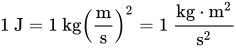
Energy is defined via work, so the SI unit of energy is the same as the unit of work – the joule (J), named in honour of James Prescott Joule[1] and his experiments on the mechanical equivalent of heat. In slightly more fundamental terms, 1 joule is equal to 1 newton metre and, in terms of SI base units
An energy unit that is used in atomic physics, particle physics, and high energy physics is the electronvolt (eV). One eV is equivalent to 1.602176634×10⁻¹⁹ J.[2]

In spectroscopy, the unit cm−10.0001239842 eV is used to represent energy since energy is inversely proportional to wavelength from the equation .

In discussions of energy production and consumption, the units barrel of oil equivalent and ton of oil equivalent are often used.

British imperial / US customary units

[edit]

The British imperial units and U.S. customary units for both energy and work include the foot-pound force (1.3558 J), the British thermal unit (BTU) which has various values in the region of 1055 J, the horsepower-hour (2.6845 MJ), and the gasoline gallon equivalent (about 120 MJ).

Log-base-10 of the ratios between various measures of energy

The table illustrates the wide range of magnitudes among conventional units of energy. For example, 1 BTU is equivalent to about 1,000 joules, and there are 25 orders-of-magnitude difference between a kilowatt-hour and an electron-volt.

Electricity

[edit]

A unit of electrical energy, particularly for utility bills, is the kilowatt-hour (kWh);[3] one kilowatt-hour is equivalent to 3.6 megajoules. Electricity usage is often given in units of kilowatt-hours per year or other periods.[4] This is a measurement of average power consumption, meaning the average rate at which energy is transferred. One kilowatt-hour per year is around 0.11 watts.

Natural gas

[edit]

Natural gas is often sold in units of energy content or by volume. Common units for selling by energy content are joules or therms. One therm is equal to about 1,055 megajoules. Common units for selling by volume are cubic metre or cubic feet. Natural gas in the US is sold in therms or 100 cubic feet (100 ft3). In Australia, natural gas is sold in cubic metres. One cubic metre contains about 38 megajoules. In most of the world, natural gas is sold in gigajoules.

Food industry

[edit]

The calorie is defined as the amount of thermal energy necessary to raise the temperature of one gram of water by 1 Celsius degree, from a temperature of 14.5 °C, at a pressure of atm. For thermochemistry a calorie of 4.184 J is used, but other calories have also been defined, such as the International Steam Table calorie of 4.1868 J. In many regions, food energy is measured in large calories (a large calory is a kilocalory, equal to 1000 calories), sometimes written capitalized as Calories. In the European Union, food energy labeling in joules is mandatory, often with calories as supplementary information.

Atom physics and chemistry

[edit]

In physics and chemistry, it is common to measure energy on the atomic scale in the non-SI, but convenient, units electronvolts (eV). One electronvolt (1 eV) is equivalent to the kinetic energy acquired by an electron in passing through a potential difference of 1 volt in a vacuum. It is common to use the SI magnitude prefixes (e.g. milli-, mega- etc) with electronvolts. Because of the relativistic equivalence between mass and energy, the eV is also sometimes used as a unit of mass. The Hartree (the atomic unit of energy) is commonly used in the field of computational chemistry since such units arise directly from the calculation algorithms without any need for conversion. Historically Rydberg units have been used.

Spectroscopy

[edit]

In spectroscopy and related fields it is common to measure energy levels in units of reciprocal centimetres. These units (cm−1) are strictly speaking not energy units but units proportional to energies, with being the proportionality constant.[5]

Explosions

[edit]

A gram of TNT releases 4,100 to 4,600 joules (980 to 1,100 calories) upon explosion. To define the tonne of TNT, this was standardized to 1 kilocalorie (4,184 joules) giving a value of 4.184 gigajoules (1 billion calories) for the tonne of TNT.[6]

See also

[edit]

References

[edit]
Revisions and contributorsEdit on WikipediaRead on Wikipedia
from Grokipedia
Units of energy are standardized measures used to quantify the capacity of a to perform work or the amount of transferred, essential across physics, , , and energy industries. The (SI) defines the joule (J) as the base unit of energy, equivalent to the work done when a force of one newton acts over a distance of one meter, or dimensionally expressed as one meter squared per second squared (kg·m²·s⁻²). Other prominent units include the calorie (cal), originally defined as the energy required to raise the temperature of one gram of by one degree at standard , commonly used in chemistry and (where the dietary is actually one kilocalorie). In particle and , the electronvolt (eV) serves as a convenient unit, representing the kinetic energy gained by a single accelerating through an electric potential difference of one volt, equal to approximately 1.602 × 10⁻¹⁹ J. For larger-scale applications like billing and heating, the kilowatt-hour (kWh) measures energy as the power of one kilowatt sustained for one hour, equivalent to 3.6 × 10⁶ J, while the British thermal unit (BTU) quantifies the heat needed to raise one pound of by one degree , widely applied in U.S. engineering and HVAC systems. These units facilitate precise calculations and conversions, with the joule serving as the universal reference in scientific contexts to ensure consistency.

Overview and Fundamentals

Definition and Role of Energy Units

is defined as the capacity of a to do work or to produce , representing a fundamental that enables changes in motion, position, or thermal state within a . Units of energy serve as standardized measures to quantify this capacity consistently across scientific disciplines, engineering applications, and everyday contexts, ensuring precise communication and comparability of results. These units are systematically derived from base physical quantities, such as , , and time, allowing for a coherent framework in measurement systems like the (SI). For example, the joule, the SI unit of , is dimensionally expressed as kg·m²/s², illustrating how energy emerges from the product of (derived from and ) and . This derivation underscores the universal nature of energy measurement, independent of specific contexts. A key principle governing energy units is their interconvertibility, rooted in the law of conservation of , which states that energy in an remains constant, merely transforming between forms such as mechanical (e.g., kinetic or potential), (), and electrical without loss or creation. All units measuring these forms—whether the SI joule as the modern standard or historical imperial units like the (BTU)—are related through precise conversion factors, facilitating seamless calculations across categories. Standardized energy units are essential to avoid catastrophic errors in computations, as mismatched units can lead to incorrect interpretations of physical phenomena. A prominent case is the 1999 Mars Climate Orbiter mission failure, where software from one team output thrust data in imperial pound-force seconds while another expected metric newton-seconds, causing a trajectory miscalculation that sent the into Mars' atmosphere at an altitude of about 57 km instead of the targeted 140–150 km, resulting in its destruction and a $327 million loss.

Historical Development

The development of units for energy traces back to the early , amid advances in and the study of engines. In 1824, Sadi Carnot's analysis of efficiency highlighted the need for quantifying and work, influencing subsequent definitions. The following year, French engineer Nicolas Clément-Desormes introduced the (capitalized) as the amount of required to raise one of by one degree , originating from calculations of in steam engines; this unit later became known as the kilocalorie, while the lowercase "calorie" was subsequently defined for one gram of water. James Prescott Joule's experiments in the 1840s further bridged mechanical work and , using devices like paddlewheels to demonstrate their equivalence and underscoring the push for standardized measures. Parallel to metric developments, imperial units emerged in 19th-century British engineering, particularly for mechanics and steam power. The foot-pound, representing the work done in raising one pound avoirdupois through one foot against gravity, gained prominence in the 1840s through Joule's quantitative studies on energy conversion, becoming a standard in mechanical engineering. Similarly, the British thermal unit (BTU), coined by engineer Thomas Tredgold in his 1824 work on warming and ventilating buildings, quantified the heat from fuel combustion and was formalized in the late 19th century for evaluating steam engine performance and thermal efficiency. These units reflected practical needs in industrial applications but varied in definition, prompting calls for consistency. By the late 19th century, efforts toward international standardization intensified. The centimeter-gram-second (CGS) system, proposed by the British Association for the Advancement of in , defined the erg as its energy unit—the work performed by one of force over one centimeter. In , the second International Electrical Congress in adopted the as a practical and , equivalent to 10^7 ergs, honoring Joule's contributions and aligning electrical and mechanical measures. This congress marked a shift from purely empirical to coherent systems. The saw the consolidation of global standards, diminishing older s. In , the 9th General Conference on Weights and Measures (CGPM) resolved to develop a practical international based on the metre-kilogram-second (MKS) framework, consulting scientific and technical bodies to unify units including those for energy. This effort culminated in 1960, when the 11th CGPM established the (SI), designating the joule—defined as the work done by one newton over one meter—as the base derived unit for energy, heat, and work. The adoption of SI accelerated the phase-out of legacy units like the erg from the CGS , which had persisted in physics but proved less suitable for and , promoting widespread consistency by the late .

SI and Metric Units

Joule

The joule, symbol J, is the derived unit of in the (SI). It is defined as the work done when a force of one newton acts over a distance of one in the direction of the force, or equivalently, one joule equals one squared per second squared: 1 J=1 kgm2s21\ \mathrm{J} = 1\ \mathrm{kg \cdot m^2 \cdot s^{-2}}. This definition positions the joule within the coherent system of SI derived units, expressing in terms of the base units of mass (), length (), and time (second). The joule's foundation traces to the 2019 revision of the SI, which redefined all base units in terms of fixed numerical values of fundamental physical constants, ensuring invariance and universality. Specifically, the is now defined via the h=6.62607015×1034 Jsh = 6.62607015 \times 10^{-34}\ \mathrm{J \cdot s}, alongside the cc and the hyperfine transition frequency ΔνCs\Delta \nu_{\mathrm{Cs}}, linking the joule to these invariants. This redefinition, effective from 20 May 2019, enhances the joule's precision for scientific measurements across scales, from everyday mechanics to quantum phenomena. In contrast, the Planck energy unit, derived from hh, cc, and the GG as Ep=c5G1.956×109 JE_p = \sqrt{\frac{\hbar c^5}{G}} \approx 1.956 \times 10^9\ \mathrm{J}
Add your contribution
Related Hubs
User Avatar
No comments yet.