Hubbry Logo
ChekaChekaMain
Open search
Cheka
Community hub
Cheka
logo
8 pages, 0 posts
0 subscribers
Be the first to start a discussion here.
Cheka
Cheka
from Wikipedia
All-Russian Extraordinary Commission
Всероссийская чрезвычайная комиссия (Russian)
Agency overview
FormedDecember 20, 1917; 107 years ago (1917-12-20)
DissolvedFebruary 6, 1922; 103 years ago (1922-02-06)
Superseding agency
TypeSecret police
Intelligence agency
Headquarters
Agency executives
Parent agencyCouncil of People's Commissars

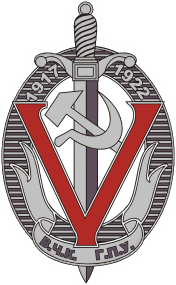
The All-Russian Extraordinary Commission (Russian: Всероссийская чрезвычайная комиссия, romanized: Vserossiyskaya chrezvychaynaya komissiya, IPA: [fsʲɪrɐˈsʲijskəjə tɕrʲɪzvɨˈtɕæjnəjə kɐˈmʲisʲɪjə]), abbreviated as VChK (Russian: ВЧК, IPA: [vɛ tɕe ˈka]), and commonly known as the Cheka (Russian: ЧК, IPA: [tɕɪˈka]), was the first Soviet secret police organization. It was established on 20 December [O.S. 7 December] 1917 by the Council of People's Commissars of the Russian SFSR,[1] and was led by Felix Dzerzhinsky.[2][3] By the end of the Russian Civil War in 1922, the Cheka had at least 200,000 personnel.

Ostensibly created to protect the October Revolution from "class enemies" such as the bourgeoisie and members of the clergy, the Cheka soon became a tool of repression wielded against all political opponents of the Bolshevik regime. The organization had responsibility for counterintelligence, oversight of the loyalty of the Red Army, and protection of the country's borders, as well as the collection of human and technical intelligence. At the direction of Vladimir Lenin, the Cheka performed mass arrests, imprisonments, torture, and executions without trial in what came to be known as the "Red Terror". It policed the Gulag system of labor camps, conducted requisitions of food, and put down rebellions by workers and peasants. The Cheka was responsible for executing at least 50,000 to as many as 200,000 people, though estimates vary widely.

The Cheka, the first in a long succession of Soviet secret police agencies, established the security service as a major player in Soviet politics. It was dissolved in February 1922, and succeeded by the State Political Directorate (GPU). Throughout the Soviet era, members of the secret police were referred to as "Chekists".

Name

[edit]

The official designation was All-Russian Extraordinary (or Emergency) Commission for Combating Counter-Revolution and Sabotage under the Council of People's Commissars of the RSFSR (Russian: Всероссийская чрезвычайная комиссия по борьбе с контрреволюцией и саботажем при Совете народных комиссаров РСФСР, Vserossiyskaya chrezvychaynaya komissiya po borbe s kontrrevolyutsiyey i sabotazhem pri Sovete narodnykh komisarov RSFSR).[4]

In 1918, its name was changed, becoming All-Russian Extraordinary Commission for Combating Counter-Revolution, Profiteering and Corruption.

A member of Cheka was called a chekist (Russian: чеки́ст, romanized: chekíst, IPA: [t͡ɕɪˈkʲist] ). Also, the term chekist often referred to Soviet secret police throughout the Soviet period, despite official name changes over time. In The Gulag Archipelago, Alexander Solzhenitsyn recalls that zeks in the labor camps used old chekist as a mark of special esteem for particularly experienced camp administrators.[5] The term is still found in use in Russia today (for example, President Vladimir Putin has been referred to in the Russian media as a chekist due to his career in the KGB and as head of the KGB's successor, FSB[6]).

The Chekists commonly dressed in black leather, including long flowing coats, reportedly after being issued such distinctive coats early in their existence.[7][8] Western communists adopted this clothing fashion. The Chekists also often carried with them Greek-style worry beads made of amber, which had become "fashionable among high officials during the time of the 'cleansing'".[9]

History

[edit]

In 1921, the Troops for the Internal Defense of the Republic (a branch of the Cheka) numbered at least 200,000.[10] These troops policed labor camps, ran the Gulag system, conducted requisitions of food, and subjected political opponents to secret arrest, detention, torture and summary execution. They also put down rebellions and riots by workers[11] or peasants, and mutinies in the desertion-plagued Red Army.[12]

After 1922, Cheka groups underwent the first of a series of reorganizations; however the theme of a government dominated by "the organs" persisted indefinitely afterward, and Soviet citizens continued to refer to members of the various organs as Chekists.[13]

The Cheka was largely controlled by people who came from well off backgrounds and from a diverse set of ethnicities. Eleven of the top twenty ranking Chekists were of the bourgeoisie or bourgeoisie-intelligentsia, one came from a family of wealthy landowners, two came from families of the industrial proletariat, only three were peasants, and three have unknown backgrounds. Six of the twenty were ethnic Russians, three were Polish Jews, three were Latvians, two were ethnic Poles, one was Ukrainian, one was an Azerbaijani Jew, one was Georgian, one was Armenian, one was a Russified Greek, and one was a Lithuanian Jew.[14]

Creation

[edit]
Members of the presidium of VCheKa (left to right) Yakov Peters, Józef Unszlicht, Abram Belenky (standing), Felix Dzerzhinsky, Vyacheslav Menzhinsky, 1921

In the first month and a half after the October Revolution (1917), the duty of "extinguishing the resistance of exploiters" was assigned to the Petrograd Military Revolutionary Committee (or PVRK). It represented a temporary body working under directives of the Council of People's Commissars (Sovnarkom) and Central Committee of RDSRP(b). The VRK created new bodies of government,[clarification needed] organized food delivery to cities and the Army, requisitioned products from bourgeoisie, and sent its emissaries and agitators into provinces. One of its most important functions was the security of revolutionary order, and the fight against counterrevolutionary activity (see: Anti-Soviet agitation).

On December 1, 1917, the All-Russian Central Executive Committee (VTsIK or TsIK)[15] reviewed a proposed reorganization of the VRK, and possible replacement of it. On December 5, the Petrograd VRK published an announcement of dissolution and transferred its functions to the department of TsIK for the fight against "counterrevolutionaries".[16] On December 6, the Council of People's Commissars (Sovnarkom) strategized how to persuade government workers to strike against counter-revolution across Russia. They decided that a special commission was needed to implement the "most energetically revolutionary" measures. Felix Dzerzhinsky (the Iron Felix) was appointed as Director and invited the participation of the following individuals: V. K. Averin, I. K. Ksenofontov, S. K. Ordzhonikidze, Ya. Kh. Peters, K. A. Peterson, V. A. Trifonov, I. S. Unshlikht, V. N. Vasilevsky, V. N. Yakovleva, V. V. Yakovlev, D. G. Yevseyev, N. A. Zhydelev.

On December 7, 1917, all of those invited except Zhydelev and Vasilevsky gathered in the Smolny Institute with Dzerzhinsky to discuss the competence and structure of the commission to combat counterrevolution and sabotage. The obligations of the commission were: "to liquidate to the root all of the counterrevolutionary and sabotage activities and all attempts to them in all of Russia, to hand over counter-revolutionaries and saboteurs to the revolutionary tribunals, develop measures to combat them and relentlessly apply them in real-world applications. The commission should only conduct a preliminary investigation".[clarification needed] The commission should also observe the press and counterrevolutionary parties, sabotaging officials and other criminals.

Smolny, the seat of the Soviet government, 1917

Three sections were created: informational, organizational, and a unit to combat counter-revolution and sabotage. Upon the end of the meeting, Dzerzhinsky reported to the Sovnarkom with the requested information. The commission was allowed to apply such measures of repression as 'confiscation, deprivation of ration cards, publication of lists of enemies of the people etc.'".[16] That day, Sovnarkom officially confirmed the creation of VCheKa. The commission was created not under the VTsIK as was previously anticipated, but rather under the Council of the People's Commissars.[17]

On December 8, 1917, some of the original members of the Cheka were replaced. Averin, Ordzhonikidze, and Trifonov were replaced by V. V. Fomin, S. E. Shchukin, Ilyin, and Chernov.[17] On the meeting of December 8, the presidium of VChK was elected of five members, and chaired by Dzerzhinsky. The issues of "speculation" or profiteering, such as by black market grain sellers[18] and "corruption" was raised at the same meeting,[19] which was assigned to Peters to address and report with results to one of the next meetings of the commission. A circular, published on December 28 [O.S. December 15] 1917, gave the address of VCheka's first headquarters as "Petrograd, Gorokhovaya 2, 4th floor".[17] On December 11, Fomin was ordered to organize a section to suppress "speculation." And in the same day, VCheKa offered Shchukin to conduct arrests of counterfeiters.

In January 1918, a subsection of the anti-counterrevolutionary effort was created to police bank officials. The structure of VCheKa was changing repeatedly. By March 1918, when the organization came to Moscow, it contained the following sections: against counterrevolution, speculation, non-residents, and information gathering. By the end of 1918–1919, some new units were created: secretly operative, investigatory, of transportation, military (special), operative, and instructional. By 1921, it changed once again, forming the following sections: directory of affairs, administrative-organizational, secretly operative, economical, and foreign affairs.

First months

[edit]

In the first months of its existence, VCheKa consisted of only 40 officials. It commanded a team of soldiers, the Sveaborgesky regiment, as well as a group of Red Guardsmen. On January 14, 1918, Sovnarkom ordered Dzerzhinsky to organize teams of "energetic and ideological" sailors to combat speculation. By the spring of 1918, the commission had several teams: in addition to the Sveaborge team, it had an intelligence team, a team of sailors, and a strike team. Through the winter of 1917–1918, all activities of VCheKa were centralized mainly in the city of Petrograd. It was one of several other commissions in the country which fought against counterrevolution, speculation, banditry, and other activities perceived as crimes. Other organizations included: the Bureau of Military Commissars, and an Army-Navy investigatory commission to attack the counterrevolutionary element in the Red Army, plus the Central Requisite and Unloading Commission to fight speculation. The investigation of counterrevolutionary or major criminal offenses was conducted by the Investigatory Commission of Revtribunal. The functions of VCheKa were closely intertwined with the Commission of V. D. Bonch-Bruyevich, which beside the fight against wine pogroms was engaged in the investigation of most major political offenses (see: Bonch-Bruyevich Commission).

Grigory Petrovsky

All results of its activities, VCheKa had either to transfer to the Investigatory Commission of Revtribunal, or to dismiss. The control of the commission's activity was provided by the People's Commissariat for Justice (Narkomjust, at that time headed by Isaac Steinberg) and Internal Affairs (at that time headed by Grigory Petrovsky). Although the VCheKa was officially an independent organization from Internal Affairs, its chief members such as Dzerzhinsky, Latsis, Unszlicht, and Uritsky (all main chekists), since November 1917 composed the collegiate of Internal Affairs headed by Petrovsky. In November 1918, Petrovsky was appointed as head of the All-Ukrainian Central Military Revolutionary Committee during VCheKa's expansion to provinces and front-lines. At the time of political competition between Bolsheviks and SRs (January 1918), Left SRs attempted to curb the rights of VCheKa and establish through the Narkomiust their control over its work. Having failed in attempts to subordinate the VCheKa to Narkomiust, the Left SRs tried to gain control of the Extraordinary Commission in a different way: they requested that the Central Committee of the party be granted the right to directly enter their representatives into the VCheKa. Sovnarkom recognized the desirability of including five representatives of the Left Socialist-Revolutionary faction of VTsIK. Left SRs were granted the post of a companion (deputy) chairman of VCheKa. However, Sovnarkom, in which the majority belonged to the representatives of RSDLP(b) retained the right to approve members of the collegium of the VCheKa.

Originally, members of the Cheka were exclusively Bolshevik; however, in January 1918, Left SRs also joined the organization.[20] The Left SRs were expelled or arrested later in 1918, following the attempted assassination of Lenin by an SR, Fanni Kaplan.

Consolidation of VCheKa and National Establishment

[edit]

By the end of January 1918, the Investigatory Commission of Petrograd Soviet (probably same as of Revtribunal) petitioned Sovnarkom to delineate the role of detection and judicial-investigatory organs. It offered to leave, for the VCheKa and the Commission of Bonch-Bruyevich, only the functions of detection and suppression, while investigative functions entirely transferred to it. The Investigatory Commission prevailed. On January 31, 1918, Sovnarkom ordered to relieve VCheKa of the investigative functions, leaving for the commission only the functions of detection, suppression, and prevention of anti revolutionary crimes. At the meeting of the Council of People's Commissars on January 31, 1918, a merger of VCheKa and the Commission of Bonch-Bruyevich was proposed. The existence of both commissions, VCheKa of Sovnarkom and the Commission of Bonch-Bruyevich of VTsIK, with almost the same functions and equal rights, became impractical. A decision followed two weeks later.[21]

On February 23, 1918, VCheKa sent a radio telegram to all Soviets with a petition to immediately organize emergency commissions to combat counter-revolution, sabotage and speculation, if such commissions had not been yet organized. February 1918 saw the creation of local Extraordinary Commissions. One of the first founded was the Moscow Cheka. Sections and commissariats to combat counterrevolution were established in other cities. The Extraordinary Commissions arose, usually in the areas during the moments of the greatest aggravation of political situation. On February 25, 1918, as the counterrevolutionary organization Union of Front-liners was making advances, the executive committee of the Saratov Soviet formed a counter-revolutionary section. On March 7, 1918, because of the move from Petrograd to Moscow, the Petrograd Cheka was created. On March 9, a section for combating counterrevolution was created under the Omsk Soviet. Extraordinary commissions were also created in Penza, Perm, Novgorod, Cherepovets, Rostov, Taganrog. On March 18, VCheKa adopted a resolution, The Work of VCheKa on the All-Russian Scale, foreseeing the formation everywhere of Extraordinary Commissions after the same model, and sent a letter that called for the widespread establishment of the Cheka in combating counterrevolution, speculation, and sabotage. Establishment of provincial Extraordinary Commissions was largely completed by August 1918. In the Soviet Republic, there were 38 gubernatorial Chekas (Gubcheks) by this time.

On June 12, 1918, the All-Russian Conference of Cheka adopted the Basic Provisions on the Organization of Extraordinary Commissions. They set out to form Extraordinary Commissions not only at Oblast and Guberniya levels, but also at the large Uyezd Soviets. In August 1918, in the Soviet Republic had accounted for some 75 Uyezd-level Extraordinary Commissions. By the end of the year, 365 Uyezd-level Chekas were established.

Felix Dzerzhinsky in a meeting among other members of the Presidium of the Cheka, 1919

In 1918, the All-Russia Extraordinary Commission and the Soviets managed to establish a local Cheka apparatus. It included Oblast, Guberniya, Raion, Uyezd, and Volost Chekas, with Raion and Volost Extraordinary Commissioners. In addition, border security Chekas were included in the system of local Cheka bodies.

In the autumn of 1918, as consolidation of the political situation of the republic continued, a move toward elimination of Uyezd-, Raion-, and Volost-level Chekas, as well as the institution of Extraordinary Commissions was considered. On January 20, 1919, VTsIK adopted a resolution prepared by VCheKa, On the abolition of Uyezd Extraordinary Commissions. On January 16 the presidium of VCheKa approved the draft on the establishment of the Politburo at Uyezd militsiya. This decision was approved by the Conference of the Extraordinary Commission IV, held in early February 1920.

Other types of Cheka

[edit]
Portrait of Martin Latsis on a Soviet postage stamp.

On August 3, a VCheKa section for combating counterrevolution, speculation and sabotage on railways was created. On August 7, 1918, Sovnarkom adopted a decree on the organization of the railway section at VCheKa. Combating counterrevolution, speculation, and crimes on railroads was passed under the jurisdiction of the railway section of VCheKa and local Cheka. In August 1918, railway sections were formed under the Gubcheks. Formally, they were part of the non-resident sections, but in fact constituted a separate division, largely autonomous in their activities. The gubernatorial and oblast-type Chekas retained in relation to the transportation sections only control and investigative functions.

The beginning of a systematic work of organs of VCheKa in RKKA refers to July 1918, the period of extreme tension of the civil war and class struggle in the country. On July 16, 1918, the Council of People's Commissars formed the Extraordinary Commission for combating counterrevolution at the Czechoslovak (Eastern) Front, led by M. I. Latsis. In the fall of 1918, Extraordinary Commissions to combat counterrevolution on the Southern (Ukraine) Front were formed. In late November, the Second All-Russian Conference of the Extraordinary Commissions accepted a decision after a report from I. N. Polukarov to establish at all frontlines, and army sections of the Cheka and granted them the right to appoint their commissioners in military units. On December 9, 1918, the collegiate (or presidium) of VCheKa had decided to form a military section, headed by M. S. Kedrov, to combat counterrevolution in the Army. In early 1919, the military control and the military section of VCheKa were merged into one body, the Special Section of the Republic, with Kedrov as head. On January 1, he issued an order to establish the Special Section. The order instructed agencies everywhere to unite the Military control and the military sections of Chekas and to form special sections of frontlines, armies, military districts, and guberniyas.

In November 1920, the Soviet of Labor and Defense created a Special Section of VCheKa for the security of the state border. On February 6, 1922, after the Ninth All-Russian Soviet Congress, the Cheka was dissolved by VTsIK, "with expressions of gratitude for heroic work." It was replaced by the State Political Administration (GPU), a section of Internal Affairs of the Russian Soviet Federative Socialist Republic (RSFSR). Dzerzhinsky remained as chief of the GPU.

Operations

[edit]

Suppression of political opposition

[edit]
Corpses of hostages executed by Cheka in 1918 in the basement of Tulpanov's house in Kherson, Ukrainian SSR, The Black Book of Communism
Corpses of people executed by Cheka in 1918 at a yard in Kharkiv, Ukrainian SSR, The Black Book of Communism

As its name implied, the Extraordinary Commission had virtually unlimited powers and could interpret them in any way it wished. No standard procedures were ever set up, except that the commission was supposed to send the arrested to the Military-Revolutionary tribunals if outside of a war zone. This left an opportunity for a wide range of interpretations, as the whole country was in total chaos. At the direction of Lenin, the Cheka performed mass arrests, imprisonments, and executions of "enemies of the people". In this, the Cheka said that they targeted "class enemies" such as the bourgeoisie, and members of the clergy.

Within a month, the Cheka had extended its repression to all political opponents of the communist government, including anarchists and others on the left. On April 11/12, 1918, some 26 anarchist political centres in Moscow were attacked. Forty anarchists were killed by Cheka forces, and about 500 were arrested and jailed after a pitched battle took place between the two groups.[22] In response to the anarchists' resistance, the Cheka orchestrated a massive retaliatory campaign of repression, executions, and arrests against all opponents of the Bolshevik government, in what came to be known as "Red Terror". The Red Terror, implemented by Dzerzhinsky on September 5, 1918, was vividly described by the Red Army journal Krasnaya Gazeta:

Without mercy, without sparing, we will kill our enemies in scores of hundreds. Let them be thousands, let them drown themselves in their own blood. For the blood of Lenin and Uritsky … let there be floods of blood of the bourgeoisie – more blood, as much as possible..."[23]

An early Bolshevik, Victor Serge described in his book Memoirs of a Revolutionary:

Since the first massacres of Red prisoners by the Whites, the murders of Volodarsky and Uritsky and the attempt against Lenin (in the summer of 1918), the custom of arresting and, often, executing hostages had become generalized and legal. Already the Cheka, which made mass arrests of suspects, was tending to settle their fate independently, under formal control of the Party, but in reality without anybody's knowledge. The Party endeavoured to head it with incorruptible men like the former convict Dzerzhinsky, a sincere idealist, ruthless but chivalrous, with the emaciated profile of an Inquisitor: tall forehead, bony nose, untidy goatee, and an expression of weariness and austerity. But the Party had few men of this stamp and many Chekas. I believe that the formation of the Chekas was one of the gravest and most impermissible errors that the Bolshevik leaders committed in 1918 when plots, blockades, and interventions made them lose their heads. All evidence indicates that revolutionary tribunals, functioning in the light of day and admitting the right of defense, would have attained the same efficiency with far less abuse and depravity. Was it necessary to revert to the procedures of the Inquisition?"

The Cheka was also used against Nestor Makhno's Revolutionary Insurgent Army of Ukraine. After the Insurgent Army had served its purpose in aiding the Red Army to stop the Whites under Denikin, the Soviet communist government decided to eliminate the anarchist forces. In May 1919, two Cheka agents sent to assassinate Makhno were caught and executed.[24]

Chinese Chekists executing an Orthodox priest in Moscow, White Russian anti-Bolshevik propaganda poster, c. 1920

Many victims of Cheka repression were "bourgeois hostages" rounded up and held in readiness for summary execution in reprisal for any alleged counter-revolutionary act. Wholesale, indiscriminate arrests became an integral part of the system.[25] The Cheka used trucks disguised as delivery trucks, called "Black Marias", for the secret arrest and transport of prisoners.[26]

It was during the Red Terror that the Cheka, hoping to avoid the bloody aftermath of having half-dead victims writhing on the floor, developed a technique for execution known later by the German words "Nackenschuss" or "Genickschuss", a shot to the nape of the neck, which caused minimal blood loss and instant death. The victim's head was bent forward, and the executioner fired slightly downward at point-blank range. This had become the standard method used later by the NKVD to liquidate Joseph Stalin's purge victims and others.[27]

Persecution of deserters

[edit]

It is believed that there were more than three million deserters from the Red Army in 1919 and 1920.[28] Officially there was about 2,630,000 registered deserters by the Central Committee for Struggle Against Desertion.[29] Approximately 500,000 deserters were arrested in 1919 and close to 800,000 in 1920, by troops of the 'Special Punitive Department' of the Cheka, created to punish desertions.[30][31] These troops were used to forcibly repatriate deserters, taking and shooting hostages to force compliance or to set an example.

In September 1918, according to The Black Book of Communism, in only twelve provinces of Russia, 48,735 deserters and 7,325 "bandits" were arrested, 1,826 were killed and 2,230 were executed. The exact identity of these individuals is confused by the fact that the Soviet Bolshevik government used the term 'bandit' to cover ordinary criminals as well as armed and unarmed political opponents, such as the anarchists.

Repression

[edit]

Number of victims

[edit]

Estimates on Cheka executions vary widely. The lowest figures (disputed below) are provided by Dzerzhinsky's lieutenant Martyn Latsis, limited to RSFSR over the period 1918–1920:

  • For the period 1918 – July 1919, covering only twenty provinces of central Russia:
In 1918: 6,300; in 1919 (up to July): 2,089; Total: 8,389
  • For the whole period 1918–19:
In 1918: 6,185; in 1919: 3,456; Total: 9,641
  • For the whole period 1918–20:
In January–June 1918: 22; in July–December 1918: more than 6,000; in 1918–20: 12,733.

Experts generally agree these semi-official figures are vastly understated.[32] Pioneering historian of the Red Terror Sergei Melgunov claims that this was done deliberately in an attempt to demonstrate the government's humanity. For example, he refutes the claim made by Latsis that only 22 executions were carried out in the first six months of the Cheka's existence by providing evidence that the true number was 884 executions.[33] W. H. Chamberlin claims, "It is simply impossible to believe that the Cheka only put to death 12,733 people in all of Russia up to the end of the civil war."[34] Donald Rayfield concurs, noting that, "Plausible evidence reveals that the actual numbers … vastly exceeded the official figures."[35] Chamberlin provides the "reasonable and probably moderate" estimate of 50,000,[34] while others provide estimates ranging up to 500,000.[36][37] Several scholars put the number of executions at about 250,000.[38][39] Some believe it is possible more people were murdered by the Cheka than died in battle.[40] Historian James Ryan gives a modest estimate of 28,000 executions per year from December 1917 to February 1922.[41]

Lenin himself seemed unfazed by the killings. On 12 January 1920, while addressing trade union leaders, he said: "We did not hesitate to shoot thousands of people, and we shall not hesitate, and we shall save the country."[42] On 14 May 1921, the Politburo, chaired by Lenin, passed a motion "broadening the rights of the [Cheka] in relation to the use of the [death penalty]."[43]

Scholarly estimates

[edit]

There is no consensus among the Western historians on the number of deaths from the Red Terror. One source gives estimates of 28,000 executions per year from December 1917 to February 1922.[44] Estimates for the number of people shot during the initial period of the Red Terror are at least 10,000.[45] Estimates for the whole period go for a low of 50,000[46] to highs of 140,000[46][47] and 200,000 executed.[48] Most estimations for the number of executions in total put the number at about 100,000.[49]

According to Vadim Erlikhman's investigation, the number of the Red Terror's victims is at least 1,200,000 people.[50] According to Robert Conquest, a total of 140,000 people were shot in 1917–1922.[51] Candidate of Historical Sciences Nikolay Zayats states that the number of people shot by the Cheka in 1918–1922 is about 37,300 people, shot in 1918–1921 by the verdicts of the tribunals – 14,200, i.e. about 50,000–55,000 people in total, although executions and atrocities were not limited to the Cheka, having been organized by the Red Army as well.[52]

According to anti-Bolshevik Socialist Revolutionary Sergei Melgunov (1879–1956), at the end of 1919, the Special Investigation Commission to investigate the atrocities of the Bolsheviks estimated the number of deaths at 1,766,188 people in 1918–1919 only.[53]

Atrocities

[edit]

The Cheka engaged in the widespread practice of torture. Depending on Cheka committees in various cities, the methods included: being skinned alive, scalped, "crowned" with barbed wire, impaled, crucified, hanged, stoned to death, tied to planks and pushed slowly into furnaces or tanks of boiling water, or rolled around naked in internally nail-studded barrels. Chekists reportedly poured water on naked prisoners in the winter-bound streets until they became living ice statues. Others beheaded their victims by twisting their necks until their heads could be torn off. The Cheka detachments stationed in Kiev would attach an iron tube to the torso of a bound victim and insert a rat in the tube closed off with wire netting, while the tube was held over a flame until the rat began gnawing through the victim's guts in an effort to escape.[54][55]

Women and children were also victims of Cheka terror. Rape of women by Cheka guards and interrogators was commonplace, superiors would only put a stop to it if the rape became too brutal.[56] Many of the women were shot after they were raped. Children between the ages of 8 and 16 were imprisoned and occasionally executed.[55]

All of these atrocities were published on numerous occasions in Pravda and Izvestiya: January 26, 1919 Izvestiya #18 article Is it really a medieval imprisonment? («Неужели средневековый застенок?»); February 22, 1919 Pravda #12 publishes details of the Vladimir Cheka's tortures, September 21, 1922 Socialist Herald publishes details of series of tortures conducted by the Stavropol Cheka (hot basement, cold basement, skull measuring, etc.).[57]

The Chekists were also supplemented by the militarized Units of Special Purpose (the Party's Spetsnaz or ЧОН).

Cheka was actively and openly utilizing kidnapping methods.[58][59] With kidnapping methods, Cheka was able to extinguish numerous cases of discontent especially among the rural population. Among the notorious ones was the Tambov rebellion.

Villages were bombarded to complete annihilation, as in the case of Tretyaki, Novokhopersk uyezd, Voronezh Governorate. [citation needed]

As a result of this relentless violence, more than a few Chekists ended up with psychopathic disorders, which Nikolai Bukharin said were "an occupational hazard of the Chekist profession." Many hardened themselves to the executions by heavy drinking and drug use. Some developed a gangster-like slang for the verb to kill in an attempt to distance themselves from the killings, such as 'shooting partridges', or 'sealing' a victim, or giving him a natsokal (onomatopoeia of the trigger action).[60]

On November 30, 1992, by the initiative of the President of the Russian Federation the Constitutional Court of the Russian Federation recognized the Red Terror as unlawful, which in turn led to the suspension of Communist Party of the RSFSR.

Regional Chekas

[edit]

Cheka departments were organized not only in big cities and guberniya seats, but also in each uyezd, at any front-lines and military formations. Nothing is known on what resources they were created.

Moscow Cheka (1918–1922)
  • Chairman – Felix Dzerzhinsky (also the leader of the Cheka overall)[61]
  • Deputy – Yakov Peters (initially the chairman of the Petrograd Department for a month, and the number two in the Cheka overall)
  • Other members – Shklovsky, Kneyfis, Tseystin, Razmirovich, Kronberg, Khaikina, Karlson, Shauman, Lentovich, Rivkin, Antonov, Delafabr, Tsytkin, G. Sverdlov, Bizensky, Yakov Blumkin, Aleksandrovich, Fines, Zaks, Yakov Goldin, Galpershtein, Kniggisen, Martin Latsis (later transfer (chief of jail), Fogel, Zakis, Shillenkus, Yanson).
Petrograd Cheka (1918–1922)
  • Chairman – Moisei Uritsky (January 1918 to 30 August 1918),[62] Gleb Bokii (31 August 1918 to 30 September 1918), Meinkman (October 1918 to January 1919),[63] Varvara Yakovleva (acting chair in two periods; November 1918 to January 1919; and October 1919 to October 1921),[64] Nikolai Antipov (January 1919 to October 1919)[65]
  • Deputy – Gleb Bokii (March 1918 to August 1918), Varvara Yakovleva (September 1918 to February 1922), Nikolai Antipov (acting deputy chairman from November 1918 to January 1919)
  • Other members – Reiller, Kozlovsky, Model, Rozmirovich, I. Diesporov, Iselevich, Krassikov, Bukhan, Merbis, Paykis, Anvelt.
Kharkov Cheka
  • Deych, Vikhman, Timofey, Vera (Dora) Grebenshchikova, A. G. Aleksandra
  • Ashykin.
[edit]

Legacy

[edit]
"Happy Birthday, Executioners" near the main FSB building, on the day the centenary of the Cheka was celebrated, 20 December 2017

Konstantin Preobrazhenskiy criticised the continuing celebration of the professional holiday of the old and the modern Russian security services on the anniversary of the creation of the Cheka, The Day of the Security Authorities of the Russian Federation [ru], with the assent of the Presidents of Russia. (Vladimir Putin, former KGB officer, chose not to change the date to another): "The successors of the KGB still haven't renounced anything; they even celebrate their professional holiday the same day, as during repression, on the 20th of December. It is as if the present intelligence and counterespionage services of Germany celebrated Gestapo Day. I can imagine how indignant our press would be!"[70][71][72]

See also

[edit]

References

[edit]

Sources

[edit]
[edit]
Revisions and contributorsEdit on WikipediaRead on Wikipedia
from Grokipedia
The Cheka, formally known as the All-Russian Extraordinary Commission for Combating Counter-Revolution, Speculation, and Sabotage, was the first organization of the Bolshevik regime, established on December 20, 1917, by a decree from the under to identify, investigate, and eliminate internal threats to Soviet power. Headed by , a Polish-born Bolshevik revolutionary, the agency operated with unchecked authority, unbound by legal constraints, enabling rapid arrests, interrogations, and executions without trial. The Cheka's defining role emerged during the , where it spearheaded the —a state-sanctioned campaign of mass repression launched in September 1918 following assassination attempts on Lenin and other leaders—to crush elements, including monarchists, socialists, and suspected saboteurs. Employing brutal methods such as torture, forced confessions, and summary shootings, the organization expanded from a small unit to over 37,000 agents by 1920, contributing to tens of thousands of executions; historical estimates attribute between 50,000 and 200,000 deaths directly to Cheka actions during this period, though precise figures are contested due to destroyed records and ideological biases in documentation. These operations solidified Bolshevik control but entrenched a legacy of institutionalized terror that influenced subsequent Soviet security organs like the GPU and . The Cheka was reorganized and renamed in 1922, marking the end of its formal existence amid the regime's consolidation of power.

Name and Etymology

Origin and Colloquial Usage

The name "Cheka" derives from the Russian acronym ЧК (Cheka), formed from the initial letters of Chrezvychaynaya Komissiya ("Extraordinary Commission"), shorthand for the organization's full title: Vserossiyskaya Chrezvychaynaya Komissiya po Bor'be s Kontrrevolyutsiey i Sabotazhem ("All-Russian Extraordinary Commission for Combating Counter-Revolution and Sabotage"). This abbreviation emerged directly from the Bolshevik decree establishing the agency on December 20, 1917, reflecting its mandate as a temporary emergency body amid post-revolutionary instability. In colloquial Russian usage, "Cheka" rapidly supplanted the formal VChK acronym, becoming the everyday term for the apparatus and its repressive functions during the . The word evoked fear and was applied generically to denote unchecked state terror, with operatives known as "Chekists" (chekisty), a designation that persisted into later Soviet security organs like the and . Post-Soviet analyses note its evolution into a broader for authoritarian , as in the term "Chekism" (chekizm), describing a mindset of ruthless loyalty to regime security over legal norms. This linguistic shift underscored the agency's role in embedding extrajudicial violence into Soviet .

Historical Context

Bolshevik Seizure of Power and Civil War Onset

The Bolshevik seizure of power occurred during the on October 25, 1917 (; November 7 Gregorian), when forces loyal to the , organized under the Bolshevik-led , captured key infrastructure in Petrograd including bridges, telegraph stations, and the . This action overthrew Alexander Kerensky's with minimal violence; the assault on the resulted in fewer than a dozen deaths, and government ministers were arrested without significant resistance. , returning from hiding, addressed the Second that evening, proclaiming the transfer of power to the Soviets and the formation of a new government, the (Sovnarkom), with Lenin as chairman. In the immediate aftermath, Bolshevik authority consolidated in Petrograd but faced immediate challenges from rival socialist factions, military units, and regional governments unwilling to recognize Soviet rule. Kerensky fled southward and attempted a counter-offensive with Cossack forces under , which was repelled near Pulkovo Heights on October 28 (O.S.), marking early armed clashes. dissolved the Provisional Government's structures and began suppressing opposition newspapers and organizations, while negotiating the Armistice of Brest-Litovsk with in December 1917 to exit , a move that alienated allies and fueled accusations of among socialists. The onset of the Russian Civil War emerged from these tensions, with sporadic rebellions and declarations of autonomy beginning in late 1917; for instance, proclaimed independence on January 10, 1918 (O.S. December 28, 1917). The forcible dissolution of the on January 6, 1918 (O.S.), where held only 24% of seats despite their monopoly on urban soviets, intensified opposition from Socialist Revolutionaries (SRs) and , sparking uprisings in cities like and . These events, compounded by , food shortages, and desertions from the front, created a volatile environment of sabotage, assassinations, and counter-revolutionary plots, prompting the to seek mechanisms for internal security amid escalating multi-factional violence that would define the through 1922.

Formation

Establishment Decree and Initial Mandate

The All-Russian Extraordinary Commission for Combating Counter-Revolution and Sabotage (Vserossiyskaya Chrezvychaynaya Komissiya, or VChK) was established on December 20, 1917 (December 7 Old Style), by a decree issued by the (Sovnarkom), the Bolshevik government's executive body chaired by . The decree, drafted amid escalating threats from anti-Bolshevik forces following the , created the Cheka as an investigative agency to address immediate security challenges, including speculative profiteering and sabotage disrupting food supplies and economic stability in Petrograd. , a Polish Bolshevik revolutionary, was appointed as its chairman at the first organizational meeting held that same day in Petrograd's . The decree specified the Cheka's initial mandate as a temporary institution, explicitly stating it would be abolished "at the moment when the attempts are finally crushed." Its core duties focused on suppressing activities across , irrespective of their social, class, or political origins: persecuting and dismantling acts of counter-revolution and ; handing suspects over to tribunals for ; eliminating organizations, groups, and "social elements"; confiscating the property of identified counter-revolutionaries; publishing lists and sentences; and devising ongoing methods to combat such threats. Unlike regular judicial bodies, the Cheka was granted broad investigative authority but lacked formal powers of arrest, execution, or independent sentencing at inception; it was tasked primarily with preliminary inquiries and referrals to existing courts, reflecting ' intent to centralize repression without immediately replicating tsarist-style extrajudicial policing. This mandate emerged from Lenin's urgent directives, including a letter to Dzerzhinsky emphasizing the need for an "extraordinary commission" to probe and prosecute in , industry, and provisioning, amid reports of and exacerbating urban shortages. The Cheka's formation bypassed the Central Executive Committee of the Soviets, underscoring Sovnarkom's assertion of direct executive control over security matters in the nascent regime's chaotic early phase.

Leadership under Dzerzhinsky

![Felix Dzerzhinsky][float-right]
, a Polish revolutionary with prior experience in underground activities and Tsarist prisons, was appointed by on December 20, 1917, as chairman of the All-Russian Extraordinary Commission (Cheka) for Combating Counter-Revolution and Sabotage. In this role, Dzerzhinsky directed the agency's initial operations from Petrograd, emphasizing rapid response to perceived threats against the regime without judicial oversight. He personally oversaw the recruitment of early personnel, ensuring the Cheka's staff consisted exclusively of committed to maintain ideological loyalty.
Under Dzerzhinsky's leadership, the Cheka expanded swiftly from an initial force of about 120 agents in early March 1918 to over 100,000 employees by 1919, incorporating specialized departments for , economic investigations, and units numbering more than 20,000 by autumn 1918. Dzerzhinsky appointed Yakov Peters as his deputy shortly after assuming command, delegating operational tasks while retaining ultimate authority over policy and executions. This structure allowed for decentralized regional committees but centralized decision-making in after the capital's relocation in March 1918, enabling coordinated suppression of opposition across Soviet territories. Dzerzhinsky's approach prioritized extrajudicial measures, including summary arrests, interrogations involving , and executions, as exemplified by his endorsement of public hangings in response to revolts, such as Lenin's 1918 order in to publicly execute 100 kulaks. He viewed the Cheka as an instrument for decisively settling accounts with counterrevolutionaries, reporting actions to the only post-facto to avoid bureaucratic delays. During the , Dzerzhinsky's direct involvement included night raids in Petrograd to eliminate suspected spies and the orchestration of the , resulting in the execution of approximately 800 socialists without trial in 1918 alone. This leadership style solidified the Cheka's reputation as ' unyielding enforcer, though it drew internal party criticism for excesses by 1921, prompting its reorganization into the GPU.

Organizational Development

Central Structure and Authority

The All-Russian Extraordinary Commission for Combating Counter-Revolution and (VChK), commonly known as the Cheka, was established as a central organ directly subordinate to the (Sovnarkom), the executive authority of the Soviet government. A issued by Sovnarkom on December 20, (December 7 Old Style), defined its mandate and attachment to the council, granting it responsibility for investigating and suppressing counter-revolutionary activities, , and related threats without initial reliance on judicial institutions. This positioning endowed the Cheka with extraordinary autonomy, allowing it to operate independently of the People's Commissariats of Internal Affairs and , though it was required to coordinate on certain matters. Leadership rested with Chairman , appointed by on December 20, 1917, who held personal command over the organization's direction and personnel selections. Dzerzhinsky presided over a collegium, a governing board of key officials including deputies such as Yakov Peters (responsible for operational sections) and (overseeing ), which convened to approve major directives and personnel appointments. The collegium's decisions reinforced centralized control, prioritizing Bolshevik loyalty in staffing; by early 1918, it mandated recruitment primarily from members to ensure ideological alignment. The central headquarters, initially in Petrograd and relocated to in March 1918, housed administrative, informational, and executive departments that coordinated nationwide activities. These units handled , arrest orders, and punitive measures, with authority expanding through decrees—such as the October 1919 formalization of judicial powers permitting trials, convictions, and executions without appeal. While nominally reporting to Sovnarkom, the Cheka's operational independence meant leaders like Dzerzhinsky often informed the council only after actions were completed, minimizing external constraints during the . This structure facilitated rapid escalation of repressive capabilities, with central staff growing from an initial 40 operatives to thousands by 1921, underscoring its pivotal role in Bolshevik consolidation of power.

Regional and Local Chekas

Provincial Chekas, or gubcheka, were established in early 1918 in Bolshevik-controlled guberniyas to combat counter-revolution and at the regional level, mirroring the central VCheka's mandate while adapting to local conditions. These bodies coordinated with local Soviets but maintained operational independence, appointing their own personnel—often drawn from party militants, workers, or former criminals—and handling investigations, arrests, and summary executions without mandatory judicial oversight. By mid-1918, approximately 40 gubcheka operated across Soviet territories, expanding as advances secured more provinces. Local structures included uezdcheka in counties and initial Chekas, formed concurrently with provincial ones to penetrate rural and areas, though organs were abolished in January 1919 to streamline hierarchy. Uezdcheka focused on grain requisitions, deserter hunts, and suppressing peasant unrest, employing tactics like village cordons and mass shootings that varied by locality—such as specialized methods in places like Kharkov or Tsaritsyn. Poor communication lines during the Civil War granted these branches substantial autonomy, leading to excesses beyond central guidelines; frequently criticized local overzeal but struggled to enforce uniformity amid wartime chaos. Nominally subordinate to provincial executive committees and the VCheka, local Chekas answered primarily to directives, enabling rapid response to threats like insurgencies or economic but fostering inconsistencies in repression. By 1919, the decentralized network encompassed hundreds of committees with over 100,000 personnel, amplifying the Cheka's reach and contributing disproportionately to provincial casualties during the . This structure persisted until the Cheka's reorganization into the GPU in 1922, when centralization intensified.

Operational Tactics

Intelligence and Arrest Procedures

The Cheka's intelligence operations relied on a hierarchical network of informants, undercover agents, and units embedded across societal sectors, including factories, railways, detachments, and educational institutions, to detect activities, sabotage, and speculation. This system drew partial inspiration from Tsarist practices, incorporating former imperial agents and methods such as , telephone wiretaps, and infiltration of opposition groups. By March 1918, the agency had grown from an initial cadre of about 120 personnel to thousands, expanding to over 100,000 operatives by late 1919, which facilitated real-time monitoring and preemptive disruption of perceived threats. Agents often operated visibly—distinguished by leather coats and peaked caps—to instill fear and encourage denunciations from the populace, supplementing formal intelligence with crowdsourced reports of disloyalty. Arrest procedures bypassed standard judicial processes, as stipulated in the Cheka's founding decree of December 20, (Old Style), which authorized the commission to independently persecute counter-revolutionaries, conduct searches, confiscate property, and detain suspects without prior warrants or appeals to tribunals. Operations typically involved sudden night raids by armed Chekist squads, who cordoned off districts, ransacked homes, and rounded up targets en masse, including relatives of suspected anti-Bolsheviks to compel compliance or extract information. In Petrograd, for instance, Yakov Peters, a deputy to , mandated identity checks and preemptive arrests of officers' families in June 1919 to neutralize potential insurgencies. Detainees faced immediate isolation and , where Cheka officials wielded unchecked prosecutorial, judicial, and punitive , often resolving cases within hours; resistance or insufficient cooperation led to summary executions at detention sites. Dzerzhinsky himself advocated for such expedited "organized terror" as essential for survival, declaring in July 1918 that judgments should culminate in rapid sentencing without prolonged deliberation.

Interrogation and Judicial Powers

The Cheka possessed extraordinary authority to conduct interrogations and impose penalties without adherence to conventional legal procedures, functioning as both investigative and punitive organ. Established by the Decree on the Formation of the All-Russian Extraordinary Commission on December 7, , it was empowered to "persecute and break up all acts of counter-revolution and " and to "bring before the revolutionary court all who are guilty," yet operational directives under permitted agents to execute verdicts summarily if delays threatened the 's security. This latitude enabled the Cheka to bypass revolutionary tribunals entirely, with agents authorized to shoot suspects on the spot during arrests or interrogations, as confirmed in internal orders emphasizing immediate action against perceived threats. Interrogation practices emphasized to obtain rapid confessions, often involving systematic to break detainees' resistance. Methods included prolonged beatings to the neck and head, forced of soapy to induce , insertion of heated irons or fragments into orifices, and psychological terror such as mock executions or threats to family members, as detailed in a compilation of Cheka techniques derived from wartime operations. These approaches were justified internally as necessary for efficiency amid exigencies, yielding fabricated admissions that fueled further arrests, though contemporary accounts from prisoners highlight their role in manufacturing rather than uncovering genuine plots. A pivotal expansion of judicial powers occurred via a decree on October 5, 1919, which formally granted the Cheka competence to try cases, pronounce sentences—including death without appeal—and oversee executions, independent of higher soviet oversight. This measure addressed earlier ambiguities in the Cheka's mandate, transforming it from a preparatory investigatory body into a de facto court system, with Dzerzhinsky's leadership ensuring alignment with Bolshevik priorities over procedural fairness. By 1921, such powers had facilitated tens of thousands of extrajudicial rulings, underscoring the Cheka's role in institutionalizing repression as a revolutionary norm.

Repressive Campaigns

Suppression of Political Opposition

The Cheka initiated suppression of political opposition shortly after its establishment, targeting groups perceived as threats to Bolshevik power. On December 30, 1917, it conducted its first major operation by arresting several Socialist Revolutionary (SR) members suspected of counter-revolutionary plotting, marking the onset of systematic political repression. This action reflected the Cheka's mandate to combat sabotage and opposition without judicial oversight, prioritizing rapid elimination of dissent over legal proceedings. In spring 1918, the Cheka escalated operations against anarchists, who had initially allied with but increasingly opposed their centralization. On April 12, 1918, Cheka forces raided approximately 26 anarchist centers in , resulting in at least 40 deaths and over 500 arrests during the clashes. These raids dismantled anarchist networks in the capital, with many detainees subjected to summary executions or imprisonment in early concentration camps. By June 1918, the decreed the expulsion of and SRs from soviets, while the Cheka enforced this by raiding their organizations and shutting down opposition presses. The July 6, 1918, in prompted further crackdowns, as rebels assassinated Cheka leader and attempted to kill Lenin. In retaliation, the Cheka arrested thousands of SRs and other suspected opponents, executing hundreds without trial, including figures like Fanny Kaplan's accomplices. Throughout the Civil War, the agency focused on White Guard sympathizers and cells, conducting mass arrests in regions like where revolts erupted, often liquidating detainees extrajudicially to deter broader resistance. These efforts consolidated Bolshevik control by neutralizing organized political alternatives, though estimates of executed political opponents in 1918 alone exceed 10,000, underscoring the Cheka's role in preempting challenges through terror.

Campaigns Against Deserters and Economic Sabotage

The Cheka intensified efforts against amid the Red Army's acute manpower shortages during the , where evasion and flight from fronts undermined Bolshevik military mobilization. On March 16, 1919, a special Cheka force of approximately 200,000 loyal troops was formed specifically to pursue and detain deserters, operating through punitive detachments that conducted mass raids, verified identities, and enforced returns to service. These units resorted to hostage-taking from deserters' families or villages to compel surrenders and deter further escapes, often executing those deemed incorrigible without as part of extrajudicial measures. Nationally, Cheka arrests of deserters totaled around 500,000 in 1919 and nearly 800,000 in 1920, reflecting the scale of the crisis where registered desertions exceeded 2.6 million by official Bolshevik counts. In , local Cheka records document 770 such arrests and 47 executions for desertion between December 1, 1918, and November 1, 1920. Parallel campaigns addressed economic sabotage, framed by Bolshevik authorities as deliberate disruption of War Communism's centralized controls on production, distribution, and requisitioning from 1918 to 1921. The Cheka prioritized suppressing speculators—often labeled "bagmen" for black-market trading—who were accused of hoarding goods, inflating prices, and evading state monopolies, alongside industrial "wreckers" sabotaging factories or rail transport. In Moscow, speculation accounted for a surge in repressions, with 26,692 arrests recorded in the same 1918–1920 period, peaking at 14,000 cases in the first half of 1920 amid famine and supply breakdowns; 53 executions followed for these offenses. Sabotage proper yielded 396 arrests, while related malfeasance (negligent or intentional economic harm) saw 5,249 detentions, comprising roughly 80% of the Moscow Cheka's caseload. Arrests quadrupled during harvest seasons, such as summer 1919, when grain concealment threatened food levies, employing methods like night raids, goods seizures, fines, and assignment to forced labor camps. These operations aligned with the Red Terror's escalation after the Soviet government's September 5, 1918, decree, which authorized summary executions for and to safeguard the regime's economic survival against perceived class enemies. While Cheka directives, such as a December 1918 order demanding irrefutable evidence against bourgeois specialists, nominally curbed arbitrary actions, practice favored swift repression over investigation, contributing to broader instability as economic coercion fueled peasant resistance and urban discontent. Archival data from highlights localized intensity, though national figures remain estimates due to fragmented reporting and overlapping jurisdictions with military tribunals.

The Red Terror

Official Declaration and Rationale

The Red Terror was officially declared through a resolution adopted by the (Sovnarkom) on September 5, 1918, which formalized the policy of mass repression under the direction of the Cheka. This decree followed the assassination of Cheka chief on August 17, 1918, in Petrograd and the attempted assassination of on August 30, 1918, in , events that Bolshevik leaders cited as evidence of escalating counter-revolutionary threats. The resolution, signed by People's Commissar of Justice Dmitry Kursky, was based on a report from Cheka chairman detailing the agency's operations against counter-revolution, speculation, and . The decree explicitly endorsed terror as a defensive necessity, stating that "in the present situation the safeguarding of the rear by means of terror is necessary" to protect the Soviet Republic from internal subversion amid the ongoing Civil War. It directed the reinforcement of the Cheka with additional Communist Party members to ensure more systematic executions and called for the isolation of class enemies—defined as bourgeoisie, landowners, and clergy—in concentration camps, with immediate shooting for those involved in White Guard organizations, conspiracies, or uprisings. Public disclosure of executed individuals' names and the justifications for their deaths was mandated to deter potential opponents and demonstrate the regime's resolve. Bolshevik rationale framed the Red Terror as an essential countermeasure to the "White Terror" perpetrated by anti-Bolshevik forces, including summary executions and pogroms against suspected reds in territories under White control during 1918. Lenin personally advocated for intensified terror in prior correspondence, such as his July 11, 1918, directive to Penza officials urging the public hanging of at least 100 kulaks as an example to suppress peasant revolts and grain hoarding, arguing that half-measures would doom the revolution. He later reinforced this in August 1918 communications, insisting on "mass terror" against Socialist Revolutionaries, bourgeoisie, and saboteurs to match enemy violence and secure Bolshevik power, viewing it as a class-based imperative rather than mere retaliation. This policy aligned with Marxist-Leninist ideology, which prioritized eliminating exploiter classes to consolidate proletarian dictatorship, though implementation often extended beyond verified threats to preempt potential resistance.

Implementation and Key Phases

The Red Terror's implementation commenced in the immediate aftermath of two pivotal events on August 30, 1918: the assassination of Petrograd Cheka chief by a Socialist Revolutionary and the shooting of by Fanya Kaplan, which left him wounded. In Petrograd, Cheka forces under Gleb Uspensky responded by executing over 500 hostages—drawn from bourgeois, clerical, and political suspect classes—without judicial process, marking the terror's spontaneous onset as a retaliatory measure against perceived threats. In , parallel reprisals ensued, with Cheka detachments liquidating dozens of prisoners from Butyrka and other jails on September 1, framing these actions as preemptive defense amid the Russian Civil War's escalating violence. Formalization followed on September 5, 1918, when the decreed the "Resolution on ," institutionalizing Cheka authority for summary executions, mass arrests, concentration camps for "irreconcilable enemies," and property seizures to eradicate "counter-revolution and sabotage." This edict, drafted under Lenin's influence and overseen by Felix Dzerzhinsky's All-Russian Extraordinary Commission (Cheka), expanded operations nationwide, integrating party commissars into Cheka ranks to accelerate repressions and prioritizing class-based targeting over individual guilt. Lenin reinforced this via a September 11 telegram to the Cheka, urging "unhesitating shooting of dozens of hostages" per executed Soviet official, exemplifying the policy's hostage-taking mechanism to deter opposition. The terror unfolded in distinct phases aligned with Civil War dynamics. The initial phase (September–December 1918) focused on urban centers like and Petrograd, emphasizing rapid liquidation of Socialist Revolutionaries, anarchists, and sympathizers, with Cheka reports documenting thousands of executions amid grain requisitions and anti-speculator drives. Escalation peaked in 1919 during advances (e.g., Denikin's offensives), as Cheka units mobilized "mobile extraordinary commissions" for field executions of deserters and rear-guard saboteurs, integrating terror into military fronts and contributing to Bolshevik consolidation in core territories. By 1920–1921, amid and war exhaustion, the phase shifted toward economic enforcement against "bagmen" traders and kulaks, with decentralized provincial Chekas conducting autonomous purges, though centralized oversight waned as victories mounted. This evolution reflected causal adaptation: terror's intensity correlated with frontline pressures, yielding to stabilization by early 1922, when Cheka reorganization into the GPU signaled partial de-escalation under the .

Scale and Impact of Repression

Direct Executions and Arrest Statistics

The Cheka's direct executions peaked during the Red Terror's implementation from September onward, with summary shootings often conducted without trial in response to perceived threats like activities, speculation, and . Official Soviet reports from the period, such as those published in Izvestiya, documented 1,183 executions in the initial months following the terror's formal declaration, though these figures covered only reported cases in select regions and excluded many extrajudicial killings by local Cheka detachments. By late , Cheka records for twenty provinces indicated 6,300 executions, a number historians consider an understatement due to incomplete reporting and the agency's operational secrecy. Scholarly analysis of declassified archives yields higher but varying estimates for total direct Cheka executions from 1918 to 1922, ranging from approximately 37,300 to 140,000, with the lower figure derived from verified Cheka verdicts excluding sentences, and higher ones accounting for unreported mass shootings in provinces like and the Urals. Historian George Leggett, drawing on contemporary Cheka documents and émigré accounts, estimates 10,000 to 15,000 victims in the terror's early phase alone (September-October 1918), emphasizing the agency's role in escalating from targeted reprisals to widespread prophylactic executions. These figures reflect direct Cheka actions, distinct from deaths in custody or by tribunals, which added at least 14,200 more executions by 1921. Arrest statistics reveal the Cheka's broader repressive scope, with the agency detaining hundreds of thousands for , often as hostages or suspects in plots. In 1919-1920, Cheka units arrested roughly 1.3 million military deserters amid widespread flight, many of whom faced immediate execution or labor camps. Specific campaigns yielded targeted hauls, such as 900 workers detained during the 1919 Tula strikes, with 200 subsequently executed. By mid-1921, Cheka personnel had swollen to 137,000, enabling mass operations that processed over 200,000 new cases annually in some regions, though comprehensive totals remain elusive due to destroyed and decentralized authority. These arrests frequently served as precursors to executions, with detainees held in ad hoc prisons where mortality from and compounded direct killings.

Scholarly Estimates and Archival Evidence

Official Soviet reports, compiled from Cheka central records, claimed 12,733 executions carried out by the agency through April 1920, with a cumulative total of around 50,000 by mid-1921 when including regional tribunals. These figures, however, excluded unrecorded summary executions by local Cheka detachments, which operated with significant and often failed to report killings to , as evidenced by surviving regional logs showing discrepancies of up to 80% in unreported deaths. Historians analyzing pre- and post-Soviet archives have revised these numbers upward substantially. George Leggett's examination of Cheka operational documents in The Cheka: Lenin's Political Police (1981) concludes that plausible totals for direct executions range from 50,000 to at least 100,000 between December 1917 and February 1922, accounting for mass shootings during the Red Terror's peak in 1918–1919 and lesser-known campaigns against deserters and speculators. Similarly, post-1991 declassified materials from Russian state archives, including Cheka plenipotentiary reports, indicate at least 37,000 documented shootings nationwide from 1918 to 1922, though analysts note this undercounts extrajudicial killings in remote areas like the Urals and where records were destroyed or never maintained. Broader scholarly assessments, incorporating indirect archival corroboration such as survivor testimonies and cross-referenced tribunal verdicts, place the Cheka's direct death toll closer to 200,000 during the Red Terror phase alone (1918–1922), encompassing not only formal executions but also deaths from torture and immediate field liquidations justified as counterrevolutionary measures. Early émigré historians like Sergei Melgunov, drawing on eyewitness accounts and leaked Bolshevik dispatches, proposed figures exceeding 1 million, but these have been critiqued as inflated by conflating Cheka actions with total Civil War fatalities; more conservative post-archival syntheses, such as those in The Black Book of Communism, align with the 100,000–200,000 range after deducting non-Cheka violence.
Historian/SourceEstimated ExecutionsBasis
Official Soviet Reports12,733–50,000Central tallies, 1918–1921
George Leggett50,000–100,000+Archival operational records and regional reports
Declassified Russian Archives (e.g., Zayats analysis)~37,000Documented shootings, 1918–1922
Red Terror syntheses (e.g., Satter/Hudson)~200,000Combined executions, torture deaths, and unreported killings
These variances stem from the Cheka's deliberate opacity—Dzerzhinsky himself admitted in internal memos that terror's efficacy required unpublicized excess—highlighting how archival gaps perpetuate debate, though converging evidence from multiple repositories affirms official undercounts by at least an .

Methods of Atrocity

Torture Practices

The Cheka frequently resorted to during interrogations to coerce confessions, extract intelligence, and terrorize perceived enemies, particularly amid the from 1918 onward. These practices, often improvised by local branches, defied Felix Dzerzhinsky's early 1918 decree prohibiting , which aimed to maintain the agency's revolutionary purity but proved unenforceable amid wartime exigencies and ideological zeal. Historical accounts, drawn from survivor testimonies and investigative reports, document systematic brutality that escalated with the Cheka's expansion to over 37,000 agents by 1920. Regional Cheka units developed signature techniques, reflecting decentralized authority and a of unchecked sadism. In Ekaterinodar, agents stretched victims on the floor and repeatedly slammed their necks with blunt objects like butts, inducing and swelling. Solitary confinement cells saw knives used to carve flesh from naked bodies, with crushing fingertips to force disclosures. Lugansk interrogators combined beatings, drenchings in ice water, plier-extraction of fingernails, needle insertions under nails, and incisions. Simferopol's methods included enemas laced with crushed , insertion of heated iron rods or metal-tipped hoses into orifices, burning genitals with candles or hot pans, and deliberate fracturing of limbs. Specialized implements amplified suffering: the "iron glove" in Kavkazskaya featured nails protruding inward to lacerate hands during forced wear; Armavir's headband employed a screw-tightened strap to compress the skull. Floggings with rubber whips, delivering 10-20 lashes, targeted vulnerable groups like nuns aiding the wounded in . Such methods, corroborated across anti-Bolshevik compilations like Sergei Melgunov's 1924 analysis of verified documents, prioritized endurance over lethality to prolong agony and yield information, though many victims died from complications. While Melgunov's work reflects perspectives skeptical of Bolshevik claims, parallel evidence from investigations and later Soviet archival releases affirms the prevalence of these practices, underscoring the Cheka's role in normalizing extralegal violence.

Mass Executions and Extrajudicial Killings

The Cheka conducted mass executions through summary procedures that bypassed formal judicial oversight, granting agents authority to impose death sentences based on suspicion of activity. Established under the September 5, 1918, decree "On ," this policy empowered the Cheka to execute individuals classified as class enemies, including former tsarist officials, , intellectuals, and suspected sympathizers, often without evidence or trial. Executions were typically carried out by firing squad in the basements of Cheka , prisons, or remote sites to minimize public awareness, with victims transported in groups for efficiency. In practice, selections for execution relied on lists compiled from arrests, denunciations, or intelligence reports, approved rapidly by local Cheka tribunals or commanders like , who advocated for immediate elimination of threats to Bolshevik power. For instance, following the August 30, 1918, assassination attempt on and the murder of Cheka chief , Petrograd Cheka executed approximately 500 hostages within days, targeting and political opponents as reprisals. Similar reprisals in saw hundreds shot, with bodies disposed in unmarked graves or crematoria to obscure the scale. Archival records and contemporary reports indicate that Cheka executions peaked in late , with monthly totals reaching thousands across Soviet-held territories; in Kharkov alone, over 3,000 were executed during intensified operations. By 1919-1920, as the Civil War expanded, mobile Cheka units (CHON) extended extrajudicial killings to rural areas, shooting deserters, kulaks, and bandit groups on sight. Historians estimate total Cheka-executed victims during the at around 50,000, though some accounts suggest up to 100,000 when including provincial atrocities, based on partial Soviet registries and émigré testimonies. These killings were extrajudicial by design, as the Cheka operated outside legal frameworks, notifying authorities post-execution if at all, which facilitated rapid suppression but invited abuses like personal vendettas or quotas for "neutralizing" enemies. Dzerzhinsky defended such methods as necessary for survival, stating in that "we stand for organized terror" against foes. Despite occasional internal critiques of excess, the practice persisted until the Cheka's reorganization in , embedding as a core tool of Soviet repression.

Dissolution and Transition

Administrative Reorganization to GPU

The Ninth , held 23-28, 1921, passed a resolution instructing the (VTsIK) to review and reorganize the Cheka, aiming to transition it from an extraordinary wartime commission to a more formalized structure. On February 6, 1922, VTsIK enacted the decree published in Sobranie uzakonenii i rasporiazhenii raboche-krest'ianskogo pravitel'stva (No. 16), formally abolishing the All-Russian Extraordinary Commission (Cheka) and its local organs while establishing the (GPU) as a specialized department within the for Internal Affairs (). The GPU was chaired by the People's Commissar or a designated deputy appointed by the (Sovnarkom), marking a shift toward integration with regular state administration. This reorganization occurred in the aftermath of the (1918-1921), as domestic and foreign threats subsided, necessitating a reduction in the Cheka's autonomous and expansive repressive powers to align with peacetime . Local GPU branches were subordinated to provincial executive committees or to central executive committees in autonomous republics and regions, with political sections in those areas reporting directly to the central GPU; provincial sections operated under VTsIK-approved regulations. The GPU's mandate focused on suppressing uprisings, , , and , alongside guarding transport infrastructure, policing borders, and combating , while overseeing special detachments sized by the Council of Labor and Defense. Operational powers were curtailed compared to the Cheka: searches, seizures, and arrests required cause; detentions without approval were limited to 48 hours for crimes in progress; indictments had to follow within two weeks, with resolutions within two months; and criminal cases were transferred to tribunals or courts, with future matters adjudicated solely by judicial bodies under supervision by the for Justice.

Internal Reforms and Critiques

Although some Bolshevik leaders and rank-and-file members expressed repugnance toward the Cheka's excesses, including arbitrary arrests and executions without trial, the agency's persistence was deemed essential for the regime's survival amid civil war threats. Internal party debates highlighted concerns over the Cheka's deviation from socialist principles through unchecked terror, with figures like and voicing reservations about its methods during discussions in 1918–1920, though consistently defended it as a necessary "sword and shield" of the revolution. These critiques intensified after the Civil War's peak, as and peasant revolts like in 1920–1921 exposed the Cheka's role in exacerbating popular discontent through grain requisitions and mass repressions. To address abuses and corruption within its ranks—such as extortion by agents profiting from speculation amid —Cheka director initiated internal purges, removing or executing unreliable personnel to enforce discipline and ideological purity. Dzerzhinsky's reports to the emphasized self-correction, admitting isolated injustices while insisting on the organization's overall fidelity to Bolshevik goals, as evidenced in his 1919–1921 correspondence where he ordered investigations into overzealous local Chekas. By late 1921, these efforts aligned with broader policy shifts under the (NEP), prompting decrees to limit extrajudicial authority; for example, a July 1921 resolution mandated for Cheka executions, reducing independent tribunal powers. A key reform came in November 1921 via the Sixth , which decreed amnesty for thousands of non-counterrevolutionary prisoners held by the Cheka, aiming to alleviate overcrowding in camps and signal a retreat from mass terror as wartime exigencies faded. These changes reflected causal pressures from internal critiques and external stabilization, including the suppression of the in March 1921, which underscored the unsustainability of unbridled repression without alienating core proletarian support. However, implementation remained inconsistent, with local Chekas resisting oversight due to entrenched autonomy, foreshadowing tensions in the impending transition to the GPU.

Legacy and Assessments

Precursor to Soviet Security Apparatus

The Cheka, officially the All-Russian Extraordinary Commission for Combating Counter-Revolution, Sabotage, and Speculation, was established on December 20, 1917 (December 7 Old Style), by a decree from the , marking the inception of the Soviet Union's dedicated security apparatus. Led by , it was granted sweeping powers to investigate, arrest, and punish perceived enemies of the Bolshevik regime without recourse to regular courts, thereby pioneering a system of preventive repression and extrajudicial authority that defined Soviet internal security operations. This structure emphasized rapid response to threats like counter-revolutionary activities during the , setting operational precedents such as informant networks, surveillance, and summary executions that persisted across later agencies. In February 1922, the Cheka was dissolved and reorganized as the (GPU), a department within the newly formed (NKVD) of the , which absorbed its personnel, functions, and methods while formalizing its role under centralized party control. This transition maintained the Cheka's core mandate of protecting the regime from internal subversion, with Dzerzhinsky continuing as head until his death in 1926, ensuring ideological and practical continuity into the GPU's evolution as the (OGPU) in 1923. The OGPU, in turn, expanded the Cheka's model nationwide and internationally, incorporating and border controls, which influenced the NKVD's broader purview during , including mass operations and the system. The Cheka's foundational influence extended to the nomenclature and ethos of Soviet security, where "Chekist" became the self-designation for operatives across successor organizations, embodying a of unquestioned to the and ruthless elimination of dissent. Archival evidence from declassified Soviet documents reveals that early Cheka directives on combating "counter-revolutionary tendencies" directly informed the organizational charts and punitive protocols of the and, later, the , with shared emphasis on political reliability over legal norms. This lineage established the security organs as a parallel power structure, often overriding judicial and legislative bodies, a dynamic that endured until the KGB's dissolution in 1991.

Debates on Necessity Versus Excess

The Bolshevik leadership, facing acute threats during the , justified the Cheka's formation and operations as indispensable for the survival of the Soviet regime against counter-revolutionary forces, including White armies, Socialist Revolutionaries, and foreign interventions. emphasized the Cheka's critical role, stating that "the Soviets would not last two days without the activities of the Cheka, but with the Cheka, the Soviet State was safe," particularly after assassination attempts such as the August 30, 1918, shooting of Lenin by and the murder of Cheka leader on August 17, 1918, which prompted the formal decree of the on September 5, 1918. , the Cheka's founder, defended terror as "an absolute necessity during times of revolution," arguing it countered the existential dangers posed by class enemies and saboteurs in a context of , , and widespread . Historians contextualizing the Cheka within the Civil War's anarchy, including mutual atrocities by forces—who executed tens of thousands of suspected and conducted pogroms—have argued that the organization's repressive measures, while harsh, represented a defensive escalation in a where conventional justice systems had collapsed. notes that under Lenin, the Cheka expanded into a "vast within the state" by 1920, employing over 250,000 officials, but attributes this growth to the war's demands rather than premeditated totalitarianism, with local Cheka units often acting autonomously amid decentralized chaos. Archival evidence post-1991 reveals that both and terrors fueled each other, with Bolshevik policies responding to White executions and requisitions that alienated peasants, though the Cheka's class-based targeting—prioritizing "exploiters" like kulaks and —extended beyond immediate military threats. Critics contend that the Cheka's excesses transcended wartime necessity, embodying an ideological commitment to prophylactic terror that preemptively liquidated social classes deemed inherently antagonistic, often via arbitrary quotas for executions without trials or evidence of guilt. Richard Pipes argues that the Red Terror stemmed from Lenin's utilitarian view of human life as expendable for ideological ends and the Bolsheviks' lack of genuine mass support, manifesting in systematic class warfare rather than proportionate self-defense, as evidenced by directives like the September 1918 order to shoot 500 hostages in Petrograd. Estimates from declassified Soviet archives indicate 50,000 to 200,000 executions by the Cheka from 1918 to 1922, many of non-combatants including intellectuals and peasants, with practices like summary shootings and hostage-taking prioritizing deterrence over justice, fostering a culture of fear that outlasted the war. The debate persists among scholars, with Soviet-era accounts and some revisionists emphasizing reactive necessity amid the Civil War's estimated 8-10 million deaths from combat, disease, and famine, while analysts like highlight the Cheka's role in entrenching one-party dictatorship through ideological purity tests, independent of external threats. Figes acknowledges Lenin's acceptance of terror as a tool but critiques its institutionalization as enabling unchecked abuses, such as the Cheka's exemption from judicial oversight, which sees as evidence of Bolshevik exceptionalism in prioritizing regime consolidation over empirical proportionality. This tension reflects broader historiographical divides, where empirical data on mutual Civil War violence supports contextual defenses, yet of Cheka directives reveals excesses rooted in Marxist-Leninist doctrine's class struggle imperative, unmitigated by accountability mechanisms present in other wartime regimes.

References

Add your contribution
Related Hubs
User Avatar
No comments yet.