
Hubbry Logo
WedgeWedgeMain
Open search
Wedge
Community hub
Wedge
logo
7 pages, 0 posts
0 subscribers
Be the first to start a discussion here.
Wedge
Wedge
from Wikipedia
A wood splitting wedge

A wedge is a triangular shaped tool, a portable inclined plane, and one of the six simple machines. It can be used to separate two objects or portions of an object, lift up an object, or hold an object in place. It functions by converting a force applied to its blunt end into forces perpendicular (normal) to its inclined surfaces. The mechanical advantage of a wedge is given by the ratio of the length of its slope to its width.[1][2] Although a short wedge with a wide angle may do a job faster, it requires more force than a long wedge with a narrow angle.

The force is applied on a flat, broad surface. This energy is transported to the pointy, sharp end of the wedge, hence the force is transported.

The wedge simply transports energy in the form of friction and collects it to the pointy end, consequently breaking the item.

History

[edit]
Flint hand axe found in Winchester

Wedges have existed for thousands of years. They were first made of simple stone. Perhaps the first example of a wedge is the hand axe (see also Olorgesailie), which is made by chipping stone, generally flint, to form a bifacial edge, or wedge. A wedge is a simple machine that transforms lateral force and movement of the tool into a transverse splitting force and movement of the workpiece. The available power is limited by the effort of the person using the tool, but because power is the product of force and movement, the wedge amplifies the force by reducing the movement. This amplification, or mechanical advantage is the ratio of the input speed to output speed. For a wedge, this is given by 1/tanα, where α is the tip angle. The faces of a wedge are modeled as straight lines to form a sliding or prismatic joint.

The origin of the wedge is unknown. In ancient Egyptian quarries, bronze wedges were used to break away blocks of stone used in construction. Wooden wedges that swelled after being saturated with water were also used. Some indigenous peoples of the Americas used antler wedges for splitting and working wood to make canoes, dwellings and other objects.

Uses of a wedge

[edit]

Wedges are used to lift heavy objects, separating them from the surface upon which they rest.[3]

Consider a block that is to be lifted by a wedge. As the wedge slides under the block, the block slides up the sloped side of a wedge. This lifts the weight FB of the block. The horizontal force FA needed to lift the block is obtained by considering the velocity of the wedge vA and the velocity of the block vB. If we assume the wedge does not dissipate or store energy, then the power into the wedge equals the power out.

Or

The velocity of the block is related to the velocity of the wedge by the slope of the side of the wedge. If the angle of the wedge is α then

which means that the mechanical advantage

Thus, the smaller the angle α the greater the ratio of the lifting force to the applied force on the wedge. This is the mechanical advantage of the wedge. This formula for mechanical advantage applies to cutting edges and splitting operations, as well as to lifting.

Note that since wedge explicitly relies on force of resistance on both sides of the wedge to deliver the force multiplier and achieve an equilibrium, the situations when one of the sides of the wedge is limited in the amount of force of resistance it can deliver is no longer a classical wedge and should be considered separately.

They can also be used to separate objects, such as blocks of cut stone. Splitting mauls and splitting wedges are used to split wood along the grain.

A narrow wedge with a relatively long taper, used to finely adjust the distance between objects is called a gib, and is commonly used in machine tool adjustment.

The tips of forks and nails are also wedges, as they split and separate the material into which they are pushed or driven; the shafts may then hold fast due to friction.

Blades and wedges

[edit]

The blade is a compound inclined plane, consisting of two inclined planes placed so that the planes meet at one edge. When the edge where the two planes meet is pushed into a solid or fluid substance, it overcomes the resistance of materials to separate by transferring the force exerted against the material into two opposing forces normal to the faces of the blade.

The blade's first known use by humans was the sharp edge of a flint stone that was used to cleave or split animal tissue, e.g. cutting meat. The use of iron or other metals led to the development of knives for those kinds of tasks. The blade of the knife allowed humans to cut meat, fibers, and other plant and animal materials with much less force than it would take to tear them apart by simply pulling with their hands. Other examples are plows, which separate soil particles, scissors which separate fabric, axes which separate wood fibers, and chisels and planes which separate wood.

Wedges, saws and chisels can separate thick and hard materials, such as wood, solid stone and hard metals and they do so with much less force, waste of material, and with more precision, than crushing, which is the application of the same force over a wider area of the material to be separated.

Other examples of wedges are found in drill bits, which produce circular holes in solids. The two edges of a drill bit are sharpened, at opposing angles, into a point and that edge is wound around the shaft of the drill bit. When the drill bit spins on its axis of rotation, the wedges are forced into the material to be separated. The resulting cut in the material is in the direction of rotation of the drill bit, while the helical shape of a bit allows the removal of the cut material.

Examples for holding objects faster

[edit]

Wedges can also be used to hold objects in place, such as engine parts (poppet valves), bicycle parts (stems and eccentric bottom brackets), and doors. A wedge-type door stop (door wedge) functions largely because of the friction generated between the bottom of the door and the wedge, and the wedge and the floor (or other surface).

Mechanical advantage

[edit]
Cross-section of a splitting wedge with its length oriented vertically. A downward force produces forces perpendicular to its inclined surfaces.

The mechanical advantage or MA of a wedge can be calculated by dividing the height of the wedge by the wedge's width:[1]
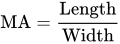
The more acute, or narrow, the angle of a wedge, the greater the ratio of the length of its slope to its width, and thus the more mechanical advantage it will yield.[2]

A wedge will bind when the wedge included angle is less than the arctangent of the coefficient of friction between the wedge and the material. Therefore, in an elastic material such as wood, friction may bind a narrow wedge more easily than a wide one. This is why the head of a splitting maul has a much wider angle than that of an axe.

See also

[edit]

References

[edit]
Revisions and contributorsEdit on WikipediaRead on Wikipedia
from Grokipedia
A wedge is a simple machine characterized by a triangular shape with two inclined planes joined at a sharp edge, thick at one end and tapering to a thin point at the other, designed to split, lift, or secure objects by directing along its sloping surfaces. It functions by transforming an input applied to its broader base into a greater output at the tip, thereby multiplying and making tasks like cutting or separating materials more efficient with less effort. The wedge has been one of the six classical simple machines recognized since ancient times, alongside the , , , , and , and it operates on the principle of converting into a splitting or holding action. Archaeological evidence indicates its use dates back to prehistoric eras, when early humans employed naturally jagged stones as rudimentary wedges for skinning animals and processing food, evolving into more refined tools by around 3000 BC in , where wooden wedges were utilized to fracture large stone blocks for pyramid . In modern applications, wedges appear in everyday tools such as axes for chopping wood, knives for slicing, chisels for carving, doorstops for securing doors, and even or pins that hold materials together by embedding their tapered forms. These devices not only reduce the force required for separation—often achieving mechanical advantages greater than 5 depending on the angle of the incline—but also play critical roles in , from splitting logs in forestry to stabilizing structures in .

Definition and Principles

Physical Description

The wedge is one of the six classical simple machines, defined as a device consisting of two inclined planes joined at a sharp edge to form a triangular or tapered shape. This configuration allows the wedge to be driven into materials by applying force to its thicker end, thereby redirecting the force along the sloping surfaces. Unlike compound machines, the wedge operates without internal moving parts, relying solely on its fixed geometry to alter the direction of applied force. The geometric properties of a wedge are characterized by its length along the inclined surface (), the height or thickness at the thick end (), and the angle of inclination (θ) between each plane and the base. These dimensions determine the wedge's in force application; a longer relative to t results in a smaller θ, which distributes force more gradually. The cross-section of a typical wedge forms an , with the apex representing the sharp edge and the base the thick end, as illustrated in basic diagrams of simple machines where the inclined planes converge symmetrically. Common materials for wedges include for its ease of shaping and availability, metal such as for enhanced durability and sharpness retention, and stone in contexts requiring resistance to wear. Modern variants may incorporate plastics or composites for lightweight, corrosion-resistant applications in specialized tools.

Fundamental Mechanics

The fundamental mechanics of a wedge operate on the principle of force transformation, where an input applied along the length of the wedge generates a larger output perpendicular to its surfaces, enabling the separation or lifting of objects. This process adheres to , particularly the second law (F = ma), as the applied accelerates the wedge into the material, resolving into components that overcome resistance through normal and shear stresses. A wedge functions as two inclined planes positioned back-to-back, forming a tapered structure that distributes the input force over an extended path. The input force along the slope resolves into a normal component to the contact surface and a parallel component that counters , allowing the wedge to penetrate and exert separating forces on the opposing sides. This duality with the amplifies the effective force output by increasing the distance over which the work is applied, in line with the in ideal conditions. The ideal (IMA) of a wedge is given by : IMA=Lt\text{IMA} = \frac{L}{t} where LL is the length along the slope of the wedge and tt is the thickness (or height) at the wide end. This quantifies the theoretical amplification of without considering losses, derived from the of the inclined planes. In practice, significantly influences wedge performance through the of μ\mu, which opposes motion and dissipates as . During insertion, kinetic acts along the sliding surfaces to resist penetration, requiring greater input than the ideal case, while static predominates during removal or holding, potentially creating a self-locking effect where the wedge remains in place without additional if μ\mu is sufficiently high. The distinction between static (μs\mu_s) and kinetic (μk\mu_k) coefficients—typically μs>μk\mu_s > \mu_k—means extraction often demands more than insertion due to the higher static threshold that must be overcome.

Historical Development

Ancient Origins

The earliest evidence of wedge tools dates to the era, where they were employed for practical tasks such as splitting wood and . Archaeological excavations have uncovered wedges from approximately 80,000 to 60,000 years ago at in , , which show use-wear patterns consistent with and splitting activities. Earlier examples include modified tools from 1.7 to 1.2 million years ago, interpreted as wedges used by early hominins to fracture wood and process animal remains. In key ancient civilizations, wedges facilitated monumental engineering feats. Around 2600 BCE, during the construction of Egypt's pyramids, workers utilized wooden wedges to quarry and blocks from . This technique involved chiseling grooves or exploiting natural fissures in the stone, inserting dry wooden wedges, and then soaking them with water to cause expansion and controlled splitting, enabling the extraction of massive stones for structures like the . The invention of the wedge cannot be attributed to a single individual but emerged from prehistoric tool-making practices among early human populations, evolving from simple lithic and organic materials. While no specific pre-1000 BCE texts directly reference wedge tools, their widespread adoption is evident in archaeological contexts across and . Culturally, the wedge held significant importance in early human engineering, allowing communities to split logs for building shelters and process materials for survival. For instance, at sites like in , wooden wedges from over 300,000 years ago aided in constructing platforms and handling timber, demonstrating their role in enabling more complex habitation and . This foundational tool also contributed to flint knapping techniques, where wedge-like strikes helped shape sharp edges for cutting implements.

Evolution in Technology

During the medieval period (circa 1000-1500 CE), advancements in enabled the widespread use of iron and wedges, which offered superior durability and strength compared to earlier wooden variants. Archaeological from sites like medieval reveals iron wedges among common metal finds, underscoring their role in everyday craftsmanship, particularly and . The of the introduced mechanization to material processing, with steam engines powering sawmills and drilling equipment that increased efficiency in cutting wood and stone, reducing reliance on manual labor. In the , wedge technology evolved toward , with shims serving as adjustable wedges in and assembly processes to achieve micron-level alignments. In automotive assembly lines, and later shims ensured accurate positioning of components, minimizing vibrations and enhancing machinery longevity—a practice refined during the mass-production era starting in the . In , shims have been used in assembly for fine-tuning alignments and load distribution, supporting advancements in and from the mid-20th century. These innovations prioritized tolerances and adaptability. Since 2020, has revolutionized wedge fabrication by enabling the rapid production of custom designs tailored for , where lightweight, geometry-specific wedges enhance mobility and gripping mechanisms in prototypes. Concurrently, sustainable bio-based composites—derived from renewable sources like plant fibers and —have been developed for tools and structural applications to mitigate environmental impacts of conventional metals and plastics, offering comparable strength with biodegradability and reducing carbon footprints.

Practical Applications

Cutting and Splitting

The wedge functions as a fundamental tool for cutting and splitting by applying concentrated along a narrow edge, generating shear stresses that surpass the material's resistance to deformation and . This mechanism allows the wedge to initiate cracks or separations in materials such as , rock, or biological tissues by distributing input over a minimal contact area, thereby exceeding the shear strength threshold and propagating along planes of . In practical applications, axes, chisels, and knives exemplify wedges tailored for dividing diverse materials: axes split wood by driving into grain lines, chisels fracture rock through targeted impacts, and knives slice flesh or softer substances with minimal resistance. The sharp edge of these tools amplifies pressure at the point of contact, enabling the applied force to overcome the material's and create clean divisions without requiring excessive overall energy. Representative examples include hydraulic log splitters used in operations, where a powered wedge penetrates and expands along wood fibers to process large logs efficiently for or timber. Geological hammers, equipped with chisel-like wedge tips, facilitate precise sample collection by splitting layered rock formations along natural fissures during field surveys. In culinary contexts, knives with blade angles of 15-20 degrees enable precision cutting of and meats, balancing sharpness for low-force slicing with durability against edge dulling. The wedging action in splitting typically involves inserting the tool into a pre-scored or crack and striking the broad end to drive it deeper, promoting radial expansion and separation along the , in contrast to the slicing motion of blades that shears material progressively with a cut. considerations emphasize maintaining edge sharpness to prevent slippage and uncontrolled strikes, as dull edges increase the risk of tool deflection, while monitoring material fatigue in the wedge itself—such as micro-cracks from repeated impacts—avoids during use.

Fastening and Separation

The wedge functions as a fastening device by being inserted into a , where it applies lateral to secure objects against movement or to adjust alignments. For instance, a wedge exploits and the principle to resist door closure by wedging under the door and creating a that counters sliding forces. Similarly, shims—thin, tapered wedge-shaped pieces of metal or —are placed between machinery components to fine-tune alignments, compensating for tolerances and ensuring precise positioning during installation or . In practical applications, wooden wedges are employed in tree felling to direct the fall of timber by inserting them into the back cut, providing leverage to overcome natural lean and guide the tree's descent safely. Pitons, which are metal wedges hammered into rock cracks, serve as temporary holds in , expanding to grip the rock faces and support climbers or ropes through frictional locking. Expandable hydraulic wedges in allow for the lifting of heavy loads in tight spaces, where pressurized fluid drives the wedge to spread and elevate structures like machinery bases or building elements with controlled force up to 16 tons. Reversible wedging techniques enable non-destructive separation of joined materials, relying on the wedge's ability to apply gradual pressure for insertion and removal without permanent alteration. In , tapered wooden wedges are used to gently separate sewn signatures or lift covers during repair, allowing conservators to access and realign components while preserving the original structure. In archaeological artifact extraction, similar reversible wedges facilitate the controlled splitting of encasing or stone matrices around delicate items, minimizing damage during recovery from sites. A specialized application appears in , where wooden or plastic dental wedges are inserted interproximally to separate teeth slightly, creating space for matrix placement during composite restorations and protecting adjacent gingival tissues. This technique ensures precise adaptation of restorative materials without trauma to surrounding structures.

Mechanical Analysis

Mechanical Advantage

The actual mechanical advantage (AMA) of a wedge is defined as the ratio of the output to the input , where the output is the separating applied to the material, and the input is the effort applied parallel to the wedge's length to drive it forward. The ideal mechanical advantage (IMA), assuming no energy losses, quantifies the amplification based on alone and equals the (VR) in frictionless conditions. For a symmetric wedge, the IMA is given by IMA=Lt\text{IMA} = \frac{L}{t}, where LL is the horizontal length from the tip to the thick end, and tt is the thickness at the thick end. This can also be expressed using the wedge angle θ\theta (the included angle between the two faces) as IMA=12tan(θ/2)\text{IMA} = \frac{1}{2 \tan(\theta/2)}. The derivation follows from the right-triangle geometry of each half of the wedge: tan(θ/2)=t/2L\tan(\theta/2) = \frac{t/2}{L}, so 2tan(θ/2)=tL2 \tan(\theta/2) = \frac{t}{L}, and inverting yields Lt=12tan(θ/2)\frac{L}{t} = \frac{1}{2 \tan(\theta/2)}. The input force acts along the wedge's length (typically horizontal), providing the effort to overcome resistance and insert the wedge. The output force acts perpendicular to this direction (vertical for horizontal insertion), splitting the material by exerting normal forces on the sloped faces. In a vector diagram, the input force Fin\mathbf{F}_\text{in} points along the positive horizontal axis. Each sloped face experiences a normal force N\mathbf{N} perpendicular to the surface; for the upper face (inclined at θ/2\theta/2 to horizontal), N\mathbf{N} has a vertical component Ncos(θ/2)N \cos(\theta/2) upward and a horizontal component Nsin(θ/2)N \sin(\theta/2) opposing insertion. The symmetric lower face contributes equally, so the total output force is 2Ncos(θ/2)2 N \cos(\theta/2) (separating) and the total horizontal resistance is 2Nsin(θ/2)2 N \sin(\theta/2), with the ideal ratio governed by the geometric IMA. The IMA increases with narrower wedge angles (smaller θ\theta), as tan(θ/2)\tan(\theta/2) decreases, amplifying force but requiring greater insertion distance for equivalent separation. Surface conditions influence the AMA; rough surfaces increase frictional losses, reducing AMA below IMA, while lubrication minimizes friction for higher efficiency approaching the ideal. As an example, for a wedge with L=20L = 20 cm and t=2t = 2 cm, IMA=20/2=10\text{IMA} = 20 / 2 = 10. Here, VR = IMA = 10, meaning the input displacement is 10 times the output separation in ideal conditions.

Efficiency and Limitations

The of a wedge as a is defined by the formula η=AMAIMA×100%\eta = \frac{AMA}{IMA} \times 100\%, where η\eta represents efficiency, AMA is the actual mechanical advantage (output divided by input ), and IMA is the ideal mechanical advantage (input divided by output , based on alone). This metric quantifies the ratio of useful work output to total input work, with real-world wedges experiencing energy losses from , material deformation, and other dissipative . For instance, in wood-splitting applications, can reduce efficiency, as the input must overcome both separation and sliding resistance along the wedge flanks. Key limitations arise from friction-induced sticking, particularly in dry or fibrous materials like , where the wedge can bind tightly, requiring additional to extract or advance it and reducing overall effectiveness. Under high loads, material deformation occurs, with the wedge itself potentially or plastically deforming if constructed from insufficiently robust alloys, while the target material may exhibit uneven splitting or chipping. Edge wear further compromises performance, as repeated impacts dull the cutting tip, increasing the effective angle and amplifying over time. Environmental factors exacerbate these issues; temperature variations cause differential thermal expansion between the wedge and target material, potentially leading to misalignment or increased stress concentrations in applications like wedges. Metal wedges are susceptible to in humid or saline environments, which weakens structural integrity and promotes pitting along the edges. Performance also varies by material hardness: wedges penetrate soft substances like more easily but risk without clean separation, whereas hard, dry materials demand greater force and heighten risks for both tool and workpiece. Mitigation strategies include applying lubricants, such as light machine or dry lubricants, to the wedge flanks to minimize and prevent sticking during . Anti-stick coatings, like PTFE-based formulations, enhance release properties and reduce adhesion in industrial wedging operations. In , nanoscale limitations further constrain wedge utility, as strain gradient effects and atomic-scale material instabilities—such as blocked phase transitions in metallic wedges—limit achievable sharpness and deformation control below 100 nm.

Comparison to Other Simple Machines

The wedge shares with the lever the fundamental purpose of amplifying an applied to perform work more efficiently, yet it differs in its fixed geometry and directional application; while a pivots around a fulcrum to redirect over a , often allowing movable components for lifting or balancing loads, the wedge operates through linear insertion without a pivot, concentrating along a tapered edge for precise, directional separation or holding. Closely related to the , the wedge functions as a portable, dual-sided version of this , consisting of two inclined planes joined at their thin ends to form a triangular , enabling localized application for tasks like splitting or prying that a stationary ramp cannot achieve. In contrast to the , which incorporates al motion via a helical inclined plane wrapped around a for fastening or lifting, the wedge relies solely on without rotation, making it unsuitable for continuous turning but ideal for one-time insertions. Similarly, unlike the or , which facilitate rotational or vertical redirection of to reduce in rolling or lifting scenarios, the wedge emphasizes lateral expansion to overcome resistance in splitting, without altering motion to circular paths. In compound machines, the wedge often combines with other simple machines to enhance functionality; for instance, a integrates a for leverage with a wedge-shaped for cutting, while the teeth of a saw act as multiple small wedges driven by linear or rotational input to slice materials progressively. A bolt exemplifies this in fastening, where the screw's threads provide rotational grip akin to an , augmented by the wedge-like head to secure against surfaces. What distinguishes the wedge among the six classical simple machines is its unique capacity to both receive input motion in and produce output motion in multiple directions simultaneously, transforming a single axial push into opposing lateral forces that can separate, secure, or elevate objects in ways unattainable by the unidirectional redirection of pulleys or the pivoted amplification of levers.

Modern Variants and Innovations

In micro/nano-scale applications, wedge principles have been integrated into micro-electro-mechanical systems () through chevron-shaped thermal actuators, which utilize angled beam structures to convert into precise for actuation. These post-2010 developments enable sub-micron displacements in compact devices, enhancing precision in applications like optical alignment and inertial sensing. For instance, a 2019 test structure design demonstrated chevron actuators achieving fracture strength measurements in MEMS thin films with deflections of 3.5 μm at 3.3 V under controlled heating, outperforming traditional electrostatic methods in force amplification. A comprehensive of electrothermal actuators highlights their role in generating forces in the µN to mN range with low voltage operation, making them suitable for integrated sensor arrays in harsh environments. In , expandable vascular s employ wedge-like radial expansion mechanisms to dilate narrowed arteries, with significant advancements approved by the FDA in the . These devices, often balloon-expandable, function analogously to a wedge by applying outward force to fracture plaque and support vessel walls, improving blood flow in conditions like . The Cypher sirolimus-eluting , approved in 2003, exemplified this by achieving over 90% procedural success in clinical trials, reducing restenosis rates to below 10% compared to bare-metal stents. Similarly, the paclitaxel-eluting , cleared in 2004, utilized a similar expansion principle, demonstrating sustained patency in over 80% of patients at one-year follow-up. Crimping tools with wedge-shaped elements further refine deployment, ensuring uniform expansion during procedures. Robotics and AI have incorporated self-adjusting wedge mechanisms in soft to handle irregular objects, leveraging deformable structures for adaptive grasping. A hybrid soft gripper design uses internal wedges within vacuum-actuated fingers and palms to control deformation, allowing conformal contact with non-uniform shapes like fruits while minimizing damage. This enables stable gripping across varied geometries, with the wedges tailoring angles for stability. Integrating and sensors enhances adaptability, as seen in sensorized variants that adjust wedge positions in real-time via AI feedback, achieving high success rates in grasping unstructured items in dynamic environments. Sustainable innovations in agriculture feature biodegradable wedge-shaped tools for , reducing and supporting eco-friendly cultivation amid challenges. Emerging research has developed wedge-form substrates and trays from natural materials like and , facilitating root initiation in cuttings without synthetic foams. For example, (manure, , and ) biodegradable seedling trays, tested in 2025 field trials, promoted 20% faster germination in crops like tomatoes compared to conventional plugs, fully decomposing in soil within six months. These designs incorporate climate-adaptive features, such as moisture-retaining structures for extreme or flood conditions, aligning with frameworks like adaptation wedges that prioritize resilience in vulnerable regions. Offshore systems using biodegradable bags, introduced in 2025, further enable substrate-free rooting in energy-efficient setups.

References

Add your contribution
Related Hubs
User Avatar
No comments yet.