Hubbry Logo
Palace of WhitehallPalace of WhitehallMain
Open search
Palace of Whitehall
Community hub
Palace of Whitehall
logo
8 pages, 0 posts
0 subscribers
Be the first to start a discussion here.
Palace of Whitehall
Palace of Whitehall
from Wikipedia

Inigo Jones's plan, dated 1638, for a new palace at Whitehall, which was realised only in part.

Key Information

The Palace of Whitehall – also spelled White Hall – at Westminster was the main residence of the English monarchs from 1530 until 1698, when most of its structures, with the notable exception of Inigo Jones's Banqueting House of 1622, were destroyed by fire. Henry VIII moved the royal residence to Whitehall after the old royal apartments at the nearby Palace of Westminster were themselves destroyed by fire. Although the Whitehall palace has not survived, the area where it was located is still called Whitehall and has remained a centre of the British government.

Whitehall was at one time the largest palace in Europe, with more than 1,500 rooms, before itself being overtaken by the expanding Palace of Versailles, which was to reach 2,400 rooms.[3] At its most expansive, the palace extended over much of the area bordered by Northumberland Avenue in the north; to Downing Street and nearly to Derby Gate in the south; and from roughly the elevations of the current buildings facing Horse Guards Road in the west, to the then banks of the River Thames in the east (the construction of Victoria Embankment has since reclaimed more land from the Thames)—a total of about 23 acres (9.3 ha). It was about 710 yards (650 m) from Westminster Abbey.

History

[edit]

By the 13th century, the Palace of Westminster had become the centre of government in England, and had been the main metropolitan residence of the king since 1049. The surrounding area became a popular and expensive location. Walter de Grey, Archbishop of York, bought a nearby property as his Westminster residence soon after 1240, calling it York Place.[4]

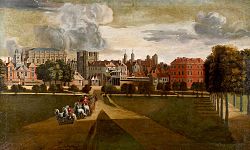
A sketch of Whitehall Palace in 1544, by Anton van den Wyngaerde.

King Edward I stayed at York Place on several occasions while work was carried out at Westminster, and enlarged it to accommodate his entourage. York Place was rebuilt during the 15th century and was expanded so much by Cardinal Wolsey that it was rivalled by only Lambeth Palace as the greatest house in the capital city, the King's palaces included. Consequently, when King Henry VIII removed the cardinal from power in 1530, he acquired York Place to replace Westminster (the royal residential, or 'privy', area of which had been gutted by fire in 1512) as his main residence, inspecting its possessions in the company of Anne Boleyn. The name 'Whitehall' was first recorded in 1532; it had its origins in the white stone used for the buildings.[5]

King Henry VIII hired the Flemish artist Anton van den Wyngaerde to redesign York Place, and he extended it during his lifetime. Inspired by Richmond Palace, he included sporting facilities, with a bowling green, indoor real tennis court, a pit for cock fighting (on the site of the Cabinet Office, 70 Whitehall) and a tiltyard for jousting (now the site of Horse Guards Parade). It is estimated that more than £30,000 (several million at present-day value)[6] were spent during the 1540s, half as much again as the construction of the entire Bridewell Palace. Henry VIII decorated his gardens with carved heraldic beasts, including unicorns, set on wooden posts. The posts were painted by the Serjeant Painters Nicholas Lafore and Anthony Toto.[7]

Henry VIII married two of his wives at the palace—Anne Boleyn in 1533 and Jane Seymour in 1536, and died there in January 1547.[8] The body of Elizabeth I was brought by barge from Richmond Palace in March 1603 to lie in state at Whitehall Palace.[9]

Anne of Denmark's secretary, William Fowler wrote Latin verses and anagrams for a sundial in the garden, restored by the orders of James VI and I.[10] In 1611, the palace hosted the first known performance of William Shakespeare's play The Tempest.[11] In February 1613 it was the venue for the wedding of Princess Elizabeth and Frederick V of the Palatinate.[12] Anne of Denmark's apartments were painted in "antique work" by John de Critz and the fireplaces carved by Maximilian Colt. A withdrawing chamber for James VI and I featured a wind dial or compass connected to a weather vane on the roof, and the room was painted by John de Critz with a scheme of the four winds, the four corners of the earth, and the four elements.[13]

The forty rooms of the lodgings provided for King James's favourite Robert Carr, 1st Earl of Somerset included a picture gallery in a converted bowling alley.[14] James VI and I made significant changes to the buildings, notably the construction in 1622 of a new Banqueting House built to a design by Inigo Jones to replace a series of previous banqueting houses dating from the time of Elizabeth I. Its decoration was finished in 1634 with the completion of a ceiling by Peter Paul Rubens, commissioned by Charles I (who was to be executed in front of the building in 1649).[15]

By 1650 Whitehall Palace was the largest complex of secular buildings in England, with more than 1,500 rooms. Its layout was irregular, and its constituent parts were of many different sizes and in several different architectural styles, making it look more like a small town than a single building.[16] The irregularity of the buildings was increased by the penchant of courtiers to build onto their assigned lodgings, either at their own expense or that of the king's. Stephen Fox, Charles II's Clerk of the Green Cloth, obtained permission from the Office of Works in the 1660s to build additions to the three rooms he was assigned. By the time he was finished he had constructed a grand mansion with coach house, stables, and a view over the Thames, all within the palace network.[17]

A plan of Whitehall Palace in 1680.
Part of a proposal for the replacement of the palace drawn by Christopher Wren in 1698. The palace was never rebuilt.

Charles II commissioned minor works, but made extensive renovations.[18] Like his father, he died at the palace, but from a stroke.[19] James II ordered various changes by Christopher Wren, including a chapel finished in 1687, rebuilding of the queen's apartments (c. 1688), and the queen's private lodgings (1689).[20] The Roman Catholic chapel of James II, constructed during a period of fierce anti-Catholicism in England, attracted much criticism and also awe when it was completed in December 1686.[21] The ceiling was adorned with 8,132 pieces of gold leaf, and at the east end of the nave an enormous marble altarpiece (40 ft (12 m) high by 25 ft (7.6 m) wide) designed by Wren and carved by Grinling Gibbons dominated the room.[22]

Destruction

[edit]

By 1691 the palace had become the largest and most complex in Europe. On 10 April a fire broke out in the much-renovated apartment previously used by the Duchess of Portsmouth, damaging the older palace structures, though apparently not the state apartments.[23] This actually gave a greater cohesiveness to the remaining complex. At the end of 1694 Mary II died in Kensington Palace of smallpox, and on the following 24 January lay in state at Whitehall; William and Mary had avoided Whitehall in favour of their palace at Kensington.[24]

A second fire on 4 January 1698 destroyed most of the remaining residential and government buildings.[25] It was started inadvertently by a servant in an upper room who had hung wet linen around a burning charcoal brazier to dry.[26] The linen caught fire and the flames quickly spread throughout the palace complex, raging for 15 hours before firefighters could extinguish them. The following day, the wind picked up and re-ignited the fire farther north. Christopher Wren, then the King's Surveyor of Works, was ordered expressly by William III to focus manpower on saving the architectural jewel of the complex, the Banqueting House.[26] Wren ordered bricklayers to block up the main window on the building's south side to block the flames from entering. Around 20 buildings were destroyed to create a firebreak, but this did little to inhibit the westward spread of the flames.[27]

John Evelyn noted succinctly on 5 January: "Whitehall burnt! nothing but walls and ruins left."[28] Besides the Banqueting House, some buildings survived in Scotland Yard and some facing the park, along with the so-called Holbein Gate, eventually demolished in 1769.[29]

During the fire many works of art were destroyed, probably including Michelangelo's Cupid, a famous sculpture bought as part of the Gonzaga collections in the seventeenth century. Also lost were Hans Holbein the Younger's iconic Whitehall Mural, including his Portrait of Henry VIII[30] and Gian Lorenzo Bernini's marble portrait bust of King Charles I.[31]

Present day

[edit]
Henry VIII's wine cellar

The Banqueting House is the only integral building of the complex now standing, although it has been somewhat modified. Various other parts of the old palace still exist, often incorporated into new buildings in the Whitehall government complex. These include a tower and other parts of the former covered tennis courts from the time of Henry VIII, built into the Old Treasury and Cabinet Office at 70 Whitehall.[32]

Queen Mary's Steps, Palace of Whitehall

Beginning in 1938, the east side of the site was redeveloped with the building now housing the Ministry of Defence (MOD), now known as the Ministry of Defence Main Building. An undercroft from Wolsey's Great Chamber, now known as Henry VIII's Wine Cellar, a fine example of a Tudor brick-vaulted roof some 70 feet (21 m) long and 30 feet (9 m) wide, was found to interfere not just with the plan for the new building but also with the proposed route for Horse Guards Avenue. Following a request from Queen Mary in 1938 and a promise in Parliament, provision was made for the preservation of the cellar. Accordingly, it was encased in steel and concrete and relocated 9 feet (3 m) to the west and nearly 19 feet (6 m) deeper in 1949, when construction resumed on the site after the Second World War. This was carried out without any significant damage to the structure and it now rests within the basement of the building.[33]

Banqueting House London, the only remaining component of the Palace of Whitehall

A number of marble carvings from the former chapel at Whitehall (which was built for James II) are present in St Andrew's Church, Burnham-on-Sea, in Somerset, to where they were moved in 1820 after having originally been removed to Westminster Abbey in 1706.[34]

See also

[edit]

References

[edit]
[edit]
Revisions and contributorsEdit on WikipediaRead on Wikipedia
from Grokipedia
The Palace of Whitehall was the main royal residence in London from 1530 until its near-total destruction by fire in 1698. Originally known as York Place, the site served as the London home of the Archbishops of York until Cardinal Thomas Wolsey acquired and substantially expanded it in the early 16th century; following Wolsey's fall from favor, Henry VIII confiscated the property in 1530, renaming it Whitehall and using it as a primary seat of power after a fire damaged the nearby Palace of Westminster. Successive Tudor and Stuart monarchs further developed the irregular complex, which by the mid-17th century encompassed over 1,500 rooms across 23 acres, making it the largest palace in Europe and a hub for administration, diplomacy, and court life. Notable events included the execution of King Charles I by Parliament in 1649, conducted from a scaffold erected outside the surviving Banqueting House, designed by Inigo Jones. The fire of 4 January 1698, ignited by linen drying near a charcoal brazier, rapidly consumed the predominantly timber-built structure, sparing only isolated elements like the Banqueting House and Queen Mary's Steps; the site subsequently became occupied by government offices, with subterranean remnants such as Henry VIII's wine cellar preserved beneath modern buildings.

Origins and Early Development

Pre-Tudor Site and Acquisition by Henry VIII

The site of the Palace of Whitehall originated as York Place, the primary residence of the Archbishops of York, established by at least century as a strategic base near the centers of royal and ecclesiastical power in Westminster. This medieval complex, initially a large rather than a fortified palace, occupied land along the and included multiple buildings acquired piecemeal, including property once held by the Dominican Black Friars before their sale to the Archbishops. Over centuries, successive Archbishops maintained and modestly expanded it for administrative and residential purposes, though no major royal or defensive structures predated the . In the early 16th century, Cardinal , upon his appointment as in 1514, undertook significant renovations to York Place, transforming it into a lavish Renaissance-style residence with new galleries, chapels, and gardens to reflect his status as Henry VIII's chief minister. These enhancements, including a notable "Green Castle" featured in a 1522 royal pageant, elevated the site's prestige but remained under ecclesiastical ownership until Wolsey's political downfall. Following Wolsey's disgrace and dismissal from power in October 1529—amid 's divorce proceedings and shifting alliances—Wolsey surrendered Place to the Crown as a gesture of submission, though the property technically reverted to the Archdiocese of , which the king compelled to yield it outright. formally acquired the site in 1530, renaming it Whitehall Palace to supplant the fire-damaged royal apartments at the Palace of Westminster (destroyed in a 1512 blaze), and immediately initiated surveys and purchases of adjacent lands to expand its footprint. This acquisition marked the transition from an episcopal manor to the monarch's principal seat, leveraging its proximity to and the Thames for governance and court functions. Surviving elements, such as portions of the 16th-century wine cellar beneath the modern building, attest to the foundational structures from this era.

Initial Expansions Under

seized York Place, Cardinal Wolsey's residence, in 1529 amid the cardinal's political downfall, formally acquiring it from the archbishopric of York in February 1530 and renaming it the Palace of Whitehall. The move addressed the Crown's need for a primary base following the 1512 fire that severely damaged the Palace of Westminster. Initial expansions began immediately, involving the demolition of parts of the existing structure and adjacent houses to accommodate royal requirements, including preparations for Henry VIII's marriage to . Henry's agents purchased surrounding properties in the Westminster borough, expanding the core of Wolsey's townhouse—a complex already featuring a , , , kitchens, and gallery built between 1514 and 1529—into a vast multi-courtyard ensemble. Key additions included a reassembled timber-framed gallery sourced from Wolsey's Esher residence, a second gallery, 's privy suite, a privy range, and riverside lodgings for Lady Mary. Further developments encompassed recreational facilities such as courtyards, gardens, a tiltyard for , and the distinctive with its flint checkerwork facade. Building materials, including timber, were repurposed from Wolsey's suppressed college at . From 1530 to 1547, the site remained a near-constant zone, elevating Whitehall to the largest royal palace in , surpassing contemporaries in scale until the rise of Versailles. Surviving remnants, such as Henry VIII's wine cellar vaults beneath the modern building—uncovered during mid-20th-century excavations—attest to the era's substantial brick and stonework.

Evolution Through Tudor and Early Stuart Eras

Elizabethan Modifications and Usage

During the reign of (1558–1603), the Palace of Whitehall emerged as the monarch's principal residence, surpassing other royal houses in frequency of use due to its capacity to house the expansive court and its proximity to the Palace of Westminster for parliamentary and administrative functions. The queen occupied the former king's apartments, adapting them for her personal use while leaving the queen's lodgings vacant, a arrangement reflecting her unmarried status and preference for centralized control over the sprawling complex. The palace's layout, divided into public riverfront buildings for state occasions and more private western sections for royal privy chambers, facilitated both governance—such as impromptu council meetings—and daily court life amid a numbering over 1,000. Few structural modifications were undertaken compared to Henry VIII's expansions, with emphasis instead on temporary adaptations for diplomacy and spectacle; a notable exception was the 1581 construction of a large, purpose-built on the palace grounds. Measuring approximately 110 feet by 60 feet, this timber-framed edifice clad in brick and canvas featured 292 glass windows for illumination during evening events and a richly painted depicting classical motifs, commissioned to impress French envoys negotiating a potential alliance with the Duke of Anjou. Intended as semi-permanent but ultimately temporary, it hosted masques, banquets, and rituals, underscoring Whitehall's role in Elizabethan and cultural display rather than enduring architectural overhaul. Whitehall's amenities, including a cockpit for bird fights, real tennis court, chapel, and adjacent tiltyard, supported the court's recreational and ceremonial demands; annual Accession Day tilts in the tiltyard drew crowds to witness knightly jousts honoring the queen's November 17 coronation anniversary, blending martial tradition with monarchical propaganda. A 1598 account by German visitor Frederick, Duke of Württemberg, highlighted the palace's galleries and entertainments, noting its scale and the queen's accessibility during progressions from the privy apartments to public spaces. These usages reinforced Whitehall's status as a nerve center for Elizabethan politics, where the queen conducted audiences, received ambassadors, and navigated factional intrigues, though its aging Tudor fabric—prone to drafts and fire risks—prompted minimal renovations focused on functionality over grandeur.

Jacobean Innovations and Caroline Embellishments

Under James I, the Palace of Whitehall saw the introduction of classical architectural principles through the work of , appointed as the king's surveyor. In 1619, Jones commenced construction of a permanent stone to replace earlier temporary wooden structures that had proven vulnerable to fire, with the building completed in 1622. This structure, measuring approximately 110 feet long by 55 feet wide and three stories high, represented the first major example of in , featuring a facade with superimposed orders of columns, pediments, and balanced proportions inspired by models such as those of and . The served primarily for masques, banquets, and court entertainments, marking a shift from the Tudor palace's predominantly Gothic and vernacular styles toward a more unified, neoclassical aesthetic intended to symbolize monarchical grandeur. During the reign of Charles I, embellishments continued under Jones's influence, emphasizing opulence and absolutist iconography. In the early 1630s, Charles commissioned nine large canvases by for the ceiling, installed by 1636, depicting the of James I and allegories of divine , at a cost exceeding £3,000—equivalent to a significant portion of the court's annual arts budget. These paintings, executed in and shipped to , elevated the interior to a propagandistic showcase of Stuart legitimacy, with the canvases integrated into a coffered ceiling design. In 1638, Jones proposed an ambitious master plan to rebuild Whitehall as a vast, symmetrical complex centered on the , incorporating quadrangular courts, extensive wings, and integrated parliamentary chambers, spanning over 700 feet in length but unrealized due to impending civil unrest. These Caroline projects underscored a vision of architectural and royal , though constrained by fiscal and political limits, with only minor additions like garden pavilions and privy lodgings completed amid the English Civil War's approach.

Architectural Layout and Notable Features

Overall Complex Design and Scale

The Palace of Whitehall formed an expansive and irregularly configured complex in , covering roughly 23 acres and extending from the River Thames northward toward modern-day , encompassing areas now occupied by government buildings and street. This scale dwarfed contemporary royal residences, such as at 6 acres, positioning Whitehall as Britain's largest secular palace by the . The layout evolved through piecemeal additions rather than a cohesive master plan, resulting in a patchwork of structures straddling a major thoroughfare, with private royal apartments, administrative offices, and recreational facilities clustered around multiple courtyards. Comprising over 1,500 rooms by 1650, the palace included long galleries for processions, state apartments for receptions, chapels, banqueting halls, a , tennis courts, and even a tiltyard for , reflecting its role as both administrative hub and courtly entertainment center. Architectural styles varied widely, from Tudor brickwork in early expansions to emerging influences in later additions, contributing to its heterogeneous appearance likened by contemporaries to a "city within a ." Seven principal courts organized the core, facilitating movement between public ceremonial spaces and private royal quarters, though the overall irregularity stemmed from ad-hoc constructions adapting to the site's constraints and royal whims. Efforts to impose order culminated in Jones's 1638 proposal for a unified classical redesign, drawing on Palladian principles with symmetrical facades, colonnades, and a grand axial layout oriented toward . This ambitious scheme envisioned a monumental riverfront and processional routes but was only partially executed, most notably in the —a double-cube hall measuring 110 by 55 feet—highlighting the tension between visionary planning and practical limitations of funding and politics. The unbuilt elements underscore how Whitehall's scale, while impressive, often prioritized functional expansion over aesthetic coherence, embodying the pragmatic evolution of monarchical power in an urban setting.

Iconic Structures like the Banqueting House

The Banqueting House stands as the only complete surviving structure from the vast Palace of Whitehall complex, constructed between 1619 and 1622 under the direction of architect Inigo Jones for King James I. Designed in a Palladian style inspired by Italian Renaissance architect Andrea Palladio, it marked the introduction of classical symmetry and proportion to English architecture on a grand scale, featuring a rusticated basement supporting a piano nobile with superimposed orders of Ionic and Corinthian columns. This three-story facade, though primarily functional on the upper levels for receptions, symbolized monarchical grandeur and served as a venue for elaborate masques, diplomatic receptions, and state banquets rather than everyday feasting. Commissioned to replace earlier temporary timber banqueting houses—one built in 1581 and destroyed by fire in 1606—the new edifice cost approximately £15,618 and measured about 110 feet long by 55 feet wide, with a height of 70 feet, allowing for a vast internal hall illuminated by large windows. In 1634, King Charles I enhanced its interior by commissioning Flemish artist to paint a canvas depicting the of James I, comprising nine panels allegorizing divine kingship and peaceful rule, which were installed in 1636 at a cost of £3,000 and remain today. The building's role extended to glorifying Stuart monarchy, with its exterior and interior reinforcing themes of absolutism amid growing parliamentary tensions. On January 30, 1649, a scaffold was erected outside the for the public execution of Charles I by Parliamentarian forces following the , an event that underscored the site's pivotal role in royal history; the king reportedly emerged through a window to address the crowd before his beheading. Spared from the devastating 1698 fire that consumed most of due to its isolated position and stone construction, it transitioned to uses like a under William and Mary and later a under in 1821. Among other notable remnants evoking the palace's former iconic elements, Queen Mary's Steps—constructed around 1629–1632 during Charles I's reign—survive along the , providing access from the privy garden to the river and exemplifying the era's landscaped integration of palace and water. Additionally, Henry VIII's 16th-century wine cellar persists beneath the modern building, a vaulted chamber originally part of the Tudor expansions, highlighting subterranean infrastructure that supported courtly excess. These fragments, alongside the , preserve tangible links to Whitehall's architectural legacy of opulent, function-specific edifices that blended utility with symbolic power.

Political and Cultural Significance

Center of Monarchical Governance and Court Life

The Palace of Whitehall emerged as the primary residence of English monarchs following Henry VIII's appropriation of York Place in 1530, functioning as the core of monarchical governance until the 1698 fire. It centralized executive authority, hosting meetings that advised the sovereign on policy and state affairs, thereby separating administrative functions from Westminster's judicial bodies like . For example, in 1536, the French ambassador attended a conference at , illustrating its role in diplomatic and advisory proceedings. Administrative operations integrated with the palace's structure, including daily Exchequer tellers' attendance and financial transactions, such as the 1581 transport of £1,500 in funds. By the seventeenth century, institutions like the shifted toward , enhancing its proximity to royal decision-making while maintaining links to Westminster via correspondence and occasional councils. This setup underscored 's evolution into a hub for policy formulation, with the Privy Council's administrative arm accompanying the . Court life at Whitehall blended governance with ceremonial pomp, supporting a substantial royal household through facilities like galleries, chapels, cockpits, and tennis courts. Daily routines encompassed public processions to the chapel on Sundays and feast days, reinforcing monarchical visibility, alongside private river access for barges used by figures like Elizabeth I. Entertainments, including masques in the Banqueting House, and diplomatic events—such as 1581 marriage negotiations and 1601 ambassadorial visits—interwove political intrigue with lavish displays in opulent bedchambers and halls. These activities sustained the court's role in projecting royal power over 168 years.

Key Historical Events and Royal Intrigues

The Palace of Whitehall served as the primary venue for pivotal royal decisions and dramatic finales in English history. King died there on January 28, 1547, in his Presence Chamber, succumbing to complications from obesity, a chronic leg ulcer, and possible renal failure at age 55. His death triggered immediate succession maneuvers, with Edward Seymour, Duke of Somerset, securing the regency for the nine-year-old amid rival claims from factions favoring Mary or Elizabeth. During the English Civil War's aftermath, Whitehall became the stage for the trial and execution of King Charles I on January 30, 1649, outside the . Convicted of high treason by for levying taxes without consent and waging war against his subjects, was beheaded on a scaffold erected before the building's north entrance, marking the only in British history and abolishing the temporarily. The event drew public outrage and martyrdom narratives, with walking through a specially opened to the scaffold on a freezing day. Under the Commonwealth, Oliver Cromwell, as Lord Protector, used Whitehall as his residence and died there on September 3, 1658, from septic fever or at age 59. His embalmed body lay in state before a lavish , but posthumous execution in 1661—hanging and decapitation at after the Restoration—reflected shifting political fortunes and royalist retribution. Whitehall's corridors facilitated court factions and whispered plots, including Henry VIII's marital dissolutions and executions ordered from its chambers, though trials occurred elsewhere. Stuart-era religious tensions, culminating in James II's flight during the 1688 , further underscored the palace's role in monarchical crises, with William III occupying it briefly before the 1698 fire.

Destruction and Transition

The 1698 Fire: Causes and Consequences

The fire that largely destroyed the Palace of Whitehall began in the afternoon of 4 1698, when a Dutch maidservant drying sheets over an unattended in a bedchamber ignited the fabric, an action prohibited due to fire risks in the timber-heavy complex. The blaze spread rapidly through the interconnected wooden structures, fueled by the palace's predominantly timber construction and exacerbated by explosions of stored , engulfing much of the southern wing within hours and raging for approximately 15 hours until extinguished the following day. Casualties included the maid herself, a guard burned to death, and a killed in a blast, amid chaos that enabled looters to plunder valuables from the ruins. The conflagration reduced the palace to rubble and ashes, obliterating over 1,000 apartments, the Tudor great hall, chapel, royal lodgings, and most administrative buildings, though the was preserved through King William III's direct orders to brick up its southern window and deploy guards. As James Vernon reported, "Except for the and the great gate all is burnt down or blown up." This marked the second major fire in seven years, following a 1691 blaze in the Privy Garden ignited by burning tally sticks, which had already compromised the aging structure. In the aftermath, William III commissioned Sir to draft rebuilding plans, but chronic Treasury shortfalls prevented execution, compounded by the king's preference for as his primary residence. Queen Anne later authorized £100,000 over six years starting in 1702 for partial reconstruction, yet funding constraints and shifting priorities halted progress, leading to the site's gradual repurposing for government offices rather than royal revival. The , another initial survivor, was demolished in 1759 to widen a roadway, symbolizing the irreversible transition from monarchical seat to administrative hub.

Post-Fire Reuse and Dismantling

Following the devastating fire on 4 January 1698, which razed most of the Palace of Whitehall complex, King William III commissioned Sir Christopher Wren to survey the ruins and devise reconstruction plans within days of the blaze. Wren, who had previously proposed designs for the palace under Charles II, submitted detailed proposals for a grander replacement, envisioning a unified structure with unified facades and extensive new wings, but these advanced no further than drawings and models. The full-scale rebuild was ultimately abandoned due to prohibitive costs estimated in the hundreds of thousands of pounds, strained post-Revolution finances, and William III's preference for alternative residences such as —purchased and expanded shortly after his 1689 accession—and Hampton Court, where he invested heavily in Wren-led renovations. With Whitehall no longer serving as the primary royal seat, the court formally relocated to , rendering comprehensive restoration unnecessary. The charred remnants, comprising no intact structures beyond the stone Banqueting House, were systematically dismantled in the immediate aftermath to eliminate hazards and clear the expansive 23-acre site. Salvageable materials, including timber and stone from the timber-framed majority of the palace, were likely repurposed locally, though records of systematic reuse are sparse; the focus shifted to site preparation for non-royal development. By the early , the cleared grounds transitioned into a hub for government administration, with key structures like the (erected 1733–1736) and (formalized in the 1740s) occupying former lands, solidifying Whitehall's enduring role as the administrative heart of Britain rather than a monarchical enclave. The Banqueting House itself, spared by its fireproof materials, continued limited ceremonial use before being leased for commercial events in the , exemplifying piecemeal adaptation over wholesale royal revival.

Legacy, Preservation, and Modern Insights

Surviving Remnants and Site Transformation

The , completed in 1622 to designs by , stands as the sole above-ground structure from the Palace of Whitehall to survive the 1698 fire intact, serving originally as a venue for masques and banquets before its adaptation as a reception space. Managed by since 2002, it underwent conservation works including stone repairs and cleaning in the to preserve its Palladian facade and Rubens ceiling paintings installed in 1636. Subterranean remnants include Henry VIII's wine cellar beneath the , a Tudor-era vaulted chamber measuring approximately 70 feet (21 meters) in length and 30 feet (9 meters) in width, constructed from with a characteristic ribbed roof dating to the 1530s expansion of the palace. This cellar, originally used for storing royal wines, escaped destruction and now hosts occasional events, though public access remains limited. Along the Thames embankment, Queen Mary's Steps, designed by Sir Christopher Wren in 1691 for Queen Mary II, provide a visible fragment of the palace's river wall and privy garden terrace, facilitating access from the royal apartments to the water's edge before embankment works altered the shoreline. These Grade I listed steps, preserved amid modern landscaping in Victoria Embankment Gardens, represent one of the few exposed pre-fire waterfront features. Following the 1698 , which rendered the palace uninhabitable, King William III opted against comprehensive reconstruction due to costs and strategic shifts toward , leading to piecemeal leasing and demolition of ruins for salvage materials by the early 1700s. The site evolved into an administrative hub, with portions repurposed for offices, military barracks, and elite housing; by the , it hosted structures like the Admiralty and , transforming the former royal enclave into the district of parliamentary and buildings. Today, the footprint encompasses ministries such as Defence and , overlaid on archaeological layers that include palace foundations just below street level, underscoring the shift from monarchical residence to bureaucratic core without unified palatial revival.

Archaeological Excavations and Recent Discoveries

Archaeological excavations at the site of the former Palace of Whitehall have primarily occurred during infrastructure developments, revealing structural remnants and artifacts from its Tudor and Stuart phases. In 1939, digs associated with construction uncovered sections of the Tudor river wall, a terrace walk, and the northernmost flight of steps, later identified as Queen Mary's Steps, which provided access from the palace to the River Thames. These findings documented waterfront features dating to Henry VIII's expansions in the 1530s. Mid-20th-century works for government buildings preserved Henry VIII's wine cellar beneath the , a vaulted chamber originally constructed around 1532 for storing royal provisions; its brickwork and dimensions align with contemporary records of the king's privy kitchen complex. Further excavations in the 1950s exposed additional foundations, though many records remained unpublished until synthesized in architectural histories. ![King Henry the VIII's Wine Cellar Underneath the MoD Main Building in London MOD 45152145.jpg][float-right] In 2014, targeted digs east of the revealed a brick surface interpreted as a floor at approximately 1 meter depth, dated to 1450–1650 through typology analysis; this may relate to pre-1547 courtier lodgings or temporary banqueting structures built in 1581 and 1606–1609. More substantially, September–October 2021 excavations beneath Horse Guards Avenue uncovered remains of the palace's Court Gate, including multiple construction phases potentially predating Henry VIII's 1530 acquisition of the site, confirmed via stratigraphic sequencing and comparative studies against historic maps. These efforts employed scientific methods like material dating to refine chronologies, highlighting the site's layered beneath modern infrastructure.

Digital Reconstructions and Historical Reconstructions

In the , artist created painted reconstructions of the Palace of Whitehall as part of his "Old London Reconstructed" series, depicting the sprawling complex's architectural features and layout based on surviving historical records and maps. These artistic renderings illustrate the palace's evolution from its York Place origins in the early through Tudor and Stuart expansions, emphasizing its irregular, maze-like configuration of over 1,500 rooms. Architectural plans from the 17th century, such as Inigo Jones's 1638 proposal for a unified new at , represent early reconstructive efforts to rationalize and expand the fragmented site under Charles I, though never realized. Similarly, drafted multiple rebuilding schemes in the 1660s for Charles II and post-1698 fire proposals, including grand designs integrating the surviving , which informed later scholarly visualizations of the palace's potential form. Modern digital reconstructions leverage archaeological data, inventories, and surveys for accurate modeling. A 2017 scholarly project digitally reconstructed Henry VIII's using evidence from royal accounts and fabric analysis, revealing the Henrician interior's integrated decorative scheme of tapestries, paneling, and furnishings. The Collection Trust's collaboration with digital firm Surface Impression produced a 3D model of Charles I's 17th-century private galleries, reuniting dispersed artworks from his collection to simulate their original spatial context and viewing experience. Historic Royal Palaces has supported 3D modeling of the , Whitehall's sole surviving structure, derived from measured surveys to depict its design and ceiling integration circa 1622. These efforts, grounded in primary sources like Hollar's 17th-century engravings and post-fire inventories, enable virtual exploration of the palace's lost interiors, aiding research into royal patronage and spatial .

References

Add your contribution
Related Hubs
User Avatar
No comments yet.