Hubbry Logo
3rd Gorkha Rifles3rd Gorkha RiflesMain
Open search
3rd Gorkha Rifles
Community hub
3rd Gorkha Rifles
logo
7 pages, 0 posts
0 subscribers
Be the first to start a discussion here.
3rd Gorkha Rifles
3rd Gorkha Rifles
from Wikipedia
3rd Gorkha Rifles (1950 onwards)
3rd Queen Alexandra's Own Gurkha Rifles (1908-1950)
Active1815 – Present
CountryIndia India
Branch Indian Army
TypeRifles
Size5 Battalions
Regimental CentreVaranasi, Uttar Pradesh
MottosKayar Hunu Bhanda Marnu Ramro
"Better to die than live like a coward"
ColorsGreen; faced black
MarchWar Cry:Jai Maha Kali, Ayo Gorkhali (Hail Goddess Kali, The Gorkhas are here)
Decorations2 Victoria Cross
1 Ashoka Chakra
1 Kirti Chakra
5 Vir Chakras
5 Shaurya Chakras
1 Yudh Seva Medal
19 Sena Medals
1 Bar to Sena Medal
4 Param Vishist Seva Medals
5 Ati Vishist Seva Medals
9 Vishist Seva Medals
2 McGregor Medals
26 Mentioned-in-Despatches
46 COAS' Commendation Cards
19 GOC-in-C's Commendation Cards
Battle honoursDelhi 1857, Ahmad Khel, Afghanistan 1878–80
Burma 1885–87, Chitral
Tirah
Punjab Frontier
First World War
La Bassée 1914, Armentières 1914, Festubert 1914 '15, Givenchy 1914 Neuve Chapelle
Aubers
France and Flanders 1914–15 Egypt 1915–16
Gaza, El Mughar, Nebi Samwil
Jerusalem
Tell 'Asur, Megiddo
Sharon
Palestine 1917–18, Sharqat, Mesopotamia 1917–18, Afghanistan 1919
Second World War
Deir el Shein
North Africa 1940–43 Monte della Gorgace Il Castello
Monte Farneto
Monte Cavallo
Italy 1943–45
Sittang 1942
Kyaukse 1942
Imphal
Tuitum, Sakawng Shenam Pass, Bishenpur, Tengnoupal
Meiktila
Defence of Meiktila Rangoon Road, Pyawbwy
Pegu 1945
Burma 1942–45
Post 1947
Uri, Jammu and Kashmir 1947–48
Shingo River Valley
Jammu and Kashmir 1971
Insignia
Regimental InsigniaA pair of crossed khukris, with a star in-between and the numeral 3 within
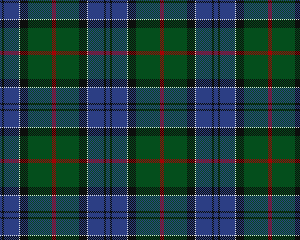
TartanColqhuon (pipes and drums)

The 3rd Gorkha Rifles or Third Gorkha Rifles, abbreviated as 3 GR is an Indian Army infantry regiment. It was originally a Gurkha regiment of the British Indian Army formed in 1815. This regiment recruit mainly Magars and Gurung tribes. They were present at a number of actions and wars including the siege of Delhi in 1857 to the First and Second World Wars. After the Partition of India in 1947 the regiment was one of the six Gorkha regiments transferred to the Indian Army as part of the Tripartite Agreement signed between India, Nepal and Britain at the time of Indian independence. Prior to independence, the regiment was known as the 3rd Queen Alexandra's Own Gurkha Rifles. In 1950 the regiment's title was changed to 3rd Gorkha Rifles. Since 1947 the regiment has participated in a number of conflicts including the 1947 and 1971 wars against Pakistan.

History

[edit]

Formation to 1885

[edit]

The regiment was raised during the Gurkha War by Sir Robert Colquhoun on 24 April 1815 as the Kemaoon Battalion.[1] It did not consist entirely of Gurkhas but of men from Kumaon and Garhwal. The regiment adopted the tartan of the Clan Colquhoun.

The regiment was primarily used to police the border with Nepal, doing so for many decades until the Indian Mutiny began in 1857. The battalion was actively involved in the efforts to quell it. During the siege of Delhi—which lasted from March to September 1857—the regiment, part of Colonel Colin Campbell's Third Column, took part in the storming of Kashmiri Gate and gained the Battle Honour "Delhi 1857". The mutiny was quelled by July 1858.

The regiment, having been brought into the line of the Bengal Army, was briefly titled the 18th Bengal Native Infantry in 1861 before the regiment gained its present numeral designation when it became the 3rd Gurkha (The Kumaon) Regiment.[2] The regiment saw service in an expedition to Bhutan shortly after the name change.

3rd Gurkha during the march to Kabul.

In 1878 the Second Afghan War began and the regiment, as part of the 2nd Infantry Brigade of the Kandahar Field Force, took part in the march to seize Kandahar. The field force successfully captured the city on 8 January 1879, having experienced great hardship on the march there. The following year the Kandahar Force began the march towards the Afghan capital Kabul to join Major-General Roberts force in an attempt to consolidate their situation in the country. During the journey, near Ghaziri, the force were attacked by a large force of Afghan tribesmen at Ahmad Khel on 19 April 1880. The fighting that ensued was intense and the field force's situation was in the balance until the Afghan forces were successfully repulsed when the 3rd Gurkha formed an infantry square.

1885–1914

[edit]

The regiment took part in the Third Burmese War after it began in 1885 and operations concluded by the following year under First Brigade.[3] In 1887 the 2nd Battalion was formed, consisting entirely of Garhwalis, but this was separated from the regiment in 1890 to form the 39th (The Garhwal) Regiment of Bengal Light Infantry. A new 2nd Battalion for the 3rd Gurkha was raised that same year and in 1891 the regiment was designated a rifle regiment, becoming the 3rd Gurkha (Rifle) Regiment.[2]

The 3rd Gurkhas took part in numerous campaigns in the volatile North-West Frontier, including the 1st Battalion's participation in the storming of the Dargai Heights on 20 October 1897 during the Tirah Campaign. The battalion was part of the Tirah Field Force intended to put down a large tribal revolt by the Afridi and Orakzais, orchestrated by Afghanistan. The 3rd Gurkhas took part in the advance into the Tirah Region, meeting resistance from tribal forces before moving on to help relieve Fort Lockheart and Fort Gulistan. After this was done the force marched on Dargai where they intended to take the heights above Dargai, controlled by tribal forces.

View of Almora, with soldiers of 3rd Gurkha Rifles, 1895.

The heights had originally been taken by the Tirah force on 18 October but they were ordered to withdraw, coming under attack as they did so and allowing the tribal force to return to the heights and strengthen their positions. The operation to retake the heights began with an artillery bombardment at 10:00 am on 20 October. The regiment took part in the initial assault, positioned at the forefront of the attack with the 2nd Gurkha Rifles and the 1st Dorsets. They advanced methodically, moving up the slopes until they charged towards the enemy but sustained heavy casualties and became pinned down. The battle raged on for hours until, after the tribal positions were subject to an artillery bombardment, a final charge was made by the 1st Gordons, followed by the Gurkhas and 3rd Sikhs. The tribal defenders wilted in the face of the charge and the heights were taken later that day.

In 1907 the title was changed to become the 3rd The Queen's Own Gurkha Rifles in honour of Alexandra of Denmark, queen consort of King Edward VII, and the following year the title became more specific when it became the 3rd Queen Alexandra's Own Gurkha Rifles.[2]

First World War

[edit]

In August 1914 the First World War began and the regiment's battalions actively participated on the Western Front and in the Middle East.

In 1916, a clerical error gave the regiment a 4th Battalion when 4/3rd, instead of 3/4th, was written on the order for the raising of a battalion for the 4th Gurkha Rifles. The following year a 3rd Battalion for the 3rd Gurkhas was formed.[2]

Western Front

[edit]

The 2nd Battalion, as part of the 20th (Garhwal) Brigade of the 7th (Meerut) Division, was sent to France a few months after the declaration of war in 1914.

The battalion's first large-scale action came at La Bassée that had commenced on 12 October as part of a period known as the "Race to the Sea". The battalion was involved in the defence of Festubert in November and Givenchy in December, during a bitter winter that the Gurkhas were no doubt unaccustomed to having spent the pre-war period on the sub-continent.

The battalion remained on the Western Front until late 1915. At the Battle of Neuve Chapelle (10–13 March) the Garhwal Brigade advanced successfully during the initial offensive and the 2nd Battalion took part in fierce fighting during the battle. In May it was involved in the battles of Festubert and Aubers. In September the battalion took part in the Battle of Loos which saw the regiment awarded its first Victoria Cross. The VC action took place on 25 September when Rifleman Kulbir Thapa of the 2nd Battalion performed with distinction near the village of Fauquissart, becoming the first Gurkha recipient of the award.[4]

The Battle of Loos was the battalion's last action on the Western Front and it left the 7th Division with the rest of the Garhwal Brigade for Egypt in December 1915 after the brigade became an independent unit.

Middle East

[edit]
The Gurkha Rifles in front line trenches at the Battle of Mughar Ridge, Palestine, November 1917

After its arrival in Egypt the 2nd Battalion saw active service against the Ottoman Empire and later took part in the Palestine campaign, the second largest campaign by force totals during the First World War. It fought in the Autumn Offensive, seeing their first action during the Battles of Gaza. It was involved in many other actions during the campaign, including the Battle of Mughar Ridge in November 1917 and the capture of Jerusalem in December. On 19 September 1918, just a few months before the conclusion of the war, the Megiddo Offensive, began and the battalion was involved in the capture of Sharon. For its part in the campaign the 3rd Gurkhas gained seven Battle Honours and the Theatre Honour "Palestine 1917–18" after such honours were granted to units in the 1920s.

On 10 April 1918 at El Kefr in Egypt, Karanbahadur Rana of the 2nd Battalion became the regiment's second VC recipient after distinguishing himself in an encounter with Ottoman forces, and was the last VC recipient of the regiment.[5]

Elsewhere the 1st Battalion, from 1917, took part in the Mesopotamian Campaign (now Iraq), gaining only a single Battle Honour in the process. It was achieved at the last battle of the campaign, at the Battle of Sharqat (28–30 October 1918).

Interwar period

[edit]

The First World War concluded with the signing of the Armistice on 11 November 1918 but this gave the regiment no respite. It took part in the Third Afghan War in 1919 and spent much of their inter-war years in the North West Frontier and Burma. The post-war reductions saw the regiment reduced to its pre-war establishment. The 3rd Battalion was disbanded in 1920 and the mistakenly raised 4th Battalion followed in 1922.

Second World War

[edit]

The regiment was actively involved in Second World War and, as had happened during the First World War, the regiment was expanded to meet its commitments. The 3rd Battalion was re-raised in 1940, followed by the 4th Battalion in 1941. During the conflict, the regiment fought in a number of theatres, including North Africa, Italy and Burma. During the North African campaign, the 2nd Battalion fought at Tobruk, where they were brought in as reinforcements at the height of the battle and suffered misfortune almost immediately, when they were partially overrun by the Germans, losing almost two hundred men as prisoners of war, although many of these managed to escape later.[6]

Post Independence

[edit]
3rd Gorkha Rifles Bicentenary postal stamp issued in 2015

India gained its independence in 1947 and the regiment was one of six Gurkha regiments (out of 10) to be allocated to the Indian Army as part of the Tripartite Agreement between Britain, India and Nepal.[7] The regiment retained its title until 1950 when India was proclaimed a Republic and the regiment became the 3rd Gorkha Rifles. It remains in existence and consists of five battalions.

The Regiment won the Battle Honour 'Pir Kanthi' in the Uri Sector in the war of 1948 and 'Shingo' in the Kargil Sector in war of 1971. 1/3 GR has the distinction of being the first battalion in the post-independence period to carry out amphibious operations during the 1971 Indo-Pak War. Colonel J.R. Chitnis, CO 1/3 GR, was honoured with the Ashoka Chakra posthumously—India's highest peacetime medal for valour—in Nagaland in 1956.

On 3 December 1997, a statue was unveiled in London in honour of the Gurkhas. A quote from Sir Ralph Turner, a former officer in the 3rd Gurkhas, was inscribed on the memorial: "Bravest of the brave, most generous of the generous, never had country more faithful friends than you."

3 Gorkha Rifles marching contingent passes through the Rajpath during the 62nd Republic Day Parade-2011

Uniforms

[edit]

In its early years as the Kemaoon Battalion, the regiment wore green uniforms with white (after 1828 black) facings. As the 3rd Gurkhas from 1861, rifle green uniforms with black cuff facings were adopted to be worn with the round peakless Kilmarnock cap common to all Gurkha regiments.[8] As was the practice with all Gurkha rifle regiments, black metal buttons and insignia were to remain features of the dress uniforms of the 3rd GR. Khaki drill was worn for active service and hot-weather dress from 1878 on. Shorts were adopted by the 3rd GR in 1900, at the same time as the wide brimmed "Kashmir" slouch hat came into general use. The latter had a green edged "pugri" (wide khaki band) as a regimental distinction.[9] While the historic dark green ceased to be worn after World War I, except as part of officers' mess uniforms and a few other limited categories, the Kilmanock cap survived as a dress item until modern times.

Notes

[edit]

References

[edit]
[edit]
Revisions and contributorsEdit on WikipediaRead on Wikipedia
from Grokipedia
The 3rd Gorkha Rifles is an elite infantry regiment of the , renowned for its soldiers' valor and discipline, originally raised on 24 April 1815 as the Kumaon Battalion—composed primarily of Kumaoni troops, with s later incorporated—during the British Company's expansion following the . It was redesignated multiple times, becoming the 3rd Rifles in 1901 and the 3rd Queen Alexandra's Own Rifles in 1907, before being allocated to upon Partition in 1947. The regiment's early history includes service in the , where it assaulted the Kashmir Gate in , and campaigns in (1865), the Second Afghan War (1880), and the Tirah Expedition (1897), earning battle honors for actions like the storming of Dargai Heights. During the First World War, its battalions fought in , , and Gaza, securing 18 battle honors and two Victoria Crosses—awarded to Kulbir Thapa in 1915 for rescuing a wounded under fire and to Karanbahadur Rana in 1918. In the Second World War, it participated in grueling battles such as the Sittang Bridge (1942) and campaigns in Burma and Malaya. Post-independence, the regiment distinguished itself in operations like the 1948 at Pir Kanthi, the 1971 Indo-Pakistani War including amphibious assaults, and counter-insurgency efforts, amassing prestigious awards including one Ashok Chakra and one . Today, the 3rd Gorkha Rifles consists of five active battalions, with its Regimental Centre located in , , and maintains the traditional Kafar Bhanda Marnu Ramro ("Better to die than be a coward") and war cry Ayo Gorkhali ("The Gurkhas are coming"). Its insignia features crossed khukris with a star and the numeral 3, symbolizing its enduring legacy of sacrifice and combat excellence within the Indian Army's Gorkha brigade.

History

Formation and Early Years (1815–1885)

The 3rd Gorkha Rifles traces its origins to the aftermath of the Anglo-Nepalese War (1814–1816), when the British East India Company sought to secure control over the newly acquired Kumaon region. On 24 April 1815, Lieutenant Sir Robert Colquhoun raised the Kumaon Battalion at Almora, initially recruiting approximately 800 hillmen from Kumaoni and Garhwali communities who had either served as auxiliaries with British forces or surrendered following the capture of Almora from Nepalese Gurkha forces. This formation marked one of the earliest organized units in the region, tasked with maintaining order and supporting British administration amid ongoing skirmishes in Garhwal and other frontier areas during the war's closing stages. The battalion's early composition reflected local ethnic groups rather than Nepalese Gurkhas, emphasizing its role as a provincial force for internal security. In 1816, the unit was redesignated the Kumaon Provincial Battalion to align with its expanded duties in pacifying the hill tracts. By , following a reorganization of the , it became the 18th (Kumaon) Regiment of , incorporating it into the regular army structure while retaining its regional identity. Over the subsequent decades, the regiment gradually shifted toward Gurkha recruitment from , beginning in the mid-19th century, which solidified its martial reputation and transformed it into a core unit. This transition was driven by the proven valor of Nepalese fighters encountered during the , leading to formal recruitment agreements with the Kingdom of . The regiment played a pivotal role in the , demonstrating loyalty amid widespread mutinies. As the Kumaon Battalion, it joined the British relief column under Major-General John Nicholson and participated in the Siege of Delhi, notably in the assault on the Kashmir Gate on 14 September 1857, where its troops helped breach the city's defenses alongside the 60th Rifles and Punjab Infantry. Later, elements contributed to the relief of under Sir Colin Campbell, enduring intense combat to break the siege and evacuate British civilians. For its actions at , the regiment earned the battle honor "Delhi 1857," a distinction that underscored its reliability and ferocity in suppressing the uprising. During the Second Anglo-Afghan War (1878–1880), the 18th (Kumaon) Regiment of formed part of the Kuram Valley under Major-General Frederick Roberts. It advanced through the challenging terrain from , participating in the capture of Peiwar Kotal on 2 December 1878, where troops flanked Afghan positions in a night assault to secure the pass. The regiment later supported the occupation of in October 1879 and Roberts' famous march to in August 1880, relieving besieged British forces after enduring harsh marches and combat at key points like the Shutargardan Pass. By the war's end, the unit had fully adopted personnel from and relocated its permanent base to in the , enhancing its strategic positioning for future border operations.

Late 19th Century Service (1885–1914)

In the late 1880s, the regiment, then designated as the 42nd (Goorkha) Regiment of Bengal Native Infantry, underwent significant administrative changes amid its involvement in imperial pacification efforts. Following its participation in the guerrilla phase of the Third Anglo-Burmese War (1885–1887), where elements supported operations leading to the capture of Mandalay in November 1885 and subsequent pacification duties across Upper Burma until 1887, the unit was restructured to reflect its growing role as a specialized Gurkha force. These duties involved suppressing dacoits and hill tribe resistance in rugged terrain, honing the regiment's expertise in irregular warfare. In 1891, it was redesignated the 3rd Goorkha (Rifle) Regiment, adopting rifle regiment customs such as black accoutrements, which formalized its identity as an elite light infantry unit focused on frontier operations. The regiment's commitments intensified on the North-West Frontier, where it played a pivotal role in the of 1895, with the newly raised 2nd Battalion contributing to the relief force that secured the Valley against tribal incursions amid fears of Russian influence. This operation solidified the regiment's reputation for endurance in high-altitude campaigns. By the late 1890s, the 1st Battalion was heavily engaged in the (1897–1898), a major punitive expedition against and tribes. It participated in key actions, including the assault on Dargai Heights on 20 October 1897, where troops scaled sheer cliffs under heavy fire to dislodge entrenched positions, and the defense of Samana Ridge against coordinated tribal attacks in September 1897. Over the course of the campaign, the battalion fought in 32 battles and 19 rearguard actions, earning the battle honours "Tirah" and "Samana" for its contributions to securing the approaches. Into the early 20th century, the regiment addressed ongoing frontier instability through expeditions like the Bazar Valley Campaign of 1908, where units conducted punitive operations against Zakka Khel Afridis, destroying villages and enforcing submission in the volatile border regions, alongside minor skirmishes that maintained British control over tribal areas. These engagements underscored the regiment's adaptability to asymmetric threats. By 1914, the regiment had expanded to five battalions (1st through 5th), reflecting broader Gurkha Brigade growth to 20 battalions overall, with a strategic shift in class composition toward Magar and Gurung recruits from western , supplemented by Rais, Limbus, and Sunwars for enhanced clan diversity and loyalty. Training during this era emphasized and marksmanship, conducted at depots like (established 1886) and later Pharenda (1903), with annual exercises in and focusing on physical conditioning and proficiency for British officers. Stationed primarily at frontier posts such as Lansdowne (regimental home since 1894), , and Dehra Dun in , battalions also rotated to for pacification duties, ensuring readiness for border defense amid rising tensions leading to the First World War.

First World War Campaigns (1914–1918)

At the outset of the First World War, the 1st and 2nd Battalions of the 3rd Queen Alexandra's Own Rifles were rapidly deployed to the Western Front in as part of the British Indian Army's contribution to the British Expeditionary Force, arriving in in September 1914 after a challenging sea voyage. These units, integrated into the Garhwal Brigade of the 7th (Meerut) Division, immediately engaged in intense , facing the unfamiliar conditions of mud, cold, and machine-gun fire that contrasted sharply with their prior experience on India's North-West Frontier. The regiment's first major actions occurred during the Battle of La Bassée in October–November 1914, where the 2nd Battalion advanced against fortified German positions, suffering significant losses in hand-to-hand fighting that showcased the Gurkhas' skill with the khukri in close-quarters combat. This was followed by engagements at in December 1914, where both battalions helped repel German counterattacks amid harsh winter conditions, and the in March 1915, during which the 2nd Battalion's assault on German trenches resulted in over 400 casualties for the unit alone, part of the broader Indian Corps' losses exceeding 2,000 men in a single day. The in September 1915 further tested the regiment, with the 2nd Battalion advancing through gas attacks and barbed wire; here, Rifleman Kulbir Thapa earned the for his extraordinary heroism on 25–26 September, when, despite severe wounds, he crawled across no-man's land to rescue a wounded Irish soldier from the Dublin Fusiliers and then carried two more British wounded to safety under heavy fire, becoming the first Gurkha recipient of the award. By mid-1916, following heavy attrition on the Western Front that claimed thousands of lives across units, the surviving battalions of the 3rd Gurkha Rifles were withdrawn and redeployed to the to bolster campaigns against the . The 1st Battalion participated in the , joining the relief efforts at Kut-al-Amara in 1916—though the town fell before relief arrived—and later advancing in the successful push toward in 1917, where troops endured extreme heat, disease, and riverine logistics in capturing key positions along the . Meanwhile, the 2nd Battalion, along with newly raised units, transferred to the , fighting in the Third Battle of Gaza in November 1917, where they helped break Ottoman lines at and Tel el Khuweilfe, contributing to the capture of by December 1917. In 1918, the regiment's role in Palestine intensified during the Battle of Megiddo, with the 2nd Battalion earning further distinction at El Kefr on 10 April, where Rifleman Karanbahadur Rana was awarded the for single-handedly charging and silencing an Ottoman machine-gun post under intense fire, allowing his pinned-down comrades to advance despite being wounded multiple times himself. The 3rd and 4th Battalions also saw action in the pursuit to , adapting their hill-warfare tactics to maneuvers while facing logistical strains from water shortages and long supply lines. Amid these global deployments, the regiment expanded dramatically from its pre-war two battalions to ten by , drawing on Nepalese recruits to reach a total strength exceeding 10,000 men, enabling sustained operations across multiple fronts despite recruitment challenges in remote Himalayan regions. soldiers grappled with profound logistical hurdles, including vulnerability to the European winter's and respiratory illnesses—unfamiliar to troops acclimated to subtropical climates—and the limited effectiveness of their traditional khukri in prolonged stalemates, though it proved decisive in charges like those at Neuve Chapelle. Following the in November 1918, the battalions began , with most units returning to by early 1919, where they were reorganized at their depot; for their service, the regiment was awarded 18 battle honours, including Festubert 1914, Loos, Gaza, and Megiddo, recognizing their pivotal contributions to Allied victories.

(1918–1939)

Following the in 1918, the 3rd Queen Alexandra's Own Rifles, like other units of the , faced significant as wartime expansions were reversed amid budget constraints and a return to peacetime footing. The regiment, which had raised ten battalions during the First World War to meet overseas demands, was reduced to five active battalions by 1922 as part of the Indian Army's comprehensive reorganization, with surplus personnel transferred to other units or disbanded. The regiment's battalions were primarily stationed across northern , including bases in the Kumaon region and Lansdowne, with regular rotations to the to counter tribal unrest. Units participated in low-intensity operations, such as the Mohmand Campaign of 1933, where they conducted patrols and skirmishes against Mohmand tribesmen raiding British territories, earning recognition for their mobility in rugged terrain. Similarly, battalions were deployed during the Waziristan operations from 1936 to 1939, supporting road construction and punitive expeditions against Wazir and Mahsud tribes, contributing to frontier battle honours for actions like Razani and Jandola. In addition to frontier duties, the 3rd Gurkha Rifles assisted with internal security amid rising tensions from the in . Battalions were called upon for in urban areas, including deployments during communal disturbances and campaigns, where their discipline helped maintain order without excessive force, though such roles strained relations with nationalist elements. During the interwar years, the regiment experimented with to enhance mobility, incorporating light armored vehicles and motorized transport for frontier patrols in the late . By 1937, battalions adopted the , replacing older Lewis guns and improving firepower for section-level tactics, with training emphasizing its integration into Gurkha close-quarters assault doctrines. Training during this era emphasized and marksmanship, conducted at depots like (established 1886) and later Pharenda (1903), with annual exercises in October and November focusing on physical conditioning and proficiency for British officers. Stationed primarily at frontier posts such as Lansdowne (regimental home since 1894), , and Dehra Dun in , battalions also rotated to for pacification duties, ensuring readiness for border defense amid rising tensions leading to the First World War. As global tensions escalated in the late , the regiment prepared for potential conflict through enhanced training, including officer exchanges with the at institutions like the at and , fostering interoperability and modern tactics in anticipation of renewed mobilization.

Second World War Operations (1939–1945)

The 3rd Gorkha Rifles, formally known as the 3rd Queen Alexandra's Own Gurkha Rifles, played a vital role in the British Indian Army's efforts during the Second World War, with its battalions deployed across diverse theaters from to . The regiment expanded rapidly to support the war effort, raising additional battalions alongside the broader Brigade's growth to 40 battalions by 1945, enabling over 110,000 Gurkhas to serve worldwide. In the Western Desert Campaign, battalions of the 3rd Gorkha Rifles fought as part of the 8th Army, contributing to key engagements that halted Axis advances in North Africa. These operations highlighted the regiment's resilience in open terrain warfare, where Gurkha riflemen provided steadfast infantry support under intense artillery and tank fire. Shifting to the Italian Campaign, battalions of the 3rd Gorkha Rifles engaged in grueling mountain fighting, notably contributing to the push through the Gustav Line and subsequent advances toward the Gothic Line in 1944. Their efforts at Monte Cassino exemplified the regiment's tenacity in rugged, fortified terrain, where close assaults dislodged entrenched German positions despite heavy enemy resistance. In the , the regiment's units adapted effectively to , employing pack mules for logistics in impenetrable terrain and relying on khukris for silent, close-quarters combat against Japanese forces. The 5th Battalion defended critical positions in the region as part of the broader in 1944, helping to repel the Japanese invasion of . Amphibious operations along the Burmese coast further showcased their versatility, with landings supporting the 14th Army's counteroffensives deep into enemy-held territory. The war exacted a heavy toll on the 3rd Gorkha Rifles, with the regiment suffering significant losses amid the Gurkha Brigade's overall casualties exceeding 20,000, including over 9,000 fatalities across all theaters. Numerous personnel received mentions in despatches for gallantry, reflecting their contributions to Allied victories. Following the war's end, wartime-raised battalions were disbanded, reducing the regiment to five active units by in preparation for post-independence service. Some elements also joined the in , aiding demilitarization and reconstruction efforts in 1945–1946.

Post-Independence Conflicts (1947–Present)

Following the in 1947, the 3rd Gorkha Rifles was divided under the Tripartite Agreement, with four battalions allocated to the and one to the , the latter eventually becoming part of the 10th Princess Mary's Own Gurkha Rifles; the Indian battalions retained the regimental identity and title, which was officially changed to 3rd Gorkha Rifles in 1950. The Regimental Centre was established at in the as part of the Gorkha Training Centres raised in 1952. During the , battalions of the 3rd Gorkha Rifles played key roles in Jammu and Kashmir, including the defense and clearance operations in the Uri sector, where the 1st Battalion earned the battle honour "Pir Kanthi" for capturing strategic positions against Pakistani raiders. The 2nd Battalion participated in the pivotal Battle of in November 1948, supporting the 77th Parachute Brigade's advance by securing high-altitude passes and facilitating the relief of , which helped link to the rest of amid harsh winter conditions. In the of 1962, the regiment saw action in both the (NEFA) and sectors. The 3rd Battalion fought fiercely in the sector of NEFA, holding defensive positions against Chinese advances from October to November as part of the 11th Infantry Brigade, contributing to delaying tactics that inflicted significant casualties despite being outnumbered. Meanwhile, the 4th Battalion was deployed in the sector of , engaging in high-altitude combat to defend forward positions along the (LAC). The 3rd Gorkha Rifles made substantial contributions during the , with battalions involved in operations in the western theatre, including the capture of positions in the Chhamb sector where they supported counteroffensives against Pakistani incursions across the Munawar Tawi River. Elements of the regiment also participated in an amphibious assault near Basantpur in the Shakargarh bulge, aiding the establishment of bridgeheads and the broader push toward , earning multiple gallantry awards for their role in these maneuvers. In the post-1971 era, the regiment engaged in counter-insurgency operations, deploying battalions as part of the (IPKF) in from 1987 to 1990, where the 5th Battalion conducted operations against the in northern provinces, focusing on securing and supporting disarmament efforts. Domestically, units have been active in counter-insurgency duties in , particularly in and under III Corps, addressing insurgent threats through patrols and cordon-and-search operations since the 1980s.) (Note: Used for structure, but primary from VIF) More recently, battalions have participated in United Nations peacekeeping missions, including deployments to the Democratic Republic of Congo in the 2000s as part of MONUC/MONUSCO, where the regiment's infantry companies conducted patrols and protected civilians in eastern provinces amid ongoing conflict. Along the LAC, the 3rd Gorkha Rifles maintains active border patrols in Ladakh and Arunachal Pradesh, responding to tensions with China through high-altitude deployments and surveillance tasks. The regiment also engages in joint exercises, such as contributions to multinational training like Yudh Abhyas, enhancing interoperability with foreign partners in counter-terrorism and mountain warfare scenarios. However, Nepal's ongoing recruitment ban since 2022, stemming from disputes over India's Agnipath scheme, has led to declining regimental strength as of November 2025, with fewer fresh Nepali Gorkha recruits affecting operational sustainability across the Gorkha brigades. The regiment marked its bicentenary in 2015 with national celebrations, including a special issued by honoring the 1st Battalion's raising in 1815 and the regiment's enduring legacy. As of 2025, the 3rd Gorkha Rifles remains active with five battalions, headquartered in , continuing its tradition of service in diverse operational roles.

Organization

Regimental Structure and Battalions

The 3rd Gorkha Rifles (3 GR) is structured as an infantry regiment within the Indian Army's Gorkha Brigade, comprising five active battalions designated as the 1st to 5th Battalion, 3rd Gorkha Rifles (1/3 GR to 5/3 GR). These battalions maintain a traditional organization centered on companies, with each typically consisting of around 800-900 personnel, emphasizing tactics suited for mountainous terrain. In addition to the regular battalions, the regiment includes the 137 Composite Eco-Task Force Battalion (Territorial Army), a specialized unit focused on ecological tasks and , affiliated with both 3 GR and 9 GR, based in Allahabad, . The Regimental Centre, known as the 39 Gorkha Training Centre, is located in , , and serves as the administrative hub for the , managing personnel records, welfare, and initial for recruits before their assignment to operational battalions. This centre ensures continuity in regimental customs and handles logistical support across all units. Personnel are drawn primarily from the Magar and Gurung communities of Nepalese origin, with battalions organized on a fixed class basis to preserve ethnic cohesion and cultural traditions. This structure fosters unit esprit de corps while adhering to the Indian Army's emphasis on integration. Command oversight is provided by the of the , a senior officer who symbolizes regimental leadership and advises on policy; as of November 2025, this role is held by K. Mahesh, following the relinquishment by C.S. Dewgun in September 2025. Battalions operate within broader formations such as the 8th Mountain Division, where Mahesh also serves as , enabling specialized capabilities. Support elements include a pipes and drums band that upholds Scottish-influenced traditions from the regiment's founding, wearing the in honor of Robert Colquhoun, the unit's originator. Additional attachments, such as signals detachments and artillery observers, enhance operational flexibility, though these are coordinated through parent brigades rather than fixed regimental assets. Since India's in , the regiment has retained core British-era traditions, including its motto "Kafar Hunu Bhanda Marnu Ramro" (Better to die than be a coward) and the war cry "Ayo Gorkhali!" (The Gurkhas are coming!), while fully aligning with doctrines on command, equipping, and inter-service coordination.

Recruitment and Training

The recruitment of soldiers for the 3rd Gorkha Rifles primarily draws from Nepal's hill districts, with selection rallies conducted at centers such as and to identify suitable candidates from ethnic groups including and Gurungs, who form the core of the regiment's composition. These rallies attract thousands of applicants annually, but only a limited number—historically around 1,400 to 1,500 across all regiments—are selected based on physical fitness, endurance tests, and interviews emphasizing resilience and discipline. Under the 1947 Tripartite Agreement between , , and the , Nepal permits the recruitment of its citizens into the Indian Army's Gorkha regiments, including the 3rd Gorkha Rifles, ensuring equal pay, pensions, and service conditions as Indian soldiers. This agreement has sustained the flow of Nepali recruits since India's , integrating them while preserving their cultural identity through the use of the in commands and the incorporation of traditional customs during service. New recruits undergo a rigorous 31-week program at the 39 Gorkha Training Centre in , (as of 2025 under the ), focusing on weapons handling, physical conditioning, tactics, and specialized khukri combat drills to hone their close-quarters fighting skills. The training culminates in an to the Indian Constitution and the , administered on the parade ground, symbolizing their commitment to the while respecting their Nepali heritage. Recent challenges have arisen from Nepal's suspension of recruitment into the since 2023, primarily in response to the Agnipath short-service scheme, leading to an overall shortfall of approximately 14,000 Gorkha soldiers across the regiments by 2025 and operational strains estimated at around 10% in affected units. To address this, the has adapted by increasing enlistment from Indian-domiciled Gorkhas, particularly from regions like and , to maintain battalion strengths without compromising the regiment's ethos.

Uniforms and Insignia

Historical Uniforms

The 3rd Gorkha Rifles, originally raised as the Kumaon Battalion in 1815, initially adopted uniforms influenced by Bengal Native Infantry patterns, featuring red coats with green facings as per the Bengal Military Regulations of 1817. Headgear during this period consisted of black shakos for parade, later supplemented by the Kilmarnock cap—a traditional Gurkha kulah variant with a red and black diced band—for everyday and ceremonial use. Following its redesignation as the 3rd Gurkha Rifles in 1861, the uniform standardized on rifle green tunics with black velvet facings, worn with blue drill trousers and black puttees, as documented in the Bengal Army Regulations of 1882. For hot-weather campaigns, such as the 1878 operations, khaki drill service dress was introduced, replacing the full green attire with practical short tunics, trousers or shorts, and pillbox caps wrapped in a red pagri turban for ceremonial elements. Insignia evolved modestly, with native officers wearing crossed khukris badges on the right breast—double for subadars and single for jemadars—while other ranks used white metal numerals on belts until the regimental crossed khukris emblem with the numeral "3" was formalized in 1903. In the early 20th century, the adoption of as standard service dress in 1902 aligned the regiment with broader reforms, featuring a green-piped , , long puttees, and or with a regimental plume for field service. During the War, particularly in and the , troops wore jackets with black facings, s, and equipment like bandoliers, while retaining the rifle green full dress for rear-area ceremonies. The saw minimal changes, with remaining dominant for service, though the 1932 regulations specified a silver Queen Alexandra's cipher badge on helmets and caps for the 3rd . World War II introduced theater-specific variations to the khaki base, including jungle green bush-shirts and shorts with anklets for Burma campaigns, and desert camouflage over khaki for North African deployments, all topped with steel helmets bearing khukri badges. Ceremonial traditions persisted, with the red pagri and kulah cap used in full rifle green attire for levees and parades, underscoring Gurkha cultural elements amid British Indian standardization. Post-1947, the insignia incorporated the Ashoka Lion atop the crossed khukris to reflect Indian independence, originating from the regiment's transfer to the .

Current Uniforms and Symbols

The 3rd Gorkha Rifles, as part of the Indian Army's rifle regiments, utilizes the standard adopted across the force, featuring a disruptive pattern (DPCU) design for operational effectiveness in various terrains. This uniform includes fatigues introduced in 2022 to enhance concealment and climate protection during field duties. Gurkha-specific elements include the rifle green beret, worn by all rifle regiments to denote their role, often paired with regimental but without distinctive in current practice. For ceremonial occasions, personnel wear the traditional rifle green tunic with black facings on collars and cuffs, reflecting the regiment's historical rifleman heritage, paired with khaki trousers and a khukri web belt that secures the iconic curved dagger. Riflemen additionally sport a red lanyard on the left shoulder, a mark of distinction in ceremonial dress for Indian rifle regiments. The shoulder title bears "3 GR" in brass, while the cap badge and collar insignia consist of crossed khukris with the numeral "3" between the blades, surmounted by the Ashoka Lion capital and a scroll reading "Kumaon" below, incorporating post-1950 national symbols like the Lion from the Indian state emblem. The regimental pipes and drums band maintains Scottish influences, donning kilts and caps during performances, a tradition linked to the regiment's founding under Scots officer Sir Robert Colquhoun. Modern equipment integrates standard gear such as ballistic vests and helmets for operational use, while the traditional khukri remains an issued sidearm for all ranks, symbolizing martial identity and serving as a utility and combat tool.

Battle Honours

Pre-Independence Honours

The 3rd Gorkha Rifles, known during the as the 3rd Queen Alexandra's Own Rifles, earned numerous battle honours for its service in various campaigns prior to Indian independence in 1947. These honours recognize the regiment's contributions in suppressing rebellions, frontier expeditions, and major world wars, reflecting its role in the . During the , the regiment received the honour "Delhi 1857" for its participation in the recapture of the city from rebel forces. In the Afghan Wars of the late 19th century, specifically the Second Anglo-Afghan War (1878–1880), the regiment was awarded "Afghanistan 1878–80", "Peiwar Kotal", and "Ahmed Khel" for actions in key engagements against Afghan forces. For service in Burmese and North-West Frontier campaigns, the honours include "Burma 1885–87" from the Third Anglo-Burmese War, as well as "Tirah 1897–98" and "Dargai" from operations against tribal forces on the frontier. In the First World War, the regiment fought in both European and Middle Eastern theatres, earning "La Bassée 1914", "Neuve Chapelle 1915", "Gaza 1917", and "Megiddo 1918", along with 14 additional honours such as Armentières 1914 and Festubert 1914–15 for its contributions to major battles. During the Second World War, battalions of the regiment served in , Italy, and the , receiving over 30 honours including "", "", "", "", and "Burma 1942–45" for pivotal roles in turning points like the defence of and advances in Burma. These pre-independence battle honours were formally granted by the British monarch on the recommendation of the Army Council and emblazoned on the regiment's colours, which are ceremonially carried in parades to commemorate the unit's legacy.

Post-Independence Honours

Following India's independence in , the 3rd Gorkha Rifles earned several battle and theatre honours from the for its role in major conflicts, reflecting the regiment's continued valor in defending national borders. These honours, embroidered on the regimental colours alongside pre-independence ones, symbolize the unit's enduring legacy of service. In the Indo-Pakistani War of 1947–48, the regiment secured the battle honour "Pir Kanthi" for actions in the Uri sector and the theatre honour "Jammu and Kashmir 1947–48" for its contributions to operations in the region. The 2/3 Gorkha Rifles played a pivotal role in capturing key positions, marking one of the first major post-independence engagements for the unit. During the Sino-Indian War of 1962, battalions of the 3rd Gorkha Rifles, including the 3/3, were deployed in the North-East Frontier Agency (NEFA), earning the theatre honour "NEFA 1962" for defensive operations against Chinese advances in the eastern sector. Their efforts at Walong helped delay enemy movements despite challenging terrain and numerical disadvantages. The regiment's total post-1947 honours exceed 10, encompassing battle and theatre honours as well as presidential unit citations for exemplary performance in various operations. In the , the 3rd Gorkha Rifles received the battle honours "Shingo River Valley" and "Chhamb", along with the theatre honour "Jammu and Kashmir 1971", for actions in the and Chhamb sectors, including amphibious assaults that supported the overall victory in the western theatre. The 1/3 Gorkha Rifles conducted the Indian Army's first post-independence amphibious operation during this war. The regiment also participated in the Indian Peace Keeping Force (IPKF) operations in from 1987 to 1990, earning the theatre honour "Sri Lanka 1987–90" for counter-insurgency efforts against the LTTE. Additionally, since 1984, units have been involved in high-altitude operations on the , receiving unit citations for sustained deployment in extreme conditions, though no formal has been gazetted for this ongoing theatre. These post-independence honours, displayed on the regimental colours, underscore the 3rd Gorkha Rifles' adaptability and resilience in .

Notable Awards and Personnel

Gallantry Awards

The 3rd Gorkha Rifles has a distinguished history of gallantry, particularly during the First World War, where its soldiers earned two es, the British Empire's highest award for valour in the face of the enemy. The was instituted in 1856 to recognize acts of extreme bravery or devotion to duty in the presence of the enemy, regardless of rank or service. Rifleman Kulbir Thapa became the first recipient on 25-26 September 1915, during the on the Western Front in . Serving with the 2nd , 3rd Queen Alexandra's Own Rifles, Thapa was wounded while fighting in a captured German trench amid heavy artillery fire and gas attacks. Despite his injuries, he rescued a wounded British soldier from the 2nd , Leicestershire Regiment, carrying him through enemy lines under cover of mist and darkness, then returned to save two wounded . On the following day, under direct enemy fire, he carried the British soldier to safety again, an act that drew applause from troops. The regiment's second Victoria Cross was awarded to Rifleman Karanbahadur Rana on 10 April 1918, at El Kefr in Palestine (now Israel), during operations against Ottoman forces. Rana, of the 2nd Battalion, 3rd Queen Alexandra's Own Gurkha Rifles, single-handedly neutralized an enemy machine-gun post that was pinning down his comrades with devastating fire. Crawling forward with a Lewis gun, he replaced his fallen gunner, silenced the machine gun, and then charged with the bayonet, killing several enemy soldiers and bombers in close combat despite being wounded by grenades and rifle fire. He continued providing covering fire to allow his section's withdrawal, demonstrating resourcefulness and utter contempt for danger. Post-independence, the regiment has continued its tradition of bravery, earning India's highest gallantry awards equivalent to the , such as the for peacetime valour and the for acts away from the battlefield. Jagannath Raoji Chitnis, Commanding Officer of 1/3 Gorkha Rifles, received the posthumously in 1956 for his actions during an anti-bandit operation in . Leading a under by Naga insurgents, Chitnis fought back fiercely to protect his men and the battalion's payroll, ultimately sacrificing his life to ensure their safety in a prolonged close-quarters battle. The , instituted in 1952, recognizes exceptional bravery not in the face of the enemy but in hazardous circumstances. The regiment has also been awarded 1 Kirti Chakra, 5 Vir Chakras—including for actions during the 1971 Indo-Pakistani War in amphibious assaults and riverine operations, where soldiers displayed acts of gallantry in the face of the enemy, such as leading assaults under heavy fire—and 5 Shaurya Chakras for counter-insurgency operations, recognizing courageous actions in internal security duties. Overall, the 3rd Gorkha Rifles has earned numerous gallantry medals across its history, reflecting its enduring legacy of sacrifice. The ceremonial significance of these awards is profound within the regiment, where recipients' names are inscribed on regimental silverware and commemorated in traditions that honour their valour, inspiring successive generations of riflemen.

Distinguished Members

The 3rd Gorkha Rifles has been led by several distinguished officers who shaped its legacy through command roles and administrative contributions. C.S. Dewgun served as Colonel of the Regiment until September 2025, when he relinquished the appointment after a 35-year career, overseeing training, traditions, and operational readiness at the 39 Gorkha Training Centre in . He was succeeded by K. Mahesh on September 23, 2025. His tenure emphasized the regiment's enduring of discipline and loyalty, fostering ties with Nepalese recruitment sources under longstanding bilateral frameworks. In the British era, regimental leadership focused on building the unit's foundational structure following its raising in 1815 as the First Nusseree Battalion from surrendered Gurkha forces at Subathu. During World War I, officers like those in the 2nd Battalion exemplified command under fire, contributing to the regiment's expansion and deployment in campaigns such as the Western Front, where the unit earned early battle honors. Post-independence, the regiment's continuity was secured through key figures involved in administrative and diplomatic efforts. The 1947 Tripartite Agreement between the , , and transferred the 3rd Gorkha Rifles to the , ensuring sustained recruitment and service terms that preserved the unit's composition and operational effectiveness. This pact, upheld by regimental colonels and liaison officers, maintained the flow of approximately 800 recruits annually from , integrating them into Indian formations while respecting cultural recruitment protocols. Distinguished contributors extended beyond command to historical documentation and cultural preservation. Major-General Nigel G. Woodyatt authored the seminal The Regimental History of the 3rd Queen Alexandra's Own Rifles (1929), compiling accounts from 1815 to 1927 that detail the unit's early campaigns and traditions, serving as a foundational reference for Gurkha heritage. More recently, the 2020 documentary Undaunted, commissioned by the , chronicles the regiment's 200-year journey, highlighting its valor in conflicts from the to while preserving Gurkha folklore through narratives of tribal origins, the "Kāfar hunu bhandā marnu rāmro" ("Better to die than be a coward"), and ceremonial practices at the training centre.

References

Add your contribution
Related Hubs
User Avatar
No comments yet.