Hubbry Logo
509th Operations Group509th Operations GroupMain
Open search
509th Operations Group
Community hub
509th Operations Group
logo
8 pages, 0 posts
0 subscribers
Be the first to start a discussion here.
509th Operations Group
from Wikipedia

509th Operations Group
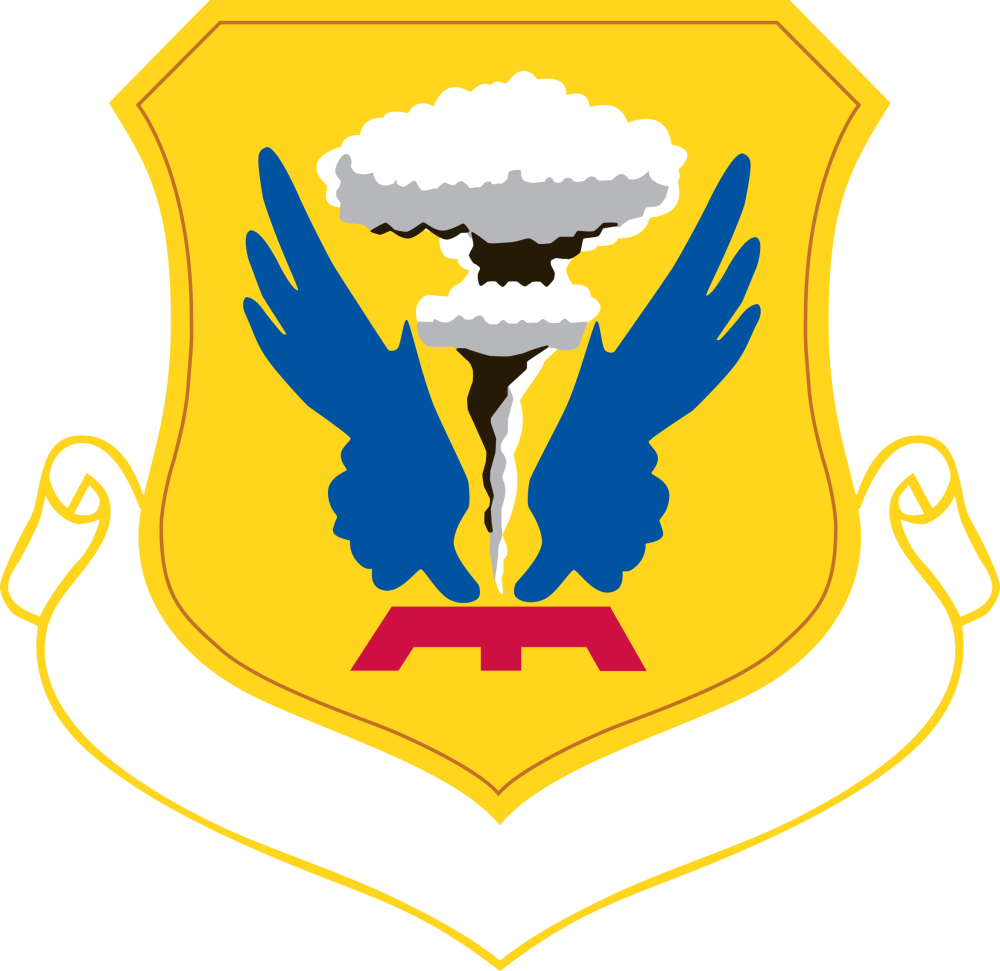
Shield of the 509th Operations Group
Active9 December 1944 – 16 June 1952; 15 July 1993 – present[1]
Country United States
Branch United States Air Force
TypeOperations Group
RoleB-2 Combat and Training Operations
Size3 squadrons
Part of 509th Bomb Wing
Garrison/HQWhiteman Air Force Base, Missouri
Tail codeWM
Engagements
World War II – Asiatic-Pacific Theater
Decorations
Air Force Outstanding Unit Award
Aircraft flown
BomberB-2A
Northrop B-2A Block 30 Spirit 82-1071 "Spirit of Mississippi"

The 509th Operations Group (509 OG) is the flying component of the United States Air Force 509th Bomb Wing, stationed at Whiteman Air Force Base, Missouri. It is equipped with all 20 of the USAF's B-2 Spirit stealth bombers, flown by its 393rd Bomb Squadron. Its 13th Bomb Squadron, the training unit for the 509th, provides training in Northrop T-38 Talon trainers as well as in the 393rd's B-2 Spirits.

The 509 OG traces its history to the World War II 509th Composite Group, which conducted the atomic bombings of Hiroshima and Nagasaki, Japan, in August 1945.

Redesignated the 509th Bombardment Group, Very Heavy in 1946, the group was one of the original ten bombardment groups of Strategic Air Command. The unit was also the host organization at Roswell Army Airfield, New Mexico in July 1947 during the alleged Roswell incident.

The 509th Bombardment Group was inactivated in 1952. In 1993, the unit was reactivated as the 509 OG, as part of the Objective Wing organization implementation of the 509th Bomb Wing.

Units

[edit]

The 509th OG consists of three component squadrons:[2]

Originally activated as the 325th Bomb Squadron on 6 January 1998. Re-designated the 13th BS ("Grim Reapers") on 23 September 2005, when that unit, flying B-1 Lancers as part of the 7th Operations Group, was inactivated. As the Formal Training Unit, the 13th BS provides Initial Qualification, Requalification, and Flight Instructor Candidate B-2 Training. Additionally, it manages the T-38 Companion Trainer Program and three Weapons Systems Trainers (flight simulators).
The 393rd BS ("Tigers"), a traditional squadron of the 509th, was activated as a B-2 squadron on 27 August 1993. It is the USAF's only operational bomb squadron.
  • 509th Operations Support Squadron
A non-flying squadron, the 509th OSS ("Hawks") controls all airfield activities at Whiteman.

Unofficial insignia

[edit]

In addition to its official insignia, during B-2 stealth bomber test flights, some members of the 509th Bomb Wing procured an unofficial insignia involving an alien, the legend To Serve Man (referring to a famous Twilight Zone episode), and the inscription Gustatus Similis Pullus (Dog Latin for "Tastes like chicken").[3]

A second variation carried the term "Classified Test Flight" instead of the Twilight Zone reference, and both harkened to the 509th's connection to the "Roswell incident".[4]

History

[edit]

The historical roots of the 509th OG begin on 17 December 1944 when the 509th Composite Group was formed at Wendover Field, Utah under Second Air Force. The 509th was formed with one mission in mind: to drop the Atomic Bomb.

The group deployed to the Western Pacific in May 1945 and was assigned to the Twentieth Air Force 313th Bombardment Wing, stationed at North Field, Tinian, in the Mariana Islands. Operations of the group, however, were controlled by Headquarters, USAAF with the 313th Bomb Wing providing logistical support.

The 509th CG made history on 6 August 1945, when the Boeing B-29 Superfortress "Enola Gay," piloted by Colonel Paul W. Tibbets, Jr., dropped the first atomic bomb on Hiroshima, Japan. The B-29 "Bockscar," piloted by Major Charles Sweeney visited the Japanese mainland on 9 August 1945 and dropped the second atomic bomb on Nagasaki.

Cold War

[edit]
Early 1946 509th Composite Group B-29 Era patch when unit was assigned to the 58th Bombardment Wing.

In November 1945, the group returned to the United States and was assigned to Roswell Army Air Base, New Mexico. For a brief period of time from January to March 1946 the 509th was assigned to the 58th Bombardment Wing at Fort Worth AAF, Texas, before returning to Roswell. The Group was assigned to Strategic Air Command on 21 March 1946, being one of the first eleven organizations assigned to SAC. At the time SAC was formed, the 509th Composite Group was the only unit to have experience with nuclear weapons and thus is regarded by many historians as the foundation on which SAC was built.[verification needed] In April 1946 many of the group's aircraft deployed to Kwajalein as part of Operation Crossroads, a series of atomic bomb tests. The remainder became the core of two new squadrons activated as part of the group, the 715th Bomb Squadron and the 830th Bomb Squadron.

On 10 July 1946, the group was renamed the 509th Bombardment Group, Very Heavy and the 320th Troop Carrier Squadron was disbanded. With the creation of the United States Air Force as a separate service, the group became the combat component of the 509th Bomb Wing on 17 November 1947, although it was not operational until 14 September 1948, when Col. John D. Ryan was named commander. As a result of postwar reductions only the 509th was equipped for the delivery of atomic bombs.

The group was redesignated as a medium bomb group in 1948 as part of the Strategic Air Command, and acquired an aerial refueling mission with the assignment of Boeing KB-29s. Its 27 operational Silverplate B-29s (the 309th had ultimately received 53 of the 65 produced) were transferred in 1949 to the 97th Bomb Wing at Biggs Air Force Base, El Paso, Texas, when the group converted to Boeing B-50D Superfortresses. The B-50D was the last derivative of the B-29 family and designed specifically for the atomic bombing mission. It was one of the last piston-engined bombers built, having a top speed just short of 400 mph (644 km/h), faster than many World War II-era piston-engined fighters still in service at the time.

During the Korean War, the 509th remained in the United States as President Harry S. Truman wasn't willing to risk extensive use of the USAF strategic bomber force, which was being used as a deterrent for possible Soviet aggression in Europe.

Its squadrons were removed on 1 February 1951, and assigned directly to the wing, effectively ending its operations. The 509th was inactivated on 16 June 1952 as part of a SAC (and later Air Force-wide) phase-out of groups with the adoption of the Tri-Deputate organization.[dubiousdiscuss]

Modern era

[edit]

The 509th Bomb Group was redesignated as the 509th Operations Group and activated on 12 March 1993 as part of the 509th Bomb Wing's reorganization under the USAF Objective Wing plan. All flying squadrons, as well as an Operational Support Squadron (OSS) were assigned to the 509th OG. The first B-2 Spirit stealth bomber arrived and was assigned to the 509th on 17 December 1993 (the date was the 49th anniversary of the activation of the 509th Composite Group and the 90th of the Wright brothers' flight).

On 17 September 1996, three 509th B-2s dropped three inert GBU-36 weapons, the highly accurate Global Positioning System-Aided Munitions (GAM) which used the GPS-Aided Targeting System (GATS). The B-2s made the drops at the Nellis AFB, Nevada, bombing range. Range officials, inspecting the area after the releases, were astonished to find that the GBU-36s had fallen seven, four, and four feet, respectively, from the target. A month later, the 509th repeated this impressive feat—only this time, they used live weapons. On 8 October 1996, three B-2s revisited the Nellis range and released 16 2,000 lb. class GBU-36 bombs from an altitude of 40,000 feet. Again, amazed range personnel discovered all sixteen projectiles hit close enough to their targets to be confirmed as 16 kills. The results so impressed USAF Chief of Staff General Ronald Fogleman that he announced at a mid-December press conference the 509th and the B-2 would reach limited (conventional) operational capability on 1 January 1997.

Operation Allied Force

[edit]

The B-2 first saw combat 23 March 1999, during NATO operations in Serbia and Kosovo, the first sustained offensive combat air offensive conducted solely from U.S. soil. Over a period of two months, the 509th generated 49 B-2 sorties flown roundtrip from Missouri to targets in Southeastern Europe.

Although the B-2s accounted for only 1 percent of all NATO sorties, the aircraft's all-weather, precision capability allowed it to deliver 11 percent of the munitions used in the air campaign. The missions lasted an average of 29 hours, demonstrating the global reach of the B-2.

On the night of 7–8 May 1999, during the Kosovo War B-2s flying out of Whiteman attacked the Belgrade embassy of the People's Republic of China, killing three and causing heavy damage. Although a strike was authorized against a target called 'Belgrade Warehouse 1', the CIA-provided coordinates pinpointed the embassy's location. Neither the aircrew nor the US Air Force were found to have any responsibility for the affair.

Operation Enduring Freedom

[edit]

Following the terrorist attacks on New York City and Washington, D.C., on 11 September 2001, the 509th quickly transitioned to a wartime mode by joining forces with the 314th Airlift Wing, Little Rock Air Force Base, Arkansas, and the Missouri Air National Guard's 139th Airlift Wing, St. Joseph, Missouri, to send Missouri Task Force-1 to assist rescue efforts at the World Trade Center.

In October 2001, the B-2 led America's strike force in Afghanistan, hitting the first targets in the country to "kick down the door" for the air campaign which followed. The bombers again flew from Missouri to their targets before landing at Diego Garcia in the Indian Ocean to exchange crews while the engines continued to run. The combat missions lasted more than 40 hours, with the aircraft operating continuously for more than 70 hours without incident before returning to Whiteman.

After twice proving its ability to fly combat missions from Missouri, the wing stepped up efforts to deploy the B-2 from forward locations. By late 2002, the Air Force had completed special shelters for the aircraft at Diego Garcia. The shelters provided a controlled climate similar to the facilities at Whiteman for specialized work on the aircraft skin in order to maintain its stealth characteristics. This ability to sustain operations from a forward location added a new dimension of flexibility to potential air campaigns.

Operation Iraqi Freedom

[edit]

The new shelters were put to use when the B-2 bombers again led a coalition air strike against the Iraqi regime of Saddam Hussein, on 21 March 2003. The famous "shock and awe" campaign saw unprecedented use of precision-guided munitions by the B-2 in an effort to minimize collateral damage and destroy key targets. The campaign also marked another milestone for the 509th, as B-2s flew combat missions from both Whiteman and a forward deployed location simultaneously.

Only a decade after delivery, the B-2 was now a proven weapons system, a veteran of three campaigns and first-ever forward deployment. In recognition of the maturity of the system and the unit, the Air Force declared the B-2 fully operational capable.

Since 2003, the B-2's forward presence has become a reality and proved the aircraft can deliver combat airpower, any time and any place. The deployment to Guam, which began in February 2005, provided a continuous bomber presence in the Asia Pacific region and augmented Pacific Command's establishment of a deterrent force. The 80-day tour, the longest in the bomber's 13-year history, also marked the first B-2 deployment since the aircraft was declared fully operational.

Lineage

[edit]
Gaggle patch of 509 OG squadrons. Consists of (clockwise from top left): 13th Bomb Squadron, 393rd Bomb Squadron, 509th Operations Support Squadron, 394th Combat Training Squadron and 509th Bomb Wing (center).
  • Established as 509 Composite Group on 9 December 1944
Activated on 17 December 1944
Redesignated: 509 Bombardment Group, Very Heavy, on 10 July 1946
Redesignated: 509 Bombardment Group, Medium, on 2 July 1948
Inactivated on 16 June 1952
  • Redesignated 509 Operations Group on 12 March 1993
Activated on 15 July 1993[1]

Assignments

[edit]

Components

[edit]

Stations

[edit]

Aircraft

[edit]

References

[edit]
Revisions and contributorsEdit on WikipediaRead on Wikipedia
from Grokipedia
The 509th Operations Group is the operational flying component of the , stationed at , , and serves as the sole U.S. Air Force unit equipped to employ the B-2 Spirit stealth bomber fleet, comprising all 20 operational aircraft in the inventory. Its lineage traces directly to the , activated on December 17, 1944, at Army Airfield, , specifically organized, equipped, and trained as the first Army Air Forces unit for atomic warfare, which executed the nuclear strikes on and in August 1945 from bases in the . In its modern role under , the group maintains combat readiness for global strike missions, including long-duration sorties such as round-trip flights from exceeding 40 hours during operations in , establishing records for sustained bomber employment. The unit oversees B-2 operations, encompassing aircrew training, mission planning, and execution of strategic deterrence tasks, contributing to U.S. Strategic Command's global strike capabilities. Notable achievements include subordinate squadrons earning the Omaha Trophy for excellence in strategic deterrence, reflecting the group's proficiency in high-stakes nuclear and conventional bombing roles. The 509th Operations Group's historical and contemporary emphasis on specialized operations underscores its defining characteristic as a of American strategic airpower, from pioneering atomic delivery to sustaining stealth penetration in contested environments.

Mission and Strategic Role

Core Mission in Nuclear Deterrence and Global Strike

The 509th Operations Group serves as the operational flying arm of the under , tasked with executing nuclear operations and global strike missions using the B-2 Spirit stealth bomber. This mandate centers on delivering both conventional and nuclear munitions to penetrate sophisticated enemy defenses, providing massive firepower anywhere on the globe from its base in . In nuclear deterrence, the group's B-2 fleet maintains a survivable second-strike capability through low-observable , enabling strikes on heavily defended targets and thereby credibly threatening adversaries' strategic assets. The platform's unrefueled range of approximately 6,000 nautical miles, extendable via , supports global reach without dependence on vulnerable forward bases, reinforcing deterrence by ensuring reliable delivery independent of preemptive attacks. Training regimens for high- and low-altitude, day or night operations sustain this readiness, as evidenced by routine exercises demonstrating mass generation and deployment of multiple aircraft. For conventional global strike, the 509th enables rapid, precision attacks on time-sensitive or hardened targets, integrating stealth penetration with heavy capacity—up to 40,000 pounds—to execute proportionate responses aligned with objectives. This dual-role versatility underscores the causal mechanism of deterrence: adversaries' awareness of the group's verifiable technological edge and operational tempo imposes calculable risks, empirically stabilizing geopolitical tensions by elevating the costs of aggression beyond prospective gains.

Historical Significance in Strategic Bombing

The 509th Operations Group traces its lineage to the 509th Composite Group, activated on December 17, 1944, as the United States Army Air Forces' sole unit trained and equipped for atomic bomb delivery during World War II. Commanded by Colonel Paul W. Tibbets Jr., the group underwent specialized training at Wendover Field, Utah, before deploying to Tinian Island in the Pacific, where it executed the world's first combat use of nuclear weapons on August 6 and 9, 1945, targeting Hiroshima and Nagasaki, respectively. This pioneering role established the group's foundational legacy in strategic bombing, demonstrating the atomic bomb's capacity as a decisive tool to compel enemy capitulation amid Japan's military intransigence, which had rejected unconditional surrender demands outlined in the Potsdam Declaration of July 26, 1945. The necessity of atomic intervention stemmed from Japan's refusal to yield despite conventional campaigns that had already devastated its cities, coupled with preparations for , the planned Allied invasion of the home islands projected to incur 268,000 to over 1 million U.S. casualties in the initial Kyushu phase alone, escalating further in subsequent operations. Declassified documents reveal no credible signals of Japanese willingness for prior to the bombings; internal deliberations, including intercepted communications, indicated continued commitment to fighting to near-total annihilation rather than accept Allied terms that preserved the emperor's status only under duress. The bombings, followed by Soviet entry into the on August 8, prompted Emperor Hirohito's intervention on August 15, 1945, announcing surrender and averting prolonged that empirical projections deemed catastrophically costly in lives. While mainstream critiques, often rooted in ethical retrospectives, decry the civilian targeting as morally excessive, causal analysis from primary records prioritizes the bombs' empirical outcome in forcing rapid capitulation absent viable alternatives, as evidenced by the absence of pre-bomb breakthroughs and Japan's mobilization of over 2 million troops for defense. Revisionist claims of redundancy overlook the strategic calculus: atomic strikes provided irrefutable demonstration of overwhelming destructive potential, breaking the deadlock of Japanese leadership's resolve, which had withstood months of . This intervention not only truncated the Pacific conflict but underscored the 509th's enduring significance in validating nuclear deterrence as a mechanism to prevent escalation to mass ground invasions.

Organization and Structure

Subordinate Squadrons and Units

The 509th Operations Group oversees three bomb squadrons that operate the Air Force's entire fleet of 20 B-2 Spirit stealth bombers, divided among operational and training roles to maintain high levels of combat readiness. The 13th Bomb Squadron serves as the primary training unit, conducting aircrew qualification and proficiency flights in both B-2 Spirits and T-38A Talon trainers to prepare pilots and mission planners for joint operations. The squadron executes structured training cycles, including simulator-based rehearsals and live sorties, contributing to the group's overall mission capable rates exceeding 80% for bomber assets as reported in annual readiness assessments. The 393rd Squadron and 509th Squadron function as the operational flying units, each managing alert postures for rapid global strike response, with rotations ensuring 24/7 availability for nuclear deterrence tasks under directives. These squadrons integrate intelligence data for mission execution, supporting conventional precision strikes and strategic deterrence patrols, with historical deployment data showing contributions to over 1,000 sorties in recent operations. Complementing the flying squadrons, the 509th Operations Support Squadron handles non-flying operational functions, including airfield management, approach control, air traffic services, base operations, and to enable seamless B-2 launches and recoveries. This squadron integrates mission planning tools and feeds, directly enhancing wing-level readiness by coordinating ground support for training and alert commitments, as evidenced by its 2022 receipt of the Omaha Trophy for outstanding operational support in strategic .

Command and Operational Components

The 509th Operations Group reports directly to the commander of the at , , facilitating integrated command over B-2 Spirit bomber operations within the wing's structure. This direct reporting line supports chain-of-command efficiency, enabling rapid execution of global strike and nuclear deterrence missions by aligning group-level flying operations with wing-wide logistics and support. The wing, in turn, operates under (AFGSC), which exercises operational control over U.S. nuclear-capable bomber forces and ensures alignment with national strategic objectives. Operational components include a detachment at 509 Spirit Blvd., Suite 117, Whiteman AFB, which coordinates internal group functions and maintains liaison roles with AFGSC and U.S. Strategic Command elements to enhance synergy. These liaisons promote interoperability between bomber, , and components, optimizing deterrence posture through shared command protocols and joint exercises like Global Thunder, which test . Such integration minimizes response delays, allowing for alert postures that can generate sorties within hours of receipt. Nuclear operations adhere to verifiable protocols rooted in presidential release , where the U.S. President holds sole discretion to authorize nuclear employment, transmitted through the to AFGSC and subordinate units. Below this level, the group enforces the two-person concept—requiring dual authentication for all critical actions involving nuclear weapons handling, arming, and launch—to prevent unauthorized actions and ensure procedural integrity. These safeguards, validated through annual command exercises, underscore the group's role in maintaining credible second-strike capability without compromising operational tempo.

Facilities and Basing

Current Primary Station

The 509th Operations Group maintains its primary station at , , where it serves as the flying component of the and operates the United States Air Force's entire fleet of 20 B-2 Spirit stealth bombers. Whiteman AFB became the sole operational base for the B-2 upon delivery of the first aircraft, Spirit of Missouri, on December 17, 1993. The base's infrastructure includes specialized climate-controlled hangars designed to protect the B-2's radar-absorbent stealth coatings from , enabling sustained operational readiness. These facilities support the group's integration with base-wide resources for continuous alert postures, contributing to nuclear deterrence missions. Whiteman's central inland location enhances survivability against coastal-based threats, such as submarine-launched missiles, while providing strategic advantages for global strike operations launched directly from the continental . Proximity to training areas facilitates efficient mission rehearsals, and recent sustainment upgrades, including and software enhancements, address fleet-wide maintenance challenges to maintain the B-2's lethality through the 2030s.

Key Historical Stations

The , predecessor to the modern 509th Operations Group, was activated on December 17, 1944, at Wendover Army Air Field, , where it conducted specialized training operations in a remote desert location selected for its isolation and security features conducive to handling classified atomic projects. In late April 1945, the unit began relocating personnel and equipment across the Pacific to North Field on Tinian Island in the , establishing a forward-deployed base with dedicated runways and support infrastructure to enable rapid adaptation to theater logistics in the Western Pacific. This shift from continental training to overseas staging reflected early mission requirements for long-range projection in isolated forward areas. Following , the unit returned to the continental and established operations at Roswell Army Air Field (later redesignated ), , commencing in late 1945, with formal wing assignment there by November 17, 1947. The base's expansive facilities and strategic inland position supported the transition to peacetime nuclear storage and maintenance logistics, accommodating B-29 and subsequent bomber fleets under oversight. This basing choice emphasized secure, self-contained infrastructure for early deterrence postures, minimizing vulnerabilities associated with coastal or overseas sites. In July 1958, the relocated to Pease Air Force Base, , involving the transfer of aircraft, ground support equipment, and over 5,000 personnel to adapt to evolving requirements for dispersed East Coast operations. The move leveraged Pease's proximity to Atlantic refueling routes while maintaining hardened facilities for B-47 and B-52 sustainment, aligning with broader force distribution to enhance national resilience against potential Soviet threats. The wing's final major transition occurred on September 30, 1990, when it shifted to , , selected for its central continental location that improved survivability through geographic dispersion away from high-threat coastal regions and facilitated secure integration of advanced stealth platforms. This relocation, executed without initial personnel or equipment movement to streamline infrastructure upgrades, supported post-Cold War logistics for low-observable aircraft maintenance and global strike readiness in a consolidated, defensible inland hub.

Equipment and Capabilities

B-2 Spirit Stealth Bomber Operations

The 509th Operations Group operates the United States Air Force's entire fleet of 20 B-2 Spirit stealth bombers from Whiteman Air Force Base, Missouri, enabling long-range precision strikes against heavily defended targets. The B-2's flying-wing design incorporates advanced low-observable stealth technology, allowing it to penetrate sophisticated integrated air defense systems while carrying up to 40,000 pounds of ordnance internally. As a dual-capable platform, the B-2 delivers nuclear gravity bombs such as the B61 and B83, alongside conventional precision-guided munitions including Joint Direct Attack Munitions (JDAM) and the GBU-57 Massive Ordnance Penetrator (MOP) for hardened and deeply buried targets. Its unrefueled combat range exceeds 6,000 nautical miles (11,000 kilometers), supporting global reach missions with aerial refueling extending operational endurance further. The group focuses on aircrew certification, tactics development for contested environments, and sustaining fleet readiness amid the B-2's demanding maintenance regime, which includes specialized care for radar-absorbent materials and avionics. This ensures high operational availability for strategic deterrence and rapid response, with the aircraft's stealth advantages outweighing sustainment challenges in enabling undetected penetration of peer adversary defenses. In training exercises, the 509th has generated significant sortie volumes, including a record month in April 2014 with the highest number of sorties and flight hours using all 20 operational B-2s, and more recently launching 12 aircraft in a mass fly-off during Spirit Vigilance in April 2024 to validate mass generation and mission execution in simulated denied-access scenarios. These efforts underscore the group's capacity to maintain combat effectiveness, with empirical data from deployments confirming the B-2's precision in delivering munitions against high-value targets without detection.

Supporting Aircraft and Technologies

The 509th Operations Group's extended-range missions rely on integration with aerial refueling assets such as the KC-135 Stratotanker and KC-46 Pegasus, which deliver critical fuel transfers to sustain intercontinental operations without intermediate basing. This capability traces directly to the unit's lineage, where the 509th Bombardment Group pioneered in-flight refueling in the late 1940s by forming the 509th Air Refueling Squadron under General Curtis LeMay and employing modified KB-29 Superfortress tankers to refuel aircraft including the F-51 Mustang and F-84 Thunderjet. These early efforts evolved into standardized flying boom procedures by the early 1950s, coinciding with the introduction of the KC-97 Stratofreighter, which offloaded up to 6,000 gallons of fuel per mission and extended strategic bomber endurance from transoceanic limits to global non-stop profiles, fundamentally enabling Strategic Air Command's alert postures and deterrence missions. Advancements in refueling innovations from this era, including boom operator training and hose-drogue adaptations tested by the 509th, reduced refueling times from over 30 minutes to under 10 minutes per connection, directly correlating to empirical gains in mission survivability and payload delivery over distances exceeding 6,000 miles without landing. Col. Michael Pyburn, former 509th Operations Group commander, attributed these developments to allowing "the U.S. to force project on a global scale," a legacy that persists in modern tandem operations with tankers supporting bomber task forces. Key enabling technologies include networked flight simulators and virtual reality systems for pre-mission rehearsal, which replicate refueling scenarios, avionics interfaces, and multi-aircraft formations to build crew proficiency. The 509th has collaborated on VR upgrades with its subordinate 13th Bomb Squadron since at least 2020, leveraging these tools to cut training costs by minimizing live sorties while maintaining fidelity in simulating extended refueling tracks and environmental variables. Such systems, evaluated positively for overall effectiveness by 509th Bomb Wing representatives in 1997 assessments, ensure operational tempo without proportional increases in fuel consumption or wear on support assets.

Historical Development

World War II Formation and Atomic Missions

The 509th Composite Group was activated on December 17, 1944, at Wendover Army Air Field, Utah, under the command of Colonel Paul W. Tibbets Jr., as the dedicated delivery unit for atomic weapons developed under the Manhattan Project. Unlike standard bombardment groups, its composite organization integrated the 393rd Bombardment Squadron for B-29 operations, along with fighter escort and photographic reconnaissance elements from the 468th Bomb Group and 1st Ordnance Squadron (Special), enabling autonomous execution of specialized atomic strikes amid wartime secrecy constraints. Personnel, numbering around 1,770, underwent rigorous isolation protocols at Wendover to compartmentalize knowledge of the mission's nuclear nature. Training emphasized adaptation of "" B-29 Superfortresses—modified for bomb bay clearance and instrumentation—with crews practicing high-altitude drops of inert "" bombs weighing 5,000 to 10,000 pounds to replicate atomic detonation dynamics, including steep post-release turns for blast evasion. By early 1945, the group had conducted over 1,500 training sorties, refining techniques under Tibbets' oversight, while maintaining cover as a conventional unit to preserve operational security. In May 1945, advance elements deployed to North Field on Tinian in the , followed by the full complement by June, positioning the group within striking range of under . The group's combat debut occurred on August 6, 1945, when Tibbets piloted the Enola Gay to drop the uranium-235 bomb "" on at 8:15 a.m. local time, detonating at 1,900 feet and destroying approximately 70% of the city. Supporting aircraft, including for blast measurement and for photography, confirmed the mission's success. Three days later, on August 9, Major Charles W. Sweeney commanded to release the plutonium-239 bomb "" over at 11:02 a.m., with at 1,650 feet amid cloud cover that initially shifted the target. These strikes, executed without fighter opposition due to Japan's depleted air defenses, yielded immediate fatalities estimated at 70,000–80,000 in and 35,000–40,000 in , with subsequent radiation effects raising totals to around 200,000. The atomic missions directly catalyzed Japan's announcement on August 15, 1945, as evidenced by intercepted communications and Hirohito's radio citing the bombs' unprecedented destructive power as overriding military resistance. This outcome forestalled , the planned Allied of the Japanese home islands, which U.S. Joint Chiefs projections assessed at 400,000–800,000 American casualties in the initial Kyushu phase alone, escalating to 1–4 million overall with Japanese losses potentially exceeding 10 million amid fanatical defense tactics observed in prior island campaigns. Empirical comparisons of atomic versus casualties, grounded in battle data from Iwo Jima and Okinawa (where U.S. losses reached 25–35% of committed forces), substantiate the bombings' role in minimizing total human cost through decisive termination of hostilities rather than attrition.

Postwar Inactivation and Cold War Reactivation

Following the atomic bombings of and in August 1945, the returned to the continental and relocated to Roswell Air Field, , on 6 November 1945, where it was redesignated the 509th Bombardment Group (Very Heavy) and equipped with B-29 Superfortresses for continued nuclear operations under . The unit maintained the U.S. Air Force's sole atomic bombing capability during this immediate postwar period, conducting training missions that underscored America's nuclear monopoly amid rising tensions with the . On 17 November 1947, Strategic Air Command (SAC) activated the 509th Bombardment Wing at Roswell and assigned the bombardment group to it, formalizing the unit's role in SAC's nascent nuclear alert posture as Soviet expansionism intensified, including the Berlin Blockade of 1948–1949. This reactivation positioned the 509th as SAC's primary atomic delivery force, with its B-29s on constant readiness to deter direct aggression; declassified SAC assessments from the era highlight that, amid understrength conventional units, the 509th's atomic-equipped bombers provided the credible retaliatory threat that restrained Soviet advances in Europe. In July 1948, the wing pioneered strategic by activating the 509th Air Refueling Squadron with KB-29 tankers, significantly extending B-29 intercontinental strike ranges and enhancing deterrence through global reach. By the early , as SAC expanded, the group began transitioning from piston-engine B-29s and B-50s to jet-powered B-47 Stratojets, improving speed and payload for alert forces while maintaining nuclear monopoly advantages until Soviet atomic tests in 1949 shifted dynamics toward mutual deterrence.

Strategic Air Command Integration and Nuclear Evolution

Following its postwar reactivation, the 509th Bomb Wing integrated fully into Strategic Air Command (SAC) operations during the 1950s, transitioning from B-50 Superfortresses to Boeing B-47 Stratojet medium bombers by 1955 and relocating to Pease Air Force Base, New Hampshire, in 1958. This shift enhanced the wing's capability for rapid nuclear strike missions, aligning with SAC's emphasis on deterrence through credible second-strike forces amid escalating Soviet nuclear threats. Equipped with KC-97 Stratofreighters for aerial refueling, the wing supported global reach, participating in deployments to England and Morocco to demonstrate forward presence and operational readiness. By 1966, the wing evolved to heavy bombers and KC-135 Stratotankers, replacing the phasing-out B-47 fleet to sustain intercontinental nuclear delivery amid advancements in Soviet air defenses. This upgrade bolstered the wing's role in SAC's (SIOP), where units like the 509th contributed to target assignment, mission rehearsal, and execution planning for scenarios, ensuring synchronized strikes across , , and naval forces. The B-52's increased and range, combined with refueling, enabled persistent airborne alert postures, including missions from Pease, where nuclear-armed B-52s maintained continuous orbits to guarantee survivability against preemptive attacks. SAC's alert programs, including Chrome Dome, achieved high reliability metrics, with the 509th's maintenance and crews supporting nonstop patrols that logged thousands of flight hours without compromising weapon security, underscoring the operational discipline that underpinned mutual assured destruction's stabilizing effect during the arms race. While costly in resources—exceeding billions in annual SAC budgets for readiness—these postures empirically deterred escalation, as evidenced by the absence of direct U.S.-Soviet nuclear conflict despite proxy wars and crises like the Cuban Missile Crisis, where SAC forces, including 509th assets, were placed on heightened alert. Challenges included fatigue from 24-hour alert cycles and technical risks in nuclear handling, yet incident rates remained low relative to mission volume, validating the causal link between sustained readiness and peace preservation over narratives of redundancy.

Modern Era Transition to Stealth and Precision Strike

The 509th Operations Group was reactivated on July 15, 1993, at Whiteman Air Force Base, Missouri, to oversee flying operations for the B-2 Spirit stealth bomber as part of post-Cold War base realignments that relocated the parent 509th Bomb Wing to the installation in September 1990 without initial personnel or equipment. This transition leveraged the group's World War II-era atomic bombing legacy to integrate the advanced low-observable platform, designed to evade sophisticated Soviet-era and emerging regional air defenses in a multipolar threat landscape. The first B-2 aircraft, Spirit of Missouri, arrived on December 17, 1993, initiating squadron training and mission development under the group's command. By January 1, 1997, the 509th achieved initial operational capability with the B-2, certifying it for both nuclear deterrence and conventional precision strikes capable of delivering up to 40,000 pounds of ordnance over intercontinental ranges. The stealth bomber's radar-absorbent materials and flying-wing configuration enabled penetration of heavily defended airspace, shifting U.S. strategic aviation from massive formations to smaller, survivable packages suited for prompt global response against proliferated threats. Post-2001, the group incorporated B-2 upgrades enhancing communications, , and compatibility with precision-guided munitions like JDAMs and JSOWs, adapting the platform for conventional operations in contested environments while retaining nuclear primacy. Low-observability performance, routinely validated in U.S. Strategic Command exercises such as Global Thunder, confirmed the aircraft's ability to achieve radar cross-sections orders of magnitude below non-stealth bombers, supporting operational concepts with reduced basing dependencies and force multipliers over legacy systems.

Operational Deployments and Engagements

Balkans and Operation Allied Force

The 509th Operations Group conducted the B-2 Spirit's first combat missions during Operation Allied Force, NATO's aerial campaign against the Federal Republic of Yugoslavia from March 24 to June 10, 1999, aimed at halting in . Aircraft from , , flew round-trip sorties exceeding 30 hours each, launching directly from the continental without forward basing. This approach minimized exposure to hostile defenses while demonstrating long-range strike capability. Over the 78-day operation, the group generated 49 B-2 sorties, accounting for less than 1 percent of NATO's total 38,004 sorties but striking over 700 targets. These missions destroyed 33 percent of all Serbian targets in the initial eight weeks, including facilities, air defense systems, and infrastructure critical to Yugoslav military operations. The B-2s delivered 656 Joint Direct Attack Munitions (JDAMs), marking the weapon's debut and enabling precision strikes that achieved an 84 percent success rate in target destruction. Serbian air defenses detected some B-2 incursions via but failed to engage effectively, underscoring the bomber's low-observability against integrated systems like SA-3 and SA-6 missiles. B-2 strikes hit 90 percent of aimed points within 40 feet, reducing compared to unguided munitions used by other platforms and contributing to the campaign's empirical pressure on Yugoslav forces. Initial rates were constrained by the limited fleet of operational —only six to eight available—and requirements for stealth coating validation between missions, yet the precision focus accelerated degradation of high-value assets, correlating with Serbia's withdrawal from by June 1999. The operations signaled U.S. strategic reach to adversaries, executing strikes from secure homeland bases and bypassing regional vulnerabilities, which reinforced deterrence against regimes employing denial tactics. Post-campaign assessments affirmed the B-2's role in 16 percent of precision-guided munitions expended, validating its utility in contested environments despite critiques of slow tempo from fleet size limitations.

Global War on Terror Operations

The 509th Operations Group's B-2 Spirit bombers conducted initial strikes in on 7 October 2001, targeting command and control facilities, airfields, and training camps in . These missions originated from , , with flight durations exceeding 40 hours, including one record 44.3-hour sortie by the Spirit of America. B-2s delivered a substantial portion of the precision-guided munitions in the campaign's opening nights, leveraging stealth to penetrate defended airspace and disrupt enemy operations without detection or losses. In Operation Iraqi Freedom commencing 20 March 2003, the group executed its first forward-based combat deployment, flying 22 sorties from and 27 direct from Whiteman while striking over 600 hardened targets, including leadership bunkers and command centers in decapitation attempts against . Equipped with GPS-guided JDAMs, B-2 strikes achieved near-perfect accuracy, with sortie reliability exceeding 90% and mission-capable rates at 85%, enabling the destruction of deeply buried facilities using up to 2,000-pound penetrators. The B-2's overwhelming initial firepower minimized U.S. personnel exposure by neutralizing high-value threats early, contributing causally to the swift regime collapse in both theaters through shock-and-awe effects that shattered command structures. However, the fleet's small size—limited to 20 aircraft—constrained overall generation compared to non-stealth platforms, though verified target destruction metrics confirmed the platform's efficacy in high-threat environments.

Recent Global Strikes and Deterrence Missions

In response to escalating threats in the region, the 509th Operations Group has conducted Bomber Task Force deployments featuring B-2 Spirit stealth bombers to allied bases, enhancing deterrence postures against Chinese aggression. These missions, including operations in 2024 and 2025, involved B-2 aircraft integrating with regional allies for exercises that demonstrate long-range strike capabilities and , signaling U.S. resolve without provoking direct escalation. For instance, in September 2024, three B-2 Spirits participated in Bomber Task Force Pacific, supporting a amid tensions with . The group's B-2 fleets have executed precision strikes against hardened underground targets, showcasing the platform's ability to neutralize threats with minimal collateral effects. On , 2024, B-2 bombers from , operated by the 509th, conducted the first-ever strikes against Houthi underground weapons storage facilities in , destroying five sites using precision-guided munitions without reported civilian casualties or radiation risks associated with conventional payloads. These operations targeted Iran-backed Houthi assets disrupting shipping, maintaining strategic pressure on proxies while avoiding broader regional escalation, as evidenced by the absence of retaliatory expansions beyond ongoing Houthi rhetoric. Extending this operational tempo into 2025, the 509th supported strikes on Iranian facilities during Operation Midnight Hammer in June, deploying seven B-2s to hit nuclear-related sites with high accuracy, further underscoring the bombers' reliability in global reach missions. Empirical data from these deployments, including sustained rates and flight hours exceeding 7,000 on individual , counter concerns over high operations tempo by affirming the B-2's mechanical robustness and crew proficiency. Ongoing deterrence exercises, such as Spirit Vigilance in April 2024, continue to validate the group's readiness, with B-2 presence reinforcing alliances and credible threats against adversaries.

Lineage, Honors, and Symbols

Official Lineage and Designations

The 509th Operations Group was constituted as the 509th Composite Group on 9 December 1944 and activated on 17 December 1944 at Wendover Army Air Field, Utah, under the United States Army Air Forces, specifically organized for atomic bomb delivery operations. It was redesignated as the 509th Bombardment Group, Very Heavy, on 10 July 1946, reflecting a shift to conventional heavy bombardment roles post-World War II. On 2 July 1948, was redesignated as the 509th , Medium, aligning with 's emphasis on medium bombers like the B-29 and later B-47 for nuclear deterrence missions. The group was inactivated on 16 June 1952 amid reorganizations following the . Redesignated as the 509th Operations Group on 12 1993 under the Objective Wing reorganization, it was activated on 15 July 1993 at , , as the operational component of the , tasked with B-2 Spirit stealth bomber missions. This activation incorporated historical squadrons from the original composite and lineages, maintaining continuity in strategic bombardment expertise.

Combat Honors and Campaign Credits

The 509th Operations Group traces its combat honors to the World War II service of the 509th Composite Group, from which it inherits campaign streamers for Air Offensive, Japan; Eastern Mandates; and Western Pacific, reflecting participation in strategic bombing operations in the Pacific Theater culminating in the atomic missions against Hiroshima on 6 August 1945 and Nagasaki on 9 August 1945. These actions earned the unit the Air Force Outstanding Unit Award with Combat "V" Device for the period 1 July to 14 August 1945, recognizing the precision execution of high-risk nuclear strikes that contributed decisively to Japan's surrender. During the era, while lacking additional campaign streamers, the group's predecessor elements within received Air Force Outstanding Unit Awards for sustained nuclear deterrence readiness, such as the period 1 April to 1 October 1968 and 1 July 1981 to 30 June 1982, underscoring empirical validation of operational effectiveness in maintaining global strategic posture amid heightened tensions. These awards highlight the unit's role in airborne alert missions and bomber deployments that deterred potential adversaries through credible nuclear capability, often underappreciated in broader historical narratives focused on overt conflicts. In the post-Cold War period, the reactivated 509th Operations Group earned successive Outstanding Unit Awards for combat and support operations, including 1 June 1997 to 31 May 1999 encompassing Operation Allied Force, where B-2 Spirits conducted precision strikes against Serbian targets; 1 June 1999 to 31 May 2001 covering initial missions following the 11 September 2001 attacks; and 1 June 2003 to 31 May 2005 involving Operation Iraqi Freedom contributions. These citations affirm the group's adaptation to stealth precision warfare, delivering over 650 sorties in Allied Force alone and pioneering long-range strikes in Enduring Freedom from Whiteman AFB, demonstrating sustained combat effectiveness in asymmetric threats.

Insignia, Emblems, and Traditions

The official emblem of the 509th Operations Group incorporates the heraldry of the 509th Bomb Wing, featuring a shield on a gold field with Air Force wings surmounting an atomic symbol and a red label of three points in the base, signifying the unit's pioneering role in atomic operations. This design, approved by the U.S. , emphasizes historical continuity from the World War II-era atomic bombings to modern strategic deterrence, with each element representing aspects of the unit's legacy as the first to deliver nuclear weapons in combat. The group variant includes a inscribed with "509th Operations Group" beneath the shield. The motto "Defensor Vindex"—Latin for "Defender Avenger"—encapsulates the group's dual mission of defense and offensive retribution, a designation carried over from its heritage. While unofficial patches have circulated among personnel, particularly those evoking the unit's secretive training phases or modern B-2 operations, regulations require adherence to the approved emblem, with deviations resolved through processes to maintain heraldic . Unit traditions tied to these symbols include annual heritage events honoring Colonel , the original commander who piloted the , such as commemorations at Wendover Army Air Field that reinforce the emblem's atomic symbolism through veteran reunions and mission retrospectives. This legacy extends to family continuity, exemplified by Paul W. Tibbets IV's command of the from June 2015 to June 2017, underscoring the enduring emblem as a marker of over stealth and precision strike capabilities.

References

Add your contribution
Related Hubs
User Avatar
No comments yet.