Hubbry Logo
search
logo
360674

5D optical data storage

logo
Community Hub0 Subscribers
Read side by side
from Wikipedia
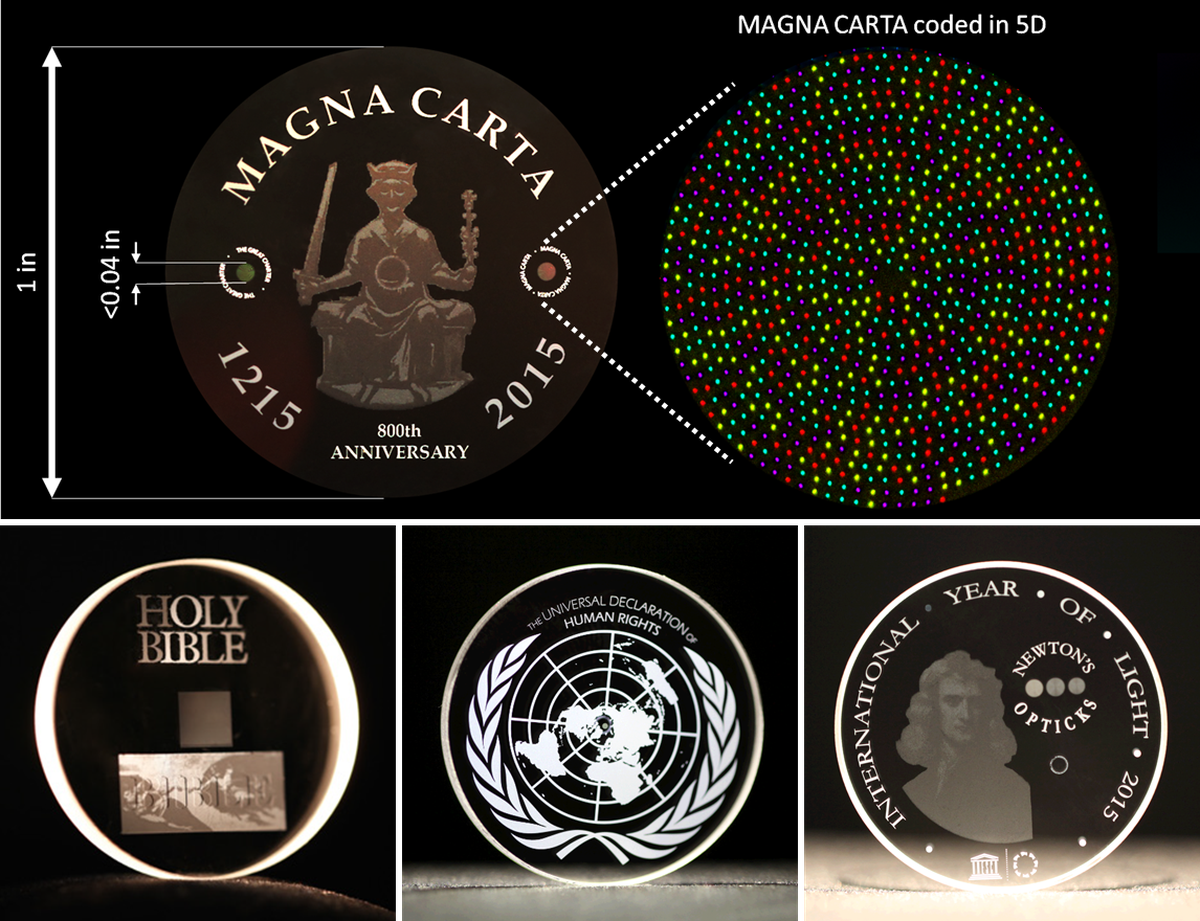
Some examples for 5D optical data storage discs. The blared areas are the actual zone of the data volume.

5D optical data storage is an experimental nanostructured glass for permanently recording digital data using a femtosecond laser writing process.[1] It is also branded Superman memory crystal, in reference to the Kryptonian memory crystals from the Superman franchise.[2] Discs using this technology could be capable of storing up to 360 terabytes worth of data[3][4] (at the largest size, 12 cm discs) for billions of years.[5][6][7][8] The University of Southampton experimentally demonstrated the technology in 2013.[9][10][11] Hitachi and Microsoft have researched glass-based optical storage techniques, the latter under the name Project Silica.[12][13]

The "5-dimensional" descriptor is because, unlike marking only on the surface of a 2D piece of paper or magnetic tape, this method of encoding uses two optical dimensions and three spatial co-ordinates to write throughout the material, which suggested the name '5D data crystal'. No exotic higher dimensional properties are involved. The size, orientation and three-dimensional position of the nanostructures comprise the so-called five dimensions.[3]

Technical design

[edit]

The concept is to store data optically in non-photosensitive transparent materials such as fused quartz, which has high chemical stability. Recording data using a femtosecond-laser was first proposed and demonstrated in 1996.[2][14][15] The storage medium consists of fused quartz, where the spatial dimensions, intensity, polarization, and wavelength are used to modulate data. By introducing gold or silver nanoparticles embedded in the material, their plasmonic properties can be exploited.[2]

According to the University of Southampton:

The 5-dimensional discs [have] tiny patterns printed on 3 layers within the discs. Depending on the angle they are viewed from, these patterns can look completely different. This may sound like science fiction, but it's basically a really fancy optical illusion. In this case, the 5 dimensions inside of the discs are the size and orientation in relation to the 3-dimensional position of the nanostructures. The concept of being 5-dimensional means that one disc has several different images depending on the angle that one views it from, and the magnification of the microscope used to view it. Basically, each disc has multiple layers of micro and macro level images.[16]

Recorded data can be read with a combination of an optical microscope and a polarizer.[17]

The technique was first demonstrated in 2009 by researchers at the Swinburne University of Technology[18] and in 2010 by Kazuyuki Hirao's laboratory at the Kyoto University,[19] and developed further by Peter Kazansky's research group at the Optoelectronics Research Centre, University of Southampton.[20][21][22][23] Discs recorded from that time have been tested for 3,100 hours at 100°C and shown to still work "perfectly" ten years later.[24]

Uses

[edit]

In 2018, Professor Peter Kazansky used the technology to store a copy of Isaac Asimov's Foundation trilogy, which was launched into space aboard Elon Musk's Tesla Roadster in association with the Arch Mission Foundation.[25]

In 2024, Kazansky's group encoded the three billion character human genome and etched it onto a coin-sized 5D disc.[26] It includes a visual key explaining how to use it, in homage to the Pioneer plaques that were placed on board the 1972 Pioneer 10 and 1973 Pioneer 11 spacecrafts. They stored it in the Memory of Mankind archive, located in the world's oldest salt mine in Hallstatt, Austria.[26]

In July 2025 Good Old Games, in collaboration with SPhotonix, encoded Heroes of Might and Magic III on the 5D crystal. It became the first video game ever preserved with this technology.[27]

See also

[edit]

References

[edit]
[edit]
Revisions and contributorsEdit on WikipediaRead on Wikipedia
from Grokipedia
5D optical data storage is an advanced optical recording technology that encodes data in five dimensions—typically three spatial dimensions (x, y, z) along with two additional parameters such as birefringence orientation and nanostructure size—using femtosecond laser writing in durable glass media like fused silica, enabling hundreds-of-terabytes-scale capacities on compact discs with exceptional longevity.[1][2] This method leverages ultrafast lasers to induce nanoscale modifications, such as birefringent nanopores in fused silica, allowing data to be written at rates up to 1 million voxels per second and read with high fidelity using confocal microscopy or polarized light.[3][4] Pioneered by researchers including Peter G. Kazansky at the University of Southampton's Optoelectronics Research Centre, the technology achieves densities over 10,000 times that of Blu-ray, with demonstrations storing up to 500 terabytes on a CD-sized silica disc through multiplexing techniques like ellipse orientation (up to 16 levels) and intensity variations (9.4–12.7 TW/cm²).[1][2] Key advantages include thermal stability up to 1000°C and data preservation for billions of years at room temperature, far surpassing traditional media like hard drives or optical discs, due to the chemical and structural integrity of the glass substrate.[5] Security features, such as encryption via heating or specific laser wavelengths (e.g., 808 nm NIR), further enhance its suitability for archival applications, with low bit error rates enabled by ordered nanostructures and stable readout after multiple cycles.[4] Recent advancements include the storage of the human genome on a 5D crystal in 2024 and parallel writing techniques achieving speeds up to 7.5 MB/s as of 2025, addressing previous limitations in writing efficiency and positioning 5D storage as a promising solution for big data challenges in AI, virtual reality, and long-term preservation.[6][7]

History and Development

Invention and Early Research

The concept of multi-dimensional optical data storage using femtosecond laser writing in transparent materials to surpass the limitations of traditional two-dimensional formats like CDs and DVDs was first proposed in 1996 by researchers including Eric N. Glezer, who demonstrated the feasibility of inducing localized refractive index changes in the bulk of materials for data recording. Building on this foundation, scientists at the University of Southampton's Optoelectronics Research Centre (ORC), led by Peter Kazansky, advanced the approach in the late 1990s and early 2000s through experiments focused on femtosecond laser interactions with fused silica glass to create self-assembled nanogratings capable of encoding data via birefringence.[8] These early investigations, detailed in seminal papers such as Bricchi et al. (2002) on form birefringence in fused silica, explored the polarization-sensitive modifications induced by ultrafast lasers, laying the groundwork for higher-dimensional storage by exploiting additional parameters like orientation and retardance. Femtosecond laser technology served as a key enabler, allowing precise control over nanostructure formation without thermal damage to the surrounding medium. In the early 2010s, Kazansky's team popularized the technology under the "Superman memory crystal" branding, drawing inspiration from the indestructible holographic crystals depicted in Superman comics to highlight its potential for ultra-durable, high-capacity archival storage.[9] Kazansky and collaborators produced foundational theoretical papers, including those on laser-induced nanogratings for polarization-multiplexed memory, emphasizing fused silica's suitability for permanent, stable data inscription due to its high thermal and chemical resilience.[10] These works, such as Shimotsuma et al. (2010) reviewing ultrafast laser nanostructuring applications, prioritized conceptual advancements in multi-layer, multi-parameter encoding while avoiding exhaustive numerical benchmarks.

Key Milestones

In 2013, researchers at the University of Southampton achieved the first experimental demonstration of 5D optical data storage by recording a 300 KB digital text file into nanostructured fused silica glass using femtosecond laser writing. This breakthrough laid the foundation for larger-scale implementations, including the potential for a 12 cm disc to store up to 360 terabytes of data while maintaining exceptional durability. In 2014, the technology earned a Guinness World Record for the most durable data storage material, highlighting its resistance to extreme environmental conditions.[11][12][6] By 2016, significant advancements in nanostructure stability were reported by the same team, enabling claims of data retention for billions of years even at temperatures up to 1,000°C, as detailed in a seminal paper on ultrafast laser writing in glass. This development solidified the technology's viability for long-term archival purposes.[13][12] In 2018, the Arch Mission Foundation launched a 5D quartz crystal containing the full text of Isaac Asimov's Foundation trilogy aboard SpaceX's Falcon Heavy rocket, attached to Elon Musk's Tesla Roadster, demonstrating the format's resilience in space environments. The crystal, developed in collaboration with University of Southampton researchers, served as a proof-of-concept for interstellar data preservation.[14][15] Advancing into 2024, scientists encoded the entire human genome—comprising approximately 3 billion base pairs—onto a coin-sized 5D disc using the same femtosecond laser technique, which was then archived in the Memory of Mankind facility in Hallstatt, Austria, to safeguard genetic information against potential human extinction. This milestone underscored the technology's capacity for preserving complex biological data over geological timescales.[6][16] In July 2025, GOG.com, in partnership with SPhotonix, preserved the complete video game Heroes of Might and Magic III on a 5D optical crystal, marking the first instance of a full commercial video game being stored in this format for indefinite archival. This effort highlighted emerging applications in digital cultural heritage preservation.[17][18] Throughout its development, 5D optical data storage has benefited from collaborations with industry leaders, including Hitachi's early efforts in glass-based archival storage commercialization and Microsoft's Project Silica, which explores parallel femtosecond laser techniques for cloud-scale data preservation.[19][20]

Fundamental Principles

The Five Dimensions

5D optical data storage utilizes five distinct dimensions to encode information within the volume of a transparent medium, such as fused silica glass, enabling far greater data density than traditional optical methods. The first three dimensions are spatial, corresponding to the x, y, and z coordinates that precisely position laser-induced nanostructures, or nano-gratings, throughout the material's bulk. These nanostructures, formed by femtosecond laser pulses, serve as the fundamental data units known as voxels, allowing information to be distributed in a three-dimensional array without relying on stacked physical layers.[21] The fourth and fifth dimensions are optical properties of these nanostructures: retardance (degree of birefringence, influenced by nanostructure size or laser intensity) and orientation (angle of the slow axis relative to the laser's polarization). The retardance represents the strength of birefringence, while the orientation determines the slow-axis direction. By varying laser parameters like intensity and polarization during writing, multiple discrete states can be created in these optical dimensions, distinguishing 5D storage from binary encoding.[21][22] These five dimensions facilitate multi-level encoding, where each voxel can represent more than a single bit of data. For instance, the retardance dimension can encode amplitude-like variations through different birefringence levels, while the orientation encodes phase-like information via polarization states, allowing combinations that store several bits per voxel—up to 7 or more in demonstrations. This contrasts with conventional optical storage, where voxels typically hold only one bit. In comparison to 3D optical storage systems like Blu-ray discs, which layer data in depth but remain limited to binary pits on those layers, 5D storage achieves exponentially higher density by incorporating the two optical dimensions without mechanical stacking or moving parts. Blu-ray relies on surface pits and reflective layers, constraining capacity to around 50 GB per disc, whereas 5D exploits the full volume and optical properties for terabyte-scale potential in a similar form factor.[21][23] The mathematical foundation for the enhanced capacity per voxel arises from the multi-level states in the two optical dimensions: if the retardance supports M distinguishable states and the orientation supports K states, the total information per voxel is log2(M×K)\log_2(M \times K) bits. This encoding, combined with the dense packing of voxels in three dimensions, provides orders-of-magnitude improvements over lower-dimensional systems.[24]

Materials Used

The primary material used in 5D optical data storage is fused silica, also known as quartz glass, valued for its exceptional optical transparency with over 99% transmission in the visible range (450–650 nm), high melting point exceeding 1700°C, and strong resistance to chemical degradation.[25][26] These properties enable the material to serve as a durable medium for long-term data preservation without significant alteration over extreme timescales. While fused silica is the main material utilizing birefringence for encoding, variant implementations employ other media, such as silver-sensitized glass, for fluorescence-based approaches.[2] Data encoding in fused silica relies on laser-induced nanostructures, specifically through birefringence effects where femtosecond laser pulses create self-assembled nanograting structures composed of 5–20 nm filaments. These structures exhibit form birefringence arising from anisotropic nanopores, with retardance values around 10⁻⁴, allowing precise manipulation of light polarization for multidimensional data representation.[25] Fused silica is preferred over polymers or other glasses due to its superior thermal stability up to 1000°C, near-zero coefficient of thermal expansion that minimizes distortion under temperature fluctuations, and immunity to degradation from cosmic radiation exposure. Polymers, by contrast, suffer from lower thermal thresholds and susceptibility to environmental breakdown, while other glasses may lack the same level of optical purity and structural integrity under irradiation.[27][6] Storage media are typically fabricated as 12 cm diameter fused silica plates, mimicking conventional optical disc sizes for compatibility, though the technology supports scalability to smaller coin-sized formats for specialized applications like archival payloads.[25][28]

Technical Implementation

Data Writing Process

The data writing process for 5D optical data storage employs femtosecond lasers to induce nanostructures deep within fused silica glass, enabling volumetric encoding without surface ablation. These lasers typically operate at wavelengths of 515 nm or 1030 nm with pulse durations around 190–300 fs, focused using high numerical aperture objectives (e.g., NA = 0.3–1.25) to concentrate energy at depths up to several millimeters.[25][29] The inscription mechanism relies on multiphoton nonlinear absorption, where intense laser pulses ionize the glass to generate a free-electron plasma. This plasma scatters light, creating interference patterns that drive the self-organization of anisotropic nanogratings—lamellar structures approximately 20 nm thick and subwavelength in width—aligned perpendicular to the polarization plane. Key parameters such as pulse energy (e.g., 30 nJ to 8 μJ), repetition rate (500 kHz to 1 MHz), and linear polarization control the nanograting's size, orientation, and birefringence retardance, allowing multi-bit encoding per voxel.[30][31][10] Data preparation involves converting binary information into 5D voxel representations, mapping bits across three spatial coordinates (x, y, z positions), nanograting slow-axis orientation (fourth dimension, e.g., 8–32 discrete angles), and retardance levels (fifth dimension, e.g., 2–4 intensity-based states for 1–2 bits). The laser beam, often shaped via spatial light modulators or digital micromirror devices for parallel processing, is scanned using precision three-axis translation stages at speeds up to 30 mm/s through the glass volume. Writing occurs in stacked layers—for instance, 100 layers spaced 17.5 μm apart, from 146 μm to 1.88 mm depth—to achieve high areal density; multi-pass irradiation (e.g., 10–250 pulses per voxel) refines multi-level structures for error-free encoding.[25][29][10] To minimize cumulative beam distortion, scattering, and potential modifications to previously written structures from plasma or nanostructure interactions, a common practical strategy is to write deeper layers first (starting from the farthest depth relative to the laser entry surface) and progress upward toward shallower layers. This bottom-up ordering reduces interference during the high-energy write phase for upper layers, as the beam initially passes through unwritten material, and helps mitigate interlayer crosstalk artifacts in dense multi-layer stacks. Writing speeds currently range from 0.2–0.4 MB/s in standard serial configurations but reach 1–10 MB/s with optimized setups, including a 2021 method using energy-modulated pulse trains for near-field enhancement that accelerated nanostructuring by over 100 times compared to conventional single-pulse approaches. Recent parallel techniques, projecting shaped voxel arrays, have demonstrated theoretical rates up to 7.5 MB/s using 100 kHz repetition rates.[1][25][29] Prototypes rely on custom systems featuring femtosecond lasers like the Pharos (Light Conversion Ltd.) or Satsuma (Amplitude Systèmes), coupled with water-immersion or oil-immersion objectives and automated scanning stages, as developed at the University of Southampton's Optoelectronics Research Centre.[10][25]

Data Reading Process

The data reading process in 5D optical data storage is non-destructive, utilizing polarization-sensitive optical microscopy to retrieve information from birefringent nanostructures inscribed in fused silica without altering the medium. A standard microscope, such as the Olympus BX51 equipped with a quantitative birefringence measurement system like the CRi Abrio, incorporates a polarizer and analyzer to probe changes in light polarization induced by the voxels. This setup allows for the passive detection of laser-induced modifications, distinguishing it from the high-energy writing phase.[32] Detection focuses on key optical properties of each voxel: retardance, which quantifies the phase shift between orthogonally polarized light components, and fast-axis orientation, which describes the alignment of the induced birefringence. The voxel size is inferred from the signal intensity, providing the additional dimensions for data encoding alongside the spatial coordinates (x, y, z). These measurements exploit the form birefringence arising from self-organized nanogratings in the glass.[32] To access data across multiple layers, the medium is scanned using 3D confocal microscopy at 60× magnification or via automated stage movement, enabling precise positioning with a lateral resolution of approximately 200 nm and an axial resolution of 1 μm. This layer-by-layer approach minimizes crosstalk between voxels spaced at sub-micrometer intervals laterally and micrometer scales axially. Post-acquisition, software algorithms process the raw birefringence maps to reconstruct the five-dimensional parameters and convert them into binary data streams. Decoding typically involves calibration against known patterns, thresholding for parameter quantization, and application of redundancy-based error correction to mitigate noise from optical aberrations or material imperfections. Current readout speeds are limited to several bytes per second due to reliance on mechanical scanning in laboratory setups, though dedicated disc drives with parallel optical readout could elevate this to tens of megabytes per second.

Performance Characteristics

Storage Capacity and Density

5D optical data storage offers theoretical capacities up to 500 terabytes (TB) on a standard 12 cm disc, leveraging the volumetric nature of the medium to encode data in a three-dimensional space within nanostructured glass. A 2021 prototype demonstrated this 500 TB capacity. This arises from the ability to create voxels across multiple layers, with advanced multi-level encoding enabling 7 to 8 bits per voxel through combinations of structural parameters.[1][27][25][2] The storage density exceeds 10,000 times that of a Blu-ray disc, which typically holds around 100 gigabytes (GB), due to the elimination of surface-based pits and tracks in favor of fully three-dimensional data placement. This volumetric approach allows for dense packing of information without the physical constraints of traditional optical media, where data is limited to a single reflective layer.[1] Key factors influencing capacity include the voxel size, which is approximately half the wavelength of the writing laser (λ/2, around 250–500 nanometers for near-infrared femtosecond lasers), enabling sub-micrometer resolution; the number of addressable layers, demonstrated up to 100 in prototypes as of 2022; and multi-level modulation schemes, such as 16 distinct size or retardance levels combined with up to 360° of orientation for the birefringent nanostructures, potentially yielding 10–12 bits per voxel in optimized configurations. Femtosecond lasers briefly referenced here facilitate precise voxel creation at these scales.[25][33][2] In comparisons, a single 500 TB 5D disc equates to the storage of roughly 5,000 Blu-ray discs, highlighting its potential to consolidate vast archives into a compact form; scaling to larger crystal formats could readily achieve petabyte-level capacities. Prototypes have achieved bit error rates below 10^{-6} through built-in parity and error correction codes, ensuring reliable data integrity in multi-layer recordings.[1][27][25]

Durability and Stability

The durability of 5D optical data storage stems from the thermodynamic stability of fused silica glass, the primary material used, which enables data longevity estimated at 3 × 10^{20} years at room temperature (303 K) and 13.8 billion years at 190°C (463 K), based on Arrhenius law extrapolations from accelerated aging tests with an activation energy of 1.81 ± 0.07 eV. These projections far exceed the age of the universe, positioning the technology as exceptionally stable for archival purposes.[27] Testing has validated this stability through rigorous environmental simulations, including accelerated aging experiments at elevated temperatures (1173–1373 K) that measured retardance decay in the nanostructures, confirming negligible degradation over extended periods equivalent to billions of years at ambient conditions. Samples have withstood exposure to 1000°C for 2 hours without data loss, direct impact pressures up to 10 tons per cm², and long-term cosmic radiation, as illustrated by a 5D crystal launched aboard SpaceX's Falcon Heavy rocket with Elon Musk's Tesla Roadster in 2018, designed to endure orbital conditions including gamma and cosmic rays. In 2024, the human genome was stored on such a crystal, further confirming its archival stability. Additionally, lower-temperature aging tests, such as 3100 hours at 100°C, have shown perfect data integrity, equivalent to over a decade of real-time exposure.[6][14][27] At the core, the storage mechanism involves femtosecond laser-induced self-assembled nanogratings—permanent anisotropic defects in the glass lattice formed by nanovoids filled with oxygen—rendering the data immune to electromagnetic pulses, water immersion, and acidic environments due to silica's inherent chemical inertness. This structural permanence ensures resilience in extreme archival settings, such as deep underground vaults or space, where the material resists degradation from radiation or mechanical stress.[14] While highly robust, the technology exhibits potential limitations at temperatures exceeding 1000°C, where slow relaxation of the nanostructures could occur over geological timescales, though this remains negligible for practical terrestrial or space-based applications.

Applications and Uses

Archival and Long-term Storage

5D optical data storage is particularly suited for eternal archives due to its exceptional durability and stability, making it ideal for preserving irreplaceable data such as cultural heritage, scientific records, and historical documents in national libraries or similar institutions. Unlike traditional media, this technology requires no ongoing power supply or maintenance, as the data is etched into nanostructured fused silica glass using femtosecond lasers, ensuring readability for billions of years under extreme conditions, including temperatures up to 1000°C.[13][27] The Arch Mission Foundation has integrated 5D optical storage into its projects for space-bound backups, launching archives containing human knowledge—such as literature and encyclopedias—into solar orbit to safeguard against earthly catastrophes. These "Arch Libraries" employ 5D crystals alongside other media to create redundant, ultra-long-term repositories, with one notable example being the 2018 SpaceX mission carrying Isaac Asimov's Foundation Trilogy encoded in 5D format for a projected 30-million-year journey.[28][34] Compared to magnetic tape or disk storage, 5D optical media offers significant advantages, including resistance to bit rot and electromagnetic interference, elimination of format obsolescence through direct nanostructural encoding, and superior compactness for exabyte-scale libraries. While magnetic tapes degrade over decades due to environmental factors and require periodic migration, 5D storage maintains integrity indefinitely without such interventions.[6] With theoretical capacities reaching 360 terabytes per disc, 5D technology enables vast archival scales, such as storing an estimated zettabyte of data—comparable to the entire internet—in approximately 3,000 compact discs, far surpassing the bulkiness of equivalent tape libraries.[27][1] Ethical considerations in deploying 5D storage for long-term preservation emphasize ensuring accessibility for future civilizations, including the provision of decoding keys and linguistic aids to decode content without prior knowledge. Projects like those of the Arch Mission Foundation incorporate visual dictionaries and encyclopedias in multiple languages, along with keys to over 5,000 languages from initiatives such as the Rosetta Project, to promote equitable recovery of human knowledge across cultures and eras.[35][36]

Notable Demonstrations

One notable demonstration occurred in 2018 when the Arch Mission Foundation encoded Isaac Asimov's Foundation trilogy—comprising three novels—onto a 5D optical storage disc using nanostructured fused quartz developed by the University of Southampton's Optoelectronics Research Centre. This "Arch Library" disc, approximately the size of a coin, was launched into space aboard SpaceX's Falcon Heavy rocket as part of the Tesla Roadster payload, orbiting the Sun to test the technology's resilience in extraterrestrial conditions, including extreme temperatures and radiation. The project highlighted 5D storage's potential for interstellar data preservation, with the encoded data confirmed fully readable upon creation and designed to endure for billions of years without degradation.[14][15] In 2024, researchers at the University of Southampton stored the complete human genome—approximately 3 gigabytes of data—onto a 1 cm-diameter 5D memory crystal made of fused silica glass. This coin-sized disc was archived in the Memory of Mankind facility, an underground vault in the Hallstatt salt mine in Austria, serving as a long-term biological archive to safeguard genetic information against potential human extinction events. The encoding utilized femtosecond laser writing to create stable nanostructures, and post-storage verification achieved 100% data readability with no signs of degradation, underscoring the format's suitability for perpetual preservation.[6][16] A milestone in cultural heritage preservation came in 2025 when GOG.com, in collaboration with SPhotonix (using technology developed at the University of Southampton), encoded the full assets and source code of Heroes of Might and Magic III: Complete—a classic strategy video game—onto a 5D optical crystal. This marked the first instance of a commercial video game being stored in this format, aimed at ensuring the title's availability for future generations amid concerns over digital obsolescence. The crystal, leveraging the technology's exceptional durability, was verified to retain 100% readability immediately after encoding, with projections for indefinite stability.[17] Earlier prototypes laid the groundwork for these achievements; in 2013, the University of Southampton demonstrated the technology's feasibility by encoding a 300 KB text file into fused quartz using femtosecond laser pulses, proving the multi-layer nanostructuring approach. By 2016, advancements enabled a prototype disc capable of 360 terabytes of capacity, which included encodings of the Universal Declaration of Human Rights in multiple languages, presented to UNESCO as a proof-of-concept for global archival use. All such demonstrations have consistently shown 100% post-storage readability and absence of degradation, attributable to the inherent stability of the silica-based nanostructures.[27][12]

Challenges and Future Prospects

Current Limitations

One of the primary barriers to the widespread adoption of 5D optical data storage is its limited writing speed, which relies on serial point-by-point laser scanning with femtosecond pulses. Historical serial methods achieved rates up to around 8 kilobytes per second, significantly slower than the gigabytes per second offered by hard disk drives (HDDs) and solid-state drives (SSDs).[37][29] This constraint arises from the need to precisely control nanostructures in fused silica glass, making it impractical for real-time or high-volume data ingestion despite the technology's high theoretical capacity of up to 360 terabytes per disc.[27] For instance, fully writing a large-capacity disc remains time-intensive, highlighting the inefficiency for large-scale applications.[38] Readout processes further complicate usability, demanding specialized equipment such as high-resolution optical microscopes and femtosecond laser systems that are not compatible with consumer-grade hardware. These setups require expert operation and can cost tens of thousands of dollars, restricting access to research laboratories rather than everyday users or enterprises.[39] The complexity stems from decoding five-dimensional nanostructures—three spatial dimensions plus size and orientation—necessitating advanced imaging techniques to achieve accurate data retrieval without errors.[29] Scalability poses additional challenges, as manufacturing large volumes of fused silica discs is energy-intensive due to the precision required in glass preparation and nanostructure formation. Error correction mechanisms, essential for maintaining data integrity in dense storage, introduce significant overhead that reduces effective capacity and increases processing demands.[40] The technology remains in early research stages, with production limited by the slow pace of femtosecond laser writing, hindering mass production.[39] Lack of standardization exacerbates integration issues, as no universal file formats or interfaces exist for 5D storage, complicating compatibility with existing digital ecosystems. This absence of protocols requires custom software and hardware adaptations, posing risks for data interoperability across systems.[39] Finally, high costs for prototypes and equipment—driven by expensive femtosecond lasers and specialized fabrication—make 5D storage prohibitive for mass-market use, with initial implementations far exceeding those of conventional media.[40][39]

Ongoing Research and Commercialization

Researchers at the University of Southampton's Optoelectronics Research Centre (ORC) continue to advance 5D optical data storage through innovations in writing efficiency, including parallel laser techniques to accelerate data inscription. In 2025, a team led by ORC scientists demonstrated parallel writing of 5D data using shaped voxels projected via digital micromirror devices, enabling simultaneous encoding of multiple nanostructures in fused silica for higher throughput, achieving speeds of 7.5 megabytes per second and 1.5 terabytes storage capacity per disc.[29] This builds on post-2021 breakthroughs, such as a high-speed femtosecond laser method that fabricates dense nanostructures in silica glass, potentially scaling capacities to hundreds of terabytes per disc. Recent efforts include storing the entire human genome—approximately 3 billion base pairs—on a 5D memory crystal in September 2024, showcasing the technology's potential for ultra-stable archival encoding.[1][6] Microsoft's Project Silica, which employs femtosecond lasers to etch data into quartz glass, is influencing hybrid optical storage approaches by demonstrating practical cloud-scale integration, with prototypes achieving 7 terabytes per tablet in 2025 tests.[41][20] Early patents by Hitachi from 2012 laid groundwork for industrial applications of laser-etched quartz storage, emphasizing long-term durability for enterprise environments. These collaborative efforts address writing speed limitations by exploring multi-layer voxel arrays and optimized laser pulses.[42] Commercialization is progressing through SPhotonix Inc., a spin-off leveraging ORC technology, which made the format available to early adopters in 2025 for archival markets, targeting sectors like cultural heritage and scientific data preservation. The company focuses on licensing femtosecond laser systems for producing 360-terabyte discs with lifetimes exceeding billions of years, supported by ongoing industrialization phases. Market analyses project the 5D data storage sector to grow at a 27% CAGR from 2025 to 2030, driven by demand for sustainable, high-density alternatives to tape and magnetic media.[43][44]

References

User Avatar
No comments yet.