


Community hub
70 (number)
View on Wikipedia
| ||||
|---|---|---|---|---|
| Cardinal | seventy | |||
| Ordinal | 70th (seventieth) | |||
| Factorization | 2 x 5 x 7 | |||
| Divisors | 1, 2, 5, 7, 10, 14, 35, 70 | |||
| Greek numeral | Ο´ | |||
| Roman numeral | LXX, lxx | |||
| Binary | 10001102 | |||
| Ternary | 21213 | |||
| Senary | 1546 | |||
| Octal | 1068 | |||
| Duodecimal | 5A12 | |||
| Hexadecimal | 4616 | |||
| Hebrew | ע | |||
| Lao | ໗ | |||
| Armenian | Հ | |||
| Babylonian numeral | 𒐕𒌋 | |||
| Egyptian hieroglyph | 𓎌 | |||
70 (seventy) is the natural number following 69 and preceding 71.
Mathematics
[edit]Properties of the integer
[edit]70 is the fourth discrete sphenic number, as the first of the form .[1] It is the smallest weird number, a natural number that is abundant but not semiperfect,[2] where it is also the second-smallest primitive abundant number, after 20. 70 is in equivalence with the sum between the smallest number that is the sum of two abundant numbers, and the largest that is not (24, 46).

70 is the tenth Erdős–Woods number, since it is possible to find sequences of seventy consecutive integers such that each inner member shares a factor with either the first or the last member.[3][a] It is also the sixth Pell number, preceding the tenth prime number 29, in the sequence .

70 is a palindromic number in bases 9 (779), 13 (5513) and 34 (2234).[b]
Happy number
[edit]70 is the thirteenth happy number in decimal, where 7 is the first such number greater than 1 in base ten: the sum of squares of its digits eventually reduces to 1.[7]
70 = 2 × 5 × 7 simplifies to 7 × 10, or the product of the first happy prime in decimal, and the base (10).
Aliquot sequence
[edit]70 contains an aliquot sum of 74, in an aliquot sequence of four composite numbers (70, 74, 40, 50, 43) in the prime 43-aliquot tree.
- The composite index of 70 is 50,[8] which is the first non-trivial member of the 43-aliquot tree.
- 40, the Euler totient of 100, is the second non-trivial member of the 43-aliquot tree.
- The composite index of 100 is 74 (the aliquot part of 70),[8] the third non-trivial member of the 43-aliquot tree.
The sum 43 + 50 + 40 = 133 represents the one-hundredth composite number,[8] where the sum of all members in this aliquot sequence up to 70 is the fifty-ninth prime, 277 (this prime index value represents the seventeenth prime number and seventh super-prime, 59).[9][5][c]
Figurate numbers
[edit]- 70 is the seventh pentagonal number.[14]
- 70 is also the fourth 13-gonal (tridecagonal) number.[15]
- 70 is the fifth pentatope number.
The sum of the first seven prime numbers aside from 7 (i.e., 2, 3, 5, 11, ..., 19) is 70; the first four primes in this sequence sum to 21 = 3 × 7, where the sum of the sixth, seventh and eighth indexed primes (in the sequence of prime numbers) 13 + 17 + 19 is the seventh square number, 49.
Central binomial coefficient
[edit]70 is the fourth central binomial coefficient, preceding , as the number of ways to choose 4 objects out of 8 if order does not matter; this is in equivalence with the number of possible values of an 8-bit binary number for which half the bits are on, and half are off.[16]

Geometric properties
[edit]7-simplex
[edit]
In seven dimensions, the number of tetrahedral cells in a 7-simplex is 70. This makes 70 the central element in a seven by seven matrix configuration of a 7-simplex in seven-dimensional space:
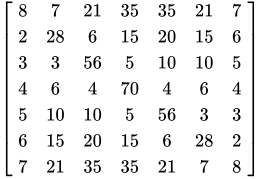
Aside from the 7-simplex, there are a total of seventy other uniform 7-polytopes with symmetry. The 7-simplex can be constructed as the join of a point and a 6-simplex, whose order is 7!, where the 6-simplex has a total of seventy three-dimensional and two-dimensional elements (there are thirty-five 3-simplex cells, and thirty-five faces that are triangular).

70 is also the fifth pentatope number, as the number of 3-dimensional unit spheres which can be packed into a 4-simplex (or four-dimensional analogue of the regular tetrahedron) of edge-length 5.[17]
Leech lattice
[edit]The sum of the first 24 squares starting from 1 is 702 = 4900, i.e. a square pyramidal number. This is the only non trivial solution to the cannonball problem, and relates 70 to the Leech lattice in twenty-four dimensions and thus string theory.
In religion
[edit]- In Jewish tradition, Ptolemy II Philadelphus ordered 72 Jewish elders to translate the Torah into Greek; the result was the Septuagint (from the Latin for "seventy"). The Roman numeral seventy, LXX, is the scholarly symbol for the Septuagint.
- In Islamic history and in Islamic interpretation the number 70 or 72 is most often and generally hyperbole for an infinite amount:
- There are 70 dead among the Prophet Muhammad's adversaries during the Battle of Badr.
- 70 of the Prophet Muhammad's followers are martyred at the Battle of Uhud.
- In Shia Islam, there are 70 martyrs among Imam Hussein's followers during the Battle of Karbala.
In other fields
[edit]- In some traditions, 70 years of marriage is marked by a platinum wedding anniversary.
- Under Social Security (United States), the age at which a person can receive the maximum retirement benefits (and may do so and continue working without reduction of benefits).
Number name
[edit]
Several languages, especially ones with vigesimal number systems, do not have a specific word for 70: for example, French: soixante-dix, lit. 'sixty-ten'; Danish: halvfjerds, short for halvfjerdsindstyve, 'three and a half score'. (For French, this is true only in France, Canada and Luxembourg; other French-speaking regions such as Belgium, Switzerland, Aosta Valley and Jersey use septante.)[18]
Notes
[edit]- ^ The smallest sequence of seventy consecutive integers sharing a factor with either first or last member starts at the twenty-three digit number (with decimal representation), 26214699169906862478864 = 24 × 3 × 7 × 11 × 13 × 19 × 23 × 29 × 37 × 43 × 47 × 53 × 67 × 73 × 2221, or approximately 2.62 × 10²².[4] Its largest prime factor is the sixty-seventh super-prime,[5] where 70 lies midway between the thirteenth pair of sexy primes (67, 73).[6]
- ^ It is also a Harshad number in bases 6, 8, 9, 10, 11, 13, 14, 15 and 16.
- ^ Meanwhile, the aliquot sum of 164 = 74 + 40 + 50 is 130,[10] with a sum-of-divisors of 294,[11] and an arithmetic mean of divisors of 49.[12][13]
References
[edit]- ^ "Sloane's A007304 : Sphenic numbers". The On-Line Encyclopedia of Integer Sequences. OEIS Foundation. Retrieved 2016-05-29.
- ^ "Sloane's A006037 : Weird numbers". The On-Line Encyclopedia of Integer Sequences. OEIS Foundation. Retrieved 2016-05-29.
- ^ "Sloane's A059756 : Erdős-Woods numbers". The On-Line Encyclopedia of Integer Sequences. OEIS Foundation. Retrieved 2016-05-29.
- ^ Sloane, N. J. A. (ed.). "Sequence A059757 (Initial terms of smallest Erdős-Woods intervals corresponding to the terms of A059756.)". The On-Line Encyclopedia of Integer Sequences. OEIS Foundation. Retrieved 2024-07-31.
- ^ a b Sloane, N. J. A. (ed.). "Sequence A006450 (Prime-indexed primes: primes with prime subscripts.)". The On-Line Encyclopedia of Integer Sequences. OEIS Foundation. Retrieved 2024-07-31.
- ^ Sloane, N. J. A. (ed.). "Sequence A023201 (Primes p such that p + 6 is also prime. (Lesser of a pair of sexy primes.))". The On-Line Encyclopedia of Integer Sequences. OEIS Foundation. Retrieved 2024-07-31.
- ^ Sloane, N. J. A. (ed.). "Sequence A007770 (Happy numbers: numbers whose trajectory under iteration of sum of squares of digits map (see A003132) includes 1.)". The On-Line Encyclopedia of Integer Sequences. OEIS Foundation. Retrieved 2024-07-31.
- ^ a b c Sloane, N. J. A. (ed.). "Sequence A002808 (The composite numbers.)". The On-Line Encyclopedia of Integer Sequences. OEIS Foundation. Retrieved 2024-07-31.
- ^ Sloane, N. J. A. (ed.). "Sequence A000040 (The prime numbers.)". The On-Line Encyclopedia of Integer Sequences. OEIS Foundation. Retrieved 2024-07-31.
- ^ Sloane, N. J. A. (ed.). "Sequence A001065 (Sum of proper divisors (or aliquot parts) of n: sum of divisors of n that are less than n.)". The On-Line Encyclopedia of Integer Sequences. OEIS Foundation. Retrieved 2024-07-31.
- ^ Sloane, N. J. A. (ed.). "Sequence A000203 (...the sum of the divisors of n.)". The On-Line Encyclopedia of Integer Sequences. OEIS Foundation. Retrieved 2024-07-31.
- ^ Sloane, N. J. A. (ed.). "Sequence A003601 (Numbers n such that the average of the divisors of n is an integer: sigma_0(n) divides sigma_1(n).)". The On-Line Encyclopedia of Integer Sequences. OEIS Foundation. Retrieved 2024-07-31.
- ^ Sloane, N. J. A. (ed.). "Sequence A102187 (Arithmetic means of divisors of arithmetic numbers (arithmetic numbers, A003601, are those for which the average of the divisors is an integer).)". The On-Line Encyclopedia of Integer Sequences. OEIS Foundation. Retrieved 2024-07-31.
- ^ "Sloane's A000326 : Pentagonal numbers". The On-Line Encyclopedia of Integer Sequences. OEIS Foundation. Retrieved 2016-05-29.
- ^ "Sloane's A051865 : 13-gonal (or tridecagonal) numbers". The On-Line Encyclopedia of Integer Sequences. OEIS Foundation. Retrieved 2016-05-29.
- ^ Sloane, N. J. A. (ed.). "Sequence A000984 (Central binomial coefficients: binomial(2*n,n) as (2*n)!/(n!)^2.)". The On-Line Encyclopedia of Integer Sequences. OEIS Foundation.
- ^ "Sloane's A000332 : Binomial coefficient binomial(n,4) = n*(n-1)*(n-2)*(n-3)/24". The On-Line Encyclopedia of Integer Sequences. OEIS Foundation. Retrieved 2016-05-29.
- ^ Peter Higgins, Number Story. London: Copernicus Books (2008): 19. "Belgian French speakers however grew tired of this and introduced the new names septante, octante, nonante etc. for these numbers".
External links
[edit]| International | |
|---|---|
| National | |

70 (number)
View on GrokipediaMathematics
Factorization and basic properties
Seventy can be expressed as the prime factorization , where 2, 5, and 7 are the first three distinct prime numbers. This form identifies 70 as a sphenic number, defined as the product of exactly three distinct primes.[7][8] As such, 70 is square-free, meaning it has no repeated prime factors, and it is not a prime power since it requires multiple distinct primes rather than a single prime raised to an exponent greater than 1. Additionally, 70 is an even composite number, as it is divisible by 2 and greater than 1 without being prime.[1] The positive divisors of 70 are 1, 2, 5, 7, 10, 14, 35, and 70, totaling eight divisors. The sum of these divisors, given by the divisor function , equals 144. This can be computed as , reflecting the multiplicative property of the function for numbers with distinct prime factors.[9] Since , 70 qualifies as an abundant number, with an abundance of . Abundant numbers are those where the sum of proper divisors exceeds the number itself. Furthermore, 70 is a Harshad number (also known as a Niven number) in base 10, as it is divisible by the sum of its digits: and .[10][11]Special number classifications
70 is the smallest weird number, a classification in number theory for abundant numbers that are not pseudoperfect (also known as semiperfect). It is abundant because the sum of its divisors , which exceeds twice 70 (), while the sum of its proper divisors (1, 2, 5, 7, 10, 14, 35) is 74, greater than 70 but with no subset summing precisely to 70.[12] This property was first systematically studied in the context of pseudoperfect numbers. Additionally, 70 qualifies as a happy number, defined by the iterative process of replacing a number with the sum of the squares of its digits until reaching 1 or entering a cycle not containing 1. Starting from 70, the sequence proceeds as , , , , and .[13] This places 70 among the initial happy numbers like 1, 7, 10, and 13.[14]Figurate numbers and sequences
70 is the seventh pentagonal number in the sequence of figurate numbers that represent the number of dots forming a regular pentagon. The general formula for the nth pentagonal number is given byBinomial and combinatorial properties
70 is the central binomial coefficient , equal to the number of ways to select 4 elements from a set of 8 without regard to order.[18] This value appears as the central entry in the 8th row of Pascal's triangle (indexing rows and positions from 0), positioned at the 4th entry.[19] The coefficient arises in the expansion of as the term .[18] Combinatorially, 70 counts the number of monotone lattice paths from the origin to the point using unit steps right (1,0) and up (0,1), a standard interpretation tied to the ballot theorem.[20] Among these 70 paths, the subset that remains weakly below the line (Dyck paths) is given by the 4th Catalan number, , illustrating an indirect connection to Catalan structures in enumerative combinatorics. In graph theory, 70 represents the number of 4-cliques (complete subgraphs ) in the complete graph on 8 vertices, as every selection of 4 vertices induces a .[18] This combinatorial role underscores 70's significance in counting substructures within fully connected systems.Applied mathematics and geometry
In applied mathematics, the number 70 features prominently in the "rule of 70," a heuristic for estimating the doubling time of quantities undergoing exponential growth, such as populations, investments, or economic indicators. The formula approximates the time $ t $ in years required for a variable to double as $ t \approx \frac{70}{r} $, where $ r $ is the annual growth rate expressed as a percentage; this derives from the natural logarithm of 2, $ \ln(2) \approx 0.693 $, scaled by 100 to yield approximately 70 for practical use with percentage rates. For instance, at a 7% growth rate, the doubling time is roughly 10 years, providing a quick mental calculation in fields like finance and demography without needing logarithmic tables or calculators.[21] In geometry, 70 arises as the number of three-dimensional faces (tetrahedral cells) in a 7-simplex, the regular polytope in seven-dimensional Euclidean space bounded by eight vertices. The general formula for the number of $ k $-dimensional faces in an $ n $-simplex is the binomial coefficient $ \binom{n+1}{k+1} $; for $ n=7 $ and $ k=3 $, this yields $ \binom{8}{4} = 70 $, highlighting 70's role in enumerating facets of higher-dimensional simplices used in computational geometry and topological studies. These structures model convex hulls and appear in applications like finite element analysis for simulating multidimensional physical systems.[22] The number 70 also appears in the geometric construction of the Leech lattice, a 24-dimensional even unimodular lattice central to sphere packing and coding theory. One construction embeds the Leech lattice in the Lorentzian lattice $ II_{25,1} $ as the orthogonal complement to a lightlike vector $ w = (0, 1, 2, \dots, 24; 70) $, where the semicolon separates the 25 positive coordinates from the negative one, ensuring $ w $ has null norm and facilitates the lattice's unimodularity. This parameterization underscores 70's utility in generating highly symmetric Euclidean lattices for applications in error-correcting codes and quantum computing.[23]Religion and mythology
In Judaism
In Judaism, the number 70 symbolizes completeness, universality, and divine order, appearing frequently in biblical and rabbinic texts to denote wholeness in leadership, humanity, and sacred interpretation. A key instance is the appointment of 70 elders by Moses to share the burdens of governance, as recounted in the Torah. In Exodus 24:1-9, God commands Moses to ascend Mount Sinai accompanied by Aaron, Nadab, Abihu, and these 70 elders of Israel, who worship from afar and witness a divine vision, establishing a model of collective authority and prophetic sharing. The number 70 further represents the entirety of humankind through the 70 nations descended from Noah's sons—Shem, Ham, and Japheth—detailed in Genesis 10's Table of Nations. This genealogy enumerates 70 progenitors, symbolizing all peoples and underscoring Jewish teachings on universal creation and the shared origins of humanity under God's covenant. Rabbinic sources expand this to emphasize 70 as a motif for global inclusivity, linking it to the 70 languages spoken at Babel and the world's diverse yet unified fabric.[24][25] Prophetic narratives employ 70 to signify a full period of exile and redemption, as in Jeremiah 29:10, where the prophet declares that the Babylonian captivity will endure 70 years before God restores Israel to Jerusalem, marking a complete cycle of judgment and renewal. In interpretive traditions, the Torah embodies 70 faces (shiv'im panim la-Torah), reflecting its multifaceted depths and the legitimacy of diverse exegeses, a concept rooted in midrashic literature that celebrates scriptural richness without contradiction.[26] Additionally, 70 denotes the fullness of human life and wisdom in ethical teachings. Pirkei Avot 5:21 identifies age 70 as li-seivah, the stage of "fullness of years," signifying mature elderhood and the pinnacle of experiential insight, often invoked to honor longevity and accumulated sagacity in Jewish life cycle observances.[27]In Christianity
In the New Testament, the Gospel of Luke records that Jesus appointed seventy (or seventy-two, varying by manuscript tradition) disciples and sent them ahead in pairs to every town and place he intended to visit, instructing them to heal the sick and announce the nearness of the kingdom of God. This event, detailed in Luke 10:1–17, illustrates the broadening of Jesus' ministry beyond the initial twelve apostles, empowering these additional followers to perform exorcisms and miracles, which they reported back with joy upon their return. The mission symbolizes a strategic expansion of the gospel message, evoking the ancient Jewish concept of seventy nations encompassing the world, adapted in Christian interpretation to represent the inclusive outreach to all peoples.[28] A key prophetic reference to 70 in Christianity arises from the Book of Daniel, where the angel Gabriel foretells "seventy weeks" decreed for the Jewish people and Jerusalem to accomplish atonement, end transgression, and anoint a most holy place (Daniel 9:24–27). Christian exegesis commonly interprets these "weeks" as seventy sets of seven years, totaling 490 years, marking a divine timeline from a decree to rebuild Jerusalem to the Messiah's arrival, sacrifice, and the confirmation of a new covenant. This prophecy is seen as fulfilled in Jesus' life, death, and the establishment of the church, with the final week often linked to end-times events or the pivotal midpoint of his earthly ministry.[29] Psalm 90:10 articulates 70 years as the typical span of human life—"The years of our life are seventy, or even by reason of strength eighty"—emphasizing the fragility and divinely appointed limits of earthly existence amid God's timelessness. This verse underscores a complete life cycle under divine order, serving as a meditation on mortality that calls for wisdom and numbering one's days to align with eternal purposes. In broader Christian symbolism, 70 represents perfected completeness, formed by multiplying 7 (divine wholeness and rest) by 10 (ordinal fullness and human responsibility), signifying God's comprehensive governance over creation and redemption.[30]In Islam
In Islamic history, the number 70 holds notable significance in key battles during the time of Prophet Muhammad. At the Battle of Badr in 624 CE, the first major confrontation between the Muslims and the Quraysh of Mecca, approximately 70 Quraysh warriors were killed, marking a pivotal victory for the early Muslim community despite being outnumbered. Similarly, in the Battle of Uhud in 625 CE, 70 Muslim companions were martyred, an event commemorated in the Quran (Surah Al-Imran 3:169) as a test of faith, highlighting themes of sacrifice and divine reward for those who persevere.[31][32] In Sufi mysticism, 70 symbolizes profound spiritual barriers, as exemplified by the concept of 70,000 veils—comprising veils of light and darkness—that separate creation from the divine essence of God. This imagery, drawn from traditional Sufi teachings, represents the multifaceted obstacles to attaining direct knowledge of the Divine, requiring progressive unveiling through purification and devotion to approach ultimate reality.[33] The number 70 also appears in hadith literature concerning forgiveness and moral accountability. A well-known compilation attributes to Prophet Muhammad a discourse on 70 major sins (al-kaba'ir), ranging from shirk (associating partners with God) to lesser infractions like backbiting, emphasizing their gravity and the need for repentance to avoid severe punishment. Additionally, traditions describe the Prophet's intercession on Judgment Day extending mercy to believers burdened by numerous transgressions, underscoring God's boundless forgiveness for those who seek it sincerely.In other traditions
In Hinduism, the number 70 holds significance in life-cycle rituals, particularly the Bheemaratha Shanti ceremony performed at the age of 70 to invoke divine blessings for health, longevity, and spiritual protection against ailments associated with old age. This rite, rooted in Vedic traditions, symbolizes the transition into advanced seniority and the pursuit of completeness in one's earthly journey toward moksha. In Chinese tradition, 70 represents a rare milestone of longevity, encapsulated in the term guxilao (古稀), derived from the Tang Dynasty poet Du Fu's famous line in "A Lament to My Old Self": "How seldom one reaches seventy in this life." This phrase underscores respect for elders who achieve such an age, often celebrated with family gatherings emphasizing harmony, wisdom, and the cyclical nature of existence influenced by Confucian and Taoist principles. Babylonian mythology and divination practices feature 70 as a symbol of cosmic order and multiplicity, notably in the Enūma Anu Enlil series, a foundational collection of 70 clay tablets recording celestial omens and planetary movements to interpret divine will and predict earthly events. This extensive corpus reflects the pantheon's structured hierarchy, where numbers like 70 denote completeness in the divine assembly overseeing cycles of fate and renewal.Science and nature
In chemistry
Element 70 in the periodic table is ytterbium (Yb), a soft, silvery-white rare earth metal belonging to the lanthanide series.[3] It was discovered in 1878 by Swiss chemist Jean Charles Galissard de Marignac at the University of Geneva, who isolated it from erbium nitrate derived from the mineral gadolinite.[3] The element is named after the Ytterby mine in Sweden, the site from which several rare earth elements—including yttrium, erbium, and terbium—were first extracted.[3] Ytterbium has a standard atomic weight of 173.045 and a melting point of 824°C.[34][3] It occurs naturally as a mixture of seven stable isotopes: ^{168}Yb, ^{170}Yb, ^{171}Yb, ^{172}Yb, ^{173}Yb, ^{174}Yb, and ^{176}Yb, with ^{174}Yb being the most abundant at approximately 32%.[3] These isotopes contribute to ytterbium's overall stability, though it also has several radioactive isotopes, such as ^{169}Yb, which has applications in radiography due to its gamma-ray emissions.[35] In practical applications, ytterbium is alloyed with stainless steel to enhance its mechanical properties, including grain refinement and strength.[3] Additionally, the isotope ^{174}Yb is utilized in atomic clocks for its high precision in timekeeping, potentially surpassing traditional cesium-based standards.[3]In astronomy
Messier 70 (M70), also designated NGC 6681, is a globular cluster located in the constellation Sagittarius. It was discovered on August 31, 1780, by French astronomer Charles Messier during his survey of nebulae and star clusters.[36] The cluster has an apparent visual magnitude of 7.9, making it visible to the naked eye under dark skies, and lies at an estimated distance of approximately 29,400 light-years from Earth.[36] NGC 70 is a spiral galaxy classified as Sbc in the Hubble sequence, situated in the constellation Andromeda. It serves as the largest member of the compact NGC 70 Group, also known as the VV 166 Group, which consists of 7 to 8 interacting galaxies exhibiting tidal distortions and active star formation.[37] Discovered by William Herschel on September 11, 1784, the galaxy is located at a distance of about 96 megaparsecs (roughly 313 million light-years) from the Milky Way, with a visual magnitude of 13.5.[37] In solar system astronomy, the number 70 appears in the orbital periods of certain periodic comets. For instance, 23P/Brorsen-Metcalf is a Halley-type comet with an orbital period of approximately 70 years, fitting the category of short-period comets with periods between 20 and 200 years.[38] This comet was first observed on July 20, 1847, by Theodor Brorsen and rediscovered in 1919 by Joel H. Metcalf, with its path showing similarities to Halley's Comet in dynamical behavior.[38] In cosmology, the Lambda-CDM model, the standard framework for understanding the universe's composition and evolution, posits that dark energy accounts for approximately 68% of the total energy density, driving the accelerated expansion observed since about 5 billion years ago.[39] This proportion, derived from measurements by the Planck satellite, underscores dark energy's dominant role alongside 27% cold dark matter and 5% ordinary matter.[39]In biology and physics
In biology, the number 70 is prominently featured in the structure of prokaryotic ribosomes, which sediment at 70S units during ultracentrifugation and are essential for protein synthesis in bacteria and archaea. These 70S ribosomes consist of a small 30S subunit and a large 50S subunit, differing from the larger 80S ribosomes found in eukaryotic cells, and their smaller size enables efficient translation in prokaryotic environments.[40] Nerve conduction velocities in myelinated fibers, which facilitate rapid signal transmission via saltatory conduction, typically range from 70 to 120 m/s in well-myelinated axons of diameters 12–20 μm, allowing for efficient neural communication in vertebrates.[41] The global average human life expectancy has approached 70–73 years in recent decades, with World Health Organization estimates indicating 73.1 years as of 2019 and projections around 73.5 years for 2025, reflecting advances in healthcare and nutrition that have extended typical lifespans beyond the historical benchmark of about 70 years often noted in biological and demographic studies. As of 2025, the global average is estimated at 73.5 years.[42][43] In physics, the 70 GeV energy scale has been significant in particle accelerator experiments, exemplified by the U-70 proton synchrotron at the Institute for High Energy Physics in Protvino, Russia, which achieved 70 GeV proton energies starting in 1967 and enabled key studies in high-energy particle interactions. This energy level also appears in searches for particles like the Higgs boson, where early models and collider data explored masses from around 70 GeV upward before the discovery at 125 GeV.[44]Culture and society
In history and politics
The year 70 CE is renowned for the Roman siege of Jerusalem, which culminated in the destruction of the Second Temple and marked the decisive phase of the First Jewish-Roman War (66–73 CE). Roman forces under Titus breached the city's defenses after months of intense fighting, leading to widespread devastation, mass casualties, and the enslavement of survivors, as chronicled in the historical accounts of Flavius Josephus, a Jewish historian who defected to the Roman side.[45][46] This event not only razed much of Jerusalem but also ended the Jewish sacrificial system centered on the Temple, reshaping Jewish religious and communal life for centuries.[47] The fall of the Second Temple in 70 CE carried significant repercussions for early Christianity, accelerating the separation between Jewish and Christian communities and influencing theological developments. With the Temple's destruction, Christian practices shifted away from temple rituals toward synagogue-based worship and emerging church structures, fulfilling Jesus' prophecy in the Gospels about not one stone being left upon another.[48][49] This catastrophe prompted early Christian writers to interpret the event as divine judgment, further distinguishing Christianity from Judaism amid Roman persecution.[50] In modern politics, the number 70 appears in key constitutional and international frameworks. Article 70 of the United Nations Charter empowers the Economic and Social Council to arrange for non-voting participation by representatives of specialized agencies in its deliberations, facilitating coordination across UN bodies.[51] Similarly, Article 70 of the Constitution of the People's Republic of China mandates the establishment of specialized committees within the National People's Congress, such as the Ethnic Affairs Committee, the Constitution and Law Committee, and the Financial and Economic Committee, to oversee legislative and oversight functions.[52] Seventy also symbolizes generational milestones in political history, as seen in the 70th anniversary celebrations of Israel's founding in 2018, which highlighted the nation's resilience since its declaration of independence on May 14, 1948. These commemorations, involving torch-lighting ceremonies, military parades, and international addresses, underscored themes of perseverance and state-building over a biblical lifespan-equivalent period.[53][54]In arts and literature
In literature, the number 70 appears prominently in William Shakespeare's Sonnets, specifically Sonnet 70, where the poet defends the young man's reputation against slander, portraying beauty as inherently susceptible to criticism.[55] The sonnet reflects themes of fairness and ornamentation, using 70 as a structural marker in the sequence dedicated to the Fair Youth. Additionally, 70 has symbolized the typical human lifespan in various literary works influenced by ancient texts, evoking themes of mortality and reflection, as seen in poetic explorations of life's brevity. In music, the 1970s represent a transformative cultural era defined by genre innovation, including the rise of punk, disco, funk, and electronic music, which challenged mainstream norms and amplified social movements like feminism and civil rights.[56] This decade's soundscape, often retroactively stylized as "the '70s," continues to inspire revivals in contemporary tracks and albums. Songs explicitly referencing 70 include "Seventy Times 7" by Brand New, a 2003 emo-rock track from their album Deja Entendu that draws on themes of betrayal and forgiveness, with its title alluding to repeated emotional reckoning.[57] In visual art, the number 70 manifests in numerological contexts, symbolizing introspection and spiritual completion, as explored in symbolic representations that blend geometry and mysticism to convey inner wisdom and infinite potential.[58] While not a dominant motif in canonical works like those of Salvador Dalí—who favored recurring numbers such as 8—the 1970s art scene itself embraced bold, experimental motifs in movements like performance art and land art, often incorporating numerical elements to critique societal structures. In film and television, 70 features in road narratives, such as the 1958 crime drama Thunder Road, starring Robert Mitchum as a moonshine runner whose high-speed chases capture the peril and freedom of American highways in Tennessee. In episodic series, Doctor Who's 1978 serial "The Invasion of Time" depicts the Fourth Doctor defending Gallifrey from alien invasion, blending science fiction with themes of invasion and regeneration during the show's classic era. Period dramas occasionally reference the year 70 CE, portraying the Roman siege of Jerusalem in works like the 2021 animated film Legend of Destruction, which dramatizes the Jewish revolt's intensity through personal zealot perspectives.[59]In sports and games
In American football, jersey number 70 has been worn by several notable players, including Hall of Famers such as Sam Huff, a linebacker for the New York Giants and Washington Redskins who played in six NFL championships and was named to the All-Decade Team for the 1950s and 1960s, and Rayfield Wright, an offensive tackle for the Dallas Cowboys who started in five Super Bowls and earned eight Pro Bowl selections.[60] Other prominent wearers include Zack Martin, the Dallas Cowboys' guard who has been selected to nine Pro Bowls and earned All-Pro honors multiple times since 2014, and Art Donovan, a defensive tackle for the Baltimore Colts who contributed to two NFL championships in the 1950s.[61] In the National Hockey League, number 70 has been donned by 39 players since 1990, with early examples including Matt DelGuidice of the Boston Bruins, though it lacks the same iconic status as in football.[62] Basketball records highlight the rarity of 70-point games, with only ten players achieving 70 or more points in NBA history, including Wilt Chamberlain, who accomplished it six times, such as his 73-point outing on November 16, 1962, against the New York Knicks. More recently, Joel Embiid scored exactly 70 points on January 22, 2024, for the Philadelphia 76ers against the San Antonio Spurs, setting a franchise record and becoming the ninth player to reach that mark, while Luka Dončić tallied 73 points on January 26, 2024, for the Dallas Mavericks against the Atlanta Hawks.[63] Elgin Baylor's 71 points on December 6, 1960, for the Minneapolis Lakers versus the Knicks also stands as a benchmark in the pre-modern era.[64] In Major League Baseball, the number 70 appears in significant team achievements, such as the Milwaukee Brewers reaching 70 wins in 2025 after 114 games, the fastest pace in franchise history and the first team to hit that milestone that season, surpassing their previous mark of 119 games set in 2021.[65] Individually, Ronald Acuña Jr. of the Atlanta Braves became the first player in MLB history to record 40 home runs and 70 stolen bases in a single season in 2023, culminating with his 70th steal on September 27 against the Chicago Cubs.[66] In the NFL, the Miami Dolphins set a modern-era record by scoring 70 points in a single game on September 24, 2023, defeating the Denver Broncos 70-20, the highest total since the 1966 Washington Redskins' 72 points.[67] The Olympics underscore 70's role in global participation metrics, with more than 70 nations having never won a medal across all Games since 1896, including populous countries like Bangladesh and smaller ones like Bhutan, highlighting disparities in athletic investment and success.[68] In recreational games, standard double-nine domino sets contain 55 tiles, extending play beyond the common double-six set of 28 tiles to include higher combinations like the 9-9, popular in extended Mexican Train or similar variants.[69]In measurement and technology
In various measurement standards, 70 centimeters (approximately 27.6 inches) has been a common diagonal screen size for portable and smaller televisions, particularly in metric-based markets during the era of cathode-ray tube (CRT) technology.[70] This dimension allowed for compact designs suitable for bedroom or secondary viewing setups, with typical width around 62 cm and height 37 cm for 4:3 aspect ratios. In the United States, speed limits of 70 miles per hour are standard on many rural Interstate highways and freeways, as established by federal guidelines under the Federal-Aid Highway Act, promoting efficient long-distance travel while balancing safety.[71] In semiconductor technology, the 70 nm process node represented a key milestone in the International Technology Roadmap for Semiconductors (ITRS) during the mid-2000s, targeting high-performance logic transistors with gate lengths around this scale to achieve density improvements per Moore's Law.[72] Although major foundries like Intel pursued nodes such as 90 nm and 65 nm for production, the 70 nm specification influenced designs for strained silicon channels and high-k dielectrics, enabling processors with over 100 million transistors. In particle physics, energies around 70 GeV have been significant in accelerator experiments, such as those at the U-70 proton synchrotron.[73] In computing, the ASCII (American Standard Code for Information Interchange) character encoding assigns decimal value 70 to the uppercase letter 'F', facilitating standardized text representation in early digital systems and programming languages.[74] Similarly, in networking, TCP/UDP port 70 is reserved for the Gopher protocol, a pre-World Wide Web system for document retrieval that operated by establishing connections to servers for menu-based navigation of resources.[75] Among vehicular infrastructure, Interstate 70 (I-70) is a major east-west highway in the United States, extending approximately 2,153 miles from Utah to Maryland and serving as a critical corridor for freight and passenger traffic across the Midwest and Rockies.[76]Numeral and linguistics
Names in different languages
In English, the term for the number 70 is "seventy," derived from Old English seofontig or (hund)seofontig, a compound of seofon ("seven") and -tig (a suffix denoting multiples of ten, akin to "ten"). This structure reflects a decimal system where tens are formed by multiplying the base number by ten, ultimately tracing back to the Proto-Indo-European root septḿ̥ for "seven."[77][78] Romance languages generally inherit the form from Latin septuāgintā ("seventy"), an irregular compound from septem ("seven") and a form related to viginti ("twenty"), possibly implying "seven into twenty" or a similar construction. In Spanish, it appears as setenta, and in Italian as settanta, both preserving the Latin root with phonetic adaptations to the respective languages' evolutions. French diverges notably with soixante-dix ("sixty-ten"), a decimal compound that emerged in the medieval period, influenced by regional dialects and avoiding a direct Latin descendant for this range.[79][80] Among Germanic languages, the pattern mirrors English's decimal compounding. German uses siebzig, from Middle High German sibenzec and Old High German sibunzug, combining sieben ("seven") with a suffix -zug or -zec for tens. Dutch employs zeventig, evolved from Middle Dutch sevontich, similarly blending zeven ("seven") and -tig (tens suffix), shared with Low German and other West Germanic dialects.[81] In East Asian languages using Sino-Xenic readings, 70 is expressed as a straightforward decimal compound. Mandarin Chinese renders it qīshí (七十), from qī ("seven," from Middle Chinese tshit) and shí ("ten"), following the classical Chinese numeral system's multiplicative structure. Japanese uses nanajū (七十), a Sino-Japanese form where nana adapts the Chinese qī for "seven" (to distinguish from shichi in other contexts) combined with jū ("ten"), reflecting kanji-based borrowing from Chinese during the 5th–9th centuries CE. In Arabic, the term is sabʿūn (سبعون), derived from the Semitic root s-b-ʿ ("seven") with the suffix -ūn for tens in the dual-gender numeral system, as seen in Classical Arabic morphology.[82] The etymological diversity highlights contrasts between pure decimal systems (e.g., English, Chinese) and remnants of vigesimal (base-20) counting in some Romance languages like French, where higher tens draw on multiples of 20 or 60 due to Celtic and Gaulish influences predating Latin standardization.Representation in numeral systems
In the decimal system (base-10), the number 70 is represented simply as 70.[83] In binary (base-2), 70 is written as 1000110₂, equivalent to .[83] In octal (base-8), it appears as 106₈, calculated as .[84] In base-7, 70 is 130₇, derived from .[84] In hexadecimal (base-16), it is 46₁₆, or .[84] In base-3, 70 is expressed as 2121₃, a palindromic representation since it reads the same forwards and backwards, computed as .[84] The following table summarizes these positional numeral representations:| Base | Representation | Calculation |
|---|---|---|
| 2 (binary) | 1000110₂ | |
| 3 | 2121₃ | |
| 7 | 130₇ | |
| 8 (octal) | 106₈ | |
| 10 (decimal) | 70 | Standard form |
| 16 (hexadecimal) | 46₁₆ |