Respect all members: no insults, harassment, or hate speech.
Be tolerant of different viewpoints, cultures, and beliefs. If you do not agree with others, just create separate note, article or collection.
Clearly distinguish between personal opinion and fact.
Verify facts before posting, especially when writing about history, science, or statistics.
Promotional content must be published on the “Related Services and Products” page—no more than one paragraph per service. You can also create subpages under the “Related Services and Products” page and publish longer promotional text there.
Do not post materials that infringe on copyright without permission.
Always credit sources when sharing information, quotes, or media.
Be respectful of the work of others when making changes.
Discuss major edits instead of removing others' contributions without reason.
If you notice rule-breaking, notify community about it in talks.
Do not share personal data of others without their consent.
January 2 – Fleeing from the Spanish Navy, French pirate Raveneau de Lussan and his 70 men arrive on the west coast of Nicaragua, sink their boats, and make a difficult 10 day march to the city of Ocotal.[1]
March – William Dampier makes the first recorded visit to Christmas Island, now a territory of Australia, located south of the island of Java (now part of Indonesia).
June 10 – The birth of James Francis Edward Stuart (later known as the Old Pretender), son and heir to James II of England and his Catholic wife Mary of Modena, at St James's Palace in London, increases public disquiet about a Catholic dynasty, particularly when the baby is baptised into the Catholic faith. Rumours about his true maternity swiftly begin to circulate.
June 24 – French forces under Chevalier de Beauregard abandon their garrison at Mergui, following repeated Siamese attacks; this ultimately leads to their withdrawal from the country.[18]
September 24 – Louis XIV publishes his manifesto Memoire de raisons, which lists his grievances and demands. He cites three major things as grievances: Wilhelm Egon von Fürstenberg, who had been earlier elected to be the coadjutor-archbishop of Cologne with support of Louis being vetoed by the pope, the continued aggressions and forming of alliances against France and providing an alternative to Fürstenberg in the Cologne election by the Holy Roman Empire, and Philip William becoming Elector Palatine and seizing the territory, which he believed belonged to Elizabeth Charlotte.[24]
November 15 (November 5 OS) – The Glorious Revolution begins: William of Orange lands at Torbay, England with a multinational force of 20,000 soldiers.[29] He makes no claim to the British Crown, saying only that he has come to save Protestantism and to maintain English liberty, and begins a march on London.
November 19 (November 9 OS) – William of Orange captures Exeter, after the magistrates flee the city.[30]
November 20 (November 10 OS) – The Wincanton Skirmish between forces loyal to James II led by Patrick Sarsfield and a party of Dutch troops is one of the few armed clashes in England during the Glorious Revolution.[31]
December 9 – The Battle of Reading takes place in Reading, Berkshire. It is the only substantial military action in England during the Glorious Revolution and ends in a decisive victory for forces loyal to William of Orange.
^Kelly, Billy (2009). "THE GUILDHALL: Derry's Museum in Glass". History Ireland. 17 (6): 66–69. JSTOR40588462.
^Reid, James Seaton; Killen, William Dool; Alexander, Samuel Davies (1860). History of the Presbyterian Church in Ireland. New York: Robert Charter & Brothers. p. 232. Retrieved June 10, 2023.
^Biographie, Deutsche (1876). Allgemeine Deutsche Biographie (in German). Historical Commission of the Bavarian Academy of Science. Retrieved June 11, 2023.
^Setton, Kenneth Meyer (1991). Venice, Austria, and the Turks in the seventeenth century. Memoirs of the American philosophical society. Philadelphia (Pa.): the American philosophical society. p. 358. ISBN978-0-87169-192-7.
![Engraving of William III, Prince of Orange]float-right
1688 marked the Glorious Revolution in England and Scotland, a pivotal political upheaval in which the reigning Catholic King James II was deposed following an invasion by his Protestant son-in-law, William III, Prince of Orange, who co-ruled with James's daughter Mary II after James's flight to France.[1][2] The event, often termed bloodless in England due to minimal direct combat there, stemmed from widespread Protestant fears over James's absolutist tendencies, his overt promotion of Catholicism, and the birth earlier that year of a male Catholic heir, James Francis Edward, on June 10, which dashed hopes for a Protestant succession through his daughters.[3][4] These anxieties culminated in the Invitation to William, a secret appeal from seven prominent English figures urging the Dutch stadtholder to intervene and safeguard Protestantism and parliamentary rights against perceived tyranny.[2]William's fleet landed at Torbay on November 5, 1688, with an army of about 15,000, encountering desertions from James's forces and limited resistance as key allies, including much of the navy and army, shifted allegiance.[5] James attempted flight twice, succeeding on December 23, after which Parliament declared the throne vacant and offered it jointly to William and Mary, who accepted under conditions affirming Protestant supremacy and limiting royal prerogative.[1][2] The revolution's outcomes included the 1689 Bill of Rights, which curtailed monarchical powers, entrenched parliamentary consent for taxation and laws, and barred Catholics from the throne, thereby establishing foundational principles of constitutional monarchy while sparking Jacobite resistance in Scotland and the Williamite War in Ireland.[6] Beyond Britain, 1688 aligned with the League of Augsburg's formation, escalating into the Nine Years' War against Louis XIV's France, reflecting intertwined European power dynamics where William's accession integrated English resources into anti-French coalitions.[7]
Events
Prelude and Causes of the Glorious Revolution
James II ascended the English throne on February 6, 1685, upon the death of his brother Charles II, who died without legitimate issue.[8] Despite James's open adherence to Catholicism, which disqualified him under the Test Acts from holding office, he initially garnered support from Protestant elites, as the line of succession appeared secured through his Protestant daughters, Mary and Anne.[9] James's reign quickly strained relations with Parliament through efforts to expand religious toleration, including appointments of Catholics to military commands and civil offices in violation of existing statutes.[5] In April 1686, the court case Godden v. Hales affirmed the king's dispensing power, enabling him to bypass laws excluding Catholics from positions of authority.[9]Tensions escalated in 1687 when James prorogued Parliament after it refused to repeal the Test Acts and penal laws against Catholics.[10] He issued a Declaration of Indulgence on April 4, 1687, suspending enforcement of religious penalties against Catholics and Protestant dissenters, and ordered its reading in Anglican churches.[11] Resistance peaked when seven bishops petitioned against the declaration's mandatory reading; James ordered their trial for seditious libel on June 15, 1688, but their acquittal on June 30 sparked widespread public celebration and eroded royal authority.[10] Concurrently, the birth of James's son, James Francis Edward Stuart, on June 10, 1688, at St. James's Palace to his Catholic wife Mary of Modena, dashed hopes of a Protestant succession, as the infant supplanted Mary and Anne as heir apparent and promised a Catholic dynasty under James's direct male line.[12]These domestic crises intersected with European geopolitics, as James's alignment with Catholic France under Louis XIV threatened Protestant interests, particularly Dutch stadtholder William of Orange, who was married to James's daughter Mary and faced a potential Franco-English alliance.[9] On June 30, 1688—the same day as the bishops' acquittal—seven English notables, known as the Immortal Seven (including the Earl of Devonshire, Earl of Danby, and Bishop of London Henry Compton), dispatched an invitation to William, urging him to intervene with an armed force to protect Protestantism and parliamentary liberties against James's perceived absolutism and popery.[13] The signatories cited James's subversion of laws, Catholic favoritism, and the prince's birth as precipitating a national emergency requiring external redress to avert tyranny.[9] Underlying causes rooted in long-standing English antipathy toward Catholic monarchy, reinforced by memories of civil war and persecution under prior Stuart absolutism, framed James's policies not as mere toleration but as steps toward re-Catholicization and unchecked royal prerogative, independent of parliamentary consent.[3]
Key Developments in the Glorious Revolution
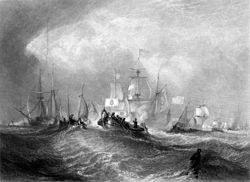
William of Orange's invasion commenced on 5 November 1688, when his fleet successfully landed at Torbay in Devon, England, despite adverse winds that had delayed the departure from the Netherlands.[11][14] The expeditionary force, comprising Dutch troops supplemented by English and Scottish exiles, advanced inland without immediate opposition, proclaiming their intent to preserve Protestantism and parliamentary liberties.[14]James II mobilized an army of approximately 25,000 men to counter the invasion, establishing headquarters at Salisbury in late November.[15] However, morale collapsed amid reports of defections, including those of key commanders like John Churchill (later Duke of Marlborough) and James's own daughter Anne, who joined William's camp.[14] James, stricken by illness and facing mutinies, retreated to London on 23 November, abandoning plans for a decisive battle.[15]Amid mounting pressure, James attempted to flee to France on 11 December 1688, discarding the Great Seal of the Realm into the River Thames to symbolize the dissolution of his government.[11] Captured near Sheerness, he was briefly detained but released by order of William's supporters, who sought to avoid martyring him.[11] James departed definitively for exile in France on 23 December, leaving the throne vacant in the eyes of his opponents.[11][14]William entered London unopposed on 18 December 1688, securing control of the capital and coordinating with Protestant nobles to convene what became the Convention Parliament.[15] The absence of pitched battles, apart from minor engagements like the Battle of Reading on 9 December 1688 where Williamite forces defeated Jacobite troops, underscored the revolution's relatively bloodless nature in England, driven more by political realignments than military conquest.[14]
Other European and Global Events
In September 1688, French forces under Louis XIV invaded the Electorate of the Palatinate in the Holy Roman Empire, initiating hostilities that escalated into the Nine Years' War (also known as the War of the Grand Alliance).[16] This unprovoked incursion, aimed at enforcing French claims from the 1684 Truce of Regensburg and securing Rhineland territories, involved systematic devastation of cities like Heidelberg, Speyer, and Mannheim to deny resources to potential enemies.[17] The League of Augsburg—comprising the Holy Roman Empire, the Dutch Republic, Spain, Sweden, and Savoy—responded by formalizing opposition, though full-scale war declarations followed into 1689; the Palatinate campaign mobilized over 100,000 French troops and marked Louis XIV's aggressive expansionism amid fiscal strains from prior conflicts.[18]Concurrently, in the Balkans, Imperial Habsburg forces under Maximilian II Emanuel, Elector of Bavaria, captured Belgrade from the Ottoman Empire on 6 September 1688 after a month-long siege, a pivotal victory in the ongoing Great Turkish War (1683–1699).[19] The operation, supported by Serbian irregulars and involving artillery barrages that breached the city's defenses, resulted in the Ottoman garrison's surrender and temporarily shifted control of key Danube fortifications to the Holy Roman Empire, weakening Ottoman hold on Hungary and contributing to their broader territorial losses.[20]Elsewhere in the Mediterranean, French naval squadrons bombarded Algiers in July 1688, targeting the Ottoman Regency's corsair bases to enforce a 1683peace treaty and curb Barbary piracy threats to French shipping.[21] The assault, involving 30 warships and fireships under Abraham Duquesne, inflicted heavy damage on harbor fortifications but failed to subdue the city fully, highlighting limits of naval coercion against entrenched North African powers.[18]Global repercussions were nascent but tied to European conflicts; colonial frontiers in North America saw heightened Anglo-French tensions in 1688, precursors to King William's War (1689–1697), with raids by French-allied Indigenous groups on English settlements in New England foreshadowing broader imperial clashes.[22] In Asia, Jesuit missionary Ferdinand Verbiest's oversight of Qing astronomical reforms under the Kangxi Emperor continued amid European scientific exchanges, though his death in January underscored the precarious role of foreign advisors in imperial China.[23]
Births
Notable Births
James Francis Edward Stuart, born on 10 June 1688 at St James's Palace in London to King James II of England and his second wife Mary of Modena, became the Jacobite claimant to the thrones of England, Scotland, and Ireland after his father's deposition; his birth, perceived by many as a Catholic threat to Protestant succession, accelerated the crisis leading to the [Glorious Revolution](/page/Glorious_ Revolution).[3][24]Alexander Pope, born on 21 May 1688 in London, emerged as a preeminent English poet and satirist of the Augustan Age, authoring influential works such as An Essay on Criticism (1711) and The Rape of the Lock (1712–1714), which showcased his mastery of heroic couplets and neoclassical style.[25]Emanuel Swedenborg, born on 29 January 1688 in Stockholm, Sweden, was a polymath who contributed to mining engineering, anatomy, and philosophy before developing a theological system blending science and mysticism, influencing later religious movements including the New Church.[26]Nader Shah, born on 22 October 1688 (or possibly November) in Khorasan, Persia, rose from tribal leader to founder of the Afsharid dynasty, conquering vast territories including Mughal India and restoring Persian power through military reforms and campaigns that amassed immense wealth, such as the Peacock Throne.[27][28]Frederick William I, born on 14 August 1688 in Berlin, succeeded his father as King in Prussia in 1713, earning the epithet "Soldier King" for his militarization of the state, creation of a standing army exceeding 80,000 men, and austere administrative reforms that strengthened Prussia's fiscal and military foundations.[28]
Deaths
Notable Deaths
James Butler, 1st Duke of Ormonde (1610–1688), Anglo-Irish statesman, soldier, and Royalist leader who served as Lord Lieutenant of Ireland and commanded forces loyal to Charles I during the Wars of the Three Kingdoms, died on 21 July 1688 at Kingston Lacy, Dorset, England, aged 77.[29]Ferdinand Verbiest (1623–1688), Flemish Jesuit missionary, astronomer, and engineer in Qing China who succeeded Johann Adam Schall von Bell as director of the Imperial Astronomical Bureau, reformed the Chinese calendar, and supervised the casting of cannons for the imperial army, died on 28 January 1688 in Beijing.[30][31]Frederick William (1620–1688), Elector of Brandenburg known as the Great Elector for centralizing power, building a standing army of 30,000 men, and expanding Brandenburg-Prussia's territory through diplomacy and the Treaty of Oliva ending Swedish dominance, died on 9 May 1688 in Potsdam.[32]John Bunyan (1628–1688), English Puritan preacher and author of The Pilgrim's Progress, the most characteristic allegory of 17th-century Nonconformist Puritanism with over 100 editions published by 1688, died on 31 August 1688 in London after contracting a fever during a mediation journey.[33]Sir Henry Morgan (c. 1635–1688), Welsh privateer who raided Spanish settlements including the sack of Portobelo in 1668 and Panama in 1671, later appointed Lieutenant Governor of Jamaica where he suppressed piracy, died on 25 August 1688 in Lawrencefield, Jamaica, likely from alcoholism or tuberculosis.[34][35]
Legacy and Historiography
Immediate Political and Military Consequences
Following James II's flight from London on 11 December 1688, William of Orange entered the city on 18 December without significant opposition, as much of the English army had deserted or submitted to his forces.[14] This rapid collapse of royal authority minimized bloodshed in England itself, with estimates of fewer than 30 deaths from military engagements during the invasion.[36]William assumed provisional control, issuing orders to maintain order and disbanding elements of James's standing army while integrating loyal units under his command.[5]The Convention Parliament, convened irregularly on 22 January 1689 without royal summons, debated the throne's vacancy for weeks amid Whig-Tory divisions.[37] On 12 February, it declared James's flight an effective abdication due to his breach of trust and the birth of a Catholic heir, resolving to offer the crown jointly to William III and Mary II under conditions limiting monarchical power.[38] The offer was accepted the same day, formalized by the Declaration of Right, which prohibited Catholics from the throne and asserted parliamentary consent for taxation and succession.[39] This settlement, ratified as the Bill of Rights in December 1689 by the succeeding parliament, entrenched parliamentary sovereignty over royal prerogatives, ending attempts at absolute rule.[37]Militarily, the revolution prompted immediate unrest beyond England: James II landed in Ireland on 12 March 1689 with French support, rallying Catholic forces and besieging Protestant strongholds like Derry from April, igniting the Williamite War that saw over 20,000 combat deaths by 1691.[5] In Scotland, Jacobite Highlanders under Viscount Dundee defeated Williamite troops at Killiecrankie on 27 July 1689 but failed to sustain the rising after Dundee's death.[14]England declared war on France on 17 May 1689, drawing William into the Nine Years' War; Dutch and English forces repelled a French invasion threat at the Battle of Bantry Bay in the same month, though with limited decisive outcome.[5] These conflicts strained resources, with William funding a permanent army of approximately 70,000 men by 1690, justified by ongoing threats from Jacobite exiles and Louis XIV's backing of James.[5]
Long-Term Impacts on Governance and Society
The Glorious Revolution of 1688 fundamentally reshaped English governance by establishing a constitutional monarchy, wherein the sovereign's authority was subordinated to parliamentary consent. The Bill of Rights, enacted on December 16, 1689, prohibited the monarch from suspending laws or levying taxes without parliamentary approval, required regular parliaments, and barred standing armies in peacetime without consent, thereby preventing arbitrary rule and ensuring fiscal accountability.[40] These provisions curtailed divine-right absolutism, which James II had pursued through dispensations favoring Catholics, and institutionalized the principle that governance derived legitimacy from representative bodies rather than personal prerogative.[3]This framework endured, fostering parliamentary sovereignty that dominated British politics for centuries. The Act of Settlement of 1701, building on revolutionary precedents, excluded Catholics from the throne and mandated judicial independence, further embedding Protestant constitutionalism and limiting monarchical interference in judiciary and succession.[41] Over time, these changes reduced civil conflicts over royal authority, as seen in the absence of major dynastic wars post-1688 compared to the preceding century's upheavals, and laid groundwork for Britain's stable expansion as a commercial power without reverting to absolutism.[42]In society, the revolution reinforced Anglican dominance while extending limited toleration to Protestant nonconformists via the Toleration Act of 1689, which exempted around 400,000 dissenters—such as Presbyterians and Quakers—from penal laws, permitting private worship if they affirmed the Trinity and swore allegiance.[43] However, this measure excluded Catholics and Unitarians, perpetuating their civil disabilities, including bans on office-holding and property ownership under revived statutes like the Test Acts, which entrenched sectarian divisions and anti-Catholic sentiment as bulwarks against perceived absolutist threats.[44] Parliamentary efforts at broader liberty faltered, as religious fervor prioritized establishment over pluralism, resulting in enduring social stratification where nonconformist gains coexisted with Catholic marginalization until the 19th century.[45]These governance structures influenced transatlantic developments, inspiring colonial charters and the American Founders' emphasis on enumerated rights and checks against executive overreach, as evidenced in the Eighth Amendment's roots in 17th-century English precedents against excessive fines and bail.[46] Domestically, the revolution's legacy promoted a societal ethos of contractual rule, diminishing feudal obligations and elevating individual protections under law, though it preserved hierarchical elements like primogeniture and church tithes that shaped class relations into the Enlightenment era.[47]
Historical Interpretations and Debates
The Glorious Revolution of 1688 has elicited varied historiographical interpretations, ranging from celebrations of constitutional progress to skeptical assessments of its transformative scope. Traditional Whig historians, exemplified by Thomas Babington Macaulay in his History of England (1848–1855), depicted the events as a triumphant, bloodless assertion of parliamentary sovereignty against James II's perceived absolutism and Catholic sympathies, crediting it with establishing limited monarchy, religious toleration for Protestants, and the rule of law as foundational to English liberty.[48] This view emphasized ideological continuity with earlier parliamentary struggles, portraying William III's invasion as a providential intervention invited by English elites to preserve Protestant succession and curb monarchical overreach.[49]Revisionist scholars from the 1970s onward, such as J.R. Jones in The Revolution of 1688 in England (1972) and J.P. Kenyon, challenged this narrative by highlighting elements of continuity in governance and power structures, arguing that the revolution lacked broad popular support and stemmed more from elite maneuvering, religious anxieties, and James II's tactical errors—such as alienating allies through aggressive Catholic policies—than from coherent revolutionary ideology.[50] They contended that William's amphibious landing at Torbay on November 5, 1688, with 15,000 troops constituted a foreign invasion by Dutch forces, enabled by the "Immortal Seven" peers' invitation, rather than an organic English uprising, and that subsequent changes, like the Bill of Rights (1689), reflected pragmatic settlement over radical rupture.[51] This perspective downplayed the "glorious" or "bloodless" labels, noting ensuing violence in Ireland and Scotland, including the Williamite War, which claimed tens of thousands of lives.[52]Post-revisionist interpretations, notably Steven Pincus's 1688: The First Modern Revolution (2009), seek to reinstate the event's revolutionary character by emphasizing widespread ideological mobilization, confessional polarization, and structural shifts toward a fiscal-military state reliant on parliamentary consent for taxation and warfare.[53] Pincus argues that debates over sovereignty, property rights, and religious pluralism engaged diverse social strata, including urban crowds and provincial assemblies, distinguishing 1688 from mere coups and aligning it with modern revolutions through its disruption of established hierarchies and embrace of contractual governance principles.[48] Critics of this view, however, maintain that such emphases overstate ideological coherence, attributing outcomes more to contingent alliances and William's strategic ambitions in countering Louis XIV's France than to endogenous English dynamics.[54]Ongoing debates center on causality and legacy: whether James II's deposition averted absolutism through institutional innovation or merely deferred monarchical tensions, as evidenced by persistent crown influence post-1688; and the extent to which economic factors, like the revolution's facilitation of public debt and banking reforms, propelled Britain's ascent as a commercial power, per analyses linking it to enhanced fiscal credibility.[55] Marxist-influenced critiques, such as those viewing it as a bourgeois consolidation against feudal remnants, have waned but underscore class interests in parliamentary ascendancy, though revisionists counter that aristocratic dominance persisted.[56] These interpretations reflect broader historiographical tensions between teleological progress narratives and empirical contingency, with source biases—such as Whig-era pamphlets favoring parliamentary heroism—necessitating cross-verification against contemporary Dutch and Jacobite accounts for causal realism.[7]