


Community hub
Recent from talks
Contribute something
Nothing was collected or created yet.
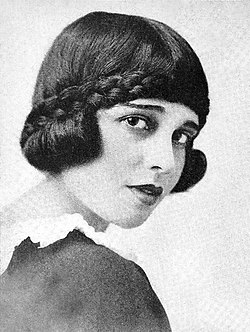
Anita Loos
View on Wikipedia
Corinne Anita Loos (April 26, 1888[1][2] – August 18, 1981) was an American actress, novelist, playwright and screenwriter. In 1912, she became the first female staff screenwriter in Hollywood, when D. W. Griffith put her on the payroll at Triangle Film Corporation. She is best known for her 1925 comic novel, Gentlemen Prefer Blondes, her screenplay of the 1939 adaptation of The Women, and her 1951 Broadway adaptation of Colette's novella Gigi.
Key Information


Early life
[edit]Loos was born in Sisson (now Mount Shasta), California, to Richard Beers Loos and Minerva Ellen "Minnie" (Smith) Loos. She had one sister, Gladys Loos, and one brother, Dr. Harry Clifford Loos, a physician and a co-founder of the Ross-Loos Medical Group.
About pronouncing her name, Loos said, "The family has always used the correct French pronunciation which is lohse. However, I myself pronounce my name as if it were spelled luce, since most people pronounce it that way and it was too much trouble to correct them."[3]
Her father founded Sisson Mascot, a tabloid newspaper, for which her mother did most of the work of a publisher.[4] In 1892, when Anita was three years old, the family moved to San Francisco, where her father bought the newspaper Music and Drama, with money that her mother "wheedled"[4] from her maternal grandfather,[4] dropped the subject of music, in which he had no interest, and retitled the weekly to The Dramatic Review, filled with the photographs of pretty girls, that copied the format of the British Police Gazette, and led to her father's romance with the opera singer Alice Nielsen.[4]
By age six, Anita Loos wanted to be a writer. While living in San Francisco, she accompanied her father, an alcoholic, on exciting fishing trips to the pier, exploring the city's underbelly (the Tenderloin and the Barbary Coast[4]) and making friends with the locals.[4] This fed her lifelong fascination with lowlifes and loose women.[5]
Career
[edit]1897-1915: Early career
[edit]In 1897, at their father's urging, Loos and her sister performed in a San Francisco stock company production of Quo Vadis? Gladys died at age eight of appendicitis,[4] while their father was away on business.[6]
Anita continued appearing on stage, being the family's breadwinner. Her father's spendthrift ways caught up with them, and in 1903 he took an offer to manage a theater company in San Diego.[4] Anita performed simultaneously in her father's company, and under another name with a more legitimate stock company.[citation needed]
After graduating from San Diego High School, Loos devised a method of cobbling together published reports of Manhattan social life and mailing them to a friend in New York, who would submit them under the friend's name for publication in San Diego. Her father had written some one-act plays for the stock company, and he encouraged Anita to write plays; she wrote The Ink Well, a successful piece, for which she received periodic royalties.[4]
In 1911, the theater[which?] was running one-reel films after each night's performances; Anita would take a perfunctory bow and run to the back of the theater to watch them.[5] She sent her first attempt at a screenplay, He Was a College Boy, to the Biograph Company, for which she received $25.[7] The New York Hat, starring Mary Pickford and Lionel Barrymore and directed by D. W. Griffith, was her third screenplay and the first to be produced. Loos dredged real life, including her own, for scenarios: she dished up her father's cronies and brother's friends, also using the rich vacationers from the San Diego resorts; eventually every experience became grist for her script mill.[4]
By 1912, Loos had sold scripts to both the Biograph and Lubin studios. Between 1912 and 1915, she wrote 105 scripts, all but four of which were produced.[8] She wrote 200 scenarios before she ever visited a film studio.[9]
1915-1917: Hollywood
[edit]
In 1915, trying to escape her mother's influence and objections to a career in Hollywood, Loos married Frank Pallma, Jr., the son of the band conductor.[10] But Frank proved to be penniless and dull – after six months, she sent him out for hair pins, and while he was gone she packed her bags and went home to her mother.[5] After that, Minnie rethought her position on a Hollywood career. Accompanied by her mother, Anita joined the film colony in Hollywood where Griffith put Loos on the payroll for Triangle Film Corporation at $75 a week with a bonus for every produced script.
Many of the scripts she turned out for Griffith went unproduced. Some he considered unfilmable because the "laughs were all in the lines, there was no way to get them onto the screen", but he encouraged her to continue, because reading them amused him.[8] Her first screen credit was for an adaptation of Macbeth in which her billing came right after Shakespeare's.[5] When Griffith asked her to assist him and Frank E. Woods in writing the intertitles for his epic Intolerance (1916),[11] she traveled to New York City for the first time to attend its premiere. Instead of returning to Hollywood, Loos spent the fall of 1916 in New York and met with Frank Crowninshield of Vanity Fair. They had an instant rapport and Loos remained a Vanity Fair contributor for several decades.[8]
Loos returned to California as Griffith was leaving Triangle to make longer films, and she joined director and future husband John Emerson for a string of successful Douglas Fairbanks movies. Loos and company realized that Douglas Fairbanks' acrobatics were an extension of his effervescent personality and parlayed his natural athletic ability into swashbuckling adventure roles. His Picture in the Papers (1916) was noted for its wry style of discursive and witty subtitles: "My most popular subtitle introduced the name of a new character. The name was something like this: 'Count Xxerkzsxxv.' Then there was a note, 'To those of you who read titles aloud, you can't pronounce the Count's name. You can only think it.' "[9]
The five films Loos wrote for Fairbanks helped make him a star.[8] When Fairbanks was offered a sweetheart deal with Famous Players–Lasky, he took the team of Emerson-Loos with him at the high income of $500 a week. During this time Loos, Fairbanks, and Emerson collaborated well together, and Loos was getting as much publicity as either Lillian Gish or Mary Pickford.[5] Photoplay magazine labeled her "The Soubrette of Satire".[8]
1918-1924: New York
[edit]In 1918, Famous Players–Lasky offered the couple a four-picture deal in New York for more money than they had been making with the Fairbanks unit.

Loos, Emerson and fellow writer Frances Marion migrated to New York as a group, with Loos and Emerson sharing a leased mansion in Great Neck, Long Island.[12] Loos wanted Marion as chaperone, as she found herself attracted to Emerson, a man 15 years her senior that she would refer to as "Mr. E".[13] He would readily admit that he "had never been, nor could be, faithful to any one female." Loos convinced herself he would see that she was different from all his other girls, and that behind his outwardly dull exterior was a great mind. She would later consider herself misled on both counts, writing: "I had set my sights on a man of brains, to whom I could look up", she lamented, "but what a terrible let down it would be to find out that I was smarter than he was."[14]
The pictures for Famous Players–Lasky were not as successful as their previous films, partly because they starred Broadway headliners not adept at screen acting and their contract was not renewed. The scripts carried both names but were mostly products of Loos alone. Later Loos would claim that Emerson took all the money and most of the credit, though his contribution usually consisted of observing from bed as she worked.[15] Much to the chagrin of her friends, her adoration of Emerson had manifested as subservience. When William Randolph Hearst offered Loos a contract to write a picture for his mistress, Marion Davies,[12] Loos included the unnecessary Emerson in the deal. Hearst liked the picture and Getting Mary Married (1919) was one of the first Marion Davies pictures that didn't lose money.[5] In addition to their films, the couple wrote two books: How to Write Photoplays, published in 1920, followed by Breaking Into the Movies in 1921.
Loos and Emerson turned down another picture with Davies, preferring to write for their old friend Constance Talmadge, whose brother-in-law Joseph Schenck (husband of Norma Talmadge) was an independent producer. Both A Temperamental Wife (1919) and A Virtuous Vamp (1919) were great hits for Talmadge. The couple joined the Talmadges and the Schencks at the Ambassador Hotel on Park Avenue, with Constance filling the void left by the loss of her sister. When Anita and Constance weren't working, they went shopping. The Talmadge-Schencks convinced Anita to summer with them in Paris without Emerson. Much of this adventure would end up as fodder for Loos's book Gentlemen Prefer Blondes.
Upon returning, they produced five more films in 16 months. During this time, Loos had filed for divorce from her estranged first husband. Emerson proposed marriage and they were married at the Schenck estate on June 15, 1919. Loos was among the first to join Ruth Hale's Lucy Stone League, an organization that fought for women to preserve their maiden names after marriage as she continued with hers.
The couple moved into a modest Murray Hill apartment and cut back to two films a year in order to travel. They spent the summer in Paris. Loos and her new assistant, John Ashmore Creeland, visited many of the Paris-based writers Loos had met in America, as well as Gertrude Stein, Alice B. Toklas, Elisabeth Marbury and Elsie De Wolfe.
After one more film for Schenck and Talmadge, The Perfect Woman (1920), Emerson refused another contract. After working with Actors Equity during their 1919 strike, he decided that the Loos-Emerson team should make the move to the theater.[5] Their first play, The Whole Town's Talking, which opened at the Bijou Theatre on August 29, 1923, received good reviews and was a moderate box-office success. Soon afterward the couple moved to a small house in Gramercy Park.
Emerson had convinced a devastated Loos that he needed to take a break from the marriage once a week. It was on these days he would date younger women, while Loos consoled herself by entertaining her friends: the Talmadge sisters, "Mama" Peg Talmadge, Marion Davies, Marilyn Miller, Adele Astaire and an assortment of chorus girls kept by prominent men.[5] These "Tuesday Widows" soireés would influence her later writings, and it was with the "Tuesday Widows" that she visited one of her favorite hangouts, Harlem, where she developed a deep and lifelong appreciation for African-American culture.[5] "Sometimes I get enquiries [sic] concerning my marriage to a man who treated me with complete lack of consideration, tried to take credit for my work and appropriated all my earnings", Loos wrote in Cast of Thousands. "The main reason is that my husband liberated me; granted me full freedom to choose my own companions."[14]

1925-1926: Gentlemen Prefer Blondes
[edit]Loos had become a devoted admirer of H. L. Mencken, a literary critic and intellect. When he was in New York, she would take a break from her "Tuesday Widows" and join his circle, which included Theodore Dreiser, Sherwood Anderson, Sinclair Lewis, Joseph Hergesheimer, essayist Ernest Boyd and theater critic George Jean Nathan. Loos adored Mencken, but gradually realized disappointingly, "High-IQ gentlemen didn't fall for women with brains, but those with more downstairs".[16] In 1925, on the train to Hollywood with Mencken, she became keenly aware of this fact when he solicited the attention of a blonde in the dining car.[16] Loos then began to write a sketch of Mencken and his vacant lady friends that would later become Gentlemen Prefer Blondes.
Gentlemen Prefer Blondes: The Illuminating Diary of a Professional Lady, began as a series of short sketches, illustrated by Ralph Barton,[17] published in Harper's Bazaar, known as the "Lorelei" stories. They were satires on the state of sexual relations that only vaguely alluded to sexual intimacy; the magazine's circulation quadrupled overnight.[18] The heroine of the stories, Lorelei Lee, was a bold, ambitious flapper, who was much more concerned with collecting expensive baubles from her conquests than any marriage licenses, in addition to being a shrewd woman of loose morals and high self-esteem. She was a practical young woman who had internalized the materialism of the United States in the 1920s and equated culture with cold cash and tangible assets.[10]
The success of the short stories had the public clamoring for them in book form. Pushed by Mencken, she signed with Boni & Liveright. Modestly published in November 1925, the first printing sold out overnight. The initial reviews were rather bland and unimpressive, but through word of mouth it became the surprise best-seller of 1925. Loos garnered fan letters from fellow authors William Faulkner, Aldous Huxley and Edith Wharton, among others.[15] "Blondes" would see three more printings sell by year's end and 20 more in its first decade. The little book would see 85 editions in the years to come and eventually be translated into 14 languages, including Chinese.[19]
When asked who the models for her characters were, Loos would almost always say they were composites of various people. But when pressed, she admitted that toothless flirt Sir Francis Beekman was modeled after writer Joseph Hergesheimer and producer Jesse L. Lasky. Dorothy Shaw was modeled after herself and Constance Talmadge and Lorelei most closely resembled acquisitive Ziegfeld showgirl Lillian Lorraine, who was always looking for new places to display the diamonds bestowed by her suitors.
Emerson first attempted to suppress its publication and then settled for a personal dedication. Loos continued to be overworked throughout 1926, sometimes working many projects at once. In the spring of 1926 she completed the stage adaptation, which opened a few weeks later in Chicago and ran for 201 performances on Broadway. Emerson had developed a serious case of hypochondria by this time, affecting laryngitis attacks to divert attention from her work;[8] in the words of his wife, "he was a man who enjoyed ill health."[10] It was the opinion of New York psychiatrist, Smith Ely Jelliffe, "that she was to blame and in order for Emerson to get better she would have to give up her career."[15] She resolved to retire after her next book, But Gentlemen Marry Brunettes, a sequel to Blondes that she had promised Harper's Bazaar.
The couple had planned another European vacation. Unwell at the last minute, Emerson insisted that Loos continue alone. Arriving in London, she was promptly taken under the wing of socialite Sibyl Colefax, whose drawing room had become filled with "the bright young things" of the day such as John Gielgud, Harold Nicolson, Noël Coward and notables such as Arnold Bennett, Max Beerbohm and Bernard Shaw. Photos of Loos on the London social scene appeared in the New York papers, and the unwell Emerson subsequently joined Loos. To keep his spirits up she took him to the theater every night. It worked; at times he spoke in normal tones. The couple traveled on to Paris as Emerson's recovery continued. In September, their vacation was cut short; Loos was needed back in New York to do revisions on Blondes for its Waldorf Theatre (Selwyn Theatre?[20][21]), Broadway debut in September 1926,[22][23][24] running for 199[25] performances in two theaters,[26][23][27] closing at the Times Square Theater, in April 1927.[28][29]
1927-1931: Leisure time
[edit]
When But Gentlemen Marry Brunettes was published in 1927, Emerson proposed another European vacation and went ahead of Loos. A seriously ill Loos followed him, coming down with a sinus attack in Vienna. She and the ear, nose and throat specialist who was treating her came up with a method of fixing Emerson's hypochondria.[5] The doctor arranged a bit of sham surgery for him and presented him with the polyps that had been supposedly removed from his vocal cords. This placebo treatment did the trick, they returned with a cured Emerson. Not wanting to undo all her efforts, Loos retired to a life of leisure.
The first film version of Gentlemen Prefer Blondes (now lost) was released in 1928 starring Ruth Taylor as Lorelei Lee and Alice White as Dorothy. It was somewhat of a flop.[30] From 1927 to 1929, Loos and Emerson traveled extensively, which was hard on Loos's health. All their winters were spent in Palm Beach, where Emerson would indulge in social climbing. Loos was starved of intellectual male companionship and met Wilson Mizner there, a witty and charming real estate speculator, and in some quarters – confidence man.[19] Though they saw each other every day, the relationship was rumored to have stopped just short of having a full-blown affair. Emerson's throat ailment returned, though he recovered quickly after his second round of "Viennese surgery".
Loos and Emerson traveled to Hollywood for Christmas in 1929 with Loos's new friend, photographer Cecil Beaton, who was part of "the bright young things" crowd. Wilson Mizner had also relocated to Hollywood as a screenwriter. Since Emerson had his own entertainment, Loos was often in the company of Beaton or Mizner. When they returned to New York in the spring of 1930, Emerson expressed his unhappiness at her inattention, threatening a relapse of his throat ailment and Loos would spend much more time alone.[5] Emerson had also lost money in the stock market crash, and suggested she return to work.[10] Loos was not completely unhappy with this, and within a few months had produced a stage adaptation of But Gentlemen Marry Brunettes and a comedy Cherries are Ripe.
With their income reduced, the couple moved to a residential hotel and did less traveling in 1931. Not long after, Loos came upon a love letter from one of Emerson's conquests. Devastated, Loos offered him a divorce; Emerson refused and suggested they live apart, with him giving her a suitable allowance. Blaming herself for his unhappiness, she moved to an apartment on East Sixty-Ninth Street. However, her new life allowed her finally to spend her portion of what she earned for the couple in any way she liked.[5]
1931-1935: MGM screenwriter
[edit]When the Emerson-Loos team got an offer to write pictures for Irving Thalberg at MGM, Emerson refused to go. Loos took the $1,000-a-week salary alone.[5]

The first project Thalberg handed Loos was Jean Harlow's Red-Headed Woman because F. Scott Fitzgerald was having no luck adapting Katherine Brush's book. Fitzgerald, an accomplished writer of novels like The Great Gatsby, was fired and replaced by Loos in a predominantly male run studio system. The picture, completed in May 1932, was a smash and established Harlow as a star and put Loos once again in the front rank of screenwriters.[31]
"She was a very valuable asset for MGM, because the studio had so many femmes fatales – Garbo, Crawford, Shearer, and Harlow – that we were always on the lookout for 'shady lady' stories. But they were problematic because of the censorship code. Anita, however, could be counted on to supply the delicate double entendre, the telling innuendo. Whenever we had a Jean Harlow picture on the agenda, we always thought of Anita first." – MGM producer Samuel Marx[5]
Loos moved to an apartment in Hollywood, where she was unexpectedly joined by Emerson. Though Emerson expressed contrition about his previous behavior, he did nothing to change it. While Emerson busied himself offering screen tests to young starlets, Loos was now free to see whomever she pleased, including her now quite ill friend Wilson Mizner. Mizner having abused his body with alcohol and drugs, wasted away until dying on April 3, 1932, a date Loos would continue to mark.
At MGM, Loos happily turned out scripts; however, she frequently had to use Emerson as a conduit to communicate with directors and other executives who balked at dealing with a woman on equal footing.[5] This worked well to promote the idea they were a happy couple and writing team. She bought a modest house in Beverly Hills in 1934. During the day it was work, and at night parties given by other MGM studio executives or stars, like the Thalbergs, the Selznicks and the Goldwyns. Loos was a frequent attendee at George Cukor's Sunday brunches, which was the closest Hollywood had to a literary salon.
In 1935, about the time of the Writer's Guild formation, she was paired with Robert Hopkins, who would later become a frequent collaborator. Their work on San Francisco got an Academy Award nomination for best original screenplay. She based Clark Gable's character on some confidence men she had known, including Wilson Mizner.[32] Thalberg had taken ill again and gave Emerson a two-year contract as a producer at $1,250 a week. By mid-1937 Loos had decided not to renew her contract with MGM; since friend and supporter Thalberg's death in September 1936, things had not been going well at the studio and every film felt like a struggle.[33] She signed with Samuel Goldwyn, formerly of MGM and now head of United Artists, for $5,000 a week and almost immediately regretted it. Loos soldiered on, working on "unworkable" scripts.
1936-1945: Life alone
[edit]In October Loos and her brother Clifford checked Emerson into a very expensive sanatorium where he was diagnosed with schizophrenia.[10] Loos, who had always left the finances to Emerson, soon discovered that most of her money was no longer in joint accounts but in his own private accounts.[8] Overworked at the studio and under stress from Emerson, she became more and more depressed. Loos promptly bought herself out of her United Artists contract, re-signed with MGM and bought a beach-front house in Santa Monica. After 17 years of marriage in 1937 Loos finally asked Emerson for a divorce and he agreed but would continue to stave off any talk of plans, making finalization impossible.[5] When Emerson was deemed well enough to leave the sanatorium, she paid for a nurse to care for him in an apartment of his own.
MGM had bought the film rights to Clare Boothe Luce's 1936 smash Broadway hit The Women in 1937. Many writers had, unsuccessfully, taken a stab at a screenplay version. The studio handed it to Loos and veteran scriptwriter Jane Murfin, and three weeks later Loos handed Cukor a script that he loved.[31] Unfortunately the censorship board did not. They insisted on changing more than 80 lines and the film had to go into production. Loos was apprehensive, but Cukor insisted she do the changes on set, among his all-star bevy of leading ladies on this female-only picture that included Thalberg widow Norma Shearer, Joan Crawford and Rosalind Russell. Loos made immediate friends with Paulette Goddard who was surprisingly well-read. When Hunt Stromberg, the last producer she respected, left MGM to produce independently; Loos tried to get out of her contract, but by then she had grown into too valuable a property to the studio.
Throughout the war Loos wrote screenplays, grew vegetables in her Victory garden and knitted socks and sweaters for the boys overseas. She also had houseguests Aldous and Maria Huxley, from England, when World War II began in September 1939. Loos convinced Huxley that it would be safer for his family if they stayed in the United States, and she got him a job adapting screenplays at MGM. Privately she had a new partner who had a drinking problem; the relationship would be short-lived and MGM decided to release her from her contract finally.
1946-1959: Return to New York
[edit]In the fall of 1946, now a free agent, Loos returned to New York to work on Happy Birthday, a Saroyanesque cocktail party comedy written for Helen Hayes.[10] The play had several false starts the previous year, but now proceeded with Joshua Logan as director, and produced by Rodgers and Hammerstein. It opened in Boston, but the audiences hated it at first. Loos kept improving the script throughout the Boston run; when it opened in New York at the Broadhurst it was a hit and ran for 600 performances.[19] Katharine Hepburn was eager to play in the screen version but the Hollywood censors weren't ready for a woman to be "sloshed on screen for two acts and be rewarded with a happy ending." Loos sold her Santa Monica house to her niece and made certain Emerson understood he would not be joining her in New York under any circumstances.
Once again in New York, she and her long time friend, screenwriter Frances Marion, worked on an unproduced play for Zasu Pitts. A few romances came her way, including Maurice Chevalier. Two Broadway producers wanted a musical version of Gentlemen Prefer Blondes and brought in Joseph Fields as co-author. Loos threatened to quit the production unless assured she would never have to speak to Fields again. The show opened in Philadelphia with a then-unknown Carol Channing. By the time it arrived in New York it was another success. Channing soon was elevated to an A-list star, the show played for 90 weeks and went on tour for another year. The producers closed the show when Channing became pregnant. Herman Levin commented: "I was convinced the show wouldn't work without Carol, and in my opinion it never has."[5] A musical film version was produced in 1953, directed by Howard Hawks and adapted by Charles Lederer. It starred Jane Russell and Marilyn Monroe. Loos had nothing to do with the production, but thought Monroe was inspired casting.[citation needed]
The success of Blondes the second time around meant Loos had a greater profile than ever before. She moved to a more spacious apartment at the Langdon Hotel and bought a car. In 1950 Loos wrote A Mouse is Born, another novel, and once sent to her publisher, she left her first trip to Europe in 20 years.[5] A Mouse is Born had a lukewarm reception, but by then Loos was already working on a dramatic adaptation of Colette's Gigi.[10] The production was under way before Colette wired that she had found their "Gigi"—she had seen Audrey Hepburn in a hotel lobby in Monte Carlo.[15] Gigi opened in the fall of 1951 and would run until the spring of 1952; by then Hepburn had been elevated to an A-list star, contracted to Paramount Pictures.
Loos worked on more adaptations for the next few years during travels while relocating to an apartment on West Fifty-Seventh Street. The apartment was that of Paul Swan, the aging "Most Beautiful Man in the World". Her next musical, The Amazing Adele starring Tammy Grimes with music by Albert Selden, never got off the ground and swiftly closed. Both Emerson and Helen Hayes' husband, Charles MacArthur, died within a few weeks of each other and the women threw themselves into their work together, with Loos working on an adaptation for Hayes' filming Anastasia in London. Loos worked and traveled even while being treated for a painful hand ailment that prevented her from writing. In 1959 Loos opened another Colette adaptation, Chéri, with Kim Stanley and Horst Buchholz in the title roles, but it ran for only two months.
1960-1981: Later life and death
[edit]Loos continued writing as a magazine contributor, appearing regularly in Harper's Bazaar, Vanity Fair and The New Yorker. Biographer Gary Carey notes: "She was a born storyteller and was always in peak form when reshaping a real-life encounter to make an amusing anecdote."[5] Loos began a volume of memoirs, A Girl Like I, published in September 1966. Her 1972 book, Twice Over Lightly: New York Then and Now, was written in collaboration with friend and actress Helen Hayes. Kiss Hollywood Good-by (1974) was a Hollywood memoir about her MGM years and would be very successful,[33] while her book, The Talmadge Girls (1978) is about the actress sisters Constance Talmadge and Norma Talmadge specifically.
Loos would become a virtual New York institution, an assiduous partygoer and diner-out; conspicuous at fashion shows, theatrical and movie events, balls and galas.[19] A celebrity anecdotalist, she was also never one to let facts spoil a good story:
With each book came a new spate of interviews and as one of the last survivors of the silent era, Anita's stories became more exaggerated and she was soon reported to have sold her first scenario at the age of 12. She continued to thrive on interesting people and interesting activities – and held an opinion on everything – but worked hard on keeping the vivacious and flippant image and hiding her loneliness.[12]
She once commented, "I've enjoyed my happiest moments when trailing a Mainbocher evening gown across the sawdust-covered floor of a saloon."[34]
She was interviewed in the television documentary series Hollywood: A Celebration of the American Silent Film (1980).[35]
After spending several weeks with a lung infection, Anita Loos suffered a heart attack and died in Manhattan's Doctors Hospital in New York City at the age of 93.[19][2] At the memorial service, friends Helen Hayes, Ruth Gordon, and Lillian Gish, regaled the mourners with humorous anecdotes and Jule Styne played songs from Loos's musicals, including "Diamonds Are a Girl's Best Friend".[12][36]
Popular culture
[edit]- Loos is portrayed in a thinly disguised manner by Tatum O'Neal, as the character Alice Forsyte, in Peter Bogdanovich's look back at early silent filmmaking in the film Nickelodeon.
- In the second season of HBO's Perry Mason (2020 TV series) the character Anita St. Pierre, played by Jen Tullock, is based on Loos.
Works
[edit]- Anita Loos Rediscovered: Film Treatments and Fiction by Anita Loos, Creator of Gentlemen Prefer Blondes[37]
- Author: Anita Loos
- Editors: Cari Beauchamp, Mary Loos
- Publisher : University of California Press, 2003
- ISBN 9780520228948
Fiction
[edit]- Gentlemen Prefer Blondes: The Intimate Diary of a Professional Lady. NY: Boni & Liveright, 1925
- But Gentlemen Marry Brunettes. NY: Boni & Liveright, 1927
- A Mouse Is Born. NY: Doubleday & Company, 1951
- No Mother to Guide Her.
- NY: McGraw Hill, 1961
- London: Arthur Barker Ltd., 1961[38]
- Fate Keeps On Happening: Adventures Of Lorelei Lee And Other Writings. NY: Dodd, Mead & Company, 1984
Nonfiction
[edit]
- w/John Emerson How to Write Photoplays NY: James A McCann, 1920
- w/John Emerson. Breaking Into the Movies. NY: James A McCann, 1921
- "This Brunette Prefers Work", Woman's Home Companion, 83 (March 1956)
- A Girl Like I. NY:Viking Press, 1966
- w/Helen Hayes. Twice Over Lightly: New York Then and Now. NY: Harcourt Brace Jovanovich, 1972
- Kiss Hollywood Good-by. NY: Viking Press, 1974
- Cast of Thousands: a pictorial memoir of the most glittering stars of Hollywood. NY: Grosset and Dunlap, 1977
- The Talmadge Girls. NY: Viking Press, 1978
Broadway credits
[edit]- The Whole Town's Talking (1923)
- The Fall of Eve (1925)
- Gentlemen Prefer Blondes (1926)
- The Social Register (1931)
- Happy Birthday (1946)
- Gentlemen Prefer Blondes (1949)
- Gigi (1951)
- Chéri (1959)
- The King's Mare (1967)
- Lorelei (1974)
Film credits
[edit]
|
|
See also
[edit]
References
[edit]References
[edit]- ^ Loos, Anita (November 10, 2003). Anita Loos Rediscovered: Film Treatments and Fiction by Anita Loos, Creator of Gentlemen Prefer Blondes. University of California Press. ISBN 978-0-520-22894-8.
- ^ a b Whitman, Alden (August 19, 1981). "Anita Loos Dead at 93; Screenwriter, Novelist". The New York Times. ISSN 0362-4331. Retrieved August 4, 2020.
- ^ Funk. 1936.
- ^ a b c d e f g h i j Loos. 1966.
- ^ a b c d e f g h i j k l m n o p q r s Carey. 1988
- ^ "Red Bluff News 24 April 1901 — California Digital Newspaper Collection". cdnc.ucr.edu. Archived from the original on October 19, 2017. Retrieved April 24, 2018.
- ^ Loos. 1974
- ^ a b c d e f g Norman. 2007.
- ^ a b Schmidt. 1917
- ^ a b c d e f g Scribners.1998.
- ^ Frost, Laura (April 2010). "Blondes Have More Fun: Anita Loos and the Language of Silent Cinema". Modernism/Modernity. 17 (2). Johns Hopkins University Press: 299–300. doi:10.1353/mod.0.0213. S2CID 143104887. Retrieved March 22, 2020.
- ^ a b c d Beauchamp. 1997
- ^ Gross, John (October 11, 1988). "Books of The Times; Centenary for Author of an Indubitable Classic". The New York Times. ISSN 0362-4331. Retrieved January 6, 2019.
- ^ a b Loos. 1977.
- ^ a b c d Gale Group. 2001
- ^ a b "Why the Writer Who Turned Audrey Hepburn and Douglas Fairbanks Into Stars Never Won an Oscar". The Hollywood Reporter. February 16, 2017. Retrieved January 6, 2019.
- ^ Wood, Bethany (February 5, 2024). "Gentlemen Prefer Adaptations: Addressing Industry and Gender in Adaptation Studies". Theatre Journal. 66 (4): 559–579. doi:10.1353/tj.2014.0120. JSTOR 24580463. S2CID 143677872.
- ^ Acker. 1991.
- ^ a b c d e NYT Obit. 1981
- ^ "This Week's Openings". Daily News. September 26, 1926. pp. D15. Retrieved June 26, 2023 – via Newspapers.com.
- ^ "Gentlemen Prefer Blondes: About This Production". Internet Broadway Database. Archived from the original on April 5, 2023. Retrieved June 26, 2023.
- ^ Henderson & Greene 2008, p. 201.
- ^ a b Atkinson, J. Brooks (September 29, 1926). "The Play; Blondes Preferred". The New York Times. ISSN 0362-4331. Archived from the original on April 13, 2022. Retrieved April 13, 2022.
- ^ "Gentlemen Prefer Blondes | Vanity Fair".
- ^ "Gentlemen Prefer Blondes - 1926 Broadway - Backstage & Production Info".
- ^ Henderson & Greene 2008, p. 202.
- ^
- The Broadway League (September 28, 1926). "Gentlemen Prefer Blondes – Broadway Play – Original". IBDB. Archived from the original on April 12, 2022. Retrieved April 12, 2022.
- "Gentlemen Prefer Blondes (Broadway, Times Square Theatre, 1926)". Playbill. Archived from the original on April 12, 2022. Retrieved April 12, 2022.
- ^ "Gentlemen Prefer Blondes – Broadway Play – Original | IBDB".
- ^ "Gentlemen Prefer Blondes (Broadway, Times Square Theatre, 1926)". Playbill. December 14, 2015. Retrieved February 12, 2024.
- ^ Hutchinson, Pamela (January 11, 2016). "Anita Loos – sharp, shameless humour of the 'world's most brilliant woman'". The Guardian. ISSN 0261-3077. Retrieved January 5, 2019.
- ^ a b Jacobs. 1998.
- ^ "The Loos Legend". The Washington Post. August 20, 1981. ISSN 0190-8286. Retrieved January 6, 2019.
- ^ a b "Ageless Anita Loos Talks of Herself and Hollywood". PEOPLE.com. Retrieved January 6, 2019.
- ^ Loos, 1966, p. 36.
- ^ Brownlow, Kevin; Gill, David (1980). Hollywood: A Celebration of the American Silent Film (video). Thames Video Production.
- ^ Lawson, Carol (August 28, 1981). "With the Joy She Requested, Anita Loos Is Bade Farewell". The New York Times. ISSN 0362-4331. Retrieved August 4, 2020.
- ^ Loos, Anita (November 2003). Anita Loos Rediscovered: Film Treatments and Fiction by Anita Loos, Creator of Gentlemen Prefer Blondes. University of California Press. ISBN 978-0-520-22894-8.
- ^ Loos, Anita (February 5, 1961). "No Mother to Guide Her".
Bibliography
[edit]- Acker, Ally (1991). Reel women: pioneers of the cinema 1896 to the present. London: Batsford. ISBN 0-7134-6960-9.
- Beauchamp, Cari (1997). Without lying down: Frances Marion and the powerful women of early Hollywood. Berkeley: University of California Press. ISBN 0-520-21492-7.
- Carey, Gary (1988). Anita Loos: a biography. New York: A.A. Knopf. ISBN 0-394-53127-2.
- Funk, Charles Earle (1936). What's the Name, Please?. New York: Funk & Wagnalls.
- Encyclopedia of World Biography Supplement, Vol. 21. New York, N.Y: Gale Group. 2001.
- Henderson, Mary C.; Greene, Alexis (2008). The story of 42nd Street: the theaters, shows, characters, and scandals of the world's most notorious street. New York: Back Stage Books. ISBN 978-0-8230-3072-9. OCLC 190860159.
- Jacobs, Katrien; Foster, Gwendolyn Audrey; Unterburger, Amy L. (1998). Women filmmakers & their films. London: St. James Press. ISBN 1-55862-357-4.
- Loos, Anita (1966). A Girl Like I. New York: The Viking press. ISBN 0-670-34112-6.
- Loos, Anita (1974). Kiss Hollywood Good-by. New York: Viking Press. ISBN 0-670-41374-7.
- Loos, Anita (1977). Cast of Thousands. New York: Grosset and Dunlap. ISBN 0-448-12264-2.
- Loos, R. Beers. "Anita's Dad Spills the Frijoles," Photoplay, August 1928, p. 47.
- Norman, Marc (2007). What Happens Next: A History of American Screenwriting. New York, N.Y: Harmony. ISBN 978-0-307-38339-6.
- Schmidt, Karl (June 1917). "The Handwriting on the Screen". Everybody's Magazine. 36: 622–23.
- The Scribner Encyclopedia of American Lives, Volume 1: 1981–1985. New York, N.Y: Charles Scribner's Sons. 1998.
- Whitman, Alden (August 19, 1981). "Anita Loos Dead at 93; Screenwriter, Novelist". The New York Times. Retrieved April 6, 2008.
External links
[edit]


- Anita Loos at IMDb
- Anita Loos at the Internet Broadway Database
- Anita Loos at the Internet Off-Broadway Database (archived)
- Anita Loos Archived August 20, 2019, at the Wayback Machine at the Women Film Pioneers Project
- Anita Loos papers, 1917–1981, held by the Billy Rose Theatre Division, New York Public Library for the Performing Arts
- Anita Loos papers, 1917-1979 at Houghton Library, Harvard University
- AFI Catalog entry for Anita Loos
- Some contemporary articles and interviews with Anita Loos
- Works by Anita Loos in eBook form at Standard Ebooks
- Works by Anita Loos at LibriVox (public domain audiobooks)


Anita Loos
View on GrokipediaEarly Life
Family Background and Childhood
Corinne Anita Loos was born on April 26, 1889, in Sisson, California (now Mount Shasta), the daughter of Richard Beers Loos, a journalist and publisher of a local tabloid newspaper, and Minerva Ellen "Minnie" Smith Loos, who managed much of the family's domestic and social affairs despite her husband's flamboyant and unreliable nature.[6][1][7] Her father, known for his charm but prone to drinking, philandering, and frequent absences, instilled in the household an atmosphere of instability, while her mother provided a stabilizing, proper influence amid financial struggles.[8][9] Loos had an older brother, Harry Clifford Loos (1882–1960), who later became a physician and co-founder of the Ross-Loos Medical Group, and a younger sister, Gladys (1891–1901), who died at age ten.[10][2] The family relocated to San Francisco when Loos was four years old, an event she later recalled as her earliest memory, marked by the tedium of unwanted attention from a local admirer during the move.[2] In San Francisco, the Loos household faced ongoing poverty, with Minnie Loos taking in boarders to supplement income as her husband's ventures faltered, including his continued journalistic pursuits and extramarital activities.[8][11] This period exposed young Loos to a peripatetic existence, as her father's restlessness led to further relocations, including to San Diego after selling the struggling newspaper business to invest in theater.[12] Amid these challenges, Loos and her sister Gladys entered the performing arts as child actresses, appearing in stock company productions such as Quo Vadis at the suggestion of one of her father's producer acquaintances.[8] These early stage experiences in San Francisco, Los Angeles, and San Diego honed Loos's familiarity with theater and performance, though the family's instability—exacerbated by her father's binges and departures—fostered her self-reliance from a young age.[9] Loos later reflected that the 1906 San Francisco earthquake destroyed her birth certificate, allowing her to adjust her reported age downward in professional circles as she entered adulthood.[13]Initial Exposure to Performing Arts
Anita Loos's initial exposure to the performing arts stemmed from her father's ventures into theater management, which immersed her in stage productions from a young age. Born in Sisson, California, in 1888, Loos grew up in a family where R. Beers Loos, after operating the local tabloid Sisson Mascot, shifted toward theatrical enterprises amid financial instability.[14] By 1903, the family had relocated to San Diego, where Beers Loos managed theater companies, including converting an abandoned stable into the Lyceum Theater in 1905 to stage pirated Broadway plays and stock productions.[2] This environment provided Loos with direct access to live performances, backstage operations, and the demands of audiences in a frontier theatrical scene often featuring makeshift venues and touring troupes.[7] To bolster family income, Loos began acting in her father's productions as a teenager, performing versatile roles under her own name and pseudonyms such as Corinne Wood while donning disguises like blonde wigs for variety.[2] A 1926 New Yorker profile recounts her professional stage debut at age five in a San Diego stock company rendition of Little Lord Fauntleroy, highlighting an early aptitude for performance amid the era's rudimentary theater practices, though subsequent biographies emphasize her teen years in San Diego as the period of sustained involvement.[15] Complementing her acting, Loos penned her first one-act plays for these venues with paternal guidance, learning dramatic form through trial-and-error stagings that exposed the raw mechanics of scripting, rehearsal, and audience reception in small-scale operations.[14] This foundational experience in live theater, distinct from the emerging silent films screened at her father's venues, cultivated her instincts for character-driven wit and narrative economy, informing her later cinematic innovations.[16]Entry into Screenwriting
First Professional Scripts
Anita Loos entered professional screenwriting in 1911 at age 23, submitting her initial scenarios to the Biograph Company while residing in San Diego. Her debut effort, The Road to Plaindale, depicted a comedic mishap involving a city couple's relocation to rural life, drawing from visual storytelling suited to silent films; Biograph purchased it, marking her entry into the industry, though production occurred later in 1912 or 1914.[2][3] Loos's second submission fared better in terms of prompt production: Biograph accepted it, leading to The New York Hat (1912), a one-reel drama directed by D.W. Griffith and starring Mary Pickford in her final Biograph role alongside Lionel Barrymore. The scenario explored themes of small-town hypocrisy and materialism, with a plot centered on a young woman's purchase of a stylish hat sparking unfounded gossip and tragedy; its success, praised for sharp social observation, established Loos's reputation for concise, character-driven narratives.[3][17] By 1912, Loos had secured status as Hollywood's inaugural female staff screenwriter at Biograph, under Griffith's oversight, and began freelancing with Lubin Studios. Between 1912 and 1915, she authored 105 scripts across both studios, with all but four produced, often incorporating satirical elements from her observations of American society and her father's theater circle. Early works like The Widow's Kids (1913) and The Saving Grace (1914) showcased her emerging style of blending humor with moral critique, typically in short formats under 1,000 feet of film.[3][17]Breakthrough with Biograph and D.W. Griffith
Anita Loos, residing in San Diego, transitioned from amateur acting to screenwriting in her early twenties by submitting scenarios to Biograph Company, the leading American film studio at the time, directed by D.W. Griffith. She sold her initial script to Biograph in 1911, marking her entry into professional filmmaking, though production details for this early submission remain sparse. By 1912, at age 24, Loos had sold multiple scenarios, including The Road to Plaindale for $25, demonstrating her rapid adaptation to the one-reel short format prevalent in the era.[3][7] Her breakthrough arrived with The New York Hat (1912), her second submitted script and the first to reach production, directed by Griffith and released by Biograph on September 5, 1912. The film starred Mary Pickford in her final Biograph appearance, with Lionel Barrymore as the pastor and sisters Lillian and Dorothy Gish in bit roles as choir members; it satirized small-town hypocrisy when a dying mother entrusts funds to a clergyman for her daughter's hat purchase, sparking scandal. Loos's scenario innovated through witty intertitles that advanced narrative and character insight, elevating subtitles beyond mere description—a technique Griffith recognized and incorporated, producing the film swiftly after acquisition. This success validated her freelance approach and prompted Biograph to purchase additional scripts, establishing her as a prolific contributor amid the studio's output of hundreds of shorts under Griffith's oversight.[3][7][18] Griffith's admiration for Loos's economical, satirical style led to dozens of her scenarios being filmed at Biograph, including contributions to titles like The Musketeers of Pig Alley (1912), co-credited with Griffith. This period solidified her reputation, transitioning her from unsolicited submissions to reliable scenarist status by late 1912, with sales to other studios like Lubin following. Though Loos later embellished her origins in memoirs—claiming precocious submissions as a teenager—contemporary records confirm her 1911-1912 entry as grounded in targeted pitches to Griffith's operation, bypassing formal credentials in an industry favoring proven commercial viability over pedigree.[3][7][19]Silent Era Career
Innovations in Intertitles and Scenario Writing
Anita Loos began her screenwriting career by submitting scenarios to D.W. Griffith's Biograph Company in 1912, with The New York Hat becoming her first produced work, a short film blending comic and dramatic elements starring Mary Pickford.[3] Her early scenarios emphasized concise visual action suited to silent film's limitations, focusing on character-driven plots that relied on minimal exposition to propel narratives forward.[19] This approach marked an innovation over earlier rudimentary photoplay outlines, as Loos structured scenarios to integrate subtle behavioral cues with economical scene descriptions, enabling directors like Griffith to capture emotional nuance through performance rather than verbose setups.[3] In collaboration with her husband John Emerson, Loos co-authored How to Write Photoplays in 1920, one of the earliest comprehensive guides to scenario construction, advocating techniques such as delineating character motivations via sequential actions and avoiding superfluous dialogue equivalents in titles.[20] The book instructed writers to prioritize "pith and wit," compressing narrative information into tight beats that mirrored the rapid pace of screen projection, a method Loos applied in over 150 scripts to heighten dramatic tension and satirical edge.[21] Her scenarios for Griffith's productions, numbering around 200 accepted submissions at $25 each, demonstrated this by weaving social commentary into everyday scenarios, such as class tensions or romantic follies, without relying on overt narration.[19] Loos pioneered the artistic elevation of intertitles, transforming them from functional captions into vehicles for humor, irony, and character revelation, thereby compensating for silent film's absence of spoken dialogue.[3] In Intolerance (1916), her intertitles infused epic solemnity with levity, such as likening ancient slave auctions to the modern "marriage market," a phrasing Griffith lauded for raising subtitles to "sanity, dignity, and brilliance combined."[19] [22] This technique upended conventions by making intertitles narrative highlights, as seen in Douglas Fairbanks vehicles like His Picture in the Papers (1916), where lines such as "a vaulting ambition which is likely to o’erleap itself" satirized the protagonist's drive while syncing verbal wit with Fairbanks's athletic feats.[3] Her intertitle innovations extended to tailoring captions to performers' personas, using piquant phrasing to underscore traits like Fairbanks's boundless energy or to deliver social barbs, as in quips about reform as women's "second choice" after lost allure.[22] Loos defended this practice in a 1920 New York Times debate, arguing intertitles expanded directorial creativity by embedding subtext that visuals alone could not convey efficiently.[3] By prioritizing brevity—often limiting titles to essential, epigrammatic insights—she enabled seamless integration with on-screen action, influencing silent cinema's linguistic economy and paving the way for more sophisticated title writing in features like the Talmadge sisters' comedies.[21] This fusion of scenario precision and intertitle artistry not only boosted commercial hits but also asserted writing's centrality in an industry dominated by directors and stars.[19]Key Collaborations and Films
Loos's early screenwriting career at Biograph Studios involved close collaboration with director D.W. Griffith, beginning with her first produced script, The New York Hat (1912), which starred Mary Pickford and Lionel Barrymore and marked Pickford's final Biograph appearance.[3] Over the subsequent years through 1916, she contributed scenarios to more than 100 short films for Griffith, pioneering the use of witty intertitles to convey dialogue and satire in silent cinema, a technique that distinguished her work from the era's more descriptive captions.[3] These efforts helped shape early narrative sophistication in one-reel comedies and dramas. Transitioning to Triangle Fine Arts in 1916, Loos partnered with director John Emerson to craft vehicles for Douglas Fairbanks, elevating his transition from light comedy to action-oriented roles. Key films included His Picture in the Papers (1916), which highlighted Fairbanks's charm through satirical social commentary; American Aristocracy (1916), directed by Lloyd Ingraham; and Wild and Woolly (1917), blending humor with Western adventure elements under Emerson's direction.[3] These collaborations, often co-written by Loos and Emerson, produced at least a dozen Fairbanks features by 1918, emphasizing physical comedy and rapid pacing that defined the star's silent persona.[3] In the late 1910s and 1920s, Loos and Emerson extended their partnership to comedies starring Constance Talmadge, such as A Virtuous Vamp (1919), where Loos's scenarios infused Talmadge's flapper-like characters with sharp wit and independence.[3] This phase yielded additional silent hits, including the 1928 adaptation of her novel Gentlemen Prefer Blondes, which retained the book's satirical edge in its portrayal of Lorelei Lee.[3] Their joint credits, totaling over 60 films by the end of the silent era, underscored Loos's versatility in tailoring scripts to performers while advancing comedic storytelling techniques.[3]Marriage and New York Transition
Relationship with John Emerson
Anita Loos began collaborating with director and screenwriter John Emerson in 1916 on scenarios for Douglas Fairbanks films at Triangle Studios/Fine Arts, marking the start of their professional and eventual personal partnership.[3] Their teamwork produced key Fairbanks vehicles such as His Picture in the Papers (1916) and Wild and Woolly (1917), which elevated Fairbanks to stardom and established Loos's reputation in comedy writing.[2] The professional alliance turned romantic, culminating in their marriage in 1919 following Loos's divorce from her first husband, Frank Pallma, Jr.[23] Post-marriage, they formalized "John Emerson-Anita Loos Productions" and signed with Famous Players-Lasky, relocating to New York in 1919 to focus on film and theater work, including adaptations and original plays staged in the 1920s.[2] The couple co-authored instructional books on screenwriting, such as Breaking into the Movies (1921), drawing from their Hollywood experiences.[24] Emerson often claimed co-authorship on Loos's scripts, a practice that drew resentment from her contemporaries who viewed Loos as the primary creative force.[7] Their relationship grew strained by Emerson's insecurities, hypochondria, and professional decline amid Loos's rising success, though she financially supported him and maintained the marriage.[25] Despite these tensions, which Loos later detailed critically in her 1966 autobiography A Girl Like I, the couple remained wed until Emerson's death on March 7, 1956, at age 81.[23]Development of Gentlemen Prefer Blondes
Anita Loos conceived the core idea for Gentlemen Prefer Blondes during a cross-country train journey in mid-1924, where she observed male passengers lavishing attention on a vapid young blonde woman, leading her to formulate the satirical premise that "gentlemen prefer blondes" as a purportedly scientific observation of male behavior.[11] In her 1966 autobiography A Girl Like I, Loos recounted sketching the initial farce featuring the gold-digging protagonist Lorelei Lee, portraying her as a cunning manipulator who exploited the "dumb blonde" archetype for personal gain, drawing from her own Hollywood experiences with chorus girls and social climbers.[11] This episode was prompted in part to distract and amuse her husband John Emerson amid his flirtation with a similar passenger or his depressive state, though Loos later offered conflicting accounts, including one framing the work as a jest aimed at her unrequited interest in critic H.L. Mencken, who famously favored blondes.[2][26] Loos structured the narrative as a series of faux-naive diary entries from Lorelei's perspective, emphasizing phonetic misspellings and malapropisms to heighten the satire on 1920s consumerist femininity and transatlantic cultural clashes.[27] She rapidly expanded the sketches after arriving in New York, completing the episodes in a matter of weeks with Emerson's editorial input, before submitting them to Harper's Bazaar.[28] The magazine serialized the work starting in its March 1925 issue, running through the spring and summer, which doubled and then tripled its circulation due to the public's enthusiasm for the episodic format.[11][29] Boni & Liveright then compiled the serial into a full novel, published in November 1925, with Loos adding a preface titled "Biography of a Book" to contextualize its hasty yet deliberate creation as a commentary on American women's opportunistic pursuits abroad.[30] The quick development reflected Loos's screenwriting discipline, honed in silent films, where concise, visually driven scenarios translated effectively to prose satire, though she later admitted the varying origin tales served to embellish the work's anecdotal allure without altering its empirical bite on gender dynamics.[2]Peak Success and Satirical Works
Publication and Reception of Gentlemen Prefer Blondes
Gentlemen Prefer Blondes: The Illuminating Diary of a Professional Lady was first serialized as a series of vignettes in Harper's Bazaar magazine starting in April 1925, which caused newsstand sales of the publication to double, triple, and even quadruple in subsequent months.[31] The full novel was published in book form by Boni & Liveright in September 1925, with the initial print run selling out entirely on its first day of release.[32] It quickly became the best-selling American novel of 1925, generating substantial royalties that made Loos a millionaire.[27][33] The work garnered enthusiastic critical reception for its sharp satire of 1920s social mores, particularly through the faux-naïve voice of protagonist Lorelei Lee, a calculating Arkansas native pursuing wealthy suitors across Europe and America.[34] Prominent literary figures lauded its wit and cultural insight; Edith Wharton, in a January 1926 letter to editor Frank Crowninshield, described it as "the Great American novel (at last!)," highlighting its incisive commentary on American manners.[35] The novel's commercial dominance contrasted with contemporaries like F. Scott Fitzgerald's The Great Gatsby, also published in 1925, underscoring Loos's appeal to a broad readership amid the Jazz Age's fascination with flapper culture and economic excess.[34] While some later analyses noted its subversive undertones on gender and class, initial responses emphasized its comedic accessibility and timely mockery of gold-digging ambitions.[31]Broadway Adaptations and Cultural Impact
The novel Gentlemen Prefer Blondes was first adapted for Broadway as a straight play in 1926, co-written by Loos and John Emerson. Directed by Edgar Selwyn, the production opened on September 28, 1926, at the Times Square Theatre and ran for 199 performances through March 1927.[36] Loos later co-adapted her novel into the 1949 musical version with book writer Joseph Fields, featuring music by Jule Styne and lyrics by Leo Robin. Directed by John C. Wilson with choreography by Agnes de Mille, the show starred Carol Channing in the role of Lorelei Lee and opened on December 8, 1949, at the Ziegfeld Theatre. It enjoyed a substantial run of 740 performances, closing on September 15, 1951, and contributed to Channing's early fame through her distinctive portrayal of the diamond-obsessed flapper.[37] The Gentlemen Prefer Blondes saga exerted lasting cultural influence by satirizing Jazz Age materialism, gender dynamics, and the commodification of femininity through Lorelei Lee's diary entries, which blend malapropisms with calculated self-interest. This framework critiqued male folly and female pragmatism without endorsing moral relativism, garnering acclaim from intellectuals like Edith Wharton, James Joyce, and H.L. Mencken for its incisive humor amid 1920s literary trends favoring earnest modernism.[38] The titular phrase permeated American vernacular, shaping stereotypes of blonde allure in fashion, advertising, and entertainment, while inspiring archetypes of shrewd, opportunistic heroines in later romantic comedies and influencing revivals like the 1974 musical Lorelei.[34][39]Hollywood Return and Later Screenwriting
MGM Period and Challenges
In late 1931, Anita Loos received an offer from Metro-Goldwyn-Mayer (MGM) to write scripts at a salary of $3,500 per week, marking her entry into one of Hollywood's major studios during the early sound era.[2] Under production head Irving Thalberg, she contributed to several successful films, including the screenplay for Red-Headed Woman (1932), a pre-Code comedy-drama starring Jean Harlow as a scheming secretary, which became a box-office hit.[40] Loos also co-wrote San Francisco (1936), earning an Academy Award nomination for Best Original Story, and adapted scripts like The Women (1939) with Jane Murfin, featuring an all-female cast in a sharp satire of high society.[19][7] Despite these achievements, Loos faced significant challenges at MGM stemming from gender biases in the studio system. Directors and executives often resisted direct collaboration with female writers, requiring her to route communications through her husband, John Emerson, as an intermediary, even though he was not formally employed there.[3] This arrangement, while enabling her to produce work, introduced inefficiencies and personal strain, as Emerson's involvement complicated professional dynamics and reflected broader institutional reluctance to credit women independently.[2] The death of Thalberg in 1936 exacerbated difficulties, leading to shifts in MGM's creative leadership and a decline in Loos's output prominence; she increasingly handled uncredited polishing jobs rather than lead scripting roles.[19] By the late 1930s, after a stint at Samuel Goldwyn Productions, Loos returned to MGM in 1938 but struggled with contract disputes and inconsistent assignments, ultimately contributing to her gradual disengagement from studio screenwriting.[2]Notable Scripts and Adaptations
During her tenure at Metro-Goldwyn-Mayer in the 1930s, Anita Loos contributed screenplays to several prominent films, leveraging her wit to craft sharp dialogue amid the constraints of the Production Code. One standout was Red-Headed Woman (1932), a pre-Code comedy-drama she adapted from Katharine Brush's novel, directed by Jack Conway and starring Jean Harlow as a scheming secretary pursuing social ascent through seduction and manipulation.[41][42] The film highlighted Loos's skill in portraying ambitious female characters with ironic humor, grossing significantly at the box office despite its risqué elements.[43] Loos co-wrote the screenplay for San Francisco (1936) with Robert E. Hopkins, under the direction of W.S. Van Dyke, featuring Clark Gable, Jeanette MacDonald, and Spencer Tracy in a tale of romance, rivalry, and redemption set against the 1906 earthquake.[44] The script earned an Academy Award nomination for Best Original Story, praised for its dramatic structure and integration of historical spectacle, which propelled the film to commercial success.[19] In 1939, Loos adapted Clare Boothe Luce's play for George Cukor's The Women, collaborating with Jane Murfin on the screenplay for an all-female cast including Norma Shearer, Joan Crawford, and Rosalind Russell.[45] The adaptation preserved the original's satirical bite on high-society intrigue and infidelity, expanding scenes for cinematic flow while amplifying the play's feminist undercurrents through Loos's incisive dialogue.[46] This work exemplified her later adaptations, blending stage origins with screen dynamics to critique social norms without overt moralizing.Post-War Life and Writings
Return to New York and Autobiographical Works
In the fall of 1946, following the conclusion of her Hollywood screenwriting contracts, Anita Loos relocated to New York City, establishing it as her primary residence for the remainder of her life.[47] This move coincided with a shift toward Broadway, where she adapted Colette's Gigi into a successful play that premiered in 1951, featuring Audrey Hepburn in the title role and running for 219 performances.[48] Loos's New York period emphasized theatrical writing and social engagements, including collaborations like the 1946 comedy Happy Birthday for Helen Hayes, reflecting her adaptation to postwar East Coast cultural circles after decades in California.[47] Loos's husband, John Emerson, died in Pasadena, California, on March 8, 1956, at age 81, after which she remained in New York, maintaining an active presence in literary and theater communities near Carnegie Hall.[23] Her later years involved writing memoirs that drew on her extensive career, with A Girl Like I, published in 1966 by Viking Press, recounting her early life, Hollywood entry, and career up to the 1925 success of Gentlemen Prefer Blondes. This 275-page autobiography highlighted personal anecdotes and industry insights, emphasizing her self-reliant path from child actress to screenwriter without romanticizing hardships. In 1972, Loos co-authored Twice Over Lightly: New York Then and Now with Helen Hayes, published by Harcourt Brace Jovanovich, which nostalgically compared the city's social evolution from the early 20th century to the contemporary era, blending personal reminiscences with urban observations.[49] Her final major autobiographical work, Kiss Hollywood Good-by, appeared in 1974 from Viking Press, extending the narrative from her memoirs to cover mid-century Hollywood experiences, including scriptwork for stars like Jean Harlow and reflections on the industry's decline post-World War II. These volumes, totaling over 500 pages across publications, preserved Loos's witty, observational style while prioritizing factual recall over embellishment, as evidenced by cross-verified details in contemporary reviews.[50] Loos continued writing and socializing in New York until her death from a heart attack on August 18, 1981, at age 93 in Manhattan's Doctors Hospital.[1]Final Projects and Personal Reflections
In her later years, Anita Loos produced several autobiographical and biographical works that reflected on her extensive career in Hollywood and personal experiences. Her memoir A Girl Like I, published in 1966 by Viking Press, detailed her early life, entry into screenwriting, and encounters with industry figures, blending wit with candid anecdotes about the era's scandals and social dynamics.[51] This was followed by Kiss Hollywood Good-By in 1974, also from Viking, where she examined her marriage to John Emerson, romantic entanglements, and the evolving film industry, portraying Hollywood's allure and pitfalls with satirical hindsight.[52][2] Loos's final major projects included Cast of Thousands (1977), a coffee-table book compiling Hollywood photographs and reminiscences from her career spanning silent films to the sound era, and The Talmadge Girls (1978), a biography of the silent-era actresses Norma, Constance, and Natalie Talmadge, drawing on her personal connections to the family.[2] These works emphasized her enduring fascination with Tinseltown's history, often highlighting the economic and creative freedoms women like herself navigated in pre-Code Hollywood. She continued contributing essays and articles to publications such as Harper's Bazaar, Vanity Fair, and The New Yorker into the late 1970s, offering reflective pieces on cultural shifts and her own longevity in writing.[53] In these writings, Loos expressed a pragmatic philosophy shaped by decades of observation, dismissing nostalgia for unchecked sentimentality and crediting her success to adaptability rather than ideology. She reflected on gender dynamics not through modern activist lenses but via empirical lessons from her collaborations and marriages, noting how charm and intellect often trumped conventional morality in professional survival.[52] Her accounts avoided self-pity, instead underscoring causal factors like personal agency and industry pragmatism in overcoming setbacks, such as Emerson's alcoholism and her own typecasting risks. Loos ceased major projects around 1980, passing away on August 18, 1981, at age 93, leaving a corpus that prioritized lived experience over theoretical abstraction.[1]Personal Philosophy and Views
Perspectives on Gender Roles and Marriage
Anita Loos's perspectives on gender roles emphasized women's pragmatic adaptation to male preferences, often through strategic displays of apparent intellectual inferiority. In her 1925 novel Gentlemen Prefer Blondes, protagonist Lorelei Lee exploits men's attraction to seemingly naive blondes to secure material advantages, satirizing the "dumb blonde" archetype as a tool for female agency rather than genuine vacuity. Loos drew from personal observation, noting that during a 1920s transatlantic voyage, a blonde actress garnered more male attention despite Loos's own wit and brunette allure, inspiring the book's premise that "it isn't that gentlemen really prefer blondes, it's just that we look dumber."[54] She extended this to marriage, quipping that "gentlemen prefer blondes... but gentlemen marry brunettes," implying men seek superficial appeal for dalliances but stability from more substantive partners.[55] Loos's marital experiences reinforced her views on relational imbalances. Her 1915 marriage to director Frank J. Pallma dissolved within months amid professional conflicts, while her 1919 union with writer-director John Emerson, lasting until his 1956 death, frayed under his insecurities about her greater success and intellect. Emerson, despite collaborating on scripts, grew jealous of Loos's higher earnings and independent acclaim, leading her to ghostwrite under his name to preserve his ego and their partnership. In reflections, she critiqued such dynamics: "In any service where a couple hold down jobs as a team, the male generally takes his ease while the wife labors at his job as well as her own."[56] This highlighted her belief in women's disproportionate emotional and professional labor in marriages, particularly when talents mismatched egos. Opposing overt feminist assertions, Loos argued in later interviews that women held inherent advantages best preserved through discretion. By the 1970s, she lambasted Women's Liberationists for publicly claiming female intellectual superiority, stating, "I'm furious about the Women's Liberationists. They keep getting up on soap-boxes and proclaiming that women are brighter than men. That's true, but it should be kept quiet or it ruins the whole racket."[22] Her stance prioritized causal realism in gender interactions—women thriving by leveraging men's predictable vanities—over ideological challenges that might disrupt established power asymmetries, as evidenced by her own career longevity in male-dominated Hollywood from 1912 to the 1980s.[2]Critiques of Feminism and Social Norms
Anita Loos expressed early critiques of the women's suffrage movement through her screenwriting, notably in the 1913 Biograph short A Cure for Suffragettes, a farce depicting suffragettes so absorbed in activism that they neglect their children, necessitating police intervention to restore domestic order.[57] This work aligned with anti-suffrage sentiments prevalent in early Hollywood, portraying advocates as disruptive to traditional family roles rather than reformers of just inequalities.[57] Loos contributed an intertitle to D.W. Griffith's Intolerance (1916) stating, "When women cease to attract men, they often turn to reform as second choice," which underscored her view that political activism served as a consolation for those unable to leverage feminine allure in social and romantic spheres, eliciting polarized reactions from audiences.[57] Throughout her career, Loos rejected identification with feminism, favoring women's strategic use of traditional gender dynamics over demands for formal equality.[19] Despite her professional success, earning up to $100,000 annually by 1917—equivalent to millions today—she publicly advocated domesticity and dismissed suffrage as appealing primarily to "unattractive women," reflecting a critique of activism as compensating for personal shortcomings in conventional femininity.[57] In her satirical works, such as Gentlemen Prefer Blondes (1925), protagonists like Lorelei Lee exemplify Loos's philosophy: women gain advantage not through overt equality but by feigning naivety to exploit male predictability, subverting social norms of intellectual parity while reinforcing biological and behavioral differences between sexes.[22] In later reflections, Loos intensified her opposition to second-wave feminism, describing Women's Liberationists as ruining women's "racket" by openly proclaiming female intellectual superiority over men—a truth she acknowledged but deemed tactically unwise to voice.[22][2] She argued that equal-rights advocacy, while partially valid, overlooked practical realities of courtship, insisting men naturally pursue and women benefit by maintaining passivity: "Men have always been the wooers and chasers... Women ought to stay put and let men do the worrying."[22] This stance critiqued feminist disruptions to evolved social norms, prioritizing causal outcomes like marital security over ideological abstractions, even as Loos navigated male-dominated industries with wit rather than confrontation.[2] Her views, drawn from decades of observing Hollywood's gender imbalances, emphasized female agency within constraints over systemic overhaul.[22]Legacy and Reception
Influence on Film and Literature
Anita Loos's screenwriting innovations during the silent era significantly advanced narrative techniques in film, particularly through her mastery of intertitles, which she transformed from mere explanatory text into witty, character-driven dialogue that propelled plots and conveyed humor. Writing over 150 scripts across three decades, Loos elevated intertitles to an artistic element, as seen in her collaborations with Douglas Fairbanks on films like His Picture in the Papers (1916), where her concise, satirical captions enhanced comedic timing and audience engagement.[3][19] Her approach influenced subsequent filmmakers by demonstrating how verbal economy could compensate for the absence of spoken dialogue, setting a precedent for sophisticated title writing that persisted into the sound era.[58] In literature, Loos's 1925 novel Gentlemen Prefer Blondes: The Illuminating Diary of a Professional Lady exerted a lasting satirical influence, critiquing 1920s consumerism, male folly, and social climbing through the faux-naïve voice of protagonist Lorelei Lee, a diamond-seeking "blonde" whose observations exposed cultural hypocrisies. Selling over 100,000 copies in its first printing and earning praise from contemporaries like H.L. Mencken for its sharp wit, the book shaped depictions of flapper-era femininity in American fiction, blending phonetically rendered dialect with ironic commentary to subvert stereotypes of female intellect.[31][59] Its adaptations—including a 1928 stage play, 1932 and 1953 films, and the 1949 Broadway musical—amplified its cross-medium reach, inspiring later works on gender dynamics and celebrity culture in both print and performance.[28] Loos's oeuvre bridged film and literature by applying cinematic pacing to prose and literary satire to scripts, fostering a hybrid style that influenced mid-20th-century writers and screenwriters in portraying shrewd, opportunistic women amid societal excess. Her emphasis on verbal precision and ironic detachment prefigured elements of screwball comedy dialogue and postmodern narrative gamesmanship, though her direct impact is most evident in the enduring revival of Blondes as a touchstone for examining class and desire in popular culture.[2][7]Achievements and Criticisms
Anita Loos achieved pioneering status as the first female staff screenwriter in Hollywood, hired by D.W. Griffith at the Triangle Film Corporation in 1912.[3] Over her three-decade career, she authored more than 150 scripts, elevating intertitles into an artistic element during the silent era by infusing them with wit and character insight.[3] By 1913, she had sold over 40 scenarios, contributing to films starring major actors of the time and establishing her as one of the era's most prolific writers.[60] Her 1925 novel Gentlemen Prefer Blondes, serialized in Harper's Bazaar as a collection of short stories, became a bestseller and satirical landmark, later adapted into a Broadway play in 1926 and films in 1928 and 1953.[2] Loos's screenplays, such as the 1932 adaptation of Red-Headed Woman, demonstrated her skill in crafting sophisticated, enduring comedies that critiqued social mores through sharp dialogue.[22] These works highlighted her influence on narrative techniques in both film and literature, particularly in portraying female agency via humor and irony.[19] Criticisms of Loos's early scripts centered on their heavy reliance on verbal wit, which Griffith deemed "unfilmable" for silent cinema due to the emphasis on dialogue over visual action.[61] Industry sexism compelled her to route communications through her husband, John Emerson, as male executives often dismissed direct input from female writers.[60] Some of her satirical content, including jokes on race, class, and gender, has been viewed as politically incorrect by contemporary standards, reflecting the era's unfiltered humor rather than modern sensitivities.[19] Loos herself expressed disdain for the women's liberation movement, arguing it disrupted traditional feminine advantages, a stance that drew ire from later feminists but aligned with her pragmatic observations of social dynamics.[22]Complete Works
Novels and Non-Fiction
Gentlemen Prefer Blondes, Loos's debut novel published in 1925 by Boni & Liveright, presents the fictional diary of Lorelei Lee, a Midwestern chorus girl navigating high society through flirtation and opportunism in 1920s New York and Europe.[62] The work satirizes class pretensions, consumerism, and gender dynamics, drawing from Loos's observations of Hollywood and Broadway elites; it sold over 100,000 copies in its first two months and inspired stage musicals and films in 1926, 1932, and 1953. Its sequel, But Gentlemen Marry Brunettes, released in 1928, shifts focus to Lorelei's brunette sister Dorothy, exploring similar themes of romance and social climbing but with less critical acclaim.[63] In the 1960s, Loos returned to fiction with A Mouse Is Born (1960) and No Mother to Guide Her (1961), both published by McGraw-Hill, which blend humor with critiques of modern parenting and youthful rebellion amid post-war American culture.[51] These later novels received mixed reviews for their lighter tone compared to her earlier satirical edge but reflected Loos's evolving views on family and independence drawn from personal experiences.[64] Loos's non-fiction primarily consists of memoirs detailing her Hollywood career and personal life. A Girl Like I (1966, Viking Press) covers her early years up to the 1920s, recounting scriptwriting breakthroughs and marriage to John Emerson with candid anecdotes about industry figures like D.W. Griffith and Douglas Fairbanks. Kiss Hollywood Good-By (1974, Viking Press) extends the narrative through mid-century, critiquing studio excesses and friendships with stars like Jean Harlow and the Marx Brothers.[51] Additional works include The Talmadge Girls (1978, Viking Press), a biography of silent film actresses Norma and Constance Talmadge based on Loos's firsthand knowledge, and collaborative efforts like Twice Over Lightly (1972) with Helen Hayes, reminiscing on theater and film.[64] Cast of Thousands (1977) compiles further Hollywood essays, emphasizing Loos's role in pioneering female screenwriting.[65]| Title | Publication Year | Type | Publisher |
|---|---|---|---|
| Gentlemen Prefer Blondes | 1925 | Novel | Boni & Liveright |
| But Gentlemen Marry Brunettes | 1928 | Novel | Boni & Liveright |
| A Mouse Is Born | 1960 | Novel | McGraw-Hill |
| No Mother to Guide Her | 1961 | Novel | McGraw-Hill |
| A Girl Like I | 1966 | Memoir | Viking Press |
| Twice Over Lightly (with Helen Hayes) | 1972 | Memoir | Dramatists Play Service |
| Kiss Hollywood Good-By | 1974 | Memoir | Viking Press |
| Cast of Thousands | 1977 | Essays | Grosset & Dunlap |
| The Talmadge Girls | 1978 | Biography | Viking Press |
Screenplays, Plays, and Other Credits
Anita Loos authored or co-authored screenplays for more than 150 films between 1912 and the mid-1940s, beginning with short scenarios for D.W. Griffith's Biograph Company and progressing to feature-length adaptations and originals at studios including Triangle, Goldwyn, and Metro-Goldwyn-Mayer.[3] Her contributions often emphasized witty intertitles in silent films and sophisticated dialogue in talkies, with frequent collaborations alongside her husband John Emerson until the late 1920s.[66] Many early credits remain uncredited due to the era's practices, but verifiable works include foundational silent comedies and dramas that influenced narrative techniques.[3] Notable screenplays include:| Year | Title | Role/Notes |
|---|---|---|
| 1912 | The New York Hat | Scenario; directed by D.W. Griffith, starring Mary Pickford.[2] |
| 1912 | The Musketeers of Pig Alley | Scenario; early gangster film directed by Griffith.[52] |
| 1916 | His Picture in the Papers | Co-written with John Emerson; comedy starring Douglas Fairbanks.[7] |
| 1916 | Intolerance | Intertitles; epic directed by Griffith.[66] |
| 1932 | Red-Headed Woman | Screenplay; pre-Code comedy starring Jean Harlow.[67] |
| 1936 | San Francisco | Co-screenplay; disaster film with Clark Gable and Jeanette MacDonald.[66] |
| 1939 | The Women | Adaptation from Clare Boothe Luce's play; all-female cast directed by George Cukor.[66] [1] |
| 1941 | Blossoms in the Dust | Screenplay; biopic of Edna Gladney starring Greer Garson.[7] |
| 1942 | I Married an Angel | Screenplay; musical adaptation starring Nelson Eddy and Jeanette MacDonald.[66] |