Hubbry Logo
Central Eastern AlpsCentral Eastern AlpsMain
Open search
Central Eastern Alps
Community hub
Central Eastern Alps
logo
8 pages, 0 posts
0 subscribers
Be the first to start a discussion here.
Central Eastern Alps
from Wikipedia

The Central Eastern Alps (German: Zentralalpen or Zentrale Ostalpen), also referred to as Austrian Central Alps (German: Österreichische Zentralalpen) or just Central Alps,[1] comprise the main chain of the Eastern Alps in Austria and the adjacent regions of Switzerland, Liechtenstein, Italy and Slovenia. South of them is the Southern Limestone Alps.

Key Information

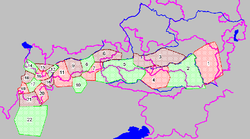
The term "Central Alps" is very common in the Geography of Austria as one of the seven major landscape regions of the country. "Central Eastern Alps" is usually used in connection with the Alpine Club classification of the Eastern Alps (Alpenvereinseinteilung, AVE). The Central Alps form the eastern part of the Alpine divide, its central chain of mountains, as well as those ranges that extend or accompany it to the north and south.

The highest mountain in the Austrian Central Alps is Grossglockner at 3,798 metres (12,461 ft).

Location

[edit]

The Central Alps have the highest peaks of the Eastern Alps, and are located between the Northern Limestone Alps and the Southern Limestone Alps, from which they differ in geological composition.

The term "Central Eastern Alps" may also be used more broadly to refer to a larger area of the Eastern Alps, mainly located in Austria, extending from the foot of the Bergamasque Alps at Lake Como and the Bernina Range in the Graubünden canton of eastern Switzerland along the Liechtenstein shore of the Rhine in the west as far as to the lower promontories east of the river Mur including the Hochwechsel in Austrian Styria. The valleys of the rivers Inn, Salzach and Enns mark their northern boundary, the Drau river (roughly corresponding to the Periadriatic Seam) their southern border. In the proposed SOIUSA system, the "Central-eastern Alps" include the Rhaetian Alps, of which the Bernina Range includes the 4,049-meter Piz Bernina in Switzerland, the easternmost 4,000-meter peak of the Alps. In the AVE system, however, the full list of mountain groups in the Alpine Club classification of the Eastern Alps includes the Bernina and neighboring ranges within the Western Limestone Alps, not the Central Eastern Alps as the Alpine Club defines them.

Central Alps as a major landscape region in Austria

[edit]

In Austria, the Eastern Alps are divided into the Northern Alps, the Greywacke zone, the Central Alps and the Southern Alps. The latter lie partly in South Carinthia, but mainly in Northeast Italy.

The Central and Northern Alps are separated by the Northern Longitudinal Trough (nördliche Längstalfurche), the line KlostertalArlbergInn Valley–Salzach Valley as far as Lake ZellWagrain Heights–Upper Enns Valley–Schober PassMürz Valley Alps–Semmering–southern Vienna Basin.[2] The Central Alps and Southern Alps are separated from one another by the Southern Longitudinal Valley (südlichen Längstalzug) Puster Valley (Rienz Valle–Toblach Field–upper Drava (Drau) Valley)–Drava Valley–Klagenfurt Basin–Meža (Mieß), or the Periadriatic Seam, which is not entirely identical with the Southern Longitudinal Trough.

Geomorphology

[edit]

The range has the highest summits in the Eastern Alps and is the most glaciated. In the transition zone between the East and West Alps, its peaks clearly dominate the region to the west (Piz d'Err, Piz Roseg). On the perimeter, however, there are also less high, often less rugged mountain chains, like the Gurktal Alps and the eastern foothills.

The Eastern Alps is separated from the Western Alps by a line from Lake Constance to Lake Como along the Alpine Rhine valley and via the Splügen Pass.

Geology

[edit]
Geological makeup of the Alps: The Central Alps are formed from the crystalline East Alpine 
and several windows, regional nappes and islands   

The Central Alps consist mainly of the gneiss and slate rocks of the various Austroalpine nappes (Lower and Upper Austroalpine), with the exception of the Hohe Tauern and Engadine windows, where they are composed mostly of Jurassic rock and limestones and, locally, (Bergell and Rieserferner) also of granite. The Austroalpine nappes are thrusted over the Penninic nappe stack. Massifs of autochthonous, crystalline rock, which hardly moved at all during Alpine folding, do not occur in the Central Alps – unlike the case in the Western Alps. The aforementioned granite intruded near the fracture zone of the Periadriatic Seam. The Western Alps do not have this division into the Northern Limestone Alps, Central Alps and Southern Limestone Alps.

The Austroalpine submerges itself at the eastern edge of the Alps under the Tertiary sediments of the Alpine Foreland in the east and the Pannonian Basin. This fracture zone exhibits active volcanism (e.g. in the Styrian thermal region).

Alpine Club classification

[edit]
AVE-
No.
Name Map Country Highest mountain Height (m) Image
25 Rätikon Flag of Switzerland Switzerland
Flag of Austria Austria
Flag of Liechtenstein Liechtenstein
Schesaplana 2,964 Schesaplana (2,964 m)
26 Silvretta Alps Flag of Switzerland Switzerland
Flag of Austria Austria
Piz Linard 3,411 Piz Linard (3,411 m)
27 Samnaun Alps Flag of Austria Austria
Flag of Switzerland Switzerland
Muttler 3,294 The Muttler
28 Verwall Alps Flag of Austria Austria Hoher Riffler 3,168 Hoher Riffler (3,168 m)
29 Sesvenna Alps Flag of Switzerland Switzerland
Flag of Italy Italy
Flag of Austria Austria
Piz Sesvenna 3,204 Piz Sesvenna (3,204 m)
30 Ötztal Alps Flag of Austria Austria
Flag of Italy Italy
Wildspitze 3,768 Wildspitze (3,768 m)
31 Stubai Alps Flag of Austria Austria
Flag of Italy Italy
Zuckerhütl 3,507 Zuckerhütl (3,507 m)
32 Sarntal Alps Flag of Italy Italy Hirzer 2,781 Hirzer (2,781 m, links)
33 Tux Alps Flag of Austria Austria Lizumer Reckner 2,884 Lizumer Reckner (2,884 m)
34 Kitzbühel Alps[a] Flag of Austria Austria Kreuzjoch 2,558 Kreuzjoch (2,558 m)
35 Zillertal Alps Flag of Austria Austria Hochfeiler 3,510 Hochfeiler (3,510 m)
36 Venediger Group Flag of Austria Austria Großvenediger 3,666 Großvenediger (3,666 m)
37 Rieserferner Group Flag of Italy Italy
Flag of Austria Austria
Hochgall 3,436 Hochgall (3,436 m)
38 Villgraten Mountains Flag of Austria Austria
Flag of Italy Italy
Weiße Spitze 2,962 Weiße Spitze (2,962 m, links)
39 Granatspitze Group Flag of Austria Austria Großer Muntanitz 3,232 Großer Muntanitz (3,232 m)
40 Glockner Group Flag of Austria Austria Großglockner 3,798 Großglockner (3,798 m)
41 Schober Group Flag of Austria Austria Petzeck 3,283 Petzeck (3,283 m)
42 Goldberg Group Flag of Austria Austria Hocharn 3,254 Hocharn (3,254 m)
43 Kreuzeck Group Flag of Austria Austria Mölltaler Polinik 2,784 Mölltaler Polinik (2,784 m)
44 Ankogel Group Flag of Austria Austria Hochalmspitze 3,360 Hochalmspitze (3,360 m)
45a Radstadt Tauern Flag of Austria Austria Weißeck 2,711 Weißeck (2,711 m)
45b Schladming Tauern Flag of Austria Austria Hochgolling 2,862 Hochgolling (2,862 m)
45c Rottenmann and Wölz Tauern Flag of Austria Austria Rettlkirchspitze 2,475 Rettlkirchspitze (2,475 m)
45d Seckau Tauern Flag of Austria Austria Geierhaupt 2,417 Geierhaupt (2,417 m)
46a Gurktal Alps Flag of Austria Austria Eisenhut 2,441 Schwarzsee with Eisenhut (2,441 m) in the background
46b Lavanttal Alps Flag of Austria Austria
Flag of Slovenia Slovenia
Zirbitzkogel 2,396 Zirbitzkogel (2,396 m)
47 Prealps East of the Mur Flag of Austria Austria Stuhleck 1,782 Summit cross on the Stuhleck (1,782 m)

The Central Eastern Alps also comprise the following ranges of the West Eastern Alps according to AVE classification, which geologically belong to the Southern Alps and are also subsumed under the Western Limestone Alps division.:

  1. ^ The Kitzbühel Alps and the adjacent Salzburg Slate Alps as part of the Greywacke zone are either counted as part of the Northern Limestone Alps or the Central Alps – geologically they form the bedrock of the Limestone Alps, and the slip zone, on which the latter were thrust northwards
AVE-
No.
Name Map Country Highest mountain Height (m) Image
63 Plessur Alps Flag of Switzerland Switzerland Aroser Rothorn 2,980 Aroser Rothorn (2,980 m)
64 Oberhalbstein Alps Flag of Switzerland Switzerland
Flag of Italy Italy
Piz Platta 3,392 Piz Platta (3,392 m)
65 Albula Alps Flag of Switzerland Switzerland Piz Kesch 3,418 Piz Kesch (3,418 m)
66 Bernina Group Flag of Italy Italy
Flag of Switzerland Switzerland
Piz Bernina 4,049 Piz Bernina (4,049 m)
67 Livigno Alps Flag of Italy Italy
Flag of Switzerland Switzerland
Cima de’ Piazzi 3,439 Cima de’ Piazzi (3,439 m)
68 Bergamasque Alps[a] Flag of Italy Italy Pizzo di Coca 3,052 Pizzo di Coca (3,052 m)
  1. ^ The Bergamasque Alps are – geologically and petrologically – part of the Southern Limestone Alps, and thus the Southern Alps

The Ortler Alps as well as the Sobretta-Gavia Group are also sometimes classified with the Central Alps, because they lie north of the geological fault of the Periadriatic Seam; in a general regional geographic sense, however, they are seen as part of the Southern Limestone Alps, because they are found south of the longitudinal trough Veltlin (Adda)–Vintschgau (Etsch).[3] Also in terms of rock, the Ortler main crest is part of the Southern Limestone Alps.

See also

[edit]

References

[edit]
[edit]
Revisions and contributorsEdit on WikipediaRead on Wikipedia
from Grokipedia
The Central Eastern Alps constitute the central segment of the mountain system in , spanning primarily across western and central , with extensions into and , and forming a key physiographic division characterized by rugged terrain, deep valleys, and elevations rising to over 4,000 meters. This region, defined within the Alpine Club classification of the (Alpenvereinseinteilung der Ostalpen, AVE), encompasses numerous subranges including the Hohe Tauern, , Stubai Alps, and Bernina Range, covering an approximate area of around 30,000 square kilometers and serving as a critical watershed for major European rivers such as the , , and upper tributaries. Geologically, the Central Eastern Alps result from the collision between the African and Eurasian plates during the era, featuring a stack of nappes from the Penninic and Austroalpine domains, with the prominent Tauern Window—a tectonic exposure of pre-Alpine basement rocks—revealing metamorphic grades up to amphibolite facies and providing insights into the orogen's deep structure. The area's lithology includes crystalline basements, schists, limestones, and extensive glacial deposits, shaped by multiple phases of uplift and erosion since the Eocene, with ongoing isostatic rebound influencing current topography. Ecologically, the Central Eastern Alps host diverse alpine biomes, from montane forests to nival zones above the treeline, supporting unique flora like edelweiss and fauna including , , and golden eagles, while glaciers—numbering over 300 in protected areas—cover about 1% of the surface and contribute significantly to regional . The region includes the Hohe Tauern National Park, Austria's largest at 1,856 km², established between 1981 and 1992 and spanning three federal states, which preserves over 300 peaks exceeding 3,000 meters, 332 glaciers (as of 2015) totaling 126 km², and 279 streams, underscoring its role in biodiversity conservation. Human activities, such as , , and hydroelectric power generation, have long shaped the landscape, with the highest peak, at 4,049 meters in the Bernina Range, symbolizing the area's heritage.

Overview and Definition

Extent and Boundaries

The Central Eastern Alps form the central crystalline zone of the , consisting primarily of Austroalpine and Penninic basement rocks that represent the core of the , sandwiched between the sedimentary-dominated to the north and the to the south. This zone is characterized by metamorphic and igneous complexes exposed through tectonic windows like the Tauern Window, distinguishing it as the structural backbone of the eastern Alpine arc. The northern boundary follows the valleys of the , , and Enns rivers, where the Grauwacken Zone serves as a transitional belt of metamorphic sediments between the and the crystalline core. This boundary marks a shift from platforms to the deeper, overthrust crystalline units of the Central Eastern Alps. To the south, the boundary is defined by the Periadriatic Seam, also known as the Insubric Line, a major dextral shear zone that separates the Central Eastern Alps from the Southern Alps, with the Drau River valley further delineating the eastern segment of this limit. This fault system accommodated significant lateral displacement during Alpine collision. The western extent stretches from a line connecting Lake Constance (Bodensee) via the Rhine Valley and Splügen Pass to Lake Como, incorporating the Bernina Range as its southwesternmost crystalline massif. In the east, it reaches just beyond the Mur River valley, encompassing territories in Austria (primarily the states of Tyrol, Salzburg, Carinthia, and Styria), Switzerland, Liechtenstein, Italy, and Slovenia. The region spans roughly 46°–47.5° N latitude and 9°–15° E longitude and playing a key role in subdividing the broader Eastern Alps.

Significance in the Alpine System

The constitute the core of the , characterized by the highest-elevation zones and serving as a transitional region between the predominantly crystalline Western Alps and the more calcareous peripheral sectors to the east. This central sector features extensive high-relief crystalline massifs, such as the Hohe Tauern and Zillertal Alps, with average elevations exceeding 3,000 meters along the main divide, contrasting with the lower-lying limestone-dominated Northern Calcareous Alps (typically under 2,500 meters). Unlike the Western Alps, where glaciation is more dispersed due to varied , the Central Eastern Alps exhibit concentrated, high-volume ice cover in their axial zones, contributing to a denser glacial network that influences regional erosion patterns and . As the primary hydrological divide of the European continent, the Central Eastern Alps form the critical watershed separating northern drainage to the Black Sea via the Danube River and southern flows to the Adriatic and Po basins. Major rivers originating here include the Inn and Salzach, which flow northward into the Danube, supplying significant discharge to Central Europe's largest river system, while the Adige drains southward to the Po Valley and the Drava courses eastward before joining the Danube, underscoring the region's role in transboundary water management. This divide regulates water resources for over 80 million people across multiple nations, with the crystalline core acting as a permeable barrier that sustains both alpine springs and downstream aquifers. Historically and culturally, the Central Eastern Alps have been pivotal in advancing geological understanding of the , with their exposed structures providing foundational evidence for plate convergence models since the . The region anchored the Habsburg Empire's territorial core, encompassing Tyrol and as strategic landscapes that shaped imperial trade and defense, while influencing Central European climate through orographic precipitation barriers that foster diverse microclimates. Key trans-Alpine routes, such as the , facilitated medieval commerce and modern connectivity, embedding the area in broader European cultural exchanges. Economically, the Central Eastern Alps drive regional prosperity through abundant hydroelectric potential, generating over 60% of Austria's electricity from alpine reservoirs in areas like the and Tauern, alongside historical mineral extraction of copper, silver, and salt from Tyrolean and Salzburger deposits. Tourism thrives in hubs like and , attracting millions annually for , , and , contributing up to 15% of local GDP in alpine districts. Compared to peripheral zones, this central area's elevated terrain amplifies these sectors by offering year-round high-altitude attractions. In contemporary contexts, the Central Eastern Alps hold modern relevance as a and protected landscape, exemplified by Hohe Tauern —the largest in the at 1,856 km²—which preserves its glacial and endemic ecosystems. The region also underpins trans-Alpine transport corridors, with infrastructure like the enhancing EU connectivity while balancing environmental pressures from increased freight volumes.

Geography

Topography and Major Features

The Central Eastern Alps feature a dramatic characterized by towering crystalline massifs, sharply sculpted peaks, and deeply incised valleys interspersed with high plateaus, forming a rugged high-mountain that spans parts of , , , and . These massifs rise prominently, with numerous summits exceeding 3,000 m in , contributing to over 500 such peaks across the region and creating a visually striking contrast between alpine heights and surrounding lowlands. The overall profile emphasizes steep gradients and localized , where crystalline core zones dominate the central and western sectors, transitioning eastward to more undulating terrain influenced by tectonic folding. Key subranges within the Central Eastern Alps include the , where the stands as the highest peak at 3,768 m; the Stubai Alps, crowned by the Zuckerhütl at 3,507 m; the Hohe Tauern, home to Austria's loftiest summit, the at 3,798 m; the Zillertal Alps, with the Hochfeiler reaching 3,509 m; and the Gurktal Alps, topped by the Eisenhut at 2,441 m. The highest point in the entire Central Eastern Alps is at 4,049 m, located in the Bernina Range along the Switzerland-Italy border, marking the easternmost 4,000 m peak in the Alpine arc. These subranges exhibit varied morphologies, from the glacier-clad summits of the Hohe Tauern to the more dissected profiles of the Ötztal and Stubai Alps, each contributing to the region's alpine diversity. Deep gorges, exemplified by the Pasterze Valley in the Hohe Tauern, descend sharply from glaciated highlands, hosting Austria's longest glacier tongue at 4 km and underscoring the interplay of ice and rock in valley carving. Toward the east, the Central Eastern Alps gradually descend into lower, forested foothills, where elevations drop below 1,500 m and coniferous woodlands encroach on former grassland ecotones, marking a shift from stark alpine relief to more temperate, vegetated slopes. The of the Central Eastern Alps is marked by extreme vertical drops, often exceeding 2,000 m from summit to valley floor over short horizontal distances, which fosters diverse microclimates and limits accessibility while enhancing the region's hydrological and ecological gradients. Glacial coverage persists on many high peaks, particularly in the western subranges, amplifying the topographic complexity through ongoing ice sculpting.

Hydrology and Glaciers

The hydrology of the Central Eastern Alps is characterized by a network of major rivers that drain the region's high and glacial , forming a critical along the Alpine crestline. North-flowing rivers, including the , , and Enns, contribute to the basin, carrying water eastward toward the . South-flowing systems, such as the , direct runoff southward to the Po basin and ultimately the , while the , originating in the southern flanks, joins the further east. Key tributaries, like the rivers in the upper catchment, enhance these networks by channeling from the rugged , with the overall watershed underscoring the ' role as a primary divide between northern and southern European drainage systems. Glaciers represent a vital component of the region's , storing and releasing water that sustains river flows, particularly during dry seasons. The Central Eastern Alps host significant glacial coverage, with glaciers spanning approximately 600 km², predominantly in (329.55 km² as of 2024), plus contributions from and . The Pasterze Glacier, 's largest and the longest in the at about 8 km, descends from the in Hohe Tauern , covering 15 km² (as of 2025) and feeding tributaries of the Möll River. The Gepatschferner, the second-largest in at 7.8 km long and 16.6 km², lies in the Ötztal Alps and supplies to the Kaunertal system. Glacier dynamics in the Central Eastern reflect ongoing retreat driven by climatic warming, with significant volume losses recorded since 1850. These glaciers have lost approximately 64% of their volume since the maximum as of 2015, with area losses reaching 57% by then, accelerating in the due to rising temperatures. Current remains negative, averaging around -1 m water equivalent per year across the , indicating persistent imbalance between accumulation and . Recent observations show continued rapid retreat; for example, in 2022/2023, measured Austrian glaciers shortened by an average of 23.9 m, with projections suggesting most could disappear within 45 years under current trends. High-alpine lakes and wetlands further define the hydrological landscape, serving as natural tarns and engineered reservoirs that regulate water flow and support . The Vernagtsee (Lake Vernago), a at 1,689 m elevation in South Tyrol's Schnalstal Valley, exemplifies a high-alpine tarn impounded by a 65 m since the 1950s, covering 100 hectares and fed by glacial streams like the Schnalser Bach. Similarly, the Reservoir in Austria's Hohe Tauern region, comprising the Mooserboden and Wasserfallboden basins, stores for pumped-storage , generating equivalent to 10% of Austria's through massive walls exceeding 100 m in height. These features not only buffer seasonal water variability but also highlight human adaptation to the region's glacial .

Geology

Tectonic Formation

The tectonic formation of the Central Eastern Alps initiated during the period around 100 Ma, driven by the of the Alpine beneath the Eurasian margin, marking the onset of convergence between the African and European plates. This process involved the closure of the , which had formed through rifting in the to , leading to the development of and passive margins that were later incorporated into the orogen. The main phase of uplift occurred during the Eocene to (approximately 50–30 Ma), as the collision between the Adriatic promontory of the African plate and the European plate intensified, resulting in continental and crustal thickening. Key orogenic events shaped the region's architecture, including the Eoalpine orogeny in the , characterized by high-pressure (up to eclogite facies) in the Austroalpine units due to intra-Adria subduction, followed by the main in the Tertiary with low-temperature/high-pressure around 40 Ma. During the Tertiary, indentation of the rigid Adriatic plate caused lateral extrusion of the orogenic wedge eastward, accommodating strain through escape tectonics and facilitating exhumation of deeper units. The structure reflects this , with the Central Eastern Alps dominated by northward-thrust Austroalpine nappes overlying Penninic units; prominent tectonic windows, such as the Tauern Window, expose underlying European-derived Penninic basement rocks, revealing the stacked architecture of subducted and obducted sequences. Major fault systems delineate the orogen's boundaries and internal divisions, including the Periadriatic Line, a prominent dextral strike-slip fault that marks the northern edge of the South Alpine units and accommodated lateral displacement during indentation. The Salzach-Enns fault zone serves as a sinistral strike-slip boundary separating the Central from the , influencing exhumation of the Tauern Window and facilitating orogen-parallel extension. Uplift rates accelerated post- to 1–2 mm/year, driven by a combination of tectonic forces and ongoing isostatic rebound following glacial unloading, contributing to the current topographic relief.

Rock Types and Structure

The Central Eastern Alps feature a crystalline basement predominantly composed of , , and , formed during the around 300 Ma. These rocks exhibit polymetamorphic histories, with the gneisses often showing migmatitic textures and the schists displaying pronounced . Amphibolites, derived from protoliths, are subordinate but widespread, particularly in units like the Tauern window. Metamorphic grades in this basement span from to eclogite , reflecting intense pressure-temperature conditions during Variscan and subsequent Alpine events. Eclogite-facies assemblages, including omphacite and , occur in high-pressure relics within the Penninic units, while greenschist-facies rocks dominate lower-grade zones. These variations result from the stacking of tectonic units during Alpine convergence. Sedimentary overlays mantle the basement in peripheral zones, consisting of Permian to limestones and dolomites that formed on carbonate platforms. In the Northern Calcareous Alps, thick sequences of dolomites like the Hauptdolomit and limestones such as the Dachsteinkalk are prominent. The Grauwacken Zone, a transitional belt, features deposits—turbiditic sandstones and shales of to Eocene age—deposited in a setting. Intrusive rocks, primarily granites and adamellites, are concentrated along the Periadriatic Seam, a major Oligocene-age fault zone. The Adamello massif exemplifies this, with intrusions emplaced between 42 and 38 Ma, forming the largest in the and showing calc-alkaline affinities. Structurally, the region is characterized by folded nappes exhibiting inverted , where older rocks overlie younger ones due to tectonic inversion. zones develop along major faults, such as the Fault, recording sinistral shear and cataclastic deformation. In the Tauern window, mineral resources include and deposits hosted in metamorphic schists and marbles, exploited historically for industrial uses. Tectonic thrusting during the Alpine orogeny has exposed these diverse rock assemblages at the surface, with a Paleozoic core overlain by Mesozoic sedimentary cover and minor Cenozoic volcanics and intrusives.

Geomorphology

Landform Development

The landform development of the Central Eastern Alps reflects a complex interplay of tectonic uplift and erosional processes spanning the Cenozoic era, with pre-Quaternary phases establishing the foundational massifs and elevated surfaces. During the Miocene, significant rock uplift shaped the initial high-relief topography, elevating planation surfaces—remnants of earlier low-relief landscapes—to altitudes of approximately 2,000–2,500 meters in regions such as the Northern Calcareous Alps. These surfaces, formed through prolonged subaerial erosion, represent a key stage in the orogen's evolution, preserved despite subsequent tectonic activity. The evolutionary trajectory of these landforms traces back to an , a broad, low-relief erosion surface developed across the proto-Alps following Eocene collision dynamics, which was subsequently dissected and uplifted. This underwent progressive incision starting in the , driven by renewed tectonic phases, leading to the formation of deep valleys and gorges by the Pleistocene. In the Central Eastern Alps, such dissection is evident in the contrast between elevated summit plateaus and incised fluvial networks, marking a shift from planation to relief rejuvenation. Valley formation in the region is predominantly controlled by structural features, with major faults guiding the alignment of longitudinal valleys parallel to the orogen's strike. For instance, the valley follows Miocene strike-slip faults associated with the Periadriatic lineament, channeling river incision that has deepened the valley to over 1,000 meters in places. These faults not only dictate valley orientation but also facilitate differential uplift, enhancing gorge development through focused fluvial erosion along weakened zones. Karstification has further sculpted the landscape, particularly at contacts between dolomite and limestone formations in the eastern sectors, leading to the development of poljes and sinkholes. In areas like the Seckau , within the Austroalpine units, dissolution processes have created extensive karst networks, including flat-floored poljes up to several kilometers long and numerous sinkholes, resulting from groundwater circulation in soluble carbonates. These features highlight the role of chemical in modifying pre-existing tectonic relief, especially in the drier eastern margins of the Central Eastern . The balance between tectonic and erosional forces maintains the dynamic equilibrium of these landforms, with counteracting rates estimated at 0.2–0.9 mm per year across the region. This ongoing adjustment, primarily driven by flexural in response to erosion unloading, sustains high elevations while allowing surface lowering through fluvial and hillslope processes. Later glacial overprinting has accentuated these pre-existing valleys, but the core structural framework remains tectonically inherited.

Glacial and Erosional Processes

The Würm glaciation, representing the final major cold stage of the Pleistocene from approximately 115,000 to 11,700 years ago, profoundly influenced the Central Eastern Alps through extensive ice cover during its phase around 26,500–19,000 years ago. Valley glaciers and coalescing icefields occupied much of the high-relief terrain, with ice thicknesses reaching up to 1,500 meters in some Austrian valleys, transforming pre-existing fluvial landscapes into glaciated systems. Multiple stadials within this period, including advances during the Gschnitz and Daun phases, featured cirque glaciers initiating in high s and expanding into valley systems, with evidence of at least three major glacial pulses in the northern sectors. These cycles of accumulation and sculpted the region's , leaving a legacy of ice-marginal positions traceable through dated sediments. Glacial erosion during these advances generated distinctive landforms, including broad U-shaped valleys such as the troughs in the Engadine area, where ice overdeepened and straightened pre-glacial V-shaped channels. Hanging valleys, formed by smaller glaciers that did not erode as deeply as main trunk glaciers, often terminate abruptly above the main valley floors, creating potential sites for waterfalls. Roches moutonnées, with their upstream polished and striated surfaces and downstream plucked faces, indicate unidirectional ice flow across resistant outcrops. Lateral and terminal moraines, composed of pushed along valley sides and at ice fronts, delineate former extents, as seen in deposits along the Inn Valley. Periglacial processes, active in ice-free zones and during interstadials, produced features above the timberline, including rock glaciers—lobate accumulations of angular debris with embedded that advance slowly downslope. Solifluction lobes, resulting from freeze-thaw cycles mobilizing saturated on slopes, form stepped or tongue-like patterns in areas of seasonal . Nivation hollows, shallow depressions excavated by prolonged and associated chemical , are prevalent on north-facing slopes where snow persists longest. These features reflect the harsh periglacial climate, with and blockfields also common in high elevations. Post-deglaciation paraglacial adjustments continue to reshape the , as debuttressed slopes undergo relaxation through rockfalls, landslides, and flows, redistributing glacially conditioned . Contemporary is dominated by in steep terrains and fluvial incision in valleys, yielding average rates of about 0.2 mm per year across many catchments, though locally higher in active zones. These rates, derived from river loads and cosmogenic nuclides, underscore the ongoing transition from glacial to non-glacial dominance. Glacial erratics, large boulders displaced from central massifs like the Hohe Tauern, and widespread till deposits of unsorted debris provide direct evidence of ice flow pathways, with lithological matching revealing radial outflow from accumulation centers toward peripheral forelands. Such indicators, combined with striations on , confirm the extent and directionality of Würm dynamics in the .

Climate and Environment

Climatic Characteristics

The Central Eastern Alps feature a diverse climate shaped by elevation gradients and atmospheric influences, with higher summits classified under the Köppen-Geiger system as alpine tundra (ET), marked by perpetually cold conditions and limited vegetation, while valley floors align with humid continental (Dfb) regimes, experiencing distinct seasonal variations. These zones are modulated by Atlantic westerlies, which deliver moist air masses from the northwest, promoting orographic precipitation on northern slopes, and by Mediterranean-derived foehn winds from the south, which introduce warm, dry airflows capable of rapidly altering local conditions. Temperature regimes exhibit pronounced vertical gradients, with annual means averaging around 0°C at 3,000 m due to adiabatic cooling, dropping to 8–10°C in lower valleys at approximately 500–1,000 m. Winter temperature inversions are common, trapping cold air in basins and exacerbating risks, while diurnal and seasonal fluctuations intensify with altitude. Precipitation is abundant and elevation-dependent, ranging from 1,500 to 2,500 mm annually across the region, with the majority (peaking October to May) falling as at higher altitudes due to orographic enhancement on windward northern faces. Southern leeward slopes receive less, often 800–1,200 mm, owing to effects from the barrier of major ranges like the Hohe Tauern. Extreme weather events punctuate the , including frequent major —up to 100 significant occurrences per year in high-risk zones during heavy snowfall winters—and foehn episodes that can elevate temperatures by 20°C or more within hours through downslope compression and release. These foehns, prevalent in valleys like those in Tyrol, often gust over 100 km/h and contribute to heightened avalanche instability by accelerating snowmelt. Climate change has amplified warming in the region by approximately 1.5–2°C since 1900, outpacing global averages and driving accelerated retreat, with over 50% volume loss in many Central Eastern Alpine glaciers since the mid-19th century. As of 2025, glaciers in the Swiss Eastern Alps have lost approximately 24% of their volume since 2015, underscoring rapid ongoing changes. Projections under moderate emissions scenarios indicate seasonal shifts in by 2100, with increases in winter (up to ~20%) and decreases in summer (up to ~20%), resulting in little net change in annual totals, potentially intensifying winter and risks while further stressing high-elevation .

Ecology and Biodiversity

The Central Eastern Alps exhibit remarkable ecological diversity due to their steep elevational gradients, which create a of habitats from montane forests to high-alpine , fostering specialized and adapted to extreme conditions. This region, encompassing parts of , , and , supports over 3,000 , representing more than a third of Austria's total , alongside thousands of animal that thrive in its varied microclimates. Ecosystems here are characterized by dynamic interactions between , , and biological communities, with hotspots emerging in geologically unique areas like the Tauern Window, where exposed rock formations enhance heterogeneity for endemic . Vegetation in the Central Eastern Alps is organized into altitudinal belts that reflect climatic transitions. In the montane zone (below approximately 1,700 m), mixed deciduous and coniferous forests dominate, featuring beech (Fagus sylvatica) and fir (Abies alba) in valleys, providing foundational cover for understory herbs and shrubs. The subalpine zone (1,500–2,000 m) transitions to open larch (Larix decidua) and stone pine (Pinus cembra) woodlands interspersed with dwarf shrub heaths, including blueberries (Vaccinium) and alpine roses (Rhododendron ferrugineum), which stabilize soils and support pollinator networks. Higher up, the alpine zone (2,000–3,000 m) consists of meadows rich in herbaceous perennials such as edelweiss (Leontopodium nivale), gentians (Gentiana), and mountain avens (Dryas octopetala), forming colorful pastures that peak in summer bloom. At the nival zone (above 3,000 m), sparse pioneer communities of lichens, mosses, and cushion plants like glacier buttercup (Ranunculus glacialis) and alpine toadflax (Linaria alpina) endure harsh winds, short growing seasons, and perpetual snow. Faunal diversity complements this floral stratification, with over 15,000 animal documented, including endemics and reintroduced populations that underscore the region's conservation significance. Mammals such as the (Rupicapra rupicapra) and (Capra ibex), agile climbers adapted to rocky terrains, roam subalpine and alpine slopes, while marmots (Marmota marmota)—reintroduced in the early —burrow in meadows for herbivory and hibernation. Predatory birds like the (Aquila chrysaetos) patrol vast territories for ungulates, and the (Gypaetus barbatus), a scavenger reintroduced in the 1980s, aids nutrient cycling across elevations. Transboundary species, including brown bears (Ursus arctos) recolonizing from Slovenian populations following reintroductions in central in the late 1980s and early 1990s, highlight connectivity challenges in the , with individuals dispersing into the Central Eastern sector. Aquatic and semi-aquatic , such as the endemic (Ichthyosaura alpestris), inhabit wetlands and streams, alongside diverse invertebrates like endemic and beetles in habitats. Key ecosystems include high-alpine meadows that serve as foraging grounds for herbivores, scree slopes hosting rupicolous (rock-dwelling) plants and reptiles, and montane wetlands that filter water and support amphibians amid glacial melt influences. These habitats, particularly in protected cores, maintain ecological processes like and , though altitudinal shifts in species distributions are observed in response to warming trends. The Hohe Tauern , spanning 1,856 km² across Austria's federal states of , , and Tyrol, exemplifies this diversity as the largest protected area in the , encompassing representative zones from forests to glaciers and recognized under IUCN Category II for strict conservation. Biodiversity faces pressures from driven by infrastructure, such as ski resorts and trails that disrupt migration corridors in subalpine areas, and encroaching from lowlands into disturbed montane edges, including like Himalayan balsam () that outcompete natives. These threats compound in hotspots around the Tauern Window, where unique metamorphic exposures foster specialized communities vulnerable to . Conservation measures prioritize connectivity and protection through the EU network, which designates approximately 30% of Austria's terrestrial area—including nearly all of Hohe Tauern (1,831 km²)—to safeguard 31 priority types and species like the and larch-stone pine forests via management plans and monitoring. Initiatives also focus on reintroduction and restoration, ensuring the persistence of endemic taxa amid ongoing environmental changes.

Human Aspects

Settlement Patterns

The Central Eastern Alps exhibit low overall , averaging approximately 60 inhabitants per square kilometer, with settlements predominantly concentrated in river valleys and foothills where and transport access are available. Higher densities occur in urban centers such as , with around 132,000 residents, and , home to about 157,000 people, which serve as key hubs for regional connectivity and services. In contrast, higher elevations feature sparse, seasonally occupied alpine pastures associated with traditional pastoral activities, limiting permanent habitation due to harsh terrain and climate. Historical settlement patterns in the region were profoundly influenced by resource extraction and pastoral economies, leading to the development of compact mining towns and dispersed hamlets. Medieval in , for instance, attracted thousands of workers, swelling the town's population to about 20,000 by 1510 and establishing it as a major economic center second only to in the . practices, involving seasonal livestock migration between valley farms and high pastures, further shaped a pattern of scattered rural hamlets across the landscape, fostering resilient, small-scale communities adapted to vertical mobility. Contemporary demographics reflect an aging and ongoing outmigration, particularly from peripheral rural areas, with the proportion of aged 65 and older reaching 18.7% in the Austrian portions of the region as of 2013. The total resident across the Central Eastern Alps is estimated at around 2 million as of 2023, with approximately 70% living in , where negative balances have contributed to depopulation in remote municipalities despite some international inflows. This trend exacerbates challenges in sustaining services in isolated communities, though urban valleys continue to attract younger workers. The urban-rural divide is stark, with valley cities functioning as vital transport and administrative nodes, while high-altitude villages preserve amid declining permanent residency. Places like , a UNESCO-listed site with fewer than 800 inhabitants, exemplify preserved medieval salt-mining settlements, offering insights into prehistoric and early modern alpine life through ancient burial sites and mining artifacts. Such villages contrast with bustling lowlands, highlighting a mosaic of interconnected yet distinct habitation types. Infrastructure developments have enhanced regional connectivity, mitigating isolation for valley and highland settlements alike. The railway tunnel, spanning 10.7 kilometers and operational since 1884, links eastern and western , facilitating efficient passenger and freight movement between Tyrol and . Similarly, the road and the under-construction 55-kilometer bolster north-south links to , supporting economic integration and reducing travel times across the alpine barrier.

Economy, Tourism, and Conservation

The economy of the Central Eastern relies heavily on production, particularly , which harnesses the region's abundant glacial and steep gradients through a network of dams and reservoirs. In , alpine dams contribute approximately 60% of the country's total , underscoring the ' pivotal role in national energy security. , 's largest energy provider, operates over 100 facilities, with more than 90% located in the Central Eastern , producing around one-third of the nation's from these sources. Historical activities, including in areas like the Eisenerz and gold panning in the Tauern region, date back to , with an estimated 50,000 tonnes of produced between 1800 B.C. and 100 B.C. Today, focuses on aggregates such as and for , supporting local infrastructure while adhering to strict environmental regulations. , centered on and alpine , plays a vital role in sustaining rural communities, with mountain farms comprising 56% of 's total agricultural holdings and contributing around 3.4% to the GDP of alpine provinces like Tyrol and . Tourism dominates the regional economy and contributes significantly to Austria's national figures, with over 40 million visitors annually to Austrian alpine areas for and summer outdoor activities, generating substantial revenue nationwide (approximately €38 billion in total spending as of 2019). remains a cornerstone, with 43.6 million skier days recorded in Austria's alpine areas and facilities like hosting world-class on approximately 580 hectares of slopes, many equipped with artificial systems. trails, such as the Eagle Walk in the Tyrol, span 64,000 kilometers across the region, attracting eco-conscious travelers and supporting over 600 mountain huts for overnight stays. The cultural sector enhances this appeal through like the , a premier gathering that bolsters local economies in Salzburg province, and UNESCO-listed sites such as the Hallstatt-Dachstein/ Cultural Landscape, which preserves prehistoric heritage while drawing heritage tourists. Conservation efforts in the Central Eastern Alps emphasize protected areas and cross-border initiatives to balance human use with ecological integrity. The Hohe Tauern National Park, Europe's largest at 1,856 square kilometers, and the Gesäuse National Park, covering 12,000 hectares in , safeguard diverse habitats including glaciers and endemic species through strict and programs. practices, aligned with directives since the early 2000s, promote low-impact activities via the Alpine Convention's guidelines, including biodiversity corridors that connect parks across , , and to facilitate wildlife migration. Challenges include pressures on sites like the , which sees millions of vehicles annually, straining and ecosystems, as well as climate-induced threats like glacier retreat. To address these, the has allocated significant funds for adaptation, with programs like and the supporting alpine projects totaling hundreds of millions of euros by 2025, focusing on resilient and habitat restoration.

Classification Systems

Alpine Club Classification

The Alpine Club classification, formally known as the Alpenvereins-Einteilung (), was developed jointly by the German Alpine Club (DAV) and the Austrian Alpine Club (ÖAV) to standardize the subdivision of the Eastern Alps into 75 distinct mountain groups for mountaineering purposes. Originally based on the Moriggl Classification from the , the system underwent a comprehensive revision initiated in 1982 and was officially published in 1984 in the Alpenvereins-Jahrbuch "Berg '84". This framework emphasizes practical utility, providing structured guidance for climbers, hikers, and explorers through dedicated guidebooks that detail routes, topography, and infrastructure within each group. Within this system, the Central Eastern Alps comprise approximately 23 groups, numbered 25 through 47, extending from the Rätikon in the west to the Lavanttal in the east. These groups represent a core segment of the ' high-alpine terrain, characterized by crystalline massifs, extensive glaciers, and rugged limestone formations. The classification delineates boundaries using orographic features (such as ridge lines and watersheds), hydrological divides (rivers and valleys), and accessibility considerations (like passes and trails), ensuring each group forms a cohesive unit for navigation and planning. Minor revisions since 1984 have primarily addressed international adjustments without altering the overall structure. Prominent groups in the Central Eastern Alps illustrate the system's diversity and elevation range. For instance, the Rätikon (Group 25) reaches its apex at Schesaplana (2,965 m), a sharp limestone peak ideal for routes. The Silvretta (Group 26) features Piz Linard (3,410 m), the range's highest point and a classic pyramid-shaped summit requiring glacier travel. Further east, the (Group 30) are dominated by (3,768 m), Austria's second-highest peak, while the Stubai Alps (Group 32) culminate in Zuckerhütl (3,507 m), known for its sugar-loaf profile and prominence. The expansive Hohe Tauern region encompasses several subgroups, including the Glockner Group (Group 40) with Großglockner (3,798 m), Austria's loftiest summit and a hallmark of high crystalline massifs, and the Granatspitz Group (Group 41), noted for its rugged formations. The AVE's enduring value lies in its integration with alpine infrastructure, where each group is supported by club-maintained maps and over 150 huts across the Central Eastern Alps, facilitating safe access to remote areas. These huts, operated by the DAV and ÖAV, offer overnight accommodations and serve as bases for multi-day tours, underscoring the classification's role as the primary reference for activities in the region.

Other Geographical and Geological Divisions

The Central Eastern Alps exhibit distinct geological divisions primarily structured around tectonic units formed during the . These include the underlying Penninic units, which encompass the central crystalline complex of gneisses and schists, and the overlying Austroalpine units consisting of metamorphic basement rocks and sedimentary covers. The Tauern Window serves as a critical tectonic exposure in the Hohe Tauern region, revealing Penninic nappes beneath Austroalpine units and providing insights into the orogen's internal structure. This subdivision highlights the region's role in the collision between the European and Adriatic plates, with the Austroalpine units representing the Adriatic margin and the Penninic units marking oceanic remnants. Alternative orographic classifications, such as the SOIUSA (Suddivisione Orografica Internazionale Unificata del Sistema Alpino) system developed in 2005 by Italian geographer Sergio Marazzi, offer a standardized international framework that integrates national schemes. SOIUSA divides the Alps into Western and Eastern parts, with the comprising five major sectors further subdivided into 22 sections and 132 subsections. This approach groups the Central Eastern Alps primarily into sectors such as the Rhaetian Alps and Noric Alps, facilitating cross-border analysis in and . In Austrian federal geography, the Central Alps are designated as a primary landscape region, encompassing the high crystalline core and spanning the states of Tyrol, , , and . This classification reflects administrative and physiographic boundaries, with elevations exceeding 3,000 meters dominating the terrain. The Niederoesterreich-Styrian Alps form the eastern extension of this region, transitioning into lower, more fragmented limestone ranges in and . Hydrological classifications of the Central Eastern Alps emphasize major drainage divides and basin management. The region lies astride the primary European watershed, separating the basin to the north and west from the basin to the south and east, influencing water flow patterns across multiple countries. Under the European Union's [Water Framework Directive](/page/Water Framework Directive) (2000/60/EC), these areas are integrated into river basin s, such as the River Basin , where ecological status assessments guide . International schemes provide broader environmental categorizations. The (UNEP) includes the Central Eastern Alps within its mountain ecosystem categories, recognizing them as high-altitude zones critical for and climate regulation under global assessments like the . Similarly, the International Union for Conservation of Nature (IUCN) delineates protected areas in the region using its management categories (I-VI), covering approximately 28% of the Alpine area with a focus on strict nature reserves and national parks to address fragmentation. Comparisons between classification systems reveal key differences in purpose and criteria. The Alpine Club classification (AVE), serving as the primary reference, prioritizes topographic features for guiding and exploration but often disregards geological boundaries, leading to overlaps with tectonic units. In contrast, modern geological schemes emphasize , while 19th-century historical divisions—such as those outlined in early Austrian and German Alpine Club studbooks—relied on rudimentary surveys and focused on accessible valleys, providing foundational but less precise delineations refined by subsequent tectonic mapping.

References

Add your contribution
Related Hubs
User Avatar
No comments yet.