


Community hub
Recent from talks
Contribute something
Nothing was collected or created yet.
Baghlah
View on Wikipedia

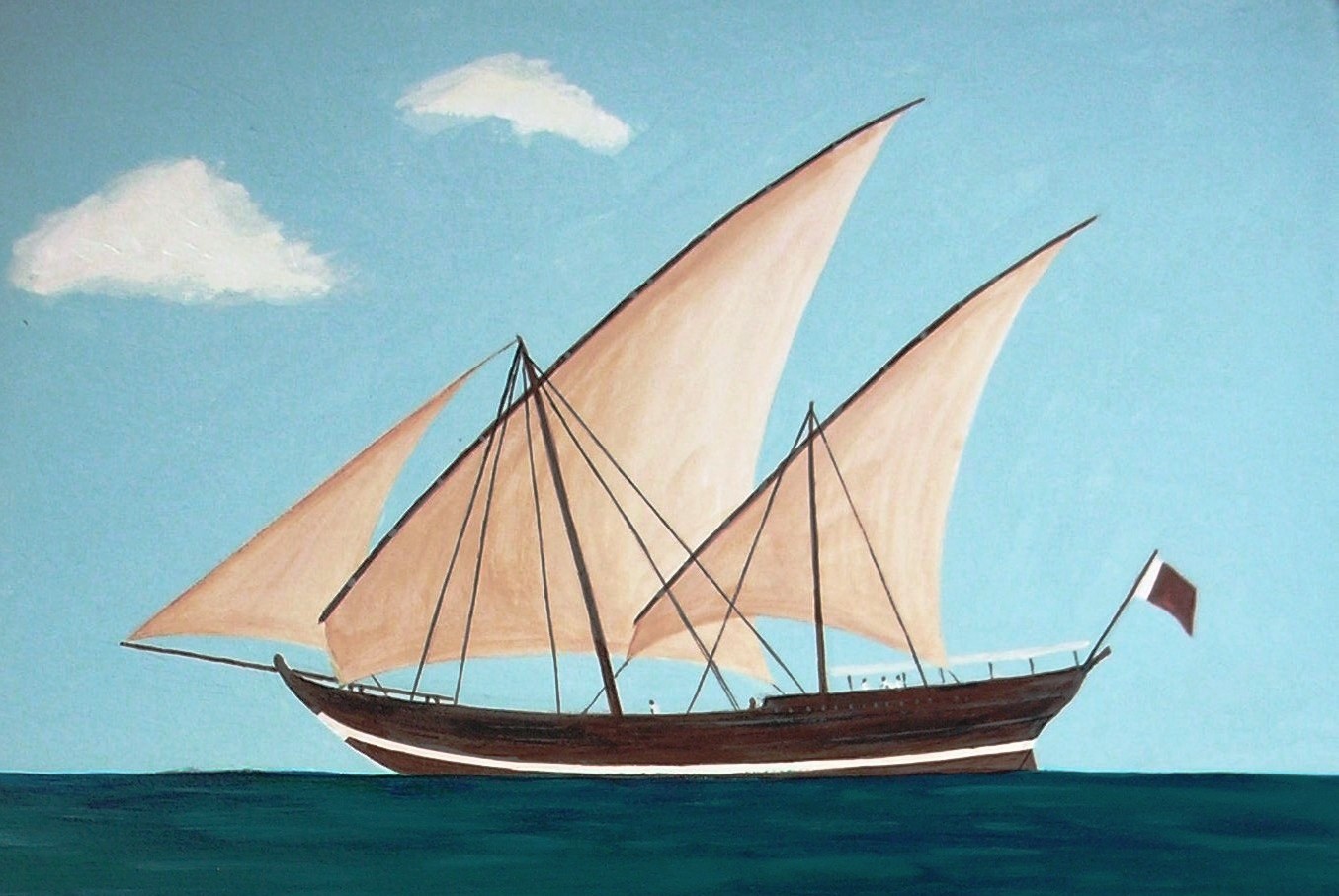
A baghlah, bagala, bugala or baggala (Arabic: بغلة) is a large deep-sea dhow, a traditional Arabic sailing vessel.[1][2] The name "baghla" means "mule" in the Arabic language.
Description
[edit]
The baghlah dhows have a curved prow with a stem-head, and sometimes an ornately carved stern and quarter galleries. Their average length w is 100 ft (30 m) with an average weight of 275 tons. Usually they have two masts using two to three lateen sails; supplementary sails like a jib are often added on the bowsprit, as well as on a topmast atop the main mast.[3] As a large and heavy ship the baghlah require a crew of at least 30 sailors. Some have even up to 40.[4]
The ghanjah or kotiya is a similar type of vessel, often difficult to distinguish from the baghlah.[5]
History
[edit]Baghlahs are widely used and have been in the past centuries as merchant ships in the Indian Ocean and the minor seas around the Arabian Peninsula. They reach eastwards to Sindh, India and up to the Bay of Bengal and further beyond as far as the Spice Islands. Southwestwards they reach down to the East African coast. They are one of the main types of ship used by Bohra traders.
In the early 19th century these ships were also part of the pirate fleets operating from semi-independent or completely independent harbours in Persia or along the Arabian Peninsula.[6]
During the 19th century, the Royal Navy attempted to suppress the Indian Ocean slave trade and in his 1873 book, Captain G. L. Sulivan described the "Bugala or genuine Dhow" as "by far the most numerous class" of dhow.[2]
In favorable conditions a baghlah can sail up to 9 knots, but is a somewhat unwieldy ship and is not as popular as the easier to maneuver boom.
See also
[edit]References
[edit]- ^ Clifford W. Hawkins, The dhow: an illustrated history of the dhow and its world
- ^ a b Sulivan, G.L. (1873). Dhow Chasing in Zanzibar Waters and on the Eastern Coast of Africa: Narrative of Five Years' Experiences in the Suppression of the Slave Trade. S. Low, Marston, Low & Searle. pp. 102–103. Retrieved 15 November 2021. (with engraving as illustration)
- ^ Too Late to Document Dhows?
- ^ Thabit A. J. Abdullah, The Political Economy of Trade in Eighteenth-Century Basra, SUNY series in the Social and Economic History of the Middle East , 2000, ISBN 978-0-7914-4808-3
- ^ The Traditional Dhow
- ^ Gardiner, Robert (2001 [1998]). The Victory of Seapower. Caxton Editions. ISBN 1-84067-359-1. p. 89
External links
[edit]
Baghlah
View on GrokipediaEtymology and Terminology
Name Origin and Variations
The term baghlah originates from the Arabic word baghlah (بغلة), literally translating to "mule" or "she-mule," an allusion possibly drawn from the ship's sturdy build and capacity for heavy loads, comparable to the endurance of pack animals in caravan trade.[9] This etymology underscores the vessel's role in long-distance maritime commerce across the Indian Ocean and Arabian Sea, where reliability under sail mirrored the mule's utility on land routes. Transliterations of the name vary due to differences in rendering Arabic script into European languages, with common forms including bagala, baggala, and bugala.[1] These spellings appear in historical accounts from the 19th and early 20th centuries, reflecting phonetic adaptations by British, Portuguese, and other colonial observers documenting Gulf and East African shipping.[10] The baggala variant, for instance, gained prevalence in English nautical texts, while bagala persists in some Indian Ocean regional dialects.[11]Relation to Other Dhow Types
The baghlah belongs to the broader family of dhows, traditional Arab sailing vessels characterized by lateen sails, sewn or lashed wooden plank construction, and hulls with shallow drafts and flat bottoms suited to regional waters and beaching.[2][7] Like other types such as the boom and ghanjah, it typically features two masts (occasionally three) with triangular lateen rigging for effective windward performance, enabling trade across the Indian Ocean, Persian Gulf, and East Africa.[12][2] These shared traits stem from indigenous Arab and Indian shipbuilding traditions, with the baghlah positioned as a "sister" vessel to the ghanjah and boom due to overlapping deep-water capabilities and cargo-focused designs.[2] Distinctions arise primarily in hull form, stern configuration, and scale, reflecting adaptations for specific roles. The baghlah's transom stern, often with five windows and a raised poop deck, draws partial influence from European designs like Portuguese carracks, providing greater stability for ocean voyages and capacities of 150–400 tons in lengths of 70–130 feet.[12][2] In comparison, the boom maintains a double-ended hull with a long, upward-curving stem and optional bowsprit for jibs, emphasizing symmetry for seagoing trade but lacking the baghlah's pronounced aft superstructure.[12][7] The ghanjah shares the baghlah's curved stem and ornate transom but varies in regional usage, often with two or three masts for similar trade routes.[12][2] Smaller dhows like the sambuk and battil diverge further, with the sambuk featuring a square stern (a later European-influenced trait) for medium-scale trade, while the battil's club-shaped sternpost and reduced size limit it to coastal fishing and local operations.[12][7] The badan, single-masted and shallow-drafted, prioritizes pearl diving over the baghlah's bulk cargo emphasis.[12] Overall, dhow classifications often hinge on stern evolution—double-ended for ancient forms versus transom/square for post-16th-century hybrids—positioning the baghlah as a large, versatile evolution for long-haul endurance rather than speed or littoral tasks.[7][2]Design and Construction
Hull and Structural Features
The baghlah, a large traditional dhow variant used for deep-sea trade, features a double-ended hull form at the waterline, characterized by a long, raking rounded stem rising to a high curved timberpost resembling a scimitar, providing hydrodynamic efficiency for ocean voyages.[13] The stern contrasts with a high, relatively upright structure ending in a wide transom that extends to the waterline, often topped by a poop deck and historically fitted with five windows, reflecting partial European design influences in later builds.[7][14] This configuration, combined with a shallow draft and relatively flat bottom amidships, enhanced maneuverability in coastal and Gulf waters while supporting heavy cargo loads.[2] Construction followed a shell-first method using sewn or stitched wooden planks, where overlapping or flush-laid boards were bound with coir fibers, cords, or thongs passed through holes, caulked with materials like animal fat or resin for watertightness, rather than relying on metal fastenings or extensive internal framing.[7][15] Planks, typically sourced from durable Indian hardwoods such as teak or acacia, formed the primary hull shell, with internal ribs, floor timbers, and a keel—sometimes doubled for stability—added later for reinforcement, particularly in larger vessels up to 60 tons.[7] This flexible, repairable design originated in pre-Islamic Arabian and Indian Ocean traditions, persisting into the 20th century despite gradual adoption of nailing in some regions.[16] Structural reinforcements included curved, decorated prows for wave deflection and a high transom stern to handle following seas, though the squared stern profile could pose risks in rough conditions without careful handling.[16] The overall beam provided ample width for cargo holds, with the hull's tucked-up lines amidships aiding stability under sail, distinguishing the baghlah from narrower coastal dhows like the sambuk.[13] These features enabled the baghlah to carry bulk cargoes across monsoon-driven routes, underscoring its adaptation to regional hydrodynamics and material availability.[2]Rigging, Sails, and Propulsion
The baghlah utilized a lateen rig, featuring triangular or quadrilateral sails attached to long yards angled against the mast, enabling effective downwind and reaching performance suited to monsoon trade routes.[2][7] Typically equipped with two masts—the forward mainmast bearing a substantially larger sail than the aft mizzen—some configurations included a third mast for additional sail area.[2] Sails, constructed from cotton cloth or woven palm leaves with seams parallel to the luff and leech, maintained a luff-to-leech ratio of approximately 1:6, providing expanded surface area compared to pure triangular designs; vessels often carried dual sails per mast, one optimized for fair weather and another for storms, as reefing was impractical.[7] Rigging incorporated coir cables and slotted mast steps over reinforced floor timbers, with the extended lateen yard sometimes composed of multiple segments joined for strength and fitted with halyard attachments.[7] Supplementary sails could augment the primary lateen setup to boost speed or adapt to varying winds.[17] Handling this rig demanded a minimum crew of 18-25 sailors to adjust yards, sheets, and braces, particularly on larger baghlahs requiring up to 30 hands.[17] Propulsion relied entirely on wind captured by the sails, with no auxiliary oars or mechanical aids in traditional operation, achieving maximum speeds of 9 knots under optimal conditions while prioritizing stability for heavy cargoes over agility.[17][2]Typical Dimensions and Cargo Capacity
The baghlah typically measured 70 to 130 feet (21 to 40 meters) in length, allowing for deep-sea capabilities while maintaining maneuverability in regional waters.[2] Its burthen tonnage ranged from 150 to 400 tons, a historical metric approximating cargo capacity by estimating the volume of standardized tuns (wine casks) the hull could accommodate, thus enabling transport of bulk goods such as dates, spices, or timber in quantities up to several hundred tons depending on load and voyage conditions.[2][18] Smaller variants, often built in locations like Sur, Oman, extended to 70 to 125 feet in length with tonnages of 125 to 300 tons, reflecting adaptations for specific trade demands or builder preferences.[1] These dimensions supported crews of 18 to 30 sailors, with cargo holds optimized for efficiency in Indian Ocean commerce rather than precise standardization.[1] The vessels featured flat-bottomed hulls and shallow drafts—typically sufficient for beaching and navigating shoals, though exact beam and depth ratios varied by construction, often yielding beam-to-length proportions around 1:4 to 1:5 for stability under lateen sails.[2]| Dimension | Typical Range |
|---|---|
| Length | 70–130 feet (21–40 m) |
| Burthen Tonnage | 150–400 tons (cargo proxy) |
Historical Development
Early Origins and Evolution
The baghlah, a large deep-sea dhow variant, evolved from earlier sewn-plank vessels prevalent in the Indian Ocean region, with precursors traceable to at least the 6th century BC through construction techniques involving stitched wooden planks secured by fibers or cords.[7] These early boats, often double-ended and shell-built plank-by-plank, originated primarily in India using teak from local forests, though they were adapted by traders along the Arabian Peninsula and East African coasts.[7] Greek and Roman historical records from the 1st century AD document sewn vessels observed near Zanzibar and southern Arabia, indicating established maritime use for trade by that era.[7] By the 8th century AD, the baghlah had developed into a prominent ocean-going form, integral to Arab commercial fleets that dominated Indian Ocean networks, extending voyages to China and facilitating the spread of trade goods and Islam.[2] Indigenous to regions encompassing the Arabian Peninsula, India, and East Africa, it built upon simple dugout hulls augmented with sewn teak planking, incorporating keels for stability and lateen sails—triangular rigs likely originating in the Red Sea and widespread by the 2nd century AD—for efficient downwind propulsion.[2][7] This shell-first construction persisted as dominant until the 15th century, enabling capacities of 150–400 tons and lengths up to 130 feet, suited for heavy cargoes over extended routes.[2] Further evolution included post-11th century modifications like a projecting bow for improved hydrodynamics, while the adoption of a high squared stern in the 16th–17th centuries reflected Portuguese influences on Arabian shipbuilding traditions.[7][2] These adaptations enhanced the baghlah's versatility from coastal fishing and trading to deep-sea commerce, sustaining its role amid competing European vessels until the steamship era.[2]Peak Usage Periods
The baghlah attained its peak prominence during the 18th and 19th centuries, when it served as the primary vessel for long-distance commerce in the Indian Ocean under the expanding Omani maritime empire. Omani rulers, particularly Sultan Said bin Sultan (r. 1806–1856), relied on fleets of baghlahs to link ports from Zanzibar and East Africa to the Arabian Peninsula, India, and beyond, transporting cargoes such as cloves, ivory, dates, and textiles. This era saw baghlahs dominate monsoon-driven trade routes, with their capacity for heavy loads—up to 400 tons—and seaworthiness enabling voyages of thousands of miles, as documented in European naval records of the period.[2][19] In the Persian Gulf and Arabian Sea, baghlahs were integral to the pearling industry boom from the mid-19th century until the 1920s, supporting seasonal migrations of thousands of divers and carrying pearls to markets in Bombay and Europe. Their lateen-rigged design allowed efficient navigation of variable winds, sustaining economic volumes that rivaled emerging steamship lines until World War I disruptions and the rise of motorized vessels eroded their role. Accounts from British Admiralty surveys in the 1870s–1890s highlight baghlahs as the backbone of regional shipping, with hundreds operating annually from Sur, Oman—the traditional building hub.[2][1] This zenith reflected adaptations from earlier medieval forms, incorporating European influences like stronger hull planking post-16th century, which enhanced durability for extended hauls amid competition from Portuguese and British interlopers. By the early 20th century, however, baghlah numbers dwindled as steamers offered faster, more reliable service, though sporadic use persisted into the 1930s for niche trades.[2]Operational and Economic Role
Primary Trade Routes and Cargoes
Baghlahs served as primary vessels for long-distance bulk cargo transport across the Indian Ocean, linking ports on the Arabian Peninsula with those in East Africa and the Indian subcontinent. Departures commonly originated from Omani hubs such as Muscat and Sur in the Gulf of Oman, proceeding via the Arabian Sea to destinations including Zanzibar and Mombasa on the East African coast, as well as Mumbai and Gujarat ports in India. These routes extended occasionally to the Maldives for regional trade until the mid-20th century. Navigation exploited monsoon patterns, with northeast winds from November to March propelling eastward voyages and southwest winds from May to September aiding returns, enabling annual cycles of up to 4,000 nautical miles.[1][20][21] Typical cargoes reflected regional resource asymmetries and economic demands, with baghlahs' spacious holds accommodating heavy, low-value bulk items unsuitable for smaller dhows. From East Africa, exports included timber like mangrove poles for construction, ivory, gums, beeswax, and enslaved Africans transported to Omani markets. Zanzibar-sourced cloves, coconuts, coconut fiber ropes, maize, and other grains moved to India. Conversely, Arabian and Persian Gulf shipments featured dates, rice, textiles, and metals bound for African ports, while Indian wood supplies fueled Omani shipbuilding. Such exchanges sustained pre-industrial trade volumes, with individual baghlahs capable of carrying several hundred tons despite lacking precise historical tonnage records for specific voyages.[22][23][24]Navigation Techniques and Crew Operations
Baghlah navigation primarily relied on knowledge of seasonal monsoon winds, which dictated trade routes across the Indian Ocean and Persian Gulf, enabling outbound voyages during the northeast monsoon from October to April and return trips with the southwest monsoon from April to October.[25] Sailors harnessed lateen sails to tack effectively against prevailing winds, a technique suited to the vessel's rigging for long-haul passages.[26] Celestial observations, including the position of the sun by day and the North Star at night, provided basic orientation, while coastal pilotage used landmarks, currents, and bird migrations for near-shore guidance.[26] Crew operations on a baghlah involved a complement of 18 to 30 sailors, depending on vessel size, with larger deep-sea variants requiring up to 40 members to manage the heavy hull and extensive sail area.[1] The nakhoda, or captain-navigator, directed course and trade decisions, drawing on experiential knowledge passed through generations of Arab seamen.[25] Deck hands, often organized in watches, handled sail trimming, rigging adjustments, and steering via a large tiller, while additional roles included cooks, carpenters for hull maintenance, and laborers for cargo loading of staples like dates, spices, and timber.[1] Daily operations emphasized seamanship adapted to open-sea conditions, with crews climbing masts to shift heavy lateen yards for wind optimization and performing stitched-plank repairs using coconut coir to address leaks from the flexible hull design.[7] Provisions management sustained voyages lasting weeks, incorporating water rationing and dried food storage, underscoring the crews' self-reliance in remote oceanic trade.[25]Economic Impact on Regional Trade Networks
The baghlah, a large deep-sea dhow originating from the Arabian Peninsula, significantly influenced regional trade networks in the Indian Ocean by enabling efficient bulk cargo transport over long distances. Capable of carrying 150 to 400 tons, these vessels traversed routes along the coasts of the Arabian Peninsula, Sindh, India, and East Africa, leveraging monsoon winds for seasonal voyages.[2][1] This capacity allowed for the shipment of heavy commodities such as dates and pearls from the Persian Gulf, spices and cotton textiles from India, and ivory, timber, and mangrove poles from East Africa, fostering economic interdependence among these regions.[7][27] By reducing reliance on overland caravans and smaller coastal craft, baghlahs lowered transport costs and increased trade volumes, which stimulated the growth of port cities and coastal economies. For instance, Arabian-provenance dhows, including baghlahs, accounted for nearly two-thirds of vessels trading to East Africa in the early 20th century, a proportion indicative of their dominance in earlier Islamic trade eras originating from the Persian Gulf until the 11th century.[23][28] This maritime commerce not only exchanged goods but also supported the economic vitality of Swahili city-states like Kilwa and Gujarati ports, where baghlah traffic contributed to the accumulation of wealth through export specialization and import diversification.[29] The baghlah's role extended to sustaining niche trading communities, such as Bohra merchants, who utilized these vessels for deep-sea commerce, thereby integrating peripheral economies into broader networks. This connectivity promoted regional prosperity by facilitating the flow of high-value items like gold and slaves alongside bulk staples, ultimately shaping the economic landscape of the Indian Ocean littoral until the advent of steamships in the late 19th century.[1][30]