


Community hub
Recent from talks
Contribute something
Nothing was collected or created yet.
Gurbani
View on Wikipedia
| Part of a series on |
| Sikh scriptures |
|---|
 |
| Guru Granth Sahib |
| Dasam Granth |
| Sarbloh Granth |
| Varan Bhai Gurdas |
Gurbani (Punjabi: ਗੁਰਬਾਣੀ, pronunciation: [ɡɝbaːɳiː], lit. the Guru's words) is a Sikh term, very commonly used by Sikhs to refer to various compositions by the Sikh Gurus and other writers of Guru Granth Sahib. In general, hymns in the central text of the Sikhs, the Guru Granth Sahib, are called Gurbani. Among Amritdhari Sikhs, a few texts from Dasam Granth which are read as Nitnem, like Tav-Prasad Savaiye and Chaupai, are also considered Gurbani. In Adi Granth, Gurbani is a sound which comes directly from the Supreme and the text is a written form of the same in worldly language and scripts. It is also called Guru’s Bani.[1]
Prior to reading Gurbani or meditating, it is compulsory to cover the head with a turban, dupatta or other cloth, as well as removing shoes, performing at least the Panj Ishnan[2] (washing of the 5 main parts of the body), and if possible using a teeth-cleaning twig.[3] Gurbani are explanations of qualities of the Primal Lord and Soul which a Sikh should comprehend and with which they can attain the supreme state. Sikh historical writings, unauthentic writings or apocryphal compositions written under the names of Sikh Gurus and other writings by Sikhs are not considered Gurbani and are referred to as Kachi Bani (ਕੱਚੀ ਬਾਣੀ; meaning adulterated verses).[4]
Etymology
[edit]Gurbani is composed of two words: 'Gur' and 'Bani'. Gur has multiple meanings depending on context. In Guru Granth Sahib, Gur is used for multiple meanings, as per context of hymn. The common use of Gur is either for wisdom and internal conscious mind (referred to as Chitta or Antar Atma).[5]
According to Pashaura Singh, compositions found in the Guru Granth Sahib are referred to either as bani ("utterances") or gurbani ("utterance of the guru").[6]
Thereby Gurbani either means the speech of wisdom or the speech of conscious mind.
Gurbani is directly received from inside after attaining a Supreme state, whereas the Granth or textual form is worldly language of the same. Gurbani is also referred to as Dhur Ki Bani (ਧੁਰ ਕੀ ਬਾਣੀ; meaning the speech from the Supreme house). In the Adi Granth, it is considered a source of spiritual knowledge which illuminates the mind and gives internal bliss. The one who comprehends Gurbani is also described as an Amritdhari. Gurbani is a source of truth with which the internal filth and sins get eradicated and one who find Gurbani sweet is in supreme state.
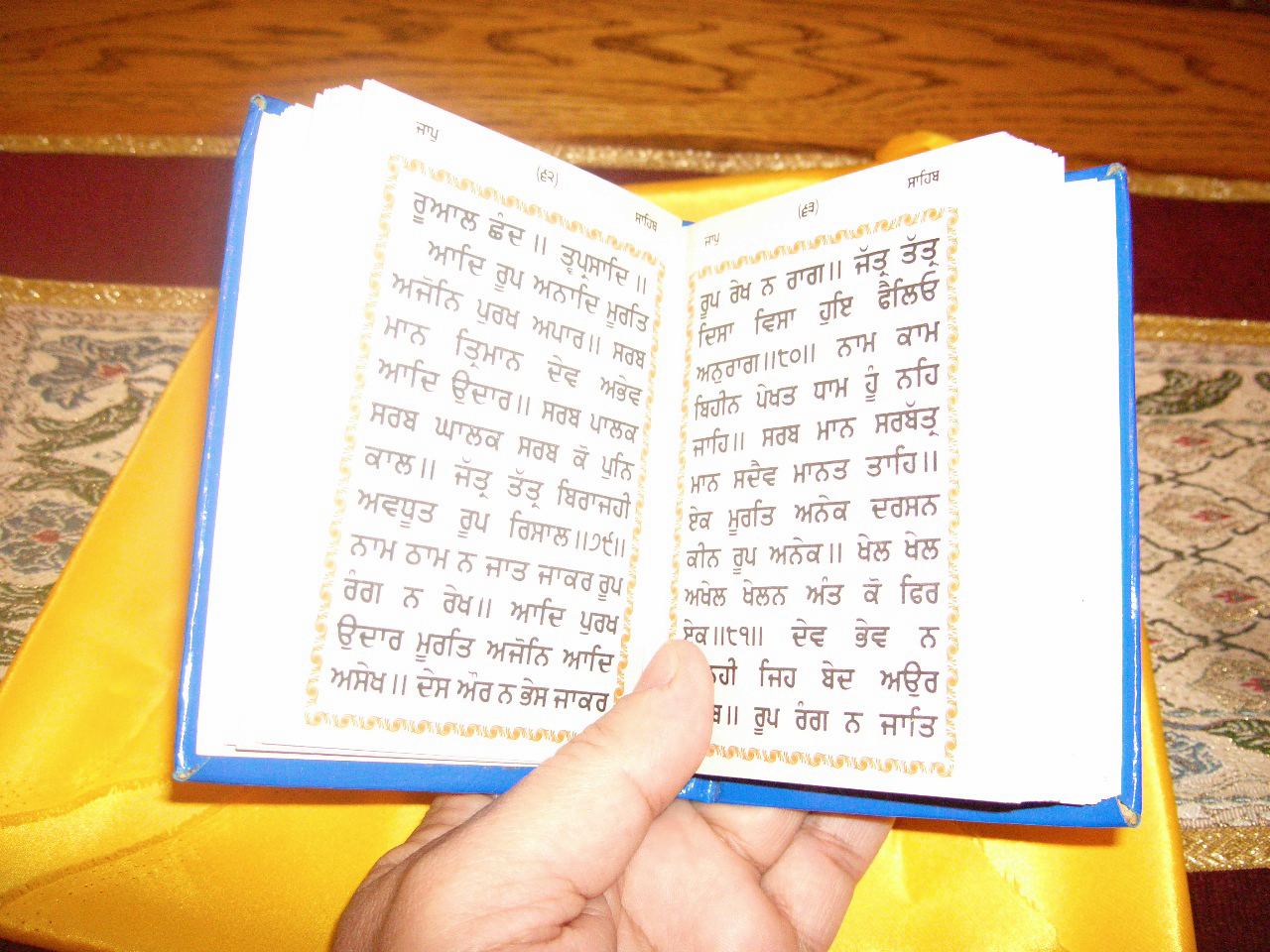
Extracts from Guru Granth Sahib are called Gutkas (ਗੁਟਕਾ; meaning small books) containing sections of Gurbani. These Gutkas can vary from just a few pages to hundreds of pages and are used by the Sikhs to read these Banis on a daily basis.
Compilation
[edit]_scribing_a_manuscript_alongside_Guru_Gobind_Singh_dictating_(right),_artwork_kept_at_Takht_Damdama_Sahib.jpg)
Gurbani is not seen as mere intellectual, spiritual writings conjured by the Sikh gurus, bhagats, bhatts, and gursikhs, but rather as divine word revealed by the creator itself.[7] As per Guru Arjan regarding the origin of gurbani:[7]
Bani originated from the Primordial One (dhurki bani), and removes all anxiety.
— Guru Arjan, The Sikh View on Happiness: Guru Arjan’s Sukhmani (2020), page 36
Nitnem compositions
[edit]The hymns of the Japji Sahib, Jaap Sahib, Tav-Prasad Savaiye, Chaupai Sahib and Anand Sahib should be read before sunrise daily according to the Sikh Rehat Maryada. These are recited by initiated Sikhs at Amritvela (before 6 a.m.). Rehras is read in the evening around sunset or after a day's work and finally Kirtan Sohila is read before going to bed. Doing Nitnem is also commonly referred as doing paath.[8]
Japji Sahib, Anand Sahib, and Kirtan Sohila are a part of Guru Granth Sahib. Jaap Sahib, Tav-Prasad Savaiye, and Chaupai Sahib were all compiled by Guru Gobind Singh and found in the Dasam Granth. Rehras is a mix with hymns from both Guru Granth Sahib and Dasam Granth. A Sikh may add more Gurbani to their Nitnem and if done frequently that Gurbani becomes a part of their Nitnem.
-
 A Pothi Sahib (Nitnem prayerbook) is commonly wrapped in a similar cloth as a mark of respect
 -
 Historical gutka manuscript of the Dasam Granth from the 18th century
 -
 Sikh gutka from early 18th century


See also
[edit]References
[edit]- ^ ਜਨੁ ਨਾਨਕੁ ਬੋਲੇ ਗੁਣ ਬਾਣੀ ਗੁਰਬਾਣੀ ਹਰਿ ਨਾਮਿ ਸਮਾਇਆ ॥੪॥੫॥
Servant Nanak chants the Glorious Words of the Guru's Bani; through them, one is absorbed into the Naam, the Name of the Lord. ||4||5||: Page 494, M5 - ^ Kainth, Gursharan Singh (2024). Festivals of Sikhs (First ed.). Bilaspur, India: Booksclinic Publishing. p. 101. ISBN 978-93-5823-642-2.
- ^ Sikh Code of Conduct. Translated by Harjinder Singh; Sukha Singh; Jaskeerth Singh (6th ed.). Walsall, England: Akaal Publishers. December 2020. p. 108. ISBN 978-1-9996052-4-7.
- ^ "Apocryphal Compositions". The Sikh Encyclopedia.
- ^ ਗੁਰਬਾਣੀ ,Mahankosh, Bhai Kahn Singh Nabha
- ^ Bangha, Imre; Stasik, Danuta, eds. (Jun 11, 2024). Literary Cultures in Early Modern North India: Current Research. Oxford University Press. pp. 175–176. ISBN 9780192889362.
- ^ a b Nayar, Kamala Elizabeth; Sandhu, Jaswinder Singh (2020). The Sikh View on Happiness: Guru Arjan’s Sukhmani. Bloomsbury Publishing. p. 36. ISBN 9781350139886.
- ^ Singha, Harbhajan; Kaur, Satwant (2008). Sikhism: A Complete Introduction. Sikh Studies, Book V (Fifth impression ed.). New Delhi: Hemkunt Press. p. 88. ISBN 9788170102458.


Gurbani
View on GrokipediaEtymology and Definition
Etymology
The term "Gurbani" derives from the Punjabi words "Gur" and "Bani," where "Gur" stems from the Sanskrit root "guru," signifying a spiritual teacher, guide, or enlightener, and "Bani" refers to utterance, word, or composition.[4][5] Together, these roots form "Gurbani," translating to "the Guru's word" or "divine composition," encapsulating the sacred writings attributed to the Sikh Gurus and select saints.[6] This etymology reflects influences from both Punjabi vernacular and Sanskrit spiritual lexicon, emphasizing transmission of divine wisdom through enlightened utterance.[4] The term's historical evolution in Sikh literature traces back to the 16th century, coinciding with the hymns of Guru Nanak Dev Ji (1469–1539), the founder of Sikhism, whose compositions were among the earliest referred to as Gurbani.[4] As subsequent Gurus composed and compiled these writings, the designation "Gurbani" became standardized to denote the collective body of their revelatory poetry, distinguishing it from secular or other religious texts.[2] By the time of the Adi Granth's compilation in 1604 under Guru Arjan Dev Ji, the term was firmly established in Sikh tradition to signify writings originating from the divine source through the Gurus.[4] While sharing linguistic and thematic parallels with "bhakti bani"—devotional compositions in the broader Indian Bhakti movement, such as those by saints like Kabir or Ravidas—Gurbani holds a unique Sikh connotation as the eternal voice of the Guru, embodied perpetually in the Guru Granth Sahib, the living scripture revered as the final Guru.[7] This elevates Gurbani beyond mere devotional poetry to an authoritative, unchanging conduit of divine instruction, integral to Sikh spiritual practice and identity.[2]Definition and Scope
Gurbani refers to the sacred compositions in Sikhism, encompassing the hymns, prayers, and teachings revealed by the Sikh Gurus and select Bhagats (devotees from diverse backgrounds). These writings form the core of Sikh scripture, embodying spiritual guidance, ethical principles, and devotion to the divine. In Sikh tradition, Gurbani is regarded as the eternal Guru, a status conferred by Guru Gobind Singh in 1708 when he declared the Guru Granth Sahib as the perpetual spiritual authority for Sikhs following his own tenure as the tenth Guru.[8][9] The scope of Gurbani is strictly limited to the authenticated verses compiled in the Guru Granth Sahib, also known as the Adi Granth, which serves as the central and living scripture of Sikhism. This canon excludes unauthenticated or later additions, ensuring doctrinal purity and focus on the Gurus' direct revelations. The Guru Granth Sahib contains approximately 5,894 shabads (hymns), organized by musical ragas and contributed primarily by six Sikh Gurus along with 15 Bhagats, such as Kabir, Farid, and Ravidas.[10][11] Gurbani is distinctly differentiated from non-canonical works, such as those in the Dasam Granth, which is a separate compilation attributed to Guru Gobind Singh but not elevated to the status of eternal Guru or core Gurbani. While the Dasam Granth includes poetic and martial compositions that may echo Gurbani-like themes, it falls outside the authenticated scriptural boundaries of the Guru Granth Sahib and is not considered essential for Sikh spiritual practice in the same authoritative manner.[12]Historical Development
Origins
Gurbani originated in the late 15th century through the spiritual revelations and compositions of Guru Nanak Dev (1469–1539), the founder of Sikhism, marking the inception of a distinct monotheistic tradition in the Indian subcontinent.[13] While drawing inspiration from the Bhakti movement's emphasis on personal devotion and the Sufi tradition's focus on mystical union with the divine, Guru Nanak's teachings rejected ritualism, caste hierarchies, and idolatry, instead promoting equality, ethical living, and direct access to the one formless God (Ik Onkar).[14] This synthesis established Gurbani as a unique scriptural corpus, composed primarily in poetic form set to Indian classical ragas, to convey universal spiritual truths.[13] A pivotal event in Gurbani's origins occurred around 1499 in Sultanpur Lodhi, where Guru Nanak experienced enlightenment during a meditative immersion in the Bein River, emerging with the divine call to his mission of world salvation.[15] This revelation inspired the composition of Japji Sahib, Gurbani's foundational hymn, which outlines the path to spiritual realization through meditation, ethical conduct, and grace.[15] Subsequently, Guru Nanak undertook several udasis, extensive missionary journeys across South Asia, the Middle East, and beyond, during which he composed initial banis (hymns) in response to encounters with diverse religious communities, laying the groundwork for Sikh thought.[13] In its early phase, Gurbani was preserved through oral transmission via kirtan, the devotional singing of hymns in prescribed ragas, performed by ragis (Sikh musicians) and rababis (hereditary accompanists) who memorized and propagated the verses within emerging Sikh congregations.[16] This musical tradition ensured accessibility and fidelity before widespread writing, though it occasionally introduced minor performative variations.[16] The transition to written records began under Guru Angad Dev (1504–1552), the second Guru, who standardized the Gurmukhi script and compiled the first pothis (manuscripts) containing Guru Nanak's compositions, entrusting these codices to successors for safeguarding the textual integrity.[16]Compilation Process
The compilation of Gurbani into the Adi Granth marked a pivotal effort to standardize and preserve the Sikh scriptural tradition, initiated by Guru Arjan in 1604 CE. Drawing from pothis—manuscript collections—assembled during the lifetimes of earlier Gurus, including the Goindval Pothis from the 1570s, Guru Arjan systematically gathered hymns attributed to Guru Nanak, Guru Angad, Guru Amar Das, and Guru Ram Das, while incorporating his own compositions and those of his father.[17] This process addressed the need for authenticity amid circulating spurious hymns falsely ascribed to "Nanak" under external influences, involving rigorous verification to ensure only genuine Sikh bani was included.[17] Bhai Gurdas, a prominent Sikh scholar and poet, served as the primary scribe for this endeavor, meticulously transcribing the text into the Kartarpur Pothi, the original manuscript comprising 974 folios completed in 1604 CE and preserved at Kartarpur.[17] The compilation faced challenges from rival factions, such as Baba Mohan and Prithi Chand, who possessed alternative pothis like the Goindval and Guru Harsahai versions, questioning Guru Arjan's editorial authority and complicating the standardization.[17] Despite these obstacles, the Adi Granth was installed at the Harmandir Sahib in Amritsar, establishing a canonical foundation that built upon oral and written traditions originating in Guru Nanak's era.[17] In 1708 CE, Guru Gobind Singh finalized the scripture as the Guru Granth Sahib by directing the inclusion of hymns from Guru Tegh Bahadur, though historical evidence indicates these may have been added as early as 1674 CE during preparatory work at Anandpur in the 1680s.[17] This edition emphasized a structured arrangement, organizing content thematically by ragas (musical modes) and vars, with hymns from the Gurus placed chronologically at the core and contributions from other Bhagats positioned peripherally, reflecting an evolution from earlier pothi formats.[17] Subsequent preservation efforts included the production of additional handwritten copies to disseminate the text widely. Baba Deep Singh, a noted Sikh scholar and warrior, prepared multiple such manuscripts between 1705 and 1728 CE, including versions installed at key Sikh sites, ensuring the scripture's accessibility amid historical disruptions.[18] These scribal works, conducted without early printing technology, relied on traditional methods to maintain textual integrity until the first printed edition emerged in the 19th century.[19]Key Contributors
The primary contributors to Gurbani, the sacred compositions enshrined in the Guru Granth Sahib, are the six Sikh Gurus who authored the majority of its 5,894 shabads, along with selected hymns from fifteen non-Sikh Bhagats whose writings aligned with core Sikh principles of monotheism, equality, and devotion, as well as compositions from eleven Bhatts (bards), and a few other Gursikhs.[20] Guru Nanak Dev (1469–1539), the founder of Sikhism, provided the foundational corpus with 974 shabads, establishing the spiritual and philosophical bedrock of Gurbani through his emphasis on direct communion with the divine.[20] His successor, Guru Angad Dev (1504–1552), contributed 62 pauris (stanzas), focusing on reinforcing Nanak's teachings on humility and ethical living.[20] Guru Amar Das (1479–1574) added 907 shabads, expanding on social reforms such as caste abolition and women's equality.[20] Guru Ram Das (1534–1581) composed 679 shabads, including those that formalized community structures like the langar (communal kitchen).[20] Guru Arjan Dev (1563–1606), the fifth Guru, authored the largest share with 2,218 shabads and oversaw the initial compilation of the Adi Granth in 1604, integrating diverse contributions while adding his own works on devotion and resilience.[20] Finally, Guru Tegh Bahadur (1621–1675), the ninth Guru, contributed 116 hymns, often reflecting themes of sacrifice and faith under persecution.[20] Collectively, the Gurus' works comprise approximately 84% of the Guru Granth Sahib's shabads.[21] Among the Bhagats, whose inclusions were determined by their harmony with Sikh tenets of universal spirituality and rejection of ritualism, Bhagat Kabir (c. 1440–1518), a weaver-saint, provided 541 hymns critiquing social hierarchies and promoting inner purity.[21] Bhagat Namdev (1270–1350), a devotional poet from Maharashtra, contributed 60 shabads emphasizing ecstatic bhakti (devotion) to one God.[21] Sheikh Farid (1173–1266), a Sufi mystic, added 4 shabads infused with ascetic wisdom and contemplation of mortality.[22][23] The 15 Bhagats' works total around 376 shabads (including sloks). The 11 Bhatts, contemporary Sikh bards, contributed 123 swayyas (praises of the Gurus), while other Gursikhs such as Baba Sundar (10 hymns on early Gurus' lives), Bhai Mardana (5 shabads), and Satta and Balwand (1 var) added further compositions. Overall, the non-Guru contributions total about 938 shabads, representing voices from Hindu, Muslim, and regional traditions that resonated with Sikh ideals.[21] Compositions by Guru Gobind Singh (1666–1708), the tenth Guru, are excluded from the core Gurbani in the Guru Granth Sahib and instead form the basis of the separate Dasam Granth, preserving the eternal status of the scripture as compiled by Guru Arjan.[20]Composition and Structure
Forms and Genres
Gurbani encompasses a range of poetic meters that structure its devotional expressions, with shabads serving as the foundational hymns composed in stanzas typically ranging from two to six lines, often set to specific musical modes for lyrical delivery.[24] These shabads, such as "Kirtan prabh ki gaai meri rasnaa" from the Adi Granth (p. 1298), emphasize ethical and moral themes through simple, repetitive structures that facilitate communal recitation.[24] Pauris, or couplets and stanzas, form integral parts of longer compositions, usually consisting of five to seven verses that build thematic progression, as seen in the 38 pauris of Japji Sahib and the 471 pauris across all vars.[24][25] Vars represent narrative ballads in Gurbani, blending pauris with interspersed saloks to convey spiritual narratives akin to heroic folk tales, with a total of 22 vars included in the Guru Granth Sahib, 21 composed by the Sikh Gurus and one by bards Satta and Balwand.[25] Examples include Guru Nanak's "Vaar Majh ki" (p. 138) and "Asa di Vaar," which unfolds ideas step-by-step through its pauris, often accompanied by saloks for concise moral insights.[24] Saloks within these vars, totaling around 1,000 across the scripture but with many integrated into the 22 vars for rhythmic emphasis, appear as standalone couplets, such as those in "Vaar Sorath Mahala 4 Salok Mahala 1" (p. 193).[24] Dohras, a form of couplet prevalent in Guru Nanak's writings, echo this concise style, drawing from Bhakti and Sufi traditions to distill profound teachings into paired lines for memorability and universality.[24] Other forms include chhants (six-lined verses) and sorths, contributing to the diverse poetic structure.[11] Among the genres of Gurbani, astpadis stand out as eight-stanza hymns derived from classical prabandh forms, used for elaborate devotional exposition, with examples appearing in 20 ragas such as Gauri Bairagan (p. 228) and sometimes extending to nine padas for rhythmic depth.[24] Sohilas, joyful wedding or evening prayer compositions typically comprising 16 verses, reorient folk birth songs like sohar into metaphysical hymns; while there are multiple sohilas as a poetic form (including 22 in raga Maru and one in Maru Dakhni), the core of the nightly Kirtan Sohila prayer consists of 5 specific shabads.[24][26] The forms of Gurbani reflect influences from classical Indian poetry, including prabandh gayan, dhrupad, and Vaisnava saptpadi, as well as folk ballads and Bhakti-Sufi couplets, yet the Sikh Gurus adapted and simplified these elements to prioritize spiritual accessibility over ornate aesthetics.[24] This simplification avoids complex alankars or figures of speech, focusing instead on direct language and universal appeal to convey divine truths without literary embellishment.[27] These meters and genres are organized within the Guru Granth Sahib primarily by raga to align poetic structure with melodic rendition.[24]Organization in Guru Granth Sahib
The Guru Granth Sahib is structured across 1,430 pages, known as angs, providing a meticulously organized compilation of Sikh scripture that emphasizes musical and thematic coherence over chronological sequence.[28] The text opens with a pre-raga section containing foundational compositions such as the Japji Sahib, So Dar, and Sohila, which set the spiritual tone without adherence to specific musical modes.[11] This is followed by the main body, comprising 31 raga-based sections that form the core of the scripture, where hymns are grouped by melodic frameworks to evoke contemplative and devotional moods.[29] These raga sections are arranged in alphabetical order of the raga names, beginning with Sri Raag (pages 14–94) and concluding with Jaijavanti (pages 1350–1353), ensuring a systematic progression that prioritizes doctrinal and aesthetic harmony.[30] Within each raga section, compositions are not ordered chronologically by the contributors but instead follow a sequence that highlights the Sikh Gurus' writings in their traditional order—starting with Guru Nanak and proceeding to Guru Tegh Bahadur—followed by contributions from Bhagats (devotee saints), fostering a unified thematic flow centered on spiritual unity and ethical living.[11] Vars, or ballad-like narratives, are interspersed throughout these raga sections, such as the Var of Guru Nanak in Asa Raag, to interweave moral instruction with the melodic structure without disrupting the overall musical organization.[31] Headings like "Raag Gauri" explicitly mark the divisions, guiding readers through the text's progression while underscoring the integral role of ragas in conveying the depth of Gurbani's message.[30] The post-raga section concludes the scripture with non-raga compositions, including the Mundavani (a sealing verse by Guru Arjan) and the Salok of Guru Tegh Bahadur, followed by the Raagmala, which lists ragas but is not set to music, symbolizing the scripture's completeness.[11] This organizational framework reflects editorial principles of doctrinal consistency, where inclusions were selected to promote harmony in Sikh teachings, avoiding discord and emphasizing universal spiritual truths across diverse voices.[32] Within these sections, poetic forms such as shabads serve as the primary vehicles for expression, adapting to the raga's emotional and philosophical nuances.[11]Linguistic Aspects
Languages Used
Gurbani, the sacred compositions compiled in the Guru Granth Sahib, is predominantly composed in medieval Punjabi, often referred to as Sant Bhasha, a devotional lingua franca that emerged among North Indian saints and bhakti poets. This primary language constitutes the vast majority of the text, drawing heavily from regional dialects and exhibiting influences from earlier Prakrit and Apabhramsha forms, which were vernacular evolutions of ancient Indo-Aryan languages. Sant Bhasha served as a bridge for spiritual expression accessible to the common populace, blending poetic simplicity with profound philosophical depth.[33][34] In addition to its Punjabi core, Gurbani incorporates elements from several other languages to reflect the diverse backgrounds of its contributors. Persian influences are evident in the shlokas of Bhagat Sheikh Farid, a 13th-century Sufi saint whose 112 shlokas and 4 shabads integrate Sufi mysticism with Punjabi rhythms.[35] Hindi dialects, such as Braj Bhasha and Awadhi, appear in the writings of Bhagats like Kabir and Namdev, whose hymns emphasize devotion and social equality; for instance, Kabir's dohas often employ everyday Hindustani idiom to critique ritualism. These integrations highlight Gurbani's inclusive ethos, drawing from the linguistic traditions of both Hindu and Muslim devotees across the Indian subcontinent.[36][34] Furthermore, Gurbani selectively employs Sanskrit-derived terms to articulate metaphysical concepts, reinterpreting them within a monotheistic framework—examples include maya (illusion) to denote worldly attachment and atman (soul) as the divine essence within. This purposeful hybridity avoids the exclusivity of classical Sanskrit or Arabic, instead fostering a transcendent vernacular that unites diverse communities beyond regional or sectarian barriers. All compositions are rendered in the Gurmukhi script, unifying the multilingual content. The linguistic diversity underscores Gurbani's universal appeal, ensuring its teachings resonate across cultural divides.[33][34]Script and Pronunciation
The Gurmukhi script, essential for rendering Gurbani, was developed and standardized by Guru Angad Dev Ji in the 16th century from the earlier Landa script to facilitate the accurate transcription of Sikh scriptures.[37] It consists of 35 primary akharas, or letters, which are primarily consonants each carrying an inherent short 'a' vowel sound unless modified. This structure provides advantages over the Devanagari script for Punjabi phonetics, as Gurmukhi avoids the need for virama to create dead consonants and employs simpler conjunct forms, making it more straightforward for representing the language's tonal and aspirated sounds without excessive complexity.[38] Pronunciation in Gurmukhi follows phonetic principles tailored to Punjabi, with vowel matras—dependent signs attached to consonants—altering the inherent vowel. For instance, the sihari—a hooked curved line preceding the consonant—denotes a short 'i' sound (as in "it"), while the bihari—a hooked curved line following the consonant—indicates a long 'ee' sound (as in "see"), as in ਕੀ (kī, meaning "which").[39] Consonant aspirates, such as ਖ (kha) and ਘ (gha), are distinctly formed to capture breathy releases inherent in Punjabi, distinguishing them from unaspirated pairs like ਕ (ka) and ਗ (ga). Key rules include the head-granthi, or implicit vowel 'a' (also called mukta), which is suppressed only through specific conjuncts or halant marks, and nasalization via the bindi (a dot above the vowel) to produce sounds like the 'n' in "sing," as in ਮੈਂ (main, meaning "I").[40] In printed editions of Gurbani, such as those of the Guru Granth Sahib, standardization ensures fidelity to original pronunciation, often incorporating tippni—explanatory marginal notes or diacritical aids like tippi (a dot for nasal endings)—to clarify ambiguities and maintain scriptural accuracy.[41] This adaptation allows multilingual content within Gurbani to be uniformly presented in Gurmukhi, preserving its phonetic integrity across diverse linguistic elements.[42]Themes and Teachings
Core Philosophical Concepts
Gurbani, the sacred scriptural compositions of Sikhism compiled in the Guru Granth Sahib, articulates the concept of Ik Onkar (ੴ) as the foundational principle of monotheism, denoting the one supreme, formless, and eternal God known as Waheguru, who is the creator and sustainer of the universe. This symbol rejects polytheism by affirming a singular, non-dual divine reality that transcends all forms and attributes, emphasizing unity over multiplicity in spiritual understanding. Expressed prominently in the Mool Mantar, the opening verse of the Guru Granth Sahib, it declares: "One Universal Creator God. The Name Is Truth. Creative Being Personified. No Fear. No Hatred. Image of the Undying, Beyond Birth, Self-Existent." The Ik Onkar underscores God's omnipresence and immanence, where the divine is both transcendent and accessible through devotion, fostering a direct personal relationship without intermediaries. Central to Gurbani's metaphysics are the intertwined concepts of Maya and Haumai, portrayed as profound barriers to realizing union with the divine. Maya, often translated as illusion, represents the deceptive duality of the material world that veils the true oneness of reality, creating a false separation between the self and the divine.[43] As Gurbani states, "Attachment to Maya is an ocean of darkness; neither this shore nor the other can be seen" (Guru Granth Sahib, p. 89).[43] Complementing this, Haumai—derived from "I-I" or ego—manifests as self-centeredness, the root of ethical vices such as lust, anger, greed, attachment, and pride, which further entrench individuals in illusion and perpetuate spiritual alienation.[43] Gurbani describes it as a "disease" that severs connection to the divine: "The evil person loves duality; they are separated through the disease of haumai" (Guru Granth Sahib, p. 1094).[43] Overcoming Maya and Haumai requires simran, the meditative remembrance and contemplation of the divine Name (Naam), which dissolves ego and unveils the underlying unity. Through simran, practitioners transcend duality, eradicating Haumai by aligning the self with divine will, as Gurbani affirms: "Those who have virtue as their treasure destroy haumai" (Guru Granth Sahib, p. 160).[44] This practice cultivates inner awareness, leading to liberation from the cycle of rebirth and illusion.[44] The path to liberation (mukti) in Gurbani is illuminated by Gur Prasad, the grace bestowed through the Guru's teachings, which serves as the essential catalyst for spiritual enlightenment and union with the divine. Gur Prasad emphasizes that true realization arises not from individual effort alone but through divine favor mediated by the Guru's wisdom, as encapsulated in the Mool Mantar: "By Guru's Grace."[45] This grace enables mukti—freedom from the bonds of Maya, Haumai, and the cycle of birth and death—achieved via Naam Simran, selfless service, and adherence to divine truth.[45] Integral to Gur Prasad is the affirmation of the equality of all souls, recognizing the divine light (Jot) as equally present in every being, irrespective of social distinctions, thereby granting universal access to liberation through sincere devotion and ethical living.[45][44]Ethical and Social Teachings
Gurbani emphasizes selfless service, known as seva, as a fundamental ethical practice that fosters humility and community welfare. Through verses in the Guru Granth Sahib, it teaches that true devotion involves physical, mental, and material contributions without expectation of reward, such as cleaning gurdwaras or aiding the needy.[46] This principle extends to vand chakna, the act of sharing one's earnings and resources, promoting communal harmony over individual accumulation. Guru Nanak Dev reinforces this by instructing, "One who works hard and eats, and gives some from his hand; Nanak, he knows the way" (Guru Granth Sahib, p. 1245), highlighting honest labor paired with generosity.[47] The institution of langar, the community kitchen, exemplifies Gurbani's rejection of caste hierarchies through shared meals where all sit equally on the floor, regardless of social status. Initiated by Guru Nanak Dev, langar embodies vand chakna and seva by providing free sustenance to visitors, symbolizing spiritual equality and eradicating discrimination based on birth. This practice aligns with teachings that service to humanity equates to service to the divine, as seen in communal efforts that unite diverse groups in preparation and consumption.[48] Gurbani's teachings on equality challenge societal divisions by asserting the inherent worth of all individuals under the divine order (Hukam). It condemns discrimination based on caste, gender, or religion, urging recognition of universal human dignity. Bhagat Kabir Ji affirms, "From the One Light, the entire universe welled up," implying no superiority among creations (Guru Granth Sahib, p. 1349). Similarly, on gender equality, Guru Nanak questions, "So why call her bad from whom kings are born?" (Guru Granth Sahib, p. 473), advocating equal spiritual potential for women and men. The Guru Granth Sahib further exhorts, "Look upon all with the single eye of equality, for in each and every heart, the Divine Light is present" (p. 599).[49] The doctrine of miri-piri integrates ethical living with social responsibility, balancing spiritual devotion (piri) and temporal authority (miri) to ensure justice and honest livelihood (kirat karni). Rooted in Guru Nanak Dev's holistic vision and formalized by Guru Hargobind, it promotes active engagement in worldly affairs guided by moral principles, such as fair governance and defense of the oppressed. Gurbani supports kirat karni as earning through ethical means, stating, "Truthful earning is obtained only through truthful living" (Guru Granth Sahib, p. 1245), linking personal integrity to broader societal justice. This balance encourages Sikhs to pursue professions honorably while upholding righteousness in community interactions.[50]Recitation and Musical Tradition
Nitnem Compositions
Nitnem, derived from the Punjabi words "nit" (daily) and "nem" (routine), encompasses a prescribed set of Gurbani compositions recited by Sikhs for personal spiritual practice, emphasizing discipline and alignment with divine principles.[51] These prayers, mandated as a daily regimen, serve to cultivate mindfulness, ethical living, and a constant remembrance of the Divine, helping practitioners transcend worldly attachments and attune to Waheguru's will.[52] Historically, Guru Gobind Singh Ji formalized the Nitnem structure during the creation of the Khalsa in 1699 CE at Anandpur Sahib, instructing initiated Sikhs to recite these banis to maintain spiritual fortitude amid challenges.[53] While these form the standard Nitnem in mainstream Sikh tradition as per Akal Takht guidelines, there are ongoing debates among some Sikh groups regarding the inclusion of compositions from the Dasam Granth. The Panj Banis, or five core compositions, form the foundation of the morning recitation, performed during Amrit Vela (the ambrosial hours before dawn, typically around 3-6 AM, often starting at approximately 5:30 AM depending on location and season).[51] These include:- Japji Sahib, composed by Guru Nanak Dev Ji, the foundational prayer of Sikhism that opens the Guru Granth Sahib; it consists of the Mool Mantar (root formula), an opening salok, 38 pauris (stanzas), and a closing salok, exploring themes of creation, meditation, and the path to enlightenment.[54][55]
- Jaap Sahib, authored by Guru Gobind Singh Ji and included in the Dasam Granth (though not part of the Guru Granth Sahib), a meditative hymn of 199 verses praising the formless Divine through diverse attributes, recited to invoke protection and universal awareness.[56][57]
- Tav Prasad Savaiye, also by Guru Gobind Singh Ji from the Dasam Granth's Akal Ustat section, comprising 10 stanzas that critique ritualism and emphasize devotion based on divine grace over birth or status.[58]
- Chaupai Sahib (or Benti Chaupai), composed by Guru Gobind Singh Ji and drawn from the Charitropakhyan in the Dasam Granth, with the Nitnem portion consisting of approximately 29 verses seeking divine shelter from adversities and affirming trust in the Creator's benevolence.[59]
- Anand Sahib (partial recitation), written by Guru Amar Das Ji and found in the Guru Granth Sahib, limited to the first five pauris plus the 40th in Nitnem, celebrating eternal bliss through union with the Divine and the joy of righteous living.[60][51]