


Community hub
Recent from talks
Contribute something
Nothing was collected or created yet.
Basel-Stadt
View on Wikipedia
Canton of Basel-Stadt or Basel-City (German: Kanton Basel-Stadt [ˌbaːzl̩ˈʃtat] ⓘ; Romansh: Chantun Basilea-Citad; French: Canton de Bâle-Ville [bɑl.vil]; Italian: Canton Basilea Città) is one of the 26 cantons forming the Swiss Confederation. It is composed of three municipalities with Basel as the capital. It is traditionally considered a "half-canton", the other half being Basel-Landschaft, its rural counterpart.
Key Information


.svg)
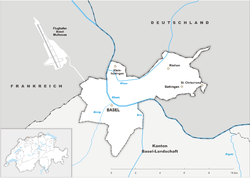
Basel-Stadt is one of the northernmost and lowest cantons of Switzerland, and the smallest by area. The canton lies on both sides of the Rhine and is very densely populated. The largest municipality is Basel, followed by Riehen and Bettingen. The only canton sharing borders with Basel-Stadt is Basel-Landschaft to the south. To the north of Basel-Stadt are France and Germany, with the tripoint being in the middle of the Rhine.
Together with Basel-Landschaft, Basel-Stadt was part of the Canton of Basel, which joined the Old Swiss Confederacy in 1501. Political quarrels and armed conflict led to the partition of the canton in 1833.
Basel-Stadt is Switzerland's seventh-largest economic centre[4] and has the highest GDP per capita in the country, ahead of the cantons of Zug and Geneva (in 2018).[5] In terms of value, over 94% of Basel City's goods exports are in the chemical and pharmaceutical sectors. With production facilities located in the neighbouring Schweizerhalle, Basel accounts for 20% of Swiss exports.[6]
History
[edit]The canton of Basel-Stadt was created when the historic canton of Basel was divided in 1833, following political quarrels and armed conflict in the canton. Some of these were concerned with the rights of the population in the agricultural areas. They ultimately led to the separation of the canton of Basel-Landschaft from the city of Basel on 26 August 1833. Since then, there has been a movement for reunification. This movement gained momentum after 1900 when many parts of Basel-Landschaft became industrialized. The two half-cantons agreed in principle to reunite, but in 1969, and again in September 2014, the people of Basel-Landschaft voted against this proposal in favour of retaining their independence.[7][8]
Geography
[edit]
The canton of Basel-Stadt is located in the north of Switzerland. Basel is located at the so-called 'knee' of the Rhine, at the point where from the west the little Birsig joins the Rhine from the left, and where the Rhine itself switches from flowing in a westerly direction to a northerly flow. It is the second flattest canton, with a height difference of only 277 metres between the Rhine and St. Chrischona.
Bettingen, Riehen and a part of Basel city lie on the east bank of the Rhine, bordered on three sides by the German state of Baden-Württemberg. The rest of the canton lies on the west bank of the Rhine.
The area of the canton is 37 km2 (14 sq mi), making Basel-Stadt the smallest canton in Switzerland. It is sometimes likened to a city-state.[9]
Basel-Stadt borders Basel-Landschaft to the south, the only adjacent canton. To the north, it borders Germany (Baden-Württemberg) and France (Grand Est). The three countries meet in the middle of the Rhine, about 150 metres north of the Dreiländereck monument.[10]
Municipalities
[edit]There are three municipalities:
| Municipality | Inhabitants (30 June 2021)[11] |
Area | |
|---|---|---|---|
| km2 | sq mi | ||
| Basel | 178,120 | 23.85 | 9.21 |
| Bettingen | 1,248 | 2.23 | 0.86 |
| Riehen | 21,788 | 10.87 | 4.20 |
Politics
[edit]The canton of Basel-Stadt shares its political structure and administration with the municipality of Basel.
Basel-Stadt is a half-canton. This means that the canton only sends one representative to the Council of States. The capital of the canton Basel-Stadt is the city of Basel. The present constitution of the canton dates from 1889. In 1966 Basel-Stadt became the first German-speaking canton to allow women to vote, five years before the right to vote was extended to all Swiss women in 1971.[12]
The parliament of the canton is the Grand Council, which has 100 members, who are elected for four years at a time. There are eight different political parties represented in the parliament; the largest party is the Social Democratic Party, with 32 seats.
The executive of the canton (Regierungsrat) is made up of seven members.
The canton has a sister state status with Massachusetts.[13]
Federal election results
[edit]| Party | Ideology | 1971 | 1975 | 1979 | 1983 | 1987 | 1991 | 1995 | 1999 | 2003 | 2007 | 2011 | 2015 | |
|---|---|---|---|---|---|---|---|---|---|---|---|---|---|---|
| FDP.The Liberalsa | Classical liberalism | 11.5 | 11.4 | 14.1 | 13.5 | 11.2 | 15.8 | 12.2 | 12.1 | 9.9 | 11.3 | 12.3 | 9.8 | |
| CVP/PDC/PPD/PCD | Christian democracy | 11.2 | 12.1 | 13.9 | 9.9 | 10.0 | 10.4 | 9.7 | 8.6 | 6.6 | 7.4 | 6.5 | 6.4 | |
| SP/PS | Social democracy | 30.4 | 33.3 | 33.3 | 31.0 | 25.9 | 25.3 | 35.5 | 33.3 | 40.9 | 35.2 | 29.1 | 33.3 | |
| SVP/UDC | Swiss nationalism | * b | * | * | * | * | 2.0 | * | 13.6 | 18.6 | 18.5 | 16.5 | 17.6 | |
| LPS/PLS | Swiss Liberal | 13.0 | 11.6 | 11.2 | 8.3 | 12.3 | 13.3 | 14.9 | 10.7 | 8.5 | 9.2 | 6.8 | 11.5 | |
| Ring of Independents | Social liberalism | 12.7 | 9.9 | 7.6 | 7.0 | 9.4 | 7.4 | * | * | * | * | * | * | |
| EVP/PEV | Christian democracy | * | 4.0 | * | 4.8 | 4.5 | 3.3 | 4.1 | 3.8 | 2.9 | 3.6 | 2.5 | 2.3 | |
| GLP/PVL | Green liberalism | * | * | * | * | * | * | * | * | * | * | 5.8 | 4.8 | |
| BDP/PBD | Conservatism | * | * | * | * | * | * | * | * | * | * | 2.2 | 1.1 | |
| PdA/PST-POP/PC/PSL | Socialism | 6.1 | 4.6 | 4.7 | 2.3 | 1.9 | 1.4 | 1.3 | * | * | * | * | * | |
| POCH | Progressivism | 1.8 | 4.2 | 10.3 | 11.9 | 9.4 | 7.8 | c | * | * | * | * | * | |
| GPS/PES | Green politics | * | * | * | * | 1.1 | 4.4 | 5.6 | 8.7 | 9.2 | 12.1 | 13.4 | 11.2 | |
| FGA | Feminist | * | * | * | 1.0 | 3.3 | d | 6.0 | e | * | * | * | * | |
| Solidarity | Anti-capitalism | * | * | * | * | * | * | 0.7 | * | * | * | * | * | |
| SD/DS | National conservatism | 8.0 | 8.2 | 3.9 | 5.3 | 4.5 | 3.2 | 6.9 | 3.8 | 1.1 | 0.7 | * | * | |
| Rep. | Republicanism | 4.9 | * | * | * | * | * | * | * | * | * | * | * | |
| EDU/UDF | Christian right | * | * | * | * | * | 0.9 | * | * | 0.7 | 0.5 | 0.5 | 0.5 | |
| Other | 0.4 | 0.8 | 0.9 | 5.0 | 6.5 | 4.8 | 0.7 | 5.5 | 1.6 | 1.7 | 4.2 | 1.4 | ||
| Voter participation % | 46.5 | 43.8 | 39.4 | 45.7 | 43.6 | 45.0 | 46.8 | 47.4 | 49.6 | 52.4 | 50.3 | 50.4 | ||
Demographics
[edit]Historical population
[edit]The historical population is given in the following table:
| Historic Population Data[15] | |||
|---|---|---|---|
| Year | Total Population | Swiss | Non-Swiss |
| 1850 | 29,698 | 22,879 | 6,819 |
| 1900 | 112,227 | 69,446 | 42,781 |
| 1950 | 196,498 | 180,145 | 16,353 |
| 1990 | 199,411 | 152,601 | 46,810 |
| 2020 | 196,735 | ||
The population of the canton (as of 31 July 2021) is 201,156.[2] As of 2007[update], the population included 56,106 foreigners, or about 30.29% of the total population.[16] The population (as of 2000[update]) is nearly evenly split between Roman Catholics (25%) and Protestants (27%). About 10% of the population was classed as adhering to another religion, while 36% did not belong to an organized religion.[17]
| Nationalities (0.30% and above)[18] | 1990 | 2000 | 2010 | 2018 |
|---|---|---|---|---|
 Switzerland Switzerland
|
77.52% | 72.44% | 67.36% | 63.58% |
 Germany Germany
|
2.60% | 3.27% | 7.58% | 8.22% |
 Italy Italy
|
6.42% | 5.44% | 4.18% | 4.32% |
 Turkey Turkey
|
3.27% | 4.38% | 3.56% | 3.09% |
 Yugoslavia Yugoslavia
|
2.79% | 3.13% | — | — |
 Serbia Serbia Montenegro Montenegro Kosovo Kosovo
|
— | — | 2.46% | 2.14% |
 Spain Spain
|
2.78% | 2.16% | 1.52% | 1.92% |
 Portugal Portugal
|
0.42% | 0.79% | 1.35% | 1.73% |
 North Macedonia North Macedonia
|
— | 1.12% | 1.17% | 1.11% |
 France France
|
0.59% | 0.54% | 0.76% | 1.10% |
 Great Britain Great Britain
|
0.35% | 0.48% | 0.96% | 1.10% |
 India India
|
0.12% | 0.17% | 0.65% | 0.83% |
 United States United States
|
0.25% | 0.31% | 0.63% | 0.80% |
 Austria Austria
|
0.45% | 0.45% | 0.58% | 0.61% |
 Poland Poland
|
0.09% | 0.08% | 0.23% | 0.47% |
 Croatia Croatia
|
— | 0.81% | 0.54% | 0.44% |
 Hungary Hungary
|
0.15% | 0.10% | 0.19% | 0.42% |
 Sri Lanka Sri Lanka
|
0.30% | 0.63% | 0.49% | 0.41% |
 Eritrea Eritrea
|
— | 0.00% | 0.10% | 0.40% |
 Netherlands Netherlands
|
0.18% | 0.21% | 0.32% | 0.40% |
 Romania Romania
|
0.05% | 0.04% | 0.12% | 0.34% |
 Bosnia and Herzegovina Bosnia and Herzegovina
|
— | 0.68% | 0.41% | 0.32% |
 Brazil Brazil
|
0.03% | 0.12% | 0.28% | 0.30% |
Economy
[edit]
The economic area of Basel is considered to be the second largest economic centre in Switzerland, after Zurich. The chemical industry and the pharmaceutical industry are of greatest significance in the canton. There are a number of multinationals in the city of Basel, attracting workers from both cantons of Basel and the areas across the border in France and Germany. Banking and finance are important as is the service sector in general. Small and middle-sized businesses employ a significant number of people, both in the city as the two municipalities. The canton is also known for its banking sector, and for being the worldwide seat of the Bank for International Settlements.
Economically, the neighbouring lands in Germany and France are not separated from the area of the canton of Basel-Stadt. Good transport links across the border, as well as supportive local governments, facilitate this link.
The fact that three nation-states come together in one spot near Basel (Dreiländereck) helps attract tourists. The site is clearly identified and a popular destination for primary school classes. The carnival attracts a large number of people from across Switzerland and the neighbouring countries.
In 2014, there were 104 workers in Basel-Stadt who worked in the primary sector (the total for all of Switzerland is 3.3%). In the same year the secondary sector employed 36,441 or about 19.0% of the total workforce. Of those in the secondary sector, nearly half of the workers were involved in the production of pharmaceutical products. The tertiary sector employed 154,896 or about 80.9% of the total, which is slightly higher than 74.9% nationwide. Of those in the tertiary sector, health care, education and retail sales made up about a quarter. Some of the other major tertiary fields included job placement (5.1%), management and business consulting (4.1%), public administration (3.9%), architectural and engineering offices (3.7%) and financial services (3.5%).[19]
Transport
[edit]
There is an international airport at Basel-Mulhouse, actually located 4 km (2.5 mi) inside French territory but with customs-free access from the city. The canton is well connected by both trains and motorways to the rest of Switzerland and the neighbouring areas in France and Germany.
Basel is a major railway station of Switzerland, connected to Paris and Berlin with direct fast trains.
There is a port at Basel for ships on the Rhine. This port is of great significance to landlocked Switzerland, as it offers the country's only direct connection to the sea. The port benefits from good connections to both rail and road.
Culture
[edit]
The Carnival of Basel (Basler Fasnacht) is a major cultural event in the year. The carnival is one of the biggest in Switzerland and attracts large crowds, despite the fact that many of its central traditions are played out in the early morning starting at 4am (Morgestraich) and followed by a continuous run of festivities for 72 hours.
The Autumn Fair in Basel (Basler Herbstmesse) is the biggest in Switzerland.
The canton of Basel is renowned for two of its biscuits. The Basler Läckerli is a hard biscuit made of honey, almonds, candied peel and Kirsch, and is enjoyed as a speciality all year round. The Basler Brunsli is made of almonds and generally enjoyed at Christmas all around Switzerland.
The Basel Messe convention center is the location of several international events. The largest are Art Basel, an art show for modern and contemporary works, and BaselWorld, a major watch and jewellery show.
Famous cultural ambassadors of Basel are the Top Secret Drum Corps and the Basel Boys Choir.
See also
[edit]Notes and references
[edit]- ^ Arealstatistik Land Cover - Kantone und Grossregionen nach 6 Hauptbereichen accessed 27 October 2017
- ^ a b Canton of Basel-Stadt Statistics, MS Excel document – T01.0.01 - Bevölkerungsstand 31 July 2021 numbers (in German) accessed 21 September 2021
- ^ "Gross domestic product (GDP) per region and canton". www.bfs.admin.ch.
- ^ Office, Federal Statistical. "Gross domestic product per canton and region". www.bfs.admin.ch.
- ^ "Schweiz - Bruttoinlandsprodukt pro Kopf nach Kanton 2018". Statista.
- ^ "Archived copy" (PDF). www.credit-suisse.com. Archived from the original (PDF) on 3 June 2016. Retrieved 11 January 2022.
{{cite web}}: CS1 maint: archived copy as title (link) - ^ "Kantonsfusion scheitert an Baselland". SRF. 28 September 2014. Retrieved 4 April 2018.
- ^ "Die beiden Basel bleiben getrennt". 28 September 2014. Retrieved 4 April 2018 – via tagesanzeiger.ch.
- ^ Canton of Basel-Stadt Welcome
- ^ Swisstopo topographic maps
- ^ Canton of Basel-Land Statistics, Wohnbevölkerung nach Nationalität und Konfession per 30. Juni 2021 (in German) accessed 22 September 2021
- ^ "1966 - 2016: 50 Jahre Frauenstimmrecht im Kanton Basel-Stadt". Frauenstimmrecht Basel-Stadt (in German). Retrieved 16 May 2022.
- ^ "Sister-State Agreement - swissnex Boston". www.swissnexboston.org. Archived from the original on 22 December 2017. Retrieved 4 April 2018.
- ^ Nationalratswahlen: Stärke der Parteien nach Kantonen (Schweiz = 100%) (Report). Swiss Federal Statistical Office. 2015. Archived from the original on 2 August 2016. Retrieved 4 August 2016.
- ^ "Basel-Stadt". Historisches Lexikon der Schweiz (in German). Retrieved 25 January 2022.
- ^ Federal Department of Statistics (2008). "Ständige Wohnbevölkerung nach Staatsangehörigkeit, Geschlecht und Kantonen". Archived from the original (Microsoft Excel) on 15 December 2008. Retrieved 5 November 2008.
- ^ Federal Department of Statistics (2004). "Wohnbevölkerung nach Religion". Archived from the original (Interactive Map) on 29 December 2008. Retrieved 15 January 2009.
- ^ "Ausländische Bevölkerung". Archived from the original on 17 December 2012. Retrieved 13 April 2019. (accessed 6 June 2012)
- ^ "Arbeitsstätten und Beschäftigte nach Kanton, Wirtschaftsabteilung und Grössenklasse". STAT-TAB (in German). Federal Statistical Office. 2014. Retrieved 18 April 2017.[permanent dead link]
External links
[edit]
- Official website

- Official statistics (archived)
- Basel-Stadt in German, French and Italian in the online Historical Dictionary of Switzerland.


| International | |
|---|---|
| National | |
| Geographic | |
| Other | |
Basel-Stadt
View on GrokipediaHistory
Origins and Medieval Development
The site of modern Basel was initially settled by the Celtic Rauraci tribe prior to Roman conquest, with the region undergoing Romanization starting under Emperor Augustus through the nearby colony of Augusta Raurica, established in 44 BCE approximately 20 kilometers east of the city.[4] Following the withdrawal of Roman forces around 400 CE, inhabitants retreated to the small Rhine fort of Basileia at the river's bend, which served as a strategic outpost along trade routes connecting the Mediterranean to northern Europe.[4] This location facilitated early commerce via the Rhine's navigable waters, though the settlement remained modest amid post-Roman instability. By the 6th and 7th centuries, Alemannic tribes established settlements around the remnants of the Roman castrum, gradually transforming Basileia—renamed Basel—into a burgeoning center under Frankish influence.[4] The city emerged as the seat of the Bishopric of Basel around the late 4th to 5th centuries, likely due to Germanic invasions displacing earlier episcopal centers, with bishops wielding temporal power over surrounding territories.[6] In 1032, Basel was incorporated into the Kingdom of Burgundy, which was absorbed into the Holy Roman Empire, enhancing its ecclesiastical and administrative prominence at the empire's western periphery.[7] Basel's ascent as a free imperial city accelerated in the 11th to 12th centuries, marked by urban expansion, market establishment by 1091, and fortifications including city walls to protect growing trade activities.[8] The construction of the Mittlere Brücke in 1226—one of the Rhine's oldest surviving crossings between Lake Constance and the North Sea—bolstered its role as a commercial nexus, enabling toll collection and goods transport that spurred economic vitality.[9] Guilds proliferated during this era, organizing artisans and merchants into entities that influenced governance and fostered self-administration, culminating in Basel's recognition as an imperial free city with privileges from Emperor Frederick II around 1226.[10] Intellectual growth peaked with the founding of the University of Basel on April 4, 1460, by Pope Pius II via a bull issued in November 1459, making it Switzerland's oldest institution of higher learning and attracting scholars amid the city's guild-driven prosperity.[11] This development solidified Basel's status as a medieval hub, where Rhine-based trade in salt, wine, and textiles intersected with emerging humanistic pursuits, though tensions between bishopric authority and civic guilds foreshadowed later autonomy struggles.[4]Separation from Basel-Landschaft in 1833
The period leading to the separation was marked by escalating urban-rural tensions within the Canton of Basel, exacerbated by the liberal regeneration movements across Switzerland in the late 1820s and early 1830s, which emphasized broader political participation and reforms in representation and taxation.[12] The urban elite in Basel city, predominantly conservative and reliant on trade revenues, held disproportionate influence in the cantonal government, while rural districts—spanning agrarian territories with lower population density—faced underrepresentation despite contributing significantly to fiscal burdens through agricultural taxes.[13] These disparities, rooted in geographic and economic divergence, fueled demands from rural liberals for proportional voting rights and reduced urban dominance, highlighting how concentrated urban governance struggled to administer dispersed rural needs efficiently.[14] Conflicts intensified in 1830–1832, known as the "Basel Troubles" (Basler Wirren), with rural uprisings against the city's authority, including a blockade of Basel by rural militias in November 1831 that disrupted urban supplies and escalated to armed skirmishes.[12] The Tagsatzung, Switzerland's federal diet, intervened to mediate, proposing the canton's division to resolve the impasse and prevent broader instability, a solution aligned with the era's push toward direct democracy.[15] On July 17, 1833, a referendum in the rural districts approved separation by a majority vote, with urban Basel acquiescing under pressure to avert further violence; the Tagsatzung formalized the split on August 26, 1833, creating two half-cantons of equal standing in the confederation.[14][15] In the immediate aftermath, Basel-Stadt retained the compact urban core—including the city of Basel and adjacent communes—totaling about 37 square kilometers, while ceding over 400 square kilometers of agrarian lands to Basel-Landschaft, enabling each entity to tailor administration to its scale: dense urban trade hubs versus expansive rural agriculture.[4] This division, driven by causal mismatches in governance scale rather than mere ideology, underscored the practical limits of unified rule over heterogeneous territories, preserving stability through localized sovereignty without diminishing either half-canton's confederative rights.[14]Industrialization and 20th-Century Growth
The chemical industry emerged as the cornerstone of Basel-Stadt's industrialization in the mid-19th century, capitalizing on the city's strategic position along the Rhine River for importing raw materials like coal and exporting finished dyes to European markets, particularly Germany. Pioneering firms such as CIBA, founded in 1859 by Alexandre Clavel as the Gesellschaft für Chemische Industrie Basel to produce synthetic aniline dyes, rapidly expanded production amid demand from the textile sector. Similarly, Sandoz was established in 1886 by Alfred Kern and Edouard Sandoz, initially focusing on chemical extracts before diversifying into pharmaceuticals. These enterprises benefited from Basel's established silk ribbon and textile dyeing traditions, transitioning to synthetic colors that required proximity to the Rhine for efficient logistics and waste disposal.[16][17] By the early 20th century, the concentration of dye factories—reaching six in Basel by century's end—fueled urban expansion and population growth, with the city proper recording 109,161 residents in 1900, more than doubling from mid-century levels due to factory employment attracting migrant labor. The sector's resilience was tested during World War I, where Swiss neutrality preserved trade routes along the Rhine despite blockades, allowing chemical exports to continue under licensed arrangements while domestic shortages prompted rationing. World War II reinforced this pattern: Basel's border location enabled discreet economic dealings with Nazi Germany, including machinery repairs and chemical supplies, but neutrality shielded the city from direct combat or bombing, limiting infrastructure damage to minor incidents. Refugee inflows from adjacent conflict zones added to the workforce, sustaining industrial output amid wartime scarcities.[18][19][20] Post-1945 reconstruction accelerated Basel-Stadt's integration into recovering European markets, with chemical firms like CIBA and Sandoz leveraging prewar expertise to pivot toward pharmaceuticals, supported by cross-border commuting from France and Germany. Population climbed to approximately 170,000 by 1950, reflecting sustained factory expansion and the canton's role as a neutral hub for trade reorientation. This era solidified Basel's economy against broader Swiss challenges like inflation, positioning it as a chemical powerhouse without EU membership dependencies.[21][22]Post-WWII Economic Expansion and EU Border Dynamics
In the decades following World War II, Basel-Stadt's economy surged due to the expansion of its chemical-pharmaceutical cluster, with firms like Roche scaling up production and research amid global demand for new therapeutics. The 1996 merger creating Novartis from Ciba-Geigy and Sandoz exemplified industry consolidation, enabling larger-scale R&D that propelled Basel's biotech leadership and generated substantial patent portfolios in drug innovation.[23] [24] Regional R&D spending reached 14.1% of GDP by the early 2000s, far exceeding national averages and supporting export-oriented growth in high-value biologics and chemicals.[25] This pharma dominance elevated Basel-Stadt's GDP per capita well above the Swiss average, with the sector's exports—accounting for roughly 50% of Switzerland's total merchandise exports by the 2000s—driving cantonal prosperity through specialized manufacturing and intellectual property.[26] [27] Economic output benefited from the Trirhena metropolitan area's cross-border integration, where daily commuters from French Alsace and German Baden-Württemberg filled skilled roles, expanding the effective labor pool for knowledge-intensive industries while leveraging lower-wage peripherals for support functions.[28] Switzerland's 2008 implementation of the Schengen Agreement mitigated longstanding border frictions with EU neighbors, streamlining personal and goods movement across the Rhine without full customs abolition, as non-EU status preserved tariffs and regulatory divergences.[29] This partial alignment boosted Trirhena's cohesion, facilitating pharma supply chains and workforce fluidity—over 100,000 cross-border workers by the 2010s—but exacerbated infrastructure strains, including traffic congestion on bridges and rail overloads, due to asymmetric economic pulls toward high-wage Swiss jobs amid uneven regional development.[30] [31] Persistent non-alignment with EU economic policies, such as currency and competition rules, sustained selective barriers, channeling growth benefits disproportionately to Basel's core while highlighting causal tensions in tri-national coordination.Geography
Location and International Borders
The Canton of Basel-Stadt is situated in northwestern Switzerland, encompassing an area of 37 km². It shares international borders with France to the west and Germany to the north, while domestically adjoining the Canton of Basel-Landschaft to the south and east. This compact territory is entirely urbanized, comprising the three contiguous municipalities of Basel, Riehen, and Bettingen, which integrate seamlessly with the central city without any rural enclaves.[32][33] Basel-Stadt forms the core of the Basel Euroregion, a trinational metropolitan agglomeration that promotes cross-border collaboration across Switzerland, France, and Germany. The canton's northern boundary features the Dreiländereck, a tripoint at the Rhine River where the three national borders converge, historically fostering trade and smuggling due to the river's navigability and proximity of jurisdictions. In contemporary terms, this geopolitical configuration supports substantial daily cross-border mobility, with over 85,000 commuters entering Basel-Stadt from neighboring France and Germany for employment.[34][35][34] The juxtaposition of sovereign borders within a densely integrated urban space enables efficient regional trade flows but also generates ongoing discussions regarding regulatory disparities, such as variances in taxation, labor laws, and environmental standards that can lead to arbitrage opportunities across the frontiers. Empirical observations confirm the canton's role as a European crossroads, where the Rhine serves as both a natural divider and connector, amplifying its strategic positioning without extending into expansive rural landscapes.[34]Topography, Rhine River, and Urban Layout
The Canton of Basel-Stadt covers 37 km² of terrain ranging from flat alluvial plains along the Rhine to undulating hills in the south, with elevations typically between 250 and 300 meters above sea level and a maximum of 427 meters at St. Margrethenberg.[36][32] This modest relief, part of the Upper Rhine Valley's transition to the Jura foothills, supports dense urbanization but limits large-scale topographic variation within the compact canton. The Rhine River dominates the landscape, flowing northward through Basel and dividing the city into Grossbasel on the left (western) bank—encompassing the historic core—and Kleinbasel on the right (eastern) bank, a separation that has shaped dual settlement patterns since medieval times.[37] As a key navigable waterway, the Rhine carries substantial freight volumes, with Basel's ports managing approximately 30% of Switzerland's container imports via inland waterways, underscoring the river's role in regional logistics despite navigational challenges from variable water levels.[38] The river's high discharge—peaking above 4,300 m³/s in extreme events—poses recurrent flood risks to low-lying urban zones, as seen in historical inundations and recent alerts affecting the stretch from Lake Constance to Basel.[39][40] Basel's urban layout integrates this topography and fluvial divide through 19 compact quarters, with the Altstadt in Grossbasel featuring a preserved medieval grid of narrow streets radiating from elevated sites like the Münster hill for defensive and overlook advantages.[37] Industrial-era growth in the 19th century drove infill construction and ribbon development along the banks, yielding one of Switzerland's highest population densities at over 5,400 inhabitants per km², which constrains horizontal expansion and emphasizes multistory buildings amid the canton's bordered confines.[32][41] This configuration, amplified by the Rhine's centrality, fosters a compact, river-oriented fabric resilient to but vigilant against hydrological pressures.[39]Climate Patterns and Environmental Features
Basel-Stadt features a temperate oceanic climate classified as Cfb under the Köppen system, characterized by mild, wet winters and moderately warm summers without dry seasons.[42] Average winter temperatures range from 1°C to 5°C in January, while summer highs reach 18°C to 22°C in July, with an annual mean around 10°C.[43] Annual precipitation totals approximately 850-950 mm, distributed fairly evenly but peaking in summer months like May and June.[44] The Rhine River corridor influences local weather by moderating temperature extremes through its thermal mass and humidity, reducing frost risk in winter and heat in summer compared to inland areas.[45] However, urbanization exacerbates an urban heat island effect, with studies documenting nocturnal temperature differentials of up to 2-3°C higher in dense city centers versus rural outskirts, driven by impervious surfaces and reduced vegetation.[46] [47] Environmental assets include significant green spaces integrated into the urban fabric, such as the Lange Erlen area, a 20-hectare alluvial forest and wildlife park along the Wiese River featuring native species like deer and boar amid wooded trails.[48] These areas provide biodiversity hotspots and recreational buffers against urban density in the compact canton. Recent MeteoSwiss analyses indicate rising flood risks along the Rhine due to climate-driven increases in extreme precipitation intensity, with projections showing heightened seasonality and potential for more frequent high-water events by mid-century.[49] [50]Administration
Municipalities and Quarter Divisions
The Canton of Basel-Stadt consists of three municipalities: the city of Basel and the smaller rural communes of Riehen and Bettingen.[37] This limited number reflects the canton's compact urban character, formed after the 1833 separation from Basel-Landschaft, which retained the city and its immediate northern enclaves while integrating all areas into a unified administrative fabric without independent rural entities.[51] The municipality of Basel dominates demographically, housing approximately 177,571 residents as of 2024 estimates, comprising over 88% of the canton's total population of around 201,384.[41][2] Riehen, with 22,534 inhabitants, and Bettingen, with 1,279, function as semi-suburban extensions, featuring residential and green spaces that complement the urban core while maintaining distinct communal identities.[52] This distribution enables efficient public service provision through close proximity, minimizing infrastructural redundancies across the 37 square kilometers of cantonal territory. For finer administrative granularity, the city of Basel employs a quarter system dividing its area into 15 Quartiere, primarily for urban planning, statistical reporting, and localized community services.[53] Quarters such as St. Johann integrate industrial, commercial, and recreational zones, including parks and transport hubs, while others like Altstadt Grossbasel preserve historical districts. This subdivision supports targeted zoning and development, adapting to the dense urban layout bisected by the Rhine without altering municipal boundaries.[37] Riehen and Bettingen, lacking similar internal quarter divisions, operate as cohesive units suited to their smaller scales and semi-rural profiles.Cantonal Governance Structure
The executive branch of the Canton of Basel-Stadt is embodied in the Regierungsrat, a seven-member collegial council directly elected by proportional representation for four-year terms, with elections synchronized to those of the federal parliament. This body assumes collective responsibility for day-to-day cantonal administration, policy implementation, budget execution, and preparation of legislative drafts for submission to the parliament, operating without a single head of government to promote shared decision-making.[54][55][56] Legislative authority is vested in the unicameral Grosser Rat, comprising 100 members elected by proportional representation every four years to represent the canton's population. The parliament enacts cantonal laws, supervises the executive and administrative apparatus, approves annual budgets and financial plans, determines taxation policies, and ratifies international treaties affecting cantonal interests. Complementing representative democracy, the system incorporates direct democratic mechanisms: eligible voters may launch popular initiatives to amend the cantonal constitution or enact statutes, requiring collection of signatures from at least 1% of the electorate for constitutional matters or 2% for ordinary laws, with subsequent validation by referendum if approved by parliament; optional referendums allow challenges to parliamentary acts within 100 days via signatures from 2% of voters, ensuring citizen oversight.[33][57][55] The judicial framework maintains independence through a hierarchy of courts, with the Kantonsgericht Basel-Stadt serving as the highest cantonal instance for civil, criminal, and administrative appeals from lower district and specialized courts, while deferring to the Swiss Federal Supreme Court on federal law and constitutional disputes. This structure upholds separation of powers, with judges appointed by the Grosser Rat from qualified candidates and subject to periodic re-election, integrating cantonal jurisprudence with federal supremacy in a dualistic legal order.[55][58] Unique to Basel-Stadt's half-canton status, the governance prioritizes a concordance approach, wherein the Regierungsrat routinely allocates seats across major parties based on electoral strength to secure broad consensus, minimizing adversarial politics and enabling stable multi-party coalitions that mirror federal practices but adapt to the canton's urban, compact scale.[59][55]Politics
Executive and Legislative Institutions
The executive authority in the Canton of Basel-Stadt is held by the Regierungsrat, a collegial body of seven members elected by direct popular vote for four-year terms.[55] Each member heads a dedicated department responsible for core administrative functions, including the Finanzdepartement for fiscal management and tax administration, the Gesundheitsdepartement for public health services, and the Erziehungsdepartement for schooling and vocational training.[60] The council collectively executes cantonal policies, prepares legislative proposals for the parliament, and oversees daily governance operations, with decisions requiring majority consensus among members.[54] Legislative power resides in the Grosser Rat, a unicameral parliament consisting of 100 members elected via proportional representation every four years.[61][55] The Grosser Rat convenes in regular sessions to pass laws, scrutinize government reports, approve annual budgets through detailed fiscal reviews, and exercise oversight over executive actions and judicial matters.[33] Parliamentary proceedings emphasize evidence-based deliberations, with committees analyzing data on expenditures and policy impacts prior to plenary votes.[61] Direct democracy instruments enable citizens to constrain both branches, mandating public votes on key decisions. A popular initiative requires signatures from 3,000 eligible voters to propose constitutional amendments or new laws, triggering a binding referendum if qualified.[62] Optional referendums against parliamentary enactments follow a similar threshold, subjecting approved legislation to popular ratification within 90 days of publication.[63] On May 18, 2025, for example, voters upheld a legislative package of tax incentives in such a referendum, confirming the measure after an optional challenge.[64] These mechanisms distribute authority beyond elected bodies, requiring periodic validation by the electorate to prevent unchecked expansion of state functions.Political Parties, Coalitions, and Voter Behavior
The political landscape of Basel-Stadt features a multi-party system dominated by the Social Democratic Party (SP), the Greens, and the Liberal Democratic Party (LDP), with the SP consistently securing the largest share of seats in the 100-member Grand Council. In the October 2024 cantonal elections, the SP emerged as the strongest party with approximately 30% of the vote, gaining one seat to reach 31, while the Greens held steady at around 18 seats and the LDP, a pro-business liberal force, lost ground to finish with 13 seats.[65] The Swiss People's Party (SVP) and Green Liberal Party (GLP) also maintain notable representation, with 11 and 8 seats respectively, reflecting a balance between left-leaning urban priorities and economic liberalism driven by the canton's pharmaceutical and financial sectors.[66] Coalitions in Basel-Stadt emphasize pragmatic governance, with the seven-member Executive Council (Regierungsrat) typically comprising representatives from the SP (two seats), LDP (two), Greens (one), GLP (one), and FDP.The Liberals (one), elected directly by popular vote for four-year terms to ensure broad consensus on fiscal and regulatory policies. This collegial structure fosters stability, as seen in cross-party cooperation on business-friendly incentives like competitive corporate taxes, which industry leaders credit for sustaining Basel's role as a hub for companies such as Novartis and Roche. However, tensions arise over regulatory burdens; environmental advocates and Green politicians push for stricter emissions controls, drawing criticism from business associations for potentially stifling innovation and investment.[67] Voter behavior exhibits moderate turnout, averaging around 50% in federal elections, with the 2023 National Council vote recording 49.2% participation amid national trends. Empirical data from that election show a shift toward centrist options, with the SP retaining strong urban support at about 28% of the vote, while the Greens declined by roughly 5 percentage points to 19%, and liberal parties like the LDP and GLP held steady or gained modestly, underscoring a preference for balanced policies over ideological extremes. Direct democratic mechanisms, including frequent cantonal referendums, often moderate left-leaning impulses by rejecting expansive public spending initiatives, as voters prioritize fiscal restraint influenced by the canton's export-oriented economy.[68][69]Federal Interactions and Direct Democracy Referendums
Basel-Stadt, classified as a half-canton under Swiss federalism, elects one representative to the Council of States and four to the National Council, with seats allocated proportionally based on population.[67] These federal parliamentarians from Basel-Stadt typically advocate for pro-trade and liberalization measures, consistent with the canton's export-oriented economy and proximity to international borders.[70] Swiss federalism imposes constraints on cantonal fiscal autonomy, as evidenced by the nationwide adoption of the OECD Pillar Two global minimum tax rate of 15%, implemented via a federal supplementary tax from January 2024.[71] In response, Basel-Stadt's government proposed compensatory tax incentives, including reduced rates for qualifying corporate profits and grants for innovation in sectors like life sciences, which voters approved in a referendum on May 18, 2025, with 63.2% support.[72] This adjustment raised the canton's effective corporate tax burden toward the 15% threshold for affected multinationals while preserving competitiveness through targeted relief.[73] Direct democracy enables Basel-Stadt residents to shape policies intersecting federal and cantonal levels, as seen in the June 13, 2021, referendum approving a statutory minimum wage of CHF 21 per hour for most employees, exempting those under collective bargaining agreements.[74] The measure, effective from 2022 and indexed for inflation (reaching CHF 22 by 2025), reflects voter prioritization of local labor standards amid Switzerland's rejection of a national minimum wage in 2014.[75] Such referendums underscore the canton's empirical approach to policy, where outcomes directly enforce voter preferences over executive proposals.Key Policy Controversies and Debates
In recent years, Basel-Stadt has faced debates over restrictions on begging in public spaces, balancing public order against humanitarian concerns. Following the repeal of a blanket ban in 2019, the canton enacted targeted prohibitions in 2021, barring begging in areas such as parks, near schools, and pedestrian zones to address nuisances like littering and intimidation often associated with organized groups from Eastern Europe.[76] [77] The Federal Supreme Court upheld these measures in April 2023, rejecting challenges that they unduly criminalized poverty, and cited evidence of disruptions to daily life; subsequently, authorities expelled 11 foreign beggars from Switzerland under revised enforcement practices.[78] [79] Critics, including human rights advocates referencing European Court of Human Rights precedents against fines for non-intrusive begging, argued for decriminalization to prioritize poverty alleviation over punitive approaches, though cantonal data emphasized localized disorder tied to cross-border migration patterns.[76] [80] The 2021 voter-approved introduction of a cantonal minimum wage of CHF 21 per hour—among the highest in Switzerland—sparked contention over its labor market effects, particularly for youth and low-skilled workers.[81] Proponents from left-leaning parties framed it as essential for equity amid rising living costs, while efficiency-focused critics warned of reduced hiring incentives, pointing to economic analyses in peer cantons like Geneva where similar thresholds correlated with diminished entry-level opportunities for young job seekers.[82] [83] Cantonal unemployment remained low overall, but debates highlighted potential 5-10% youth-specific rises in underemployment critiques, with right-leaning voices advocating flexibility over mandates to sustain competitiveness in border-adjacent industries.[84] Welfare policy reviews have centered on coercive measures, including compulsory placements and interventions for integration, amid fiscal and ethical scrutiny. In September 2024, the Grand Council allocated CHF 600,000 for a comprehensive study reassessing these tools, which have been used to enforce participation in labor programs and address public space encroachments linked to non-integrated migrant populations.[85] Advocates for tightening emphasized cost savings—estimated in the millions annually—and order restoration in hygiene-challenged urban zones, supported by data on welfare dependency patterns; conversely, equity proponents called for reduced coercion to foster voluntary integration, warning that over-reliance risks alienating vulnerable groups without resolving root socioeconomic drivers.[86]Demographics
Current Population Size and Density
As of December 31, 2024, the resident population of the Canton of Basel-Stadt stood at 207,515, reflecting a year-over-year increase of 1,207 individuals.[87] This figure encompasses the permanent resident population across its three municipalities: Basel, Riehen, and Bettingen, with Basel accounting for the vast majority.[88] The canton's land area measures approximately 37 square kilometers, yielding a population density of about 5,608 inhabitants per square kilometer, the highest among Swiss cantons.[88] This urban compactness stems from its role as a concentrated metropolitan hub, with limited undeveloped land constrained by the Rhine River and bordering France and Germany.[32] Annual population growth averaged 0.6% in 2024, primarily propelled by net positive migration rather than natural increase, consistent with patterns reported by the Swiss Federal Statistical Office for urban cantons.[87] The median age hovers around 42 years, indicating moderate demographic aging tempered by inflows of working-age residents.[89] Daytime population surges beyond resident figures due to a tri-national commuter workforce, exceeding 85,000 inbound workers from neighboring France and Germany, elevating effective daily occupancy to over 290,000.[34] This influx, representing roughly 40% augmentation, underscores Basel-Stadt's economic pull as a cross-border employment center.[90]Immigration Trends and Ethnic Composition
The Canton of Basel-Stadt has one of the highest proportions of foreign nationals among Swiss cantons, reaching 38.6% of the resident population as of September 2024, with the figure climbing to a 55-year record of 39% by mid-2025 amid ongoing population growth to over 208,000 residents.[91] This equates to approximately 81,400 foreign nationals, reflecting sustained inflows driven by the canton's economic hubs in pharmaceuticals, chemicals, and finance, which draw skilled labor primarily from EU/EFTA countries.[92] Approximately 55.8% of the population aged 15 and over had a migration background as of 2022, the latest available figure, encompassing both first- and second-generation migrants and exceeding the national average of 41%.[91][93] Immigration trends show robust net gains, with 13,880 new residents arriving in 2024, of which 67% originated from abroad; Germany supplied the largest cohort at 2,347 individuals, underscoring EU labor mobility under bilateral agreements.[94] Foreign nationals predominantly hail from EU/EFTA states, with Germans forming the top group (around 14,000 in Basel city alone), followed by Italians (over 8,000), Portuguese (3,400+), and French (2,300+), comprising the bulk of the 168 nationalities represented.[94][41] Non-EU origins include Turkey, former Yugoslav states, and smaller contingents from Spain, the UK, and India, though these remain secondary to European flows. This composition supports the canton's high-skill sectors but correlates with elevated urban densities, where over 65% of residents in core districts exhibit migration backgrounds, amplifying localized strains on housing and public spaces.[94] Cross-border commuters further intensify the de facto ethnic diversity, with 35,000-37,000 G-permit holders from France and Germany entering daily for work, effectively doubling the transient foreign presence relative to resident figures and sustaining economic output in border-proximate industries.[32] While this influx bolsters GDP through specialized labor—particularly in Basel's multinational pharma firms—critics in local discourse highlight integration hurdles, including reports of sanitation issues in high-migrant neighborhoods and nascent parallel communities resistant to Swiss norms, as noted in resident forums and media analyses of urban decay patterns.[95][96] Such challenges stem causally from rapid demographic shifts outpacing assimilation infrastructure, though empirical data affirm net economic positives via tax revenues and innovation from EU migrants.[97]Linguistic, Religious, and Age Distributions
The resident population of Basel-Stadt is overwhelmingly German-speaking, with over 75% reporting German (predominantly Swiss German dialects in everyday use) as the primary language spoken at home among those aged 15 and older.[98] This aligns with the canton's location in Switzerland's Alemannic region, where Standard German serves official functions while the local dialect dominates informal communication. Multilingualism prevails due to the high proportion of international residents, cross-border workers from France and Germany, and expatriates in knowledge-intensive industries; English functions as a key second language for about 12.5% of the population, facilitating business and academia.[99] Shares of French (around 4-5%), Italian (3-4%), and other languages like Portuguese or Albanian reflect proximity to Romance-language areas and labor migration patterns.[98] Religious affiliation in Basel-Stadt is marked by pronounced secularization, with 54% of residents unaffiliated as of 2018-2022 structural survey data, exceeding the national average of 34% non-religious in 2022.[100][101] Protestant (Reformed) and Roman Catholic communities, historically dominant, together represent about 29%, down from over 90% in 1970, with each denomination roughly equal in size.[100] Islam comprises 8%, driven by immigration from Muslim-majority countries including Turkey and the Balkans; other Christians account for 6%, while Jews and non-Abrahamic faiths form negligible shares under 1% each.[100] This profile indicates a rapid shift toward irreligion, especially among urban youth and professionals, amid broader European trends of declining institutional religion. The population's age distribution comprises 17% under 20 years, 63% aged 20-64, and 20% over 64, based on 2023 resident figures.[102] This relatively balanced structure, with a median age around 42, relies on sustained net immigration to counter low fertility rates (below replacement level) and maintain the labor force for export-oriented sectors. High educational attainment bolsters workforce productivity, with about 40% of those over 15 holding tertiary qualifications such as university degrees, far above national averages and linked to institutions like the University of Basel.[103]Historical Population Dynamics
The population of Basel-Stadt experienced gradual growth in the early 19th century, reaching approximately 26,700 inhabitants by 1850, primarily within the urban confines of Basel city following the canton's separation from Basel-Landschaft in 1833, which via referendum preserved the densely settled core area and funneled subsequent urban migration into its territory.[104] By the late 19th century, this trend accelerated amid broader Swiss industrialization, with the population surpassing 110,000 by 1901 as workers were drawn to the Rhine-border region's trade and manufacturing hubs, concentrating demographic pressure in the half-canton's limited 37 km² area.[105] Post-World War II, growth stabilized, hovering around 190,000 from the 1950s through the 1980s, reflecting balanced natural increase offset by outward suburban migration to surrounding cantons and cross-border commuting patterns enabled by the tri-national location.[106] A slight decline occurred in the 1970s–1990s due to urban flight, but resurgence began in the late 1990s, with the population expanding by over 20% from 2000 to 2025, largely from EU free movement agreements post-2002 that intensified inbound migration and commuter inflows from France and Germany. The following table summarizes decadal population figures from Swiss federal censuses and cantonal records, highlighting the shift from 19th-century expansion to modern immigration-driven gains:| Year | Population |
|---|---|
| 1850 | 26,698 |
| 1900 | 112,227 |
| 1950 | 190,000 (approx.) |
| 2000 | 186,039 |
| 2020 | 196,735 |