


Community hub
Recent from talks
Contribute something
Nothing was collected or created yet.
Battle of Novi (1799)
View on Wikipedia| Battle of Novi (1799) | |||||||
|---|---|---|---|---|---|---|---|
| Part of the Italian campaigns in the War of the Second Coalition | |||||||
 Battle of Novi, by Alexander Kotzebue | |||||||
| |||||||
| Belligerents | |||||||
 Russian Empire Russian Empire Habsburg monarchy Habsburg monarchy |
 French Republic French Republic | ||||||
| Commanders and leaders | |||||||
|
Alexander Suvorov Wilhelm Derfelden Pyotr Bagration Mikhail Miloradovich Ivan Förster Paul Kray Michael von Melas Peter Ott Heinrich von Bellegarde Michael von Fröhlich Anton Mittrowsky Alexander von Seckendorff Johann Nobili |
Barthélemy Joubert † Jean Moreau Dominique de Pérignon (POW) Emmanuel de Grouchy (POW) Louis Lemoine Laurent de Gouvion Saint-Cyr Gaspard Gardanne François Watrin Pierre de Laboissière Jan Dąbrowski Jan Dąbrowski | ||||||
| Units involved | |||||||
| See Allied Army | See French Army | ||||||
| Strength | |||||||
| 34,930 to 40,000[e] | ||||||
| Casualties and losses | |||||||
|
8,000–9,000[f] …other calculations 3 guns[17] |
9,663–12,000[g] …other calculations 37 guns[18][6][15] 4 standards[19] | ||||||
  Location within Europe | |||||||


The Battle of Novi[h] took place on 15 August 1799[i], was a battle between combined army of the Habsburg monarchy and Imperial Russians under Field Marshal Alexander Suvorov and a Republican French army under General Barthélemy Catherine Joubert. As soon as Joubert fell during the battle, Jean Victor Marie Moreau immediately took overall command of the French forces. After a prolonged and bloody struggle, the Austro-Russians broke through the French defenses and drove their enemies into a disorderly retreat, while French division commanders Catherine-Dominique de Pérignon and Emmanuel Grouchy were captured. Novi Ligure is in the province of Piedmont in Northern Italy a distance of 58 kilometres (36 mi) north of Genoa. The battle occurred during the War of the Second Coalition which was part of the French Revolutionary Wars.[20]
Novi was a strong defensive position situated on steep heights. An old fortress wall from the 15th century surrounded the city. This medieval wall served as a good defense for the French chasseurs. It was damaged in many places, there were breaks, but the French had barricaded all these breaches.[citation needed]
In 1799, Russian and Austrian forces swept across the Po River valley, recapturing lands taken by Napoleon Bonaparte in 1796. The French troops in Italy were badly defeated at the major battles of Magnano, Cassano and the Trebbia. Subsequently, French and Cisalpine Italian troops retreated into Genoa and the Ligurian Republic. A new French government placed Joubert in command of the reformed Army of Italy and ordered him to take the offensive. Accordingly, the French army moved north across the mountain crests and assembled on high ground at Novi Ligure on 14 August. To Joubert's dismay, it was clear that large Coalition forces were nearby. The next morning Paul Kray's Austrian corps assaulted the French left flank and the battle was on. After a delay, Suvorov committed a Russian corps to attack the center, where the walled town of Novi was, and Michael von Melas' Austrian corps to attack the French right flank. Kray's troops suffered heavy losses but by evening the French army was badly beaten and the French hold on the Italian Riviera was gravely weakened. Cavalry proved ineffective in such terrain and was hardly used by either the Allied or French sides. The Russo-Austrians deployed it en masse only to pursue. However, the Coalition planners proceeded to throw away their advantage by sending Suvorov's Russians to Switzerland, a change of strategy that ended badly.
Background
[edit]The 1799 campaign in Italy began with the Battle of Verona, a series of costly but indecisive clashes around Verona on 26 March.[21] At the Battle of Magnano on 5 April, the Habsburg Austrian army of Paul Kray triumphed over the Republican French army of Barthélemy Louis Joseph Schérer. While suffering losses of 4,000 killed and wounded and 2,000 captured, Kray's Austrians inflicted casualties of 3,500 killed and wounded and captured 4,500 men, 18 artillery pieces and seven colors from the French.[22] Two days later, a distraught Schérer begged to be relieved of command, but before that happens, he would be defeated again in the small battle with Alexander Suvorov at Lecco on 26 April. Michael von Melas arrived to take command of the Austrian army from Kray on 9 April. Hearing that 12,000 Austrians were approaching from the Tyrol to the north, Schérer abandoned the line of the Mincio River on 12 April. Leaving 12,000 troops in the fortress of Mantua and 1,600 more in Peschiera del Garda, the demoralized French commander ordered his crippled army to withdraw. As the soldiers fell back, the skies opened up and turned the retreat into a sodden nightmare.[23]
On 15 April 1799, the veteran Russian field marshal Alexander Suvorov formally took command of the combined Austro-Russian army in Italy.[24] On 27 April Suvorov defeated the French, now under Jean Victor Marie Moreau, at the Battle of Cassano, and then in the First Battle of Marengo (Battle of San Giuliano) on 16 May. At Cassano, the Allies suffered 2,000 casualties while the French sustained losses of 2,500 killed and wounded plus 5,000 soldiers, 27 guns and three colors captured; the next day a 3,000-man French division was trapped and surrendered at Verderio Superiore,[25] however, the Russians subsequently lost the Battle of Bassignana on 12 May. After the battle of Cassano, the next major action was the Battle of the Trebbia from 17 to 20 June where Suvorov's 37,000-strong Austro-Russian army (only up to 32,656 troops involved) mauled Jacques MacDonald's 33,000-man French army, which had earlier broken through Austrian positions in the Battle of Modena[j] on 12 June. The Allies suffered 5,500 casualties at the Trebbia, while inflicting 16,500 on the French including the taking of 7,000 prisoners.[6] On 20 June, just as the battle of the Trebbia ended, the Second Battle of Marengo (Battle of Cascina Grossa) took place, where the Austrians suffered a setback. Nevertheless, Coalition forces successfully besieged a number of key fortresses in the meantime. Peschiera fell on 6 May,[27] Milan was captured on 24 May[28] and Turin fell on 20 June after a nine-day siege.[29] Suvorov and his Austrian allies had evicted the French from almost all of Italy, while Archduke Charles, Duke of Teschen beat André Masséna's French army at the First Battle of Zurich on 4–6 June.[30]

A day after defeating MacDonald along the Trebbia River, the Allies captured the 17th Light Demi Brigade, 1,099 men, six guns and three colors. On 22 June Suvorov halted pursuit by his army, exhausted by continuous marching and fighting. At first a division was allowed to follow the French,[31] but this was soon reduced to an Austrian advanced guard under Johann von Klenau which went on to clear the Grand Duchy of Tuscany of enemy forces. On 20 June, Moreau and 14,000 French troops left the security of the mountains to defeat Count Heinrich von Bellegarde and 11,000 Austrians in the Second Battle of Marengo. Bellegarde withdrew to the west after suffering 2,260 casualties but Moreau soon scampered back to the safety of the Apennines after hearing news of the Trebbia.[32] French casualties numbered 1,000 killed and wounded in this encounter.[33]
By 27 June, Suvorov moved his main army west to cover the sieges of Alessandria and Tortona while Kray was still reducing Mantua.[32] Suvorov and his Austrian chief of staff Johann Gabriel Chasteler de Courcelles planned to evict the weakened and battered French forces from Genoa and the Italian Riviera. However, instructions soon arrived from Vienna squelching any notion of offensive operations. Emperor Francis and his foreign minister Johann Amadeus Francis de Paula, Baron of Thugut insisted that the Italian fortresses must first be captured. In fact the emperor and Thugut were suspicious of Russian designs on Genoa and Tuscany, areas which they considered to be in Austria's sphere of influence. For his part, Suvorov was annoyed with Viennese officials for trying to direct the war from long distance.[34]
Repeated military defeats shook the public's faith in the French Directory. The Coup of 30 Prairial VII occurred on 18 June which pushed Emmanuel-Joseph Sieyès and Paul Barras into leading roles and elevated Jean Baptiste Bernadotte to the post of Minister of War.[35] There were two major forces in Italy, the 19,000-strong Army of the Alps under Jean Étienne Championnet and 40,713 men of the Army of Italy. The French government placed its hopes on Barthélemy Catherine Joubert to retrieve the situation as the new commander of the Army of Italy. Not only was Joubert a talented general, but he was believed to be lacking political ambitions and thus not a threat to the government. When Joubert arrived in the theater on 4 August, Moreau gracefully stepped aside and offered his assistance.[36]

The Allies successfully wrapped up the siege of Alessandria on 21 July and the Siege of Mantua on 30 July. These important events released 30,000 Coalition troops for field operations. Suvorov placed Konrad Valentin von Kaim with 14,000 Austrians to guard the west of Piedmont and Karl Joseph Hadik von Futak with 11,000 more to observe the alpine passes into Switzerland to the north. Klenau with 5,000 troops at Sarzana was watching the southeast side of Genoa. Kray was ordered to join the main army as quickly as possible. The rest of Suvorov's army was deployed in the area of Alessandria and Tortona.[35] In the meantime, Chasteler was seriously wounded by a canister shot on 17 July during the siege of Alessandria[37] and replaced by another Austrian, Anton von Zach.[34] Despite the pain of his injury, Chasteler produced a new plan for ousting the French from the Ligurian mountains. This plan was put on indefinite hold when the news of the impending French offensive became known.[35]

The Army of Italy was fortunate in having capable generals. Catherine-Dominique de Pérignon led the left wing while Laurent Gouvion Saint-Cyr directed the right wing. Both became Marshals of France under Napoleon along with Joubert's chief of staff Louis Gabriel Suchet and division commander Emmanuel Grouchy. Joubert's generals wished to wait for Championnet's army to come up on their left around 20 August before advancing. However, Joubert believed that his orders to attack from the Directory were imperative and refused to delay.[38] Saint-Cyr's wing moved north through the Bocchetta Pass and Gavi. At Serravalle Scrivia they besieged a castle held by four companies of Austrians. This position had been captured by Pyotr Bagration's 2,100-man Russian advance guard as recently as 9 August. Pérignon's wing had farther to march. This French column pushed some of Bellegarde's troops out of Terzo then swung east through Acqui Terme, Rivalta Bormida and Capriata d'Orba. Saint-Cyr arrived alone at Novi Ligure on 13 August, but Suvorov declined to attack, hoping to lure the French into the plains where his superior cavalry and artillery might prove decisive. That same day contact was established with Pérignon's approaching troops.[39]
Kray's troops reached Alessandria on 12 June and Suvorov planned to launch them into an attack on Pérignon's wing early on the 14th. This proved to be impossible, but Kray managed to join Bellegarde's force and he promised to attack on 15 August. Meanwhile, the division of François Watrin moved down from the hills in the direction of Tortona, giving every indication that the French offensive was still in full swing. Joubert had hoped that he was facing only 8,000 enemies. But he was stunned to see that he was facing at least 36,000 enemies including Kray's corps in the plains below. Both Pérignon and Saint-Cyr counseled retreat, but Joubert put off a final decision until the next day. Meanwhile, Suvorov assumed that the French army would soon descend into the plains. When the French came forward, Kray and 27,000 soldiers would cut into their left flank while Bagration's 5,700-man Russian advance guard would turn their right flank. With luck the two forces would link hands behind the French. Once the turning movements were well developed, Wilhelm Derfelden's 9,850 Russians and Melas' 8,800 Austrians would join the battle. Farther north, Johann Baptist Alcaini's 5,260-strong force besieged Tortona, covered by Andrei Grigorevich Rosenberg's 8,270 Russians.[40]
Forces
[edit]Allied Army
[edit]
Kray's corps was divided into two Austrian divisions under Bellegarde and Peter Karl Ott von Bátorkéz. The brigade commanders were Friedrich Joseph Anton von Bellegarde, Friedrich Heinrich von Gottesheim, Ferdinand Minckwitz and Alexander Friedrich von Seckendorff. Except for the last-named, it is not clear in which division the brigadiers served. Ott's left division included three battalions each of the Deutschmeister Nr. 4, Terzy Nr. 16 and Mittrowsky Nr. 40 Infantry Regiments, two battalions of the Vukassovich Nr. 48 Infantry Regiment, one battalion of the Szluiner Grenz Infantry Regiment Nr. 4, and six squadrons of the Archduke John Dragoon Regiment Nr. 3. Ott commanded 9,979 infantry and 906 cavalry for a total of 10,885.[41][18]

Bellegarde's division consisted of three battalions each of the Sztáray Nr. 33 and Nádasdy Nr. 39 Infantry Regiments, two battalions each of the Huff Nr. 8, Kheul Nr. 10, Gyulai Nr. 32 and Lattermann Nr. 45 Infantry Regiments, six squadrons of the Kaiser Dragoon Regiment Nr. 1 and eight squadrons of the Archduke Joseph Hussar Regiment Nr. 2. This force numbered 11,796 foot and 1,724 horse or a strength of 13,520 troops. To Bellegarde's right was a screening force under Seckendorff which was made up of two battalions of the Oranien Nr. 15 Infantry Regiment, one battalion of the Szluiner Grenz and three squadrons of the Hussar Regiment Nr. 5. The screening force counted 2,491 infantry and 524 cavalry or a total of 3,015 soldiers. Kray wielded a total of 27,420 troops in his large corps.[41][18]
On the Allied left, Melas commanded Michael von Fröhlich's 8,575-strong Austrian division. The division consisted of more than 3,660 grenadiers in nine battalions, six squadrons each of the Lobkowitz Nr. 10 and Levenehr Nr. 14 Dragoon Regiments, 1,258 sabers, three battalions of the Fürstenberg Infantry Regiment Nr. 36, 2,081 men, and two battalions of the Stuart Infantry Regiment Nr. 18, 1,576 troops. One brigadier was Johann I Joseph, Prince of Liechtenstein, though the troops under his command are not given.[41][18] Franz Joseph, Marquis de Lusignan led the Fürstenberg, Morzin, Paar, Pertusi and Weber Grenadier Battalions and Johann Ludwig Alexius von Loudon commanded the Hohenfeld, Goeschen, Schiaffinatti and Weissenwolff Grenadier Battalions. Anton Ferdinand Mittrowsky directed two of the Fürstenberg infantry battalions and two squadrons of the Lobkowitz Dragoons while Johann Benedikt Nobili led the two Stuart infantry battalions and two more squadrons of the Lobkowitz Regiment.[42]

Derfelden's 15,552-man Russian corps was divided into a division under Derfelden himself, a second division led by Mikhail Miloradovich and an Advance Guard led by Bagration. The Advance Guard consisted of two battalions each of the Bagration and Miller Jäger Regiments, 1,189 foot, the Dendrygin, Lomonosov, Sanaev and Kalemin Combined Grenadier Battalions, 1,728 foot, the Denisov, Sychov, Grekov and Semernikov Cossack Regiments, 1,948 horse, and six squadrons of the Austrian Karaczay Dragoon Regiment Nr. 4, 840 horse. Altogether, the 5,705-man Advance Guard counted 2,917 infantry and 2,788 cavalry. Derfelden's 6,127-strong infantry division included two battalions each of the Schveikovsky, Förster, Tyrtov and Baranovsky Musketeer Regiments and two battalions of the Rosenberg Grenadier Regiment. Miloradovich's 3,720-man infantry division had two battalions each of the Jung-Baden, Dalheim and Miloradovich Musketeer Regiments. The strength of Suvorov's Austro-Russian army was 44,347 foot and 7,200 horse, a total of 51,547 soldiers, not counting gunners and sappers.[41][18]
French Army
[edit]
According to one authority Joubert's army numbered 32,843 infantry and 2,087 cavalry for a total of 34,930 men. Saint-Cyr stated the army was 34,000-strong but in another place gave a strength of 35,487 foot and 1,765 horse, or a total of 37,252 men not counting artillery. According to Spencer C. Tucker, the total French force amounted 35,000.[16] The French supply arrangements had collapsed and the troops were tired, thirsty and starving. Some soldiers were reduced to eating grass and leaves.[43] Pérignon's wing consisted of the infantry divisions of Grouchy and Louis Lemoine plus a two-brigade infantry reserve and Antoine Richepanse's cavalry reserve. All demi brigades had two battalions each except where otherwise noted. Grouchy's 5,620-man division had a first brigade under Charles Louis Dieudonné Grandjean made up of the 39th and 92nd Line Infantry Demi Brigades and one battalion of the 26th Light Infantry Demi Brigade. The second brigade of Henri François Marie Charpentier consisted of the 93rd and 99th Line Demi Brigades. Lemoine's 6,410-strong division included a first brigade under Louis Garreau with the 26th Line and 80th Line and one battalion of the 5th Light and a second brigade under Jean Mathieu Seras counting the 20th Light and 34th Line. The three squadron strong 1st Hussar Regiment was attached to Lemoine. The 4,875-man reserve included Bertrand Clauzel's brigade with the 29th Light and 74th Line and Louis Partouneaux's brigade with the 105th Line and one battalion of the 26th Light. Richepanse commanded 1,002 sabers in the 2nd Chasseurs à Cheval, 12th Dragoon, and the 1st, 3rd and 18th Cavalry Regiments. Each regiment counted two squadrons.[44][45]
Saint-Cyr's wing comprised the infantry divisions of Pierre Garnier de Laboissière, François Watrin and Jean Henri Dombrowski, a strong independent brigade under Louis Léonard Colli-Ricci, plus infantry and cavalry reserves. Laboissière's division numbered between 3,645 and 3,976 men in six battalions and had the three squadron strong 6th Hussar Regiment attached. François Jean Baptiste Quesnel's brigade included the 17th Light and 63rd Line Demi Brigades while Gaspard Amédée Gardanne's brigade counted the 18th Light and 21st Line Demi Brigades. Watrin's division had between 4,535 and 6,040 soldiers in 10 battalions including the attached 25th Chasseurs à Cheval of two squadron strength. André Calvin's advanced guard counted the 8th, 15th and 27th Light and 2nd Line, Antoine Arnaud's brigade consisted of the 12th and 30th Light and Pierre Étienne Petitot's [fr] brigade had the 62nd and 78th Line. Dombrowski's division counted between 2,130 and 2,340 troops in seven battalions. Dombrowski's units were the 17th and 55th Line, the Polish Legion including a cavalry squadron and two battalions of the 1st (Italian) Cisalpine. Colli commanded from 3,878 to 4,260 men consisting of two battalions each of the 14th, 24th and 68th Line plus a battalion of Poles. The infantry reserve had 2,420 soldiers in four battalions of the 3rd and 106th Line. François Guérin d'Etoquigny's [fr] cavalry reserve numbered 425 sabers in five squadrons of the 16th and 19th Dragoons and 19th Chasseurs à Cheval.[44][45]
Battle
[edit]Kray attacks
[edit]
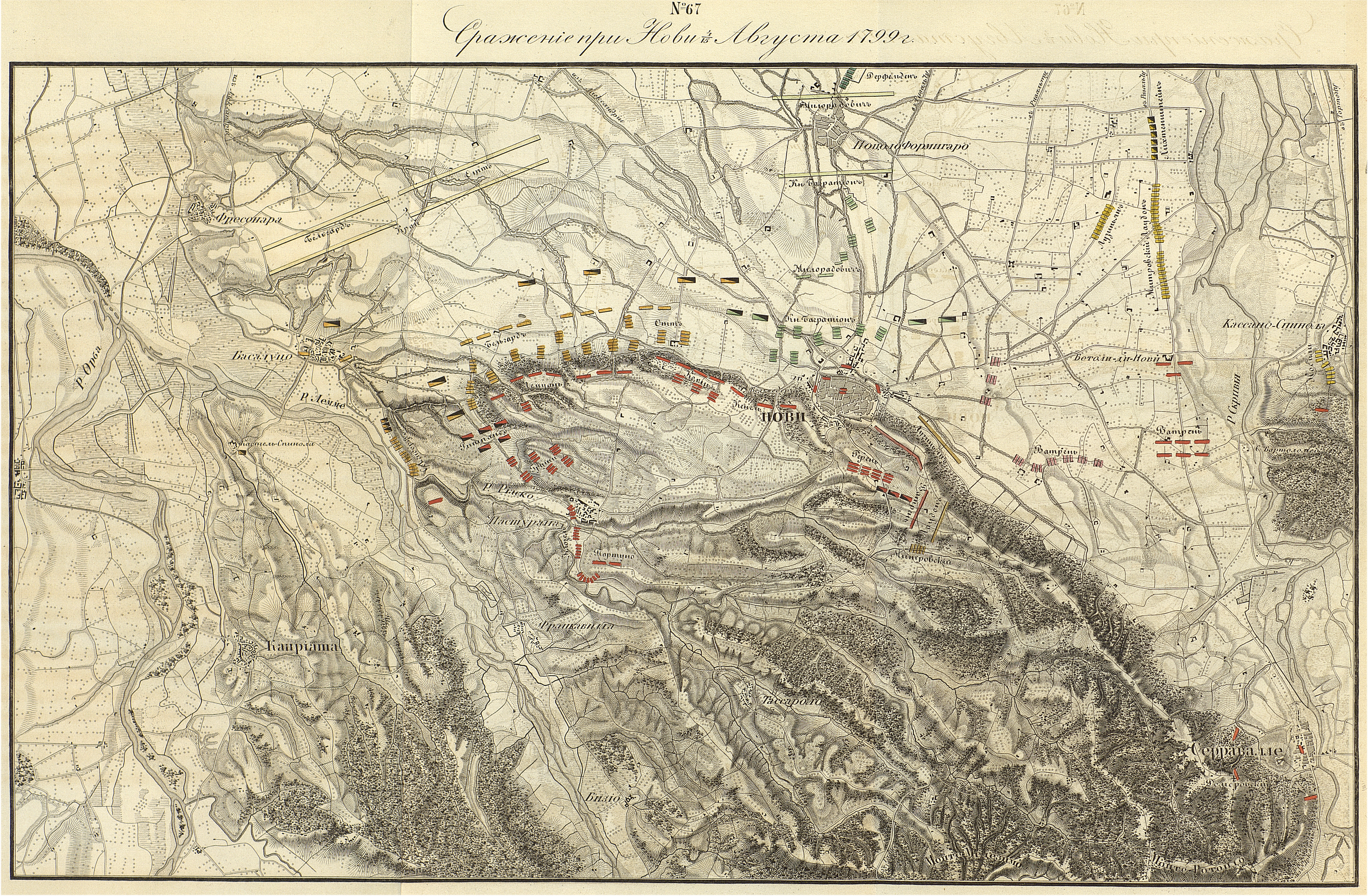
Joubert did not plan on fighting at Novi Ligure, but the position that his troops held was well-suited for a defensive battle. Facing north, the French held an arc of high ground from Serravalle on the right to Pasturana on the left. In the center, Novi was surrounded by a wall and ditch dating to the Middle Ages. One weakness of the position was that the deep ravines of the Riasco and Braghena streams cut across the rear, obstructing any retreat. Kray had the Allied right wing in movement before dawn with Bellegarde on the right and Ott on the left. Seckendorf on the far right aimed for the place where the Riasco stream emerged from its ravine. The crackle of muskets began at 3:20 am as the Austrian columns bumped into French picket lines. This provoked a great racket in the French camps as their surprised troops rushed into formation. At first light, the Allies saw that the heights were crowned by the blue lines of French infantry. Instead of striking the flank of an enemy army on the move, the Austrians of the right wing were making a frontal attack on a strong position.[43]

On the extreme French right, Dombrowski's division blockaded the Austrians in Serravalle Castle.[46] Next in line was Watrin's division which was still deployed in the low ground to the east of Novi. Gardanne's brigade held Novi while the rest of Laboissière's division lined the heights behind the town. Farther to the left was Lemoine's division and then Grouchy's division on the far left. The left was braced by the reserves of Clauzel, Partouneaux and Richepanse.[43]
At the foot of the plateau, Ott and Bellegarde deployed from marching columns into lines. At first their assault enjoyed some success against their sleep-groggy opponents. However, the slopes were steep and obstructed by vineyards, forcing the Austrians to redeploy into column. Pérignon brought Clauzel and Partouneaux to the assistance of Grouchy, while Saint-Cyr sent Colli's brigade from the right wing to help Lemoine. Moreau took charge of the French center in the contest against Ott.[47] In this phase of the battle Joubert was fatally hit while leading a counterattack by the 26th Light Demi Brigade. Despite mounting losses, the Austrian infantry bravely and repeatedly struggled forward in columns. As they reached the top of the slope and tried to redeploy into line, they were struck by French counterattacks and forced back. At last, Ott's columns were overthrown by the 26th Light and 105th Line and Kray's entire wing fell back to the bottom of the heights to reform.[48]
By 9:00 am Kray and his officers managed to reorganize their troops when an order arrived from Suvorov to renew the attack. Once more the Austrians attacked the heights and once more they were defeated with loss. While Clauzel and Richepanse helped repulse Bellegarde's division, Partouneaux counterattacked Ott. Encouraged by his success, Partouneaux unwisely charged down into the plain where his troops were scattered by four squadrons of the Archduke Joseph Hussars and Kaiser Dragoons. Partouneaux was among those captured. After the repulse of his second attack, Kray massed a 40-gun battery with which he bombarded any French troops who dared to line the crest. But the Austrian general refused to launch more attacks until the rest of the army joined the fight. Suvorov had planned to encircle a French army in motion. The unexpected circumstances threw the Allied plan out of gear.[48]
Bagration and Miloradovich in battle
[edit]
Suvorov realized that every man must be thrown into the battle. Bagration's command belatedly attacked Novi at 10:00 am. As the Russians moved forward they were subjected to an intense artillery barrage. Bagration's troops were able to press back the French skirmish lines through the outlying ditches, gardens and suburbs of Novi, but were foiled when they encountered Novi's city wall. Moving to their right, they were easy marks for the tirailleurs who were concealed in the vineyards and farm buildings. The Russians ran into Quesnel's brigade of Laboissière's division defending the heights; it held back the Russians. As the Russians pushed forward, they were attacked in flank by Gardanne's men from Novi and even by Watrin's division from the French right flank, which was eager to gain its revenge for the defeat on the Trebbia. Most of Miloradovich's division was sent into the fray to assist Bagration (Ivan Förster [ru] was appointed commander of Miloradovich's dispatched force[49]): the Miller Jaeger and the Lomonosov and Sanaev grenadiers succeeded in containing Gardanne's thrusts from Novi, but every Russian assault on the French center came to grief. Bagration's Cossacks found employment by luring French skirmishers into the plain and then killing or capturing them.[50]
Melas' movement
[edit]
In due course, Derfelden's division arrived at the front and was hurled into a new attack near Novi. Kray's wing attacked once more and his attack stalled. Around 11:30 am Suvorov directed the Allied left wing under Melas to advance. However, Melas, shortly after Derfelden left, declined to attack Novi as ordered by Suvorov's sent adjutant Colonel Lavrov. Instead of a full-fledged frontal attack on the right of the Novi position, he carefully reconnoitered the ground and also decided to head out east of this strong position—on the distant right flank. The Austrian sent Nobili's two battalions and two squadrons south along the east bank of the Scrivia River toward the Serravalle Castle to prevent any French threat from that direction. Nobili was aided by Lieutenant Colonel Dworschak and the garrison of Serravalle Castle, which made a sortie into the town. The remainder of the left wing, the main force, moved down the west bank of the river with Mittrowsky's brigade on the left and the grenadier battalions on the right, to help the Russians against Watrin as directed; Melas would instruct Lusignan's brigade to attack to the east of Novi in conjunction with Derfelden, while Loudon's brigade made a wider sweep eastwards toward the heights with Mittrowsky. Loudon and Mittrowsky headed that way due to pressure from the Austro-Russian commander in chief, who directed them to be moved from the east bank, thus only Nobili's brigade remained there, going to Serravalle. At the same time Melas himself with Lusignan's brigade and Liechtenstein's cavalry joined the Russian left flank. Melas was criticized for his rather slow progress, although Suvorov reported to Francis II that Melas' column "moved forward with the speed of an arrow."[42][51]
Around 3:00 pm the most recent Austro-Russian attack was repulsed from the line of heights. According to Gryazev's chronicles, Rosenberg Grenadiers advanced half way up the slopes, but recoiled in the face of a fire at point blank range. They were saved from destruction by Suvorov, who ordered them to veer to the right, and then fall back downhill. By this time Watrin had positioned his division on the heights to the east of Novi. Lusignan's grenadiers made three frontal attacks on Watrin without breaking through. Meanwhile, Loudon's grenadiers approached Watrin's right flank and Mittrowsky's command threatened an even deeper envelopment. In the face of the new attacks, Watrin's division crumbled. Saint-Cyr threw the 106th Line Demi Brigade into a counterattack which stopped the Austrians and captured Lusignan, who was wounded. By 5:00 pm, Watrin and the 106th were finally beaten by superior numbers and retreated. On the opposite flank Kray attacked again between 3:00 and 4:00 pm.[42]

Coalition breakthrough
[edit]Around 5:30 pm the entire French position started to disintegrate. The Paar Grenadier Battalion drove Colli's 68th Line from the crest near Novi. The troops of Derfelden and Melas broke into Novi at about the same time, driving out most of Gardanne's men. Laboissière's division managed to follow Watrin's men in their escape. But at about this time the French army split into two halves which were not reunited until three days later.[52] As the French left started to pull back, the Allies closed in for the kill, unleashing their cavalry. Earlier, Bellegarde had posted a battalion and four squadrons near Pasturana on the far right. Now, as the French retreated they had to negotiate the streets of Pasturana, the Braghena Gorge immediately to the south and Bellegarde's small force.[53]
The entire French left wing had to squeeze through the blockage. The Russians took no prisoners, killing every Frenchman that they caught. If a French soldier survived as a prisoner, it was because he was taken by Kray's Austrians. In the melee Grouchy tried to rally his men but was cut down and captured. Pérignon was also taken prisoner after suffering three wounds including a deep saber cut above his left eye. Colli and at least 2,000 other French soldiers and 21 artillery pieces were captured, mostly in the bottleneck at Pasturana. As night fell, the French army streamed away and the exhausted Allies stopped. Near midnight, some of Gardanne's men were discovered hiding out in Novi and the Russians went through the town again. Having accomplished their purpose, they began looting and Suvorov ordered his drummers to beat assembly to stop the pillage.[53]
Results
[edit]
Years later when Moreau was asked about Suvorov, he replied:[54]
"What can you say of a general so resolute to a superhuman degree, and who would perish himself and let his army perish to the last man rather than retreat a single pace."
Suvorov sent a summary letter (22 August [O.S. 11 August] 1799) regarding the French defensive position, strength, total losses (including retreat) and the results of the battle, where, with elements of his usual eccentricity, Suvorov addresses to Admiral Fyodor Ushakov, who was campaigning on the Mediterranean [ru] at that time. It contained:
"My merciful sovereign, Fyodor Fyodorovich!
I hasten to inform Your Excellency of the severe defeat of the enemy. On the 4/15 of this month he appeared on the mountains' ridges near Novi, consisting of 37,000 mans[k], and drew up in battle order, having Gavi behind him on the left, and with his right wing extending to Serravalle. In this position he was attacked, completely broken and put to flight. His damage amount, according to the admission of the French themselves, to 20,000 men. More than 6,000 men were killed on the spot, including General Joubert, who commanded the army, General of Division Vatrant[l] and Bri[gade] G[eneral] Garreau; 4 generals were taken prisoner: General-in-Chief Pérignon, divisional generals Grouchy and Colli; Brigadier General Partouneaux, and the staff, senior officers, and privates about 5,000; over 4,000 men scattered; 39 guns were beaten off, 48 boxes of gutpowder[m],
— I will forever remain with the utmost respect, my merciful sovereign, Your Excellency's most humble servant."[55]
Historian Digby Smith called Novi, "one of the bloodiest battles of the era" and the casualties bear this out. Smith claimed that the Allies sustained about 900 killed, 4,200 wounded and 1,400 captured or missing (6,500 totally), plus three guns. Russian generals Gorchakov, Tyrtov and Chubarov were wounded. The French lost 1,500 killed, 5,500 wounded and 4,500 prisoners — 11,500 totally. The Allies also captured 37 guns, 40 munition wagons and eight colors.[18] Christopher Duffy stated that one Austrian account admitted a sum of 799 killed, 3,670 wounded and 1,259 missing, though this adds up to less than the 5,754 reported total. Kray's wing alone had 710 killed, 3,260 wounded and 1,175 missing. The Russians suffered 2,496 casualties. The two sets of figures add up to a total Allied loss of 8,250. Duffy gave French losses as 6,500 to 6,643; evidently this is only the killed and wounded.[56] Statistician Gaston Bodart noticed 11,000 Frenchmen out of 35,000 and 9,000 allies out of 50,000.[17] Gunther E. Rothenberg asserted that both sides lost 7,000 killed and wounded, while the Allies had 2,000 missing or prisoners and the French had 4,000 prisoners or missing plus 37 guns.[6] David G. Chandler rounded the casualties to 8,000 Allied and 11,000 French.[57] According to Spencer C. Tucker, 11,000 were killed on the French side, and 9,000 on the Allied side.[16] Micheal Clodfelter estimated Allied losses at 8,750, of which 6,050 Austrians were lost including captured, and the Russians lost 2,700 men. The French losses Clodfelter assessed at 9,663, of which 6,663 men were KIA and WIA, and about 3,000 were taken captive. 37 guns were lost.[15] According to David Eggenberger, the Coalition lost 8,000 men in the attack, while the French lost 11,000.[10] According to Aleksandr Bogolyubov [ru], Coalition losses amounted to 8,000 men, and French casualties, including those soldiers who fled after the battle, totaled 16,000 and all the wagons.[58] According to another version, — Orlov's, — together with the dispersed, the losses amounted to only 15,100, but it is based on the assumptions of some, as stated by the author; by the same estimate 6,500 were killed or wounded and 4,600 captured (11,100 totally).[12] According to Ivan Rostunov [ru], general irretrievable and sanitary losses of the French reached 20,000 soldiers and officers (also including the retreat that followed; i.e. those who deserted, stragglers, died under various circumstances, taken prisoner, battle-wounded and sick who were hospitalized, etc.).[59]
Bagration was awarded the Order of Alexander Nevsky while Derfelden earned the Order of St. Andrew.[56]
Once the soldiers of the French left wing got clear of the Braghena Gorge, they quickly left the battlefield far behind. The right wing, however, was in a difficult spot because it was unable to withdraw through Gavi and Nobili's command blocked its escape route via Arquata Scrivia. Saint-Cyr was unable to dislodge the Austrians with Dombrowski's men and finally shoved Nobili out of the way by using Watrin's division. Suvorov brought up Rosenberg's corps to the battlefield but did not launch a pursuit. The Russian commander in chief still planned to evict the French from Genoa and the Italian Riviera, but orders soon arrived sending troops elsewhere. Klenau's command to the southeast of Genoa was diverted to secure Austrian control of Tuscany. A French offensive seized Valais in southwest Switzerland, routing some of Hadik's troops. Suvorov detached Kray to the north with 10,000 Austrians to help.[60]
On 25 August, Suvorov's hopes to conquer Liguria were dashed forever when fresh instructions from Emperor Francis reached him. A new strategy put forward by the British and approved by Czar Paul and the Austrians directed Suvorov to take command of a new Russian army assembling in Switzerland. This army would be formed by joining the Russian troops in Italy to another Russian army in Germany under Alexander Korsakov. The army was to invade France through the Jura Mountains. When Korsakov arrived in Switzerland, Archduke Charles, Duke of Teschen immediately moved north into Germany with the main Austrian army. The strategy's timing failed. Charles left Switzerland too early and Suvorov reached Switzerland too late.[61] André Masséna wrecked the Allied plan when he defeated Korsakov at the Second Battle of Zurich on 26 September 1799.[62]
See also
[edit]Notes
[edit]- ^ 4 August 1799 by Julian calendar
- ^ The number of artillerymen is unknown.
- ^ 44,347 infantry, 7,200 cavalry (incl. 1,948 Cossack cavalrymen);[1][b] however, due to the terrain, the cavalry was not very effective.[2][3]
According to the other version, 51,200 men took part in the battle. It also says 34,900 French participated.[4]
Other sources claim 50,000 men.[5][6]
Total Allied Field Army strength: 64,700 (89 battalions, 52 squadrons, 6 Cossack regiments—41,000 Austrians, 23,700 Russians/Cossacks; not all of them were involved).[7] - ^ The number of artillerymen is unknown.
- ^ According to one count, 32,843 infantrymen and 2,087 cavalrymen (34,930). According to another, 35,487 infantry and 1,765 cavalry (37,252).[1][d] Due to the terrain and the Coalition's superiority in horsepower, the cavalry was not very vigorous and, moreover, was ineffective.[2][3]
Another source claims as high as 40,000 men.[5]
Total Army of Italy strength: ~45,000 (by the end of July 1799 referring to the Julian calendar; not all of them were involved).[8] - ^
- ^
- ^ It was the first battle of Novi in 1799.
- ^ 4 August 1799 by Julian calendar
- ^ MacDonald was injured there with two sabre blows.[26]
- ^ Russian: состоявшей в 37 000 человеках
- ^ The sources do not claim a captured general of division with this or a similar last name, f.e., Watrin. Probably, Suvorov confused him with someone else, as he once did with Lecourbe and Lacour (see Battle of Muottental § 1 October), or he simply got false information.
- ^ Russian: с потрохом ящиков 48
References
[edit]- ^ a b Duffy (1999), pp. 137, 138
- ^ a b Orlov 1892, p. 303.
- ^ a b See maps
- ^ Orlov 1892, p. 280.
- ^ a b Griffith 1998, p. 200.
- ^ a b c d e f g h Rothenberg (1980), p. 249
- ^ Orlov 1892, p. 270.
- ^ Orlov 1892, pp. 267, 280.
- ^ a b Chandler (1979), p. 318
- ^ a b c Eggenberger 1985, p. 314.
- ^ a b Arsenyev & Petrushevsky 1897, p. 252.
- ^ a b c Orlov 1892, p. 301.
- ^ a b Egorshina & Petrova 2023, p. 144.
- ^ Duffy (1999), pp. 148–149
- ^ a b c d Clodfelter 2017, p. 109.
- ^ a b c d Tucker 2009, p. 1008.
- ^ a b c d e f Bodart 1908, p. 340.
- ^ a b c d e f g Smith (1998), p. 163. Smith gave the Austrian regiment numbers and brigadiers.
- ^ Velichko et al. 1914, p. 24.
- ^ Griffith, Paddy (1998). The Art of War of Revolutionary France, 1789–1802. Greenhill Books. p. 200. ISBN 1-85367-335-8.
- ^ Smith (1998), pp. 149–150
- ^ Smith (1998), p. 151
- ^ Duffy (1999), p. 47
- ^ Duffy (1999), p. 53
- ^ Smith (1998), pp. 152–153
- ^ Orlov 1892, p. 182.
- ^ Smith (1998), p. 154
- ^ Smith (1998), p. 156
- ^ Smith (1998), p. 159
- ^ Rothenberg (1980), p. 43
- ^ Duffy (1999), p. 112
- ^ a b Duffy (1999), p. 113
- ^ Smith (1998), p. 160
- ^ a b Duffy (1999), pp. 114–115
- ^ a b c Duffy (1999), p. 129
- ^ Duffy (1999), pp. 130–131
- ^ Duffy (1999), p. 123
- ^ Duffy (1999), p. 132
- ^ Duffy (1999), p. 133
- ^ Duffy (1999), pp. 134–135
- ^ a b c d Duffy (1999), pp. 136–137
- ^ a b c Duffy (1999), pp. 144–145
- ^ a b c Duffy (1999), p. 138
- ^ a b Duffy (1999), p. 137
- ^ a b Smith (1998), p. 163. Smith provided the numbers of battalions and squadrons in the French army.
- ^ Duffy (1999), p. 132 map
- ^ Duffy (1999), p. 139
- ^ a b Duffy (1999), p. 142
- ^ Milyutin 1852, p. 55.
- ^ Duffy (1999), p. 143
- ^ Orlov 1892, pp. 297–298.
- ^ Duffy (1999), p. 146
- ^ a b Duffy (1999), p. 147
- ^ Latimer, 68
- ^ Suvorov, Alexander (1799). (in Russian) – via Wikisource.
- ^ a b Duffy (1999), pp. 148–149
- ^ Chandler (1979), p. 318
- ^ Bogolyubov 1939, p. 118.
- ^ Rostunov 1989.
- ^ Duffy (1999), p. 150
- ^ Duffy (1999), pp. 152–153
- ^ Chandler (1979), p. 496
Sources
[edit]- Chandler, David G. (1979). Dictionary of the Napoleonic Wars. New York, N.Y.: Macmillan. ISBN 0-02-523670-9.
- Clausewitz, Carl von (2020). Napoleon Absent, Coalition Ascendant: The 1799 Campaign in Italy and Switzerland. Vol. 1. Translated by Murray, Nicholas; Pringle, Christopher. Lawrence, Kansas: University Press of Kansas. ISBN 978-0-7006-3025-7. Retrieved 6 June 2023.
- Clodfelter, M. (2017). Warfare and Armed Conflicts: A Statistical Encyclopedia of Casualty and Other Figures, 1492-2015 (4th ed.). Jefferson, North Carolina: McFarland. ISBN 978-0-7864-7470-7.
- Duffy, Christopher (1999). Eagles Over the Alps: Suvorov in Italy and Switzerland, 1799. Chicago, Ill.: The Emperor's Press. ISBN 1-883476-18-6.
- Rothenberg, Gunther E. (1980). The Art of War in the Age of Napoleon. Bloomington, Ind.: Indiana University Press. ISBN 0-253-31076-8.
- Smith, Digby (1998). The Napoleonic Wars Data Book. London: Greenhill. ISBN 1-85367-276-9.
- Tucker, Spencer C. (2009). A Global Chronology of Conflict: From the Ancient World to the Modern Middle East [6 volumes]: From the Ancient World to the Modern Middle East. ABC-CLIO. ISBN 978-1851096725.
- Eggenberger, David (1985). An Encyclopedia of Battles. New York: Dover Publications. ISBN 0-486-24913-1. Retrieved 28 June 2023.
- Latimer, Jon (December 1999). "War of the Second Coalition". Military History: 62–69.
- Bodart, Gaston (1908). Militär-historisches Kriegs-Lexikon (1618–1905) (in German). Vienna and Leipzig: C. W. Stern. Retrieved 27 May 2023.
- Orlov, Nikolay Aleksandrovich (1892). Разбор военных действий Суворова в Италии в 1799 году [Analysis of Suvorov's military actions in Italy in 1799] (PDF) (in Russian). St. Petersburg: Тип. Тренке и Фюсно. ISBN 9785998994289.
{{cite book}}: ISBN / Date incompatibility (help) - Rostunov, Ivan I. (1989). Генералиссимус Александр Васильевич Суворов: Жизнь и полководческая деятельность [Generalissimo Alexander Suvorov: Life and military activity] (in Russian). Moscow: Voenizdat. ISBN 5-203-00046-8.
- Bogolyubov, Aleksandr N. (1939). Полководческое искусство А.В. Суворова [The art of military leadership of A.V. Suvorov] (in Russian). Moscow: Voenizdat. ISBN 978-5-4484-0277-7.
{{cite book}}: ISBN / Date incompatibility (help) - Arsenyev, Konstantin; Petrushevsky, Fyodor (1897). Brockhaus and Efron Encyclopedic Dictionary (in Russian). Vol. XXI. Нибелунги — Нэффцер. Friedrich A. Brockhaus (Leipzig), Ilya A. Efron (St. Petersburg). Retrieved 30 May 2023.
- Milyutin, Dmitry (1852). История войны России с Францией в царствование Императора Павла I в 1799 году [The history of Russia's war with France during the reign of Emperor Paul I in 1799] (in Russian). Vol. III. St. Petersburg: Типография штаба военно-учебных заведений. Retrieved 26 July 2023.
- Velichko, Konstantin; Novitsky, Vasily; Schwarz, Aleksey von; Apushkin, Vladimir; Schulz, Gustav von (1914). Sytin Military Encyclopedia (in Russian). Vol. XVII. Нитроглицерин — Патруль. Тип. Т-ва И. Д. Сытина. Retrieved 28 June 2023.
- Egorshina, O.; Petrova, A. (2023). История русской армии [The history of the Russian Army] (in Russian). Moscow: Edition of the Russian Imperial Library. ISBN 978-5-699-42397-2.
External links
[edit]Maps:
- "Battle of Novi, 15 August 1799";
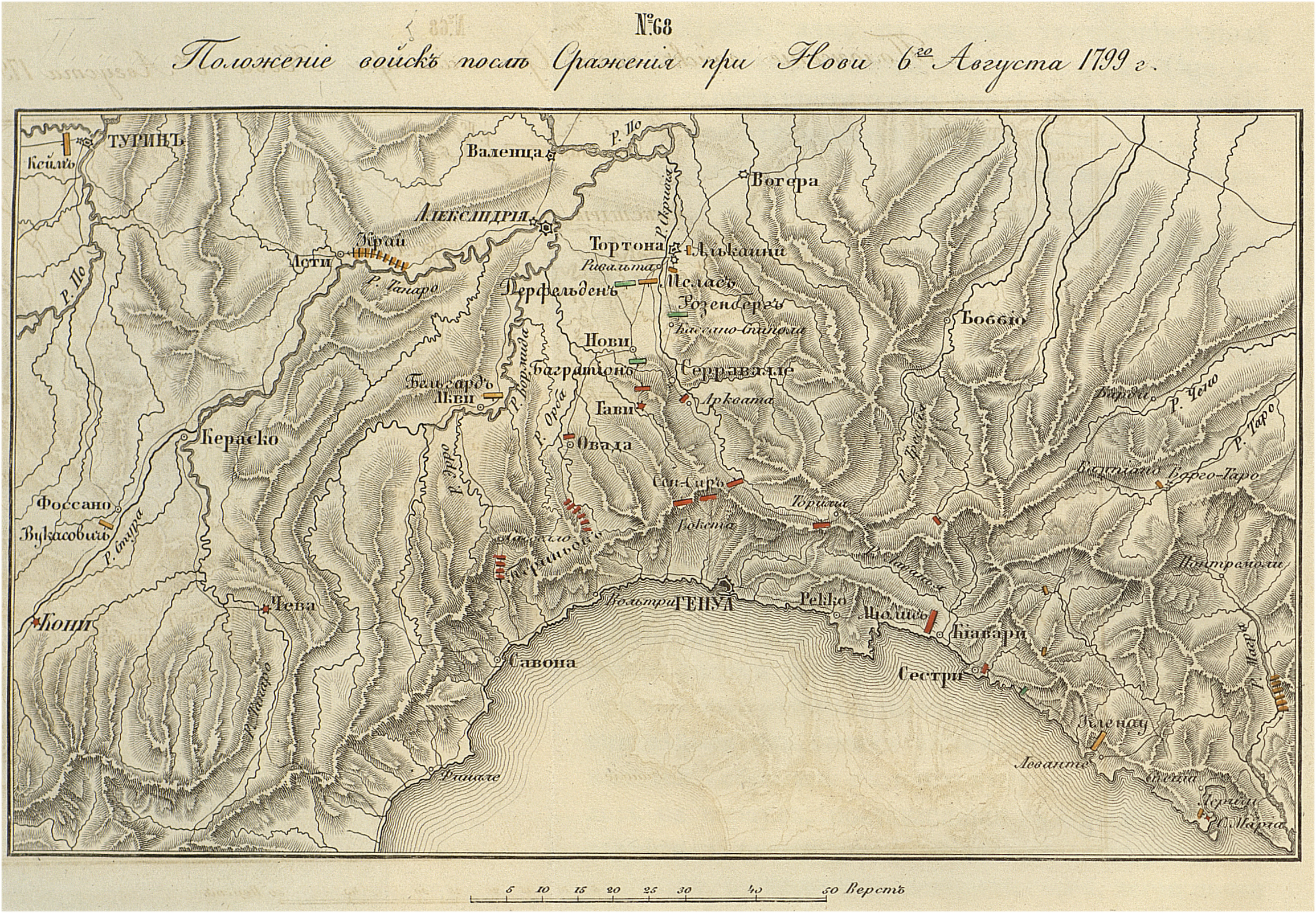
- "Position of the troops after the Battle of Novi, 17 August 1799".
 Media related to Battle of Novi at Wikimedia Commons
| Preceded by Battle of Cascina Grossa |
French Revolution: Revolutionary campaigns Battle of Novi (1799) |
Succeeded by Battle of Krabbendam |


Battle of Novi (1799)
View on GrokipediaHistorical Background
Formation of the Second Coalition
The Second Coalition formed amid escalating tensions from French expansionism during the Revolutionary Wars, as the Directory's regime consolidated control over northern Italy through puppet states like the Cisalpine Republic and annexed territories via the Treaty of Campo Formio on October 17, 1797, directly threatening Austrian influence in the region and broader European balance. Monarchist powers viewed these gains as existential risks, combining territorial revanchism with fears of revolutionary ideology spreading instability and undermining absolutist regimes, prompting a pragmatic alliance to rollback French dominance rather than mere ideological opposition.[3] Britain, alarmed by French naval threats and continental ambitions, initiated diplomatic efforts, allying with Russia in December 1798 following the French defeat at the Battle of the Nile on August 1, 1798, which exposed vulnerabilities in French overseas expeditions and encouraged renewed coalition-building.[3] Austria rejoined the anti-French front in early 1799, motivated by the imperative to reclaim Lombardy and the Rhineland territories lost or influenced by France, leveraging British financial support to mobilize armies while coordinating with Russian reinforcements for joint operations in Italy.[4] Tsar Paul I committed significant Russian forces, dispatching approximately 30,000 troops under Field Marshal Alexander Suvorov to the Italian theater in spring 1799 to augment Austrian contingents, reflecting St. Petersburg's strategic interest in curbing French power projection and securing Mediterranean access against Ottoman rivals indirectly bolstered by French actions.[5] The Ottoman Empire acceded to the coalition in January 1799, driven by French invasions of Egypt and Syria starting July 1798, aligning with Britain and Russia to contest French influence in the Levant and eastern Mediterranean.[4] The Kingdom of Naples and Portugal also participated, with Naples seeking to expel French garrisons from the Italian peninsula, forming a multinational front totaling over 300,000 troops by mid-1799 aimed at coordinated offensives across multiple theaters.[6] This alliance structure emphasized causal military realism over unified command, with Britain providing naval supremacy and subsidies—estimated at £2 million annually to Austria alone—to sustain continental operations, while divergences in strategic priorities, such as Austrian focus on Italy versus Russian ambitions in Switzerland, foreshadowed later frictions.[7] The coalition's empirical success in 1799, including Russian-Austrian advances in Italy, stemmed from exploiting French overextension post-Egypt and internal Directory instability, though underlying tensions between allies limited long-term cohesion.[8]Italian Campaign Prior to Novi
In April 1799, Russian Field Marshal Alexander Suvorov assumed command of the joint Austro-Russian army in northern Italy, initiating a swift offensive against French forces weakened by the absence of Napoleon Bonaparte, who had departed for the Egyptian campaign in 1798.[8] Suvorov's forces, numbering approximately 60,000 men including Russian reinforcements and Austrian contingents under Generals Kray and Melas, advanced rapidly from the Ticino River toward the Adda, covering over 300 miles in two weeks despite logistical challenges.[9] This maneuver exploited French disarray, as the Army of Italy under Barthélemy Scherer suffered from command instability, with Scherer replaced by Jean Victor Moreau amid reports of poor discipline and inadequate supplies.[10] The campaign's opening clash occurred at Cassano d'Adda on April 27, where Suvorov's troops, led by Russian General Pyotr Bagration, assaulted French positions defended by around 12,000 men under Jean-Mathieu-Philibert Sérurier and Moreau.[9] In fierce fighting across the Adda River bridges, the Allies inflicted over 2,000 French casualties while sustaining about 1,500 losses, compelling the French to retreat and abandon Milan on April 28.[11] This victory disrupted French control over Lombardy, forcing Moreau to withdraw toward the Apennines and exposing supply lines to local insurgencies that harassed French foraging parties and communications.[10] Further French recovery efforts faltered as Étienne Macdonald marched north from Naples with 35,000 troops to link with Moreau, but Suvorov preempted the junction. At the Battle of Trebbia from June 17 to 19, Suvorov's 35,000 Allies engaged Macdonald's exhausted army of similar size along the riverbanks near Piacenza.[12] Over three days of grueling combat in sweltering heat, the Russians and Austrians repelled repeated French assaults, inflicting 12,000 casualties (including 5,000 dead or wounded) against 6,000 Allied losses, with Macdonald's forces suffering from fatigue, disease, and ammunition shortages.[13] Macdonald retreated to Genoa, leaving the French position in Italy fragmented and overextended, as their armies contended with stretched logistics vulnerable to Coalition interdiction and peasant uprisings.[10] By July 1799, these engagements had shifted momentum decisively toward the Coalition, with Suvorov's aggressive maneuvers and reinforced positions contrasting French attrition from leadership vacuums—Joubert briefly commanded before redirecting to Italy—and chronic supply deficits exacerbated by Bonaparte's Egyptian diversion, which deprived the Directory of unified strategic direction.[8] French troop strength in Italy dwindled to under 50,000 effectives amid desertions and illness, while Coalition forces benefited from Russian tenacity and Austrian numerical support, setting the stage for further advances.[12]Prelude
French Strategic Maneuvers
In response to the Directory's directives amid deteriorating French positions in Italy, Barthélemy Catherine Joubert assumed command of the Army of Italy on August 4, 1799, arriving in Genoa to replace Jean Victor Marie Moreau and reorganize fragmented forces previously scattered by Coalition advances.[14][5] The Directory explicitly ordered an aggressive offensive to counter Russian Field Marshal Alexander Suvorov's rapid conquests in Lombardy and Piedmont, aiming to relieve besieged garrisons like Tortona and disrupt enemy momentum before further reinforcements could consolidate.[15] Joubert, motivated by intelligence suggesting Austrian forces remained dispersed across sieges and garrisons, prioritized a swift concentration to exploit perceived vulnerabilities in Coalition dispositions.[16] Joubert directed his army northward from Genoese coastal positions across the Apennines, seeking to link elements under Moreau and Laurent de Saint-Cyr for a unified strike.[1] By August 13, forward units had advanced into the Tortona plain, with main concentrations forming near Novi by August 14, as Joubert, accompanied by Moreau and Saint-Cyr, conducted a reconnaissance of the southern hills overlooking the town to plan a surprise assault on isolated Austrian detachments.[17] This maneuver reflected an emphasis on operational tempo, leveraging the army's recent reforms and residual revolutionary discipline to outpace enemy reactions.[15] The strategy, however, rested on optimistic assumptions that disregarded logistical strains from mountainous marches, which fatigued troops and strained supply lines already weakened by prior defeats.[1] French planners underestimated Suvorov's capacity for rapid marches—demonstrated in his earlier Italian campaigns—allowing Coalition forces to converge despite initial separations, while the hilly terrain around Novi inherently favored prepared defenders over hasty attackers.[16][5] This approach prioritized ideological drive over empirical assessment of enemy cohesion and geographic constraints, contributing to vulnerabilities exposed in execution.[15]Coalition Defensive Positioning
Field Marshal Alexander Suvorov directed the Austro-Russian forces to converge on the heights around Novi by August 14, 1799, establishing defensive positions on elevated terrain overlooking the town and the Scrivia River valley in anticipation of the French advance.[1] Austrian General Michael von Melas, commanding the left wing with approximately 11,000 infantry and 4,000 cavalry positioned near Rivalta, coordinated the integration of his units with Russian divisions under Suvorov's overall authority, including 12,000 infantry and 3,000 cavalry led by General Fyodor Derfelden at Spineto.[1] Russian corps under Prince Peter Bagration and General Mikhail Miloradovich, previously detached for independent operations—Bagration from Castelnuovo Scrivia—were recalled to bolster the line, with Bagration ordered to march to Novi starting around 3:00 a.m. on August 15 following Suvorov's directive issued at 2:00 a.m.[18] This reinforcement drew from reserves totaling about 6,000 infantry and 4,000 cavalry, concentrating roughly 45,000 Coalition troops near Alessandria and Pozzolo Formigaro north of Novi.[1] Austrian commanders Feldzeugmeister Paul Kray and General Heinrich von Bellegarde secured the flanks, with Kray's corps on the right (east) and Bellegarde's on the left (west), fortifying lines that exploited the natural defensive advantages of the ridges and slopes to repel assaults from the plain below.[1] Intelligence reports confirming the French Army of Italy's concentration under General Barthélemy Joubert prompted these measures, enabling methodical positioning over hasty maneuvers.[1]Opposing Forces
Coalition Army Composition
The Coalition army at the Battle of Novi on 15 August 1799, under the overall command of Russian Field Marshal Alexander Suvorov, comprised approximately 50,000-52,000 troops, including around 28,000 Austrians and 22,000-24,000 Russians, organized into combined infantry, cavalry, and artillery formations that emphasized disciplined linear tactics and rapid maneuvers honed from prior victories in the Italian campaign.[1][19] Austrian forces, drawn from the Habsburg monarchy's regular army, were led by generals such as Feldzeugmeister Paul Kray von Krajowa, Lieutenant General Heinrich von Bellegarde, and General Michael von Melas, featuring infantry divisions structured in brigades of fusilier and grenadier regiments, supported by cuirassier and hussar cavalry squadrons.[17] Russian contingents, including elite grenadier divisions under generals like Pyotr Bagration, Fyodor Rostopchin (Rosenberg), and Fyodor Derfelden, incorporated Cossack light cavalry for screening and flanking roles, with infantry emphasizing shock assaults in dense column formations.[1] The army's artillery component, totaling around 80-100 guns primarily of 6- to 12-pounder calibers, was distributed across batteries attached to infantry divisions and a central reserve, providing superior firepower compared to opposing shortages, enabled by reliable Habsburg supply depots in Piedmont that ensured ammunition and forage availability despite the summer campaign's demands.[1] High morale pervaded the ranks, bolstered by successive triumphs such as the Battles of Cassano (May 1799) and Trebbia (June-July 1799), which had routed French forces and restored monarchical control over northern Italy, fostering cohesion between the allied contingents through Suvorov's emphasis on aggressive offensive doctrine integrated with Austrian defensive expertise.[2]| Division/Corps | Commander | Approximate Strength | Composition |
|---|---|---|---|
| Austrian Left Wing | Ott | 7,000 | Infantry brigades, light cavalry |
| Russian Left Wing | Rosenberg | 6,000 | Grenadiers, dragoons |
| Allied Center | Derfelden (Russian) with Austrian support | 15,000 | Russian infantry (Forster, Schwiekowsky divisions), Austrian grenadiers |
| Austrian Right Wing | Bellegarde/Kray | 10,000-26,000 (corps total) | Fusiliers, cuirassiers, artillery |
| Russian Right Wing | Bagration | 6,000 | Grenadiers, Cossacks |
| Cavalry Reserve | Mixed Austrian-Russian | 6,000 | Hussars, dragoons, Cossacks |
French Army Composition
The French Army of Italy, under the command of General Barthélemy Catherine Joubert, fielded approximately 35,000 men at the Battle of Novi on 15 August 1799, comprising roughly 33,000 infantry and 2,000 cavalry, with artillery support limited to about 40-43 guns.[1][5] The force was structured into divisions primarily suited for defensive operations rather than aggressive maneuvers, reflecting Joubert's recent assumption of independent command after General Barthélemy Scherer's resignation amid prior setbacks.[17] Key divisions included the left wing under General Jean Victor Marie Moreau, the center under General Claude Victor, and an advance guard led by General François Watrin, supplemented by elements from General Laurent Gouvion Saint-Cyr's forces on the right and detachments under Generals Catherine-Dominique de Pérignon and Emmanuel Grouchy.[20] This organization featured a mix of veteran units from earlier Italian campaigns and hastily raised levies from revolutionary conscription, which diluted overall troop quality and cohesion following defeats like the Battle of the Trebbia in June 1799.[17] Equipment shortages were evident, with inferior artillery—predominantly lighter field pieces—unable to match Coalition firepower, and cavalry forces hampered by numerical inferiority and limited training, compelling reliance on dense infantry columns vulnerable to formed musketry and bayonet charges.[1] Joubert's inexperience in autonomous high command, despite his tactical acumen demonstrated under generals like Jean-Baptiste Jourdan, exacerbated vulnerabilities; appointed hastily by the Directory to rally the demoralized army, he lacked the tenure to fully integrate disparate elements or instill unified discipline amid ongoing supply strains and desertions.[5] These factors, rooted in the broader instability of post-Thermidorian French military structures, left the army prone to fragmentation under pressure, as evidenced by its rapid collapse despite initial positional advantages.[17]Geography and Terrain
Novi River Valley Layout
The Novi area, near the town of Novi Ligure in Piedmont, northern Italy, encompasses a transitional landscape between the flat Po Valley plains to the north and the rising foothills of the Ligurian Apennines to the south. The Scrivia River flows westward along the northern edge of these heights, forming a natural boundary that funneled approaches into narrower corridors. This river valley configuration, with its elevated southern ridges overlooking the Tortona plain, restricted broad frontal maneuvers, compelling forces to navigate confined paths amid terraced vineyards and fragmented farmsteads.[17] Coalition positions anchored on the Scrivia heights, which rose approximately 200 feet above the adjacent plain, provided inherent defensive superiority through superior vantage for observation and artillery placement. The undulating terrain, steep slopes, and fragmented clearings in the Apennine outcrops amplified these advantages, as lower-lying attackers faced prolonged exposure during ascents, compounded by the physical demands of climbing through irregular, vineyard-covered inclines that disrupted cohesion and formation integrity.[17][1] The plain between the Scrivia and Orba Rivers to the north offered relatively open ground for initial advances but transitioned abruptly into the valley's constrictions, where the foothills' contours limited lateral shifts and concentrated efforts into vulnerable chokepoints. This layout, rooted in the geological interplay of river incision and orogenic uplift, causally predisposed uphill defenders to repel downhill assaults by exploiting gravitational and visibility asymmetries, rendering large-scale infantry surges inherently disadvantageous without overwhelming numerical or surprise elements.[17][5]Topographical Challenges
The undulating hills and steep ridges encircling Novi Ligure, part of the Ligurian Apennines foothills, posed significant obstacles to French offensive operations by elevating Coalition positions and exposing attackers to prolonged vulnerability during ascents. These gradients, rising sharply from the Scrivia River valley, restricted the mobility of French artillery batteries, which struggled to achieve stable emplacement or traverse uneven terrain under fire, thereby diminishing their suppressive role against entrenched defenders.[1][17] Narrow defiles and limited road networks, such as those threading through the valley approaches, funneled French reinforcements into predictable paths, amplifying the effectiveness of Coalition skirmishers and enfilading positions while hindering rapid concentration of forces. The Scrivia River itself, with its few viable bridges and marshy banks, functioned as a natural chokepoint, constraining lateral movements and complicating any diversification of French lines beyond frontal exposures.[16] This topography inherently privileged sustained defensive firepower over impulsive uphill charges, as the physics of elevation—steep inclines dissipating momentum and increasing fatigue—neutralized advantages in numerical superiority or aggressive tactics, favoring instead the disciplined volley fire maintainable from static high-ground redoubts. Wooded patches on lower slopes further obscured Coalition maneuvers while exposing French columns to potential interdiction, underscoring how the landscape causally reinforced positional superiority for the allies.[17][5]Course of the Battle
Opening French Assaults
At dawn on August 15, 1799, French commander Barthélemy Catherine Joubert ordered simultaneous assaults by divisions under Generals Pierre Louis Watrin and Claude Victor Perrin on the forward positions held by Austrian corps commanders Paul Kray and Heinrich von Bellegarde, aiming to exploit partial surprise achieved by the Army of Italy's northward maneuver from Genoa.[17] [1] However, the Coalition forces preempted the French offensive, with Kray's Austrians launching the initial attack at approximately 5:00 a.m. against the French left flank near Pasturana, disrupting Joubert's plan amid the rugged terrain of the Novi River valley's southern hills and vineyards, which channeled advances into exposed columns vulnerable to defensive fire.[1] [5] Joubert personally rode forward to rally and lead grenadiers in a counterassault against Kray's advancing troops, exposing himself during the melee; he was struck in the chest by a musket ball and mortally wounded within the first hour, uttering "Marchez toujours" ("Always march forward") before succumbing, which created an immediate command vacuum as subordinates like Jean Victor Marie Moreau scrambled to assume control.[1] [5] French columns under Watrin and Victor pressed their intended assaults eastward and centrally but were repulsed with heavy losses from enfilading artillery and infantry volleys, as the steep slopes and narrow paths stalled momentum and prevented overrun of Coalition outposts.[2] [1] Early fighting inflicted severe casualties on the French, with estimates of around 5,000 killed or wounded in the opening hours, compounding disarray from Joubert's death and exposing vulnerabilities in coordination against the entrenched Allied defenses.[21] These repulses on the French left and center marked the failure of the dawn offensive, shifting initiative to the Coalition while French forces withdrew to consolidate on higher ground.[5][1]Coalition Defensive Holds
The Austrian forces under General Paul Kray faced staunch French opposition during their initial push against the elevated positions near Pasturana on the morning of August 15, 1799, where the first assault was repelled by the French 20th Légère Division.[1] A subsequent attack, bolstered by artillery and reinforcements from Heinrich XV, Prince of Reuss-Plauen—later supported by General Heinrich von Bellegarde—likewise faltered after three hours of combat, as French General Dominique Perignon launched a vigorous counteroffensive that temporarily forced the Austrians back.[1] Despite these setbacks, Kray's troops demonstrated tactical resilience by reforming in two-line infantry formations and leveraging skirmishers to disrupt French cohesion, thereby anchoring the Coalition's left flank against numerically pressing enemy advances.[1] This steadfast resistance highlighted the Habsburg army's reliance on disciplined, professional infantry tactics, which emphasized orderly withdrawals and rapid redeployments over the fervent but often fragmented charges characteristic of French revolutionary units motivated by ideological zeal rather than rigorous coordination.[1] Bellegarde's concurrent efforts to engage French cavalry under Emmanuel Grouchy further exemplified this approach, as his division absorbed and parried assaults while maintaining overall positional integrity on the high ground.[1] Such holds not only inflicted significant attrition on the French but also delayed their consolidation, affording essential breathing room for Russian corps to maneuver into position and avert a potential collapse of the Coalition line.[1]Russian Flanking Maneuvers
As the battle progressed into the morning of August 15, 1799, Field Marshal Alexander Suvorov recalled detached Russian units to initiate flanking maneuvers against the French lines centered on Novi. Prince Peter Bagration's advance guard, comprising 8 battalions totaling 4,865 men including grenadier companies and Cossack squadrons, received orders around 8:00–9:00 a.m. to assault the town and envelop the French left flank (northern sector) held by General Pierre Gardanne's brigade.[22] This force struck eastward toward the slopes of Monte Rotondo, leveraging rapid mobility to outpace French reinforcements while Cossack detachments probed and disrupted the enemy rear, including raids on undefended supply wagons that sowed confusion among French logistics.[1] Initial advances met intense musketry and canister fire, but the Russians' shock tactics—marked by close-order grenade and bayonet assaults—began eroding French cohesion by late morning.[5] Concurrently, General Mikhail Miloradovich's corps of 6 battalions (3,720 men) maneuvered in the center, reorganizing into columns that advanced around noon to envelop westward toward the Belvedere Plateau, targeting gaps in the French right-center under General François Watrin.[22] These actions complemented Bagration's push, with Miloradovich's troops exploiting terrain for partial flanking coverage and delivering decisive volleys that shattered French counterthrusts. Combined with elements from General Fyodor Derfelden's reserve (adding roughly 7,000 men), approximately 10,000–15,000 Russians engaged in these maneuvers, their ferocity and tactical flexibility turning the tide against overstretched French divisions by midday.[22][1] The envelopments prevented French consolidation, forcing piecemeal retreats and exposing flanks to further Coalition pressure without reliance on Austrian static defenses.Decisive Coalition Counterattack
Following the death of General Joubert early in the battle, General Jean Victor Marie Moreau assumed command of the French Army of Italy but proved unable to effectively rally his disorganized forces against the Coalition's growing numerical and positional advantages.[1] Around midday on August 15, 1799, Field Marshal Alexander Suvorov ordered General Michael von Melas to initiate a general advance with his Austrian reserves, dividing them into three columns to strike along the Scrivia River toward Serravalle, at Monte Rotondo east of Novi, and in support of assaults on Novi itself and the French right under General Laurent de Saint-Cyr.[1] [2] This multi-pronged offensive rapidly enveloped exposed French flanks, as Coalition infantry pressed forward while exploiting gaps created by earlier defensive holds and Russian maneuvers, forcing Moreau's divisions into a contracting defensive perimeter amid mounting casualties and ammunition shortages.[1] Allied cavalry units, bolstered by Melas' reinforcements totaling around 15,000 horsemen in the overall force, then executed charges against fragmented French formations, shattering morale and accelerating the breakdown of cohesion in divisions like those of Generals Olivier Macquard and Jean Lannes.[1] By approximately 6:00 PM, a decisive Coalition push captured Pasturana, severing principal French lines of retreat and triggering a general rout; the French abandoned over 37 artillery pieces along with caissons and standards as surviving units fled in disorder across the Riasco stream toward Gavi, with the battle effectively concluding by evening.[1] This phase underscored the causal impact of Melas' reinforced superiority in manpower and coordination, which overwhelmed French command fragmentation and prevented any effective counter-consolidation.[1]Immediate Aftermath
Casualties and Captures
The French Army of Italy suffered severe losses during the Battle of Novi on 15 August 1799, with estimates ranging from 9,500 to 16,500 total casualties including killed, wounded, and prisoners. Contemporary accounts from Coalition commanders, such as Austrian General Michael von Melas, reported approximately 3,000 French killed, 4,000 wounded, and 4,000 prisoners, though these figures likely reflect victor bias toward exaggeration. Lower estimates, cross-verified with later analyses, indicate around 1,500 killed, 5,000 wounded, and 3,000–4,600 prisoners, for a minimum total of 9,500. Among the captured were four generals, 84 officers, and several standards; the French also relinquished 37–39 artillery pieces and 28 caissons. General Barthélemy Joubert, the French commander, was killed by a cannonball early in the engagement, contributing to command disarray. French official reports tended to understate losses for morale and propaganda purposes, omitting full prisoner counts.[1][2] Coalition forces, benefiting from defensive terrain and superior coordination, incurred lighter casualties totaling 5,500–8,200, with breakdowns of roughly 1,800 killed, 5,200 wounded, and 1,200 prisoners across Austro-Russian units. Russian Field Marshal Alexander Suvorov's dispatches emphasized minimal disruptions to his lines, aligning with the lower end of these figures despite aggressive flanking maneuvers. These losses were disproportionately borne by assaulting elements but remained sustainable given the army's overall strength.[1]| Side | Killed | Wounded | Prisoners | Total Casualties | Material Losses |
|---|---|---|---|---|---|
| French | 1,500–3,000 | 4,000–5,000 | 3,000–7,000 | 9,500–16,500 | 37–39 guns, 4 flags, 28 caissons |
| Coalition | ~1,800 | ~5,200 | ~1,200 | 5,500–8,200 | Minimal |