Hubbry Logo
Seine fishingSeine fishingMain
Open search
Seine fishing
Community hub
Seine fishing
logo
8 pages, 0 posts
0 subscribers
Be the first to start a discussion here.
Seine fishing
Seine fishing
from Wikipedia
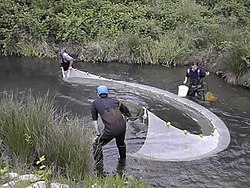
Seining for fish in a river.
An illustration of a basic seine net.

Seine fishing (or seine-haul fishing; /sn/ SAYN) is a method of fishing that employs a surrounding net, called a seine, that hangs vertically in the water with its bottom edge held down by weights and its top edge buoyed by floats. Seine nets can be deployed from the shore as a beach seine, or from a boat.

Boats deploying seine nets are known as seiners. Two main types of seine net are deployed from seiners: purse seines and Danish seines. A seine differs from a gillnet, in that a seine encloses fish, where a gillnet directly snares fish.

Etymology

[edit]

The word seine has its origins in the Old English segne,[1] which entered the language via Latin sagena, from the original Greek σαγήνη sagēnē (a drag-net).[2]

History

[edit]

Seines have been used widely in the past, including by Stone Age societies. For example, the Māori used large canoes to deploy seine nets which could be over a kilometer long. The nets were woven from green flax, with stone weights and light wood or gourd floats, and could require hundreds of men to haul.[3]

Haul seining with horses on the Columbia River

Native Americans on the Columbia River wove seine nets from spruce root fibers or wild grass, again using stones as weights. For floats they used sticks made of cedar which moved in a way which frightened the fish and helped keep them together.[4]

Arrian's description of Alexander the Great's expedition on the Makran coast in 325 B.C. includes a detailed description of seine fishing by a tribe known as the Ichthyophagi (Fish-eaters).[5]

Seine nets are also well documented in ancient cultures in the Mediterranean region. They appear in Egyptian tomb paintings from 3000 BCE. In ancient Roman literature, the poet Ovid makes many references to seine nets, including the use of cork floats and lead weights.[6][7][8]

Beach seine

[edit]
Seining at the Atlantic Ocean beach, St. Simons, Georgia, US, 1991

The beach seine is employed by anchoring a section of netting on the shoreline, then dragging the net into the water and surrounding the fish, before pulling it ashore.[9] Several countries have prohibited the use of the seines; Kenya outlawed the use of beach seines in 2001.[10]

Purse seine

[edit]
Fish swimming near the surface are surrounded by a wall of netting supported by floats.
The net is drawn or "pursed" so it is closed at the bottom as well.
Ring netter operating in Mount's Bay, Cornwall

A common type of seine is a purse seine, named such because along the bottom are a number of rings. A line (referred to as a purse-line) passes through all the rings, and when pulled, draws the rings close to one another, preventing the fish from "sounding", or swimming down to escape the net. This operation is similar to a traditional style purse, which has a drawstring. The purse seine is a preferred technique for capturing fish species which school, or aggregate, close to the surface: sardines, mackerel, anchovies, herring, and certain species of tuna (schooling); and salmon soon before they swim up rivers and streams to spawn (aggregation). Boats equipped with purse seines are called purse seiners.

Purse seiner on the U.S. Pacific Coast

Purse seines are ranked by experts as one of the most sustainable commercial fishing methods when compared with other options.[11] Purse seine fishing can result in smaller amounts of by-catch (unintentionally caught fish), especially when used to catch large species of fish (like herring or mackerel) that shoal tightly together.[12] When used to catch fish that shoal together with other species, or when used in parallel with fish aggregating devices, the percentage of by-catch greatly increases.[12]

Use of purse seines is regulated in many countries; in Sri Lanka, for example, using this type of net within 7 kilometres (3.8 nmi; 4.3 mi) of the shore is illegal.[13] However, they can be used in the deep sea, after obtaining permission from authorities. Purse seine fishing can have negative impacts on fish stocks because it can involve the bycatch of non-target species and it can put too much pressure on fish stocks.[14]

Purse seine boat encircling a school of fish
A school of about 400 tons of jack mackerel encircled by a Chilean purse seiner

Power block

[edit]
Salmon seiner with power block 1967
Closeup of the power block

The power block is a mechanized pulley used on some seiners to haul in the nets. According to the UN Food and Agriculture Organization, no single invention has contributed more to the effectiveness of purse seine net hauling than the power block.[15]

The Puretic power block line was introduced in the 1950s and was the key factor in the mechanization of purse seining. The combination of these blocks with advances in fluid hydraulics and the new large synthetic nets changed the character of purse seine fishing. The original Puretic power block was driven by an endless rope from the warping head of a winch. Nowadays, power blocks are usually driven by hydraulic pumps powered by the main or auxiliary engine. Their rpm, pull and direction can be controlled remotely.[15]

A minimum of three people are required for power block seining; the skipper, skiff operator, and corkline stacker. In many operations a fourth person stacks the leadline, and often a fifth person stacks the web.

Drum

[edit]
Drum net seiner in Johnstone Strait, British Columbia

In certain parts of the western United States as well as Canada, specifically on the coast of British Columbia, drum seining is a method of seine fishing which was adopted in the late 1950s and is used exclusively in that region.[16]

The drum seine uses a horizontally mounted drum to haul and store the net instead of a power block. The net is pulled in over a roller, which spans the stern, and then passes through a spooling gear with upright rollers. The spooling gear is moved from side to side across the stern which allows the net to be guided and wound tightly on the drum.[17]

There are several advantages to the drum seine over the power block. The net can be hauled very quickly - at more than twice the speed of using a power block, the net does not require overhead handling, and the process is therefore safer. The most important advantage is that the drum system can be operated with fewer deckhands. However, it is illegal to use a seine drum in the state of Alaska.[18]

Danish seine

[edit]

A Danish seine, also occasionally called an anchor seine, consists of a conical net with two long wings with a bag where the fish collect. Drag lines extend from the wings, and are long so they can surround an area.

A Danish seine is similar to a small trawl net, but the wire warps are much longer and there are no otter boards. The seine boat drags the warps and the net in a circle around the fish. The motion of the warps herds the fish into the central net.

Danish seiner vessels are usually larger than purse seiners, though they are often accompanied by a smaller vessel. The drag lines are often stored on drums or coiled onto the deck by a coiling machine. A brightly coloured buoy, anchored as a "marker", serves as a fixed point when hauling the seine. A power block, usually mounted on a boom or a slewing deck crane, hauls the seine net.

Danish seining works best on demersal fish which are either scattered on or close to the bottom of the sea, or are aggregated (schooling). They are used when there are flat but rough seabeds which are not trawlable. It is especially useful in northern regions, but not much in tropical to sub-tropical areas.

The net is deployed, with one end attached to an anchored dan (marker) buoy, by the main vessel, the seiner, or by a smaller auxiliary boat. A drag line is paid out, followed by a net wing. As the seiner sweeps in a big circle returning to the buoy, the deployment continues with the seine bag and the remaining wing, finishing with the remaining drag line. In this way a large area can be surrounded. Next the drag lines are hauled in using rope-coiling machines until the catch bag can be secured.

The seine netting method developed in Denmark. Scottish seining ("fly dragging") was a later modification. The original procedure is much the same as fly dragging except for the use of an anchored marker buoy when hauling, and closing the net and warps and net by winch.

Other images

[edit]
Purse seining
Modern French tuna purse seiner using a power block. The helicopter is used to search for tuna schools.
Skiff tuna purser
Seine skiff setting the net
Brailing the salmon on board
Seining in the past
Early steam seine netter
Manually seining salmon on Columbia River, Oregon, 1914
Hauling in a beach seine using horse teams 1938
R/V John R. Manning starting a purse seine set in the tropical Pacific Ocean, ca. 1950.

See also

[edit]

Notes

[edit]

References

[edit]
[edit]
Revisions and contributorsEdit on WikipediaRead on Wikipedia
from Grokipedia
Seine fishing is a fishing technique that utilizes a seine net, consisting of a long wall of netting suspended vertically in the water with floats along the top and weights along the bottom, to encircle and capture schools of . This method targets primarily pelagic or schooling species such as sardines, , , and , allowing for the efficient harvest of large quantities in a single operation. The practice encompasses several variants, including beach seines deployed from shore to trap against the beach, boat seines operated from vessels to surround demersal or midwater , and purse seines, which incorporate a mechanism to close the net's bottom like a purse, preventing escape. Seine nets have been employed since antiquity, with archaeological evidence indicating their use thousands of years ago across continents for both subsistence and commercial purposes. Purse seining, the most industrialized form, dominates global capture fisheries for species like tropical tuna, enabling vessels to deploy nets up to 2 kilometers in length and process catches onboard for freezing. While highly productive, with low relative fuel consumption per ton of catch in some operations, it has faced scrutiny for bycatch of non-target species and juveniles, particularly when associated with fish aggregating devices, though empirical assessments show variability in ecological impacts depending on management practices. Defining characteristics include the net's adaptability to different scales—from artisanal hand-hauling to mechanized power blocks—and its reliance on spotting fish schools via aerial or sonar observation in modern applications.

Definition and Terminology

Etymology

The term "seine" refers to a type of and, by extension, the method of fishing with it, originating from the seine, which entered the language around the 13th century. This derives from segne or segn, attested before 950 AD, denoting a dragnet used for encircling . The form traces to Proto-Germanic sagina, borrowed from Latin sagēna, a large fishing net, which itself stems from sagḗnē (σαγήνη), describing a dragnet or hauling net employed in early Mediterranean fisheries. This etymological lineage reflects the net's ancient utility in communal fishing practices, with archaeological evidence of similar dragnet technologies dating to at least 8300 BC in regions like the , though the specific terminology solidified through Greco-Roman transmission to Northern European languages. The word's adoption in English aligns with the spread of seine techniques via Viking and Anglo-Saxon maritime traditions, distinct from unrelated terms like the River Seine's name, which derives from the Gaulish . No direct connection exists between the fishing implement's nomenclature and the Parisian waterway.

Basic Principles and Mechanics

Seine fishing employs a surrounding net, known as a , that hangs vertically in the water column with its top edge supported by floats and its bottom edge weighted by leads or a lead line to maintain an upright position. The fundamental principle is to encircle a with this net, creating a temporary barrier that prevents escape, after which the fish are concentrated and captured by hauling the net aboard a vessel or onto shore. The mechanics begin with locating a fish school, often visually from a vessel or aircraft, followed by deploying the to form a wall around the target area. In basic operations, one end of the net is anchored or held while the vessel maneuvers to surround the fish, converging the net ends to herd the catch into a central pocket or bunt. For variants without a closing mechanism, retrieval involves winching or manually pulling the net, lifting it vertically to trap fish against the bottom or shore. In purse seine applications, a key mechanical feature is the purse line threaded through rings along the bottom edge, which is drawn tight like a to seal the net's base and prevent from escaping downward. Hauling then proceeds using power blocks or brailing to transfer the catch, with net depths typically ranging from 50 to 200 meters and circumferences up to several kilometers depending on vessel size and target species. This encircling method relies on the net's mesh size for species selectivity, where smaller meshes retain while larger ones allow of non-target sizes.

Historical Development

Ancient and Pre-Industrial Origins

Seine fishing, employing vertically suspended nets to encircle schools of , originated in prehistoric eras with the development of netting technologies during the and Archaic periods. Archaeological evidence from the includes notched netsinkers from sites like Lamoka Lake, dated to over 8,000 years before present, used to weight bottom edges of encircling nets for capturing in shallow waters. Comparable finds of fish seines and traps, preserved in bogs, have been recovered from a site near , , radiocarbon-dated to approximately 7,500 years ago, indicating organized communal efforts to harvest migratory species. The technique's conceptual foundations, involving a weighted leadline and floated headline to form a temporary underwater barrier, likely evolved from earlier trap and weir systems as human populations intensified exploitation of riverine and lacustrine fisheries. In Eurasia, early adoption is inferred from the etymology of "seine," tracing to the ancient Greek sagēnē (a dragnet for fishing), borrowed into Latin sagena and thence to medieval European languages, reflecting widespread Mediterranean and Near Eastern use by the Bronze Age. Prehistoric nets were typically crafted from plant fibers, flax, or animal sinew, limiting size to what small groups could deploy and haul manually, targeting coastal or estuarine species in tidal movements. Prior to industrialization, seine fishing remained labor-intensive, relying on human or draft animal power for deployment and retrieval. In medieval , such as at Lake Puruvesi in , records from the describe winter seine hauls through ice, though the practice may predate written accounts by centuries, involving teams drawing nets across frozen shallows to trap vendace and other schooling fish. Indigenous methods in , including Pacific Northwest tribes, utilized seines woven from spruce roots or grasses with stone weights, deployed from beaches or canoes for runs, sustaining communities without mechanical aids until European contact. These pre-industrial variants emphasized seasonal, location-specific adaptations, with net lengths rarely exceeding 100-200 meters due to material constraints and manual handling.

Industrialization and Mechanization

The transition to industrialized accelerated in the late with the introduction of steam-powered vessels in Scandinavian fisheries, starting experimentally in from the late 1860s, which allowed for extended operations and larger nets compared to or . By the early , purse seine operations in regions like the adopted motorized boats, with the first documented purse seine there in 1905, marking a shift from manual to engine-assisted deployment and retrieval. Mechanization of net handling advanced significantly in beach seining by the early 1900s, incorporating power boats and motor winches that enabled nets up to 800 meters in length, reducing physical labor and increasing catch capacity. For purse seining, the critical innovation was the power block, a mechanized system invented by Mario Puratić and patented in 1953, first trialed in the Pacific in , which automated the hauling of heavy nets and minimized needs from dozens to a handful. The Puretic power block, introduced commercially in the , became the cornerstone of purse seine mechanization worldwide, facilitating the use of synthetic netting materials that further enabled larger gears and higher efficiency in industrial fleets targeting species like sardines and . This development, combined with diesel engines and hydraulic systems, transformed seine fishing from labor-intensive artisanal practices into capital-intensive operations by the mid-20th century, with rapid expansion in where purse seines dominated industrial catches by the early . Overall, these advancements increased productivity but also intensified pressure on , prompting subsequent regulatory responses in mechanized fisheries.

Post-War Expansion and Modern Adaptations

Following , seine fishing underwent significant mechanization that facilitated its expansion, particularly in purse seining operations. The invention of the Puretic power block in revolutionized net hauling by enabling smaller crews to manage larger seines through hydraulic assistance, reducing labor requirements from dozens to a handful per vessel. This innovation, combined with early sonar-based fish finders emerging around 1950, allowed for efficient targeting and retrieval of pelagic schools, boosting productivity in regions like the Pacific fisheries and Norwegian grounds. The global tuna purse seine fleet expanded rapidly post-1945, driven by demand for canned protein and advancements in vessel and . Purse catches of escalated from negligible levels in 1950 to over 2.2 million metric tons by 2000, with U.S. operations establishing key bases in during the early 1950s and Japanese fleets pushing into after lifting wartime restrictions. By the , larger purse seines necessitated bigger steel-hulled vessels in , such as Norway's transition to enhanced trawler-seiners, while tropical fisheries adopted spotter for locating surface schools. Modern adaptations since the late have integrated and synthetic materials, with hydraulic rams on power blocks improving net stacking and GPS aiding precise deployment. Fish aggregating devices (FADs) deployed from seiners have concentrated catches but raised sustainability concerns due to bycatch of juveniles and non-target , prompting international regulations like those from the Inter-American Tropical Tuna Commission. These developments have sustained seine fishing's dominance in small pelagic harvests, though fleet overcapacity in some areas has led to quota systems and gear restrictions to mitigate stock depletion.

Types of Seine Fishing

Beach Seining

Beach seining employs a seine net operated directly from the shore to capture fish in shallow coastal or estuarine waters, typically by encircling schools and hauling the net onto the . The net consists of a central bunt or bag flanked by extended wings, often augmented by long towing ropes that can exceed hundreds of meters, with floats along the upper edge and weights on the lower to form a vertical barrier. This method targets demersal and pelagic in water depths generally under 5 meters, relying on the beach slope to concentrate the catch. The technique originates from ancient practices, with archaeological evidence of seine nets dating to approximately 8300 BC in regions using natural fibers like plant materials or animal sinew. Historical accounts, such as Arrian's record of ichthyophagi tribes employing beach seining along the coast in 325 BC, illustrate its early coastal application for subsistence. In , Indigenous groups adapted similar nets with stones and poles for shoreline hauls, while European colonization introduced mechanized variants, including horse teams for pulling in the late 19th century, as documented in fisheries around 1895. Beach seining spread to the Western via Dutch influences in during the 1650s, later expanding regionally for small-scale operations. Deployment begins by anchoring one net end on the beach, then extending the opposite wing offshore by wading, swimming, or small boat to form a semicircle around the target area, before coordinated hauling from both ends to purse and beach the net. Hauling requires teams of fishers or draft animals to manage the ropes, with net dimensions varying by locale— for instance, Columbia River examples feature unequal tapered wings up to 300 meters total length to suit tidal flats. Modern adaptations include lightweight synthetic meshes for easier handling, though traditional operations persist in artisanal fisheries across , , and , where nets target juvenile-heavy catches comprising 65-97% small fish in operations. While small-scale and often seabed-sparing when operated in clear water, beach seining can degrade shallow habitats through repeated dragging and contributes to of juveniles, exacerbating stock depletion in heavily fished areas. Studies in the Western Indian Ocean identify it as highly destructive to beds and fringes due to fine-mesh of non-target and disturbance. Sustainability hinges on regulatory limits, such as mesh size minima and seasonal closures, to mitigate and growth observed in unregulated artisanal contexts.

Purse Seining

Purse seining employs a large encircling net deployed to surround a , with the bottom edge drawn closed via a purse line threaded through rings, forming a barrier that traps the catch underwater before hauling. The net features floats along the upper edge and weights on the lower lead line to maintain vertical position, typically targeting surface or mid-water pelagic species visible via echosounders or visual spotting. This method contrasts with other seine types by its ability to fully enclose schools in open water, enabling capture of dense aggregations without bottom contact. The technique originated around 1826 in the United States, initially for coastal species like and , before spreading globally for industrial-scale operations. Deployment begins with a purse seiner vessel circling the at speed, paying out the net from a power block to form a U-shape or full , often aided by a to extend reach. Once surrounded, the purse line is hauled to cinch the bottom, preventing escape, followed by vertical brailing or pumping the fish aboard using brailers or vacuum systems. Modern purse seines vary in scale, with tuna nets reaching lengths of up to 2,000 meters and depths of 200 meters, constructed from synthetic meshes for durability and reduced drag. Innovations include hydraulic power blocks introduced post-World War II for efficient hauling, sonar for precise school location, and refrigerated seawater systems for onboard preservation, boosting yields in tropical fisheries. Globally, purse seining accounts for approximately 66% of tropical tuna catches, including skipjack, yellowfin, and bigeye, with fleets operating in the Atlantic, Indian, and Pacific Oceans. In 2022, it captured about 67.5% of the world's skipjack, bigeye, and yellowfin tuna.

Danish Seining

Danish seining employs a conical net resembling a demersal trawl but without boards, utilizing long weighted ropes—known as warps or sweeps—to herd bottom-dwelling toward the net's central , or codend. The gear typically features two extended wings flanking the conical body, with the warps attached to their ends, creating a herding effect by disturbing the substrate as the vessel maneuvers. This method targets demersal species such as , , , and other or gadoids scattered on or near the ocean floor, operating effectively in depths from shallow coastal waters up to 150 meters on continental shelves. The technique originated in in , when fisherman Jens Væver developed it to target in the , rapidly increasing catches and spreading to regions like the , , and later , , and . In operation, the vessel deploys one warp to the via a or , followed by one net wing; it then circles the area—typically 0.5 to 2 nautical miles in radius—while paying out the net and the second warp, enclosing the fishing ground without continuous towing. Hauling begins by winching both warps simultaneously, causing the ropes to sweep inward and funnel fish into the net, which is lighter and more fuel-efficient than otter trawls due to shorter towing durations and reduced gear weight. Nets measure 50–100 meters in length with warps up to 1–2 km each, often constructed from lighter materials to minimize drag. Compared to purse seining, Danish seining focuses on benthic habitats rather than pelagic schools, yielding higher catch quality from reduced damage but potentially higher of non-target demersal or benthic organisms. Empirical assessments indicate lower fuel consumption—up to 50% less than —and reduced seabed abrasion, as the gear skips over rather than ploughs the substrate, though direct comparisons remain limited by sparse quantitative studies. However, warp abrasion contributes to microplastic , with Norwegian Danish seine fisheries releasing 77–97 tons annually from rope wear alone. Sustainability claims of low ecosystem impact are often cited but rest on few investigations, with some caught classified as near-threatened by IUCN standards, underscoring needs for gear-specific monitoring.

Other Variants

Scottish seining, also referred to as fly-dragging or fly-shooting, employs a conical with extended wings and long sweeps of to herd such as and roundfish over smooth sandy or muddy . Unlike Danish seining, which relies on heavier otter boards for bottom disturbance, Scottish seining uses lighter laid on the to guide toward the without significant sediment disruption, enabling operation from smaller vessels on mobile grounds. The technique involves deploying the ropes in a V-formation, towing the to encircle the herded , and hauling the catch into a central bag, with operations typically lasting 1.5 to 3 hours per haul. This method is noted for its lower fuel consumption and reduced impact compared to , targeting like sole, , and in regions including the and Northeast Atlantic. Pair seining extends the single-vessel approach by utilizing two coordinated boats to deploy and retrieve a shared net, sweeping larger areas of clean for demersal . Each vessel handles one end of the net and sweeps, with ropes up to several kilometers in length facilitating encirclement over expansive grounds unsuitable for single-boat operations. Developed as an adaptation of fly-dragging, pair seining enhances efficiency for mixed demersal fisheries, such as those in the targeting whitefish, though it demands precise to avoid gear tangling. Empirical assessments indicate potential energy savings over solo seining due to shared towing loads, but operational challenges include vessel and regulatory restrictions in some jurisdictions. Anchor seining, distinct from Danish variants in some classifications, positions the vessel stationary via or buoys while deploying the net and ropes to encircle fish schools, minimizing vessel movement and fuel use on inshore grounds. The net, often conical with wings, is hauled from a fixed point, fish via sweep lines rather than active towing, suitable for smaller-scale operations in areas with variable currents. This method has been applied historically in European and Asian fisheries for like and , though its use has declined with favoring mobile techniques.

Operational Techniques and Equipment

Net Design and Deployment

nets feature a rectangular panel of suspended vertically between a buoyant float line at the top and a weighted lead line at the bottom, forming a barrier that encircles schools. The netting body consists of knotted or knotless panels, with floats such as balls or cork attached to the headline and lead weights or along the footline to maintain depth. Modern constructions use synthetic multifilament or monofilament fibers like or for the twine, offering resistance to abrasion, reduced waterlogging, and extended compared to pre-1940s natural materials such as or . Mesh size in seine nets is calibrated to target specific while permitting juveniles to escape, typically ranging from 1 to 3 inches stretched measure depending on ; for instance, purse seines often employ 2-inch in the body. Regulations enforce minimum dimensions to mitigate , such as at least 40 mm for pelagic seines in some jurisdictions, with variations by region and gear type to balance selectivity and efficiency. Deployment techniques adapt to net type and environment. In purse seining, vessels use or aerial spotters to locate surface schools, then pay out the net in a widening loop from power blocks or winches, forming a vertical up to 2,000 meters long and 200 meters deep around the aggregation. The bottom is subsequently pursed by hauling a through rings on the lead line, trapping against the vessel before brailing or pumping the catch aboard. Beach seines are set from shore or auxiliary boats, with one wing anchored and the other extended seaward before coordinated hauling sweeps onto the , relying on manual or mechanical traction without bottom closure. Danish seine deployment involves towing weighted wings from a vessel to herd into the central bag, using sweep lines to minimize net contact with the . These methods prioritize rapid encirclement to exploit schooling behavior, with success rates tied to density and sea conditions.

Vessel and Gear Innovations

The power block represented a transformative innovation in purse seine gear, mechanizing the labor-intensive process of hauling nets. Invented by Mario Puratić and patented in , the device employed a rotating grooved wheel driven by hydraulic or to retrieve heavy purse seines rapidly, reducing hauling time from several hours to under 30 minutes and enabling the use of larger nets up to 1,500 meters in length. First trialed successfully by American purse seiners in the Pacific in 1954, it proliferated globally by the late 1950s, boosting catch efficiency and vessel productivity while minimizing crew fatigue. Vessel designs for purse seining adapted to accommodate these mechanical advancements, shifting from wooden sailing craft to steel-hulled motorized boats with optimized deck configurations. Typical modern purse seiners measure 30 to 80 meters, featuring expansive net bins, hydraulic winches, and integrated power blocks mounted on gantries for seamless deployment and retrieval. Specialized layouts, such as those in one-boat systems for or two-boat setups for , include refrigerated seawater holds and brailing scoops to preserve catch quality during transfer from the net. In Danish seining, gear innovations focused on reducing bottom contact and enhancing selectivity, including the adoption of lighter synthetic ropes and swept-area modifications since the early to target demersal more precisely. Contemporary advancements incorporate automated handling systems on vessels to streamline sorting and processing, as seen in Nordic whitefish fisheries where conveyor lines increased throughput by up to 50% compared to manual methods. Vessel hulls for Danish seiners emphasize stability for towing long warps, often with reinforced keels to withstand gear stresses. Further gear refinements, such as knotless synthetic meshes and acoustic deterrents, have improved durability and reduction in both purse and Danish seines, though empirical data indicate variable efficacy depending on target and deployment depth. These developments collectively elevated seine fishing's , with global purse seine fleets expanding vessel capacities from under 100 tons in the to over 2,000 tons today.

Catch Processing and Handling

In purse seine operations, the primary method of catch extraction involves brailing, where large dip nets or brails scoop from the pursed net into the vessel's hold, minimizing damage compared to mechanical alternatives. Pumping via suction systems transfers directly but risks and scale damage, while ramping hauls the net aboard en masse, potentially crushing under weight. Once aboard, undergo rapid chilling to below 0°C, ideally to -1°C core temperature within hours, to halt and preserve flesh integrity, as elevated temperatures post-capture accelerate spoilage in species like . Sorting follows extraction to separate target species from , often manually on deck or via automated systems, with undersized or non-target fish returned to the sea when viable. removes slime and debris, enhancing before storage in iced holds or blast freezers, where modern vessels achieve capacities exceeding 100 tons per trip. For , immediate freezing at -40°C or below prevents formation, a key quality metric regulated by bodies like the FDA. In beach seining, handling emphasizes manual hauling to shore, where nets are drawn onto beaches or shallow areas, followed by immediate sorting to limit air exposure and physical stress, as prolonged out-of-water time exceeds 5-10 minutes risks mortality in sensitive . Fish are then cleaned, rinsed of debris, and stored in shaded, cool conditions or processed on-site via gutting and icing to maintain freshness for local markets. Danish seine catches, resembling trawl hauls, are processed by winching nets aboard, with automated systems applied to species like whitefish to improve fillet by reducing blood retention and oxidation. Overall, best practices prioritize minimizing bruising through gentle transfer and rapid , as empirical studies link poor handling to 20-30% degradation in transit.

Environmental Impacts and Sustainability

Bycatch Dynamics and Species Interactions

In purse seine fisheries targeting tropical tunas, bycatch primarily consists of non-tuna pelagic species such as sharks, billfishes, rays, and occasionally marine turtles and seabirds, with global rates averaging 1.4% of target catch by weight from 2011 to 2015, excluding minor tunas. These rates vary by fishing mode: free-school sets yield lower bycatch (under 1%) dominated by incidental billfish and small tunas, while sets on drifting fish aggregating devices (FADs) elevate it to 2-5%, driven by aggregation of mixed-species schools including silky sharks (Carcharhinus falciformis) and mobulid rays. In beach and Danish seining, bycatch dynamics shift toward demersal and juvenile fish, with empirical observer data from Gulf of Mexico menhaden purse seines (a hybrid variant) showing finfish bycatch at 0.5-2% of catch weight, often released alive but subject to 20-50% post-release mortality from handling stress and air exposure. Species interactions in seine nets arise from behavioral associations exploited by the gear: tunas often co-occur with (Stenella spp.) in mixed schools, leading to encirclement and historical bycatch peaks of over 100,000 cetaceans annually in the eastern Pacific during the 1960s-1970s, reduced to under 1,000 by 2020 through backdown maneuvers that allow dolphin release. FADs amplify interactions by attracting opportunistic predators like , which compete intraspecifically for prey within the net, resulting in higher discard mortality (up to 70% for ) due to exhaustion during hauling. interact via passive drift into nets, with estimated annual captures below 300 individuals in Atlantic purse seines, mostly loggerheads (Caretta caretta) released with 80-90% short-term survival when freed promptly. These dynamics reflect causal linkages between net enclosure volume (often exceeding 1 km²) and probabilistic capture of vertically migrating species, rather than targeted predation. Empirical mitigation alters interaction patterns: acoustic deterrents reduce cetacean approaches by 50-70% in experimental sets, while gear modifications like turtle excluder panels—less common in pelagic seines—increase post-release survival for rays by minimizing entanglement trauma. However, FAD proliferation correlates with 80-90% of in some oceans, as it homogenizes assemblages and disrupts natural hierarchies, per observer datasets from 2000-2019 showing elasmobranch rising 20-30% in FAD-heavy zones. In non-tuna seines like Danish operations, bottom-contact interactions yield higher benthic (e.g., 10-15% of catch in some studies), with displacement effects persisting post-haul due to sediment disturbance. Overall, volumes, though low proportionally, total hundreds of thousands of tons annually across global seine fisheries, underscoring the need for mode-specific observer coverage to quantify interaction beyond aggregated rates.

Habitat and Ecosystem Effects

Purse seining, targeting pelagic fish schools in the water column, exerts minimal direct pressure on benthic habitats due to the absence of seabed contact, distinguishing it from demersal gears like trawls. Empirical assessments confirm that this method avoids physical abrasion or smothering of seafloor communities, preserving sediment structure and epibenthic organisms in fished areas. However, the deployment of fish aggregating devices (FADs) associated with purse seining can indirectly modify pelagic ecosystems by concentrating predators around artificial structures, potentially altering local prey distributions and fostering entanglement risks or ghost fishing from lost gear, which persists as debris and affects marine vertebrates. Beach seining operations, conducted in shallow coastal zones, involve net deployment and hauling across intertidal and subtidal substrates, leading to temporary disturbance and potential damage to structured habitats such as beds or algal mats. Local fisher reports and field studies in regions like the document habitat degradation from repeated dragging, including uprooting of benthic vegetation and reduced substrate stability, which can diminish refuge availability for and . These effects are often localized and reversible through natural reworking, but cumulative impacts in high-use areas may contribute to long-term shifts in nearshore , with observed declines in associated assemblages. Danish seining, a demersal variant that sweeps the with weighted lines and nets, induces greater habitat perturbation than pelagic methods through resuspension and contact with epifauna, though quantitative comparisons indicate lower disturbance footprints and benthic mortality rates than or beam trawling. Studies using video surveys and grab sampling reveal that Danish seine tracks cause partial burial or displacement of infaunal communities, elevating and reducing oxygen penetration in , which disrupts engineers like polychaetes and bivalves essential for nutrient cycling. Recovery times for affected benthic assemblages vary from weeks to months, influenced by type and current strength, with empirical data suggesting adaptive reductions in community diversity but no evidence of irreversible in moderately fished grounds. Across seine methods, ecosystem-level effects stem primarily from selective removal rather than wholesale , with causal links to trophic cascades appearing limited in well-managed fisheries; for instance, purse seine removals in tropical grounds show no broad-scale pelagic restructuring per long-term monitoring, underscoring the gear's relative efficiency in minimizing collateral environmental costs. Nonetheless, interactions with vulnerable habitats, such as coral-adjacent zones in or Danish seining, necessitate spatially explicit to mitigate compounding pressures from variability or .

Management Practices and Empirical Outcomes

Management practices in purse seine fisheries, particularly for tropical tunas in the Eastern Pacific Ocean, are governed by the Inter-American Tropical Tuna Commission (IATTC) through resolutions establishing vessel registries, catch limits, and retention requirements. Resolution C-02-03 restricts access to licensed vessels only, while multi-annual programs like C-24-01 mandate full retention of bigeye, skipjack, and yellowfin tuna to minimize discards. Additional measures include seasonal closures for bigeye tuna, escalating from 1,200 metric tons with 10 closure days to higher thresholds, and limits on active fish aggregating devices (FADs) to curb juvenile bycatch. In Danish seine operations, typically targeting demersal species like plaice and cod, management integrates into broader trawl frameworks with gear-specific licensing, effort controls, and ecological risk assessments to limit seabed disturbance. Empirical outcomes demonstrate variable success, with IATTC harvest strategies enabling evidence-based adjustments that have stabilized tropical tuna stocks, as evidenced by sustained catches in 2022 exceeding prior years without exceeding biomass reference points for yellowfin and skipjack. Spatial management via marine protected areas (MPAs) has yielded spillover effects, increasing catch-per-unit-effort (CPUE) in adjacent purse seine grounds by 12-18% for tunas, attributable to reduced fishing pressure and biomass export. FAD mitigation, including retrieval mandates and biodegradable designs adopted in 2025, correlates with lower non-tuna bycatch rates, supporting stock rebuilding for species like bigeye, though overfishing persists in some scenarios without full compliance. In Danish seine fisheries, management has facilitated efficient targeting of flatfish with lower fuel intensity than trawling (e.g., 20-50% reduced energy per ton caught), contributing to plaice stock stability in regions like the North Sea where effort controls align with maximum sustainable yield (MSY) thresholds. However, outcomes for cod stocks remain challenged, with recovery partial despite harvest reductions, as modeling shows economic responses to effort caps yielding only modest biomass gains absent broader ecosystem quotas. Overall, empirical data from FAO-aligned assessments indicate that integrating observer coverage (e.g., 5-100% in purse seine) and MSY targets could boost global yields by up to 12% in overfished seine-targeted stocks, though enforcement gaps in small-scale beach seining undermine sustainability in areas like the Gulf of Guinea.

Economic and Social Dimensions

Commercial Viability and Efficiency

Purse seine operations, the predominant commercial form of seine fishing targeting pelagic species such as , sardines, and , demonstrate high efficiency through elevated catch per unit effort (CPUE) metrics compared to many other gear types. In Lebanese fisheries, purse seiners recorded the highest CPUE among fleet segments, contributing 43.5-45.6% of total landings volume due to their capacity for rapid encirclement of dense schools. Technical efficiency analyses in regions like the reveal that purse seiners achieve substantial productivity, with spatiotemporal models standardizing CPUE to inform stock assessments and operational optimizations. studies indicate potential for 23% catch increases via variable input adjustments, underscoring inherent scalability in favorable conditions. Commercial viability is evidenced by robust profitability indicators across diverse contexts. Norwegian purse seine fleets targeting pelagics generated annual catch values of 3-4 billion from 2006-2011, with average vessel profits expanding 3.9-fold over assessed periods amid rising revenues. In Indonesian small pelagic operations, two-vessel purse seine setups exhibit a of 67.4 months, reflecting feasible capital recovery despite upfront s exceeding Rp 492 million. Financial ratios further affirm , including capital turnover of 2.15 and net profit-to-capital of 0.80 in evaluated purse-seine ventures, where high-volume catches of lower-priced still yield net gains. Efficiency gains from innovations like power blocks and spotter aircraft enhance viability by reducing labor demands and fuel consumption per landed, though fluctuations and regulatory constraints pose risks. Purse fisheries maintain low carbon footprints—often below certain productions—bolstering economic appeal amid premiums. In contrast, and Danish variants, reliant on manual or horse-assisted hauling, exhibit lower scalability and higher per-unit costs, limiting their commercial dominance to artisanal scales. Overall, purse 's alignment with schooling behaviors yields superior returns, provided access to abundant s and effective management.

Comparisons to Alternative Fishing Methods

Purse seine fishing, a dominant method for pelagic species such as , contrasts with in its minimal disturbance, as it operates in the without dragging gear across habitats, thereby reducing benthic impacts observed in demersal operations. efficiency is high for demersal stocks but incurs greater fuel use intensity and disruption, with studies indicating purse seining's lower fuel consumption per catch compared to pelagic variants. rates in purse seining average under 1% for sets on free-swimming schools, outperforming 's higher incidental capture of non-target species, though fish aggregating devices (FADs) in purse seining can elevate juvenile and mixed-species . Compared to , purse seining yields larger volumes of smaller, younger —accounting for about 66% of global catch—enabling rapid harvests of schools but resulting in lower per-fish value than longline's focus on premium, mature specimens. Longlining exhibits lower overall volume but higher selectivity for bigeye and yellowfin, with reduced bycatch of small pelagics; however, it poses greater risks to sharks, seabirds, and through hooks, whereas purse seining's encirclement nets minimize such entanglements when avoiding FADs. Economic analyses highlight purse seining's superior scalability for commercial fleets, with higher gross returns in species like relative to longline operations, though longliners command premium markets for sashimi-grade . Beach seining, used in coastal shallows, differs from by employing dragged nets that disturb sediments and capture broader size ranges, leading to higher percentages exceeding target in some cases and lower crew earnings due to seasonal . Gillnets offer passive selectivity by size but entangle non-targets indiscriminately, while beach seines' active hauling amplifies effects in sensitive nearshore ecosystems; economically, purse and beach variants demonstrate viability in regions like India's coast, with profitability driven by low operational costs during peak seasons from 2008–2009 data. In contrast to pole-and-line methods, which achieve near-zero through individual but lower catch per unit effort, seining prioritizes volume efficiency, supporting industrial-scale processing despite elevated juvenile retention concerns in fisheries.

Socioeconomic Contributions and Challenges

Purse seine fishing, the predominant form of commercial seine fishing, generates substantial economic value through the harvest of high-volume species like skipjack, yellowfin, and bigeye tuna, which constitute over two-thirds of global tropical tuna catches. In the Western and Central Pacific Ocean, the purse seine tuna fishery alone was valued at $3.3 billion in 2022, representing 55% of the region's total tuna catch value and supporting export revenues critical for island nations. Globally, tuna fisheries, with purse seine as the primary method, contribute more than $40 billion annually to the economy, bolstering food security and protein supply in coastal communities across Asia, the Pacific, and Africa. This sector sustains in vessel operations, onboard , and ancillary industries such as net and fuel supply, particularly in developing economies where fisheries account for a notable share of GDP and livelihoods. In regions like and Takalar, purse seine operations provide primary income sources for fishers, with revenues derived from like and sardines enhancing local household stability despite variable catches. However, the industrial scale of purse seine fleets—encompassing over 2,100 vessels worldwide as of 2025—concentrates benefits in larger operations, often limiting direct gains compared to artisanal methods while amplifying multiplier effects through and . Challenges include socioeconomic vulnerabilities from stock fluctuations and regulatory pressures, as evidenced by income reductions and extended fishing durations reported by purse seine fishers amid declining abundances in certain fleets. Operational costs have risen due to fuel dependency and compliance with mitigation, exacerbating economic strain in overcapitalized sectors like European tropical tuna purse seiners, where ecological mandates intersect with profitability. Labor conditions on large purse seiners pose risks, including long voyages and incidents from gear handling, contributing to a broader in fleet viability and community dependence on fisheries. In some areas, such as northwest Mediterranean purse seine operations, intertwined and social disruptions have led to warnings of sectoral collapse without .

Controversies and Debates

Fish Aggregating Devices and Bycatch Mitigation

Fish aggregating devices (FADs) are artificial structures, typically consisting of buoys, rafts, or submerged materials like netting or palm fronds, deployed by purse seine vessels to concentrate such as skipjack, yellowfin, and . These devices exploit the natural tendency of tuna to aggregate around floating objects, enabling fishers to locate and encircle schools more efficiently; over 50% of global tropical catches by purse seine fleets occur at FADs. While FADs boost catch per unit effort by up to threefold compared to free-school sets, they elevate risks by attracting non-target species including , , and rays, as well as juvenile tunas that associate with FADs at higher densities than adults. Bycatch composition in FAD-associated purse seine sets features a broader diversity of than unassociated sets, with documented increases in captures of ecologically sensitive groups like sea turtles and mobulid rays; for instance, studies in the Tuna Commission area report rates up to 5-10% of total catch weight in FAD sets, versus under 1% in free-swimming sets. This disparity arises from FADs' appeal to mixed assemblages, including epipelagic that entangle in appendages or get enclosed during net deployment. Entanglement in drifting FADs (dFADs) also generates "ghost fishing" through lost gear, exacerbating and unintended mortality, with estimates of 300,000-500,000 metric tons of FAD-related waste annually in tropical oceans. Mitigation efforts emphasize FAD design modifications, such as non-entangling configurations using rigid poles instead of netting to reduce appendage-related entrapments, which field trials in the eastern showed decreased turtle and interactions by 40-60%. Biodegradable materials for construction, mandated in some regional fishery management organizations (RFMOs) since 2017, aim to limit persistence of lost devices, though empirical degradation rates vary from 6-24 months depending on composition. Regulatory measures include seasonal closures—such as the Western and Central Pacific Fisheries Commission's reduction from three to 1.5 months in December 2023—to protect spawning stocks and juveniles—and caps on active numbers per vessel, enforced via electronic monitoring buoys that track deployments in real-time. The International Seafood Sustainability Foundation (ISSF), starting with its 2010 Project, promotes voluntary guidelines for management, including selectivity enhancements like pre-set scouting to avoid high-bycatch aggregations, which have correlated with 20-30% reductions in discards in adopting fleets. Despite these interventions, challenges persist due to incomplete reporting and variable compliance; for example, gaps in selectivity data from FAD sets suggest underestimation of impacts on small , prompting calls for science-based frameworks integrating acoustic surveys and onboard observers. RFMO resolutions, such as those from the Inter-American Tropical Tuna Commission, increasingly require FAD registries and design standards, yet enforcement relies on vessel self-reporting, which empirical audits indicate undercounts deployments by 10-20%. Ongoing research advocates hybrid approaches combining FAD limits with incentives for free-school to balance efficiency gains against ecological costs.

Overfishing Allegations and Stock Assessments

Purse seine fisheries, particularly those targeting tropical tunas, have faced allegations of contributing to overfishing through high harvest rates and the use of fish aggregating devices (FADs), which concentrate juvenile fish and inflate catches beyond sustainable levels. In the Indian Ocean, a 2023 analysis using multiple indicators, including spawning potential ratios and biomass trends, concluded that yellowfin tuna stocks are systematically overfished, with fishing mortality exceeding replacement levels despite international quotas. Similarly, excess vessel capacity in purse seine fleets has been identified as a driver of overcapacity in tuna fisheries, enabling catches that outpace stock replenishment in regions like the western and central Pacific Ocean. These claims, often amplified by conservation groups, highlight empirical risks from catch-per-unit-effort declines and length-frequency data showing shifts toward smaller, younger fish. Stock assessments for key seine-targeted species reveal varied outcomes, informed by age-structured models integrating catch data, effort metrics, and biological parameters. For , a species historically depleted by purse seine and longline fisheries, the 2024 NOAA assessment declared the stock rebuilt, with biomass at historic highs following U.S. catch reductions to 368 metric tons in 2022, demonstrating effective quota enforcement and international cooperation. In contrast, stocks, pursued via purse seines in the northwest Atlantic, were deemed overfished in the 2022 assessment due to below-target biomass, though current fishing mortality rates do not constitute overfishing, as removals align with precautionary reference points. Tuna assessments in the eastern Pacific, reliant on purse seine indices from dolphin-associated sets, employ integrated models like those reviewed by IATTC, which incorporate spatial effort and size composition to estimate sustainable yields, revealing as fully exploited but yellowfin approaching overfished thresholds. Empirical evaluations underscore the role of in assessments; for instance, length-frequency distributions from purse catches provide nonparametric insights into dynamics, aiding detection of signals like truncated size spectra. In data-limited fisheries, such as those for small pelagics, catch-based methods estimate risks via productivity-susceptibility analyses, though these are less robust than full stock models and prone to underestimating declines without auxiliary surveys. responses, including FAD restrictions adopted in 2023 by coastal states, aim to mitigate juvenile and align harvests with assessments, yet compliance gaps persist in regions with high noncompliance by industrial fleets. Overall, while allegations spotlight real pressures from seine efficiency, assessments indicate that is not uniform, with recovery possible under evidence-based controls rather than blanket prohibitions.

Regulatory Conflicts and Certification Critiques

In , regulatory conflicts over purse seine fishing intensified in 2020 when the government imposed a statewide ban, prompted by protests from small-scale fishers who argued that mechanized purse seiners deplete nearshore stocks, capture juveniles indiscriminately, and exacerbate competition for resources. Mechanized fishers contested the ban as discriminatory against modern gear, leading to legal challenges; in March 2025, India's agreed to hear petitions against it, referencing a report that questioned the ban's scientific basis and alignment with national fisheries policy. Similar tensions in culminated in a 1994 emergency ban on purse seine operations to resolve gear conflicts and perceived , though enforcement challenges persisted. Indonesia has repeatedly grappled with seine net regulations, reimposing a nationwide ban on destructive seine and trawl gears in July 2021 to safeguard fish stocks amid evidence of habitat damage and bycatch, only to partially ease enforcement in 2018 following fisher protests over livelihood impacts. In the United States, Virginia's Marine Resources Commission in 2022 proposed a one-mile shoreline buffer for menhaden purse seine operations in Chesapeake Bay to mitigate on-water conflicts with recreational users and reduce net spillover risks, though regulators rejected broader moratorium calls in 2024, attributing local shortages more to climate variability than overfishing. In Kenya, a 2001 ban on beach seining aimed to curb growth overfishing—where immature fish are harvested before reaching optimal yield sizes—but compliance remains low due to inadequate monitoring and economic dependence on the gear. Critiques of certification schemes like the Marine Stewardship Council (MSC) for purse seine fisheries center on perceived loopholes in standards for bycatch, juvenile mortality, and stock sustainability, particularly in tuna fisheries using fish aggregating devices (FADs). A 2023 analysis by the NGO BLOOM Association claimed MSC certifications for tropical tuna purse seiners have enabled overfished stocks by progressively weakening criteria, such as allowing higher FAD usage despite evidence of increased shark and juvenile bycatch, prioritizing market access over empirical stock recovery data. Mongabay reported in October 2023 that approximately 50% of MSC-labeled "sustainable" tuna originated from FAD-associated sets, which environmental groups argue undermine certification integrity by conflating free-school fishing benefits with overall fishery impacts. In response, MSC has defended partial certifications—such as for free-school sets only—as incentivizing best practices, while refuting claims of standard dilution and noting peer-reviewed assessments show certified fisheries align with regional management advice. A 2013 review found formal objections in 12% of MSC-assessed fisheries, representing 35% of certified volume by weight, often citing ambiguous wording on ecosystem effects that allows passage despite unresolved bycatch concerns from groups like 50 NGOs in 2017. These debates highlight tensions between certification's market-driven model and demands for stricter, data-verified criteria, with critiques attributing leniency to industry influence rather than causal evidence of sustainability.

References

Add your contribution
Related Hubs
User Avatar
No comments yet.