


Community hub
Recent from talks
Contribute something
Nothing was collected or created yet.
Bilboes
View on Wikipedia
| Part of a series on |
| Forced labour and slavery |
|---|
Bilboes (plurale tantum) are iron restraints normally placed on a person's ankles. They have commonly been used as leg shackles to restrain prisoners for different purposes until the modern ages. Bilboes were also used on slave ships, such as the Henrietta Marie. According to legend, the device was invented in Bilbao and was imported into England by the ships of the Spanish Armada for use on prospective English prisoners. The Oxford English Dictionary notes that the term was used in English well before then.
Description
[edit]Bilboes consist of a pair of U-shaped iron bars (shackles) with holes in the ends, through which an iron rod is inserted. The rod mostly has a large knob on one end, and a slot in the other end into which a wedge or a padlock is driven to secure the assembly. Bilboes occur in different sizes, ranging from regular large ones to smaller sizes particularly fitting women's ankles and even sizes to restrain the wrists. The rod can also be fastened to a wall or a rigid trestle as it was mostly used in prisons. This way the person is restrained to stay put, while only allowing movement of the feet sideways inside the limited range the rod allows for.[1]
History
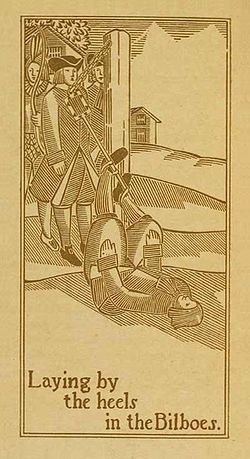
[edit]Bilboes used as public punishment in former times combined physical discomfort with public humiliation. The person was often restrained barefoot, which added to the humiliation. They were popular in England and America in the colonial and early revolutionary periods (such as in the Massachusetts Bay Colony). They were used in England to "punyssche transgressours ageynste ye Kinges Maiesties lawes". Bilboes appear occasionally in literature, including Hamlet (Act V, Scene 2: "Methought I lay worse than the mutinies in the bilboes") and the journals of Captain Cook.[2]
A notable case of excessive use is documented from Trinidad under British administration by governor Thomas Picton during the criminal procedure against eighteen-year-old Luisa Calderón in 1801. The former maid of governor Picton was accused of theft from his household and interrogated. She was also subjected to the picket torture, which first led to an extorted confession. Subsequently, she was left restrained in bilboes over the continuous period of eight months while the legal inquest was in progress. The shackles were rigidly fastened to the wall of her confinement cell, so she was forced to remain in one place for the entire duration of her imprisonment. The charges were eventually dropped, so Calderón was released from her incarceration and the bilboes were taken off after months of being incessantly restrained. This excessive form of incarceration along with the preceding torture was later assessed as inhumane in a juridic reappraisal.[3]
Use in slavery
[edit]Bilboes were used to restrain slaves on slave ships. Components forming more than eighty bilboes have been recovered from the Henrietta Marie, an English slave ship that was wrecked in the Florida Keys in 1700 after delivering slaves to Jamaica. Bilboes were also found in the Molasses Reef Wreck, a Spanish wreck in the Turks and Caicos Islands from very early in the 16th century, which may have been a slave ship hunting Lucayans in the Bahamas. Bilboes were used to fasten two slaves together, so that the eighty-plus bilboes found on the Henrietta Marie would have restrained up to 160 slaves. Bilboes were usually not placed on every slave transported, nor were they left on for all of a voyage. Only the slaves that were strongest and presumably most likely to revolt or escape were kept in bilboes for all of a voyage.[1]
See also
[edit]References
[edit]- ^ a b Malcom, Corey (October 1998). "The Iron Bilboes of the Henrietta Marie" (PDF). The Navigator: Newsletter of the Mel Fisher Maritime Heritage Society. 13 (10). Archived from the original (PDF) on 18 December 2015. Retrieved 28 May 2012.
- ^ Earle, Alice Morse (1896). Curious Punishments of Bygone Days. at Project Gutenberg
- ^ "THOMAS PICTON, ESQ". The Newgate Calendar. Retrieved 2014-02-22.
Bilboes
View on GrokipediaDesign and Construction
Materials and Fabrication
Bilboes were primarily fabricated from wrought iron, a material chosen for its tensile strength, ductility, and resistance to corrosion compared to cast iron, which was brittle and unsuitable for load-bearing restraints subjected to stress and potential tampering.[7][9] Wrought iron's fibrous structure, resulting from the puddling process involving the oxidation of pig iron impurities, allowed it to be hammered and shaped without fracturing, essential for creating durable components that could withstand repeated use in harsh maritime environments.[7] The fabrication process relied on traditional blacksmithing techniques, beginning with heating wrought iron bars in a forge to a malleable state, typically around 900–1200°C, followed by hammering to form the long central bar, often exceeding 1 inch (25 mm) in diameter and up to 44 inches (1118 mm) in length.[3] U-shaped shackle loops, each designed to encircle an ankle or wrist, were forged from flat iron stock bent into semicircles with aligned holes at the ends for the sliding bar; these loops measured approximately 3.5–3.8 inches (89–96.5 mm) wide and were secured against slippage by a forged knob or rivet at one end of the bar and a slot for a padlock hasp at the other.[3][7] Additional features, such as a flat flange with eight rivets for bolting the device to a deck, post, or wall, were hammered and riveted post-forging to enhance fixity.[3] This hand-forged construction yielded devices weighing around 5 kg (11 lb), simple in design yet effective for mass restraint, with the bilboes form remaining largely unchanged from circa 1550 to 1850 due to its proven functionality and ease of production by skilled smiths using basic tools like anvils, hammers, and tongs.[10][7] Production was typically outsourced to ironworks or shipyard blacksmiths, with no evidence of specialized machinery until the Industrial Revolution, ensuring portability and adaptability for naval and penal applications.[7]Mechanism and Operation
Bilboes function as a restraint device comprising a long, heavy iron bar or bolt, typically fixed to the floor or deck of a ship, along which sliding shackles can move. These shackles, often U-shaped or semicircular irons, are designed to encircle the ankles (or occasionally wrists) of one or more individuals, secured by hinges and padlocks to prevent removal. The mechanism allows minimal lateral movement along the bar but restricts standing, walking, or effective resistance, compelling the restrained person to remain seated or prone with legs extended.[4][11][12] In operation, the ankles are inserted into the open shackles, which are then clamped shut and locked, often positioning the prisoner forward of the bar to limit backward escape while exposing them to the vessel's conditions. This setup, common on naval and merchant ships from the 17th century onward, enforced discipline by inducing prolonged discomfort from the iron's weight, restricted blood flow, and awkward posture, with durations ranging from hours to days depending on the offense's severity. The bar's fixed mounting ensured collective restraint for multiple offenders, linking their movements and amplifying psychological deterrence through shared immobility.[13][8][3] The device's simplicity relied on mechanical leverage rather than intricate locks, with the sliding action permitting adjustment for different leg lengths but prohibiting separation without unlocking. In slave trade contexts, bilboes paired captives' limbs—such as one person's right ankle to another's left—via the bar, minimizing individual resistance while facilitating overcrowding in holds; archaeological examples from wrecks like the Henrietta Marie confirm this chained configuration's prevalence in the late 17th and 18th centuries.[7][14]Variants and Adaptations
Bilboes generally featured a rigid iron bar with sliding U-shaped shackles designed to encircle the ankles, often bolted to a ship's deck or a fixed point to immobilize the restrained individual.[3] Adaptations allowed for multiple shackles on a single bar, enabling the simultaneous restraint of several prisoners by linking their ankles or wrists side-by-side, which maximized control in confined spaces like ship holds or prison cells.[12] This multi-person configuration was particularly prevalent on transatlantic slave ships, where bilboes connected the right ankle or wrist of one captive to the left of another, forming chains of detainees to prevent coordinated resistance during voyages that could last months.[7] Wrist-oriented variants emerged alongside ankle models, with shackles sized for hands rather than feet, sometimes incorporating neck rings for added restriction in severe punitive contexts.[5] A more elaborate tri-pattern adaptation integrated rods through cuffs for the legs, wrists, and neck, forcing the body into a contorted posture that compounded physical discomfort and psychological submission, as documented in naval disciplinary records from the 17th and 18th centuries.[15] These designs evolved from simpler Iron Age restraints to more refined late medieval forms, incorporating hinged or keyed mechanisms for easier application and removal by authorities, though the core sliding-shackle principle persisted.[7] In colonial prisons and land-based enforcement, portable bilboes without deck fixings allowed for transportable use, adapting the maritime tool for static incarceration by securing the bar to walls or floors via chains or bolts.[5] Spanish-influenced models, termed "Spanish bilboes" in 18th-century British inventories, emphasized heavier gauged iron for durability against escape attempts, weighing up to 11 pounds and featuring reinforced rods to withstand prolonged strain.[3] Later adaptations in the 19th century occasionally replaced fixed bars with segmented chains linking individual shackles, offering limited mobility for labor tasks while retaining restraint, though this shifted toward modern handcuff precursors rather than pure bilboes.[15]Etymology and Historical Origins
Linguistic Roots
The term bilboes entered English in the 16th century, denoting iron leg restraints consisting of a bar with sliding shackles.[2] Its etymology remains uncertain, with the prevailing hypothesis linking it to Bilbao (historically spelled Bilboa), a city in Spain renowned for metalworking.[16] This association likely stems from Bilbao's production of high-quality steel, considered among Europe's finest during the early modern period, which may have been used in fabricating such devices.[4] Some accounts suggest the name derives from the purported invention of bilboes in Bilbao, though direct evidence for this origin is lacking and the term's appearance in English predates popularized narratives of Spanish importation via the 1588 Armada.[2] The word may parallel bilbo, an English term from the mid-16th century for a flexible sword manufactured in Bilbao, reflecting the region's expertise in tempering iron for durable implements.[1] This connection underscores a broader linguistic pattern where place names denoting craftsmanship (e.g., Bilbao for edged weapons and restraints) were anglicized to describe exported goods or technologies. Alternative derivations, such as phonetic adaptations from Spanish or Basque terms for irons or bars, lack substantiation in historical linguistics, and no pre-16th-century attestations in Romance languages have been identified to support them.[16] The plural form bilboes (used as a plurale tantum) aligns with English conventions for paired implements like shackles, without altering the core toponymic root.[2]Early Evidence and Development
The earliest textual reference to bilboes appears in the 1627 work of Jesuit priest Alonso de Sandoval, De Instauranda Aethiopum Salute, where he describes their use in restraining African captives in Cartagena during the early seventeenth century.[7] This account aligns with archaeological evidence indicating bilboes were employed in Spanish maritime contexts by the early sixteenth century, as components have been recovered from shipwrecks such as the Molasses Reef Wreck in the Turks and Caicos Islands, dated to approximately 1520. Of Spanish origin, named after the ironworking center of Bilbao, bilboes consisted of a long iron bar with sliding U-shaped shackles designed to secure multiple ankles closely together, adapting earlier single-fetters for group restraint on vessels.[7] In English colonies, bilboes were imported from England and documented in judicial records as early as August 7, 1632, when the Boston court ordered their use against a colonist for selling ammunition to Native Americans.[17] Magistrates in early Boston relied on these devices, featuring heavy bars with padlocks, to enforce discipline and public humiliation by confining offenders' legs in a raised, uncomfortable position.[13] The design's simplicity and durability facilitated its adoption for shipboard punishment, where it prevented resistance during voyages, with minimal evolution beyond refinements in forging for strength.[3] By the mid-seventeenth century, bilboes had become a standard restraint in naval and colonial settings, evidenced by examples in royal collections dated to this period and their prevalence on English ships for yoking prisoners.[3] Their development emphasized practicality over innovation, retaining the core bar-and-shackle mechanism that allowed crews to immobilize several individuals efficiently, though accounts note occasional adaptations like attachment to decks or walls for fixed restraint.[7]Primary Uses
Maritime and Naval Discipline
Bilboes were employed extensively in maritime and naval discipline from the 16th century through the Age of Sail, serving as iron restraints to confine offenders by securing their ankles to a fixed bar bolted to the ship's deck. This device immobilized individuals, often two at a time via sliding shackles, exposing them to discomfort from restricted movement, weather exposure, and public view by the crew, which amplified humiliation as a deterrent. Primarily used for short-term punishment or pre-trial confinement on vessels lacking dedicated brigs, bilboes addressed offenses such as insubordination, drunkenness, or minor infractions, preventing resistance or escape in the confined environment of a ship.[6][4] In naval service, particularly the Royal Navy during the 17th and 18th centuries, prisoners awaiting flogging or court-martial were routinely shackled in bilboes on deck, as warships prioritized space for armament and provisions over imprisonment facilities. This practice aligned with the harsh disciplinary codes like the Articles of War, where immediate restraint maintained order amid long voyages and combat risks. Historical accounts describe their application before corporal punishments, underscoring bilboes' role in the spectrum of escalating penalties from confinement to lashing.[18][19] Archaeological finds from maritime wrecks provide concrete evidence of their use; for example, the 1622 wreck of the Spanish galleon Nuestra Señora de Atocha yielded U-shaped grilletes and bilboes measuring approximately 17.5 inches in length, employed to punish crew for crimes like blasphemy or disobedience during transatlantic crossings. These restraints doubled as tools for controlling transported prisoners or galley oarsmen in earlier eras, reflecting adaptations across European naval traditions from the 1550s onward.[20] In the United States Navy, the term "in irons" denoted shackling to bilboes, with "double irons" incorporating wrist restraints, a method that persisted on American sailing ships into the late 19th century despite evolving disciplinary norms. This continuity highlights bilboes' practicality in enforcing maritime law where alternatives like stocks were less feasible at sea.[21]Colonial Law Enforcement and Prisons
Bilboes served as a primary restraint in colonial American law enforcement and prisons, particularly in the early 17th century, to secure prisoners and deter misconduct. Imported from England by magistrates in Boston around 1630, these devices consisted of a long iron bar equipped with sliding shackles and padlocks capable of confining multiple individuals simultaneously in a fixed, immobilizing position.[13] They were affixed to jail floors or walls, elevating offenders' legs off the ground to inflict discomfort, restrict movement, and prevent escape attempts.[22] In Puritan colonies such as Massachusetts and Plymouth, bilboes were routinely deployed for offenses ranging from Sabbath-breaking to insubordination, reflecting a penal system emphasizing restraint over prolonged incarceration. Court records from the 1630s document their use on refractory colonists, including servants and religious dissenters, often as an alternative to fines or whipping when payment was infeasible. For example, in 1636, Massachusetts authorities applied bilboes to punish moral infractions, underscoring their role in enforcing communal discipline through physical immobility and public visibility.[17] This practice extended to jails in Jamestown and other British North American settlements by the mid-17th century, where bilboes supplemented rudimentary lockups lacking secure cells.[13] While effective for short-term confinement, bilboes in prisons drew implicit criticism for their crude application, as colonial gaols often combined them with hard labor or exposure to elements, exacerbating physical strain without rehabilitative intent. Historical accounts indicate their prevalence waned by the late 18th century as centralized penitentiaries emerged, favoring solitary cells and lighter irons over such bulky apparatuses. Nonetheless, bilboes remained emblematic of early colonial justice's reliance on visible, corporal deterrence rather than reformative custody.[17][13]Restraint in the Transatlantic Slave Trade
Bilboes served as primary restraints for enslaved Africans during the Middle Passage of the transatlantic slave trade, chaining captives by their ankles or wrists to prevent resistance and maintain order in overcrowded holds. These devices typically featured a rigid iron bar with sliding U-shaped shackles that linked two or more individuals, allowing limited movement while ensuring collective immobilization.[7][12] Historical records indicate bilboes were the preferred "irons" among slave ship crews from at least the late 17th century onward, valued for their simplicity and capacity to secure large numbers efficiently.[7] Archaeological recovery from the wreck of the English slave ship Henrietta Marie, which conducted voyages between 1697 and 1700, yielded dozens of bilboes capable of restraining up to 160 captives, reflecting their standardized use in early English slaving operations transporting Africans from West Africa to the Caribbean.[23] The ship's artifacts demonstrate bilboes' design accommodated the vessel's cargo capacity, with shackles sized for adults and occasionally juveniles, though adaptations for children were less common.[7] Crew logs and survivor accounts from similar vessels describe routine application during loading in African ports and sustained use throughout the Atlantic crossing, where enslaved people were often secured in pairs below decks for weeks or months.[14] Contemporary descriptions, such as those in Marcus Rediker's analysis of slave ship practices, detail bilboes' role in suppressing revolts; for instance, a straight iron rod with flattened ends and U-loops slid onto it allowed quick assembly to fetter groups during uprisings.[24] Mortality data from voyages equipped with such restraints show death rates of 10-20% per crossing, exacerbated by immobility leading to sores, infections, and dysentery, though bilboes themselves were not the sole cause.[25] British parliamentary inquiries into the trade, post-1788, confirmed persistent bilboe usage despite regulations attempting to mandate less severe confinements, highlighting their entrenched practicality.[26] By the early 19th century, as abolitionist pressures mounted, bilboes gradually yielded to individual handcuffs, but their deployment spanned the trade's peak from 1700 to 1807, affecting millions embarked from Africa.[7]Effectiveness and Criticisms
Operational Advantages
Bilboes provided operational efficiency in restraining multiple individuals with a single device, as their long iron bar incorporated sliding shackles that could secure several pairs of ankles or wrists simultaneously, reducing the need for numerous separate irons and simplifying oversight in crowded environments like ships and prisons.[7][17] The straightforward design, featuring U-shaped shackles affixed to a bolt or bar, enabled quick application and adjustment without specialized tools, allowing enforcers to immobilize offenders rapidly during disciplinary actions at sea or in colonial outposts.[17][13] Wrought from robust iron, these restraints endured harsh maritime conditions, including exposure to saltwater and physical stress, maintaining integrity over prolonged use on voyages such as those of the slave ship Henrietta Marie in 1700, where over 160 individuals were controlled using 81 bolts and 165 shackle loops.[7] Their compact and portable nature facilitated storage in limited shipboard space and easy relocation, while the enforced close proximity of linked prisoners heightened psychological deterrence, minimizing individual or group resistance by complicating coordinated movement or escape attempts.[7]Accounts of Physical and Psychological Impact
![Historical bilboes irons][float-right] Bilboes inflicted acute physical discomfort through tight iron shackles clamped around the ankles, often resulting in chafing, sores, and leg strain due to restricted movement.[13] In colonial punishments, such as those in early Boston, offenders endured hours or days in these heavy bars, which limited posture to sitting or lying, exacerbating muscle fatigue and pain.[13] On galleons like the Nuestra Señora de Atocha, shackles measuring approximately 17.5 inches with small loops confined crew for disciplinary infractions, causing physical injuries from prolonged immobility in harsh sea conditions.[20] During the transatlantic slave trade, bilboes on vessels such as the Henrietta Marie—capable of securing over 160 individuals via 81 bolts and 165 loops—intensified physical suffering over voyages averaging 50 to 100 days, leading to severe skin abrasions, infections, and bodily deterioration from enforced proximity and inaction.[7] Captives chained in pairs or groups experienced compounded harm, as the restraints prevented resistance while promoting disease spread in unsanitary holds.[7] Psychologically, bilboes engendered humiliation, particularly when applied publicly in colonial settings, where restrained individuals faced communal scorn barefoot and exposed.[13] Maritime accounts describe mental strain from constant surveillance and helplessness, fostering despair and submission among sailors and prisoners alike.[20] For enslaved Africans, the devices amplified trauma during the Middle Passage, symbolizing dehumanization and contributing to profound emotional duress through enforced vulnerability and loss of agency.[7]Comparative Analysis with Other Restraints
Bilboes, consisting of a long iron bar fitted with sliding shackles for the ankles, offered distinct advantages over individual leg irons or chain-linked shackles in maritime and colonial settings due to their capacity to restrain multiple individuals simultaneously on a single device.[13][7] This interconnected design prevented coordinated resistance or escape attempts among groups, such as enslaved captives in ship holds or mutinous sailors, by limiting separation while permitting minimal shuffling movement—unlike solitary shackles, which allowed greater individual mobility if not additionally chained.[7] Their simplicity, durability, and portability made them particularly effective for naval discipline and slave transport, where rapid application and resistance to corrosion from saltwater were essential, contrasting with bulkier or more flexible chain systems that required more maintenance or links prone to failure under strain.[7][27] In comparison to stocks or pillories, which immobilized the upper body in fixed wooden frames for public shaming on land, bilboes prioritized confinement over visibility, enabling use in low-light, cramped ship compartments without requiring permanent fixtures.[6][4] Stocks enforced static exposure to deter through humiliation, often for hours or days in community view, whereas bilboes facilitated ongoing labor or restraint without halting ship operations, though both induced similar physical strains like joint pressure and skin abrasion from prolonged immobility.[27] Handcuffs, typically for wrists, complemented bilboes by addressing upper-body threats but lacked the bilboes' emphasis on lower-body control to prevent kicking or fleeing in close quarters.[6]| Restraint Type | Key Design Features | Primary Advantages in Historical Use | Notable Disadvantages | Contexts of Application |
|---|---|---|---|---|
| Bilboes | Long bar with sliding ankle shackles, often locking multiple pairs | Restrained groups efficiently; portable for ships; durable in harsh conditions | Rigid bar limited any adaptive movement; potential for shared infections in group use | Naval punishment, slave ships (e.g., Henrietta Marie, 1690s)[7] |
| Leg Irons/Shackles | Individual ankle cuffs connected by short chain | Allowed shuffling gait for labor; easier for single-person application | Permitted more separation in groups; chains could tangle or break | Prisons, galleons (e.g., Nuestra Señora de Atocha, 1622)[28] |
| Stocks | Fixed wooden frame for ankles and sometimes wrists | Public deterrence via exposure; low material cost | Immobile and land-bound; vulnerable to weather damage | Colonial public punishment (e.g., Boston, 17th century)[13] |
| Chain-Linked Systems | Flexible chains linking wrists/ankles or waists | Versatile for full-body restraint; adjustable length | Heavier overall; higher risk of link failure under force | General imprisonment, transport[28] |