Hubbry Logo
Bibliothèque nationale de FranceBibliothèque nationale de FranceMain
Open search
Bibliothèque nationale de France
Community hub
Bibliothèque nationale de France
logo
8 pages, 0 posts
0 subscribers
Be the first to start a discussion here.
Bibliothèque nationale de France
from Wikipedia

The Bibliothèque nationale de France (French: [biblijɔtɛk nɑsjɔnal fʁɑ̃s];[a] BnF) is the national library of France, located in Paris on two main sites, Richelieu and François-Mitterrand. It is the national repository of all that is published in France. Some of its extensive collections, including books and manuscripts but also precious objects and artworks, are on display at the BnF Museum (formerly known as the Cabinet des Médailles) on the Richelieu site.

Key Information

The National Library of France is a public establishment under the supervision of the Ministry of Culture. Its mission is to constitute collections, especially the copies of works published in France that must, by law, be deposited there, conserve them, and make them available to the public. It produces a reference catalogue, cooperates with other national and international establishments, as well as participates in research programs.

History

[edit]

The National Library of France traces its origin to the royal library founded at the Louvre Palace by Charles V in 1368. Charles had received a collection of manuscripts from his predecessor, John II, and transferred them to the Louvre from the Palais de la Cité. The first librarian of record was Claude Mallet, the king's valet de chambre, who made a sort of catalogue, Inventoire des Livres du Roy nostre Seigneur estans au Chastel du Louvre. Jean Blanchet made another list in 1380 and Jean de Bégue one in 1411 and another in 1424. Charles V was a patron of learning and encouraged the making and collection of books. It is known that he employed Nicholas Oresme, Raoul de Presles, and others to transcribe ancient texts. At the death of Charles VI, this first collection was unilaterally bought by the English regent of France, the Duke of Bedford, who transferred it to England in 1424. It was apparently dispersed at his death in 1435.[3][4][5]

Charles VII did little to repair the loss of these books, but the invention of printing resulted in the starting of another collection in the Louvre inherited by Louis XI in 1461. Charles VIII seized a part of the collection of the kings of Aragon.[6] Louis XII, who had inherited the library at Blois, incorporated the latter into the Bibliothèque du Roi and further enriched it with the Gruthuyse collection and with plunder from Milan. Francis I transferred the collection in 1534 to Fontainebleau and merged it with his private library. During his reign, fine bindings became the craze and many of the books added by him and Henry II are masterpieces of the binder's art.[4]

Under librarianship of Jacques Amyot, the collection was transferred to Paris and then relocated on several occasions, a process during which many treasures were lost.[citation needed] Henry IV had it moved to the Collège de Clermont in 1595, a year after the expulsion of the Jesuits from their establishment. In 1604, the Jesuits were allowed to return and the collection was moved to the Cordeliers Convent, then in 1622 to the nearby Confrérie de Saint-Côme et de Saint-Damien [fr] on the rue de la Harpe. The appointment of Jacques Auguste de Thou as librarian initiated a period of development that made it the largest and richest collection of books in the world. He was succeeded by his son who was replaced, when executed for treason, by Jérôme Bignon, the first of a line of librarians of the same name. Under de Thou, the library was enriched by the collections of Queen Catherine de Medici. The library grew rapidly during the reigns of Louis XIII and Louis XIV, due in great part to the interest of Minister Jean-Baptiste Colbert, himself a dedicated collector of books.[4]

The site in the Rue de la Harpe becoming inadequate, the library was again moved, in 1666, to two adjacent houses in Rue Vivienne. After Colbert, Louis XIV's minister Louvois also took interest in the library and employed Jean Mabillon, Melchisédech Thévenot, and others to procure books from every source. In 1688, a catalogue in eight volumes was compiled.[4] Louvois considered the erection of an opulent building to host it on what would become the Place Vendôme, a project that was however left unexecuted following the minister's death in 1691.

Galerie Mazarin, Richelieu site

The library opened to the public in 1692, under the administration of Abbott Camille le Tellier de Louvois, the minister's son. The Abbé Louvois was succeeded by Jean-Paul Bignon, who in 1721 seized the opportunity of the collapse of John Law's Mississippi Company. The company had been relocated by Law into the former palace of Cardinal Mazarin around Hôtel Tubeuf, and its failure freed significant space in which the Library would expand (even though the Hotel Tubeuf itself would remain occupied by French East India Company and later by France's financial bureaucracy until the 1820s). Bignon also instituted a complete reform of the library's system. Catalogues were made which appeared from 1739 to 1753 in 11 volumes. The collections increased steadily by purchase and gift to the outbreak of the French Revolution, at which time it was in grave danger of partial or total destruction, but owing to the activities of Antoine-Augustin Renouard and Joseph Van Praet it suffered no injury.[4]

The library's collections swelled to over 300,000 volumes during the radical phase of the French Revolution when the private libraries of aristocrats and clergy were seized. After the establishment of the French First Republic in September 1792, "the Assembly declared the Bibliothèque du Roi to be national property and the institution was renamed the Bibliothèque Nationale. After four centuries of control by the Crown, this great library now became the property of the French people."[3]

Salle ovale before restoration, Richelieu site

A new administrative organization was established. Napoleon took great interest in the library and among other things issued an order that all books in provincial libraries not possessed by the Bibliothèque Nationale should be forwarded to it, subject to replacement by exchanges of equal value from the duplicate collections, making it possible, as Napoleon said, to find a copy of any book in France in the National Library. Napoleon furthermore increased the collections by spoil from his conquests. A considerable number of these books were restored after his downfall. During the period from 1800 to 1836, the library was virtually under the control of Joseph Van Praet. At his death it contained more than 650,000 printed books and some 80,000 manuscripts.[4]

Following a series of regime changes in France, it became the Imperial National Library and in 1868 was moved to newly constructed buildings on the Rue de Richelieu designed by Henri Labrouste. Upon Labrouste's death in 1875 the library was further expanded, including the grand staircase and the Oval Room, by academic architect Jean-Louis Pascal. In 1896, the library was still the largest repository of books in the world, although it has since been surpassed by other libraries for that title.[7] By 1920, the library's collection had grown to 4,050,000 volumes and 11,000 manuscripts.[4]

In 2024, the library removed four 19th-century books from its public access, namely two volumes of The Ballads of Ireland published in 1855, a bilingual anthology of Romanian poetry dating from 1856, and book of the Royal Horticultural Society published between 1862 and 1863, after tests indicated that their covers and bindings were coloured using green pigments containing arsenic.[8]

Richelieu site

[edit]

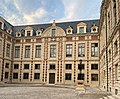
The Richelieu site occupies a full city block in Paris, surrounded by rue de Richelieu (west), rue des Petits-Champs (south), rue Vivienne [fr] (east), and rue Colbert [fr] (north). There are two entrances, respectively on 58, rue de Richelieu and 5, rue Vivienne. This site was the main location of the library for 275 years, from 1721 to 1996. It now hosts the BnF Museum as well as facilities of the BnF, the library of the Institut National d'Histoire de l'Art (in the Saller Labrouste since 2016), and the library of the École Nationale des Chartes. It was comprehensively renovated in the 2010s and early 2020s on a design by architects Bruno Gaudin [fr] and Virginie Brégal.

François-Mitterrand site

[edit]
View of the Bibliothèque nationale de France, François-Mitterrand site

On 14 July 1988, President François Mitterrand announced "the construction and the expansion of one of the largest and most modern libraries in the world, intended to cover all fields of knowledge, and designed to be accessible to all, using the most modern data transfer technologies, which could be consulted from a distance, and which would collaborate with other European libraries". Due to initial trade union opposition, a wireless network was fully installed only in August 2016.

In July 1989, the services of the architectural firm of Dominique Perrault were retained. The design was recognized with the European Union Prize for Contemporary Architecture in 1996. The construction was carried out by Bouygues.[9] Construction of the library ran into huge cost overruns and technical difficulties related to its high-rise design, so much so that it was referred to as the "TGB" or "Très Grande Bibliothèque" (lit.'Very Large Library', a sarcastic allusion to the successful TGV high-speed rail system).[10] After the move of the major collections from the Rue de Richelieu, the National Library of France was inaugurated on 15 December 1996.[11]

As of 2016, the BnF contains roughly 14 million books at its four Parisian sites (Bibliothèque François-Mitterrand, Richelieu, Arsenal, and Opéra) as well as printed documents, manuscripts, prints, photographs, maps and plans, scores, coins, medals, sound documents, video and multimedia documents, and scenery elements.[12] The library retains the use of the Rue de Richelieu complex for some of its collections.

Plan of the Bibliothèque François-Mitterrand
Located near the Métro stationBibliothèque François Mitterrand.

Manuscript collection

[edit]

The Manuscripts department houses the largest collection of medieval and modern manuscripts worldwide. The collection includes medieval chansons de geste and chivalric romances, eastern literature, eastern and western religions, ancient history, scientific history, and literary manuscripts by Pascal, Diderot, Apollinaire, Proust, Colette, Sartre, etc. The collection is organised:

Digital library

[edit]

Gallica[14] is the digital library for online users of the Bibliothèque nationale de France and its partners. It was established in October 1997. Today it has more than six million digitized materials of various types: books, magazines, newspapers, photographs, cartoons, drawings, prints, posters, maps, manuscripts, antique coins, scores, theater costumes and sets, audio and video materials. All library materials are freely available.[citation needed]

On 10 February 2010, a digitized copy of Scenes of Bohemian Life by Henri Murger (1913) became Gallica's millionth document. In February 2019, the five millionth document was a copy of the manuscript "Record of an Unsuccessful Trip to the West Indies" stored in the Bibliothèque Inguimbertine and on 30 March 2023 the ten millionth document was added.[15]

As of 2024, Gallica had made available online approximately 10 million documents :[citation needed]

  • 864,428 books
  • 186,495 manuscripts
  • 5,804,801 newspapers and magazines issues
  • 1,792,736 images
  • 196,486 maps
  • 64,967 music scores
  • 52,004 audio recordings
  • 519,877 objects
  • 5,585 video recordings

Most of Gallica's collections of texts have been converted into text format using optical character recognition (OCR-processing), which allows full-text search in the library materials.[citation needed]

Each document has a digital identifier, the so-called ARK (Archival Resource Key) of the National Library of France and is accompanied by a bibliographic description.[citation needed]

List of directors

[edit]

1369–1792

[edit]

1792–present

[edit]

Notable patrons

[edit]

Raoul Rigault, leader during the Paris Commune in 1871, was known for habitually occupying the library and reading endless copies of the newspaper Le Père Duchesne.[16]

[edit]

Alain Resnais directed Toute la mémoire du monde (transl. All the Memory in the World), a 1956 short film about the library and its collections.

Web accessibility

[edit]

On september 2025, the website of the Bibliothèque nationale de France was tested for conformance with Web Content Accessibility Guidelines (WCAG), in its version WCAG 2.2, using Popetech [d] as evaluation platform, which, in turn, uses the WAVE web accessibility evaluation tool [d] as automated web accessibilty evaluaton tool (AWAET).[citation needed]

The website of Bibliothèque nationale de France obtained a score of 7.6 decimal out of 10. This is known as Automated Accessibility Score provided by Popetech. The test was taken on September 2025 as part of a research on web accessibility of national libraries around the world.[17]


This result means that the website of Bibliothèque nationale de France cannot be considered accessible, if the treshold is stablised as 8 out of 10. Therefore, efforts still need to be made to achieve full compliance with web accessibility directives.[citation needed]

This section is added to this page in order to raise awarness about the web accessibility barriers faced by persons with disbilities that limit them to equally enjoying the Web. Web accessibilily is considered basic human right by the Convention on the Rights of Persons with Disabilities from the United Nations (UN).[18]

See also

[edit]

Notes

[edit]

References

[edit]

Further reading

[edit]
[edit]
Revisions and contributorsEdit on WikipediaRead on Wikipedia
from Grokipedia
The Bibliothèque nationale de France (BnF), known in English as the of France, is a major public institution in that functions as the country's principal repository for printed, manuscript, and multimedia works, receiving legal deposits of all publications produced or distributed in . Its collections, numbering over 40 million items—including books, manuscripts, prints, photographs, maps, scores, coins, medals, and archaeological artifacts—represent one of the world's most comprehensive assemblages of cultural and historical materials, with a focus on French heritage and its global influences. Tracing its origins to the royal library assembled by King Charles V at the in 1368, the BnF evolved through royal patronage and expansions, including the transfer of the Bibliothèque du Roi to the former Mazarin Palace (now the Richelieu site) in 1721, which marked a key phase of public accessibility and architectural development. The modern BnF was formally established on January 3, 1994, through the merger of the historic Bibliothèque nationale with the newly constructed Bibliothèque de France, expanding its scope to include advanced via platforms like Gallica, which provides to millions of digitized documents. The library operates four primary sites in the Paris region—Richelieu, François-Mitterrand, , and Opéra—along with a facility in , accommodating researchers, exhibitions, and public visits while prioritizing conservation of rare items such as ancient Greek manuscripts and Enlightenment-era prints. Its Richelieu site, renovated and reopened in 2022, features iconic spaces like the Oval Room and Labrouste Reading Room, underscoring the BnF's role in blending historical architecture with contemporary scholarly access.

Historical Development

Origins as Royal Library (1368–1789)

The Bibliothèque royale, predecessor to the modern Bibliothèque nationale de , originated in 1368 when King Charles V established a personal collection of manuscripts at the in , housing approximately 1,200 volumes in a dedicated gallery within the palace's falconry tower. This initiative reflected Charles V's patronage of scholarship and translation efforts into vernacular , marking the first systematic royal library in rather than ad hoc accumulations by prior monarchs. The collection emphasized historical, philosophical, and scientific texts, acquired through purchases, gifts, and commissions from scribes and illuminators. Following Charles V's death in 1380, the library faced dispersal amid the , with portions scattered or lost, though his brother and nephew Charles VI worked to recover and expand it, adding inventories and chains to secure books in the . By the early 15th century, under Charles VII and , efforts to reassemble holdings continued, but the collection remained modest and primarily for royal use, with limited scholarly access. relocated the library to the Château de Blois around 1498–1501, enhancing its prestige through acquisitions from Italian humanists during his Milan campaigns, though it endured neglect and losses during the . The Renaissance era under Francis I catalyzed major growth after 1515, with the library moved to and enriched by diplomatic gifts, confiscations from Italian printers, and systematic purchases of Hebrew, Greek, and Latin manuscripts, swelling holdings to over 2,000 items by . In 1537, Francis I instituted the dépôt légal via ordinance, mandating French publishers to deposit copies of new works, laying groundwork for practices and boosting printed book acquisitions, though enforcement was inconsistent initially. Subsequent Valois kings, including Henry II and Henry III, sustained expansions amid the Wars of Religion (1562–1598), which caused damage but spared wholesale destruction; by Henry IV's reign (1589–1610), relocation to between 1567 and 1593 solidified its urban base, with the first comprehensive catalog compiled in 1622 under librarian Théodore Godefroy. In the , and influenced growth through private libraries later integrated into the royal collection, but , as superintendent from 1661, orchestrated its modernization under , doubling manuscript holdings and quadrupling printed volumes through aggressive acquisitions across . oversaw relocation from temporary sites to purpose-built galleries in the rue Vivienne quarter starting in , commissioning catalogs and inventories to professionalize management. A 1692 decree by under abbé de Louvois opened the library to qualified scholars, making it 's first major public-access royal repository, though with restrictions on borrowing and copying. By the 18th century, under directors like abbé Bignon from , the library was reorganized into specialized departments for manuscripts, printed books, maps, and coins, facilitating better preservation and access, with daily visitors reaching nearly 100 by the . Acquisitions intensified via royal patronage and confiscations, including Oriental and scientific works, positioning it as Europe's largest collection with around 300,000 printed volumes and thousands of manuscripts by , though space constraints in the aging Richelieu structures foreshadowed expansion needs. This era emphasized Enlightenment-era cataloging, such as the 1739–1753 printed inventory, underscoring its role in advancing French intellectual authority without yet achieving full universality.

Revolutionary Confiscations and Expansion (1789–1870)

During the , the Bibliothèque du Roi underwent a fundamental transformation, becoming state property and opening more broadly to the public as part of the revolutionary push to democratize knowledge. Following the establishment of the First Republic in September 1792, the decreed the library national property, renaming it the Bibliothèque nationale and mandating free access for researchers. This shift aligned with decrees nationalizing ecclesiastical and émigré assets, redirecting private collections to public institutions. The library's collections expanded dramatically through systematic confiscations authorized by revolutionary legislation. A November 1789 decree nationalized church properties, leading to the dissolution of monasteries and the transfer of their libraries to the nation; select volumes, including rare manuscripts and incunabula, were allocated to the Bibliothèque nationale. Subsequent laws targeted émigré and noble holdings, with a March 1792 decree enabling seizures from opponents of the Revolution, resulting in the influx of thousands of volumes from aristocratic libraries. Overall, these confiscations added hundreds of thousands of items, roughly doubling the pre-Revolution holdings of approximately 300,000 printed volumes and 12,000 manuscripts by the early 1800s, though many works required sorting, cataloging, and repair amid wartime disruptions. Under the Directory and Napoleonic regimes, the library consolidated its role as France's central repository, with administrative reforms enhancing its structure. In 1802, Pierre Daunou organized the collections into specialized departments for printed books, manuscripts, maps, prints, and medals, while decreed further acquisitions from conquered territories and private sales. By 1810, intensified cataloging efforts and enforcement—reinforced since the edict but more rigorously applied—supported steady growth, reaching over 600,000 printed volumes. Throughout the Restoration, , and Second Empire, expansion continued via purchases, bequests, and international exchanges, though without the revolutionary scale of seizures. Holdings surpassed 1 million volumes by mid-century, bolstered by state funding and the reorganization under Minister of Public Instruction Achille Fould, which improved storage at the Rue de Richelieu site. By 1870, amid the , the library had evolved into a comprehensive national archive, preserving revolutionary gains in collection size despite periodic budgetary constraints and losses from neglect.

Republican Consolidation and Growth (1870–1980s)

Following the establishment of the Third Republic in 1870, the Bibliothèque nationale de France underwent administrative consolidation, with Léopold Delisle appointed as administrator-general in 1874 to oversee enhanced organization, cataloging, and scholarly access to holdings. This period emphasized the library's role as a republican institution, building on revolutionary foundations by prioritizing systematic inventorying amid growing collections from prior confiscations and donations. The 1881 law on press freedom formalized stricter requirements, mandating publishers to submit copies of printed works, journals, and periodicals to the BnF, which spurred rapid expansion in modern printed materials and established it as France's primary repository for contemporary output. Throughout the late 19th and early 20th centuries, collections swelled through targeted acquisitions of private libraries and manuscripts, alongside the influx from legal deposits, reaching millions of volumes by the interwar era as publishing output exploded. The Catalogue général des livres imprimés project, initiated under Delisle, published its first volume in 1897 and systematically documented pre-1960 holdings by 1981, facilitating scholarly use despite space constraints at the Richelieu site, where 19th-century extensions by proved insufficient for surging demand. World War I and II posed preservation challenges, with portions of rare collections evacuated to provincial sites for safekeeping, yet the BnF maintained operations and resumed acquisitions postwar, incorporating emerging formats like photographs and recordings. By the mid-20th century, storage shortages intensified due to unchecked growth in printed and non-book materials, prompting the construction of annexes, including at Versailles in 1934, expanded in 1954 and 1971, and further facilities at Sablé in 1980. These offsite depots alleviated immediate pressures but highlighted infrastructural limits, with reader spaces remaining inadequate by the amid rising public and research demands. Early informatization efforts in the laid groundwork for catalog , addressing inefficiencies in manual systems while collections continued to accumulate under mandates.

Physical Infrastructure

Richelieu Site: Traditional Hub

The Richelieu site, located at 58 rue de Richelieu in Paris's 2nd , forms the historic core of the Bibliothèque nationale de France, comprising the Richelieu Quadrangle—a multifaceted ensemble of buildings spanning four centuries, incorporating the 17th-century Hôtel Tubeuf as its oldest section and the Mazarin Palace from 1643. This traditional hub primarily houses specialized research departments, including Manuscripts, Prints and Photography, Coins, Medals and Antiques, , and , dedicated to the on-site consultation of the BnF's heritage collections. Key architectural landmarks include the Oval Room, an expansive reading hall built from 1897 to 1932 by Jean-Louis Pascal, measuring 43.70 meters long, 32.80 meters wide, and 18 meters high, which reopened in 2022 after renovations. The Labrouste Room, constructed between 1861 and 1868 by with a pioneering iron framework and nine cupolas, now accommodates the Institut national d'histoire de l'art library. Restored galleries, such as the Mansart Gallery in brick and stone and the 280 m² Mazarin Gallery with its frescoed vault, underscore the site's layered 17th- to 19th-century heritage. Extensive renovations led by architects Bruno Gaudin and Virginie Bréal, phased over 15 years and concluding with full public access in autumn 2022, modernized infrastructure while preserving monumental features like the 18th-century cour d'honneur—modified by Labrouste in 1870–1872—and the mid-19th-century Vivienne Garden, replanted with papyriferous species. Reading rooms demand a pass for entry, supporting scholarly work amid ongoing enhancements, including ramps and audio guides; the site also features the BnF Museum exhibiting around 900 items from its numismatic, medal, and antique holdings.

François-Mitterrand Site: Modern Expansion

The François-Mitterrand site, located in Paris's 13th arrondissement at Tolbiac along the Seine River, represents the Bibliothèque nationale de France's primary modern expansion initiative. Announced by President on July 14, 1988, as part of a plan to construct one of the world's largest and most advanced libraries, the project addressed the overcrowding at the historic Richelieu site by providing space for contemporary printed works, materials, and growing acquisitions post-1980. The initiative was driven by the need to modernize operations and accommodate an estimated annual intake of 150,000 monographs and 20,000 periodicals, shifting focus from rare manuscripts—housed primarily at Richelieu—to mass storage and public access for recent publications. Construction commenced in following the selection of architect Dominique Perrault's design in August 1989 from an international competition. Perrault's minimalist scheme features four L-shaped glass towers, each 24 stories tall and evoking open , enclosing a vast central planted with pine trees symbolizing the raw material of . The towers include 11 levels dedicated to compact shelving for books, protected by automated wooden shutters against sunlight, alongside office spaces and transport systems for materials. The site spans approximately 120,000 square meters of floor space, with an underground storage facility capable of holding up to 13 million volumes, enabling efficient retrieval via computerized catalogs. Officially inaugurated on March 30, 1995, by President Mitterrand, the facility opened to the public on December 17, 1996, under President , marking the completion of core operations despite phased document transfers. This expansion quadrupled the BnF's storage capacity for modern holdings, integrating advanced automation for book transport on rails and public reading areas like the elevated "Haute Plateau" salle, designed for 2,000 researchers with panoramic views. While praised for its innovative and role in democratizing access, the faced for high costs exceeding 10 billion francs and initial functionality issues, such as inadequate natural light control in reading spaces. The site now primarily houses post-1801 printed materials, microforms, and , supporting the BnF's mission to preserve France's intellectual output amid digital shifts.

Auxiliary Facilities and Renovations

The BnF maintains several auxiliary facilities beyond its primary Richelieu and François-Mitterrand sites, including the Arsenal Library in Paris's district, which originated as a amassed by the Marquis de Paulmy in the and now holds over one million printed volumes and 100,000 manuscripts specializing in , , and related disciplines. The Opéra site, located at 8 Rue Scribe in the 9th arrondissement, functions as the Bibliothèque-Musée de l'Opéra, integrated into the BnF in 1935, with collections spanning three centuries of documentation, including archives established in 1866 and museum holdings of visual materials. In , the Maison Jean Vilar serves as a specialized outpost with more than 39,000 volumes on theater and , alongside archives and records, operated in partnership with the BnF and open to the public for research and exhibitions. Renovations at the BnF have primarily targeted the aging Richelieu site through the Richelieu Renaissance Project, initiated around 2010 as the institution's first full-scale overhaul since 1721, encompassing structural reinforcements, facade restorations, and modernization of 30,000 square meters out of the site's total 58,000 square meters. This multi-phase effort, led by architect Bruno Gaudin and spanning roughly twelve years across three French presidencies, included closure of key areas like the Room in September 2016 for seismic upgrades and interior refits, with the BnF Museum reopening in September 2022 featuring enhanced display cases and visitor access. The project restored historical elements such as the Mazarin Gallery while adding contemporary features like an interior and improved , enabling public entry to previously restricted spaces and boosting capacity for research and exhibitions. In 2022, complementary work on the Richelieu Quadrangle addressed building security and preservation needs. Auxiliary sites have seen limited structural changes, with focus instead on collection management and digitization integration rather than major physical overhauls.

Collections and Preservation

Manuscripts and Incunabula

The BnF's Department of Manuscripts curates one of the world's richest collections of handwritten documents, encompassing medieval codices, ancient fragments, and modern autographs acquired primarily through royal foundations and subsequent institutional expansions. Originating with King Charles V's library in the around 1368, the holdings feature illuminated works, scriptural texts, and scholarly treatises that illuminate European intellectual history from onward. These materials are systematically described in the BnF Archives and Manuscripts Catalogue, which aggregates descriptions across departments for research access. Key strengths lie in medieval Latin and vernacular manuscripts, including biblical commentaries, patristic writings, and , many preserved from monastic and aristocratic libraries. Preservation efforts emphasize climate-controlled storage and conservation techniques, with microfilming initiatives dating back decades having produced over 25,000 copies of Western manuscripts to mitigate risks from handling and . Notable items include 9th-century Carolingian codices like BnF Latin 4404, which contains the alongside Visigothic legal texts and early illustrations, exemplifying the fusion of textual tradition and visual artistry in early medieval . The incunabula collection, housed largely within the Reserve of Rare Books, comprises the third-largest holdings globally, with more than 8,000 distinct editions printed in before January 1, 1501, excluding the Library's contributions. This corpus documents the nascent phase of movable-type printing, pioneered by Gutenberg, and includes works in Latin, vernacular languages, and classical editions from presses in over 150 cities. Catalogued exhaustively in the Catalogue des incunables (CIBN), these volumes feature rubricated initials, illustrations, and bindings reflecting contemporary artisanal practices, bridging manuscript illumination and industrialized reproduction. Incunabula preservation prioritizes non-invasive stabilization, with subsets digitized for scholarly analysis while originals remain restricted to mitigate photochemical damage from exposure. The collection's scale and diversity—spanning , , and —underscore the BnF's role in tracing printing's causal impact on knowledge dissemination, as evidenced by the proliferation of standardized texts post-1450 that accelerated scholarship.

Printed Books and Serials

The printed books and serials collection of the Bibliothèque nationale de France holds approximately 15 million volumes, including monographs, periodicals, journals, and newspapers, positioning it among the largest such repositories globally. This encompasses works in French and foreign languages, acquired through , purchases, exchanges, and donations, with a focus on comprehensive coverage of French intellectual output since the . Legal deposit forms the core acquisition mechanism, requiring French publishers to submit copies of all printed publications—ranging from books and pamphlets to serial issues—under regulations originating in a edict by King Francis I and codified in modern law. This system ensures the BnF receives around 60,000 new monographic titles and thousands of serial volumes annually, maintaining archival completeness despite exemptions for certain low-circulation or internal materials. Foreign printed works supplement the collection via targeted acquisitions to support scholarly needs in , , and sciences. Serials holdings include over 500,000 titles, featuring extensive runs of newspapers from the 17th century (such as Gazette de France, first issue 1631) and periodicals covering politics, arts, and sciences, with millions of individual issues preserved. These materials, stored in climate-controlled stacks across Richelieu and François-Mitterrand sites, undergo conservation treatments to mitigate acid-paper degradation common in 20th-century prints. Access occurs via the BnF's general catalogue, with on-site consultation restricted to researchers, while digitization through Gallica has rendered select serials—over 5 million newspaper pages—freely available online.

Non-Textual Holdings

The Bibliothèque nationale de France maintains diverse non-textual collections, encompassing prints, photographs, maps, plans, coins, medals, and antiques, which complement its textual holdings and support scholarly research in , , and . These materials, acquired through royal patronage, revolutionary confiscations, and ongoing deposits under legal mandate, include artifacts dating from antiquity to the present. The Department of Prints and Photography preserves engravings, lithographs, drawings, posters, and photographs, with annual acquisitions of roughly 25,000 items focused on French and international graphic works. This department, rooted in the 17th-century Cabinet du Roi, holds selections from artists like and Dürer, alongside 20th-century advertising posters by . The Department of Maps and Plans curates over 800,000 maps and plans spanning historical and modern , including one of the world's largest assemblages of antique terrestrial and celestial globes, exceeding 200 items from the onward. These holdings document geographic knowledge evolution, from medieval portolan charts to 20th-century aerial surveys. Numismatic and antique collections, housed in the Department of Coins, Medals, and Antiques, feature approximately 122,000 Greek and Roman provincial coins alongside medals, cameos, and silver treasures like the 1st–3rd century Berthouville hoard (over 25 kg) and the 1st-century Great Cameo of . Originating from royal cabinets expanded post-Revolution, these items include unique artifacts such as the (7th century) and Charlemagne's chessboard. The Picture Collection aggregates digitized iconographic materials from these departments, offering hundreds of thousands of high-definition images of prints, photographs, maps, and coins for research and publication, with ongoing enhancing accessibility.

Digital Transformation

Gallica Digital Library

Gallica is the digital library of the Bibliothèque nationale de France (BnF), providing free online access to digitized materials from the BnF's collections and those of partner institutions. Launched in 1997, it was established to make a wide range of available via the , initially focusing on mass of books, periodicals, and images to preserve and disseminate France's bibliographic patrimony. By 2023, marking its 25th anniversary, Gallica had reached a milestone of 10 million digitized documents, encompassing books, newspapers, magazines, maps, photographs, and other media spanning various periods. The platform's collections reflect the diversity of the BnF's holdings, including rare printed works, incunabula, serial publications, and visual archives, with content sourced from the library's physical repositories and collaborative projects. Digitization efforts involve automated scanning technologies for large-scale processing, often conducted in partnership with nearly 300 institutions as of 2024, such as local libraries, archives, and regional bodies, to expand coverage beyond the BnF's own materials. These partnerships facilitate "white label" initiatives, where customized versions of Gallica's infrastructure support partner-specific digital heritage portals, enhancing preservation through redundant digital backups. Access to Gallica is unrestricted and open to the public worldwide, with no subscription required, supporting advanced search functionalities, thematic curated collections (e.g., on historical figures or events), and viewing tools. Users can download high-resolution files for items, promoting scholarly research and public education, while rights-managed content adheres to French legal deposit laws ensuring compliance. The library integrates with broader European initiatives like , aggregating French heritage data to foster cross-border access, though primary emphasis remains on French-language and Francophone materials. Ongoing expansions prioritize fragile or high-demand items, with annual updates reflecting new digitization campaigns to maintain relevance amid growing digital demands.

Broader Digitization and Access Initiatives

The Bibliothèque nationale de France (BnF) extends its digital efforts beyond the Gallica library through public-private partnerships aimed at mass digitization of 20th-century holdings, including an initiative announced in early to digitize and commercialize online approximately 500,000 out-of-print books over five years, with revenues reinvested into further preservation and access projects. These partnerships, such as those formalized around 2013, involve private entities handling digitization while granting the BnF perpetual access rights, though they have drawn criticism for temporarily restricting works to commercial exploitation terms of up to 10 years. Despite initial resistance to external tech-driven projects—exemplified by former president Jean-Noël Jeanneney's 2005 push for a European as a counter to —the BnF has engaged in collaborative scanning, including a 2010 agreement allowing reciprocal access to digitized collections with for out-of-copyright materials. A key component of broader access is data.bnf.fr, the BnF's portal that exposes structured metadata from its catalogs as linked , facilitating semantic queries, reuse in third-party applications, and integration with global knowledge graphs via standards like RDF and ARK identifiers for persistent resource linking. This platform supports and research by enabling developers and scholars to access authority files, bibliographic records, and entity relationships without full reliance on Gallica's image-based content, aligning with the BnF's digital roadmap for enhanced data mobility and public reuse under open licenses. The BnF also contributes significantly to supranational access frameworks, notably as a primary data provider to , the European Union's digital aggregator, supplying millions of metadata records and digitized assets through protocols like OAI-PMH to promote cross-border discovery and reuse. These efforts encompass not only Gallica-derived content but also specialized datasets from partner institutions and backup digitization programs, fostering a federated European ecosystem while adhering to public funding mandates for free access to materials. Additionally, the BnF advances born-digital preservation via extensions to web content and software, with ongoing projects as of 2025 integrating usage analytics and AI tools to optimize collection accessibility and metadata enrichment.

Governance and Operations

Leadership and Directors

The Bibliothèque nationale de France (BnF) is directed by a president, appointed by presidential on the proposal of the Minister of , who oversees strategic direction, operations, and preservation efforts as the institution's chief executive. The role emphasizes advancing national collections, digital access, and scholarly resources amid evolving technological and budgetary constraints. Gilles Pécout, a specializing in modern European history and former French ambassador to , has served as president since 18 April 2024. His appointment followed a decree issued on 20 March 2024, succeeding Laurence Engel after her eight-year term. Pécout's prior diplomatic experience includes roles in cultural affairs, positioning him to address ongoing challenges like site renovations at Richelieu and international collaborations. Laurence Engel, the first woman to hold the presidency, led the BnF from 11 April 2016 to April 2024. A graduate of the and former cultural administrator, Engel prioritized digitization expansions, public outreach, and responses to global events such as the pandemic's impact on access. Her tenure saw advancements in the Gallica digital library and partnerships with European institutions, though it coincided with debates over funding amid fiscal pressures. Bruno Racine preceded Engel, serving from 2 April 2007 to 2016. An alumnus with prior leadership at the , Racine extended his initial three-year mandate and focused on numerical transitions, including enhanced online cataloging and acquisitions policy reforms to counter digital disruptions in publishing. His administration navigated post-2008 economic constraints while expanding international loans and exhibitions. Prior to the 1994 establishment of the BnF as an autonomous public entity under the Bibliothèque de France project, the institution operated under administrators-general appointed by the state. Notable figures include Julien Cain, who directed from 1930 to 1940 and 1945 to 1966, overseeing wartime evacuations of collections and post-war reconstructions that preserved over 10 million items despite occupation risks. These predecessors laid foundational emphasizing enforcement and centralized archiving, principles retained in the modern presidency. The Bibliothèque nationale de France (BnF) operates as an établissement public à caractère administratif (public administrative establishment), established by Decree No. 94-3 of 3 January 1994 and placed under the administrative tutelle (oversight) of the Minister of Culture. Its legal mandate encompasses collecting, cataloging, conserving, and enriching 's documentary heritage across all domains of knowledge; ensuring the preservation and public communication of its collections; producing and disseminating national bibliographic data; and conducting research related to its missions. Central to this mandate is the dépôt légal (legal deposit) system, originating from an edict by King Francis I in 1537 and codified in subsequent legislation, which requires publishers, producers, and distributors to submit copies of all printed, audiovisual, electronic, and multimedia works produced or imported in , thereby constituting the institution's primary acquisition mechanism without direct purchase costs. This obligation ensures comprehensive representation of national intellectual output, with the BnF receiving and processing deposits from over 70,000 annual titles as of recent reports. Funding for the BnF derives principally from state allocations through the national budget, channeled via the Ministry of Culture as a subvention pour charges de service public (public service subsidy) to support its core statutory duties. Supplementary income includes self-generated revenues from services such as reader admissions, document reproductions, exhibitions, and licensing; partnerships with research agencies like the Agence Nationale de la Recherche; and private contributions via a dedicated fonds de dotation established for mécénat (corporate patronage) and individual donations, which funded specific projects like digitization initiatives in 2023. State subsidies typically account for approximately 74% of total resources, reflecting the institution's role as a public good rather than a commercial entity. The BnF's annual for 2024 totaled approximately €280 million, with the subsidy fixed at €211.53 million in autorisations d'engagement (commitment authorizations). This allocation covers operational expenses including staff (around 2,300 employees), preservation, acquisitions beyond legal deposits, and infrastructure maintenance across its sites. Budget execution is subject to annual parliamentary review, with 2025 projections indicating reconduction of 2024 levels without adjustment for , potentially eroding amid rising costs for conservation and digital projects. Oversight includes performance reporting to the Ministry, ensuring alignment with mandate fulfillment, though supplementary funding pursuits have expanded to mitigate fiscal pressures from static state grants.

Controversies and Challenges

Architectural Design and Cost Overruns

The François-Mitterrand site of the Bibliothèque nationale de France was conceived as part of President François Mitterrand's grands projets, with construction announced on July 14, 1988, and an international architectural competition launched in 1988, attracting 244 entries. Dominique Perrault's winning design, selected in 1989, featured four 24-story L-shaped towers positioned like open books at the corners of a square, enclosing a vast esplanade and sunken gardens along the River in 's . This minimalist, high-rise configuration prioritized automated underground and tower storage for millions of volumes, with public reading rooms and facilities concentrated at the lower levels to create a contemplative urban landscape. The towers, each containing 12 levels of high-density shelving capable of holding up to 2 million books, were clad in glass to evoke transparency and lightness, while the served as a forecourt with pine trees providing shade and reference to historical motifs. Construction commenced in 1991 on a former industrial site, incorporating innovative elements like metal mesh screens for light diffusion and extensive subterranean spaces for climate-controlled preservation. The project faced technical challenges, including structural demands of the towers and environmental control for book storage, which contributed to delays; the site was inaugurated on December 15, 1996, but fully opened to the in 1998. The total construction cost reached approximately 7.2 billion French francs (equivalent to about 1.1 billion euros), marking substantial overruns from initial estimates due to complexities in the high-rise design, material innovations, and mid-project alterations to retain Perrault's vision, such as preserving the exposed stack towers. Contemporary reports highlighted these overruns as emblematic of broader issues in Mitterrand's ambitious building program, with the library's expenses drawing scrutiny for exceeding projections amid technical difficulties like solar glare and ventilation in the towers. The French Senate later described the costs as controversial, prompting calls for investigative oversight.

Preservation Issues and Construction Problems

The François-Mitterrand site (Tolbiac), opened in 1998, has encountered preservation challenges stemming from its architectural design, including exposure of book collections in the four open L-shaped glass towers to direct sunlight, which accelerates degradation of and bindings; this necessitated the installation of roughly 8,000 pivoting wooden louvers (each 3 feet wide and spanning floor-to-ceiling) to shield materials, though critics have described the structure as inherently hostile to long-term conservation. Water infiltration issues have compounded these problems, with groundwater from the adjacent Seine River seeping into the building—by design in parts of the structure—and causing periodic flooding, as documented in late 1998. The site's vulnerability to flooding was starkly demonstrated on January 12, 2014, when a pipe joint rupture in the main building released 25 cubic meters of water, inundating three levels and soaking approximately 38,000 documents; emergency protocols were invoked that Sunday afternoon, enabling the salvage of affected collections through rapid evacuation and drying processes. Ongoing flood prevention efforts at the François-Mitterrand site, informed by its low-lying position near the , include structural barriers and monitoring systems, but historical risks—such as overflow and rapid rise—persist across BnF facilities, prompting site-specific contingency plans. Operational flaws linked to , including unreliable compact shelving mechanisms that delay retrieval and intermittent motion-sensor in stacks providing insufficient illumination for careful handling, have further strained preservation by increasing handling errors and wear on items. Renovations at the historic Richelieu site, initiated in the 2010s and culminating in partial reopenings by 2022, revealed construction-related hazards during deconstruction phases, notably traces of and lead in building materials, which mandated immediate abatement protocols, worker protections, and project delays to safeguard both collections and personnel. These discoveries, common in pre-20th-century Parisian structures, underscored the challenges of aging for modern preservation standards, including enhanced climate control and seismic reinforcement, without compromising irreplaceable holdings stored onsite.

Scholarly and Cultural Role

Research Usage and Notable Patrons

The Bibliothèque nationale de France (BnF) maintains dedicated facilities across its primary sites, including the Richelieu site's specialized reading rooms for manuscripts, rare books, and maps, as well as the François-Mitterrand site's high-density storage and retrieval systems accessible via automated delivery. Researchers must register for a research card, granting access to onsite collections not available digitally, with priority given to academic, professional, and independent scholars pursuing documented projects. These facilities support disciplines ranging from medieval paleography to modern , with onsite consultation required for fragile or unique items comprising over 10 million manuscripts, incunabula, and archival documents. Annual usage of reading areas reflects a recovery from disruptions, with fewer than 380,000 visits recorded in 2021—a 12% increase from 2020 but 59% below pre-2020 norms—indicating typical yearly admissions exceeding 900,000 for scholarly consultation. By 2023, total onsite visits across all BnF functions reached 1.45 million, including substantial activity, rising to a record 1.7 million in 2024 amid expanded access post-Richelieu renovations. Digital complements, such as the Gallica portal, handle millions of remote queries annually, but onsite persists for verification, with ties forged between BnF curators and external scholars through collaborative cataloging and expertise-sharing. Notable patrons have included generations of historians leveraging BnF holdings for foundational works; for instance, 19th-century scholar extensively consulted its archives and printed collections in composing his multi-volume Histoire de France, drawing on royal and revolutionary-era documents to reconstruct national narratives from primary evidence. In the , press historians like those contributing to RetroNews projects utilized BnF's vast periodical archives—spanning 15 million issues—for interwar cultural analyses, as exemplified by researchers Emmanuelle Retaillaud and Anne-Claude Ambroise-Rendu. Contemporary usage features international academics, such as CNRS-affiliated Ottomanists Frédéric Hitzel, who rely on BnF's oriental manuscripts for specialized studies, underscoring the institution's role in sustaining empirical historical inquiry amid global scholarly networks.

Exhibitions, Outreach, and Public Impact

The Bibliothèque nationale de France maintains a dedicated at its Richelieu site, featuring permanent displays of nearly 900 items from its collections, with exhibits regularly renewed to highlight treasures such as illuminated manuscripts, rare books, and historical artifacts. Temporary exhibitions, often thematic and drawing on the BnF's vast holdings, are organized across sites including Richelieu and François-Mitterrand, focusing on topics like in the Galerie Mansart or broader cultural histories. These exhibitions serve to promote public engagement with France's documentary heritage, with attendance tracked in annual reports to the Conference of European National Librarians, reflecting efforts to broaden access beyond researchers. Outreach initiatives include educational programs tailored for students and the general public, such as access to a with over 330,000 documents and dedicated spaces for group study at the François-Mitterrand site. The "Pass lecture / culture" subscription grants unlimited entry for those aged 14 and older to reading rooms, exhibitions, concerts, and performances, fostering sustained cultural participation. Additionally, the BnF hosts international professionals and young researchers through exchange programs, promoting French bibliographic methods and collaborative preservation efforts. Partnerships with institutions like the enable joint digitization projects, enhancing global access to shared cultural heritage. Public impact is amplified through digital and on-site engagement, with the Gallica digital library consulted over 18.5 million times in 2021, providing free access to millions of digitized items and extending the BnF's reach beyond physical visitors. Cultural cooperation agreements, such as the 2023 pact with Amiens, aim to introduce regional audiences to BnF collections via localized events and displays. These efforts underscore the institution's role in disseminating national and universal heritage, with initiatives like manuscript readings in specialized rooms innovating audience approaches to historical materials. The BnF's European and international engagements further ensure broad communication of its collections, prioritizing preservation alongside public dissemination.

References

Add your contribution
Related Hubs
User Avatar
No comments yet.