



Community hub
Braising
View on Wikipedia

Braising (from the French word braiser) is a combination-cooking method that uses both wet and dry heats: typically, the food is first browned at a high temperature, then simmered in a covered pot in cooking liquid (such as wine, broth, coconut milk or beer). It is similar to stewing, but braising is done with less liquid and usually used for larger cuts of meat. Braising of meat is often referred to as pot roasting, though some authors make a distinction between the two methods, based on whether additional liquid is added.[1][2] Osso buco and coq au vin are well known braised meat dishes, and the technique can also be used to prepare fish, tempeh, tofu, or fruits and vegetables.
Techniques
[edit]Most braises follow the same basic steps. The food to be braised (meats, vegetables, mushrooms, etc.) is first pan-seared to brown its surface and enhance its flavor (through the Maillard reaction). If the food will not produce enough liquid of its own, a certain amount of cooking liquid that often includes an acidic element (e.g., tomatoes, beer, balsamic vinegar, wine) is added to the pot, often with stock. A classic braise is done with a relatively whole cut of meat, and the braising liquid will cover two-thirds of the food in the pan. The dish is then covered and cooked with a lid or cartouche at a very low simmer until the meat becomes so tender that it can be "cut" with just the gentlest of pressure from a fork (versus a knife). Often the cooking liquid is finished to create a sauce or gravy as well.[3][4][5]
Sometimes foods with high water content (particularly vegetables) can be cooked in their own juices, making the addition of liquid unnecessary.[6]
Despite a common misconception that braising adds moisture to meat, the opposite is true, and the appearance of moisture comes from gentle cooking breaking down connective tissue and collagen, which lubricates and tenderizes fibers.[7][8]
Braised foods
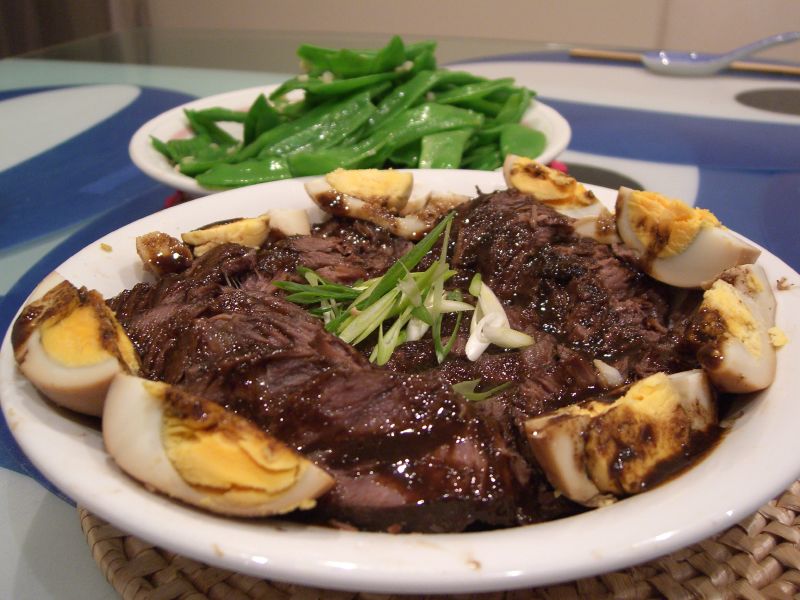
[edit]Braising is used extensively in the cuisines of Asia, particularly Chinese cuisine[9] and Vietnamese cuisine, where soy sauce (or, in Vietnam, soy sauce and fish sauce) is often added to the braising liquid.
-
 Braised pot roast
 -
 Chinese braised pork spare ribs with preserved mustard greens
 -
 Braised baby artichokes
 -
 Chinese braised pork belly


See also
[edit]

References
[edit]- ^ "Pot-Roasting". Food Resource. College of Health and Human Sciences, Oregon State University. Archived from the original on 18 July 2011. Retrieved 30 March 2009.
- ^ "Braise". Food Resource. College of Health and Human Sciences, Oregon State University. Archived from the original on 6 May 2009. Retrieved 30 March 2009.
- ^ Buford, Bill (2006). Heat. New York, NY, USA: Alfred A. Knopf. pp. 70–75. ISBN 978-1-4000-4120-6.
- ^ Colicchio, Tom (2000). Think Like a Chef. Clarkson-Potter. pp. 52–63. ISBN 978-0-609-60485-4.
- ^ Hansen, James (3 December 2023). "Upgrade Your Poaching Experience With The Help Of Parchment Paper". The Daily Meal. Archived from the original on 2 September 2024. Retrieved 9 May 2025.
- ^ Courtine, Robert J.; et al., eds. (1988) [French edition published 1984]. Larousse Gastronomique (English ed.). Paul Hamlyn. p. 133. ISBN 0-600-32390-0.
- ^ "The Truth About Braising". America's Test Kitchen. Archived from the original on 5 December 2022. Retrieved 24 June 2024.
- ^ Lopez-Alt, J Kenji (2015). "Soups, Stews, and the Science of Stock". The Food Lab: Better Home Cooking Through Science. America: W. W. Norton & Company. ISBN 9780393081084. Retrieved 24 June 2024.
- ^ Tropp, Barbara (1996). The Modern Art of Chinese Cooking. William Morrow Cookbooks. ISBN 978-0-688-14611-5.
Cooking techniques | |||||||
|---|---|---|---|---|---|---|---|
| Dry |
| ||||||
| Wet |
| ||||||
| Fat-based |
| ||||||
| Mixed medium | |||||||
| Device-based | |||||||
| Non-heat | |||||||
| See also | |||||||

| Poultry |   | ||||
|---|---|---|---|---|---|
| Livestock | |||||
| Game | |||||
| Fish | |||||
| Shellfish and other seafood | |||||
| Insects | |||||
| Cuts and preparation |
| ||||
| List articles |
| ||||
| Ethics and psychology | |||||
| Alternatives | |||||
| Meat science | |||||
| Meat industry | |||||
| Related subjects | |||||
Braising
View on GrokipediaDefinition and Fundamentals
Definition of Braising
Braising is a combination cooking method that employs both dry and moist heat, beginning with searing the food at high temperature to develop a browned exterior, followed by slow cooking in a minimal amount of liquid at low heat, usually in a covered vessel.[9] This technique is particularly suited for tougher cuts of meat, such as brisket or short ribs, as well as hearty vegetables like root crops.[10] The primary purpose of braising is to tenderize less tender proteins by breaking down their connective tissues and collagen through prolonged exposure to moisture and gentle heat, resulting in succulent textures.[4] Simultaneously, it infuses the food with deep flavors from the braising liquid, which often includes stocks, wine, or broth, enhancing the overall taste profile.[11] Key characteristics of braising include the use of aromatic vegetables (such as onions, carrots, and celery), herbs (like thyme and bay leaves), and flavorful stocks or broths to form the cooking liquid, which partially submerges the ingredients—typically covering one-third to one-half of the food—to allow for both steaming and simmering effects.[12][13] This partial coverage distinguishes braising from fully submerged methods like stewing.[14]Comparison to Other Moist Cooking Methods
Braising sets itself apart from other moist cooking methods by combining an initial dry-heat sear with subsequent slow simmering in a limited amount of liquid that partially covers the ingredients, allowing for both browning and tenderization. This contrasts with stewing, where ingredients are fully submerged in liquid to yield a broth-like dish, and with poaching or boiling, which rely solely on submersion without searing—poaching at gentle temperatures (160–180°F) for delicate foods like fish, and boiling at a vigorous 212°F for sturdy items like pasta or vegetables.[15][16][17] The distinctions often hinge on ingredient preparation and cooking environment. For instance, braising suits larger, whole cuts of meat, while stewing calls for uniformly diced pieces to ensure even cooking in abundant liquid. Pot-roasting, a close variant of braising, typically occurs entirely on the stovetop with similar partial liquid coverage and searing, whereas braising frequently transfers to the oven for consistent, low oven heat (275–325°F or 135–163°C), which maintains the braising liquid at a gentle simmer around 185–195°F (85–90°C).[14][15][18][19]| Method | Liquid Level | Initial Step | Suitable Ingredients | Primary Cooking Location | Key Outcome |
|---|---|---|---|---|---|
| Braising | Partial (1/3 coverage) | Searing | Large, tough meat cuts (e.g., brisket) | Oven (after stovetop sear) | Tenderized with concentrated sauce |
| Stewing | Full submersion | Optional browning | Diced meat/vegetables | Stovetop or oven | Brothy, uniform tenderness |
| Pot-Roasting | Partial (similar to braising) | Searing | Whole roasts | Stovetop | Moist, fall-apart texture |
| Poaching | Full submersion | None | Delicate proteins (e.g., fish, eggs) | Stovetop | Gentle, moist preservation |
| Boiling | Full submersion | None | Hearty starches/vegetables | Stovetop | Quick cooking, potential nutrient loss |
| Steaming | None (steam only) | None | Vegetables, seafood | Steamer | Nutrient retention, firm texture |