Hubbry Logo
CD33CD33Main
Open search
CD33
Community hub
CD33
logo
8 pages, 0 posts
0 subscribers
Be the first to start a discussion here.
Contribute something
CD33
CD33
from Wikipedia
CD33
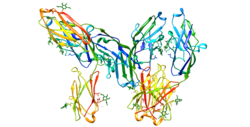
Available structures
PDBOrtholog search: PDBe RCSB
Identifiers
AliasesCD33, CD33 molecule, SIGLEC-3, SIGLEC3, p67
External IDsOMIM: 159590; MGI: 99440; HomoloGene: 88651; GeneCards: CD33; OMA:CD33 - orthologs
Orthologs
SpeciesHumanMouse
Entrez
Ensembl
UniProt
RefSeq (mRNA)

NM_001082618
NM_001177608
NM_001772

NM_001111058
NM_021293

RefSeq (protein)

NP_001076087
NP_001171079
NP_001763

NP_001104528
NP_067268

Location (UCSC)Chr 19: 51.23 – 51.24 MbChr 7: 43.17 – 43.19 Mb
PubMed search[3][4]
Wikidata
View/Edit HumanView/Edit Mouse

CD33 or Siglec-3 (sialic acid binding Ig-like lectin 3, SIGLEC3, SIGLEC-3, gp67, p67) is a transmembrane receptor expressed on cells of myeloid lineage.[5] It is usually considered myeloid-specific, but it can also be found on some lymphoid cells.[6]

It binds sialic acids, therefore is a member of the SIGLEC family of lectins.

Structure

[edit]

The extracellular portion of this receptor contains two immunoglobulin domains (one IgV and one IgC2 domain), placing CD33 within the immunoglobulin superfamily. The intracellular portion of CD33 contains immunoreceptor tyrosine-based inhibitory motifs (ITIMs) that are implicated in inhibition of cellular activity.[7]

Function

[edit]

CD33 can be stimulated by any molecule with sialic acid residues such as glycoproteins or glycolipids. Upon binding, the immunoreceptor tyrosine-based inhibition motif (ITIM) of CD33, present on the cytosolic portion of the protein, is phosphorylated and acts as a docking site for Src homology 2 (SH2) domain-containing proteins like SHP phosphatases. This results in a cascade that inhibits phagocytosis in the cell.[8]

Alzheimer's disease

[edit]

CD33 controls microglial activation but in Alzheimer disease it goes overdrive in presence of amyloid and tau proteins, its expression is known to be tied to TREM2.[9][10][11][12]

Clinical significance

[edit]

CD33 is the target of gemtuzumab ozogamicin (trade name: Mylotarg®; Pfizer/Wyeth-Ayerst Laboratories),[13] an antibody-drug conjugate (ADC) for the treatment of patients with acute myeloid leukemia. The drug is a recombinant, humanized anti-CD33 monoclonal antibody (IgG4 κ antibody hP67.6) covalently attached to the cytotoxic antitumor antibiotic calicheamicin (N-acetyl-γ-calicheamicin) via a bifunctional linker (4-(4-acetylphenoxy)butanoic acid).[14] Several mechanisms of resistance to gemtuzumab ozogamicin have been elucidated.[15] On September 1, 2017, the FDA approved Pfizer's Mylotarg.[16]

Gemtuzumab ozogamicin was initially approved by the U.S. Food and Drug Administration in 2000. However, during post marketing clinical trials researchers noticed a greater number of deaths in the group of patients who received gemtuzumab ozogamicin compared with those receiving chemotherapy alone. Based on these results, Pfizer voluntarily withdrew gemtuzumab ozogamicin from the market in mid-2010, but was reintroduced to the market in 2017.[17][18][19]

CD33 is also the target in Vadastuximab talirine (SGN-CD33A), a novel antibody-drug conjugate being developed by Seattle Genetics, utilizing this company's ADC technology.[20]

References

[edit]
[edit]
Revisions and contributorsEdit on WikipediaRead on Wikipedia
from Grokipedia
CD33, also known as -3 or sialic acid-binding immunoglobulin-like lectin 3, is a transmembrane that serves as an inhibitory receptor primarily expressed on cells of the myeloid lineage, including monocytes, macrophages, granulocytes, and myeloid precursors. As a member of the family within the , CD33 recognizes sialic acid-containing glycans on cell surfaces and components, thereby mediating cell-cell interactions and modulating immune signaling through recruitment of tyrosine phosphatases such as SHP-1 and SHP-2 via its cytoplasmic immunoreceptor tyrosine-based inhibitory motifs (ITIMs). Structurally, CD33 consists of an extracellular region with one V-set immunoglobulin-like domain followed by a C2-set domain, a single transmembrane helix, and a short cytoplasmic tail containing two ITIMs that enable negative regulation of cellular activation. The protein is encoded by the CD33 gene located on chromosome 19q13.41 in humans, producing multiple isoforms through alternative splicing, with the full-length form featuring the sialic acid-binding V-set domain essential for ligand interaction. Expression of CD33 is broad but predominantly high in hematopoietic tissues, with the highest levels observed in spleen (RPKM 7.5) and bone marrow (RPKM 6.6), reflecting its role in myeloid differentiation and immune homeostasis. It localizes to the external side of the plasma membrane, Golgi apparatus, and peroxisomes, where it influences processes like endocytosis and sialic acid-dependent adhesion. Biologically, CD33 functions to dampen innate immune responses by inhibiting production, activation, and immune signaling pathways, thereby preventing excessive and promoting . It binds sialic acids in cis (on the same cell) or trans (on other cells), which can mask its activity or facilitate inhibitory signaling, and it enables activation to regulate downstream pathways like those involving suppressor of cytokine signaling 3 (SOCS3). In normal physiology, CD33 contributes to maintaining myeloid cells in a resting state and modulating their proliferation and survival during immune challenges. CD33 holds significant clinical relevance as a therapeutic target in (AML), where it is expressed on 85-90% of leukemic blasts and some leukemia stem cells, but absent from normal hematopoietic stem cells, allowing selective targeting. The antibody-drug conjugate (GO), first approved in 2000 but withdrawn in 2010 and re-approved in 2017, delivers the cytotoxic agent to CD33-positive cells and is used as a CD33-directed therapy for AML, demonstrating improved survival in favorable- and intermediate-risk patients when combined with , though resistance mechanisms like drug efflux and isoform variations can limit efficacy (as of 2025). Additionally, genetic variants in CD33, such as the rs3865444 polymorphism, are associated with increased risk of late-onset by enhancing microglial expression of CD33, which inhibits amyloid-β clearance and promotes plaque accumulation in the . As of 2025, emerging CD33-targeted immunotherapies, including CAR-NK cells and bispecific ADCs, are in clinical development for AML, alongside efforts to target CD33 in .

Gene and Expression

Genomic Location and Variants

The CD33 gene is located on the long (q) arm of human at cytogenetic band 19q13.41. The spans 28,941 bp (approximately 29 kb), from 51,211,076 to 51,240,016 on the forward strand, and comprises 7 exons that encode the protein's functional domains. This genomic organization supports the production of a primary transcript that undergoes post-transcriptional processing to generate mature mRNA species. Alternative splicing of the CD33 pre-mRNA primarily involves exon 2, which encodes the extracellular immunoglobulin V-set (IgV) domain responsible for recognition. Inclusion of exon 2 yields the full-length isoform CD33M, a with sialic acid-binding capability, whereas exclusion of exon 2 produces the truncated isoform CD33m, which lacks the IgV domain and is predominantly intracellular. These isoforms arise from tissue-specific splicing regulation, with CD33m being more prevalent in certain myeloid contexts, and their ratio influences overall CD33 function in immune modulation. Several single nucleotide polymorphisms (SNPs) in CD33 have functional consequences on transcript processing and protein expression. The intronic SNP rs12459419 (C>T), located near the 3' splice site of 2, promotes 2 skipping in the T , thereby increasing the proportion of CD33m relative to CD33M and reducing cell-surface CD33 levels. Recent studies (as of November 2025) have further detailed the impact of rs12459419 on microglial splicing and expression. The (MAF) of rs12459419 T is approximately 30-32% in European-ancestry populations and 15-44% across global superpopulations. Another key variant, rs2455069 (A>G) in 3, introduces a missense change (Arg69Gly) that alters the protein's structural conformation, potentially affecting interactions and overall expression; the G has a frequency of about 47% in Italian cohorts and is linked to modulated CD33 levels. The CD33 gene exhibits strong evolutionary conservation across mammals, with orthologs present in primates like chimpanzees and rodents like mice, reflecting its ancient role in innate immunity. However, the alternative splicing mechanism generating the CD33m isoform is largely human-specific, as non-human primates predominantly express the full-length CD33M form, highlighting adaptive changes in human microglial regulation.

Tissue and Cellular Expression

CD33 is a sialic acid-binding immunoglobulin-like lectin (Siglec) primarily expressed on cells of the myeloid lineage, serving as a key marker for immature myeloid cells such as hematopoietic progenitors, monocytes, macrophages, dendritic cells, and granulocytes. Expression is notably high on multipotent myeloid precursors and unipotent colony-forming cells in the bone marrow, with detection on normal myeloid progenitors and myelocytes. In contrast, CD33 shows low or absent expression on mature lymphocytes, erythrocytes, platelets, and non-hematopoietic tissues, highlighting its specificity to the myeloid compartment. During myeloid cell development, CD33 expression is dynamically regulated, exhibiting high levels on early multi-lineage hematopoietic progenitors such as , CFU-GM, CFU-G, and E-BFU in the , and progressively downregulated as cells mature into peripheral granulocytes and tissue macrophages. This maturation-associated decrease results in low-level surface expression on mature granulocytes, while monocytes and macrophages retain moderate levels. Gene variants, such as the promoter SNP rs3865444, can influence expression by modulating of exon 2, thereby altering isoform ratios and overall protein levels. In the , CD33 is expressed predominantly on , the resident myeloid-derived immune cells of the brain, where it correlates with microglial markers like CD11b and AIF-1. immunostaining confirms this localization, with no significant expression observed in neurons or . CD33 exists in two main isoforms: the full-length CD33M (membrane-bound, including 2 for binding) and the shorter D2-CD33 isoform (lacking 2, with reduced ligand-binding capacity), both present on and other myeloid cells, though their relative abundance varies by genetic background. CD33 expression can be modulated under pathological conditions, such as , where it is upregulated on infiltrating myeloid cells in inflamed tissues, contributing to immune regulation in these environments.

Protein Structure

Domain Organization

CD33 is a type I transmembrane with a molecular weight of approximately 40-67 kDa, varying by isoform and extent of . The protein architecture includes an extracellular domain, a single transmembrane helix, and a short cytoplasmic . The extracellular region consists of two immunoglobulin-like domains: an N-terminal V-set Ig domain responsible for sialic acid recognition and a membrane-proximal C2-set Ig domain. These domains form the ligand-binding portion of the receptor, with the V-set domain at the distal end. The transmembrane domain is a 21-residue alpha-helix that anchors CD33 in the plasma membrane and appears to maintain a monomeric configuration. The cytoplasmic tail contains two immunoreceptor tyrosine-based inhibitory motifs (ITIMs), characterized by sequences LxYxxL (around Tyr340) and TxYxxV (around Tyr358), which facilitate recruitment of SH2 domain-containing phosphatases upon phosphorylation. Recent structural studies, including crystal structures of the extracellular domains (PDB IDs 5IHB, 5J06, and 9bet), have revealed a monomer-dimer equilibrium influenced by the C2-set domain, with the transmembrane and cytosolic regions showing limited oligomerization propensity. These analyses indicate minimal conformational shifts in the core domains under physiological conditions.

Sialic Acid Binding and Interactions

CD33, a member of the family, exhibits binding specificity for s, particularly recognizing both α2,3- and α2,6-linked s through its N-terminal V-set immunoglobulin domain. This interaction is mediated by conserved key residues within the V-set domain, including Arg99, which forms electrostatic contacts with the carboxylate group of , and Trp106, which contributes hydrophobic interactions essential for accommodation. The binding affinity is influenced by the glycosylation state of CD33 itself, with N-linked glycans at Asn69 and Asn114 playing regulatory roles; specifically, the glycan at Asn69 masks the -binding site in its sialylated form, and desialylation or at this site enhances recognition. CD33 engages in both cis- and trans-interactions with sialylated glycans. In cis-binding, CD33 interacts with sialylated glycans on the same cell surface, often leading to masking of its and modulation of receptor . Trans-binding occurs when CD33 on one cell recognizes sialylated glycoproteins on adjacent cells, facilitating - and inhibitory signaling in myeloid cells. These interactions underscore CD33's role as a self-recognition receptor, contributing to by dampening activation signals upon engagement. Among key interacting partners, CD33 forms a sialic acid-dependent cis-interaction with CD45, a receptor tyrosine phosphatase on immune cells, which suppresses CD45's phosphatase activity and thereby influences downstream immune regulation. Additionally, CD33 biophysically interacts with clusterin, a chaperone protein, through sialylated glycan recognition, with genetic associations linking this partnership to altered microglial function. CD33 also binds SHP-1 (PTPN6), a protein tyrosine phosphatase, in a genotype-dependent manner; for example, the Alzheimer's disease risk-associated rs3865444 CC genotype enhances this interaction, promoting inhibitory signaling in cells expressing full-length CD33. These molecular associations highlight CD33's integration into broader inhibitory networks on myeloid cells.

Biological Functions

Role in Myeloid Cell Regulation

CD33 serves as an inhibitory receptor on myeloid progenitors, where it suppresses the proliferation and differentiation of these cells during hematopoiesis. Engagement of CD33 by monoclonal antibodies has been shown to induce and inhibit proliferation in normal hematopoietic progenitors, thereby modulating the expansion of myeloid lineages. This regulatory function helps maintain balance in myeloid cell development, preventing excessive production of mature myeloid cells. Recent studies on individuals with germline CD33 loss-of-function variants have shown mild increases in + monocytes and decreases in CD3+ T cells, along with subtle reductions in overall leukocyte and counts, but no significant clinical manifestations or overt , underscoring CD33's modulatory rather than essential role in myeloid regulation. In macrophages and , CD33 modulates by inhibiting the uptake of apoptotic cells, cellular debris, pathogens, and synapses. The full-length CD33 isoform (CD33M) specifically reduces phagocytic activity, limiting the clearance of these targets and thereby restraining microglial responses in the . This inhibition is mediated through CD33's recognition of ligands on target surfaces, which transduces negative signals to dampen phagocytic efficiency. CD33 also plays a key role in controlling by dampening release from activated monocytes. Reduced CD33 expression correlates with increased production of pro-inflammatory , such as IL-6 and TNF-α, in response to stimuli like or high glucose conditions, indicating that CD33 normally attenuates these responses to prevent excessive . Expression of CD33 is dynamically regulated during myeloid cell maturation and immune , with high levels on immature progenitors and progressive downregulation as cells mature into monocytes, macrophages, or granulocytes. Upon by T-cell contact, phorbol esters, or Fcγ receptor cross-linking, CD33 surface expression decreases on monocytes, fine-tuning immune responses by reducing inhibitory signaling at later stages. This pattern allows CD33 to exert stronger control over early myeloid expansion while permitting robust effector functions in mature cells.

Signaling Mechanisms

CD33 functions primarily as an inhibitory receptor through its intracellular immunoreceptor -based inhibitory motifs (ITIMs). Upon engagement by sialic acid-containing ligands, CD33 undergoes on its ITIMs, mediated by Src family kinases such as Lyn or . This creates docking sites for the Src homology 2 (SH2) domain-containing protein phosphatases SHP-1 (PTPN6) and SHP-2 (), which are recruited to the phosphorylated ITIMs. The differential binding affinities of the ITIMs for SHP-1 and SHP-2 contribute to fine-tuned inhibitory signaling, with the membrane-proximal ITIM preferentially associating with SHP-1 and the distal one with SHP-2. The recruited SHP-1 and SHP-2 exert their inhibitory effects by dephosphorylating key substrates in activating pathways, thereby dampening downstream signaling in myeloid cells. For instance, these phosphatases target phosphorylated residues on adaptor proteins like DAP12, which is associated with activating receptors such as TREM2, leading to reduced activation of spleen tyrosine kinase (Syk). This inhibition propagates to suppress phosphatidylinositol 3-kinase (PI3K)/Akt and (MAPK) pathways, which are critical for cellular activation, proliferation, and production. Consequently, CD33 signaling attenuates overall myeloid cell responsiveness, promoting a baseline repressive state. CD33 exists in two main isoforms with distinct signaling capabilities: the full-length CD33M and the truncated CD33m. CD33M, which includes both ITIMs, fully mediates inhibitory signaling as described, repressing processes like upon engagement. In contrast, CD33m lacks the V-set -binding domain due to but retains both ITIMs in the cytoplasmic tail. Due to its lack of ligand-binding capability and predominant intracellular localization, CD33m promotes gain-of-function effects, such as enhanced , through ITIM-mediated signaling. CD33 engages in cross-talk with other receptors to modulate immune responses, notably dampening Fcγ receptor (FcγR)-mediated activation. Ligand-induced CD33 signaling inhibits FcγRI (CD64)-triggered calcium mobilization and downstream effector functions in monocytes and macrophages by recruiting SHP-1/2 to counteract activating signals. This inhibitory cross-talk helps maintain immune homeostasis by preventing excessive activation in response to immune complexes.

Role in Alzheimer's Disease

Genetic Risk Factors

The (SNP) rs2455069 (G>A) in the CD33 gene represents a primary genetic risk factor for (AD), with the minor A conferring protection against susceptibility. This protective is associated with an (OR) of approximately 0.85–0.90 for reduced AD risk and promotes skipping of 2, thereby decreasing expression of the full-length CD33M isoform in . The lead CD33 variant, rs3865444 (C>A), is the most established risk factor at this locus, with the minor protective by reducing CD33 expression and promoting 2 skipping, leading to enhanced microglial . Additional CD33 variants, such as rs12459419, contribute to risk by influencing splicing and expression levels, with the major C linked to higher CD33 expression and increased susceptibility. Meta-analyses of genome-wide association studies (GWAS) conducted between 2019 and 2025 have established genome-wide significance for these CD33 variants, confirming their role in across large multi-ancestry cohorts totaling over 100,000 individuals. High expression of the AD-associated CD33M isoform, driven by risk alleles at these loci, correlates with impaired microglial phagocytic function, exacerbating amyloid-beta accumulation. Population-based studies indicate elevated AD risk among APOE ε4 carriers who also possess CD33 risk alleles, such as the G allele of rs2455069, with evidence of gene-gene interactions accelerating cognitive decline. Earlier meta-analyses (2015–2018) have noted ethnic variations in these associations, including protective effects of CD33 minor alleles more evident in Caucasian populations compared to East Asian groups.

Pathogenic Mechanisms

CD33 contributes to (AD) progression by impairing the clearance of amyloid-β (Aβ) plaques through its inhibitory effects on microglial . As a sialic acid-binding immunoglobulin-like (), CD33 recognizes sialylated glycans on Aβ aggregates, which triggers recruitment of Src homology 2 domain-containing phosphatase-1 (SHP-1) and SHP-2 via its intracellular immunoreceptor tyrosine-based inhibitory motifs (ITIMs). This signaling cascade dampens phagocytic activity in , the 's primary immune cells responsible for Aβ removal, resulting in plaque accumulation and sustained . Studies have shown that higher CD33 expression correlates with reduced Aβ uptake in human and AD tissue, exacerbating . In AD, CD33 engages in cis-interactions with other myeloid receptors, such as CD45 (protein tyrosine phosphatase receptor type C), which suppress CD45's phosphatase activity and further hinder microglial responses. This binding disrupts dephosphorylation of key signaling molecules, impairing Aβ clearance and promoting neuronal damage, including loss of dendritic spines in amyloid-exposed neuronal cultures. Recent biophysical studies from 2025 have also identified direct interactions between CD33 and clusterin (CLU), a chaperone protein that modulates Aβ aggregation; these interactions alter CD33's sialic acid affinity and genetically influence AD risk by enhancing plaque stability in microglia-neuron co-cultures. Such molecular cross-talk underscores CD33's role in perpetuating a neurotoxic microenvironment. AD-associated risk alleles, particularly those promoting the membrane-bound long isoform CD33^M, drive microglial dysfunction by upregulating pro-inflammatory pathways while suppressing homeostatic functions. This isoform shift increases expression of inflammatory markers like nestin and reduces responses, fostering a chronic pro-inflammatory state that accelerates and neuronal loss independent of Aβ levels. Proteomic analyses of AD brains reveal altered and impaired migration in , contributing to inefficient debris clearance and synaptic degeneration. Emerging from 2024–2025 highlights genotype-dependent interactions between CD33 and SHP-1 (PTPN6), where variants enhance SHP-1 to CD33 ITIMs, amplifying inhibitory signaling in response to Aβ exposure. This leads to genotype-specific reductions in density in amyloid-treated neuronal models, linking microglial inhibition directly to synaptic pathology. studies confirm that these interactions correlate with increased Aβ burden and tangles in AD cohorts, providing mechanistic insight into how CD33 variants exacerbate neurodegeneration.

Clinical Applications

Targeting in Acute Myeloid Leukemia

CD33 is expressed on the surface of myeloid cells, including leukemic blasts in 85-90% of (AML) cases, which positions it as a reliable marker for detecting via . The primary therapeutic targeting of CD33 in AML involves (GO), an antibody-drug conjugate approved by the FDA in 2000 under accelerated approval for relapsed CD33-positive AML in patients over 60 years, which was voluntarily withdrawn in 2010 due to lack of confirmatory trial success but re-approved in 2017 at a fractionated lower dose for newly diagnosed CD33-positive AML in adults, with the indication extended to pediatric patients aged 1 month and older in 2020. GO consists of a humanized anti-CD33 conjugated to , a cytotoxic that induces DNA double-strand breaks upon internalization in CD33-expressing cells, leading to . Clinical trials, such as the ALFA-0701 study, demonstrated improved outcomes with GO added to standard induction chemotherapy, including a 2-year overall survival of 53% vs. 42% overall (HR 0.69; 95% CI 0.49-0.98; p=0.0368), with benefits particularly in favorable- and intermediate-risk patients. Emerging CD33-targeted immunotherapies include bispecific T-cell engager antibodies, such as AMG 330 (CD33xCD3), which redirect T cells to lyse CD33-positive blasts. Phase I/II trials of CD33xCD3 bispecifics in relapsed/ AML have reported overall response rates of 30-60%, with complete remissions in about 20-40% of patients, though remains a common managed with step-up dosing. Similarly, CD33-directed chimeric receptor (CAR) T-cell therapies, including those using second-generation constructs with CD3ζ and costimulatory domains, have shown promising early results in phase I/II studies up to 2025, achieving complete response rates of 40-60% in heavily pretreated AML patients, particularly when combined with lymphodepletion. As of 2025, phase I/II trials of CD33 CAR-T therapies continue to show complete response rates of 40-60% in relapsed/ AML, with efforts to mitigate on-target off-tumor toxicity. Resistance to CD33-targeted therapies, particularly GO, can arise from alternative splicing of CD33 transcripts that exclude exon 2, resulting in isoforms lacking the membrane-distal V-set Ig-like domain and reducing surface expression by up to 50% in some AML cells, thereby evading antibody binding. This splicing polymorphism, present in approximately 20-30% of AML cases depending on rs12459419 genotype, correlates with inferior response rates to GO and has prompted investigations into splice variant-specific targeting strategies.

Therapeutic Potential in Neurodegeneration

The therapeutic potential of targeting CD33 in neurodegeneration, particularly (AD), stems from its role in inhibiting microglial phagocytosis of amyloid-β (Aβ) plaques, a hallmark of AD pathology. Downregulating CD33 expression or function enhances microglial clearance of Aβ, reducing plaque burden and in preclinical models. For instance, genetic knockout of CD33 in AD mouse models (e.g., APP/PS1 and 5xFAD) has been shown to decrease Aβ levels by approximately 30-40% and amyloid plaque density by 20-35%, while improving cognitive outcomes. These findings position CD33 inhibition as a strategy to restore beneficial microglial activity without broadly suppressing innate immunity. Preclinical studies have explored anti-CD33 antibodies to block CD33 signaling and promote Aβ uptake. In models expressing full-length CD33, administration of monoclonal antibodies such as AL003 downregulated surface CD33 on , leading to increased Aβ and reduced plaque-associated dystrophic neurites. Similarly, approaches using (AAV) vectors to deliver CD33-specific (shRNA) in APP/PS1 mice resulted in 25-35% reductions in soluble Aβ42 and cortical plaque area when initiated early in disease progression. These interventions also attenuated by lowering pro-inflammatory levels, such as IL-1β, in the hippocampus. Emerging gene editing strategies aim to address AD-associated CD33 variants, such as the rs2455069 polymorphism, which increases risk by altering CD33 splicing and surface expression. /Cas9-mediated editing of rs2455069 in induced pluripotent stem cell-derived has demonstrated potential for isoform switching from the risk-conferring full-length CD33 to the protective short isoform lacking the sialic acid-binding domain, thereby enhancing Aβ clearance without off-target effects. Additionally, recent 2025 investigations into the CD33-CD45 interaction have revealed that CD33 binding inhibits CD45 activity, impairing microglial signaling; small-molecule inhibitors disrupting this cis-interaction restored function and improved phagocytic efficiency in human myeloid cells, suggesting a novel therapeutic avenue for AD. Clinical translation has advanced to early-phase trials, with anti-CD33 monoclonal antibodies like AL003 entering Phase I and Ib studies between 2020 and 2022 to evaluate safety, target engagement, and biomarker changes in mild-to-moderate AD patients. These trials focused on (CSF) Aβ levels and peripheral CD33 downregulation, showing preliminary tolerability but were discontinued due to strategic shifts by collaborators. No Phase II/III trials are currently active as of 2025, though ongoing preclinical optimization emphasizes brain-penetrant formats. Key challenges include achieving sufficient blood-brain barrier penetration for large-molecule antibodies, which limits central efficacy, and mitigating off-target effects on peripheral myeloid cells, potentially increasing infection risk. Combination therapies with anti-amyloid agents, such as , are proposed to synergize plaque clearance with microglial activation, though long-term safety data remain needed.

References

Add your contribution
Related Hubs
Contribute something
User Avatar
No comments yet.