Hubbry Logo
Claymore mineClaymore mineMain
Open search
Claymore mine
Community hub
Claymore mine
logo
8 pages, 0 posts
0 subscribers
Be the first to start a discussion here.
Claymore mine
Claymore mine
from Wikipedia

The Claymore mine is a directional anti-personnel mine developed for the United States Armed Forces, invented by Norman MacLeod. Unlike a conventional land mine, the Claymore may be command-detonated (fired by remote-control), and is directional, shooting a wide pattern of metal balls into a kill zone. The Claymore can also be activated by a booby-trap tripwire firing system for use in area denial operations.

Key Information

The Claymore fires steel balls out to about 300 ft (100 m) within a 60° arc in front of the device. It is used primarily in ambushes and as an anti-infiltration device against enemy infantry. It is also used against unarmored vehicles.

Many countries have developed and used mines like the Claymore. Examples include models MON-50, MON-90, MON-100, and MON-200 introduced by the Soviet Union and used by its successor Russia,[3] as well as MRUD (Serbia), MAPED F1 (France), and Mini MS-803 (South Africa).

Description

[edit]

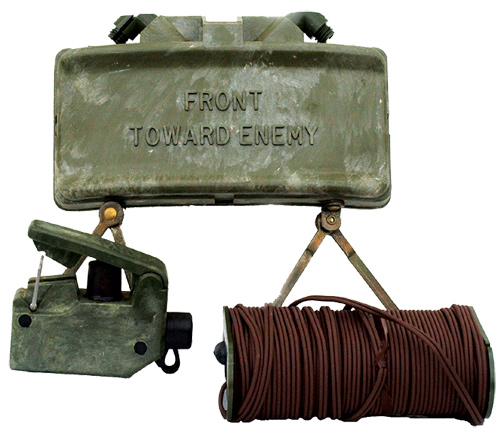
The M18A1 Claymore mine has a horizontally convex gray-green plastic case (inert training versions are light blue or green with a light blue band). The shape was developed through experimentation to deliver the optimum distribution of fragments at 160 ft (50 m) range. The case has the words "FRONT TOWARD ENEMY" embossed on the front of the mine.[4] A simple open sight on the top surface allows for aiming the mine. Two pairs of scissor legs attached to the bottom support the mine and allow it to be aimed vertically. On both sides of the sight are fuse wells set at 45°.

Internally the mine contains a layer of C-4 explosive behind a matrix of about seven hundred 18-inch-diameter (3 mm) steel balls set into an epoxy resin.

When the M18A1 is detonated, the explosion drives the matrix forward, out of the mine at a velocity of 3,900 ft/s (1,200 m/s),[1] at the same time breaking it into individual fragments. The steel balls are projected in a 60° fan-shaped pattern 7 feet (2 m) high and 160 ft (50 m) wide at a range of 160 ft (50 m). The force of the explosion deforms the relatively soft steel balls into a shape similar to a .22 rimfire projectile.[1] These fragments are moderately effective up to a range of 330 ft (100 m), with a hit probability of around 10% on a prone man-sized 1.3-square-foot (0.12 m2) target. The fragments can travel up to 800 ft (250 m). The optimum effective range is 160 ft (50 m), at which the optimal balance is achieved between lethality and area coverage, with a hit probability of 30% on a man-sized target.[5]

The weapon and all its accessories are carried in an M7 bandolier ("Claymore bag"). The mine is detonated as the enemy personnel approaches the killing zone. Controlled detonation may be accomplished by use of either an electrical or non-electrical firing system. When mines are employed in the controlled role, they are treated as individual weapons and are reported in the unit fire plan. They are not reported as mines; however, the emplacing unit must ensure that the mines are removed, detonated, or turned over to a relieving unit. The 100-foot (30 m) M4 electric firing wire on a green plastic spool is provided in each bandolier. The M57 firing device (colloquially referred to as the "clacker") is included with each mine. An M40 circuit test set is packed in each case of six mines. When the mines are daisy-chained together, one firing device can detonate several mines.

The mine can be detonated by any mechanism that activates the blasting cap. There are field-expedient methods of detonating the mine by tripwire, or by a timer, but these are rarely used.

Development

[edit]

The development of the M18A1 mine dates back to work done during World War II. The Misnay–Schardin effect was independently discovered during that war by József Misnay, a Hungarian, and Hubert Schardin, a German. When a sheet of explosive detonates in contact with a heavy backing surface (for example, a metal plate), the resulting blast is primarily directed away from the surface in a single direction. Schardin spent some time developing the discovery as a side-attack anti-tank weapon, but development was incomplete at the end of the war. Schardin also spent time researching a "trench mine" that used a directional fragmentation effect.[1]

Norman MacLeod and Calord Corporation

[edit]
Images from the 1956 Macleod patent

Following the massed Chinese attacks during the Korean War, Canada and the United States began to develop projects to counter them. Canada fielded a weapon called the "Phoenix" landmine, which used the Misnay–Schardin effect to project a spray of 0.25-inch (6.4 mm) steel cubes towards the enemy. The cubes were embedded in 5 pounds (2.3 kg) of Composition B explosive. It was too large to be a practical infantry weapon and was relatively ineffective, with a maximum effective range of only 70 to 100 feet (20 to 30 m).[1]

Around 1952 Norman MacLeod, at his company the Calord Corporation, began working on a small directional mine for use by infantry. It is not clear if the United States Picatinny Arsenal took the concept from the Canadian weapon and asked Norman MacLeod to develop it, or if he developed the design independently and presented it to them. MacLeod designed a weapon called the T-48; broadly similar to the final M18A1, it lacked a number of the design details that made the M18A1 effective.

Through Picatinny, the United States Army accepted the weapon into service as the M18 Claymore and approximately 10,000 were produced. It was used in small numbers in Vietnam from around 1961. It was not until the improved M18A1 was developed that the Claymore became a widely used weapon.

The M18 was 9.25 inches (235 mm) long and 3.27 inches (83 mm) high, held in a plastic case with three folding spike legs on the bottom. An electrical blasting cap for triggering the mine was inserted through a small hole in the side. Internally the mine consisted of a layer of 12 ounces (340 g) of C-3 explosive (the forerunner of C-4 explosive) in front of which was laid an array of 0.25-inch (6.4 mm) steel cubes. In total the mine weighed about 2.43 pounds (1.10 kg), and could be fitted with an optional peep sight for aiming.[6] It lacked the later version's iconic "FRONT TOWARD ENEMY" marking. The mine was planted in the ground, using its three sharp legs, and aimed in the direction of enemy approach; at that point, it was fitted with an electrical blasting cap. The mine was triggered from a safe position, preferably to the side and rear. The mine was barely more than a prototype and was not considered a "reliable casualty producer"; like the Phoenix it had an effective range of only 90 feet (30 m).[1]

MacLeod applied for a patent for the mine on 18 January 1956, and was granted it in February 1961.[7] The patent was later the subject of a civil court case between MacLeod, the Army, and Aerojet, which further developed the Claymore design. MacLeod's case collapsed when photographs of the German Trenchmine prototype were produced as evidence of prior art.[1]

Throner, Kennedy, Bledsoe, and Kincheloe at Aerojet

[edit]
The original M18 Claymore mine. The detonator is inserted into the side.

In 1954 Picatinny Arsenal issued a request for proposals (RFP) to improve the M18 as a more effective weapon. At Aerojet in the early 1950s, Guy C. Throner had independently come up with a design for a Claymore-like mine. He worked with Don Kennedy and the two men submitted a 30-page proposal in response to Picatinny's RFP. They were awarded a $375,000 development contract to improve the Claymore design. The Picatinny criteria for the weapon were as follows:

  • It must weigh less than 3.5 pounds (1.6 kilograms)
  • It must throw enough fragments so that at a range of 55 yards (50 m) it achieves a 100 percent strike rate on a 1.3-square-foot (0.12 m2) target (man-sized)
  • The fragment area must not be more than 8 feet (2.4 m) high and no more than 60° wide
  • Fragments must have a velocity of 4,000 feet per second (1,200 m/s) providing 58 foot-pounds (79 joules) of kinetic energy delivered to the target.

The requirement for kinetic energy was based on the fact that 58-foot-pounds is required to deliver a potentially lethal injury.[8] Given the requirements of weight and fragment density, approximately 700 fragments were needed, with the ability to aim the mine with an accuracy of around 2 feet (0.6 m) at the center of the target zone. The team at Aerojet were given access to all previous research into directional mines, including the M18 and the Phoenix, as well as German research. Dr. John Bledsoe led the initial project.[1]

The original M18 mine fell far short of Picatinny's requirements. One of the first improvements was to replace the steel cubes with 732-inch (5.6 mm) hardened 52100 alloy ball bearings. These performed poorly for two reasons. Firstly, the hardened steel balls spalled into fragments when hit by the shock of the explosion; the fragments were neither aerodynamic enough nor large enough to perform effectively. Secondly, the blast "leaked" between the balls, reducing their velocity.[1]

A second problem was the curvature of the mine. This was determined experimentally by Bledsoe, through a large number of test firings. After Bledsoe left the project to work at the Rheem corporation, William Kincheloe, another engineer, came onto the Claymore project.[1]

Kincheloe immediately suggested using softer 18-inch (3.2 mm) steel "gingle" balls, which were used in the foundry process. They did not spall from the shock of the explosive, but deformed into a useful aerodynamic shape similar to a .22 rimfire projectile. Using a homemade chronograph, the engineers clocked the balls at 3,775 feet per second (1,151 m/s). The second change was to use a poured plastic matrix to briefly contain the blast from the explosive, so that more of the blast energy was converted into projectile velocity. After a number of experiments, the engineers settled on Devcon-S steel-filled epoxy to hold the balls in place. With this change, the velocity improved to 3,995 feet per second (1,218 m/s).[1]

Technical challenges to overcome included developing a case to contain the corrosive C-3 explosive that would be durable enough to withstand months of field handling in wide temperature ranges. Using dyes to test various plastics for leaks, they found a suitable plastic called Durex 1661½, which could be easily molded into a case.[1]

A US Marine places a Claymore mine.

By the spring of 1956, Aerojet had a near-final design. It was awarded a pre-production contract for 1,000 M18A1 Claymores, designated T-48E1 during testing. The initial versions of the mine used two pairs of wire legs produced from number 9 (3 mm) wire. Later when production was ramped up, the design was changed to flat steel scissor, folding-type legs.[1]

Early pre-production mines were triggered using a battery pack, which had been used with the M18. This was found to be undesirable for a number of reasons. Bill Kincheloe came up with the idea of using a "Tiny Tim" toggle generator, of the type used with a number of Navy rockets.[1] Originally an aluminum box was used to hold the generator. Later a Philadelphia company, Molded Plastic Insulation Company, took over the manufacture of the firing device for the first large-scale production run producing a plastic device.[1]

The sighting for the device was originally intended to be a cheap pentaprism device, which would allow the user to look down from above and see the sight picture. After locating a suitably low-cost device, the engineers found that fumes from either the C-3 explosive or the cement used to glue the sight to the top of the mine corroded the plastic mirrors, rendering them unusable. They adopted simple peep sights, which were later replaced by a knife blade sight.

Testing concluded that the mine was effective out to approximately 110 yards (100 m), being capable of hitting 10% of the attacking force. At 55 yards (50 m), this increased to 30%. The development project completed, the Aerojet team sent the project back to Picatinny. The Arsenal bid it out to various component suppliers. In 1960 it was type standardized as the M18A1. It was first used in Vietnam in the spring or early summer 1966.[1]

Minor modifications were made to the mine during its service. A layer of tinfoil was added between the fragmentation matrix and the explosive. This slightly improves the fragment velocity, and protects the steel fragments from the corrosive explosive. A ferrite choke was added to prevent RF signals and lightning from triggering the mine.[1]

Variants

[edit]

M68 inert training kit

[edit]

The M68 kit is designed to familiarize personnel with the placement and arming of a real M18 directional mine. It comes with all the components of a real Claymore kit packed in an M7 bandolier. The light blue or black plastic M33 inert anti-personnel mine is the training and practice version of the M18A1 Claymore. Some inert mines were green with a light blue band. It does not contain an explosive or pyrotechnic filler of any kind. It is packed in a Claymore bag with inert M10 simulated detonator cap wire, an M57 "clacker" firing control, and an M40 circuit test kit.

Mini-Multi-Purpose Infantry Munition

[edit]

In early 2015, the U.S. Army began testing a smaller version of the Claymore called the Mini-Multi-Purpose Infantry Munition (M-MPIMS). It weighs 2 pounds (0.9 kg) and has a 160 ft (50 m) effective range, similar to the full-size Claymore. At its optimized range of 100 ft (30 m), the fragmentation zone is 75 ft (23 m) wide and 7 ft (2 m) high, with a minimum of five hits per square meter (0.5 per square foot). It has the surface space of an average smartphone and includes a Picatinny rail for camera, laser, or other attachments. The M-MPIMS is designed to be more controllable than the Claymore with less collateral damage, using an insensitive munitions explosive that is poured rather than packed for more uniform distribution results in more consistent blast pattern. Rear-safety distance has been decreased to 50 ft (15 m) and shelf life has been increased to 25 years.[9]

International directional fragmentation AP mines

[edit]

PADMINE is an anti-personnel directional fragmentation mine produced by the United Kingdom, similar to the Claymore in cosmetic design with two swivelling legs, inserted into soft-ground. Its lethality out to 160 feet (50 m) arrives in the form of 650 steel balls and it is activated by remote control or trip wire.

The M18 directional fragmentation anti-personnel mine, developed by Cardoen of Chile, contains 626 grams of explosives, surrounded by 607 anti-personnel fragmentation units providing a 60° arc of fire, with a 160-to-820-foot (50 to 250 m) lethal range.

Italy produces the DAF M6 and DAF M7 directional fragmentation mines, weighing 40 and 22 pounds (18 and 10 kg) respectively, with trip wire or remote control detonation. Their appearance is similar to the Claymore mine.[10][better source needed]

National copies

[edit]

A number of licensed and unlicensed copies of the mine have been produced.

See also

[edit]

References

[edit]
[edit]
Revisions and contributorsEdit on WikipediaRead on Wikipedia
from Grokipedia
The M18 Claymore mine is a directional anti-personnel fragmentation mine designed to deliver a fan-shaped pattern of steel ball bearings over a targeted area, primarily for defensive or ambush operations against infantry. Developed in the United States during the 1950s, it features a curved, rectangular plastic body approximately 8.5 inches long, 1.375 inches wide, and 3.25 inches high, weighing about 3.5 pounds, and contains 1.5 pounds of C-4 explosive packed with 700 steel spheres. It is command-detonated via an electrical firing device such as the M57 "clacker," producing a 60-degree arc of fragments lethal up to 50 meters and causing casualties out to 100 meters. Invented by Norman MacLeod and patented in 1956, the Claymore drew inspiration from German directional anti-tank mines and the Canadian "Phoenix" mine tested during the , evolving through U.S. Army prototypes at into the standardized M18A1 in 1960. The design emphasized a fixed, forward-facing blast to minimize risk to friendly forces, with foldable legs for staking into the ground and an integrated peep sight for aiming at a 2-meter height over a 50-meter range. First deployed in limited numbers during the early around 1961, it gained widespread notoriety for its effectiveness in perimeter defense, ambushes, and disrupting enemy trails, often earning the nickname "clacker" from its detonator. The mine's components include the main explosive body, firing device, 100-foot electrical wire spool, and a test clip for verification, allowing emplacement singly or in arrays for enhanced coverage. Under international law, such as Amended Protocol II of the Convention on Certain Conventional Weapons, it is unrestricted when command-detonated but subject to safeguards like monitoring and removal within 72 hours if used with tripwires. Still in active service with the U.S. military and allies as of 2025, the M18A1 remains a staple for light infantry units due to its portability, low cost, and psychological impact on adversaries.

Design and Operation

Physical Characteristics

The M18A1 Claymore mine has a curved rectangular plastic body constructed from fiberglass-filled , which minimizes detectability by metal detectors and weighs approximately 3.5 pounds (1.6 kg) in its complete assembly. The device is painted in an olive drab color with markings for identification and is typically 8.5 inches (216 mm) long, 1.375 inches (35 mm) wide (thickness), 3.25 inches (83 mm) high with legs folded, and approximately 6.75 inches (171 mm) high with legs extended; the front face measures 8.5 inches (216 mm) wide by 3.25 inches (83 mm) high. Prominently displayed on the convex front face is the marking "FRONT TOWARD ENEMY," accompanied by directional arrows to ensure proper orientation during emplacement. The mine's lethality derives from its fragmentation payload of 700 spherical balls, each 3.2 mm (1/8 inch) in diameter, embedded in an epoxy resin matrix across the front face. Upon detonation, these balls are propelled forward in a controlled fan-shaped spanning a 60-degree horizontal arc and covering a of 2 , achieving a maximum of about 2 . This configuration yields an effective casualty radius of 50 meters (160 feet), with fragments remaining lethal up to 100 meters in open terrain, though fragments can travel as far as 250 meters under optimal conditions.

Components and Firing Mechanism

The M18A1 Claymore mine consists of a fiberglass-filled polystyrene body housing approximately 700 steel ball bearings embedded in an epoxy resin matrix on the front face, backed by a 1.5-pound (0.68 kg) slab of Composition C-4 plastic explosive. The mine features two detonator wells on the top surface, designed to accept either an electric blasting cap, such as the M4 assembly, or a nonelectric shock tube initiator. Accompanying components include two 16-gauge copper firing wires spooled to 100 feet (30 meters) for electrical initiation, connected to the M57 firing device, which serves as a battery-powered pulse generator. The device attaches via alligator clips to the firing wires and includes a safety bail switch toggleable between SAFE and FIRE positions. For emplacement, the mine has two pairs of folding scissor-type legs that provide stability when secured with included leg wires or stakes. Aiming is facilitated by an integrated plastic peep sight, either slit-type or knife-edge and positioned above the detonator wells for precise alignment at a standard 50-meter range; the slit-type sight is aimed at a height of 2.5 meters, while the knife-edge type is aimed at ground level. The firing mechanism operates through command detonation, primarily electrical but with a nonelectric alternative, ensuring controlled initiation from a remote position. In the electrical mode, the M57 device delivers a 4.2-volt pulse through the 16-gauge firing wires to the M4 blasting cap inserted into one detonator well, igniting the C-4 explosive. The nonelectric option employs a 100-foot shock tube connected to an M81 pull-type igniter, which transmits a deflagration signal to a nonelectric blasting cap in the detonator well. Upon detonation, the C-4 charge creates a high-velocity pressure wave that shears the steel balls from the matrix, propelling them forward in a 60-degree horizontal fan-shaped pattern covering a height of 2 meters over an effective casualty radius of 50 meters. The second detonator well remains available for backup or daisy-chaining multiple mines, though single-well initiation suffices for standard operation. The operational sequence begins with site selection and mine emplacement: the device is positioned with its front facing the target area, legs unfolded and inserted into the ground for a 2-foot height, and the peep sight used to align the mine at waist level (approximately 2.5 meters above ground at 50 meters). A short length of firing wire or (about 1 meter) is unwound and secured to a stake near the mine to prevent movement, followed by insertion of the blasting cap or into the detonator well after removing the shipping plug priming adapter. For electrical setups, an M40 test clip is connected to verify circuit continuity with a 3-volt battery or meter, ensuring resistance below 4 ohms. The remaining wire is then extended to a covered firing position at least 16 meters behind or to the side of the mine, where the operator connects the M57 device, sets it to FIRE, and squeezes the handle to initiate detonation—or pulls the igniter ring for nonelectric firing. Safety features emphasize manual arming and remote command to minimize accidental discharge, with the shipping plug priming adapter sealing the wells during transport and storage to prevent premature insertion of initiators. The M57 firing device incorporates a shorting plug for protection when not in use and requires deliberate movement to the position before activation. Unlike some modern mines, the standard M18A1 lacks built-in anti-handling or anti-tamper devices, relying instead on emplacement and operator vigilance for . The 100-foot wire length establishes the maximum effective command range, with operators required to maintain a minimum safe distance of 16 meters from the rear and sides to avoid backblast hazards.

Development and History

Invention and Early Prototypes

The conceptual foundations of the Claymore mine emerged from advancements in directional explosives, particularly the Misznay-Schardin effect, independently discovered by Hungarian engineer József Misznay and German physicist Hubert Schardin while developing more effective anti-tank mines for . This effect utilizes a rigid backing to propel fragments forward in a focused pattern, minimizing backward dispersion, and was incorporated into German and Hungarian directional fragmentation devices deployed late in the war. The post-Korean War era heightened the U.S. military's demand for portable anti-personnel weapons to defend against massed charges, drawing lessons from human-wave tactics observed in Pacific island campaigns and the . In response, American inventor Norman A. , working at the Explosive Research Corporation, initiated development of a lightweight directional mine around 1952. 's design evolved through prototypes known as the T-48, featuring iterations with varying cube or ball counts—ranging from hundreds to over a thousand—and different like or C-3, aimed at achieving consistent fragmentation over a 50-meter kill radius. His efforts culminated in a filed on January 18, 1956, for an "anti-personnel fragmentation weapon" (U.S. 2,972,949, issued February 28, 1961), describing a convex plastic casing embedded with fragments and a command-detonated to direct lethality forward while reducing . Early testing of MacLeod's 1956 model and subsequent T-48 variants began at in , revealing key challenges including inconsistent fragment dispersion due to gas leakage around projectiles, aiming inaccuracies from rudimentary sights, and unreliable battery-powered detonators that failed under field conditions. The U.S. Army expressed formal interest in the concept by 1958, prompting procurement of approximately 10,000 units for evaluation, though production was limited pending improvements. From 1957 to 1958, a team of engineers at General Corporation—Guy C. Throner, , John Bledsoe, and William Kincheloe—refined the prototypes over about a year, optimizing fragment packing for better velocity and pattern control, enhancing the aiming scissor-leg assembly, and stabilizing the firing circuit to meet portability requirements under 3.5 pounds. These efforts addressed fragmentation consistency by shifting to uniform 1/8-inch spheres and resolved aiming issues through integrated elevation and markers, laying the groundwork for operational viability.

Standardization and Military Adoption

The M18 antipersonnel mine, an early prototype of the directional fragmentation , was type classified by the U.S. Army in the late , with formal standardization occurring in fiscal year 1959. This model featured optional peep sights for aiming and utilized Composition C-3 explosive, but it was soon superseded by the improved M18A1 variant. The M18A1 was standardized in 1960 as the official replacement, incorporating enhancements such as Composition C-4 explosive for greater reliability and a shift from the peep sight to a fixed plastic slit-type or knife-edge (blade) sight for more precise directional aiming. These modifications addressed aiming inaccuracies identified in earlier testing, including issues with and effective height adjustments at various ranges. The design evolution was partly influenced by observations of human-wave tactics and Soviet-supplied directional mines encountered during the , which highlighted the need for a command-detonated capable of countering massed assaults. Production of the Claymore mine was assigned to General Corporation, which had been involved in its development since the late through the Misznay-Schardin effect-based prototypes. By 1965, over 10,000 units of the M18 and early M18A1 had been manufactured, marking significant scaling for military stockpiles. The U.S. Army formally adopted the M18A1 Claymore in 1961, integrating it into infantry doctrine as a versatile, command-detonated defensive tool for perimeter security and ambushes. This adoption followed type classification in 1960 and included procurement for training and deployment preparations. The mine's emphasis on operator control via electric blasting caps and firing wires distinguished it from indiscriminate anti-personnel devices, aligning with evolving tactical needs for controlled fragmentation effects.

Variants

Training and Inert Models

The M68 Inert Training Kit for the Claymore mine was introduced during the to support safe instruction on the weapon system without risk of accidental detonation. This kit features an inert body, typically constructed from light blue or black plastic to externally replicate the M18A1 , weighing approximately 3.5 pounds while containing no explosives or pyrotechnic fillers. It includes dummy components such as simulated M10 blasting caps, priming adapters, and non-functional wiring to mimic the full assembly. Primarily utilized for personnel familiarization, the M68 kit enables hands-on practice in mine placement, aiming via the integrated sight, and procedures for arming and disarming, all within controlled training environments. Issued as complete sets with simulated firing wire reels, functional M57 electrical firing devices (for click simulation), M40 test sets, and storage bandoleers or bags, it emphasizes safety protocols and tactical employment without live hazards. Beyond the M68, simpler inert models such as wooden or basic plastic mock-ups serve for introductory drills, allowing soldiers to rehearse basic handling and positioning without any resemblance to operational components. These lack fragmentation simulation or wiring, focusing solely on conceptual layout in group exercises. As of 2025, the M68 and similar inert trainers remain standard in U.S. Army safety training programs, including force-on-force scenarios with synthetic variants. A key limitation of these training models is their inability to replicate the blast, fragmentation, or acoustic effects of a live , necessitating supplementary live-fire exercises for full proficiency assessment.

Modern and Specialized Derivatives

In the , the U.S. Army developed the Mini-Multi-Purpose Munition (Mini-MPIMS) as a compact derivative of the M18A1 , designed specifically for and scalable for broader ground forces use. Weighing approximately 2 pounds, the Mini-MPIMS employs 315 spherical steel fragments propelled at a of 2,300 meters per second, achieving an of 50 meters with an optimized impact zone at 30 meters. It was tested during live-fire events, including trials at Fort Benning in 2015, and fielded that year for enhanced versatility in urban and close-quarters combat, where it can be oriented sideways for narrower coverage or combined with multiple units to expand the fragmentation pattern. By 2025, the U.S. Army integrated Claymore mines with unmanned systems, conducting tests of first-person view (FPV) drones armed with the munition for both anti-personnel and counter-drone roles. In August 2025, the demonstrated this capability at Fort Rucker, using a SkyRaider to approach and detonate a Claymore mine mid-air against a , achieving the service's first air-to-air kill via shrapnel dispersal from an airburst. These experiments highlight the mine's adaptation for low-end uncrewed aerial threat defense and ground target engagement, leveraging remote piloting for precise delivery in dynamic environments. Production of the standard M18A1 Claymore continues into 2025 under U.S. contracts, supporting ongoing operational needs. These derivatives emphasize miniaturization and integration to address contemporary and drone proliferation challenges while maintaining the original's directional fragmentation principle.

International Versions

Licensed and Allied Productions

Several U.S. allies have produced or adopted licensed versions of the Claymore mine under agreements, ensuring compatibility with standards for defensive operations. developed the C19 Defensive and Support Mine as a direct licensed copy of the M18A1, featuring a similar curved plastic body packed with approximately 700 steel balls of 3.2 diameter, propelled by to an effective range of 50 meters lethal and up to 100 meters fragmentation at 1,200 m/s . The C19, renamed the Defensive Command Detonated Weapon to comply with the 1997 Mine Ban Treaty, remains in service with Canadian forces for command-detonated use in ambushes and perimeter defense. The employs the M18A1 Claymore mine, integrated into British for anti-infiltration roles, while retaining the standard Composition C-4 explosive and 700 steel ball fragmentation pattern and 50-meter effective radius. British forces have produced or assembled these under U.S. licensing arrangements, with thousands in by the 1980s, and the mine continues in limited service as of 2025 for command-detonated applications in defensive scenarios. standardization agreements, such as those outlined in STANAGs for mine operations, facilitated this technology sharing among allies to enhance in joint exercises and deployments.) Other allies, including and , utilize the M18A1 under similar U.S. technology transfer protocols, incorporating it into their defensive tactics without significant domestic production variations. fields the M18A1 directly for anti-personnel roles, aligning with allied equipment standards, while maintains stockpiles of the mine, reported as retained for command-detonated employment as late as 2012 and compliant with obligations into 2025. These licensed adoptions emphasize the mine's role in shaping battlefield perimeters across allied forces, with production focused on ensuring reliable fragmentation over a consistent 50-meter kill radius.

Independent Copies and Equivalents

The , developed by the in the mid-1960s as an independent directional , features a body containing approximately 700 grams of explosive and is designed to project fragments over a lethal range of 50 meters in a 54-degree arc. It incorporates embedded fragments or ball bearings and uses adjustable scissor legs for variable aiming angles, allowing deployment on uneven terrain or tilted surfaces for enhanced targeting flexibility. The mine's design diverges from earlier concepts by emphasizing portability and command detonation via electrical or non-electrical fuzes, and it saw extensive use by Soviet forces in during the , where it was employed in ambushes and defensive positions. A related Soviet design, the introduced in the late , expands on this concept with a larger sheet-metal body holding about 2 kilograms of explosive to propel roughly 400 cylindrical rod fragments (10 in ) over a 100-meter lethal range, achieving a fragmentation spread of up to 9.5 meters at maximum distance. Like the , it supports tiltable mounting for precise orientation and can accommodate various fuzing options, including variants, though its primary mode remains command-initiated. These MON-series mines have proliferated through exports to over 20 non-NATO countries, including those in , Africa, and the , with ongoing production in as of 2025 for military stockpiles and allied supplies. The Serbian , engineered in the former during the 1970s as a non-licensed equivalent, employs a convex plastic casing with 900 grams of (PETN or RDX-based) to launch 650 ball bearings (5.5 mm ) in a 60-degree arc, effective to 40-50 meters. Its scissor legs enable adjustable for varied aiming, and the waterproof body supports deployment in diverse environments, distinguishing it through greater fragment density compared to some contemporaries. Production continues in for domestic forces and export to non-NATO states. France's F1, adopted in the late , represents another independent adaptation with a body packing 500 ball bearings and an undisclosed quantity of high , primarily command-detonated. The design prioritizes surface emplacement with folding supports for aiming adjustments, and while not mass-exported, it remains in production for French forces and has influenced equivalents in select non-NATO partners. China's Type 66, developed in the , serves as a directional with a plastic body containing 600 ball bearings embedded in , supported by scissor legs for tiltable positioning and a lethal radius of approximately 50 meters. This design incorporates mechanical or electrical fuzing options, some with anti-materiel potential against light vehicles, and continues to be manufactured for use and export to non-NATO nations in and Africa as of 2025. Finland has developed the Viuhkapanos (fan charge) series of command-detonated directional fragmentation charges as independent equivalents to the Claymore mine. These are used by the Finnish Defence Forces for defending positions and ambushes. The modern Viuhkapanos VP 2010 has a total weight of 2.5 kg, containing 1.4 kg of explosive, and projects over 920 metal projectiles (each weighing 0.5 g) in a 60-degree arc. The heavier Viuhkapanos VP 84 weighs 18.8 kg with 11.5 kg of explosive, producing a 35-degree shrapnel sector effective to approximately 150 meters, primarily against unarmored and lightly armored vehicles or helicopters. The VP 88 serves as the base light model in the series. These independent designs highlight adaptations such as enhanced aiming versatility in the MON series and integration in the MAPED F1, while broader proliferation underscores their role in non-NATO arsenals, with equivalents documented in more than 20 countries by 2025 through reverse-engineering and local production.

Operational History

Vietnam War Deployment

The M18 Claymore mine saw its initial combat deployment in in the early 1960s, with approximately 10,000 units of the original M18 variant manufactured and some sent to U.S. forces in starting around 1960. By the mid-1960s, particularly following its standardization as the M18A1 in 1960 with minor refinements for reliability, the mine became widely employed by U.S. troops, including and Marine units, for defensive and offensive operations against and North Vietnamese Army forces. Millions of Claymore mines were produced during the conflict, marking a shift from earlier anti-personnel mines by emphasizing directed fragmentation over indiscriminate blasts. U.S. forces integrated the into tactics along trails and base perimeters, positioning the mine's concave face—marked with "FRONT TOWARD " to avoid misfires—toward likely enemy approach routes. It was often command-detonated via the M57 firing device (clacker) for precise control during ambushes, or paired with tripwires for automated activation, creating kill zones that funneled NVA and VC patrols into lethal 60-degree arcs of 700 steel balls. Marine Corps units innovated by daisy-chaining multiple mines, linking their detonators to a single clacker for expanded coverage, as seen in defensive setups during patrols and night operations. However, the humid environment posed logistical challenges, with moisture occasionally shorting the clacker's batteries and requiring frequent checks to maintain reliability. The Claymore proved highly effective against NVA and VC patrols, inflicting heavy casualties—estimated in the thousands across ambushes and perimeter defenses—by shredding exposed infantry in open formations before they could close on U.S. positions. During the in January 1968, it played a critical role in repelling assaults, such as at the U.S. Embassy in Saigon where Claymores helped secure the grounds against sappers, and at outposts like Lang Vei where used them to counter NVA human-wave attacks. Compared to bounding mines like the , which caused significant friendly casualties through unpredictable jumps and fragments, the Claymore's directional design and command detonation reduced U.S. losses, with post-war assessments from military reviews praising its versatility in both static defenses and mobile ambushes.

Post-Vietnam and Cold War Use

Following the , the maintained its of M18A1 mines and continued their deployment in defensive roles during the era, including integration into perimeter defenses for forward operating bases. By the early 1990s, the U.S. had produced approximately 7.8 million mines since 1960, forming a significant portion of its 10.4 million , which underwent routine maintenance to ensure operational readiness in various environments. These mines proved reliable in diverse climatic conditions, from arid deserts to temperate zones, with minor durability enhancements to casings and explosives implemented during refurbishments to address wear from storage. In the 1991 , U.S. forces employed mines as part of layered defensive perimeters to protect against infantry assaults and infiltration attempts, contributing to the overall use of 117,634 antipersonnel mines by coalition forces. Drawing on Vietnam-era lessons of tactics, their placement evolved to incorporate tripwires and manual command detonation for controlled engagements, enhancing counter-insurgency elements within broader conventional operations. Exports of mines to allied nations during the , totaling deliveries from 1969 to 1992, were governed by U.S. arms transfer policies that restricted proliferation while supporting interoperability, though later arms control discussions in the 1990s began influencing tighter regulations. The Soviet Union utilized analogous MON-series directional mines, such as the MON-50 and MON-100, extensively during the Soviet-Afghan War (1979–1989) for ambushes and area denial against mujahideen forces. These mines, functionally similar to the Claymore in their curved fragmentation design and command-detonation capability, were deployed in operations like the 1981 Musa-Kala ambush, where 20 MON mines killed 26 fighters and captured 20 others, and a 1984 Helmand Province engagement that destroyed three trucks and eliminated 44 mujahideen. Tactics often involved manual placement or scatterable delivery via artillery to block guerrilla movements in valleys and mountain passes, reflecting a doctrinal emphasis on counter-insurgency through defensive barriers. During the 1990s peacekeeping missions in Bosnia-Herzegovina, forces, including U.S. troops under (IFOR) and Stabilization Force (SFOR), incorporated Claymore mines into base defenses amid widespread mine contamination from the . Their use focused on protecting convoys and outposts from potential sabotage, with command-detonated configurations adhering to emerging international norms that permitted such devices while prohibiting victim-activated variants. Accidental detonations from mishandling during emplacement or maintenance posed risks in these operations, underscoring the need for rigorous training to mitigate non-combat incidents. By 2000, global production of and equivalent directional mines exceeded several million units, driven by U.S. manufacturing and licensed variants for allies, solidifying their role in military doctrines as versatile tools for and tactical denial.

Contemporary Conflicts and Adaptations

In the and wars (2001–2021), U.S. forces frequently deployed the M18A1 in urban ambushes and perimeter defenses around forward operating bases, leveraging its directional fragmentation to counter insurgent assaults. The system's effectiveness in these environments was enhanced by innovations like the remote detonation setup, which allowed operators to trigger Claymores via radio signals from computers several kilometers away, reducing exposure to enemy fire. Since Russia's full-scale of in 2022, directional anti-personnel mines have played a key role in the conflict, with Russian forces employing the —a lightweight Soviet-designed equivalent to the —for defensive emplacements, booby traps, and anti-infantry barriers along frontlines. Ukrainian sappers have encountered these and other mines while clearing recently liberated areas, facing intense risks from shelling and hidden devices during operations in regions like in 2023. In adaptation, Ukrainian units have mounted shrapnel-packed warheads resembling payloads on FPV drones, enabling "flying " strikes that detonate mid-air to deliver a 60-degree of fragments effective up to 50 yards against exposed infantry; 2024 footage from groups like the shows these munitions neutralizing Russian assault teams in open terrain. To bolster Ukraine's defenses against Russian dismounted , the U.S. reversed its policy in November 2024 and began transferring non-persistent antipersonnel landmines, which deactivate after a set period to minimize long-term hazards; these are restricted by Ukraine to unpopulated combat zones. Drawing lessons from Ukrainian , the U.S. Army tested Claymore-armed adaptations in August 2025 at Fort Rucker, , where a SkyRaider quadcopter FPV drone manually detonated a mine payload to achieve the first documented U.S. air-to-air drone kill, demonstrating potential for both counter-unmanned aerial system roles and precision ground strikes. The remains a staple in U.S. inventories, with 2024 assessments underscoring its utility for deterrence against peer threats, ongoing production by contractors like , and no decommissioning plans amid sustained demand. Exports face constraints from the 1997 Ottawa Convention, which prohibits anti-personnel mines for its 164 state parties (though the U.S. is a non-signatory), prompting reliance on policy exceptions for aid to allies like . Remote detonation variants, such as those using radio commands, are vulnerable to electronic countermeasures like signal jamming, necessitating hardened fuzing in modern deployments.

References

Add your contribution
Related Hubs
User Avatar
No comments yet.