


Community hub
Coma Berenices
View on Wikipedia
| Constellation | |
 | |
| Abbreviation | Com |
|---|---|
| Genitive | Comae Berenices |
| Pronunciation | /ˈkoʊmə ˌbɛrəˈnaɪsiːz/, genitive /ˈkoʊmiː/ |
| Symbolism | Berenice's hair |
| Right ascension | 11h 58m 25.0885s–13h 36m 06.9433s[1] |
| Declination | 33.3074303°–13.3040485°[1] |
| Area | 386 sq. deg. (42nd) |
| Main stars | 3 |
| Bayer/Flamsteed stars | 44 |
| Stars brighter than 3.00m | 0 |
| Stars within 10.00 pc (32.62 ly) | 1 |
| Brightest star | β Com (4.26m) |
| Nearest star | β Com[2]: 84 |
| Messier objects | 8 |
| Meteor showers | Coma Berenicids |
| Bordering constellations | Canes Venatici Ursa Major Leo Virgo Boötes |
| Visible at latitudes between +90° and −70°. Best visible at 21:00 (9 p.m.) during the month of May. | |
Coma Berenices is an ancient asterism in the northern sky, which has been defined as one of the 88 modern constellations. It is in the direction of the fourth galactic quadrant, between Leo and Boötes, and it is visible in both hemispheres. Its name means "Berenice's Hair" in Latin and refers to Queen Berenice II of Egypt, who sacrificed her long hair as a votive offering.[3] It was introduced to Western astronomy during the third century BC by Conon of Samos and was further corroborated as a constellation by Gerardus Mercator and Tycho Brahe. It is the only modern constellation named after a historic person.[a]
The constellation's major stars are Alpha, Beta, and Gamma Comae Berenices. They form a half square, along the diagonal of which run Berenice's imaginary tresses, formed by the Coma Star Cluster. The constellation's brightest star is Beta Comae Berenices, a 4.2-magnitude main sequence star similar to the Sun. Coma Berenices contains the North Galactic Pole and one of the richest-known galaxy clusters, the Coma Cluster, part of the Coma Supercluster. Galaxy Malin 1, in the constellation, is the first-known giant low-surface-brightness galaxy. Supernova SN 1940B was the first scientifically observed (underway) type II supernova. FK Comae Berenices is the prototype of an eponymous class of variable stars. The constellation is the radiant of one meteor shower, Coma Berenicids, which has one of the fastest meteor speeds, up to 65 kilometres per second (40 mi/s).
History
[edit]
Coma Berenices has been recognized as an asterism since the Hellenistic period[4] (or much earlier, according to some authors), and is the only modern constellation named for an historic figure.[5] It was introduced to Western astronomy during the third century BC by Conon of Samos, the court astronomer of Egyptian ruler Ptolemy III Euergetes, to honour Ptolemy's consort, Berenice II.[6] Berenice vowed to sacrifice her long hair as a votive offering if Ptolemy returned safely from battle during the Third Syrian War.[7] Modern scholars are uncertain if Berenice made the sacrifice before or after Ptolemy's return; it was suggested that it happened after Ptolemy's return (around March–June or May 245 BC), when Conon presented the asterism jointly with scholar and poet Callimachus during a public evening ceremony.[8] In Callimachus' poem, Aetia (composed around that time), Berenice dedicated her tresses "to all the gods". In Poem 66, the Latin translation by the Roman poet Catullus, and in Hyginus' De Astronomica, she dedicated her tresses to Aphrodite and placed them in the temple of Arsinoe II (identified after Berenice's death with Aphrodite) at Zephyrium. According to De astronomica, by the next morning the tresses had disappeared. Conon proposed that Aphrodite had placed the tresses in the sky as an acknowledgement of Berenice's sacrifice.[7] Callimachus called the asterism plokamos Berenikēs or bostrukhon Berenikēs in Greek, translated into Latin as "Coma Berenices" by Catullus. Hipparchus[9] and Geminus also recognized it as a distinct constellation.[10] Eratosthenes called it "Berenice's Hair" and "Ariadne's Hair", considering it part of the constellation Leo.[11] Similarly, Ptolemy did not include it among his 48 constellations in the Almagest;[9] considering it part of Leo[4] and calling it Plokamos.[12]

Coma Berenices became popular during the 16th century. In 1515, a set of gores by Johannes Schöner labelled the asterism Trica, "hair". In 1536 it appeared on a celestial globe by Caspar Vopel, who is credited with the asterism's designation as a constellation.[13] That year, it also appeared on a celestial map by Petrus Apianus as "Crines Berenices". In 1551, Coma Berenices appeared on a celestial globe by Gerardus Mercator with five Latin and Greek names: Cincinnus, caesaries, πλόκαμος, Berenicis crinis and Trica. Mercator's reputation as a cartographer ensured the constellation's inclusion on Dutch sky globes beginning in 1589.[14]
Tycho Brahe, also credited with Coma's designation as a constellation, included it in his 1602 star catalogue.[4] Brahe recorded fourteen stars in the constellation; Johannes Hevelius increased its number to twenty-one, and John Flamsteed to forty-three. Coma Berenices also appeared in Johann Bayer's 1603 Uranometria, and a few other 17th-century celestial maps followed suit. Coma Berenices and the now-obsolete Antinous are considered the first post-Ptolemaic constellations depicted on a celestial globe.[15] With Antinous, Coma Berenices exemplified a trend in astronomy in which globe- and map-makers continued to rely on the ancients for data. This trend ended at the turn of the 16th century with observations of the southern sky and the work of Tycho Brahe.[14]
Before the 18th century Coma Berenices was known in English by several names, including "Berenice's Bush" and "Berenice's periwig".[16] The earliest-known English name, "Berenices haire", dates to 1601.[16][17] By 1702 the constellation was known as Coma Berenices,[18] and appears as such in the 1731 Universal Etymological English Dictionary.
In non-Western astronomy
[edit]Coma Berenices was known to the Akkadians as Ḫegala.[19] In Babylonian astronomy a star, known as ḪÉ.GÁL-a-a (translated as "which is before it") or MÚL.ḪÉ.GÁL-a-a, is tentatively considered part of Coma Berenices.[20] It was also argued that Coma Berenices appears in Egyptian Ramesside star clocks as sb3w ꜥš3w, meaning "many stars".[21]
In Arabic astronomy Coma Berenices was known as Al-Dafira الضفيرة ("braid"), Al-Hulba الهلبة and Al-Thu'aba الذؤابة (both meaning "tuft"), the latter two are translations of the Ptolemaic Plokamos, forming the tuft of the constellation Leo[12] and including most of the Flamsteed-designated stars (particularly 12, 13, 14, 16, 17, 18 and 21 Comae Berenices).[22] Al-Sufi included it in Leo. Ulugh Beg, however, regarded Al-Dafira as consisting of two stars, 7 and 23 Comae Berenices.[23] R. H. Allen's Star Names gives the name Al Ḍafīrah to 15 = Gamma Comae Berenices.[16]
The North American Pawnee people depicted Coma Berenices as ten faint stars on a tanned elk-skin star map dated to at least the 17th century.[24] In the South American Kalina mythology, the constellation was known as ombatapo (face).[25]
The constellation was also recognized by several Polynesian peoples. The people of Tonga had four names for Coma Berenices: Fatana-lua, Fata-olunga, Fata-lalo and Kapakau-o-Tafahi.[26] The Boorong people called the constellation Tourt-chinboiong-gherra, and saw it as a small flock of birds drinking rainwater from a puddle in the crotch of a tree.[27] The people of the Pukapuka atoll may have called it Te Yiku-o-te-kiole, although sometimes this name is associated with Ursa Major.[28]
Characteristics
[edit]Coma Berenices is bordered by Boötes to the east, Canes Venatici to the north, Leo to the west and Virgo to the south. Covering 386.5 square degrees and 0.937% of the night sky, it ranks 42nd of the 88 constellations by area.[29] The three-letter abbreviation for the constellation, as adopted by the International Astronomical Union in 1922, is "Com".[30] The official constellation boundaries, as set by Belgian astronomer Eugène Delporte in 1930,[b] are defined by a polygon of 12 segments (illustrated in infobox). In the equatorial coordinate system, the right ascension coordinates of these borders lie between 11h 58m 25.09s and 13h 36m 06.94s, and the declination coordinates are between +13.30° and +33.31°.[1] Coma Berenices is wholly visible to observers north of latitude 56°S.[c] and the constellation's midnight culmination occurs on 2 April.[32]
Features
[edit]
Although it is not large, Coma Berenices contains one galactic supercluster, two galactic clusters, one star cluster and eight Messier objects (including several globular clusters). These objects can be seen with minimal obscuration by dust because the constellation is not in the direction of the galactic plane. Because of that, there are few open clusters (except for the Coma Berenices Cluster, which dominates the northern part of the constellation), diffuse nebulae or planetary nebulae. Coma Berenices contains the North Galactic Pole at right ascension 12h 51m 25s and declination +27° 07′ 48″ (epoch J2000.0).
Stars
[edit]Brightest stars
[edit]
Coma Berenices is not particularly bright, as none of its stars are brighter than fourth magnitude,[33] although there are 66 stars brighter than or equal to apparent magnitude 6.5.[d][29]
The constellation's brightest star is Beta Comae Berenices (43 Comae Berenices in Flamsteed designation), at magnitude 4.2 and with a high proper motion. In Coma Berenices' northeastern region, it is 29.95 ± 0.10 light-years from Earth.[35] A solar analog, it is a yellow-hued F-type main-sequence star with a spectral class of F9.5V B.[36] Beta Comae Berenices is around 36% brighter,[37] and 15% more massive than the Sun,[38] and with a radius 10% larger.[37]
The second-brightest star in Coma Berenices is the 4.3-magnitude, bluish Alpha Comae Berenices (42 Comae Berenices), with the proper name Diadem,[39] in the southeastern part of the constellation. Despite its Alpha Bayer designation, the star is dimmer than Beta Comae Berenices, being one of the cases where designation does not correspond to the brightest star. It is a double star, with the spectral classes of F5V and F6V.[40] The star system is 58.1 ± 0.9 light-years from Earth.[41]
Gamma Comae Berenices (15 Comae Berenices) is an orange-hued giant star with a magnitude of 4.4 and a spectral class of K1III C. In the southwestern part of the constellation, it is 169 ± 2 light-years from Earth,[42] Estimated to be around 1.79 times as massive as the Sun,[43] it has expanded to around 10 times its radius.[44] It is the brightest star in the Coma Star Cluster.[45] With Alpha Comae Berenices and Beta Comae Berenices, Gamma Comae Berenices forms a 45-degree isosceles triangle from which Berenice's imaginary tresses hang.
Star systems
[edit]
The star systems of Coma Berenices include binary, double and triple stars. 21 Comae Berenices (sometimes called Kissin, but this name is shared with 23 Comae Berenices) is a close binary with nearly equal components and an orbital period of 26 years.[46] The system is 272 ± 3 light-years away.[47] The Coma Cluster contains at least eight spectroscopic binaries,[48] and the constellation has seven eclipsing binaries: CC, DD, EK, RW, RZ, SS and UX Comae Berenices.[49]
There are over thirty double stars in Coma Berenices,[50] including 24 Comae Berenices with contrasting colors. Its primary is an orange-hued giant star with a magnitude of 5.0, 610 light-years from Earth, and its secondary is a blue-white-hued star with a magnitude of 6.6. Triple stars include 12 Comae Berenices, 17 Comae Berenices, KR Comae Berenices and Struve 1639.[51][52]
Variable stars
[edit]Over 200 variable stars are known in Coma Berenices, although many are obscure.[53] Alpha Comae Berenices is a possible Algol variable.[54] FK Comae Berenices, which varies from magnitude 8.14 to 8.33 over a period of 2.4 days, is the prototype for the FK Comae Berenices class of variable stars[53] and the star in which the "flip-flop phenomenon" was discovered.[55] FS Comae Berenices is a semi-regular variable, a red giant with a period of about two months whose magnitude varies between 6.1 and 5.3. R Comae Berenices is a Mira variable with a maximum magnitude of almost 7.[56] There are 123 RR Lyrae variables in the constellation,[57] with many in the M53 cluster.[58] One of these stars, TU Comae Berenices, may have a binary system.[59] The M100 galaxy contains about twenty Cepheid variables, which were observed by the Hubble Space Telescope.[60] Coma Berenices also contains Alpha2 Canum Venaticorum variables, such as 13 Comae Berenices and AI Comae Berenices.[61]
In 2019 scientists at Aryabhatta Research Institute of Observational Sciences announced the discovery of 28 new variable stars in Coma Berenices' globular cluster NGC 4147.[62]
Supernovae
[edit]A number of supernovae have been discovered in Coma Berenices. Four (SN 1940B, SN 1969H, SN 1987E and SN 1999gs) were in the NGC 4725 galaxy,[63] and another four were discovered in the M99 galaxy (NGC 4254): SN 1967H, SN 1972Q, SN 1986I and SN 2014L.[63] Five were discovered in the M100 galaxy (NGC 4321): SN 1901B, SN 1914A, SN 1959E, SN 1979C and SN 2006X.[63] SN 1940B, discovered on 5 May 1940, was the first observed type II supernova.[64] SN 2005ap, discovered on 3 March 2005, is the second-brightest-known supernova to date with a peak absolute magnitude of about −22.7.[65] Due to its great distance from Earth (4.7 billion light-years), it was not visible to the naked eye and was discovered telescopically. SN 1979C, discovered in 1979, retained its original X-ray brightness for 25 years despite fading in visible light.[66]
Other stars
[edit]Coma Berenices also contains the neutron star RBS 1223 and the pulsar PSR B1237+25.[67] RBS 1223 is a member of the Magnificent Seven, a group of young neutron stars.[68] In 1975, the first extra-solar source of extreme ultraviolet, the white dwarf HZ 43, was discovered in Coma Berenices.[69] In 1995, there was a very rare outburst of the WZ Sagittae-type dwarf nova AL Comae Berenices.[70] A June 2003 outburst from GO Comae Berenices, an SU Ursae Majoris-type dwarf nova, was photometrically observed.[71]
Exoplanets
[edit]Coma Berenices has seven known exoplanets.[72] One, HD 108874 b, has Earth-like insolation.[73] WASP-56 is a sun-like star of spectral type G6 and apparent magnitude 11.48 with a planet 0.6 the mass of Jupiter that has a period of 4.6 days.[74]
Star clusters
[edit]Coma Star Cluster
[edit]The Coma Star Cluster represents Berenice's sacrificed tresses and as a naked eye object has been known since antiquity, appearing in Ptolemy's Almagest.[75] It doesn't have a Messier or NGC designation, but is in the Melotte catalogue of open clusters (designated Melotte 111) and is also catalogued as Collinder 256. It is a large, diffuse open cluster of about 50 stars ranging between magnitudes five and ten, including several of Coma Berenices' stars which are visible to the naked eye. The cluster is spread over a huge region (more than five degrees across) near Gamma Comae Berenices. It has such a large apparent size because it is relatively close, only 280 light-years or 86 parsecs away.[76][77]
Globular clusters
[edit]M53 (NGC 5024) is a globular cluster which was discovered independently by Johann Elert Bode in 1775 and Charles Messier in February 1777; William Herschel was the first to resolve it into stars.[58] The magnitude-7.7 cluster is 56,000 light-years from Earth. Only 1° away is NGC 5053, a globular cluster with a sparser nucleus of stars. Its total luminosity is the equivalent of about 16,000 suns, one of the lowest luminosities of any globular cluster. It was discovered by William Herschel in 1784. NGC 4147 is a somewhat dimmer globular cluster, with a much-smaller apparent size and an apparent magnitude of 10.7.[78]
Galaxies
[edit]Coma Supercluster
[edit]The Coma Supercluster, itself part of the Coma Filament, contains the Coma and Leo Cluster of galaxies. The Coma Cluster (Abell 1656) is 230 to 300 million light-years away. It is one of the largest-known clusters, with at least 10,000 galaxies (mainly elliptical, with a few spiral galaxies).[79] Due to its distance from Earth, most of the galaxies are visible only through large telescopes. Its brightest members are NGC 4874 and NGC 4889, both with a magnitude of 13; most others are magnitude 15 or dimmer. NGC 4889 is a giant elliptical galaxy with one of the largest-known black holes (21 billion solar masses),[80] and NGC 4921 is the cluster's brightest spiral galaxy.[81] After observing the Coma Cluster, astronomer Fritz Zwicky first postulated the existence of dark matter during the 1930s.[79] The massive galaxy Dragonfly 44 discovered in 2015 was found to consist almost entirely of dark matter.[82] Its mass is very similar to that of the Milky Way,[82] but it emits only 1% of the light emitted by the Milky Way.[83] NGC 4676, sometimes called the Mice Galaxies, is a pair of interacting galaxies 300 million light-years from Earth. Its progenitor galaxies were spiral, and astronomers estimate that they had their closest approach about 160 million years ago. That approach triggered large regions of star formation in both galaxies, with long "tails" of dust, stars and gas. The two progenitor galaxies are predicted to interact significantly at least one more time before they merge into a larger, probably-elliptical galaxy.[84]
Virgo Cluster
[edit]
Coma Berenices contains the northern portion of the Virgo Cluster (also known as the Coma–Virgo Cluster), about 60 million light-years away. The portion includes six Messier galaxies. M85 (NGC 4382), considered elliptical or lenticular, is one of the cluster's brighter members at magnitude nine. M85 is interacting with the spiral galaxy NGC 4394 and the elliptical galaxy MCG-3-32-38.[67] However, it is relatively isolated from the rest of the cluster.[86] M88 (NGC 4501) is a multi-arm spiral galaxy seen at about 30° from edge-on. It has a highly-regular shape with well-developed, symmetrical arms. Among the first galaxies recognized as spiral,[87] it has a supermassive black hole in its center.[67] M91 (NGC 4548), a barred spiral galaxy with a bright, diffuse nucleus, is the faintest object in Messier's catalog at magnitude 10.2.[88] M98 (NGC 4192), a bright, elongated spiral galaxy seen nearly edge-on, appears elliptical because of its unusual angle. The magnitude-10 galaxy has no redshift.[89] M99 (NGC 4254) is a spiral galaxy seen face-on. Like M98 it is of magnitude-10 and has an unusually long arm on its west side. Four supernovae have been observed in the galaxy.[90][91][92] M100 (NGC 4321), a magnitude-nine spiral galaxy seen face-on, is one of the cluster's brightest.[60] Photographs reveal a brilliant core, two prominent spiral arms, an array of secondary arms and several dust lanes.
Other galaxies
[edit]
M64 (NGC 4826) is known as the Black Eye Galaxy because of the prominent dark dust lane in front of the galaxy's bright nucleus. Also known as the Sleeping Beauty and Evil Eye galaxy,[93] it is about 17.3 million light-years away.[94] Recent studies indicate that the interstellar gas in the galaxy's outer regions rotates in the opposite direction from that in the inner regions, leading astronomers to believe that at least one satellite galaxy collided with it less than a billion years ago. All other evidence of the smaller galaxy has been assimilated. At the interface between the clockwise- and counterclockwise-rotating regions are many new nebulae and young stars.[84]
NGC 4314 is a face-on barred spiral galaxy at a distance of 40 million light-years. It is unique for its region of intense star formation, creating a ring around its nucleus which was discovered by the Hubble Space Telescope. The galaxy's prodigious star formation began five million years ago, in a region with a diameter of 1,000 light-years. The core's structure is also unique because the galaxy has spiral arms which feed gas into the bar.[84]
NGC 4414 is an unbarred spiral flocculent galaxy about 62 million light-years away. It is one of the closest flocculent spiral galaxies.[95]
NGC 4565 is an edge-on spiral galaxy which appears superimposed on the Virgo Cluster. NGC 4565 has been nicknamed the Needle Galaxy because when seen in full, it appears as a narrow streak of light.[96] Like many edge-on spiral galaxies, it has a prominent dust lane and a central bulge. NGC 4565 has at least two satellite galaxies, and one of them is interacting with it.[97]
NGC 4651, about the size of the Milky Way, has tidal stellar streams gravitationally stripped from a smaller, satellite galaxy.[98] It is about 62 million light-years away.[98] It is located on the outskirts of the cluster,[99] and is also known as the Umbrella Galaxy. Unlike the other spiral galaxies in the cluster, NGC 4651 is rich in neutral hydrogen, which also extends beyond the optical disk.[100] Its star formation is typical for a galaxy of its type.[99]
Spiral galaxy Malin 1 discovered in 1986 is the first-known giant low-surface-brightness galaxy.[101] With UGC 1382, it is also one of the largest low-surface-brightness galaxies.[101]
In 2006 a dwarf galaxy, also named Coma Berenices, was discovered in the constellation from data obtained by the Sloan Digital Sky Survey.[102] The galaxy is a faint satellite of the Milky Way. It is one of the faintest satellites of the Milky Way - its integrated luminosity is about 3700 times that of the Sun (absolute visible magnitude of about −4.1), which is lower than many globular clusters.[103] A high mass to light ratio may mean that the satellite has large amounts of dark matter.[104]
-

-
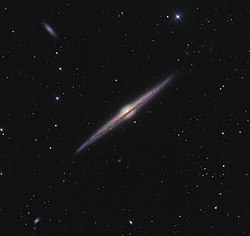 NGC 4565 (Needle Galaxy)
 -
 NGC 4651, with umbrella-shaped stellar streams
 -
 The constellation Coma Berenices hosts the galaxy NGC 4495 among myriad other astronomical objects.
 -
 The jellyfish galaxy JW39 hangs serenely in this image from the NASA/ESA Hubble Space Telescope. This galaxy lies over 900 million light-years away in the constellation Coma Berenices.


.jpg)
Quasars
[edit]HS 1216+5032 is a bright, gravitationally lensed pair of quasars.[106] W Comae Berenices (or ON 231), a blazar in the constellation's northwest, was originally designated a variable star and later found to be a BL Lacertae object.[107] As of 2009, it had the most intense gamma ray spectrum of the sixty known gamma-ray blazars.[107]
Gamma-ray bursts
[edit]Some gamma-ray bursts occurred in Coma Berenices, particularly GRB 050509B on 9 May 2005[108] and GRB 080607 on 7 June 2008.[109] GRB 050509B, which lasted only 0.03 second, became the first short burst with a detected afterglow.[108]
Meteor showers
[edit]The Coma Berenicids meteor shower peaks around 18 January.[53] Despite the shower's low intensity (averaging one or two meteors per hour) its meteors are some of the fastest, with speeds up to 65 kilometres per second (40 mi/s).[53]
In culture
[edit]
Since Callimachus' poem, Coma Berenices has been occasionally featured in culture. Alexander Pope alludes to the legend in the ending of The Rape of the Lock, in which the titular hair is placed among the stars. (The poem would go on to provide the names of some of the moons of Uranus.) In 1886, Spanish artist Luis Ricardo Falero created a mezzotint print personifying Coma Berenices alongside Virgo and Leo.[110] In 1892, the Russian poet Afanasy Fet made the constellation the subject of his short poem, composed for the Countess Natalya Sollogub.[111] The Swedish poet Gunnar Ekelöf wrote the lines "Your friend the comet combed his hair with the Leonids / Berenice let her hair hang down from the sky" in a 1933 poem.[112] American writer and folksinger Richard Fariña mentions Coma Berenices in his 1966 novel Been Down So Long It Looks Like Up To Me, sardonically writing about content typical to upper-level astronomy coursework at Cornell: "It's the advanced courses give you trouble. Relativity principles, spiral nebula in Coma Berenices, that kind of hassle". The Bolivian poet, Pedro Shimose, makes Coma Berenices the home address of his "Señorita NGC 4565" in his poem "Carta a una estrella que vive en otra constelación" ("Letter to a star who lives in another constellation"), included in his 1967 collection, "Sardonia".[113] "[114] The Irish poet W. B. Yeats, in his poem "Her Dream", refers to "Berenice's burning hair" being "nailed upon the night". Francisco Guerrero, a 20th-century Spanish composer, wrote an orchestral work on the constellation in 1996. In 1999 Irish artist Alice Maher made a series of four oversize drawings, entitled Coma Berenices, of entwining black hair coils.[115] The asterism also gives its name to a prose poem in Where Shall I Wander, a 2005 collection by the American writer John Ashbery.[116]
Notes
[edit]- ^ One other constellation's name is derived from a reference to a historical person: the constellation Scutum is a shortening of the former name Scutum Sobiescianum ("shield of Sobieski"), named after King John III Sobieski of Poland. It is called the equivalent of "Shield of Sobieski" in some other languages, such as French.
- ^ Delporte had proposed standardising the constellation boundaries to the International Astronomical Union, who had agreed and gave him the lead role[31]
- ^ While parts of the constellation technically rise above the horizon to observers between 56°S and 77°S, stars within a few degrees of the horizon are to all intents and purposes unobservable.[29]
- ^ Objects of magnitude 6.5 are among the faintest visible to the unaided eye in suburban–rural transition night skies.[34]
See also
[edit]References
[edit]- ^ a b c "Coma Berenices, constellation boundary". The Constellations. International Astronomical Union. Retrieved 27 February 2014.
- ^ Kirkpatrick, J. Davy; Marocco, Federico; et al. (April 2024). "The Initial Mass Function Based on the Full-sky 20 pc Census of ~3600 Stars and Brown Dwarfs". The Astrophysical Journal Supplement Series. 271 (2): 55. arXiv:2312.03639. Bibcode:2024ApJS..271...55K. doi:10.3847/1538-4365/ad24e2.
- ^ "Coma Berenices". The American Heritage Dictionary of the English Language (5th ed.). HarperCollins.
- ^ a b c Pasachoff, Jay M. (2006). Stars and Planets. Boston, Massachusetts: Houghton Mifflin.
- ^ Van Oppen de Ruiter 2015, p. 109.
- ^ Gaius Julius Hyginus (1589). "2.24". Astronomica. [Heidelbergae] In Officina Sanctandreana.
- ^ a b Barentine, John C. (2016). Uncharted Constellations: Asterisms, Single-Source and Rebrands. Springer. p. 17. ISBN 978-3-319-27619-9.
- ^ Van Oppen de Ruiter, Branko F. (2015). Berenice II Euergetis: Essays in Early Hellenistic Queenship. Springer. p. 110. ISBN 978-1-137-49462-7.
- ^ a b Ley, Willy (December 1963). "The Names of the Constellations". For Your Information. Galaxy Science Fiction. pp. 90–99.
- ^ Dekker, Elly (2012). Illustrating the Phaenomena: Celestial Cartography in Antiquity and the Middle Ages. Oxford, United Kingdom: Oxford University Press. p. 41. ISBN 978-0-19-960969-7.
- ^ Garfinkle, Robert (1997). Star-Hopping: Your Visa to Viewing the Universe. Cambridge, United Kingdom: Cambridge University Press. p. 122. ISBN 0-521-59889-3.
- ^ a b Kunitzsch, Paul (2002). "Albumasariana" (PDF). Annali Istituto Universitario Orientale di Napoli. OPAR L'Orientale Open Archive. p. 4. Retrieved 6 November 2016.
- ^ Ridpath, Ian. "Coma Berenices". Star Tales. Retrieved 11 April 2012.
- ^ a b Dekker, Elly. "Caspar Vopel's Ventures in Sixteenth-Century Celestial Cartography". Atlas Coelestis. Retrieved 15 Aug 2016.
- ^ Lankford, John (2011). History of Astronomy: An Encyclopedia. Taylor & Francis. p. 165. ISBN 978-0-8153-0322-0.
- ^ a b c Allen, Richard Hinckley. "Star Names Their Lore and Meaning". LacusCurtius. Retrieved 19 July 2016.
- ^ "Berenice". Online Etymology Dictionary. Retrieved 19 July 2016.
- ^ Leybourn, William; Morden, Robert (1702). An Introduction to Astronomy, Geography, Navigation and Other Mathematical Sciences, Made Easie by the Description and Uses of the Coelestial and Terrestrial Globes. R. Morden. p. 30.
- ^ Douglas B. Miller; R. Mark Shipp (1996). An Akkadian Handbook: Paradigms, Helps, Glossary, Logograms, and Sign List. Eisenbrauns. p. 53. ISBN 0-931464-86-2.
- ^ E. Reiner; D. Pingree (1985). "Babylonian Planetary Omens. Part Two. Enūma Anu Enlil Tablets 50–51" (PDF). Undena Publications. Archived from the original (PDF) on 16 August 2016. Retrieved 10 July 2016.
- ^ José Lull; Juan Antonio Belmonte. "In Search of Cosmic Order: Selected Essays on Egyptian Archaeoastronomy" (PDF). Instituto de Astrofísica de Canarias. p. 177.
- ^ "The Tail Hair". Two Deserts One Sky. Retrieved 6 November 2016.
- ^ Royal Astronomical Society (1843). Memoirs of the Royal Astronomical Society. Vol. 14–15. p. 191.
- ^ Ralph N. Buckstaff (1927). "Stars and Constellations of a Pawnee Sky Map". American Anthropologist. Vol. 29, no. 2. p. 282.
- ^ Lévi-Strauss, Claude (1983). Mythologiques. University of Chicago Press. p. 232. ISBN 0-226-47487-9.
- ^ Maud Worcester Makemson (1941). The Morning Star Rises: an account of Polynesian astronomy. Yale University Press. p. 281. Bibcode:1941msra.book.....M.
- ^ Helaine Selin, ed. (2012). Astronomy Across Cultures: The History of Non-Western Astronomy. Springer Science & Business Media. p. 75. ISBN 978-94-011-4179-6.
- ^ Slovenská akadémia vied. Kabinet orientalistiky (1999). Asian and African Studies. Vol. 8. Veda. p. 32.
- ^ a b c Ridpath, Ian. "Constellations: Andromeda–Indus". Star Tales. self-published. Retrieved 26 August 2015.
- ^ Russell, Henry Norris (1922). "The New International Symbols for the Constellations". Popular Astronomy. 30: 469. Bibcode:1922PA.....30..469R.
- ^ Ridpath, Ian. "Constellation boundaries: How the modern constellation outlines came to be". Star Tales. self-published. Retrieved 1 June 2016.
- ^ Robert Thompson; Barbara Thompson (2007). Illustrated Guide to Astronomical Wonders: From Novice to Master Observer. O'Reilly Media, Inc. p. 184. ISBN 978-0-596-52685-6.
- ^ "Волосы Вероники" (in Russian). Pushchino Radioastronomic Observatory. Retrieved 20 July 2016.
- ^ Bortle, John E. (February 2001). "The Bortle Dark-Sky Scale". Sky & Telescope. Retrieved 28 August 2017.
{{cite web}}: CS1 maint: deprecated archival service (link) - ^ Brown, A. G. A.; et al. (Gaia collaboration) (August 2018). "Gaia Data Release 2: Summary of the contents and survey properties". Astronomy & Astrophysics. 616. A1. arXiv:1804.09365. Bibcode:2018A&A...616A...1G. doi:10.1051/0004-6361/201833051. Gaia DR2 record for this source at VizieR.
- ^ "bet Com". SIMBAD. Centre de données astronomiques de Strasbourg. Retrieved 19 November 2016.
- ^ a b Boyajian, Tabetha S.; McAlister, Harold A.; van Belle, Gerard; Gies, Douglas R.; ten Brummelaar, Theo A.; von Braun, Kaspar; Farrington, Chris; Goldfinger, P. J.; O'Brien, David; Parks, J. Robert; Richardson, Noel D.; Ridgway, Stephen; Schaefer, Gail; Sturmann, Laszlo; Sturmann, Judit; Touhami, Yamina; Turner, Nils H.; White, Russel (2012). "Stellar Diameters and Temperatures. I. Main-sequence A, F, and G Stars". The Astrophysical Journal. 746 (1): 101. arXiv:1112.3316. Bibcode:2012ApJ...746..101B. doi:10.1088/0004-637X/746/1/101. S2CID 18993744.. See Table 10.
- ^ Takeda, G.; Ford, E. B.; Sills, A.; Rasio, F. A.; Fischer, D. A.; Valenti, J. A. (2007). "Stellar parameters of nearby cool stars. II. Physical properties of ~1000 cool stars from the SPOCS catalog". Astrophysical Journal Supplement Series. 168 (2): 297–318. arXiv:astro-ph/0607235. Bibcode:2007ApJS..168..297T. doi:10.1086/509763. S2CID 18775378. Note: see VizieR catalogue J/ApJS/168/297.
- ^ "Naming Stars". IAU.org. Retrieved 16 July 2022.
- ^ "alf Com". SIMBAD. Centre de données astronomiques de Strasbourg. Retrieved 22 November 2016.
- ^ van Leeuwen, F. (2007). "Validation of the New Hipparcos Reduction". Astronomy and Astrophysics. 474 (2): 653–64. arXiv:0708.1752. Bibcode:2007A&A...474..653V. doi:10.1051/0004-6361:20078357. S2CID 18759600.
- ^ Brown, A. G. A.; et al. (Gaia collaboration) (August 2018). "Gaia Data Release 2: Summary of the contents and survey properties". Astronomy & Astrophysics. 616. A1. arXiv:1804.09365. Bibcode:2018A&A...616A...1G. doi:10.1051/0004-6361/201833051. Gaia DR2 record for this source at VizieR.
- ^ Luck, R. Earle (2015). "Abundances in the Local Region. I. G and K Giants". The Astronomical Journal. 150 (3): 88. arXiv:1507.01466. Bibcode:2015AJ....150...88L. doi:10.1088/0004-6256/150/3/88. S2CID 118505114.
- ^ Pasinetti Fracassini, L. E.; et al. (2001). "Catalogue of Apparent Diameters and Absolute Radii of Stars (CADARS)". Astronomy & Astrophysics. 367 (2) (Third ed.): 521–24. arXiv:astro-ph/0012289. Bibcode:2001A&A...367..521P. doi:10.1051/0004-6361:20000451. S2CID 425754. HD 108381 Accessed on line October 12, 2010.
- ^ Joerg S. Schlimmer (January 1, 2014). "Discovery of Small Companions of Comae and TYC 1989-00307-1 in Constellation Coma Berenices and a Possible New Common Proper Motion Pair in the Constellation Canes Venatici" (PDF). Journal of Double Star Observations. Retrieved 25 November 2016.
- ^ Patrick Moore; Robin Rees (2014). Patrick Moore's Data Book of Astronomy. Cambridge University Press. p. 412. ISBN 978-1-139-49522-6.
- ^ Brown, A. G. A.; et al. (Gaia collaboration) (August 2018). "Gaia Data Release 2: Summary of the contents and survey properties". Astronomy & Astrophysics. 616. A1. arXiv:1804.09365. Bibcode:2018A&A...616A...1G. doi:10.1051/0004-6361/201833051. Gaia DR2 record for this source at VizieR.
- ^ Burnham, Robert (2013). Burnham's Celestial Handbook: An Observer's Guide to the Universe Beyond the Solar System, v.2. Courier Corporation. p. 672. ISBN 978-0-486-31793-9.
- ^ "Atlas of O-C Diagrams of Eclipsing Binary Stars". Mt. Suhora Astronomical Observatory. Retrieved 6 November 2016.
- ^ "Double Stars in Coma Berenices". Eagle Creek Observatory. Archived from the original on 25 November 2016. Retrieved 6 November 2016.
- ^ Garfinkle 1997, pp. 127–128.
- ^ P. Zasche; R. Uhlář (15 September 2010). "The triple system KR Comae Berenices". Astronomy & Astrophysics. 519: A78. arXiv:1011.6563. Bibcode:2010A&A...519A..78Z. doi:10.1051/0004-6361/201014888. S2CID 118435158. Retrieved 24 November 2016.
- ^ a b c d Tammy Plotner (24 Dec 2015). "Coma Berenices". Universe Today. Retrieved 15 Aug 2016.
- ^ "Alert Notice 506: Alpha Com eclipse observing campaign". AAVSO. January 16, 2015. Retrieved 24 November 2016.
- ^ Thomas Hackman; Jaan Pelt; Maarit J. Mantere; Lauri Jetsu; Heidi Korhonen; Thomas Granzer; Perttu Kajatkari; Jyri Lehtinen; Klaus G. Strassmeier (22 March 2013). "Flip-flops of FK Comae Berenices". Astronomy & Astrophysics. 553: A40. arXiv:1211.0914. Bibcode:2013A&A...553A..40H. doi:10.1051/0004-6361/201220690. S2CID 118705220.
- ^ H.J.P Arnold; Paul Doherty; Patrick Moore (1999). The Photographic Atlas of the Stars. CRC Press. p. 128. ISBN 0-7503-0654-8.
- ^ "Coma Berenices". RR Lyrae stars: the GEOS maxima database. 11 March 2008. Retrieved 22 November 2016.
- ^ a b "Messier 53". The Messier Catalog. Retrieved 24 November 2016.
- ^ Pierre de Ponthiere; Franz-Josef Hambsch; Kenneth Menzies; Richard Sabo (10 May 2016). "TU Comae Berenices : Blazhko RR Lyrae Star in a Potential Binary System". Journal of the American Association of Variable Star Observers (Jaavso). 44 (1): 18. arXiv:1605.03242. Bibcode:2016JAVSO..44...18D.
- ^ a b "Messier 100". The Messier Catalog. Retrieved 24 November 2016.
- ^ Garfinkle 1997, p. 127.
- ^ "Indian scientists discover 28 new Milky Way stars". Hindustan Times. 27 July 2019. Retrieved 10 November 2019.
- ^ a b c "List of Supernovae". IAU Central Bureau for Astronomical Telegrams. Retrieved 6 November 2016.
- ^ Albert G. Petschek, ed. (2012). Supernovae. Springer Science & Business Media. p. 60. ISBN 978-1-4612-3286-5.
- ^ Robert M. Quimby; Greg Aldering; J. Craig Wheeler; Peter Höflich; Carl W. Akerlof; Eli S. Rykoff (3 September 2007). "SN 2005ap: A Most Brilliant Explosion". The Astrophysical Journal. 668 (2): L99–L102. arXiv:0709.0302. Bibcode:2007ApJ...668L..99Q. doi:10.1086/522862. S2CID 18897235.
- ^ "The supernova that just won't fade away". ESA. 21 July 2005. Retrieved 25 November 2016.
- ^ a b c Nagle, John (June 2016). "Coma Berenices" (PDF). Newsletter of the Baton Rouge Astronomical Society. Retrieved 15 Aug 2016.
- ^ F. Haberl (4 September 2006). "The Magnificent Seven: Magnetic fields and surface temperature distributions". Astrophysics and Space Science. 308 (1–4): 181–190. arXiv:astro-ph/0609066. Bibcode:2007Ap&SS.308..181H. doi:10.1007/s10509-007-9342-x. S2CID 15013359.
- ^ "Two satellites to observe the unobservable". New Scientist (1684): 56. 30 September 1989. ISSN 0262-4079.
- ^ Mobberley, Martin (2009). Cataclysmic Cosmic Events and How to Observe Them. Springer Science & Business Media. p. 32. ISBN 978-0-387-79946-9.
- ^ Akira Imada; Taichi Kato; Makoto Uemura; Ryoko Ishioka; Thomas Krajci; Yasuo Sano; Tonny Vanmunster; Donn R.Starkey; Lewis M.Cook; Jochen Pietz; Daisaku Nogami; Bill Yeung; Kazuhiro Nakajima; Kenji Tanabe; Mitsuo Koizumi; Hiroki Taguchi; Norimi Yamada; Yuichi Nishi; Brian Martin; Ken'ichi Torii; Kenzo Kinugasa; Christopher P.Jones (17 December 2004). "The 2003 Superoutburst of an SU UMa-type Dwarf Nova, GO Comae Berenices". Revista Mexicana de Astronomía y Astrofísica, Serie de Conferencias. 20: 265. arXiv:astro-ph/0412450. Bibcode:2004RMxAC..20..265I.
- ^ "HEC: The Constellations of Exoplanets". Planetary Habitability Laboratory University of Puerto Rico at Arecibo. Archived from the original on 15 August 2016. Retrieved 24 November 2016.
- ^ W. Lyra. Naming the extrasolar planets. INSPIRE / High-Energy Physics. p. 23.
- ^ Faedi, F.; Pollacco, D.; Barros, S. C. C.; Brown, D.; Collier Cameron, A.; Doyle, A. P.; Enoch, R.; Gillon, M.; et al. (2013). "WASP-54b, WASP-56b, and WASP-57b: Three New Sub-Jupiter Mass Planets from SuperWASP". Astronomy and Astrophysics. 551: A73–90. arXiv:1210.2329. Bibcode:2013A&A...551A..73F. doi:10.1051/0004-6361/201220520. S2CID 14346225.
- ^ Stewart Moore. "A binocular star cluster for spring skies". British Astronomical Association. Retrieved 8 September 2017.
- ^ van Leeuwen, F. (April 2009). "Parallaxes and proper motions for 20 open clusters as based on the new Hipparcos catalogue". Astronomy and Astrophysics. 497 (1): 209–242. arXiv:0902.1039. Bibcode:2009A&A...497..209V. doi:10.1051/0004-6361/200811382. S2CID 16420237.
- ^ Majaess, D.; Turner, D.; Lane, D.; Krajci, T. (September 2011). "Deep Infrared ZAMS Fits to Benchmark Open Clusters Hosting Delta Scuti Stars". Journal of the American Association of Variable Star Observers. 39 (2): 219. arXiv:1102.1705. Bibcode:2011JAVSO..39..219M.
- ^ Dalessandro, Emanuele; et al. (November 2012), "Ultraviolet Properties of Galactic Globular Clusters with Galex. II. Integrated Colors", The Astronomical Journal, 144 (5): 13, arXiv:1208.5698, Bibcode:2012AJ....144..126D, doi:10.1088/0004-6256/144/5/126, S2CID 56419886, 126.
- ^ a b Larry Sessions (April 6, 2016). "Coma Cluster of galaxies". EarthSky. Retrieved 6 November 2016.
- ^ Nicholas J. McConnell (2011-12-08). "Two ten-billion-solar-mass black holes at the centres of giant elliptical galaxies". Nature. 480 (7376): 215–218. arXiv:1112.1078. Bibcode:2011Natur.480..215M. doi:10.1038/nature10636. PMID 22158244. S2CID 4408896.
- ^ S. van den Bergh (1976-06-15). "A new classification system for galaxies". Astrophysical Journal. 206: 883–887. Bibcode:1976ApJ...206..883V. doi:10.1086/154452.
- ^ a b "Scientists Discover Massive Galaxy Made of 99.99 Percent Dark Matter". Keck Observatory. 25 August 2016. Archived from the original on 25 May 2018. Retrieved 11 December 2016.
- ^ Crosswell, Ken (26 July 2016). "The Milky Way's dark twin revealed". Nature News. doi:10.1038/nature.2016.20333. S2CID 124730115. Retrieved 30 July 2016.
- ^ a b c Wilkins, Jamie; Dunn, Robert (2006). 300 Astronomical Objects: A Visual Reference to the Universe. Buffalo, New York: Firefly Books. ISBN 978-1-55407-175-3.
- ^ "25 years of stunning definition". www.spacetelescope.org. Retrieved 10 December 2018.
- ^ Escudero, Carlos G.; Cortesi, Arianna; Faifer, Favio R.; Sesto, Leandro A.; Smith Castelli, Analía V.; Johnston, Evelyn J.; Reynaldi, Victoria; Chies-Santos, Ana L.; Salinas, Ricardo; Menéndez-Delmestre, Karín; Gonçalves, Thiago S.; Grossi, Marco; Mendes De Oliveira, Claudia (2022). "The complex globular cluster system of the S0 galaxy NGC 4382 in the outskirts of the Virgo Cluster". Monthly Notices of the Royal Astronomical Society. 511 (1): 393–412. arXiv:2201.01759. Bibcode:2022MNRAS.511..393E. doi:10.1093/mnras/stac021.
- ^ "Messier 88". The Messier Catalog. Retrieved 20 November 2016.
- ^ "Messier 91". The Messier Catalog. Retrieved 20 November 2016.
- ^ Burnham 2013, p. 682.
- ^ "List of Supernovae", Central Bureau for Astronomical Telegrams, IAU, retrieved 2018-12-19
- ^ Vollmer, B.; Huchtmeier, W.; van Driel, W. (September 2005). "NGC 4254: a spiral galaxy entering the Virgo cluster". Astronomy and Astrophysics. 439 (3): 921–933. arXiv:astro-ph/0505021. Bibcode:2005A&A...439..921V. doi:10.1051/0004-6361:20041350. S2CID 17414818.
- ^ Fairall, A. P. (August 1975), "The spectrum of the type II supernova 1967h in NGC 4254", Monthly Notes of the Astronomical Society of South Africa, 34 (7–8): 94–98
- ^ Tammy Plotner. "Messier 64". Universe Today. Retrieved 19 November 2016.
- ^ Tully, R. Brent; et al. (August 2016), "Cosmicflows-3", The Astronomical Journal, 152 (2): 21, arXiv:1605.01765, Bibcode:2016AJ....152...50T, doi:10.3847/0004-6256/152/2/50, S2CID 250737862, 50.
- ^ "NGC 4414: A Flocculent Spiral Galaxy". NASA. 3 April 2002. Retrieved 19 November 2016.
- ^ "A Galactic Disc, Edge-on and Up Close". ESA/Hubble Picture of the Week. Retrieved 9 July 2012.
- ^ HALOGAS: H I Observations and Modeling of the Nearby Edge-on Spiral Galaxy NGC 4565
- ^ a b "Astronomy Picture of the Day". NASA. Retrieved 18 November 2016.
- ^ a b Koopmann, R.; Kenney, J. D. P. (2004). "Hα Morphologies and Environmental Effects in Virgo Cluster Spiral Galaxies". The Astrophysical Journal. 613 (2): 866–885. arXiv:astro-ph/0406243. Bibcode:2004ApJ...613..866K. doi:10.1086/423191. S2CID 17519217.
- ^ Chung, A.; Van Gorkom, J.H.; Kenney, J.F.P.; Crowl, Hugh; Vollmer, B. (2009). "VLA Imaging of Virgo Spirals in Atomic Gas (VIVA). I. The Atlas and the H I Properties". The Astronomical Journal. 138 (6): 1741–1816. Bibcode:2009AJ....138.1741C. doi:10.1088/0004-6256/138/6/1741.
- ^ a b Lea M. Z. Hagen; Mark Seibert; Alex Hagen; Kristina Nyland; James D. Neill; Marie Treyer; Lisa M. Young; Jeffrey A. Rich; Barry F. Madore (7 July 2016). "On the classification of UGC 1382 as a giant low surface brightness galaxy". The Astrophysical Journal. 826 (2): 210. arXiv:1607.02147. Bibcode:2016ApJ...826..210H. doi:10.3847/0004-637X/826/2/210. S2CID 28203497.
- ^ Belokurov, V.; Zucker, D. B.; Evans, N. W.; Kleyna, J. T.; Koposov, S.; Hodgkin, S. T.; Irwin, M. J.; Gilmore, G.; Wilkinson, M. I.; Fellhauer, M.; Bramich, D. M.; Hewett, P. C.; Vidrih, S.; De Jong, J. T. A.; Smith, J. A.; Rix, H. -W.; Bell, E. F.; Wyse, R. F. G.; Newberg, H. J.; Mayeur, P. A.; Yanny, B.; Rockosi, C. M.; Gnedin, O. Y.; Schneider, D. P.; Beers, T. C.; Barentine, J. C.; Brewington, H.; Brinkmann, J.; Harvanek, M.; Kleinman, S. J. (2007). "Cats and Dogs, Hair and a Hero: A Quintet of New Milky Way Companions". The Astrophysical Journal. 654 (2): 897–906. arXiv:astro-ph/0608448. Bibcode:2007ApJ...654..897B. doi:10.1086/509718. S2CID 18617277.
- ^ Martin, N. F.; De Jong, J. T. A.; Rix, H. W. (2008). "A Comprehensive Maximum Likelihood Analysis of the Structural Properties of Faint Milky Way Satellites". The Astrophysical Journal. 684 (2): 1075–1092. arXiv:0805.2945. Bibcode:2008ApJ...684.1075M. doi:10.1086/590336. S2CID 17838966.
- ^ Simon, J. D.; Geha, M. (2007). "The Kinematics of the Ultra-faint Milky Way Satellites: Solving the Missing Satellite Problem". The Astrophysical Journal. 670 (1): 313–331. arXiv:0706.0516. Bibcode:2007ApJ...670..313S. doi:10.1086/521816. S2CID 9715950.
- ^ "A subtle swarm". www.spacetelescope.org. Retrieved 5 December 2016.
- ^ Wolfgang Steinicke; Richard Jakiel (2007). Galaxies and How to Observe Them. Springer Science & Business Media. p. 50. ISBN 978-1-84628-699-5.
- ^ a b Mobberley 2009, p. 168.
- ^ a b "NASA's Swift catches 500th gamma-ray burst". ScienceDaily. 25 April 2010. Retrieved 11 December 2016.
- ^ Francis Reddy. "Gamma-Ray Burst Offers First Peek at a Young Galaxy's Star Factory". NASA. Retrieved 11 December 2016.
- ^ "La chevelure de Berenice". British Museum. Retrieved 24 November 2016.
- ^ "Стихотворение Фета А.А. "Графине Н. М. Соллогуб (О, Береника! Сердцем чую)"" (in Russian). Poesias.ru. Retrieved 10 January 2017.
- ^ Ekelöf, Gunnar (2013). En självbiografi: efterlämnade brev och anteckningar (in Swedish). Albert Bonniers Förlag. p. 126. ISBN 978-91-0-013697-0.
Din vän kometen kammade håret med Leoniderna / Berenice låt sitt hår hänga ner från himlen
- ^ (La Paz: Universidad Mayor de San Andrés, 1967).
- ^ Farina, Richard (1996-05-01). Been Down So Long It Looks Like Up to Me. Penguin. p. 27. ISBN 978-1-101-54952-0.
- ^ "Coma Berenices (1 of 4)". Sotheby's. Archived from the original on 27 March 2019. Retrieved 24 November 2016.
- ^ "John Ashbery's NEST". ashberyhouse.yale.edu. Retrieved 2026-01-12.
External links
[edit]
- The Deep Photographic Guide to the Constellations: Coma Berenices
- The clickable Coma Berenices
- Chisholm, Hugh, ed. (1911). . Encyclopædia Britannica (11th ed.). Cambridge University Press.

Constellation history | |||||||||
|---|---|---|---|---|---|---|---|---|---|
| |||||||||
| |||||||||
|


Coma Berenices
View on GrokipediaHistory
Western Mythology and Early Records
The constellation Coma Berenices, meaning "Berenice's Hair" in Latin, originates from a Hellenistic myth involving Queen Berenice II of Egypt, wife of Ptolemy III Euergetes. During the Third Syrian War around 246 BCE, Berenice vowed to sacrifice her renowned long locks to the gods if her husband returned safely from battle. Upon his victorious homecoming, she cut her hair and dedicated it in the temple of Arsinoe Aphrodite in Alexandria, but the tresses mysteriously disappeared, causing distress at court. To console the queen and avert panic, the royal astronomer Conon of Samos announced that the goddess Aphrodite had elevated the hair to the heavens as an eternal constellation, visible as a cluster of stars near Virgo.[7][5] Ancient Greek and Roman astronomers observed the starry region now known as Coma Berenices, though it was not initially recognized as a distinct constellation. In his poem Phaenomena (circa 275 BCE), Aratus included the stars within the figures of Leo or Virgo without distinguishing the area as a separate asterism. Later Hellenistic commentators, such as Eratosthenes, interpreted the stellar group as a tuft or lock of hair associated with Ariadne beneath Corona Borealis, reflecting early poetic imagery of the cluster. By the 2nd century CE, Claudius Ptolemy cataloged the asterism in his Almagest as a "nebulous mass" or Plokamos (lock of hair), comprising three unformed stars positioned at the end of the tail of Leo or Virgo, marking it as part of those larger figures rather than an independent entity.[5][8] The transition to formal constellation status occurred in the Renaissance. Danish astronomer Tycho Brahe first listed Coma Berenices as a separate constellation in his comprehensive star catalog of 1602, distinguishing it from Virgo and recording 14 stars within its bounds, which helped standardize its recognition among European astronomers. Shortly thereafter, Johann Bayer depicted it prominently in his influential star atlas Uranometria (1603), illustrating the figure as flowing locks labeled "Coma Berenices" or "Bernice's Hair," complete with Greek lettering for its principal stars, thereby embedding the mythological name in Western celestial cartography.[5][9]Non-Western Astronomical Traditions
In ancient Babylonian astronomy, the stars of Coma Berenices, along with the western portion of Virgo, formed the constellation known as the "Frond," depicted as the goddess Erua (also called Sherua or Ishtar of the Date Palm) holding a sacred branch of the date palm. This asterism symbolized the ripening of dates in the autumn months when it rose heliacally, predating Greek interpretations and reflecting cuneiform traditions of divine hair or locks associated with fertility goddesses.[10][11] Arabic astronomers referred to Coma Berenices as Al-Dafīrah (the Braid or Lock of Hair), Al-Hulbah (the Coarse Hair), or Al-Thu'ābah (the Tuft), often viewing it as an extension of Leo's tail rather than a separate figure. The 10th-century Persian astronomer Abd al-Rahman al-Sufi cataloged its stars individually within Leo in his influential Kitāb ṣuwar al-kawākib al-thābitah (Book of Fixed Stars), describing them as a nebulous cluster and noting their faint, diffuse appearance. Later, Ulugh Beg treated Al-Dafīrah as a distinct asterism in his 15th-century star catalog. Among Native American groups, the Pawnee people, particularly the Skidi band, depicted Coma Berenices on a 17th-century elk-skin star chart as a scattered group of ten faint stars, possibly representing part of a larger celestial figure tied to seasonal rituals and cosmology involving nearby Virgo as a broader mythological entity. In South American Kalina (Carib) mythology, the constellation was known as ombotapo (the Face), integrated into narratives of human and animal forms in the sky.[12][13][14] Polynesian navigators recognized Coma Berenices as a navigational asterism, with the people of Tonga assigning it multiple names including Fatana-lua (Double Shelf or Double Cluster), Fata-olunga (Upper Shelf), Fata-lalo (Lower Shelf), and Kapakau-o-Tafahi (Shoulder of Tafahi), using its rising and setting positions to guide voyages across the Pacific. In Hawaiian and Māori traditions, it formed part of broader star paths for wayfinding, though specific names varied by island group.[14][15] In Chinese astronomy, Coma Berenices encompassed the asterism Niū (婁, the Girl or Weaving Woman), a minor lodge in the Azure Dragon quadrant of the eastern sky, symbolizing a young maiden or servant in imperial cosmology and cataloged in Tang Dynasty texts like the Kaiyuan Zhanjing (Establishing Origins Star Classic) of 729 CE. Additional asterisms within it included Wū Zhūhóu (Five Feudal Lords) and Láng Wèi (Imperial Rank), reflecting hierarchical social structures, with historical observations dating back to the Han Dynasty but formalized during the Tang era.Characteristics
Position and Visibility
Coma Berenices occupies a region of the northern celestial hemisphere with boundaries spanning right ascension from 11h 58m to 13h 36m and declination from +13° to +33°, according to the International Astronomical Union (IAU) delineations.[16] This area covers 386 square degrees, making it the 42nd largest of the 88 modern constellations.[8] The constellation lies adjacent to Virgo to the south and Boötes to the north, with Canes Venatici and Leo forming its other borders, positioning it within the spring sky for northern observers.[17] In the Northern Hemisphere, Coma Berenices is best visible during May evenings, when it culminates high overhead after sunset, though its midnight culmination occurs on April 2.[3] Observers at latitudes above approximately 77°N can see the entire constellation as circumpolar. At mid-northern latitudes, such as around 58°N, the northern parts remain visible year-round, but the southern extent dips below the horizon. It appears faint to the naked eye, with no stars brighter than magnitude 4.3. The main asterism, known as the Coma Star Cluster (Melotte 111), has an integrated magnitude of 1.8, appearing as a hazy patch visible to the naked eye under dark skies.[3] Due to its subdued stellar glow, Coma Berenices demands dark skies away from light pollution for effective observation; binoculars are recommended for initial detection of its loose star grouping, which resembles a hazy patch even under moderate conditions.[3] Ancient records noted its visibility as a subtle extension of Boötes' figure in spring skies.[3]Boundaries and Extent
The boundaries of Coma Berenices were delineated by Belgian astronomer Eugène Delporte in his 1930 work Délimitation scientifique des constellations, which was officially adopted by the International Astronomical Union (IAU) following their 1928 General Assembly. These boundaries follow lines of constant right ascension and declination for the epoch B1875.0, ensuring that every point on the celestial sphere belongs to exactly one constellation, with Coma Berenices encompassing its traditional asterism while separating it from neighboring regions.[18] The constellation spans an area of 386.5 square degrees, ranking it as the 42nd largest among the 88 modern IAU constellations and covering approximately 0.937% of the total sky. Although positioned in close proximity to the zodiacal constellation Virgo, Coma Berenices is not itself a zodiac constellation, as the zodiac comprises only the traditional 12 along the ecliptic path.[14] Stars within these boundaries are cataloged using Bayer designations, such as β Comae Berenices for the brightest star, and Flamsteed numbers, which provide numerical identifiers based on right ascension ordering within the constellation. Over long timescales, axial precession causes stellar positions to shift relative to the fixed coordinate boundaries, potentially altering which stars lie within Coma Berenices in future epochs, though current astronomical catalogs account for precession to J2000.0 standards.[19] Coma Berenices shares its southern border with Virgo, northern border with Canes Venatici, northeastern border with Ursa Major, and eastern border with Boötes, forming a compact region in the northern celestial hemisphere.[8]Stellar Content
Brightest and Notable Stars
The brightest star in Coma Berenices is Beta Comae Berenices, with an apparent visual magnitude of 4.25.[20] This main-sequence star has a spectral type of F9.5V, making it a yellow-white dwarf similar in characteristics to the Sun but slightly hotter and more luminous.[20] Located approximately 30 light-years from Earth, it exhibits high proper motion, with components of -800.72 mas/yr in right ascension and +882.30 mas/yr in declination, indicating significant transverse movement across the sky.[20] Its radial velocity is +5.30 km/s, showing a gentle recession from the Solar System. The second-brightest star, Alpha Comae Berenices, is known by the traditional name Diadem and has a combined apparent visual magnitude of 4.32.[21] This binary system consists of two main-sequence stars with spectral types F5V and F6V, orbiting each other with a period of about 26 years and separated by roughly 0.2 arcseconds.[21] Situated 58 light-years away, the system displays proper motion values of -433.13 mas/yr in right ascension and +141.24 mas/yr in declination, along with a radial velocity of -18.83 km/s.[21] The name Diadem, evoking a jeweled crown, reflects its position as the symbolic "crown" atop Berenice's hair in the constellation's mythological representation, a designation popularized in 19th-century catalogs.[22] Gamma Comae Berenices ranks as the third-brightest at an apparent visual magnitude of 4.34.[23] Classified as a K1III giant, this orange-hued star is evolved and expanded, with a distance of about 164 light-years from Earth.[23] It has a radial velocity of +3.38 km/s and proper motion components of -83.01 mas/yr in right ascension and -80.92 mas/yr in declination.[23] Among other notable stars, 21 Comae Berenices stands out with an apparent visual magnitude of 5.47, visible to the naked eye under dark skies.[24] This A2p chemically peculiar star, located 270 light-years away, is recognized for its variability and inclusion in studies of magnetic Ap stars.[24]Variable Stars and Stellar Systems
Coma Berenices hosts a diverse array of variable stars, including pulsating, eruptive, and eclipsing types, which provide valuable insights into stellar interiors and evolutionary processes. These variables exhibit brightness fluctuations due to intrinsic pulsations, surface activity, or interactions in binary systems, with over 200 known in the constellation.[25] Among the notable cataclysmic variables is AL Comae Berenices, a dwarf nova characterized by tremendous outburst amplitudes, reaching up to 9 magnitudes during rare superoutbursts, as observed in time-resolved spectroscopy.[26] This system, consisting of a white dwarf accreting material from a low-mass companion, exemplifies the dynamic accretion processes in short-period binaries. Another significant discovery occurred in 2019, when photometric observations identified 28 new variable stars within the globular cluster NGC 4147, marking the first such detections in this object and including RR Lyrae and SX Phoenicis types.[25] Binary and multiple stellar systems are prevalent in Coma Berenices, offering opportunities to study orbital dynamics and stellar masses. A prominent example is 12 Comae Berenices, a double-lined spectroscopic binary located approximately 280 light-years away, with an orbital period of 396.5 days and an eccentricity of 0.566, where the primary is a G0 III-IV giant and the secondary an A3 V star. The constellation also features eclipsing binaries such as RW Comae Berenices, which display photometric variations due to mutual eclipses, aiding in the determination of component radii and inclinations. These systems contrast with fixed bright stars like Beta Comae Berenices by revealing dynamical interactions absent in single-star profiles. Variable stars in Coma Berenices contribute to understanding stellar evolution, particularly through pulsating types that serve as standard candles for distance measurements. R Comae Berenices, a classic Mira-type long-period variable, undergoes semi-regular pulsations with a period of about 317 days and amplitude exceeding 6 magnitudes, reflecting late-stage asymptotic giant branch evolution and mass loss. Cepheid variables, though fewer in the local field, enable precise distance calibrations via their period-luminosity relation, as demonstrated in broader galactic studies where such stars anchor the cosmic distance ladder. The 2006 discovery of the Coma Berenices dwarf spheroidal galaxy by the Sloan Digital Sky Survey revealed a faint Milky Way satellite at a distance of about 140,000 light-years, populated primarily by low-mass, metal-poor stars that trace the galaxy's tidal disruption and accretion history. Time-series photometry in this dwarf galaxy has identified pulsating variables like RR Lyrae stars, which confirm its ancient stellar population and aid in refining the Milky Way's mass distribution models.Deep-Sky Objects
Star Clusters
Coma Berenices hosts several notable star clusters, ranging from nearby open clusters to more distant globular clusters, offering insights into stellar evolution and galactic structure. The constellation's star clusters are primarily aggregates of stars bound by gravity, with the open clusters forming from recent molecular clouds and globular clusters representing ancient populations from the Milky Way's early formation. These objects are observable with amateur equipment under dark skies, providing a rich field for study. The most prominent open cluster in Coma Berenices is the Coma Star Cluster, also known as Melotte 111. Located approximately 280 light-years from Earth, this loose open cluster spans about 5–6 degrees across the sky, making it one of the largest apparent clusters visible to the naked eye in good conditions. It contains around 40 stars brighter than magnitude 10, primarily of spectral types A and G, with the cluster's integrated magnitude of 1.8 allowing individual members to be resolved without optical aid on clear nights. Estimated to be 400 to 500 million years old, Melotte 111 represents an intermediate-age population, where stars have evolved beyond the main sequence but retain a coherent structure due to their proximity and low stellar density. Observers often appreciate it through binoculars, which reveal the scattered pattern resembling a faint glow near γ Comae Berenices, enhancing its visibility over a wide field of view.[27][28] Among the globular clusters, NGC 4147 stands out as a compact, metal-poor example. This cluster has an apparent magnitude of 10.3 and lies about 60,000 light-years away, positioning it on the far side of the galactic halo. Its low metallicity, with iron abundances around [Fe/H] ≈ -1.9, indicates formation in the early universe from pristine gas clouds, and it contains several hundred thousand stars packed into a core radius of just a few light-years. Hubble Space Telescope observations have resolved intricate details, including blue stragglers and horizontal branch stars, revealing dynamical processes like mass segregation within the cluster. NGC 4147's high galactic latitude of 77 degrees minimizes foreground extinction, making it a valuable target for studying halo kinematics. Another significant globular cluster is M53, cataloged as NGC 5024, which is brighter and more accessible. With an apparent magnitude of 7.7, M53 is visible in small telescopes and is situated approximately 58,000 light-years from Earth. This cluster, also metal-poor with [Fe/H] ≈ -1.9, spans an angular diameter of 13 arcminutes and harbors hundreds of thousands of ancient stars, aged over 12 billion years. Its position near the galactic anticenter highlights the Milky Way's outer halo structure.Galaxies and Superclusters
The Coma Supercluster is one of the nearest major superclusters to the Milky Way, located at an average distance of approximately 100 Mpc and spanning a region about 20 Mpc in diameter. It contains roughly 3,000 galaxies, organized into filaments and clusters, with the central Coma Cluster (Abell 1656) serving as its dominant feature.[29] This structure highlights the hierarchical assembly of cosmic large-scale features, where gravitational interactions bind galaxies over vast scales.[30] At the heart of the Coma Supercluster lies the Coma Cluster, a rich assemblage of over 1,000 identified galaxies situated about 99 Mpc from Earth.[31] The cluster's redshift is z = 0.0235, corresponding to a recessional velocity influenced by the Hubble flow. Its high velocity dispersion of approximately 1,000 km/s among member galaxies indicates a total mass on the order of 10^{15} solar masses, predominantly in the form of dark matter that maintains the cluster's gravitational binding. Dominated by massive elliptical galaxies such as NGC 4874 and NGC 4889, the Coma Cluster exemplifies the environmental processes that quench star formation in dense regions.[31] The constellation Coma Berenices also includes galaxies from the nearer Virgo Cluster (part of the separate Virgo Supercluster), located about 16 Mpc away and containing over 1,300 galaxies, with the giant elliptical M87 as a prominent member hosting a supermassive black hole.[32] Notable examples include the lenticular galaxy M85. Dynamical studies highlight the Virgo Cluster's role in the local universe's filamentary structure, distinct from the more distant Coma Supercluster. Notable individual galaxies within the Coma Cluster include the ultra-diffuse galaxy Dragonfly 44, discovered in 2015 through a deep imaging survey of the cluster.[33] Observations revealed its exceptionally low surface brightness and high stellar velocity dispersion, initially implying that dark matter constitutes nearly 100% of its total mass, though later stellar velocity measurements suggest a lower fraction more typical for ultra-diffuse galaxies.[34][35] This makes it a key probe for understanding dark matter-dominated systems. Other significant members are the elliptical galaxy IC 4051, noted for its globular cluster system shaped by tidal interactions,[36]Extragalactic and Transient Phenomena
Quasars
Coma Berenices hosts several notable quasars, which are among the most luminous and distant objects in the observable universe, powered by accretion onto supermassive black holes at the centers of distant galaxies. These quasars appear as point-like sources projected against the constellation's backdrop, with their emissions spanning radio to gamma-ray wavelengths due to relativistic jets and thermal processes in their accretion disks. Typical luminosities for such quasars reach approximately 10^{46} erg/s, driven by material spiraling into black holes with masses exceeding 10^8 solar masses, producing intense radiation from heated accretion disks at temperatures around 10^5 K.[37] One prominent example is Ton 599 (also known as 4C +29.45), located at right ascension 11h 59m 32s and declination +29° 14' 44" (J2000), with a spectroscopic redshift of z = 0.725, placing it about 6 billion light-years away. Identified in the 1960s as the optical counterpart to a radio source from the Tonantzintla survey, Ton 599 was recognized as a quasar through its strong emission lines and high radio flux, contributing to early understandings of these enigmatic objects as extragalactic phenomena. It is a flat-spectrum radio quasar (FSRQ) classified as a blazar due to its beamed emission, exhibiting dramatic flares across the spectrum, including gamma-ray outbursts detected by the Fermi Large Area Telescope in 2017 and subsequent years.[38][39][40] Another significant quasar is PKS 1222+216 (4C +21.35), at coordinates right ascension 12h 24m 54s and declination +21° 22' 46" (J2000), with z = 0.435, corresponding to roughly 4.6 billion light-years. Discovered in the 1960s via radio surveys like the Parkes Catalogue and confirmed as a quasar through optical spectroscopy revealing broad emission lines, it exemplifies the role of early radio catalogs—similar to the Third Cambridge (3C) survey—in quasar identification by linking compact radio sources to quasi-stellar optical counterparts. As a gamma-ray emitting blazar, PKS 1222+216 has shown extreme variability, including very high-energy gamma-ray flares observed by the MAGIC telescope in 2010, highlighting relativistic effects in its jet structure.[41][42] The discovery of quasars in Coma Berenices, including contributions from radio surveys such as the 4C and Parkes catalogs, paralleled the broader quasar revolution initiated by the 3C catalog in the early 1960s, which identified objects like 3C 273 and established quasars as distant, highly energetic active galactic nuclei. These surveys systematically cataloged radio sources, enabling optical follow-ups that revealed the true nature of quasars beyond initial assumptions of galactic stars. In Coma Berenices, this process uncovered sources like 3C 275.1 (z = 0.555), identified as a quasar in 1986, further populating the region's quasar inventory. Recent observations of quasars in Coma Berenices have focused on multi-wavelength monitoring rather than major new discoveries since 2015, with instruments like Fermi-LAT and Swift capturing variability in Ton 599 and PKS 1222+216, revealing correlations between optical, X-ray, and gamma-ray emissions tied to jet dynamics. The James Webb Space Telescope (JWST) holds potential for deeper infrared follow-ups on these and other quasars projected near the Coma Supercluster, enabling studies of their host galaxies and dust-obscured environments at higher redshifts.[43][44]Gamma-Ray Bursts and Supernovae
Coma Berenices has been the direction from which several significant gamma-ray bursts (GRBs) have been detected, providing key insights into high-energy transient events. One of the most notable is GRB 050509b, a short-duration GRB lasting approximately 0.03 seconds, observed by NASA's Swift satellite on May 9, 2005. This event was localized to within 0.1 arcminutes of a luminous elliptical galaxy at redshift z=0.225, approximately 2.7 billion light-years away, marking the first precise association of a short GRB with a non-star-forming host galaxy and supporting the compact object merger model for such bursts.[45] The Swift Burst Alert Telescope (BAT) played a crucial role in its rapid detection and follow-up, enabling multi-wavelength observations that revealed no optical afterglow but confirmed the burst's proximity to the galaxy cluster environment.[46] Supernovae in the direction of Coma Berenices have also been extensively studied, offering windows into stellar evolution and cosmic distances. A prominent example is SN 1979C, a Type II supernova discovered in the spiral galaxy Messier 100 (NGC 4321), approximately 50 million light-years away, which was visually detected by amateur astronomer Gus Johnson on August 19, 1979. This event, one of the brightest supernovae of the 20th century in a nearby galaxy, has been monitored for decades, revealing ongoing X-ray emission from its remnant suggestive of a young neutron star or black hole formation.[47] Another historical Type II supernova, SN 1940B in the galaxy NGC 4725, holds the distinction of being the first observed in real-time during its early phases, allowing pioneering spectroscopic studies of the explosion process. For Type Ia events, SN 2006X in Messier 100, discovered on February 4, 2006, has been instrumental in cosmological research due to its low extinction and well-sampled light curve, aiding refinements in distance measurements and the Hubble constant determination. These transients are detected through a combination of space-based and ground-based observatories. The Swift satellite's BAT instrument excels at promptly localizing GRBs, triggering automated follow-ups with its X-ray Telescope and Ultraviolet/Optical Telescope, often within minutes. Supernovae, in contrast, are primarily identified via systematic surveys such as the All-Sky Automated Survey for Supernovae (ASAS-SN) and professional telescopes like the Las Cumbres Observatory Global Telescope Network, supplemented by amateur contributions that have historically enabled early discoveries like SN 1979C. The study of GRBs and supernovae in Coma Berenices yields profound implications for understanding stellar death and the universe's expansion. Short GRBs like 050509b highlight the role of neutron star mergers in heavy element production, while Type II events such as SN 1979C and SN 1940B illuminate core-collapse mechanisms in massive stars, potentially linked to variable progenitors like luminous blue variables. Type Ia supernovae, exemplified by SN 2006X, serve as standard candles for probing dark energy, with their uniform luminosities enabling precise measurements of cosmic acceleration. No GRBs have been firmly localized to this constellation since 2020, reflecting the rarity of these events and potential gaps in sky coverage by current instruments.Exoplanets and Meteor Showers
Exoplanetary Systems
Coma Berenices hosts several confirmed exoplanetary systems, primarily detected through radial velocity and transit methods, reflecting the constellation's inclusion of relatively bright stars suitable for these techniques. As of November 2025, the NASA Exoplanet Archive lists approximately 11 confirmed exoplanets orbiting stars within the constellation's boundaries, with ongoing surveys like TESS contributing to recent discoveries. These systems feature a mix of gas giants and sub-Neptunes, none of which are Earth-like in size or composition, though some receive stellar insolation comparable to Earth's.[48][49] One of the earliest detections is the 11 Comae Berenices system, where a massive gas giant, 11 Comae Berenices b, orbits a K0 III giant star approximately 321 light-years away. Discovered in 2007 via radial velocity measurements using the HIRES spectrograph at Keck Observatory, the planet has a minimum mass of about 15 Jupiter masses and an orbital period of 323 days, placing it in a relatively cool outer position around its host. This Jupiter analog highlights early successes in radial velocity surveys targeting evolved stars.[50][51] The HD 108874 system, located roughly 195 light-years distant, contains two super-Jupiter planets detected in 2006 through radial velocity observations with the AFOE and HIRES instruments. HD 108874 b, with a minimum mass of 1.36 Jupiter masses and a 395-day orbit at about 1 AU, receives Earth-like levels of stellar insolation from its G5V host star, though its gaseous nature precludes habitability. Its outer companion, HD 108874 c (minimum mass 0.89 Jupiter masses, period 794 days), further illustrates multi-planet architectures stable over long timescales, as confirmed by subsequent dynamical analyses. No Earth-sized planets are present, emphasizing the prevalence of massive worlds in this system. A notable recent addition is the HD 110067 system, a bright K0V star 105 light-years away hosting six sub-Neptune planets in a rare resonant chain, discovered in 2023 using TESS transit data refined by CHEOPS and ground-based follow-up. The planets (b through g) have radii between 1.9 and 2.9 Earth radii and orbital periods ranging from 4.1 to 20.3 days, locked in a 3:4:6:8:12:16 near-resonance configuration that suggests formation through inward migration. This architecture provides key insights into planetary system evolution, with the innermost worlds receiving intense stellar radiation unsuitable for habitability. The system's brightness facilitates atmospheric studies, potentially revealing compositional details via transmission spectroscopy.[52][53] Transit surveys have also identified shorter-period giants, such as WASP-56 b, a 0.6 Jupiter-mass hot Jupiter orbiting a G6V star approximately 1046 light-years distant, confirmed in 2013 from WASP photometry and radial velocity validation. With a 3.4-day orbit and inflated radius of 1.1 Jupiter radii, it exemplifies tidal heating effects on close-in worlds. Similarly, TOI-1811 b, a 1.0 Jupiter-mass gas giant on a 3.7-day orbit around a K-dwarf 418 light-years away, was validated in 2023 through TESS observations and ground-based photometry, demonstrating TESS's role in expanding the catalog despite incomplete sky coverage. These examples underscore the diversity of exoplanets in Coma Berenices, from resonant sub-Neptunes to hot Jupiters, with no confirmed habitable-zone terrestrial worlds to date.[54][55][56]| System | Host Star Type | Number of Confirmed Planets | Primary Detection Method | Discovery Year | Key Reference |
|---|---|---|---|---|---|
| 11 Comae Berenices | K0 III | 1 (gas giant) | Radial velocity | 2007 | Lovis et al. (2007) |
| HD 108874 | G5 V | 2 (super-Jupiters) | Radial velocity | 2006 | Butler et al. (2006) |
| HD 110067 | K0 V | 6 (sub-Neptunes) | Transit (TESS/CHEOPS) | 2023 | Luque et al. (2023) |
| WASP-56 | G6 V | 1 (hot Jupiter) | Transit (WASP) | 2013 | Faedi et al. (2013) |
| TOI-1811 | K V | 1 (hot Jupiter) | Transit (TESS) | 2023 | Rodriguez et al. (2023) |