Hubbry Logo
Completeness (statistics)Completeness (statistics)Main
Open search
Completeness (statistics)
Community hub
Completeness (statistics)
logo
7 pages, 0 posts
0 subscribers
Be the first to start a discussion here.
Contribute something
Completeness (statistics)
from Wikipedia

In statistics, completeness is a property of a statistic computed on a sample dataset in relation to a parametric model of the dataset. It is opposed to the concept of an ancillary statistic. While an ancillary statistic contains no information about the model parameters, a complete statistic contains only information about the parameters, and no ancillary information. It is closely related to the concept of a sufficient statistic which contains all of the information that the dataset provides about the parameters.[1]

Definition

[edit]

Consider a random variable X whose probability distribution belongs to a parametric model Pθ parametrized by θ.

Say T is a statistic; that is, the composition of a measurable function with a random sample X1,...,Xn.

The statistic T is said to be complete for the distribution of X if, for every measurable function g,[1]

The statistic T is said to be boundedly complete for the distribution of X if this implication holds for every measurable function g that is also bounded.

Examples

[edit]

Bernoulli model

[edit]

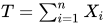
The Bernoulli model admits a complete statistic.[1] Let X be a random sample of size n such that each Xi has the same Bernoulli distribution with parameter p. Let T be the number of 1s observed in the sample, i.e. . T is a statistic of X which has a binomial distribution with parameters (n,p). If the parameter space for p is (0,1), then T is a complete statistic. To see this, note that
Observe also that neither p nor 1 − p can be 0. Hence if and only if:
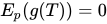
On denoting p/(1 − p) by r, one gets:

First, observe that the range of r is the positive reals. Also, E(g(T)) is a polynomial in r and, therefore, can only be identical to 0 if all coefficients are 0, that is, g(t) = 0 for all t.

It is important to notice that the result that all coefficients must be 0 was obtained because of the range of r. Had the parameter space been finite and with a number of elements less than or equal to n, it might be possible to solve the linear equations in g(t) obtained by substituting the values of r and get solutions different from 0. For example, if n = 1 and the parameter space is {0.5}, a single observation and a single parameter value, T is not complete. Observe that, with the definition:

then, E(g(T)) = 0 although g(t) is not 0 for t = 0 nor for t = 1.

Gaussian model with fixed variance

[edit]

This example will show that, in a sample X1X2 of size 2 from a normal distribution with known variance, the statistic X1 + X2 is complete and sufficient. Suppose X1, X2 are independent, identically distributed random variables, normally distributed with expectation θ and variance 1. The sum

is a complete statistic for θ.

To show this, it is sufficient to demonstrate that there is no non-zero function such that the expectation of

remains zero regardless of the value of θ.

That fact may be seen as follows. The probability distribution of X1 + X2 is normal with expectation 2θ and variance 2. Its probability density function in is therefore proportional to

The expectation of g above would therefore be a constant times

A bit of algebra reduces this to

where k(θ) is nowhere zero and

As a function of θ this is a two-sided Laplace transform of h, and cannot be identically zero unless h is zero almost everywhere.[2] The exponential is not zero, so this can only happen if g is zero almost everywhere.

By contrast, the statistic is sufficient but not complete. It admits a non-zero unbiased estimator of zero, namely .

Sufficiency does not imply completeness

[edit]

Most parametric models have a sufficient statistic which is not complete. This is important because the Lehmann–Scheffé theorem cannot be applied to such models. Galili and Meilijson 2016 [3] propose the following didactic example.

Consider independent samples from the uniform distribution:

is a known design parameter. This model is a scale family (a specific case of a location-scale family) model: scaling the samples by a multiplier multiplies the parameter .

Galili and Meilijson show that the minimum and maximum of the samples are together a sufficient statistic: (using the usual notation for order statistics). Indeed, conditional on these two values, the distribution of the rest of the sample is simply uniform on the range they define: .

However, their ratio has a distribution which does not depend on . This follows from the fact that this is a scale family: any change of scale impacts both variables identically. Subtracting the mean from that distribution, we obtain:

We have thus shown that there exists a function which is not everywhere but which has expectation . The pair is thus not complete.

Importance of completeness

[edit]

The notion of completeness has many applications in statistics, particularly in the following theorems of mathematical statistics.

Lehmann–Scheffé theorem

[edit]

Completeness occurs in the Lehmann–Scheffé theorem,[1] which states that if a statistic that is unbiased, complete and sufficient for some parameter θ, then it is the best mean-unbiased estimator for θ. In other words, this statistic has a smaller expected loss for any convex loss function; in many practical applications with the squared loss-function, it has a smaller mean squared error among any estimators with the same expected value.

Examples exists that when the minimal sufficient statistic is not complete then several alternative statistics exist for unbiased estimation of θ, while some of them have lower variance than others.[3]

See also minimum-variance unbiased estimator.

Basu's theorem

[edit]

Bounded completeness occurs in Basu's theorem,[1] which states that a statistic that is both boundedly complete and sufficient is independent of any ancillary statistic.

Bahadur's theorem

[edit]

Bounded completeness also occurs in Bahadur's theorem. In the case where there exists at least one minimal sufficient statistic, a statistic which is sufficient and boundedly complete, is necessarily minimal sufficient.[4]

Notes

[edit]
Revisions and contributorsEdit on WikipediaRead on Wikipedia
from Grokipedia
In statistics, completeness is a property of a statistic TT relative to a family of probability distributions {Pθ:θΘ}\{P_\theta : \theta \in \Theta\}, where TT is said to be complete if, for every measurable function gg such that Eθ[g(T)]=0\mathbb{E}_\theta[g(T)] = 0 for all θΘ\theta \in \Theta, it follows that g(T)=0g(T) = 0 almost surely with respect to PθP_\theta for all θΘ\theta \in \Theta. This condition implies that no non-constant function of TT can be unbiased for the constant zero across the entire parameter space unless it is identically zero, ensuring that TT exhausts all relevant information about θ\theta without redundancy in expectation. The concept of completeness was formalized by Erich L. Lehmann and Henry Scheffé in their 1950 paper titled "Completeness, similar regions, and unbiased estimation", published in Sankhyā, where it emerged as a tool to address limitations in earlier notions of sufficiency and to refine results on optimal estimators. Since then, completeness has become central to mathematical statistics, particularly when paired with sufficiency: a complete sufficient statistic uniquely determines the uniformly minimum variance unbiased estimator (UMVUE) of any estimable function via the Lehmann-Scheffé theorem, which states that any unbiased estimator of a parameter can be improved by conditioning on such a statistic without increasing variance. Furthermore, Basu's theorem leverages completeness to establish independence between a complete sufficient statistic and any ancillary statistic, facilitating simplified inference by decoupling parameter-dependent and parameter-free components of the data. Bounded completeness, a related but weaker variant requiring the condition only for bounded functions gg, often suffices for these applications and holds more broadly, such as in exponential families. Common examples of complete statistics arise in regular exponential families, where the natural sufficient statistic—such as the sum of observations for i.i.d. samples from a distribution with density f(x;θ)=h(x)exp(θt(x)A(θ))f(x; \theta) = h(x) \exp(\theta t(x) - A(\theta))—is complete under mild conditions on the parameter space. For instance, the sample sum Y=i=1nXiY = \sum_{i=1}^n X_i from i.i.d. normal(θ,1\theta, 1) random variables is both sufficient and complete for θ\theta, allowing unique UMVUEs like Y/nY/n for the mean. In contrast, not all sufficient statistics are complete; for uniform(0, θ\theta) samples, the maximum order statistic is minimal sufficient and complete, whereas the full sample vector is sufficient but incomplete, as non-trivial functions like differences of individual observations have zero expectation for all θ\theta but are not zero almost surely. These properties extend to order statistics in certain nonparametric settings, though completeness there requires specific tail behaviors to avoid counterexamples.

Core Concepts

Definition of Completeness

In statistics, a statistic TT is complete for a family of probability distributions {Pθ:θΘ}\{P_\theta : \theta \in \Theta\} if, for every gg, the condition Eθ[g(T)]=0E_\theta[g(T)] = 0 for all θΘ\theta \in \Theta implies that g(T)=0g(T) = 0 almost surely with respect to PθP_\theta for all θΘ\theta \in \Theta. Equivalently, TT is complete if the only gg satisfying g(t)dPθ(t)=0for all θΘ\int g(t) \, dP_\theta(t) = 0 \quad \text{for all } \theta \in \Theta is g0g \equiv 0. This property was introduced by Lehmann and Scheffé in their 1950 paper on completeness, similar regions, and unbiased estimation, as a tool in estimation theory to address uniqueness of estimators. Intuitively, completeness rules out non-trivial functions of TT whose expectation is zero across the entire parameter space, ensuring no hidden systematic biases in estimators derived from TT that vanish in expectation everywhere.

Bounded Completeness

Bounded completeness is a weaker condition than completeness, applicable to families of distributions where the full completeness property does not hold but sufficiency results still apply to bounded functions. A statistic TT is boundedly complete if, for every bounded measurable function gg such that Eθ[g(T)]=0E_\theta[g(T)] = 0 for all θ\theta in the parameter space Θ\Theta, it follows that g(T)=0g(T) = 0 almost surely with respect to PθP_\theta for all θΘ\theta \in \Theta. The key difference from general completeness lies in the restriction to bounded functions gg, which simplifies verification in many parametric models, particularly exponential families where the expectation equations are easier to analyze under boundedness constraints. This makes bounded completeness practical for deriving of estimators in restricted function classes without requiring the stronger global condition. Mathematically, the condition can be expressed as: if gg is measurable and bounded, say g(t)M|g(t)| \leq M for some constant MM, and g(t)dPθ(t)=0\int g(t) \, dP_\theta(t) = 0 for all θΘ\theta \in \Theta, then g0g \equiv 0 with respect to the family of measures {Pθ}\{P_\theta\}. Bounded completeness often holds in location-scale families, such as certain mixtures or translations where full completeness fails due to overparameterization, but the bounded restriction ensures no non-trivial bounded functions have zero expectation across the family.

Examples

Bernoulli Distribution

Consider a sequence of nn independent and identically distributed Bernoulli random variables X1,,XnX_1, \dots, X_n, each with success probability p(0,1)p \in (0,1). The statistic T=i=1nXiT = \sum_{i=1}^n X_i follows a binomial distribution with parameters nn and pp, denoted TBinomial(n,p)T \sim \text{Binomial}(n, p). This statistic TT is minimal sufficient for pp. The probability mass function of TT is given by P(T=kp)=(nk)pk(1p)nk,k=0,1,,n.P(T = k \mid p) = \binom{n}{k} p^k (1-p)^{n-k}, \quad k = 0, 1, \dots, n. The family of binomial distributions with fixed nn and varying p(0,1)p \in (0,1) is complete, meaning that if gg is any measurable function such that Ep[g(T)]=0\mathbb{E}_p[g(T)] = 0 for all p(0,1)p \in (0,1), then g(T)=0g(T) = 0 almost surely. To establish completeness, suppose Ep[g(T)]=0\mathbb{E}_p[g(T)] = 0 for all p(0,1)p \in (0,1). This implies k=0ng(k)(nk)pk(1p)nk=0.\sum_{k=0}^n g(k) \binom{n}{k} p^k (1-p)^{n-k} = 0. Factoring out (1p)n(1-p)^n, the equation becomes (1p)nk=0ng(k)(nk)(p1p)k=0.(1-p)^n \sum_{k=0}^n g(k) \binom{n}{k} \left( \frac{p}{1-p} \right)^k = 0. Since (1p)n>0(1-p)^n > 0 for p(0,1)p \in (0,1), it follows that k=0ng(k)(nk)ρk=0\sum_{k=0}^n g(k) \binom{n}{k} \rho^k = 0 for all ρ=p/(1p)>0\rho = p/(1-p) > 0. The left side is a polynomial in ρ\rho of degree at most nn that vanishes for all ρ>0\rho > 0, hence identically zero, so all coefficients must be zero: g(k)(nk)=0g(k) \binom{n}{k} = 0 for each kk, implying g(k)=0g(k) = 0 for all k=0,,nk = 0, \dots, n. Thus, g(T)=0g(T) = 0 almost surely. This argument relies on the uniqueness of the coefficients in the generating function, which determines the distribution uniquely via its factorial moments. The sample mean Xˉ=T/n\bar{X} = T/n is a one-to-one function of TT and thus also a complete sufficient statistic for pp.

Normal Distribution with Known Variance

In the normal distribution with known variance, consider a random sample X1,,XnX_1, \dots, X_n drawn independently and identically from N(μ,σ2)N(\mu, \sigma^2), where σ2>0\sigma^2 > 0 is fixed and known, and the parameter of interest is the location θ=μR\theta = \mu \in \mathbb{R}. The sample mean Xˉ=n1i=1nXi\bar{X} = n^{-1} \sum_{i=1}^n X_i serves as a sufficient statistic for μ\mu. The distribution of Xˉ\bar{X} is N(μ,σ2/n)N(\mu, \sigma^2 / n), and completeness arises from the structure of this location family, ensuring that Xˉ\bar{X} uniquely determines all unbiased estimators without bias in expectation across the parameter space. The probability density function of each observation is f(xμ)=(2πσ2)1/2exp((xμ)22σ2),f(x \mid \mu) = (2\pi \sigma^2)^{-1/2} \exp\left( -\frac{(x - \mu)^2}{2\sigma^2} \right), which can be rewritten in exponential family form as f(xμ)=(2πσ2)1/2exp(x22σ2)exp(μxσ2μ22σ2).f(x \mid \mu) = (2\pi \sigma^2)^{-1/2} \exp\left( -\frac{x^2}{2\sigma^2} \right) \exp\left( \frac{\mu x}{\sigma^2} - \frac{\mu^2}{2\sigma^2} \right). This identifies the family as a one-parameter exponential family with natural parameter η=μ/σ2\eta = \mu / \sigma^2 and sufficient statistic i=1nXi=nXˉ\sum_{i=1}^n X_i = n \bar{X}. Since the parameter space for η\eta is an open interval in R\mathbb{R}, the family has full rank, and the minimal sufficient statistic nXˉn \bar{X} is therefore complete. To see completeness directly, suppose gg is a measurable function such that Eμ[g(Xˉ)]=0\mathbb{E}_\mu [g(\bar{X})] = 0 for all μR\mu \in \mathbb{R}. The expectation is Eμ[g(Xˉ)]=g(xˉ)nσ2πexp(n(xˉμ)22σ2)dxˉ=0.\mathbb{E}_\mu [g(\bar{X})] = \int_{-\infty}^\infty g(\bar{x}) \cdot \frac{\sqrt{n}}{\sigma \sqrt{2\pi}} \exp\left( -\frac{n (\bar{x} - \mu)^2}{2\sigma^2} \right) d\bar{x} = 0.
Add your contribution
Related Hubs
Contribute something
User Avatar
No comments yet.