



Community hub
Recent from talks
Contribute something
Nothing was collected or created yet.
Computer music
View on WikipediaComputer music is the application of computing technology in music composition, to help human composers create new music or to have computers independently create music, such as with algorithmic composition programs. It includes the theory and application of new and existing computer software technologies and basic aspects of music, such as sound synthesis, digital signal processing, sound design, sonic diffusion, acoustics, electrical engineering, and psychoacoustics.[1] The field of computer music can trace its roots back to the origins of electronic music, and the first experiments and innovations with electronic instruments at the turn of the 20th century.[2]
History
[edit]
Much of the work on computer music has drawn on the relationship between music and mathematics, a relationship that has been noted since the Ancient Greeks described the "harmony of the spheres".
Musical melodies were first generated by the computer originally named the CSIR Mark 1 (later renamed CSIRAC) in Australia in 1950. There were newspaper reports from America and England (early and recently) that computers may have played music earlier, but thorough research has debunked these stories as there is no evidence to support the newspaper reports (some of which were speculative). Research has shown that people speculated about computers playing music, possibly because computers would make noises,[3] but there is no evidence that they did it.[4][5]
The world's first computer to play music was the CSIR Mark 1 (later named CSIRAC), which was designed and built by Trevor Pearcey and Maston Beard in the late 1940s. Mathematician Geoff Hill programmed the CSIR Mark 1 to play popular musical melodies from the very early 1950s. In 1950 the CSIR Mark 1 was used to play music, the first known use of a digital computer for that purpose. The music was never recorded, but it has been accurately reconstructed.[6][7] In 1951 it publicly played the "Colonel Bogey March"[8] of which only the reconstruction exists. However, the CSIR Mark 1 played standard repertoire and was not used to extend musical thinking or composition practice, as Max Mathews did, which is current computer-music practice.
The first music to be performed in England was a performance of the British National Anthem that was programmed by Christopher Strachey on the Ferranti Mark 1, late in 1951. Later that year, short extracts of three pieces were recorded there by a BBC outside broadcasting unit: the National Anthem, "Baa, Baa, Black Sheep", and "In the Mood"; this is recognized as the earliest recording of a computer to play music as the CSIRAC music was never recorded. This recording can be heard at the Manchester University site.[9] Researchers at the University of Canterbury, Christchurch declicked and restored this recording in 2016 and the results may be heard on SoundCloud.[10][11][6]
Two further major 1950s developments were the origins of digital sound synthesis by computer, and of algorithmic composition programs beyond rote playback. Amongst other pioneers, the musical chemists Lejaren Hiller and Leonard Isaacson worked on a series of algorithmic composition experiments from 1956 to 1959, manifested in the 1957 premiere of the Illiac Suite for string quartet.[12] Max Mathews at Bell Laboratories developed the influential MUSIC I program and its descendants, further popularising computer music through a 1963 article in Science.[13] The first professional composer to work with digital synthesis was James Tenney, who created a series of digitally synthesized and/or algorithmically composed pieces at Bell Labs using Mathews' MUSIC III system, beginning with Analog #1 (Noise Study) (1961).[14][15] After Tenney left Bell Labs in 1964, he was replaced by composer Jean-Claude Risset, who conducted research on the synthesis of instrumental timbres and composed Computer Suite from Little Boy (1968).
Early computer-music programs typically did not run in real time, although the first experiments on CSIRAC and the Ferranti Mark 1 did operate in real time. From the late 1950s, with increasingly sophisticated programming, programs would run for hours or days, on multi million-dollar computers, to generate a few minutes of music.[16][17] One way around this was to use a 'hybrid system' of digital control of an analog synthesiser and early examples of this were Max Mathews' GROOVE system (1969) and also MUSYS by Peter Zinovieff (1969).
Until now partial use has been exploited for musical research into the substance and form of sound (convincing examples are those of Hiller and Isaacson in Urbana, Illinois, US; Iannis Xenakis in Paris and Pietro Grossi in Florence, Italy).[18]
In May 1967 the first experiments in computer music in Italy were carried out by the S 2F M studio in Florence[19] in collaboration with General Electric Information Systems Italy.[20] Olivetti-General Electric GE 115 (Olivetti S.p.A.) is used by Grossi as a performer: three programmes were prepared for these experiments. The programmes were written by Ferruccio Zulian [21] and used by Pietro Grossi for playing Bach, Paganini, and Webern works and for studying new sound structures.[22]

John Chowning's work on FM synthesis from the 1960s to the 1970s allowed much more efficient digital synthesis,[23] eventually leading to the development of the affordable FM synthesis-based Yamaha DX7 digital synthesizer, released in 1983.[24]
Interesting sounds must have a fluidity and changeability that allows them to remain fresh to the ear. In computer music this subtle ingredient is bought at a high computational cost, both in terms of the number of items requiring detail in a score and in the amount of interpretive work the instruments must produce to realize this detail in sound.[25]
In Japan
[edit]In Japan, experiments in computer music date back to 1962, when Keio University professor Sekine and Toshiba engineer Hayashi experimented with the TOSBAC computer. This resulted in a piece entitled TOSBAC Suite, influenced by the Illiac Suite. Later Japanese computer music compositions include a piece by Kenjiro Ezaki presented during Osaka Expo '70 and "Panoramic Sonore" (1974) by music critic Akimichi Takeda. Ezaki also published an article called "Contemporary Music and Computers" in 1970. Since then, Japanese research in computer music has largely been carried out for commercial purposes in popular music, though some of the more serious Japanese musicians used large computer systems such as the Fairlight in the 1970s.[26]
In the late 1970s these systems became commercialized, including systems like the Roland MC-8 Microcomposer, where a microprocessor-based system controls an analog synthesizer, released in 1978.[26] In addition to the Yamaha DX7, the advent of inexpensive digital chips and microcomputers allowed real-time generation of computer music.[24] In the 1980s, Japanese personal computers such as the NEC PC-88 came installed with FM synthesis sound chips and featured audio programming languages such as Music Macro Language (MML) and MIDI interfaces, which were most often used to produce video game music, or chiptunes.[26] By the early 1990s, the performance of microprocessor-based computers reached the point that real-time generation of computer music using more general programs and algorithms became possible.[27]
Advances
[edit]Advances in computing power and software for manipulation of digital media have dramatically affected the way computer music is generated and performed. Current-generation micro-computers are powerful enough to perform very sophisticated audio synthesis using a wide variety of algorithms and approaches. Computer music systems and approaches are now ubiquitous, and so firmly embedded in the process of creating music that we hardly give them a second thought: computer-based synthesizers, digital mixers, and effects units have become so commonplace that use of digital rather than analog technology to create and record music is the norm, rather than the exception.[28]
Research
[edit]There is considerable activity in the field of computer music as researchers continue to pursue new and interesting computer-based synthesis, composition, and performance approaches. Throughout the world there are many organizations and institutions dedicated to the area of computer and electronic music study and research, including the CCRMA (Center of Computer Research in Music and Acoustic, Stanford, USA), ICMA (International Computer Music Association), C4DM (Centre for Digital Music), IRCAM, GRAME, SEAMUS (Society for Electro Acoustic Music in the United States), CEC (Canadian Electroacoustic Community), and a great number of institutions of higher learning around the world.
Music composed and performed by computers
[edit]Later, composers such as Gottfried Michael Koenig and Iannis Xenakis had computers generate the sounds of the composition as well as the score. Koenig produced algorithmic composition programs which were a generalization of his own serial composition practice. This is not exactly similar to Xenakis' work as he used mathematical abstractions and examined how far he could explore these musically. Koenig's software translated the calculation of mathematical equations into codes which represented musical notation. This could be converted into musical notation by hand and then performed by human players. His programs Project 1 and Project 2 are examples of this kind of software. Later, he extended the same kind of principles into the realm of synthesis, enabling the computer to produce the sound directly. SSP is an example of a program which performs this kind of function. All of these programs were produced by Koenig at the Institute of Sonology in Utrecht in the 1970s.[29] In the 2000s, Andranik Tangian developed a computer algorithm to determine the time event structures for rhythmic canons and rhythmic fugues, which were then "manually" worked out into harmonic compositions Eine kleine Mathmusik I and Eine kleine Mathmusik II performed by computer;[30][31] for scores and recordings see.[32]
Computer-generated scores for performance by human players
[edit]Computers have also been used in an attempt to imitate the music of great composers of the past, such as Mozart. A present exponent of this technique is David Cope, whose computer programs analyses works of other composers to produce new works in a similar style. Cope's best-known program is Emily Howell.[33][34][35]
Melomics, a research project from the University of Málaga (Spain), developed a computer composition cluster named Iamus, which composes complex, multi-instrument pieces for editing and performance. Since its inception, Iamus has composed a full album in 2012, also named Iamus, which New Scientist described as "the first major work composed by a computer and performed by a full orchestra".[36] The group has also developed an API for developers to utilize the technology, and makes its music available on its website.
Computer-aided algorithmic composition
[edit]
Computer-aided algorithmic composition (CAAC, pronounced "sea-ack") is the implementation and use of algorithmic composition techniques in software. This label is derived from the combination of two labels, each too vague for continued use. The label computer-aided composition lacks the specificity of using generative algorithms. Music produced with notation or sequencing software could easily be considered computer-aided composition. The label algorithmic composition is likewise too broad, particularly in that it does not specify the use of a computer. The term computer-aided, rather than computer-assisted, is used in the same manner as computer-aided design.[37]
Machine improvisation
[edit]Machine improvisation uses computer algorithms to create improvisation on existing music materials. This is usually done by sophisticated recombination of musical phrases extracted from existing music, either live or pre-recorded. In order to achieve credible improvisation in particular style, machine improvisation uses machine learning and pattern matching algorithms to analyze existing musical examples. The resulting patterns are then used to create new variations "in the style" of the original music, developing a notion of stylistic re-injection. This is different from other improvisation methods with computers that use algorithmic composition to generate new music without performing analysis of existing music examples.[38]
Statistical style modeling
[edit]Style modeling implies building a computational representation of the musical surface that captures important stylistic features from data. Statistical approaches are used to capture the redundancies in terms of pattern dictionaries or repetitions, which are later recombined to generate new musical data. Style mixing can be realized by analysis of a database containing multiple musical examples in different styles. Machine Improvisation builds upon a long musical tradition of statistical modeling that began with Hiller and Isaacson's Illiac Suite for String Quartet (1957) and Xenakis' uses of Markov chains and stochastic processes. Modern methods include the use of lossless data compression for incremental parsing, prediction suffix tree, string searching and more.[39] Style mixing is possible by blending models derived from several musical sources, with the first style mixing done by S. Dubnov in a piece NTrope Suite using Jensen-Shannon joint source model.[40] Later the use of factor oracle algorithm (basically a factor oracle is a finite state automaton constructed in linear time and space in an incremental fashion)[41] was adopted for music by Assayag and Dubnov[42] and became the basis for several systems that use stylistic re-injection.[43]
Implementations
[edit]The first implementation of statistical style modeling was the LZify method in Open Music,[44] followed by the Continuator system that implemented interactive machine improvisation that interpreted the LZ incremental parsing in terms of Markov models and used it for real time style modeling[45] developed by François Pachet at Sony CSL Paris in 2002.[46][47] Matlab implementation of the Factor Oracle machine improvisation can be found as part of Computer Audition toolbox. There is also an NTCC implementation of the Factor Oracle machine improvisation.[48]
OMax is a software environment developed in IRCAM. OMax uses OpenMusic and Max. It is based on researches on stylistic modeling carried out by Gerard Assayag and Shlomo Dubnov and on researches on improvisation with the computer by G. Assayag, M. Chemillier and G. Bloch (a.k.a. the OMax Brothers) in the Ircam Music Representations group.[49] One of the problems in modeling audio signals with factor oracle is the symbolization of features from continuous values to a discrete alphabet. This problem was solved in the Variable Markov Oracle (VMO) available as python implementation,[50] using an information rate criteria for finding the optimal or most informative representation.[51]
Use of artificial intelligence
[edit]The use of artificial intelligence to generate new melodies,[52] cover pre-existing music,[53] and clone artists' voices, is a recent phenomenon that has been reported to disrupt the music industry.[54]
Live coding
[edit]Live coding[55] (sometimes known as 'interactive programming', 'on-the-fly programming',[56] 'just in time programming') is the name given to the process of writing software in real time as part of a performance. Recently it has been explored as a more rigorous alternative to laptop musicians who, live coders often feel, lack the charisma and pizzazz of musicians performing live.[57]
See also
[edit]
- Acousmatic music
- Adaptive music
- Csound
- Digital audio workstation
- Digital synthesizer
- Fast Fourier transform
- Human–computer interaction
- Laptronica
- List of music software
- Module file
- Music information retrieval
- Music notation software
- Music sequencer
- New Interfaces for Musical Expression
- Physical modelling synthesis
- Programming (music)
- Sampling (music)
- Sound and music computing
- Tracker
- Vaporwave
- Vocaloid
References
[edit]- ^ Curtis Roads,The Computer Music Tutorial, Boston: MIT Press, Introduction
- ^ Andrew J. Nelson, The Sound of Innovation: Stanford and the Computer Music Revolution, Boston: MIT Press, Introduction
- ^ "Algorhythmic Listening 1949–1962 Auditory Practices of Early Mainframe Computing". AISB/IACAP World Congress 2012. Archived from the original on 7 November 2017. Retrieved 18 October 2017.
- ^ Doornbusch, Paul (9 July 2017). "MuSA 2017 – Early Computer Music Experiments in Australia, England and the USA". MuSA Conference. Retrieved 18 October 2017.
- ^ Doornbusch, Paul (2017). "Early Computer Music Experiments in Australia and England". Organised Sound. 22 (2). Cambridge University Press: 297–307 [11]. doi:10.1017/S1355771817000206.
- ^ a b Fildes, Jonathan (17 June 2008). "Oldest computer music unveiled". BBC News Online. Retrieved 18 June 2008.
- ^ Doornbusch, Paul (March 2004). "Computer Sound Synthesis in 1951: The Music of CSIRAC". Computer Music Journal. 28 (1): 11–12. doi:10.1162/014892604322970616. S2CID 10593824.
- ^ Doornbusch, Paul (29 June 2009). "The Music of CSIRAC". Melbourne School of Engineering, Department of Computer Science and Software Engineering. Archived from the original on 18 January 2012.
- ^ "Media (Digital 60)". curation.cs.manchester.ac.uk. Archived from the original on 3 March 2021. Retrieved 15 December 2023.
- ^ "First recording of computer-generated music – created by Alan Turing – restored". The Guardian. 26 September 2016. Retrieved 28 August 2017.
- ^ "Restoring the first recording of computer music – Sound and vision blog". British Library. 13 September 2016. Retrieved 28 August 2017.
- ^ Lejaren Hiller and Leonard Isaacson, Experimental Music: Composition with an Electronic Computer (New York: McGraw-Hill, 1959; reprinted Westport, Connecticut: Greenwood Press, 1979). ISBN 0-313-22158-8. [page needed]
- ^ Bogdanov, Vladimir (2001). All Music Guide to Electronica: The Definitive Guide to Electronic Music. Backbeat Books. p. 320. ISBN 978-0-87930-628-1. Retrieved 4 December 2013.
- ^ Tenney, James. (1964) 2015. “Computer Music Experiences, 1961–1964.” In From Scratch: Writings in Music Theory. Edited by Larry Polansky, Lauren Pratt, Robert Wannamaker, and Michael Winter. Urbana: University of Illinois Press. 97–127.
- ^ Wannamaker, Robert, The Music of James Tenney, Volume 1: Contexts and Paradigms (University of Illinois Press, 2021), 48–82.
- ^ Cattermole, Tannith (9 May 2011). "Farseeing inventor pioneered computer music". Gizmag. Retrieved 28 October 2011.
In 1957 the MUSIC program allowed an IBM 704 mainframe computer to play a 17-second composition by Mathews. Back then computers were ponderous, so synthesis would take an hour.
- ^ Mathews, Max (1 November 1963). "The Digital Computer as a Musical Instrument". Science. 142 (3592): 553–557. Bibcode:1963Sci...142..553M. doi:10.1126/science.142.3592.553. PMID 17738556.
The generation of sound signals requires very high sampling rates.... A high speed machine such as the I.B.M. 7090 ... can compute only about 5000 numbers per second ... when generating a reasonably complex sound.
- ^ Bonomini, Mario; Zammit, Victor; Pusey, Charles D.; De Vecchi, Amedeo; Arduini, Arduino (March 2011). "Pharmacological use of l-carnitine in uremic anemia: Has its full potential been exploited?☆". Pharmacological Research. 63 (3): 157–164. doi:10.1016/j.phrs.2010.11.006. ISSN 1043-6618. PMID 21138768.
- ^ Parolini, Giuditta (2016). "Pietro Grossi's Experience in Electronic and Computer Music by Giuditta Parolini". University of Leeds. doi:10.5518/160/27. Archived from the original on 18 June 2021. Retrieved 21 March 2021.
- ^ Gaburo, Kenneth (Spring 1985). "The Deterioration of an Ideal, Ideally Deteriorized: Reflections on Pietro Grossi's 'Paganini AI Computer'". Computer Music Journal. 9 (1): 39–44. JSTOR 4617921.
- ^ "Music without Musicians but with Scientists Technicians and Computer Companies". 2019.
- ^ Giomi, Francesco (1995). "The Work of Italian Artist Pietro Grossi: From Early Electronic Music to Computer Art". Leonardo. 28 (1): 35–39. doi:10.2307/1576152. JSTOR 1576152. S2CID 191383265.
- ^ Dean, Roger T. (2009). The Oxford Handbook of Computer Music. Oxford University Press. p. 20. ISBN 978-0-19-533161-5.
- ^ a b Dean 2009, p. 1
- ^ Loy, D. Gareth (1992). "Notes on the implementation of MUSBOX...". In Roads, Curtis (ed.). The Music Machine: Selected Readings from 'Computer Music Journal'. MIT Press. p. 344. ISBN 978-0-262-68078-3.
- ^ a b c Shimazu, Takehito (1994). "The History of Electronic and Computer Music in Japan: Significant Composers and Their Works". Leonardo Music Journal. 4. MIT Press: 102–106 [104]. doi:10.2307/1513190. JSTOR 1513190. S2CID 193084745. Retrieved 9 July 2012.[permanent dead link]
- ^ Dean 2009, pp. 4–5: "... by the 90s ... digital sound manipulation (using MSP or many other platforms) became widespread, fluent and stable."
- ^ Doornbusch, Paul. "3: Early Hardware and Early Ideas in Computer Music: Their Development and Their Current Forms". In Dean (2009), pp. 44–80. doi:10.1093/oxfordhb/9780199792030.013.0003
- ^ Berg, Paul (1996). "Abstracting the future: The Search for Musical Constructs". Computer Music Journal. 20 (3). MIT Press: 24–27 [11]. doi:10.2307/3680818. JSTOR 3680818.
- ^ Tangian, Andranik (2003). "Constructing rhythmic canons" (PDF). Perspectives of New Music. 41 (2): 64–92. Archived from the original (PDF) on 24 January 2021. Retrieved 16 January 2021.
- ^ Tangian, Andranik (2010). "Constructing rhythmic fugues (unpublished addendum to Constructing rhythmic canons)". IRCAM, Seminaire MaMuX, 9 February 2002, Mosaïques et pavages dans la musique (PDF). Archived from the original (PDF) on 22 January 2021. Retrieved 16 January 2021.
- ^ Tangian, Andranik (2002–2003). "Eine kleine Mathmusik I and II". IRCAM, Seminaire MaMuX, 9 February 2002, Mosaïques et pavages dans la musique. Archived from the original on 21 January 2021. Retrieved 16 January 2021.
- ^ Leach, Ben (22 October 2009). "Emily Howell: the computer program that composes classical music". The Daily Telegraph. Retrieved 6 October 2017.
- ^ Cheng, Jacqui (30 September 2009). "Virtual Composer Makes Beautiful Music and Stirs Controversy". Ars Technica.
- ^ Ball, Philip (1 July 2012). "Iamus, classical music's computer composer, live from Malaga". The Guardian. Archived from the original on 25 October 2013. Retrieved 15 November 2021.
- ^ "Computer composer honours Turing's centenary". New Scientist. 5 July 2012.
- ^ Christopher Ariza: An Open Design for Computer-Aided Algorithmic Music Composition, Universal-Publishers Boca Raton, Florida, 2005, p. 5
- ^ Mauricio Toro, Carlos Agon, Camilo Rueda, Gerard Assayag. "GELISP: A Framework to Represent Musical Constraint Satisfaction Problems and Search Strategies", Journal of Theoretical and Applied Information Technology 86, no. 2 (2016): 327–331.
- ^ Shlomo Dubnov, Gérard Assayag, Olivier Lartillot, Gill Bejerano, "Using Machine-Learning Methods for Musical Style Modeling", Computers, 36 (10), pp. 73–80, October 2003. doi:10.1109/MC.2003.1236474
- ^ Dubnov, S. (1999). "Stylistic randomness: About composing NTrope Suite." Organised Sound, 4(2), 87–92. doi:10.1017/S1355771899002046
- ^ Jan Pavelka; Gerard Tel; Miroslav Bartosek, eds. (1999). Factor oracle: a new structure for pattern matching; Proceedings of SOFSEM'99; Theory and Practice of Informatics. Springer-Verlag, Berlin. pp. 291–306. ISBN 978-3-540-66694-3. Retrieved 4 December 2013.
Lecture Notes in Computer Science 1725
- ^ "Using factor oracles for machine improvisation", G. Assayag, S. Dubnov, (September 2004) Soft Computing 8 (9), 604–610 doi:10.1007/s00500-004-0385-4
- ^ "Memex and composer duets: computer-aided composition using style mixing", S. Dubnov, G. Assayag, Open Music Composers Book 2, 53–66
- ^ G. Assayag, S. Dubnov, O. Delerue, "Guessing the Composer's Mind : Applying Universal Prediction to Musical Style", In Proceedings of International Computer Music Conference, Beijing, 1999.
- ^ "Continuator". Archived from the original on 1 November 2014. Retrieved 19 May 2014.
- ^ Pachet, F., The Continuator: Musical Interaction with Style Archived 14 April 2012 at the Wayback Machine. In ICMA, editor, Proceedings of ICMC, pages 211–218, Göteborg, Sweden, September 2002. ICMA.
- ^ Pachet, F. Playing with Virtual Musicians: the Continuator in practice Archived 14 April 2012 at the Wayback Machine. IEEE MultiMedia,9(3):77–82 2002.
- ^ M. Toro, C. Rueda, C. Agón, G. Assayag. "NTCCRT: A concurrent constraint framework for soft-real time music interaction." Journal of Theoretical & Applied Information Technology, vol. 82, issue 1, pp. 184–193. 2015
- ^ "The OMax Project Page". omax.ircam.fr. Retrieved 2 February 2018.
- ^ "Guided music synthesis with variable markov oracle", C Wang, S Dubnov, Tenth Artificial Intelligence and Interactive Digital Entertainment Conference, 2014
- ^ S Dubnov, G Assayag, A Cont, "Audio oracle analysis of musical information rate", IEEE Fifth International Conference on Semantic Computing, 567–557, 2011 doi:10.1109/ICSC.2011.106
- ^ "Turn ideas into music with MusicLM". Google. 10 May 2023. Retrieved 22 September 2023.
- ^ "Pick a voice, any voice: Voicemod unleashes "AI Humans" collection of real-time AI voice changers". Tech.eu. 21 June 2023. Retrieved 22 September 2023.
- ^ "'Regulate it before we're all finished': Musicians react to AI songs flooding the internet". Sky News. Retrieved 22 September 2023.
- ^ Collins, N.; McLean, A.; Rohrhuber, J.; Ward, A. (2004). "Live coding in laptop performance". Organised Sound. 8 (3): 321–330. doi:10.1017/S135577180300030X. S2CID 56413136.
- ^ Wang G. & Cook P. (2004) "On-the-fly Programming: Using Code as an Expressive Musical Instrument", In Proceedings of the 2004 International Conference on New Interfaces for Musical Expression (NIME) (New York: NIME, 2004).
- ^ Collins, Nick (2003). "Generative Music and Laptop Performance". Contemporary Music Review. 22 (4): 67–79. doi:10.1080/0749446032000156919. S2CID 62735944.
Further reading
[edit]- Ariza, C. 2005. "Navigating the Landscape of Computer-Aided Algorithmic Composition Systems: A Definition, Seven Descriptors, and a Lexicon of Systems and Research." In Proceedings of the International Computer Music Conference. San Francisco: International Computer Music Association. 765–772.
- Ariza, C. 2005. An Open Design for Computer-Aided Algorithmic Music Composition: athenaCL. PhD dissertation, New York University.
- Boulanger, Richard, ed. (6 March 2000). The Csound Book: Perspectives in Software Synthesis, Sound Design, Signal Processing, and Programming. MIT Press. p. 740. ISBN 978-0-262-52261-8. Archived from the original on 2 January 2010. Retrieved 3 October 2009.
- Chadabe, Joel. 1997. Electric Sound: The Past and Promise of Electronic Music. Upper Saddle River, New Jersey: Prentice Hall.
- Chowning, John. 1973. "The Synthesis of Complex Audio Spectra by Means of Frequency Modulation". Journal of the Audio Engineering Society 21, no. 7:526–534.
- Collins, Nick (2009). Introduction to Computer Music. Chichester: Wiley. ISBN 978-0-470-71455-3.
- Dodge, Charles; Jerse (1997). Computer Music: Synthesis, Composition and Performance. Thomas A. (2nd ed.). New York: Schirmer Books. p. 453. ISBN 978-0-02-864682-4.
- Doornbusch, P. 2015. "A Chronology / History of Electronic and Computer Music and Related Events 1906–2015 Archived 18 August 2020 at the Wayback Machine"
- Heifetz, Robin (1989). On the Wires of Our Nerves. Lewisburg, Pennsylvania: Bucknell University Press. ISBN 978-0-8387-5155-8.
- Dorien Herremans; Ching-Hua Chuan; Elaine Chew (November 2017). "A Functional Taxonomy of Music Generation Systems". ACM Computing Surveys. 50 (5): 69:1–30. arXiv:1812.04186. doi:10.1145/3108242. S2CID 3483927.
- Manning, Peter (2004). Electronic and Computer Music (revised and expanded ed.). Oxford Oxfordshire: Oxford University Press. ISBN 978-0-19-517085-6.
- Perry, Mark, and Thomas Margoni. 2010. "From Music Tracks to Google Maps: Who Owns Computer-Generated Works?". Computer Law & Security Review 26: 621–629.
- Roads, Curtis (1994). The Computer Music Tutorial. Cambridge: MIT Press. ISBN 978-0-262-68082-0.
- Supper, Martin (2001). "A Few Remarks on Algorithmic Composition". Computer Music Journal. 25: 48–53. doi:10.1162/014892601300126106. S2CID 21260852.
- Xenakis, Iannis (2001). Formalized Music: Thought and Mathematics in Composition. Harmonologia Series No. 6. Hillsdale, New York: Pendragon. ISBN 978-1-57647-079-4.
| People | 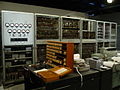
 | |
|---|---|---|
| Programs and instruments | ||
| Places | ||
| Techniques | ||
| Compositions | ||
| International | |
|---|---|
| National | |
| Other | |

Computer music
View on GrokipediaDefinition and Fundamentals
Definition
Computer music is the application of computing technology to the creation, performance, analysis, and synthesis of music, leveraging algorithms and digital processing to generate, manipulate, or interpret musical structures and sounds.[5][2] This field encompasses both collaborative processes between humans and computers, such as interactive composition tools, and fully autonomous systems where computers produce music independently through programmed rules or machine learning models.[7] It focuses on computational methods to solve musical problems, including sound manipulation and the representation of musical ideas in code.[2] Unlike electroacoustic music, which broadly involves the electronic processing of recorded sounds and can include analog techniques like tape manipulation, computer music specifically emphasizes digital computation for real-time synthesis and algorithmic generation without relying on pre-recorded audio.[6][8] It also extends beyond digital audio workstations (DAWs), which primarily serve as software for recording, editing, and mixing audio tracks, by incorporating advanced computational creativity such as procedural generation and analysis-driven composition.[9] The term "computer music" emerged in the 1950s and 1960s amid pioneering experiments, such as Max Mathews's MUSIC program at Bell Labs in 1957, which enabled the first digital sound synthesis on computers.[10] It was formalized as a distinct discipline in 1977 with the founding of the Institut de Recherche et Coordination Acoustique/Musique (IRCAM) in Paris, which established dedicated computing facilities for musical research and synthesis, institutionalizing the integration of computers in avant-garde composition.[11] The scope includes core techniques like digital sound synthesis, algorithmic sequencing for structuring musical events, and AI-driven generation, where models learn patterns to create novel compositions, but excludes non-computational technologies such as analog synthesizers that operate without programmable digital control.[10][12]Key Concepts
Sound in computer music begins with the binary representation of analogue sound waves, which are continuous vibrations in air pressure captured by microphones and converted into discrete digital samples through a process known as analogue-to-digital conversion. This involves sampling the waveform at regular intervals (typically thousands of times per second) to measure its amplitude, quantizing those measurements into binary numbers (e.g., 16-bit or 24-bit resolution for precision), and storing them as a sequence of 1s and 0s that a computer can process and reconstruct.[13] This digital encoding allows for manipulation, storage, and playback without loss of fidelity, provided the sampling rate adheres to the Nyquist-Shannon theorem (at least twice the highest frequency in the signal).[14] A fundamental prerequisite for analyzing and synthesizing these digital sounds is the Fourier transform, which decomposes a time-domain signal into its frequency components, revealing the harmonic structure of sound waves. The discrete Fourier transform (DFT), commonly implemented via the fast Fourier transform (FFT) algorithm for efficiency, is expressed as: where represents the input signal samples, is the number of samples, and indexes the frequency bins; this equation transforms the signal into a spectrum of sine waves at different frequencies, amplitudes, and phases, enabling tasks like filtering harmonics or identifying musical pitches.[15] Digital signal processing (DSP) forms the core of computer music by applying mathematical algorithms to these binary representations for real-time audio manipulation, such as filtering, reverb, or pitch shifting, often using convolution or recursive filters implemented in software or hardware. DSP techniques leverage the computational power of computers to process signals at rates matching human hearing (up to 20 kHz), bridging analogue acoustics with digital computation.[16] Two primary methods for generating sounds in computer music are sampling and synthesis, which differ in their approach to recreating or creating audio. Sampling captures real-world sounds via analogue-to-digital conversion and replays them with modifications like time-stretching or pitch-shifting, preserving natural timbres but limited by storage and memory constraints. In contrast, synthesis generates sounds algorithmically from mathematical models, such as additive (summing sine waves) or subtractive (filtering waveforms) techniques, offering infinite variability without relying on pre-recorded material.[17] The Musical Instrument Digital Interface (MIDI), standardized in 1983, provides a protocol for interfacing computers with synthesizers and other devices, transmitting event-based data like note on/off, velocity, and control changes rather than raw audio, enabling synchronized control across hardware and software in musical performances.[18] Key terminology in computer music includes granular synthesis, which divides audio into short "grains" (typically 1-100 milliseconds) for recombination into new textures, allowing time-scale manipulation without pitch alteration; algorithmic generation, where computational rules or stochastic processes autonomously create musical structures like melodies or rhythms; and sonification, the mapping of non-musical data (e.g., scientific datasets) to auditory parameters such as pitch or volume to reveal patterns through sound.[19][20][21] Computer music's interdisciplinary nature integrates computer science paradigms, such as programming for real-time systems and machine learning for pattern recognition, with acoustics principles like waveform propagation and psychoacoustics, fostering innovations in both artistic composition and scientific audio analysis.[22]History
Early Developments
The foundations of computer music trace back to analog precursors in the mid-20th century, particularly the development of musique concrète by French composer and engineer Pierre Schaeffer in 1948. At the Studio d'Essai of the French Radio, Schaeffer pioneered the manipulation of recorded sounds on magnetic tape through techniques such as looping, speed variation, and splicing, treating everyday noises as raw musical material rather than traditional instruments. This approach marked a conceptual shift from fixed notation to malleable sound objects, laying groundwork for computational methods by emphasizing transformation and assembly of audio elements.[23][24] The first explicit experiments in computer-generated music emerged in the early 1950s with the CSIR Mk1 (renamed CSIRAC), Australia's pioneering stored-program digital computer operational in 1951. Programmers Geoff Hill and Trevor Pearcey attached a loudspeaker to the machine's output, using subroutines to toggle bits at varying rates and produce monophonic square-wave tones approximating simple melodies, such as the "Colonel Bogey March." This real-time sound synthesis served initially as a diagnostic tool but demonstrated the potential of digital hardware for audio generation, marking the earliest known instance of computer-played music.[25][26][27] By 1957, more structured compositional applications appeared with the ILLIAC I computer at the University of Illinois, where chemist and composer Lejaren Hiller, collaborating with physicist Leonard Isaacson, generated the "Illiac Suite" for string quartet. This work employed stochastic methods, drawing on Markov chain probability models to simulate musical decision-making: random note selection within probabilistic rules for pitch, duration, and harmony, progressing from tonal to atonal sections across four movements. Programs were submitted via punch cards to sequence these parameters, outputting a notated score for human performers rather than direct audio. Hiller's approach, detailed in their seminal 1959 book Experimental Music: Composition with an Electronic Computer, formalized algorithmic generation as a tool for exploring musical structure beyond human intuition.[28][29][30][20][31] These early efforts were constrained by the era's hardware limitations, including vacuum-tube architecture in machines like CSIRAC and ILLIAC I, which operated at speeds of around 1,000 instructions per second and consumed vast power while generating significant heat. Processing bottlenecks restricted outputs to basic waveforms or offline score generation, with no capacity for complex polyphony or high-fidelity audio, underscoring the nascent stage of integrating computation with musical creativity.[32][33]Digital Revolution
The digital revolution in computer music during the 1970s and 1990s marked a pivotal shift from analog and early computational methods to fully digital systems, enabling greater accessibility, real-time processing, and creative interactivity for composers and performers. This era saw the emergence of dedicated institutions and hardware that transformed sound synthesis from labor-intensive batch processing—where computations ran offline on mainframes—to interactive environments that allowed immediate feedback and manipulation. Key advancements focused on digital signal processing, frequency modulation techniques, and graphical interfaces, laying the groundwork for modern electronic music production.[34] A landmark development was the GROOVE system at Bell Labs, introduced in the early 1970s by Max Mathews and Richard Moore, which integrated a digital computer with an analog synthesizer to facilitate real-time performance and composition. GROOVE, or Generated Real-time Operations on Voltage-controlled Equipment, allowed musicians to control sound generation interactively via a PDP-11 minicomputer linked to voltage-controlled oscillators, marking one of the first hybrid systems to bridge human input with digital computation in live settings. This innovation addressed the limitations of prior offline systems by enabling composers to experiment dynamically, influencing subsequent real-time audio tools.[35][36] In 1977, the founding of IRCAM (Institute for Research and Coordination in Acoustics/Music) in Paris by Pierre Boulez further propelled this transition, establishing a center dedicated to advancing real-time digital synthesis and computer-assisted composition. IRCAM's early facilities incorporated custom hardware like the 4A digital synthesizer, capable of processing 256 channels of audio in real time, which supported composers in exploring complex timbres and spatialization without the delays of batch methods. Concurrently, John Chowning at Stanford University secured a patent for frequency modulation (FM) synthesis in 1973, a technique that uses the modulation of one waveform's frequency by another to generate rich harmonic spectra efficiently through digital algorithms. This method, licensed to Yamaha, revolutionized digital sound design by simulating acoustic instruments with far less computational overhead than additive synthesis.[37][38][39] The 1980s brought widespread commercialization and software standardization, exemplified by Yamaha's DX7 synthesizer released in 1983, the first mass-produced digital instrument employing Chowning's FM synthesis to produce versatile, metallic, and bell-like tones that defined pop and electronic music of the decade. Complementing hardware advances, Barry Vercoe developed Csound in 1986 at MIT's Media Lab, a programmable sound synthesis language that allowed users to define instruments and scores via text files, fostering portable, real-time audio generation across various computing platforms. Another innovative figure, Iannis Xenakis, introduced the UPIC system in 1977 at the Centre d'Études de Mathématiques et d'Automatique Musicales (CEMAMu), a graphical interface where composers drew waveforms and trajectories on a tablet, which the computer then translated into synthesized audio, democratizing abstract composition for non-programmers.[40][41][42] These developments collectively enabled the move to interactive systems, where real-time audio processing became feasible on affordable hardware by the 1990s, empowering a broader range of artists to integrate computation into live performance and studio work without relying on institutional mainframes. The impact was profound, as digital tools like FM synthesis and Csound reduced barriers to experimentation, shifting computer music from esoteric research to a core element of mainstream production.[34]Global Milestones
In the early 2000s, the computer music community saw significant advancements in open-source tools that democratized access to real-time audio synthesis and algorithmic composition. SuperCollider, originally released in 1996 by James McCartney as a programming environment for real-time audio synthesis, gained widespread adoption during the 2000s due to its porting to multiple platforms and integration with GNU General Public License terms, enabling collaborative development among composers and researchers worldwide.[43] Similarly, Pure Data (Pd), developed by Miller Puckette starting in the mid-1990s as a visual programming language for interactive multimedia, experienced a surge in open-source adoption through the 2000s, fostering applications in live electronics and sound design by academic and independent artists.[44] A pivotal commercial milestone came in 2001 with the release of Ableton Live, a digital audio workstation designed specifically for live electronic music performance, which revolutionized onstage improvisation and looping techniques through its session view interface and real-time manipulation capabilities.[45] This tool's impact extended globally, influencing genres from techno to experimental music by bridging studio production and performance. In 2003, sonification techniques applied to the Human Genome Project's data marked an interdisciplinary breakthrough, as exemplified in the interactive audio piece "For Those Who Died: A 9/11 Tribute," where DNA sequences were musically encoded to convey genetic information aurally, highlighting computer music's role in scientific data representation.[46] Established centers continued to drive international progress, with Stanford University's Center for Computer Research in Music and Acoustics (CCRMA), founded in 1974, sustaining its influence through the 2000s and beyond via interdisciplinary research in synthesis, spatial audio, and human-computer interaction in music. In Europe, the EU-funded COST Action IC0601 on Sonic Interaction Design (2007–2011) coordinated multinational efforts to explore sound as a core element of interactive systems, promoting workshops, publications, and prototypes that integrated auditory feedback into user interfaces and artistic installations.[47][48] The 2010s brought innovations in machine learning and mobile accessibility. The Wekinator, introduced in 2009 by Rebecca Fiebrink and collaborators, emerged as a meta-instrument for real-time, interactive machine learning, allowing non-experts to train models on gestural or audio inputs for applications in instrument design and improvisation, with ongoing use in performances and education.[49] Concurrently, the proliferation of iOS Audio Unit v3 (AUv3) plugins from the mid-2010s onward transformed mobile devices into viable platforms for computer music, enabling modular synthesis, effects processing, and DAW integration in apps like AUM, thus expanding creative tools to portable, touch-based environments worldwide.[50]Developments in Japan
Japan's contributions to computer music began in the mid-20th century with the establishment of pioneering electronic music facilities that laid the groundwork for digital experimentation. The NHK Electronic Music Studio, founded in 1955 and modeled after the NWDR studio in Cologne, Germany, became a central hub for electronic composition in Asia, enabling the creation of tape music using analog synthesizers, tape recorders, and signal generators.[51] Composers such as Toru Takemitsu collaborated extensively at the studio during the late 1950s and 1960s, integrating electronic elements into works that blended Western modernism with subtle Japanese aesthetics, as seen in his early experiments with musique concrète and noise manipulation within tempered tones.[52] Takemitsu's involvement helped bridge traditional sound concepts like ma (interval or space) with emerging electronic techniques, influencing spatial audio designs in later computer music.[53] In the 1960s, key figures Joji Yuasa and Toshi Ichiyanagi advanced computer-assisted composition through their work at NHK and other venues, pushing beyond analog tape to early digital processes. Yuasa's pieces, such as Aoi-no-Ue (1961), utilized electronic manipulation of voices and instruments, while Ichiyanagi's Computer Space (1970) marked one of Japan's earliest uses of computer-generated sounds, produced almost entirely with computational methods to create abstract electronic landscapes.[54] Their experiments, often in collaboration with international avant-garde influences, incorporated traditional Japanese elements like koto timbres into algorithmic structures, as evident in Yuasa's Kacho-fugetsu for koto and orchestra (1967) and Ichiyanagi's works for traditional ensembles.[55] These efforts highlighted Japan's early adoption of computational tools for composition, distinct from global trends in stochastic methods by emphasizing perceptual intervals drawn from gagaku and other indigenous forms. The 1990s saw significant milestones in synthesis technology driven by Japanese manufacturers, elevating computer music's performative capabilities. Yamaha's development of physical modeling synthesis culminated in the VL1 synthesizer (1993), which simulated the physics of acoustic instruments through digital waveguides and modal synthesis, allowing real-time control of virtual brass, woodwinds, and strings via breath controllers and MIDI.[56] This innovation, stemming from over a decade of research at Yamaha's laboratories, provided expressive, responsive timbres that outperformed sample-based methods in nuance and playability.[57] Concurrently, Korg released the Wavestation digital workstation in 1990, introducing wave sequencing—a technique that cyclically morphed waveforms to generate evolving textures—and vector synthesis for blending multiple oscillators in real time.[58] The Wavestation's ROM-based samples and performance controls made it a staple for ambient and electronic composition, influencing sound design in film and multimedia. Modern contributions from figures like Ryuichi Sakamoto further integrated technology with artistic expression, building on these foundations. As a founding member of Yellow Magic Orchestra in the late 1970s, Sakamoto pioneered the use of synthesizers like the Roland System 100 and ARP Odyssey in popular electronic music, fusing algorithmic patterns with pop structures in tracks like "Rydeen" (1979).[59] In his solo work and film scores, such as Merry Christmas, Mr. Lawrence (1983), he employed early computer music software for sequencing and processing, later exploring AI-driven composition in collaborations discussing machine-generated harmony and rhythm.[60] Japan's cultural impact on computer music is evident in the infusion of traditional elements into algorithmic designs, alongside ongoing institutional research. Composers drew from gamelan-like cyclic structures and Japanese scales in early algorithmic works, adapting them to software for generative patterns that evoke temporal flux, as in Yuasa's integration of shakuhachi microtones into digital scores.[55] In the 2010s, the National Institute of Advanced Industrial Science and Technology (AIST) advanced AI composition through projects like interactive melody generation systems, using Bayesian optimization and human-in-the-loop interfaces to balance exploration of diverse motifs with exploitation of user preferences in real-time creation.[61] These efforts, led by researchers such as Masataka Goto, emphasized culturally attuned algorithms that incorporate Eastern rhythmic cycles, fostering hybrid human-AI workflows for composition.[62]Technologies
Hardware
The hardware for computer music has evolved significantly since the mid-20th century, transitioning from large-scale mainframe computers to specialized processors enabling real-time audio processing. In the 1950s and 1960s, early computer music relied on mainframe systems such as the ILLIAC I at the University of Illinois, which generated sounds through algorithmic composition and playback, often requiring hours of computation for seconds of audio due to limited processing power.[63] By the 1980s, the introduction of dedicated digital signal processing (DSP) chips marked a pivotal shift toward more efficient hardware; the Texas Instruments TMS320 series, launched in 1983, provided high-speed fixed-point arithmetic optimized for audio tasks, enabling real-time synthesis in applications like MIDI-driven music systems.[64] This progression continued into the 2010s with the adoption of graphics processing units (GPUs) for parallel computing in audio rendering, allowing complex real-time effects such as physical modeling and convolution reverb that were previously infeasible on CPUs alone.[65] Key components in modern computer music hardware include audio interfaces, controllers, and specialized input devices that facilitate low-latency signal conversion and user interaction. Audio interfaces like those from MOTU, introduced in the late 1990s with models such as the 2408 PCI card, integrated analog-to-digital conversion with ADAT optical I/O, supporting up to 24-bit/96 kHz resolution for multitrack recording in digital audio workstations.[66] MIDI controllers, exemplified by the Novation Launchpad released in 2009, feature grid-based button arrays for clip launching and parameter mapping in software like Ableton Live, enhancing live performance workflows.[67] Haptic devices, such as force-feedback joysticks and gloves, enable gestural control by providing tactile feedback during performance; for instance, systems developed at Stanford's CCRMA in the 1990s and 2000s use haptic interfaces to manipulate physical modeling parameters in real-time, simulating instrument touch and response.[68] Innovations in the 2000s introduced field-programmable gate arrays (FPGAs) for customizable synthesizers, allowing hardware reconfiguration for diverse synthesis algorithms without recompiling software; early examples include FPGA implementations of wavetable and granular synthesis presented at conferences like ICMC in 2001, offering low-latency operation superior to software equivalents.[69] In the 2020s, virtual reality (VR) and augmented reality (AR) hardware has integrated spatial audio processing, with devices like the Oculus Quest employing binaural rendering for immersive soundscapes; Meta's Oculus Spatializer, part of the Audio SDK, supports head-related transfer functions (HRTFs) to position audio sources in 3D space, enabling interactive computer music experiences in virtual environments.[70] Despite these advances, hardware challenges persist, particularly in achieving minimal latency and efficient power use for portable systems. Ideal round-trip latency in audio interfaces remains under 10 ms to avoid perceptible delays in monitoring and performance, as higher values disrupt musician synchronization; this threshold is supported by human auditory perception studies showing delays beyond 10-12 ms as noticeable.[71] Power efficiency is critical for battery-powered portable devices, such as mobile controllers and interfaces, where DSP and GPU workloads demand optimized architectures to extend operational time without compromising real-time capabilities.[72]Software
Software in computer music encompasses specialized programming languages, development environments, and digital audio workstations (DAWs) designed for sound synthesis, processing, and manipulation. These tools enable musicians and programmers to create interactive audio systems, from real-time performance patches to algorithmic signal processing. Graphical and textual languages dominate, allowing users to build modular structures for audio routing and control, often integrating with hardware interfaces for live applications.[73] Key programming languages include Max/MSP, a visual patching environment developed by Miller Puckette at IRCAM starting in 1988, which uses interconnected objects to facilitate real-time music and multimedia programming without traditional code.[73] MSP, the signal processing extension, was added in the mid-1990s to support audio synthesis and effects. ChucK, introduced in 2003 by Ge Wang and Perry Cook at Princeton University, is a strongly-timed, concurrent language optimized for on-the-fly, real-time audio synthesis, featuring precise timing control via statements like "=> " for scheduling events.[74] Faust, a functional programming language created by Grame in 2002, focuses on digital signal processing (DSP) by compiling high-level descriptions into efficient C++ or other backend code for synthesizers and effects.[75] Development environments and DAWs extend these languages into full production workflows. Max for Live, launched in November 2009 by Ableton and Cycling '74, embeds Max/MSP within the Ableton Live DAW, allowing users to create custom instruments, effects, and MIDI devices directly in the timeline for seamless integration.[76] Ardour, an open-source DAW initiated by Paul Davis in late 1999 and first released in 2005, provides multitrack recording, editing, and mixing capabilities, supporting plugin formats and emphasizing professional audio handling on Linux, macOS, and Windows.[77] Essential features include plugin architectures like VST (Virtual Studio Technology), introduced by Steinberg in 1996 with Cubase 3.02, which standardizes the integration of third-party synthesizers and effects into host applications via a modular interface. Cloud-based collaboration emerged in the 2010s with tools such as Soundtrap, a web-based DAW launched in 2013 by Soundtrap AB (later acquired by Spotify in 2017), enabling real-time multi-user editing, recording, and sharing of music projects across browsers.[78] Recent advancements feature web-based tools like Tone.js, a JavaScript library developed by Yotam Mann since early 2014, which leverages the Web Audio API for browser-native synthesis, effects, and interactive music applications, supporting scheduling, oscillators, and filters without plugins.[79]Composition Methods
Algorithmic Composition
Algorithmic composition refers to the application of computational rules and procedures to generate musical structures, either autonomously or in collaboration with human creators, focusing on formal systems that parameterize core elements like pitch sequences, rhythmic patterns, and timbral variations. These algorithms transform abstract mathematical or logical frameworks into audible forms, enabling the exploration of musical possibilities beyond traditional manual techniques. By defining parameters—such as probability distributions for note transitions or recursive rules for motif development—composers can produce complex, structured outputs that adhere to stylistic constraints while introducing variability. This approach emphasizes determinism within bounds, distinguishing it from purely random generation. Early methods relied on probabilistic models to simulate musical continuity. Markov chains, which predict subsequent events based on prior states, were pivotal in the 1950s for creating sequences of intervals and harmonies. Lejaren Hiller and Leonard Isaacson implemented zero- and first-order Markov chains in their Illiac Suite for string quartet (1957), using the ILLIAC I computer to generate experimental movements that modeled Bach-like counterpoint through transition probabilities derived from analyzed corpora. This work demonstrated how computers could formalize compositional decisions, producing coherent yet novel pieces.[80] Building on stochastic principles, the 1960s saw computational formalization of probabilistic music. Iannis Xenakis employed Markov chains and Monte Carlo methods to parameterize pitch and density in works like ST/10 (1962), where an IBM 7090 simulated random distributions for percussion timings and spatial arrangements, formalizing his "stochastic music" paradigm to handle large-scale sonic aggregates beyond human calculation. These techniques parameterized rhythm and timbre through statistical laws, yielding granular, cloud-like textures. Xenakis's approach, detailed in his theoretical framework, integrated ergodic theory to ensure perceptual uniformity in probabilistic outcomes.[81] Fractal and self-similar structures emerged in the 1980s via L-systems, parallel rewriting grammars originally for plant modeling. Applied to music, L-systems generate iterative patterns for pitch curves and rhythmic hierarchies, producing fractal-like motifs. Przemyslaw Prusinkiewicz's 1986 method interprets L-system derivations—strings of symbols evolved through production rules—as note events, parameterizing melody and duration to create branching, tree-like compositions that evoke natural growth. This enabled autonomous generation of polyphonic textures with inherent symmetry and recursion.[82] Notable tools advanced rule-based emulation in the 1990s. David Cope's Experiments in Musical Intelligence (EMI) analyzes and recombines fragments from classical repertoires using algorithmic signatures for style, autonomously composing pastiche pieces in the manner of Bach or Mozart by parameterizing phrase structures and harmonic progressions. EMI's non-linear, linguistic-inspired rules facilitate large-scale forms, as seen in its generation of full movements. Genetic algorithms further refined evolutionary parameterization, optimizing harmony via fitness functions like , where evaluates consonance (e.g., interval ratios) and weights factors such as voice leading. R.A. McIntyre's 1994 system evolved four-part Baroque harmony by breeding populations of chord progressions, selecting for tonal coherence and resolution.[83]Computer-Generated Music
Computer-generated music refers to the autonomous creation of complete musical works by computational systems, where the computer handles composition and can produce symbolic or direct sonic outputs, often leveraging rule-based or learning algorithms to simulate creative processes. This approach emphasizes the machine's ability to generate performable music, marking a shift from human-centric composition to machine-driven artistry. Pioneering efforts in this domain date back to the mid-20th century, with systems that generated symbolic representations or audio structures.[63] One foundational example is the Illiac Suite, composed in 1957 by Lejaren Hiller and Leonard Isaacson using the ILLIAC I computer at the University of Illinois. This work employed probabilistic Markov chain models to generate pitch, rhythm, amplitude, and articulation parameters, resulting in a computed score for string quartet performance, such as Experiment 3, which modeled experimental string sounds through human execution without initial manual scoring. Building on such probabilistic techniques, 1980s developments like David Cope's Experiments in Musical Intelligence (EMI), initiated around 1984, enabled computers to analyze and recombine musical motifs from existing corpora to create original pieces in specific styles, outputting symbolic representations (e.g., MIDI or notation) that could be rendered as audio mimicking composers like Bach or Mozart through recombinatorial processes. EMI's system demonstrated emergent musical coherence by parsing and regenerating structures autonomously, often yielding hours of novel material indistinguishable from human work in blind tests.[84][85] Procedural generation techniques further advanced this field by drawing analogies from computer graphics, such as ray tracing, where simple ray propagation rules yield complex visual scenes; similarly, in music, procedural methods propagate basic sonic rules to construct intricate soundscapes. For instance, grammar-based systems recursively apply production rules to generate musical sequences, evolving from initial seeds into full audio textures without predefined outcomes. In the 1990s, pre-deep learning neural networks extended waveform synthesis capabilities, as seen in David Tudor's Neural Network Synthesizer (developed from 1989), which used multi-layer perceptrons to map input signals to output waveforms, creating evolving electronic timbres through trained synaptic weights that simulated biological neural adaptation. These networks directly synthesized audio streams, bypassing symbolic intermediates like MIDI, and highlighted the potential for machines to produce organic, non-repetitive sound evolution.[86][87] Outputs in computer-generated music vary between direct audio rendering, which produces waveform files for immediate playback, and MIDI exports, which provide parametric data for further synthesis but still enable machine-only performance. Emphasis is placed on emergent complexity arising from simple rules, where initial parameters unfold into rich structures, as quantified by metrics like Kolmogorov complexity. This measure assesses the shortest program length needed to generate a musical pattern, revealing how rule simplicity can yield high informational density; for example, analyses of generated rhythms show that low Kolmogorov values correlate with perceived musical sophistication, distinguishing procedural outputs from random noise. Such metrics underscore the field's focus on verifiable creativity, ensuring generated works exhibit structured unpredictability akin to human innovation.[88]Scores for Human Performers
Computer systems designed to produce scores for human performers leverage algorithmic techniques to generate notated or graphical representations that musicians can read and execute, bridging computational processes with traditional performance practices. These systems emerged prominently in the mid-20th century, evolving from early stochastic models to sophisticated visual programming environments. By automating aspects of composition such as harmony, rhythm, and structure, they allow composers to create intricate musical materials while retaining opportunities for human interpretation and refinement.[89] Key methods include the use of music notation software integrated with algorithmic tools. For instance, Sibelius, introduced in 1998, supports plugins that enable the importation and formatting of algorithmically generated data into professional scores, facilitating the creation of parts for ensembles. Graphical approaches, such as the UPIC system developed by Iannis Xenakis in 1977 at the Centre d'Etudes de Mathématiques et Automatique Musicales (CEMAMu), permit composers to draw waveforms and temporal structures on a digitized tablet, which the system interprets to generate audio for electroacoustic works.[90][91] Pioneering examples from the 1970s include Xenakis' computer-aided works, where programs like the ST series applied stochastic processes to generate probabilistic distributions for pitch, duration, and density, producing scores for orchestral pieces such as La légende d'Eer (1977), which features spatialized elements performed by human musicians. In more recent developments, the OpenMusic environment, initiated at IRCAM in 1997 as an evolution of PatchWork, employs visual programming languages to manipulate symbolic musical objects—such as chords, measures, and voices—yielding hierarchical scores suitable for live execution. OpenMusic's "sheet" object, introduced in later iterations, integrates temporal representations to algorithmically construct polyphonic structures directly editable into notation.[89][92][93] Typical processes involve rule-based generation, where algorithms derive harmonic and contrapuntal rules from corpora like Bach chorales, applying them to input melodies to produce chord functions and voice leading. The output is converted to MIDI for playback verification, then imported into notation software for engraving and manual adjustments, often through iterative loops where composers refine parameters like voice independence or rhythmic alignment. For example, systems using data mining techniques, such as SpanRULE, segment melodies and generate harmonies in real-time, achieving accuracies around 50% on test sets while supporting four-voice textures.[94] These methods offer significant advantages, particularly in rapid prototyping of complex polyphony, where computational rules enable the exploration of dense, multi-layered textures—such as evolving clusters or interdependent voices—that manual sketching would render impractical. By automating rule application and notation rendering, composers can iterate designs efficiently, as evidenced by speed improvements of over 200% in harmony generation tasks, ultimately enhancing creative focus on interpretive aspects for performers.[94][93]Performance Techniques
Machine Improvisation
Machine improvisation in computer music refers to systems that generate musical responses in real time, often in collaboration with human performers, by processing inputs such as audio, MIDI data, or sensor signals to produce spontaneous output mimicking improvisational styles like jazz.[95] These systems emerged prominently in the late 20th century, enabling computers to act as interactive partners rather than mere sequencers, fostering dialogue through adaptive algorithms. Early implementations focused on rule-based and probabilistic methods to ensure coherent, context-aware responses without predefined scores. One foundational technique is rule-based response generation, where predefined heuristics guide the computer's output based on analyzed human input. A seminal example is George Lewis's Voyager system, developed in the 1980s, which creates an interactive "virtual improvising orchestra" by evaluating aspects of the human performer's music—such as density, register, and rhythmic patterns—via MIDI sensors to trigger corresponding instrumental behaviors from a large database of musical materials. Voyager emphasizes nonhierarchical dialogue, allowing the computer to initiate ideas while adapting to the performer's style, as demonstrated in numerous live duets with human musicians. Statistical modeling of musical styles provides another key approach, using n-gram predictions to forecast subsequent notes or phrases based on learned sequences from corpora of improvisational music. In n-gram models, the probability of a next musical event is estimated from the frequency of preceding n-1 events in training data, enabling the system to generate stylistically plausible continuations during performance. For instance, computational models trained on jazz solos have employed n-grams to imitate expert-level improvisation, capturing idiomatic patterns like scalar runs or chord-scale relationships. Advanced models incorporate Hidden Markov Models (HMMs) for sequence prediction, where hidden states represent underlying musical structures (e.g., harmonic progressions or motifs), and observable emissions are the surface-level notes or events. Transition probabilities between states, such as , model the likelihood of evolving from one hidden state to another, allowing the system to predict and generate coherent improvisations over extended interactions. Context-aware HMM variants, augmented with variable-length Markov chains, have been applied to jazz music to capture long-term dependencies, improving responsiveness in real-time settings.[96] Examples of machine improvisation include systems from the 1990s at institutions like the University of Illinois at Urbana-Champaign, where experimental frameworks explored interactive duets using sensor inputs for real-time adaptation, building on earlier computer music traditions.[97] These setups often involved MIDI controllers or audio analysis to synchronize computer responses with human performers, as seen in broader developments like Robert Rowe's interactive systems that processed live input for collaborative improvisation.[95] Despite advances, challenges persist in machine improvisation, particularly syncing with variable human tempos, which requires robust beat-tracking algorithms to handle improvisational rubato and metric ambiguity without disrupting flow.[98] Additionally, avoiding repetition is critical to maintain engagement, as probabilistic models can default to high-probability loops; techniques like entropy maximization or diversity penalties in generation algorithms help introduce novelty while preserving stylistic fidelity.Live Coding
Live coding in computer music refers to the practice of writing and modifying source code in real-time during a performance to generate and manipulate sound, often serving as both the composition and execution process. This approach treats programming languages as musical instruments, allowing performers to extemporize algorithms on the fly and reveal the underlying code to the audience. Emerging as a distinct technique in the early 2000s, live coding emphasizes the immediacy of code alteration to produce evolving musical structures, distinguishing it from pre-composed algorithmic works.[99] The origins of live coding trace back to the TOPLAP manifesto drafted in 2004 by a collective including Alex McLean and others, which articulated core principles such as making code visible and audible, enabling algorithms to modify themselves, and prioritizing mental dexterity over physical instrumentation. This manifesto positioned live coding as a transparent performance art form where the performer's screen is projected for audience view, fostering a direct connection between code and sonic output. Early adopters drew from existing environments like SuperCollider, an open-source platform for audio synthesis and algorithmic composition that has been instrumental in live coding since its development in the late 1990s, enabling real-time sound generation through interpreted code.[99][100] A pivotal tool in this domain is TidalCycles, a domain-specific language for live coding patterns, developed by Alex McLean starting around 2006, with the first public presentation in 2009 during his doctoral research at Goldsmiths, University of London. Inspired by Haskell's functional programming paradigm, TidalCycles facilitates the creation of rhythmic and timbral patterns through concise, declarative code that cycles and transforms in real-time, such as defining musical phrases with operations liked1 $ sound "bd*2 sn bd*2 cp" # speed 2. This pattern-based approach allows performers to layer, slow, or mutate sequences instantaneously, integrating seamlessly with SuperCollider for audio rendering. Techniques often involve audience-visible projections of the code editor, enhancing the performative aspect by displaying evolving algorithms alongside the music.[101]
Prominent examples include the algorave festival series, which began in 2012 in London, UK, co-organized by figures including Alex McLean from Sheffield and others as events blending live coding with dance music culture, featuring performers using tools like TidalCycles to generate electronic beats in club settings during the 2010s. McLean's own performances, such as those with the duo slub since the early 2000s, exemplify live coding's evolution, where he modifies code live to produce glitchy, algorithmic electronica, often projecting code to demystify the process. These events have popularized live coding beyond academic circles, with algoraves held internationally to showcase real-time code-driven music.[102][103]
The advantages of live coding lie in its immediacy, allowing spontaneous musical exploration without fixed scores, and its transparency, which invites audiences to witness the creative decision-making encoded in software. Furthermore, it enables easy integration with visuals, as the same code can drive both audio and projected graphics, creating multisensory performances that highlight algorithmic aesthetics.[99]
Real-Time Interaction
Real-time interaction in computer music encompasses hybrid performances where human musicians engage with computational systems instantaneously through sensors and feedback loops, enabling dynamic co-creation of sound beyond pre-programmed sequences. This approach relies on input devices that capture physical or physiological data to modulate synthesis, processing, or spatialization in live settings. Gesture control emerged prominently in the 2010s with devices like the Leap Motion controller, a compact sensor tracking hand and finger movements with sub-millimeter precision at over 200 frames per second, allowing performers to trigger notes or effects without physical contact. For instance, applications such as virtual keyboards (Air-Keys) map finger velocities to MIDI notes across a customizable range, while augmented instruments like gesture-enhanced guitars demonstrate touchless parameter control for effects such as vibrato.[104] Biofeedback methods extend this by incorporating physiological signals, such as electroencephalogram (EEG) data, for direct brain-to-music mapping; the Encephalophone, developed in 2017, converts alpha-frequency rhythms (8–12 Hz) from the visual or motor cortex into scalar notes in real time, achieving up to 67% accuracy among novice users for therapeutic and performative applications.[105] Supporting these interactions are communication protocols and optimization techniques tailored for low-latency environments. The Open Sound Control (OSC) protocol, invented in 1997 at the Center for New Music and Audio Technologies (CNMAT) and formalized in its 1.0 specification in 2002, facilitates networked transmission of control data among synthesizers, computers, and controllers with high time-tag precision for synchronized events.[106] OSC's lightweight, address-based messaging has become foundational for distributed performances, enabling real-time parameter sharing over UDP/IP. To address inherent delays in such systems—often 20–100 ms or more—latency compensation techniques include predictive algorithms like dead reckoning, which forecast performer actions to align audio streams, and jitter buffering to smooth variable network delays in networked music performances (NMP). Studies in networked music performance show tolerance and mitigation techniques effective for round-trip times up to 200 ms through predictive algorithms and buffering.[107] Hardware controllers, such as those referenced in broader computer music hardware, often integrate with OSC for seamless input. Pioneering examples trace to the 1990s, when composer Pauline Oliveros integrated technology into Deep Listening practices to foster improvisatory social interaction. Through telematic performances over high-speed internet, Oliveros enabled multisite collaborations where participants adapted to real-time audio delays and spatial cues, using visible processing tools to encourage communal responsiveness and unpredictability in group improvisation.[108] Her Adaptive Use Musical Instrument (AUMI), refined in this era, further supported inclusive real-time play by translating simple gestures into sound for diverse performers, emphasizing humanistic connection via technological mediation.[109] Tangible interfaces exemplify practical applications, such as the reacTable, introduced in 2007 by researchers at Pompeu Fabra University. This tabletop system uses fiducial markers on physical objects—representing synthesizers, effects, and controllers—tracked via computer vision (reacTIVision framework) to enable multi-user collaboration, where rotating or connecting blocks modulates audio in real time without screens or keyboards.[110] Deployed in installations and tours, it promotes intuitive, social music-making by visualizing signal flow on a projected surface, influencing subsequent hybrid performance tools. In the 2020s, virtual reality (VR) has advanced real-time interaction through immersive concerts that blend performer-audience agency. Projects like Concerts of the Future (2024) employ VR headsets and gestural controllers (e.g., AirStick for MIDI input) to let participants join virtual ensembles, interacting with 360-degree spatial audio from live-recorded instruments like flute and cello, thus democratizing performance roles in a stylized, anxiety-reducing environment.[111] Such systems highlight VR's potential for global, sensor-driven feedback loops, with post-pandemic adoption accelerating hybrid human-computer concerts.[112]Research Areas
Artificial Intelligence Applications
Artificial intelligence applications in computer music emerged prominently in the 1980s and 1990s, focusing on symbolic AI and knowledge-based systems to model musical structures and generate compositions. These early efforts emphasized rule-based expert systems that encoded musical knowledge from human composers, enabling computers to produce music adhering to stylistic constraints such as counterpoint and harmony. Unlike later machine learning approaches, these systems relied on explicit representations of musical rules derived from analysis of existing works, aiming to simulate creative processes through logical inference and search.[113] A key technique involved logic programming languages like Prolog, which facilitated the definition and application of harmony rules as declarative constraints. For instance, Prolog programs could generate musical counterpoints by specifying rules for chord progressions, voice leading, and dissonance resolution, allowing the system to infer valid sequences through backtracking and unification. Similarly, search algorithms such as A* were employed to find optimal musical paths, treating composition as a graph search problem where nodes represent musical events and edges enforce stylistic heuristics to minimize costs like dissonance or structural incoherence. These methods enabled systematic exploration of musical possibilities while respecting predefined knowledge bases.[114][115] Prominent examples include David Cope's Experiments in Musical Intelligence (EMI), developed in the late 1980s, which used a small expert system to analyze and recompose music in specific styles, including contrapuntal works by composers like Bach. EMI parsed input scores into patterns and recombined them via rules for motif recombination and harmonic continuity, producing coherent pieces that mimicked human composition. Another system, CHORAL from the early 1990s, applied expert rules to harmonize chorales in the style of J.S. Bach, selecting chords based on probabilistic models of voice leading and cadence structures derived from corpus analysis. These systems demonstrated AI's potential for knowledge-driven creativity in music research.[113][116] Despite their innovations, these early AI applications faced limitations inherent to rule-based systems, such as brittleness in handling novel or ambiguous musical contexts where rigid rules failed to adapt without human intervention. Knowledge encoding was labor-intensive, often resulting in systems that excelled in narrow domains but struggled with the improvisational flexibility or stylistic evolution seen in human music-making. This rigidity contrasted with the adaptability of later learning-based methods, highlighting the need for more dynamic representations in AI music research.[115]Sound Analysis and Processing
Sound analysis and processing in computer music encompasses computational techniques that extract meaningful features from audio signals, enabling tasks such as feature detection and signal manipulation for research and creative applications. These methods rely on digital signal processing (DSP) principles to transform raw audio into representations that reveal temporal and spectral characteristics, facilitating deeper understanding of musical structures.[117] A foundational method is spectrogram analysis using the Short-Time Fourier Transform (STFT), which provides a time-frequency representation of audio signals by applying a windowed Fourier transform over short segments. The STFT is defined aswhere is the input signal, is the window function centered at time , and is the angular frequency; this allows visualization and analysis of how frequency content evolves over time in musical sounds.[117] In music contexts, STFT-based spectrograms support applications like onset detection and harmonic analysis, as demonstrated in genre classification systems that achieve accuracies above 70% on benchmark datasets.[118] Pitch detection algorithms are essential for identifying fundamental frequencies in monophonic or polyphonic music, aiding in melody extraction and score generation. The YIN algorithm, introduced in 2002, improves upon autocorrelation methods by combining difference functions with cumulative mean normalization to reduce errors in noisy environments, achieving lower gross pitch errors (around 1-2%) compared to earlier techniques like autocorrelation alone on speech and music datasets.[119] Applications of these methods include automatic music transcription (AMT), which converts polyphonic audio into symbolic notation such as piano rolls or MIDI, addressing challenges like note onset and offset estimation through multi-pitch detection frameworks.[120] Another key application is timbre classification, where Mel-Frequency Cepstral Coefficients (MFCCs) capture spectral envelope characteristics mimicking human auditory perception; MFCCs, derived from mel-scale filterbanks and discrete cosine transforms, have been used to classify musical instruments with accuracies exceeding 90% in controlled settings, such as distinguishing piano, violin, and flute timbres from isolated samples.[121][122] Tools like the Essentia library, developed in the 2010s, provide open-source implementations for these techniques, including STFT computation, MFCC extraction, and pitch estimation, supporting real-time audio analysis in C++ with Python bindings for music information retrieval tasks.[123] Research in source separation further advances processing by decomposing mixed audio signals; Non-negative Matrix Factorization (NMF) models the magnitude spectrogram as a product of non-negative basis and activation matrices, enabling isolation of individual sources like vocals from accompaniment in music mixtures with signal-to-distortion ratios improving by 5-10 dB over baseline methods.[124] The field of Music Information Retrieval (MIR) has driven much of this research since the inaugural International Symposium on Music Information Retrieval (ISMIR) in 2000, evolving into an annual conference that fosters advancements in signal analysis through peer-reviewed proceedings on topics like transcription and separation.[125][126]