Cooper (profession)
Cooper (profession)
Main page
2154284

Cooper (profession)

logo
Community Hub0 subscribers
Read side by side
from Wikipedia

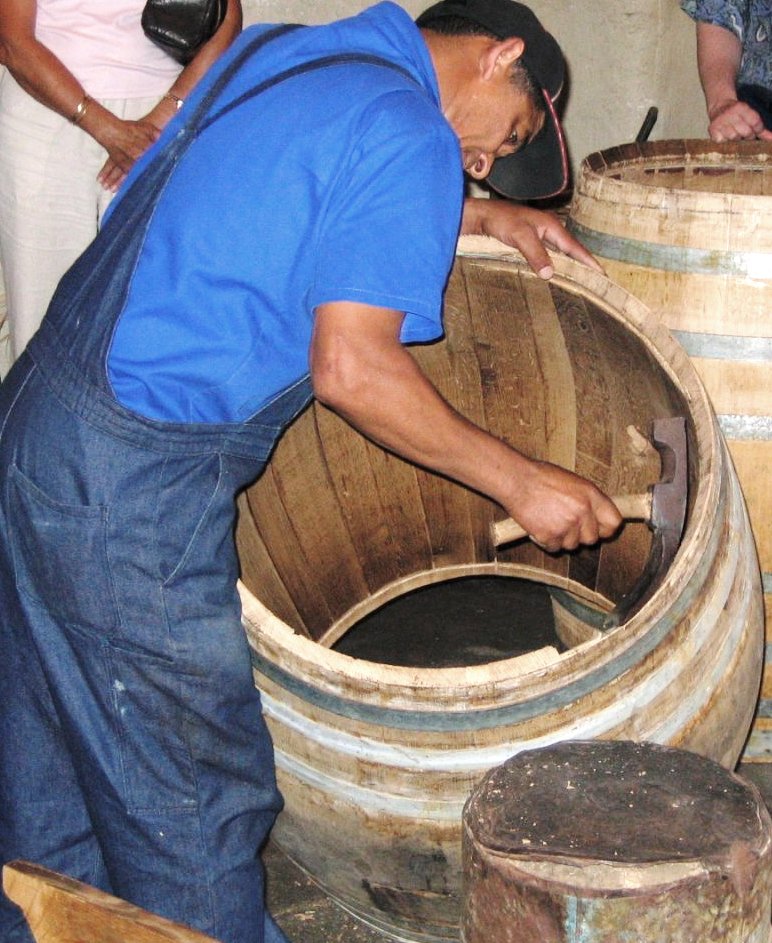
Cooper readies or rounds off the end of a barrel using a cooper's hand adze
Assembly of a barrel, called mise en rose in French

A cooper is a craftsman who produces wooden casks, barrels, vats, buckets, tubs, troughs, and other similar containers from timber staves that were usually heated or steamed to make them pliable.

Journeymen coopers also traditionally made wooden implements, such as rakes and wooden-bladed shovels. In addition to wood, other materials, such as iron, were used in the manufacturing process. The trade is the origin of the surname Cooper.

Etymology

[edit]

The word "cooper" is derived from Middle Dutch or Middle Low German kūper 'cooper' from kūpe 'cask', in turn from Latin cupa 'tun, barrel'.[1][2] The word was adopted in England as an occupational surname, Cooper.[2]

The art and skill of coopering refers to the manufacture of wooden casks, or barrels. The facility in which casks are made is referred to as a cooperage.[3][4][5][6]

History

[edit]

Traditionally, a cooper is someone who makes wooden, staved vessels, held together with wooden or metal hoops and possessing flat ends or heads. Examples of a cooper's work include casks, barrels, buckets, tubs, butter churns, vats, hogsheads, firkins, tierces, rundlets, puncheons, pipes, tuns, butts, troughs, pins and breakers.

A hooper was the man who fitted the wooden or metal hoops around the barrels or buckets that the cooper had made, essentially an assistant to the cooper.[7] The English name Hooper is derived from that profession.[8] Over time, coopers took on the role of the hooper themselves.

Antiquity

[edit]
Cooper's workshop, Roscheider Hof Open Air Museum

An Egyptian wall-painting in the tomb of Hesy-Ra, dating to 2600 BC, shows a wooden tub made of staves, bound together with wooden hoops, and used to measure.[9] Another Egyptian tomb painting dating to 1900 BC shows a cooper and tubs made of staves in use at the grape harvest.[10] Palm-wood casks were reported in use in ancient Babylon. In Europe, buckets and casks dating to 200 BC have been found preserved in the mud of lake villages.[11] A lake village near Glastonbury dating to the late Iron Age has yielded one complete tub and a number of wooden staves.[citation needed]

The Roman historian Pliny the Elder reports that cooperage in Europe originated with the Gauls in Alpine villages where they stored their beverages in wooden casks bound with hoops.[12] Pliny identified three types of coopers: ordinary coopers, wine coopers and coopers who made large casks.[13] Large casks contained more and longer staves and were correspondingly more difficult to assemble. Roman coopers tended to be independent tradesmen, passing their skills on to their sons. The Greek geographer Strabo records wooden pithoi (casks) were lined with pitch to stop leakage and preserve the wine.[14] Barrels were sometimes used for military purposes. Julius Caesar used catapults to hurl barrels of burning tar into towns under siege to start fires.[15]

Empty casks were used to line the walls of shallow wells from at least Roman times. Such casks were found in 1897 during archaeological excavation of Roman Silchester in Britain. They were made of Pyrenean silver fir and the staves were one and a half inches thick and featured grooves where the heads fitted. They had Roman numerals scratched on the surface of each stave to help with reassembly.[16]

In Anglo-Saxon Britain, wooden barrels were used to store ale, butter, honey, and mead. Drinking vessels were also made from small staves of oak, yew or pine. These items required considerable craftsmanship to hold liquids and might be bound with finely worked precious metals. They were highly valued items and were sometimes buried with the dead as grave goods.[17]

After the Battle of Hastings in 1066, when the Normans started settling in England, much wine was shipped over the English Channel from France.[18]

Wherever and whatever goods were traded, casks were used, in the same way as cardboard boxes later became common storage containers.[18]

Middle Ages to 20th century

[edit]
Cooper's brands from 1518 as recorded in a civic register from Bozen, South Tyrol[19]
Coopering of casks on a dock for a whaler

On ships

[edit]

Ships, in the age of sail, provided much work for coopers. They made water and provision casks, the contents of which sustained crew and passengers on long voyages. They also made barrels to contain high-value commodities, such as wine and sugar. The proper stowage of casks on ships about to sail was an important stevedoring skill. Casks of various sizes were used to accommodate the sloping walls of the hull and make maximum use of limited space. Casks also had to be tightly packed, to ensure they did not move during the voyage and endanger the ship, crew and cask contents.[20]

Whaling ships in particular, featuring long voyages and large crews, needed many casks – for salted meat, other provisions and water – and to store the whale oil.[21] Sperm whale oil was a particularly difficult substance to contain, due to its highly viscous nature, and oil coopers were perhaps the most skilled tradesmen in pre-industrial cooperage.[22] Whaling ships usually carried a cooper on board, to assemble shooks (disassembled barrels) and maintain casks.[23][18]

In the 19th century, coopers who crafted barrels on ships were often called groggers (or jolly jack tars), as when a barrel of rum had been emptied, they would fill it up with boiling water and roll it around, creating a drink which was called grog.[24]

On land

[edit]

Coopers in Britain started to organise as early as 1298. The Worshipful Company of Coopers is one of the oldest Livery Companies in London. It still survives today although it is now largely a charitable organisation.[25] In the 16th century, the company won the right for coopers to be independent from breweries.[24]

Many coopers worked for breweries, making the large wooden vats in which beer was brewed, such as Guinness in Ireland. They also made the wooden kegs in which the beer was shipped to liquor retailers. Beer kegs had to be particularly strong in order to contain the pressure of the fermenting liquid, and the rough handling they received when transported, sometime over long distances, to pubs where they were rolled into tap-rooms or were lowered into cellars.[3]

An ordinance passed in 1420 in England required every cooper to stamp each finished cask with a mark unique to him so his work could be recognised and to protect the trade from interlopers.[26] The practice continued well into the 20th century.

Prior to the mid-20th century, the cooper's trade flourished in the United States; a dedicated trade journal was published, the National Cooper's Journal, with advertisements from firms that supplied everything from barrel staves to purpose-built machinery.[27]

After the Industrial Revolution at the turn of the 19th century and prohibition in the United States in the early 20th century, there was less demand for barrels, and over time, various other containers were manufactured for shipping goods, including shipping containers, metal drums, and corrugated cardboard. Storing, shipping, and fermenting alcohol became the main uses for wooden barrels.[18]

In the early days, Guinness employed its own team of up to 300 highly-paid coopers in the brewery, making barrels which would be shipped around the world, and wooden casks were used by the brewery for nearly two centuries. In 1946 aluminium kegs were introduced, and over time gradually replaced the wooden barrels, until these in turn were replaced by stainless steel in the late 1980s. By 1961 there were only 70 coopers still employed by Guinness, and the last wooden cask was used in March 1963.[3]

Construction, types, and sizes

[edit]

Wood

[edit]

Barrels intended for wine storage are made predominantly with either French common oak (Quercus robur), French white oak (Quercus petraea) or American white oak (Quercus alba), or Quercus sessilifolia, an Asian species that grows in Japan, Taiwan, and much of south-eastern China.[5]

Types of coopering

[edit]

There are three main categories of coopering:[3][18]

  • White coopering, creating pails, butter churns, tubs,[3] spoons, ladles, and other household equipment[18]
  • Dry, or "slack" (U.S.), coopering, making casks for holding dry goods, like flour, tobacco and vegetables,[3] designed to keep moisture out[18]
  • Wet, or "tight" (U.S.) coopering, making casks for holding liquids, including water, wine, whiskey, milk, oil, and paint[3][18]

Cask sizes

[edit]
A cooper nailing the lid of a cask in place at a brewery in London during World War I

In wet coopering, wooden casks were traditionally made in several sizes in England and Ireland, including:[3]

  • Firkin, containing 8 imp gal (36 L; 9.6 US gal)
  • Kilderkin, containing 16 imp gal (73 L; 19 US gal)
  • Barrel, containing 32 imp gal (150 L; 38 US gal)
  • Hogshead, containing 52 imp gal (240 L; 62 US gal)
  • Butt, containing 104 imp gal (470 L; 125 US gal)

The firkin is the most common size for an ale cask.[24]

Construction process

[edit]

As part of the barrel-making process, the cask needs to be steamed to soften and loosen lignin in the wood, and it is then toasted. Toasting develops the flavours of the sugars in the wood, that is the cellulose and hemicellulose. Then the barrel is charred, which involves exposing it to 1,300 °F (704 °C) for 45 seconds.[18]

A wine barrel is toasted for around 35 minutes with a low fire, while for whiskey it is usual to toast for just 45 seconds on a high fire, to burn the surface.[28]

21st century

[edit]

In the 21st century, coopers mostly operate barrel-making machinery and assemble casks for the wine and spirits industry. Traditionally, the staves were heated to make them easier to bend. This is still done, but now because the slightly toasted interior of the staves imparts a certain flavour over time to the wine or spirit contents that is much admired by experts.

In the 1960s, breweries started using metal casks because of cost and simplicity; since then, the trade of master cooper in England has been dwindling.[24] In 2009 there were only four breweries left in England employing coopers, and only one was a master cooper: Alastair Simms at Wadworth Brewery in Devizes, Wiltshire.[29] When he appealed for apprentices, there were many applications, but the government's insistence that trainees should attend a university killed off a lot of the interest. Subsequently, there has been a resurgence of craft breweries and English winemakers employing coopers.[24] In 2015 Simms was at Theakston Brewery in Masham, North Yorkshire.[30][31][24] Simms had an apprentice by November 2015. He still uses the traditional tools, including a croze which he estimates is over 250 years old.[32]

In the United States, there are also few master coopers left. Ramiro Herrera, Master Cooper for Caldwell Vineyard in the Napa Valley, was sent to France to learn his trade, where only two out of 40 starters completed the four-year training course. It takes him around 11 hours to build a barrel, before it is ready to be toasted.[28]

Recycling casks is common in the trade, and wine casks may be converted to contain beer. Centuries-old tools remain the preferred tool of the master cooper.[24]

By 2021, very few of the 30-odd coopers left in the United States still used traditional methods.[18]

The number of coopers has declined in Australia. A 1959 photograph held in the National Library of Australia is captioned "The cooper Harry Mahlo (one of the last coopers) Yalumba wineries, Angaston, Barossa Valley, South Australia, 1959".[33] Several cooperages have closed in the 21st century, and, while there is a need for new coopers, there has been no pathway to the trade via apprenticeships since 1996, when the Howard government reformed the apprenticeship scheme to focus particularly on construction, food and hospitality, and hairdressing.[34] In January 2024, it was reported that there was only one winery left in Australia still making its own barrels for storing wine, and there were fewer than 100 people still making barrels at small cooperages for other purposes.[35] Some cooperages, such as the Margaret River Cooperage in Margaret River, Western Australia, do not make new barrels, but recooper imported barrels for use by small wineries.[5]

There are more than 150 cooperage companies in France, representing approximately 1,500 people employed in the french cooperage world and 600,000 barrels produced. This makes France the world leader[36]. Fifty of them are grouped together in the French Cooperage Federation (Fédération française de tonnellerie), created in 1978, and represent 90% of french production[37]. They are mainly located in the five major wine-growing basins[38][36]. These companies export 75% of their production worldwide, half of which to the United States. Some cooperages are listed on the stock exchange, making it one of the most dynamic sectors in the french wood industry. Cooperage represents the largest market for French oak wood, with 300,000 m3 of logs purchased in 2014[36].

In film

[edit]

The 2015 film In the Heart of the Sea featured master cooper Alastair Simms, who made 200 barrels for the film.[24]

See also

[edit]

References

[edit]

Further reading

[edit]
Revisions and contributorsEdit on WikipediaRead on Wikipedia
from Grokipedia
A cooper is a skilled craftsman who constructs and repairs wooden barrels, casks, vats, buckets, tubs, and similar containers from timber staves bound by metal hoops, a trade essential for storing and transporting liquids and dry goods throughout history. The term "cooper" derives from the Latin cuparius, meaning barrel maker, via Middle Low German kuper.[1][2][3] The profession traces its origins to ancient civilizations, evolving through Egyptian open-ended containers and Celtic innovations around 200 BC that introduced metal hoops for durability.[4][1] Romans adopted and refined the craft, with the historian Pliny the Elder documenting its use among the Gauls in the 1st century AD and standardizing sizes for wine and olive oil trade under the term cuparii, which facilitated widespread commerce across Europe.[4][1] By the medieval period, coopers formed guilds, such as the Worshipful Company of Coopers, which received its royal charter in 1501 in Britain though the trade was organized earlier, regulating quality and supporting booming industries in beer, wine, and spirits; these guilds underscored the trade's economic importance, with coopers often earning high wages due to the precision required.[1][4][2] Coopering demands expertise in woodworking, geometry, and metallurgy, typically acquired through seven-year apprenticeships culminating in mastery tests like crafting a flawless barrel; tools include draw knives, side axes, hammers, chisels, and planes to shape staves from woods like oak, pine, or chestnut, which are split, air-dried for 2–3 years, planed, bent with steam or heat, and assembled with iron or wooden hoops.[1][2][3] The process varies by type: white coopering for household items like buckets and churns; slack or dry coopering for non-liquid goods such as flour or apples; and tight or wet coopering for watertight vessels used in brewing, distilling, and shipping, often involving toasting or charring interiors at temperatures up to around 600°F (315°C) to impart flavors like vanilla during aging.[1][3][4][5] In colonial America and industrial ports like 18th–20th-century Leith, Scotland, coopers were vital to trade economies, producing up to 10 barrels per day and ensuring standardized measures for goods; their work supported naval, brewing, and distilling sectors, with records preserved in archives highlighting regional variations.[2][1] Today, the craft has declined sharply due to metal and plastic alternatives—only about 30 professional barrel coopers remained in the United States as of 2021, primarily crafting oak barrels for the craft spirits industry, where a single barrel can age whiskey for years and influence its final profile.[3] The surname "Cooper," derived from Latin cuparii, ranks among the most common in English-speaking regions, reflecting the profession's historical prevalence.[1]

Introduction and etymology

Definition and role

A cooper is a skilled craftsman who specializes in the making, repairing, and maintaining of wooden containers such as barrels, casks, vats, buckets, and tubs, constructed from timber staves bound together with metal or wooden hoops.[6] These vessels were essential for containing and transporting a wide range of materials in pre-industrial eras.[7] The primary role of a cooper involves creating containers that ensure the preservation of goods by providing watertight seals for liquids like wine, beer, water, and oil, or airtight enclosures for dry items such as food, gunpowder, and other perishables to prevent spoilage, contamination, or exposure to air and vermin.[7][8] This craftsmanship was crucial for maintaining the quality and safety of stored and shipped products, supporting industries including food preservation, distillation, and maritime trade.[6] In pre-industrial societies, coopers held significant economic and practical importance, as their work facilitated efficient storage, transportation, and trade of commodities across local and international markets, underpinning sectors like agriculture, brewing, and shipping where wooden casks were the standard for bulk handling before modern alternatives emerged.[6][9] Their specialized skills contributed to the stability of supply chains, enabling the long-distance movement of goods without substantial loss.[7] Coopers traditionally specialized into three distinct categories based on the type of goods handled: white coopers focused on dry, household items such as pails, tubs, butter churns, and utensils that did not require tight sealing, often serving domestic or small-scale needs; slack or dry coopers made containers for non-liquid bulk goods like flour, apples, or tobacco; in contrast, wet coopers crafted watertight casks for liquids, demanding greater precision to achieve leak-proof construction capable of withstanding pressure from fermenting or stored fluids like beer and wine.[1][8][6] This division allowed for efficient adaptation to varied industrial and everyday demands, with wet coopering generally regarded as the most technically demanding branch.[10]

Etymology

The word "cooper" derives from Middle English couper or cowper, first attested around 1415 as an occupational term for a craftsman who constructs and repairs wooden barrels, tubs, and casks. This entered English from Middle Dutch cūper or Middle Low German kūper, both denoting a barrel maker, which in turn stem from cūpe or kūpe meaning "cask," "tub," or "vat."[11][12][13] The root traces to Latin cupa, referring to a large wooden tun, barrel, or vat used in ancient Rome for storing and transporting liquids like wine and oil. In Roman contexts, cupa described essential trade vessels, often paired with terms like cuparius in Medieval Latin to indicate the barrel maker.[14][6] Parallel terms appear in other languages, reflecting shared linguistic origins. The French tonnelier (cooper) comes from Middle French tonnel (barrel, modern tonneau) combined with the agent suffix -ier. Similarly, the German Küfer originates from Middle High German küefer, directly meaning "cooper" or barrel maker.[15][16] Terminology for the profession evolved with container designs, shifting from broader references to simple tubs (kupe-related forms for open vessels) to specialized "casks" for sealed, liquid-holding barrels, as seen in the refinement of Dutch and German roots into modern English usage.[11][12]

Historical development

Ancient origins

The earliest evidence of coopering precursors appears in Neolithic sites across Europe and the Near East around 4000 BCE, where communities utilized hollowed-out logs as rudimentary containers for liquids and storage, foreshadowing the later stave-based construction of barrels. Archaeological excavations, such as those at early water wells in central Europe, have uncovered these hollowed trunks of deciduous trees, demonstrating advanced woodworking skills for the era that allowed for watertight vessels essential for agriculture and settlement life.[17] In Mesopotamia, while clay pithoi dominated storage, similar basic log-working techniques emerged in parallel, supporting early trade and resource management in riverine environments.[18] Coopering evolved significantly in ancient Egypt by approximately 3000 BCE, with craftsmen producing wooden buckets and vats for transporting wine and other commodities, marking a shift toward more portable and versatile containers compared to fragile ceramics. This practice spread to Greece and Rome, where specialized coopers fabricated stave-built barrels for storing and shipping wine, olive oil, and grain, enhancing efficiency in urban and military supply chains. In Rome, the "cupa"—a standardized large tun—became a hallmark of the profession, often constructed from imported northern woods like oak to ensure durability.[19] The term "cupa" reflects the linguistic roots tied to early vat-making, as noted in Roman sources.[20] Trade routes profoundly shaped these early techniques, as Mediterranean shipping demanded robust, stackable containers that outperformed amphorae in northern climes, while connections via the Silk Road from the 2nd century BCE onward introduced exchanges of woodworking knowledge across Eurasia for transporting valuables like spices and liquids. Roman adoption of Celtic barrel designs, encountered through Gallic trade, further refined hoop-bound stave assembly for long-haul voyages and overland caravans.[21] By the 1st century CE, barrels facilitated empire-wide logistics, from provisioning legions to exporting goods.[22] Key artifacts underscore this development, including remarkably preserved Roman barrel remains from Vesuvian sites like Pompeii and Herculaneum, buried in 79 CE, which reveal basic stave-and-hoop construction using local and imported timbers for everyday and commercial use. Additional evidence from Reims (circa 100-200 CE) highlights skilled coopering with radial-sawn staves and iron hoops, while assemblages at Vindolanda in Britain (early 2nd century CE) show barrels' role in frontier trade, often repaired and recycled over multiple phases. These finds illustrate the profession's maturation up to the Roman Empire's fall, with over 390 coopered elements documented across provinces.[23][24]

Medieval to early modern periods

During the medieval period, coopering evolved from informal craftsmanship into a regulated profession through the formation of guilds across Europe, beginning as early as the 12th century. In England, the fellowship of coopers likely originated around this time, with the earliest documented record appearing in 1298 when London coopers were fined for price-fixing activities by the city's authorities.[25] These guilds, such as the London Company of Coopers, established formal structures to oversee apprenticeships, enforce quality standards for barrel construction, and maintain standardized measures essential for trade in goods like ale, wine, and salt. By regulating entry into the trade—typically requiring seven years of apprenticeship—guilds ensured skilled labor while protecting members from competition, fostering a professional identity tied to both economic and religious functions, as seen in continental examples like the 1286 Florence guild dispute over innovative stave-bending techniques using water.[26] The Black Death of 1347–1351 profoundly disrupted the cooperage trade by decimating Europe's population and creating acute labor shortages, which accelerated specialization within the profession. With up to one-third of the workforce lost, surviving coopers commanded higher wages and greater autonomy, prompting guilds to distinguish between "wet" coopers, who crafted watertight barrels for liquids such as wine and beer, and "dry" coopers, who made containers for solids like flour or gunpowder.[27] This division, formalized in guild charters by the late 14th century, allowed for more efficient training and production amid reduced labor pools, ultimately enhancing the trade's resilience as demand for reliable storage surged in recovering markets.[28] Regional variations emerged prominently in the 14th century, reflecting local economic needs. In Bordeaux, France, coopers specialized in wine barrels to support the region's burgeoning export trade, adapting Celtic-era designs to create durable oak casks suited for long-distance shipping across the Atlantic and to England, where annual exports reached tens of thousands of tuns by the early 1300s.[29] In England, shipyard coopers in ports like London and Portsmouth focused on naval stores, producing barrels for tar, pitch, and turpentine essential to the Royal Navy's maintenance during the Tudor era.[30] As Europe entered the early modern period and the Age of Sail (c. 15th–18th centuries), coopering advanced technically to meet the demands of colonial expansion, particularly in stave bending and iron hoop application. Coopers refined heating and steaming methods to curve oak staves more precisely, enabling larger, leak-proof casks that withstood ocean voyages, while iron hoops—replacing wooden ones for greater durability—were hammered into place to secure assemblies under maritime stresses.[4] These innovations supported transatlantic trade in commodities like rum from the Caribbean, tobacco from Virginia, and salted fish from Newfoundland, with coopers' guilds expanding to colonial outposts to standardize production for imperial fleets.[31]

19th and 20th centuries

The profession of cooper experienced significant growth during the late 18th and 19th centuries amid the Industrial Revolution, as mechanization and expanding global trade amplified demand for wooden barrels in shipping, agriculture, and emerging industries. In the United States, coopers shifted toward mass production, with cooperages adopting steam-powered tools and assembly lines to fabricate standardized casks for commodities like flour, salted meat, and whiskey. By the mid-19th century, the discovery of oil in Pennsylvania in 1859 triggered an unprecedented surge in barrel needs, as petroleum required watertight containers for transport; U.S. oil production reached 20 million barrels annually by the 1870s, necessitating coopers to produce millions of 42-gallon barrels each year to match this volume.[32][33] Specialized roles emerged in key sectors, including whaling and petroleum. Whaling ships routinely employed coopers as onboard craftsmen to assemble disassembled "shooks" into barrels and maintain casks for storing whale oil during extended voyages, a critical task that ranked them above average crewmen in ship hierarchy. In the petroleum industry, Standard Oil, founded in 1870, influenced barrel standardization by establishing in-house cooperages that halved production costs from $3 to $1.50 per barrel by 1870, while the Petroleum Producers Association formalized the 42-gallon oil barrel in 1872 to streamline rail and barge transport—fitting 20 barrels per flatcar.[34][33] The 1849 California Gold Rush further boosted demand, as the influx of over 300,000 prospectors created acute shortages of provisions, including water hauled in barrels by wagon or on foot to supply booming settlements like San Francisco. Wet coopers, who crafted liquid-tight barrels for whiskey and oil, thrived in this era, but the U.S. Prohibition era (1920–1933) severely disrupted their trade by banning alcohol production and sales, closing distilleries and eliminating thousands of jobs for barrel makers amid the collapse of related industries.[35][36] The early 20th century marked the onset of decline for traditional cooperage, accelerated post-World War II (1940s–1970s) by the rise of metal drums and plastic containers, which offered durability and lower costs for shipping chemicals, oil, and foodstuffs. In Kentucky, a hub for whiskey barrel production, the cooper workforce contracted dramatically—from thousands employed in peak distilleries to mere hundreds by the late 20th century—as bourbon output stabilized at around 2.3 million barrels annually in the 1960s but faced competition from synthetic alternatives.[37][38]

Techniques and materials

Woods and preparation

The selection of wood for coopering prioritizes species with inherent properties that ensure the barrel's impermeability, structural integrity, and flavor contribution to its contents. American white oak (Quercus alba) is the predominant choice for tight cooperage, particularly in bourbon and whiskey barrels, due to the presence of tyloses—bubble-like structures in the heartwood that swell upon contact with water, sealing the wood's vessels and preventing leakage.[39][40] European oaks, such as those from French forests (Quercus robur or Quercus petraea) or Hungarian/Slavonian regions, are favored for wine barrels because of their finer grain and subtler tannin profile, which imparts balanced vanilla and spice notes without overpowering the wine's character.[41][42] Alternatives like American chestnut (Castanea dentata) or redwood (Sequoia sempervirens) have been used historically for less demanding applications, such as vinegar or water storage, where their natural rot resistance suffices, though they lack the tightness of oak.[43] Sourcing timber for coopering emphasizes sustainability to maintain long-term availability, with white oak primarily harvested from managed forests in the eastern United States, including Appalachian and Ozark regions, where selective logging supports regeneration; however, as of 2025, increased demand from the bourbon industry has raised concerns about white oak decline, prompting initiatives like the White Oak Resilience Act to promote forest health.[44][45][46] For European oak, wood is drawn from certified forests in France, Hungary, and Croatia, adhering to strict environmental standards to preserve biodiversity.[47] These practices ensure a steady supply while minimizing deforestation impacts. Once sourced, the wood undergoes seasoning through air-drying, typically lasting 2 to 5 years outdoors in stacked piles to gradually reduce moisture content to 12-18%, which prevents fungal rot, stabilizes the timber, and enhances pliability for bending.[48][49] This natural process also leaches out bitter extractives, improving the wood's suitability for aging beverages. Preparation begins with quarter-sawing the seasoned logs into staves, a radial cutting method that aligns the grain perpendicular to the board's face, minimizing warping and twisting during use.[50] Standard staves measure approximately 1 to 1.5 inches in thickness and 30 to 36 inches in length, depending on the barrel size, with widths varying from 4 to 6 inches at the widest point to form the curved structure efficiently.[50] Environmental considerations in wood choice focus on resistance to the acids and alcohols in stored liquids; white oak's tyloses provide exceptional impermeability to acetic acid in vinegar and ethanol in spirits, while European oak's denser structure resists microbial penetration in wine.[51][52] This durability ensures the barrel maintains integrity over years of aging without imparting off-flavors from degradation.

Tools and equipment

Coopers rely on a suite of specialized hand tools, featuring metal blades and wooden handles, designed for precision shaping and assembly of wooden staves.[53] The drawknife, featuring a long blade with two handles, is fundamental for shaving and curving the inner and outer surfaces of staves to form the barrel's bilge and contours.[54] Complementing this, the backing knife—a variant of the drawknife with a curved or straight blade—refines the external bevels and edges of staves for a tight fit, while the hollowing knife shapes the internal hollow.[53] The adze, with its perpendicular axe-like blade on a short handle, provides rough hollowing and chiming of stave ends, often used after heating the wood to facilitate bending.[55] For groove cutting, the croze—a chisel-like tool with a sliding block—precisely incises the croze line at each end of the barrel to seat the headpieces, ensuring leak-proof assembly; its blade must maintain uniform depth, typically around 1/8 inch for standard casks.[53] Assembly tools include hoop drivers, mallets with tapered heads for positioning metal or wooden hoops without damage, and trusses—temporary iron or wooden supports that hold staves in place during bending and raising.[54] Howels, specialized gouges, create sunken ledges in the barrel heads for flush fitting and reinforcement. In the 19th century, many of these tools evolved from wrought iron construction to high-carbon steel blades, improving edge retention and reducing frequent sharpening needs amid increased production demands.[56] Additional implements like the froe and mallet aid initial stave splitting along the grain, while the shaving horse—a foot-operated vise—secures pieces for safe, ergonomic handling during drawknife work.[54] A typical 19th-century cooper's workshop featured a compact layout optimized for workflow, with a central workbench, shaving horse, and wall-mounted racks for tools; the jointer—a long plane up to 6 feet—smoothed and beveled stave edges for precise alignment, often set to angles of 45-60 degrees at the bilge for structural integrity.[57] The sun plane, a narrow-bodied tool, leveled the chime after adzing, creating a seating surface for heads, while the bevel square measured critical angles to prevent leaks.[56] These setups emphasized efficiency in small sheds or urban shops, where coopers processed staves sequentially from rough cutting to finishing.[53] The profession's physical demands, involving repetitive pulling with drawknives, swinging adzes, and hammering hoops, pose ergonomic challenges, including risks of upper limb musculoskeletal disorders from prolonged awkward postures and vibration exposure; historical accounts note the need for strong builds, with modern studies confirming elevated injury rates among coopers.[58] Safety measures traditionally included sharp tool maintenance to avoid slips and supportive benches to reduce strain, though the trade's manual nature limited mechanization until the late 19th century.[54]

Construction process

The construction of a traditional wooden barrel begins with raising the staves, where pre-shaped wooden planks are arranged in a circular formation around one of the barrel heads, often secured temporarily with a head-hoop and a cooper's vice to form the initial structure.[6] This assembly creates the barrel's basic cylindrical form, with the staves positioned to achieve the characteristic bilge curve—a pronounced bulge in the middle that enhances structural strength by distributing pressure from contents evenly across the hoops.[59] To facilitate bending, the staves are heated over an open fire or cresset for approximately 20 minutes until pliable, allowing the cooper to truss them tightly using a windlass and adze, which draws the ends together while expanding the middle into the bilge shape.[59] Once bent, permanent hoops—typically made of iron or hickory—are fitted starting from the ends and progressing toward the bilge, driven into place with a mallet and hoop driver to compress the staves and ensure a seamless joint.[6] The ends of the barrel are then trimmed level using a hatchet and smoothed with a plane, followed by cutting a croze groove around the interior rim with a specialized croze tool to accommodate the heads.[6] The second head is prepared by measuring and cutting it to fit precisely, beveling its edges, and inserting it into the croze, where it is held in place by the compressive force of the hoops.[59] Variations in the process distinguish tight barrels, designed for liquids, from slack barrels for dry goods; tight barrels require more refined jointing of staves for watertight seals, using thicker materials and additional precision in beveling, while slack barrels allow looser fits since they do not need to retain moisture.[59] For barrels intended for spirits, the interior is charred after assembly by exposing the wood to an open flame for 15 to 30 seconds, creating a carbon layer that filters impurities and imparts flavor compounds during aging.[60] Quality checks throughout involve verifying the evenness of the bilge curve with patterns, ensuring no gaps in the stave joints by visual and manual inspection, and finally filling the completed barrel with water to test for leaks, with any imperfections addressed by tightening hoops or refitting heads.[6] A skilled cooper typically requires about 11 hours to hand-build a standard barrel, encompassing all these steps from raising to testing.[61]

Types and standards

Varieties of coopering

Coopering is traditionally divided into three primary varieties based on the intended use and construction requirements of the containers: white, dry (also known as slack), and wet (also known as tight). White coopering involves crafting small, non-watertight vessels for household and farm use, such as pails, butter churns, tubs, and kitchen utensils, typically using softwoods like pine or cedar that do not require the precision needed for liquid containment.[62][63] Dry or slack coopering produces larger barrels for non-liquid goods that do not demand absolute sealing, including butter firkins for dairy storage and nail kegs for hardware transport, often employing woods like oak but with looser stave assembly to allow for expansion and contraction without leakage concerns.[10][4] In contrast, wet or tight coopering creates watertight casks designed to hold liquids under pressure, such as wine pipes for transporting Bordeaux or beer hogsheads for ale maturation, necessitating exacting craftsmanship with hardwoods like oak to ensure durability and impermeability.[64][62] Specializations within coopering emerged to meet industry-specific needs, particularly in maritime and distilling contexts. Ship coopers focused on constructing and maintaining large water casks essential for long voyages, using robust tight construction to prevent spoilage and sustain crews, often repairing barrels at sea or in port to address damage from rough handling.[65][59] Distillery coopers specialize in fabricating charred oak barrels for spirits like bourbon, where the interior charring process imparts flavor compounds during aging; these professionals typically work in-house at facilities, assembling new barrels from staves seasoned for optimal interaction with whiskey.[66][67] Coopering tasks are further categorized by whether they involve new making—full construction of barrels from raw staves—or repair work, which includes replacing damaged heads, rehooping, and reseasoning to extend cask life, a distinction critical in high-volume trades like brewing and shipping where maintenance ensures ongoing usability.[68][69] Regional styles reflect local resources and commodities, adapting core techniques to unique demands. In Scotland, slack coopers produced specialized barrels for the herring industry, crafting non-tight casks to pack salted fish for export, with coopers' yards in ports like Wick supporting the trade by manufacturing up to 120,000 barrels annually in the late 19th century to preserve the seasonal catch.[70][71] Japanese coopers, known as okeya or kioke specialists, construct cedar vats called kioke for sake fermentation, using breathable Yoshino cedar staves bound by bamboo hoops to promote microbial activity and traditional brewing in regions like Nada, where these vessels enhance the beverage's nuanced flavors.[72][73] In contemporary practice, while traditional wooden coopering persists, hybrid varieties incorporating composite materials have appeared for short-term liquid storage, blending wood elements with plastic liners or reinforcements to reduce costs and improve portability in applications like rainwater collection or temporary shipping, though these diverge from pure craftsmanship.[74]

Cask sizes and measurements

Cask sizes and measurements have evolved from historical standards rooted in trade needs, with variations across regions and systems to accommodate different liquids and purposes. In the English wine trade, which began standardizing units around the 14th century, traditional sizes included the hogshead at 63 U.S. gallons, the barrel at 31.5 U.S. gallons for beer and oil, and the puncheon at 84 U.S. gallons for rum.[75][76] These measurements facilitated efficient storage and transport, with the hogshead term emerging in the 15th century as a key unit equivalent to 63 gallons.[77] Differences between Imperial and U.S. standards arose post-colonization, reflecting adjustments for local practices. The British barrel holds 36 imperial gallons, larger than the U.S. equivalent of 31.5 U.S. gallons, to suit brewing and shipping requirements.[77] Conversions to the metric system aid modern comparisons, such as the U.S. barrel equating to approximately 119 liters.[75] Regional variations highlight adaptations to local commodities and traditions. In France, the pièce measures 228 liters and is standard for aging Burgundy wines, while Bordeaux employs the barrique at 225 liters for its red varietals.[78] For international trade, modern standards emphasize consistency, with the 225-liter barrique widely adopted for wine export, supported by industry guidelines rather than rigid ISO specifications for wooden casks.[79] Basic volume calculations for coopers rely on structural elements like stave count and dimensions. A typical cask uses 24 to 38 staves, with 32 being common for balance and strength, combined with head diameters of 21 to 26 inches in standard barrels to achieve the desired capacity.[80][81] These parameters ensure the barrel's bilge allows for expansion while maintaining integrity during filling and transport.

Modern practice

Decline and revival

The traditional profession of coopering underwent a sharp decline in the post-World War II era, as the introduction of plastic and steel containers from the 1950s onward displaced wooden barrels in most industrial and commercial uses due to their superior durability, lighter weight, and reduced production costs.[82][83] In the United States, where the trade had thrived with over 50,000 coopers in the late 19th century, the workforce dwindled to fewer than 1,000 by 2000, reflecting the broader shift away from wooden casks for liquids and dry goods.[84] A resurgence began in the early 2000s, propelled by the explosive growth of craft brewing and distilling sectors seeking authentic, traditional aging methods to enhance flavor profiles in premium products. This revival has been particularly pronounced in the Kentucky bourbon industry, where legal requirements for new charred oak barrels have sustained demand amid a production boom that filled a record 3.2 million barrels in 2023 alone. By 2025, the sector continues to support major cooperages like Independent Stave Company and Brown-Forman, though the number of traditional master coopers remains low (around 30 in the U.S. as of 2021), while factory operations employ broader workforces; earlier projections of the profession's near-extinction have been countered.[85][86][87][3] The global wooden barrels market, valued at approximately $879 million in 2024, has benefited from this niche resurgence, with much of the growth attributed to the premium spirits segment where oak aging imparts distinctive tastes essential for high-end whiskeys, wines, and rums.[88] However, the revival confronts ongoing hurdles, including an aging workforce—many coopers now in their 50s or older—and acute shortages in skilled training, as the craft demands years of hands-on apprenticeship. Efforts to mitigate these issues include new facilities and structured apprenticeship programs in Scotland's whisky industry, such as the £1.3 million-backed cooperage launched in 2025 to train emerging talent and ensure long-term sustainability.[89] In 2025, the bourbon sector faces additional pressures from production slowdowns, record-high aging inventories (16.1 million bourbon barrels as of January 2025), and potential tariffs, with barrel taxes reaching $75 million, up 27% from 2024.[90]

Current applications

In the 21st century, coopering remains essential to the production of premium spirits, wines, and craft beers, where oak barrels impart complex flavors through maturation processes. In the United States, all straight bourbon whiskey must be aged in new charred oak barrels as mandated by federal standards, with production projected at approximately 230 million gallons in 2025 (equivalent to over 4 million barrels annually, based on mid-2025 trends showing declines from prior peaks).[91] Globally, the market for oak barrels used in wine, scotch, and whiskey is valued at around $2.2 billion as of 2025, with production involving millions of barrels each year to meet demand from aging premium beverages.[92] Wine aging in oak barrels continues for high-end varieties, enhancing tannins and aromas, while craft beer producers increasingly utilize used whiskey barrels to experiment with barrel-aged stouts and sours, adding depth without requiring extensive new coopering. Innovations in coopering focus on extending barrel life and diversifying flavor profiles. Recharred used barrels, particularly ex-bourbon casks refurbished for scotch whisky, involve disassembling, shaving neutral inner layers, and applying new char to revive oak influence, a practice refined at facilities like the Cambus Cooperage. Hybrid barrels, blending different oak species such as American and French or incorporating alternative materials like clay for the vessel body with wooden staves, offer eco-friendlier options by reducing reliance on virgin oak while providing unique maturation characteristics. These advancements support sustainability by minimizing waste and adapting to varied producer needs. Sustainability efforts in modern coopering emphasize responsible sourcing and circular practices. Major cooperages certify American white oak under the Sustainable Forestry Initiative (SFI) Fiber Sourcing Standard to ensure sustainable harvesting, with over 17.1 million barrels aging in Kentucky alone as of 2025.[93] French oak suppliers often use PEFC certification for forest management, promoting biodiversity and traceability. In the European Union, regulations such as Commission Regulation (EU) No 401/2010 stipulate oak barrel maturation for certain protected designation of origin wines, allowing multiple reuses to extend barrel utility.[94] End-of-life staves are recycled into furniture like tables and chairs, transforming waste into durable products and reducing landfill contributions. Key geographic hubs drive contemporary coopering. Kentucky, United States, serves as the epicenter for bourbon barrel production, with facilities like Kentucky Cooperage crafting millions of new oak barrels yearly. In Jerez de la Frontera, Spain, specialized cooperages maintain sherry cask traditions, producing American oak butts for fortified wines. Emerging activity in Australia supports boutique wineries, where local coopers supply custom oak barrels for innovative varietals, reflecting growing demand in the Asia-Pacific region.

Social and cultural significance

Guilds, apprenticeships, and profession

The Worshipful Company of Coopers in London, granted its first royal charter by Henry VII in 1501, played a central role in regulating the profession by establishing quality standards for barrels, overseeing labor conditions, and controlling wages to maintain fair practices within the trade.[95][25] Similar organizations existed across Europe, including the Küfereigilden (coopers' guilds) in German cities such as Anklam, where they organized craftsmen, enforced production norms, and facilitated communal activities from the late medieval period through the 18th century.[96][4] These guilds collectively ensured the profession's integrity by limiting entry, resolving disputes, and promoting standardized techniques essential for trade and storage. Apprenticeship formed the backbone of cooper training historically and continues today. In the 18th century, aspiring coopers typically served a seven-year term under a master, progressing through stages from basic tasks to journeyman status and eventual mastery, which included comprehensive instruction in stave preparation, barrel assembly, and quality gauging.[59][2] Modern programs have shortened to 2-4 years, often at operational cooperages where trainees work alongside seasoned professionals; for instance, initiatives at distilleries like Irish Distillers emphasize hands-on learning in contemporary barrel production while preserving traditional skills.[97] Professional organizations uphold industry standards in the present day. The Associated Cooperage Industries of America (ACIA), established in 1934, supports wooden cooperage operations by providing resources on best practices, sustainability, and regulatory compliance for members worldwide.[98] Certifications, such as those earned through structured apprenticeship completions, recognize proficiency as a certified cooper. Coopers enjoyed elevated socioeconomic status in the medieval era, their specialized skills in crafting durable containers granting them prestige comparable to other essential artisans, as reflected in guild protections and community reliance on their work for commerce and preservation.[4] In the contemporary context, the role remains a niche craft occupation, with U.S. salaries typically ranging from $40,000 to $70,000 annually, depending on experience, location, and employer, underscoring its blend of tradition and specialized demand in industries like distilling and brewing.[99][100] The profession's historical prevalence is also reflected in the surname "Cooper," which ranks among the most common occupational surnames in English-speaking countries, such as the 8th most common in the United States as of the 2020 census.[101]

Depictions in media and culture

In literature, the profession of the cooper has often symbolized working-class resilience and craftsmanship amid industrial change. Depictions in film and television highlight the cooper's specialized role in historical settings. Modern documentaries, like the 2020s YouTube video "Handcrafted Barrel Cooper's Historic Art" from the channel Earth Uncovered, showcase the labor-intensive process of stave assembly and barrel construction using archival footage from 1962, illustrating traditional techniques as practiced at cooperages.[102] Culturally, coopers and their barrels carry symbolic weight in festivals and language. The Schäfflertanz, or Coopers' Dance, is a historic parade in Munich performed every seven years by barrel makers' guild members, originating in the 16th century as a celebratory procession with wooden barrel props to invoke prosperity and community spirit, notably tied to events like Oktoberfest.[103] The idiom "over a barrel," meaning to be in a vulnerable position, traces to 19th-century American practices where individuals were laid over barrels for punishment or to clear lungs after near-drowning, evoking powerlessness in trade and seafaring contexts linked to coopering.[104] In 21st-century media, the revival of artisanal coopering has gained traction through podcasts and online videos celebrating heritage crafts. The "Past & Present" podcast episode "Meet the Cooper" (2012) features Colonial Williamsburg artisan Ramona Vogel demonstrating traditional barrel-making techniques, highlighting the skill's endurance in historical reenactments.[105] YouTube channels like Tillers International offer tutorials on coopering jigs and barrel construction, promoting hands-on learning and the profession's resurgence amid interest in sustainable, small-batch distilling.[106]

References

User Avatar
No comments yet.