Hubbry Logo
Covalent bondCovalent bondMain
Open search
Covalent bond
Community hub
Covalent bond
logo
8 pages, 0 posts
0 subscribers
Be the first to start a discussion here.
Covalent bond
Covalent bond
from Wikipedia
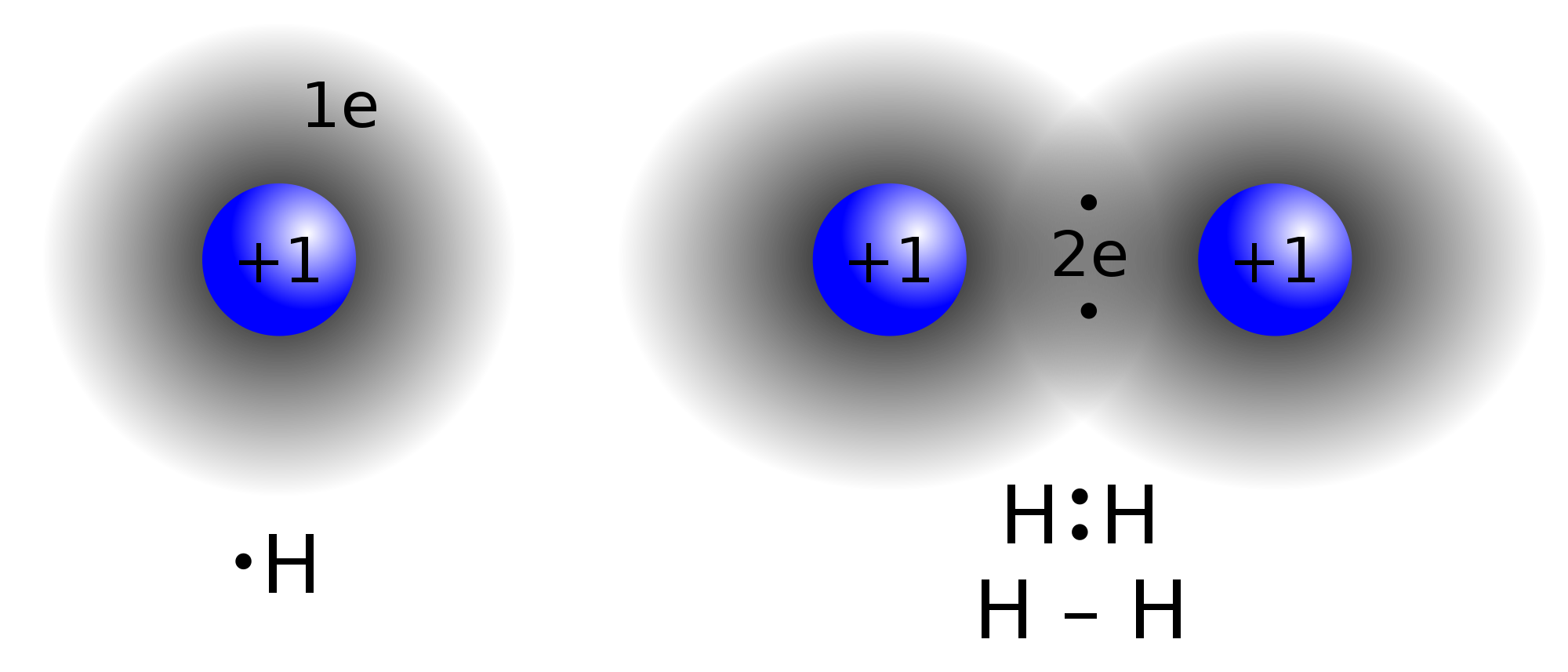
A covalent bond forming H2 (right) where two hydrogen atoms share the two electrons

A covalent bond is a chemical bond that involves the sharing of electrons to form electron pairs between atoms. These electron pairs are known as shared pairs or bonding pairs. The stable balance of attractive and repulsive forces between atoms, when they share electrons, is known as covalent bonding.[1] For many molecules, the sharing of electrons allows each atom to attain the equivalent of a full valence shell, corresponding to a stable electronic configuration. In organic chemistry, covalent bonding is much more common than ionic bonding.

Covalent bonding also includes many kinds of interactions, including σ-bonding, π-bonding, metal-to-metal bonding, agostic interactions, bent bonds, three-center two-electron bonds and three-center four-electron bonds.[2][3] The term "covalence" was introduced by Irving Langmuir in 1919, with Nevil Sidgwick using "co-valent link" in the 1920s. Merriam-Webster dates the specific phrase covalent bond to 1939,[4] recognizing its first known use. The prefix co- (jointly, partnered) indicates that "co-valent" bonds involve shared "valence", as detailed in valence bond theory.

In the molecule H
2
, the hydrogen atoms share the two electrons via covalent bonding.[5] Covalency is greatest between atoms that have similar electronegativities, regardless of whether the elements are the same as each other. Covalent bonding that entails the sharing of electrons over more than two atoms is said to be delocalized.

History

[edit]
Early concepts in covalent bonding arose from this kind of image of the molecule of methane. Covalent bonding is implied in the Lewis structure by indicating electrons shared between atoms.

The term covalence in regard to bonding was first used in 1919 by Irving Langmuir in a Journal of the American Chemical Society article entitled "The Arrangement of Electrons in Atoms and Molecules". Langmuir wrote that "we shall denote by the term covalence the number of pairs of electrons that a given atom shares with its neighbors."[6]

The idea of covalent bonding can be traced several years before 1919 to Gilbert N. Lewis, who in 1916 described the sharing of electron pairs between atoms[7] (and in 1926 he also coined the term "photon" for the smallest unit of radiant energy). He introduced the Lewis notation or electron dot notation or Lewis dot structure, in which valence electrons (those in the outer shell) are represented as dots around the atomic symbols. Pairs of electrons located between atoms represent covalent bonds. Multiple pairs represent multiple bonds, such as double bonds and triple bonds. An alternative form of representation, not shown here, has bond-forming electron pairs represented as solid lines.[8]

Lewis proposed that an atom forms enough covalent bonds to form a full (or closed) outer electron shell. In the diagram of methane shown here, the carbon atom has a valence of four and is, therefore, surrounded by eight electrons (the octet rule), four from the carbon itself and four from the hydrogens bonded to it. Each hydrogen has a valence of one and is surrounded by two electrons (a duet rule) – its own one electron plus one from the carbon. The numbers of electrons correspond to full shells in the quantum theory of the atom; the outer shell of a carbon atom is the n = 2 shell, which can hold eight electrons, whereas the outer (and only) shell of a hydrogen atom is the n = 1 shell, which can hold only two.[9]

While the idea of shared electron pairs provides an effective qualitative picture of covalent bonding, quantum mechanics is needed to understand the nature of these bonds and predict the structures and properties of simple molecules. Walter Heitler and Fritz London are credited with the first successful quantum mechanical explanation of a chemical bond (molecular hydrogen) in 1927.[10] Their work was based on the valence bond model, which assumes that a chemical bond is formed when there is good overlap between the atomic orbitals of participating atoms.

Types of covalent bonds

[edit]

Atomic orbitals (except for s orbitals) have specific directional properties leading to different types of covalent bonds. Sigma (σ) bonds are the strongest covalent bonds and are due to head-on overlapping of orbitals on two different atoms. A single bond is usually a σ bond. Pi (π) bonds are weaker and are due to lateral overlap between p (or d) orbitals. A double bond between two given atoms consists of one σ and one π bond, and a triple bond is one σ and two π bonds.[8]

Covalent bonds are also affected by the electronegativity of the connected atoms which determines the chemical polarity of the bond. Two atoms with equal electronegativity will make nonpolar covalent bonds such as H–H. An unequal relationship creates a polar covalent bond such as with H−Cl. However polarity also requires geometric asymmetry, or else dipoles may cancel out, resulting in a non-polar molecule.[8]

Covalent structures

[edit]

There are several types of structures for covalent substances, including individual molecules, molecular structures, macromolecular structures and giant covalent structures. Individual molecules have strong bonds that hold the atoms together, but generally, there are negligible forces of attraction between molecules. Such covalent substances are usually gases, for example, HCl, SO2, CO2, and CH4. In molecular structures, there are weak forces of attraction. Such covalent substances are low-boiling-temperature liquids (such as ethanol), and low-melting-temperature solids (such as iodine and solid CO2). Macromolecular structures have large numbers of atoms linked by covalent bonds in chains, including synthetic polymers such as polyethylene and nylon, and biopolymers such as proteins and starch. Network covalent structures (or giant covalent structures) contain large numbers of atoms linked in sheets (such as graphite), or 3-dimensional structures (such as diamond and quartz). These substances have high melting and boiling points, are frequently brittle, and tend to have high electrical resistivity. Elements that have high electronegativity, and the ability to form three or four electron pair bonds, often form such large macromolecular structures.[11]

One- and three-electron bonds

[edit]
Lewis and MO diagrams of an individual 2e bond and 3e bond

Bonds with one or three electrons can be found in radical species, which have an odd number of electrons. The simplest example of a 1-electron bond is found in the dihydrogen cation, H+
2
. One-electron bonds often have about half the bond energy of a 2-electron bond, and are therefore called "half bonds". However, there are exceptions: in the case of dilithium, the bond is actually stronger for the 1-electron Li+
2
than for the 2-electron Li2. This exception can be explained in terms of hybridization and inner-shell effects.[12]

The simplest example of three-electron bonding can be found in the helium dimer cation, He+
2
. It is considered a "half bond" because it consists of only one shared electron (rather than two);[13] in molecular orbital terms, the third electron is in an anti-bonding orbital which cancels out half of the bond formed by the other two electrons. Another example of a molecule containing a 3-electron bond, in addition to two 2-electron bonds, is nitric oxide, NO. The oxygen molecule, O2 can also be regarded as having two 3-electron bonds and one 2-electron bond, which accounts for its paramagnetism and its formal bond order of 2.[14] Chlorine dioxide and its heavier analogues bromine dioxide and iodine dioxide also contain three-electron bonds.

Molecules with odd-electron bonds are usually highly reactive. These types of bond are only stable between atoms with similar electronegativities.[14]

Dioxygen is sometimes represented as obeying the octet rule with a double bond (O=O) containing two pairs of shared electrons.[15] However the ground state of this molecule is paramagnetic, indicating the presence of unpaired electrons. Pauling proposed that this molecule actually contains two three-electron bonds and one normal covalent (two-electron) bond.[16] The octet on each atom then consists of two electrons from each three-electron bond, plus the two electrons of the covalent bond, plus one lone pair of non-bonding electrons. The bond order is 1+0.5+0.5=2.

Modified Lewis structures with 3e bonds
Nitric oxide
Dioxygen

Resonance

[edit]

There are situations whereby a single Lewis structure is insufficient to explain the electron configuration in a molecule and its resulting experimentally-determined properties, hence a superposition of structures is needed. The same two atoms in such molecules can be bonded differently in different Lewis structures (a single bond in one, a double bond in another, or even none at all), resulting in a non-integer bond order. The nitrate ion is one such example with three equivalent structures. The bond between the nitrogen and each oxygen is a double bond in one structure and a single bond in the other two, so that the average bond order for each N–O interaction is 2 + 1 + 1/3 = 4/3.[8]

Aromaticity

[edit]

In organic chemistry, when a molecule with a planar ring obeys Hückel's rule, where the number of π electrons fit the formula 4n + 2 (where n is an integer), it attains extra stability and symmetry. In benzene, the prototypical aromatic compound, there are 6 π bonding electrons (n = 1, 4n + 2 = 6). These occupy three delocalized π molecular orbitals (molecular orbital theory) or form conjugate π bonds in two resonance structures that linearly combine (valence bond theory), creating a regular hexagon exhibiting a greater stabilization than the hypothetical 1,3,5-cyclohexatriene.[9]

In the case of heterocyclic aromatics and substituted benzenes, the electronegativity differences between different parts of the ring may dominate the chemical behavior of aromatic ring bonds, which otherwise are equivalent.[9]

Hypervalence

[edit]

Certain molecules such as xenon difluoride and sulfur hexafluoride have higher coordination numbers than would be possible due to strictly covalent bonding according to the octet rule. This is explained by the three-center four-electron bond ("3c–4e") model which interprets the molecular wavefunction in terms of non-bonding highest occupied molecular orbitals in molecular orbital theory and resonance of sigma bonds in valence bond theory.[17]

Electron deficiency

[edit]

In three-center two-electron bonds ("3c–2e") three atoms share two electrons in bonding. This type of bonding occurs in boron hydrides such as diborane (B2H6), which are often described as electron deficient because there are not enough valence electrons to form localized (2-centre 2-electron) bonds joining all the atoms. However, the more modern description using 3c–2e bonds does provide enough bonding orbitals to connect all the atoms so that the molecules can instead be classified as electron-precise.

Each such bond (2 per molecule in diborane) contains a pair of electrons which connect the boron atoms to each other in a banana shape, with a proton (the nucleus of a hydrogen atom) in the middle of the bond, sharing electrons with both boron atoms. In certain cluster compounds, so-called four-center two-electron bonds also have been postulated.[18]

Quantum mechanical description

[edit]

After the development of quantum mechanics, two basic theories were proposed to provide a quantum description of chemical bonding: valence bond (VB) theory and molecular orbital (MO) theory. A more recent quantum description[19] is given in terms of atomic contributions to the electronic density of states.

Comparison of VB and MO theories

[edit]

The two theories represent two ways to build up the electron configuration of the molecule.[20] For valence bond theory, the atomic hybrid orbitals are filled with electrons first to produce a fully bonded valence configuration, followed by performing a linear combination of contributing structures (resonance) if there are several of them. In contrast, for molecular orbital theory, a linear combination of atomic orbitals is performed first, followed by filling of the resulting molecular orbitals with electrons.[8]

The two approaches are regarded as complementary, and each provides its own insights into the problem of chemical bonding. As valence bond theory builds the molecular wavefunction out of localized bonds, it is more suited for the calculation of bond energies and the understanding of reaction mechanisms. As molecular orbital theory builds the molecular wavefunction out of delocalized orbitals, it is more suited for the calculation of ionization energies and the understanding of spectral absorption bands.[21]

At the qualitative level, both theories contain incorrect predictions. Simple (Heitler–London) valence bond theory correctly predicts the dissociation of homonuclear diatomic molecules into separate atoms, while simple (Hartree–Fock) molecular orbital theory incorrectly predicts dissociation into a mixture of atoms and ions. On the other hand, simple molecular orbital theory correctly predicts Hückel's rule of aromaticity, while simple valence bond theory incorrectly predicts that cyclobutadiene has larger resonance energy than benzene.[22]

Although the wavefunctions generated by both theories at the qualitative level do not agree and do not match the stabilization energy by experiment, they can be corrected by configuration interaction.[20] This is done by combining the valence bond covalent function with the functions describing all possible ionic structures or by combining the molecular orbital ground state function with the functions describing all possible excited states using unoccupied orbitals. It can then be seen that the simple molecular orbital approach overestimates the weight of the ionic structures while the simple valence bond approach neglects them. This can also be described as saying that the simple molecular orbital approach neglects electron correlation while the simple valence bond approach overestimates it.[20]

Modern calculations in quantum chemistry usually start from (but ultimately go far beyond) a molecular orbital rather than a valence bond approach, not because of any intrinsic superiority in the former but rather because the MO approach is more readily adapted to numerical computations. Molecular orbitals are orthogonal, which significantly increases the feasibility and speed of computer calculations compared to nonorthogonal valence bond orbitals.

Covalency from atomic contribution to the electronic density of states

[edit]

Evaluation of bond covalency is dependent on the basis set for approximate quantum-chemical methods such as COOP (crystal orbital overlap population),[23] COHP (Crystal orbital Hamilton population),[24] and BCOOP (Balanced crystal orbital overlap population).[25] To overcome this issue, an alternative formulation of the bond covalency can be provided in this way.

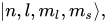
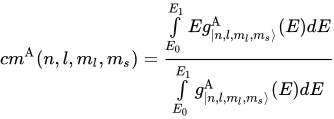
The mass center of an atomic orbital with quantum numbers for atom A is defined as

where is the contribution of the atomic orbital of the atom A to the total electronic density of states of the solid
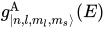
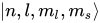
where the outer sum runs over all atoms A of the unit cell. The energy window is chosen in such a way that it encompasses all of the relevant bands participating in the bond. If the range to select is unclear, it can be identified in practice by examining the molecular orbitals that describe the electron density along with the considered bond.

The relative position of the mass center of levels of atom A with respect to the mass center of levels of atom B is given as

where the contributions of the magnetic and spin quantum numbers are summed. According to this definition, the relative position of the A levels with respect to the B levels is

where, for simplicity, we may omit the dependence from the principal quantum number in the notation referring to

In this formalism, the greater the value of the higher the overlap of the selected atomic bands, and thus the electron density described by those orbitals gives a more covalent A−B bond. The quantity is denoted as the covalency of the A−B bond, which is specified in the same units of the energy .

Analogous effect in nuclear systems

[edit]

An analogous effect to covalent binding is believed to occur in some nuclear systems, with the difference that the shared fermions are quarks rather than electrons.[26] High energy proton-proton scattering cross-section indicates that quark interchange of either u or d quarks is the dominant process of the nuclear force at short distance. In particular, it dominates over the Yukawa interaction where a meson is exchanged.[27] Therefore, covalent binding by quark interchange is expected to be the dominating mechanism of nuclear binding at small distance when the bound hadrons have covalence quarks in common.[28]

See also

[edit]

References

[edit]

Sources

[edit]
[edit]
Revisions and contributorsEdit on WikipediaRead on Wikipedia
from Grokipedia
A covalent bond is a type of formed by the sharing of one or more pairs of valence s between two atoms, typically nonmetals, to achieve stable electron configurations resembling those of . This sharing allows each atom to attain a full of electrons in its outer shell, following the , although achieves a . The concept of the covalent bond, emphasizing shared pairs, was first systematically proposed by American chemist in his 1916 paper "The Atom and the Molecule," revolutionizing the understanding of chemical bonding beyond ionic models. Covalent bonds form primarily between atoms with similar electronegativities, contrasting with ionic bonds that involve electron transfer between metals and nonmetals. The strength and length of these bonds depend on the number of shared electron pairs: a single bond involves one pair (e.g., in H₂), a double bond two pairs (e.g., in O₂), and a triple bond three pairs (e.g., in N₂), with higher bond orders generally resulting in shorter, stronger bonds. This multiplicity enables the formation of diverse molecular structures, from simple diatomic gases to complex polymers. Covalent bonds are classified as nonpolar or polar based on the uniformity of electron sharing. In nonpolar covalent bonds, electrons are shared equally between identical or similarly electronegative atoms, resulting in no net dipole moment, as seen in molecules like Cl₂ or CH₄. Polar covalent bonds occur when there is unequal sharing due to differing electronegativities, creating partial charges (δ+ and δ-) that impart polarity, exemplified by H₂O or HF, which influences properties like solubility and reactivity. These bonds are fundamental to organic chemistry and biochemistry, constituting the backbone of all carbon-based molecules, including hydrocarbons, proteins, and DNA, and enabling the vast diversity of life-sustaining compounds. Covalent bonding also underpins materials science, from semiconductors like silicon to advanced polymers, highlighting its role in both natural and synthetic systems.

Fundamentals

Definition and formation

A covalent bond is a chemical bond formed by the sharing of one or more pairs of electrons between two atoms, typically nonmetals, to achieve stable electron configurations. This sharing allows each atom to attain a fuller outer electron shell, often following the octet rule, which posits that atoms tend to gain, lose, or share electrons to acquire eight electrons in their valence shell, mimicking the stable configuration of noble gases. In the formation process, atoms with unpaired valence electrons approach each other, and their valence orbitals overlap to form molecular orbitals, where the shared s are attracted to both nuclei, creating a mutual attraction that counterbalances the repulsion between the positively charged nuclei. This overlap results in a stable bond once the atoms reach an optimal distance. Lewis dot structures illustrate this sharing: for dihydrogen (), two atoms each contribute one to form a single covalent bond, represented as H:H or H–H, with the shared pair denoted by a line or two dots. In dioxygen (), each oxygen atom shares two pairs of s to form a , depicted as :O::O: or O=O, satisfying the for both atoms. Covalent bonds typically form between atoms with similar electronegativities, where the electronegativity difference is less than 1.7 on the Pauling scale, ensuring electrons are shared rather than fully transferred as in ionic bonds. The serves as a guideline for predicting bond formation in most main-group elements, though exceptions exist for elements like or those in period 3 and beyond. The formation of a covalent bond is an that releases energy, as the bonded system possesses lower than the separated atoms due to the stabilizing electron-nuclear attractions. Unlike ionic bonds, which involve complete , covalent bonds rely on this shared for stability.

Key properties

Covalent bonds are characterized by their substantial strength, typically measured as the bond dissociation energy (BDE), which represents the enthalpy change required to break the bond homolytically into neutral radicals at 298 K. For instance, the BDE for a C-H single bond is approximately 413 kJ/mol, while that for a C=C double bond reaches about 614 kJ/mol, illustrating how higher bond multiplicity enhances stability through increased electron sharing. Bond strength is influenced by factors such as bond order, where multiple bonds provide greater orbital overlap and thus higher energy, and atomic size, as larger atoms generally form weaker bonds due to reduced overlap efficiency./Chemical_Bonding/Fundamentals_of_Chemical_Bonding/Bond_Energies) The length of a covalent bond, defined as the equilibrium distance between the nuclei of bonded atoms, varies inversely with bond strength and order. Single covalent bonds typically span 100–200 pm, encompassing examples like the C-H bond at ~109 pm and C-C at ~154 pm, while double and triple bonds are shorter, such as C=C at 134 pm, owing to the contraction from enhanced and orbital overlap. This relationship underscores how optimal overlap in molecular orbitals minimizes the of the bond. A defining feature of covalent bonds is their directionality, stemming from the anisotropic of valence orbitals like s, p, and d, which favor specific angular orientations for maximal overlap and minimal repulsion. This property dictates molecular architectures, as seen in the tetrahedral of (CH₄), where four sp³ hybrid orbitals arrange at 109.5° angles to form equivalent C-H bonds. Exceptions occur in delocalized systems, such as π-bond networks in , where distribution reduces strict directional constraints, allowing more isotropic bonding character./Fundamentals/Resonance_and_Inductive_Effects/Resonance_Structures_-_Delocalized_Electrons) Covalent bonds impart notable stability to molecular structures, often resulting in compounds with high resilience, as the strong sharing resists disruption under elevated temperatures. However, they are susceptible to homolytic cleavage under conditions like high energy input, where the bond breaks symmetrically to yield two radicals, initiating reactive pathways in processes such as free ./10%3A_Intro_to_Theory_of_Chemical_Reactions/10.06%3A_Covalent_Bond_Cleavage-_Outcomes_and_Reaction_Intermediates) This reactivity highlights the balance between the inherent durability of covalent linkages and their potential for controlled dissociation in chemical transformations./Chemical_Bonding/Fundamentals_of_Chemical_Bonding/Bond_Energies)

Historical development

Early concepts

The recognition of covalent bonding emerged from 19th-century observations distinguishing organic compounds from ionic salts, highlighting their non-conductive properties in solution. In the 1860s, French chemist conducted extensive studies on , producing stable organic compounds like alcohols and ethers that differed from inorganic salts in their properties. These findings underscored the existence of non-ionic bonding mechanisms in carbon-based molecules, laying empirical groundwork for later structural theories of valence. Early 20th-century valence theories began to conceptualize bonding in terms of involvement. In 1904, German chemists Richard Abegg and Max Bodländer proposed a valence framework where an element's maximum positive and negative valences sum to eight, attributing this to electron affinities and shared "points of attack" between atoms. Their model suggested that bonding could involve electron pairs rather than mere transfer, providing a precursor to shared-pair concepts without invoking . The modern idea of covalent bonding crystallized in 1916 with Gilbert N. Lewis's seminal work, introducing the shared electron pair as the basis for molecular stability. Lewis envisioned atoms as cubical structures with electrons at corners, where bonding occurs through pairs of shared valence electrons to achieve an octet configuration, as illustrated in water (H₂O) with oxygen sharing two pairs with hydrogens. This octet rule emphasized that non-metallic elements form bonds to complete eight electrons in their outer shell, explaining the neutrality and discrete nature of molecules like methane and ammonia. In 1919, Irving Langmuir expanded on Lewis's ideas, coining the term "covalent bond" and applying the octet rule to distinguish covalent from ionic bonding. Despite these advances, classical valence models faced significant limitations in accounting for certain molecular behaviors. They struggled to rationalize multiple bonds, such as the in , which required conceptualizing more than one shared pair without clear structural justification. Similarly, the observed in dioxygen (O₂), indicating unpaired s, defied expectations of fully paired octets in its , revealing the need for deeper insights into electron arrangement.

Theoretical advancements

The theoretical understanding of covalent bonds advanced significantly in the early through the application of , building on earlier classical ideas like Lewis's electron-pair sharing concept. In 1927, and provided the first quantum mechanical treatment of the covalent bond in the hydrogen molecule (H₂), demonstrating how electron exchange between atoms leads to bond formation. Their approach used symmetric and antisymmetric wavefunctions to account for the , showing that the bonding arises from the overlap of atomic orbitals and the resulting stabilization energy. This foundational work paved the way for further refinements in the late 1920s and early 1930s, establishing the distinction between and . Key milestones included the 1927 Heitler-London paper, followed by contributions from John C. Slater in 1929 and others up to 1931, which formalized the covalent bond as a shared-electron-pair interaction in non-polar systems, contrasting it with the complete in ionic bonds. Experimental validations, such as measurements of bond lengths in molecules like and , corroborated these theoretical predictions by revealing consistent interatomic distances attributable to covalent interactions. Linus Pauling extended these ideas in the 1930s with his valence bond (VB) theory, introducing the concept of orbital hybridization to explain the directional nature of covalent bonds. He proposed that atomic orbitals combine to form hybrid orbitals—such as sp, sp², and sp³ in carbon compounds—enabling optimal overlap and the observed geometries in molecules like methane (tetrahedral) and ethylene (trigonal planar). Pauling also developed the resonance theory, describing delocalized electrons in systems like benzene as superpositions of multiple VB structures, which accounts for enhanced stability without fixed single or double bonds. His seminal book, The Nature of the Chemical Bond (1939), synthesized these advancements and became a cornerstone of chemical theory. Concurrently, Robert S. Mulliken advanced (MO) theory in the 1930s, emphasizing delocalized electrons spread over the entire rather than localized pairs. Mulliken's framework treated as systems where atomic orbitals combine to form molecular orbitals, occupied by electrons that contribute to across the structure, as seen in diatomic like O₂. This approach complemented VB theory by providing a basis for understanding conjugation and . By the , the transition to computational methods marked a new era in covalent bond , with early Hartree-Fock self-consistent field calculations quantitative predictions of bond energies. Pioneered by and in the late 1920s but practically implemented in the on early computers, these methods approximated the many-electron wavefunction for molecules, yielding bond dissociation energies for simple systems like H₂ accurate to within a few kcal/mol and supporting the theoretical between covalent and ionic bonds.

Classification

Bond order variations

Covalent bonds are classified by their bond order, which represents the number of electron pairs shared between atoms. A bond order of one corresponds to a , two to a , and three to a , with higher orders generally resulting in shorter and stronger bonds. A single covalent bond involves the sharing of one pair of electrons, forming a (σ) bond through head-on overlap of atomic orbitals. For example, the carbon-carbon in (C₂H₆) has a of approximately 154 pm and is the longest and weakest among common carbon-carbon bonds, with a bond dissociation energy of about 377 kJ/mol. Single bonds allow free rotation around the bond axis due to the cylindrical symmetry of the σ bond. A double covalent bond consists of two shared electron pairs: one σ bond and one pi (π) bond, formed by sideways overlap of p orbitals. In ethene (C₂H₄), the carbon-carbon has a length of about 134 pm, making it shorter and stronger than a , with a dissociation energy around 614 kJ/mol. The presence of the π bond restricts rotation around the , leading to geometric isomerism in substituted alkenes, as rotation would require breaking the π bond and demands significant energy (approximately 264 kJ/mol). A triple covalent bond involves three shared electron pairs: one σ bond and two π bonds. The nitrogen-nitrogen triple bond in N₂ has a bond length of 110 pm and is notably strong, with a dissociation energy of 945 kJ/mol, contributing to the molecule's stability. Similarly, the carbon-carbon triple bond in ethyne (C₂H₂) measures about 120 pm. Triple bonds are the shortest and strongest among typical covalent bonds between second-period elements, further limiting rotation. Fractional bond orders arise in systems described by or (MO) theory, where electrons are delocalized over multiple bonds. For instance, in , resonance structures average to a carbon-carbon of 1.5, resulting in bond lengths of 140 pm, intermediate between single (154 pm) and double (134 pm) bonds. In MO theory, is calculated as half the difference between the number of electrons in bonding and antibonding orbitals: = (number of bonding electrons − number of antibonding electrons)/2. This yields integer orders for simple diatomic molecules like O₂ (bond order 2) but fractional values for species with partial occupancy of degenerate orbitals. Higher bond orders generally increase bond strength and decrease due to greater between nuclei, enhancing orbital overlap and electrostatic attraction. For carbon-carbon bonds, the at 154 pm and 377 kJ/mol contrasts with the double at 134 pm and 614 kJ/mol, and the triple at 120 pm and approximately 839 kJ/mol, illustrating this trend. These variations influence , reactivity, and physical properties, such as the planarity enforced by double and triple bonds.

Polarity distinctions

Covalent bonds are classified into nonpolar and polar types based on the symmetry of electron sharing between the bonded atoms, primarily determined by differences in . In nonpolar covalent bonds, electrons are shared equally because the atoms involved have identical or very similar electronegativities, resulting in a difference of less than 0.4 on the Pauling scale. Examples include the H–H bond in dihydrogen (electronegativity difference of 0) and the Cl–Cl bond in dichlorine (electronegativity difference of 0), both of which exhibit symmetric charge distribution with no net dipole. Polar covalent bonds, in contrast, involve unequal electron sharing due to an electronegativity difference ranging from 0.4 to 1.7, leading to partial charges on the atoms. For instance, in (HCl), chlorine's electronegativity of 3.16 exceeds 's 2.20, creating a difference of 0.96; this results in a partial positive charge (δ+) on and a partial negative charge (δ–) on . The resulting bond dipole moment for HCl is 1.08 D, quantifying the charge separation. The degree of polarity can be quantified using Pauling's electronegativity scale, which assigns values based on data, and an for partial ionic character: % ionic = 100 × (1 – e^(–(ΔEN)²/4)), where ΔEN is the electronegativity difference. For HCl, this yields approximately 21% ionic character, indicating a predominantly covalent bond with some ionic contribution. Polarity in covalent bonds has significant consequences for molecular interactions, as it induces dipole moments that enable dipole-dipole forces between molecules. In (H₂O), the O–H bonds are polar (electronegativity difference of 1.24), and the molecule's bent with a 104.5° bond angle prevents dipole cancellation, enhancing overall molecular polarity and facilitating stronger intermolecular attractions. Covalent bonds represent one end of a continuum of bond types, where increasing differences gradually blend polar covalent characteristics into , without a sharp boundary.

Coordinate bonds

A coordinate bond, also known as a dative covalent bond, is a subtype of covalent bond in which the shared pair of electrons is supplied entirely by one of the bonding atoms. This occurs when an atom possessing a of electrons (a Lewis base) donates that pair to another atom with an empty orbital (a Lewis acid), forming a two-center, two-electron bond without subsequent sharing from the acceptor. Such bonds form through the interaction of the donor's highest occupied (HOMO) with the acceptor's lowest unoccupied (LUMO). A classic example is the ammonia-borane adduct, where the atom in NH₃ donates its to the electron-deficient atom in BF₃, resulting in H₃N→BF₃. In coordination chemistry, coordinate bonds are prevalent in metal-ligand interactions, as seen in the hexaamminecobalt(III) complex [Co(NH₃)₆]³⁺, where six NH₃ molecules each donate a to the central Co³⁺ , occupying its d-orbitals. Once established, a coordinate bond exhibits properties similar to standard covalent bonds, including comparable bond strengths typically in the range of 100–200 kJ/mol; for instance, the B–N dative bond dissociation energy in is approximately 117 kJ/mol. Initially directional due to the unilateral electron donation, the bond becomes symmetric in the final molecule, with delocalized density indistinguishable from non-dative covalent bonds. In Lewis structures, coordinate bonds are conventionally notated with a single arrow (→) pointing from the donor atom to the acceptor, emphasizing the dative nature, though they are often depicted as regular lines in simplified diagrams post-formation. Coordinate bonds commonly occur in complexes, where ligands like NH₃ or CN⁻ form multiple dative linkages to the metal center, and in certain oxyanions such as SO₄²⁻, where some S–O interactions are described as dative from oxygen to .

Structural manifestations

Discrete molecular forms

Discrete molecular forms of covalent bonding occur in finite, isolated units known as molecules, where atoms are connected exclusively by strong intramolecular covalent bonds, while weaker intermolecular forces such as van der Waals interactions or hydrogen bonding hold the molecules together in aggregates. These structures contrast with extended lattices by forming discrete entities that can exist independently, allowing for distinct physical properties like in nonpolar solvents and generally low electrical conductivity in pure form. Representative examples include diatomic molecules like (N₂), where a triple covalent bond links the two atoms, and polyatomic species such as (CH₄) with four single bonds around carbon or (CO₂) featuring two double bonds. In organic compounds, (C₂H₅OH) exemplifies this form, with covalent bonds defining its chain and hydroxyl group. The volatility and low melting points of these molecular forms arise from the dominance of weak intermolecular forces over the robust intramolecular covalent bonds, enabling easy phase transitions at moderate temperatures. For instance, N₂ boils at -196°C and CH₄ at -161°C, reflecting minimal energy needed to overcome van der Waals attractions between molecules. Within each molecule, all bonds are covalent, and their directional nature dictates the overall geometry, often predicted using valence shell electron pair repulsion (VSEPR) theory, which posits that electron pairs around a central atom arrange to minimize repulsion. In CO₂, the two double bonds and no lone pairs on carbon result in a linear shape with a 180° bond angle, enhancing molecular stability. Such discrete molecules are prevalent among elements and their compounds, providing stability through complete octet fulfillment via shared s, and they are commonly isolated as gases, liquids, or low-melting solids at standard conditions. This form's prevalence in nonmetals stems from their high electronegativities, favoring electron sharing over transfer. Historically, the recognition of covalent bonds in discrete molecular forms emerged prominently in , building on G. N. Lewis's 1916 conceptualization of shared electron pairs, which laid the foundation for understanding molecular structures like those in hydrocarbons. This insight propelled advancements in synthesizing and characterizing organic molecules throughout the .

Extended network forms

Extended network forms of covalent bonding occur when atoms are interconnected through an infinite array of covalent bonds, creating one-dimensional (1D), two-dimensional (2D), or three-dimensional (3D) lattices known as covalent network solids. These structures differ fundamentally from discrete molecular forms by lacking finite molecular units; instead, they form giant, continuous frameworks where breaking the solid requires severing numerous covalent bonds. This results in characteristic properties such as extremely high melting points, exceptional , and . For example, , a 3D covalent network, has a melting point of approximately 3500°C under , reflecting the strength of its extensive carbon-carbon bonds. In 3D networks, atoms are linked in all directions to form rigid, isotropic structures. Diamond exemplifies this, with each carbon atom tetrahedrally coordinated to four others via sp³-hybridized covalent bonds, creating a lattice that imparts unparalleled hardness. Silicon forms a similar 3D network, adopting the structure where each silicon atom shares electrons with four neighbors, contributing to its role in . Quartz (SiO₂), another 3D example, consists of a continuous framework of corner-sharing SiO₄ tetrahedra, where silicon-oxygen covalent bonds extend throughout the crystal, distinguishing it from molecular crystals like CO₂ that feature isolated units held by weaker forces. Two-dimensional networks feature planar sheets of covalently bonded atoms, often with weaker interlayer interactions. illustrates this, comprising stacked layers of carbon atoms in hexagonal rings; within each layer, sp²-hybridized bonds form a strong 2D network, while delocalized pi electrons overlap perpendicularly, enabling electrical conductivity along the planes. In contrast, 1D networks involve linear chains of atoms, as seen in polymeric , where sulfur atoms link covalently into long, flexible chains that can extend indefinitely, though these are less rigid than higher-dimensional forms. The properties of these network solids stem from their bonding architecture. Most are electrical insulators due to localized valence electrons tightly bound in covalent linkages, preventing charge mobility; graphite is an exception, conducting electricity anisotropically via its delocalized . arises from the directional specificity of covalent bonds, which do not allow layers or chains to slide past one another under stress, leading to cleavage rather than ductile deformation. High melting points and further reflect the required to disrupt the pervasive covalent framework. Applications of extended network solids leverage their structural integrity and electronic properties. Silicon and germanium, both forming 3D covalent diamond-like networks, are semiconductors; their band gaps allow controlled conductivity when doped, enabling transistors and integrated circuits essential to modern . These materials' covalent provides thermal stability and mechanical robustness, supporting their widespread use in devices operating under high temperatures and stresses.

Advanced bonding phenomena

Odd-electron bonds

Odd-electron bonds represent unconventional covalent interactions where an odd number of electrons are shared between two atomic centers, leading to half-integer bond orders and distinct electronic properties compared to conventional even-electron bonds. These bonds arise in radical species or ions and are typically described using (MO) theory, where the bonding and antibonding orbitals exhibit uneven electron occupancy. The bond order for such systems is calculated as 12(nbna)\frac{1}{2}(n_b - n_a), with nbn_b and nan_a denoting the number of electrons in the bonding and antibonding MOs, respectively, resulting in a bond order of 0.5 for both one- and three-electron configurations. These bonds are generally weak, paramagnetic due to unpaired electrons, and often transient, observed primarily in gas-phase ions or stabilized radicals through spectroscopic techniques like photoelectron and . One-electron bonds involve a single shared between two nuclei, forming a "half-bond" with 0.5. A prototypical example is the molecular , \ceHe2+\ce{He2+}, observed in the gas phase, where the single occupies the σ1s\sigma_{1s} MO while the antibonding MO remains empty. The dissociation energy of \ceHe2+\ce{He2+} is approximately 2.5 eV, reflecting its relative weakness compared to standard covalent bonds, with a of about 1.08 . This configuration was first theoretically analyzed in early quantum mechanical treatments, confirming stability despite the odd count. Similar one-electron occurs in \ceH2+\ce{H2+}, the hydrogen molecular , which shares an analogous electronic structure and of 0.5, with a dissociation energy of around 2.8 eV. Experimental evidence for these species comes from and photoelectron , highlighting their presence in ionized gases. Three-electron bonds feature three electrons delocalized over two centers, typically with two electrons in the bonding MO and one in the antibonding MO, yielding a of 0.5. A well-studied example is the sulfur-sulfur interaction in \ce(H2SSH2)+\ce{(H2S \cdots SH2)+}, the radical cation dimer of , where the S-S is 2.886 and the bond dissociation is -40.7 kJ/mol at 298 , indicating modest stability. Quantum chemical calculations reveal that this bond derives nearly 60% of its strength from covalent interactions, with electrostatic contributions playing a supporting role. Infrared spectroscopy of gas-phase \ce(H2S)n+\ce{(H2S)_n+} clusters (n=3-6) confirms the presence of a stable \ce(H2SSH2)+\ce{(H2S \cdots SH2)+} core, demonstrating persistence beyond isolated dimers. The dimer, \ce(NO)2\ce{(NO)2}, exhibits weak bonding with odd-electron character, forming a loosely bound structure observed at low temperatures, where the interaction energy is about 3.2 kcal/mol, blending covalent and dispersion forces. These systems are paramagnetic and rare in condensed phases due to reactivity, but they provide insights into radical-mediated processes.

Resonance stabilization

Resonance stabilization arises from the delocalization of electrons in covalent systems that cannot be adequately represented by a single , instead existing as a hybrid of multiple contributing . This concept, developed within , posits that the actual electronic configuration is a superposition of these structures, leading to greater stability than any individual form due to lowered energy from electron delocalization. The stabilization, known as resonance energy, quantifies this effect and typically falls in the range of 20-40 kcal/mol, as observed in systems like where the hybrid structure enhances overall molecular stability. A classic example is (O₃), which exhibits two equivalent structures: one with a between the central oxygen and one terminal oxygen, and the other with the double bond shifted to the other terminal oxygen. This delocalizes the π electrons and formal charges, stabilizing the bent beyond what a single structure would predict. Similarly, the carbonate ion (CO₃²⁻) is described by three forms, each featuring a C=O to one oxygen and single bonds to the others, with the negative charges distributed accordingly. The equivalence of these structures results from the of the ion, promoting uniform electron sharing across all three C-O linkages. Resonance structures are visually represented using curved arrows to depict the relocation of pairs, such as shifting a π bond to form a or vice versa, thereby interconverting the forms without implying actual molecular . The magnitude of energy is determined experimentally via , for instance by comparing observed heats of or to those expected for localized structures, or through computational valence bond calculations that evaluate the energy difference between the hybrid and reference structures. One key effect of resonance is the equalization of bond lengths and partial bond orders in the delocalized system. In the carbonate ion, for example, all three C-O bonds measure approximately 129 pm, an intermediate value between a typical C-O (143 pm) and C=O (122 pm), reflecting a of about 1.33 per link. This averaging arises directly from the contribution, yielding fractional bond orders that enhance structural uniformity and stability. In , the hybrid is treated as a of the contributing Lewis structures, weighted by their relative contributions based on and overlap integrals, which accounts for the observed stabilization. However, this approach has limitations, as it relies on approximate wavefunctions and localized orbitals, often underestimating or overestimating exact energies compared to more advanced quantum mechanical methods.

Aromatic systems

Aromatic systems exemplify a pronounced form of delocalization in covalent bonds, manifesting in planar, cyclic, conjugated molecules that possess 4n + 2 π electrons, where n is a non-negative . This phenomenon, known as , imparts exceptional thermodynamic stability due to the cyclic overlap of p orbitals, leading to a delocalized π electron cloud. The foundational principle, , was proposed by Erich Hückel in 1931 through calculations on , predicting aromatic character for systems with this electron count that are fully conjugated and planar. For n = 0, (C₆H₆) features six π electrons from three double bonds, serving as the archetypal with equalized C–C bond lengths of approximately 139 pm, intermediate between typical single (154 pm) and double (134 pm) bonds, as determined by X-ray diffraction. (C₅H₅N), a heterocyclic analog, also adheres to the rule with six π electrons, where the nitrogen atom contributes one electron to the system while maintaining planarity and conjugation. Key properties of aromatic systems include enhanced stability, evidenced by a resonance energy of about 36 kcal/mol in benzene, which resists addition reactions in favor of substitution to preserve the delocalized structure. Diamagnetic ring currents arise from the circulating π electrons in a magnetic field, detectable via nuclear magnetic resonance (NMR) spectroscopy, where protons inside the ring experience shielding (upfield shifts) and those outside deshielding (downfield shifts), confirming the aromatic electron flow. In the molecular orbital framework underlying Hückel's rule, the cyclic conjugation yields a set of π orbitals where the lowest six (for benzene) are bonding and fully occupied, with the highest occupied molecular orbital (HOMO) filled and degenerate non-bonding orbitals empty, optimizing energy and stability. Beyond benzenoid structures, non-benzenoid aromatics like the cyclopentadienyl anion (C₅H₅⁻) with six π electrons (n = 1) exhibit , contributing to the unusual acidity of (pKₐ ≈ 16) as the anion forms a stable, planar system. Similarly, the (C₇H₇⁺) is aromatic with six π electrons in a seven-membered ring, displaying high stability for a and equal bond lengths. In contrast, anti-aromatic systems with 4n π electrons, such as cyclobutadiene (C₄H₄, 4 π electrons), are destabilized due to partial filling of antibonding orbitals, leading to rectangular distortion and reactivity; experimental photoacoustic calorimetry quantifies this antiaromatic destabilization at about 13.5 kcal/mol relative to localized bonds. Experimental validation of often involves deficits in heat of ; for , the observed value is 49.8 kcal/mol, 36 kcal/mol less exothermic than the expected 85.8 kcal/mol for three isolated double bonds, underscoring the stabilization . This criterion, combined with structural uniformity and magnetic , distinguishes aromatic covalent systems from non-aromatic conjugated counterparts.

Hypervalent configurations

Hypervalent configurations refer to molecular structures in which a central atom, typically from the third period or heavier in the p-block, appears to exceed the by accommodating more than eight valence electrons in its bonding sphere. This phenomenon is exemplified by molecules such as (SF₆), where the atom is surrounded by 12 valence electrons from six S-F bonds, and (PCl₅), with 10 electrons around from five P-Cl bonds. A key model for understanding hypervalency without invoking d-orbital participation is Pauling's concept of three-center four-electron (3c-4e) bonds, which describe in species like the triiodide ion (I₃⁻). In I₃⁻, the linear structure features a central iodine atom bridged by two equivalent I-I bonds, each conceptualized as a 3c-4e interaction involving four electrons delocalized over three atoms, providing stability through partial covalent and ionic character without requiring expanded orbitals. This model emphasizes multicenter as an alternative to traditional two-center two-electron (2c-2e) bonds, particularly effective for main-group elements with electronegative ligands like , which enhance stability by polarizing electron density toward the periphery. Geometric properties of hypervalent molecules often reflect their electron distribution, as seen in PCl₅'s trigonal bipyramidal arrangement, where axial P-Cl bonds (approximately 214 pm) are longer than equatorial ones (approximately 202 pm) due to greater repulsion in the axial positions. Similarly, SF₆ adopts an octahedral geometry with uniform S-F bond lengths of about 156 pm, indicative of equivalent bonding environments stabilized by the high of , which facilitates electron withdrawal and reduces central atom electron density. In xenon tetrafluoride (XeF₄), the square planar configuration arises from two lone pairs occupying axial positions in an octahedral electron arrangement, with Xe-F bond lengths around 196 pm and bond dissociation energies supporting the molecule's kinetic stability despite formal hypervalency. Debates surrounding hypervalency have centered on the role of d-orbitals in bonding, with early models proposing hybridization involving empty d-orbitals to accommodate extra pairs; however, computational analyses show negligible d-orbital contribution, as their energies are too high for effective overlap in main-group elements. Instead, modern interpretations favor ionic contributions and negative , where electronegativity induces partial charge separation, or charge-shift bonding, as in XeF₂ and XeF₄, where between covalent and zwitterionic forms dominates the bonding strength.

Electron-deficient species

Electron-deficient species in covalent bonding refer to compounds where the central atom possesses fewer than eight valence electrons, resulting in an incomplete octet and necessitating alternative bonding arrangements to achieve stability. A classic example is (BF₃), where the atom is surrounded by only six from three B–F bonds, rendering it electron-deficient. This electron scarcity drives such species to form multi-center bonds, where electrons are shared among more than two atoms, as seen in (B₂H₆), which features two three-center two-electron (3c–2e) bonds involving B–H–B bridges. These 3c–2e bonds, often termed banana bonds due to their curved orbital shape, allow the molecule to distribute its limited electrons effectively across the structure. In borane clusters, electron counting is rationalized using Wade's rules, which predict the geometry based on the number of skeletal electron pairs available for cluster bonding. For instance, closo-boranes like [B₁₂H₁₂]²⁻ follow the n + 1 rule, where n is the number of boron vertices, requiring 2n + 2 skeletal electrons for a closed polyhedral structure. These rules highlight how electron deficiency in boranes leads to delocalized, multi-center bonding rather than traditional two-center two-electron (2c–2e) bonds, enabling stable cluster formations. Representative examples include the aluminum chloride dimer (Al₂Cl₆), where each aluminum atom in the monomeric AlCl₃ has only six valence electrons, prompting dimerization via two bridging chloride ions to form 3c–4e bonds. Similarly, (BeCl₂) adopts a linear polymeric chain structure in the solid state, with each atom tetrahedrally coordinated by four chlorines through bridging, compensating for its four-electron valence shell./03:_Simple_Bonding_Theory/3.01:_Lewis_Electron-Dot_Diagrams/3.1.04:Lewis_Fails_to_Predict_Unusual_Cases-_Boron_and_Beryllium) These species exhibit pronounced Lewis acidity due to their electron deficiency; for example, BF₃ readily accepts an from a Lewis base like NH₃ to form a coordinate , completing the octet at . This property underscores their high reactivity, often leading to applications in and synthesis. Spectroscopic evidence, such as studies on , confirms the bridged structure, revealing B–H bridge bond lengths of approximately 1.33 compared to 1.19 Å for terminal B–H bonds, reflecting the weaker, multi-center nature of the bridges.

Theoretical frameworks

Valence bond approach

The valence bond (VB) describes covalent bonds as the result of the overlap between atomic orbitals from adjacent atoms, where shared pairs occupy these overlapping regions to lower the overall energy of the system. This approach emphasizes localized bonding, treating each bond as an independent pair of electrons derived from atomic orbitals on the bonded atoms. The foundational application of VB to a simple covalent bond is seen in the hydrogen molecule (H₂), where and modeled the bonding wavefunction as a symmetric of atomic 1s orbitals from each : ψbonding=12[1sA(1)1sB(2)+1sA(2)1sB(1)],\psi_{\text{bonding}} = \frac{1}{\sqrt{2}} \left[ 1s_A(1)1s_B(2) + 1s_A(2)1s_B(1) \right],
Add your contribution
Related Hubs
User Avatar
No comments yet.