Hubbry Logo
search
logo
299836

Cross ventilation

logo
Community Hub0 Subscribers
Read side by side
from Wikipedia
Cross-breezes work when two windows are opposite of each other.

Cross ventilation is a natural phenomenon where wind enters an opening, such as a window, flows directly through the space, and exits through an opening on the opposite side of the building (where the air pressure is lower). This produces a cool stream of air and a current across the room from the exposed area to the sheltered area.[1]

Cross ventilation is powered by the wind and thus requires no energy input, in addition to being the most effective method of wind ventilation. A commonly used technique to remove pollutants and heat in an indoor environment, cross ventilation can also decrease or even obviate the need for air conditioning and can improve indoor air quality.[2] Other terms used for the effect include cross-breeze, cross-draft, wind effect ventilation and cross-flow ventilation. In Germany they have been called lüften and Stoßlüften.[3]

Process

[edit]

The phenomenon occurs when openings in an environment (including vehicles) or building (houses, factories, sheds, etc) are set on opposite or adjoining walls, which allow air to enter and exit, thus creating a current of air across the interior environment.[4] Windows or vents positioned on opposite sides of the room allow passive breezes a pathway through the structure, which circulate the air and provide passive cooling.[1]

There is also a pressure difference between the opposite sides of the establishment. The effect is mostly driven by the wind, whereby the air is pulled into the building on the high pressure windward part and is pushed out on the low pressure downwind side of the establishment (because of the pressure difference between the openings). A wind's effect on a structure creates regions that have positive pressure on the building's upwind area and a negative pressure on the downwind side. Thus, the building shape and local wind patterns are critical in making wind pressures that force airflow through its openings.[5]

If the windows on both sides of the buildings are opened, the overpressure on the side facing the wind, and/or low pressure on the adjacent protected side, will make a current of air through the room from the uncovered side towards the sheltered side. If there are windows on both sides in a building, cross ventilation is appropriate where the width of the room is up to five times the floor-to-ceiling height. If openings are only one side then wind-driven ventilation is more suited for structures where the width is around 2.5 times the floor to ceiling height.[6]

Factors

[edit]

Cross ventilation relies on many factors, such as the tightness of the establishment, wind direction and how much wind is available, its potential travel through chimneys, vents and other openings in the home. Casement windows can be installed to improve cross-breezes. Air quality may also affect cross ventilation.

Although cross ventilation is generally more direct at its job than stack ventilation, the cons include its effects being unproductive on hot, still days, when it is most necessary. Moreover, cross ventilation is generally only suitable for narrow buildings. The contrasting height of the openings (walls, sill, panels or furniture) ordered by the space also immediately influence the level and velocity of ventilation.[1]

Effectiveness

[edit]

Cross ventilation works well in climates with hotter temperatures, where the system allows continual changes of the air within the building, refreshing it and reducing the temperature inside the structure and also when the window on the windward side of the building is not opened as much as the one on the leeward side. Cross ventilation will not be efficacious if the windows are more than 12m apart and if a window is behind a door that is regularly shut.[7]

An opened window that faces a prevailing wind and is conjugated with another window on the opposite side of a building will supply natural ventilation for fresh air. A decent and effective cross ventilation will remove heat from the interior and keep indoor air temperatures approximately 1.5 °C (2.7°F) above the outdoor air temperatures, ensuring that there is a steady inflow and outflow of fresh air inside the building.[8]

Besides windows, other openings like brise soleils, doors, louvers or ventilation grills and ducts can also work as effective ventilation openings, though an awning window provides the least effectivity. The wind surrounding building structures is important when it comes to assessing the air quality and thermal comfort indoors since both air and heat exchange rely heavily on the wind pressure on the exterior of the building. For the best airflow, the windward windows of the occupied space should not be opened as much as those on the leeward side.[9]

Disadvantages of wind-driven ventilation include capricious wind speeds and directions (which may create a strong unpleasant draft), and the polluted air from the outside that may tarnish the indoor air quality.[10] Moreover, cross ventilation is not recommended for use in disease prevention when air is being moved by the cross ventilation from an unclean area into a clean area.[11]

Types

[edit]
In a windcatcher, wind is forced down on the windward side and exits on the leeward side, using the stack effect.

There are four different types of cross ventilation:[12]

  • Single-sided ventilation: This method depends on the pressure contrasts between different openings within the occupied space. For rooms that only feature a single opening, the ventilation is impelled by turbulence, thereby creating a pumping activity on that lone opening, causing small inflows and outflows. Single-sided ventilation has a weak effect. It is preferable when cross ventilation is not achievable, where it uses windows or vents at the other side of the space to control air pressure.
  • Cross ventilation (single spaces): Being unsophisticated and efficacious, this type of ventilation is a horizontal process that is driven by pressure differences between the windward and leeward sides of the occupied indoor environment. Ventilation here is generally provided using windows and vents at either side of a building where the variation in pressure draw air in and out.
  • Cross ventilation (double-banked spaces): Involving banked rooms, this method features openings in the hallway structure. The openings allow a way for noise to move between spaces. It can provide a much higher air-exchange rate in comparison with single-sided ventilation.
  • Stack ventilation: This ventilation is a vertical process and it's beneficiary for taller buildings with central atriums. It draws cooler air in at a lower level, whereby the air rises thereafter due to heat exposure before it is ventilated out at a higher level. Benefits from temperature compartmentalization and related pressure quality of the air, whereby warm air loses density when it rises and the cooler air supplants it.

Equation

[edit]

For a simple volume with two openings, the cross wind flow rate can be calculated using the following equation:[13]

where is the far-field wind speed; is a local pressure drag coefficient for the building, defined at the location of the upstream opening; is a local pressure drag coefficient for the building, defined at the location of the downstream opening; is the cross-sectional area of the upstream opening; is the cross-sectional area of the downstream opening; is the discharge coefficient of the upstream opening; and is the discharge coefficient of the downstream opening.

For rooms with single opening, the calculation of ventilation rate is more complicated than cross ventilation due to the bi-directional flow and strong turbulent effect. The ventilation rate for single-sided ventilation can be accurately predicted by combining different models for mean flow, pulsating flow and eddy penetration.[14] The mean flow rate for single-sided ventilation is determined by:
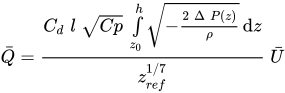
where

l = width of the window;

h = elevation of the top edge of the window;

z0 = elevation of neural level (where inside and outside pressure balance);

zref = reference elevation where the wind velocity is measured (at 10 m) and

= mean wind velocity at the reference elevation.

As observed in the equation (1), the air exchange depends linearly on the wind speed in the urban place where the architectural project will be built. CFD (Computational Fluid Dynamics) tools and zonal modelings are usually used to design naturally ventilated buildings. Windcatchers can assist wind-driven ventilation by guiding air in and out of structures.

See also

[edit]

References

[edit]
Revisions and contributorsEdit on WikipediaRead on Wikipedia
from Grokipedia
Cross ventilation is a passive architectural strategy that promotes airflow through a building by allowing fresh air to enter via openings on the windward side and exit through openings on the leeward side, driven by wind-generated pressure differentials, thereby enhancing indoor air quality and thermal comfort without relying on mechanical equipment.[1] The principle of cross ventilation exploits the natural pressure gradient created when wind strikes a structure: higher pressure on the windward facade forces air inward, while lower pressure on the leeward side draws it outward, facilitating continuous air exchange.[2] This process is most effective in buildings with narrow floor plans—typically limited to a depth of about five times the floor-to-ceiling height (around 15 meters)—and requires strategically placed operable windows or vents on opposite walls to maximize airflow rates.[2] Design considerations include orienting the building to prevailing winds, ensuring intake openings are smaller than exhausts to optimize velocity, and integrating features like open interior layouts or courtyards to avoid obstructions.[3][1] Key benefits of cross ventilation include significant energy savings by reducing dependence on HVAC systems for cooling, particularly in dry or moderate climates, where it can lower cooling loads and operational costs.[1][4] It also improves occupant health through better dilution of indoor pollutants and enhanced circulation, while contributing to sustainability by minimizing greenhouse gas emissions associated with mechanical ventilation.[3] In hot-humid regions, combining cross ventilation with shading or thermal mass elements further boosts thermal performance and comfort.[2] Historically, cross ventilation has been integral to vernacular architecture in arid climates, such as traditional Iranian houses like the Tabatabaei House in Kashan, which employ wind catchers, sunken courtyards, and pools to harness wind and buoyancy for cooling.[3] Modern applications extend to energy-efficient residential and commercial designs, including historic building retrofits, where it supports preservation while achieving up to notable reductions in energy use during transitional seasons.[4]

Principles

Definition and Mechanism

Cross ventilation is a natural ventilation technique in which fresh air enters a building through openings on the windward side and exits through openings on the leeward side, establishing a horizontal airflow path across the interior space.[5] This method leverages external wind to facilitate the movement of air, promoting indoor air quality and thermal comfort without reliance on powered systems.[6] The fundamental mechanism of cross ventilation operates through pressure differentials generated by wind around the building envelope. On the windward facade, where the wind impinges directly, a region of higher static pressure forms due to the stagnation of airflow, pushing air inward through inlet openings. Conversely, on the leeward side, a low-pressure zone develops from flow separation and acceleration, drawing air outward through exhaust openings and creating a continuous stream of ventilation.[5] This process is most effective in rooms with depths up to five times the floor-to-ceiling height, as greater distances can lead to insufficient airflow penetration and uneven distribution.[6] Wind and temperature differences serve as primary drivers, though the pressure gradient from wind predominates in this configuration.[7] As a form of passive ventilation, cross ventilation contrasts with mechanical ventilation by utilizing ambient environmental forces—such as wind—rather than fans or pumps to induce airflow, thereby reducing energy consumption and operational costs in suitable climates. This passive approach requires strategic placement of openings to maximize the pressure differential while minimizing internal flow resistance.[5]

Driving Forces

Cross ventilation is primarily powered by wind-driven forces, which generate pressure differentials across building openings to induce airflow. When wind impinges on a structure, it creates a region of positive (stagnation) pressure on the windward side, where air velocity decreases, and a region of negative (suction) pressure on the leeward side, where air accelerates around the building.[8] This pressure difference drives air to enter through windward openings and exit through leeward ones, facilitating horizontal airflow. The underlying physics is explained by Bernoulli's principle, which states that an increase in fluid velocity corresponds to a decrease in static pressure, thus accounting for the dynamic pressure variations caused by wind speed and direction.[9] A secondary driving force in cross ventilation is buoyancy, arising from temperature-induced density differences in air, often referred to as the stack effect. Warmer indoor air, being less dense, rises relative to cooler outdoor air, creating a vertical pressure gradient that can assist horizontal flow if openings are positioned to leverage this buoyancy.[10] In horizontal cross ventilation setups, this effect is typically subordinate to wind forces, as the primary airflow path is lateral rather than vertical.[8] The interaction between wind and buoyancy determines the overall ventilation dynamics, with wind generally dominating in most practical scenarios due to its higher potential energy input from external speeds. Buoyancy enhances cross flow particularly in multi-story buildings or spaces with uneven heating, where thermal gradients amplify the pressure differential alongside wind effects.[11] At low wind speeds, buoyancy can play a more significant role in initiating or sustaining flow, but as wind velocity increases, it overrides thermal effects, shifting the ventilation regime toward wind-dominated mixing.[10]

Design Factors

Architectural Elements

Cross ventilation relies on strategic placement of openings in building envelopes to facilitate airflow driven by pressure differences from wind. Typically, at least two openings—such as windows, doors, or vents—are positioned on opposite or adjacent walls to create an inlet on the windward side and an outlet on the leeward side, allowing fresh air to enter low and exit high for optimal circulation.[12] Operable casement or awning windows are particularly effective, as they provide adjustable airflow by opening fully to nearly 90% of their glazed area and can be angled to enhance pressure zones that promote cross flow.[13][14] These designs enable control over ventilation rates, minimizing drafts while maximizing air exchange, with inlet areas often comprising about 1% of the floor area per side.[12] Building geometry significantly influences the efficacy of cross ventilation by determining the path and velocity of airflow. Effective ventilation is generally limited to room depths of up to five times the ceiling height, such as 12-15 meters in single-story spaces with standard 2.5-3 meter ceiling heights, beyond which air movement diminishes substantially.[12][15] Orientation plays a critical role, with the building's long facade ideally aligned perpendicular to prevailing winds to capture maximum pressure differentials across the structure.[12] In coastal hot-humid climates such as Odisha, India, designs often incorporate large windows on the east and north sides to capture morning light and breezes, while providing windows on the south and west sides with shading devices to reduce afternoon solar gain and heat ingress. High ceilings and dedicated vents further support buoyancy effects to manage elevated humidity levels through enhanced air circulation.[16][17] Internal obstructions, including furniture, partitions, or non-open-plan layouts, must be minimized to maintain a clear airflow path, as even minor barriers can reduce ventilation efficiency by disrupting streamlines.[18] The building envelope's tightness must balance energy efficiency with ventilation needs, as excessive air leakage can undermine thermal performance while overly sealed designs may restrict natural airflow. A well-sealed envelope reduces uncontrolled infiltration, supporting energy savings, but incorporates sufficient operable openings to achieve target air change rates without mechanical assistance.[19] Elements like louvers or grilles on vents provide controlled pathways for cross ventilation, allowing adjustable intake while preventing weather ingress and maintaining envelope integrity in energy-efficient constructions.[18][20]

Environmental Influences

Cross ventilation's effectiveness is profoundly influenced by prevailing wind patterns, which dictate the pressure differentials necessary for airflow through building openings. Wind direction must align favorably with the orientation of inlet and outlet vents to maximize pressure differences, with optimal performance occurring when winds approach perpendicular to the facade, generating positive pressure on the windward side and negative pressure on the leeward side.[9] Speed variability further modulates this process; consistent winds above 2 m/s enhance flow rates, while gusty or low-speed conditions diminish ventilation potential by reducing the dynamic pressure gradient.[21] In urban environments, wind speeds are typically 20-50% lower than in rural settings due to frictional drag from surrounding structures, leading to increased turbulence and irregular flow patterns that can disrupt consistent cross ventilation.[22] Site-specific obstructions, such as adjacent buildings, often create shielding zones or eddies that further attenuate wind availability, necessitating careful site assessment to avoid locations in urban canyons where downwash or stagnation occurs.[9] Climatic conditions play a pivotal role in determining the viability of cross ventilation, with temperate zones offering the highest potential due to moderate temperatures and reliable breezes. In Mediterranean and subtropical highland climates, natural ventilation hours can exceed 5,000 annually, enabling effective cooling without mechanical assistance, as diurnal temperature swings facilitate buoyancy-assisted flow.[22] Conversely, hot and humid regions, such as tropical Southeast Asia and coastal Odisha, India, present significant challenges, with near-zero viable ventilation hours stemming from persistently high temperatures (often above 30°C) and humidity levels that limit evaporative cooling. In these areas, architectural adaptations like east- and north-facing windows with shading on south and west exposures, combined with high ceilings and vents, help optimize cross ventilation for humidity control.[22][16] In still, hot conditions prevalent in desert or inland arid zones, minimal wind speeds below 1 m/s render cross ventilation ineffective, often requiring hybrid systems to supplement airflow and prevent overheating.[23] Recent studies project increased overheating risks and reduced comfort hours for natural ventilation in European and Mediterranean regions by mid-to-late century, with coastal areas seeing viable hours drop to as low as 26% under high-emission scenarios by 2080.[24] Microclimate factors at the building site introduce localized variations that can either enhance or impede cross ventilation consistency. Topography, such as elevated ridges or valleys, can channel winds to accelerate flow or create low-velocity pockets that stagnate air, with hillside sites often experiencing accelerated breezes that boost ventilation by 20-30% compared to flat terrains.[25] Vegetation, including trees and shrubs, typically reduces wind speeds by 10-40% through drag, potentially shielding buildings from excessive gusts but also diminishing pressure differentials needed for robust cross flow; strategic placement, however, can improve air quality by filtering particulates.[26] Pollution levels in microclimates, particularly in industrialized or high-traffic areas, compromise ventilation benefits by introducing contaminants, with air quality indices above 100 reducing usable ventilation hours by up to 30% in affected urban sites, as occupants avoid opening windows to prevent indoor pollutant ingress.[22]

Performance Evaluation

Performance evaluation of cross ventilation involves assessing its effectiveness in cooling, air quality enhancement, and overall occupant comfort, using both quantitative metrics and qualitative observations. Key indicators include the extent of indoor temperature moderation relative to outdoor conditions and the dilution of indoor pollutants. This performance is particularly evident in comparisons with single-sided ventilation, where cross ventilation achieves up to 1.5°C lower indoor temperatures under similar outdoor conditions of around 26°C.[27] Additionally, it improves air quality by promoting pollutant dilution, with studies showing enhanced dispersion of airborne contaminants through increased airflow paths.[28] Quantitative metrics for evaluation include air change rates (ACH), which measure the volume of air exchanged per hour, and thermal comfort indices such as the Predicted Mean Vote (PMV). Cross ventilation often yields higher ACH values—ranging from 5 to 12 or more in moderate winds—compared to single-sided approaches, enabling 14 times greater ventilation rates in some configurations.[27] PMV, which predicts thermal sensation on a scale from -3 (cold) to +3 (hot), is used to quantify comfort, with cross ventilation typically shifting PMV values closer to neutral (0) by balancing air velocity and temperature.[29] These metrics provide objective benchmarks, often derived from field measurements or simulations, to verify if ventilation meets standards like those from ASHRAE for acceptable indoor environments. As of 2024, studies indicate natural ventilation can reduce cooling energy by 40-50% in major urban areas in Europe when properly designed.[30] However, evaluations must account for limitations that can undermine performance. Cross ventilation becomes ineffective when openings exceed 12 meters apart, as pressure differentials weaken and airflow paths are disrupted, reducing ventilation efficacy to levels comparable to single-sided systems.[31] Blocked or obstructed openings further diminish flow, leading to stagnant zones and uneven distribution. Potential drawbacks include risks of excessive drafts causing discomfort, increased noise infiltration from external sources, and entry of outdoor contaminants such as particulate matter or allergens, particularly in polluted urban settings.[32] Qualitative assessments complement quantitative metrics by incorporating occupant feedback on perceived comfort, airflow direction, and sensory issues like humidity or odor. While quantitative data establishes baseline performance, qualitative insights reveal contextual factors, such as varying wind directions, that may not be captured in ACH or PMV alone, ensuring a holistic evaluation of cross ventilation's viability in diverse building scenarios.[33]

Types and Configurations

Basic Configurations

Cross ventilation relies on strategic placement of openings to create pressure-driven airflow paths, distinguishing basic configurations by room geometry and opening positions. In the double-banked configuration, openings are positioned on opposite walls of shallow rooms, enabling straightforward wind-driven flow from windward to leeward sides across the interior space. This arrangement is most effective in rooms with a depth limited to 4-5 times the ceiling height, as greater distances increase flow resistance and reduce ventilation efficacy.[34] The adjacent-wall configuration involves openings on adjacent walls, optimized for corner rooms or L-shaped building plans, where it promotes enhanced airflow by allowing wind entry from perpendicular directions and diagonal paths through the space. This setup improves circulation in non-linear layouts compared to strictly linear opposite-wall arrangements.[35] In contrast to single-sided ventilation, which generates airflow primarily through turbulence within a single facade and yields lower rates, these basic cross ventilation configurations exploit pressure differentials between multiple exterior openings for stronger, more directed air movement.[36]

Advanced and Hybrid Variants

Stack-assisted cross ventilation integrates horizontal airflow driven by wind pressures with vertical buoyancy effects from thermal stacks, enabling effective ventilation in multi-story buildings with deeper floor plans. In this configuration, warm air from spaces with higher heat loads rises through dedicated stacks, creating secondary flows that draw cooler air across lower floors lacking sufficient natural buoyancy. The magnitude of this secondary ventilation increases with the ratio of lower-to-upper floor opening sizes and the stack height, allowing for balanced airflow distribution across connected levels. For instance, in a building with 3-meter floor heights and a 35 cm stack, connecting a ground floor with a 3 kW heat load to a basement library enhances ventilation in the deeper, low-occupancy space. This approach is particularly beneficial for multi-story atria, where buoyant air accumulates to drive cross flows from floor-level inlets, with vent sizes scaled using dimensionless parameters like the Ventilation Performance Index to ensure equal per-person flow rates of 8-10 l/s while maintaining thermal comfort.[37][38] Hybrid ventilation systems augment natural cross ventilation with mechanical elements, such as low-pressure fans or sensors, to sustain airflow during periods of insufficient wind or buoyancy. These two-mode setups prioritize natural forces when conditions allow, switching to mechanical assistance to boost cross flows and maintain indoor comfort while minimizing energy use. Automated vents, controlled by sensors monitoring wind speed, temperature differentials, and air quality, open or adjust dynamically to optimize hybrid performance; for example, fans activate at low wind speeds to induce pressure differences mimicking natural cross ventilation. This integration reduces reliance on full mechanical systems, achieving up to 60-70% energy savings in mixed-mode buildings compared to purely mechanical alternatives. Hybrid designs are sized for variable flows, combining wind-driven inlets with fan-assisted outlets to handle fluctuating external conditions effectively.[39][40][41] Courtyard and atrium variants of cross ventilation leverage enclosed spaces to create induced pressure zones that amplify airflow through strategic geometric and opening placements. In open courtyards, oblique wind angles (e.g., 30°-45°) generate vortices that elevate pressure on inner walls and suction on external surfaces, increasing the flow coefficient (C_Q) by up to 50% compared to normal incidence, thus enhancing cross flows across adjacent rooms. Atria improve this further by incorporating roofs with openings positioned in low-pressure zones (e.g., C_p ≈ -0.09), where suction draws air upward, achieving C_Q values of 0.28 and up to 40% higher ventilation rates than open courtyards, with more uniform distribution. Monopitched atrium roofs create strong suction (C_p = -0.95) at high levels and positive pressure (C_p = +0.26) on windward faces, inducing cross ventilation in surrounding spaces while courtyard depth-to-width ratios have minimal impact (≤18% variation in C_Q). These configurations couple cross flows with stack effects for superior cooling efficiency in hot-arid climates, reducing indoor temperatures by promoting even airflow without excessive short-circuiting.[42][43]

Modeling and Analysis

Flow Equations

The airflow rate in cross ventilation scenarios is commonly calculated using an orifice flow model that accounts for pressure differences across two openings driven by external wind forces. This analytical approach treats the openings as orifices in series, where the total flow is determined by the balance of wind-induced pressures and the resistance of each opening. The standard equation for the volumetric flow rate $ Q $ through the building is given by:
Q=UwindCp1Cp21A12Cd12+1A22Cd22 Q = U_{\text{wind}} \sqrt{\frac{C_{p1} - C_{p2}}{\frac{1}{A_1^2 C_{d1}^2} + \frac{1}{A_2^2 C_{d2}^2}}}
where $ U_{\text{wind}} $ is the reference wind speed (typically measured at building height), $ C_{p1} $ and $ C_{p2} $ are the external pressure coefficients at the inlet and outlet openings (with $ C_{p1} > C_{p2} $ for inflow at the first opening), $ A_1 $ and $ A_2 $ are the areas of the inlet and outlet openings, and $ C_{d1} $ and $ C_{d2} $ are the corresponding discharge coefficients (empirical factors typically ranging from 0.6 to 0.8 for sharp-edged openings, accounting for flow contraction and losses).[44] This equation derives from Bernoulli's principle applied to incompressible, steady airflow through the orifices, combined with the expression for wind pressure differences. The external pressure difference across the openings is $ \Delta P = \frac{1}{2} \rho U_{\text{wind}}^2 (C_{p1} - C_{p2}) $, where $ \rho $ is air density. For each opening, the local pressure drop is $ \Delta P_i = \frac{\rho}{2} \left( \frac{Q}{C_{di} A_i} \right)^2 $. Summing the drops for the two openings in series yields $ \Delta P = \frac{\rho Q^2}{2} \left( \frac{1}{(C_{d1} A_1)^2} + \frac{1}{(C_{d2} A_2)^2} \right) $. Substituting the wind pressure expression and solving for $ Q $ simplifies to the form above, with the $ \frac{1}{2} \rho $ terms canceling out.[44] The model assumes ideal conditions, including steady and uniform wind, negligible internal flow resistances (such as from room geometry), incompressible air, and unidirectional flow through each opening without significant turbulence effects or bidirectional components. These assumptions hold best for low-rise buildings with moderate wind speeds and large openings relative to room volume, though real-world deviations (e.g., due to gusts) can lead to underestimation of flow rates by up to 20-30% when pressure differences are small.[44] For single-sided ventilation (one opening), the orifice model simplifies to bidirectional flow through a single aperture, where the gross inflow rate is $ Q_{\text{gross}} = C_d A \sqrt{2 \Delta P / \rho} $, but the net flow is zero, and effective ventilation is assessed via age-of-air or tracer gas metrics rather than net throughput; cross ventilation remains the primary configuration for this equation's application.[44]

Simulation Methods

Computational Fluid Dynamics (CFD) simulations are widely employed to predict cross-ventilation performance in buildings, enabling detailed analysis of three-dimensional airflow patterns, turbulence effects, and heat transfer within complex geometries. These simulations solve the Navier-Stokes equations numerically to model wind-driven flows through openings, accounting for factors such as building shape, obstacle interference, and internal partitions. Popular software packages include ANSYS Fluent for commercial applications and the open-source OpenFOAM for customizable simulations, which support turbulence models like Reynolds-Averaged Navier-Stokes (RANS), Large Eddy Simulation (LES), and Scale-Adaptive Simulation (SAS). LES and SAS models have demonstrated superior accuracy over steady RANS for capturing transient flow features in cross-ventilation scenarios, particularly in isolated buildings.[45][46] Empirical and semi-empirical models provide faster alternatives to full CFD for integrating cross-ventilation into whole-building energy analysis, often using zone-based approaches that divide structures into thermal zones connected by airflow paths. Tools such as EnergyPlus employ an Airflow Network model to simulate ventilation rates based on empirical correlations for pressure differences and discharge coefficients, incorporating cross-ventilation as a key mechanism for reducing cooling loads. Similarly, ESP-r utilizes network flow solvers to model multi-zone airflow, coupling ventilation predictions with dynamic thermal simulations for assessing energy performance in naturally ventilated designs. These models rely on simplified assumptions, such as uniform zone pressures, making them suitable for early-stage design but less precise for detailed indoor flow distributions.[47][48][49] Validation of simulation methods for cross-ventilation typically involves comparing model outputs to experimental data from wind tunnel tests or full-scale field measurements to ensure reliability. Studies have shown that well-validated CFD models, particularly those using LES, can achieve good agreement with measured velocity profiles and flow rates in realistic building geometries, with discrepancies often below 20% for mean airflow. However, limitations persist in urban wind modeling, where steady RANS approaches struggle with the complex turbulence generated by surrounding buildings and microclimatic effects, leading to overestimations of ventilation rates by up to 50% in densely packed environments. These challenges underscore the need for hybrid approaches, such as coupling CFD with urban canopy models, to improve predictions in non-isolated settings.[50][46][51]

Applications

Historical Context

Cross ventilation principles trace back to ancient vernacular architecture, where strategic openings harnessed prevailing winds for cooling and air circulation. In ancient Egypt, tomb builders utilized pressure differences from diurnal temperature variations to drive natural airflow through aligned shafts and tunnels, maintaining stable interior conditions in underground structures like those in the Valley of the Kings.[52] Similarly, some theories suggest that narrow air shafts in Egyptian pyramids, such as the Great Pyramid of Giza, may have connected burial chambers to the exterior and facilitated ventilation to preserve cooler temperatures despite the desert heat, though their primary purpose is believed to be for stellar or symbolic alignment.[53] Roman architecture advanced these concepts through domestic and public designs featuring atriums—central halls with compluvium roof openings that captured rainwater while allowing hot air to rise and escape, promoting cross breezes across aligned interior spaces.[54] In arid Middle Eastern regions, traditional buildings employed wind catchers (badgirs), multi-directional towers originating in ancient Egypt around 1300 BCE with later developments in Persia during the medieval period, which funneled winds downward into rooms while expelling stale air upward, creating effective cross ventilation in courtyard houses.[55][56] During the 19th century, British colonial architecture in India refined cross ventilation for tropical climates by adapting the indigenous bungalow into spacious, single-story structures with encircling verandas, high ceilings, and multiple operable doors to maximize airflow and mitigate heat.[57] In the early 20th century, modernist pioneers like Le Corbusier incorporated passive ventilation into designs such as the Villa Savoye (1929), using ribbon windows and open plans to enable continuous cross breezes, aligning with his "five points of architecture" that prioritized natural light and air movement over mechanical systems.[58] Post-World War II, the proliferation of electric-powered heating, ventilation, and air conditioning (HVAC) systems diminished the use of cross ventilation, as sealed buildings with mechanical climate control became standard for comfort and efficiency in commercial and residential construction.[59][60] This shift reversed during the 1970s energy crises, triggered by the 1973 oil embargo, which escalated fuel costs and spurred architects to revive passive strategies like cross ventilation to minimize reliance on energy-intensive HVAC, fostering innovations in sustainable building design.[61][62][59]

Modern Architectural Uses

In contemporary sustainable architecture, cross ventilation plays a pivotal role in achieving energy efficiency and environmental certifications such as LEED and Passive House standards. By facilitating natural airflow to reduce reliance on mechanical cooling systems, it contributes to credits in categories like Indoor Environmental Quality (EQ) for enhanced ventilation and Energy and Atmosphere (EA) for optimized energy performance. For instance, in LEED v4, cross ventilation strategies can contribute to points in the EA category, such as up to 5 points for peak thermal load reduction.[63] Similarly, Passive House principles emphasize airtight envelopes combined with controlled natural ventilation to minimize heating and cooling demands, often integrating cross ventilation to maintain indoor air quality while targeting space heating demand below 15 kWh/m² annually and primary energy use below 120 kWh/m² annually.[64] Iconic examples illustrate these applications. The Bullitt Center in Seattle, completed in 2013, employs automated operable windows to enable cross ventilation for passive cooling, achieving net-zero energy operation and LEED Platinum certification; this system offsets a significant portion of cooling needs (e.g., 750 hours annually) in mild climates, reducing reliance on mechanical cooling systems.[65] Likewise, the Eastgate Centre in Harare, Zimbabwe, opened in 1996 but emblematic of ongoing biomimetic trends, draws inspiration from termite mound ventilation to create passive cross flows via underground air channels and chimney stacks, using 90% less energy for cooling compared to conventional buildings of similar size.[66] In urban high-rise contexts, cross ventilation is adapted through innovative facades and atria to counter wind shadowing and stack effects. The Kanchanjunga Apartments in Mumbai, a 1980s tower designed with cross-ventilation features, demonstrates up to 58% reduction in thermal discomfort hours via strategically placed openings, informing modern designs like those incorporating double-skin facades for airflow induction.[33] In multi-story offices and schools, it supports indoor air quality (IAQ) without full mechanical reliance; for example, post-2000 school projects using wind-induced cross ventilation in corridors have improved CO₂ levels below 1000 ppm, enhancing occupant health and productivity.[67] These implementations yield measurable benefits, including cooling energy savings of 20-40% in temperate to hot-dry climates. Case studies from near-zero energy schools post-2000 report 18-33% overall primary energy reductions while maintaining IAQ standards, with health gains such as lower respiratory issues from better pollutant dilution. Hybrid variants, blending cross ventilation with minimal mechanical boosts, further optimize these outcomes in variable urban winds.[68]

References

User Avatar
No comments yet.