Hubbry Logo
Heat pipeHeat pipeMain
Open search
Heat pipe
Community hub
Heat pipe
logo
8 pages, 0 posts
0 subscribers
Be the first to start a discussion here.
Heat pipe
Heat pipe
from Wikipedia
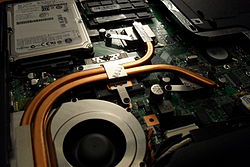
A laptop computer heat pipe system

A heat pipe is a heat-transfer device that employs phase transition to transfer heat between two solid interfaces.[1]

At the hot interface of a heat pipe, a volatile liquid in contact with a thermally conductive solid surface turns into a vapor by absorbing heat from that surface. The vapor then travels along the heat pipe to the cold interface and condenses back into a liquid, releasing the latent heat. The liquid then returns to the hot interface through capillary action, centrifugal force, or gravity, and the cycle repeats.

Due to the very high heat-transfer coefficients for boiling and condensation, heat pipes are highly effective thermal conductors. The effective thermal conductivity varies with heat-pipe length and can approach 100 kW/(m⋅K) for long heat pipes, in comparison with approximately 0.4 kW/(m⋅K) for copper.[2]

Modern CPU heat pipes are typically made of copper and use water as the working fluid.[3] They are common in many consumer electronics like desktops, laptops, tablets, and high-end smartphones.

History

[edit]

The general principle of heat pipes using gravity, commonly classified as two-phase thermosiphons, dates back to the steam age. Angier March Perkins and his son Loftus Perkins created the Perkins Tube, which achieved widespread use in locomotive boilers and working ovens.[4] Capillary-based heat pipes were first suggested by R. S. Gaugler of General Motors in 1942, who patented the idea,[5] but did not develop it.

George Grover independently developed capillary-based heat pipes at Los Alamos National Laboratory in 1963; his patent of that year[6] was the first to use the term "heat pipe", and he is often referred to as "the inventor of the heat pipe".[7] He noted in his notebook:[8]

Such a closed system, requiring no external pumps, may be of particular interest in space reactors in moving heat from the reactor core to a radiating system. In the absence of gravity, the forces must only be such as to overcome the capillary and the drag of the returning vapor through its channels.

Grover's suggestion was taken up by NASA, which led heat-pipe development in the 1960s, particularly regarding applications to and reliability in space flight. This was understandable given the low weight, high heat flux, and zero power draw of heat pipes, and that they would not be adversely affected by a zero gravity environment.

The first space application was the thermal equilibration of satellite transponders.[9] As satellites orbit, one side is exposed to the direct radiation of the sun while the opposite side is completely dark and exposed to the deep cold of outer space. This causes severe temperature discrepancies (and thus reduces reliability and accuracy) of the transponders. The heat pipe designed for this purpose managed the high heat fluxes and demonstrated flawless operation with and without the influence of gravity. That cooling system was the first to use variable-conductance heat pipes to actively regulate heat flow or evaporator temperature.

NASA tested heat pipes designed for extreme conditions, with some using liquid sodium as the working fluid. Other forms of heat pipes cool communication satellites.[10] Publications in 1967 and 1968 by Feldman, Eastman,[11] and Katzoff first discussed applications of heat pipes for wider uses such as in air conditioning, engine cooling, and electronics cooling. These papers were the first to mention flexible, arterial, and flat-plate heat pipes. Publications in 1969 introduced the concept of the rotational heat pipe with its applications to turbine-blade cooling and contained the first discussions of heat-pipe applications to cryogenic processes.

Starting in the 1980s, Sony began incorporating heat pipes into its commercial electronic products in place of both forced-convection and passive-finned heat sinks. Initially they were used in receivers and amplifiers, soon spreading to other high-heat-flux electronics applications.

During the late 1990s, increasingly high-heat-flux microcomputer CPUs spurred a threefold increase in the number of U.S. heat-pipe patent applications. As heat pipes evolved from a specialized industrial heat-transfer component to a consumer commodity, most development and production moved from the U.S. to Asia.

CPU heat pipes are typically made of copper and use water as the working fluid.[3]

Structure, design, and construction

[edit]
Longitudinal cross-section of a heat pipe. It is closed at both ends. The 'wick' coats the inside surface, while the inner cavity is filled with vapour. The diagram illustrates heat transfer: 1. (left end of the pipe) working fluid evaporates to vapour absorbing thermal energy; 2. vapour migrates along cavity to lower temperature end; 3. vapour condenses back to fluid and is absorbed by the wick, releasing thermal energy; 4. working fluid flows back to the lower temperature end.
Diagram showing components and mechanism for a heat pipe containing a wick
A worker in high visibility clothing and a hard hat examines a long line of pipes about four times his height sticking out of rocky ground.
Heat pipes keep ground frozen and inhibit water transfer into the open pit during mining activities at Ekati Diamond Mine.
This 100×100×10 mm thick, flat heat pipe (heat spreader) animation was created using high-resolution CFD analysis and shows temperature-contoured flow trajectories.
This 120-mm-diameter vapor chamber (heat spreader) heat-sink-design thermal animation was created using high-resolution CFD analysis and shows temperature-contoured heat-sink surface and fluid-flow trajectories.
Cross section of a heat pipe for cooling the CPU of a laptop computer. Ruler scale is in millimetres.
Cut-away view of a 500 μm thick, flat heat pipe with a thin planar capillary (blue)
Thin, flat heat pipe (heat spreader) with remote heat sink and fan

A typical heat pipe consists of an envelope (sealed pipe), a wick, and a working fluid. The envelope is made of a material that is compatible with the working fluid such as copper for water heat pipes, or aluminum for ammonia heat pipes. Typically, a vacuum pump removes the air from the pipe, which is partially filled with a working fluid and then sealed. The working-fluid mass is chosen so that the heat pipe contains both vapor and liquid over the operating temperature range.[1]

The operating temperature of a given heat pipe system is critically important. Below the operating temperature, the liquid is too cold and cannot vaporize into a gas. Above the operating temperature, all the liquid has turned to gas, and the environmental temperature is too high for the gas to condense. Thermal conduction is still possible through the walls, but at a greatly reduced rate of thermal transfer. In addition, for a given heat input, a minimum working-fluid temperature must be attained, while at the other end, any additional increase (deviation) in the heat-transfer coefficient from the initial design tends to inhibit the heat-pipe action. This can be counterintuitive, in the sense that if a heat-pipe system is aided by a fan, then the heat-pipe operation may potentially be severely reduced. The operating temperature and the maximum heat-transport capacity—limited by its capillary or other structure used to return the fluid to the hot area—are closely related.[12]

Working fluids are chosen according to the required operating temperatures, with examples ranging from liquid helium for extremely low-temperature applications (2–4 K) to mercury (523–923 K), sodium (873–1473 K), and even indium (2000–3000 K) for extremely high temperatures. The vast majority of heat pipes for room-temperature applications use ammonia (213–373 K), alcohol (methanol (283–403 K), ethanol (273–403 K)), or water (298–573 K). Copper/water heat pipes have a copper envelope, use water as the working fluid, and typically operate from 20 to 150 °C (293–423 K).[13][14] Water heat pipes are sometimes partially filled with water, heated until the water boils and displaces the air, and then sealed while hot.

The heat pipe must contain saturated liquid and its vapor (gas phase). The saturated liquid vaporizes and travels to the condenser, where it is cooled and condensed.

The liquid returns to the evaporator via the wick, which exerts capillary action on the liquid. Wick structures include sintered metal powder, screen, and grooved wicks, which have a series of grooves parallel to the pipe axis. When the condenser is located above the evaporator in a gravitational field, gravity can return the liquid. In this case, the pipe is a thermosiphon. Rotating heat pipes use centrifugal forces to return liquid from the condenser to the evaporator.[1]

Heat pipes contain no moving parts and typically require no maintenance, though non-condensable gases that diffuse through the pipe's walls, that result from breakdown of the working fluid, or that exist as original impurities in the material, may eventually reduce the pipe's effectiveness.[1]

The heat pipe's advantage over many other heat-dissipation mechanisms is its efficiency in transferring heat. A pipe one inch in diameter and two feet long can transfer 3.7 kW (13,000 BTU/h) at 1,800 °F (980 °C) with only 18 °F (10 °C) drop from end to end.[14] Some heat pipes have demonstrated a heat flux of more than 23 kW/cm2, about four times the that of the Sun's surface.[15]

Some envelope/working-fluid pairs that appear to be compatible are not. For example, water in an aluminum envelope develops significant amounts of non-condensable gas within hours or days. This issue is primarily due to the oxidation and corrosion of aluminum in the presence of water, which releases non-condensable hydrogen gas.[16]

In an endurance test, pipes are operated for long intervals and monitored for problems such as non-condensable gas generation, material transport, and corrosion.[17][18]

The most commonly used envelope/wick/fluid combinations include:[19]

Other combinations include stainless-steel envelopes with nitrogen, oxygen, neon, hydrogen, or helium working fluids at temperatures below 100 K, copper/methanol for electronics cooling when the heat pipe must operate below the water range, aluminum/ethane heat pipes for spacecraft thermal control in environments when ammonia can freeze, and refractory-metal envelope / lithium fluid for applications above 1,050 °C (1,320 K; 1,920 °F).[20]

Heat pipes must be tuned to particular cooling conditions. The choice of pipe material, size, and coolant all affect the optimal temperature. Outside of its design heat range, thermal conductivity is reduced to the heat-conduction properties of its envelope. For copper, that is around 1/80 of the design flux. This is because below the range, the working fluid never vaporizes, and above the range, it never condenses.

Few manufacturers can make a traditional heat pipe smaller than 3 mm in diameter due to material limitations.[21] Researchers have shown that heat pipes containing graphene can improve cooling performance in electronics.[22]

Types

[edit]

In addition to standard, constant-conductance heat pipes (CCHPs), other types include:[23]

  • Vapor chambers (planar heat pipes), which are used for heat-flux transformation, and surface isothermalization;
  • Variable-conductance heat pipes (VCHPs), which use a non-condensable gas (NCG) to change the heat pipe's effective thermal conductivity as power or the heat-sink conditions change;
  • Pressure-controlled heat pipes (PCHPs), a type of VCHP where the reservoir volume or the NCG mass can be changed, to increase precision;
  • Diode heat pipes, which have a high thermal conductivity in the forward direction, and a low thermal conductivity in the reverse direction;
  • Thermosiphons, which return the liquid to the evaporator by gravitational/accelerational forces; and
  • Rotating heat pipes, which return the liquid to the evaporator by centrifugal forces.

Vapor chamber

[edit]

Thin planar pipes (heat spreaders or flat pipes) have the same primary components as tubular pipes.[24] They add an internal support structure or a series of posts to the vapor chamber to accommodate clamping pressures up to 90 psi (620 kPa). This helps prevent collapse of the flat top and bottom when pressure is applied.

The two main applications for vapor chambers are when high powers and heat fluxes are applied to a relatively small evaporator.[25] Heat input to the evaporator vaporizes liquid, which flows in two dimensions to the condenser surfaces. After the vapor condenses, capillary forces in the wick return the condensate to the evaporator. Most vapor chambers are insensitive to gravity, and operate when inverted, with the evaporator above the condenser. In this application, the vapor chamber acts as a heat-flux transformer, cooling a high heat flux from an electronic chip or laser diode, and transforming it to a lower heat flux that can be removed by natural or forced convection. With special evaporator wicks, vapor chambers can remove 2000 W over 4 cm2, or 700 W over 1 cm2.[26]

Another major use of vapor chambers is for cooling laptops. As vapor chambers are flatter and more two-dimensional, gaming laptops benefit more compared to traditional pipes. For example, the vapor-chamber cooling in Lenovo's Legion 7i was a selling point (although only a few units were so equipped).[27]

Compared to a one-dimensional tubular pipe, the width of a two-dimensional pipe allows thin devices to offer an adequate cross section for heat flow. Such pipes appear in "height-sensitive" applications, such as notebook computers and surface-mount circuit-board cores. It is possible to produce flat pipes as thin as 1.0 mm (only slightly thicker than a credit card).[28]

Variable conductance

[edit]

Standard heat pipes are constant-conductance devices, where the operating temperature is set by the source and sink temperatures, and the thermal resistance from the source to the sink. The temperature drops linearly as the power or condenser temperature is reduced. For some applications, such as satellite or research-balloon thermal control, the electronics are overcooled at low powers, or at the low-sink temperatures. Variable-conductance heat pipes (VCHPs) are used to passively maintain the temperature of the electronics being cooled as power and sink conditions change.[29]

Variable-conductance heat pipes add two elements: a reservoir and a non-condensable gas (NCG). The non-condensable gas is typically argon, though helium is used for thermosyphons. When the heat pipe is not operating, the non-condensable gas and working-fluid vapor are mixed. When the pipe is operating, the non-condensable gas is swept toward the condenser by the flow of the working-fluid vapor. Most of the non-condensable gas is located in the reservoir, while the remainder blocks a portion of the condenser. The VCHP works by varying the active length of the condenser. When the power or heat-sink temperature is increased, the heat-pipe vapor temperature and pressure increase. The increased vapor pressure forces more of the non-condensable gas into the reservoir, increasing the active condenser length and the conductance. Conversely, when the power or heat-sink temperature is decreased, the heat-pipe vapor temperature and pressure decrease, and the non-condensable gas expands, reducing the active condenser length and conductance.

The addition of a small heater on the reservoir, with the power controlled by the evaporator temperature, allows thermal control of roughly ±1–2 °C. In one example, the evaporator temperature was maintained in a ±1.65 °C control band, as power varied from 72 to 150 W, and heat sink temperature varied from +15 °C to −65 °C.

VCHPs can be used when tighter temperature control is required.[30] The evaporator temperature is used to either vary the reservoir volume, or the amount of non-condensable gas. VCHPs have demonstrated milli-Kelvin temperature control.[31]

Diode

[edit]

Conventional heat pipes transfer heat from the hotter to the colder end. Several designs act as a thermal diode, transferring heat in one direction, while acting as an insulator in the other:[32]

  • Thermosyphons transfer heat only from the bottom to the top, where the condensate returns by gravity. When the thermosyphon is heated at the top, no liquid is available to evaporate.
  • Rotating heat pipes allow liquid to travel only by centrifugal forces from the evaporator to the condenser. No liquid is available when the condenser is heated.
  • Vapor-trap diode heat pipes.
  • Liquid-trap diode heat pipes.

A vapor-trap diode is fabricated in a similar fashion to a variable-conductance heat pipe, with a gas reservoir at the end of the condenser. During fabrication, the heat pipe is charged with the working fluid and a controlled amount of a non-condensable gas (NCG). During normal operation, the flow of the working-fluid vapor from the evaporator to the condenser sweeps the non-condensable gas into the reservoir, where it does not interfere with the normal heat-pipe operation. When the nominal condenser is heated, the vapor flow is from the nominal condenser to the nominal evaporator. The non-condensable gas is dragged along with the flowing vapor, completely blocking the nominal evaporator, and greatly increasing the thermal resistivity of the heat pipe. In general, there is some heat transfer to the nominal adiabatic section. Heat is then conducted through the heat-pipe walls to the evaporator. In one example, a vapor-trap diode carried 95 W in the forward direction, and only 4.3 W in the reverse direction.[33]

A liquid trap diode has a wicked reservoir at the evaporator end of the heat pipe, with a separate wick that is not in communication with the wick in the remainder of the heat pipe.[34] During normal operation, the evaporator and reservoir are heated. The vapor flows to the condenser, and liquid returns to the evaporator by capillary forces in the wick. The reservoir eventually dries out, since there is no method for returning liquid. When the nominal condenser is heated, liquid condenses in the evaporator and the reservoir. While the liquid can return to the nominal condenser from the nominal evaporator, the liquid in the reservoir is trapped, since the reservoir wick is not connected. Eventually, all of the liquid is trapped in the reservoir, and the heat pipe ceases operation.

Thermosyphons

[edit]

Most heat pipes use a wick to return the liquid from the condenser to the evaporator, allowing the heat pipe to operate in any orientation. The liquid is sucked up back to the evaporator by capillary action, similar to the way that a sponge sucks up water when an edge is placed in contact with a pool of water. However, the maximum adverse elevation (evaporator over condenser) is relatively small, on the order of 25 cm for a typical water heat pipe.

If, however, the evaporator is located below the condenser, then the liquid can drain back by gravity instead of requiring a wick, and the distance between the two can be much longer. Such a gravity-aided heat pipe is known as a thermosyphon.[35]

In a thermosyphon, liquid working fluid is vaporized by a heat supplied to the evaporator at the bottom of the heat pipe. The vapor travels to the condenser at the top of the heat pipe, where it condenses. The liquid then drains back to the bottom of the heat pipe by gravity, and the cycle repeats. Thermosyphons are diode heat pipes; when heat is applied to the condenser end, there is no condensate available, and hence no way to form vapor and transfer heat to the evaporator.

Thermosyphon designs include[36] thermoprobe, thermopile, depth thermosyphon, sloped-thermosyphon foundation, flat-loop thermosyphon foundation, and hybrid flat-loop thermosyphon foundation.

While a typical terrestrial water heat pipe is less than 30 cm long, thermosyphons are often several meters long. The thermosyphons used to cool the trans-Alaska pipeline were roughly 11 to 12 m long. Even longer thermosyphons have been proposed for the extraction of geothermal energy. For example, Storch et al. fabricated a 53 mm I.D., 92 m long propane thermosyphon that carried roughly 6 kW of heat.[37] Their scalability to large sizes also makes them relevant for solar-thermal[38] and HVAC applications.[39]

Loop

[edit]

A loop heat pipe (LHP) is a passive two-phase transfer device. It can carry higher power over longer distances by having co-current liquid and vapor flow, in contrast to the counter-current flow in a conventional heat pipe.[40][41] This allows the wick in a loop heat pipe to be required only in the evaporator and compensation chamber. Micro loop heat pipes have been employed in ground and space applications.

Oscillating or pulsating

[edit]

An oscillating heat pipe (OHP), also known as a pulsating heat pipe (PHP), is only partially filled with liquid working fluid. The pipe is arranged in a serpentine pattern in which freely moving liquid and vapor segments alternate.[42] Oscillation takes place in the working fluid; the pipe remains motionless. These have been investigated for many applications, including cooling photovoltaic panels,[43] cooling electronic devices,[44] heat-recovery systems, fuel-cell systems,[45][46] HVAC systems,[47] and desalination.[48] PHPs can be combined with phase-change materials.[44][48]

Heat transfer

[edit]

Heat pipes rely on phase change to transfer thermal energy. They cannot lower temperatures at either end below the ambient temperature—they can only equalize the temperature within the pipe.

When one end of the heat pipe is heated, the working fluid inside the pipe at that end vaporizes and increases the vapor pressure inside the cavity of the heat pipe. The latent heat of vaporization absorbed by the working fluid reduces the temperature at the hot end of the pipe.

The vapor pressure over the working fluid at the hot end is higher than at the cooler end, and this pressure difference drives a rapid mass transfer to the condensing end where the excess vapor condenses, releases its latent heat, and warms the cool end. Non-condensing gases (caused by e.g., contamination) in the vapor impede the gas flow and reduce effectiveness, particularly at low temperatures, where vapor pressures are low. The speed of molecules in a gas is approximately the speed of sound, and in the absence of noncondensing gases (i.e., if there is only a gas phase present), this is the upper limit to the velocity they can travel at. In practice, the speed of the vapor is limited by the rate of condensation at the cold end and far lower than the molecular speed.[citation needed] The condensation rate is close to the product of the sticking coefficient, the molecular speed, and the gas density, if the condensing surface is very cold. However, if the surface is close to the temperature of the gas, then the evaporation caused by the finite temperature of the surface largely cancels this heat flux. If the temperature difference is more than some tens of degrees, then the vaporization from the surface is typically negligible, as can be assessed from the vapor-pressure curves. In most cases, with efficient heat transport through the gas, it is challenging to maintain significant temperature differences between the gas and the condensing surface. Moreover, this temperature difference corresponds to a large effective thermal resistance by itself. The bottleneck is often less severe at the heat source, as the gas densities are higher there, corresponding to higher maximum heat fluxes.

Temperature range

[edit]

An interesting property of heat pipes is the temperature ranges over which they are effective. It is not the case that a water-charged heat pipe only works when the hot end reaches the boiling point (100 °C, 212 °F, at normal atmospheric pressure) and steam is transferred to the cold end. However, the boiling point of water depends on the absolute pressure inside the pipe. In an evacuated pipe, water vaporizes from its triple point (0.01 °C, 32.02 °F) to its critical point (374 °C, 705 °F), as long as the heat pipe contains both liquid and vapor. Thus a heat pipe can operate at hot-end temperatures as low as just slightly warmer than the melting point of the working fluid, although the maximum rate of heat transfer is low at temperatures below 25 °C (77 °F). Similarly, a heat pipe with water as a working fluid can work well above the atmospheric boiling point (100 °C, 212 °F). The maximum temperature for long term water heat pipes is 270 °C (518 °F), with heat pipes operating up to 300 °C (572 °F) for short-term tests.[49][50]

The heat of vaporization greatly exceeds the specific heat capacity. Using water as an example, the energy needed to evaporate one gram of water is 540 times the amount of energy needed to raise the temperature of that same one gram of water by 1 °C. Almost all of that energy is rapidly transferred to the "cold" end when the fluid condenses there.[citation needed]

Applications

[edit]

Spacecraft

[edit]
Heat pipes on spacecraft typically use a grooved aluminum extrusion as the envelope.
Typical grooved aluminum-ammonia VCHP for spacecraft thermal control, with the evaporator section on the bottom, and the non-condensable gas reservoir just below the valve[33]

A spacecraft thermal control system has the function to keep all components on the spacecraft within their acceptable temperature ranges. This is complicated by the following:

  • Widely varying external conditions, such as eclipses;
  • Micro-g environment;
  • Heat removal from the spacecraft by thermal radiation only;
  • Limited electrical power available, favoring passive solutions; and
  • Long lifetimes, with no possibility of maintenance.

Some spacecraft are designed to last 20 years, so passive heat transport—rejecting the heat by thermal radiation—means that large radiator panes (multiple square meters) are required. Heat pipes and loop heat pipes are used extensively in spacecraft.

Grooved wicks are used in spacecraft heat pipes, as shown in the first photograph. The heat pipes are formed by extruding aluminum, and typically have an integral flange to increase the heat transfer area, which lowers the temperature drop. Grooved wicks are used in spacecraft since the heat pipes do not have to operate against gravity. This allows spacecraft heat pipes to reach several meters long, in contrast to the roughly 25 cm maximum length for a terrestrial water heat pipe. Ammonia is the most common working fluid for spacecraft heat pipes. Ethane is used when the heat pipe must operate at temperatures below ammonia's freezing temperature.

The second figure shows a typical grooved aluminum/ammonia VCHP for spacecraft thermal control. The heat pipe is an aluminum extrusion, similar to that shown in the first figure. The bottom flanged area is the evaporator. Above the evaporator, the flange is machined off to allow the adiabatic section to be bent. The condenser is shown above the adiabatic section. The NCG reservoir is located above. The valve is removed after filling and sealing the pipe. When electric heaters are used on the reservoir, the evaporator temperature can be controlled within ±2 K of the setpoint.

Computer systems

[edit]
A heat sink (aluminum) with heat pipes (copper)
Typical heat pipe configuration within a consumer laptop. The heat pipes conduct waste heat away from the CPU, GPU, and voltage regulators, transferring it to a heat sink coupled with a cooling fan that acts as a fluid-to-fluid heat exchanger.

Heat pipes began to be used in computer systems in the late 1990s,[51] when increased power requirements and subsequent increases in heat emission resulted in greater demands on cooling systems. They are now extensively used in many modern computer systems, typically to move heat away from components such as CPUs and GPUs to heat sinks.

Solar thermal

[edit]

Heat pipes are also widely used in solar thermal water heating applications in combination with evacuated tube solar collector arrays. In these applications, distilled water is commonly used as the heat transfer fluid inside a sealed length of copper tubing that is located within an evacuated glass tube and oriented towards the Sun. In connecting pipes, the heat transport occurs in the liquid steam phase because the thermal transfer medium is converted into steam in a large section of the collecting pipeline.[52]

In solar thermal water heating applications, an individual absorber tube of an evacuated tube collector is up to 40% more efficient compared to more traditional "flat plate" solar water collectors. This is largely because they evacuate the tube, which slows down convective and conductive heat loss. Relative efficiencies of the evacuated tube system are reduced however, when compared to flat plate collectors because the latter have a larger aperture size and can absorb more solar energy per unit area. This means that while an individual evacuated tube has better insulation (lower conductive and convective losses), an array of tubes absorbs less energy per unit area due to the reduced absorber surface area because of the rounded tubes. Therefore, real world efficiencies of both designs are about the same.

Evacuated tube collectors reduce the need for anti-freeze additives since the vacuum helps slow heat loss. However, under prolonged exposure to freezing temperatures the heat transfer fluid can still freeze and precautions must be taken to ensure that the frozen does not damage the evacuated tube. Properly designed solar thermal water heaters can be frost protected down to more than -3 °C with special additives and are used in Antarctica to heat water.[citation needed]

Permafrost cooling

[edit]
Alaska pipeline support legs cooled by heat pipe thermosyphons to keep permafrost frozen

Building on permafrost is difficult because heat from the structure can thaw the permafrost. Heat pipes are used in some cases to avoid the risk of destabilization. For example, in the Trans-Alaska Pipeline System residual ground heat remaining in the oil as well as heat produced by friction and turbulence in the moving oil could conduct down the pipe's support legs and melt the permafrost that anchors the supports. This would cause the pipeline to sink and possibly be damaged. To prevent this, each vertical support member is equipped with four thermosyphons.[53]

During the winter, the air is colder than the ground around the supports. The liquid at the bottom of the thermosyphon is vaporized by heat absorbed from the ground, cooling the surrounding permafrost and lowering its temperature. During the summer, the thermosyphons stop operating, since no gas condenses at the top, but the extreme cold during the winter causes condensation and the liquid flows down. In the Trans-Alaska Pipeline System ammonia was initially used as the working fluid, however this was replaced with carbon dioxide due to blockages.[54]

Thermosyphons keep the permafrost frozen alongside parts of the Qinghai–Tibet Railway where the embankment and track absorb the sun's heat. Heat pipes on either side of relevant formations prevent that heat from spreading into the surrounding permafrost.

Cooking

[edit]

The first commercial heat pipe product was the "Thermal Magic Cooking Pin" developed by Energy Conversion Systems, Inc., and first sold in 1966.[55] The cooking pans used water as the working fluid. The envelope was stainless steel, with an inner copper layer for compatibility. To roast meat, one end of the heat pipe is poked through the meat. The other end extends into the oven where it draws heat to the middle of the meat. The pin reduces cooking time for large pieces of meat by one-half.[56]

The principle has been applied to camping stoves. The heat pipe transfers a large volume of heat at low temperature to allow goods to be baked and other dishes to be cooked in camping-type situations.[citation needed]

Ventilation heat recovery

[edit]

In heating, ventilation, and air-conditioning (HVAC) systems, heat pipes are positioned within the supply and exhaust air streams of an air-handling system or in the exhaust gases of an industrial process, recovering heat.

The device consists of a battery of multi-row finned heat pipe tubes located within both the supply and exhaust air streams. The system recovers heat from the exhaust and transfers it to the intake.

Efficiency is greatest when the unit is positioned upright with the supply-air side mounted over the exhaust-air side, which allows the liquid refrigerant to flow quickly back to the evaporator aided by the force of gravity. Gross heat transfer efficiencies of up to 75% are claimed by manufacturers.[citation needed]

Nuclear power conversion

[edit]

Cooling systems for nuclear power cells for spacecraft encounter extreme thermal conditions. Alkali-metal heat pipes can transfer heat from the source to a thermionic or thermoelectric converter to generate electricity.

Since the early 1990s, heat pipes for transporting heat between the reactor core and the power-conversion system have been attempted.[57] The first reactor to produce electricity using heat pipes was opened on September 13, 2012.[58]

Wankel rotary combustion engines

[edit]

Ignition of the fuel mixture takes place in a specific part of Wankel engines, inducing thermal dilatation disparities that reduce power output, impair fuel economy, and accelerate wear. In SAE paper 2014-01-2160, "A Heat Pipe Assisted Air-Cooled Rotary Wankel Engine for Improved Durability, Power and Efficiency",[59] the authors claimed a reduction in top engine temperature from 231 °C to 129 °C, and the temperature difference reduced from 159 °C to 18 °C for a typical small-chamber-displacement air-cooled unmanned aerial vehicle engine.

Heat exchangers

[edit]

Heat exchangers transfer heat from a hot stream to a cold stream of air, water, or oil. A heat-pipe heat exchanger contains several heat pipes that each acts as a heat exchanger. This increases efficiency, lifespan, and safety. In case one pipe breaks, only a small amount of liquid is released, which is critical for certain industrial processes such as aluminum casting. Additionally, with one broken heat pipe, the heat exchanger remains operable.

The EU-funded ETEKINA project used a heat-pipe heat exchanger to recover over 40% of waste heat from various industrial factories across Europe between 2017 and 2022.[60]

Potential applications

[edit]

Research explores the use of heat pipes in various systems:

  • Improving the efficiency of geothermal heating to prevent slippery roads during winter in cold climate zones.[61]
  • Increasing the efficiency of photovoltaic cells by coupling the solar panel to a heat-pipe system. This transports heat away from overheated panels to maintain optimal temperatures for maximum energy generation. Additionally, the tested setup uses the recovered energy to heat water.[62]
  • Hybrid control-rod heat pipes to shut down a nuclear reactor in case of an emergency and simultaneously transferring decay heat away to prevent the reactor from running hot.[63]

See also

[edit]
  • Heat sink – Passive heat exchanger that transfers heat
  • Loop heat pipe – Two-phase heat transfer device
  • Thermoelectric cooling – Applies an electric current to heat or cool materials

References

[edit]
[edit]
Revisions and contributorsEdit on WikipediaRead on Wikipedia
from Grokipedia
A heat pipe is a passive, two-phase device that efficiently transports heat from a source to a using the and of a within a sealed, vacuum-tight containing a wick structure. The device operates without external power, relying on to return the condensed fluid to the evaporator section, achieving effective thermal conductivities up to 100 times that of . Invented in 1942 by Richard S. Gaugler at as a means to improve efficiency, the modern heat pipe concept was independently developed and named in 1963 by George Grover at , where it was initially explored for nuclear applications. Early designs used high-temperature fluids like and sodium, but advancements in the 1970s introduced lower-temperature variants with or , enabling broader terrestrial and uses. Since then, heat pipes have become essential in thermal management, particularly in environments requiring high handling, such as up to 20 kW/cm², with minimal temperature drops. Key components include the (typically or aluminum for durability), the (selected based on , e.g., for 0–200°C ranges), and the wick (porous material like sintered metal or grooves for pumping). In operation, input at the vaporizes the fluid, driving vapor flow to the cooler condenser where it releases and condenses; the wick then draws the liquid back against gravity or acceleration forces. This cycle ensures near-isothermal conditions, making heat pipes ideal for applications in electronics cooling (e.g., laptops and servers), spacecraft thermal control (e.g., 's and OCO-2 missions), and . Variants include variable conductance heat pipes (VCHPs) for adjustable performance, heat pipes that prevent back-conduction, and loop heat pipes for longer-distance transport.

Fundamentals

Overview

A heat pipe is a passive heat-transfer device that utilizes the principles of evaporative cooling and phase change to efficiently transport over moderate distances without requiring external power. It consists of a sealed, evacuated , typically a metal tube, partially filled with a that undergoes and cycles to move from a source to a . This two-phase process enables the device to achieve exceptionally high effective conductivities, often ranging from to /m·, which can be up to 250 times greater than that of (approximately 400 /m·). The basic structure includes three primary sections: the , where is absorbed and the evaporates into vapor; the adiabatic section, which insulates and allows vapor transport with minimal loss; and the condenser, where the vapor releases to the and condenses back into liquid. A porous wick structure lines the interior, providing to return the condensed liquid to the against or in any orientation, ensuring continuous operation. In a simple , input at the end causes the liquid to boil, generating high-pressure vapor that flows to the cooler condenser end, where it condenses and releases ; the wick then pumps the liquid back via forces. Key advantages of heat pipes include their isothermal operation, maintaining near-uniform temperatures across the device (typically a 2–5°C difference end-to-end), reliability without moving parts, and adaptability to various orientations due to capillary-driven flow. Heat pipes have since become ubiquitous in cooling, high-power systems, and energy-efficient designs.

History

The concept of the heat pipe was first proposed in 1942 by R. S. Gaugler of , who patented a capillary-based device for but did not pursue its development further. Independently, in 1963, George M. Grover at developed a functional heat pipe while working on thermal management for nuclear-powered systems, addressing the need for efficient heat dissipation in high-temperature environments. This invention stemmed from efforts to create lightweight, reliable cooling solutions amid the space race's demands for advanced propulsion and power systems. Grover and colleagues published the first detailed description of the heat pipe in , introducing it as a structure of very high thermal conductance suitable for specialized applications. quickly adopted the technology in the mid- for , integrating heat pipes into systems to manage extreme temperature variations in orbit. By the late , RCA Laboratories obtained key patents and demonstrated the first commercial application, using heat pipes in heat sinks for transmitters, marking the transition from space to terrestrial uses. The 1970s saw broader commercialization, with heat pipes expanding into electronics cooling for computers and other devices, driven by increasing power densities. During this period, advanced variable conductance heat pipes (VCHPs), which incorporated non-condensable gas reservoirs to actively control thermal resistance and prevent overcooling in variable environments. In 1990, Hisateru Akachi patented the pulsating heat pipe, a simpler, wickless variant that relied on oscillatory flow for enhanced performance in compact systems. Post-2000 developments focused on micro- and miniature heat pipes to meet the thermal challenges of , such as laptops and smartphones, where constraints demanded high-efficiency, low-profile cooling. These advancements built on earlier space-driven innovations, shifting emphasis to scalable, cost-effective designs for high-volume terrestrial markets.

Design and Components

Structure

A heat pipe consists of a sealed, evacuated tubular container, typically constructed from high-thermal-conductivity metals such as or aluminum, with outer diameters ranging from 3 mm to 10 mm for standard designs and lengths from 10 cm to several meters depending on the application. The tube is divided into three primary zones along its length: the section at the heat input end, where is absorbed; the adiabatic section in the middle, which facilitates vapor transport with minimal heat loss; and the condenser section at the heat rejection end, where the vapor releases heat and condenses. This linear geometry enables efficient one-dimensional , though the pipe can be bent or shaped for integration without significantly compromising performance. Lining the inner wall of the container is a wick structure, a porous medium that returns condensed liquid from the condenser to the via against gravity or other forces. Common wick types include sintered metal powders, which offer high but lower permeability; screen or structures, providing moderate performance across various orientations; and grooved surfaces machined into the wall for simple, high-permeability designs suitable for axial applications. Advanced variants encompass arterial wicks, featuring embedded channels for enhanced liquid distribution; wicks, such as single-layer screens for thin profiles; and composite wicks, combining elements like sintered over grooves to balance capillary pumping and vapor flow. The wick material, often , , or , is selected to match the container and ensure structural integrity under operational stresses. The container is hermetically sealed at both ends to preserve the internal and prevent fluid leakage or contamination, with materials chosen for compatibility with the and resistance to across the operating temperature range. Optional end fittings, such as headers or flanges, may be incorporated to facilitate attachment to heat sources, sinks, or larger thermal management systems. Variations in form include flexible heat pipes with braided or hinged sections for dynamic applications, flat profiles for compact cooling, and micro-scale versions with sub-millimeter diameters for miniaturized devices, all retaining the core zonal and wick architecture.

Working Fluids and Materials

The selection of working fluids for heat pipes is governed by the range, with the critical temperature exceeding the maximum operating temperature to maintain two-phase operation, while remaining below the minimum temperature, and exhibiting favorable thermophysical properties. Key properties include high of vaporization for efficient phase change heat transport, high to sustain in wick structures, low to minimize hydrodynamic losses, and appropriate to match the application's thermal load. Additionally, the fluid must demonstrate long-term compatibility with the container and wick materials to prevent , gas generation, or material degradation. Common working fluids are chosen based on these properties and the targeted temperature regime. For moderate temperatures around room conditions to 200°C, is widely used due to its high (approximately 2257 kJ/kg at 100°C) and (0.059 N/m at 100°C), enabling effective operation from 20°C to 280°C. serves cryogenic and low-temperature applications from -65°C to 100°C, offering low and good compatibility with certain metals, while operates from -60°C to 100°C with similar advantages for cooling. For high-temperature scenarios exceeding 600°C, alkali metals like sodium (600–1100°C) or (500–700°C) are employed, leveraging their high thermal conductivity and despite higher challenges. Container materials must possess high thermal conductivity for radial heat spreading, mechanical strength to withstand internal pressures, and compatibility with the to avoid reactions. is preferred for and due to its excellent thermal conductivity (about 400 W/m·K) and compatibility up to 280°C, while aluminum suits in low-temperature ranges (-65–100°C) with its nature and conductivity (237 W/m·K), though it requires careful pairing. is selected for high-temperature alkali metals like sodium, providing corrosion resistance and strength up to 1100°C, and offers versatility for or in demanding environments. Wettability is also critical, ensuring the fluid spreads effectively on the material surface to support flow. Compatibility between fluids and materials is essential to prevent issues such as , non-condensable gas (NCG) generation, or solid deposition, which can degrade performance over time. For instance, aluminum reacts with to produce gas, leading to increased pressure and reduced efficiency, while copper is incompatible with due to potential . Such reactions are mitigated through , surface coatings (e.g., nickel plating on aluminum), or life-testing protocols that verify stability under operational conditions. Fluid charging involves evacuating the heat pipe to remove air and contaminants, then introducing a precise amount of high-purity , typically triple-distilled to minimize NCG, before sealing. The charge volume is determined by the desired void fraction (often 10–20% to accommodate vapor expansion) and at operating temperatures, ensuring optimal liquid distribution without flooding or dry-out. Purity is verified post-charging through cold-trap tests, where NCG accumulation is limited to less than 1% of the pipe length at -40°C. Recent research explores advanced fluids to enhance performance beyond traditional options. Nanofluids, which suspend nanoparticles (e.g., Al₂O₃ or CuO) in base fluids like or acetone, improve thermal conductivity by up to 20–30% and reduce thermal resistance in heat pipes, as demonstrated in studies on pulsating and loop variants for electronics cooling. Ionic liquids, often mixed with (e.g., [emim][TfO] + H₂O), offer tunable properties like negligible and high stability, enabling operation in loop heat pipes with reduced startup times and improved heat transfer coefficients, though challenges in persist.

Construction Methods

Heat pipes are typically fabricated from metallic tubes, such as or aluminum, formed through or processes to achieve the desired and thickness, often ranging from 3 to 8 mm for standard designs. is particularly used for creating integral axial grooves in the inner , which serve as simple wick structures, while ensures smooth, thin-walled envelopes suitable for high-pressure applications. For specialized cases like spacecraft components, grooved aluminum s may incorporate dual bores for redundancy, joined via . The wick structure is inserted next, with common methods including , , and . involves packing metal powders, such as or , into the tube and heating to approximately 80% of the melting temperature to form a porous with 45-70% , enabling high and heat fluxes up to 75 W/cm². entails layering fine mesh screens (e.g., 100x100 mesh) and spot-welding or them in place, offering low-cost fabrication with comparable performance to sintered wicks. Machined grooves, created via or , provide low but limit heat flux to around 10 W/cm², commonly used in low-gravity environments. In ultra-thin heat pipes, wick insertion challenges arise from ensuring uniform deposition, often addressed with spiral woven mesh or multi-size composite to maintain permeability, such as 1.299 × 10⁻¹¹ m² for sintered powder. Recent advancements include additive manufacturing techniques, such as , for fabricating complex wick structures like lattices or hybrids, allowing for optimized (up to 70%) and enhanced performance in micro-scale applications as of 2024. Sealing follows wick placement, typically by pinch-off or under to create a hermetic enclosure. Pinch-off involves collapsing and the tube end after filling, while or ensures vacuum-tight joints with minimal , verified via inspection. For ultra-thin variants, localized shrinking and techniques accommodate flat profiles without compromising integrity. Furnace in a atmosphere is employed for of flat heat pipes, using alloys like Handy & Harman No. 560 for strong, leak-proof bonds. Fluid filling occurs after evacuation to remove air and impurities, typically to pressures below 10^{-5} (or 30-40 millitorr in production setups) using a system, followed by introduction of a precise volume of , such as triple-distilled or . The fill ratio is calibrated to optimize performance, often 10-20% of the volume, with the tube then resealed by cold pinch-off and . Getters, such as zirconium-based materials, may be incorporated during filling to chemically absorb non-condensable gases like , preventing accumulation that degrades condenser efficiency. In miniature designs, compatibility issues like from fluids (e.g., avoiding with aluminum) are critical to minimize non-condensable gas generation. Quality control encompasses leak testing via helium mass spectrometry (maximum rate 3.2 × 10^{-9} cc/sec), thermal performance verification through charging curves that plot heat transport versus fill charge, and non-destructive inspections like dye-penetrant for welds. Non-condensable gas levels are assessed by measuring condenser thermal gradients at low temperatures (e.g., -40°C) under 15-25 W input, ensuring less than 0.5 inch accumulation. Life compatibility tests confirm envelope-wick-fluid stability, such as copper-water pairs enduring up to 300°C short-term. For scalability, batch production of micro heat pipes leverages micro-electro-mechanical systems (MEMS) techniques, such as for groove patterning or powder injection molding for sintered wicks, though uniform deposition remains challenging in sub-millimeter scales due to capillary inconsistencies. Standard heat pipes support high-volume output, with facilities achieving 4,000 units per week via automated stamping and lines. Cost factors include materials (e.g., sintered wicks at moderate expense versus low-cost screen weaves) and labor, with wick fabrication often comprising a significant portion, reducible through alternatives like stainless steel screens. Custom extrusions and vacuum processes elevate expenses for specialized pipes, but automation since the 1980s has shifted from manual assembly to integrated evacuation-fill-seal stations, boosting throughput to 50 units per hour. Copper-water systems remain more economical than aluminum-ammonia for terrestrial electronics cooling.

Operating Principles

Heat Transfer Process

The heat transfer process in a heat pipe begins at the section, where thermal energy input causes the in liquid form to absorb heat and undergo at the liquid-vapor interface. This phase change generates high-pressure vapor, which expands and flows through the central vapor space toward the cooler condenser section due to the slight . Upon reaching the condenser, the vapor releases its to the surroundings, condensing back into liquid at the interface, which then collects and returns to the to complete the cycle. This closed-loop circulation occurs without external pumps, relying on the fluid's phase change properties for efficient heat transport over distances. Key physics governing this process involve the phase transitions at the and condenser interfaces, where and occur isothermally, maintaining nearly uniform temperatures along the vapor flow path. The vapor flow is approximately isobaric, with minimal due to the low viscous resistance in the vapor phase compared to flow. return is facilitated by in wick structures, driven by the pressure difference across the curved meniscus (ΔP_cap = 2σ cosθ / r), where σ is , θ is the , and r is the pore radius, which overcomes gravitational and frictional forces. Overall, the system achieves high effective thermal conductivity—often orders of magnitude greater than solid conductors—through this passive, two-phase mechanism. The fundamental heat transport in a heat pipe is quantified by the relation Q=m˙hfgQ = \dot{m} h_{fg}, where QQ is the heat load transferred, m˙\dot{m} is the of the , and hfgh_{fg} is the of . To derive this, consider the energy balance at the : the input heat QQ drives , converting liquid mass m˙\dot{m} to vapor and absorbing m˙hfg\dot{m} h_{fg}, neglecting contributions which are minor compared to the . At the condenser, the same m˙\dot{m} condenses, releasing Qm˙hfgQ \approx \dot{m} h_{fg}, assuming steady-state operation and no net fluid accumulation. This equation highlights the process's , as heat transfer relies primarily on the large rather than gradients. Orientation influences the liquid return mechanism: in gravity-assisted configurations like thermosyphons, the evaporator must be positioned below the condenser to leverage hydrostatic for downward flow, enhancing performance in vertical setups. In contrast, capillary-driven heat pipes with wicks operate independently of , allowing arbitrary orientations but potentially facing reduced capacity against in adverse tilts due to increased capillary pumping demands. During startup, the heat pipe transitions from an initial state—often with frozen or distributed —through transient phases to steady operation. Heat input first induces or redistribution of the in the , followed by initial that may involve at low pressures before establishing continuum vapor flow, potentially limited by sonic velocities in the vapor core. Recovery from dry-out, where the wick temporarily depletes of , occurs by reducing heat input or relying on back-conduction to rewet , leading to pressure oscillations until steady-state circulation is achieved, typically within seconds to minutes depending on properties and geometry.

Performance Factors

The performance of a heat pipe is influenced by several key factors related to its wick structure and fluid dynamics, which determine the capillary pumping capability and overall heat transport efficiency. Wick permeability, a measure of the wick's ability to allow liquid flow, is directly tied to the pore size and porosity of the structure; higher permeability facilitates greater liquid return rates but must be balanced against smaller pore sizes that enhance capillary action. The capillary pressure generated by the wick, which drives the liquid from the condenser to the evaporator, is given by the equation ΔPcap=2σcosθr\Delta P_{\text{cap}} = \frac{2\sigma \cos \theta}{r}, where σ\sigma is the surface tension of the working fluid, θ\theta is the contact angle, and rr is the effective pore radius. Smaller pore radii increase this pressure, enabling operation against gravity or in adverse orientations, but reduce permeability, creating a fundamental trade-off in wick design. Vapor flow resistance arises from pressure drops along the vapor core due to friction and acceleration, which becomes significant at high heat loads and can limit performance in long heat pipes. Shear effects, particularly at the liquid-vapor interface, can entrain liquid droplets into the vapor stream, disrupting the wick's liquid supply and reducing efficiency. Heat transport in a heat pipe is constrained by several physical limits, each dominating under specific operating conditions. The sonic limit occurs when vapor velocity approaches the , choking the flow; it is expressed as Qsonic=hfgAvρvaQ_{\text{sonic}} = h_{fg} A_v \rho_v a, where hfgh_{fg} is the of vaporization, AvA_v is the vapor cross-sectional area, ρv\rho_v is the vapor , and aa is the in the vapor. This limit is typically relevant at startup or low operating temperatures for cryogenic fluids. The viscous limit governs at low vapor pressures, where frictional losses in the vapor flow dominate, restricting the needed for circulation; it is more pronounced in heat pipes with small diameters or low-temperature operation. The entrainment limit arises from high vapor velocities shearing liquid from the wick surface into the vapor core, quantified by the approaching unity, and is critical in high-heat-flux scenarios or with fluids of low . The orientation of a heat pipe relative to gravity affects its performance, particularly for gravity-assisted return in wicked designs. For an inclined heat pipe, the effective gravitational acceleration is geff=gcosαg_{\text{eff}} = g \cos \alpha, where gg is the and α\alpha is the tilt angle from the horizontal; this component influences the hydrostatic opposing capillary pumping. At small positive tilt angles (evaporator below condenser), performance improves due to enhanced liquid return, while adverse tilts reduce capacity by increasing the required capillary head. Thermal resistance quantifies the temperature drop across the heat pipe for a given heat load, defined overall as R=TevapTcondQR = \frac{T_{\text{evap}} - T_{\text{cond}}}{Q}, where TevapT_{\text{evap}} and TcondT_{\text{cond}} are the and condenser temperatures, and QQ is the rate. This total resistance comprises contributions from the (wall and wick conduction, plus evaporation interface), the adiabatic transport section (vapor and pressure drops), and the condenser (condensation interface and conduction). Minimizing these components—through optimized wick thickness and fluid selection—enhances conductance, typically achieving effective thermal conductivities orders of magnitude higher than solid metals. Optimization of design involves trade-offs to maximize the heat capacity QmaxQ_{\max}, often by the pumping ability. Increasing wick permeability improves liquid flow but lowers , necessitating composite wicks that combine fine pores for pumping with coarser structures for ; however, this reduces reliability due to potential non-uniformity. Larger vapor core diameters reduce flow resistance and entrainment risks but increase overall size and weight. Fluid choice balances and , while pipe and are tuned against viscous and sonic limits, with margins applied (e.g., 20-50% below calculated QmaxQ_{\max}) to operation across orientations.

Limitations and Failure Modes

Heat pipes, while effective for thermal management, are subject to several operational limits that constrain their heat transport capacity under varying conditions. The entrainment limit arises when high vapor velocities shear liquid droplets from surface, impeding liquid return to the and causing performance degradation, often audible as clicking or pinging sounds. The limit occurs when 's pumping pressure can no longer overcome frictional losses, gravity, or other pressure drops, leading to dry-out; this is the most common restriction, influenced by wick structure, fluid properties, and orientation, with maximum power typically limited in adverse elevations such as 25 cm for copper-water systems. Boiling limit manifests at high heat fluxes, where in the wick forms vapor bubbles that blanket the surface, blocking liquid supply and capping flux at around 75 W/cm² for sintered water wicks. For cryogenic or heat pipes, the frozen startup limit poses challenges, as low vapor pressures during thawing can delay priming for hours, requiring specific techniques to ensure reliable operation in zero-gravity or low-temperature environments. Failure modes in heat pipes often stem from material interactions and environmental stresses, progressively reducing efficiency. Leakage from seals or welds compromises the internal , detected via helium leak tests with sensitivities down to 10⁻¹¹ std cc/sec, and can arise from or cracks in the . results from fluid-envelope incompatibility, such as aluminum with generating non-condensable gases or altering wick wettability, which blocks the condenser and diminishes over time. Wick degradation, including clogging from particulates, , or crushing under acceleration, increases flow resistance and lowers the pumping capacity, often exacerbated by or material transport. Accumulation of non-condensable gases, produced by or reactions, further reduces the effective condenser length by creating insulating zones, with problematic levels as low as 10-100 ppm. Typical lifespan for heat pipes in demanding applications, such as constant conductance heat pipes, is 15-20 years, though high temperatures, , or incompatible materials can accelerate degradation through enhanced or wick . Diagnostics primarily involve monitoring temperature gradients along the pipe; a sharp increase in the evaporator-to-condenser gradient signals dry-out or non-condensable gas buildup, while isothermal profiles within 1°C at low temperatures confirm integrity. Mitigation strategies focus on design enhancements to extend reliability. Oversized or hybrid wicks with optimized pore sizes increase head to counter dry-out, supporting higher fluxes up to 50 W/cm². Variable conductance designs incorporate non-condensable gas reservoirs to buffer accumulation and maintain control. Fluid additives or compatible pairs, verified through life tests, prevent and gas , while thorough and techniques minimize leakage risks.

Types

Thermosyphons

A thermosyphon is a type of heat pipe that operates without a wick structure, relying instead on gravitational or forces to return condensed liquid to the section. consists of a sealed, evacuated tube—typically made of or aluminum—partially filled with a such as , , or refrigerants, with the positioned below the condenser to ensure effective liquid drainage. This gravity-assisted design eliminates the need for , simplifying the internal geometry and allowing for larger diameters compared to wicked heat pipes. In operation, heat applied to the lower section causes pool boiling of the , generating vapor that rises through the tube due to . The vapor travels to the upper condenser, where it undergoes , releasing and forming a that drains back to the pool under gravity. This cycle enables efficient , with thermosyphons achieving higher heat fluxes than wicked heat pipes owing to the absence of wick-induced flow resistance, though performance is highly sensitive to orientation, requiring the to remain below the condenser. Thermosyphons offer several advantages, including simpler and cheaper construction due to the lack of wicking material, which reduces complexity and costs. They also support higher transport capacities in vertical configurations, with large-scale units capable of handling up to 100 kW in applications like . These benefits make thermosyphons suitable for fixed-orientation systems where aid is reliable. Common applications include recovery in industrial settings, such as exhaust cooling, and solar thermal collectors for efficient energy capture. Limitations arise primarily from operational constraints, including flooding at high heat loads, where excessive vapor generation entrains liquid droplets, impeding return flow and potentially leading to dry-out. The in the evaporator pool boiling regime, which sets an upper limit on sustainable heat input, is described by the Zuber : qcritA=Chfgρv1/2[σg(ρlρv)/ρv2]1/4\frac{q_{\text{crit}}}{A} = C h_{fg} \rho_v^{1/2} \left[ \sigma g (\rho_l - \rho_v) / \rho_v^2 \right]^{1/4} where Cπ/240.131C \approx \pi/24 \approx 0.131, hfgh_{fg} is the latent heat of vaporization, ρv\rho_v and ρl\rho_l are vapor and liquid densities, σ\sigma is surface tension, and gg is gravitational acceleration. This hydrodynamic instability model highlights the balance between vapor production and liquid supply, beyond which transition to film boiling occurs, severely degrading performance.

Loop Heat Pipes

Loop heat pipes (LHPs) represent an advanced variant of capillary-driven devices, featuring a closed-loop configuration that separates the liquid and vapor flow paths to enhance performance under high loads and variable orientations. The core design includes a porous evaporator wick, typically made from sintered metals such as , or with pore radii ranging from 0.7 to 15 μm and of 55–75%, which serves as the primary wick for capillary pumping. This is connected to distinct vapor and liquid transport lines—smooth-walled to minimize losses—and a condenser where rejection occurs. A key component is the compensation chamber, integrated with the evaporator and containing a secondary wick, which stores excess liquid and regulates by managing the meniscus interface, thereby preventing vapor ingress into the liquid line. The development of LHPs originated in the in 1972, pioneered by scientists Yury F. Gerasimov and Yury F. Maydanik, who patented the concept and constructed the first prototype: a 1.2 m long device capable of transporting approximately 1 kW using as the . This innovation addressed limitations in traditional heat pipes for applications, where independence and long-distance transport were critical. By the late 1980s, LHPs were deployed in Soviet satellites, including the Gorizont and GRANAT spacecraft launched in 1989, demonstrating reliable operation in zero- environments. Subsequent adoption by and ESA in missions like the Geoscience Altimeter System (GLAS) and Atmospheric Backscatter (ATLID) further validated their robustness for thermal management. In operation, heat applied to the causes the —commonly , , or refrigerants—to evaporate within the primary wick, generating vapor that flows through the dedicated vapor line to the condenser, where it condenses and releases heat. The resulting liquid returns via the separate liquid line to the compensation chamber, from which in the primary wick pumps it back to the , overcoming pressure drops and elevation changes. This separation of flow paths, combined with the secondary wick in the compensation chamber, enables LHPs to tolerate transport distances of several meters (or tens of meters horizontally) and adverse orientations without reliance on , as the head compensates for hydrostatic effects. The system's self-priming nature, facilitated by the integral evaporator-hydroaccumulator design, ensures startup without external power or preconditioning. LHPs offer significant advantages, including heat transport capacities exceeding 1 kW over distances of meters, with low thermal resistance (0.1–0.42 K/W) and high handling (10,000–100,000 W/m²K) in the . Their flexibility supports ramified, miniature, or variable-geometry configurations, making them ideal for where conventional heat pipes falter due to orientation sensitivity or wick limitations. Performance is governed by the pumping capacity equation, which balances the wick-generated against losses: ΔPwick=2σcosθreΔPvΔPlgΔzρl\Delta P_{\text{wick}} = \frac{2\sigma \cos\theta}{r_e} - \Delta P_v - \Delta P_l - g \Delta z \rho_l Here, ΔPwick\Delta P_{\text{wick}} is the net capillary pressure, σ\sigma is , θ\theta is the , rer_e is the effective pore radius, ΔPv\Delta P_v and ΔPl\Delta P_l are vapor and liquid pressure drops, gg is , Δz\Delta z is elevation difference, and ρl\rho_l is liquid density. This relation ensures reliable operation up to the capillary limit, with maximum transport factors reaching 160 W·m for ammonia-based systems in horizontal tests.

Pulsating Heat Pipes

Pulsating heat pipes (PHPs), also known as oscillating heat pipes, represent a wickless variant of heat pipes that achieve efficient through the oscillatory motion of slugs and vapor plugs within a serpentine capillary tube. Invented by Hiroshi Akachi in 1990, PHPs are constructed from a single, continuous tube of capillary dimensions—typically with an inner diameter less than the critical capillary diameter, calculated as dc=2σg(ρlρv)1/2d_c = \frac{2\sigma}{g(\rho_l - \rho_v)^{1/2}}, where σ\sigma is , gg is , and ρl\rho_l, ρv\rho_v are and vapor densities—bent into multiple U-turns to form , adiabatic, and condenser sections. The tube is evacuated and partially filled with a at a charge ratio of 40-70%, which naturally segments the fluid into alternating slugs and vapor plugs without needing a separate wick structure. The operating principle relies on oscillations induced by phase changes rather than steady circulation. Heat input at the causes local at the liquid-vapor interfaces, expanding vapor plugs and generating waves that propel adjacent slugs toward the condenser. There, contracts the plugs, reversing the flow and creating a , back-and-forth pulsation that promotes intense mixing and enhances convective . This oscillatory flow, driven by the momentum of vapor expansion and liquid displacement, operates without reaching a steady-state equilibrium, with the motion's and depending on , fill ratio, and tube geometry. PHPs offer significant advantages in simplicity and versatility, as their fabrication involves straightforward tube bending and sealing, enabling low-cost production and adaptability to complex shapes for compact applications. They demonstrate high heat transport capabilities, with effective thermal conductivities reaching up to 24,000 W/m·K and heat loads of up to 100 W in small-scale devices, making them ideal for electronics cooling where traditional wicks may be impractical. Performance optimization hinges on the fill ratio, where values around 50% maximize slug-plug dynamics and minimize dry-out risks, and tube diameter, ensuring operation in the slug-flow regime below the critical value to sustain pulsations. Oscillation frequency models for gravity-assisted PHPs approximate fg/Lf \sim \sqrt{g / L}
Add your contribution
Related Hubs
User Avatar
No comments yet.