


Community hub
Recent from talks
Contribute something
Nothing was collected or created yet.
DeLand, Florida
View on Wikipedia
DeLand is a city in and the county seat of Volusia County, Florida, United States. It is a part of the Deltona–Daytona Beach–Ormond Beach metropolitan area. As of the 2020 U.S. census, its population was 37,351.
Key Information


.png)

The city was founded in 1876, and was named for its founder, Henry Addison DeLand.[9] DeLand is home to Stetson University, Florida's oldest private college, as well as the Museum of Art - DeLand. The DeLand Municipal Airport serves as an uncontrolled general-aviation reliever airport to commercial operations at Daytona Beach International Airport (DAB), Orlando Sanford International Airport (SFB), and Orlando International Airport (MCO).
History
[edit]
DeLand was previously known as "Persimmon Hollow" for the wild persimmon trees that grow around the natural springs, and the area was originally accessible only by steamboat up the St. Johns River.[2]
The first settler in the area was probably Ruben Marsh. He first came to Florida during the Seminole Indian War in 1841, during a scouting party that stopped at a lake area within the modern city limits, and in 1846, when the war ended, Ruben Marsh got married and moved to what is now known as DeLand. He bought a settlers claim, where he built a cabin for his family and started raising livestock.[2]
Henry Addison DeLand, a baking soda magnate from Fairport, New York, visited there in 1876, and envisioned building a citrus, agricultural, and tourism center. He sold his northern business and hired people to clear land, lay out streets, erect buildings, and recruit settlers, most of whom came from upstate New York (though DeLand never lived in the city year-round). On December 6, 1876, at 2:00 pm, the settlers decided to rename the community from Persimmon Hollow to DeLand, in honor of his founding and helping develop its infrastructure.[2]
In 1877, DeLand built a public school for the town.[9] To enhance the community's stature and culture, and to enhance the value of his local real-estate holdings, in 1883, DeLand established DeLand Academy, Florida's first private college.[9] However, in 1885, a freeze destroyed the orange crop. One story has it that DeLand had guaranteed settlers' investments as an inducement to relocate, so was obligated to buy back their ruined groves, though no hard evidence indicates that this took place. As for many other would-be real-estate magnates in the area at the time, his Florida investments were nearly worthless after the freeze, and he returned to his home in the North. DeLand entrusted the academy to his friend, John B. Stetson, a wealthy hat manufacturer from Philadelphia and one of the institution's founding trustees. In 1889, it was renamed John B. Stetson University in its patron's honor.[9] In 1900, it founded the first law school in Florida (which relocated to Gulfport in 1954). Its various sports teams are called the Hatters.
The community was officially incorporated as the City of DeLand in 1882, and became the county seat of Volusia County in 1887. It was the first city in Florida to have electricity.[10] According to city officials, minutes of the first City Commission meeting in 1882 show the city decided to create a seal with the emblems of "Faith, Hope and Charity," namely a cross, an anchor and a heart.
The city seal was briefly the object of a controversy in 2013, when the national group Americans United for Separation of Church and State sent the city a letter in which they argued that the seal unconstitutionally promotes Christianity, thus allegedly breaching the First Amendment Establishment Clause.[11][12] The controversy faded after the city refused to change the seal.[13]
During the 1920s Florida Land Boom, fine examples of stucco Mediterranean Revival architecture by native architect Medwin Peek and others were constructed in DeLand. Many of these buildings have been handsomely restored, including the restored Athens Theatre.
Since 1992, the city has hosted the DeLand Fall Festival of the Arts, a two-day event held annually in the historic downtown area on the weekend before Thanksgiving. As of 2009, the event has an annual attendance of more than 50,000 during the weekend.
Geography
[edit]Topography
[edit]According to the United States Census Bureau, the city has a total area of 17.8 square miles (46.1 km2), of which 0.19 sq mi (0.5 km2), or 1.06%, is covered by water.[14] DeLand is drained by the St. Johns River.
Climate
[edit]The climate in this area is characterized by hot, humid summers and generally mild winters. According to the Köppen climate classification, the City of DeLand has a humid subtropical climate zone (Cfa).
| Climate data for DeLand, Florida, 1991–2020 normals, extremes 1892–present | |||||||||||||
|---|---|---|---|---|---|---|---|---|---|---|---|---|---|
| Month | Jan | Feb | Mar | Apr | May | Jun | Jul | Aug | Sep | Oct | Nov | Dec | Year |
| Record high °F (°C) | 89 (32) |
90 (32) |
96 (36) |
98 (37) |
100 (38) |
102 (39) |
102 (39) |
102 (39) |
101 (38) |
98 (37) |
91 (33) |
89 (32) |
102 (39) |
| Mean maximum °F (°C) | 81.8 (27.7) |
83.9 (28.8) |
87.4 (30.8) |
90.3 (32.4) |
93.8 (34.3) |
96.0 (35.6) |
96.7 (35.9) |
96.3 (35.7) |
93.9 (34.4) |
91.1 (32.8) |
86.1 (30.1) |
82.6 (28.1) |
97.5 (36.4) |
| Mean daily maximum °F (°C) | 69.1 (20.6) |
72.1 (22.3) |
76.4 (24.7) |
81.2 (27.3) |
85.9 (29.9) |
89.2 (31.8) |
90.9 (32.7) |
90.4 (32.4) |
87.7 (30.9) |
82.5 (28.1) |
75.8 (24.3) |
71.2 (21.8) |
81.0 (27.2) |
| Daily mean °F (°C) | 56.9 (13.8) |
59.7 (15.4) |
63.6 (17.6) |
69.1 (20.6) |
74.7 (23.7) |
79.8 (26.6) |
81.6 (27.6) |
81.5 (27.5) |
79.3 (26.3) |
73.0 (22.8) |
65.0 (18.3) |
59.8 (15.4) |
70.3 (21.3) |
| Mean daily minimum °F (°C) | 44.6 (7.0) |
47.4 (8.6) |
50.7 (10.4) |
57.1 (13.9) |
63.6 (17.6) |
70.5 (21.4) |
72.2 (22.3) |
72.7 (22.6) |
70.8 (21.6) |
63.5 (17.5) |
54.2 (12.3) |
48.4 (9.1) |
59.6 (15.3) |
| Mean minimum °F (°C) | 29.1 (−1.6) |
31.6 (−0.2) |
35.9 (2.2) |
43.6 (6.4) |
53.9 (12.2) |
65.0 (18.3) |
68.1 (20.1) |
69.0 (20.6) |
64.7 (18.2) |
50.3 (10.2) |
40.2 (4.6) |
33.4 (0.8) |
27.4 (−2.6) |
| Record low °F (°C) | 16 (−9) |
15 (−9) |
25 (−4) |
30 (−1) |
42 (6) |
54 (12) |
59 (15) |
60 (16) |
53 (12) |
34 (1) |
24 (−4) |
16 (−9) |
15 (−9) |
| Average precipitation inches (mm) | 3.07 (78) |
2.44 (62) |
3.54 (90) |
2.47 (63) |
4.16 (106) |
8.20 (208) |
8.70 (221) |
7.05 (179) |
6.91 (176) |
3.98 (101) |
2.32 (59) |
2.65 (67) |
55.49 (1,409) |
| Average precipitation days (≥ 0.01 in) | 8.3 | 7.4 | 7.9 | 6.2 | 8.6 | 17.2 | 17.2 | 16.5 | 14.0 | 10.3 | 8.1 | 8.2 | 129.9 |
| Source: NOAA[15][16] | |||||||||||||
On February 2, 2007, DeLand and the surrounding area was the site of a major tornado outbreak.[17] One tornado passed through Deland. It reached a peak intensity of EF-3 (160–165 mph; 257–266 km/h), had a track length of 26 miles (42 km), and was responsible for the deaths of 13 people.[18] On August 18, 2020, an EF-2 tornado made landfall in DeLand around 4 PM EST, and caused an estimated $7.4 million in damages over its 4.6-mile (7.4 km) path.[19]
Demographics
[edit]| Census | Pop. | Note | %± |
|---|---|---|---|
| 1890 | 1,113 | — | |
| 1900 | 1,449 | 30.2% | |
| 1910 | 2,812 | 94.1% | |
| 1920 | 3,324 | 18.2% | |
| 1930 | 5,246 | 57.8% | |
| 1940 | 7,041 | 34.2% | |
| 1950 | 8,652 | 22.9% | |
| 1960 | 10,775 | 24.5% | |
| 1970 | 11,641 | 8.0% | |
| 1980 | 15,354 | 31.9% | |
| 1990 | 16,491 | 7.4% | |
| 2000 | 20,904 | 26.8% | |
| 2010 | 27,031 | 29.3% | |
| 2020 | 37,351 | 38.2% | |
| U.S. Decennial Census[20] | |||

2010 and 2020 census
[edit]| Race | Pop 2010[21] | Pop 2020[22] | % 2010 | % 2020 |
|---|---|---|---|---|
| White (NH) | 18,122 | 22,760 | 67.04% | 60.94% |
| Black or African American (NH) | 4,465 | 5,056 | 16.52% | 13.54% |
| Native American or Alaska Native (NH) | 56 | 52 | 0.21% | 0.14% |
| Asian (NH) | 484 | 901 | 1.79% | 2.41% |
| Pacific Islander or Native Hawaiian (NH) | 14 | 19 | 0.05% | 0.05% |
| Some other race (NH) | 32 | 254 | 0.12% | 0.68% |
| Two or more races/multiracial (NH) | 436 | 1,297 | 1.61% | 3.47% |
| Hispanic or Latino (any race) | 3,422 | 7,012 | 12.66% | 18.77% |
| Total | 27,031 | 37,351 | 100.00% | 100.00% |
As of the 2020 United States census, 37,351 people, 12,675 households, and 7,753 families were residing in the city.[23]
As of the 2010 United States census, 27,031 people, 10,007 households, and 5,498 families were living in the city.[24]
2000 census
[edit]As of 2000, the city had 8,375 households, of which 23.8% had children under 18 living with them, 37.0% were married couples living together, 14.6% had a female householder with no husband present, and 44.7% were not families. About 37.2% of all households were made up of individuals, and 20.4% had someone living alone who was 65 or older. The average household size was 2.22 and the average family size was 2.92.
In 2000, in the city, the age distribution was 20.7% under 18, 14.9% from 18 to 24, 23.2% from 25 to 44, 17.6% from 45 to 64, and 23.6% who were 65 or older. The median age was 38 years. For every 100 females, there were 83.0 males. For every 100 females 18 and over, there were 77.8 males.
In 2000, the median income for a household in the city was $28,712, and for a family was $35,329. Males had a median income of $26,389 versus $20,114 for females. The per capita income for the city was $15,936. About 14.2% of families and 19.0% of the population were below the poverty line, including 31.3% of those under 18 and 8.7% of those 65 or over.

Economy
[edit]Businesses include Mystic Powerboats.
Arts and culture
[edit]Sites of interest include:
- African American Museum of Art[25]
- Alexander Haynes House
- Athens Theatre[26]
- Chief Master at Arms House
- DeLand Hall
- DeLand Municipal Airport
- Downtown DeLand Historic District
- John B. Stetson House
- Kilkoff House
- Museum of Art - DeLand
- Old DeLand Memorial Hospital
- Stetson University Campus Historic District
- Stockton-Lindquist House
- Volusia County Fair and Expo Center
- Volusia Speedway Park
- West Volusia Historical Society & Museum
Historic districts
[edit]


Downtown DeLand's main street, Woodland Boulevard, has a number of notable 19th-century buildings. It is officially known as Downtown DeLand Historic District.
The Garden District is a mixed-use neighborhood adjacent to downtown DeLand, which is officially known as Downtown DeLand's Historic Garden District. The neighborhood was originally developed between 1900 and 1920. It fell into a long period of decline after World War II, and by the 1980s, had become blighted.[27]
In 2001, an artist bought 27 dilapidated structures, renamed the area the Garden District, and lobbied to create a new historic district. During the following eight years, he restored 32 homes and businesses, which have become the core of a neighborhood revival. This was documented in the film New Urban Cowboy: Toward a New Pedestrianism.[28]
Sports
[edit]DeLand hosts all home games for Stetson University Stetson Hatters athletic teams. The Stetson Hatters men's basketball team and women's basketball teams play at the Edmunds Center, an on-campus arena which opened in 1974 and seats about 5,000 spectators.[citation needed]
The Hatters baseball team plays at Melching Field at Conrad Park, a 2,500-seat ballpark. Melching Field was built in 1999 and is a college baseball venues in the NCAA, having hosted numerous Atlantic Sun Conference championships, and the 2018 NCAA Baseball Regionals. Prior to the opening of Melching Field, the Hatters played at old Conrad Park on the same site, which also hosted spring training games in the 1940s and 1950s and the DeLand Red Hats, a Florida State League minor league franchise.[citation needed]
Spec Martin Stadium is a 6,000-seat football stadium that serves as home of the Stetson University Hatters football team. Stetson had discontinued its football program in the early 1960s, and reinstated the sport in 2013, when it joined the Pioneer Football League.[citation needed]
DeLand has been called the "skydiving capital of the world", with the several skydiving industries located here.[29] The skydiving industry employs over 500 workers from the DeLand area. This in combination with the tourist end of the industry makes it one of the town's largest economic contributors.[30][29]
The Central Florida Warriors of the USA Rugby League are based in DeLand.
Government
[edit]The City of DeLand has a commission-manager form of government.[31] The city commission consists of five members, one of whom is the independently elected Mayor-Commissioner.[31] All commissioners are elected citywide in non-partisan elections every four years.[31]

Elected officials
[edit]| Name | Seat | Term ends | Citations | |
|---|---|---|---|---|

|
Chris Cloudman | Mayor/Seat 1 | 2026 | [32] |

|
Jessica Davis | Seat 2 & Vice Mayor | 2026 | [33] |

|
Richard Paiva | Seat 3 | 2028 | [34] |

|
Daniel Reed | Seat 4 | 2028 | [35] |

|
Kevin Reid | Seat 5 | 2026 | [36] |
Education
[edit]Public primary and secondary education is handled by Volusia County Schools.
Elementary schools
[edit]- Blue Lake Elementary
- Citrus Grove Elementary
- Edith I. Starke Elementary
- Freedom Elementary
- George W. Marks Elementary
- Woodward Avenue Elementary
Middle schools
[edit]- DeLand Middle School
- Southwestern Middle School
High schools
[edit]Private schools
[edit]- DeLand Preparatory Academy
- Magnolia Christian School
- Saint Barnabas Episcopal School
- Saint Peters Catholic School
- Stetson Baptist Christian School
Montessori schools
[edit]- Casa Montessori School
- Children's House Montessori School
Colleges and universities
[edit]Media
[edit]Filming location
[edit] |
Productions filmed or partly filmed in DeLand include:
Newspapers
[edit]- The West Volusia Beacon, a weekly news publication covering DeLand and West Volusia County
- The Daytona Beach News-Journal, a daily newspaper covering the greater Daytona Beach area and Volusia County
- Orlando Sentinel, a newspaper based in Orlando with a bureau covering Volusia County
Radio stations
[edit]AM
[edit]FM
[edit]Publishing
[edit]Infrastructure
[edit]Transportation
[edit]Rail and public transportation
[edit]
Since 2024, the DeLand station has been the northern terminus of Orlando's SunRail commuter rail system. It also contains a spur leading from the station which was built by the Orange Ridge, DeLand and Atlantic Railroad and has received passenger service in the past.
Local transit service is provided by VOTRAN.[41]
Aviation
[edit]During World War II, Babcock Airplane Corporation manufactured 60 Waco CG-4 assault gliders at DeLand.[42] The firm was out of business by 1945.[43]
The DeLand Municipal Airport operates as a general aviation airport as well as a reliever airport for Orlando and Daytona Beach. It also contains the DeLand Naval Air Station Museum.
Highways
[edit]Notable people
[edit]- Horace Allen, professional MLB baseball player
- Byllye Avery, health care activist
- Charles P. Bailey, former U.S. Army Air Force officer and Tuskegee Airman
- R. H. Barlow, author, poet, anthropologist, and historian
- Bill Booth, skydiving engineer, inventor, and entrepreneur
- David Cohen, CEO and founder of TechStars
- Joyce Cusack, former member of the Florida House of Representatives and retired registered nurse
- Terence Trent D'Arby, singer-songwriter
- Jacob deGrom, current MLB baseball player
- Paul Dicken, former MLB baseball player
- Marvin Dunn (born 1940) educator, historian, and filmmaker; born and raised in DeLand[44]
- Daniel Dye, professional stock car racing driver
- Bert Fish, lawyer, judge, philanthropist, and ambassador.
- R. Buckminster Fuller, mathematician, futurist, inventor of the geodesic dome, and coined the phrase "Spaceship Earth"
- Mike Gillislee, former NFL football player
- Lue Gim Gong, horticulturalist
- Bridgette Gordon, head women's basketball coach at Florida A&M University, and former WNBA basketball player
- Stephen Guarino, actor and comedian
- Ed Hickox, retired MLB umpire
- Burling Hull, magician
- Carolyn J. B. Howard, politician who previously served the Maryland House of Delegates
- Craig T. James, lawyer and former congressman
- Arthur Jones, inventor and founder of Nautilus, Inc. and MedX Corporation
- Chipper Jones, MLB Hall of Fame baseball player
- Danny Kelley, stock car racing driver
- Kitty, musician and rapper
- J. C. Van Landingham, former NASCAR driver
- Dee Libbey, composer
- Gary Russell Libby, art historian, curator, and director emeritus of Museum of Arts and Sciences
- Vincent Martella, actor
- Jack Ness, former MLB baseball player
- Medwin Peek, Mediterranean Revival architect
- Luke Scott, former baseball player
- Frances Shimer, founder of Shimer College in Illinois
- Maurice Starr, musician, songwriter, and record producer, notably for New Edition and New Kids on the Block
- John Batterson Stetson, hat manufacturer who invented the Stetson cowboy hat
- Tra Thomas, IMG Academy coach and former NFL football player
- William Amory Underhill, lobbyist and philanthropist
- Noble "Thin Man" Watts, saxophonist
- Luke Weaver, MLB baseball player
- Verner Moore White, landscape and portrait painter
- Earl Ziebarth, state representative
Sister city
[edit]DeLand is a sister city of Belén, Costa Rica.[45]
See also
[edit]References
[edit]- ^ "US Gazetteer files: 2010, 2000, and 1990". United States Census Bureau. February 12, 2011. Archived from the original on August 24, 2019. Retrieved April 23, 2011.
- ^ a b c d e f "About Us - HISTORY OF DELAND". www.deland.org.
- ^ "2020 U.S. Gazetteer Files". United States Census Bureau. Archived from the original on March 18, 2021. Retrieved October 31, 2021.
- ^ a b "US Board on Geographic Names". United States Geological Survey. October 25, 2007. Archived from the original on February 12, 2012. Retrieved January 31, 2008.
- ^ Al Everson. "DeLandite shares story of war, hardship, and survival". The West Volusia Beacon. Retrieved August 27, 2025.
- ^ "Prohibition Days in DeLand". DeLand Historical Society. Retrieved August 27, 2025.
- ^ Mark Harper. "Years after restoration, DeLand's Athens Theater has become 'crown jewel' of downtown". The Daytona Beach News-Journal. Retrieved August 27, 2025.
- ^ "U.S. Census website". United States Census Bureau. Archived from the original on December 27, 1996. Retrieved January 31, 2008.
- ^ a b c d Chisholm, Hugh, ed. (1911). . Encyclopædia Britannica. Vol. 7 (11th ed.). Cambridge University Press. p. 943.
- ^ Roberts, L. Thomas; West Volusia Historical Society (2014). DeLand. Charleston, South Carolina: Arcadia Publishing. p. 8. ISBN 978-1467111652.
- ^ DeFeo, Anthony (September 11, 2013). "DeLand opts to defend its 131-year-old city seal; Americans United weighs options". The Daytona Beach News Journal. Archived from the original on August 1, 2017. Retrieved July 30, 2017.
- ^ "Florida city fights to keep 131-year-old seal at center of church-state dispute". Fox News. September 26, 2013. Archived from the original on August 1, 2017. Retrieved July 30, 2017.
- ^ "D.C. group: Thou shalt not read the Bible at city meetings". The West Volusia Beacon. July 12, 2017. Archived from the original on July 31, 2017. Retrieved July 31, 2017.
- ^ "Geographic Identifiers: 2010 Demographic Profile Data (G001): DeLand city, Florida". United States Census Bureau. Archived from the original on December 27, 1996. Retrieved February 14, 2012.
- ^ "NOWData - NOAA Online Weather Data". National Oceanic and Atmospheric Administration. Archived from the original on September 5, 2015. Retrieved May 28, 2021.
- ^ "Summary of Monthly Normals 1991-2020". National Oceanic and Atmospheric Administration. Archived from the original on November 3, 2021. Retrieved May 28, 2021.
- ^ "Tornadoes kill at least 19 in Florida". CNN. February 3, 2007. Archived from the original on August 18, 2007. Retrieved July 21, 2007.
- ^ "The Groundhog Day Tornado Outbreak" (PDF). National Weather Service Weather Forecast Office in Melbourne, Florida. National Oceanic Atmospheric Administration. February 17, 2007. Archived (PDF) from the original on January 27, 2017. Retrieved March 11, 2014.
- ^ Cutway, Adrienne (August 20, 2020). "DeLand tornado caused $7.4 million in damages". WKMG. KMG ClickOrlando. Archived from the original on September 16, 2020. Retrieved September 28, 2020.
- ^ "Census of Population and Housing". Census.gov. Archived from the original on April 26, 2015. Retrieved June 4, 2015.
- ^ "P2 HISPANIC OR LATINO, AND NOT HISPANIC OR LATINO BY RACE - 2010: DEC Redistricting Data (PL 94-171) - DeLand city, Florida". United States Census Bureau.
- ^ "P2 HISPANIC OR LATINO, AND NOT HISPANIC OR LATINO BY RACE - 2020: DEC Redistricting Data (PL 94-171) - DeLand city, Florida". United States Census Bureau.
- ^ "S1101 HOUSEHOLDS AND FAMILIES - 2020: DeLand city, Florida". United States Census Bureau.
- ^ "S1101 HOUSEHOLDS AND FAMILIES - 2010: DeLand city, Florida". United States Census Bureau.
- ^ "African American Museum of the Arts | DeLand, FL 32720". www.daytonabeach.com. Archived from the original on August 8, 2020. Retrieved January 30, 2020.
- ^ "Athens Theatre". Visit Florida. Archived from the original on August 13, 2020. Retrieved January 30, 2020.
- ^ Carolanne Griffith Roberts, "Saving a Neighborhood", Southern Living Magazine, April 2004, Florida Living pp. 22-25.
- ^ "The New Urban Cowboy: Michael E. Arth Transforms "Cracktown" into Historic Garden District in DeLand", DeLand Magazine, Jan/Feb 2008, by Teri Pruden
- ^ a b Whitney, Valerie (May 10, 2012). "DeLand chamber salutes area parachute businesses". Daytona Beach News-Journal. Archived from the original on August 12, 2014. Retrieved June 19, 2012.
- ^ Horton, Jen (February 15, 2011). "DeLand still debating 2 skydive centers". West Volusia Beacon. Archived from the original on March 1, 2011. Retrieved June 19, 2012.
- ^ a b c "City Commission". deland.org. Retrieved October 9, 2025.
- ^ "Chris Cloudman". deland.org. Retrieved October 9, 2025.
- ^ "Jessica Davis". deland.org. Retrieved October 9, 2025.
- ^ "Richard Paiva". deland.org. Retrieved October 9, 2025.
- ^ "Daniel Reed". deland.org. Retrieved October 9, 2025.
- ^ "Kevin Reid". deland.org. Retrieved October 9, 2025.
- ^ "EVERETT/EDWARDS, INC. :: Florida (US) ::". OpenCorporates. Retrieved August 8, 2022.
- ^ "CASSETTE CURRICULUM Trademark of EVERETT/EDWARDS, INC. - Serial Number 73059784". alter.com. Retrieved August 8, 2022.
- ^ "EVERETT/EDWARDS, INC. / Shaw Elsie B". florida.intercreditreport.com. Retrieved August 8, 2022.
- ^ Stuart, Jesse (January 1, 1970). "Contemporary American Poets Read Their Work: Jesse Stuart". Jesse Stuart Oral History Collection. Retrieved August 8, 2022.
- ^ "West Volusia County Area Bus Service Guide For DeLand, Deltona, Pierson, and Seville (September 2013)" (PDF). Votran. Archived from the original (PDF) on December 3, 2013. Retrieved November 25, 2013.
- ^ Andrade, John M. (1979). U.S. Military Aircraft Designations and Serials since 1909. Leister, UK: Midland Counties Publications. p. 96. ISBN 0-904597-22-9.
- ^ David D. Jackson. "WWII US Glider Manufacturing Sites". Warbirds and Airshows. Archived from the original on December 19, 2019. Retrieved December 21, 2019.
- ^ "Marvin Dunn '61, Psychologist, Historian, Author and Activist, Bennie Award in Service" (PDF).
- ^ "Municipalidad de Belén".
External links
[edit]

 Geographic data related to DeLand, Florida at OpenStreetMap
- The Florida Agriculturist, historical newspaper for DeLand, Florida fully and openly available in the Florida Digital Newspaper Library

.svg)


Municipalities and communities of Volusia County, Florida, United States | ||
|---|---|---|
| Cities | 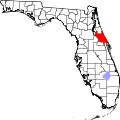 | |
| Towns | ||
| CDPs | ||
| Unincorporated communities | ||
| Ghost town | ||
| Footnotes | ‡This populated place also has portions in an adjacent county or counties | |
| Principal cities |  | ||||
|---|---|---|---|---|---|
| Counties |
| ||||
| Populated places | |||||
| Topics | |||||
| International | |
|---|---|
| National | |
| Geographic | |
| Other | |

DeLand, Florida
View on GrokipediaHistory
Founding and Early Settlement (1876–1900)
Henry Addison DeLand, a baking soda manufacturer from Fairport, New York, founded the settlement in 1876 after purchasing a $1,000 plot of land during a visit to central Florida. Returning in October of that year, he acquired additional acreage and promoted the area as a hub for citrus cultivation and cultural development, dubbing it the "Athens of Florida."[5][6][7] On December 6, 1876, approximately two dozen settlers from within a 10- to 12-mile radius convened at John Rich's cabin to formally name the community DeLand in recognition of its founder's contributions, including a $400 donation and one acre of land for a schoolhouse. Early infrastructure efforts included the establishment of a wharf at Cabbage Bluff, known as DeLand Landing, by 1880 to facilitate steamboat transport of goods and passengers. In 1881, the Orange Ridge, DeLand and Atlantic Railroad was incorporated, connecting the settlement to broader rail networks and spurring modest population and economic growth driven by lumber and nascent citrus industries.[2][8][9] DeLand personally guaranteed investments to attract northern settlers and leased land for orange groves, fostering agricultural expansion despite initial challenges like rudimentary transportation. The founding of DeLand Academy in 1883 marked a pivotal step toward his educational vision, with philanthropist John B. Stetson later assuming financial support after relocating to the area for health reasons. By 1890, the population reached 1,113, reflecting steady influxes of farmers and entrepreneurs.[8][9][10] The period's prosperity was curtailed by the Great Freeze of 1894–1895, which destroyed much of the citrus crop; temperatures in DeLand plummeted to 17 degrees Fahrenheit, killing young trees and unharvested fruit across Volusia County. DeLand absorbed significant financial losses from his guarantees but pledged to reimburse affected investors, underscoring the risks of Florida's subtropical agriculture. Despite this setback, the population grew to 1,449 by 1900, as resilient settlers pivoted to diversified farming and the town's institutional foundations endured.[11][12][10]Expansion and Institutional Growth (1900–1950)
DeLand's population grew steadily from around 1,100 residents in 1900 to approximately 11,200 by 1950, reflecting annual growth rates of 6.85% between 1900 and 1910, followed by more moderate increases averaging 2-5% through subsequent decades.[10] This expansion was fueled by the citrus industry, railroad connectivity established earlier, and the anchoring presence of educational institutions.[13] The 1920s Florida Land Boom accelerated development, with city limits expanded, new subdivisions platted, and downtown sidewalks installed, though the subsequent 1928 downturn and Great Depression prompted a temporary reduction in municipal boundaries to one square mile.[14] Stetson University, originally DeLand Academy founded in 1883, solidified its role as a central institution during this period, achieving university status and expanding academic offerings.[15] The Stetson University College of Law was established in 1900, becoming Florida's first law school to admit women in 1905.[16] Campus infrastructure grew with new buildings constructed around 1904, 1905, and 1908 to accommodate increasing enrollment, maintaining its position as Florida's oldest private university on its original site through the 1930s.[17] Municipal infrastructure advanced incrementally, with the fire department modernized around 1900 under Chief Silas B. Wright through the introduction of horse-drawn hook-and-ladder rigs and repurposed Confederate uniforms for firefighters, who earned 50 cents per daytime call and $1 for nighttime responses.[18] By 1926, a new city hall incorporating fire and police facilities was completed, supporting the county seat's administrative needs amid post-boom recovery.[18] Road improvements in the early 1900s further enhanced connectivity, contributing to economic stability despite national economic challenges.[14]Post-War Development and Modernization (1950–2000)
In the decades following World War II, DeLand's population grew steadily amid Florida's broader suburban expansion, with an average annual increase of 2.22% from 1950 to 1960 and 2.81% from 1970 to 1980, driven by migration, affordable housing, and proximity to growing regional hubs like Orlando.[10] This demographic shift strained municipal resources but spurred infrastructural adaptations, including the professionalization of the fire department under the first paid chief, Charles L. Holman, appointed in 1952, who oversaw a shift from volunteer to salaried operations with alternating 24-hour shifts.[18] The city's aviation infrastructure modernized significantly with the 1946 return of the former Naval Air Station—commissioned in 1942 for pilot training—to civilian control as DeLand Municipal Airport, fostering general aviation, flight schools, and related economic activity that diversified beyond agriculture and citrus.[19] Stetson University contributed to intellectual and physical growth, capitalizing on post-war enrollment surges to construct facilities like Davis Hall in 1967 as an initial home for its business school, enhancing DeLand's appeal as an educational center.[20] By the 1970s, further upgrades included a new Fire Station 81 in 1975, introducing modern apparatus and emergency medical services, alongside the hiring of specialized personnel like the first "smoke diver" in the same year.[18] Downtown areas faced challenges from suburban retail competition and automobile dependency, resulting in vacancy and blight by the 1980s as commercial activity shifted outward.[21] Revitalization gained traction in the late period with the 1985 formation of the Downtown Development Authority and DeLand's selection as one of Florida's inaugural Main Street program participants, emphasizing historic preservation, facade improvements, and small business incentives to counter decline without large-scale demolition.[21] These efforts, supported by low-budget community initiatives, laid groundwork for adaptive reuse of early-20th-century structures, aligning modernization with retention of the city's core identity.[22]Recent Growth and Challenges (2000–Present)
DeLand experienced substantial population growth in the 21st century, expanding from approximately 20,000 residents in 2000 to 39,832 by 2023, representing a 105.79% increase at an average annual rate of 4.60%.[23] This surge aligned with broader Florida migration trends, fueled by the city's proximity to Orlando, affordable housing relative to coastal areas, and amenities like Stetson University, which bolstered education and cultural sectors.[24] By 2025, estimates projected further growth to 46,206, with a 3.58% annual rate, though official city figures for 2024 stood at 41,264 permanent residents.[25][4] Economic development emphasized downtown revitalization and business attraction, with a tax-financing district established in the early 2000s funding infrastructure upgrades that transformed the area into a vibrant commercial hub by the 2010s.[21] Key industries included healthcare, manufacturing, retail, and education, supported by city initiatives to retain existing firms and lure high-wage employers, contributing to median household income rising to $73,352 in 2023 from lower baselines earlier in the period.[26][27][24] Infrastructure investments, such as an $83 million water reclamation facility upgrade initiated in 2023, aimed to accommodate expanding flows from residential and commercial development.[28] Road and intersection improvements, including projects on SR 44 and US 92, addressed traffic demands from suburban expansion.[29] Challenges arose from rapid urbanization straining natural and built environments, particularly flooding exacerbated by development in low-lying areas and inadequate historical drainage.[30] Hurricanes Ian in 2022 and subsequent storms prompted $49.4 million in Volusia County grants for DeLand-specific projects, including stormwater expansions and pump station enhancements to mitigate repeat inundation.[31] Local standards requiring developments to withstand 100-year storms provided some resilience, but growth outpaced infrastructure, leading to overcrowded schools and hospitals by the mid-2020s.[30][32] State legislation in 2025, such as SB 180, restricted post-disaster moratoriums on construction, prompting local pushback over diminished control to enforce sustainable growth amid flood risks.[33] Ongoing drainage analyses in 2025 sought to preempt future vulnerabilities through targeted county planning.[34]Geography and Environment
Location and Topography
DeLand serves as the county seat of Volusia County in the U.S. state of Florida, positioned in the western portion of the county within northern peninsular Florida.[35] The city lies at geographic coordinates 29°01′41″N 81°18′11″W, approximately 35 miles (56 km) north-northwest of Orlando and 20 miles (32 km) west of Daytona Beach along the Atlantic coast.[36] It forms part of the Deltona–Daytona Beach–Ormond Beach metropolitan statistical area, which encompasses broader east-central Florida population centers.[37] The terrain of DeLand features gentle slopes amid a landscape of sandy soils, wetlands, and uplands, spanning roughly 17.8 square miles (46 km²).[38] Average elevation stands at about 36 feet (11 m) above sea level, with variations reflecting the underlying coastal plain morphology.[39] The city is underlain by the DeLand Ridge, a prominent Pleistocene-era sand deposit representing the highest and oldest stable land surface in Volusia County, formed around 100,000 years ago during lower sea levels that facilitated dune and ridge development.[40] This ridge contributes to moderately well-drained conditions with rolling elevations, contrasting the predominantly flat, low-lying expanses typical of Florida's interior.[41] Proximity to the St. Johns River, which borders the area to the west, influences local hydrology, though DeLand itself occupies drier upland positions away from direct floodplain exposure.[35] The topography supports a mix of urban development on higher ground and peripheral natural features including lakes and sinkholes characteristic of karst-influenced sands.[41]Climate and Natural Features
DeLand features a humid subtropical climate classified as Köppen Cfa, marked by long, hot, and humid summers alongside mild winters with occasional cold fronts.[42] Average annual temperatures reach highs of 81°F (27°C) and lows of 60°F (16°C), with extremes typically ranging from 48°F (9°C) in winter to 91°F (33°C) in summer.[43] [44] The hot season spans from late May to mid-September, during which daily highs often exceed 87°F (31°C), accompanied by high humidity levels averaging 70-90%.[44] Winters are generally temperate, with rare freezes; the coldest month, January, sees average highs around 70°F (21°C) and lows near 48°F (9°C).[43] Precipitation totals approximately 50.6 inches (129 cm) annually, concentrated in the wet season from June to September, when afternoon thunderstorms driven by sea breeze convection are common.[45] The region experiences about 126 days with measurable rain per year, contributing to lush vegetation but also periodic flooding risks.[43] DeLand lies within the Atlantic hurricane basin, with tropical cyclone activity peaking from June 1 to November 30; its inland location reduces storm surge threats compared to coastal areas but exposes it to high winds, heavy rainfall, and tornadoes, as evidenced by events like Hurricane Irma in 2017, which brought sustained winds over 50 mph and widespread power outages.[46] Geographically, DeLand sits at an average elevation of 36 feet (11 meters) above sea level amid gently rolling hills, providing subtle topographic variation uncommon in Florida's predominantly flat peninsula.[39] The St. Johns River, Florida's longest (310 miles or 499 km) and one of its slowest-flowing waterways, borders the city to the east, fostering floodplain ecosystems with cypress swamps, hardwood hammocks, and diverse wildlife including manatees and wading birds.[47] The underlying Floridan Aquifer supplies freshwater, supporting karst features like nearby Blue Spring—the largest in the St. Johns basin, discharging 86 million gallons daily at a constant 72°F (22°C).[48] Vegetation includes live oaks, southern pines, and palmettos in upland areas, transitioning to wetlands along waterways, while Volusia County's 77 soil types range from sandy entisols to hydric histosols in lowlands.[41]Demographics
Population Trends and Projections
The population of DeLand increased from 27,031 in the 2010 U.S. decennial census to 37,351 in the 2020 U.S. decennial census, reflecting a growth rate of 38.2% over the decade.[4] This expansion aligned with broader patterns in Volusia County and central Florida, where inbound domestic migration from higher-cost states contributed to sustained increases, supported by the region's lower property taxes and housing affordability compared to metropolitan areas like Orlando. Post-2020 growth accelerated, with the U.S. Census Bureau estimating the population at 45,587 as of July 1, 2024, a 22.0% rise from the 2020 census base of 37,351.[49] The University of Florida's Bureau of Economic and Business Research (BEBR), which provides official state estimates, reported 43,185 residents as of April 1, 2024, indicating an annual growth rate of approximately 3-4% in recent years.[50] These figures underscore DeLand's appeal as a county seat with institutional anchors like Stetson University, drawing retirees, remote workers, and families amid Florida's net domestic inflow exceeding 300,000 annually statewide.[51]| Year | Population Estimate | Source |
|---|---|---|
| 2010 | 27,031 | U.S. Census Bureau (decennial) |
| 2020 | 37,351 | U.S. Census Bureau (decennial)[49] |
| April 1, 2024 | 43,185 | BEBR[50] |
| July 1, 2024 | 45,587 | U.S. Census Bureau[49] |
Racial, Ethnic, and Socioeconomic Composition
According to the 2020 United States Census, DeLand's population of 37,351 residents exhibited a racial and ethnic composition dominated by individuals identifying as White, with non-Hispanic Whites comprising 61.9% of the total.[55] Non-Hispanic Black or African American residents accounted for 12.5%, while Hispanic or Latino residents of any race represented 21.5%. Smaller shares included Asian non-Hispanics at 1.4%, those identifying with two or more races (non-Hispanic) at 5.6%, and other groups such as Native Hawaiian and Pacific Islander at 0.1%.[55] These figures reflect a majority White non-Hispanic population consistent with patterns in many Florida inland cities, influenced by historical settlement and recent migration trends from other U.S. regions.[56]| Racial/Ethnic Group | Percentage (2020 Census/ACS) |
|---|---|
| White (Non-Hispanic) | 61.9% |
| Hispanic or Latino (any race) | 21.5% |
| Black or African American (Non-Hispanic) | 12.5% |
| Two or More Races (Non-Hispanic) | 5.6% |
| Asian (Non-Hispanic) | 1.4% |
| Other (including Native American, Pacific Islander) | <1% |
Household Income, Poverty, and Immigration Patterns
The median household income in DeLand was $73,352 during the 2019–2023 period, based on U.S. Census Bureau American Community Survey estimates.[49] This level exceeds the 2023 Florida state median of $73,300 but trails the national median of $80,610.[57][58] Per capita income in the city reached $33,054 over the same timeframe, reflecting a socioeconomic profile influenced by retirement migration and educational institutions like Stetson University, which draw middle-income domestic households.[59] DeLand's poverty rate for individuals was 10.2% in 2019–2023, lower than Florida's statewide rate of 12.3% and the national figure of approximately 11.5%.[56][60] This rate equates to about 3,717 residents below the poverty line in a population of roughly 39,000, with higher concentrations in areas like North DeLand (31.2%) tied to lower-wage service sectors.[61] Factors contributing to the relatively low citywide rate include stable employment in education, healthcare, and tourism, though vulnerabilities persist among younger and transient populations.[56] Immigration patterns in DeLand feature a modest foreign-born population of 9.0% as of 2019–2023, well below Florida's 21.4% statewide share and the U.S. average of 14.3%.[49][56] Among foreign-born residents, origins include Europe (19%), Asia (13%), and Latin America (predominantly Mexico and other Central American countries at around 60% combined), indicating selective migration patterns favoring skilled or family-based entries rather than broad labor inflows.[56] The city's lower immigrant density aligns with its role as a regional hub for retirees and students, limiting appeal for large-scale international settlement compared to South Florida metros; net domestic in-migration has driven recent population gains instead.[4]Government and Politics
Municipal Government Structure
DeLand operates under a commission-manager form of government, as defined in its city charter. In this structure, the City Commission serves as the legislative body, establishing policy and appointing the city manager, who is responsible for the day-to-day administration of city operations and departments.[62][63] The City Commission consists of five members elected at large by city residents in nonpartisan elections. One of these positions is designated as the Mayor-Commissioner seat, which carries ceremonial duties including presiding over commission meetings and representing the city in official capacities, while all commissioners share equal voting power on policy matters. Commissioners serve staggered four-year terms, with elections held to fill specific seats as terms expire.[64][65] The city manager, appointed by and serving at the pleasure of the commission, oversees executive functions such as budgeting, personnel, and service delivery across departments including finance, public works, and community development. This form emphasizes professional management while maintaining elected oversight, a common municipal structure in Florida designed to balance democratic input with administrative efficiency.[62][66]Electoral History and Political Alignment
DeLand municipal elections are non-partisan and held in even-numbered years, coinciding with Florida's primary election dates, for the positions of mayor and the four other city commissioners, who together form the five-member city commission under a commission-manager government structure.[67] The mayor is elected at-large to a four-year term, while commissioners serve staggered two-year terms.[64] Longtime Mayor Bob Apgar held office from 2002 until his retirement in 2022 after five terms, overseeing periods of steady municipal governance focused on local infrastructure and community development.[68] In the 2022 mayoral election, Chris Cloudman, a sitting commissioner since 2014, won with approximately 52% of the vote against challengers Reggie Williams (about 30%) and Buz Nesbit (about 18%), marking the first leadership change in two decades.[68][69] City commission races, such as the 2024 primary for Seat 2, typically feature low-turnout contests emphasizing local issues like growth management and zoning, with winners advancing to general elections if no candidate secures a majority.[70] In broader political alignment, DeLand residents exhibit patterns consistent with Volusia County's conservative-leaning electorate, where Republican candidates have dominated federal and state races.[71] Voter registration in Volusia County shows Republicans comprising the largest share, followed by no-party-affiliation independents and Democrats, reflecting a structural advantage for conservative policies on taxation, development, and public safety.[72]| Election Year | Volusia County Presidential Results | Trump (R) % | Biden/Harris (D) % |
|---|---|---|---|
| 2020 | Trump vs. Biden | 54.5% | 44.1% |
| 2024 | Trump vs. Harris | 60.2% | 38.5% |