Hubbry Logo
Earthworks (engineering)Earthworks (engineering)Main
Open search
Earthworks (engineering)
Community hub
Earthworks (engineering)
logo
8 pages, 0 posts
0 subscribers
Be the first to start a discussion here.
Earthworks (engineering)
from Wikipedia
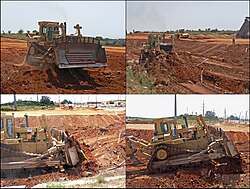
Caterpillar D10 bulldozer at work

Earthworks are engineering works created through the processing of parts of the earth's surface involving quantities of soil or unformed rock.

Shoring structures

[edit]

An incomplete list of possible temporary or permanent geotechnical shoring structures that may be designed and utilised as part of earthworks:

[edit]

Excavation

[edit]
Earth moving equipment (c. 1922)
Flattened and leveled construction site. Road roller in the background.

Excavation may be classified by type of material:[1]: 13.1 

  • Topsoil excavation
  • Earth excavation
  • Rock excavation
  • Muck excavation – this usually contains excess water and unsuitable soil
  • Unclassified excavation – this is any combination of material types

Excavation may be classified by the purpose:[1]: 13.1, 13.2 

Civil engineering use

[edit]

Typical earthworks include road construction, railway beds, causeways, dams, levees, canals, and berms. Other common earthworks are land grading to reconfigure the topography of a site, or to stabilize slopes.

Geofoam is a new lightweight earthworks technique used to build a bridge overpass on weak soil near Montreal.

Military use

[edit]
Earthworks ditch and rampart in Germany - age prehistorical prior to 300 BC

In military engineering, earthworks are, more specifically, types of fortifications constructed from soil. Although soil is not very strong, it is cheap enough that huge quantities can be used, generating formidable structures. Examples of older earthwork fortifications include moats, sod walls, motte-and-bailey castles, and hill forts. Modern examples include trenches and berms.

Equipment

[edit]

Heavy construction equipment is usually used due to the amounts of material to be moved — up to millions of cubic metres. Earthwork construction was revolutionized by the development of the (Fresno) scraper and other earth-moving machines such as the loader, the dump truck, the grader, the bulldozer, the backhoe, and the dragline excavator.

Mass haul planning

[edit]
Excavation of over 76 million cubic metres (23 million cubic metres of which was additional to the planned amount due to landslides) for the Culebra Cut, Panama canal construction photo taken c. 1907

Engineers need to concern themselves with issues of geotechnical engineering (such as soil density and strength) and with quantity estimation to ensure that soil volumes in the cuts match those of the fills, while minimizing the distance of movement. In the past, these calculations were done by hand using a slide rule and with methods such as Simpson's rule. Earthworks cost is a function of hauled amount x hauled distance. The goal of mass haul planning is to determine these amounts and the goal of mass haul optimization is to minimize either or both.[2]

Now they can be performed with a computer and specialized software, including optimisation on haul cost and not haul distance (as haul cost is not proportional to haul distance).

See also

[edit]
  • Contour trenching – Conservation technique in agriculture
  • Cut and fill – Earthmoving technique to minimize labor
  • Earth movers – Vehicles designed for executing construction tasks, construction/engineering vehicles used for earthworks civil engineering
  • Earth structure – Building or other structure made largely from soil
  • Earthworks (archaeology) – General term to describe artificial changes in land level in history and pre-history
  • Gabion – Cage full of rock
  • Keyline design – Landscaping to optimize water usage
  • Land restoration – Process of restoring land to a different state
  • Grading (earthworks) – In civil engineering, creating a profile
  • Spoil tip – Pile built of accumulated spoil
  • Subgrade – Material underneath a road or track
  • Terrace (earthworks) – Terrain formed by tiered platforms

Calculation software

[edit]
Earthworks cut and fill map and estimation summary produced by Kubla Cubed

Earthwork software is generally a subset of CAD software, in which case it often an add-on to a more general CAD package such as AutoCAD.[3] In that case, earthwork software is principally used to calculate cut and fill volumes which are then used for producing material and time estimates. Most products offer additional functionality such as the ability to takeoff terrain elevation from plans (using contour lines and spot heights); produce shaded cut and fill maps; produce cross sections and visualize terrain in 3D.[4] The means by which volumes are calculated in software can differ quite considerably leading to potentially different results with the same input data. Many software products use methods based on triangulated irregular networks (TINS) and triangular prism volume algorithms, however other calculation methods are in use based on rationalizing elevations into high density grids or cross-sections.[5][6][7]

A few programs are specialised in earthworks transport optimization and planning the construction works.

References

[edit]
[edit]
Revisions and contributorsEdit on WikipediaRead on Wikipedia
from Grokipedia
Earthworks in engineering encompass the excavation, movement, placement, and compaction of , rock, or other earth materials to shape the terrain for purposes. These activities form the foundational phase of many projects, involving the removal of material from higher elevations (cuts) and the deposition of material to build up lower areas (fills), often balanced to optimize costs and efficiency. Key operations include roadway excavation, embankment construction, backfilling, and stabilization, ensuring the ground is prepared for subsequent like pavements or structures. The importance of earthworks lies in their role as a critical component of virtually every major endeavor, such as building roads, railways, airports, , and levees, where proper handling directly influences project stability, durability, and performance. By enhancing bearing capacity, controlling settlement and permeability, and minimizing environmental disturbances, earthworks prevent failures like or while adhering to design specifications. Effective earthworks also reduce overall construction costs through precise volume calculations and material reuse, typically measured in cubic yards or meters. Modern earthworks practices integrate advanced technologies and sustainable methods to improve accuracy and mitigate risks. Computer-based modeling and GPS-guided machinery enable real-time monitoring of cut-and-fill balances, compaction densities, and haul routes, enhancing in large-scale projects. Additionally, emphasis on , management, and the use of addresses environmental concerns and , ensuring long-term viability.

Introduction and Fundamentals

Definition and Scope

Earthworks in engineering refer to the systematic , movement, and shaping of , unformed rock, and other to modify for purposes, encompassing activities such as excavation, embankment construction, and grading. This involves altering the natural to create stable , roadways, or landforms, often as a foundational step in civil projects. Unlike broader , which focuses on the subsurface behavior and properties of for and stability , earthworks primarily address surface-level manipulation and during . Key principles underlying earthworks include accurate volume calculations for operations to balance material movement and minimize waste, as well as fundamental concepts such as to assess stability during excavation and compaction properties to ensure embankment durability. For instance, determines the soil's resistance to failure under load, guiding safe angles, while compaction involves densifying layers to achieve required for load-bearing capacity, typically measured via standard tests like the method. Volume estimation often employs methods like the average end area approach for regular cross-sections or the prismoidal formula for irregular profiles, where the total earthwork volume is the sum of prismoid volumes between adjacent cross-sections. These principles ensure efficient resource use and structural integrity without delving into advanced geotechnical modeling. The scope of earthworks extends to site preparation for clearing and leveling ground, foundation work to create stable bases for structures, infrastructure grading for roads and railways, and landform creation such as artificial hills or reservoirs, spanning scales from small-scale excavations for building pads to massive projects like highway corridors or earth dams. These activities integrate with overall project planning to optimize material transport, often using tools like mass haul diagrams for haulage efficiency, though the core focus remains on terrain alteration rather than specialized machinery or historical techniques. Standard measurements include volume in cubic meters (SI) or cubic yards (imperial) for cut and fill quantities, and bench height—typically 4 to 5 feet vertically between steps in sloped excavations—to maintain safety and stability in deeper cuts.

Historical Development

Earthworks in engineering trace their origins to ancient civilizations, where large-scale manipulation of and earth was essential for monumental constructions. In around 2600 BCE, the building of the pyramids, such as the , relied heavily on earthen ramps and temporary earthworks to transport massive stone blocks to elevated positions, enabling the precise layering of materials without advanced machinery. These methods demonstrated early ingenuity in and compaction to support heavy loads during construction. Similarly, the Romans advanced earthworks techniques in infrastructure projects from the 3rd century BCE onward, incorporating terracing and sophisticated drainage systems in roads like the Via Appia (312 BCE) and aqueducts such as the Aqua Appia, which involved extensive cutting, filling, and channeling to manage water flow and terrain stability across varied landscapes. During the medieval and early modern periods, earthworks evolved to support fortifications and expanding transportation networks. , constructed in 122 CE under Emperor , exemplifies Roman-influenced earthworks in Britain, featuring a massive turf and stone barrier with accompanying es, mounds, and vallum (a rearward and rampart system) spanning 73 miles to demarcate the empire's northern frontier, built primarily by auxiliary troops using local soils for efficiency. In the , canal engineering marked a significant leap, particularly through the work of in Britain. As chief engineer for the (completed in phases from 1761 to 1776), Brindley oversaw innovative earthworks including cuttings, embankments, and tunnels, such as the Worsley tunnel, which facilitated coal transport and demonstrated precise contouring and waterproofing techniques that influenced subsequent European canal systems. The in the 19th century introduced mechanization to earthworks, transforming their scale and speed, especially in railway construction. George Stephenson's projects, including the (opened 1825) and the (1830), utilized steam-powered locomotives and early earth-moving equipment to execute massive cuttings and embankments, such as the bog crossing, which required innovative drainage and soil stabilization to lay tracks over challenging terrains. A pivotal innovation was Alfred Nobel's invention of in 1867, a safer explosive that revolutionized blasting in earthworks by allowing controlled rock fragmentation for excavations in , railways, and canals, reducing labor intensity and accident risks compared to black powder. In the 20th century, earthworks saw accelerated mechanization and standardization, particularly after , as postwar reconstruction demanded efficient large-scale operations. The development of hydraulic excavators in the mid-20th century, with early models emerging in the , enabled precise digging and lifting through fluid-powered systems, succeeding steam and cable-operated machines and boosting productivity in civil projects. Concurrently, from onward, standards like those from the American Society for Testing and Materials (ASTM), including the (ASTM D698, developed in 1933), provided rigorous methods for assessing soil density and stability, ensuring engineered fills met performance criteria in road and dam construction. Post-WWII advancements further mechanized processes, with like bulldozers and scrapers becoming widespread for rapid in infrastructure booms. The modern era, from the 1990s, integrated digital technologies for precision earthworks. The adoption of (GPS) in earthmoving equipment during the 1990s enabled real-time machine guidance, reducing over-excavation and improving accuracy in grading for highways and sites, as demonstrated in early implementations on U.S. projects. Similarly, (BIM) emerged in the late 1990s for infrastructure, allowing 3D digital simulations of earthworks sequences to optimize cut-and-fill balances and clash detection, enhancing collaboration and efficiency in heavy . From 2020 to 2025, further advancements include the integration of (IoT) sensors for real-time monitoring, automation in machinery for reduced labor risks, and drone-based surveying for precise site mapping, enhancing efficiency and in earthworks. These innovations continue to refine earthworks practices, emphasizing and data-driven decision-making.

Types and Processes

Excavation and Cutting

Excavation and cutting form a core component of earthworks engineering, encompassing the systematic removal of , rock, or other to create depressions, level surfaces, or access for development. These operations are critical in projects such as road construction, foundation preparation, and utility installation, where precise control over material removal ensures structural integrity and site readiness. The choice of method depends on geological conditions, project scale, and safety requirements, with techniques evolving from manual labor to mechanized processes for efficiency. Primary methods for excavation include open excavation for trenches and pits, benching for slope stabilization, and blasting for rock. Open excavation involves direct removal of overburden to form linear trenches for pipelines or drainage or broader pits for basements and , typically using mechanical equipment to achieve controlled depths. Benching creates horizontal steps or terraces in excavation walls, enhancing stability by reducing the unsupported height of slopes; this is particularly essential for cuts with slopes steeper than 1.5:1 (horizontal:vertical), as it distributes loads and prevents sloughing in unstable conditions. For formations, blasting is the preferred method, utilizing drilled patterns such as staggered rows or square grids to place charges, with explosives like (-) loaded into boreholes to fracture and loosen the material for subsequent removal; , comprising 94% prilled and 6% , is favored for its low cost and in dry blasts. Cutting processes are tailored to volume and precision needs, influenced heavily by characteristics. Bulk cutting employs heavy machinery to rapidly remove large quantities of material in mass grading operations, suitable for reshaping in projects, while trimming uses finer tools for accurate surface finishing in areas requiring tight tolerances, such as around structures. dictates during cutting: granular soils, like , behave as cohesionless materials where stability aligns with the angle of repose—typically 30° to 45°—governed by interparticle , necessitating flatter slopes to avoid under . In contrast, cohesive soils, such as clay, derive strength from interparticle bonds, allowing steeper safe cut slopes of 1:1 (45°), though saturation can reduce cohesion and trigger failures, requiring geotechnical assessment. Safety protocols are integral to excavation and cutting to mitigate hazards like cave-ins and flooding. Effective spoil pile management requires stockpiling excavated material at least 2 feet (0.61 m) from the excavation edge, using barriers if necessary to prevent surcharge loads from destabilizing walls. techniques address inflow, with sump pumps installed in collection pits at the excavation base to remove accumulated continuously, and well point systems deploying a network of shallow perforated pipes under vacuum to lower the across larger areas, ensuring dry working conditions without excessive settlement. In deep cuts exceeding 5 feet, structures may supplement these methods for added support. Accurate volume estimation guides resource allocation and cost control in cutting operations. The trapezoidal rule provides a standard approximation for cut volumes along a project alignment, calculated as the average of cross-sectional areas at two consecutive stations multiplied by the distance between them: V=A1+A22×LV = \frac{A_1 + A_2}{2} \times L where A1A_1 and A2A_2 are the end areas (in square units), and LL is the length (in linear units) between sections; this method integrates irregular profiles by treating segments as frustums of pyramids or trapezoidal prisms, yielding reliable estimates for linear earthworks like roadways.

Embankment and Filling

Embankment and filling involve the systematic of raised structures by placing and compacting or other to create stable landforms, such as bases, , or levees. This contrasts with excavation by focusing on material addition rather than removal, ensuring structural integrity through controlled layering and density achievement. The technique is essential for projects requiring elevation changes, where improper execution can lead to or excessive settlement. Building techniques for embankments emphasize layered placement to facilitate uniform compaction and minimize voids. Materials are typically spread in horizontal lifts of 150-300 mm (6-12 inches) thick, depending on and equipment, allowing for effective densification without bridging or uneven . Moisture control is critical during placement; for clay soils, the optimal water content, determined via the standard , ranges from 12-18% to achieve maximum dry while avoiding excessive plasticity or . This moisture adjustment ensures the soil is neither too dry, which hinders compaction, nor too wet, which can cause shear failure under roller loads. Fill materials are sourced from borrow areas, either on-site for and reduced hauling costs or off-site when quantities are insufficient. Select fills, preferably low-plasticity soils like silty sands or gravels, are chosen for core zones due to their favorable compaction and drainage properties, while fills—such as organic-rich or expansive soils—are limited to outer slopes if they pose no risk. Settlement must be anticipated, distinguishing primary consolidation, which occurs rapidly during or soon after due to pore expulsion, from secondary compression, a slower, long-term process driven by particle rearrangement in saturated fine-grained soils. These settlements are mitigated through staged and monitoring to prevent differential movements. Compaction methods apply mechanical forces to increase density and , with static techniques using the weight of smooth or sheepsfoot rollers to knead and compress layers, suitable for cohesive soils. Vibratory methods, employing oscillating drums on 10-15 rollers, are more effective for granular materials, transmitting dynamic deeper into the lift for faster achievement of target densities. Specifications typically require at least 95% of the standard maximum dry density for overall stability, verified through field tests like nuclear density gauges to ensure load-bearing capacity and reduce permeability. Slope design for embankments balances stability against strength and external loads, with side s commonly ranging from 2:1 to 3:1 (horizontal:vertical) for fills to prevent sliding, steeper ratios possible with reinforcement. The crest width is designed to a minimum of 3 meters () for roadways to accommodate and drainage, providing a stable platform while allowing for future widening. measures, such as hydroseeding with native grasses or installing geotextiles over slopes, protect against , particularly on exposed faces where vegetation establishment is slow. Volume calculations for fill quantities employ the trapezoidal (or average end-area) method, integrating cross-sectional areas along the alignment to estimate total earthwork: V=L2(A1+A2)V = \frac{L}{2} (A_1 + A_2), where VV is , LL is centerline length between sections, and A1,A2A_1, A_2 are end areas. Adjustments for shrinkage (volume reduction upon compaction) and swelling (initial expansion from excavation) are applied, typically 10-20% depending on , to determine the actual borrow needed and avoid shortages.

Shoring and Support Structures

Shoring and support structures are essential components in earthworks , providing temporary or permanent stabilization to prevent collapse in excavations, trenches, and slopes. These systems counteract lateral earth pressures exerted by surrounding , ensuring worker safety and structural integrity during activities such as foundation work, installation, and road building. Selection of depends on factors including excavation depth, , conditions, and site-specific loads, with designs often governed by standards from agencies like OSHA and state departments of transportation. Common types of temporary include timber shoring, hydraulic shoring, and sheet piling. Timber shoring utilizes soldier piles—vertical timber or posts driven into the ground—and horizontal walers to brace excavation walls, suitable for shallow to moderate depths in stable s. Hydraulic shoring employs pneumatic struts and aluminum or rails, offering adjustable support for trenches less than 6 meters deep, allowing for quick installation and removal without . Sheet piling consists of interlocking sheets driven into the ground, ideal for water-bearing soils where is challenging, as it forms a continuous barrier to retain soil and . Design principles for shoring systems are based on theories of lateral earth pressure, with Rankine theory commonly applied for active pressure in cohesionless soils. The active earth pressure PP is calculated as: P=12KaγH2P = \frac{1}{2} K_a \gamma H^2 where Ka=1sinϕ1+sinϕK_a = \frac{1 - \sin \phi}{1 + \sin \phi} is the active earth pressure coefficient, γ\gamma is the soil unit weight, HH is the wall height, and ϕ\phi is the soil friction angle. This theory assumes a vertical backfill and no wall friction, providing a conservative estimate for shoring loads. Designs incorporate a factor of safety typically ranging from 1.5 to 2.0 against sliding and overturning to account for uncertainties in soil properties and construction tolerances. Installation of follows sequential procedures to minimize risks, particularly in deeper excavations. For excavations greater than 20 feet (6.1 m) in depth, or when using designs outside standard tabulated data, OSHA requires a protective designed by a registered professional , often using slide rail systems—modular panels and rails installed incrementally as excavation progresses—to provide step-by-step support and allow safe access for workers. Bracing is placed starting from the top down, with hydraulic adjustments ensuring even pressure distribution, and all installations must comply with site-specific classifications and load assessments. Permanent support structures, such as retaining walls, are integrated into earthworks to stabilize slopes long-term after temporary is removed. retaining walls rely on the mass of or to resist overturning from pressures, suitable for heights up to 3-4 meters in low-load scenarios. retaining walls, typically L-shaped or inverted T-shaped structures, use a stem and base slab to counterbalance lateral forces, allowing for taller applications (up to 10 meters) in projects like embankments. These walls are designed to transition seamlessly from temporary , incorporating drainage features to mitigate hydrostatic pressures. Removal of shoring and subsequent backfilling must be conducted gradually to prevent voids or instability in the surrounding soil. Temporary systems like hydraulic struts or timber braces are dismantled in reverse order—from bottom to top—while backfill material is compacted in layers around the excavation, ensuring uniform support and avoiding surcharges on adjacent structures. This staged process, often using flowable fill for hard-to-reach areas, maintains soil integrity and complies with safety protocols to eliminate hazards post-construction.

Applications

Civil Engineering Projects

Earthworks play a pivotal role in projects by providing the foundational grading, excavation, and filling necessary for stable . In and , cut-and-fill balancing is essential to optimize alignments, minimizing the volume of material transported while ensuring the road follows the natural terrain efficiently. This involves calculating earth volumes to match cuts with fills, reducing costs and environmental impact, as demonstrated in low-volume road designs where templates balance excavation and embankment. preparation follows, where soil is compacted and tested using the (CBR) to assess strength and determine pavement thickness requirements, ensuring load-bearing capacity against traffic and weather. For dams and reservoirs, earthworks enable the construction of earthfill dams through zoned cores that enhance impermeability, typically featuring a central impervious clay core surrounded by permeable transition zones, filters, drains, and outer shells to control seepage and ensure structural integrity. Coffer dams, temporary enclosures built with sheet piling and bracing, are critical for dewatering sites during foundation work, allowing safe excavation below water levels while preventing soil erosion and flooding. These structures integrate with overall dam design to support long-term water retention and flood control. In railways and airports, earthworks facilitate precise subgrade formation for track and pavement stability. Railway ballast placement involves layering crushed stone over the subgrade to distribute loads, provide drainage, and maintain track alignment, with earthworks ensuring a uniform formation before ballast is spread to depths of about 300 mm. For airports, runway grading incorporates a cross-slope of 1 to 1.5 percent to promote effective surface drainage, preventing water ponding that could compromise pavement integrity during operations. This grading is achieved through controlled and compaction to meet standards for smooth, sloped surfaces. Urban development relies on earthworks for site leveling to create stable building pads, involving excavation or filling to achieve uniform elevations that support and prevent differential settlement. Utility trenching is integrated during this phase, with coordinated excavations for , cables, and sewers backfilled and compacted to avoid future disruptions while aligning with the leveled site. Notable case studies highlight the scale of earthworks in major projects. The , completed in 1914, required massive cuts and fills, including the excavation of approximately 76 million cubic meters of material in the alone to traverse mountainous terrain. Similarly, the in , constructed from 1994 to 2006, involved over 102 million cubic meters of excavation and about 29 million cubic meters of fill to form the and foundation, integrating zoned earthfill techniques for seismic stability.

Military and Defensive Uses

Earthworks have played a pivotal role in operations, providing defensive fortifications, mobility enhancements, and tactical advantages through rapid terrain modification. In , particularly during the in 1916, Allied forces constructed extensive trench systems featuring zig-zag designs to minimize exposure to enfilading machine-gun fire, which could rake straight-line trenches from the flanks. These configurations, often incorporating communication trenches and firing steps, allowed troops to advance or withdraw with reduced vulnerability while maintaining fields of fire. Earth berms, raised mounds of compacted soil, were also employed as anti-tank defenses, with slopes typically ranging from 1:1 to 1:2 and crest thicknesses of 2-3 feet to deflect projectiles and halt armored advances. In modern military contexts, earthworks facilitate rapid infrastructure development and obstacle creation. During in the Pacific theater, the U.S. Army Corps of Engineers' aviation battalions, such as the 871st Airborne Engineer Aviation Battalion, used bulldozers and scrapers for swift earthmoving to construct expeditionary airfields on islands like , completing grass runways in under a month despite challenging terrain and limited equipment transport via C-47 aircraft. These efforts supported air operations by quickly grading and compacting soil for or asphalt surfaces. Earthworks are integral to minefield preparation, where combat engineers dig access lanes, emplace markers, and create berms to channel enemy movements into mined areas, ensuring tactical control as outlined in U.S. Army doctrine for countermine operations. Additionally, earth-filled barriers serve as temporary flood defenses in operational areas, with units like HESCO's MIL-configurable systems allowing two personnel and a loader to erect protective walls equivalent to 1,500 sandbags in 20 minutes, mitigating water threats to bases or supply lines. Defensive earthworks include specialized structures tailored for protection and concealment. Foxholes, essential one- or two-person fighting positions, are typically excavated 1-2 meters deep to reach armpit level for cover, with dimensions of approximately 2 feet wide by 3-6.5 feet long, incorporating sumps and parapets 18 inches high for added ballistic shielding. Revetments consist of sloped earth walls, often at 4:1 to 5:1 ratios, reinforced with materials like wire mesh or sandbags to prevent collapse in trenches or positions, enhancing stability against impacts. Berms, mounded earth barriers 1.8-3.7 meters high with 2-3 foot crest widths, deflect blasts and fragments from , providing overhead and side protection for vehicles or personnel while allowing integration with natural terrain. Combat engineer units execute these earthworks under fire, employing for breaching and mobility. U.S. sappers use armored combat earthmovers like the M9 ACE and bulldozers to rapidly clear obstacles, such as ditches or berms, by pushing or creating gaps, enabling mechanized advances in contested environments. These units also construct hasty roads by grading and compacting earth paths, often 10-20 feet wide, to support in forward areas, as detailed in engineer field manuals for expeditionary operations..pdf) Camouflage is inherently integrated into earthwork design to evade detection, leveraging natural blending for survivability. techniques emphasize preserving and replacing or turf to match surrounding , with spoil piles dispersed and covered using local foliage, branches, or grasses to disrupt outlines and mimic patterns in varied environments like deserts or woodlands..pdf) This approach, per U.S. doctrine, minimizes visual signatures by aligning earth features with shadow and color variations, reducing aerial or ground risks..pdf)

Environmental and Landscaping Applications

Earthworks in environmental and landscaping applications focus on reshaping land to enhance ecological functions, mitigate degradation, and integrate aesthetic features while prioritizing . These practices involve excavation, filling, and grading to restore habitats, control , and manage in non-structural contexts, such as natural landscapes and green spaces. By mimicking natural , earthworks support and long-term without the load-bearing demands of projects. In restoration projects, earthworks enable the rehabilitation of degraded sites through targeted regrading and filling. For mine sites, regrading waste rock and involves slopes to stable gradients, typically 2:1 to 3:1 (horizontal:vertical), to reduce risks and promote regrowth, as demonstrated in post-mining reclamation efforts in southeast , . Similarly, wetland creation relies on controlled filling to reconstruct hydrologic features; the Comprehensive Everglades Restoration Plan (CERP), initiated in the 2000s with significant progress as of 2025, exemplifies this through the construction of the 10,000-acre Everglades Agricultural Area (EAA) Reservoir, which incorporates 16 million cubic yards of compacted earthen fill for embankments and soil bentonite cutoff walls to restore natural water flows and habitats across southern Florida. These approaches not only recapture lost s but also improve by filtering pollutants through engineered soils. Erosion control represents a core application of earthworks, particularly on slopes and watercourses, where reshaping prevents loss and . Terracing constructs level benches along contours to intercept runoff, with spacing intervals of 1.5 to 6 meters depending on slope steepness and type, effectively reducing by up to 50% on gradients exceeding 8% by shortening flow paths and increasing infiltration. For stream banks, placement—layering angular stones over fabric—stabilizes vulnerable areas by dissipating hydraulic energy and protecting against undercutting, as seen in shoreline stabilization projects where extends 1-2 meters wide and 0.5-1 meter thick to maintain bank integrity while allowing vegetation to bind the substrate below. These methods enhance landscape resilience in erosion-prone regions like riverine environments. In , earthworks create functional and aesthetic features that integrate with natural systems. Mounding builds elevated earth forms, often 0.5-1.5 meters high, for garden beds to improve drainage and in poorly drained soils, fostering diversity in urban or residential settings. Retention s, excavated to depths of 1-3 meters and lined with compacted clay or geomembranes, capture runoff, reducing peak flows by 30-50% and promoting infiltration to recharge , as utilized in eco-friendly designs that transform impervious surfaces into biodiverse water features. Compaction during ensures pond stability, though minimal to preserve permeability. Sustainable practices in these applications emphasize resource conservation to minimize environmental impact. Topsoil preservation involves stripping and stockpiling the fertile upper layer, typically 150 mm thick, in designated areas protected by silt fences and seeded covers to prevent loss and contamination, enabling its reuse across 80-90% of restored sites. Native soil reuse further reduces imports by recycling on-site materials for backfilling and grading, cutting transportation emissions by up to 40% while maintaining essential for revegetation. These techniques align with broader goals of circular in ecological projects. Regulatory compliance is integral, particularly through EPA guidelines for control during earthworks. Silt fences, installed as temporary barriers at least 0.6 meters high with fabric supported by posts spaced 1.5-2 meters apart, trap from runoff, achieving 60-80% removal efficiency on disturbed sites under 2 hectares. These measures prevent off-site , ensuring adherence to National Pollutant Discharge Elimination System (NPDES) standards for stormwater management in restoration and landscaping activities.

Equipment and Machinery

Excavation and Earth-Moving Equipment

Excavators are essential machines in earthworks for digging and loading operations, primarily utilizing hydraulic systems to power articulated arms and buckets. Hydraulic backhoe excavators, the most common type, feature bucket capacities typically ranging from 0.5 to 5 cubic meters (m³), allowing them to handle various soil types efficiently in construction and site preparation tasks. Long-reach variants extend the boom and arm to depths exceeding 10 meters, ideal for specialized applications such as deep trenching or foundation work where standard reach is insufficient. Crawler-mounted excavators, equipped with tracks, provide superior stability and traction on soft or uneven terrain, while wheeled models offer greater mobility on firm ground and roads, enabling faster repositioning between sites. Front-end loaders and bulldozers complement excavators by facilitating and site leveling. Front-end loaders, often wheeled for versatility, employ buckets with capacities from 1 to 10 m³, enabling rapid scooping and loading of loose earth or aggregates into transport vehicles. Bulldozers, typically crawler-based for pushing power, use straight or curved blades with widths of 2 to 5 meters to displace soil over short distances of up to 150 meters, making them suitable for clearing and grading large areas in earthworks projects. Scrapers and dump trucks handle bulk transport of excavated materials over medium distances. Motor scrapers, self-loading machines with open bowls, carry heaped capacities of 10 to 30 m³, efficiently cutting, loading, and dumping soil in a single cycle for high-volume earthmoving. Articulated dump trucks (haulers), with their flexible for rough terrain, offer payload capacities of 20 to 40 tonnes, allowing them to navigate construction sites while minimizing spillage and maximizing haul efficiency. Selection of excavation and earth-moving depends on several key factors to optimize and cost. Cycle times, such as 20 to 30 seconds per load for a standard hydraulic , directly influence productivity, with shorter cycles favored for high-volume operations. is critical, as modern machines incorporate technologies like variable engine speeds to reduce consumption by up to 20% compared to older models, lowering operational costs on extended projects. As of 2025, increasing adoption of electric and hybrid excavators and dozers addresses environmental regulations and reduces emissions, with models offering comparable power to diesel equivalents. Attachments, including ripper teeth for breaking hardpan or quick-change buckets, enhance versatility, allowing one machine to adapt to diverse tasks without multiple units. Emerging autonomous features, such as GPS-guided dozing and semi-autonomous loading, further improve precision and safety in large-scale operations. Maintenance practices ensure equipment longevity and safety in demanding earthworks environments. Daily inspections focus on hydraulic systems, checking fluid levels, hoses, and cylinders for leaks or wear to prevent failures that could halt operations. Undercarriage components, such as tracks or wheels, require routine examination for excessive wear, debris buildup, or pin joint issues, with cleaning and lubrication performed to mitigate premature degradation from abrasive soils.

Compaction and Finishing Tools

Compaction and finishing tools are essential in earthworks engineering for densifying layers to enhance load-bearing capacity and stability, while achieving precise surface grades for subsequent phases. These tools operate after initial earth-moving to ensure uniform , typically targeting 95% of maximum dry as per standard specifications, and to prepare surfaces for applications like paving or . Rollers, graders, and testing devices form the core of this equipment category, with and finishing techniques optimizing their performance. Rollers are primary compaction tools, categorized by drum type to suit soil characteristics. Smooth drum rollers, often weighing 6-12 tonnes, are effective for granular soils like , applying static or vibratory forces through steel s to achieve even compaction on sub-bases and rock fills. Sheepsfoot rollers, featuring protruding on the , provide a action ideal for cohesive soils such as clay, delivering high impact to bind particles tightly in embankment fills and backfilling. Pneumatic rollers, with multi-tyre configurations (typically 7-11 tires), exert contact of 400-800 kPa, combining and for versatile compaction across types, particularly in asphalt finishing and high-production earthworks. Finish graders ensure accurate surface leveling post-compaction. Motor graders use adjustable blades to shape terrain with precision, capable of achieving vertical accuracies of ±5 mm through manual or hydraulic controls, essential for subgrades and site preparation. Laser-guided systems enhance this by integrating receivers for real-time blade adjustments, maintaining flatness within ±2 mm tolerances to minimize material overuse and rework in large-scale earthworks. Testing tools verify compaction efficacy in the field. Nuclear density gauges measure in-situ and non-destructively using gamma , aligning with ASTM D6938 standards for rapid assessment during earthworks to confirm compliance with targets. Plate load tests evaluate by applying incremental loads to a plate, typically requiring >100 kPa for stable subgrades, providing data on settlement and per ASTM D1196 procedures. Vibration techniques augment roller performance by inducing particle rearrangement in soils. Frequencies of 20-50 Hz are optimal for sands, promoting deeper penetration and increase, while 4-8 passes with vibratory rollers generally achieve 95% compaction without risking over-compaction-induced cracking. Finishing processes finalize earthwork surfaces for durability and integration. involves seeding and mulching slopes to prevent , often applied post-trimming to establish on finished grades as per FHWA guidelines for slope protection. Asphalt preparation requires a smooth, compacted base free of loose material, rolled to incorporate any irregularities before binder application, ensuring in pavement overlays. Slope trimming dresses cut-and-fill faces uniformly to design cross-sections, removing protrusions and scaling rocks to maintain stability and drainage.

Planning and Execution

Site Assessment and

Site assessment in earthworks engineering begins with comprehensive site surveys to evaluate terrain characteristics and subsurface conditions, ensuring informed design and execution of projects such as embankments and excavations. Topographic mapping is a critical component, often utilizing technology to achieve high-precision elevations with accuracies up to 1 cm horizontally and 2 cm vertically, enabling detailed digital terrain models for volume calculations and cut-fill planning. Geotechnical borings complement these surveys by providing direct sampling and in-situ testing, including the (SPT), which measures penetration resistance through N-values—the number of blows required to drive a sampler 30 cm into the —typically ranging from low (N < 4) for loose soils to high (N > 50) for dense conditions, guiding foundation stability assessments. Soil classification follows these surveys to categorize materials based on engineering properties, primarily using the (USCS), developed for geotechnical applications in and earthworks. The USCS divides soils into coarse-grained (e.g., GW for well-graded with less than 5% fines, suitable for drainage) and fine-grained groups (e.g., CL for lean clay with low plasticity, indicating moderate compressibility), determined through and plasticity tests. further refine fine-grained classifications by defining boundaries of soil consistency: the liquid limit (LL) is the water content at which soil transitions from plastic to liquid behavior, with values >50 indicating high plasticity and potential for swelling; the plastic limit (PL) marks the minimum water content for plasticity; and the plasticity index (PI = LL - PL) quantifies the range of plastic behavior, influencing and compaction suitability. Laboratory and field testing evaluates key mechanical and hydraulic properties to predict soil performance during earthworks. The measures undrained in cohesive s, applicable for strengths typically between 50-100 kPa in soft to firm clays, by rotating a vane in the soil and recording the torque required for failure, which informs and excavation support needs. Permeability testing assesses water flow through soils, with coefficients (k) varying widely: 10^{-3} cm/s for clean sands (high drainage) to 10^{-7} cm/s for silts and clays (low permeability, requiring ), often conducted via constant-head or falling-head methods on samples from borings. Groundwater assessment is integral to site evaluation, as high water tables can complicate excavation and compaction. Piezometers, installed in boreholes, monitor pore water pressures and groundwater levels in real-time, providing data on hydraulic gradients and flow directions that determine dewatering requirements, such as wellpoint systems for sites with levels within 3-6 m of the surface. Risk identification during assessment targets geohazards that could impact earthworks longevity and safety. Expansive soils, rich in montmorillonite clays, pose shrink-swell risks, with potential volume changes >10% under moisture fluctuations leading to differential settlement; assessment involves oedometer tests to quantify swell potential and guide mitigation like soil replacement or lime stabilization. Contamination screening, through soil and groundwater sampling analyzed for heavy metals, hydrocarbons, and other pollutants per EPA guidelines, identifies environmental liabilities early, ensuring compliance and preventing exposure during earthmoving operations.

Mass Haul Planning and Optimization

Mass haul planning in earthworks involves strategic to efficiently excavated from cut areas to fill locations, minimizing transportation costs and delays. This process relies on graphical and computational tools to balance volumes and optimize haul routes along a linear alignment, such as a roadway. By plotting cumulative earthwork volumes against station chainage, planners identify opportunities to on-site materials, reducing the need for external borrow or waste disposal sites. The mass haul diagram is a fundamental tool for this planning, representing a graphical plot of cumulative volumes versus station chainage along the project centerline. It illustrates the progressive accumulation of material, with positive values indicating net cut (excess material available for haul) and negative values showing net fill (demand for material). The diagram distinguishes free haul distances, typically 50-100 meters where movement is economically viable without additional compensation, from overhaul regions beyond this limit, where costs escalate due to longer transport. Balance points on the diagram occur where the curve crosses the zero line, delineating self-contained earthwork sections that require no net import or export. Balancing cut and fill volumes aims to achieve a cut-fill approaching 1:1, targeting zero net import or export to maximize on-site material . This requires adjusting for volume changes, such as shrinkage in fills where loose excavated material compacts, often by 10% for clayey soils. Planners apply shrinkage factors during volume calculations to ensure the adjusted fill volume matches available cut material, preventing under- or over-excavation. data from site assessments, including swell and shrinkage properties, informs these adjustments to maintain balance across project segments. Optimization techniques enhance mass haul efficiency by minimizing total haul distance and associated costs, often using models. These mathematical approaches formulate the problem as an objective to minimize transportation volume-distance, subject to constraints like volume balance and capacity limits, outperforming traditional mass diagrams in handling variable properties. Seminal applications integrate with mass haul data to determine optimal cut-fill pairings, reducing overhaul by up to 20-30% in complex alignments. supports this, such as Bentley's OpenRoads (formerly InRoads), which generates 3D mass haul visualizations and automated optimization routines, and Autodesk Civil 3D, which creates dynamic mass haul diagrams with balance point analysis for iterative design refinement. Cost estimation in mass haul planning incorporates unit rates for haul operations, typically ranging from $2-5 per cubic meter, scaled by and . These rates account for factors like free haul limits and overhaul premiums, with total costs derived from the product of and average haul as visualized in the mass haul diagram. For context, a dozer's of approximately 200 cubic meters per hour can inform time-based costing in balanced segments, though site-specific adjustments are essential. Accurate estimation relies on optimized diagrams to avoid inflated overhaul expenses, ensuring bids reflect realistic material movement logistics. Phasing strategies sequence cut and fill activities to minimize temporary stockpiles, promoting direct haul from excavation to placement sites. By prioritizing cuts in upstream segments to supply immediate downstream fills, planners reduce storage needs and associated handling costs, often aligning phases with mass diagram balance points. This sequential approach, common in linear projects, limits material exposure and supports efficient across construction stages.

Safety and Environmental Considerations

Earthworks operations involve significant safety risks, primarily from cave-ins, which have historically resulted in dozens of fatalities annually construction industry. For instance, between 2003 and 2017, there were 373 trenching-related deaths, with over 80% occurring in construction settings. Other common hazards include struck-by incidents from and materials, as well as hazardous atmospheres in excavations, defined by OSHA as those with oxygen levels below 19.5% or containing toxic gases like from nearby machinery. These risks are exacerbated in trenches deeper than 5 feet (1.5 meters), where instability can lead to rapid collapses. Regulatory frameworks in the United States mandate protective measures to address these hazards. The (OSHA) enforces standards under 29 CFR Subpart P, requiring protective systems such as shoring, shielding, or sloping for excavations deeper than 5 feet to prevent cave-ins. For mining-related earthworks, the (MSHA) applies Title 30 of the , focusing on surface and underground operations to ensure safe ground control and equipment use. Compliance involves daily inspections by a competent person and adherence to guidelines to predict collapse potential. Mitigation strategies emphasize (PPE) and procedural safeguards. Workers must wear hard hats, , and harnesses for fall protection in excavations over 6 feet deep, as required by OSHA. Prior to digging, operators must call to locate underground utilities, preventing strikes on gas lines or electrical cables that could cause explosions or . Additional measures include barricading excavation sites, using spotters for mobile equipment, and testing atmospheres with gas monitors before entry. Environmental considerations in earthworks focus on minimizing impacts from soil disturbance. Erosion and sediment control are managed through Stormwater Pollution Prevention Plans (SWPPPs), required under the National Pollutant Discharge Elimination System (NPDES) for sites disturbing one acre or more, which outline practices like silt fences and sediment basins to prevent runoff into waterways. Dust suppression techniques, such as water spraying or chemical stabilizers, reduce airborne particulates that can affect air quality and nearby communities. Efforts to minimize habitat disruption include scheduling work outside breeding seasons and restoring native vegetation post-construction. Waste management practices prioritize by spoil material where possible, such as reusing clean excavated as fill on-site to reduce use. Contaminated fill must be avoided or properly tested and treated to prevent leaching of pollutants into , with disposal directed to licensed facilities under environmental regulations. These approaches align with broader goals of resource conservation and .

References

Add your contribution
Related Hubs
User Avatar
No comments yet.