Hubbry Logo
Gojong of KoreaGojong of KoreaMain
Open search
Gojong of Korea
Community hub
Gojong of Korea
logo
8 pages, 0 posts
0 subscribers
Be the first to start a discussion here.
Gojong of Korea
Gojong of Korea
from Wikipedia

Key Information

Gojong (Korean고종; Hanja高宗; 8 September 1852 – 21 January 1919), personal name Yi Myeongbok (이명복; 李命福), later Yi Hui (이희; 李㷩), also known as the Gwangmu Emperor (광무제; 光武帝), was the penultimate Korean monarch. He ruled Korea for 43 years, from 1864 to 1907, first as the last king of Joseon, and then as the first emperor of the Korean Empire from 1897 until his forced abdication in 1907. His wife, Queen Min (posthumously honored as Empress Myeongseong), played an active role in politics until her assassination carried out by the Japanese.

Gojong oversaw the bulk of the Korean monarchy's final years. He was born into the ruling House of Yi, and was first crowned on 13 December 1863 at the age of twelve. His biological father, Grand Internal Prince Heungseon (widely known as Heungseon Daewongun), acted as regent until he reached the age of majority, although he continued holding power until 1874. At this time, Korea was under policies of strict isolationism. By contrast, Japan had been rapidly modernizing under the Meiji Restoration. In 1876, Japan forcefully opened Korea and began a decades-long process of moving the peninsula into its own sphere of influence. For the following few decades, Korea was highly unstable, and subjected to a number of foreign encroachments. Incidents such as the 1882 Imo Incident, the 1884 Kapsin Coup, the 1894–1895 Donghak Peasant Rebellion, and the 1895 assassination of Gojong's wife occurred during his reign. All of these incidents were related to or involved foreign powers.

All the while, Gojong attempted to consolidate control, seek foreign support, and modernize the country in order to keep Korea independent. He initiated the Gwangmu Reform, which sought to improve the military, industry, and education, to some amount of success. These reforms were seen as insufficient by some parts of the Korean literati, especially the Independence Club, which Gojong at first tolerated but eventually abolished in 1898. After Japan defeated China in the 1894–1895 First Sino-Japanese War, China lost its suzerainty over Korea, which it had held for centuries. In 1897, shortly after returning from his internal exile in the Russian legation in Seoul, Gojong proclaimed the establishment of the independent Korean Empire, and became its first emperor. Gojong's actions drew the ire of Japan. After Japan defeated Russia in the 1904–1905 Russo-Japanese War, it finally became the sole power in the region, and accelerated its pace of absorbing Korea. Two months after the victory, Korea under Gojong lost diplomatic sovereignty in the Japan–Korea Treaty of 1905, signed by five ministers of Korea. Gojong refused to sign it and made attempts to bring the treaty to the attention of the international community and convince leading powers of the treaty's illegitimacy, but to no avail.

Gojong was forced to abdicate by Japan on 20 July 1907, and was replaced by his son, Yi Cheok. He was then confined to the palace Deoksugung. He made multiple attempts to escape and establish a government in exile abroad, but was unsuccessful each time. Korea formally became a Japanese colony in 1910, and the Korean imperial family was formally absorbed into the Japanese Imperial house. Gojong died on 21 January 1919, in his palace, in conditions that were then and are still seen in Korea as suspicious. The official cause of death was cerebral hemorrhage but rumors persisted that Gojong had been poisoned by Japan [ko]. His death was a direct catalyst for the March First Movement, which in turn bolstered the Korean independence movement.

Early life

[edit]

Yi Myeong-bok was born on 25 July 1852, in Jeongseonbang (정선방; 貞善坊) district, Seoul, Joseon. He was born into the royal House of Yi, and was the son of Yi Ha-eung and Lady Min.[1] After King Cheoljong died without son, the influential Andong Kim clan nominated Yi as the next King. Yi became Prince Ik-seon, shortly before his coronation.[1] He entered the palace on 9 December 1863, and his father and mother were ennobled.[2]

King of Joseon

[edit]
Gojong in 1884. Photo by Percival Lowell
Japanese illustration of Gojong and Queen Min receiving Inoue Kaoru.

On 13 December 1863, Yi was crowned in Injeong gate of Changdeokgung.[3] He was only twelve years old when he was crowned. Queen Sinjeong acted as regent until he became an adult. His father, Prince Heungseon Daewongun, assisted in the affairs of Queen Sinjeong's regency. In 1866, when the queen proclaimed the abolishment of the regency, Gojong's rule started.[1] On 6 March 1866, Min Chi-rok's daughter, Lady Min was selected as the new queen.[4] Even though Gojong's father Daewongun had no rights to maintain the regency, he still acted as regent illegally.[1]

During the mid-1860s, the Daewongun was the main proponent of isolationism and was responsible for the persecution of native and foreign Catholics, a policy that led directly to the French and the United States' expeditions to Korea, in 1866 and 1871 respectively. The early years of the Daewongun's rule also witnessed a concerted effort to restore the largely dilapidated Gyeongbokgung, the seat of royal authority. During this time, the Seowon (private academies that often doubled as epicenters of factional power), and the power wielded by the Andong Kim clan in particular were dismantled.[5]

Finally in 1873, Gojong announced the assumption of his direct royal rule. In November 1874, with the retirement of the Daewongun, Gojong's consort, Queen Min (posthumously known as Empress Myeongseong) and Yeoheung Min clan, gained complete control over the court, filling senior court positions with members of her family.[1] It was an open secret that the court and its policy were controlled by the queen consort.[6]

Gojong tried to strengthen the king's authority by giving important positions to consort kins and royal family members. It is known that Min Young-hwan, who was a distant relative of Queen Min, was Gojong's favorite official.[7]

External pressures and unequal treaties

[edit]

In the 19th century, tensions mounted between Qing China and Imperial Japan, culminating in the First Sino-Japanese War in 1894–1895. Much of this war was fought on the Korean peninsula. Japan, having acquired Western military technology after the Meiji Restoration, secured a victory against Joseon forces in Ganghwa Island, forcing Joseon to sign the Treaty of Ganghwa in 1876. Japan encroached upon Korean territory in search of fish, iron ore, and other natural resources. It also established a strong economic presence in the peninsula, heralding the beginning of Japanese imperialist expansion in East Asia. These events were the roots of Gojong's antipathy to the Japanese Empire.[1]

The Treaty of Ganghwa became the first unequal treaty signed between Korea and a foreign country; it gave extraterritorial rights to Japanese citizens in Korea and forced the Korean government to open three ports, Busan, Chemulpo (Incheon), and Wonsan, to Japanese and foreign trade. With the signing of such a lopsided treaty, Korea became easy prey for competing imperialistic powers, paving the way for Korea's annexation by Japan.[8]

Imo Rebellion and Kapsin Coup

[edit]

King Gojong began to rely on a new paid army (byeolgigun) of soldiers equipped with rifles. These new armies were requested by the Gaehwa Party and was supervised by Yun Ung-nyeol.[9] In contrast to the well-armed army, the old army had not received a salary for 13 months. The tattered army was finally paid one month's salary. Enraged, the old army sparked a riot, and the Daewongun seized power.[10] When the Imo Incident happened, Queen Min requested the Qing Empire for military support. On 27 June 1882, the Qing deployed about 3,000 soldiers in Seoul. They kidnapped the Daewongun on 7 July 1882, which led the Min family to regain political power.[11]

During the Imo incident when Queen Min was taking refuge in her relative's villa, Lady Seon-yeong of the Yeongwol Eom clan showed extreme devotion towards King Gojong. He rewarded her fealty by promoting her to the rank of Jimil Sanggung (5th senior rank of Women of the Internal Court).[12]

On 4 December 1884, five revolutionaries attempted a coup d'état by leading a small anti-old minister army to detain King Gojong and Queen Min. These revolutionaries tried to remove the Qing army from Korea.[13] The Kapsin Coup failed after 3 days. Some of its leaders, including Kim Okkyun, fled to Japan, and others were executed.

While suppressing this coup, Gojong actively invited Qing only to increase the Yuan Shikai's influence over Korea. Yet Gojong did try to maintain the independence of his nation. The Chinese even considered abdicating Gojong for consolidation of Qing influence in Korea. For Gojong, he believed that relying on to stronger powers was the best solution in the situation without neither army to guard him nor money. However, these decision never followed his own responsibility, ultimately poisoning his very own nation he intended to save.[14]

Peasant revolts

[edit]

Widespread poverty presented significant challenges to the 19th century Joseon Dynasty. Starvation was rampant, and much of the populace lived in run-down shanties lined along dirt roads.[15] Famine, poverty, crushing taxes, and corruption among the ruling class, led to many notable peasant revolts in the 19th century.

In 1894, the Donghak Peasant Revolution took hold as an anti-government, anti-yangban, and anti-foreign campaign. One leading cause of the revolution was the tax system implemented by Queen Min. Gojong asked for the assistance from the Chinese and Japanese to crush the revolution. Yi Jun-yong and others coordinated with peasants to assassinate Gojong. However, the plot was leaked and the revolution failed.[1] Although the revolution ultimately failed, many of the peasants' grievances were later addressed with the Kabo Reform.

One of the biggest reforms in 1894 was abolishing the slave (nobi) system, which had existed as far back as the Gojoseon period.[16]

Assassination of Queen Min

[edit]

In 1895, Queen Min, posthumously elevated to Empress Myeongseong, was assassinated by Japanese agents. The Japanese minister to Korea, Miura Gorō, orchestrated the plot against her. A group of Japanese agents entered Gyeongbokgung in Seoul, which was under guard by Korean troops sympathetic to the Japanese, and the queen was killed in the palace. The queen had attempted to counter Japanese interference in Korea. She and her court were pro-Russian in the immediate run-up to the assassination.[17]

Anti-Japanese sentiments in Korea

[edit]

In 1895 Japan won the First Sino-Japanese War, expanding its influence over the Korean government. The Kabo Reforms and the assassination of the queen stirred controversy in Korea, fomenting Korean anti-Japanese sentiment. Gojong's antipathy toward the Japanese intensified, and he turned to Russia as an ally by signing Russia–Korea Treaty of 1884. He sent many emissaries to Russian Empire.[1]

Some Confucian scholars, as well as peasants, formed over 60 successive righteous armies to fight for Korean freedom. These armies were preceded by the Donghak movement and succeeded by various Korean independence movements.

Internal exile to the Russian legation

[edit]

Pro-Japanese government grew, while anti-Japanese politicians were either killed or fled for their survival after the Chun Sang Door Incident in 1895. Gojong perceived the need for refuge.[18][page needed]

On 11 February 1896, King Gojong and his crown prince fled from the Gyeongbokgung to the Russian legation in Seoul,[19] from where they governed for about one year, an event known as Gojong's internal exile to the Russian legation. Because of staying in the Russian legation many concessions of Korea were taken by Russia.[1] Gojong sent Min Young-hwan to the coronation of Nicholas II of Russia.[20] Min returned to Korea in October 1896 with Russian Army instructors. These instructors were able to train guards which enabled Gojong to return to palace in February 1897.[21]

Emperor of Korea

[edit]
Portrait of Gojong (age 49), by Chae Yong-sin

Coronation

[edit]

On 13 October 1897, Gojong declared himself Emperor of Korea in a ceremony at the newly constructed altar Hwangudan.[1] The name of the state was also changed to the Great Korean Empire,[22] and a new era name Gwangmu (광무; 光武; lit. shining and martial) was declared. This was a symbolic gesture to mark the end of Qing's suzerainty over Korea.[1] That same day, Gojong appointed Sunjong as the Imperial Crown Prince.[23]

Consolidation of power and reforms

[edit]

When the Daewongun died in 1898, Emperor Gwangmu refused to attend the funeral of his father because of their poor relationship. But it was also reported that the emperor's cries could be heard when he looked over the palace wall.[24][25]

On 17 August 1899, Gojong enacted the Constitution of the Korean Empire, which granted him absolute power.[26] Despite this, Gojong still entertained the possibility of establishing a constitutional monarchy. He discussed proposals proposed by the reformist Independence Club and Gaehwa Party. However, his reforms were seen as insufficient by members of the Independence Club, which angered them. After rumors emerged, possibly spread by conservative politicians, that the Independence Club planned to abolish the empire and proclaim a republic, Gojong abolished them instead.[27]

Gojong was subjected to many assassination or abdication attempts. First in July 1898, Ahn Gyeong-su, the Minister of Military tried to abdicate Gojong.[1] Ahn was executed for conspiracy on 28 May 1900.[28] Second, on 12 September 1898, Kim Hong-rok tried to assassinate Gojong with by instilling poison in Gojong's coffee.[29] In 1904, some Korean students in Japan tried to make Gojong abdicate, and make Prince Imperial Ui the emperor.[30]

Efforts to secure Korea's independence

[edit]

Military reforms

[edit]
Portrait of Gojong wearing Tongcheonggwan and Gangsapo
Gojong and the Crown Prince Sunjong with their Pickelhaube

Gojong was acutely aware of Korea's, and especially its army's, need to modernize. Min Young-hwan brought on Russian instructors that were tasked with modernizing the army. Gojong was pleased with their work. In March 1898, the Russian instructors departed, and Gojong ordered the Ministry of Military to take over. By the request of the Minister of Military, Yi Jong-geon, a military academy was established in April 1898.[31] In order to command both the army and navy, Gojong appointed himself as the Grand Field Marshal of the Imperial Korean Armed Forces and the Crown Prince as Field Marshal on 29 June 1898.[32]

On 2 July 1898, Gojong assumed full control over the army.[31] A Board of Marshals was established on 1 August 1899,[33] which Gojong used to further his control.[34] In 1899, he bought weapons from various countries and sent many cadets to Imperial Japanese Army Academy. Meanwhile, he continued expanding the military. By July 1900, there were 17,000 men of the Jinwidae. In 1901, about 44 percent of the Empire's total revenue was used for the military.[31]

Diplomatic efforts

[edit]

Gojong also attempted to establish ties with other countries. For example, Yi Han-eung was sent to London in 1901 as the acting diplomatic minister to the United Kingdom. But Great Britain rebuffed Yi's overtures, and established the Anglo-Japanese Alliance in 1902. Yi killed himself in protest in May 1905.[35]

Abdication

[edit]
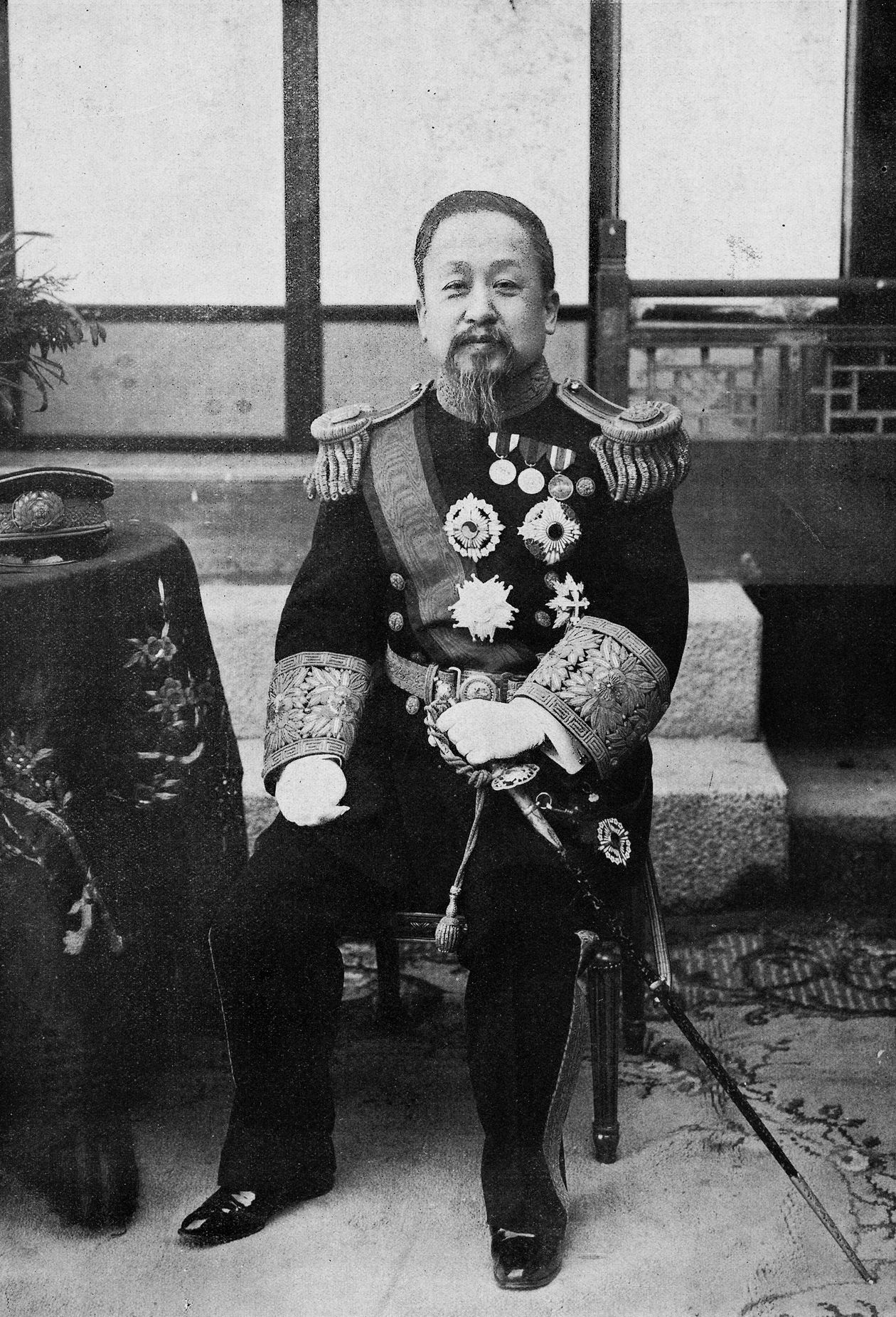
Gojong wearing a western-style uniform (태황제 예복; 太皇帝 禮服). He wore it since the abdication of 1907.

On 2 July 1907, the information about the dispatch of the envoys reached the ears of Resident-General Itō Hirobumi at the time. Ito was experienced.[36][37]

"If this envoy incident is based on a decree, it is believed to be a good opportunity to take decisive action regarding Korea. In other words, I believe it will be a good opportunity for us to have fiscal power, military power, or judicial power."

— Telegram sent by Resident-General Ito to the Japanese Foreign Minister at 2:00 a.m. on July 3, 1907, Document 4 of the Resident-General's Office.

On the previous day, the 6th, Song Pyŏngjun, a Minister of Agriculture, Commerce and Industry, made a demand to Emperor Gojong.

"Either go to Japan yourself and apologize to the Emperor, or apologize to General Hasegawa in front of the Daehan Gate."

According to Japanese records, the former council meeting on this day lasted for two hours, during which the Prime Minister instead made a declaration of war and threatened the Emperor, while the Minister of Agriculture, Commerce and Industry pressured him to apologize in front of the palace.[36]

On 16 July, the pro-Japanese cabinet met with the Emperor and demanded that he sign the Eulsa Treaty as a measure to stabilize the country, apologize to the Japanese Emperor, and abdicate the throne. Gojong refused. On 17 July, Seoul was in turmoil. Wall posters appeared in Jongno and other places, saying, "Look at the Imjin War! Is it the result of the Queen's execution incident?" "The Japanese aggression is unstoppable and imminent." The cabinet once again demanded the Emperor's abdication. An enraged Gojong once again refused.[36]

On 18 July, a cabinet meeting lasted for two hours at Yi Wan-yong's residence. The agenda was the Emperor's abdication. The lackeys who received orders from Resident-General Ito Hirobumi announced the Emperor's abdication at 8 p.m. The area outside Gyeongun Palace was surrounded by the pro-Japanese organization Iljinhoe, led by Song Pyŏngjun.[a] The Emperor requested more time (帝答之以思數日而下批). The meeting, which ended at 10 p.m., resumed at 1 a.m. the next morning.

The details of this meeting are recorded in "Maechen Yarok" by Hwang Hyeon and "Daehan Gye-nyeon-sa" (A History of Late Korean Empire) written by Jung Gyo.[36]

"Wan-yong and seven others entered. The Emperor refused (to abdicate). Wan-yong and Byeong-jun used disrespectful language countless times. Lee Byeong-mu threatened with a drawn sword (李秉武拔劒威嚇)."

— Jung Gyo, "Daehan Gye-nyeon-sa"

"Yi Wan-yong drew his sword and shouted in a rough voice, 'Do you not understand what kind of world we are in right now?' People around tried to stab Yi Wan-yong with a sword, but the Emperor eventually waved him off and said, 'In that case, it would be better to step down first.'"

— Hwang Hyeon, "Maechen Yarok"

Yi Wan-yong and others withdrew. The overnight council meeting ended at 5 a.m. The attendants entered the meeting hiding pistols in their bosoms. The Minister of Justice Jo Jung-eung [ko] cut off all external telephone lines.[b][c]

On that day, Gojong declared that he would pass the throne to his son. The abdication ceremony took place the next day, 20 July. Gojong personally chose the date and added, "Follow the temporary regulations (權停例)."[d] The temporary regulations refer to a simplified ritual performed by the monarch without sitting on the throne. The Emperor's abdication ceremony took place without the presence of Gojong or Sunjong.[e][36]

The essential element for depriving of ruling power is the deprivation of military power. Yi Byeong-mu, who drew a sword against King Gojong and led the military's neutralization under the command of Ito, carried out the military disarmament. Four days later, the Japan-Korea Treaty of 1907 was announced. The key point was the dissolution of the Korean Empire's military. The secret provisions of the treaty included the following clauses: all military forces except the Royal Guards will be dissolved. Disbanded soldiers will be relocated to Gando and engaged in reclamation. They will also be engaged in reclamation in the desolate areas of the country. The person who announced the dissolution of the military was Prime Minister Yi Wan-yong, and the Minister of Defense, Yi Byeong-mu.[f][36]

On 19 July, when Emperor Gojong was being threatened, the royal guard unit, which was the palace guard, attempted to enter Gyeongun Palace.[g]

"Yi Byeong-mu ordered General Jung Wi-jae, the commander of the 3rd Battalion of the 1st Regiment of the Capital Guards, to bring in 70 palace guards stationed outside the palace. When Jung Wi-jae refused, Hanmyeong, the commander of the palace guards, drew his sword and shouted at the military dictatorship to resist. The palace guards, wearing civilian clothes and carrying bayonets, entered the palace."

— From Daehan Gye-nyeon-sa

On that night, at that time, Yi Byeong-mu asked the Japanese for a favor, and if Jung Wi-jae continued to doubt him, he told him to take away his weapons.[h][36]

On 20 July 1907, Gojong was dethroned.[1] Some officials, such as Pak Yŏnghyo, and Yi Tojae, tried to assassinate the members of cabinet of Ye Wanyong, who led the abdication.[38] After abdicating, Emperor Gojong was confined to his palace Deoksugung, and the Japanese replaced him with his son, Sunjong.

In June 1910, Gojong tried to escape to Primorsky Krai in Russia and establish a government in exile, but he failed to do so.[39] On 22 August 1910, Korea was formally annexed by Japan. Gojong lost his imperial title, and was instead granted the title, "King Emeritus Yi of Deoksu" (徳寿宮李太王), and was recognized as a member of the imperial family of Japan. In 1915, Gojong again tried to flee from his confinement with the help of Sangsul, but failed.[40] In 1918, he made another attempt, this time with the goal of going to Beijing with Lee Hoe-yeong, but again failed.[41][42]

Death and legacy

[edit]
Gojong's funeral procession (1 March 1919)

On 21 January 1919, Gojong died suddenly at Deoksugung at the age of 66. There was and still is speculation that Gojong had been poisoned by Japan [ko]. The idea first emerged and was widely circulated around the time of his death.[43]

His death and subsequent funeral proved a catalyst for the March First Movement for Korean independence from Japanese rule.[43] He is buried with his wife at the imperial tomb of Hongneung (홍릉; 洪陵), Namyangju, Gyeonggi Province. The couple's grave is now considered a UNESCO World Heritage site, as part of the Royal Tombs of the Joseon dynasty.[44]

Family

[edit]

Consort(s) and their respective issue

  • Min Ja-yeong (민자영), Empress Myeongseong of the Yeoheung Min clan (명성황후 민씨; 17 November 1851 – 8 October 1895)[i]
    • Prince Royal Yi Choi (원자 이최; 4 November 1871 – 8 November 1871), second son[j]
    • Second daughter (3 February 1873 – 28 September 1873)
    • Yi Cheok, the Yunghui Emperor (융희제 이척; 25 March 1874 – 24 April 1926), third son
    • Yi Deol (이덜; 5 April 1875 – 18 April 1875), fourth son
    • Yi Bu (이부; 18 February 1878 – 5 June 1878), sixth son
  • Eom Seon-yeong (엄선영), Imperial Noble Consort Sunheon of the Yeongwol Eom clan (순헌황귀비 엄씨; 2 February 1854 – 20 July 1911)
  • Yang Chun-gi (양춘기), Imperial Consort Gwi-in of Boknyeongdang Hall of the Cheongju Yang clan (복녕당 귀인 양씨; 27 September 1882 – 30 May 1929)
  • Yi Sun-ah (이순아), Imperial Consort Gwi-in of Yeongbodang Hall of the Gyeongju Yi clan (영보당 귀인 이씨; 1843 – 17 December 1928)
    • Yi Seon, Prince Wanhwa (완화군 이선; 16 April 1868 – 12 January 1880), first son
    • Yi Eo (이어; 1871–1872), first daughter
  • Imperial Consort Gwi-in of the Deoksu Jang clan (귀인 장씨; 1860–?)
    • Yi Geung (이긍; 1875 – ?), third daughter
    • Yi Kang, Prince Imperial Ui (의친왕 이강; 30 March 1877 – August 1955), fifth son
  • Park Mi-suk (박미숙), Imperial Consort Gwi-in of the Hong clan (귀인 홍씨)
    • Yi Ju-won (이주원; 1886–1929), seventh son
    • Yi Ju-chan (이주찬; 1889–1926), eighth son
  • Imperial Consort Gwi-in of Naeandang Hall of the Gyeongju Yi clan (내안당 귀인 이씨; 1847 – 13 February 1914)
    • Fourth daughter (1879–1880)
  • Imperial Consort Gwi-in of Bohyeondang Hall of the Haeju Jeong clan (보현당 귀인 정씨; 23 February 1882 – 1943)
    • Yi U (이우; 20 August 1915 – 25 July 1916), tenth son
  • Yi Wan-deok (이완덕), Imperial Consort Gwi-in of the Yi clan of Gwanghwadang Hall (광화당 귀인 이씨; 1885 – 10 November 1965)
    • Yi Yuk (이육; 3 July 1914 – 22 January 1915), ninth son[k]
  • Kim Ok-gi (김옥기), Lady Kim of Samchukdang Hall of the Andong Kim clan (삼축당 김씨; 1892 – 23 September 1970)
  • Court Lady Kim of Jeonghwadang Hall of the Gwangsan Kim clan (정화당 상궁 김씨; 1864–?)
  • Court Lady Yeom (상궁 염씨)
  • Court Lady Seo (상궁 서씨; 1862–?)
  • Kim Chung-yeon (김충연), Court Lady Kim (상궁 김씨; 1864–?)

Honours

[edit]
Korean honours[citation needed]
  • Founder and Sovereign of the Grand Order of the Golden Ruler – 17 April 1900
  • Founder and Sovereign of the Grand Order of the Auspicious Stars – 12 August 1902
  • Founder and Sovereign of the Grand Order of the Plum Blossoms – 17 April 1900
  • Founder and Sovereign of the Order of the National Crest – 17 April 1900
  • Founder and Sovereign of the Order of the Purple Falcon – 16 April 1901
  • Founder and Sovereign of the Order of the Eight Trigrams – 16 April 1901
  • Grand Cordon of the Grand Order of the Auspicious Phoenix – 1907
Foreign honours[citation needed]

Ancestry

[edit]
[edit]

See also

[edit]

Notes

[edit]

References

[edit]

Bibliography

[edit]
[edit]
Revisions and contributorsEdit on WikipediaRead on Wikipedia
from Grokipedia
Gojong (1852–1919) was the 26th and final king of the Joseon dynasty, ascending to the throne in 1863 as a child under the regency of his father, Yi Ha-eung (the Daewongun), and later the first emperor of the Korean Empire from its proclamation in 1897 until his forced abdication in 1907. His reign spanned a transformative period for Korea, initially characterized by conservative isolationism enforced by the Daewongun to consolidate power and repel foreign incursions, followed by efforts to modernize the state through administrative reforms, military reorganization, and diplomatic outreach amid growing threats from imperial powers. In 1897, Gojong renamed the kingdom the (Daehan Jeguk) and declared himself Emperor Gwangmu to symbolize independence from and assert internationally, initiating the Gwangmu Reforms aimed at centralizing , promoting industry, and adopting Western technologies. However, these ambitions were undermined by internal factionalism, the 1895 assassination of his consort by Japanese agents, and escalating Japanese dominance, culminating in the 1905 Eulsa Treaty that reduced Korea to a . Gojong's secret dispatch of envoys to the Second Conference in 1907 to protest Japanese encroachment provoked his deposition by Japan on July 20, 1907, in favor of his son Sunjong, paving the way for Korea's full annexation in 1910. Gojong spent his remaining years in seclusion, dying on January 21, 1919, under circumstances widely suspected to involve poisoning by Japanese authorities, a claim that fueled the March 1 Movement independence protests shortly after his funeral. His legacy remains defined by futile yet resolute attempts to preserve Korean autonomy against overwhelming geopolitical pressures, blending traditional Confucian governance with nascent imperial ambitions.

Early Life and Ascension

Birth, Family Background, and Education

Gojong, originally named Yi Myeong-bok, was born on 8 September 1852 in Unhyeongung Palace, Hanseong, the capital of (modern-day , ). He was the second son of Yi Ha-eung (1820–1898), a collateral prince of the ruling who initially held modest status within the extended royal family, and his wife from the , later honored as Grand Internal Princess Consort Sunmok (died 1898). His elder brother had died young, making Gojong the sole surviving male heir in the immediate family. The had ruled since its founding in 1392 by Yi Seong-gye, emphasizing as state ideology and maintaining isolationist policies under the tributary system with Qing China. Yi Ha-eung descended from King Injo (r. 1623–1649) through Prince Sado's line but lacked direct succession claims, living outside the main palace until political exigencies after King Cheoljong's death without an heir in 1863 elevated his son to the throne. Yi Ha-eung's strategic alliances and purge of rival factions secured this outcome, transforming the family's peripheral position into regency power. Prior to his ascension at age 11, Gojong underwent traditional palace education focused on Confucian scholarship, including and Five Classics, historical annals, poetry composition, and moral philosophy, tutored by scholars adhering to Joseon's Neo-Confucian orthodoxy. This curriculum, modeled on the national Sungkyunkwan academy established in 1398, prioritized rote memorization, ethical governance, and to prepare elites for bureaucratic exams and administration, though as a royal, Gojong's studies bypassed formal testing. His early training under his father's influence reinforced conservative , limiting exposure to Western or practical sciences until later reforms.

Regency Under Heungseon Daewongun

Heungseon Daewongun (Yi Ha-eung), father of the young King Gojong, assumed the regency upon Gojong's ascension to the throne in December 1863, formally receiving his title in 1864 and exercising de facto power until 1873. His rule emphasized strengthening central authority amid internal factionalism and external threats from Western powers and Japan, following the Opium Wars' demonstration of Qing China's vulnerability. Daewongun pursued rigorous isolationism, rejecting foreign treaties, trade, and diplomatic contacts to preserve Joseon's Confucian order and sovereignty, viewing external influences as existential risks to traditional governance. A cornerstone of Daewongun's domestic agenda was administrative centralization and measures, aimed at curbing the power of entrenched elites and bureaucratic factions like the , which had dominated during the preceding regency. He purged corrupt officials, reformed tax collection to bolster state revenues, and initiated economic policies such as issuing the dangbaekjeon paper currency to fund reconstruction projects, though these often imposed heavy burdens on the populace through forced levies and labor mobilization. Notably, from 1867, Daewongun directed the extensive rebuilding of Gyeongbokgung Palace, destroyed by fire over three centuries earlier, employing tens of thousands of workers and consuming vast resources equivalent to years of national revenue, symbolizing a return to dynastic grandeur but straining finances. Daewongun's extended to suppressing perceived internal threats, culminating in the 1866 Byeongin Persecution against Catholics, whom he regarded as conduits for foreign and disruptors of social hierarchy. This campaign executed thousands of Korean Catholics and seven French missionaries, enforcing edicts against as a challenge to state orthodoxy and prompting the French punitive expedition (Byeongin yangyo) that year, which Joseon forces repelled at . While bolstering short-term regime stability, such authoritarian tactics alienated reformist elements and sowed seeds of opposition from Queen Min's faction. By 1873, as Gojong matured, mounting palace intrigue led to Daewongun's abrupt ouster; on July 13, the king declared (saje), confining his father to semi-retirement and reversing many isolationist policies under Queen Min's influence, marking the regency's end and shifting toward cautious openness. Daewongun's tenure, though criticized for rigidity and fiscal excess, temporarily unified the against external pressures through decisive, if coercive, leadership.

Reign as King of Joseon

Opening to the World: External Pressures and Unequal Treaties

Joseon Korea, under King Gojong, adhered to a policy of isolationism, refusing foreign trade and diplomacy beyond its tributary relationship with China, until mounting external pressures from imperial powers forced its opening in the late 1870s. Following Japan's Meiji Restoration and its own coerced opening by Western powers, Japan sought to expand influence in Korea, viewing it as a strategic buffer against Russia and China. In September 1875, the Japanese warship Unyō intruded into restricted waters near Ganghwa Island, prompting Korean coastal defenses to open fire; Japan retaliated by bombarding forts and landing troops. This Ganghwa Incident escalated in February 1876 when a Japanese fleet blockaded the island, compelling Joseon negotiators to sign the Japan–Korea Treaty of Amity (Treaty of Ganghwa) on February 26, 1876, under threat of further military action. The Treaty of Ganghwa nominally declared Korea an "independent state" equal to , ending its overt tributary status with and opening the to Japanese trade, while permitting Japanese consulates and unrestricted travel for Japanese subjects within Korea. However, it was markedly unequal, granting extraterritorial jurisdiction over its citizens in Korea—exempting them from Korean laws—and most-favored-nation status, ensuring any concessions to other powers extended to without reciprocity. Joseon received no equivalent rights in , and the treaty's terms reflected akin to Commodore Perry's 1853-1854 actions against , prioritizing Japanese commercial and strategic gains over mutual benefit. This agreement eroded Joseon's sovereignty and triggered demands from other powers wary of Japanese dominance. Emboldened by Korea's opening to Japan, Western nations pursued similar treaties to secure trade access and protect their interests. The United States, leveraging the 1871 Shinmiyangyo expedition's aftermath and precedents, negotiated the Joseon–United States Treaty of 1882 (Shufeldt Treaty), signed on May 22, 1882, in , which established diplomatic relations, opened the port of , and allowed American consular presence. Like the Ganghwa Treaty, it imposed for U.S. citizens, fixed low import tariffs at 10%, and included most-favored-nation clauses, without granting reciprocal privileges or control over tariffs, thus limiting fiscal autonomy. Subsequent treaties followed this model: with the and in 1883, Russia in 1884, in 1884, and in 1886, each replicating unequal provisions that privileged foreign merchants and officials, fostering economic penetration and legal exemptions that undermined Korean authority. These unequal treaties collectively exposed to intensified foreign influence, as powers exploited to evade local jurisdiction and low tariffs to flood markets with imports, contributing to fiscal strain and internal instability during Gojong's rule. While some Korean elites saw potential for modernization through , the imbalanced terms prioritized imperial extraction, setting precedents for further encroachments by and others.

Internal Challenges: Rebellions and Coups

During Gojong's reign, Joseon Korea experienced significant internal instability, manifested in military mutinies, factional coups, and peasant uprisings driven by economic grievances, , and toward modernization efforts that favored certain elites and foreign advisors. These events underscored the fragility of central amid power struggles between conservative and reformist factions, often exacerbated by unequal treatment within the and administrative . The began on July 23, 1882, as a by soldiers of the old in , who protested reduced rations, delayed pay, and perceived favoritism toward a new Japanese-trained unit receiving better provisions. The unrest escalated into widespread riots, with mutineers attacking the Japanese legation, killing several officials including the military advisor, and targeting properties linked to the Min clan, which dominated court politics under Queen Min's influence. In the ensuing chaos, the rebels summoned , Gojong's father and former regent, from exile to restore order, leading to his temporary reinstatement and a of Min faction members. Qing Chinese forces intervened decisively, arresting Daewongun—who had ordered further anti-Japanese measures—and restoring the Min-led government, while the incident prompted the 1882 Convention between and to regulate their military presence in Korea. The Gapsin Coup, occurring from December 4 to 6, 1884, represented a failed reformist bid by pro-Japanese intellectuals and officials, led by Kim Ok-kyun, to overthrow conservative dominance and enact rapid modernization, including ending Joseon's tributary status to and abolishing class distinctions. Backed by Japanese legation guards who initially secured the royal , the coup leaders held Gojong under loose captivity, executed several pro- officials, and proclaimed a new Enlightenment Party government aimed at emulating 's Meiji reforms. However, Qing reinforcements under swiftly suppressed the uprising, forcing key plotters to flee to and resulting in the deaths of hundreds, including Japanese soldiers; the failure reinforced Chinese suzerainty temporarily via the 1885 Convention of Tientsin, which limited foreign troops in . A larger-scale internal challenge emerged with the Donghak Peasant Revolution in early 1894, sparked by widespread rural discontent over famine, exorbitant taxes, official corruption, and growing foreign economic influence, particularly Japanese merchants displacing local traders. Led by Donghak (Eastern Learning) adherents under figures like , peasants in seized county offices starting in February–March 1894, demanding the ouster of corrupt officials and social reforms while invoking anti-foreign slogans. The uprising swelled to tens of thousands, capturing key towns like Gobu in April and marching toward , but Gojong's government, unable to suppress it independently, requested Qing military aid, which in turn provoked Japanese intervention and escalated into the . Although temporarily quelled by combined foreign forces, the rebellion highlighted deep socioeconomic fractures and the regime's reliance on external powers for internal security.

Influence of Queen Min and Domestic Power Struggles

Queen Min, born Min Ja-yeong on October 17, 1851, married the 15-year-old King Gojong on March 20, 1866, during the regency of his father, the Heungseon Daewongun. Initially limited by the Daewongun's dominance, her influence grew after Gojong assumed personal rule in 1873, ousting his father from power. This shift marked the beginning of Queen Min's de facto control over court politics, as Gojong proved indecisive and reliant on her counsel. The core domestic power struggle pitted Queen Min against the Daewongun, whose isolationist seclusion policy clashed with her push for gradual modernization through selective foreign engagement, particularly with to offset Japanese encroachment. The Daewongun sought to curtail her authority by installing a royal consort, Daegwangbin, who bore Gojong a son in 1871, but this son died young in 1880, removing a potential rival heir aligned with conservative factions. Queen Min countered by promoting relatives from her to high offices, including her father Yeoheung Min and brother Min Seung-ho, fostering that alienated traditional elites and intensified factional divisions between Min loyalists and Daewongun supporters. These struggles exacerbated longstanding court factionalism, with conservatives resisting reforms and progressives demanding faster Westernization often under Japanese influence. Queen Min navigated this by backing anti-Japanese conservatives during the 1884 Gapsin Coup, where Japanese-backed reformers briefly seized power before Chinese intervention restored the status quo. Her policies emphasized sovereignty through balanced diplomacy, but domestic instability persisted, culminating in the 1882 , where soldier mutinies over unpaid wages and Japanese favoritism led to the Daewongun's temporary recall; Queen Min then maneuvered for his to under Sino-Japanese agreement to neutralize his threat. This event highlighted how personal rivalries intertwined with military discontent and foreign meddling, undermining Joseon's internal cohesion.

Assassination of Queen Min and Anti-Japanese Backlash

On 8 October 1895, Japanese agents assassinated Queen Min (Empress Myeongseong) at Palace in , an event known as the Eulmi Incident. The operation was commissioned by , Japan's minister to Korea, with the complicity of (Gojong's father), to eliminate Queen Min's influence, which favored Russian alignment over Japanese dominance amid imperial rivalries. Approximately 20 to 30 Japanese military personnel, including members of the Japanese-trained Hullyeondae militia, infiltrated the palace disguised as Korean guards. They located Queen Min in a private pavilion, stabbed and slashed her to death with swords and bayonets, then dragged her body to a courtyard, mutilated it, doused it with oil, and burned it on a pyre of brushwood to destroy evidence. The temporarily empowered pro-Japanese factions, with Daewongun assuming regency under Japanese protection, but it failed to stabilize Japanese control. Miura and 11 accomplices were arrested and tried in Japan, but acquitted in due to procedural issues and nationalist sympathies, exacerbating foreign distrust of 's actions. Primary diplomatic records, including British consular reports and Satow's diaries, documented the event's brutality and Japanese orchestration. The killing ignited intense anti-Japanese backlash across Korea, manifesting in public protests, boycotts of Japanese goods, and attacks on Japanese residents and facilities. This outrage spurred the formation of uibyeong (righteous armies), irregular civilian militias comprising peasants, scholars, and elites dedicated to resisting Japanese encroachment through . These groups, emerging prominently from late 1895 into 1896, numbered in the thousands and conducted ambushes and uprisings, contributing to the erosion of Japanese influence and prompting Gojong's refuge in the Russian legation in February 1896. The incident underscored Queen Min's pivotal role in Joseon's struggles and intensified against foreign domination.

Failed Modernization Initiatives and Exile to Russian Legation

Following the assassination of Queen Min on October 8, 1895, by Japanese agents, King Gojong faced heightened threats to his rule amid widespread and fears of further coups. On February 11, 1896, Gojong, accompanied by Yi Cheok and over 200 officials and guards, covertly fled Palace under the cover of night, seeking asylum at the Russian legation in to evade Japanese dominance. This event, known as the Agwan Pacheon, marked a desperate bid for protection from Tsarist , which had emerged as a counterbalance to Japanese influence after the Sino-Japanese War of 1894–1895. From the legation, where he resided for approximately one year and nine days, Gojong issued edicts repealing the pro-Japanese Gabo Reforms of 1894–1896, which had imposed Western-style institutions such as a cabinet system, the abolition of classical exams, and the end of class distinctions but provoked backlash due to their perceived foreign imposition and disruption of traditional norms. He ordered the execution or exile of key Gabo leaders, including Kim Hong-jip, restoring elements of the old Confucian bureaucracy while attempting to stabilize his authority. To secure Russian support, Gojong granted extensive concessions, including mining and lumbering rights, and imported Russian military advisors to bolster defenses, aiming to foster a modern, independent state insulated from Japanese encroachment. These initiatives faltered due to structural weaknesses in Joseon's governance and external dependencies. Earlier modernization drives, accelerated after the 1876 Treaty of Ganghwa, had introduced foreign advisors and partial military reforms but were repeatedly undermined by internal rebellions, such as the of 1882, and factional strife between conservative isolationists and progressive reformers. The Gabo era's heavy taxation and economic policies, including reliance on Japanese loans and imports that devastated rural textile production, had already eroded public support and exacerbated peasant unrest, as seen in the Donghak Uprising of 1894. Gojong's legation-based efforts, while enabling short-term anti-Japanese measures, deepened reliance on Russian patronage, which proved transient; Russia's in 1895 checked Japan temporarily but failed to provide sustained military or economic aid sufficient for self-reliant industrialization or army modernization. Persistent resistance to cultural shifts, such as the discontinuation of traditional exams, highlighted the causal primacy of entrenched interests and societal over top-down decrees, rendering comprehensive reforms infeasible without broader institutional buy-in or coercive capacity that lacked. The exile thus exposed the limits of Gojong's agency: while it preserved the throne momentarily, it deferred genuine modernization, as foreign concessions alienated potential domestic allies and invited further great-power rivalries that ultimately exploited. By prioritizing survival through alliances over endogenous capacity-building, these episodes contributed to 's vulnerability, culminating in Gojong's return to a precarious in early without resolved structural deficits.

Establishment of the Korean Empire

Proclamation as Emperor Gwangmu

On , 1897, Gojong returned to the Korean capital from his refuge in the Russian legation, where he had fled following the assassination of Queen Min in 1895 amid Japanese influence. Upon his return to Gyeongungung Palace (now ), he began preparations to reform the state structure, seeking to counterbalance Japanese dominance and Russian interests by elevating Korea's international standing. This included naming the new era "Gwangmu" on August 14, 1897, signaling an intent to invoke historical precedents of renewal and martial prowess. The formal proclamation of the occurred on October 12, 1897, during a ceremony held in Junghwajeon Hall at Deoksugung Palace. Gojong declared the end of the Dynasty's tributary relationship with Qing China, established post the Sino-Japanese War of 1894–1895, and asserted Korea's sovereignty as an independent empire named Daehan Jeguk. He adopted the title Gwangmu, positioning himself as the equal of rulers in neighboring imperial states like Qing China and Meiji Japan. The decree emphasized modernization and self-strengthening to resist foreign imperialism, though practical sovereignty remained constrained by unequal treaties and internal weaknesses. The proclamation sought from major powers to legitimize the 's status, with providing initial support due to its rivalry with . However, viewed the elevation as a challenge to its influence, contributing to heightened tensions that foreshadowed further interventions. Domestically, the change involved adopting , including a new seal and flag, to symbolize the shift from kingdom to , though was hampered by fiscal shortages and political .

Gwangmu Reforms: Administrative, Military, and Economic Modernization

The Gwangmu Reforms, enacted following the proclamation of the in 1897, represented Emperor Gojong's concerted effort to centralize authority, emulate Western administrative models, and bolster fiscal capacity amid mounting imperial pressures from , , and other powers. Building on the earlier Gabo Reforms of 1894–1896, which had restructured the government into a cabinet system with eight ministries including Home Affairs and , the Gwangmu era emphasized enforcement of modern bureaucracy and household registration (Gwangmu Hojuk) to standardize population records and taxation. These administrative measures abolished vestiges of the aristocracy's privileges, such as hereditary offices, and shifted toward merit-based , though implementation faced resistance from entrenched elites and inconsistent enforcement. Military modernization under the reforms sought to replace Joseon's outdated forces with a conscript-based Imperial Korean Army equipped with Western-style training and weaponry. In 1899, Gojong established the Supreme Military Council to consolidate command under imperial oversight, aiming to expand standing troops through local and reduce reliance on factional militias. Efforts included importing rifles and , with initial units trained by Russian and later Japanese advisors, but chronic underfunding—exacerbated by revenue shortfalls—and internal corruption limited expansion to roughly 20,000–30,000 effectives by 1904. Post-Russo-Japanese War (1904–1905), Japanese forces compelled the disbandment of independent Korean units in 1907 via the disbandment decree, rendering these initiatives largely ineffective for national defense. Economic reforms focused on revenue generation through land and fiscal restructuring to fund industrialization and infrastructure. The Gwangmu Land Survey (Gwangmu Yangjeon), launched in 1898, systematically measured parcels across counties to issue formal titles, clarifying ownership obscured by Joseon's communal practices and enabling precise taxation; by 1901, it covered 124 of 369 counties, quadrupling land tax yields from 1898 to 1904 and comprising 75% of state by 1903. Complementary measures included modern accounting in the and tentative steps toward currency stabilization, such as silver-standard coins issued from 1902 onward, though broader monetary unification efforts faltered amid foreign dominance. These policies spurred limited commercial growth, including early banking experiments, but were truncated in 1904 by Japanese intervention, which halted surveys and subordinated economic sovereignty, underscoring the reforms' vulnerability to external coercion despite initial fiscal gains.

Diplomatic Strategies to Counter Imperialism

Following the proclamation of the on , 1897, Gojong pursued independent diplomatic relations with major powers to affirm Korea's sovereignty and offset Japanese dominance, building on prior Joseon-era treaties such as those with the (1882), (1883), the (1883), and (1884). These efforts included notifying foreign governments of the empire's establishment to secure recognition as an equal sovereign entity, thereby aiming to internationalize Korea's position and deter unilateral aggression. Gojong established Korean legations in key capitals, including , St. Petersburg, , , and , to foster direct engagement and diversify alliances beyond . Prior to the (1904–1905), Gojong's strategy emphasized balancing Russian and Japanese influence, declaring Korea's neutrality on November 23, 1903, and dispatching proclamations via special messengers to countries including on January 16, 1904, in an attempt to invoke international norms against involvement in great-power conflicts. He cultivated ties with through envoys and correspondence, such as a December 1905 mission led by Captain Hyun Sang-geon to restore Korean post-war, leveraging 's pre-war role as a to . This approach reflected a realist calculation to exploit rivalries among imperial powers, though it yielded limited results as 's defeat in 1905 shifted dynamics decisively toward . After Japan's imposition of the Eulsa Protectorate Treaty on November 17, 1905—which stripped Korea of diplomatic —Gojong escalated covert appeals to nullify the agreement and rally global support. In August 1905, he penned a detailed letter to Tsar Nicholas II asserting Korea's millennia-long independence and decrying Japanese violations. By June 1906, letters were sent to nine nations seeking adjudication in an , while in April 1907, Gojong dispatched three secret envoys—Yi Sang-seol, Yi Jun, and Yi Wi-jong—to the Second Hague Peace Conference to publicly declare the treaty's invalidity and plead for intervention. The envoys arrived in but were denied official participation, as Korea lacked an invitation; their mission nonetheless publicized Japan's coercion, though it provoked Japanese retaliation, culminating in Gojong's forced on July 19, 1907. These strategies, while innovative in appealing to emerging and multilateral forums, faltered due to the prevailing balance-of-power acquiescence to Japanese expansionism; most Western states, prioritizing alliances like the (1902), offered no substantive aid, with as a rare exception in expressing sympathy. Gojong's persistence in secret until his death underscored a commitment to , but the absence of enforceable great-power guarantees exposed the limits of asymmetric appeals against a militarily ascendant aggressor.

Abdication and Japanese Domination

Forced Abdication and the Japan-Korea Protectorate Treaty

The Japan–Korea Protectorate Treaty, also known as the Eulsa Treaty, was imposed on November 17, 1905, designating the Korean Empire as a protectorate of Japan and transferring control of Korea's foreign affairs, military, and key diplomatic functions to Japanese oversight. The agreement was signed by five Korean officials—Park Je-sun, Lee Ji-yong, Lee Geun-taek, Gwon Jung-hyeon, and Lee Wan-yong—under intense pressure from Japanese envoy Itō Hirobumi, who had arrived in Seoul on November 9 with a directive from Emperor Meiji urging Gojong's compliance; Gojong himself refused to sign, viewing the treaty as a violation of Korean sovereignty. Provisions preserved prior Japan-Korea treaties inconsistent with the new terms and installed Itō as Japan's first Resident-General in Seoul, marking the onset of direct Japanese administrative interference. In defiance, Gojong authorized secret envoys, including Yi Sang-seol and Yi Jun, to attend the Second Hague Peace Conference from June 15 to appeal for international recognition of Korea's independence and nullification of status, providing documentation of Japanese coercion. Japanese intelligence uncovered the mission in July 1907, interpreting it as a breach of the treaty's foreign policy restrictions and a direct challenge to Japan's authority, which had been bolstered by its victory in the . Japan responded by deploying troops to the Korean Imperial Palace and compelling Gojong's on July 19, 1907, in favor of his son, Yi Cheok, who ascended as Emperor Sunjong; this act confined Gojong to Palace under surveillance and paved the way for the dissolution of the Korean Imperial Army on August 1, 1907, eliminating residual military independence. The , executed through Japanese ultimatum rather than domestic consent, underscored the treaty's coercive framework, as seven pro-Japanese Korean ministers facilitated the process amid widespread domestic outrage labeling them traitors. These events accelerated Japan's path to full in 1910, rendering a transitional phase of escalating domination.

Final Years Under Constraint

Following his forced on July 20, 1907, in favor of his son Sunjong, Gojong resided at Deoksugung Palace in under increasing Japanese oversight, which intensified after Korea's in 1910. This confinement limited his public role, though he retained nominal status as former emperor and received a Japanese , while Japanese authorities monitored his movements and communications to suppress potential resistance. Despite these restrictions, Gojong persisted in covert diplomatic efforts against Japanese domination, including dispatching aides to in June 1910 to appeal for international intervention. Such actions reflected his ongoing resistance, though they yielded no significant foreign support amid Japan's consolidation of control over the . Japanese records and contemporary accounts indicate heightened surveillance during this period, preventing organized opposition from the palace. Gojong died suddenly on January 21, 1919, at Deoksugung Palace, aged 66, with the official cause reported as cerebral hemorrhage. Immediate rumors, fueled by his lack of prior serious illness and the timing amid rising Korean unrest, alleged poisoning by Japanese officials to forestall agitation; these persisted without forensic confirmation, as no was conducted under Japanese authority. His funeral procession in directly precipitated the March First Movement protests against colonial rule.

Death and Immediate Legacy

Circumstances of Death and Suspicions of Poisoning

Gojong died suddenly on , 1919, at the age of 66, while confined to Deoksugung Palace in under Japanese oversight following his in 1907. Contemporary accounts reported that he consumed a serving of , a traditional sweet rice drink, after which he experienced intense stomach pain and expired roughly one hour later. The Japanese colonial authorities declared the cause as cerebral hemorrhage, with no performed to verify the . Suspicions of poisoning arose immediately among Koreans, attributed to the abrupt onset despite Gojong's lack of documented chronic illnesses, and fueled by wall posters and public discourse accusing Japanese agents of administering toxin via the sikhye. These rumors gained traction amid rising anti-colonial sentiment, as Gojong remained a potent symbol of Korean independence, potentially galvanizing resistance against the 1910 annexation. Symptoms such as acute abdominal distress aligned with acute poisoning rather than typical cerebrovascular events, prompting speculation of arsenic or similar substances, though forensic confirmation remains absent due to the era's constraints and colonial control over investigations. Historical analyses, including work by Donald N. Clark, present circumstantial evidence implicating senior Japanese officials, such as Governor-General , motivated by fears of Gojong inspiring renewed nationalist uprisings. Testimony from Nashimoto Masako, Gojong's daughter-in-law and wife of , in her asserted direct knowledge of , corroborating insider suspicions within the imperial household. Potential Korean collaborators, including figures like Min Pyong-sok and Song Pyong-jun, have been named in some accounts as facilitating the act under Japanese direction. Despite these claims, definitive proof eludes historians, as Japanese records deny involvement and no exhumation has substantiated ; the episode nonetheless catalyzed the March First Movement, with Gojong's funeral procession serving as a flashpoint for mass protests.

Short-Term Political Aftermath

Gojong's death on January 21, 1919, in Deoksugung Palace under Japanese confinement fueled widespread suspicions of poisoning by Japanese authorities, igniting public outrage and accelerating anti-colonial sentiment across Korea. Rumors of foul play, including claims that Gojong had been administered toxic substances during medical treatment, spread rapidly in and beyond, amplifying grief over the deposed into demands for national sovereignty. This reaction was compounded by existing resentment toward Japanese annexation in 1910 and the 1907 forced , positioning Gojong's passing as a symbolic martyrdom. The suspicions directly precipitated the March First Movement, a nationwide series of nonviolent protests for independence that commenced on March 1, 1919—timed just before Gojong's state funeral on March 3 to leverage the ensuing mourning. On that day, 33 intellectuals in publicly read a , sparking demonstrations in over 80 locations involving an estimated 2 million participants, including students, peasants, and religious leaders. Protests featured chants of "Korean independence" and symbolic acts like seizing police stations, reflecting a unified rejection of Japanese rule. Japanese authorities responded with brutal suppression, deploying over 20,000 troops and police who killed approximately 7,500 and arrested 46,000 others in the ensuing months, marking one of the bloodiest crackdowns in colonial history. Despite the repression, the movement prompted the formation of the Korean Provisional Government in on April 11, 1919, led by figures like , which sought international recognition and coordinated exile activism. Diplomatic appeals to the Paris Peace Conference highlighted Korea's case, though Allied powers, influenced by Japan's alliance status, offered no substantive support, underscoring the limits of post-World War I principles. In the immediate term, Sunjong's powerless regency persisted under tighter Japanese oversight, with no restoration of imperial authority, while the unrest exposed fractures in colonial control and galvanized long-term resistance networks. The Japanese shifted to a facade of policies by 1920, but the movement's legacy entrenched Gojong's death as a catalyst for organized rather than immediate political upheaval.

Family and Personal Life

Consorts, Children, and Succession Issues

Gojong's principal consort was of the Min clan, married on March 20, 1866, when both were teenagers. She bore five children between 1870 and 1882, including four sons and one daughter, but only the second son, Yi Cheok (born March 3, 1874), survived infancy. The others succumbed to illnesses common in the era, such as and digestive disorders, reflecting the high rates in 19th-century Korean royal households despite access to court physicians. After Queen Myeongseong's on October 8, 1895, Gojong maintained a system of secondary consorts consistent with dynasty traditions, which allowed kings one queen and up to ten ranked concubines for producing heirs and ensuring dynastic continuity. Notable concubines included Lady Yang (promoted to Gwi-in after bearing a child), who gave birth to on May 25, 1912, at age 60 for Gojong. Other concubines, such as those of the Yi and Heo clans, produced additional surviving offspring amid ongoing palace politics and favoritism shifts. Gojong fathered over 20 children in total, but only four reached adulthood: his legitimate son Yi Cheok, who became , and three illegitimate sons and daughters from concubines, including Yi Kang (born 1877), Yi Yeong (born 1897), and Deokhye. This pattern underscored the Joseon emphasis on legitimate heirs from the queen for throne eligibility, relegating concubine-born children to lesser titles and roles despite their numbers. Infant and child mortality, often exacerbated by court rivalries and inadequate , decimated earlier progeny. Succession proceeded to Yi Cheok as the sole surviving son of the queen, aligning with Confucian principles favoring legitimate male heirs and avoiding disputes that had plagued prior dynastic transitions. No documented internal family conflicts over primogeniture arose, though the proliferation of concubine children reflected Gojong's efforts to secure backups amid health concerns and political instability. External pressures ultimately dictated the 1907 transfer, but within the family, Yi Cheok's position remained unchallenged.

Personal Habits and Character Assessments

Gojong's early character was marked by timidity and heavy reliance on regents and consorts, reflecting a perceived indecisiveness that hampered decisive governance amid internal factions and external threats. During his father's regency from 1864 to 1873, and later under Empress Myeongseong's influence until her on October 8, 1895, Gojong deferred key decisions, fostering criticisms of weak leadership unable to consolidate power or counter Japanese encroachment effectively. Post-1895, he displayed increased , as in fleeing to the Russian legation from February 11, 1896, to February 20, 1897, to evade perceived Japanese plots, and proclaiming the on October 12, 1897, yet this phase revealed paranoia and inconsistent policies that alienated allies. Chronicler Hwang Hyŏn, in his Maecheon yarok (compiled 1864–1910), depicted Gojong as meticulous in administrative details but flawed by excessive ambition and failure to curb , ultimately attributing the dynasty's fall to royal and mismanagement rather than solely foreign . Such assessments, drawn from eyewitness accounts, highlight Gojong's emotional volatility, including frustration over ministerial resistance to dismissals like that of Jo Hee-yeon in the 1890s, where he reportedly expressed impotent rage against constraining Confucian hierarchies. Personal habits adhered to Joseon royal norms, involving early-morning rituals, Confucian readings, and structured court audiences, but Gojong showed openness to novelty, adopting Western suits by the 1880s and installing electric lighting at Deoksugung Palace in 1897 via Edison technicians. He maintained multiple consorts—beyond , including Shinbin (d. 1898) and several sukui—producing 14 sons and 7 daughters amid a reportedly strained primary , reflecting traditional polygamous practices amid political maneuvering. Susceptibility to folk beliefs persisted, with shamans consulted for ailments like Imperial Prince Yeongchin's in the and influencing concubine promotions during crises, as when a mudang aligned with Umbi (1854–1911) post-empress to sway affairs. This blend of tradition and selective underscored a ruler torn between heritage and exigency, per contemporary records.

Overall Legacy and Evaluation

Achievements: Partial Modernization and National Assertion

In October 1897, Gojong proclaimed the establishment of the , assuming the title of emperor to symbolize Korea's sovereignty and independence from China's historical suzerainty, following the latter's defeat in the (1894–1895) and formal recognition of Korean autonomy in the . This act involved adopting , a new named Gwangmu, and diplomatic overtures to Western powers for recognition as an equal state. The Gwangmu Reform (1897–1907) represented Gojong's primary modernization initiative, targeting military restructuring, educational overhaul, and infrastructural development to bolster national strength amid foreign pressures. Military efforts included forming a modern conscript army, the Imperial Korean Army, with Western-style training and equipment procurement, aiming to replace outdated forces reliant on traditional levies. Educationally, Gojong promoted technical and industrial schooling, dispatching over 1,000 students to and by 1905 for training in sciences, , and administration, while establishing institutions like the Foreign Language and Science School (later Kyungsung Imperial University precursor). Industrial and infrastructural advances under the reforms encompassed the construction of Korea's first railroad line from to , completed in 1899 to facilitate and mobility, alongside telegraph networks linking major cities by 1900. State-sponsored factories produced textiles, glass, and munitions, with the Royal Factory in operational by 1900, reflecting initial steps toward self-sufficiency in key sectors despite reliance on foreign advisors and technology. To assert national interests internationally, Gojong dispatched three secret envoys to the Second Peace Conference in June 1907, protesting the Japan–Korea Protectorate Treaty of 1905 as coerced and invalid, seeking global validation of Korean independence and nullification of Japanese encroachments. These emissaries presented credentials bearing Gojong's seal and a personal declaration denying consent to the treaty, highlighting coerced signatures by Japanese officials, though the effort ultimately failed due to diplomatic isolation and led to Gojong's abdication. Such actions underscored persistent attempts at autonomous amid escalating external threats.

Criticisms: Leadership Weaknesses and Internal Failures

Gojong's leadership was marked by indecisiveness, which undermined consistent governance and reform efforts during a period of existential threats. From 1896 to 1905, he presided over a government that largely drifted without implementing substantial self-strengthening measures, exacerbating internal vulnerabilities amid mounting foreign encroachments. This hesitation was evident in his initial tolerance of the Independence Club, formed in 1896 to promote modernization, , and from Chinese suzerainty, only to order its dissolution later that year under pressure from conservative elites resistant to change. Such vacillation extended to broader policy failures, including inadequate support for progressive initiatives that could have bolstered national resilience. The collapse of the Kapsin Coup in December 1884, an attempted reformist takeover advocating rapid Western-style modernization, reflected Gojong's inability to decisively back or suppress factions effectively, allowing Chinese forces to intervene and restore the status quo. Similarly, the Kabo Reforms of 1894–1896, aimed at centralizing authority and curtailing aristocratic privileges, faltered due to incomplete implementation and resistance from entrenched interests, highlighting Gojong's reliance on a conservative ill-equipped for systemic overhaul. Internal administrative weaknesses were compounded by pervasive and factionalism, which eroded governmental efficacy. Contemporary accounts, including those from U.S. diplomat , traced systemic graft to influences close to the throne, fostering a culture of that prioritized loyalties over merit or public welfare. The rise of the Min under Queen Min's patronage after the 1882 entrenched nepotism, with unqualified relatives securing high offices and contributing to fiscal mismanagement, such as delayed military pay that sparked the mutiny itself. These failures manifested in unaddressed grievances fueling peasant uprisings like the Donghak Rebellion of 1894, triggered by local , exorbitant taxes, and administrative abuses, which exposed the regime's incapacity to reform from within and instead escalated into international conflict.

Historiographical Debates: Victim of Imperialism vs. Inherent Systemic Collapse

The historiographical debate surrounding Gojong's reign centers on whether the Korean Empire's annexation by Japan in 1910 stemmed predominantly from relentless foreign imperialism or from profound internal systemic deficiencies that predated and facilitated external domination. Scholars aligning with the "victim of imperialism" interpretation contend that Korea, despite its isolationist policies and late start in modernization, was inexorably ensnared by great power rivalries and Japan's aggressive continental expansion after the Meiji Restoration of 1868. This perspective underscores events such as the forced Japan-Korea Treaty of 1876, which opened ports under unequal terms following the Un'yō incident of 1875–1876, and Japan's orchestration of the assassination of Empress Myeongseong on October 8, 1895, to eliminate anti-Japanese resistance. Proponents argue that Gojong's diplomatic maneuvers, including the Korean Empire's declaration on October 12, 1897, represented genuine assertions of sovereignty amid overwhelming odds, with Japan's victories in the First Sino-Japanese War (1894–1895) and Russo-Japanese War (1904–1905) decisively tilting the balance, culminating in the Eulsa Treaty of November 17, 1905, and the Japan-Korea Annexation Treaty of August 22, 1910. This view often prevails in narratives emphasizing geopolitical vulnerability, portraying Joseon/Korea as a buffer state caught between declining Qing China, expansionist Japan, and tsarist Russia, where internal reforms were systematically sabotaged by foreign intrigue rather than domestic inertia. In contrast, the "inherent systemic collapse" thesis attributes the empire's fall to entrenched structural pathologies within Joseon's neo-Confucian , including rampant , factional infighting, and chronic failure to enact sustainable reforms, which eroded long before peak imperial pressures. Under Gojong's 43-year rule from 1863 to 1907, administrative decay manifested in nepotistic appointments and bribery scandals, as high offices were often secured through family ties or payments rather than merit, weakening governance and fiscal integrity. The Donghak Peasant Revolution of 1894, which mobilized up to 100,000 rebels against local , heavy taxation, and foreign influence, exemplified how internal grievances fueled widespread unrest, necessitating Qing intervention that invited Japanese retaliation. Gojong's personal leadership drew criticism for vacillation and ineffectual patronage shifts—initially under his Heungseon Daewongun's regency (1864–1873), then Empress Myeongseong's influence favoring , and later pro-Russian overtures like the Russian legation refuge from February 1896 to February 1897—preventing cohesive policy or military buildup. Unlike Japan's Meiji-era centralization, Korea's Gabo Reforms of 1894–1896, which abolished and restructured ministries, faltered due to elite resistance and incomplete implementation, leaving the army outdated and the economy agrarian with minimal industrialization by 1900. Reconciling these views, realist analyses posit that while Japanese imperialism supplied the mechanism of conquest—exploiting treaties and military disparities—Korea's pre-existing frailties, including a rigid class system stifling innovation and a military depleted since the Imjin War (1592–1598), created the conditions for rapid subjugation without significant domestic mobilization. Contemporary observers like Japanese Prime Minister Itō Hirobumi, who negotiated the 1905 protectorate, cited Korean "incompetence" in governance as justifying intervention, a framing echoed in some early 20th-century accounts but contested today for colonial apologetics. Post-1945 Korean historiography, influenced by independence struggles, has tilted toward the victim narrative to foster national unity, potentially underemphasizing empirical evidence of reform failures, such as the unratified Hague Appeal of 1907 where Gojong sought international aid but lacked allied support due to prior diplomatic isolation. Balanced assessments, drawing on archival records, conclude that systemic inertia amplified imperial vulnerabilities: a state unable to quell internal rebellions or forge a modern army by the 1890s was causally predisposed to collapse under external stress, irrespective of aggressor intent.

References

Add your contribution
Related Hubs
User Avatar
No comments yet.