Hubbry Logo
Enewetak AtollEnewetak AtollMain
Open search
Enewetak Atoll
Community hub
Enewetak Atoll
logo
8 pages, 0 posts
0 subscribers
Be the first to start a discussion here.
Enewetak Atoll
Enewetak Atoll
from Wikipedia
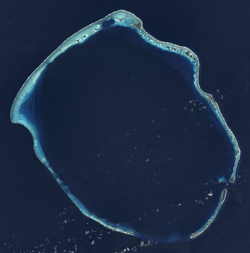
Map of Enewetak Atoll

Key Information

Aerial view of Enewetak and Parry

Enewetak Atoll (/ɛˈnwəˌtɔːk, ˌɛnɪˈwtɔːk/;[2] also spelled Eniwetok Atoll or sometimes Eniewetok; Marshallese: Ānewetak, [ænʲeːwɛːdˠɑk], or Āne-wātak, [ænʲeːwæːdˠɑk];[3] known to the Japanese as Brown Atoll or Brown Island; Japanese: ブラウン環礁) is a large coral atoll of 40 islands in the Pacific Ocean and with its 296 people (as of 2021)[1] forms a legislative district of the Ralik Chain of the Marshall Islands. With a land area total less than 5.85 square kilometers (2.26 sq mi),[1] it is no higher than 5 meters (16.4 ft) and surrounds a deep central lagoon, 80 kilometers (50 mi) in circumference. It is the second-westernmost atoll of the Ralik Chain and is 305 kilometers (190 mi) west from Bikini Atoll.

It was held by the Japanese from 1914 until its capture by the United States in February 1944 during World War II, then became Naval Base Eniwetok. Nuclear testing by the US, totaling the equivalent of over 30 megatons of TNT, took place during the Cold War; in 1977–1980, a concrete dome (the Runit Dome) was built on Runit Island to deposit radioactive soil and debris.[4]

The Runit Dome is deteriorating and could be breached by a typhoon, though the sediments in the lagoon are even more radioactive than those which are contained.[5]

Etymology

[edit]

The U.S. government referred to the atoll as "Eniwetok" until 1974, when it changed its official spelling to "Enewetak" (along with many other Marshall Islands place names, to more properly reflect their pronunciation by the Marshall Islanders[6]).

Geography

[edit]

Enewetak Atoll formed atop a seamount. The seamount was formed in the late Cretaceous.[7] This seamount is now about 1,400 meters (4,600 ft) below sea level.[8] It is made of basalt, and its depth is due to a general subsidence of the entire region and not because of erosion.[9]

Enewetak has a mean elevation above sea level of 3 meters (9.8 ft).[10]

History

[edit]

Humans have inhabited the atoll since about 1,000 B.C.[11]

The islands were first settled by Austronesian islanders.

The first European colonizers to Enewetak, Spanish explorer Álvaro de Saavedra Cerón, arrived on 10 October 1529.[12][13] He called the island "Los Jardines" (The Gardens). In 1794, sailors aboard the British merchant sloop Walpole called the islands "Brown's Range" (thus, the Japanese name "Brown Atoll"). It was visited by about a dozen ships before the establishment of the German colony of the Marshall Islands in 1885.[14]

The World Wars

[edit]

With the rest of the Marshalls, Enewetak was captured by the Imperial Japanese Navy in 1914, during World War I and mandated to the Empire of Japan by the League of Nations in 1920. The Japanese administered the island under the South Seas Mandate, but mostly left affairs in hands of traditional local leaders until the start of World War II. The atoll, together with other parts of Marshall Islands located to the west of 164°E, was placed under the governance of Pohnpei district during the Japanese administration period, separately from the rest of the Marshall Islands.[15]

Fighting on Enewetak Atoll during the Battle of Eniwetok in World War II

In November 1942, the Japanese built an airfield on Engebi Island. As they used it only for refueling planes between Truk and islands to the east, no aviation personnel were stationed there, and the island had only token defenses. When the Gilberts fell to the United States, the Imperial Japanese Army assigned defense of the atoll to the 1st Amphibious Brigade, formed from the 3rd Independent Garrison, which had previously been stationed in Manchukuo. The 1st Amphibious Brigade arrived on January 4, 1944. Some 2,586 of its 3,940 men were left to defend Eniwetok Atoll, supplemented by aviation personnel, civilian employees, and laborers. However, they were unable to finish the fortifications before the American attack came in February. During the ensuing Battle of Eniwetok, the Americans captured Enewetak in a five-day amphibious operation. Fighting mainly took place on Engebi Islet, site of the most important Japanese installation, although some combat occurred on the main islet of Enewetak itself and on Parry Island, where there was a Japanese seaplane base.

Following its capture, the anchorage at Enewetok became a major US Naval Advance Base with Service Squadron 4 and Service Squadron 10 stationed in the lagoon. The daily average of ships present during the first half of July 1944 was 488; during the second half of July, the daily average number of ships at Enewetak was 283.[16] Naval Base Eniwetok was part of the vast Naval Base Marshall Islands. US Navy Seabees of the 110th Naval Construction Battalion arrived on February 21 and 27 to begin construction of Stickell Field.[17] It had two taxiways and a 6,800-by-400-foot (2,070 by 120 m) runway.[17] In June 1945, the 67th CB arrived to build a 35,000 man recreation center to be turned over to CBMU 608.[17]

In 1950, John C. Woods, who executed the Nazi war criminals convicted at the Nuremberg trials, died by accidental electrocution while stationed on Enewetak Atoll.

Nuclear weapons testing

[edit]

After the end of World War II, Enewetak came under the control of the United States as part of the Trust Territory of the Pacific Islands, until the independence of the Marshall Islands in 1986. During its tenure, the United States evacuated the local residents many times, often involuntarily.[citation needed] The atoll was used for nuclear testing, as part of the Pacific Proving Grounds. Before testing commenced, the U.S. exhumed the bodies of United States servicemen killed in the Battle of Enewetak and returned them to the United States to be re-buried by their families. 43[a] nuclear tests were fired at Enewetak from 1948 to 1958.[20]

The first hydrogen bomb test, code-named Ivy Mike, occurred in late 1952 as part of Operation Ivy; it vaporized the islet of Elugelab and created two new elements: Fermium and Einsteinium. This test included B-17 Flying Fortress drones to fly through the radioactive cloud to test onboard samples. B-17 mother ships controlled the drones while flying within visual distance of them. In all, 16 to 20 B-17s took part in this operation, of which half were controlling aircraft and half were drones. To examine the explosion clouds of the nuclear bombs in 1957/58, several rockets (mostly from rockoons) were launched. One USAF airman Jimmy Robinson was lost at sea during the tests. Robinson's F-84 Thunderjet crashed and sank 3.5 miles (5.6 km) short of the island. Robinson's body was never recovered.[21][22][23]

Aerial view of the Runit Dome. The dome is placed in the crater created by the "Cactus" nuclear weapons test in 1958.

Radiological cleanup

[edit]

A radiological survey of Enewetak was conducted from 1972 to 1973.[24] In 1977, the United States military began decontamination of Enewetak and other islands. During the three-year, US$100 million cleanup process, the military mixed more than 80,000 cubic meters (100,000 cu yd) of contaminated soil and debris[25] from the islands with Portland cement and buried it in an atomic blast crater on the northern end of the atoll's Runit Island.[26][b] The material was placed in the 9.1-meter (30 ft) deep, 110-meter (360 ft) wide crater created by the May 5, 1958, "Cactus" nuclear weapons test. A dome composed of 358 concrete panels, each 46 centimeters (18 in) thick, was constructed over the material. The final cost of the cleanup project was US$239 million.[25] The United States government declared the southern and western islands in the atoll safe for habitation in 1980,[c] and residents of Enewetak returned that same year.[27] The military members who participated in that cleanup mission are suffering from many health issues, but the U.S. Government refused to provide health coverage[28] until 2022 with the passage of the Honoring our PACT Act.[29]

The 2000 environmental restoration award included funds for additional cleanup of radioactivity on Enewetak. Rather than scrape the topsoil off, replace it with clean topsoil, and create another radioactive waste repository dome at some site on the atoll (a project estimated to cost US$947 million), most areas still contaminated on Enewetak were treated with potassium.[d] Soil that could not be effectively treated for human use was removed and used as fill for a causeway connecting the two main islands of the atoll (Enewetak and Parry). The cost of the potassium decontamination project was US$103.3 million.[30]

A report by the US Congressional Research Service projects that the majority of the atoll will be fit for human habitation by 2026–2027, after nuclear decay, de-contamination and environmental remediation efforts create sufficient dose reductions.[31] However, in November 2017, the Australian Broadcasting Corporation reported that rising sea levels caused by climate change are seeping inside the dome, causing radioactive material to leak out.[32]

U.S. relations with Marshall Islands

[edit]

Section 177 of the 1983 Compact of Free Association between the governments of the United States and the Marshall Islands[33] establishes a process for Marshallese to make a claim against the United States government as a result of damage and injury caused by nuclear testing. That same year, an agreement was signed to implement Section 177, which established a US$150 million trust fund. The fund was intended to generate US$18 million a year, which would be payable to claimants on an agreed-upon schedule. If the US$18 million a year generated by the fund was not enough to cover claims, the principal of the fund could be used.[34][30] A Marshall Islands Nuclear Claims Tribunal was established to adjudicate claims. In 2000, the tribunal made a compensation award to the people of Enewetak consisting of US$107.8 million for environmental restoration; US$244 million in damages to cover economic losses caused by loss of access and use of the atoll; and US$34 million for hardship and suffering.[30] In addition, as of the end of 2008, another US$96.658 million in individual damage awards were made. Only US$73.526 million of the individual claims award has been paid, however, and no new awards were made between the end of 2008 and May 2010.[30] Due to stock market losses, payments rates that have outstripped fund income, and other issues, the fund was nearly exhausted, as of May 2010, and unable to make any additional awards or payments.[30] A lawsuit by Marshallese arguing that "changed circumstances" made Nuclear Claims Tribunal unable to make just compensation was dismissed by the Supreme Court of the United States in April 2010.[35]

Education

[edit]

Marshall Islands Public School System operates Enewetak Elementary School.[36] Marshall Islands High School on Majuro serves the community.[37]

Eniwetok Airfield

[edit]

Men from the 110th Naval Construction Battalion arrived on Eniwetok between 21 and 27 February 1944 and began clearing the island for construction of a bomber airfield. A 2,100-meter (6,900 ft) by 120-meter (390 ft) runway with taxiways and supporting facilities was built. The first plane landed on 11 March. By 5 April the first operational bombing mission was conducted.[38] The base was later named for Lieutenant John H. Stickell.[39][40]

In mid-September 1944 operations at Wrigley Airfield on Engebi Island were transferred to Eniwetok.[41]

US Navy and Marine units based at Eniwetok included:

  • VB-102 operating PB4Y-1s from 12–27 August 1944[42]
  • VB-108 operating PB4Y-1s from 11 April-10 July 1944[43]
  • VB-109 operating PB4Y-1s from 5 April-14 August 1944[44]
  • VB-116 operating PB4Y-1s from 7 July-27 August 1944[45]
  • VPB-121 operating PB4Y-1s from 1 March-3 July 1945[46]
  • VPB-144 operating PV-2s from 27 June 1945 until September 1946[47]

The airstrip is now abandoned and its surface partially covered by sand.

Parry Island seaplane base

[edit]

The Imperial Japanese Navy had developed a seaplane base on Parry Island. Following its capture on 22 February, Seabee's from the 110th Naval Construction Battalion expanded the base, building a coral-surfaced parking area and shops for minor aircraft and engine overhaul. A marine ways was installed on a Japanese pier and boat-repair shops were also erected.[38]

US Navy and Marine units based at Parry Island included:

  • VP-13 operating PB2Y-3s from 26 February-22 June 1944[48]
  • VP-16 operating PBM-3Ds from 7 June-1 August 1944[48]
  • VP-21 operating PBM-3Ds from 19 August-17 October 1944 and from 15 July-11 September 1945[49]
  • VP-23 operating PBY-5As from 20 August 1944 – 9 April 1945[50]
  • VP-MS-6 operating PBM-5Es from 1 February 1948 in support of Operation Sandstone[51]
  • VP-102 operating PB2Y-3s from 3 February-30 August 1944[52]
  • VP-202 operating PBM-3Ds from 24 February-1 March 1944[53]
  • VPB-19 operating PBM-3Ds from 2 November 1944 – 12 February 1945 and 6 March 1945-January 1946[54]
  • VPB-22 operating PBM-3Ds from 10 October-30 November 1944 and from 25 June-7 August 1945[55]

List of nuclear weapons tests at Eniwetok

[edit]

Summary

[edit]
Nuclear Tests on and around Enewetak Atoll
Series Start Date End Date Count Yield Range Total Yield
Sandstone 14 April 1948 14 May 1948 3 18 - 49 kilotons 104 kilotons
Greenhouse 7 April 1951 4 May 1951 4 45.5-225 kilotons 396.5 kilotons
Ivy 31 October 1952 15 November 1952 2 500 kilotons - 10.4 megatons 10.9 megatons
Castle 13 May 1954 13 May 1954 1 110 kilotons - 15 megatons 48 megatons
Redwing 4 May 1956 21 July 1956 11 190 tons - 1.9 megatons ~2.61 megatons
Hardtack I 5 April 1958 18 August 1958 22 Zero - 8.9 megatons 16.1 megatons
Total (on Enewetak)     43[31]   Approx 31.8 megatons (almost 6% of total test yield worldwide)
Test shot Date Location Yield
X-Ray 18:17 14 April 1948 (GMT) Enjebi Islet 37 kt
Yoke 18:09 30 April 1948 (GMT) Aomon Islet 49 kt
Zebra 18:04 14 May 1948 (GMT) Runit Islet 18 kt
Test shot Date Location Yield
Dog 18:34 7 April 1951 (GMT) Runit Islet 81 kt
Easy 18:26 20 April 1951 (GMT) Enjebi Islet 47 kt
George 21:30 8 May 1951 (GMT) Eberiru Islet 225 kt
Item 18:17 24 May 1951 (GMT) Enjebi Islet 45.5 kt
Test shot Date Location Yield
Mike 19:14:59.4 31 October 1952 (GMT) Elugelab Islet 10.4 Mt
King 23:30 15 November 1952 (GMT) Runit Islet 500 kt
Test shot Date Location Yield
Nectar 18:00 13 May 1954 UTC Off Bogon Islet near Ivy Mike crater 1.69 Mt
Test shot Date Location Yield
Lacrosse 18:25 4 May 1956 (GMT) Runit Islet 40 kt
Yuma 19:56 27 May 1956 (GMT) Aomon Islet 0.19 kt
Erie 18:15 30 May 1956 (GMT) Runit Islet 14.9 kt
Seminole 00:55 6 June 1956 (GMT) Bogon Islet 13.7 kt
Blackfoot 18:26 11 June 1956 (GMT) Runit Islet 8 kt
Kickapoo 23:26 13 June 1956 (GMT) Aomon Islet 1.49 kt
Osage 01:14 16 June 1956 (GMT) Runit Islet 1.7 kt
Inca 21:26 21 June 1956 (GMT) Rujoru Islet 15.2 kt
Mohawk 18:06 2 July 1956 (GMT) Eberiru Islet 360 kt
Apache 18:06 8 July 1956 (GMT) near Ivy Mike crater 1.9 Mt
Huron 18:12 21 July 1956 (GMT) Off Flora Islet 250 kt
Test shot Date Location Yield
Yucca 18:15 28 April 1958 (GMT) 157 km N of Eniwetok Atoll[e] 1.7 kt
Cactus 18:15 5 May 1958 (GMT) Runit Islet 18 kt
Butternut 18:15 11 May 1958 (GMT) Eniwetok Atoll 81 kt
Koa 18:30 12 May 1958 (GMT) Eniwetok Atoll 1370 kt
Wahoo 01:30 16 May 1958 (GMT) Eniwetok Atoll 9 kt
Holly 18:30 20 May 1958 (GMT) Eniwetok Atoll 5.9 kt
Yellowwood 2:00 26 May 1958 (GMT) Eniwetok Lagoon 330 kt
Magnolia 18:00 26 May 1958 (GMT) Eniwetok Atoll 57 kt
Tobacco 02:50 30 May 1958 (GMT) Eniwetok Atoll 11.6 kt
Rose 18:45 2 June 1958 (GMT) Eniwetok Atoll 15 kt
Umbrella 23:15 8 June 1958 (GMT) Eniwetok Lagoon 8 kt
Walnut 18:30 14 June 1958 (GMT) Eniwetok Atoll 1.45 kt
Linden 03:00 18 June 1958 (GMT) Eniwetok Atoll 11 kt
Elder 18:30 27 June 1958 (GMT) Eniwetok Atoll 880 kt
Oak 19:30 28 June 1958 (GMT) Eniwetok Lagoon 8.9 Mt
Sequoia 18:30 1 July 1958 (GMT) Eniwetok Atoll 5.2 kt
Dogwood 18:30 5 July 1958 (GMT) Eniwetok Atoll 397 kt
Scaevola 04:00 14 July 1958 (GMT) Eniwetok Atoll 0 kt
Pisonia 23:00 17 July 1958 (GMT) Eniwetok Atoll 255 kt
Olive 18:15 22 July 1958 (GMT) Eniwetok Atoll 202 kt
Pine 20:30 26 July 1958 (GMT) Eniwetok Atoll 2000 kt
Quince 02:15 6 August 1958 (GMT) Eniwetok Atoll 0 kt
Fig 04:00 18 August 1958 (GMT) Eniwetok Atoll 0.02 kt
[edit]

Missile Impact Location System

[edit]

From 1958 through 1960 the United States installed the Missile Impact Location System (MILS) in the Navy managed Pacific Missile Range, later the Air Force managed Western Range, to localize the splash downs of test missile nose cones. MILS was developed and installed by the same entities that had completed the first phase of the Atlantic and U.S. West Coast SOSUS systems. A MILS installation, consisting of both a target array for precision location and a broad ocean area system for good positions outside the target area, was installed at Eniwetok as part of the system supporting Intercontinental Ballistic Missile (ICBM) tests. Other Pacific MILS shore terminals were at the Marine Corps Air Station Kaneohe Bay supporting Intermediate Range Ballistic Missile (IRBM) tests with impact areas northeast of Hawaii and the other ICBM test support systems at Midway Island and Wake Island.[57][58][59]

[edit]

Notes

[edit]

References

[edit]

Bibliography

[edit]
[edit]
Revisions and contributorsEdit on WikipediaRead on Wikipedia
from Grokipedia

Enewetak Atoll is a coral atoll comprising 40 islands encircling a lagoon in the northwestern Marshall Islands of the central Pacific Ocean, which served as a primary site for 43 United States nuclear weapons tests from 1948 to 1958, yielding a combined explosive force equivalent to 31.7 megatons of TNT and including the Ivy Mike detonation, the world's first successful thermonuclear test on November 1, 1952. The atoll's indigenous Marshallese population of approximately 150 was forcibly relocated to Ujelang Atoll in 1947 to facilitate testing, following its capture from Japanese forces during the Battle of Eniwetok in February 1944.
In the 1970s, the U.S. conducted a radiological cleanup operation from 1977 to 1980, consolidating contaminated soil and debris from 13 islands into the Cactus Crater on Runit Island, which was then capped with a concrete dome known as the Runit Dome, measuring 114 meters in diameter and containing over 100,000 cubic yards of radioactive waste. This structure, built without a liner over fractured bedrock directly above the Pacific Ocean, has faced concerns regarding its long-term integrity amid erosion and potential breach risks from extreme weather, though radiological monitoring indicates primary ongoing contamination risks stem from lagoon sediments rather than the dome itself. As of 2021, a small population of 296 Marshallese resides on habitable southern islands, supported by U.S. compensation under the Compact of Free Association, while northern islands remain restricted due to residual radioactivity.

Etymology

Name origins and variations

The name Enewetak originates from the spoken by the indigenous people of the Ralik Chain, referring to the 's central island and, by extension, the entire coral ring. Local interpretations render it as "island that moves," potentially evoking the shifting sands, tidal dynamics, or migratory patterns observed in the atoll's ecosystem. European contact introduced early variations: Spanish explorer sighted the atoll on October 10, 1529, and designated it Los Jardines ("The Gardens"), reflecting its lush appearance from afar. In 1794, British sailors aboard the merchant sloop Walpole charted it as "Brown's Range," a name that influenced subsequent Japanese references to "Brown Atoll" during their mandate period from to 1944. Under United States administration following World War II, the phonetic spelling Eniwetok prevailed in official documents and military operations, approximating the Marshallese pronunciation as recorded by early American surveys. In 1974, the U.S. Board on Geographic Names revised it to Enewetak to conform to standardized Marshallese orthography, aligning with decolonization efforts and native preferences across the Trust Territory of the Pacific Islands; alternative transcriptions like Enewetok persist in some historical contexts.

Geography

Physical features and formation

Enewetak Atoll consists of approximately 40 low-lying islets encircling a central , with a total land area of less than 5.85 square kilometers. The islets rise no higher than 5 meters above and form an elliptical structure measuring about 40 kilometers in length and 32 kilometers in width. The enclosed spans roughly 1,000 square kilometers, with depths reaching up to 64 meters. The atoll's foundation lies atop a basaltic originating from a volcanic edifice that protrudes approximately 3.2 kilometers above the floor. This structure formed through volcanic activity in a subsiding oceanic setting, consistent with the Darwinian model of where fringing reefs develop around an emerging . As the underlying subsided due to isostatic adjustment and thermal cooling of the oceanic , the reefs expanded outward and upward via continuous growth and carbonate deposition, transitioning to a barrier reef and eventually an as the island submerged below . Drill cores reveal thick sequences of aragonite-rich limestones overlying the volcanic basement, attesting to prolonged over millions of years since at least the pre-Neogene period.

Climate, ecology, and biodiversity

Enewetak Atoll experiences a characterized by consistently high temperatures and , with annual averages ranging from 27°C to 29°C and minimal seasonal variation. Minimum temperatures rarely drop below 24°C, while highs seldom exceed 29°C. Annual precipitation totals approximately 1,400 mm, concentrated in wetter months from May to , with a relatively drier period from to influenced by . The atoll's ecology is dominated by a system encompassing fringing reefs, patch reefs, and a central approximately 80 km in , supporting a dynamic marine environment shaped by oceanic currents and nutrient . Vegetation on the low-lying islands (elevations below 5 m) is limited to salt-tolerant such as palms, , and scrub, with terrestrial ecosystems constrained by thin soils and exposure to . The marine realm features high productivity in the and fore-reef zones, where trophic interactions among , , and sustain food webs, though historical disturbances have altered reef structures in localized areas. Biodiversity is particularly rich in the marine habitats, with over 800 documented species inhabiting and passes, including herbivores on reef flats and pelagic predators in deeper channels. Coral cover varies, with some undisturbed exhibiting up to 100% live in pre-disturbance surveys, supporting diverse like mollusks and echinoderms. Nuclear testing from 1948 to 1958 vaporized or contaminated northern islands, reducing local complexity and initially disrupting fish communities in blast craters, though recolonization by resilient has occurred in shallower sites. Southern sectors, spared major blasts, retain higher diversity, reflecting partial ecosystem recovery amid ongoing radiological legacies.

Pre-20th Century History

Indigenous settlement and culture

The indigenous inhabitants of Enewetak Atoll, known as the Enewetakese, are ethnically Marshallese, part of the broader Micronesian population that colonized the archipelago through Austronesian seafaring migrations originating from and Near . Archaeological evidence from pottery, linguistic patterns, and oral histories supports initial human settlement of the , including remote atolls like Enewetak, around 4,000 years ago (circa 2000 BCE), with populations establishing permanent communities adapted to coral atoll environments by navigating vast oceanic distances using canoes, stellar observations, and wave patterns. Enewetak's isolation in the northwestern fostered a tight-knit society centered on subsistence fishing, coconut cultivation, and , with communities residing on multiple islets within the for resource access and defense. Traditional followed a matrilineal structure common to Marshallese atolls, featuring hereditary paramount chiefs (iroij errik) overseeing land rights and commoners (kajur) handling daily labor, reinforced by a strong of genealogies, myths, and navigational lore passed through elaborate public orations at ceremonies. Maritime prowess defined cultural identity, with Enewetakese mastering non-instrumental techniques, including the use of woven stick charts (rebbelib) to encode swell directions and island sightings, enabling inter-atoll voyages essential for , alliances, and warfare. Pre-colonial beliefs involved animistic rituals honoring spirits of the and land, with sacred sites for chiefly burials and pre-battle invocations, though these practices varied by due to limited contact until European arrival.

European exploration and early contact

The first recorded European contact with Enewetak Atoll occurred on October 1, 1529, when Spanish explorer , commanding the Florida, sighted the atoll during an expedition to find a western route to ..pdf) Saavedra's crew made landfall shortly thereafter, interacting briefly with the indigenous Marshallese inhabitants, whom they found hospitable; the atoll was named Los Jardines ("The Gardens") in recognition of its lush appearance and the welcoming reception..pdf) This visit marked the initial European awareness of the atoll, though no permanent settlement or extensive mapping followed, as Spain prioritized resource-rich territories elsewhere in the Pacific. Subsequent European visits remained infrequent for over two centuries, with the atoll largely outside major navigational routes. British merchant vessels began sporadic stops in the late 18th century for provisioning and trade, including the Royal Admiral under Captain Henry Bond on December 15, 1792; the Walpole commanded by Thomas Butler on December 13, 1794; and the Hunter led by John Fearn on November 16, 1798. These encounters involved exchanges of goods such as iron tools for food and water, introducing metal items to local society but also risking disease transmission, though specific impacts at Enewetak are undocumented. In the early 19th century, scientific expeditions expanded contact: Russian explorer Otto von Kotzebue anchored the Predpriyemiye at the on October 11, 1825, conducting surveys as part of a global voyage; this was followed by Fedor Petrovich Litke's vessels Moller and Senyavin in November 1827, which charted features and noted ethnographic details. The U.S. Exploring Expedition's warship USS Vincennes, under Lieutenant John H. Aulick, visited on November 13, 1835, contributing to early hydrographic data amid broader Pacific reconnaissance. Merchant and traffic increased mid-century, exemplified by the British ship Agnes Holt in 1864, fostering limited trade but no formal claims. By the late 19th century, missionary outreach complemented commercial visits, with the American vessel Morning Star III, captained by George Graland, arriving in 1883 to establish Protestant influence amid growing European interest in the region. These interactions remained transient, centered on resupply and evangelism, until Germany's declaration of a over the in 1885 shifted dynamics toward colonial administration..pdf) Overall, early European engagements introduced novel technologies and ideas but were constrained by the atoll's remoteness and lack of exploitable resources like pearls or found elsewhere in .

20th Century History

World War II strategic role

Enewetak Atoll, located approximately 530 kilometers northwest of Kwajalein in the Marshall Islands, assumed strategic significance in World War II as part of the U.S. island-hopping campaign to neutralize Japanese defenses in the central Pacific. Held by Japan since its seizure of the German-mandated Marshall Islands in 1914, the atoll featured key islands suitable for airfields and anchorages, making it a potential staging point for operations against the Marianas and Philippines. U.S. planners advanced the originally scheduled May 1944 capture to February, leveraging the diversionary Truk carrier raid on February 17-18, 1944, to surprise Japanese forces. Operation Catchpole, commanded by Rear Admiral Harry W. Hill, USN, commenced on February 17, 1944, with landings by U.S. Marines and Army units targeting Engebi, Eniwetok, and Parry Islands to secure the atoll's airfield on Engebi and provide fleet anchorage. The rapid conquest by February 23 eliminated Japanese resistance, denying them a base from which to interdict Allied advances. Post-capture, Enewetak served as a vital forward base, enabling air raids on Truk Lagoon and supporting subsequent campaigns in the Marianas, , and beyond by hosting long-range bombers and providing logistical support for the U.S. Pacific Fleet. The atoll's development into Naval Base Eniwetok facilitated the projection of air power, contributing to the isolation of remaining Japanese strongholds like Truk.

Post-war U.S. Trust Territory administration

Following the conclusion of , Enewetak Atoll transitioned from U.S. to inclusion in the Trust Territory of the Pacific Islands (TTPI), a strategic trusteeship administered by the , which took effect on July 18, 1947. The TTPI encompassed over 2,000 islands across , including the chain, with Enewetak falling under initial U.S. Navy oversight as part of postwar governance aimed at promoting , health, education, and while maintaining strategic U.S. interests. Administration was centralized under a U.S. , with district administrators handling local affairs; for the , this involved retaining wartime naval bases like Eniwetok for logistical support and infrastructure maintenance. In December 1947, U.S. authorities relocated the approximately 145 Marshallese residents of Enewetak—comprising the population of Enewetak and nearby islets—to Ujelang Atoll, a smaller and less fertile location about 120 kilometers west, to clear the atoll for anticipated high-priority uses. This action, executed under TTPI military-civilian coordination, included provisions for temporary housing, food supplies, and copra production support, though Ujelang's limited and strained the displaced community from the outset. Prior to relocation, U.S. forces exhumed and repatriated the remains of American servicemen buried on the atoll during the 1944 invasion, ensuring no graves interfered with operational plans. The brief pre-testing administration phase emphasized security, environmental surveys, and base enhancements, with Enewetak serving as a forward naval outpost under command until formal TTPI civilian elements expanded in , when overall territory administration shifted to the U.S. Department of the Interior. Local governance remained minimal, with U.S. officials consulting Marshallese leaders on routine matters like fisheries and health services, but strategic decisions overrode indigenous input, reflecting the trusteeship's dual military trusteeship status. By early 1948, Enewetak's population centers were depopulated, and U.S. personnel focused on constructing test support facilities, marking the atoll's pivot from postwar recovery to specialized use.

Nuclear Weapons Testing Program

Strategic rationale and overall scope

Enewetak Atoll was selected as a nuclear testing site due to its position under administration as part of the post-World War II Strategic Trusteeship over the , providing legal authority for operations with minimal international oversight. The atoll's remote Pacific location, sparse population of approximately 145 indigenous residents who were evacuated on December 21, 1947, to Ujelang Atoll, and geographical features—including a large protected over six miles in , larger islands than , deeper surrounding waters, and predictable wind and current patterns—facilitated controlled detonations and fallout management. Proximity to U.S. air bases within 1,000 miles enabled logistical support, while isolation from major population centers reduced risks to non-participants. The strategic rationale centered on accelerating U.S. development amid emerging tensions, particularly after the Soviet Union's 1949 atomic test, to achieve military superiority through advanced fission and thermonuclear designs. Testing at Enewetak shifted from Atoll's focus on weapons effects to iterative device prototyping, emphasizing principles for hydrogen bombs that minimized while maximizing yield and compactness for delivery systems. Operations like in 1951 validated fusion-boosting concepts, culminating in on November 1, 1952—the first successful thermonuclear detonation yielding 10.4 megatons—which confirmed theoretical feasibility but highlighted engineering challenges for weaponization. The program's overall scope encompassed 43 atmospheric nuclear tests conducted between 1948 and 1958, with a combined yield of approximately 31.7 megatons, primarily in the atoll's northern quadrant to shield southern support bases from radioactive fallout. Detonations employed diverse configurations, including 19 barge-mounted, 13 tower-supported, seven surface, two underwater, and two airdrop shots, enabling comprehensive data on yields, blast effects, and radiation propagation. This systematic experimentation advanced U.S. capabilities from kiloton-range fission devices to megaton-class thermonuclear weapons, informing deployable arsenals until the 1963 Partial Test Ban Treaty halted atmospheric testing.

Key test series and technological advancements

The executed 43 nuclear detonations at Enewetak Atoll from 1948 to 1958, comprising a total yield of approximately 31.7 megatons and driving critical progress in fission and fusion weapon designs. These operations, conducted under the Commission's Pacific Proving Ground, shifted from refining implosion efficiency to achieving multi-megaton thermonuclear yields, enabling smaller, higher-yield devices suitable for strategic bombers and missiles. Operation Sandstone, spanning April to May 1948, featured three tower-mounted tests ( on April 15 yielding 37 kt, on April 30 at 49 kt, and Zebra on May 14 at 18 kt) that validated levitated-pit and composite-core implosion techniques, boosting efficiency by separating the plutonium core from the tamper to allow more rapid compression and neutron multiplication before disassembly. These innovations increased yields by over 50% compared to prior designs while reducing requirements, laying groundwork for compact primaries in . Operation in April-May 1951 conducted four shots, including George (May 9, 225 kt), which pioneered fission boosting via deuterium-tritium gas injection into the primary, enhancing and burn-up for yields far exceeding unboosted predecessors of similar mass. This series demonstrated scalable implosion systems with tamper materials like , which bred additional through fast fission, advancing toward efficient thermonuclear triggers. Operation Ivy marked a breakthrough with two November 1952 tests at Enewetak: (November 1, 10.4 Mt), a massive cryogenic liquid-deuterium device that vaporized Island and confirmed the Teller-Ulam staged for , producing fusion energy over 1,000 times that of fission bombs like . (November 15, 500 kt) set the record for pure fission yield using a hollow-pit design with tamper, yielding data on high-efficiency fission without fusion staging. Later series refined these foundations: Operation Redwing's Enewetak shots, such as (May 6, 1956, 13.7 kt), explored tactical and safety-modified designs; while I in 1958 encompassed 35 tests, many at Enewetak, prioritizing low-yield, one-point safe warheads for air delivery and assessing failure modes under abnormal conditions. These efforts collectively transitioned U.S. arsenal from kiloton to megaton scales, emphasizing reliability, , and reduced weight for deployable systems.

Immediate physical and human impacts

The 43 nuclear tests conducted by the United States at Enewetak Atoll between 1948 and 1958 resulted in profound physical alterations to the atoll's geography, including the complete vaporization of multiple islands and the formation of large craters. The most dramatic example occurred during Operation Ivy on November 1, 1952, when the Ivy Mike shot, with a yield of approximately 10.4 megatons TNT equivalent, detonated on Elugelab Island, obliterating it entirely and excavating a crater 1.9 kilometers (6,240 feet) in diameter and 50 meters (160 feet) deep. Other high-yield tests, such as those in Operations Greenhouse, Redwing, and Hardtack I, similarly reshaped or partially destroyed islands like Runit, Bogon, and Namu, with surface and shallow underwater detonations eroding landmasses, widening the lagoon, and scattering debris across the atoll. These blasts collectively reduced habitable land area and altered reef structures, with immediate effects including shock waves that damaged structures on distant islands and initial radioactive fallout deposition. Human impacts were primarily manifested through preemptive evacuations rather than blast casualties, as test sites were cleared of personnel. In April 1947, the roughly 150 Marshallese residents of Enewetak were relocated to Ujelang Atoll to accommodate testing preparations, with subsequent displacements during specific operations. No immediate fatalities among humans were recorded from the detonations themselves, owing to exclusion zones and remote detonation protocols; however, military observers, diagnostic equipment operators, and support personnel stationed at safe distances—typically beyond 10-20 kilometers—experienced flash blindness, minor injuries from blast effects in early tests, and acute radiation exposures from unpredicted fallout patterns in some instances, though these were limited by design and did not result in widespread . Evacuated inhabitants faced immediate hardships from abrupt relocation without full compensation or , setting the stage for prolonged displacement.

Radiological Cleanup and Rehabilitation

Planning and execution (1977-1980)

Planning for the radiological cleanup of Enewetak Atoll commenced in April 1972, following U.S. government assessments of contamination from prior nuclear tests, with the initial preliminary radiological survey conducted from May 10 to 24, 1972. Subsequent engineering and radiological surveys from October 1972 to October 1973 evaluated contamination levels, primarily transuranic elements such as and , which posed long-term hazards due to their persistence compared to shorter-lived fission products like and cesium-137. These efforts informed habitability determinations, deeming southern islands (Enewetak, Medren, Japtan, Ananij) suitable for residence after non-contaminated scrap removal, while northern islands required targeted decontamination to achieve plutonium levels below 40 picocuries per gram (pCi/g) for residential use, 80 pCi/g for , and 160 pCi/g for food-gathering areas. The scope prioritized heavily contaminated northern islands including Enjebi, , Aomon, Boken, and Lujor, focusing on excavating approximately 79,000 cubic yards of plutonium-contaminated soil exceeding 400 pCi/g, alongside debris segregation and removal of non-radiological hazards. Interagency coordination involved the Department of Defense (DOD) via the Defense Nuclear Agency (DNA) for overall management, the Department of Energy (DOE, formerly ERDA) for radiological expertise and surveys, and the Department of the Interior (DOI) for rehabilitation and resettlement under Trust Territory administration. Additional support came from the U.S. Army Corps of Engineers, , , Atomic Energy Commission, and Environmental Protection Agency. Cost estimates evolved from $18.4 million using labor to around $100 million total, incorporating and contingencies; congressional approvals included 94-107 (October 7, 1975), 94-367 (July 16, 1976), and the FY 1977 Construction Appropriation Act, with initial allocations of $20 million despite higher requests. DNA and DOE agreed on cleanup objectives emphasizing hazard reduction for safe return rather than restoration to pre-test conditions, with land-use restrictions to mitigate residual risks. Execution began on June 15, 1977, with mobilization of a peaking at nearly 1,000 personnel—primarily U.S. military from , , and units totaling over 8,000 rotations—and base camp construction on Enewetak Island. Workers employed protective measures including dosimeters, regular monitoring, and restricted access to high-contamination zones, while excavating soil in 6-inch layers using heavy equipment like backhoes and dozers, windrowing, and hauling via to Island's Cactus Crater. Debris was manually and mechanically sorted into radiological categories, with contaminated portions (>1,000 pCi/g) directed to the crater and non-contaminated scrap (55,000 cubic yards) removed by contractors. Soil removal progressed island-by-island: Aomon pilot cleanup from February to June 1978, Enjebi from July 1978 to May 1979 (including plowing experiments), Boken from late 1978 to July 1979, and Lujor from April to July 1979, with subsurface sampling and aerial surveys refining targets. Waste disposal entailed mixing excavated material with cement and water into slurry, tremie-poured into the 1958-formed Cactus Crater from June 1978 to February 1979, followed by dome capping completed September 6, 1979, entombing up to 200,000 cubic yards. Rehabilitation involved importing clean soil for northern islands and planting palms, with southern islands cleared of by September 11, 1978; operations faced logistical hurdles like Mary in December 1977 evacuating 829 personnel, but achieved 60% completion by mid-1979 per oversight reviews. The project concluded April 15, 1980, with demobilization and a handover ceremony on April 8, enabling partial resettlement under defined safety protocols.

Methods, challenges, and outcomes

The primary method employed in the radiological cleanup was systematic excavation of contaminated and subsurface material from 22 islands, using heavy machinery such as D8K bulldozers, backhoes, and loaders to remove layers in 6-inch lifts until concentrations fell below 40 picocuries per gram (pCi/g), the threshold for residential . Contaminated was classified by radiation levels—red for over 100 picorad per hour (pR/hr), yellow for 15-100 pR/hr, and green for non-radioactive—and handled accordingly, with transported via landing craft utility (LCU) barges and stockpiled on before entombment. Approximately 104,000 to 141,000 cubic yards of soil and 259,000 cubic yards of , including 55,000 cubic yards of radioactive scrap metal, were excavated and relocated, primarily to the Cactus Crater on , where it was mixed with cement and saltwater via pipes to form a stabilized matrix, then capped with an 18-inch dome embedded into the . In situ radiation detection vans equipped with germanium detectors for scanning aided hotspot identification, while was detonated or collected by Navy explosive ordnance disposal teams. Logistical challenges stemmed from the atoll's remote Pacific location, necessitating mobilization of and supplies across limited transport capacity—barges could haul only about 80,000 cubic yards annually—and frequent delays in deliveries, such as pipe shortages and extended offloading times for cargo ships. Environmental factors, including typhoons like Rita in 1978 and in 1979, disrupted operations by damaging piers, scattering materials into the , and causing , with total storm-related damages exceeding $591,000. Technical difficulties involved heterogeneous distribution, requiring iterative resurveys and adjustments to volume estimates (revised four times), as well as equipment failures like pump malfunctions leading to material segregation in the fill. Operational accidents resulted in 63 lost-time incidents and at least six U.S. servicemen fatalities from non-radiation causes, such as vehicle mishaps and aspiration, amid heat stress from anti-contamination suits in tropical conditions. Outcomes included successful decontamination of 11 islands, with seven certified for unrestricted residential use—such as Enjebi, where 97% of samples averaged 20 pCi/g—and overall reduction of surface on by 75%, containing about 14.72 curies of transuranic elements. The project, involving a peak population of 536 personnel (totaling around 7,000 participants, primarily U.S. military), concluded 1.5 months ahead of schedule on February 15, 1980, at a of approximately $100 million, enabling trial resettlement of about 400 Enewetakese by October 1980 on southern islands while restricting northern ones like due to persistent fission products. However, limitations persisted, including subsurface fragments, unverified long-term dome integrity without independent radiological assessment, and risks from potential non-adherence to usage restrictions, necessitating ongoing monitoring. doses to cleanup workers remained low, with 99.97% below 70 millirem, correlating to minimal risks.

Worker exposures and long-term effectiveness

During the Enewetak Atoll radiological cleanup from 1977 to 1980, approximately 5,600 U.S. Department of Defense personnel, including and civilian workers, were involved in removing contaminated and from six heavily affected islands, under supervision by a Radiation Control Division. Workers wore personal dosimeters such as badges (12,248 issued) and thermoluminescent dosimeters (7,519 issued), with additional monitoring via air sampling (5,204 samples), urine bioassays for intake (over 2,000 samples), and nasal smears. External exposures were primarily from in and , while internal exposures stemmed from potential or of transuranic elements like /240 and resuspended during excavation. Personal protective equipment, including respirators with protection factors of 50 to 1,000, was mandated for high-risk tasks, limiting airborne intake. Dose assessments, combining direct measurements and reconstructions accounting for environmental surveys from 1972 onward, indicated low overall exposures. For external gamma doses, 68% of film badge readings registered zero detectable exposure, with 99.3% below 20 millirem (mrem); the highest valid whole-body reading was 70 mrem, and upper-bound reconstructed external doses averaged 11 to 64 mrem per deployment. Internal doses were negligible, with 99.97% of urine bioassays below detectable limits for and upper-bound effective doses from or incidental estimated at 29 mrem or less; food consumption (e.g., or coconuts) contributed minimally, under 2 mrem total. Total effective doses, incorporating conservative uncertainties like heat-damaged badges and maximum exposure assumptions (e.g., 10 hours/day without full respirator use), ranged from 30 to 220 mrem per six-month tour—far below the 5 rem (5,000 mrem) annual occupational limit and comparable to or less than natural of about 300 mrem/year. No acute radiation effects were observed among workers, and official dose reconstructions conclude that levels were insufficient to produce measurable health risks, such as elevated cancer incidence, given thresholds typically exceeding 100 millisieverts (10 rem) above background. Anecdotal reports from veterans, including claims of disproportionate cancers (around 35% in some self-reported groups) and conditions like brittle bones, have prompted advocacy for benefits under laws like the PACT Act, but no peer-reviewed epidemiological study has established causal links to cleanup exposures due to confounding factors like and lack of comprehensive cohort tracking. Uncertainties in assessments, such as variable badge reliability in tropical conditions and conservative high-sided modeling (e.g., uncertainty factors of 3 for external and 10 for internal doses), were addressed through multiple validation methods, supporting the low-risk determination. The cleanup's long-term effectiveness centered on reducing transuranic contaminants to thresholds deemed safe for human habitation: plutonium soil concentrations below 40 picocuries per gram (pCi/g) for residential areas and below 160 pCi/g for or food gathering, achieved by excising and entombing over 100,000 cubic yards of material in the Dome crater. This effort successfully eliminated overt environmental hazards on treated islands, enabling partial resettlement by and reducing projected lifetime doses for residents to below U.S. averages. Post-cleanup monitoring, including annual radiological surveys since , has confirmed sustained low gamma exposure rates (e.g., 7–70 microreentgen per hour island averages) and negligible resuspension, with no exceedances of criteria. While the waste repository has faced scrutiny for potential leaks exacerbated by factors, the soil rehabilitation measures have proven durable, preventing widespread recontamination and supporting atoll outside quarantined zones.

Environmental and Health Assessments

Radiation contamination sources and decay

The primary sources of radioactive contamination at Enewetak Atoll originated from 43 nuclear weapons tests conducted by the United States between April 1948 and July 1958, which dispersed radionuclides via atmospheric fallout, direct deposition of bomb debris, and residue from unfissioned nuclear materials. These tests, totaling approximately 30 megatons of yield, included fission and fusion devices that generated fission products such as cesium-137 and strontium-90, neutron-activated coral and soil components, and transuranic elements like plutonium isotopes from device components. Fallout primarily affected the northern atoll islands and lagoon sediments, with close-in deposition from surface, barge, and tower shots creating localized hotspots, while air bursts contributed to broader dispersal; lagoon sediments now serve as the largest long-term reservoir due to plutonium-bearing particles settling post-detonation. Key long-lived radionuclides persisting today include cesium-137 (half-life 30.17 years), which decays via beta emission to stable barium-137, strontium-90 (half-life 28.79 years) decaying to and then zirconium-90, plutonium-239 (half-life 24,110 years) via to , plutonium-240 (half-life 6,561 years) to , and americium-241 (half-life 432.6 years) to neptunium-237. These isotopes derive mainly from fission (e.g., Cs-137 yield ~6% of total fission products) and residual actinides in test devices, with plutonium isotopes exhibiting high specific activity due to alpha emission but low mobility in carbonate soils unless resuspended. Shorter-lived species, such as (half-life 8 days) and (5.27 years), decayed rapidly post-testing, contributing minimally to current inventories by 2025. Radiological decay has significantly reduced overall activity since 1958: cesium-137 levels have declined by a factor of about 4 (spanning roughly two half-lives), from peak fallout concentrations exceeding 1,000 pCi/g in some soils to current surface averages below 10 pCi/g on cleaned southern islands, though hotspots persist in northern craters and sediments. /240 totals remain elevated at ~2-3% of original deposits due to their extended half-lives, with combined inventories estimated at 100-200 curies across the , primarily alpha-emitting and thus requiring or for risk. Empirical measurements confirm that while gamma emitters like Cs-137 have decayed predictably, transuranics show negligible reduction, with ongoing low-level remobilization via and sustaining trace fluxes to marine environments. Natural processes, including dilution in waters (volume ~4 km³) and binding to particulates, further attenuate effective doses, though long half-lives imply persistence for .

Empirical health risk data versus claims

Empirical dose reconstructions from U.S. nuclear tests at Enewetak Atoll indicate that while fallout radionuclides dispersed to nearby atolls, the atoll's resident population—approximately 150-200 individuals—was relocated to Ujelang Atoll prior to the 1948-1958 testing series, minimizing direct acute exposures. Post-relocation and cleanup, chronic intakes of key radionuclides like cesium-137 and plutonium-239 via food chains yielded estimated committed effective doses below 10 mSv for most resettled Enewetakese, with thyroid doses rarely exceeding 1 Gy except in isolated high-fallout events affecting transient groups. These levels align with natural background radiation in high-radon areas, and long-term monitoring confirms annual exposures under 1 mSv for current inhabitants on habitable islands. Projected cancer risks, calculated using linear no-threshold models, attribute 2-12% of lifetime thyroid cancers and under 5% of leukemias to fallout in Enewetak-affected cohorts, far lower than baselines driven by endemic factors like ; overall, radiation-related excess cancers comprise less than 2% of the 10,600 projected baseline cases among 24,783 Marshallese, with Enewetak-specific figures even smaller due to evacuation. No population-level epidemiological studies document statistically significant excesses in all-cause mortality or non-thyroid cancers exceeding expectations, contrasting claims of health crises. Cleanup workers from 1977-1980, numbering about 4,300 including U.S. military personnel, received mean external doses of 1-3 mSv and negligible internal commitments, per records, yielding projected lifetime cancer risks under 0.1% above unexposed peers—deemed low by VA standards without presumptive service connection. Self-reported veteran surveys cite elevated rare cancers, but uncontrolled for confounders like asbestos handling or smoking, these lack causal linkage to in peer-reviewed analyses. Runit Dome monitoring since 1980 detects no off-site migration of exceeding natural decay, with dome plutonium inventories (85% of total atoll Pu-239) contributing less than 0.1 mSv/year to nearby versus dominant lagoon sediment sources; health risks from hypothetical breach scenarios remain below limits, unsupported by empirical leakage data. Advocacy assertions of genetic mutations or unchecked birth defects traceable to Enewetak overlook confounding prevalences and small cohort sizes (under 100 post-resettlement births tracked), where observed anomalies do not deviate significantly from regional baselines.

Runit Dome: Design, monitoring, and durability

The Runit Dome, also known as the Containment Structure, was constructed between 1977 and 1980 to encapsulate approximately 85,000 cubic meters of radioactive soil, debris, and plutonium-contaminated materials excavated from other sites across Enewetak Atoll. The structure overlies the 1958 nuclear test on , which measures about 114 meters in diameter and 30 meters deep. It comprises three primary elements: a perimeter keywall of 99 interlocking sections, each 0.62 meters thick, to stabilize the crater walls; a fill of contaminated materials mixed with for solidification; and a dome-shaped cap, 0.46 meters thick, poured to prevent dispersion by wind and rain while not designed as a impermeable barrier. The cap's design prioritized containment of solids over , anticipating of rainwater through the structure into the underlying permeable bedrock. Monitoring of the Runit Dome has been conducted by the U.S. Department of Energy (DOE) since its completion, involving biennial inspections of structural integrity, sampling, and radiological surveys of surrounding sediments and biota. External gamma levels on average 13.1 millirem per year (mrem/y), with measurements ranging from 7 to 42.9 mrem/y, primarily from surface soils rather than the dome itself. Independent assessments, including a 2019 study, detected elevated radionuclide concentrations in Runit soils for cesium-137, , and compared to other islands, though water levels have risen since 2015, attributed by DOE to resuspension from pre-existing contaminated sediments rather than dome breach. The EPA concurs with DOE's evaluation that current releases do not pose significant health risks, with hypothetical full dome failure projected to yield doses below 0.2 mrem/y for nearby inhabited islands. Durability assessments indicate the dome remains structurally sound without imminent collapse risk, though the concrete cap exhibits cracks, spalling, and vegetation overgrowth after over 40 years of exposure. intrusion occurs via the permeable base, with tidal fluctuations causing the groundwater table within the dome to rise and fall, flushing radionuclides into ; however, the majority of the dome's 545 trillion becquerels of constitutes less than 1% of the atoll's total inventory, with surrounding uncontained sediments holding higher concentrations. exacerbates vulnerabilities through sea-level rise (projected 0.3-1.2 meters by 2100), increased storm intensity, and erosion, potentially accelerating cap degradation or sediment mobilization, though modeling shows minimal additional radiological doses even under extreme scenarios. DOE's 2024 climate impact report, informed by simulations, concludes that while wave overtopping and flooding risks grow, they would not substantially elevate human or ecological exposures beyond background levels.

Habitability, Resettlement, and Current Status

Post-cleanup resettlement efforts

Upon completion of the radiological cleanup in April 1980, the enabled the return of approximately 450 Enewetak atoll residents, including the dri-Enewetak and dri-Enjebi communities, who had been displaced to Ujelang Atoll since 1947. resettlement focused on the southern islands of Enewetak, Medren, and Japtan, where an early return program had already placed 50-60 individuals on Japtan starting in May 1977. To support habitation, rehabilitation efforts included constructing 116 homes, community centers, and piers on these islands, alongside planting 31,000 coconut trees and other subsistence crops such as to restore agricultural viability. Of the atoll's 40 islands, 30 were certified suitable for residential use, seven for , and two for gathering, based on residual levels below established thresholds after removal and . However, northern islands like remained quarantined due to persistent high concentrations, and Enjebi—traditional home to half the population—was cleaned to residential standards but saw delayed full resettlement. The U.S. Department of Energy provided economic and logistical support to the resettled population from 1980 until 1997, including monitoring via and plutonium urinalysis conducted by , which confirmed annual cesium-137 doses ranging from less than 0.01 to 0.02 millisieverts, with a maximum of 0.19 millisieverts—levels deemed not to pose significant risks. In 2001, the Enewetak Radiological Laboratory was established and staffed by Marshallese technicians, with ongoing training from to sustain independent assessments. The atoll was officially returned to the Republic of the Marshall Islands in 1986, marking the transition to local administration while U.S. aid continued for self-sufficiency. Despite these measures, challenges persisted, including inadequate food-bearing plants into the early and restrictions on accessing contaminated zones.

Ongoing monitoring and projected habitability

The U.S. Department of Energy (DOE) has conducted ongoing radiological monitoring at Enewetak Atoll since the 1977-1980 cleanup, including annual for cesium-137 (¹³⁷Cs) body burdens and plutonium for residents on habitable islands such as Enewetak Island. Average ¹³⁷Cs body burdens in adult males have remained around 1 kBq from 1977 to 2018, corresponding to an effective dose of approximately 5 mrem per year, below the Republic of the ' 15 mrem/year standard for residual contamination. +240 levels in urine samples are below 1 μBq per 24-hour void, consistent with global fallout baselines of 2-4 μBq and indicating no elevated intake. and biota sampling, along with visual and unmanned aerial surveys of the Dome (most recently in 2018), track migration, with sediments identified as the primary residual source rather than dome leakage. Current resident doses from residual radionuclides are estimated at less than 1-5 mrem per year across the , far below the international public exposure limit of 100 mrem per year and U.S. background averages of around 300 mrem per year from natural sources. Residents on Enewetak Island, approximately 13 miles from , exhibit no measurable adverse health effects attributable to residual contamination, with intake of radionuclides described as very low or negligible. remains quarantined and uninhabited due to subsurface plutonium hotspots, while other islands deemed habitable post-cleanup support limited populations under these monitoring protocols. Projections indicate no significant radiological risks to on populated islands over the next 5-20 years, with natural decay of shorter-lived isotopes like ¹³⁷Cs ( 30 years) expected to further reduce exposures absent major disruptions. Climate-driven scenarios, including sea-level rise of 62 cm by 2090 and intensified storms, model potential dome failure or erosion releasing contaminants, yet estimated additional doses remain below 0.2 mrem per year on distant inhabited islands and under 20 mrem per year near in the first post-event year—still negligible compared to natural background. These assessments emphasize that atoll-wide outweighs dome contributions, supporting sustained monitoring to detect any real-time changes rather than preemptive relocation.

Recent developments (2020s climate and erosion studies)

A 2025 study by modeled the effects of events and future scenarios on Enewetak Atoll's radiologically contaminated sites, using hydrodynamic and transport simulations for three historical storms (1992, 1994, 2015). Under current conditions, storm-induced generated high bottom , eroding -bound sediments in shallow areas for 2-4 hours per event, with wave-driven flooding amplifying resuspension. This resulted in temporary spikes in concentrations up to 7.6 Bq/m³ (from a baseline of 0.9 Bq/m³), particularly affecting northern islands with up to 84-fold increases; however, 30-day averages remained low at 3.25 × 10^{-4} Bq/m³. Future 2090 projections under pseudo-global-warming scenarios showed weakened storms near the atoll but persistent risks from , with a potential mean 7.6-fold concentration increase if Dome failure occurred, underscoring the need for exposure assessments but indicating no baseline exceedance of thresholds. A 2020 U.S. Department of Energy assessment of Runit Dome stability, incorporating climate projections, found the concrete cap experiencing minor erosion and spalling from wave action and salt intrusion, yet the overall structure intact with no measurable release from to the marine environment. was projected to intensify surges and overwash, potentially increasing flooding similar to a 2009 event that inundated the ocean-facing beach, but plutonium levels in waters and corals showed long-term decline via natural processes. Monitoring confirmed annual doses below 100 mrem/year, well under international limits, though sampling was paused due to access restrictions. Local environmental reports from the early 2020s documented ongoing shoreline on northern, windward island sides of Enewetak Atoll, driven by intensified wave energy amid observed of approximately 3-5 mm/year in the region, exacerbating sediment loss without quantifying rates specific to contaminated areas. These changes compound vulnerabilities for low-lying islands, with projections of heightened coastal squeeze by mid-century, though empirical data indicate some atoll resilience through sediment accretion offsetting partial in non-contaminated zones.

U.S.-Marshall Islands Relations

Compacts of Free Association framework

The (COFA) between the and the Republic of the (RMI), signed in 1983 and entering into force on October 21, 1986, defines the core framework for their bilateral relationship, encompassing territories including Enewetak Atoll. Under this agreement, the RMI maintains sovereignty over domestic affairs and foreign relations (except defense), while the U.S. assumes full responsibility for the RMI's external security, including the right to establish and operate military facilities and to exercise strategic denial—preventing third-country military access or influence within RMI territory. This defense umbrella has historically supported U.S. strategic interests in the Pacific, with provisions enabling oversight of sensitive sites like nuclear test atolls, though Enewetak's primary post-test role has shifted toward rehabilitation rather than active basing. In exchange for these security commitments, the U.S. delivers economic and technical assistance to the RMI, structured through annual grants, sector-specific allocations (e.g., for , and ), and trust fund contributions to promote fiscal . RMI citizens receive non-immigrant access to the U.S. for , , and residence, along with eligibility for certain federal benefits, fostering migration flows that alleviate population pressures on remote atolls like Enewetak. The framework also facilitates U.S.-funded programs addressing environmental and legacies, including support for Enewetak's relocated communities through and food aid initiatives administered by the Department of the Interior. The original COFA's financial terms were amended via the 2003 Compact of Free Association Amendments Act, extending U.S. grants totaling over $1 billion through fiscal year 2023, with allocations prioritizing compact impact reports on development outcomes. A successor agreement, signed October 16, 2023, and effective May 1, 2024, commits approximately $2.3 billion over 20 years, enhancing funding for climate adaptation, public health, and infrastructure resilience—areas critical to Enewetak's habitability amid erosion and contamination risks—while reaffirming U.S. basing rights at sites like . This renewal underscores the framework's evolution to address contemporary geopolitical tensions, including Chinese influence in the region, without altering core sovereignty-defense dynamics.

Nuclear compensation agreements and funding

The nuclear compensation framework for Enewetak Atoll stems from Section 177 of the 1986 (COFA) between the and the Republic of the Marshall Islands, under which the US accepted responsibility for past nuclear testing effects and established a $150 million trust fund to address health, environmental, and socioeconomic impacts across affected atolls, including Enewetak. This fund supported the creation of the Marshall Islands Nuclear Claims Tribunal in 1987, an independent body authorized to adjudicate , , and hardship claims arising from the US nuclear tests conducted at Enewetak from 1948 to 1958. The Tribunal's awards for Enewetak-specific claims totaled approximately $244 million for loss of and $30 million for hardship and relocation hardships, though disbursements were capped by available trust fund balances, resulting in partial payments for many claimants. Pursuant to the Section 177 implementing agreement, the disbursed $48.75 million directly to the Enewetak Rehabilitation and Resettlement Authority (later the Enewetak Distribution Authority) to settle claims related to nuclear testing damages, including land loss and community relocation from onward. Additional funding under COFA appendices allocated $30 million to the government for nuclear-related programs, with annual disbursements of $2 million over 15 years starting in the late , part of which supported Enewetak health and monitoring initiatives. The trust fund's structure prioritized categories such as (e.g., radiation-induced cancers) and property devaluation, but by the early 1990s, GAO assessments indicated shortfalls, with the fund exhausting resources for high-value claims while leaving under separate Department of Energy oversight. Amendments to COFA in and subsequent agreements extended nuclear-related funding, incorporating a "changed circumstances" provision that allowed for supplemental claims; however, Enewetak-specific awards under this remained limited, prompting legislative proposals like the 2010 Republic of the Supplemental Nuclear Compensation Act, which sought additional appropriations but did not result in new dedicated Enewetak funding. In 2023, a bilateral agreement renewed COFA provisions, committing approximately $309 million in grant assistance over 20 years for nuclear legacy programs, including Enewetak monitoring, though this represented broad atoll support rather than Enewetak-exclusive compensation. rulings have exceeded initial fund capacities—totaling over $2 billion across all atolls—highlighting ongoing inadequacies in covering verified damages, as determined by empirical health and radiological data submitted in claims.

Disputes, lawsuits, and unresolved claims

In 1982, residents of Enewetak Atoll filed claims in U.S. courts seeking additional restoration of their homeland beyond initial efforts, citing inadequate cleanup from nuclear testing conducted between 1948 and 1958, which rendered much of the atoll uninhabitable. These claims were redirected to the Marshall Islands Nuclear Claims Tribunal (NCT), established under the Section 177 Agreement of the 1986 (COFA), which provided a $150 million U.S.-funded trust to adjudicate nuclear-related for affected atolls including Enewetak. The NCT awarded Enewetak claimants $386 million in total damages for property destruction, health impacts, and relocation hardships stemming from 43 nuclear detonations that vaporized islands and spread radioactive fallout across the atoll. However, the tribunal's awards across all atolls exceeded the available fund by billions, leaving many Enewetak claims underpaid or unresolved, with only partial distributions made by the early ; for instance, and hardship claims received fractions of awarded amounts due to fund exhaustion. Attempts to challenge these shortfalls through U.S. courts, including arguments of "changed circumstances" rendering the NCT unable to deliver just compensation amid rising medical costs and environmental persistence of radionuclides, were dismissed, as courts upheld the COFA's waiver of further U.S. liability in exchange for the initial settlement. The U.S. maintains that the Section 177 Agreement fully settled all past, present, and future claims by Marshallese citizens and the related to nuclear testing. Unresolved disputes persist over the adequacy of compensation, with Enewetak advocates highlighting ongoing risks, intergenerational effects like elevated cancer rates, and the atoll's limited despite cleanup efforts from to , which concentrated waste in the Runit Dome but did not address all contamination sources. Recent COFA renegotiations, including a 2023 U.S. agreement providing additional grants totaling over $700 million for and environmental programs, have not fully funded NCT awards or resolved property claims for Enewetak, leading to calls for supplemental U.S. appropriations amid funding delays in . A 2024 UN Council report underscored these gaps, noting the U.S. nuclear legacy's contribution to uncompensated harms in Enewetak and other atolls.

Infrastructure and Economy

Airfields, bases, and missile systems

Following the U.S. capture of Enewetak Atoll from Japanese forces between February 17 and 23, 1944, American engineers rapidly constructed military infrastructure to support Pacific Theater operations. Engebi Island's pre-existing Japanese airfield, featuring two runways including a 4,025-foot bomber strip, was seized intact on February 17 and repurposed for Allied aircraft until its decommissioning on September 18, 1944. Concurrently, starting in late February 1944, the 110th Naval Construction Battalion cleared and developed Eniwetok Airfield—also known as Stickell Field—on Eniwetok Island, establishing it as a key staging point with a 7,700-foot paved runway still operational today as Enewetak Auxiliary Airfield (ICAO: PKMA). Naval Base Eniwetok was formalized as a logistical hub, providing anchorage, repair facilities, and supply depots that facilitated advances toward objectives like Truk; by , most activities had consolidated there from Engebi, with only a minimal remaining elsewhere. Post-World War II, the atoll transitioned to the Seven's Enewetak Proving Ground for 43 nuclear detonations from 1948 to 1958, where existing airfields supported diagnostic flights, including B-17 drone operations during in April 1948. After nuclear testing concluded, Enewetak served in (ICBM) programs, hosting tracking and systems to monitor launches and functioning as a downrange target for ballistic missiles fired from starting around 1958. The U.S. Air Force Space and Missile Test Center (SAMTEC) assumed management, maintaining the site in caretaker status from 1968 until radiological cleanup efforts in the 1970s shifted priorities toward rehabilitation. No active missile systems remain today, with infrastructure largely demilitarized under the U.S.- .

Economic dependencies and U.S. aid impacts

The economy of Enewetak Atoll remains heavily reliant on U.S. financial assistance, stemming from the disruptions caused by nuclear testing relocation and , which curtailed traditional subsistence activities like and . Local production is limited, with residents depending on imported goods and supplemental distributions to meet , as radioactive fallout has rendered much of the land and marine resources unsafe or unproductive. This dependency mirrors broader patterns in the Republic of the Marshall Islands (RMI), where U.S. aid under the (COFA) constitutes the primary revenue source, funding over 60% of government operations including health, education, and infrastructure. U.S. aid to Enewetak flows through multiple channels, including annual COFA grants averaging $76 million nationwide through 2043, with allocations supporting atoll-specific programs such as food supplements derived from a $550,000 grant in 2018 for cultivating , , and other crops to offset import reliance. Nuclear-related funding, including a $150 million trust established under the Section 177 Agreement of the original 1986 COFA and an additional $700 million trust fund agreed in 2023 for affected atolls, provides earnings for needs like shipments and economic support, though distributions remain modest and insufficient for full self-sufficiency. Technical Assistance Program (TAP) grants, such as $2 million in 2023 for groundwater monitoring around the Dome waste site, further tie aid to rather than direct . The impacts of this aid have perpetuated a cycle of dependency, as limited channeling into local investment or productive capacity—despite cumulative U.S. assistance exceeding $1 billion to the RMI from to alone—has shifted the atoll from relative self-sufficiency to dependence, undermining incentives for sustainable enterprise. While has sustained population resettlement and basic services post-1980 cleanup, it has not reversed the structural vulnerabilities from testing-era displacements, with economic analyses indicating that such assistance often prioritizes short-term relief over long-term , exacerbating fiscal passivity in remote atolls like Enewetak.

Demographics and Society

Population dynamics and relocation history

The indigenous of Enewetak Atoll, consisting of approximately 145 Marshallese inhabitants, was relocated by the in December 1947 to Ujelang Atoll, an uninhabited and smaller landmass about 125 miles southwest, to facilitate activities. This displacement preceded the first tests under in April 1948, with a total of 43 detonations conducted between 1948 and 1958, rendering much of the atoll uninhabitable due to radioactive fallout and blast damage. Following the cessation of testing, the displaced community remained on Ujelang until a U.S.-funded cleanup operation from to removed contaminated topsoil from habitable islands and concentrated in the Runit Dome on . Partial resettlement began in , allowing return to four southern islands (Enewetak, Medren, Japtan, and ) deemed safe after remediation, though northern and central islands remained restricted owing to persistent contamination levels exceeding safety thresholds. The resettlement effort included construction of 116 homes to accommodate the returning population, but health monitoring revealed elevated risks, contributing to ongoing emigration. As of the 2021 Republic of the Marshall Islands census, Enewetak Atoll's resident stands at 296 individuals (159 males and 137 females), concentrated primarily on Enewetak Island, reflecting a modest recovery but far below pre-relocation estimates adjusted for natural growth. Demographic pressures, including limited , concerns from residual radionuclides, and economic reliance on U.S. aid, have driven significant out-migration to urban centers like and Ebeye, where many Enewetak descendants now reside amid broader Marshallese trends. This pattern underscores a disrupted equilibrium, with atoll residency sustained mainly by cultural ties and compensation funds rather than full restoration.

Education, culture, and community resilience

The public education system in Enewetak Atoll follows the Republic of the ' model, which mandates compulsory schooling for eight years, comprising six years of starting at age six. Enewetak Elementary School, operated by the Marshall Islands Public School System, serves primary students on the atoll, while requires travel to Marshall Islands High School on Atoll, reflecting logistical challenges in remote outer islands with limited facilities. The atoll's small resident population of 296 as of the 2021 census—47% under age 20—constrains local schooling resources, exacerbating issues like teacher shortages and dependence on U.S.-funded aid for infrastructure amid ongoing nuclear legacy health concerns that affect attendance and development. Marshallese culture in Enewetak emphasizes matrilineal descent, with land rights and tied to clans and lineages descending from ancient chiefly lines, fostering communal decision-making through iroij (chiefs) and alaps (mayors). Traditional practices include stick-chart across vast Pacific distances, reflecting empirical mastery of currents, , and wave patterns honed over centuries, alongside oral histories and communal feasts centered on like and coconut. These elements persist despite disruptions from mid-20th-century U.S. nuclear testing, which displaced the original 147 inhabitants to Ujelang Atoll in February 1947, eroding direct ties to ancestral lands and substituting subsistence fishing with aid-dependent economies, though cultural transmission endures via family networks and efforts. Community resilience in Enewetak manifests in adaptive responses to forced relocations and radiological contamination from 43 U.S. nuclear tests conducted between 1948 and 1958, which vaporized islands and rendered much of the atoll uninhabitable without cleanup. Partial occurred post-1980 cleanup operations, where residents and workers rehabilitated habitable islands like Enewetak and Medren, demonstrating causal determination through collective labor despite elevated cancer rates and genetic anomalies linked to fallout exposure. Ongoing engagement in national adaptation planning, as documented in 2023 community consultations, highlights proactive measures against compounded threats like sea-level rise, with youth-led initiatives preserving oral testimonies and to sustain identity amid demographic youthfulness and external dependencies.

References

Add your contribution
Related Hubs
User Avatar
No comments yet.