Event horizon
Event horizon
Main page

Event horizon

logo
Community Hub0 subscribers
Read side by side
from Wikipedia

Diagram of the event horizon of a Schwarzschild black hole

In astrophysics, an event horizon is a boundary beyond which events cannot affect an outside observer. Wolfgang Rindler coined the term in the 1950s.[1]

In 1784, John Michell proposed that gravity can be strong enough in the vicinity of massive compact objects that even light cannot escape.[2] At that time, the Newtonian theory of gravitation and the so-called corpuscular theory of light were dominant. In these theories, if the escape velocity of the gravitational influence of a massive object exceeds the speed of light, then light originating inside or from it can escape temporarily but will return. In 1958, David Finkelstein used general relativity to introduce a stricter definition of a local black hole event horizon as a boundary beyond which events of any kind cannot affect an outside observer, leading to information and firewall paradoxes, encouraging the re-examination of the concept of local event horizons and the notion of black holes. Several theories were subsequently developed, some with and some without event horizons. One of the leading developers of theories to describe black holes, Stephen Hawking, suggested that an apparent horizon should be used instead of an event horizon, saying, "Gravitational collapse produces apparent horizons but no event horizons." He eventually concluded that "the absence of event horizons means that there are no black holes – in the sense of regimes from which light can't escape to infinity."[3][4]

Any object approaching the horizon from the observer's side appears to slow down, never quite crossing the horizon.[5] Due to gravitational redshift, its image reddens over time as the object moves closer to the horizon.[6]

In an expanding universe, the speed of expansion reaches — and even exceeds — the speed of light, preventing signals from traveling to some regions. A cosmic event horizon is a real event horizon because it affects all kinds of signals, including gravitational waves, which travel at the speed of light.

More specific horizon types include the related but distinct absolute and apparent horizons found around a black hole. Other distinct types include:

Cosmic event horizon

[edit]
The reachable Universe as a function of time and distance, in context of the expanding Universe

In cosmology, the event horizon of the observable universe is the largest comoving distance from which light emitted now can ever reach the observer in the future. This differs from the concept of the particle horizon, which represents the largest comoving distance from which light emitted in the past could reach the observer at a given time. For events that occur beyond that distance, light has not had enough time to reach our location, even if it was emitted at the time the universe began. The evolution of the particle horizon with time depends on the nature of the expansion of the universe. If the expansion has certain characteristics, parts of the universe will never be observable, no matter how long the observer waits for the light from those regions to arrive. The boundary beyond which events cannot ever be observed is an event horizon, and it represents the maximum extent of the particle horizon.

The criterion for determining whether a particle horizon for the universe exists is as follows. Define a comoving distance dp as
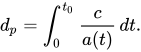
In this equation, a is the scale factor, c is the speed of light, and t0 is the age of the Universe. If dp → ∞ (i.e., points arbitrarily as far away as can be observed), then no event horizon exists. If dp ≠ ∞, a horizon is present.

Examples of cosmological models without an event horizon are universes dominated by matter or by radiation. An example of a cosmological model with an event horizon is a universe dominated by the cosmological constant (a de Sitter universe).

A calculation of the speeds of the cosmological event and particle horizons was given in a paper on the FLRW cosmological model, approximating the Universe as composed of non-interacting constituents, each one being a perfect fluid.[7][8]

Apparent horizon of an accelerated particle

[edit]
Spacetime diagram showing a uniformly accelerated particle, P, and an event E that is outside the particle's apparent horizon. The event's forward light cone never intersects the particle's world line.

If a particle is moving at a constant velocity in a non-expanding universe free of gravitational fields, any event that occurs in that Universe will eventually be observable by the particle, because the forward light cones from these events intersect the particle's world line. On the other hand, if the particle is accelerating, in some situations light cones from some events never intersect the particle's world line. Under these conditions, an apparent horizon is present in the particle's (accelerating) reference frame, representing a boundary beyond which events are unobservable.

For example, this occurs with a uniformly accelerated particle. A spacetime diagram of this situation is shown in the figure to the right. As the particle accelerates, it approaches, but never reaches, the speed of light with respect to its original reference frame. On the spacetime diagram, its path is a hyperbola, which asymptotically approaches a 45-degree line (the path of a light ray). An event whose light cone's edge is this asymptote or is farther away than this asymptote can never be observed by the accelerating particle. In the particle's reference frame, there is a boundary behind it from which no signals can escape (an apparent horizon). The distance to this boundary is given by , where a is the constant proper acceleration of the particle.

While approximations of this type of situation can occur in the real world[citation needed] (in particle accelerators, for example), a true event horizon is never present, as this requires the particle to be accelerated indefinitely (requiring arbitrarily large amounts of energy and an arbitrarily large apparatus).

Interacting with a cosmic horizon

[edit]

In the case of a horizon perceived by a uniformly accelerating observer in empty space, the horizon seems to remain a fixed distance from the observer no matter how its surroundings move. Varying the observer's acceleration may cause the horizon to appear to move over time or may prevent an event horizon from existing, depending on the acceleration function chosen. The observer never touches the horizon and never passes a location where it appeared to be.

In the case of a horizon perceived by an occupant of a de Sitter universe, the horizon always appears to be a fixed distance away for a non-accelerating observer. It is never contacted, even by an accelerating observer.

Event horizon of a black hole

[edit]

Far away from the black hole, a particle can move in any direction. It is only restricted by the speed of light.

Closer to the black hole spacetime starts to deform. In some convenient coordinate systems, there are more paths going towards the black hole than paths moving away.[Note 1]

Inside the event horizon all future time paths bring the particle closer to the center of the black hole. It is no longer possible for the particle to escape, no matter the direction the particle is traveling.

One of the best-known examples of an event horizon derives from general relativity's description of a black hole, a celestial object so dense that no nearby matter or radiation can escape its gravitational field. Often, this is described as the boundary within which the black hole's escape velocity is greater than the speed of light. However, a more detailed description is that within this horizon, all lightlike paths (paths that light could take) (and hence all paths in the forward light cones of particles within the horizon) are warped so as to fall farther into the hole. Once a particle is inside the horizon, moving into the hole is as inevitable as moving forward in time – no matter in what direction the particle is travelling – and can be thought of as equivalent to doing so, depending on the spacetime coordinate system used.[10][9][11][12]

The surface at the Schwarzschild radius acts as an event horizon in a non-rotating body that fits inside this radius (although a rotating black hole operates slightly differently). The Schwarzschild radius of an object is proportional to its mass. Theoretically, any amount of matter will become a black hole if compressed into a space that fits within its corresponding Schwarzschild radius. For the mass of the Sun, this radius is approximately 3 kilometers (1.9 miles); for Earth, it is about 9 millimeters (0.35 inches). In practice, however, neither Earth nor the Sun have the necessary mass (and, therefore, the necessary gravitational force) to overcome electron and neutron degeneracy pressure. The minimal mass required for a star to collapse beyond these pressures is the Tolman–Oppenheimer–Volkoff limit, which is approximately three solar masses.

According to the fundamental gravitational collapse models,[13] an event horizon forms before the singularity of a black hole. If all the stars in the Milky Way would gradually aggregate towards the galactic center while keeping their proportionate distances from each other, they will all fall within their joint Schwarzschild radius long before they are forced to collide.[4] Up to the collapse in the far future, observers in a galaxy surrounded by an event horizon would proceed with their lives normally.

Black hole event horizons are widely misunderstood. Common, although erroneous, is the notion that black holes "vacuum up" material in their neighborhood, where in fact they are no more capable of seeking out material to consume than any other gravitational attractor. As with any mass in the universe, matter must come within its gravitational scope for the possibility to exist of capture or consolidation with any other mass. Equally common is the idea that matter can be observed falling into a black hole. This is not possible. Astronomers can detect only accretion disks around black holes, where material moves with such speed that friction creates high-energy radiation that can be detected (similarly, some matter from these accretion disks is forced out along the axis of spin of the black hole, creating visible jets when these streams interact with matter such as interstellar gas or when they happen to be aimed directly at Earth). Furthermore, a distant observer will never actually see something reach the horizon. Instead, while approaching the hole, the object will seem to go ever more slowly, while any light it emits will be further and further redshifted.

Topologically, the event horizon is defined from the causal structure as the past null cone of future conformal timelike infinity. A black hole event horizon is teleological in nature, meaning that it is determined by future causes.[14][15][16] More precisely, one would need to know the entire history of the universe and all the way into the infinite future to determine the presence of an event horizon, which is not possible for quasilocal observers (not even in principle).[17][18] In other words, there is no experiment and/or measurement that can be performed within a finite-size region of spacetime and within a finite time interval that answers the question of whether or not an event horizon exists. Because of the purely theoretical nature of the event horizon, the traveling object does not necessarily experience strange effects and does, in fact, pass through the calculated boundary in a finite amount of its proper time.[19]

Interacting with black hole horizons

[edit]

A misconception concerning event horizons, especially black hole event horizons, is that they represent an immutable surface that destroys objects that approach them. In practice, all event horizons appear to be some distance away from any observer, and objects sent towards an event horizon never appear to cross it from the sending observer's point of view (as the horizon-crossing event's light cone never intersects the observer's world line). Attempting to make an object near the horizon remain stationary with respect to an observer requires applying a force whose magnitude increases unboundedly (becoming infinite) the closer it gets.

In the case of the horizon around a black hole, observers stationary with respect to a distant object will all agree on where the horizon is. While this seems to allow an observer lowered towards the hole on a rope (or rod) to contact the horizon, in practice this cannot be done. The proper distance to the horizon is finite,[20] so the length of rope needed would be finite as well, but if the rope were lowered slowly (so that each point on the rope was approximately at rest in Schwarzschild coordinates), the proper acceleration (G-force) experienced by points on the rope closer and closer to the horizon would approach infinity, so the rope would be torn apart. If the rope is lowered quickly (perhaps even in freefall), then indeed the observer at the bottom of the rope can touch and even cross the event horizon. But once this happens it is impossible to pull the bottom of rope back out of the event horizon, since if the rope is pulled taut, the forces along the rope increase without bound as they approach the event horizon and at some point the rope must break. Furthermore, the break must occur not at the event horizon, but at a point where the second observer can observe it.

Assuming that the possible apparent horizon is far inside the event horizon, or there is none, observers crossing a black hole event horizon would not actually see or feel anything special happen at that moment. In terms of visual appearance, observers who fall into the hole perceive the eventual apparent horizon as a black impermeable area enclosing the singularity.[21] Other objects that had entered the horizon area along the same radial path but at an earlier time would appear below the observer as long as they are not entered inside the apparent horizon, and they could exchange messages. Increasing tidal forces are also locally noticeable effects, as a function of the mass of the black hole. In realistic stellar black holes, spaghettification occurs early: tidal forces tear materials apart well before the event horizon. However, in supermassive black holes, which are found in centers of galaxies, spaghettification occurs inside the event horizon. A human astronaut would survive the fall through an event horizon only in a black hole with a mass of approximately 10,000 solar masses or greater.[22]

Beyond general relativity

[edit]

A cosmic event horizon is commonly accepted as a real event horizon, whereas the description of a local black hole event horizon given by general relativity is found to be incomplete and controversial.[3][4] When the conditions under which local event horizons occur are modeled using a more comprehensive picture of the way the Universe works, that includes both relativity and quantum mechanics, local event horizons are expected to have properties that are different from those predicted using general relativity alone.

At present, it is expected by the Hawking radiation mechanism that the primary impact of quantum effects is for event horizons to possess a temperature and so emit radiation. For black holes, this manifests as Hawking radiation, and the larger question of how the black hole possesses a temperature is part of the topic of black hole thermodynamics. For accelerating particles, this manifests as the Unruh effect, which causes space around the particle to appear to be filled with matter and radiation.

According to the controversial black hole firewall hypothesis, matter falling into a black hole would be burned to a crisp by a high energy "firewall" at the event horizon.

An alternative is provided by the complementarity principle, according to which, in the chart of the far observer, infalling matter is thermalized at the horizon and reemitted as Hawking radiation, while in the chart of an infalling observer matter continues undisturbed through the inner region and is destroyed at the singularity. This hypothesis does not violate the no-cloning theorem as there is a single copy of the information according to any given observer. Black hole complementarity is actually suggested by the scaling laws of strings approaching the event horizon, suggesting that in the Schwarzschild chart they stretch to cover the horizon and thermalize into a Planck length-thick membrane.

A complete description of local event horizons generated by gravity is expected to, at minimum, require a theory of quantum gravity. One such candidate theory is M-theory. Another such candidate theory is loop quantum gravity.

See also

[edit]

Notes

[edit]

References

[edit]

Further reading

[edit]
Revisions and contributorsEdit on WikipediaRead on Wikipedia
from Grokipedia
In general relativity, an event horizon is a boundary in spacetime that divides it into regions causally disconnected from a distant observer, such that no events occurring beyond this boundary can influence the observer's future.[1] This boundary marks a point of no return, where the gravitational influence is so intense that nothing, not even light, can escape to the outside universe.[2] Most prominently, event horizons define the outer edge of black holes, where the escape velocity equals the speed of light.[3] The concept emerged from solutions to Einstein's field equations, with the Schwarzschild metric describing a non-rotating black hole's event horizon as a null hypersurface surrounding a central singularity.[4] In 1958, physicist David Finkelstein clarified its nature by introducing coordinates that revealed the apparent singularity at the horizon as a coordinate artifact, confirming it as a one-way membrane through which matter and light can enter but not exit.[5] For a non-rotating black hole, the event horizon's radius—known as the Schwarzschild radius—is directly proportional to the object's mass; for a black hole with the mass of the Sun, this radius is approximately 3 kilometers.[4][2] Event horizons play a crucial role in black hole physics, creating a shadow in surrounding light due to gravitational lensing, which appears roughly twice the horizon's actual size.[6] This shadow was first imaged in 2019 by the Event Horizon Telescope collaboration for the supermassive black hole at the center of the galaxy M87, and in 2022 for Sagittarius A* at the center of the Milky Way, providing direct visual evidence of the phenomenon.[2][7] Beyond black holes, analogous horizons appear in other relativistic contexts, such as the Rindler horizon for uniformly accelerated observers in flat spacetime, underscoring the horizon's fundamental connection to causality and the structure of spacetime.[1]

Fundamental Concepts

Definition and Properties

An event horizon is a null hypersurface in spacetime that serves as the causal boundary separating regions where events occurring inside the surface cannot influence observers outside, due to the structure of light cones and the speed-of-light limit.[8] This boundary acts as a one-way membrane: light rays and matter can cross inward along null or timelike geodesics, but no causal signals can propagate outward to reach external observers.[8] The term was first introduced by Wolfgang Rindler in 1956, in the context of horizons visible to accelerated observers in special relativity, where it divides events into those observable by a specific fundamental observer and those that remain unobservable.[9] Key properties of an event horizon stem from its null character, meaning the hypersurface is generated by null geodesics with tangent vectors that are lightlike. For infalling observers following timelike paths, the horizon represents a point of no return where future-directed light cones tip entirely inward, preventing any escape to infinity; outside observers perceive the horizon as a boundary beyond which incoming signals are causally disconnected.[10] This one-way permeability enforces strict causality, ensuring that the interior region is isolated from the exterior in terms of future influence, though past connections may exist.[8] The concept was generalized to gravitational collapse scenarios by David Finkelstein in 1958, who described the event horizon as a "unidirectional membrane" in the Schwarzschild geometry, emphasizing its role in black hole formation without singularities in the coordinate system. Unlike other spacetime boundaries, such as ergospheres—regions of forced frame-dragging around rotating black holes—or photon spheres—unstable orbits for light outside the horizon—event horizons are fundamentally causal separators defined globally by the spacetime's asymptotic structure, not by local stability or energy extraction properties.[10]

Mathematical Formulation

In general relativity, an event horizon is rigorously defined as the boundary of the causal past of future null infinity I+\mathcal{I}^+, consisting of all points through which every future-directed null geodesic is incomplete, meaning it cannot be extended to reach I+\mathcal{I}^+. This boundary forms a smooth, three-dimensional null hypersurface generated by a congruence of null geodesics that are inextendible to the future but terminate in finite affine parameter due to gravitational focusing. Similarly, a past event horizon bounds the causal future of past null infinity I\mathcal{I}^-, with geodesics incomplete to the past. Penrose diagrams provide a conformal compactification of spacetime that preserves null geodesics as lines at 45-degree angles, allowing visualization of the global causal structure where event horizons appear as straight null boundaries separating causally disconnected regions. In these diagrams, the horizon is depicted as a null line connecting the asymptotic boundaries, highlighting the one-way causal flow across it without altering the conformal metric. Global hyperbolicity of a spacetime ensures a well-posed initial value problem, defined by the existence of a Cauchy surface such that the intersection of the causal future J+(p)J^+(p) and causal past J(q)J^-(q) is compact for all points p,qp, q. This compactness condition on causal sets prevents pathologies like closed timelike curves and guarantees that event horizons, as global causal boundaries, are uniquely determined by the spacetime's causal structure without ambiguity in geodesic extendibility. The formation and properties of such horizons are governed by the Raychaudhuri equation, which describes the evolution of the expansion scalar θ\theta along a geodesic congruence with affine parameter λ\lambda:
dθdλ=1n2θ2σabσab+ωabωabRabkakb \frac{d\theta}{d\lambda} = -\frac{1}{n-2} \theta^2 - \sigma_{ab} \sigma^{ab} + \omega_{ab} \omega^{ab} - R_{ab} k^a k^b
for null geodesics in nn-dimensions (with n=4n=4 for spacetime), where σab\sigma_{ab} is the shear tensor, ωab\omega_{ab} the rotation tensor, and RabkakbR_{ab} k^a k^b the Ricci curvature projected along the tangent vector kak^a. In vacuum or under the null energy condition (Rabkakb0R_{ab} k^a k^b \geq 0), and assuming vanishing rotation (ωab=0\omega_{ab} = 0) for surface-forming congruences, the equation simplifies to show focusing: if θ0\theta \leq 0 initially and shear is non-negative, θ\theta decreases monotonically, leading to geodesic incompleteness in finite λ\lambda. Penrose's focusing theorem applies this to prove singularity formation: in a globally hyperbolic spacetime satisfying the null convergence condition, if a trapped surface exists (where θ0\theta \leq 0 for both null congruences), then all future-directed geodesics from it are incomplete, implying the presence of an event horizon bounding the causal future. This theorem underscores how the Raychaudhuri equation enforces causal incompleteness, central to horizon emergence in collapsing spacetimes.

Black Hole Event Horizons

In Static Spacetimes

In static spacetimes, the simplest model of a black hole event horizon arises in the context of the Schwarzschild metric, which describes the geometry around a spherically symmetric, non-rotating, uncharged mass MM in asymptotically flat spacetime.[11] The metric in Schwarzschild coordinates (t,r,θ,ϕ)(t, r, \theta, \phi) is given by
ds2=(12GMc2r)c2dt2(12GMc2r)1dr2r2dθ2r2sin2θdϕ2, ds^2 = \left(1 - \frac{2GM}{c^2 r}\right) c^2 dt^2 - \left(1 - \frac{2GM}{c^2 r}\right)^{-1} dr^2 - r^2 d\theta^2 - r^2 \sin^2\theta d\phi^2,
where GG is the gravitational constant and cc is the speed of light.[11] At the radial coordinate rs=2GM/c2r_s = 2GM/c^2, known as the Schwarzschild radius, the metric component gttg_{tt} vanishes, and grrg_{rr} diverges, marking the location of the event horizon.[12]
This apparent singularity in Schwarzschild coordinates is a coordinate artifact rather than a physical one, as demonstrated by transforming to null coordinates that extend across the horizon.[12] In Eddington-Finkelstein coordinates, for instance, infalling null geodesics smoothly cross r=rsr = r_s, revealing the horizon as a one-way causal boundary.[12] To fully resolve the structure and cover the maximal analytic extension, Kruskal-Szekeres coordinates (T,R,θ,ϕ)(T, R, \theta, \phi) are employed, where the metric takes the form
ds2=32GM3c2rer/(2GM/c2)(dT2+dR2)r2dΩ2, ds^2 = \frac{32 G M^3}{c^2 r} e^{-r/(2 G M / c^2)} \left( -dT^2 + dR^2 \right) - r^2 d\Omega^2,
with rr implicitly defined as a function of TT and RR.[13] These coordinates show that the event horizon at R=0R = 0, T>0T > 0 is a regular, null hypersurface, free of curvature singularities, separating the exterior region from the interior black hole region.[13]
The eternal Schwarzschild black hole represents an idealized, time-symmetric solution existing for all time, with two asymptotically flat regions connected through a throat at the horizon.[13] In contrast, realistic black holes form dynamically through the gravitational collapse of a star, as modeled by the Oppenheimer-Snyder solution for pressureless dust.[14] In this model, a uniform spherical star of mass MM and radius greater than rsr_s collapses homologously, forming a trapped surface at r=rsr = r_s once the matter crosses it, leading to an event horizon that envelopes the collapsing material without altering the exterior Schwarzschild geometry.[14] The horizon thus emerges as a global feature determined by the total mass, with no information about the star's internal structure escaping outward. A key property of the static event horizon is its surface gravity κ\kappa, which measures the acceleration required to maintain a stationary observer near the horizon and is constant over the horizon for stationary black holes.[15] For the Schwarzschild case, κ=c4/(4GM)\kappa = c^4 / (4 G M), reflecting the horizon's "strength" in redshifted terms.[15] In semi-classical gravity, this surface gravity relates to the Hawking temperature TH=κ/(2πkBc)T_H = \hbar \kappa / (2 \pi k_B c), where \hbar is the reduced Planck constant and kBk_B is Boltzmann's constant, implying the horizon emits thermal radiation as a blackbody at temperature inversely proportional to the black hole mass.[16] The no-hair theorem underscores the simplicity of static horizons, asserting that any asymptotically flat, static vacuum spacetime containing a black hole is uniquely the Schwarzschild solution, determined solely by the total mass MM. This uniqueness, proven for non-rotating, uncharged cases, implies that the event horizon's location and properties are fixed by MM alone, with no additional "hair" such as multipole moments or other quantum numbers characterizing the black hole.

In Dynamic and Rotating Spacetimes

In rotating black holes, described by the Kerr metric, the event horizon deviates from the spherical symmetry of the static Schwarzschild case due to the black hole's angular momentum. The Kerr solution, derived as an exact vacuum solution to Einstein's field equations for an axially symmetric, rotating mass, is expressed in Boyer-Lindquist coordinates, which separate the metric into components resembling spherical coordinates but incorporate rotation via the parameter a=J/Ma = J/M, where JJ is the angular momentum and MM is the mass. These coordinates reveal an oblate event horizon, with the outer horizon located at the radial coordinate r+=M+M2a2r_+ = M + \sqrt{M^2 - a^2} (in units where G=c=1G = c = 1), provided a<Ma < M to avoid a naked singularity. An inner (Cauchy) horizon exists at r=MM2a2r_- = M - \sqrt{M^2 - a^2}, marking the boundary of a region where timelike geodesics can connect to a separate asymptotically flat universe in the maximal extension of the spacetime. For charged black holes in the absence of rotation, the Reissner-Nordström metric provides the analogous exact solution to the Einstein-Maxwell equations, incorporating electrostatic charge QQ. In Schwarzschild-like coordinates, the metric function yields two horizons: the outer event horizon at r+=GMc2+(GMc2)2GQ2c4r_+ = \frac{GM}{c^2} + \sqrt{\left(\frac{GM}{c^2}\right)^2 - \frac{GQ^2}{c^4}} and the inner Cauchy horizon at r=GMc2(GMc2)2GQ2c4r_- = \frac{GM}{c^2} - \sqrt{\left(\frac{GM}{c^2}\right)^2 - \frac{GQ^2}{c^4}}, assuming Q<GM/c2|Q| < GM/c^2 for a black hole rather than a naked singularity. These horizons enclose a region of reversed causality similar to the Kerr inner horizon, with the Cauchy horizon susceptible to instabilities from infalling perturbations. Rotation introduces unique features absent in static spacetimes, notably the ergosphere, a region outside the outer event horizon where the metric's gttg_{tt} component changes sign, forcing all objects to co-rotate with the black hole due to frame-dragging. Bounded by the static limit surface at r=M+M2a2cos2θr = M + \sqrt{M^2 - a^2 \cos^2 \theta}, the ergosphere enables energy extraction via the Penrose process, where particles split in this region to yield outgoing particles with more energy than the incoming one. Frame-dragging, or the Lense-Thirring effect amplified in the Kerr geometry, twists spacetime such that the angular velocity of zero angular momentum observers (ZAMOs) matches ω=gtϕ/gϕϕ=2Mar/Σ2\omega = -g_{t\phi}/g_{\phi\phi} = 2Mar / \Sigma^2, where Σ2=r2+a2cos2θ\Sigma^2 = r^2 + a^2 \cos^2 \theta, dragging inertial frames along the rotation axis. In dynamic scenarios, such as binary black hole mergers, event horizons evolve non-stationarily, forming apparent horizons that track the global event horizon during inspiral, merger, and ringdown phases. Numerical relativity simulations, solving Einstein's equations on adaptive meshes, reveal that the common apparent horizon forms promptly after the horizons touch, with the final Kerr-like horizon settling to parameters inferred from gravitational wave observations.[17] These simulations, validated against post-2015 LIGO detections like GW150914, show peak luminosities exceeding 105610^{56} erg/s,[18] with horizons becoming highly distorted during merger, confirming the robustness of dynamic horizon evolution in general relativity.

Cosmological Event Horizons

In de Sitter Spacetime

In de Sitter spacetime, characterized by a positive cosmological constant Λ>0\Lambda > 0 and empty of matter, the geometry admits a cosmological event horizon associated with each timelike geodesic observer. This horizon arises due to the exponential expansion of the spacetime, preventing light signals from regions beyond a finite distance from reaching the observer. In static coordinates centered on such an observer, the metric is given by
ds2=(1r2l2)dt2+dr21r2/l2+r2dΩ2, ds^2 = -\left(1 - \frac{r^2}{l^2}\right) dt^2 + \frac{dr^2}{1 - r^2/l^2} + r^2 d\Omega^2,
where l=3/Λl = \sqrt{3/\Lambda} is the de Sitter radius and H=1/l=Λ/3H = 1/l = \sqrt{\Lambda/3} is the constant Hubble parameter. The event horizon is located at r=lr = l, where the metric component gttg_{tt} vanishes and grrg_{rr} diverges, marking a Killing horizon generated by the timelike Killing vector t\partial_t. Beyond this radius, the expansion causes recession velocities to exceed the speed of light, rendering the region causally disconnected from the observer.[19] The cosmological event horizon in de Sitter spacetime shares key properties with black hole event horizons, including null geodesics that asymptote to it without crossing inward. It is a regular, non-pathological surface, and its proper area is A=4πl2A = 4\pi l^2. The surface gravity κ\kappa associated with this horizon is κ=1/l=H\kappa = 1/l = H, computed from the Killing vector normalization. Unlike black hole horizons, the de Sitter horizon is observer-dependent: each fundamental observer, following a timelike geodesic, perceives their own horizon at a comoving distance corresponding to the Hubble radius c/Hc/H (in units where c=1c=1). In the global embedding of de Sitter space as a hyperboloid in five-dimensional Minkowski space, these horizons form a tessellation, with antipodal points separated by the horizon.[19] Gibbons and Hawking established a thermodynamic analogy for the de Sitter event horizon, demonstrating that quantum fields in the static patch exhibit thermal particle creation with a temperature T=H2πkBT = \frac{\hbar H}{2\pi k_B}. This Gibbons-Hawking temperature arises from the periodicity in the Euclidean continuation of the metric, analogous to the Hawking effect for black holes. The horizon entropy is then S=A/(4G)=πl2/(G)S = A/(4 G \hbar) = \pi l^2 / (G \hbar), satisfying a first law δM=TδS\delta M = T \delta S where MM relates to the observer's "energy." Particle production across the horizon leads to a steady flux, maintaining the thermal equilibrium, though the horizon's stability contrasts with black hole evaporation due to the positive cosmological constant.[20]

In Expanding Universes

In the Friedmann-Lemaître-Robertson-Walker (FLRW) metric, which describes a homogeneous and isotropic expanding universe, the cosmological event horizon represents the maximum proper distance beyond which light emitted today will never reach an observer, even in the infinite future, due to accelerating expansion. This horizon is quantified by the comoving distance χe(t)=tcdta(t)\chi_e(t) = \int_t^\infty \frac{c \, dt'}{a(t')}, where a(t)a(t) is the scale factor normalized to a(t0)=1a(t_0) = 1 at the present time t0t_0, and cc is the speed of light; the proper distance at time tt is then de(t)=a(t)χe(t)d_e(t) = a(t) \chi_e(t). In the current Λ\LambdaCDM model, this integral converges to a finite value because the universe's expansion accelerates due to dark energy, limiting the future light cone of the observer.[21] The existence of a cosmological event horizon depends critically on the equation of state parameter ww for the dominant energy component, defined via p=wρc2p = w \rho c^2 where pp is pressure and ρ\rho is energy density. For w>1/3w > -1/3, the scale factor a(t)a(t) grows such that the integral diverges, implying no event horizon as light from arbitrarily distant regions can eventually reach the observer; however, for w<1/3w < -1/3, as in accelerating universes dominated by dark energy (w1w \approx -1), the integral remains finite, establishing a true event horizon.[21] This threshold marks the transition to eternal acceleration, a feature confirmed in the Λ\LambdaCDM framework where dark energy drives weff<1/3w_{\rm eff} < -1/3 at late times. In the observable universe under the Λ\LambdaCDM model, informed by analyses up to 2025 including James Webb Space Telescope (JWST) observations, with cosmological parameters such as H071H_0 \approx 71 km/s/Mpc and ΩΛ0.7\Omega_\Lambda \approx 0.7, the current event horizon distance is approximately 16.2 billion light-years.[22][23] This must be distinguished from the particle horizon, which delineates the past light cone and extends to about 46 billion light-years (the radius of the observable universe today), representing regions from which light has already reached us since the Big Bang. The Hubble horizon, by contrast, is the instantaneous boundary at dH=c/H(t0)14d_H = c / H(t_0) \approx 14 billion light-years, where recession velocities equal cc, but it fluctuates with the expansion rate H(t)H(t) and does not capture the full future causal limit. Looking to the future in a Λ\Lambda-dominated era, the comoving event horizon χe(t)\chi_e(t) shrinks over cosmic time as the accelerating expansion outpaces light travel, approaching the de Sitter limit where χe1/a(t)\chi_e \propto 1/a(t). This contraction will eventually isolate local gravitationally bound structures, such as the Local Group, from the larger-scale cosmic expansion, while distant galaxies recede beyond the horizon, rendering them causally disconnected forever.[24]

Observer-Dependent Horizons

Rindler Horizons

Rindler horizons arise in the context of special relativity for observers undergoing uniform proper acceleration in flat Minkowski spacetime, serving as a key example of an observer-dependent event horizon. These horizons demarcate regions of spacetime causally disconnected from the accelerated observer, analogous to black hole event horizons but without gravitational curvature. The concept was introduced by Wolfgang Rindler in 1956, who used it to unify various notions of visual horizons and draw parallels to gravitational collapse scenarios, highlighting how acceleration induces a similar causal structure in flat space.[25] In Rindler coordinates, which describe the spacetime experienced by such accelerated observers, the metric takes the form $ ds^2 = -\alpha^2 \xi^2 , dt^2 + d\xi^2 + dy^2 + dz^2 $, where $ t $ is the proper time for observers at fixed spatial coordinates, $ \xi $ is the spatial coordinate along the acceleration direction, and $ \alpha $ is a parameter related to acceleration. The coordinates cover the right Rindler wedge ($ \xi > 0 $), with the event horizon located at $ \xi = 0 $ (or $ \xi \to -\infty $ in extended conventions), beyond which signals cannot reach the observer due to the finite speed of light. Rindler formalized these coordinates in his 1966 analysis, linking them to the geometry of uniformly accelerated frames and their extension to Kruskal-like diagrams.[26] The Rindler horizon emerges from the Lorentz transformation applied to the hyperbolic motion of a particle with constant proper acceleration $ \alpha $. For an observer following the trajectory $ x = (c^2/\alpha) \cosh(\alpha \tau / c) $, $ ct = (c^2/\alpha) \sinh(\alpha \tau / c) $ (in units where $ c = 1 $), the coordinate transformation to Rindler variables is $ t = \frac{1}{\alpha} \artanh\left( \frac{T}{X} \right) $, $ \xi = \frac{1}{\alpha} \ln\left( \alpha \sqrt{X^2 - T^2} \right) $, where $ (T, X) $ are Minkowski coordinates. This transformation reveals that the horizon corresponds to the null asymptote $ X = |T| $, concealing the opposite Rindler wedge (regions with $ X < |T| $) from the accelerated observer, as light rays from there asymptote to the horizon without crossing it. This derivation underscores the horizon's role in dividing Minkowski space into causally inaccessible sectors for accelerated observers. The proper acceleration of an observer at fixed $ \xi > 0 $ is $ \alpha / \xi $.[26] A significant quantum implication of the Rindler horizon is the Unruh effect, where an accelerated observer perceives the Minkowski vacuum as a thermal bath of particles with temperature $ T = \alpha / (2\pi) $ (in natural units where $ \hbar = c = k_B = 1 $). This arises because the Rindler modes are related to Minkowski modes via a Bogoliubov transformation, leading to particle creation across the horizon as seen by the accelerated detector. The effect, predicted by William Unruh in 1976, provides a flat-space analogue to Hawking radiation and emphasizes the observer-dependent nature of the vacuum state. Experimental analogues of Rindler horizons have been pursued in condensed matter systems to probe these effects in laboratory settings. Such setups aim to validate the theoretical predictions without requiring extreme accelerations.

Apparent Horizons

An apparent horizon is defined as a marginally trapped surface in spacetime, characterized by the condition that the expansion scalar of outgoing null geodesics vanishes, θ+=0\theta_{+} = 0, while the expansion of incoming null geodesics remains negative, θ<0\theta_{-} < 0.[27] This local definition relies on the geometry of a spacelike hypersurface and identifies regions where light rays cannot escape outward, serving as a quasi-local analog to the global event horizon.[27] The expansion scalars arise from the Raychaudhuri equation, which governs the focusing of null geodesics in curved spacetime.[27] In numerical relativity, apparent horizons play a crucial role in simulating dynamic phenomena such as black hole mergers, where global event horizons are computationally intractable due to their non-local nature.[27] By locating apparent horizons on each time slice, simulations can excise the singular interior region, stabilizing the evolution of the spacetime metric and enabling accurate extraction of gravitational waveforms.[27] The isolated horizon framework, introduced by Ashtekar, Beetle, and Lewandowski in 2000, formalizes this approach by modeling non-stationary horizons as weakly isolated surfaces with well-defined boundary conditions, allowing for distortions and rotations while preserving key black hole mechanics laws.[28] This framework has become foundational for analyzing merger remnants in binary black hole simulations aligned with LIGO observations.[28] Unlike global event horizons, which are null hypersurfaces fixed by the asymptotic structure of spacetime and remain gauge-independent, apparent horizons are foliation-dependent and can lie inside, coincide with, or even temporarily lie outside the event horizon during dynamical evolution.[27] They evolve temporally, expanding or contracting in response to infalling matter or gravitational waves, making them particularly suited for transient spacetimes without Killing symmetries.[27] In stationary cases, such as the Kerr metric, apparent and event horizons align, but in mergers, multiple apparent horizons may form and coalesce before settling into a single event horizon.[27] In spherically symmetric gravitational collapse, Hawking's area theorem, which posits that the total area of event horizons is non-decreasing under the null energy condition, extends to apparent horizons due to their coincidence in such geometries. During the collapse of a dust shell or null fluid, the apparent horizon forms at the onset of trapping and monotonically increases in area as matter accretes, mirroring the event horizon's growth and providing a local verification of the theorem without requiring global causality analysis. This application underscores the theorem's robustness in dynamic, symmetric scenarios.

Interactions and Implications

Crossing the Horizon

For a free-falling observer, crossing the event horizon of a black hole is locally uneventful, as the spacetime geometry appears smooth and indistinguishable from Minkowski spacetime in the observer's immediate vicinity, consistent with the equivalence principle. This "no drama" scenario arises because the event horizon is a global feature of spacetime rather than a local physical barrier, allowing the observer to pass through without experiencing any singular forces or discontinuities in their proper frame. Tidal forces, which arise from the gradient of the gravitational field, play a key role in the physical experience near the horizon and vary significantly with black hole mass. For supermassive black holes with masses around 10910^9 solar masses, these forces at the event horizon are negligible—on the order of 10910^{-9} g per meter—allowing a human-sized observer to cross intact without noticeable stretching or compression.[29] In contrast, for stellar-mass black holes with masses around 10 solar masses, the tidal forces become extreme well before reaching the horizon, leading to "spaghettification," where the observer is stretched radially and compressed transversely due to accelerations exceeding 10710^{7} g per meter, disrupting the object long before horizon crossing. The scaling of tidal forces inversely with the square of the black hole mass explains this difference, as the larger event horizon radius dilutes the gravitational gradient.[29] From the perspective of a distant observer, the infalling object's approach to the horizon involves extreme time dilation: coordinate time tt required to reach the horizon diverges to infinity, while the proper time τ\tau experienced by the free-faller remains finite. Any light signals emitted by the infaller undergo infinite gravitational redshift as they climb out from near the horizon, appearing frozen and infinitely dimmed to the distant observer, effectively disconnecting the two causally. Once inside the event horizon, information flow is irrevocably severed; no signals, particles, or causal influences can propagate outward to exterior regions, enforcing a one-way causal structure inherent to the horizon's definition. This disconnection implies that the interior evolution, culminating in the singularity, remains hidden from outside observers. Thought experiments illustrate these dynamics through contrasts between eternal and collapsing black holes. In the eternal Schwarzschild black hole, the horizon exists timelessly as a coordinate singularity in static coordinates, but free-fallers cross it smoothly in finite proper time without issue. For realistic collapsing horizons, as modeled in the Oppenheimer-Snyder dust collapse, the event horizon forms dynamically as the star implodes, enveloping the surface in finite proper time for infalling matter while appearing asymptotically approached from afar. Quantum considerations introduce entanglement between particles separated by the horizon, such as in virtual pair production near it, raising questions about information preservation across the boundary in semiclassical regimes, though classical general relativity alone predicts no disruption to the free-faller's experience.

Observational Effects

The Event Horizon Telescope (EHT) has provided direct visual evidence of event horizon effects through shadow imaging of supermassive black holes. In 2019, the EHT captured the first image of the shadow cast by the supermassive black hole in the galaxy M87 (M87*), revealing a dark central region surrounded by a bright photon ring, consistent with the silhouette of an event horizon against the surrounding emission from hot plasma.[30] The observed shadow diameter measures approximately 42 microarcseconds, corresponding to about 5.2 times the Schwarzschild radius for a non-rotating black hole of mass 6.5 × 10^9 solar masses, with the photon ring forming at roughly 2.6 times the Schwarzschild radius due to unstable photon orbits near the horizon.[30] Similarly, in 2022, the EHT imaged the shadow of Sagittarius A* (Sgr A*), the supermassive black hole at the Milky Way's center, showing a comparable structure with a shadow diameter of about 51.8 microarcseconds for a mass of 4 × 10^6 solar masses, again aligning with general relativity predictions for the event horizon's boundary.[31] In September 2025, the EHT released new polarized images of M87* from 2021 observations, revealing dynamic magnetic field structures around the event horizon consistent with general relativity.[32] Gravitational lensing near event horizons distorts light paths from background sources and accretion material, producing asymmetric brightness and multiple images in the photon ring observed by the EHT.[30] This lensing amplifies emission from regions close to the horizon, creating the ring-like structure where photons orbit unstably before escaping or falling in. Additionally, gravitational redshift affects photons emitted from matter approaching the horizon, stretching their wavelengths and shifting spectral lines to lower energies, as seen in the broadened and asymmetric profiles of emission lines from infalling gas.[33] These redshift effects provide indirect probes of the strong gravitational potential just outside the horizon, confirming the spacetime curvature predicted by general relativity. In binary black hole mergers detected by LIGO and Virgo since 2015, the ringdown phase of the gravitational wave signal offers empirical tests of event horizon stability. Following the merger, the newly formed black hole "rings down" by emitting quasi-normal modes that dampen exponentially, with frequencies and decay rates matching those expected for a perturbed Kerr horizon settling into equilibrium. The first detection, GW150914, exhibited ringdown consistent with a final black hole of 62 solar masses, where deviations from general relativity predictions are constrained to less than 10% in mode amplitudes, supporting the horizon's role in absorbing perturbations without producing echoes or instabilities. Subsequent events, such as GW170817 involving a neutron star merger but informing black hole limits, further validate horizon dynamics by excluding alternative models without horizons. X-ray observations of accretion disks around stellar-mass black holes, particularly from NASA's Chandra X-ray Observatory, reveal emission from regions perilously close to the event horizon, providing evidence for its existence through spectral signatures. In systems like Cygnus X-1, iron K-alpha emission lines at 6.4 keV show relativistic broadening and asymmetric profiles due to Doppler and gravitational redshift from the innermost stable circular orbit, typically at 1.2–3 times the Schwarzschild radius, beyond which matter plunges inward.[34] Chandra data on X-ray novae, such as GRO J1655-40, indicate that the compact objects lack a solid surface, as evidenced by the absence of thermal emission bursts expected from neutron stars; instead, the luminosity drops abruptly during quiescence, consistent with material crossing the horizon without reflection.[35] These observations constrain the innermost disk edge to within a few gravitational radii, affirming the horizon's boundary. Astronomical observations impose strong constraints on the existence of event horizons by ruling out naked singularities, which would produce distinct, unshielded signatures absent in data. The EHT images of M87* and Sgr A* exclude horizonless compact objects, such as those in mimetic gravity theories, because they lack the predicted divergent lensing caustics or infinite brightness near a naked singularity; instead, the observed shadows match horizon-enclosed solutions.[36] Flux limits from near-infrared to X-ray observations further disfavor naked singularities, as they would emit unbounded radiation or exhibit unstable photon orbits leading to detectable echoes, which are not seen in over 200 binary black hole mergers or active galactic nuclei. The absence of such features across diverse systems supports the cosmic censorship hypothesis, implying that singularities are generically hidden behind horizons in nature.

Extensions Beyond General Relativity

In Quantum Field Theory

In quantum field theory treated in curved spacetime, event horizons give rise to particle creation through vacuum fluctuations, a phenomenon first predicted for black holes by Stephen Hawking in 1974.[37] Hawking's calculation employs Bogoliubov transformations to relate the quantum vacuum states of free-falling observers near the horizon to those of distant, stationary observers, revealing a thermal spectrum of emitted particles with temperature $ T = \frac{\kappa}{2\pi} $, where $ \kappa $ is the surface gravity at the horizon.[37] This Hawking radiation carries energy away from the black hole at a power $ P \propto \frac{1}{M^2} $, with $ M $ the black hole mass, leading to gradual mass loss and eventual evaporation on a timescale $ \tau \propto M^3 $.[37] The prediction of Hawking radiation implies that black holes are not eternal, challenging classical general relativity by suggesting complete evaporation, but it also raises the black hole information paradox: quantum mechanics demands unitary evolution preserving information, yet the no-hair theorem and thermal emission appear to destroy it irreversibly as the horizon encodes only mass, charge, and spin. In the 1990s, Leonard Susskind proposed black hole complementarity as a resolution, positing that information is both stored on the stretched horizon for infalling observers and encoded in outgoing radiation for distant ones, without violating quantum monogamy due to the inaccessibility of both descriptions simultaneously. The Unruh effect, originally derived for uniformly accelerating observers in flat spacetime perceiving the Minkowski vacuum as thermal radiation, generalizes to curved horizons in black hole spacetimes, where the horizon acts analogously to the Rindler horizon, producing observer-dependent particle detection. Recent semi-classical approaches in the 2020s seek to resolve the information paradox through fuzzball models, which replace the classical horizon with horizonless, string-theoretic configurations of extended objects that preserve information in their quantum structure without singularities. Complementing this, the island formula for entanglement entropy, incorporating quantum extremal surfaces behind the horizon, reproduces the expected Page curve for evaporating black holes, ensuring unitary evolution by accounting for entanglement between radiation and interior "islands."

In Modified Gravity Theories

In modified gravity theories, event horizons associated with black holes often exhibit structures distinct from those in general relativity, influenced by additional fields or curvature modifications that can introduce scalar hair, multiple boundaries, or even the absence of horizons altogether. Scalar-tensor theories, for example, permit hairy black hole solutions where a non-trivial scalar field extends to the horizon, shifting its location from the GR value of $ r_h = 2M $ and allowing for exact metrics in frameworks like Horndeski and degenerate higher-order scalar-tensor (DHOST) gravity.[38] These solutions, such as the stealth Kerr metric, maintain asymptotic flatness while coupling the scalar to the gravitational field, violating the no-hair theorem of GR and enabling phenomena like modified quasinormal modes.[38] In f(R) gravity models, such as $ f(R) = R - 2a \sqrt{R} $, the event horizon plays a pivotal role in particle dynamics, fostering chaotic behavior in massless particle trajectories near the boundary due to exponential growth in radial motion. For neutral black holes, the horizon radius is given by $ r_H = \frac{2}{3a} $, while charged variants have $ r_+ \approx 2.135 $ for specific parameters like $ a = 0.166 $, with chaos intensifying as the parameter $ a $ increases and occurring within narrow energy ranges (e.g., $ E = 400 $ for neutral cases). This contrasts with the integrable geodesics in GR, highlighting how higher-order curvature terms disrupt stability near the horizon. Baseline mimetic gravity, which mimics dark matter effects through a constrained scalar degree of freedom, predicts compact objects as either naked singularities without event horizons or black holes with modified metrics lacking stable photon spheres, yielding shadows far smaller than GR's $ r_{\rm sh} \approx 5.2M $.[36] Event Horizon Telescope images of M87* (shadow diameter $ \approx 11M \pm 1.5M )andSgrA() and Sgr A* ( 4.21M \lesssim r_{\rm sh} \lesssim 5.56M $ at 2σ) rule out these configurations, as the mimetic naked singularity produces no shadow and the black hole shadow is pathologically small (e.g., $ r_{\rm sh} \approx 2M $).[36] More generally, modified gravity can render horizons apparent rather than global event horizons, particularly in dynamic spacetimes, where outer horizons violate the null energy condition and inner ones satisfy it, potentially avoiding singularities through negative energy densities or firewalls.[39] These alterations facilitate tests via gravitational waves and imaging, constraining theories against GR benchmarks.[39]

References

User Avatar
No comments yet.
