Hubbry Logo
search
logo
1346448

Facial skeleton

logo
Community Hub0 Subscribers
Read side by side
from Wikipedia
Facial bones
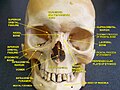
The fourteen bones that form the human facial skeleton
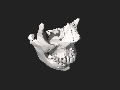
The fourteen facial bones. (Neurocranium is shown in semi-transparent.)
  Blue: Vomer (1)
  Yellow: Maxilla (2)
  Purple: Mandible (1)
  Pink: Nasal bones (2)
  Red: Palatine bones (2)
  Bright blue: Lacrimal bones (2)
  Dark green: Zygomatic bones (2)
  Bright green: Inferior nasal concha (2)
Details
Part ofFace, skeleton
Identifiers
Latinossa faciei, ossa facialia
MeSHD005147
TA2356
Anatomical terms of bone

The facial skeleton comprises the facial bones that may attach to build a portion of the skull.[1] The remainder of the skull is the neurocranium.

In human anatomy and development, the facial skeleton is sometimes called the membranous viscerocranium, which comprises the mandible and dermatocranial elements that are not part of the braincase.

Structure

[edit]

In the human skull, the facial skeleton consists of fourteen bones in the face:[1][2]

Variations

[edit]

Elements of the cartilaginous viscerocranium (i.e., splanchnocranial elements), such as the hyoid bone, are sometimes considered part of the facial skeleton. The ethmoid bone (or a part of it) and also the sphenoid bone are sometimes included, but otherwise considered part of the neurocranium. Because the maxillary bones are fused, they are often collectively listed as only one bone. The mandible is generally considered separately from the cranium.

Development

[edit]

The facial skeleton is composed of dermal bone and derived from the neural crest cells (also responsible for the development of the neurocranium, teeth and adrenal medulla) or from the sclerotome, which derives from the somite block of the mesoderm. As with the neurocranium, in Chondricthyes and other cartilaginous vertebrates, they are not replaced via endochondral ossification.

Variation in craniofacial form between humans is largely due to differing patterns of biological inheritance. Cross-analysis of osteological variables and genome-wide SNPs has identified specific genes that control this craniofacial development. Of these genes, DCHS2, RUNX2, GLI3, PAX1 and PAX3 were found to determine nasal morphology, whereas EDAR impacts chin protrusion.[3]

Additional images

[edit]

See also

[edit]

References

[edit]
[edit]
Revisions and contributorsEdit on WikipediaRead on Wikipedia
from Grokipedia
The facial skeleton, also known as the viscerocranium or splanchnocranium, comprises 14 bones that form the anterior and lower portions of the human skull, defining the structural framework of the face.[1] These bones include six paired structures—the maxillae (2), zygomatic bones (2), nasal bones (2), lacrimal bones (2), palatine bones (2), and inferior nasal conchae (2)—along with two unpaired bones, the mandible and vomer.[2] Collectively, they articulate to create the bony boundaries of the orbits, nasal cavity, oral cavity, and paranasal sinuses, while excluding the neurocranium that primarily protects the brain.[3] The primary functions of the facial skeleton extend beyond mere support; it safeguards sensory organs such as the eyes, olfactory structures, and taste buds, while providing attachment sites for the muscles of facial expression, mastication, and deglutition.[4] For instance, the maxillae and mandible form the upper and lower jaws, respectively, housing the teeth and enabling essential processes like chewing and speech articulation.[3] The zygomatic bones contribute to the prominent cheek contours, and the nasal bones and vomer establish the midline nasal septum, facilitating airflow and olfaction.[5] Additionally, the facial skeleton's intricate sutures and foramina allow passage for neurovascular structures, including branches of the trigeminal nerve and major blood vessels supplying the face.[6] In evolutionary and developmental terms, the facial skeleton arises from the first pharyngeal arch and other branchial structures during embryogenesis, contrasting with the neurocranium's chondrocranium origin,[7] and exhibits significant variation across populations in features like nasal bridge height and jaw prominence.[8] This bony complex not only imparts aesthetic and functional diversity to the human visage but also plays a critical role in forensic identification, surgical interventions such as orthognathic procedures, and the study of craniofacial disorders.[4]

Anatomy

Bones

The facial skeleton, also known as the viscerocranium, comprises 14 irregular bones that form the structural framework of the face, including six paired bones and two unpaired bones. These bones collectively contribute to the boundaries of the orbits, nasal cavity, and oral cavity, with several exhibiting pneumatic characteristics due to the presence of air-filled sinuses or cells.[3][6][9] The mandible is the only unpaired, mobile bone in the facial skeleton, presenting a U-shaped or horseshoe morphology with a horizontal body and two vertical rami ascending from its posterior ends. Its body features an alveolar process housing the lower teeth, mental protuberance at the midline chin, and foramina such as the mental foramen for neurovascular passage; each ramus includes a condylar process superiorly for articulation, a coronoid process anteriorly for muscle attachment, and the mandibular foramen on its medial surface leading to the mandibular canal. Positioned inferior to the maxillae, the mandible forms the lower boundary of the oral cavity and contributes to the floor of the submandibular region.[10][11][12] The vomer, the other unpaired bone, is a thin, quadrilateral plate oriented in the sagittal plane, forming the inferior portion of the nasal septum. It features a superior free margin and an inferior grooved border that articulates with the maxillae and palatine bones; its posterior border is thicker and irregular for attachment to the sphenoid. Located posteriorly within the nasal cavity, the vomer divides the left and right nasal passages and integrates with the perpendicular plate of the ethmoid superiorly.[9][6] The paired nasal bones are small, rectangular plates situated superiorly in the midline of the face, forming the bridge of the nose. Each has a quadrilateral shape with an external surface marked by a nasal notch inferiorly and an internal surface contributing to the nasal cavity roof; they meet at the internasal suture. These bones articulate superiorly with the frontal bone and inferiorly with the maxillae and nasal cartilages, establishing the superior nasal cavity boundary.[9] The paired maxillae are the largest facial bones, each exhibiting a pyramidal shape with a central body and four processes: frontal (superior, forming the medial orbital rim), zygomatic (lateral, articulating with the zygomatic bone), alveolar (inferior, bearing upper teeth sockets), and palatine (posterior, contributing to the hard palate). The body contains the maxillary sinus, a pneumatic cavity that lightens the bone and communicates with the nasal cavity via the hiatus semilunaris; key features include the infraorbital foramen on the anterior surface and the posterior superior alveolar foramina. The maxillae form the central midface, comprising the floor of the orbits, the anterior and lateral walls of the nasal cavity, the majority of the hard palate, and the anterior oral cavity walls.[13][14][15] The paired zygomatic bones, or cheekbones, are quadrangular and diamond-shaped, positioned laterally in the face to form the prominence of the cheeks. Each has three processes: temporal (posterior, extending to the temporal bone via the zygomatic arch), maxillary (medial, articulating with the maxilla), and frontal (superior, forming the lateral orbital rim); the bone also features a zygomaticofacial foramen. These bones contribute to the lateral and inferior orbital walls, the lateral nasal cavity margin, and the anterior portion of the zygomatic arch.[16][17] The paired lacrimal bones are the smallest facial bones, thin and rectangular, located in the medial walls of the orbits anterior to the ethmoid. Each presents a posterior orbital plate with a fossa for the lacrimal sac and a small anterior nasal crest; the bone is perforated by the nasolacrimal canal inferiorly. They form the medial boundaries of the orbits and the anterior portion of the lateral nasal cavity walls, articulating with the maxillae, ethmoid, and inferior nasal conchae.[9] The paired palatine bones are L-shaped, each consisting of a horizontal plate (forming the posterior hard palate) and a perpendicular plate (contributing to the lateral nasal wall and pterygopalatine fossa). The horizontal plate features a pyramidal process posteriorly and the greater palatine foramen; the perpendicular plate includes the sphenopalatine notch and orbital process superiorly, which may contain small air cells. These bones complete the posterior oral cavity floor, form the posterior nasal cavity walls, and contribute to the inferior orbital floor. The paired inferior nasal conchae, or turbinates, are thin, curved, scroll-like plates projecting from the lateral nasal walls. Each has a medial convex surface increasing air turbulence and a lateral surface with vascular plexuses; the bone is elongated and sickle-shaped, articulating superiorly with the ethmoid and posteriorly with the palatine. They form the inferior lateral boundaries of the nasal cavity, enhancing its internal volume and surface area.[9] Collectively, these irregular bones interlock to create a robust yet lightweight facial framework, with the pneumatic maxillae and occasional air cells in the zygomatic and palatine bones reducing overall density while maintaining structural integrity for enclosing the orbits, partitioning the nasal cavity, and bounding the oral cavity.[6][3][9]

Articulations and foramina

The facial skeleton features several types of articulations that connect its bones, including fibrous joints, gomphoses, and synovial joints. Fibrous joints predominate, consisting of sutures that unite the cranial and facial bones with dense connective tissue, allowing minimal movement in adults. Gomphoses are specialized fibrous joints where the roots of the teeth are anchored into the alveolar sockets of the maxilla and mandible by the periodontal ligament. The primary synovial joint is the temporomandibular joint (TMJ), a bicondylar hinge and gliding articulation between the mandibular condyle and the mandibular fossa of the temporal bone, facilitating jaw movements.[18][19][20] Key sutures in the facial skeleton include the frontonasal suture, which joins the frontal bone to the nasal bones at the bridge of the nose. The zygomaticomaxillary suture connects the zygomatic bone to the maxilla along the inferolateral orbital margin and cheek. The intermaxillary suture, also known as the midsagittal suture, unites the two maxillary bones at the midline of the upper jaw. The nasomaxillary suture links the nasal bones to the maxilla on either side of the nasal bridge. These sutures form irregular, interlocking edges that provide stability to the facial framework.[21][22] Foramina in the facial skeleton serve as passages for neurovascular structures. The infraorbital foramen, located on the anterior surface of the maxilla below the orbit, transmits the infraorbital nerve (a branch of the maxillary nerve) and artery, supplying sensation and blood to the midface, including the lower eyelid, lateral nose, cheek, upper lip, and maxillary sinus. The mental foramen, situated on the anterolateral aspect of the mandible below the premolars, allows passage of the mental nerve (terminal branch of the inferior alveolar nerve) and mental artery, providing sensory innervation to the lower lip, chin, and anterior gingiva. The incisive foramen, found in the anterior hard palate between the central incisors, transmits the nasopalatine nerve, which supplies sensation to the anterior palate and nasal septum.[23][24][25][26][27][28] Canals and fissures further connect the facial skeleton to adjacent spaces. The pterygopalatine fossa, a small pyramidal space posterior to the maxilla, communicates via multiple openings, including the palatine canal (transmitting greater and lesser palatine nerves and vessels to the oral cavity), the pterygoid canal (carrying the vidian nerve and artery to the middle cranial fossa), and the sphenopalatine foramen (allowing entry of the sphenopalatine artery and nasopalatine nerve from the nasal cavity). The inferior orbital fissure, between the maxilla and greater wing of the sphenoid, links the orbit to the pterygopalatine and infratemporal fossae, permitting passage of the zygomatic nerve, infraorbital artery and vein, and sympathetic fibers. These structures enable the transmission of nerves, arteries, veins, and lymphatic vessels essential for facial innervation and vascular supply.[29][30][31]

Functions

Structural support

The facial skeleton serves as a critical biomechanical framework, distributing forces across the midface to withstand impacts and masticatory loads. The zygomatic arches act as lateral buttresses, transferring stress from the maxilla to the temporal bone and thereby dissipating energy during lateral or frontal trauma.[32] Similarly, the maxillary sinuses contribute to reducing the weight of the facial skeleton through their pneumatized structure.[33] Beyond mechanics, the facial skeleton provides essential support for overlying soft tissues and safeguards vital sensory structures. It forms a stable scaffold for the attachment and positioning of facial skin, muscles, and subcutaneous fat pads, ensuring the structural integrity and contour of the face.[4] The orbital rims and walls, composed of contributions from the frontal, zygomatic, and maxillary bones, encase and protect the eyeballs from external injury, while the nasal bones and maxillae shield the nasal cavity, maintaining an unobstructed airway essential for respiration.[6] The facial skeleton integrates seamlessly with the neurocranium as its anterior extension, forming a unified cranial vault that supports the brain and distributes loads across key articulations. The nasal bridge, bridging the frontal bone and nasal bones, bears vertical forces from the upper face, channeling them posteriorly to the cranium.[34] At the inferior aspect, the mandibular symphysis unites the two halves of the mandible, enabling it to transmit occlusal forces upward to the maxilla and ultimately to the neurocranium via the zygomatic arches.[4] Evolutionarily, the human facial skeleton exhibits adaptations linked to bipedalism and dietary shifts, featuring reduced prognathism compared to other primates. This orthognathic profile, with a flatter midface and smaller jaws, aligns the occlusal plane more vertically under the cranium, optimizing balance and energy efficiency during upright posture.[35] In contrast to the prognathic snouts of chimpanzees and gorillas, which project forward to accommodate larger masticatory muscles, human adaptations reflect selection for encephalization and tool use, lightening the anterior skull while preserving structural support.[36]

Role in facial expressions and mastication

The facial skeleton provides critical attachment points for muscles involved in facial expressions, allowing for nuanced movements of the skin and soft tissues. For instance, the zygomaticus major muscle originates from the lateral surface of the zygomatic bone and inserts into the modiolus at the corner of the mouth, enabling the elevation and lateral retraction of the upper lip during smiling. Similarly, other mimetic muscles, such as the orbicularis oculi, attach to the frontal process of the maxilla and the medial orbital margin, facilitating eyelid closure and brow movements essential for expressions like squinting or surprise.[37] These bony origins ensure that contractions translate into precise facial deformations without disrupting underlying structures. In mastication, the facial skeleton serves as robust anchors for the primary chewing muscles, transmitting forces efficiently during grinding and biting. The masseter muscle arises from the zygomatic arch and inserts onto the lateral surface of the mandibular ramus and coronoid process, generating powerful closing forces on the jaw.[38] The temporalis muscle originates from the temporal fossa of the temporal bone and the deep surface of the temporal fascia, inserting into the coronoid process and the anterior border of the mandibular ramus, which aids in elevating the mandible and retracting it during chewing cycles. These attachments allow for coordinated elevation, protraction, and lateral deviation of the mandible, optimizing food breakdown. The temporomandibular joint (TMJ), formed by the mandibular condyle articulating with the mandibular fossa of the temporal bone, facilitates these movements through a complex structure stabilized by ligaments. The joint capsule encloses a synovial cavity lined with articular cartilage and filled with synovial fluid for lubrication, while key ligaments—including the temporomandibular ligament (a lateral thickening of the capsule), sphenomandibular ligament, and stylomandibular ligament—limit excessive translation and rotation.[20] Kinematically, the TMJ operates via a hinge-like rotation for mandibular opening and closing (primarily involving the condyle's inferior glide relative to the fossa) and a gliding translation for lateral excursions and protrusion, enabling protrusive and side-to-side shifts up to approximately 10-12 mm.[39] This dual mechanism ensures smooth transitions between hinge and glide phases during mastication. Sensory feedback during these activities is mediated by branches of the trigeminal nerve (cranial nerve V), which pass through specific foramina in the facial skeleton to provide proprioception and touch sensation. The mandibular division (V3) exits via the foramen ovale in the sphenoid bone, innervating the muscles of mastication for proprioceptive input on jaw position and force, while the maxillary division (V2) traverses the foramen rotundum to supply sensory fibers to the upper teeth and palate.[40] The ophthalmic division (V1) emerges through the superior orbital fissure, contributing to forehead sensation relevant to facial movements. These pathways allow for reflexive adjustments, such as modulating bite force to prevent overload during chewing.[41] The alveolar processes of the maxilla and mandible integrate the dentition into this system by housing the tooth roots in sockets that support occlusion and transmit masticatory forces. The superior alveolar process of the maxilla and inferior of the mandible form ridges that align teeth for proper intercuspation during closure, distributing occlusal loads across the periodontal ligament to the underlying bone.[42] This arrangement enables efficient force transmission—up to several hundred newtons during biting—while absorbing shock to protect the skeleton from fracture.[43]

Development

Embryonic origins

The facial skeleton originates primarily from cranial neural crest cells, which delaminate from the dorsal neural tube and migrate to populate the facial mesenchyme, along with contributions from paraxial mesoderm. These neural crest cells begin migrating ventrolaterally around the fourth week of gestation, forming the mesenchymal core of the developing craniofacial structures that will give rise to the skeletal elements.[44][45] The branchial (pharyngeal) arches, which emerge sequentially during the fourth and fifth weeks, serve as the foundational scaffolds for facial development. The first branchial arch, also known as the mandibular arch, divides into dorsal maxillary and ventral mandibular processes, providing the precursors for the upper and lower jaws, respectively. The second branchial arch contributes indirectly to the facial skeleton through its cartilage, which influences structures like the styloid process, though its primary derivatives are associated with the middle ear.[46][47] Specific derivatives from these arches include Meckel's cartilage from the first arch, which forms the foundational template for the mandible and parts of the middle ear ossicles such as the malleus and incus. In contrast, Reichert's cartilage arises from the second arch and develops into the stapes, styloid process of the temporal bone, and stylohyoid ligament, thereby linking to facial skeletal support via the cranial base. The maxillary process of the first arch specifically contributes to the formation of the upper jaw bones.[48][47] By the sixth week of gestation, interactions between the neural crest-derived mesenchyme, overlying ectoderm, and underlying endoderm lead to the outgrowth of facial prominences, including the frontonasal prominence medially and the paired maxillary and mandibular prominences laterally. These prominences arise from the fusion and remodeling of arch tissues, establishing the basic topographic pattern of the face through reciprocal signaling that patterns the skeletal precursors.[49][46]

Ossification processes

The ossification of the facial skeleton primarily occurs through intramembranous ossification, a direct process where mesenchymal cells differentiate into osteoblasts to form bone without a cartilaginous intermediate, accounting for the development of most facial bones such as the maxilla, zygomatic, nasal, and palatine bones.[50] This mode contrasts with endochondral ossification, which is limited in the facial skeleton and mainly involves secondary centers in the mandible, such as the condylar process, where cartilage models are replaced by bone.[12] In the mandible, initial intramembranous ossification arises from remnants associated with Meckel's cartilage, highlighting a hybrid mechanism unique to this bone.[51] Ossification centers emerge early in embryonic development, with the mandible showing the first activity around the 6th to 7th week from a single primary center per side located lateral to Meckel's cartilage near the mental foramen.[12] The maxilla follows shortly thereafter, with its primary ossification center appearing in the 7th to 8th week in the mesenchyme between the developing tooth buds and the nasal cavity.[52] Other facial bones, including the zygomatic and nasal bones, initiate intramembranous ossification by the 8th to 10th week, while secondary centers in the mandible—such as the condylar, coronoid, and mental ossicles—form between the 10th week and late fetal period, fusing progressively to the main body by birth or within the first postnatal year.[53] Maxillary growth involves multiple centers that unite via sutures, many of which remain patent into adulthood to accommodate ongoing expansion.[22] Postnatally, facial skeleton growth proceeds through appositional bone deposition at sutures and periosteal surfaces, coupled with internal remodeling that reshapes bones in response to functional demands.[54] According to the functional matrix theory proposed by Melvin Moss, this growth is secondarily influenced by surrounding soft tissues and functional activities, such as masticatory muscles promoting mandibular ramus elongation through mechanical stimulation during chewing.[55] This adaptive remodeling continues into adolescence, with sutures facilitating transverse expansion of the midface and overall facial proportions maturing by early adulthood.[56]

Variations and clinical aspects

Normal anatomical variations

The facial skeleton exhibits sexual dimorphism, with males typically displaying more robust features compared to females. Males often have more prominent supraorbital ridges and superciliary arches, contributing to a pronounced brow region, while females tend to have smoother, less projecting supraorbital margins.[57] The mandible in males is generally larger, with a more everted gonial angle and greater intergonial width, reflecting extended postnatal growth periods that accentuate these traits during adolescence and early adulthood.[58][59] Bizygomatic width, a key measure of midfacial breadth, shows significant dimorphism, with males averaging approximately 5–9 mm greater than females, corresponding to a relative difference of about 4–7% after accounting for allometric scaling, though effect sizes indicate high dimorphism (Cohen's d ≈ 1.39).[60][61] Age-related changes in the facial skeleton include progressive suture obliteration and sinus pneumatization. Craniofacial sutures, such as those in the nasal region, often begin to fuse around age 30, while the zygomaticotemporal suture typically obliterates in the seventh decade of life, leading to increased rigidity in the adult skull.[62] Paranasal sinus pneumatization continues into adulthood; the maxillary sinuses expand postnatally and may increase in volume through the third decade, while frontal sinuses pneumatize starting around age 7 and complete development by early adulthood, influencing midfacial contour and lightness.[63][64] Ethnic variations manifest in distinct morphological patterns of the facial skeleton, shaped by genetic and environmental factors. Populations of African descent commonly exhibit broader nasal apertures (platyrrhine index >85), reflecting adaptations to warmer climates, whereas Asian populations tend toward narrower apertures (leptorrhine index <70) with more projecting nasal bridges.[65][66] Orbital shapes also differ, with East Asian skulls often showing more rounded superior orbital margins and reduced interorbital breadth compared to the more quadrangular orbits and wider interorbital distances in European-derived groups.[67] These traits contribute to overall facial diversity across global populations.[68] Mild bilateral asymmetry is a normal feature of the facial skeleton in the majority of individuals, arising from developmental fluctuations rather than pathology. In patients with dentofacial deformities, up to 74% show some mandibular asymmetry, often as a slight deviation of the midline (typically <3 mm), with the condylar process being particularly variable; in the general population, prevalence is approximately 10-25%.[69] Fluctuating asymmetry in facial landmarks averages 1.0–2.8 mm, affecting structures like the mandible and zygoma in approximately 32% of cases at clinically noticeable levels, though most remain subclinical.[70][71]

Pathological conditions and fractures

Congenital anomalies of the facial skeleton arise from disruptions in embryonic development, leading to structural defects that often require multidisciplinary intervention. Cleft lip and palate represent one of the most common such anomalies, resulting from the failure of facial prominences to fuse properly during the fourth to seventh weeks of gestation. This incomplete fusion creates an opening in the lip, alveolus, or palate, affecting the maxilla and potentially leading to feeding difficulties, speech impediments, and dental malocclusions if untreated.[72][73] Craniosynostosis, the premature fusion of cranial and facial sutures, is another key congenital anomaly impacting the facial skeleton, often seen in syndromic forms like Apert syndrome. In Apert syndrome, mutations in the FGFR2 gene cause multisuture craniosynostosis, resulting in a tower-shaped skull, midfacial hypoplasia, hypertelorism, and a beaked nose, which distort the overall facial architecture and may contribute to obstructive sleep apnea or vision issues. These anomalies contrast with normal anatomical variations by necessitating surgical correction to prevent intracranial pressure buildup or facial asymmetry.[74][75] Trauma to the facial skeleton frequently results in fractures, classified by location and pattern to guide treatment. The Le Fort classification, based on experimental studies, delineates midfacial fractures involving the maxilla and pterygoid plates: Le Fort I is a horizontal fracture below the maxillary sinuses, separating the alveolar process from the upper face; Le Fort II is a pyramidal fracture extending through the nasal bridge, medial orbits, and infraorbital rims; and Le Fort III involves craniofacial dissociation, with fractures across the zygomatic arches, orbits, and nasal bones, often leading to severe edema and airway compromise. Mandibular fractures, the most common in the facial skeleton, typically occur at the condyle due to direct impact or at the body from lateral forces, frequently presenting as multiple sites in over 50% of cases and causing malocclusion or nerve damage.[76][77] Acquired conditions further compromise the facial skeleton through infectious, metabolic, or neoplastic processes. Osteomyelitis, an inflammatory bone infection, commonly originates from odontogenic sources like untreated dental abscesses, where polymicrobial bacteria invade the mandible or maxilla, causing necrosis and potential spread to adjacent soft tissues. Paget's disease of bone, a chronic disorder of bone remodeling, leads to excessive resorption followed by disorganized overgrowth, though involvement of the facial bones is uncommon (typically <10% of cases) and resulting in enlargement of the skull base or jaw, with risks of hearing loss or sarcoma development. Tumors such as osteosarcoma, though rare in the craniofacial region (comprising less than 1% of head and neck malignancies), arise from osteoblastic activity and predominantly involve the mandible, presenting with swelling, pain, and a poorer prognosis if resection margins are inadequate due to anatomical constraints.[78][79][80] Diagnosis of these pathological conditions relies on advanced imaging and targeted testing to assess extent and etiology. Computed tomography (CT) scanning, particularly with multiplanar and 3D reconstructions, is the gold standard for evaluating facial fractures, offering high sensitivity (up to 90%) for detecting Le Fort patterns and mandibular disruptions by visualizing bone fragments and displacements. Genetic testing, such as sequencing for FGFR2 mutations, confirms syndromic craniosynostosis like Apert syndrome, enabling early intervention. The systematic recognition of facial skeletal pathologies advanced notably after World War II, when military trauma studies documented high rates of maxillofacial injuries, spurring refinements in classification and surgical techniques.[81][74][82]

References

User Avatar
No comments yet.