Hubbry Logo
PetalPetalMain
Open search
Petal
Community hub
Petal
logo
8 pages, 0 posts
0 subscribers
Be the first to start a discussion here.
Petal
Petal
from Wikipedia
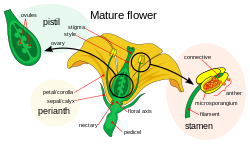
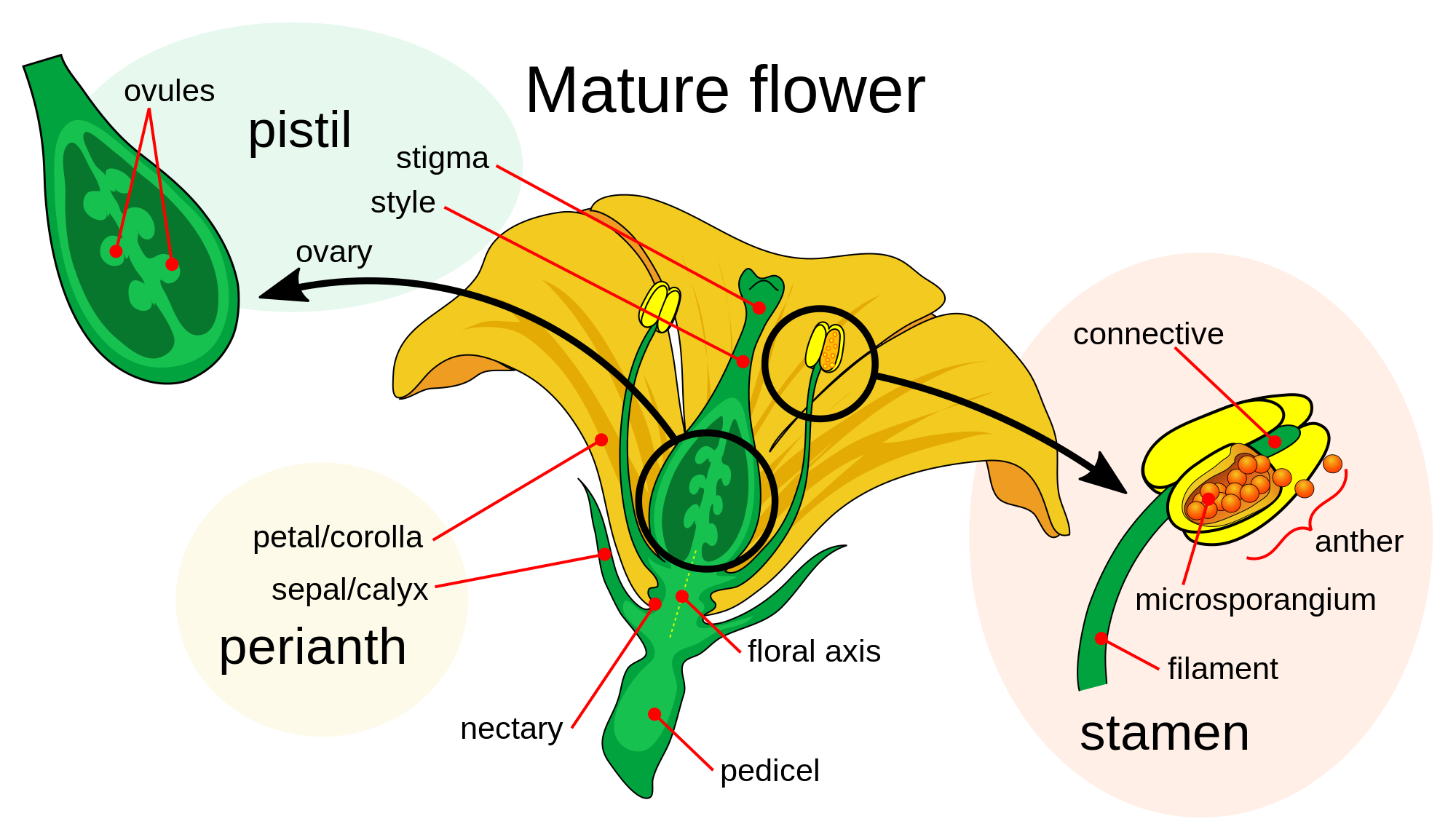
In a mature flower, the perianth consists of a calyx (sepals) and the corolla (petals) it supports.

Petals are modified leaves that form an inner whorl surrounding the reproductive parts of flowers. They are often brightly coloured or unusually shaped to attract pollinators. All of the petals of a flower are collectively known as the corolla. Petals are usually surrounded by an outer whorl of modified leaves called sepals, that collectively form the calyx and lie just beneath the corolla. The calyx and the corolla together make up the perianth, the non-reproductive portion of a flower. When the petals and sepals of a flower are difficult to distinguish, they are collectively called tepals. Examples of plants in which the term tepal is appropriate include genera such as Aloe and Tulipa. Conversely, genera such as Rosa and Phaseolus have well-distinguished sepals and petals. When the undifferentiated tepals resemble petals, they are referred to as "petaloid", as in petaloid monocots, orders of monocots with brightly coloured tepals. Since they include Liliales, an alternative name is lilioid monocots.

Although petals are usually the most conspicuous parts of animal-pollinated flowers, wind-pollinated species, such as the grasses, either have very small petals or lack them entirely (apetalous).

Tetrameric flower of a primrose willowherb (Ludwigia octovalvis) showing petals and sepals
A tulip's actinomorphic flower with three of both petals and sepals, similar enough to be considered tepals

Corolla

[edit]
Diagram of apopetalous corolla
Apopetalous corolla
daisy -campanulate corolla, bearing long points and emergent from tubular calyx (Brugmansia aurea, Golden Angel's Trumpet, family Solanaceae).

The collection of all petals in a flower is referred to as the corolla. The role of the corolla in plant evolution has been studied extensively since Charles Darwin postulated a theory of the origin of elongated corollae and corolla tubes.[1]

A corolla of separate petals, without fusion of individual segments, is apopetalous. If the petals are free from one another in the corolla, the plant is polypetalous or choripetalous; while if the petals are at least partially fused, it is gamopetalous or sympetalous. In the case of fused tepals, the term is syntepalous. Fused petals may form a tube, which is then known as a 'corolla tube'.

Variations

[edit]
Pelargonium peltatum flowers resemble those of geraniums, but are conspicuously zygomorphic.
Geranium incanum, with an actinomorphic flower typical of the genus
The white flower of Pisum sativum, the Garden Pea: an example of a zygomorphic flower.
Narcissus pseudonarcissus showing (from bend to tip of flower) spathe, floral cup, tepals, and corona
The petals of Combretum indicum

Petals can differ dramatically in different species. The number of petals in a flower may hold clues to a plant's classification. For example, flowers on eudicots (the largest group of dicots) most frequently have four or five petals while flowers on monocots have three or six petals, although there are many exceptions to this rule.[2]

The petal whorl or corolla may be either radially or bilaterally symmetrical. If all of the petals are essentially identical in size and shape, the flower is said to be regular[3] or actinomorphic (meaning "ray-formed"). Many flowers are symmetrical in only one plane (i.e., symmetry is bilateral) and are termed irregular or zygomorphic (meaning "yoke-" or "pair-formed"). In irregular flowers, other floral parts may be modified from the regular form, but the petals show the greatest deviation from radial symmetry. Examples of zygomorphic flowers may be seen in orchids and members of the pea family.

In many plants of the aster family such as the sunflower, Helianthus annuus, the circumference of the flower head is composed of ray florets. Each ray floret is anatomically an individual flower with a single large petal. Florets in the centre of the disc typically have no or very reduced petals. In some plants such as Narcissus, the lower part of the petals or tepals are fused to form a floral cup (hypanthium) above the ovary, and from which the petals proper extend.[4][5][6]

A petal often consists of two parts: the upper broader part, similar to a leaf blade, also called the blade; and the lower narrower part, similar to a leaf petiole, called the claw,[3] separated from each other at the limb. Claws are distinctly developed in petals of some flowers of the family Brassicaceae, such as Erysimum cheiri.

The inception and further development of petals show a great variety of patterns.[7] Petals of different species of plants vary greatly in colour or colour pattern, both in visible light and in ultraviolet. Such patterns often function as guides to pollinators and are variously known as nectar guides, pollen guides, and floral guides.

Genetics

[edit]

The genetics behind the formation of petals, in accordance with the ABC model of flower development, are that sepals, petals, stamens, and carpels are modified versions of each other. It appears that the mechanisms to form petals evolved very few times (perhaps only once), rather than evolving repeatedly from stamens.[8]

Significance of pollination

[edit]

Pollination is an important step in the sexual reproduction of higher plants. Pollen is produced by the male flower or by the male organs of hermaphroditic flowers.

Pollen does not move on its own and thus requires wind or animal pollinators to disperse the pollen to the stigma of the same or nearby flowers. However, pollinators are rather selective in determining the flowers they choose to pollinate. This develops competition between flowers and as a result flowers must provide incentives to appeal to pollinators (unless the flower self-pollinates or is involved in wind pollination). Petals play a major role in competing to attract pollinators. Henceforth pollination dispersal could occur and the survival of many species of flowers could prolong.

Types of pollination

[edit]

Wind pollination

[edit]

Wind-pollinated flowers often have small, dull petals and produce little or no scent. Some of these flowers will often have no petals at all. Flowers that depend on wind pollination will produce large amounts of pollen because most of the pollen scattered by the wind tends to not reach other flowers.[9]

Attracting insects

[edit]

Flowers have various regulatory mechanisms to attract insects. One such helpful mechanism is the use of colour guiding marks. Insects such as the bee or butterfly can see the ultraviolet marks which are contained on these flowers, acting as an attractive mechanism which is not visible towards the human eye. Many flowers contain a variety of shapes acting to aid with the landing of the visiting insect and also influence the insect to brush against anthers and stigmas (parts of the flower). One such example of a flower is the pōhutukawa (Metrosideros excelsa), which acts to regulate colour in a different way. The pōhutukawa contains small petals also having bright large red clusters of stamens.[10] Another attractive mechanism for flowers is the use of scents which are highly attractive to humans. One such example is the rose. On the other hand, some flowers produce the smell of rotting meat and are attractive to insects such as flies. Darkness is another factor that flowers have adapted to as nighttime conditions limit vision and colour-perception. Fragrancy can be especially useful for flowers that are pollinated at night by moths and other flying insects.[10]

Attracting birds

[edit]

Flowers are also pollinated by birds and must be large and colourful to be visible against natural scenery. In New Zealand, such bird–pollinated native plants include: kowhai (Sophora species), flax (Phormium tenax) and kaka beak (Clianthus puniceus). Flowers adapt the mechanism on their petals to change colour in acting as a communicative mechanism for the bird to visit. An example is the tree fuchsia (Fuchsia excorticata), which are green when needing to be pollinated and turn red for the birds to stop coming and pollinating the flower.[10]

Bat-pollinated flowers

[edit]

Flowers can be pollinated by short-tailed bats. An example of this is the dactylanthus (Dactylanthus taylorii). This plant has its home under the ground acting the role of a parasite on the roots of forest trees. The dactylanthus has only its flowers pointing to the surface and the flowers lack colour but have the advantage of containing much nectar and a strong scent. These act as a useful mechanism in attracting the bat.[11]

References

[edit]

Bibliography

[edit]
Revisions and contributorsEdit on WikipediaRead on Wikipedia
from Grokipedia
A petal is a modified leaf-like structure that forms part of the corolla, the inner whorl of the in a , typically soft, brightly colored, and arranged to surround the reproductive organs of the flower. These sterile floral appendages primarily function to attract pollinators such as and birds through vivid colors, patterns (including markings), and sometimes fragrance, guiding them toward and . In botanical structure, petals alternate with the outer sepals of the calyx and collectively contribute to the , which protects the flower bud before opening. The word petal originates from the New Latin petalum, from pétalon meaning "." Petals exhibit significant variation across angiosperms: they may be free or fused into a tube or bell shape, range in number from few to many (often used in plant identification), and can be absent in incomplete flowers like those of grasses or dogwoods, where other structures may serve similar attractive roles. In cases where petals and sepals are indistinguishable, they are termed tepals, as seen in lilies and tulips. Petals contribute to floral diversity and efficiency, with their colors and forms adapted to specific pollinators across approximately 330,000 angiosperm (as of 2024).

Definition and Anatomy

Basic Structure

Petals are modified leaves that constitute the inner whorl of the , collectively forming the corolla, which surrounds the flower's reproductive organs including the stamens and carpels. This positioning places petals inward from the sepals, serving as a visually prominent layer in many angiosperm flowers. Typically, petals feature a thin, expanded known as the lamina, which provides a broad surface area, and a basal that attaches the petal to the floral receptacle. Veins run through the petal for and nutrient transport, while some exhibit nectar guides—distinct patterns, often visible in ultraviolet light, that aid in guiding pollinators. These elements contribute to the petal's yet durable composition, adapted for display rather than . Petals differ from sepals, which form the outer perianth whorl (calyx) and are generally green, leaf-like, and protective of the developing bud. In contrast to tepals, which are undifferentiated structures combining sepal and petal characteristics and common in monocots like lilies, petals are distinctly showy in eudicots. For example, roses (Rosa spp.) display five simple, distinct petals arising from the receptacle, emphasizing their separate nature. Conversely, morning glories (Ipomoea spp.) feature petals fused into a funnel-shaped corolla, creating a unified tubular structure.

Relation to Floral Organs

In angiosperm flowers, petals collectively form the corolla, which serves as the inner whorl of the and contrasts with the outer calyx composed of sepals. The calyx, typically green and protective, encloses the developing bud, while the corolla often features vibrant colors to attract pollinators. Petals within the corolla can be apopetalous, remaining free and distinct, as seen in many like those in the family, or gamopetalous, where they fuse at their bases to form a tube or bell shape, common in solanaceous plants. This fusion enhances structural integrity and facilitates specialized interactions with pollinators. Petals occupy the second floral whorl, positioned immediately inner to the sepals and outer to the stamens and carpels in the typical angiosperm flower arrangement. This sequential organization—from calyx (outermost), corolla, androecium, to (innermost)—supports the flower's reproductive efficiency by layering protective and attractive elements around the sexual organs. In some lineages, such as monocots, this distinction blurs, with petals and sepals becoming morphologically similar and termed tepals, as in lilies ( spp.) where six petaloid tepals form a uniform . Orchids (Orchidaceae) have a perianth consisting of three sepals and three petals, all typically petaloid, with the inner median petal often modified into a specialized lip (labellum). The evolutionary fusion leading to sympetalous corollas has been particularly prominent in the asterid clade, where it arose convergently to promote pollinator specificity and floral diversification. In asterids, such as those in the Lamiales and Asterales orders, gamopetalous corollas develop through mechanisms like congenital fusion of petal primordia or postgenital adhesion, often involving genes that regulate organ boundaries and lateral growth, such as CUC-like and TCP transcription factors. This sympetaly supports specialized functions, including the formation of nectar guides and precise pollen deposition, contributing to the clade's success with over 80,000 species.

Development and Genetics

Ontogeny

Petal ontogeny begins with the initiation of petal in the second whorl of the floral , following the formation of sepals in the first whorl. In model like , this occurs during stage 5 of floral development, where the four petal primordia emerge simultaneously with stamen near the base of the sepals, establishing the characteristic whorled arrangement. This sequential initiation is driven by localized maxima that create response sites for primordium outgrowth, ensuring precise positioning within the . The growth phases of petals proceed through distinct stages of , expansion, and differentiation. Initial predominates from stages 5 to 9, rapidly forming the petal through meristematic activity regulated by and signaling, which promote proliferation and establish outgrowth gradients. This is followed by a phase of cell expansion from stages 7 to 10, where petals elongate significantly—reaching lengths of about 200 µm and acquiring a tongue-like shape—under the influence of auxin-mediated pathways that coordinate broadening. Differentiation occurs later, from stages 9 to 12, involving the specialization of epidermal cells into conical adaxial papillae and cobblestone-like abaxial cells, alongside patterning and margin refinement, to confer structural integrity and aesthetic features. Hormonal gradients play a pivotal role in directing these processes, with and exerting antagonistic yet complementary effects. gradients, generated by polar transport via PIN-FORMED proteins, initiate primordia and sustain early outgrowth by activating downstream genes like JAGGED and ARF8 for cell division and expansion in the petal blade. , often counterbalancing , enhances cell division and promotes margin development during blade expansion, as observed in eudicots like where signaling peaks during organ maturation. Post-pollination, many species undergo petal mediated by and , which disrupt - balance to activate cell wall-degrading enzymes in the abscission zone, facilitating petal shedding after fertilization. Petal development is temporally synchronized with other floral organs to ensure coordinated maturation, completing prior to in most . In Arabidopsis, petals lag behind stamens in early growth but reach comparable lengths by stage 12, with full differentiation achieved before the flower opens at stage 13, aligning with carpel enclosure and readiness. This timing is conserved across , where petal formation integrates with the ABC genetic model to specify identity in the second whorl while harmonizing overall floral architecture. In non-eudicot angiosperms, such as monocots, petal (or ) ontogeny often involves more simultaneous whorl initiation, reflecting broader developmental diversity.

Molecular Mechanisms

The molecular mechanisms governing petal development primarily revolve around the ABC model of flower organ identity, which posits that combinatorial activity of three classes of genes specifies the four floral whorls. In this framework, B-class genes, such as APETALA3 (AP3) and PISTILLATA (PI) in , are essential for determining petal identity in the second whorl, where they interact with A-class genes to promote petal formation rather than sepals. These B-class genes encode transcription factors that form protein complexes to activate downstream targets involved in cell differentiation and organ . Regulatory networks extend beyond the core ABC genes through intricate interactions of MADS-box transcription factors and post-transcriptional regulators like microRNAs (miRNAs). MADS-box proteins, including those from the SEPALLATA (SEP) subfamily, form higher-order complexes (quartets) that fine-tune for petal specification and maintenance, integrating signals from hormonal pathways such as and to coordinate growth. Additionally, miRNAs, particularly miR157, target SQUAMOSA PROMOTER BINDING PROTEIN-LIKE (SPL) genes to modulate petal size and shape by regulating and expansion during late developmental stages in species like hybrida. The single origin hypothesis for petals posits that these structures evolved once in angiosperms, likely from stamens or sepals, with conserved B-class genes providing molecular evidence across diverse lineages. Phylogenetic analyses reveal that AP3/PI orthologs exhibit similar expression patterns in the second whorl of like and , supporting a unified genetic program for petal identity that predates the diversification of flowering plants. This conservation underscores how modifications in regulatory elements of these genes facilitated petal evolution without requiring de novo origins. Modern research employing /Cas9 has elucidated the roles of specific genes in petal pigmentation, particularly MYB transcription factors that control . For instance, targeted mutations in the hybrida ANTHOCYANIN4 (AN4) gene, an R2R3-MYB regulator, result in reduced accumulation and paler petals, confirming its direct activation of the phenylpropanoid pathway for production. Such studies highlight the precision of in dissecting these networks, revealing how MYB factors integrate environmental cues to modulate petal color without altering overall morphology.

Morphology and Diversity

Shapes and Symmetry

Petals in angiosperms vary in number, often reflecting evolutionary clades. In , floral parts including petals are typically arranged in multiples of four or five, with many exhibiting five petals as a common pattern. In monocots, petals generally occur in multiples of three. Floral symmetry influences petal arrangement and pollinator interaction. Actinomorphic flowers possess radial , allowing division into identical halves along multiple vertical planes, as seen in buttercups ( spp.). Zygomorphic flowers exhibit bilateral , divisible into mirror images along only one plane, such as in snapdragons (), where this form directs access to reproductive structures. Petal shapes are defined by their aestivation, or pre-anthesis arrangement in the bud. Valvate aestivation features petals with margins touching but not overlapping, as in some mustard family flowers. Imbricate aestivation involves overlapping petals, where one petal's margin covers the adjacent one's, common in many . Contorted (or twisted) aestivation shows petals overlapping in a helical manner, each outside on one side and inside on the other, typical of some solanaceous plants. Specialized shapes include the labellum in orchids, a modified petal enlarged into a lip-like structure that serves as a platform for pollinators. Petal fusion contributes to corolla diversity. Choripetalous (or polypetalous) corollas consist of separate petals, as in roses (Rosa spp.). Sympetalous (or gamopetalous) corollas feature united petals forming tubular or wheel-shaped structures, seen in the bell-shaped flowers of Campanulaceae.

Colors and Patterns

Petals exhibit a wide array of colors primarily due to the presence of specific pigments synthesized within their cells. Anthocyanins, a class of flavonoid pigments, are responsible for red, purple, and blue hues in many flowering plants, accumulating in the vacuoles of petal epidermal cells to produce vibrant displays. Carotenoids contribute yellow, orange, and sometimes red tones by embedding in chromoplasts, with examples including beta-carotene and lycopene that enhance visual contrast in species like marigolds. In the Caryophyllales order, betalains serve a similar role to anthocyanins, producing reds and yellows but through a distinct biosynthetic pathway involving tyrosine-derived compounds, as seen in flowers such as those of the four o'clock plant (Mirabilis jalapa). Beyond uniform coloration, petals often feature intricate patterns formed by differential distribution, which create visual motifs like spots, streaks, and venation contrasts. Nectar guides, for instance, appear as UV-absorbing zones at the petal base or center, typically due to that absorb light while reflecting visible wavelengths, forming bullseye or striped patterns invisible to humans but prominent to pollinators. Spots and streaks arise from localized or concentrations in petal tissues, as observed in petunias where genetic regulation leads to radial or linear markings. Venation contrasts highlight underlying vascular patterns through pigment deposition along petal veins, enhancing structural visibility in species like snapdragons. Environmental factors significantly influence petal coloration and pattern stability. In hydrangeas, modulates structure by altering aluminum ion availability; acidic conditions ( below 5.5) promote blue complexes, while alkaline soils ( above 6) yield pink or red forms due to limited aluminum uptake. Seasonal occurs as petals age, driven by pigment degradation from high temperatures, , or UV exposure, which breaks down anthocyanins and , leading to paler tones in summer-blooming . In some , such as trichopoda, tepals lack prominent pigmentation, appearing creamy white or greenish due to minimal and accumulation, reflecting simpler structures in early-diverging lineages.

Functions

Protection and Support

Prior to , petals contribute to the enclosure of the flower bud alongside sepals, shielding the developing stamens and carpels from , physical damage by herbivores, and abiotic stresses like frost. Petals also provide mechanical support to the flower through specialized sclerenchyma tissues, particularly sclereids embedded in the petal mesophyll. These lignified cells confer rigidity to the otherwise delicate corolla, enabling it to function as a stable landing platform for pollinators while safeguarding the inner reproductive organs from mechanical disruption. For instance, in Camellia species, sclereids distributed throughout the corolla form a supportive network that withstands bending forces without compromising floral display. Following successful , petals typically undergo and , which serves to deter additional visits by reducing visual and olfactory attractiveness, thereby conserving resources for development. This process is mediated by the formation of zones—specialized cell layers at the petal base where hydrolytic enzymes degrade cell walls, facilitating clean petal drop without injury to the remaining flower. In ethylene-sensitive species like roses (Rosa spp.), pollination accelerates this response within hours, ensuring efficient resource reallocation. In certain environments, such as and alpine habitats, petals play a secondary role in through adjustable orientation and movement. By altering petal angle relative to sunlight—often via —flowers can trap solar to elevate internal above ambient levels, promoting viability and activity in cold conditions. For example, in high-elevation species, a modest increase in petal cupping can raise floral by up to 0.5°C, demonstrating adaptive behavioral control over balance.

Reproductive Attraction

Petals play a crucial role in angiosperm by attracting pollinators to the flower, thereby promoting transfer and fertilization. This attraction is achieved through a combination of sensory cues that signal the availability of rewards like and , which incentivize pollinators to visit and interact with the reproductive organs. Without such mechanisms, rates would decline, limiting and production essential for . Visual cues provided by petals, including bright colors and patterns, serve as long-range signals to draw toward the flower. These features often contrast sharply with the background, making the flower more conspicuous and guiding to nectar guides or reproductive parts. For instance, studies on natural populations have shown that variation in petal coloration influences pollinator visitation rates, with preferred hues increasing attraction and success. Olfactory signals from petals involve the emission of volatile organic compounds (VOCs) that create distinctive scents appealing to specific pollinators. These VOCs, primarily produced by petal tissues, form odor plumes that can travel distances to lure insects or other animals. In roses, benzenoids represent a major class of these petal-emitted VOCs, contributing to the flower's characteristic fragrance that attracts pollinators like bees. Petal VOCs often exceed those from other floral parts in abundance, emphasizing their specialized role in scent-based attraction. Tactile features on petal surfaces, such as microtextures formed by conical epidermal cells, provide physical cues that aid pollinator landing and movement. These structures offer grip, preventing slippage and directing pollinators toward the center of the flower for efficient pollen collection and deposition. Research demonstrates that bees can detect and prefer these tactile patterns, which enhance foraging speed and pollination accuracy. Collectively, the visual, olfactory, and tactile attributes of petals boost efficiency by targeting naive and experienced pollinators alike, thereby elevating the of angiosperms in diverse ecosystems. This integrated attraction strategy has been key to the evolutionary dominance of flowering plants, with experimental evidence showing higher visitation and transfer in petal-bearing flowers compared to those lacking such features.

Pollination Adaptations

Abiotic Pollination

Abiotic , or anemophily and hydrophily, involves non-biological vectors such as and , where petals play a diminished role compared to biotic systems, often being reduced or absent to facilitate efficient transfer without the need for visual or olfactory attraction. In these systems, floral structures prioritize lightweight production and dispersal mechanisms over elaborate displays. In anemophilous flowers, petals are typically reduced or entirely absent, as their presence could hinder the release and airborne transport of lightweight, abundant grains. This reduction minimizes drag and interference during wind-mediated dispersal, allowing to travel vast distances efficiently. A prominent example occurs in the family (grasses), where traditional petals are replaced by lodicules—small, scale-like structures homologous to petals in other monocots—that swell briefly to pry open the florets and expose stamens without attracting pollinators. These chaffy scales, often two or three per floret, are inconspicuous and colorless, emphasizing the shift away from attraction toward mechanical facilitation of shedding in windy conditions. Such adaptations are widespread in wind-pollinated angiosperms, which comprise about 10% of and have evolved independently over 65 times from animal-pollinated ancestors. Hydrophily, or water-mediated , similarly features minimal petal development in submerged or floating flowers, where elaborate would impede flotation or submersion. In epihydrophily, occurring at the water surface, petals—if present—are small and aid in rather than attraction, ensuring female flowers remain accessible to drifting male or flowers. The aquatic monocot () exemplifies this: its female flowers emerge on elongated peduncles to float with reduced, whitish segments that do not dominate the structure, while male flowers detach entirely and float freely, releasing via water currents to reach stigmas. In hypohydrophily, fully submerged pollination in related taxa, petals are even more vestigial or absent, with often forming mucilaginous threads for underwater transport. These modifications in aquatic monocots like highlight petals' inconspicuous nature to avoid hydrodynamic resistance. Overall, abiotic pollination systems underscore the optional role of petals in angiosperms, particularly evident in basal lineages where or water vectors evolved early and reduced reliance on for reproductive success. In , such as those in the ANITA grade, abiotic mechanisms are rare but demonstrate that petals are not essential when dispersal depends on physical agents rather than biotic intermediaries, allowing evolutionary flexibility in floral . This contrasts with the more derived emphasis on petal-mediated attraction in animal-pollinated clades.

Biotic Pollination by Insects

Petal adaptations for biotic pollination by insects, known as entomophily, often include visual and olfactory cues that guide pollinators to reproductive structures. Many flowers exhibit UV-reflective patterns on petals, invisible to humans but detectable by insects like bees, which absorb UV light to perceive contrasting nectar guides that direct them toward nectar sources. These patterns enhance pollinator efficiency by reducing search time and increasing contact with anthers and stigmas. Additionally, petal-emitted scents frequently mimic food rewards such as nectar or pollen, or even mating pheromones to attract specific insects, thereby facilitating pollen transfer without direct rewards in some cases. Zygomorphic (bilateral) symmetry in petals, as seen in the Fabaceae family, further specializes these structures for insect visitors by providing directional cues that align the pollinator's body with key floral parts during visitation. Pollinator specificity is evident in petal color variations tailored to insect vision and behavior. Blue and violet petals predominate in bee-pollinated flowers, as bees possess trichromatic vision sensitive to these wavelengths, which stand out against green foliage and promote faithful visitation. In contrast, red petals are more common in butterfly-pollinated species, leveraging butterflies' attraction to warmer hues while deterring bees, which perceive red as dark or black. Landing platforms formed by broad, flat petals in the family, such as those in sunflowers ( spp.), accommodate heavier insects like bumblebees, allowing them to perch stably while accessing central disc florets for and . Representative examples illustrate these adaptations in action. In sunflowers, petal-based UV nectar guides create a "bullseye" pattern that bees follow to the reproductive center. Orchids employing deceptive mimicry, such as sexually deceptive species in the genus Ophrys, use petal shapes and scents mimicking female insects to lure males into pseudocopulation attempts, achieving pollination without offering nectar or pollen rewards. Petal morphology also diversifies in response to insect tongue lengths, influencing corolla tube depth. Short-tongued insects like syrphid flies favor shallow corollas for easy nectar access, whereas long-tongued species such as hawkmoths select deeper tubes, leading to co-evolutionary matching where tube length correlates with pollinator proboscis size to minimize nectar robbery by mismatched visitors. This variation ensures efficient pollination across entomophilous syndromes while maintaining petal integrity as a supportive platform.

Biotic Pollination by Vertebrates

Biotic pollination by vertebrates, particularly birds and bats, has driven the of specialized petal structures in many angiosperms to facilitate effective transfer. These adaptations contrast with those for smaller pollinators by emphasizing robustness and accessibility for larger visitors, often prioritizing visual cues for diurnal birds or olfactory signals for nocturnal bats. Petals in vertebrate-pollinated flowers typically produce abundant as a reward, guiding visitors to reproductive organs while minimizing energy waste on non-pollinating interactions. In , or bird pollination, petals are often large and sturdy to withstand perching or hovering, with vibrant red or orange hues that stand out against green foliage to attract avian vision sensitive to long wavelengths. For instance, species feature wide, trumpet-shaped corollas with five or more broad petals in shades of red, orange, or pink, allowing hummingbirds to access deep nectar reservoirs while contacting stamens and stigmas. Tubular petal arrangements are common in hummingbird-adapted flowers, such as those in certain species, where narrow, elongated corollas match bill lengths for precise pollen deposition. Some flowers exhibit color changes post-pollination, shifting from bright reds to duller tones to deter further visits and direct birds to unpollinated blooms. In African , petal-like bracts form colorful, cup-shaped inflorescences in red or orange, providing perches for sunbirds that feed on glucose-rich , with presenters releasing grains upon bird contact. Chiropterophily, or bat pollination, features petals that are large, durable, and often pale or white to reduce visibility to diurnal competitors, paired with strong nocturnal scents for echolocation-guided attraction. These petals form bell- or cup-shaped corollas that accommodate heavy, non-hovering bats, as seen in agaves where sturdy, pale green or maroon blooms hold copious nectar at the base, enabling bats like the lesser long-nosed bat to lap it up without relying on color cues. In baobabs (Adansonia digitata), massive white petals open at dusk with a musky odor, creating pendulous, chiropterophilous flowers that bats grasp for nectar access, though regional variations show occasional moth dominance. Petal durability ensures structural integrity against bat weight, while the lack of bright coloration aligns with bats' limited color vision, emphasizing scent and texture for pollination efficiency.

Evolutionary Aspects

Origin and Early Evolution

The emergence of petals in angiosperms is traced through fossil records and comparative morphology, revealing their role as a transformative feature in early flower evolution. The earliest unequivocal angiosperm fossils, such as from approximately 125 million years ago in the , exhibit simple reproductive structures lacking sepals or petals, representing a basal form without specialized attractive . These structures are interpreted as precursors, likely derived from either stamens or sepals, based on the absence of specialized corollas in these basal forms and the gradual appearance of more elaborate in later deposits. Two primary hypotheses explain the origin of petals: the foliar hypothesis, positing derivation from leaf-like bracts or sepals, and the androecial hypothesis, suggesting transformation from fertile stamens into sterile petaloid organs. The foliar origin is supported by morphological continuity between sepals, bracts, and petals in many lineages, particularly in where parts are undifferentiated. In contrast, the androecial origin gains evidence from patterns, where B-class genes (such as APETALA3 and PISTILLATA), which specify identity, are also active in developing petals, indicating a shared developmental pathway in groups like core . These genetic similarities underscore a likely staminodial (stamen-derived) ancestry in certain clades, though polyphyletic origins—combining both hypotheses across angiosperm evolution—are increasingly favored. In , such as Amborella trichopoda and species of , the consists of tepals—undifferentiated organs that serve both protective and attractive functions—rather than distinct petals, reflecting a primitive state with spiral or variable arrangements. This tepal-dominated condition transitions to well-differentiated petals in core , where the second perianth whorl specializes into colorful, often nectar-guiding structures, marking a key evolutionary shift around the mid-Cretaceous. The of distinct petals represented a pivotal by enhancing visual and olfactory cues for pollinators, facilitating more efficient biotic and contributing to the explosive diversification of angiosperms during the period. This , coupled with insect-flower mutualisms, is credited with accelerating rates, as evidenced by the increasing dominance of angiosperms in the fossil record during the .

Diversity and Adaptations

Petals exhibit significant diversity through , particularly in lineages reliant on animal , where elaborate structures have evolved to enhance attraction and specificity. In the order , such as the Hawaiian lobeliads (Campanulaceae), petal elaboration—including elongated tubes and vibrant colors—has driven in response to diverse pollinator guilds, reflecting hierarchical adaptations to and elevation gradients. Conversely, in wind-pollinated clades like many and early-diverging angiosperms, petals are often reduced in size or entirely absent to minimize interference with dispersal and optimize resource allocation toward reproductive organs. These contrasting trajectories illustrate how ecological pressures shape petal across angiosperm lineages. Coevolution between petals and pollinators has further diversified petal morphology, with traits finely tuned to specific pollinator behaviors and physiologies. A classic example is the extraordinarily long nectar spurs in moth-pollinated orchids, such as Angraecum sesquipedale, which extend up to 32 cm and coevolved with the hawk moth Xanthopan morgani praedicta, enabling precise pollen transfer during nocturnal visitation. Such specialized petal modifications, including tubular corollas, promote reproductive isolation and speciation in pollinator-dependent systems. Contemporary evolutionary pressures reveal ongoing changes in petal traits amid global environmental shifts. Recent analyses show that , particularly and rising temperatures, has rapidly altered petal pigmentation, with UV-absorbing anthocyanins increasing by approximately 2% annually across , , and to protect against heightened exposure. In invasive species, petal loss or reduction frequently accompanies evolutionary transitions to , enhancing reproductive assurance in novel environments where pollinators are unreliable, as seen in shifts toward floral simplification under Baker's rule. Globally, petal diversity peaks in tropical regions, where higher abundance and biotic interactions foster greater morphological disparity compared to temperate zones. This latitudinal gradient supports complex adaptations, including petal in deceptive syndromes, where orchids like those in Ophrys imitate female insect morphology and pheromones to lure males for , thereby bypassing reward provision.

References

Add your contribution
Related Hubs
User Avatar
No comments yet.