Hubbry Logo
Foot bindingFoot bindingMain
Open search
Foot binding
Community hub
Foot binding
logo
8 pages, 0 posts
0 subscribers
Be the first to start a discussion here.
Foot binding
Foot binding
from Wikipedia
Foot binding
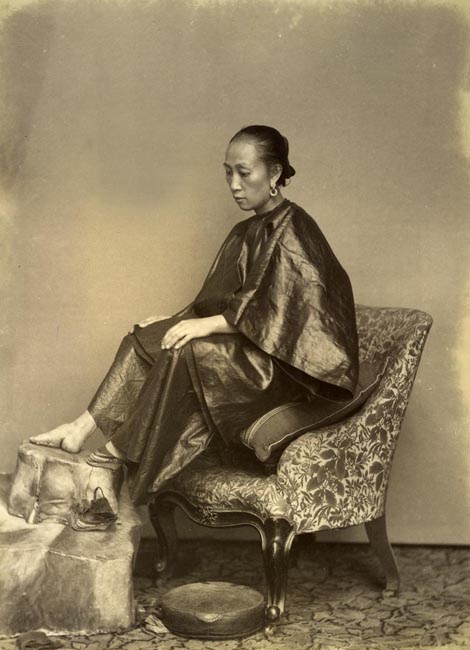
An albumen silver print photograph of a young woman with bound feet; she sits on a chair facing left, her feet - one with a lotus shoe, the other bare - propped up on a stool.
A Chinese woman showing her foot, image by Lai Afong, c. 1870s
Traditional Chinese纏足
Simplified Chinese缠足
Transcriptions
Standard Mandarin
Hanyu Pinyinchánzú
Wade–Gilesch'an2-tsu2
IPA[ʈʂʰǎn.tsǔ]
Yue: Cantonese
Yale Romanizationchìhn-jūk
Jyutpingcin4-zuk1
IPA[tsʰin˩.tsʊk̚˥]
Alternative (Min) Chinese name
Traditional Chinese裹腳
Simplified Chinese裹脚
Transcriptions

Foot binding (simplified Chinese: 缠足; traditional Chinese: 纏足; pinyin: chánzú), or footbinding, was the Chinese custom of breaking and tightly binding the feet of young girls to change their shape and size. Feet altered by foot binding were known as lotus feet and the shoes made for them were known as lotus shoes. In late imperial China, bound feet were considered a status symbol and a mark of feminine beauty. However, foot binding was a painful practice that limited the mobility of women and resulted in lifelong disabilities.

The prevalence and practice of foot binding varied over time, by region, and by social class.[1] The practice may have originated among court dancers during the Five Dynasties and Ten Kingdoms period in 10th-century China and gradually became popular among the elite during the Song dynasty, later spreading to lower social classes by the Qing dynasty (1644–1912). Manchu emperors attempted to ban the practice in the 17th century but failed.[2] In some areas, foot binding raised marriage prospects. It has been estimated that by the 19th century 40–50% of all Chinese women may have had bound feet, rising to almost 100% among upper-class Han Chinese women.[3] Frontier ethnic groups such as Turkestanis, Manchus, Mongols, and Tibetans generally did not practice footbinding.[4][5][6]

While Christian missionaries and Chinese reformers challenged the practice in the late 19th century, it was not until the early 20th century that the practice began to die out, following the efforts of anti-foot binding campaigns. Additionally, upper-class and urban women dropped the practice sooner than poorer rural women.[7] By 2007, only a handful of elderly Chinese women whose feet had been bound were still alive.[8]

History

[edit]

Origin

[edit]
A black and white stylised illustration of a seated woman, one foot resting on top of her left thigh, wrapping and binding her right foot.
18th-century illustration showing Yao Niang binding her own feet

There are a number of stories about the origin of foot binding before its establishment during the Song dynasty. One of these accounts is of Pan Yunu, a favourite consort of the Southern Qi Emperor Xiao Baojuan. In the story, Pan Yunu, renowned for having delicate feet, performed a dance barefoot on a floor decorated with the design of a golden lotus. The Emperor, expressing admiration, said that "lotus springs from her every step!" (bù bù shēng lián 歩歩生蓮), a reference to the Buddhist legend of Padmavati, under whose feet lotus springs forth. This story may have given rise to the terms 'golden lotus' or 'lotus feet' used to describe bound feet; there is no evidence, however, that Consort Pan ever bound her feet.[9]

The general view is that the practice is likely to have originated during the reign of the 10th-century Emperor Li Yu of the Southern Tang, just before the Song dynasty.[2] Li Yu created a 1.8-meter-tall (6 ft) golden lotus decorated with precious stones and pearls and asked his concubine Yao Niang (窅娘) to bind her feet in white silk into the shape of the crescent moon. She then performed a dance on the points of her bound feet on the lotus.[2] Yao Niang's dance was said to be so graceful that others sought to imitate her.[10] The binding of feet was then replicated by other upper-class women and the practice spread.[11]

Some of the earliest possible references to foot binding appear around 1100, when a couple of poems seemed to allude to the practice.[12][13][14][15] Soon after 1148,[15] in the earliest extant discourse on the practice of foot binding, scholar Zhang Bangji [zh] wrote that a bound foot should be arch shaped and small.[16][17] He observed that "women's foot binding began in recent times; it was not mentioned in any books from previous eras."[15] In the 13th century, scholar Che Ruoshui [zh] wrote the first known criticism of the practice: "Little girls not yet four or five years old, who have done nothing wrong, nevertheless are made to suffer unlimited pain to bind [their feet] small. I do not know what use this is."[15][18][19]

Southern Song zaju actresses with a form of footbinding of the period[20]

The earliest archeological evidence for foot binding dates to the tombs of Huang Sheng, who died in 1243 at the age of 17, and Madame Zhou, who died in 1274. Each woman's remains showed feet bound with gauze strips measuring 1.8 m (6 ft) in length. Zhou's skeleton, particularly well preserved, showed that her feet fit into the narrow, pointed slippers that were buried with her.[15] The style of bound feet found in Song dynasty tombs, where the big toe was bent upwards, appears to be different from 'the 'three-inch golden lotus' of later eras. The more severe form of footbinding may have developed in the 16th century.[21][22]

Later eras

[edit]
Small bound feet were once considered beautiful while large unbound feet were judged as crude.

At the end of the Song dynasty, men would drink from a special shoe, the heel of which contained a small cup. During the Yuan dynasty some would also drink directly from the shoe itself. This practice was called 'toast to the golden lotus' and lasted until the late Qing dynasty.[23]

The first European to mention foot binding was the Italian missionary Odoric of Pordenone in the 14th century, during the Yuan dynasty.[24] However no other foreign visitors to Yuan China mentioned the practice, including Ibn Battuta and Marco Polo (who nevertheless noted the dainty walk of Chinese women, who took very small steps), perhaps an indication that it was not a widespread or extreme practice at that time.[25] The Mongols themselves did not practice footbinding but it was permitted for their Chinese subjects.[26][11] The practice became increasingly common among the gentry families, later spreading to the general populace, as commoners and theatre actors alike adopted foot binding. By the Ming period the practice was no longer the preserve of the gentry but it was considered a status symbol.[27][28][29] As foot binding restricted the movement of a woman, one side effect of its rising popularity was the corresponding decline of the art of women's dance in China, and it became increasingly rare to hear about beauties and courtesans who were also great dancers after the Song era.[30][31]

A lotus shoe for bound feet, Louise Weiss collection, Saverne

The Manchus issued a number of edicts to ban the practice, first in 1636 when the Manchu leader Hong Taiji declared the founding of the new Qing dynasty, then in 1638, and another in 1664 by the Kangxi Emperor.[27] Few Han Chinese complied with the edicts, and Kangxi eventually abandoned the effort in 1668. By the 19th century, it was estimated that 40–50% of Chinese women had bound feet. Among upper class Han Chinese women, the figure was almost 100%.[8] Bound feet became a mark of beauty and were also a prerequisite for finding a husband. They also became an avenue for poorer women to marry up in some areas, such as Sichuan.[32] In late 19th century Guangdong it was customary to bind the feet of the eldest daughter of a lower-class family who was intended to be brought up as a lady. Her younger sisters would grow up to be bond-servants or domestic slaves and be able to work in the fields, but the eldest daughter would be assumed never to have the need to work. Women, their families and their husbands took great pride in tiny feet, with the ideal length, called the 'Golden Lotus', being about three Chinese inches () long—around 11 cm (4.3 in).[33][34] This pride was reflected in the elegantly embroidered silk slippers and wrappings girls and women wore to cover their feet. Handmade shoes served to exhibit the embroidery skill of the wearer as well.[35] These shoes also served as support, as some women with bound feet might not have been able to walk without the support of their shoes and would have been severely limited in their mobility.[36] Contrary to missionary writings, many women with bound feet were able to walk and work in the fields, albeit with greater limitations than their non-bound counterparts.[37]

In the 19th and early 20th centuries, there were dancers with bound feet as well as circus performers who stood on prancing or running horses. Women with bound feet in one village in Yunnan Province formed a regional dance troupe to perform for tourists in the late 20th century, though age has since forced the group to retire.[38] In other areas, women in their 70s and 80s assisted in the rice fields (albeit in a limited capacity) even into the early 21st century.[8]

Decline

[edit]

Opposition to foot binding had been raised by some Chinese writers in the 18th century. In the mid-19th century, many of the leaders of the Taiping Rebellion were men of Hakka background whose women did not bind their feet, and they outlawed foot binding in areas under their control.[39][40] However the rebellion failed and Christian missionaries, who had provided education for girls and actively discouraged what they considered a barbaric practice that had deleterious social effect on women,[41] then played a part in changing elite opinion on foot binding through education, pamphleteering and lobbying of the Qing court,[42][43] as no other culture in the world practised the custom of foot binding.[44]

The earliest-known Western anti-foot binding society was formed in Amoy (Xiamen) in 1874. 60–70 Christian women in Xiamen attended a meeting presided over by a missionary, John MacGowan, and formed the Natural Foot Society (Tianzu Hui (天足会), literally Heavenly Foot Society).[45][46] MacGowan held the view that foot binding was a serious problem that called into doubt the whole of Chinese civilization; he felt that "the nefarious civilization interferes with Divine Nature."[47] Members of the Heavenly Foot Society vowed not to bind their daughters' feet.[44][41] In 1895, Christian women in Shanghai led by Alicia Little, also formed a Natural Foot Society.[46][48] It was also championed by the Woman's Christian Temperance Movement founded in 1883 and advocated by missionaries including Timothy Richard, who thought that Christianity could promote equality between the sexes.[49] This missionary-led opposition had stronger impacts than earlier Han or Manchu opposition.[50] Western missionaries established the first schools for girls, and encouraged women to end the practice of foot binding.[51] Christian missionaries did not conceal their shock and disgust either when explaining the process of foot binding to Western peers and their descriptions shocked their audience back home.[50]

Reform-minded Chinese intellectuals began to consider foot binding to be an aspect of their culture that needed to be eliminated.[52] In 1883, Kang Youwei founded the Anti-footbinding Society near Canton to combat the practice, and anti-foot binding societies appeared across the country, with membership for the movement claimed to reach 300,000.[53][54] The anti-foot binding movement stressed pragmatic and patriotic reasons rather than feminist ones, arguing that abolition of foot binding would lead to better health and more efficient labour. Kang Youwei submitted a petition to the throne commenting on the fact that China had become a joke to foreigners and that "footbinding was the primary object of such ridicule."[55]

Reformers such as Liang Qichao, influenced by Social Darwinism, also argued that it weakened the nation, since enfeebled women supposedly produced weak sons.[56] In his "On Women's Education", Liang Qichao asserts that the root cause of national weakness inevitably lies the lack of education for women. Qichao connected education for women and foot binding: "As long as foot binding remains in practice, women's education can never flourish."[57] Qichao was also disappointed that foreigners had opened the first schools as he thought that the Chinese should be teaching Chinese women.[55] At the turn of the 20th century, early feminists, such as Qiu Jin, called for the end of foot binding.[58][59] In 1906, Zhao Zhiqian wrote in Beijing Women's News to blame women with bound feet for being a national weakness in the eyes of other nations.[60] Many members of anti-foot binding groups pledged to not bind their daughters' feet nor to allow their sons to marry women with bound feet.[46][61] In 1902, Empress Dowager Cixi issued an anti-foot binding edict, but it was soon rescinded.[citation needed]

In 1912 the new Republic of China government banned foot binding, though the ban was not actively implemented,[62] and leading intellectuals of the May Fourth Movement saw foot binding as a major symbol of China's backwardness.[63] Provincial leaders, such as Yan Xishan in Shanxi, engaged in their own sustained campaign against foot binding with foot inspectors and fines for those who continued the practice,[62] while regional governments of the later Nanjing regime also enforced the ban.[42] The campaign against foot binding was successful in some regions. In one province, a 1929 survey showed that, while only 2.3% of girls born before 1910 had unbound feet, 95% of those born after were not bound.[64] In a region south of Beijing, Dingxian, where over 99% of women once had bound feet, no new cases were found among those born after 1919.[65][66] In Taiwan, the practice was also discouraged by the ruling Japanese from the beginning of Japanese rule, and from 1911 to 1915 it was gradually made illegal.[67] The practice lingered on in some regions in China. In 1928, a census in rural Shanxi found that 18% of women had bound feet,[38] while in some remote rural areas, such as Yunnan Province, it continued to be practiced until the 1950s.[68][69] In most parts of China the practice had virtually disappeared by 1949.[64] The practice was also stigmatized in Communist China, and the last vestiges of foot binding were stamped out, with the last new case of foot binding reported in 1957.[70][71] By the 21st century, only a few elderly women in China still had bound feet.[72][73] In 1999, the last shoe factory making lotus shoes, the Zhiqian Shoe Factory in Harbin, closed.[74][75]

Practice

[edit]

Variations and prevalence

[edit]
A comparison between a woman with unbound feet (left) and a woman with bound feet (right) in 1902.

Foot binding was practised in various forms and its prevalence varied in different regions.[76] A less severe form in Sichuan, called "cucumber foot" (huángguā jiǎo 黃瓜腳) due to its slender shape, folded the four toes under but did not distort the heel or taper the ankle.[38][77] Some working women in Jiangsu made a pretence of binding while keeping their feet natural.[42] Not all women were always bound—some women once bound remained bound throughout their lives, some were only briefly bound and some were bound until marriage.[78] Foot binding was most common among women whose work involved domestic crafts and those in urban areas;[42] it was also more common in northern China, where it was widely practised by women of all social classes, but less so in parts of southern China such as Guangdong and Guangxi, where it was largely a practice of women in the provincial capitals or among the gentry.[79][16] Feet were bound to their smallest in the northern provinces of Hebei, Shandong, Shanxi and Shaanxi, but the binding was less extreme and less common in the southern provinces of Guangdong, Guangxi, Yunnan and Guizhou, where not all daughters of the wealthy had bound feet.[80] Foot binding limited the mobility of girls, so they became engaged in handwork from childhood.[35] It is thought that the necessity for female labour in the fields owing to a longer growing season in the South and the impracticability of bound feet working in wet rice fields limited the spread of the practice in the countryside of the South.[81] However some farming women bound their daughter's feet, but "the process began later than in elite families, and feet were bound more loosely among the poor."[82]

Scholarly estimates of the number of women with bound feet at the height of the practice range widely, but most modern historians place the figure between 10 and 20 million. Historian John R. Shepherd, drawing on Qing dynasty and early Republican census records, argues that footbinding reached its demographic peak in the mid- to late-19th century, particularly among Han women in the central and eastern provinces.[83] Based on Taiwan's 1905 census, Shepherd found that over two-thirds of Hoklo women had bound feet, while Hakka and indigenous groups had binding rates below 1 percent.[84] Laurel Bossen and Hill Gates, drawing on interviews with thousands of elderly rural Chinese women, conclude that footbinding was nearly universal among inland Han women born before 1910, although its prevalence declined rapidly after 1915.[85]

The practice transcended social class, though its function varied. While gentry families bound their daughters' feet to conform to elite aesthetics and reinforce chastity, some rural households bound only one daughter's feet to improve marriage prospects while leaving others unbound for agricultural labor.[86] In textile-producing areas, footbinding was often linked to a household labor strategy: bound girls were confined indoors and tasked with spinning and weaving, while unbound girls performed fieldwork.[87] Scholar C. Fred Blake argued that footbinding in these contexts "appropriated" female labor by enforcing immobility within the domestic sphere.[88]

Urban–rural differences in prevalence became especially stark in the early 20th century. In port cities such as Xiamen and Shanghai, anti-footbinding societies successfully curbed the practice by the 1910s. A 1937 survey in Xiamen found that only 4.5 percent of women still had bound feet, almost all of them born before 1905.[citation needed] In contrast, rural surveys from the 1920s show lingering adherence: in villages of Hebei Province, 99.2 percent of women born before 1890 had bound feet, and as late as 1915, 60 percent of young girls were still being bound.[89] These disparities suggest that urban elites abandoned footbinding first, while the practice persisted in the countryside into the 1930s.

Ethnic variation played a significant role in footbinding's distribution. Manchu women were officially prohibited from binding their feet and instead wore high-soled "flower bowl" shoes to mimic the swaying gait of bound feet.[90] Other non-Han groups, including Mongols and Tibetans, generally rejected the custom.[91] Nonetheless, assimilation occurred in some regions: Hui Muslim women in Gansu and Dungan communities in Central Asia retained footbinding into the 20th century, influenced by neighboring Han populations.[92] In multiethnic areas, bound feet became a visible marker of Han female identity and distinction from non-Han groups.[93]

Recent scholarship has also challenged the notion that footbinding was solely patriarchal or aesthetic. Bossen and Gates argue that the practice was often embedded in rural household economies, where it kept girls indoors to perform textile labor critical to family income.[94] Their research shows that footbinding was strongly associated with regions engaged in hand-spinning, and declined rapidly once machine-made yarn displaced home production.[95] They conclude that the practice's demise stemmed not only from reformist ideology, but from material shifts in rural labor and technology.[96]

The Manchu "flower bowl" shoes designed to imitate bound feet, mid-1880s

Manchu women, as well as Mongol and Chinese women in the Eight Banners, did not bind their feet. The most a Manchu woman might do was to wrap the feet tightly to give them a slender appearance.[5] The Manchus, wanting to emulate the particular gait that bound feet necessitated, adapted their own form of platform shoes to cause them to walk in a similar swaying manner. These Manchu platform shoes were known as "flower bowl" shoes (Chinese: 花盆鞋; pinyin: Huāpénxié) or "horse-hoof" shoes (Chinese: 馬蹄鞋; pinyin: Mǎtíxié); they have a platform generally made of wood 5–20 cm (2–6 in) in height and fitted to the middle of the sole, or they have a small central tapered pedestal. Many Han Chinese in the Inner City of Beijing did not bind their feet either, and it was reported in the mid-1800s that around 50–60% of non-banner women had unbound feet. Han immigrant women to the Northeast came under Manchu influence and abandoned foot binding.[97] Bound feet nevertheless became a significant differentiating marker between Han women and Manchu or other banner women.[5]

The Hakka people were unusual among Han Chinese in not practising foot binding.[98][99] Most non-Han Chinese people, such as the Manchus, Mongols and Tibetans, did not bind their feet. Some non-Han ethnic groups did. Foot binding was practised by the Hui Muslims in Gansu Province.[100] The Dungan Muslims, descendants of Hui from northwestern China who fled to central Asia, were also practising foot binding up to 1948.[101] In southern China, in Canton (Guangzhou), 19th-century Scottish scholar James Legge noted a mosque that had a placard denouncing foot binding, saying Islam did not allow it since it constituted violating the creation of God.[102]

Process

[edit]
A bound foot
A bound foot
A bandaged bound foot

The process was started before the arch of the foot had a chance to develop fully, usually between the ages of four and nine. Binding usually started during the winter months since the feet were more likely to be numb and the pain would not be as extreme.[103]

First, each foot would be soaked in a warm mixture of herbs and animal blood. This was intended to soften the foot and aid the binding. Then the toenails were cut back as far as possible to prevent in-growth and subsequent infections, since the toes were to be pressed tightly into the sole of the foot. Cotton bandages, 3 m (10 ft) long and 5 cm (2 in) wide, were prepared by soaking them in the blood and herb mixture. To enable the size of the feet to be reduced, the toes on each foot were curled under, then pressed with great force downwards and squeezed into the sole of the foot until the toes broke.[44]

The bandages were repeatedly wound in a figure-eight movement, starting at the inside of the foot at the instep, then carried over the toes, under the foot and around the heel, the broken toes being pressed tightly into the sole of the foot. The foot was drawn down straight with the leg and the arch of the foot forcibly broken. At each pass around the foot, the binding cloth was tightened, pulling the ball of the foot and the heel together, causing the broken foot to fold at the arch, pressing the toes beneath the sole. The binding was pulled so tightly that the girl could not move her toes at all and the ends of the binding cloth were then sewn so that the girl could not loosen it.

An X-ray of two bound feet
Schema of an X-ray comparison between an unbound and bound foot

The girl's broken feet required a great deal of care and attention and they would be unbound regularly. Each time the feet were unbound they were washed, the toes checked for injury, and the nails trimmed. When unbound, the broken feet were also kneaded to soften them and the soles of the girl's feet were often beaten to make the joints and broken bones more flexible. The feet were also soaked in a concoction that caused necrotic flesh to fall off.[52]

Immediately after this procedure, the girl's broken toes were folded back under and the feet were rebound. The bindings were pulled even tighter each time the girl's feet were rebound. This unbinding and rebinding ritual was repeated as often as possible (for the rich at least once daily, for poor peasants two or three times a week), with fresh bindings. It was generally an elder female member of the girl's family or a professional footbinder who carried out the initial breaking and ongoing binding of the feet. It was considered preferable to have someone other than the mother do it, as she might have been sympathetic to her daughter's pain and less willing to keep the bindings tight.[103]

Once a girl's foot had been crushed and bound, attempting to reverse the process by unbinding was painful,[104] and the shape could not be reversed without a woman undergoing the same pain again. The timing and degree of foot binding varied among communities.[105]

Health problems

[edit]
feet of a Chinese woman in an isolation hospital in Mauritius
Feet of a Chinese woman, showing the effect of foot-binding

The most common problem with bound feet was infection. Despite the amount of care taken in regularly trimming the toenails, they would often in-grow, becoming infected and causing injuries to the toes. Sometimes, for this reason, the girl's toenails would be peeled back and removed altogether. The tightness of the binding meant that the circulation in the feet was faulty, and the circulation to the toes was almost cut off, so injuries to the toes were unlikely to heal and were likely to gradually worsen and lead to infected toes and rotting flesh. The necrosis of the flesh would initially give off a foul odour. Later the smell may have come from various microorganisms that colonized the folds.[106] Most of the women receiving treatment did not go out often and were disabled.[44]

If the infection in the feet and toes entered the bones, it could cause them to soften, which could result in toes dropping off. This was seen as a benefit because the feet could then be bound even more tightly. Girls whose toes were more fleshy would sometimes have shards of glass or pieces of broken tiles inserted within the binding next to her feet and between her toes to cause injury and introduce infection deliberately.[107] Disease inevitably followed infection, meaning that death from septic shock could result from foot binding, and a surviving girl was more at risk of medical problems as she grew older. It is thought that as many as 10% of girls may have died from gangrene and other infections owing to foot binding.[108]

At the beginning of the binding, many of the foot bones would remain broken, often for years. However as the girl grew older the bones would begin to heal. Even after the foot bones had healed, they were prone to rebreaking repeatedly, especially when the girl was in her teenage years and her feet were still soft. Bones in the girls' feet would often be deliberately broken again to further change the size or shape of the feet. This was especially the case with the girl's toes, which were broken several times since small toes were especially desirable.[109] Older women were more likely to break hips and other bones in falls, since they could not balance properly on their feet, and were less able to rise to their feet from a sitting position.[110] Other issues that may have arisen from foot binding included paralysis and muscular atrophy.[104] By the turn of the century foot binding had been exposed in photographs, X-rays and detailed textual descriptions. These scientific investigations detailed how foot binding deformed the leg, covered the skin with cracks and sores and altered the posture.[111] There is also some evidence that points to some older women in select rural areas experiencing higher levels of osteoporosis morbidities.[112]

Views and interpretations

[edit]

There are many interpretations to the practice of foot binding. The interpretive models used include fashion (with the Chinese customs somewhat comparable to the more extreme examples of Western women's fashion such as the Wasp waist), seclusion (sometimes evaluated as morally superior to the gender mingling in the West), perversion (the practice imposed by men with sexual perversions), inexplicable deformation, child abuse and extreme cultural traditionalism. In the late 20th century some feminists introduced positive overtones, reporting that it gave some women a sense of mastery over their bodies and pride in their beauty.[113]

Beauty and erotic appeal

[edit]
Bound feet were considered beautiful and even erotic.

Before foot binding was practised in China, admiration for small feet already existed as demonstrated by the Tang dynasty tale of Ye Xian written around 850 by Duan Chengshi. This tale of a girl who lost her shoe and then married a king who sought the owner of the shoe as only her foot was small enough to fit the shoe contains elements of the European story of Cinderella and is thought to be one of its antecedents.[114][115] For many, the bound feet were an enhancement to a woman's beauty and made her movement more dainty,[116] and a woman with perfect lotus feet was likely to make a more prestigious marriage.[117][118] Even while not much was written on the subject of foot binding prior to the latter half of the 19th century, the writings that were done on this topic, particularly by educated men, frequently alluded to the erotic nature and appeal of bound feet in their poetry.[118] The desirability varies with the size of the feet—the perfect bound feet and the most desirable (called 'golden lotuses') would be around 3 Chinese inches (around 10 cm or 4 in) or smaller, while those larger were called 'silver lotuses' (4 Chinese inches—around 13 cm or 5.1 in) or 'iron lotuses' (5 Chinese inches—around 17 cm or 6.7 in—or larger, and thus the least desirable for marriage).[119] Therefore people had greater expectations for foot binding brides.[120] The belief that foot binding made women more desirable to men is widely used as an explanation for the spread and persistence of foot binding.[121]

Some also considered bound feet to be intensely erotic. Some men preferred never to see a woman's bound feet, so they were always concealed within tiny 'lotus shoes' and wrappings. According to Robert van Gulik, the bound feet were also considered the most intimate part of a woman's body. In erotic art of the Qing period where the genitalia may be shown, the bound feet were never depicted uncovered.[122] Howard Levy, however, suggests that the barely revealed bound foot may also only function as an initial tease.[121]

An effect of the bound feet was the lotus gait, the tiny steps and swaying walk of a woman whose feet had been bound. Women with such deformed feet avoided placing weight on the front of the foot and tended to walk predominantly on their heels.[103] Walking on bound feet necessitated bending the knees slightly and swaying to maintain proper movement and balance, a dainty walk that was also considered to be erotically attractive to some men.[123] Some men found the smell of the bound feet attractive and some also apparently believed that bound feet would cause layers of folds to develop in the vagina, and that the thighs would become sensuously heavier and the vagina tighter.[124] The psychoanalyst Sigmund Freud considered foot binding to be a "perversion that corresponds to foot fetishism",[125] and that it appeased male castration anxiety.[44]

Role of Confucianism

[edit]
A woman with her feet unwrapped

During the Song dynasty, the status of women declined.[44] A common argument is that it was the result of the revival of Confucianism as neo-Confucianism and that, in addition to promoting the seclusion of women and the cult of widow chastity, it also contributed to the development of foot binding.[126] According to Robert van Gulik, the prominent Song Confucian scholar Zhu Xi stressed the inferiority of women as well as the need to keep men and women strictly separate.[127] It was claimed by Lin Yutang among others, probably based on an oral tradition, that Zhu Xi also promoted foot binding in Fujian as a way of encouraging chastity among women; that by restricting their movement, it would help keep men and women separate.[126] However, historian Patricia Ebrey suggests that this story might be fictitious,[128] and argued that the practice arose so as to emphasize the gender distinction during a period of societal change in the Song dynasty.[44][129]

Some Confucian moralists in fact disapproved of the erotic associations of foot binding, and unbound women were also praised.[130] The Neo-Confucian Cheng Yi was said to be against foot binding and his family and descendants did not bind their feet.[131][132] Modern Confucian scholars such as Tu Weiming also dispute any causal link between neo-Confucianism and foot binding,[133] as Confucian doctrine prohibits mutilation of the body as people should not "injure even the hair and skin of the body received from mother and father". It is argued that such injunction applies less to women, rather it is meant to emphasize the sacred link between sons and their parents. Furthermore, it is argued that Confucianism institutionalized the family system in which women are called upon to sacrifice themselves for the good of the family, a system that fostered such practice.[134]

Historian Dorothy Ko proposed that foot binding may be an expression of the Confucian ideals of civility and culture in the form of correct attire or bodily adornment, and that foot binding was seen as a necessary part of being feminine as well as being civilized. Foot binding was often classified in Chinese encyclopedia as clothing or a form of bodily embellishment rather than mutilation. One from 1591, for example, placed foot binding in a section on "Female Adornments" that included hairdos, powders, and ear piercings. According to Ko, the perception of foot binding as a civilized practice may be evinced from a Ming dynasty account that mentioned a proposal to "entice [the barbarians] to civilize their customs" by encouraging foot binding among their womenfolk.[135] The practice was carried out only by women on girls, and it served to emphasize the distinction between male and female, an emphasis that began from an early age.[136][137] Anthropologist Fred Blake argued that the practice of foot binding was a form of discipline undertaken by women themselves, and perpetuated by women on their daughters, so as to inform their daughters of their role and position in society, and to support and participate in the neo-Confucian way of being civilized.[134]

Feminist perspective

[edit]

Foot binding is considered an oppressive practice against women who were victims of a sexist culture.[138][139] It is also widely seen as a form of violence against women.[140][141][142] Bound feet rendered women dependent on their families, particularly the men, as they became largely restricted to their homes.[143] Thus, the practice ensured that women were much more reliant on their husbands.[144] The early Chinese feminist Qiu Jin, who underwent the painful process of unbinding her own bound feet, attacked foot binding and other traditional practices. She argued that women, by retaining their small bound feet, made themselves subservient by imprisoning themselves indoors. She believed that women should emancipate themselves from oppression, that girls could ensure their independence through education, and that they should develop new mental and physical qualities fitting for the new era.[145][59] The end of the practice of foot binding is seen as a significant event in the process of female emancipation in China,[146] and a major event in the history of Chinese feminism.[citation needed]

In the late 20th century, some feminists have pushed back against the prevailing Western critiques of foot binding, arguing that the presumption that foot binding was done solely for the sexual pleasure of men denies the agency and cultural influence of women.[147][37]

Other interpretations

[edit]

Some scholars such as Laurel Bossen and Hill Gates reject the notion that bound feet in China were considered more beautiful, or that it was a means of male control over women, a sign of class status, or a chance for women to marry well (in general, bound women did not improve their class position by marriage). Foot binding is believed to have spread from elite women to civilian women and there were large differences in each region. The body and labor of unmarried daughters belonged to their parents, thereby the boundaries between work and kinship for women were blurred.[76] They argued that foot binding was an instrumental means to reserve women to handwork, and can be seen as a way by mothers to tie their daughters down, train them in handwork, and keep them close at hand.[148][149] This argument has been challenged by John Shepherd in his book Footbinding as Fashion, and shows there was no connection between handicraft industries and the proportion of women bound in Hebei.[150]

Foot binding was common when women could do light industry, but where women were required to do heavy farm work they often did not bind their feet because it hindered physical work. These scholars argued that the coming of the mechanized industry at the end of the 19th century and the beginning of the 20th century, such as the introduction of industrial textile processes, resulted in a loss of light handwork for women, removing a reason to maintain the practice. Mechanization resulted in women who worked at home facing a crisis.[35] Coupled with changes in politics and people's consciousness, the practice of foot binding disappeared in China forever after two generations.[76][148] More specifically, the 1842 Treaty of Nanjing (after the First Opium War) opened five cities as treaty ports where foreigners could live and trade. This led to foreign citizens residing in the area, where many proselytized as Christian missionaries. These foreigners condemned many long-standing Chinese cultural practices like foot binding as "uncivilized" — marking the beginning of the end for the centuries-long practice.[111]

It has been argued that while the practice started out as a fashion, it persisted because it became an expression of Han identity after the Mongols invaded China in 1279, and later the Manchus' conquest in 1644, as it was then practised only by Han women.[clarification needed][136] During the Qing dynasty, attempts were made by the Manchus to ban the practice but failed, and it has been argued the attempts at banning may have in fact led to a spread of the practice among Han Chinese in the 17th and 18th centuries.[151] John Shepherd provides a critical review of the evidence cited for the notion that foot binding was an expression of "Han identity" and rejects this interpretation.[152]

[edit]

The bound foot has played a prominent part in many media works, both Chinese and non-Chinese, modern and traditional.[153] These depictions are sometimes based on observation or research and sometimes on rumors or supposition. Sometimes, as in the case of Pearl Buck's The Good Earth (1931), the accounts are relatively neutral or empirical, implying respect for Chinese culture.[a] Sometimes, the accounts seem intended to rouse like-minded Chinese and foreign opinion to abolish the custom, and sometimes the accounts imply condescension or contempt for China.[154]

  • Quoted in the Jin Ping Mei (c. 1610): "displaying her exquisite feet, three inches long and no wider than a thumb, very pointed and with high insteps."[155]
  • Anna Bunina mentions the custom in her 1810 fable "Пекинское ристалище" (The Peking Stadium), which describes a Chinese woman attempting to run a race and barely finishing the boys' course, yet still getting applause for the effort. Bunina used the custom as an allegory to her own difficulties in getting recognition as a poet.[156]
  • Flowers in the Mirror (1837) by Ju-Chen Li includes chapters set in the "Country of Women", where men bear children and have bound feet.[157]
  • The Three-Inch Golden Lotus (1994) by Feng Jicai[158] presents a satirical picture of the movement to abolish the practice, which is seen as part of Chinese culture.
  • In the film The Inn of the Sixth Happiness (1958), Ingrid Bergman portrays Gladys Aylward, a British missionary to China who is assigned as a foreigner the task by a local Mandarin to unbind the feet of young women, an unpopular order that the civil government had failed to fulfill. Later, the children are able to escape troops by walking miles to safety.
  • Ruthanne Lum McCunn wrote a biographical novel, Thousand Pieces of Gold (1981, adapted into a 1991 film), about Polly Bemis, a Chinese American pioneer woman. It describes her feet being bound and later unbound when she needed to help her family with farm labor.
  • Emily Prager's short story "A Visit from the Footbinder", from her collection of short stories of the same name (1982), describes the last few hours of a young Chinese girl's childhood before the professional footbinder arrives to initiate her into the adult woman's life of beauty and pain.[159]
  • Jung Chang's family autobiography Wild Swans presents the story of Yu-Fang, the grandmother, who had bound feet from the age of two.
  • Lisa Loomer's play The Waiting Room (1994) deals with themes of body modification. One of the three main characters is an 18th-century Chinese woman who arrives in a modern hospital waiting room, seeking medical help for complications resulting from her bound feet. She describes the foot-binding process, as well as the physical and psychological harm her bound feet have caused.[160]
  • Lensey Namioka's novel Ties that Bind, Ties that Break (1999) follows a girl named Ailin in China who refuses to have her feet bound, which comes to affect her future.[161]
  • Lisa See's novel Snow Flower and the Secret Fan (2005) is about two Chinese girls who are destined to be friends. The novel is based upon the sacrifices women make to be married and includes the two girls being forced into getting their feet bound. The book was adapted into a 2011 film directed by Wayne Wang.
  • The Filipino horror film Feng Shui and its sequel Feng Shui 2 feature a ghost of a foot-bound woman inhabits a bagua and cursed those who holds the item.
  • Sieglinde Sullivan from Black Butler had her feet bound when she was young as part of the "Emerald Witch" hoax invented by the German military.
  • Lisa See's novel China Dolls (2014) describes Chinese family traditions including foot binding.
  • Xiran Jay Zhao's novel Iron Widow (2021) is set in a futuristic world inspired by medieval China that still practices foot binding. The main character, Wu Zetian, had her feet bound in childhood and suffers from chronic pain due to it.
  • Edward Rutherfurd's novel China: An Epic Novel, is set in late Qing Dynasty China, when foot binding was still common practice among Han Chinese in the north. Bright Moon, the daughter of a main character Mei-Ling, has her feet bound to increase her chances of a good marriage, and the practice is described in detail. The character soon resents that she has her feet bound, as it causes her severe pain, and stops her from participating in many activities.
  • In episode 9 of the anime series The Apothecary Diaries, a servant girl was found dead in a moat. After an autopsy, it was found that she had her feet bound.

See also

[edit]

Notes

[edit]

Citations

[edit]
  1. ^ Shepherd 2018.
  2. ^ a b c "Chinese Foot Binding". BBC. Archived from the original on 2013-11-18.
  3. ^ Lim, Louisa (19 March 2007). "Footbinding: From Status Symbol to Subjugation". NPR News.
  4. ^ 高, 洪兴 (1995). 缠足史 (in Chinese). 上海文艺出版社. p. 30. ISBN 7-5321-1265-9.
  5. ^ a b c Elliott, Mark C. (2001). The Manchu Way: the Eight Banners and Ethnic Identity in Late Imperial China. Stanford, California: Stanford University Press. pp. 246–249. ISBN 978-0-8047-3606-0.
  6. ^ Levy, Howard (1966). Chinese Footbinding: The History of a Curious Erotic Custom by Howard S. Levy. Bell Publishing Company, New York. p. 53.
  7. ^ Hershatter 2018, p. 68.
  8. ^ a b c Lim, Louisa (19 March 2007). "Painful Memories for China's Footbinding Survivors". Morning Edition. National Public Radio. Archived from the original on 7 June 2022.
  9. ^ Ko 2002, pp. 32–34.
  10. ^ Ko 2002, pp. 42.
  11. ^ a b Victoria Pitts-Taylor, ed. (2008). Cultural Encyclopedia of the Body. Greenwood. p. 203. ISBN 978-0-313-34145-8.
  12. ^ "Han Chinese Footbinding". Textile Research Centre.
  13. ^ Xu Ji 徐積 《詠蔡家婦》: 「但知勒四支,不知裹两足。」(translation: "knowing about arranging the four limbs, but not about binding her two feet); Su Shi 蘇軾 《菩薩蠻》:「塗香莫惜蓮承步,長愁羅襪凌波去;只見舞回風,都無行處踪。偷穿宮樣穩,並立雙趺困,纖妙說應難,須從掌上看。」
  14. ^ Patricia Buckley Ebrey (1 December 1993). The Inner Quarters: Marriage and the Lives of Chinese Women in the Sung Period. University of California Press. pp. 37–39. ISBN 9780520913486.
  15. ^ a b c d e Morris, Ian (2011). Why the West Rules - For Now: The Patterns of History, and What They Reveal About the Future. McClelland & Stewart. p. 424. ISBN 978-1-55199-581-6.
  16. ^ a b Ko 2005, p. 111–115.
  17. ^ 墨庄漫录-宋-张邦基 8-卷八. Archived from the original on 2015-02-21. Retrieved 2015-02-21.
  18. ^ Valerie Steele; John S. Major (2000). China Chic: East Meets West. Yale University Press. pp. 38–40. ISBN 978-0-300-07931-9.
  19. ^ 车若水. 脚气集. Original text: 妇人纒脚不知起于何时,小儿未四五岁,无罪无辜而使之受无限之苦,纒得小来不知何用。
  20. ^ 绿绸绣花鞋. Henan Museum.
  21. ^ Ko 2005, pp. 187–191.
  22. ^ Ko 2002, pp. 21–24.
  23. ^ Marie-Josèphe Bossan (2004). The Art of the Shoe. Parkstone Press Ltd. p. 164. ISBN 978-1-85995-803-2.
  24. ^ Ebrey, Patricia (2003-09-02). Women and the Family in Chinese History. Routledge. p. 196. ISBN 9781134442935.
  25. ^ Haw, Stephen G. (2006-11-22). Marco Polo's China: A Venetian in the Realm of Khubilai Khan. Routledge. pp. 55–56. ISBN 9781134275427.
  26. ^ Encyclopedia of Chinese History. Taylor & Francis. 2016. p. 218. ISBN 9781317817161.
  27. ^ a b Li-Hsiang Lisa Rosenlee (1 February 2012). Confucianism and Women: A Philosophical Interpretation. SUNY Press. pp. 141–. ISBN 978-0-7914-8179-0.
  28. ^ Valerie Steele; John S. Major (2000). China Chic: East Meets West. Yale University Press. p. 37. ISBN 978-0-300-07931-9.
  29. ^ Ping Wang (2000). Aching for Beauty: Footbinding in China. University of Minnesota Press. pp. 32–. ISBN 978-0-8166-3605-1.
  30. ^ Anders Hansson (1996). Chinese Outcasts: Discrimination and Emancipation in Late Imperial China. Brill. p. 46. ISBN 978-9004105966.
  31. ^ van Gulik 1961, p. 222.
  32. ^ Brown et al. 2012, pp. 1035–1067.
  33. ^ Gates 2014, p. 8.
  34. ^ Manning, Mary Ellen (10 May 2007). "China's "Golden Lotus Feet" - Foot-binding Practice". Archived from the original on 28 September 2013. Retrieved 29 January 2012.
  35. ^ a b c Bossen, Laurel; Xurui, Wang; Brown, Melissa J.; Gates, Hill (2011). "Feet and Fabrication: Footbinding and Early Twentieth-Century Rural Women's Labor in Shaanxi". Modern China. 37 (4): 347–383. doi:10.1177/0097700411403265. ISSN 0097-7004. JSTOR 23053328. PMID 21966702. S2CID 44529240.
  36. ^ Bossen, Laurel (2004). "Film Review — Footbinding: Search for the Three Inch Golden Lotus". Anthropologica. 48 (2): 301–303. doi:10.2307/25606208. JSTOR 25606208.
  37. ^ a b Hershatter 2018, p. 66.
  38. ^ a b c Simon Montlake (November 13, 2009). "Bound by History: The Last of China's 'Lotus-Feet' Ladies". Wall Street Journal.
  39. ^ Vincent Yu-Chung Shih; Yu-chung Shi (1968). The Taiping Ideology: Its Sources, Interpretations, and Influences. University of Washington Press. pp. 27–29. ISBN 978-0-295-73957-1.
  40. ^ Olivia Cox-Fill (1996). For Our Daughters: How Outstanding Women Worldwide Have Balanced Home and Career. Praeger Publishers. p. 57. ISBN 978-0-275-95199-3.
  41. ^ a b Hershatter 2018, p. 46.
  42. ^ a b c d Blake, C. Fred (2008). Bonnie G. Smith (ed.). The Oxford Encyclopedia of Women in World History. Oxford University Press USA. pp. 327–329. ISBN 978-0-19-514890-9.
  43. ^ Mary I. Edwards (1986). The Cross-cultural Study of Women: A Comprehensive Guide. Feminist Press at The City University of New York. pp. 255–256. ISBN 978-0-935312-02-7.
  44. ^ a b c d e f g Mackie, Gerry (1996). "Ending Footbinding and Infibulation: A Convention Account". American Sociological Review. 61 (6): 999–1017. doi:10.2307/2096305. ISSN 0003-1224. JSTOR 2096305.
  45. ^ Ko 2005, p. 14–17.
  46. ^ a b c Whitefield, Brent (2008). "The Tian Zu Hui (Natural Foot Society): Christian Women in China and the Fight against Footbinding" (PDF). Southeast Review of Asian Studies. 30: 203–12. Archived from the original (PDF) on 18 April 2016.
  47. ^ Zito, Angela (March 2007). "Secularizing the Pain of Footbinding in China: Missionary and Medical Stagings of the Universal Body". Journal of the American Academy of Religion. 75 (1): 1–24. doi:10.1093/jaarel/lfl062. JSTOR 4139836. PMID 20681094.
  48. ^ Ko 2005, p. 14–16.
  49. ^ Vincent Goossaert; David A. Palmer (15 April 2011). The Religious Question in Modern China. University of Chicago Press. pp. 70–. ISBN 978-0-226-30416-8. Retrieved 31 July 2012.
  50. ^ a b Drucker, "The Influence of Western Women on the Anti-Footbinding Movement 1840-1911", in Historical Reflections (1981), 182.
  51. ^ Rachel Keeling. "The Anti-Footbinding Movement, 1872-1922: A Cause for China Rather Than Chinese Women", in Social and Political Movements 1 (2008), 12.
  52. ^ a b Levy, Howard S. (1991). The Lotus Lovers: The Complete History of the Curious Erotic Tradition of Foot Binding in China. New York: Prometheus Books. p. 322.
  53. ^ Guangqiu Xu (2011). American Doctors in Canton: Modernization in China, 1835–1935. Transaction Publishers. p. 257. ISBN 978-1-4128-1829-2.
  54. ^ Hershatter 2018, p. 67.
  55. ^ a b Keeling. "The Anti-Footbinding Movement, 1872-1922: A Cause for China Rather Than Chinese Women", in Social and Political Movements 1 (2008), 14.
  56. ^ Connie A. Shemo (2011). The Chinese Medical Ministries of Kang Cheng and Shi Meiyu, 1872–1937. Lehigh University Press. p. 51. ISBN 978-1-61146-086-5.
  57. ^ Liang Qichao. "On Women's Education", in The Birth of Chinese Feminism: Essential Texts in Transnational Theory, by Lydia He Liu, Rebecca E. Karl and Dorothy Ko (Columbia University Press, 2013), 202.
  58. ^ Mary Keng Mun Chung (1 May 2005). Chinese Women in Christian Ministry. Peter Lang. ISBN 978-0-8204-5198-5.
  59. ^ a b "1907: Qiu Jin, Chinese feminist and revolutionary". ExecutedToday.com. July 15, 2011.
  60. ^ Hershatter 2018, pp. 67–68.
  61. ^ Appiah, Kwame Anthony (2010-10-22). "The Art of Social Change: Campaigns against foot-binding and genital mutilation". The New York Times. ISSN 0362-4331. Retrieved 2017-09-03.
  62. ^ a b Ko 2005, p. 50–63.
  63. ^ Wang Ke-wen (1996). Reilly, Thomas; Bangsbo, Jens; Williams, A. Mark (eds.). Science and Football III. Taylor & Francis. p. 8. ISBN 978-0-419-22160-9.
  64. ^ a b Mary White Stewart (27 January 2014). Ordinary Violence: Everyday Assaults against Women Worldwide. Praeger. pp. 4237–428. ISBN 978-1-4408-2937-6.
  65. ^ Keck, Margaret E.; Sikkink, Kathryn (1998). Activists beyond Borders: Advocacy Networks in International Politics. Cornell University Press. pp. 64–65. ISBN 978-0-8014-8456-8.
  66. ^ Gamble, Sidney D. (September 1943). "The Disappearance of Foot-Binding in Tinghsien". American Journal of Sociology. 49 (2): 181–183. doi:10.1086/219351. JSTOR 2770363. S2CID 72732576.
  67. ^ Hu, Alex. "The Influence of Western Women on the Anti-Footbinding Movement". Historical Reflections, Vol. 8, No. 3, Women in China: Current Directions in Historical Scholarship, Fall 1981, pp. 179–199. "Besides improvements in civil engineering, progress was made in social areas as well. The traditional Chinese practice of foot binding was widespread in Taiwan's early years. Traditional Chinese society perceived women with smaller feet as being more beautiful. Women would bind their feet with long bandages to stunt growth; housemaids were divided into those with bound feet and those without. The former served the daughters of the house, while the latter were assigned heavier work. This practice was later regarded as barbaric. In the early years of the Japanese colonial period, the Foot-binding Liberation Society was established to promote the idea of natural feet, but its influence was limited. The fact that women suffered higher casualties in the 1906 Meishan quake with 551 men and 700 women dead and 1,099 men and 1,334 women injured—very different from the situation in Japan—raised public concern. Foot binding was blamed and this gave impetus to the drive to stamp out the practice."
  68. ^ Favazza, Armando R. (2011), Bodies under Siege: Self-mutilation, Nonsuicidal Self-injury, and Body Modification in Culture and Psychiatry, p. 118.
  69. ^ Gillet, Kit (16 April 2012). "In China, foot binding slowly slips into history". The Los Angeles Times.
  70. ^ Li Xiu-ying. "Women with Bound Feet in China: Cessation of Bound Feet during the Communist Era". University of Virginia. Archived 2020-07-31 at the Wayback Machine. Excerpts from When I was a girl in China, stories collected by Joseph Rupp.
  71. ^ Ko 2005, p. 4.
  72. ^ "Unbound: China's last 'lotus feet' – in pictures". The Guardian. 15 June 2015.
  73. ^ Rosenberg, David (May 21, 2015). "Traveling Across China to Tell the Story of a Generation of Women With Bound Feet". Slate.
  74. ^ Ko 2005, p. 9.
  75. ^ X (2002-04-08). "The Shoes Fit, but Feet Grow Rare". Los Angeles Times. Retrieved 2024-08-03.
  76. ^ a b c Gates, Hill (2001). "Footloose in Fujian: Economic Correlates of Footbinding". Comparative Studies in Society and History. 43 (1): 130–148. doi:10.1017/S0010417501003619. ISSN 0010-4175. JSTOR 2696625. PMID 18193574. S2CID 11299781.
  77. ^ Gates 2014, p. 7.
  78. ^ Gates 2014, p. 20.
  79. ^ William Duiker; Jackson Spielvoge, eds. (2012). World History (7th Revised ed.). Wadsworth. p. 282. ISBN 978-1-111-83165-3.
  80. ^ Ko 2005, p. 139.
  81. ^ Shepherd 2018, p. 100.
  82. ^ Hershatter 2018, p. 15.
  83. ^ Shepherd 2018, p. 77-78.
  84. ^ Shepherd 2018, pp. 78–81.
  85. ^ Bossen & Gates 2017, pp. 35–42.
  86. ^ Ko 2005, pp. 96–102, 138–141.
  87. ^ Bossen & Gates 2017, pp. 101–110.
  88. ^ Blake, C. Fred (1994). "Foot-Binding in Neo-Confucian China and the Appropriation of Female Labor". Signs. 19 (3): 676–712. doi:10.1086/494917.
  89. ^ Gamble, Sidney D. (1921). Peking: A Social Survey. George H. Doran Company. pp. 247–255.
  90. ^ Shepherd 2018, pp. 38–44.
  91. ^ Ko 2005, pp. 115–118.
  92. ^ Bossen & Gates 2017, pp. 165–169.
  93. ^ Rhoads, Edward J. M. (2015). Manchus and Han: Ethnic Relations and Political Power in Late Qing and Early Republican China. University of Washington Press.
  94. ^ Bossen & Gates 2017, pp. 183–196.
  95. ^ Bossen & Gates 2017, pp. 200–209.
  96. ^ Bossen & Gates 2017, pp. 213–220.
  97. ^ Shepherd 2018, pp. 144–163.
  98. ^ Lawrence Davis, Edward (2005). Encyclopedia of Contemporary Chinese Culture, Routledge, p. 333.
  99. ^ Shepherd 2018, pp. 43–44, 89–95.
  100. ^ Hastings, James; Selbie, John Alexander; Gray, Louis Herbert (1916). Encyclopædia of religion and ethics. Vol. 8. Edinburgh: T. & T. Clark. p. 893. ISBN 9780567065094. Retrieved January 1, 2011. {{cite book}}: ISBN / Date incompatibility (help) Original from Harvard University
  101. ^ Touraj Atabaki, Sanjyot Mehendale; Sanjyot Mehendale (2005). Central Asia and the Caucasus: transnationalism and diaspora. Psychology Press. p. 31. ISBN 978-0-415-33260-6. Retrieved January 1, 2011.
  102. ^ James Legge (1880). The religions of China: Confucianism and Tâoism described and compared with Christianity. London: Hodder and Stoughton. p. 111. Retrieved June 28, 2010. mohammedan. (Original from Harvard University)
  103. ^ a b c Jackson, Beverley (1997). Splendid Slippers: A Thousand Years of an Erotic Tradition. Ten Speed Press. ISBN 978-0-89815-957-8.
  104. ^ a b Margo DeMello (2007). Encyclopedia of Body Adornment. Greenwood Press. pp. 116–117. ISBN 978-0-313-33695-9.
  105. ^ Shepherd 2018, pp. 78–83.
  106. ^ Newham, Fraser (21 March 2005). "The ties that bind". The Guardian.
  107. ^ "2014 - TE.230: Bound Foot of a Chinese woman 1862 - Pathology Museum".
  108. ^ Stewart, Mary White (27 January 2014). Ordinary Violence: Everyday Assaults against Women Worldwide. Praeger. p. 423. ISBN 978-1-4408-2937-6.
  109. ^ Cummings, S. R.; Ling, X.; Stone, K. (1997). "Consequences of foot binding among older women in Beijing, China". American Journal of Public Health. 87 (10): 1677–1679. doi:10.2105/AJPH.87.10.1677. PMC 1381134. PMID 9357353.
  110. ^ Cummings, S. & Stone, K. (1997) "Consequences of Foot Binding Among Older Women in Beijing China", in: American Journal of Public Health EBSCO Host. October 1997
  111. ^ a b Hershatter 2018.
  112. ^ Pan, Yi et al. “A study on bone mass in elderly chinese foot-binding women.” International journal of endocrinology vol. 2013 (2013): 351670. doi:10.1155/2013/351670
  113. ^ Patricia Buckley Ebrey, "Gender and Sinology: Shifting Western Interpretations of Foot binding, 1300-1890", Late Imperial China (1999) 20#2 pp 1-34.
  114. ^ Shirley See Yan Ma (4 December 2009). Footbinding: A Jungian Engagement with Chinese Culture and Psychology. Taylor & Francis Ltd. pp. 75–78. ISBN 9781135190071.
  115. ^ Beauchamp, Fay. "Asian Origins of Cinderella: The Zhuang Storyteller of Guangxi" (PDF). Oral Tradition. 25 (2): 447–496. Archived from the original (PDF) on 2017-12-15. Retrieved 2017-07-25.
  116. ^ Ebrey, Patricia Buckley (2010). 'Cambridge Illustrated History of China (2nd ed.). New York: Cambridge University Press. pp. 160–161. ISBN 9780521124331.
  117. ^ Hershatter 2018, p. 47.
  118. ^ a b Hershatter 2018, p. 45.
  119. ^ King, Ian (31 March 2017). The Aesthetics of Dress. Springer. p. 59. ISBN 9783319543222.
  120. ^ Brown, Melissa J.; Feldman, Marcus W.; Ehrlich, Paul R. (2009). "Sociocultural Epistasis and Cultural Exaptation in Footbinding, Marriage Form, and Religious Practices in Early 20th-Century Taiwan". Proceedings of the National Academy of Sciences of the United States of America. 106 (52): 22139–22144. Bibcode:2009PNAS..10622139B. doi:10.1073/pnas.0907520106. ISSN 0027-8424. JSTOR 40536412. PMC 2796906. PMID 20080786.
  121. ^ a b Gates 2014, p. 56.
  122. ^ van Gulik 1961, pp. 218.
  123. ^ Janell L. Carroll (2009). Sexuality Now: Embracing Diversity. Cengage Learning. p. 8. ISBN 978-0-495-60499-0.
  124. ^ Armando R. Favazza (2 May 2011). Bodies under Siege: Self-mutilation, Nonsuicidal Self-injury, and Body Modification in Culture and Psychiatry (third ed.). Johns Hopkins University Press. p. 117. ISBN 9781421401119.
  125. ^ Hacker, Authur (2012). China Illustrated. Turtle Publishing. ISBN 9781462906901.
  126. ^ a b Patricia Buckley Ebrey (19 September 2002). Women and the Family in Chinese History. Routledge. pp. 10–12. ISBN 978-0415288224.
  127. ^ Anders Hansson (1996). Chinese Outcasts: Discrimination and Emancipation in Late Imperial China. Brill. p. 46. ISBN 978-9004105966.
  128. ^ Li-Hsiang Lisa Rosenlee (April 2006). Confucianism and Women: A Philosophical Interpretation. State University of New York Press. p. 139. ISBN 978-0-7914-6749-7.
  129. ^ McMahan, Aubrey L. "Why Chinese Neo-Confucian Women Made a Fetish of Small Feet". Grand Valley Journal of History. 2 (1 Article 3). CiteSeerX 10.1.1.648.2278.
  130. ^ Bonnie G. Smith (2008). The Oxford Encyclopedia of Women in World History: 4 Volume Set. Oxford University Press, USA. pp. 358–. ISBN 978-0-19-514890-9.
  131. ^ 丁传靖 编 (1981). 《宋人轶事汇编》. 北京: 中华书局. p. 卷9,第2册,页455.
  132. ^ Bin Song (16 March 2017). "Foot-binding and Ruism (Confucianism)". Huffington Post.
  133. ^ Tu Wei-ming (1985). Confucian thought: selfhood as creative transformation. State University of New York Press.
  134. ^ a b C. Fred Blake (1994). "Foot-Binding in Neo-Confucian China and the Appropriation of Female Labor" (PDF). Signs. 19 (3): 676–712. doi:10.1086/494917. S2CID 40841025. Archived from the original (PDF) on 2018-10-25. Retrieved 2016-10-29.
  135. ^ Ko, Dorothy (1997). "The Body as Attire: The Shifting Meanings of Footbinding in Seventeenth-Century China" (PDF). Journal of Women's History. 8 (4): 8–27. doi:10.1353/jowh.2010.0171. S2CID 145191396.
  136. ^ a b Valerie Steele; John S. Major (2000). China Chic: East Meets West. Yale University Press. pp. 40–41. ISBN 978-0-300-07931-9.
  137. ^ Dorothy Ko (1994). Teachers of the Inner Chambers: Women and Culture in Seventeenth-century China. Stanford University Press. pp. 149–. ISBN 978-0-8047-2359-6.
  138. ^ Li-Hsiang Lisa Rosenlee (February 2012). Confucianism and Women: A Philosophical Interpretation. SUNY Press. p. 139. ISBN 9780791481790.
  139. ^ Fan Hong (2013-04-03). Footbinding, Feminism and Freedom: The Liberation of Women's Bodies in Modern China. Routledge. ISBN 9781136303142.
  140. ^ Mary White Stewart (27 January 2014). Ordinary Violence: Everyday Assaults against Women Worldwide (2nd ed.). Praeger. pp. 423–437. ISBN 9781440829383.
  141. ^ Claire M. Renzetti; Jeffrey L. Edleson, eds. (6 August 2008). Encyclopedia of Interpersonal Violence. Vol. 1. SAGE Publications. p. 276–277. ISBN 978-1412918008.
  142. ^ Laura L. O'Toole; Jessica R. Schiffman, eds. (1 March 1997). Gender Violence: Interdisciplinary Perspectives. New York University Press. p. 6. ISBN 978-0814780411.
  143. ^ Fairbank, John King (1986). The Great Chinese Revolution, 1800–1985. New York: Harper & Row. p. 70. ISBN 9780060390570.
  144. ^ Le, Huy Anh S. (2014). "Revisiting Footbinding: The Evolution of the Body as Method in Modern Chinese History". Inquiries Journal. 6 (10).
  145. ^ Hong Fan (1 June 1997). Footbinding, Feminism, and Freedom: The Liberation of Women's Bodies in Modern China. Routledge. pp. 90–96. ISBN 978-0714646336.
  146. ^ Hong Fan (1 June 1997). Footbinding, Feminism, and Freedom: The Liberation of Women's Bodies in Modern China. Routledge. p. 1. ISBN 978-0714646336.
  147. ^ Dorothy Ko, "Rethinking sex, female agency, and footbinding", Research on Women in Modern Chinese History / Jindai Zhongguo Funu Shi Yanjiu (1999), Vol. 7, pp 75–105
  148. ^ a b Colleen Walsh (December 9, 2011). "Unraveling a brutal custom". Harvard Gazette.
  149. ^ Gates 2014.
  150. ^ Shepherd 2018, pp. 113–143.
  151. ^ Ko 2005, p. 266.
  152. ^ Shepherd 2018, pp. 23–31.
  153. ^ Mei Ching Liu, "Women and the Media in China: An Historical Perspective", Journalism Quarterly 62 (1985): 45-52.
  154. ^ Patricia Ebrey, "Gender and Sinology: Shifting Western Interpretations of Footbinding, 1300–1890", Late Imperial China 20.2 (1999): 1-34.
  155. ^ The Golden Lotus, Volume 1. Singapore: Graham Brash (PTE) Ltd. 1979. p. 101.
  156. ^ Rosslyn, Wendy; Tosi, Alessandra, eds. (2012). Women in Nineteenth-Century Russia: Lives and Culture. doi:10.11647/obp.0018. ISBN 978-1-906924-65-2.
  157. ^ Ruzhen Li (1965). Flowers in the Mirror. translation by Lin Tai-yi. University of California Press. ISBN 978-0-520-00747-5.
  158. ^ Jicai, Feng (1994). The Three Inch Lotus. Translated by Wakefield, David. Honolulu: University of Hawaii Press. ISBN 9780585250052.
  159. ^ Newman, Judie (2007-06-01). "The Readerly Politics of Western Domination : Emily Prager's "A Visit from the Footbinder"". Journal of the Short Story in English. Les Cahiers de la nouvelle (48). eISSN 1969-6108.
  160. ^ Gecgil, Emine (2018). Bhattacharjee, Subashish; Narayan Ray, Girindra (eds.). New Women's Writing: Contextualising Fiction, Poetry and Philosophy. Cambridge Scholars Publishing. pp. 191–205. ISBN 978-1-5275-0814-9.
  161. ^ "Children's Book Review: Ties That Bind, Ties That Break by Lensey Namioka". Publishers Weekly. May 1999. Retrieved April 23, 2018.

References and further reading

[edit]
[edit]
Revisions and contributorsEdit on WikipediaRead on Wikipedia
from Grokipedia
Foot binding was a customary practice among women involving the tight wrapping of girls' feet beginning around ages four to eight, which stunted natural growth, broke bones including the toes folded under the sole, and reshaped the foot into a small, arched form approximately three inches long known as the "golden lotus." This deformation, prized for its aesthetic and erotic qualities, originated in the elite courts of the around the 10th or and proliferated across social classes by the late , persisting for over a millennium until its effective eradication in the early . The binding process required repeated applications of cloth bandages, often soaked in substances to soften tissue, over several years to achieve the desired concavity and pointed , resulting in lifelong disabilities such as , infections, , reduced mobility, and heightened risk without proportionally increased fracture rates. Women with bound feet exhibited greater instability, with higher incidences of falls, difficulty squatting, and challenges rising from seated positions unaided compared to those with natural feet. Despite these physical tolls, empirical analyses challenge assumptions of foot binding as a pure economic liability, indicating it facilitated hypergamous marriages by elevating women's perceived marital value through signals of refinement and family investment capacity. Culturally, foot binding demarcated ethnic Han identity against groups like Manchus who prohibited it for their women, serving as a marker of upper-class by restricting labor-intensive activities while enhancing erotic allure in elite circles. Its prevalence reflected causal dynamics in marriage markets disrupted by systems, where bound feet correlated with upward for daughters rather than mere patriarchal coercion. Decline accelerated through late Qing anti-binding campaigns, missionary influences, and nationalist reforms, culminating in legal bans post-1911 Revolution, though remnants lingered into the amid social pressures favoring unbound feet for modernization and equality.

Historical Origins and Development

Early Emergence in the Song Dynasty

The practice of foot binding is traditionally associated with its emergence during the early Song Dynasty (960–1279 CE), though some accounts trace inspirational precedents to the preceding Five Dynasties and Ten Kingdoms period (907–960 CE). A legendary origin story attributes the custom to Yao Niang, a court dancer and concubine of Emperor Li Yu of the Southern Tang state (r. 961–975 CE), who reportedly bound her feet with white silk into a crescent moon shape to perform a graceful "lotus dance" on a golden platform, captivating the emperor and inspiring imitation among elite women. This tale, first recorded in later historical texts, lacks contemporary corroboration and may represent retrospective myth-making rather than verifiable history, as no direct archaeological or textual evidence from the 10th century confirms binding at that time. The earliest substantiated evidence appears in the mid-13th century, from the tomb of Lady Huang Sheng, wife of an imperial clansman, who died in 1243 CE during the Song era; excavations uncovered tiny red silk shoes measuring approximately 18 cm in length, indicating bound feet deformed to a "golden lotus" shape. This find suggests the practice had taken root among upper-class women by the Southern Song period (1127–1279 CE), likely originating in court circles where dancers and courtesans bound feet to enhance aesthetic appeal and mobility in performance, mimicking the pointed slippers of theatrical costumes or symbolizing delicacy and status. Textual references from the Song Dynasty, such as poems and medical writings, begin to mention small feet as a beauty ideal, but the custom remained confined to elite urban environments in northern and southern China, without widespread adoption across society. Archaeological analyses of Song-era skeletal remains provide limited but supportive data, with some female foot bones showing early signs of compression and malformation consistent with binding initiation around ages 5–8, though prevalence was low compared to later dynasties. The practice's causal roots likely stemmed from a confluence of aesthetic preferences for petite, arched feet—evoking fragility and exclusivity—and social signaling among the , where unbound natural feet were increasingly viewed as coarse; however, economic factors like urban prosperity enabling of women played a minimal role at this nascent stage. By the dynasty's end, foot binding had transitioned from performative novelty to a marker of refined , setting the stage for broader dissemination.

Expansion in Later Dynasties

During the (1271–1368), established by Mongol conquerors who did not practice foot binding, the custom experienced a temporary decline, particularly among elites who sought to align with ruling norms that rejected it as a affectation. Archaeological evidence from this period shows limited skeletal modifications indicative of binding, suggesting it persisted mainly in southern regions among lower-status Han women but lacked the institutional support for widespread adoption. The practice revived and expanded significantly under the (1368–1644), as Han rulers reinstated Confucian ideals emphasizing female seclusion and aesthetic refinement, elevating bound feet as a marker of elite . By the mid-Ming, binding had become obligatory for court women and urban elites, with textual records from literati describing it as a prerequisite for alliances; skeletal analyses from Xi'an cemeteries reveal that over 80% of elite female burials featured deformed feet consistent with binding, indicating near-universal prevalence among this class. It gradually diffused to middle-class merchant families in late Ming urban centers like and , where economic prosperity enabled the luxury of non-laboring women, though rural adoption remained low at around 10–20% based on regional tomb evidence. In the (1644–1912), despite Manchu rulers' repeated prohibitions—such as Kangxi Emperor's 1662 edict banning it among Han civilians to promote productivity, withdrawn in 1668 amid resistance—foot binding proliferated among Han populations, reaching 40–50% of all women by the and nearly 100% in upper-class households. Excavations at sites like Xuecun in show binding in virtually all female remains from middle- and upper-class contexts, reflecting its entrenchment as a even as Manchu banner women were officially barred, though some adopted it covertly. The practice's expansion to rural and lower classes accelerated in the 18th–19th centuries, driven by social emulation and marriage market pressures, with estimates from contemporary surveys indicating 60–80% prevalence in provinces like and by 1900. This growth persisted until early 20th-century reform movements, underscoring the custom's resilience against imperial fiat due to entrenched cultural and economic incentives.

Prevalence Across Social Classes and Regions

Foot binding originated as an elite practice in the (960–1279 CE), confined to court dancers and imperial circles, before expanding to the and urban upper classes during the Yuan and Ming dynasties (1271–1644 CE), where it symbolized gentility and exemption from physical toil. By the (1644–1912 CE), emulation drove its adoption among middle-class merchant and scholarly families, with lower-class rural women increasingly binding feet to enhance marriage prospects, though prevalence remained lower among peasant households reliant on female field labor. Upper-status women typically achieved tighter bindings (e.g., "three-inch golden lotus"), reflecting greater resources for prolonged procedures, while lower classes opted for looser forms compatible with light domestic work. Prevalence varied sharply by region, correlating with agricultural demands and social mobility opportunities. In northern and central provinces like and , foot binding approached universality among Han women by the late 18th to early 20th centuries, facilitated by and economies that permitted indoor female tasks over intensive outdoor labor. Southern provinces such as , , and exhibited rare adoption, as and cultivation necessitated unbound feet for high female labor inputs—e.g., sugarcane areas saw binding rates drop by up to 12.8 percentage points per standard deviation increase in cane proportion around 1915. The table below summarizes province-level data from late imperial surveys:
ProvincePrevalence LevelNotes
RareHigh labor demands in wet-rice south.
RareSimilar southern agricultural constraints.
CommonNorthern indoor work prevalent.
CommonCentral alignment with status emulation.
The practice was ethnically delimited, absent among non-Han groups like Manchus, , and Tibetans, who viewed natural feet as markers of equestrian mobility and cultural distinction; Qing Manchu rulers prohibited binding for Han subjects but failed to enforce it, preserving it as a Han identity signal post-Mongol era. Overall, by the , binding affected an estimated 40–50% of Chinese women nationally, nearing 100% among upper-class Han in binding-strong regions, though exact figures varied with local economies and declined sharply after anti-binding campaigns post-1912.

The Practice of Binding

Binding Techniques and Procedures

The binding of feet typically commenced between the ages of 4 and 9, when the bones remained malleable, though accounts commonly specify initiation around 5 to 7 years old to exploit the foot's developmental flexibility. This procedure was generally performed by female family members, such as mothers or grandmothers, within the domestic quarters, emphasizing its role as a ritualistic family practice confined to women. The initial steps involved soaking the feet in hot water to soften the tissues, followed by clipping the toenails short to facilitate manipulation and prevent ingrown issues during compression. The four smaller toes were then forcibly bent or curled downward under the ball of the foot toward the sole, while the big toe was left extended to preserve alignment for rudimentary walking. Tight binding cloths, often measuring about 3 meters (10 feet) in length and sometimes soaked in herbal mixtures or animal blood for adhesion and purported medicinal effect, were wrapped firmly around the foot to secure the toes in this folded position, drawing the heel and forefoot closer together to induce a pronounced arch. This wrapping process required repeated tightening over subsequent days and years, with bandages readjusted periodically to maintain constriction as the foot deformed, often causing intense , swelling, and ulceration that demanded ongoing care to avert or . The goal was to achieve a compact "golden lotus" shape, ideally 7-10 cm (3 inches) long, through sustained pressure that atrophied muscles and reshaped bones progressively until maturity. Full binding could extend lifelong, with cloths rebound daily or as needed to prevent reversion, though incomplete adherence sometimes resulted in less severe deformations.

Variations in Style and Severity

Foot binding practices varied in style and severity, with the degree of constriction determining the final foot size and shape, often classified into categories based on length: the elite "golden lotus" at approximately three inches, the more common "silver lotus" at four inches, and the larger "iron lotus" exceeding five inches. The golden lotus required the most rigorous binding techniques, involving repeated breaking and folding of toes under the sole to create a pronounced arch and pointed shape, resulting in severe deformation and limited mobility, prized among upper classes for its aesthetic ideal. Silver and iron lotuses involved comparatively looser bindings, allowing greater functionality for women in labor-intensive roles, though still altering natural foot structure. Severity differed by social class, with elite families enforcing tighter bindings to achieve smaller feet as a , while lower-class women often had less extreme versions to retain some capacity for household or field work. In economically demanding regions like cotton-producing areas, binding persisted but with moderated tightness to balance immobility's role in signaling non-labor status against practical needs. Regional differences included less severe forms in areas like , where bindings produced broader "cucumber feet" rather than the extreme pointed lotus shape prevalent in central and northern . Over time, styles evolved; early bindings (10th-13th centuries) featured the big toe bent upward, contrasting the later Ming and Qing eras' underfolded toes for the compact lotus form, reflecting increasing emphasis on minimal size. Shape variations also occurred geographically, with oval profiles in central and northwest versus square or axes in eastern regions, influenced by local customs and binding methods. These adaptations highlight how binding's implementation balanced cultural ideals of beauty with practical constraints of mobility, class, and geography.

Enforcement Within Families

Foot binding was primarily enforced by mothers or other female relatives within the family, commencing when girls reached ages 5 to 8, as the bones remained pliable for reshaping. Mothers initiated the procedure by folding the four smaller toes under the foot, breaking them along with the arch, and securing the foot with bandages up to 10 feet long to compress it into a pointed shape approximately 3 to 4 inches long. This multi-year process involved periodic re-binding as the girl grew, often continuing even after the mother's death, with the girl maintaining the bindings herself. Enforcement stemmed from the perceived necessity of bound feet for securing advantageous marriages, as unbound feet rendered daughters unmarriageable in regions where the practice prevailed, particularly among communities from the onward. Families faced social pressure to conform, with mothers selecting daughters-in-law based on bound feet, reinforcing the cycle through generations. Economic incentives also played a role, as bound feet confined women to home-based labor such as spinning and , providing supervised contributions to without risking mobility that might lead to unsupervised outings. Resistance from girls was common due to intense , but familial authority prevailed through persistent physical and the threat of lifelong social and marital exclusion. Survivors' accounts describe mothers overriding cries of agony to achieve the desired "golden lotus" shape, with no documented leniency for refusal within compliant families. In some cases, families deceived anti-binding authorities by concealing bindings under oversized shoes, underscoring the depth of intra-family commitment to the practice despite external bans starting in the early . While grandmothers occasionally participated, the primary enforcers were mothers, acting on behalf of patriarchal family structures to perpetuate the custom.

Health and Physical Consequences

Acute Effects During Binding

The foot binding process typically commenced between ages four and nine, involving the deliberate of the toes and arch to reshape the foot into a pointed, concave form. Mothers or female relatives soaked the feet in solutions or animal blood, trimmed the toenails, forcibly bent the four smaller toes under the sole, and broke the arch by pressing the foot upward against the leg before securing it with long bandages sewn to prevent loosening. Bandages were re-tightened one to three times weekly, progressively increasing constriction over one to two years until the foot stabilized in its altered shape. This procedure induced immediate and intense due to the mechanical breaking of bones and soft tissue compression, often described as excruciating and persisting acutely for the initial binding phase. Swelling arose from vascular and trauma, exacerbating pressure on tissues and risking ulceration where skin broke under the bindings. Ulcerations frequently developed during binding, providing entry points for bacterial leading to septicemia or in severe cases. Restricted circulation from tight wrappings could cause tissue strangulation and , sometimes necessitating toe auto-amputation or full if untreated. The cumulative trauma occasionally resulted in shock, with historical estimates indicating that approximately one in ten girls succumbed within the first few days from pain-induced shock or complicating infections. Despite these risks, many families persisted, viewing successful binding as essential for social prospects, though acute complications like fever and suppuration were common and managed through herbal remedies or binding adjustments.

Chronic Health Outcomes and Mortality

Foot binding induced irreversible skeletal deformities, such as fractured and atrophied metatarsals folded under the foot, resulting in lifelong and profound mobility limitations. Women with bound feet exhibited significantly reduced efficiency, with steps averaging 40% shorter than those of unbound women, exacerbating and dependency on assistance for ambulation. These impairments persisted into , with bound-foot women 5.6 times more likely to require support to walk unaided compared to peers with natural feet. The biomechanical alterations from binding shifted weight-bearing to the and altered posture, contributing to pelvic deformation, lower back strain, and increased fall risk; studies of elderly women found bound-foot individuals fell more frequently and struggled with or standing from chairs without aid. Reduced overall physical activity due to these constraints heightened osteoporosis susceptibility, with bound-foot bones showing diminished trabecular density and structural integrity, though prevalence (around 82%) and fracture incidence remained comparable to unbound controls, suggesting compensatory adaptations or confounding lifestyle factors. Chronic circulatory deficits and tissue from tight bandaging fostered recurrent ulcers and infections, including ingrown toenails leading to toe loss and potential . Mortality directly attributable to chronic foot binding complications appears limited, with no large-scale epidemiological data establishing elevated overall death rates; however, severe infections could progress to and fatality in isolated cases. Indirect risks, such as falls precipitating fractures or immobility fostering secondary conditions like pressure sores, likely compounded vulnerability in later life, though quantitative assessments remain scarce. Empirical survivor cohorts indicate that while was pervasive—affecting millions over centuries—most women endured into advanced age despite these burdens.

Empirical Evidence from Survivor Studies

A 1997 community-based study of 216 women aged 70 and older in revealed significant mobility impairments among those with bound feet. Participants with bound feet were over three times more likely to report falling in the past year ( 3.6) compared to those with natural feet, and they demonstrated reduced lower extremity strength, as measured by inability to perform a full squat (0% success rate versus 40% for unbound) and greater difficulty rising from a without using arms (81% required assistance versus 42%). Quantitative assessments in a 2015 study of 28 elderly women with lifelong bound feet in Province indicated compromised bone health, with lower speed of sound values in the (average 1,168 m/s versus normative data suggesting healthier bone in unbound peers), correlating with restricted and potential risk, though lifestyle factors like lower calcium intake also contributed. Radiographic examinations of survivors confirm severe skeletal deformities. In a 2006 of a 99-year-old Chinese woman, X-rays displayed bilateral with high longitudinal arches, foreshortened feet (measuring approximately 14 cm), dislocated and overlapping phalanges, and vertically oriented , consistent with chronic binding-induced adaptations that compromised weight-bearing and stability. Similar findings from a 2023 analysis of bound foot morphology in historical contexts, informed by survivor data, highlighted atypical midfoot hyperarch, talar necrosis risks, and phalangeal dislocations, linking these to lifelong pain and abnormalities observed in living subjects. Self-reported data from a large-scale survey of over 4,000 women born before 1945 in Province documented infection rates of 24.3% among those with bound feet, often during the binding process or later due to ulcers and poor circulation, with survivors exhibiting persistent deformities that limited ambulation into old age. A footprint analysis of a 90-year-old survivor further quantified ergonomic deficits, showing reduced contact area and altered pressure distribution that exacerbated fatigue and fall risk during minimal locomotion. Prevalence among centenarians underscores in survivor data: in 1997 Beijing cohorts, bound feet affected 38% of women aged 80+, reflecting higher early mortality from complications like , yet those surviving to advanced age still bore cumulative disabilities, including reported by nearly all examined subjects.

Social and Economic Functions

Role as a

Foot binding emerged as an elite practice during the (960–1279 CE), initially confined to court circles and urban nobility, where it distinguished high-status women through the display of artificially modified feet resembling "golden lotuses." This exclusivity stemmed from historical accounts linking the custom to imperial dancers and possibly an empress's deformity, positioning it as a courtly inaccessible to lower classes without the means to forgo daughters' productive labor. The practice symbolized family wealth by incapacitating women for agricultural or heavy manual work, thereby advertising economic self-sufficiency and the luxury of dedicating female household members to sedentary pursuits like or domestic refinement rather than field labor. Bound feet, requiring prolonged binding starting around age 4–6 and ongoing care, imposed significant time and resource costs, functioning as a that lower socioeconomic groups emulated to signal upward mobility despite the physical toll. In regions with intensive cotton cultivation, such as parts of the by the 19th century, binding correlated with specialization in high-value hand-spinning and , further reinforcing its association with prosperous households capable of leveraging non-ambulatory female labor. By the Ming (1368–1644) and Qing (1644–1912) dynasties, foot binding had diffused widely among populations, yet retained its status connotations, as unbound feet marked ethnic minorities like Manchus—who prohibited the practice—or rural poor dependent on physical exertion. families viewed unbound women as unfit for hypergamous marriages, with bound feet enhancing matrimonial prospects into wealthier strata and perpetuating class distinctions through generational transmission. Empirical patterns from 19th– surveys indicate prevalence rates exceeding 90% in some urban upper-class communities, declining sharply among landless peasants where daughters' fieldwork was essential for survival.

Impact on Marriage and Hypergamy

Foot binding profoundly shaped women's prospects in imperial and Republican-era by functioning as a visible indicator of status and cultural refinement, thereby influencing mate selection in a patrilineal where alliances often prioritized symbolic compatibility over economic parity. Families bound daughters' feet to signal socioeconomic stability, as the practice required resources to support reduced mobility and precluded heavy field labor, making such women desirable to or merchant households valuing sedentary domestic roles over productive contributions. The practice's linkage to —marrying into higher-status families—stemmed from intensified female competition in markets triggered by male upward mobility via the civil examination system, which expanded during the (960–1279 CE) and persisted through the Qing (1644–1912 CE). Theoretical models posit that foot binding raised daughters' by embodying idealized , allowing lower-status families to compete for grooms whose heterogeneous qualities (e.g., scholarly ) widened spousal disparities. County-level regressions from 148 locations in 1931–1934 reveal that a one-standard-deviation increase in examination quotas correlated with a 17-percentage-point rise in foot-binding prevalence (21.3% of the mean), underscoring incentives over mere labor disincentives. Empirical assessments temper this narrative, showing was not ubiquitous and foot binding's facilitative role regionally contingent. In a of 7,314 rural women from early 20th-century , northern, central, and , only 33% married upward socioeconomically, with 66% at natal levels and 22% downward; foot binding significantly predicted entry into households with greater land, housing, and livestock ownership solely in (p < 0.001), not elsewhere. This variation implies that while foot binding amplified hypergamous opportunities amid gender-asymmetric mobility—evident in higher adoption rates among classes vying for high-ability men—its broader impact reinforced status quo marriages more than systemic upward shifts, challenging assumptions of universal elite access via binding.

Economic Incentives and Labor Dynamics

Foot binding altered the division of labor in agrarian Chinese households by restricting women's mobility, thereby channeling their efforts toward sedentary tasks such as spinning, , and , which were central to economies reliant on production. This specialization enabled families to allocate unbound sons or male relatives to physically demanding field work, optimizing resource use in labor-scarce environments where cultivation predominated. Empirical analysis of historical from regions like and indicates that foot-bound women contributed substantially to family income through the production of marketable handicrafts, countering the notion that binding rendered them economic burdens; instead, it facilitated a gendered division where women's output in home-based industries supplemented agricultural yields. Economic incentives for binding daughters' feet stemmed from enhanced productivity in high-value sedentary labor, particularly during the (1644–1912), when demand for cotton textiles surged. Families in areas with intensive cotton farming bound girls' feet to focus them on spinning thread—a task compatible with limited mobility—yielding up to twice the output of field labor in terms of family revenue, as unbound feet were prone to damage delicate fibers or tools. This practice persisted in rural settings into the early because bound women's handicraft production generated exchange value for grain or cash, providing a hedge against subsistence risks; econometric models of and labor markets confirm that such specialization raised household welfare by trading short-term mobility loss for long-term income stability. In the marriage market, foot binding served as a credible signal of investment in a daughter's sedentary skills, attracting matches with wealthier households that valued women's contributions to domestic economies over field labor. Historical records and survivor interviews from the late 19th and early 20th centuries reveal that bound feet correlated with hypergamous unions, where grooms' families anticipated net gains from brides' output, estimated to cover 20–30% of household cloth needs in binding-prevalent regions. This incentive was amplified by male shocks, such as expansions, prompting families to bind feet as a premarital to secure alliances that bolstered amid uncertain . Regional labor dynamics further underscore these incentives: binding rates were lower in southern China's wet-rice economies, where intensive paddy farming necessitated women's full mobility—contributing up to 50% of field labor—compared to northern dryland areas favoring , where binding exceeded 80% by the . Shifts like sugarcane introduction in Taiwan during the Japanese colonial period (1895–1945) reversed this by demanding agile harvesting, leading to unbinding as families prioritized mobile labor over sedentary gains, with binding prevalence dropping sharply post-1920. Such variations highlight how binding's economic viability hinged on crop-specific labor demands, eroding when alternatives offered higher returns.

Cultural Significance and Interpretations

Aesthetic and Erotic Dimensions

Bound feet were esteemed in traditional Chinese for their small size and curved shape, evoking the delicate petals of a lotus blossom. The paragon, termed the "golden lotus," spanned roughly 3 inches (7.6 cm) in length, representing an elite standard of feminine refinement from the (960–1279 CE) through the Qing (1644–1912 CE). Larger variants, such as the 4-inch "silver lotus," proved tolerable, while feet exceeding 5 inches were derided as "iron lotuses" unfit for desirable matches. The binding yielded a pointed, arched form, typically encased in ornate embroidered shoes that concealed yet accentuated the modification's intricacy. This alteration compelled a mincing , wherein women swayed their hips and relied on and for , a motion lauded for its graceful, fragile demeanor aligning with ideals of upper-class . Erotically, bound feet embodied profound allure from the practice's putative origins in the 10th-century tale of dancer Yao Niang, whose crescent-bound feet, dubbed "golden lotuses," mesmerized Emperor Li Yu during toe-pointed dances. Literary traditions amplified this, with thousands of poems and erotic texts extolling the feet's sensuality, often as the body's most intimate feature; the shroud of secrecy surrounding them intensified desire, culminating in rituals of unveiling and tactile admiration by partners. The gait's undulating quality further heightened eroticism by accentuating pelvic motion, embedding footbinding within conjugal and courtesan dynamics.

Alignment with Confucian Values

Foot binding, originating in the (960–1279 CE), predated classical Confucian texts but aligned with emphases on hierarchical gender roles and women's domestic seclusion, which gained prominence from the same period. , as articulated by thinkers like (1130–1200 CE), stressed the "three obediences" for women—obedience to father, husband, and son—and confined women to the inner spheres of the household to cultivate virtue and prevent moral lapses such as unchastity. By severely limiting mobility, bound feet physically enforced this separation of male public domains from female private ones, symbolizing a woman's commitment to fidelity and subservience, which were idealized as extensions of familial harmony central to Confucian cosmology. This practice reinforced the Confucian virtue of li (propriety) by marking elite women as refined and unsuited for manual labor, thereby upholding social distinctions between classes and genders; unbound feet became associated with peasant women who performed fieldwork, contrasting with the bound "golden lotus" feet of those adhering to upper-class norms. Historical analyses indicate that while early Confucian scholars occasionally critiqued foot binding as excessive or frivolous—evident in Song-era edicts attempting bans—it eventually conflated with demonstrations of chastity, as immobile women were deemed less prone to extramarital temptations, aligning with neo-Confucian texts prioritizing female self-restraint over physical autonomy. For instance, bound feet were praised in some Ming (1368–1644 CE) and Qing (1644–1912 CE) literati writings as embodying the ideal of a virtuous wife devoted solely to her husband's lineage, mirroring the Analects' broader injunctions against women engaging in public affairs. Empirical evidence from survivor accounts and anthropological studies shows that foot-bound women often internalized these alignments, viewing their altered as a of refinement that enhanced marital prospects within patrilineal systems, though this came at the cost of lifelong dependency. Critics, including some modern historians, argue the link was not causal but cultural accretion, as Confucian never explicitly mandated binding, yet its persistence in circles sustained the practice as a proxy for adherence to gendered hierarchies until the .

Traditional Chinese Perspectives on Agency

In traditional Chinese society, foot binding was often perpetuated through the active decisions of mothers, who bound their daughters' feet starting around ages three to seven to conform to prevailing beauty standards and improve marriage prospects. This maternal agency reflected a pragmatic , as unbound feet were associated with rural labor and lower-status matches, while bound "lotus feet" signaled refinement and eligibility for hypergamous unions with wealthier families. Historical accounts indicate that women viewed the practice as a means of exercising limited within patriarchal constraints, choosing physical deformation to secure and indoor domestic roles over arduous fieldwork. In rural contexts persisting into the twentieth century, bound feet exempted women from heavy agricultural duties, allowing focus on household crafts like , which carried prestige and income potential. This choice was reinforced by cultural norms equating small feet with and , ideals that aligned with expectations of feminine and seclusion from public spaces. Neo-Confucian thought, influential from the Song dynasty onward, framed foot binding as emblematic of women's capacity for self-sacrifice and obedience, virtues that enhanced familial harmony and social order. Although early Confucian scholars critiqued it as excessive frivolity, by the Ming and Qing eras, the practice became intertwined with adherence to gender hierarchies, where women's voluntary endurance of pain demonstrated moral fortitude akin to ritual propriety. Primary elite writings, such as those in imperial poetry and family records, portrayed bound feet not as coercion but as a deliberate aesthetic and erotic refinement, chosen by women to embody the "three obediences" to father, husband, and son. Critics within , including some literati, acknowledged the agency involved but debated its wisdom, noting that mothers' decisions often prioritized short-term marital gains over long-term mobility, yet the persistence across classes underscored women's role in sustaining the custom despite evident hardships. Empirical patterns from late imperial records show that unbound women faced and reduced opportunities, incentivizing intergenerational transmission as a form of strategic agency rather than passive victimhood.

Decline and Abolition

Internal Anti-Binding Campaigns

Opposition to foot binding emerged sporadically among Chinese elites from the Song dynasty onward, with critics decrying its physical deformities and deviation from natural form, though these voices lacked organized momentum. During the Ming dynasty (1368–1644), scholars such as Che Ruoshui in the 15th century condemned the practice as unnatural and harmful, arguing it contradicted Confucian ideals of bodily integrity, but imperial edicts failed to enforce bans due to entrenched social customs. In the Qing dynasty, Manchu rulers issued prohibitions against foot binding for their own ethnic group as early as 1638, imposing severe penalties to preserve mobility for nomadic heritage, yet these measures did not extend effectively to Han Chinese populations where the practice persisted. Organized internal campaigns gained traction in the late amid self-strengthening reforms, led by Confucian intellectuals who viewed foot binding as a barrier to national vitality. In 1883, reformer established the first Chinese-led anti-footbinding society near (Canton), advocating unbound feet to enhance women's productivity and align with modernizing imperatives. Kang's efforts expanded in 1894 with the founding of the Unbound Foot Association in , which pledged members—primarily elites—to forgo binding daughters' feet and marry only those with natural feet, amassing thousands of adherents across provinces by emphasizing pragmatic benefits like improved health and labor capacity over aesthetic traditions. These societies, including precursors to the Tianzu Hui (Natural Foot Society) formed in 1895, operated through oaths, petitions to officials, and public exhortations, achieving localized successes in urban centers where influence curbed the practice among emerging middle classes. Critics like , Kang's disciple, reinforced the campaigns in writings that linked foot binding to China's military weaknesses, arguing it crippled female contributions to household and state economies during crises like the . Despite resistance from conservative factions who saw unbound feet as vulgar, these internal initiatives laid groundwork for broader decline by shifting elite norms, with membership pledges reportedly exceeding 10,000 by 1900 in alone. Earlier precedents, such as Taiping Rebellion leaders' prohibitions in the 1850s–1860s, had transiently enforced natural feet in rebel-held territories, demonstrating feasibility through coercive authority but collapsing with the movement's defeat.

Nationalist and Pragmatic Motivations

In the wake of China's defeats in the (1839–1842 and 1856–1860) and the (1894–1895), late Qing reformers linked foot binding to national weakness, arguing that the practice deformed half the population, reducing overall physical vitality and military readiness. Intellectuals such as contended that bound feet prevented women from bearing healthy children or contributing to societal productivity, exacerbating China's vulnerability to foreign powers amid calls for self-strengthening (yangwu yundong). This perspective framed abolition not as moral reform but as a pragmatic necessity for building a robust nation capable of modernization and defense. Pragmatic motivations centered on enhancing labor efficiency and economic output, as bound feet severely restricted women's mobility for fieldwork, which constituted a significant portion of rural economies where over 80% of the resided by 1900. Reformers highlighted how the practice increased dependency on male labor and family resources, straining households during famines or wars, and advocated natural feet to enable women to perform tasks like farming or , thereby boosting agricultural yields and household income. Health arguments reinforced this, noting chronic infections, falls, and reduced lifespan among bound-foot women, which diminished quality and perpetuated cycles of . Nationalist campaigns in the early era, including provincial bans from 1902 onward, emphasized foot binding as a symbol of backwardness contrasting with Japan's rapid industrialization post-1868 . Figures like , in his 1904 edict as , prohibited the practice in official families to model efficiency, arguing it impeded women's education and physical training essential for a modern citizenry. These efforts gained traction by tying unbinding to broader nationalist goals, such as increasing female literacy rates—which rose from under 10% in 1900 to over 20% by 1920 in urban areas—and fostering a adaptable to factories and railways. By prioritizing empirical outcomes like improved mobility over ideological , these motivations accelerated voluntary abandonment in urban centers, where surveys indicated a drop from near-universal binding among elite girls in 1890 to under 50% by 1915.

Final Eradication Under Republican and Communist Regimes

Following the Xinhai Revolution, the provisional Republican under enacted a nationwide ban on foot binding in 1912, prohibiting the practice and mandating natural feet for marriage eligibility. involved inspectors who imposed heavy fines, physical punishments such as beatings, and forced unbinding of feet, particularly in urban and accessible regions. By 1915, fines were formalized as a primary penalty, contributing to a sharp decline in urban areas where compliance reached near universality among younger generations. However, political fragmentation during the (1916–1928) and subsequent civil conflicts limited central authority, allowing persistence in remote rural provinces like and into the 1930s, where social customs and arranged marriages sustained isolated cases. A 1929 survey in a representative village illustrated the uneven progress: 99% of women over age 40 and 95% over age 30 had bound feet, but binding had ceased entirely among those under 30, reflecting voluntary shifts driven by education campaigns and economic pressures rather than uniform coercion. Nationalist motivations under the emphasized modernization and racial strength, viewing bound feet as a of national weakness amid foreign threats, yet incomplete and reliance on local enforcement precluded total eradication before 1949. The establishment of the in 1949 marked the practice's final elimination, achieved by 1950 through comprehensive state-led campaigns combining propaganda, social mobilization, and penalties integrated into and collectivization efforts. The 1950 explicitly prohibited feudal customs harming women, including foot binding, while enforcing slogans like "women hold up half the heavens" compelled participation in agricultural labor, rendering bound feet impractical for required fieldwork in communes. Rural enforcement succeeded where Republican measures failed due to the Communist Party's cadre system, which monitored villages, imposed fines or social ostracism on violators, and leveraged mass organizations to unbind remaining cases, eliminating holdouts by the early 1950s. This coercive integration of anti-binding into broader socioeconomic restructuring ensured compliance, with no verifiable new instances post-1950.

Modern Reassessments and Legacy

Economic vs. Patriarchal Explanations

The patriarchal explanation posits foot binding as a mechanism of dominance in Confucian , intended to physically immobilize women, enforce dependency on men, and symbolize and subservience by preventing escape or labor outside the home. This view, prominent in early 20th-century reformist and Western critiques, attributes the practice's persistence to systemic , where bound feet rendered women incapable of fieldwork, reinforcing their confinement to domestic roles and patriarchal . However, empirical analyses challenge this as overly reductive, noting that such interpretations often stem from and modernization discourses that projected external moral frameworks onto Chinese practices, overlooking endogenous motivations and women's roles in perpetuating the custom through mother-daughter transmission. In contrast, economic explanations frame foot binding as a strategic to elevate daughters' prospects in a hypergamous , where parents traded reduced physical labor capacity for access to higher-status grooms and improved welfare. Economic models demonstrate that binding emerged and intensified following male-specific shocks, such as the 's expansion after 1370, which increased competition in the market by elevating successful male candidates' desirability. Families in land-scarce or commercially oriented regions, where female agricultural labor contributed less to productivity, adopted binding to signal refinement and non-laboring , thereby compensating for limited dowries and securing alliances with wealthier in-laws. Data from 19th- and early 20th-century Sichuan and Fujian counties reveal that women with bound feet achieved upward through in over 80% of cases examined, compared to unbound women who more often married laterally or downward, contradicting assumptions of binding as a pure economic burden. Regional variations further support economic causality over uniform patriarchal imposition: binding prevalence correlated inversely with labor-intensive cash crops like , which demanded female mobility and fieldwork, leading to its rapid decline in such areas by the as families prioritized daughters' productive contributions over marital signaling. Agent-based simulations of Chinese social ecology confirm that binding's maintenance aligned with marriage market incentives for rather than isolated erotic or control motives, with cessation accelerating when economic opportunities for unbound women equalized . While patriarchal structures provided the cultural backdrop, first-principles analysis of family decision-making—balancing short-term labor costs against long-term alliance gains—reveals economic rationality as the primary driver, as evidenced by binding's concentration among non-elite Han families seeking socioeconomic ascent rather than elite enforcement of seclusion. This perspective integrates causal realism by emphasizing verifiable incentives over ideologically laden oppression narratives, which fail to account for the practice's voluntary adoption by mothers and its adaptability to market shifts.

Debunking Oppression Narratives

Common interpretations frame foot binding as a tool of patriarchal control, designed to restrict women's mobility and enforce subservience, yet historical evidence reveals significant female agency in its perpetuation. Mothers typically initiated the binding process on their daughters between ages five and six, using silk strips to reshape feet over two years, viewing it as preparation for marriage and household contributions rather than mere male imposition. This practice was administered and emotionally invested in by women, challenging narratives of unilateral oppression by highlighting intergenerational transmission among females. Anthropological analyses, such as C. Fred Blake's "mindful-body" theory, interpret foot binding as a voluntary ordeal through which mothers instructed daughters in enduring pain to navigate and succeed within a male-dominated neo-Confucian , thereby appropriating female labor for family benefit. In rural contexts, binding ensured girls remained sedentary from around age six, enabling them to produce economically valuable handicrafts like spun thread and woven cloth, which sustained household incomes in regions lacking machine-produced alternatives until the early . Interviews with nearly 1,800 elderly women, two-thirds of whom had experienced binding, confirmed that it facilitated commercial handwork over domestic tasks, with some crediting it for feeding their families through sales of items like grain bags. Marriage prospects further underscore women's strategic involvement, as bound feet—ideally three-inch "golden lotuses"—signaled diligence, conformity, and craftsmanship to prospective mothers-in-law, enhancing a daughter's eligibility to "marry up" and providing families . While painful, the practice was not universally resisted; many women accepted it for these pragmatic gains, with showing 99% marriage rates among bound-foot women, dispelling claims of it rendering them unmarriageable burdens. This economic and social utility, rather than erotic appeal alone, explains its persistence into the , complicating reductive oppression frameworks that overlook female complicity and adaptive rationales.

Archaeological and Anthropological Insights

Archaeological evidence for foot binding primarily derives from skeletal remains and associated artifacts dating to the Ming (1368–1644 CE) and Qing (1644–1912 CE) dynasties, with earlier indications from the (960–1279 CE) limited to non-skeletal finds such as embroidered shoes in elite tombs. In the Xinzhi cemetery in northern Province, examination of 35 sets of bound female foot bones compared to 33 unbound sets revealed significantly diminished bone size, disorganized and less dense trabecular structure, and altered morphology indicative of intentional deformation starting in childhood. These changes included shortened metatarsals and compressed phalanges, confirming the practice's biomechanical effects on skeletal development. Skeletal analyses from a cemetery at Yangguanzhai near , , identified foot binding in elite female burials, characterized by extreme foot shortening, fused tarsals, and hallux , suggesting the custom's prevalence among higher-status women during this period. At the Xifengbu cemetery in , bound-foot females exhibited a higher incidence of and associated skeletal injuries in the feet compared to unbound individuals, linking the practice to chronic joint degeneration and mobility impairment. In Ming-period sites, foot binding affected approximately half of women with preserved foot bones, indicating substantial adoption even if not universal. Anthropological investigations further elucidate the deformities' form and function, with studies of preserved bound feet showing an exaggerated midfoot arch, vertically tilted , and displaced phalanges that rendered normal impossible without compensatory adaptations. Bioarchaeological assessments highlight paleopathological consequences, including stress fractures and arthropathies, underscoring the physical costs borne by practitioners across centuries. These insights reveal foot binding as a status-linked modification that prioritized aesthetic ideals over functionality, with archaeological distributions suggesting regional and temporal variations in intensity and social exclusivity.

References

Add your contribution
Related Hubs
User Avatar
No comments yet.