


Forging
View on Wikipedia

Forging is a manufacturing process involving the shaping of metal using localized compressive forces. The blows are delivered with a hammer (often a power hammer) or a die. Forging is often classified according to the temperature at which it is performed: cold forging (a type of cold working), warm forging, or hot forging (a type of hot working). For the latter two, the metal is heated, usually in a forge. Forged parts can range in weight from less than a kilogram to hundreds of metric tons.[1][2] Forging has been done by smiths for millennia; the traditional products were kitchenware, hardware, hand tools, edged weapons, cymbals, and jewellery.
Since the Industrial Revolution, forged parts are widely used in mechanisms and machines wherever a component requires high strength; such forgings usually require further processing (such as machining) to achieve a finished part. Today, forging is a major worldwide industry.[3]
History
[edit]Forging is one of the oldest known metalworking processes.[1] Traditionally, forging was performed by a smith using hammer and anvil, though introducing water power to the production and working of iron in the 12th century allowed the use of large trip hammers or power hammers that increased the amount and size of iron that could be produced and forged. The smithy or forge has evolved over centuries to become a facility with engineered processes, production equipment, tooling, raw materials and products to meet the demands of modern industry.
In modern times, industrial forging is done either with presses or with hammers powered by compressed air, electricity, hydraulics or steam. These hammers may have reciprocating weights in the thousands of pounds. Smaller power hammers, 500 lb (230 kg) or less reciprocating weight, and hydraulic presses are common in art smithies as well. Some steam hammers remain in use, but they became obsolete with the availability of the other, more convenient, power sources.
Processes
[edit]
There are many different kinds of forging processes available; however, they can be grouped into three main classes:[1]
- Drawn out: length increases, cross-section decreases
- Upset: length decreases, cross-section increases
- Squeezed in closed compression dies: produces multidirectional flow
Common forging processes include: roll forging, swaging, cogging, open-die forging, impression-die forging (closed die forging), press forging, cold forging, automatic hot forging and upsetting.[1][4]
Temperature
[edit]All of the following forging processes can be performed at various temperatures; however, they are generally classified by whether the metal temperature is above or below the recrystallization temperature.[5] If the temperature is above the material's recrystallization temperature it is deemed hot forging; if the temperature is below the material's recrystallization temperature but above 30% of the recrystallization temperature (on an absolute scale) it is deemed warm forging; if below 30% of the recrystallization temperature (usually room temperature) then it is deemed cold forging. The main advantage of hot forging is that it can be done more quickly and precisely, and as the metal is deformed work hardening effects are negated by the recrystallization process. Cold forging typically results in work hardening of the piece.[6][7]
Drop forging
[edit]Drop forging is a forging process where a hammer is raised and then "dropped" into the workpiece to deform it according to the shape of the die. There are two types of drop forging: open-die drop forging and impression-die (or closed-die) drop forging. As the names imply, the difference is in the shape of the die, with the former not fully enclosing the workpiece, while the latter does.
Open-die drop forging
[edit]

Open-die forging is also known as smith forging.[8] In open-die forging, a hammer strikes and deforms the workpiece, which is placed on a stationary anvil. Open-die forging gets its name from the fact that the dies (the surfaces that are in contact with the workpiece) do not enclose the workpiece, allowing it to flow except where contacted by the dies. The operator therefore needs to orient and position the workpiece to get the desired shape. The dies are usually flat in shape, but some have a specially shaped surface for specialized operations. For example, a die may have a round, concave, or convex surface or be a tool to form holes or be a cut-off tool.[9] Open-die forgings can be worked into shapes which include discs, hubs, blocks, shafts (including step shafts or with flanges), sleeves, cylinders, flats, hexes, rounds, plate, and some custom shapes.[10] Open-die forging lends itself to short runs and is appropriate for art smithing and custom work. In some cases, open-die forging may be employed to rough-shape ingots to prepare them for subsequent operations. Open-die forging may also orient the grain to increase strength in the required direction.[9]
Advantages of open-die forging
[edit]- Reduced chance of voids
- Better fatigue resistance
- Improved microstructure
- Continuous grain flow
- Finer grain size
- Greater strength[11]
- Better response to thermal treatment[12]
- Improvement of internal quality
- Greater reliability of mechanical properties, ductility and impact resistance
"Cogging" is the successive deformation of a bar along its length using an open-die drop forge. It is commonly used to work a piece of raw material to the proper thickness. Once the proper thickness is achieved the proper width is achieved via "edging".[13] "Edging" is the process of concentrating material using a concave shaped open-die. The process is called "edging" because it is usually carried out on the ends of the workpiece. "Fullering" is a similar process that thins out sections of the forging using a convex shaped die. These processes prepare the workpieces for further forging processes.[14]
-
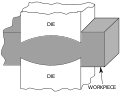 Edging
 -
 Fullering


Impression-die forging
[edit]Impression-die forging is also called "closed-die forging". In impression-die forging, the metal is placed in a die resembling a mold, which is attached to an anvil. Usually, the hammer die is shaped as well. The hammer is then dropped on the workpiece, causing the metal to flow and fill the die cavities. The hammer is generally in contact with the workpiece on the scale of milliseconds. Depending on the size and complexity of the part, the hammer may be dropped multiple times in quick succession. Excess metal is squeezed out of the die cavities, forming what is referred to as "flash". The flash cools more rapidly than the rest of the material; this cool metal is stronger than the metal in the die, so it helps prevent more flash from forming. This also forces the metal to completely fill the die cavity. After forging, the flash is removed.[8][15]
In commercial impression-die forging, the workpiece is usually moved through a series of cavities in a die to get from an ingot to the final form. The first impression is used to distribute the metal into the rough shape in accordance to the needs of later cavities; this impression is called an "edging", "fullering", or "bending" impression. The following cavities are called "blocking" cavities, in which the piece is working into a shape that more closely resembles the final product. These stages usually impart the workpiece with generous bends and large fillets. The final shape is forged in a "final" or "finisher" impression cavity. If there is only a short run of parts to be done, then it may be more economical for the die to lack a final impression cavity and instead machine the final features.[16]
Impression-die forging has been improved in recent years through increased automation which includes induction heating, mechanical feeding, positioning and manipulation, and the direct heat treatment of parts after forging.[17] One variation of impression-die forging is called "flashless forging", or "true closed-die forging". In this type of forging, the die cavities are completely closed, which keeps the workpiece from forming flash. The major advantage to this process is that less metal is lost to flash. Flash can account for 20 to 45% of the starting material. The disadvantages of this process include additional cost due to a more complex die design and the need for better lubrication and workpiece placement.[16]
There are other variations of part formation that integrate impression-die forging. One method incorporates casting a forging preform from liquid metal. The casting is removed after it has solidified, but while still hot. It is then finished in a single cavity die. The flash is trimmed, then the part is quench hardened. Another variation follows the same process as outlined above, except the preform is produced by the spraying deposition of metal droplets into shaped collectors (similar to the Osprey process).[17]
Closed-die forging has a high initial cost due to the creation of dies and required design work to make working die cavities. However, it has low recurring costs for each part, thus forgings become more economical with greater production volume. This is one of the major reasons closed-die forgings are often used in the automotive and tool industries. Another reason forgings are common in these industrial sectors is that forgings generally have about a 20 percent higher strength-to-weight ratio compared to cast or machined parts of the same material.[16]
Design of impression-die forgings and tooling
[edit]Forging dies are usually made of high-alloy or tool steel. Dies must be impact- and wear-resistant, maintain strength at high temperatures, and have the ability to withstand cycles of rapid heating and cooling. In order to produce a better, more economical die the following standards are maintained:[17]
- The dies part along a single, flat plane whenever possible. If not, the parting plane follows the contour of the part.
- The parting surface is a plane through the center of the forging and not near an upper or lower edge.
- Adequate draft is provided; usually at least 3° for aluminium and 5° to 7° for steel.
- Generous fillets and radii are used.
- Ribs are low and wide.
- The various sections are balanced to avoid extreme difference in metal flow.
- Full advantage is taken of fiber flow lines.
- Dimensional tolerances are not closer than necessary.
Barrelling occurs when, due to friction between the work piece and the die or punch, the work piece bulges at its centre in such a way as to resemble a barrel. This leads to the central part of the work piece to come in contact with the sides of the die sooner than if there were no friction present, creating a much greater increase in the pressure required for the punch to finish the forging.
The dimensional tolerances of a steel part produced using the impression-die forging method are outlined in the table below. The dimensions across the parting plane are affected by the closure of the dies, and are therefore dependent on die wear and the thickness of the final flash. Dimensions that are completely contained within a single die segment or half can be maintained at a significantly greater level of accuracy.[15]
| Mass [kg (lb)] | Minus tolerance [mm (in)] | Plus tolerance [mm (in)] |
|---|---|---|
| 0.45 (1) | 0.15 (0.006) | 0.46 (0.018) |
| 0.91 (2) | 0.20 (0.008) | 0.61 (0.024) |
| 2.27 (5) | 0.25 (0.010) | 0.76 (0.030) |
| 4.54 (10) | 0.28 (0.011) | 0.84 (0.033) |
| 9.07 (20) | 0.33 (0.013) | 0.99 (0.039) |
| 22.68 (50) | 0.48 (0.019) | 1.45 (0.057) |
| 45.36 (100) | 0.74 (0.029) | 2.21 (0.087) |
A lubricant is used when forging to reduce friction and wear. It is also used as a thermal barrier to restrict heat transfer from the workpiece to the die. Finally, the lubricant acts as a parting compound to prevent the part from sticking in the dies.[15]
Press forging
[edit]Press forging works by slowly applying a continuous pressure or force, which differs from the near-instantaneous impact of drop-hammer forging. The amount of time the dies are in contact with the workpiece is measured in seconds (as compared to the milliseconds of drop-hammer forges). The press forging operation can be done either cold or hot.[15]
The main advantage of press forging, as compared to drop-hammer forging, is its ability to deform the complete workpiece. Drop-hammer forging usually only deforms the surfaces of the work piece in contact with the hammer and anvil; the interior of the workpiece will stay relatively undeformed. Another advantage to the process includes the knowledge of the new part's strain rate. By controlling the compression rate of the press forging operation, the internal strain can be controlled.
There are a few disadvantages to this process, most stemming from the workpiece being in contact with the dies for such an extended period of time. The operation is a time-consuming process due to the amount and length of steps. The workpiece will cool faster because the dies are in contact with workpiece; the dies facilitate drastically more heat transfer than the surrounding atmosphere. As the workpiece cools it becomes stronger and less ductile, which may induce cracking if deformation continues. Therefore, heated dies are usually used to reduce heat loss, promote surface flow, and enable the production of finer details and closer tolerances. The workpiece may also need to be reheated.
When done in high productivity, press forging is more economical than hammer forging. The operation also creates closer tolerances. In hammer forging a lot of the work is absorbed by the machinery; when in press forging, the greater percentage of work is used in the work piece. Another advantage is that the operation can be used to create any size part because there is no limit to the size of the press forging machine. New press forging techniques have been able to create a higher degree of mechanical and orientation integrity. By the constraint of oxidation to the outer layers of the part, reduced levels of microcracking occur in the finished part.[15]
Press forging can be used to perform all types of forging, including open-die and impression-die forging. Impression-die press forging usually requires less draft than drop forging and has better dimensional accuracy. Also, press forgings can often be done in one closing of the dies, allowing for easy automation.[18]
Upset forging
[edit]Upset forging increases the diameter of the workpiece by compressing its length.[18] Based on number of pieces produced, this is the most widely used forging process.[18] A few examples of common parts produced using the upset forging process are engine valves, couplings, bolts, screws, and other fasteners.
Upset forging is usually done in special high-speed machines called crank presses. The machines are usually set up to work in the horizontal plane, to facilitate the quick exchange of workpieces from one station to the next, but upsetting can also be done in a vertical crank press or a hydraulic press. The initial workpiece is usually wire or rod, but some machines can accept bars up to 25 cm (9.8 in) in diameter and a capacity of over 1000 tons. The standard upsetting machine employs split dies that contain multiple cavities. The dies open enough to allow the workpiece to move from one cavity to the next; the dies then close and the heading tool, or ram, then moves longitudinally against the bar, upsetting it into the cavity. If all of the cavities are utilized on every cycle, then a finished part will be produced with every cycle, which makes this process advantageous for mass production.[18]
These rules must be followed when designing parts to be upset forged:[19]
- The length of unsupported metal that can be upset in one blow without injurious buckling should be limited to three times the diameter of the bar.
- Lengths of stock greater than three times the diameter may be upset successfully, provided that the diameter of the upset is not more than 1.5 times the diameter of the stock.
- In an upset requiring stock length greater than three times the diameter of the stock, and where the diameter of the cavity is not more than 1.5 times the diameter of the stock, the length of unsupported metal beyond the face of the die must not exceed the diameter of the bar.
Automatic hot forging
[edit]The automatic hot forging process involves feeding mill-length steel bars (typically 7 m (23 ft) long) into one end of the machine at room temperature and hot forged products emerge from the other end. This all occurs rapidly; small parts can be made at a rate of 180 parts per minute (ppm) and larger can be made at a rate of 90 ppm. The parts can be solid or hollow, round or symmetrical, up to 6 kg (13 lb), and up to 18 cm (7.1 in) in diameter. The main advantages to this process are its high output rate and ability to accept low-cost materials. Little labor is required to operate the machinery.
There is no flash produced so material savings are between 20 and 30% over conventional forging. The final product is a consistent 1,050 °C (1,920 °F) so air cooling will result in a part that is still easily machinable (the advantage being the lack of annealing required after forging). Tolerances are usually ±0.3 mm (0.012 in), surfaces are clean, and draft angles are 0.5 to 1°. Tool life is nearly double that of conventional forging because contact times are on the order of 0.06-second. The downside is that this process is only feasible on smaller symmetric parts and cost; the initial investment can be over $10 million, so large quantities are required to justify this process.[20]
The process starts by heating the bar to 1,200 to 1,300 °C (2,190 to 2,370 °F) in less than 60 seconds using high-power induction coils. It is then descaled with rollers, sheared into blanks, and transferred through several successive forming stages, during which it is upset, preformed, final forged, and pierced (if necessary). This process can also be coupled with high-speed cold-forming operations. Generally, the cold forming operation will do the finishing stage so that the advantages of cold-working can be obtained, while maintaining the high speed of automatic hot forging.[21]
Examples of parts made by this process are: wheel hub unit bearings, transmission gears, tapered roller bearing races, stainless steel coupling flanges, and neck rings for liquid propane (LP) gas cylinders.[22] Manual transmission gears are an example of automatic hot forging used in conjunction with cold working.[23]
Roll forging
[edit]Roll forging is a process where round or flat bar stock is reduced in thickness and increased in length. Roll forging is performed using two cylindrical or semi-cylindrical rolls, each containing one or more shaped grooves. A heated bar is inserted into the rolls and when it hits a spot the rolls rotate and the bar is progressively shaped as it is rolled through the machine. The piece is then transferred to the next set of grooves or turned around and reinserted into the same grooves. This continues until the desired shape and size is achieved. The advantage of this process is there is no flash and it imparts a favorable grain structure into the workpiece.[24]
Examples of products produced using this method include axles, tapered levers and leaf springs.
Net-shape and near-net-shape forging
[edit]Also known as precision forging, it was developed to minimize cost and waste post-forging such that the resultant product needs little or no final machining. Costs are reduced by using less material, producing less scrap, less energy used, and less or no additional machining. Precision forging also requires less draft, 1° to 0°. The downside of this process is cost, it is only implemented when significant cost reduction can be achieved.[25]
Cold forging
[edit]Near net shape forging is most common when parts are forged without heating the slug, bar or billet. Aluminum is a common material that can be cold forged depending on final shape. Lubrication of the parts being formed is critical to increase the life of the mating dies.
Induction forging
[edit]Unlike the above processes, induction forging is based on the type of heating style used. Many of the above processes can be used in conjunction with this heating method.
Multidirectional forging
[edit]Multidirectional forging is forming of a work piece in a single step in several directions. The multidirectional forming takes place through constructive measures of the tool. The vertical movement of the press ram is redirected using wedges which distributes and redirects the force of the forging press in horizontal directions.[26]
Isothermal forging
[edit]Isothermal forging is a process by which the materials and the die are heated to the same temperature (iso- meaning "equal"). Adiabatic heating is used to assist in the deformation of the material, meaning the strain rates are highly controlled. This technique is commonly used for forging aluminium, which has a lower forging temperature than steels. Forging temperatures for aluminum are around 430 °C (806 °F), while steels and super alloys can be 930 to 1,260 °C (1,710 to 2,300 °F).
Benefits:
- Near net shapes which lead to lower machining requirements and therefore lower scrap rates
- Reproducibility of the part
- Due to the lower heat loss smaller machines can be used to make the forging
Disadvantages:
- Higher die material costs to handle temperatures and pressures
- Uniform heating systems are required
- Protective atmospheres or vacuum to reduce oxidation of the dies and material
- Low production rates
Materials and applications
[edit]
Forging of steel
[edit]Depending on the forming temperature steel forging can be divided into:[27]
- Hot forging of steel
- Forging temperatures above the recrystallization temperature between 950–1250 °C
- Good formability
- Low forming forces
- Constant tensile strength of the workpieces
- Warm forging of steel
- Forging temperatures between 750–950 °C
- Less or no scaling at the workpiece surface
- Narrower tolerances achievable than in hot forging
- Limited formability and higher forming forces than for hot forging
- Lower forming forces than in cold forming
- Cold forging of steel
- Forging temperatures at room conditions, self-heating up to 150 °C due to the forming energy
- Narrowest tolerances achievable
- No scaling at workpiece surface
- Increase of strength and decrease of ductility due to strain hardening
- Low formability and high forming forces are necessary
For industrial processes steel alloys are primarily forged in hot condition. Brass, bronze, copper, precious metals and their alloys are manufactured by cold forging processes; each metal requires a different forging temperature.
Forging of aluminium
[edit]- Aluminium forging is performed at a temperature range between 350–550 °C
- Forging temperatures above 550 °C are too close to the solidus temperature of the alloys and lead in conjunction with varying effective strains to unfavorable workpiece surfaces and potentially to a partial melting as well as fold formation.[28]
- Forging temperatures below 350 °C reduce formability by increasing the yield stress, which can lead to unfilled dies, cracking at the workpiece surface and increased die forces
Due to the narrow temperature range and high thermal conductivity, aluminium forging can only be realized in a particular process window. To provide good forming conditions a homogeneous temperature distribution in the entire workpiece is necessary. Therefore, the control of the tool temperature has a major influence to the process. For example, by optimizing the preform geometries the local effective strains can be influenced to reduce local overheating for a more homogeneous temperature distribution.[29]
Application of aluminium forged parts
[edit]High-strength aluminium alloys have the tensile strength of medium strong steel alloys while providing significant weight advantages. Therefore, aluminium forged parts are mainly used in aerospace, automotive industry and many other fields of engineering especially in those fields, where highest safety standards against failure by abuse, by shock or vibratory stresses are needed. Such parts are for example pistons,[citation needed] chassis parts, steering components and brake parts. Commonly used alloys are AlSi1MgMn (EN AW-6082) and AlZnMgCu1,5 (EN AW-7075). About 80% of all aluminium forged parts are made of AlSi1MgMn. The high-strength alloy AlZnMgCu1,5 is mainly used for aerospace applications.[30]
Forging of magnesium
[edit]- Magnesium forging occurs at a temperature range between 290–450 °C[31]
Magnesium alloys are more difficult to forge due to their low plasticity, low sensitivity to strain rates and narrow forming temperature.[31] Using semi-open die hot forging with a three-slide forging press (TSFP) has become a newly developed forging method for Mg–Al alloy AZ31, commonly used in forming aircraft brackets.[32][33] This forging method has shown to improve tensile properties but lacks uniform grain size.[34][35] Even though the application of magnesium alloys increases by 15–20% each year in the aerospace and automotive industry, forging magnesium alloys with specialized dies is expensive and an unfeasible method to produce parts for a mass market. Instead, most magnesium alloy parts for industry are produced by casting methods.
Equipment
[edit]

The most common type of forging equipment is the hammer and anvil. Principles behind the hammer and anvil are still used today in drop-hammer equipment. The principle behind the machine is simple: raise the hammer and drop it or propel it into the workpiece, which rests on the anvil. The main variations between drop-hammers are in the way the hammer is powered; the most common being air and steam hammers. Drop-hammers usually operate in a vertical position. The main reason for this is excess energy (energy that is not used to deform the workpiece) that is not released as heat or sound needs to be transmitted to the foundation. Moreover, a large machine base is needed to absorb the impacts.[9]
To overcome some shortcomings of the drop-hammer, the counterblow machine or impactor is used. In a counterblow machine both the hammer and anvil move and the workpiece is held between them. Here excess energy becomes recoil. This allows the machine to work horizontally and have a smaller base. Other advantages include less noise, heat and vibration. It also produces a distinctly different flow pattern. Both of these machines can be used for open-die or closed-die forging.[36]
Forging presses
[edit]A forging press, often just called a press, is used for press forging. There are two main types: mechanical and hydraulic presses. Mechanical presses function by using cams, cranks and/or toggles to produce a preset (a predetermined force at a certain location in the stroke) and reproducible stroke. Due to the nature of this type of system, different forces are available at different stroke positions. Mechanical presses are faster than their hydraulic counterparts (up to 50 strokes per minute). Their capacities range from 3 to 160 MN (300 to 18,000 short tons-force). Hydraulic presses, such as the four-die device, use fluid pressure and a piston to generate force. The advantages of a hydraulic press over a mechanical press are its flexibility and greater capacity. The disadvantages include a slower, larger, and costlier machine to operate.[15]
The roll forging, upsetting, and automatic hot forging processes all use specialized machinery.
| Force (tonnes) |
Ingot size (tonnes) |
Company | Location |
|---|---|---|---|
| 16,500 | 600 | Shanghai Electric Group[38] | Shanghai, China |
| 16,000 | 600 | China National Erzhong Group[38] | Deyang, China |
| 14,000 | 600 | Japan Steel Works | Japan |
| 15,000 | 580 | China First Heavy Industries Group[39] | Heilongjiang, China |
| 13,000 | Doosan | South Korea |
| Force (tonnes) |
Force (tons) |
Ingot size (tonnes) |
Company | Location |
|---|---|---|---|---|
| 100,000 | (110,231) | Giva Group[40] | Rho, Lombardy, Italy | |
| 80,000 | (88,200) | >150 | China Erzhong[38] | Deyang, China |
| 75,000 | (82,690) | VSMPO-AVISMA | Russia | |
| 65,000 | (71,660) | Aubert & Duval[41][42] | Issoire, France | |
| 53,500 | (60,000) | Weber Metals, Inc.[43] | California, United States | |
| (45,350) | 50,000 | 20 | Alcoa 50,000 ton forging press Alcoa,[44][45] Wyman Gordon[46][47] |
US |
| 40,000 | (44,100) | Aubert & Duval[41] | Pamiers, France | |
| 30,000 | (33,080) | 8 | Wyman Gordon[48] | Livingston, Scotland |
| 30,000 | (33,070) | Weber Metals, Inc.[49] | California, United States | |
| 30,000 | (33,070) | Howmet Aerospace[50] | Georgia, United States |
See also
[edit]
References
[edit]- ^ a b c d Degarmo, p. 389
- ^ a b Heavy Manufacturing of Power Plants Archived 2010-11-08 at the Wayback Machine World Nuclear Association, September 2010. Retrieved: 25 September 2010.
- ^ "Forging: The Early Years". All Metals & Forge Group. 22 January 2013. Archived from the original on 3 January 2018. Retrieved 1 October 2013.
- ^ "Things To Know About Forging". sites.google.com.
- ^ FORGING AND STAMPING NONFERROUS METALS. HANDBOOK (10 May, 1984, By N. I. Korneyev, V. M. Arzhakov, et al)https://apps.dtic.mil/sti/tr/pdf/ADA141689.pdf
- ^ Degarmo, p. 373
- ^ Degarmo, p. 375
- ^ a b Degarmo, p. 391
- ^ a b c Degarmo, p. 390
- ^ "Forging Shapes". All Metals & Forge Group. 4 January 2013. Archived from the original on 1 July 2018. Retrieved 1 October 2013.
- ^ "Forged Crankshaft Advantages". Great Lakes Forge. Retrieved 28 February 2014.
- ^ "Advantages of Forging" (PDF). Frisa. Archived from the original (PDF) on 2021-04-17. Retrieved 2020-08-31.
- ^ Cast steel: Forging, archived from the original on 18 February 2009, retrieved 3 March 2010
- ^ Kaushish, J. P. (2008), Manufacturing Processes, PHI Learning, p. 469, ISBN 978-81-203-3352-9
- ^ a b c d e f g Degarmo, p. 394
- ^ a b c Degarmo, p. 392
- ^ a b c Degarmo, p. 393
- ^ a b c d Degarmo, p. 395
- ^ Degarmo, pp. 395–396
- ^ Degarmo, pp. 396–397
- ^ Degarmo, p. 396
- ^ Precision Hot Forging Archived 2008-10-20 at the Wayback Machine. Samtech. Retrieved 22 November 2007
- ^ Precision Composite Forging Archived 2008-04-17 at the Wayback Machine. Samtech. Retrieved 22 November 2007
- ^ Degarmo, pp. 397–398
- ^ Degarmo, p. 398
- ^ Behrens, Stonis, Rüther, Blohm: Flash reduced forging of complicated high duty parts using preforming operations, IPH – Institut für Integrierte Produktion Hannover gGmbH, Hannover, 2014.
- ^ Doege, E., Behrens, B.-A.: Handbuch Umformtechnik: Grundlagen, Technologien, Maschinen (in German), Springer Verlag, 2010, p. 7
- ^ Doege, E.; Behrens, B.-A.: Handbuch Umformtechnik: Grundlagen, Technologien, Maschinen, Springer Verlag, 2010, pp. 671f.
- ^ Stonis, M.: Mehrdirektionales Schmieden von flachen Aluminiumlangteilen (in German), In: Behrens, B.-A.; Nyhuis, P.; Overmeyer, L. (ed.): Berichte aus dem IPH, Volume 01/2011, PZH Produktionstechnisches Zentrum GmbH, Garbsen 2011.
- ^ Richter, J.; Stonis, M.: Qualitätsverbesserung beim Aluminiumschmieden (in German), In Aluminium Praxis, Giesel Verlag GmbH, Volume 20 (2015), Issue 6/15, p. 20.
- ^ a b Papenberg, Nikolaus P et al. “Mg-Alloys for Forging Applications-A Review.” Materials vol. 13,4 985. 22 Feb. 2020, doi:10.3390/ma13040985
- ^ Dziubińska, A., Gontarz, A., Dziubiński, M., & Barszcz, M. (2016). THE FORMING OF MAGNESIUM ALLOY FORGINGS FOR AIRCRAFT AND AUTOMOTIVE APPLICATIONS. Advances in Science and Technology Research Journal. https://doi.org/10.12913/22998624/64003
- ^ Dziubinska, A., & Gontarz, A. (2015). A new method for producing magnesium alloy twin-rib aircraft brackets. Aircraft Engineering and Aerospace Technology. https://doi.org/10.1108/AEAT-10-2013-0184
- ^ Dziubinska, A., Gontarz, A., & Zagórski, I. (2018). Qualitative research on AZ31 magnesium alloy aircraft brackets with a triangular rib produced by a new forging method. Aircraft Engineering and Aerospace Technology. https://doi.org/10.1108/AEAT-09-2016-0160
- ^ Dziubińska, A., Gontarz, A., Horzelska, K., & Pieśko, P. (2015). The Microstructure and Mechanical Properties of AZ31 Magnesium Alloy Aircraft Brackets Produced by a New Forging Technology. Procedia Manufacturing. https://doi.org/10.1016/j.promfg.2015.07.059
- ^ Degarmo, pp. 392–393
- ^ Kidd, Steve. New nuclear build – sufficient supply capability? Archived June 13, 2011, at the Wayback Machine Nuclear Engineering International, 3 March 2009. Retrieved: 25 September 2010
- ^ a b c "China Building World's Largest Press Forge". China Tech Gadget. 27 October 2011. Archived from the original on 22 July 2012. Retrieved 12 February 2012.
- ^ "World's Largest 15000MN hydraulic forging press". China Tech Gadget. 3 November 2011. Retrieved 15 May 2012.
- ^ "Giva Group". Retrieved 1 February 2025.
- ^ a b "Eramet alloys". Archived from the original on 10 December 2010. Retrieved 18 May 2012.
- ^ Altan, Taylan (1983). Feasibility of Using a Large Press (80,000 – 200,000 Ton) for Manufacturing Future Components on Army Systems. p. 12. Archived from the original on April 8, 2013.
- ^ Dean M. Peters (10 December 2018). "Weber Metals' New 60,000-Ton Hydraulic Press". Forge Magazine. Retrieved 25 April 2020.
- ^ Heffernan, Tim (8 February 2012). "Iron Giant". The Atlantic. Retrieved 12 February 2012.
- ^ 50,000 Ton Closed Die Forging Press (PDF). American Society of Mechanical Engineers. 1981. Archived from the original (PDF) on 2012-02-27. Retrieved 2012-05-15. History of the Mesta Press at Alcoa
- ^ The Wyman-Gordon 50,000 Ton Forging Press (PDF). American Society of Mechanical Engineers. 1983. Archived from the original (PDF) on 2015-02-01. History of the Loewy Press at Wyman-Gordon
- ^ Edson, Peter (18 April 1952). "Revolutionary Metal Press Cuts Cost of Planes and Guns". Sarasota Journal. Retrieved 12 February 2012.
- ^ "Wyman Gordon Livingston". Retrieved 18 May 2012.
- ^ "Weber Metals". Retrieved 18 July 2013.
- ^ "Howmet Aerospace". Retrieved 18 May 2012.
Bibliography
[edit]- Degarmo, E. Paul; Black, J. T.; Kohser, Ronald A. (2011). Materials and Processes in Manufacturing (11th ed.). Wiley. ISBN 978-0-470-92467-9.
- Doege, E.; Behrens, B.-A.: Handbuch Umformtechnik: Grundlagen, Technologien, Maschinen (in German), 2nd Edition, Springer Verlag, 2010, ISBN 978-3-642-04248-5
- Ostermann, F.: Anwendungstechnologie Aluminium (in German), 3rd Edition, Springer Verlag, 2014, ISBN 978-3-662-43806-0

| International | |
|---|---|
| National | |
| Other | |

Forging
View on GrokipediaHistory
Ancient origins
The earliest evidence of forging dates back to around 4000 BCE in Mesopotamia and ancient Egypt, where artisans employed basic techniques involving simple stone or metal hammers struck against rudimentary anvils to shape native copper into tools and weapons.[6] These early methods relied on cold-working or annealing heated metal over open fires, marking the transition from the Stone Age to the Copper Age and enabling the production of functional implements like axes and adzes.[7] By the Bronze Age, around 2000 BCE, the invention and adoption of bellows revolutionized forging by allowing for sustained higher temperatures in furnaces, which facilitated the smelting and working of copper and its alloy bronze.[8] In Egypt, hieroglyphic depictions from this period illustrate foot-operated bellows directing air into forges, enhancing the efficiency of metal heating and deformation processes essential for crafting more durable bronze items.[8] This technological advancement spread across the Near East, supporting larger-scale production of alloys that combined copper with tin for superior strength. Prominent artifacts exemplify these early forging achievements, such as Egyptian copper chisels from the Old Kingdom (circa 2686–2181 BCE), which were hammered from cast ingots to form sharp edges for stoneworking and woodworking.[9] Similarly, Hittite iron swords and daggers from the late Bronze Age (circa 1400 BCE), forged from smelted or meteoric iron, demonstrate advanced heat treatment and hammering techniques that produced harder edges than contemporary bronze weapons.[10] Forging held profound cultural significance in ancient societies, symbolizing craftsmanship and divine inspiration; in Greece, blacksmiths associated with the god Hephaestus enjoyed elevated status for producing arms and armor vital to warfare and heroism.[11] In Rome, blacksmiths operated within collegia—formal craft associations that provided mutual support, regulated practices, and fostered community ties among metalworkers essential to imperial infrastructure and military needs.[12] These guilds underscored forging's role in sustaining economic and social structures, evolving later into more mechanized industrial processes.Industrial developments
The introduction of steam-powered hammers marked a pivotal shift in forging during the early 19th century, transitioning the craft from labor-intensive manual methods to mechanized production capable of handling large-scale operations. In 1842, Scottish engineer James Nasmyth patented the steam hammer, a device that harnessed steam pressure to deliver precise and powerful blows, enabling the forging of massive components such as propeller shafts and locomotive parts that were previously unfeasible with traditional trip hammers.[13] This innovation addressed the growing demands of Britain's expanding industrial base, where the need for robust metalwork outpaced human strength, and it laid the groundwork for standardized forging processes that improved efficiency and output.[14] The Industrial Revolution further propelled forging into the heart of mechanized manufacturing, particularly for infrastructure and transportation sectors like railroads and heavy machinery. By the mid-19th century, steam hammers and related equipment standardized the production of rails, axles, and engine components, facilitating the rapid expansion of rail networks across Europe and North America that connected factories to markets and spurred economic integration.[13] A landmark demonstration occurred at the 1851 Great Exhibition in London's Crystal Palace, where Nasmyth's steam hammer showcased its precision in forging intricate metal pieces, highlighting Britain's industrial prowess and influencing global adoption of such technologies for machinery production.[14] This event underscored forging's role in the era's technological optimism, as exhibited components exemplified how forged steel enhanced the durability and scale of steam engines and rail systems essential to industrial progress.[15] In the late 19th century, the development of drop forging using hammers advanced precision manufacturing, allowing for the repeatable shaping of complex parts under controlled impacts from raised dies. These drop hammers, powered initially by steam and later by mechanical linkages, emerged as a refinement of earlier drop hammers, enabling the mass production of uniform components with minimal waste and high strength.[16] This technique proved instrumental in emerging industries, such as the bicycle boom of the 1890s, where drop-forged cranks, frames, and pedals provided the lightweight yet resilient structures needed for safer, faster designs, and in early automobiles, where it produced critical elements like gears and suspension parts that withstood vibrational stresses.[13] The economic ramifications of these advancements were profound, fostering the proliferation of specialized forging shops that capitalized on the demand for industrialized goods. By 1900, the number of such facilities had surged in Europe—particularly in Britain and Germany—and the United States, where forging output supported the steel-intensive growth of railroads and urban machinery, contributing to the dramatic growth of U.S. manufacturing capacity, which increased over fivefold from 1870 to 1900.[13] This expansion not only created thousands of jobs in metalworking but also integrated forging into supply chains, driving down costs for end-users in transportation and engineering while establishing regional hubs like Manchester and Pittsburgh as global centers for forged products.[17]Modern advancements
Following World War II, the United States Air Force initiated the Heavy Press Program in 1950 to develop massive hydraulic forging presses for producing large, high-strength components essential for aerospace applications. This effort culminated in the construction of several 50,000-ton capacity presses between 1952 and 1957, including the Alcoa Mesta press, which enabled the forging of complex aluminum and titanium structures for military and commercial aircraft, significantly advancing aviation manufacturing capabilities.[18][19] In the 1980s, the introduction of finite element analysis (FEA) revolutionized forging design by allowing computational simulation of material flow, stress distribution, and defect formation during the process, thereby minimizing physical trial-and-error iterations and optimizing die designs. Early FEA applications in forging, building on foundational work from the 1970s, gained widespread industrial adoption through improved computing power, enabling more accurate predictions of deformation in bulk forming operations like extrusion and upsetting. This shift reduced development costs and time, with industry reports noting a surge in computer-aided forging simulations by the late 1980s.[20] Post-2000 advancements have integrated hybrid processes combining forging with additive manufacturing (AM) to produce high-performance components, such as near-net-shape Ti-6Al-4V parts, by using AM to create preforms that are then forged for enhanced density and mechanical properties. These hybrid routes reduce material waste and machining needs while improving efficiency for aerospace and automotive applications. Concurrently, the adoption of eco-friendly, water-dilutable lubricants, such as synthetic graphite-free formulations, has minimized environmental impact by lowering emissions and enabling easier disposal, with industry formulations offering high biodegradability without compromising lubrication efficacy.[21][22][23] A notable milestone in the 2010s was the application of isothermal forging for titanium aluminide turbine blades, which maintains uniform temperatures to produce lightweight, heat-resistant components for advanced jet engines, enhancing fuel efficiency in commercial aviation. This technique supports the production of blades with refined microstructures capable of withstanding extreme operational stresses.[24][25] In the 2020s, advancements include the integration of artificial intelligence for real-time process monitoring and predictive maintenance, alongside further emphasis on sustainable practices to achieve net-zero emissions in forging operations.[26]Basic Principles
Definition and deformation processes
Forging is a manufacturing process that shapes metal workpieces through the application of compressive forces, typically using hammers, presses, or dies, without melting the material. This plastic deformation refines the internal grain structure, aligning grains along the principal stress directions to enhance mechanical properties such as strength and toughness. Unlike other methods, forging produces parts with directional grain flow that follows the contour of the final shape, resulting in superior fatigue resistance and reliability compared to cast components, which exhibit more isotropic microstructures prone to defects like porosity. The primary deformation mechanism in forging is plastic deformation, which occurs when stresses exceed the material's yield strength, enabling permanent shape change through the movement of dislocations within the crystal lattice. As deformation proceeds, dislocations multiply and interact, leading to work hardening that increases the material's resistance to further deformation by impeding subsequent dislocation motion. In processes involving elevated temperatures, such as hot forging, dynamic recovery and recrystallization can occur, where new strain-free grains nucleate and grow, counteracting work hardening to maintain ductility and allow continued deformation without fracture. These mechanisms collectively refine the microstructure, breaking down coarse cast structures into finer, more uniform grains.[27] The force required for forging derives from the fundamental relationship between applied stress and material response during plastic flow. To initiate and sustain deformation, the applied compressive stress must equal or exceed the material's flow stress, defined as the stress needed to maintain constant plastic strain rate under given conditions of temperature, strain, and strain rate. For a frictionless, homogeneous deformation in a simple compression test approximating ideal open-die forging, the forging force is given byTemperature classifications
Forging processes are classified based on the operating temperature relative to the material's melting point (T_m, in Kelvin), which significantly influences the material's ductility, required forming forces, and final properties. These classifications—hot, warm, and cold forging—determine the deformation behavior, with higher temperatures generally promoting easier flow but potentially introducing issues like oxidation, while lower temperatures enhance precision and strength at the cost of higher energy input.[31] Hot forging occurs above the recrystallization temperature, typically in the range of 0.5 to 0.8 T_m (or about 70-80% of the absolute melting temperature), such as 900-1200°C for steels, where dynamic recovery and recrystallization enable extensive ductile flow with minimal residual stresses and work hardening.[31][32] This regime allows for large deformations in a single operation, reducing the need for multiple passes and improving grain refinement, though it requires careful control to avoid defects like hot shortness near the melting point (limited to ~40°C below T_m).[31] Warm forging takes place at intermediate temperatures, roughly 0.3 to 0.6 T_m (e.g., 500-900°C for steels), bridging the benefits of hot and cold processes by offering improved ductility over cold forging while maintaining better dimensional precision and surface finish than hot forging, with lower energy consumption due to reduced flow stress compared to cold conditions.[31] This range minimizes scaling and oxidation issues associated with higher temperatures, making it suitable for precision components, though it still demands higher forces than hot forging.[31] Cold forging is conducted below 0.3 T_m, typically at or near room temperature (up to ~0.25 T_m, or around 200-300°C for steels including deformation-induced heating), emphasizing high-strength outcomes through significant work hardening but requiring substantially greater forming forces due to limited ductility and no recrystallization.[31] It excels in producing parts with excellent surface quality and tight tolerances, such as fasteners, but is limited to ductile materials and simpler shapes to avoid cracking.[31] The flow stress (σ) in forging exhibits strong temperature dependence, often modeled by an Arrhenius-type relation:where σ_0 is a reference stress, Q is the activation energy for deformation, R is the gas constant, and T is the absolute temperature; this exponential form captures how flow stress decreases sharply with rising temperature, facilitating lower force requirements in hot regimes.[33] Higher temperatures reduce σ by promoting thermally activated dislocation motion, while strain rate effects can modify this through additional terms, underscoring the need for temperature control in process design.[33][31]