Hubbry Logo
GhassanidsGhassanidsMain
Open search
Ghassanids
Community hub
Ghassanids
logo
8 pages, 0 posts
0 subscribers
Be the first to start a discussion here.
Ghassanids
Ghassanids
from Wikipedia

Key Information

The Ghassanids,[a] also known as the Jafnids,[2] were an Arab tribe. Originally from South Arabia, they migrated to the Levant in the 3rd century and established what would eventually become a Christian kingdom under the aegis of the Byzantine Empire.[3][4] However, some of the Ghassanids may have already adhered to Christianity before they emigrated from South Arabia to escape religious persecution.[4][5]

As a Byzantine vassal, the Ghassanids participated in the Byzantine–Sasanian Wars, fighting against the Sasanian-allied Lakhmids, who were also an Arabian tribe, but adhered to the non-Chalcedonian Church of the East.[3][5] The lands of the Ghassanids also acted as a buffer zone protecting lands that had been annexed by the Romans against raids by Bedouins.[citation needed]

After just over 400 years of existence, the Ghassanid kingdom fell to the Rashidun Caliphate during the Muslim conquest of the Levant. A few of the tribe's members then converted to Islam, while most dispersed themselves amongst Melkites and Syriacs in what is now Jordan, Israel, Syria, Palestine, and Lebanon.[4]

History

[edit]

Establishment

[edit]

Genealogy and emigration from South Arabia

[edit]

In the Arab genealogical tradition, which developed during the early Islamic period, the Ghassanids were considered a branch of the Azd tribe of South Arabia. In this genealogical scheme, their ancestor was Jafna, a son of Amr Muzayqiya ibn Amir ibn Haritha ibn Imru’ al Qais ibn Tha’labah ibn Mazin ibn Azd, through whom the Ghassanids were purportedly linked with the Ansar (the Aws and Khazraj tribes of Medina), who were the descendants of Jafna's brother Tha'laba.[6] According to the historian Brian Ulrich, the links between Ghassan, the Ansar, and the wider Azd are historically tenuous, as these groups are almost always counted separately from each other in sources other than post-8th-century genealogical works and the story of the 'Scattering of Azd'.[7] In the latter story, the Azd migrate northward from South Arabia and different groups of the tribe split off in different directions, with the Ghassan being one such group.[8]

Settlement in the Roman frontier

[edit]

Per the "Scattering of Azd" story, the Ghassanids eventually settled within the Roman limes.[3][9] The tradition of Ghassanid migration finds support in the Geography of Ptolemy, which locates a tribe called the Kassanitai south of the Kinaidokolpitai and the river Baitios (probably the wadi Baysh). These are probably the people called Casani in Pliny the Elder, Gasandoi in Diodorus Siculus and Kasandreis in Photios I of Constantinople (relying on older sources).[10][11] The date of the migration to the Levant is unclear, but they are believed to have first arrived in the region of Syria between 250 and 300, with later waves of migration circa 400.[3] Their earliest appearance in records is dated to 473, when their chief, Amorkesos, signed a treaty with the Byzantine Empire acknowledging their status as foederati controlling parts of Palestine. He apparently became a Chalcedonian Christian at this time. By the year 510, the Ghassanids were no longer Miaphysites, but Chalcedonian.[12][failed verification]

Byzantine period

[edit]
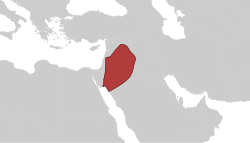
Near East in 565, showing the Ghassanids and their neighbors.

The "Assanite Saracen" chief Podosaces that fought alongside the Sasanians during Julian's Persian expedition in 363 might have been a Ghassanid.[13]

After originally settling in the Levant, the Ghassanids became a client state to the Byzantine Empire. The Romans found a powerful ally in the Ghassanids who acted as a buffer zone against the Lakhmids. In addition, as kings of their own people, they were also phylarchs, native rulers of client frontier states.[14][15] The capital was at Jabiyah in the Golan Heights. Geographically, it occupied much of the eastern Levant, and its authority extended via tribal alliances with other Azdi tribes all the way to the northern Hijaz as far south as Yathrib (Medina).[16]

Byzantine–Sasanian wars

[edit]

The Ghassanids fought alongside the Byzantine Empire against the Persian Sasanians and Arab Lakhmids.[5] The lands of the Ghassanids also continually acted as a buffer zone, protecting Byzantine lands against raids by Bedouin tribes. Among their Arab allies were the Banu Judham and Banu Amilah.

The Byzantines were focused more on the East and a long war with the Sasanians was always their main concern. The Ghassanids maintained their rule as the guardian of trade routes, policed Lakhmid tribes and was a source of troops for the imperial army. The Ghassanid king al-Harith ibn Jabalah (reigned 529–569) supported the Byzantines against the Sasanians and was given in 529 by the emperor Justinian I, the highest imperial title that was ever bestowed upon a foreign ruler; also the status of patricians. In addition to that, al-Harith ibn Jabalah was given the rule over all the Arab allies of the Byzantine Empire.[17] Al-Harith was a Miaphysite Christian; he helped to revive the Syrian Miaphysite (Jacobite) Church and supported Miaphysite development despite Orthodox Byzantium regarding it as heretical. Later Byzantine mistrust and persecution of such religious unorthodoxy brought down his successors, Al-Mundhir III ibn al-Harith (reigned 569–582).

The Ghassanids, who had successfully opposed the Lakhmids of al-Hirah in Lower Mesopotamia, prospered economically and engaged in much religious and public building; they also patronized the arts and at one time entertained the Arab poets al-Nabighah and Hassan ibn Thabit at their courts.[3]

Early Islamic period

[edit]

Rashidun conquest of the Levant

[edit]

The nascent Muslim state in Medina, first under the Islamic prophet Muhammad (d. 632) and lastly under the second caliph, Umar (r. 634–644), made abortive attempts to contact or win over the Ghassan of Syria.[18] The last phylarch of the Ghassan, Jabala ibn al-Ayham, stories of whom are shrouded in legend, led his tribesmen and those of Byzantium's other allied Arab tribes in the Byzantine army that was routed by the Muslims at the Battle of Yarmouk in c. 636. After supposedly embracing Islam, Jabala left the faith and ultimately withdrew with his tribesmen from Syria to Byzantine-held Anatolia in 639, by which time the Muslims had conquered most of Byzantine Syria. Unable to make headway with the Ghassan, the Muslim administration in Syria under its governor Mu'awiya succeeded in allying with the Ghassan's old-established Syrian allies, the Banu Kalb. The latter became the cornerstone of Mu'awiya's military power in Syria, and later, when he became head of the Syria-based Umayyad Caliphate in 661, of the Islamic empire in general.[19]

Umayyad and Abbasid periods

[edit]

Significant remnants of the Ghassan remained in Syria, residing in Damascus and the city's Ghouta countryside.[20] At least nominally and probably gradually, many of these Ghassanids embraced Islam, especially under Mu'awiya's rule. According to the historian Nancy Khalek, they consequently became an "indispensable" group of Muslim society in early Islamic Syria.[20] Mu'awiya actively sought the militarily and administratively experienced Syrian Christians, including the Ghassanids, and members of the tribe served him and later Umayyad caliphs as governors, commanders of the shurta (select troops), scribes, and chamberlains. Several descendants of the tribe's Tha'laba and Imru al-Qays branches are listed in the sources as Umayyad court poets, jurists, and officials in the eastern provinces of Khurasan, Adharbayjan and Armenia.[21]

When Mu'awiya's grandson, Caliph Mu'awiya II, died without a chosen successor amid the Second Muslim Civil War in 684, Umayyad rule was on the verge of collapse in Syria, having already collapsed throughout the caliphate, where the supporters of a rival caliph, the Mecca-based Ibn al-Zubayr, took charge. The Ghassan, along with their tribal allies in Syria, especially the Kalb, supported continued Umayyad rule to secure their interests under the dynasty, and nominated Mu'awiya's distant cousin, Marwan I, as caliph during a summit of the Syrian tribes in the old Ghassanid capital of Jabiyah.[22] Dahhak ibn Qays al-Fihri, the governor of Damascus, meanwhile, threw his backing behind Ibn al-Zubayr. During the Battle of Marj Rahit, which pitted Marwan against Dahhak in a meadow north of Damascus, the scion of the Ghassanid family in Damascus, Yazid ibn Abi al-Nims, led a revolt there and secured control of the city for Marwan, who routed Dahhak and assumed office. In a poem attributed to him, Marwan lauds the Ghassan, as well as the Kalb, Kinda, and Tanukh of Syria, for supporting him.[23]

The above tribes thereafter formed the Yaman faction, in opposition to the Qays tribes which backed Dahhak and Ibn al-Zubayr. The Qays–Yaman rivalry contributed to the downfall of Umayyad rule, with each faction supporting different Umayyad dynasts and governors in what became the Third Muslim Civil War. The Ghassanid Shabib ibn Abi Malik was a leader of the Yaman in Damascus and conspired to assassinate the pro-Qaysi Caliph al-Walid II (r. 743–744). After the latter was killed, the Ghassan marched on Damascus to help install his successor, the Yamani-backed Yazid III (r. 744–744).[24] The toppling of the Umayyads and the advent of the Iraq-based Abbasid Caliphate in 750 "was disastrous for the power, wealth and status of the Arab tribes in Syria", including the Ghassan, according to the historian Hugh N. Kennedy. By the 9th century, the tribe had adopted a settled life, being recorded by the geographer al-Ya'qubi (d. 890) to be living in the Ghouta gardens region of Damascus and in Gharandal in Transjordan.[25]

Scholarly families in Damascus

[edit]

Two Damascene Ghassanid families in particular achieved prominence in early Islamic Syria, those of Yahya ibn Yahya al-Ghassani (d. 750s) and Abu Mushir al-Ghassani (d. 833). The former was the son of Caliph Marwan's head of the shurta, Yahya ibn Qays. Upon returning to Damascus after his stint as a governor of Mosul for the Umayyad caliph Umar II (r. 717–720), Yahya ibn Yahya took up scholarship and became known as the sayyid ahl Dimashq (leader of the people of Damascus), transmitting purported hadiths (traditions and utterances) of Muhammad, which he derived from his uncle Sulayman, who received the transmissions from Muhammad's Damascus-based companion, Abu Darda. Among some traditions sourced to Yahya ibn Yahya by later Muslim scholars are those regarding the discovery of John the Baptist's head in the Umayyad Mosque of Damascus and others which praise the mosque's splendor and the Umayyad dynasty in general. Yahya ibn Yahya's sons, grandsons, great-grandsons and great-great-grandsons continued their ancestor's interests in hadith scholarship and remained part of the Damascene elite into the mid-9th century.[26]

Abu Mushir's grandfather, Abd al-A'la, was a hadith scholar and Abu Mushir studied under the famous Syrian scholar Sa'id ibn Abd al-Aziz al-Tanukhi. He became a prominent hadith scholar in Damascus, with special interest in the administrative history of Syria, its local elite's genealogies and local scholars.[27] During the Fourth Muslim Civil War between the Abbasid dynasts, an Umayyad, Abu al-Umaytir al-Sufyani, took power in Syria in 811, in a bid to reestablish the Umayyad Caliphate. Abu Mushir, whose grandfather was killed by the Abbasids in 750, disdained the Iraqis represented by the Abbasids and supported the restoration of Umayyad rule. He served as Abu al-Umaytir's qadi (chief jurist), but was imprisoned by the Abbasids in the years following the rebellion's suppression in 813.[28] His great-grandsons Abd al-Rabb ibn Muhammad and Amr ibn Abd al-A'la also attained fame as Damascene scholars.[27]

Kings

[edit]

Medieval Arabic authors used the term Jafnids for the Ghassanids, a term modern scholars prefer at least for the ruling stratum of Ghassanid society.[2] Earlier kings are traditional, actual dates highly uncertain.

  1. Jafnah I ibn Amr (220–265)
  2. Amr I ibn Jafnah (265–270)
  3. Tha'labah ibn Amr (270–287) – Ally of Romans
  4. al-Harith I ibn Tha'labah (287–307)
  5. Jabalah I ibn al-Harith I (307–317)
  6. al-Harith II ibn Jabalah 'ibn Maria' (317–327)
  7. al-Mundhir I Senior ibn al-Harith II (327–330) with...
  8. al-Ayham ibn al-Harith II (327–330) and...
  9. al-Mundhir II Junior ibn al-Harith II (327–340) and...
  10. al-Nu'man I ibn al-Harith II (327–342) and...
  11. Amr II ibn al-Harith II (330–356) and...
  12. Jabalah II ibn al-Harith II (327–361)
  13. Jafnah II ibn al-Mundhir I (361–391) with...
  14. al-Nu'man II ibn al-Mundhir I (361–362)
  15. al-Nu'man III ibn Amr ibn al-Mundhir I (391–418)
  16. Jabalah III ibn al-Nu'man (418–434)
  17. al-Nu'man IV ibn al-Ayham (434–455) with...
  18. al-Harith III ibn al-Ayham (434–456) and...
  19. al-Nu'man V ibn al-Harith (434–453)
  20. al-Mundhir II ibn al-Nu'man (453–472) with...
  21. Amr III ibn al-Nu'man (453–486) and...
  22. Hijr ibn al-Nu'man (453–465)
  23. al-Harith IV ibn Hijr (486–512)
  24. Jabalah IV ibn al-Harith (512–529)
  25. al-Amr IV ibn Mah'shi (529)
  26. al-Harith V ibn Jabalah (529–569)
  27. al-Mundhir III ibn al-Harith (569–581) with...
  28. Abu Kirab al-Nu'man ibn al-Harith (570–582)
  29. al-Nu'man VI ibn al-Mundhir (581–583)
  30. al-Harith VI ibn al-Harith (583)
  31. al-Nu'man VII ibn al-Harith Abu Kirab (583–?)
  32. al-Ayham ibn Jabalah (?–614)
  33. al-Mundhir IV ibn Jabalah (614–?)
  34. Sharahil ibn Jabalah (?–618)
  35. Amr IV ibn Jabalah (628)
  36. Jabalah V ibn al-Harith (628–632)
  37. Jabalah VI ibn al-Ayham (632–638)

Legacy

[edit]

The Ghassanids reached their peak under al-Harith V and al-Mundhir III. Both were militarily successful allies of the Byzantines, especially against their enemies the Lakhmids, and secured Byzantium's southern flank and its political and commercial interests in Arabia proper. On the other hand, the Ghassanids remained fervently dedicated to Miaphysitism, which brought about their break with Byzantium and Mundhir's own downfall and exile, which was followed after 586 by the dissolution of the Ghassanid federation.[29] The Ghassanids' patronage of the Miaphysite Syrian Church was crucial for its survival and revival, and even its spread, through missionary activities, south into Arabia. According to the historian Warwick Ball, the Ghassanids' promotion of a simpler and more rigidly monotheistic form of Christianity in a specifically Arab context can be said to have anticipated Islam.[30] Ghassanid rule also brought a period of considerable prosperity for the Arabs on the eastern fringes of Syria, as evidenced by a spread of urbanization and the sponsorship of several churches, monasteries and other buildings. The surviving descriptions of the Ghassanid courts impart an image of luxury and an active cultural life, with patronage of the arts, music and especially Arab-language poetry. In the words of Ball, "the Ghassanid courts were the most important centres for Arabic poetry before the rise of the Caliphal courts under Islam", and their court culture, including their penchant for desert palaces like Qasr ibn Wardan, provided the model for the Umayyad caliphs and their court.[31]

After the fall of the first kingdom in the 7th century, several dynasties, both Christian and Muslim, ruled claiming to be a continuation of the House of Ghassan.[32] Besides the claim of the Phocid or Nikephorian Dynasty of the Byzantine Empire being related. The Rasulid Sultans ruled from the 13th until the 15th century in Yemen,[33] while the Burji Mamluk Sultans did likewise in Egypt from the 14th to the 16th centuries.[34]

The last rulers to claim the titles of Royal Ghassanid successors were the Christian Sheikhs Al-Chemor in Mount Lebanon ruling the small sovereign principality of Akoura (from 1211 until 1641) and Zgharta-Zwaiya (from 1643 until 1747)[35] from Lebanon.[36][37][38]

See also

[edit]

Notes and references

[edit]

Bibliography

[edit]
Revisions and contributorsEdit on WikipediaRead on Wikipedia
from Grokipedia
The Ghassanids were an Arab dynasty descended from the tribe of who migrated northward to the and region around 250–300 CE, gradually establishing a sedentary kingdom dominant east of the and southeast of by circa 500 CE. As fervent affiliated with the Syrian-Jacobite church, they formed a symbiotic alliance with the , functioning as from 502 CE onward to secure the eastern frontier against Sasanian Persia, Lakhmid Arabs, and nomads, receiving imperial subsidies and integration while retaining Arab . Under kings of the Jafnid line, such as al-Harith ibn Jabala (r. 529–569 CE), invested as basileus by Emperor , they achieved notable successes like the "Day of Halima" victory over the Lakhmids at in 569 CE and patronized Christian sites including pilgrimages to Sergiopolis and . Their , known as Ghassanland, extended in a western arc of the from the to Sinai, blending nomadic heritage with urban development at centers like Jabiya. Religious tensions arose from their Monophysitism clashing with Byzantine Chalcedonian orthodoxy, prompting temporary expulsion in 572 CE under Emperor , though relations were later restored; the dynasty effectively ended after the Muslim Arab victory at Yarmouk in 636 CE, with the last king, , fleeing to .

Origins in South Arabia

Tribal Genealogy and Early History

The Ghassanids, known dynastically as the Jafnids, originated as a branch of the Azd tribal confederation in , with roots in the fertile regions of where sedentary agricultural communities predominated alongside ancient kingdoms like Saba and Himyar. Traditional Arab genealogical accounts, preserved in medieval Islamic histories, trace their lineage to Ghassān, an eponymous ancestor within the broader Azd descent from the Qaḥṭānī , emphasizing non-nomadic origins tied to settled Yemeni society rather than purely pastoral groups. Empirical evidence supports their pre-migration presence in South Arabia during the third century CE, including a local inscription dated to 267 CE explicitly mentioning Ghassān, indicating activity amid the declining Himyarite polity and interactions with regional powers such as Aksumite , which exerted influence over parts of Yemen from the late second century onward. The ruling Jafnid line is genealogically linked to Jafnah (or Jafna) ibn ʿAmr, traditionally identified as the progenitor who consolidated leadership around 220 CE, drawing on subclans in 's Najrān and Maʾrib areas during a period of environmental strain and political fragmentation in the second and third centuries. Byzantine chronicles and Arab sources corroborate this foundational figure, portraying him as descending from ʿAmr Muẓayqiyā ibn ʿĀmir, with the clan's early involving alliances and rivalries among South Arabian tribes under Himyarite overlordship, as evidenced by epigraphic records of Azd-related groups. These ties reflect causal dynamics of resource competition and imperial pressures, including Aksumite incursions into Yemen circa 220–300 CE, which disrupted local equilibria without direct nomadic displacement. Claims of deeper Sabaean connections appear in folklore linking Azd to Maʾrib's ancient dams, but remain unsubstantiated beyond tribal oral traditions. By the early third century, the Ghassanids' Yemen-based phase involved navigating droughts and hydraulic failures that undermined South Arabian resilience, as proxy indicators from regional paleoclimate data suggest aridity episodes contributing to societal shifts, though specific causation for their northward movement remains inferred from broader migrations post-Maʾrib breaches in the first century CE. This context underscores their transition from integrated Yemeni networks to frontier seekers, with Jafnah's era marking the onset of organized driven by these pressures rather than or .

Emigration to the Levant

The Ghassanids, originating from the tribal confederation in South Arabia, undertook a northward migration beginning in the early third century AD, primarily driven by environmental catastrophe and ensuing resource pressures. The failure of the Ma'rib Dam around 220–250 AD unleashed catastrophic flooding that devastated agricultural lands and water infrastructure in the Wadi Hadhramaut region of , displacing populations and exacerbating scarcity in an already arid environment where oasis-based economies were precarious. This event, corroborated by South Arabian inscriptions and later genealogical traditions, functioned as a causal trigger under first-principles dynamics of survival: diminished compelled kin-groups to seek viable territories northward, where declining incense trade routes had already strained local alliances and intensified intertribal competition. Subsequent waves of emigration, spanning roughly 250–300 AD, involved core Ghassanid clans traversing the via caravan paths toward the fertile fringes of the , including the plateau in and eastern . These movements were not uncoordinated flights but pragmatic relocations toward zones of opportunity, as the —facing persistent threats from nomadic raiders and Sasanian proxies—actively recruited Arab groups as frontier buffers without granting full provincial status. Roman authorities, pragmatically leveraging tribal structures for low-cost defense, extended client privileges to incoming phylarchs, distinguishing these alliances from integrated citizenship and prioritizing military utility over . Initial settlements coalesced around oases and Roman outposts, such as those near Bostra in modern , where Ghassanid pastoralists could exploit marginal lands unsuitable for intensive Roman farming. This migration pattern reflects causal realism in pre-Islamic Arabian dynamics: southward Yemen's hydraulic vulnerabilities, combined with northern imperial incentives, channeled demographic pressures into the Syro-Jordanian , prefiguring the Ghassanids' role as semi-autonomous wards rather than conquerors. Empirical traces in Byzantine administrative records and nasab (genealogical) lore affirm the timeline, though South Arabian sources remain fragmentary due to the era's oral traditions and limited .

Settlement and Rise under Roman/Byzantine Auspices

Initial Foederati Role on the Frontier

The Ghassanids were granted formal foederati status by Byzantine Emperor Anastasius I in 502 AD through an initial foedus treaty, which recognized them as allied tribal phylarchs tasked with securing the Syrian desert frontier against incursions by the Lakhmids, Persian-aligned Arab rivals. This arrangement integrated their mobile cavalry forces into the Byzantine defensive system, replacing or supplementing static limitanei garrisons along the limes orientalis and emphasizing rapid-response patrols over fixed fortifications. In exchange for these military obligations, the Ghassanids received annual subsidies akin to the payments typical of alliances, along with rights to state-owned lands for settlement and pasturage, and titles that centralized command under a single phylarch. These grants fostered administrative integration, with bases such as functioning as forward military hubs for coordinating tribal levies and logistics, thereby buffering Byzantine provinces from nomadic raids and Persian proxies without full territorial cession. Byzantine administrative records highlight the treaty's emphasis on economic incentives to ensure loyalty, yet the Ghassanids' remained limited by imperial oversight, as subsidies were conditional on adherence to directives against Sasanian threats, revealing a pragmatic balance of dependency and delegated authority. This foedus underscored the strategic utility of client tribes in extending Roman influence into arid border zones ill-suited for legionary deployment.

Establishment of the Kingdom and Capitals

The Ghassanid kingdom coalesced as a centralized political entity in the early sixth century under Byzantine patronage, with al-Harith ibn Jabala (r. 529–569) emerging as the pivotal figure in its establishment. In 529, Byzantine Emperor appointed al-Harith as rex gentium Arabum (king of the ), granting him authority over the Arab along the eastern frontier and elevating him to the patrician rank, which formalized Ghassanid overlordship in the . This appointment, occurring amid heightened tensions with Sasanian-backed Lakhmids, enabled al-Harith to unify disparate Arab tribes under Ghassanid leadership, transforming a loose tribal into a semi-autonomous kingdom reliant on imperial subsidies for stability and expansion. Jabiyah, located in the Golan Heights south of Damascus, served as the primary Ghassanid seat, functioning as a royal encampment and administrative hub rather than a fixed urban capital, reflecting the nomadic roots of the tribe amid settled governance. Al-Harith's reign saw the construction of monasteries, forts, and palatial complexes, such as those at al-Hallabat, which underscored the kingdom's Christian orientation and defensive posture. These developments were financed through annual Byzantine subsidies, estimated in gold solidi, which subsidized tribal levies and infrastructure enhancements, including patrols and fortifications along key routes like the Strata Diocletiana to secure trade and imperial borders. Administratively, the kingdom was organized into phylarchies—tribal districts governed by subordinate chieftains loyal to the Ghassanid —encompassing allied groups such as the Salihids and other clans under a hierarchical structure that balanced tribal with royal oversight. This system, bolstered by Byzantine financial and diplomatic support in the 530s, allowed the Ghassanids to maintain internal cohesion and frontier control, with al-Harith's designation of his son al-Mundhir as heir in 563 further institutionalizing dynastic succession. Such arrangements exemplified how imperial subsidies causally enabled the Ghassanids' semi-independent rule, prioritizing empirical governance over mere vassalage.

Military and Political Functions

Conflicts with Lakhmids and Sasanians

The Ghassanids functioned as a key Byzantine proxy in frontier conflicts with the Sasanian-aligned Lakhmids, engaging in recurrent border raids and skirmishes to safeguard from incursions originating in . These clashes, rooted in tribal rivalries and imperial proxy dynamics, escalated from the late onward, with Ghassanid emphasizing mobility and to counter Lakhmid expansions and deter Sasanian heavy forces indirectly through their Arab allies. In response to Lakhmid raids devastating during 528–529, Emperor consolidated Arab under (r. c. 529–569), appointing him supreme phylarch with royal title to unify tribal defenses. Al-Harith's early successes included a 538–539 raid into Lakhmid lands over grazing disputes, disrupting their operations and affirming Ghassanid strategic deterrence. The pivotal engagement occurred in June 554 at the Battle of Yawm Halima (also known as the Battle of Chalcis) in northern , where al-Harith employed an by a 100-man force—including the poet Labid—to slay Lakhmid king al-Mundhir III (r. 505–554), shattering Lakhmid cohesion. This victory prompted Ghassanid forces to advance and burn , the Lakhmid capital, severely curtailing Sasanian proxy threats. For these feats, Justinian bestowed al-Harith with the patrician dignity, underscoring Byzantine reliance on Ghassanid martial prowess.

Participation in Byzantine-Sasanian Wars

The Ghassanids contributed auxiliary cavalry forces to Byzantine campaigns during the of 502–506, primarily through frontier skirmishes and raids that countered Sasanian-aligned Lakhmid incursions into , though their role remained secondary to regular imperial legions amid logistical strains that saw Byzantine defeats like the sack of Amida in 502. In the subsequent of 527–532, under phylarch , they provided critical flank support, participating in key victories such as the in 530, where their mobile horsemen harassed Sasanian supply lines and aided in repelling a larger Persian force estimated at 40,000–50,000, preserving Byzantine control over Mesopotamia's borders. records Ghassanid contingents numbering in the thousands of , integrated with Roman cataphracts to exploit tactical mobility against Sasanian heavy infantry, though exact figures fluctuate between 5,000 and 10,000 across federate alliances, reflecting ad hoc mobilizations rather than standing armies. The climactic Byzantine–Sasanian War of 602–628 saw initial Ghassanid bolstering of Byzantine defenses in the , with their horsemen screening advances and disrupting Sasanian logistics during early phases, including precursors to later engagements like the 613–614 pushes toward Antioch where Arab auxiliaries mitigated some imperial troop shortages amid 's counteroffensives. However, internal fractures eroded this support; the deposition of al-Nu'man VI in 614 by , driven by efforts to suppress Monophysite sympathies among the Ghassanids, prompted widespread defection and neutrality, depriving Byzantium of up to 10,000 seasoned frontier riders and exposing over-reliance on such volatile as a structural vulnerability. Theophanes notes resultant casualties in exposed flanks during Sasanian conquests of and , with Persian forces exploiting the vacuum to capture in 613 and in 614, linking Ghassanid unreliability causally to Byzantine exhaustion from prolonged attrition—total imperial losses exceeding 100,000 across theaters—and diminished capacity against subsequent threats. This dependency on Arab buffers, while tactically advantageous in mobile warfare, amplified strategic risks when loyalty fractured under doctrinal pressures, contributing to the war's near-collapse of Byzantine eastern defenses before 's 622–628 resurgence.

Religion, Society, and Culture

Conversion to Christianity and Doctrinal Stance

The Ghassanids' transition to Christianity occurred gradually during their migration northward from South Arabia in the third and fourth centuries CE, with widespread adoption among the tribal elite by the early fifth century as they integrated into the Roman frontier defense system as foederati. This shift was driven by strategic alliances with the Roman Empire, exposure to Christian missionaries, and the political advantages of aligning with the empire's dominant faith, rather than isolated hagiographic narratives of royal baptisms. Archaeological and epigraphic evidence, including early Christian symbols in Ghassanid-associated settlements, supports a collective rather than abrupt conversion, distinguishing it from the more localized Nestorian influences among contemporaneous Arab groups like the Lakhmids. Initially aligned with Chalcedonian orthodoxy—the dyophysite Christology affirmed at the in 451 CE—the Ghassanids diverged toward (the non-Chalcedonian view of Christ's single incarnate nature) in the sixth century, reflecting broader Levantine resistance to imperial theological impositions. King al-Harith V (r. 529–569 CE), a key Ghassanid phylarch, actively patronized Miaphysite leaders, including commissioning the consecration of bishops to counter Chalcedonian dominance, despite nominal Byzantine overlordship. This stance fostered doctrinal independence, evidenced by royal inscriptions invoking Miaphysite formulas and the establishment of monasteries that served as centers of non-Chalcedonian and scholarship. The Ghassanids' support extended to , the sixth-century bishop of , whom they backed in ordaining hundreds of Miaphysite clergy across and Arabia, effectively organizing a parallel structure resistant to Chalcedonian persecution. Inscriptions from Ghassanid rulers, such as those at sites in the region, affirm this commitment through references to "one nature after the union" and dedications to Miaphysite saints, underscoring a pragmatic blend of tribal and theological dissent. Monasteries like those in the Ghassanid heartlands, patronized by the dynasty, preserved Syriac liturgical traditions and hosted anti-Chalcedonian synods, highlighting the federation's role in sustaining amid imperial pressures.

Social Organization, Economy, and Cultural Achievements

The Ghassanid social structure retained core elements of Arab tribal organization, featuring a paramount king from the Jafnid dynasty who coordinated a of phylarchs—tribal leaders responsible for subtribes and allied groups such as the Salihids and Judhamites—under Byzantine oversight as . This emphasized loyalty to the king, who distributed patronage and resolved disputes, though phylarchs maintained in local and military levies. The economy centered on mobile involving and herding, augmented by revenues from safeguarding caravan trade routes across the and toll collection at frontier posts, rather than extensive agriculture or sedentary farming. Byzantine subsidies, including annual payments in gold—escalated during conflicts like Justinian's Persian War (540–545 CE)—provided critical support, enabling the maintenance of forces and integration into imperial supply networks. Trade hubs near and al-Hallabat facilitated exchanges of spices, textiles, and incense, linking peninsular Arabia to Mediterranean markets. Culturally, the Ghassanids advanced pre-Islamic literary traditions through royal patronage of poets, professionalizing verse composition; al-Nabigha al-Dhubyani and , among others, eulogized kings like al-Harith ibn Jabala for generosity and valor, embedding motifs of muruwwa (chivalric honor emphasizing hospitality and bravery). Frontier position fostered multilingual competence among elites, with as the vernacular alongside Greek for imperial diplomacy and for regional inscriptions and . Tribal permitted women limited shares and , reflecting nomadic precedents, though patriarchal norms prevailed. However, recurrent internal feuds among subtribes, exacerbated by competition for subsidies, drew Byzantine critiques of factionalism and weakened unified action, as recorded by contemporaries like .

Relations with Byzantine Core and Internal Dynamics

The Ghassanids' alliance with the Byzantine Empire was characterized by strategic interdependence, with the Arabs providing essential frontier defense and cavalry against Sasanian incursions in exchange for annual subsidies, territorial grants, and imperial recognition of their authority over allied tribes. Emperor Justinian I formalized this in 529 by bestowing upon King al-Harith ibn Jabalah (r. 529–569) the prestigious title of patricius—a rare honor for a non-Roman—and designating him effectively as "king of all Arabs" under Roman suzerainty, thereby consolidating Ghassanid leadership over the foederati Saracens to secure the eastern limes. This arrangement preserved substantial Ghassanid autonomy in local governance and tribal affairs, though it obligated military service and nominal loyalty to Constantinople, fostering a vassal-like dynamic without full integration into the imperial bureaucracy. Tensions arose from imperial suspicions of Ghassanid overreach and doctrinal divergences, as the dynasty's adherence to clashed with the Chalcedonian orthodoxy enforced by emperors like (r. 565–578), who viewed Monophysite sympathies as potential conduits for disloyalty amid ongoing Sasanian threats. In 572, Justin summoned al-Mundhir III (r. 569–581), al-Harith's son, to under the guise of alliance consultations but arrested and imprisoned him on charges of insubordination, including unauthorized executions of Byzantine officials and perceived encroachments on imperial prerogatives such as constructing fortified palaces. This precipitous act, motivated by Justin's aim to reassert central control and curb Arab ambitions, ignited immediate unrest among the Ghassanids, with al-Mundhir's son al-Nu'man rallying tribal forces in revolt, exposing the fragility of the system when Byzantine interventions disrupted local power equilibria. By 579, during a brief truce in the Byzantine-Sasanian War, Ghassanid forces under residual loyalists resumed independent operations that contravened imperial directives, further widening rifts exacerbated by withheld subsidies and religious persecutions. Internally, Ghassanid politics revolved around dynastic selection rather than rigid , allowing kings to nominate capable male kin—sons, brothers, or nephews—as successors or co-rulers to maintain stability amid tribal confederations, though this flexibility occasionally fueled rivalries between branches or ambitious heirs. Al-Mundhir III, for example, briefly co-ruled with his brother al-Nu'man before consolidating sole authority, a pattern reflecting pragmatic adaptations to Byzantine oversight and exigencies. Such dynamics underscored the causal interplay between internal cohesion and external pressures, where overreliance on a single king's favor with the could destabilize the kingdom when imperial policies shifted toward centralization.

Decline and Fall

Challenges from Religious Schisms and Imperial Policies

The Ghassanids' commitment to , in opposition to the Chalcedonian orthodoxy enforced by Byzantine emperors since the in 451, fostered persistent doctrinal friction that compromised frontier defense efforts. Chronicles such as those of illustrate how these schisms divided Christian communities in the eastern provinces, with Miaphysite Ghassanid leaders sheltering persecuted clergy and tribesmen, thereby straining relations with and weakening coordinated resistance against external threats. This internal discord eroded unified fronts, as evidenced by Miaphysite hesitancy to fully commit troops during crises, prioritizing confessional loyalties over imperial directives. Following the Byzantine recovery from the Sasanian wars in 628, Emperor pursued reconciliation with Miaphysites through , but the failure of this policy—culminating in the Ecthesis of 638—reignited persecutions that targeted non-conformists across and Arabia. These measures alienated key Ghassanid figures, including King , whose forces had bolstered Byzantine armies despite doctrinal differences; the king's subsequent marginalization reflected imperial suspicion of Miaphysite reliability amid mounting Arab incursions. Such policies, intended to enforce , instead exacerbated resentments, as Ghassanid elites viewed them as punitive betrayals after decades of subsidizing border security. In 637, as Muslim forces advanced through the , Heraclius's administration dissolved remaining Arab phylarchates, severing annual subsidies estimated at over 1,000 pounds of gold and disbanding federate units that had numbered up to 15,000 warriors. This abrupt policy shift, driven by fears of defection among religiously divergent allies, triggered widespread Ghassanid disillusionment and prompted some leaders to withhold support or negotiate separately, directly contributing to defensive collapses. The causal interplay of schismatic intolerance and fiscal retrenchment thus transformed loyal into reluctant participants, underscoring empirical failures in Byzantine frontier management.

Rashidun Conquest of the Levant

The invasion of the commenced in 634 CE, targeting Byzantine where Ghassanid Arab allies mounted initial resistance. At the Battle of Rahit in 634, Ghassanid forces under Byzantine command clashed with ibn al-Walid's vanguard, suffering defeat in a skirmish that exposed vulnerabilities in their defensive lines. This preceded of , which began on 21 634 and concluded with the city's capitulation on 19 after relentless assaults and internal betrayals among defenders, severing key Byzantine supply routes despite Ghassanid efforts to bolster regional garrisons. By 636 CE, the Ghassanids, led by King Jabala ibn al-Aiham, committed contingents to the Byzantine field army confronting the main force at the Battle of Yarmouk (15–20 August). Jabala's Ghassanid horsemen, integrated into the allied coalition alongside Armenian, Slavic, and European units, fought tenaciously but were outmaneuvered by Khalid's tactics, including feigned retreats and dust storms that disrupted cohesion. The , numbering around 20,000–40,000 unified troops, exploited fractures in the larger Byzantine host (estimates exceeding 40,000 but plagued by command disputes and desertions from unpaid auxiliaries, including some Arab elements strained by lapsed Byzantine subsidies). Post-Yarmouk, Ghassanid resistance crumbled amid heavy casualties—al-Tabari's chronicles detail thousands slain across Syrian engagements, with Ghassanid units decimated in the rout. Jabala initially submitted to Caliph but soon apostatized and fled north to with remnants, abandoning , the Ghassanid capital, which fell to Abu Ubaydah's forces later in 636 amid minimal further opposition. The conquest's ferocity manifested in mass killings during pursuits and sieges, as recorded in early Islamic histories, reflecting the Rashidun's rapid exploitation of Byzantine disarray rather than sustained Ghassanid counteroffensives.

Post-Conquest Trajectory

Immediate Aftermath and Resistance Efforts

Following the conquest of the culminating in the Battle of Yarmuk in August 636, Jabalah ibn al-Ayham, the last Ghassanid king, initially submitted to Caliph and converted to , retaining nominal leadership over his tribesmen in exchange for tribute and military service. However, chafing under diminished and reportedly after a personal altercation with a Muslim tribesman who trampled his cloak without consequence—highlighting the erosion of his prior privileged status—Jabalah renounced and defected to Byzantine Emperor in 638, seeking refuge and restoration of his kingship. Accompanied by several thousand Ghassanid warriors and families, primarily from Christian factions unwilling to assimilate, Jabalah migrated northward into , where they were resettled as to bolster frontier defenses against further Arab incursions. Al-Baladhuri's Futuh al-Buldan records similar post-conquest migrations of Arab Christian groups from , including elements of the Ghassanid confederation, toward Byzantine-held territories like to preserve communal identity and avoid jizya taxation or forced integration into the nascent Islamic . These movements reflected pragmatic survival strategies amid causal pressures of territorial loss and religious policy shifts, with fleeing groups leveraging kinship ties and Byzantine alliances forged over centuries. Sporadic Ghassanid-led resistance emerged in the early 640s, manifesting as localized uprisings against Umayyad-appointed governors in and , often fueled by grievances over land reallocations favoring conquering tribes like the . These efforts were quelled through caliphal countermeasures, including co-optation via tribal realignments—offering amnesties and administrative roles to compliant Ghassanid subclans—effectively fragmenting cohesion and redirecting loyalties toward the new order rather than outright suppression. Such dynamics underscored the Ghassanids' adaptive yet ultimately constrained persistence, as and partial accommodation preempted unified revolt.

Integration and Persistence under Umayyads and Abbasids

Under Umayyad rule, segments of the Ghassanid elite integrated into the nascent Islamic administration through their alignment with the Yaman tribal confederation, which bolstered the dynasty's power base in against northern Qaysi rivals. This co-optation allowed select Christian Arab families, including Ghassanid lineages, to retain influence as scholars and courtiers, as evidenced by their contributions to Umayyad intellectual circles despite constraints. Such adaptation preserved elements of Ghassanid identity amid subordination, though it represented a marked reduction from autonomous status under to protected but inferior subjects under caliphal oversight. Military and administrative roles further facilitated this persistence; Ghassanid contingents had engaged in early clashes like Marj al-Ṣuffar in 634 CE, and subsequent structural echoes in Muawiya I's (r. 661–680 CE) organization of Qinnasrīn suggest continuity in frontier governance, potentially drawing on pre-conquest expertise. Tax policies reflected pragmatic favoritism toward loyal Christian : tribes analogous to the Ghassanids, such as the , secured reduced payments under Caliph I (r. 634–644 CE), exempting them from full poll taxes in exchange for military service and tribute in kind, a concession rooted in their Arab tribal status rather than religious parity. Papyri from Syrian and Egyptian contexts corroborate such arrangements for dhimmis, indicating selective exemptions that incentivized accommodation without erasing underlying fiscal and legal hierarchies. The Abbasid revolution of 750 CE diminished Ghassanid prominence, as the dynasty's pivot toward Persian and northern Arab elements marginalized southern Christian tribes previously favored by the Umayyads. Remnants endured in peripheral military functions, akin to Taghlibi units providing border auxiliaries, but without the earlier administrative leverage. Conversion incentives intensified under Abbasid rulers like Umar II (r. 717–720 CE), who extended tax relief to new Muslims, accelerating Islamization and diluting Ghassanid cohesion; by the ninth century, distinct tribal identity had largely assimilated into broader Arab Christian or Muslim populations, evidenced by the scarcity of Ghassanid-specific references in later chronicles. This erosion underscored the causal primacy of religious policy and dynastic shifts in supplanting pre-Islamic Arab polities with caliphal centralization.

Scholarly and Elite Families in Later Periods

Descendants of Ghassanid elites, particularly those settled in after the 7th-century conquest, integrated into early Islamic society while retaining elements of their pre-conquest status through scholarly and administrative roles. During the (661–750 CE), several members of Ghassanid families flourished as scholars, drawing on their prior experience in Byzantine-aligned governance to contribute to the emerging Islamic intellectual framework in . In the Abbasid era (750–1258 CE), traceable continuity of Ghassanid lineages became more obscured, as caliphal patronage shifted toward northern Qaysi tribes amid the Qays-Yaman rivalries, marginalizing Yemeni-origin groups like the Ghassanid confederation's core allies, including . Nonetheless, elite families linked to these tribes persisted in , producing contributions to that echoed pre-Islamic Ghassanid court traditions, such as odes, while some maintained Christian affiliations amid broader conversions. This survival stemmed from Umayyad-era marital and client ties that buffered against exclusion, though Abbasid , focused on Hashimite legitimacy and Muslim Arab tribal purity, systematically downplayed non-conquest dynastic ancestries, rendering explicit Ghassanid claims in or medical scholarship scarce in extant records. Local genealogies in Damascene sources hint at such families' roles in teaching networks, but empirical verification remains limited by source selectivity favoring converted elites.

Rulers of the Ghassanids

Legacy and Modern Interpretations

Historical Impact on Arab and Christian Traditions

The Ghassanids exerted a measurable influence on early Islamic through their established practices of tribal and frontier defense, which the Umayyads adapted for territorial control in the , shifting from Byzantine coercive diplomacy to alliance-based governance with groups. Their role as Byzantine introduced elements of tactics to Arab warfare, with armored units that prefigured Umayyad adoption of similar mounted forces for rapid frontier stabilization, as evidenced by continuity in phylarchic command structures post-conquest. While some accounts exaggerate Ghassanid as an "imperial Arab" polity, archaeological and epigraphic records confirm their verifiable contribution to Byzantine-Arab border security against Persian and nomadic incursions from the onward. In cultural terms, Ghassanid patronage fostered a synthesis of Arab and Byzantine elements, notably in pre-Islamic , where court poets under rulers like al-Mundhir III (r. 569–581) composed verses on , warfare, and tribal that enriched the literary canon and bridged nomadic oral traditions with imperial themes. This legacy persisted in the collections, preserving motifs of chivalry and desert life that influenced later Arab-Islamic expressions without direct doctrinal imposition. For Christian traditions, the Ghassanids' Monophysite affiliations supported the construction and endowment of monasteries across and Transjordan, such as the al-Hallabat complex, which integrated palatial, ecclesiastical, and settlement features in a phased from the mid-6th century, yielding enduring architectural remnants like basilical churches and baptismal fonts. These institutions safeguarded Syriac liturgical practices and texts amid the 7th-century conquests, with Ghassanid-backed sites like Dayr al-Kahil exemplifying resilience through Umayyad-era adaptations, thereby maintaining a continuity of Arab rooted in empirical rather than speculative .

Debates in Historiography and Obscured Narratives

Historiographical debates on the Ghassanids often revolve around the extent to which their represented a deliberate that eroded Byzantine frontier cohesion or a pragmatic to doctrinal impositions perceived as alienating Arab tribal loyalties. Some analyses posit that Ghassanid adherence to Miaphysitism, formalized under kings like Al-Mundhir III (r. 569–581), alienated core Chalcedonian authorities in , fostering internal dissent and reducing military reliability during critical campaigns, thereby contributing to vulnerabilities exploited in the 630s. Counterarguments frame this shift as a rational theological assertion against Chalcedonian , which marginalized non-Greek subjects through councils like (451 CE), potentially unifying under a less imperial orthodoxy without inherently weakening defensive capacities. Empirical evidence from Syriac chronicles indicates that while schisms amplified fractures, primary causation lay in Byzantine fiscal exactions and succession disputes that fragmented Ghassanid phylarchies by the 590s, paralleling Lakhmid internal woes under Sassanid oversight. Islamic historiographical traditions, exemplified by al-Tabari's Tarikh al-Rusul wa al-Muluk (completed ca. 915 CE), tend to subsume Ghassanid agency within narratives of inexorable Islamic expansion, portraying them as transient Byzantine proxies who capitulated readily at Yarmuk (636 CE) with scant elaboration on their prior or cultural . This minimization aligns with a post-conquest emphasis on Arab tribal unification under the , obscuring pre-Islamic polities' administrative sophistication, such as tax systems and urban foundations evidenced in epigraphic remains from sites like al-Jabiya. Recent scholarship counters this through interdisciplinary reconstruction; Irfan Shahid's multi-volume Byzantium and the Arabs (1984–2009), drawing on over 1,000 Greek, Syriac, and inscriptions, documents Ghassanid contributions to Byzantine limes arabicus defenses and literary output, challenging views of them as mere nomads. Shahid's philological rigor highlights how source survival biases—favoring Abbasid-era redactions—have perpetuated underestimation, though critiques note his occasional overreliance on fragmentary . Causal assessments of conquest success underscore Ghassanid fractures as pivotal, with religious-political rifts enabling forces to bypass unified resistance; post-602 CE Byzantine-Sassanid wars exacerbated this by dissolving subsidies, leaving phylarchs to factionalize rather than coalesce. Parallels with Lakhmid collapse reveal symmetric patterns in client-state dependencies, where imperial overreach precipitated endogenous breakdowns absent holistic tribal reforms. Modern assertions of Ghassanid dynastic continuity, including purported imperial titles or pretensions, falter against evidential voids, representing ahistorical revivals unanchored in genealogical or legal continuity beyond elite intermarriages. These claims, often amplified in non-academic forums, diverge from verifiable trajectories of Ghassanid dispersal into Umayyad clienteles, prioritizing mythic restoration over archival fidelity.

References

Add your contribution
Related Hubs
User Avatar
No comments yet.