Hubbry Logo
Hot cathodeHot cathodeMain
Open search
Hot cathode
Community hub
Hot cathode
logo
8 pages, 0 posts
0 subscribers
Be the first to start a discussion here.
Hot cathode
Hot cathode
from Wikipedia
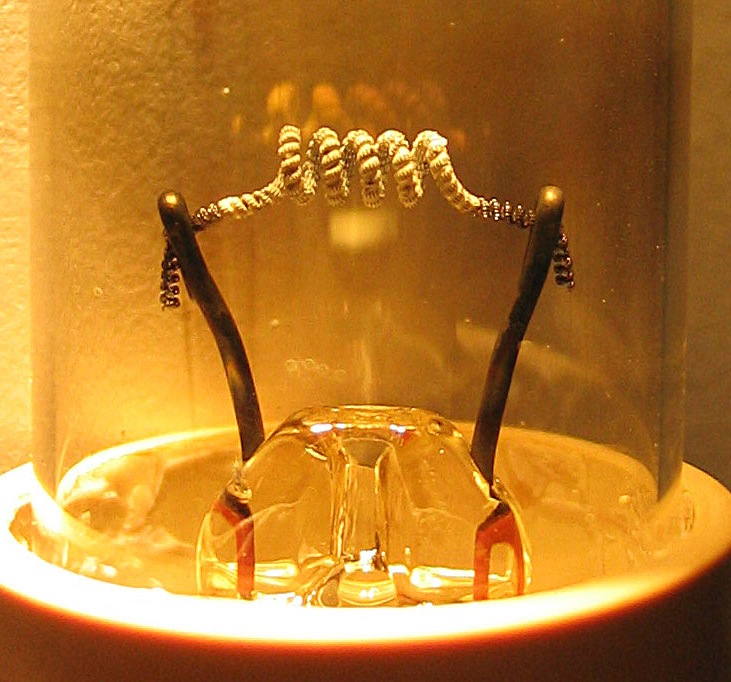
A tungsten filament acting as a directly heated cathode in a low pressure mercury gas discharge lamp which emits electrons. To increase electron emission, a white thermionic emission mix coating is applied on hot cathodes, visible on the central portion of the coil. Typically made of a mixture of barium, strontium, and calcium oxides, the coating is sputtered away through normal use, eventually resulting in lamp failure.

In vacuum tubes and gas-filled tubes, a hot cathode or thermionic cathode is a cathode electrode which is heated to make it emit electrons due to thermionic emission. This is in contrast to a cold cathode, which does not have a heating element. The heating element is usually an electrical filament heated by a separate electric current passing through it. Hot cathodes typically achieve much higher power density than cold cathodes, emitting significantly more electrons from the same surface area. Cold cathodes rely on field electron emission or secondary electron emission from positive ion bombardment, and do not require heating. There are two types of hot cathode. In a directly heated cathode, the filament is the cathode and emits the electrons. In an indirectly heated cathode, the filament or heater heats a separate metal cathode electrode which emits the electrons.

From the 1920s to the 1960s, a wide variety of electronic devices used hot-cathode vacuum tubes. Today, hot cathodes are used as the source of electrons in fluorescent lamps, vacuum tubes, and the electron guns used in cathode-ray tubes and laboratory equipment such as electron microscopes.

Description

[edit]
Two indirectly heated cathodes (orange heater strip) in ECC83 dual triode tube
Cutaway view of a triode vacuum tube with an indirectly heated cathode (orange tube), showing the heater element inside

A cathode electrode in a vacuum tube or other vacuum system is a metal surface which emits electrons into the evacuated space of the tube. Since the negatively charged electrons are attracted to the positive nuclei of the metal atoms, they normally stay inside the metal and require energy to leave it.[1] This energy is called the work function of the metal.[1] In a hot cathode, the cathode surface is induced to emit electrons by heating it with a filament, a thin wire of refractory metal like tungsten with current flowing through it.[1][2] The cathode is heated to a temperature that causes electrons to be 'boiled off' of its surface into the evacuated space in the tube, a process called thermionic emission.[1]

There are two types of hot cathodes:[1]

Directly heated cathode
In this type, the filament itself is the cathode, emits the electrons directly and is coated in metal oxides. Directly heated cathodes were used in the first vacuum tubes. Today, they are used in fluorescent tubes and most high-power transmitting vacuum tubes.
Indirectly heated cathode
In this type, the filament is not the cathode but rather heats a separate cathode consisting of a sheet metal cylinder surrounding the filament, and the cylinder emits electrons. Indirectly heated cathodes are used in most low power vacuum tubes. For example, in most vacuum tubes the cathode is a nickel tube, coated with metal oxides. It is heated by a tungsten filament inside it, and the heat from the filament causes the outside surface of the oxide coating to emit electrons.[2] The filament of an indirectly heated cathode is usually called the heater.

The main reason for using an indirectly heated cathode is to isolate the rest of the vacuum tube from the electric potential across the filament, allowing vacuum tubes to use alternating current to heat the filament. In a tube in which the filament itself is the cathode, the alternating electric field from the filament surface would affect the movement of the electrons and introduce hum into the tube output. It also allows the filaments in all the tubes in an electronic device to be tied together and supplied from the same current source, even though the cathodes they heat may be at different potentials.

Glow of a directly heated cathode in an Eimac 4-1000A 1 kW power tetrode tube in a radio transmitter. Directly heated cathodes operate at higher temperatures and produce a brighter glow. The cathode is behind the other tube elements and not directly visible.

To improve electron emission, cathodes are usually treated with chemicals, compounds of metals with a low work function. These form a metal layer on the surface which emits more electrons. Treated cathodes require less surface area, lower temperatures and less power to supply the same cathode current. The untreated thoriated tungsten filaments used in early vacuum tubes (called "bright emitters") had to be heated to 2,500 °F (1,370 °C), white-hot, to produce sufficient thermionic emission for use, while modern coated cathodes (called "dull emitters") produce far more electrons at a given temperature, so they only have to be heated to 800–1,100 °F (427–593 °C).[1][3]

Types

[edit]

Oxide-coated cathodes

[edit]

The most common type of indirectly heated cathode is the oxide-coated cathode, in which the nickel cathode surface has a coating of alkaline earth metal oxide to increase emission. One of the earliest materials used for this was barium oxide; it forms a monatomic layer of barium with an extremely low work function. More modern formulations utilize a mixture of barium oxide, strontium oxide and calcium oxide. Another standard formulation is barium oxide, calcium oxide, and aluminium oxide in a 5:3:2 ratio. Thorium oxide may be used as well. Oxide-coated cathodes operate at about 800-1000 °C, orange-hot. They are used in most small glass vacuum tubes, but are rarely used in high-power tubes because the coating is degraded by positive ions that bombard the cathode, accelerated by the high voltage on the tube.[4]

For manufacturing convenience, the oxide-coated cathodes are usually coated with carbonates, which are then converted to oxides by heating. The activation may be achieved by microwave heating, direct electric current heating, or electron bombardment while the tube is on the exhausting machine, until the production of gases ceases. The purity of cathode materials is crucial for tube lifetime.[5] The Ba content significantly increases on the surface layers of oxide cathodes down to several tens of nanometers in depth, after the cathode activation process.[6] The lifetime of oxide cathodes can be evaluated with a stretched exponential function.[7] The survivability of electron emission sources is significantly improved by high doping of high‐speed activator.[8]

Barium oxide reacts with traces of silicon in the underlying metal, forming a barium silicate (Ba2SiO4) layer. This layer has high electrical resistance, especially under discontinuous current load, and acts as a resistor in series with the cathode. This is particularly undesirable for tubes used in computer applications, where they can stay without conducting current for extended periods of time.[9]

Barium also sublimates from the heated cathode, and deposits on nearby structures. For electron tubes, where the grid is subjected to high temperatures and barium contamination would facilitate electron emission from the grid itself, higher proportion of calcium is added to the coating mix (up to 20% of calcium carbonate).[9]

SEM Image of G1 Support and G1 Wire, of a heavily used Pentode showing Barium oxide Contamination (green) from the cathode.

Boride cathodes

[edit]
Lanthanum hexaboride hot cathode
Lanthanum hexaboride hot cathodes

Lanthanum hexaboride (LaB6) and cerium hexaboride (CeB6) are used as the coating of some high-current cathodes. Hexaborides show low work function, around 2.5 eV. They are also resistant to poisoning. Cerium boride cathodes show lower evaporation rate at 1700 K than lanthanum boride, but it becomes equal at 1850 K and higher. Cerium boride cathodes have one and a half times the lifetime of lanthanum boride, due to its higher resistance to carbon contamination. Boride cathodes are about ten times as "bright" as the tungsten ones and have 10-15 times longer lifetime. They are used e.g. in electron microscopes, microwave tubes, electron lithography, electron beam welding, X-Ray tubes, and free electron lasers. However these materials tend to be expensive.

Other hexaborides can be employed as well; examples are calcium hexaboride, strontium hexaboride, barium hexaboride, yttrium hexaboride, gadolinium hexaboride, samarium hexaboride, and thorium hexaboride.

Thoriated filaments

[edit]

A common type of directly heated cathode, used in most high power transmitting tubes, is the thoriated tungsten filament, discovered in 1914 and made practical by Irving Langmuir in 1923.[10] A small amount of thorium is added to the tungsten of the filament. The filament is heated white-hot, at about 2400 °C, and thorium atoms migrate to the surface of the filament and form the emissive layer. Heating the filament in a hydrocarbon atmosphere carburizes the surface and stabilizes the emissive layer. Thoriated filaments can have very long lifetimes and are resistant to the ion bombardment that occurs at high voltages, because fresh thorium continually diffuses to the surface, renewing the layer. They are used in nearly all high-power vacuum tubes for radio transmitters, and in some tubes for hi-fi amplifiers. Their lifetimes tend to be longer than those of oxide cathodes.[11]

Thorium alternatives

[edit]

Due to concerns about thorium radioactivity and toxicity, efforts have been made to find alternatives. One of them is zirconiated tungsten, where zirconium dioxide is used instead of thorium dioxide. Other replacement materials are lanthanum(III) oxide, yttrium(III) oxide, cerium(IV) oxide, and their mixtures.[12]

Other materials

[edit]

In addition to the listed oxides and borides, other materials can be used as well. Some examples are carbides and borides of transition metals, e.g. zirconium carbide, hafnium carbide, tantalum carbide, hafnium diboride, and their mixtures. Metals from groups IIIB (scandium, yttrium, and some lanthanides, often gadolinium and samarium) and IVB (hafnium, zirconium, titanium) are usually chosen.[12]

In addition to tungsten, other refractory metals and alloys can be used, e.g. tantalum, molybdenum and rhenium and their alloys.

A barrier layer of other material can be placed between the base metal and the emission layer, to inhibit chemical reaction between these. The material has to be resistant to high temperatures, have high melting point and very low vapor pressure, and be electrically conductive. Materials used can be e.g. tantalum diboride, titanium diboride, zirconium diboride, niobium diboride, tantalum carbide, zirconium carbide, tantalum nitride, and zirconium nitride.[13]

Cathode heater

[edit]

A cathode heater is a heated wire filament used to heat the cathode in a vacuum tube or cathode-ray tube. The cathode element has to achieve the required temperature in order for these tubes to function properly. This is why older electronics often need some time to "warm up" after being powered on; this phenomenon can still be observed in the cathode-ray tubes of some modern televisions and computer monitors. The cathode heats to a temperature that causes electrons to be 'boiled out' of its surface into the evacuated space in the tube, a process called thermionic emission. The temperature required for modern oxide-coated cathodes is around 800–1,000 °C (1,470–1,830 °F).

The cathode is usually in the form of a long narrow sheet metal cylinder at the center of the tube. The heater consists of a fine wire or ribbon, made of a high resistance metal alloy like nichrome, similar to the heating element in a toaster but finer. It runs through the center of the cathode, often being coiled on tiny insulating supports or bent into hairpin-like shapes to give enough surface area to produce the required heat. Typical heaters have a ceramic coating on the wire. When it's bent sharply at the ends of the cathode sleeve, the wire is exposed. The ends of the wire are electrically connected to two of the several pins protruding from the end of the tube. When current passes through the wire it becomes red hot, and the radiated heat strikes the inside surface of the cathode, heating it. The red or orange glow seen coming from operating vacuum tubes is produced by the heater.

There is not much room in the cathode, and the cathode is often built with the heater wire touching it. The inside of the cathode is insulated by a coating of alumina (aluminum oxide). This is not a very good insulator at high temperatures, therefore tubes have a rating for maximum voltage between cathode and heater, usually only 200 to 300 V.

Heaters require a low voltage, high current source of power. Miniature receiving tubes for line-operated equipment use on the order of 0.5 to 4 watts for heater power; high power tubes such as rectifiers or output tubes use on the order of 10 to 20 watts, and broadcast transmitter tubes might need a kilowatt or more to heat the cathode.[14] The voltage required is usually 5 or 6 volts AC. This is supplied by a separate 'heater winding' on the device's power supply transformer that also supplies the higher voltages required by the tubes' plates and other electrodes. One approach used in transformerless line-operated radio and television receivers such as the All American Five is to connect all the tube heaters in series across the supply line. Since all the heaters are rated at the same current, they would share voltage according to their heater ratings.

Battery-operated radio sets used direct-current power for the heaters (commonly known as filaments), and tubes intended for battery sets were designed to use as little filament power as necessary, to economize on battery replacement. The final models of tube-equipped radio receivers were built with subminiature tubes using less than 50 mA for the heaters, but these types were developed at about the same time as transistors which replaced them.

Where leakage or stray fields from the heater circuit could potentially be coupled to the cathode, direct current is sometimes used for heater power. This eliminates a source of noise in sensitive audio or instrumentation circuits.

The majority of power required to operate low power tube equipment is consumed by the heaters. Transistors have no such power requirement, which is often a great advantage.

Failure modes

[edit]

The emissive layers on coated cathodes degrade slowly with time, and much more quickly when the cathode is overloaded with too high current. The result is weakened emission and diminished power of the tubes, or in CRT's diminished brightness.

The activated electrodes can be destroyed by contact with oxygen or other chemicals (e.g. aluminium, or silicates), either present as residual gases, entering the tube via leaks, or released by outgassing or migration from the construction elements. This results in diminished emissivity. This process is known as cathode poisoning. High-reliability tubes had to be developed for the early Whirlwind computer, with filaments free of traces of silicon.

Slow degradation of the emissive layer and sudden burning and interruption of the filament are two main failure modes of vacuum tubes.

Transmitting tube hot cathode characteristics

[edit]
Material[15] Operating temperature Emission efficacy Specific emission
Tungsten 2500 K() 5 mA/W 500 mA/cm2
Thoriated tungsten 2000 K(1726c) 100 mA/W 5 A/cm2
Oxide coated 1000 K 500 mA/W 10 A/cm2
Barium aluminate 1300 K 400 mA/W 4 A/cm2

See also

[edit]

References

[edit]
[edit]
Revisions and contributorsEdit on WikipediaRead on Wikipedia
from Grokipedia
A hot cathode, also known as a thermionic cathode, is an electrode that is heated to high temperatures to facilitate the emission of electrons through thermionic emission, a process where thermal energy enables electrons to overcome the material's work function and escape into a vacuum. This emission occurs when the cathode, typically made from materials like tungsten, lanthanum hexaboride (LaB6), or oxide-coated metals such as barium oxide (BaO) on nickel, reaches operating temperatures ranging from approximately 1150 K for low-work-function coatings to 2200 K for refractory metals like tantalum. The principle relies on the Richardson-Dushman equation, which describes the emission current density as a function of temperature and work function, allowing for controlled electron generation in either temperature-limited or space-charge-limited modes. Hot cathodes are fundamental components in various devices, including vacuum tubes, where they serve as the primary source of s accelerated toward an , enabling functions like amplification, rectification, and in early . In modern applications, they power high-resolution instruments such as scanning microscopes (SEM), transmission microscopes (TEM), and X-ray tubes, providing stable, high-current beams with low emittance for imaging and analysis. Additionally, hot cathodes contribute to thermionic energy converters, which directly transform into by allowing s to flow from a hot emitter () to a cooler collector (), offering potential for efficient power generation in high-temperature environments like space propulsion or . The design of hot cathodes often incorporates filaments or discs heated indirectly or directly by electrical current, with coatings like LaB6 ( ~2.7 eV) preferred for their higher emission efficiency compared to pure metals (e.g., at ~4.5 eV), reducing required operating temperatures and extending lifespan.

Fundamentals

Definition and Historical Context

A hot cathode is an in or gas-filled tubes that emits electrons via when heated to sufficiently high temperatures, typically around 1000–2500 K depending on the material, in contrast to cathodes that rely on field emission without intentional heating. This heating overcomes the material's , allowing electrons to escape the cathode surface and form the electron current essential for device operation. The process, which underlies hot cathode functionality, involves excitation of s to energies above the surface barrier. The historical development of hot cathodes traces back to early 20th-century efforts to improve electron emission in vacuum devices, building on discoveries like the Edison effect in the 1880s. A pivotal advancement came in 1914 when Irving Langmuir at General Electric filed a patent for the thoriated tungsten cathode, which enhanced emission efficiency by incorporating a thin layer of thorium on tungsten filaments through specialized heat treatment. Langmuir's work, including his 1913 studies on thermionic currents in high-vacuum tungsten lamps, laid the groundwork for reliable hot cathodes by deriving key relationships like the Child-Langmuir law for space-charge-limited currents. He also contributed to high-emission cathodes, including improvements in oxide coatings that enabled lower operating temperatures and greater practicality for widespread use. Hot cathodes saw practical implementation in vacuum tubes by 1923, powering early electronics such as amplifiers and detectors that revolutionized communication. Their adoption peaked from the 1920s through the 1960s, forming the core of radios, television receivers, and high-power transmitters, where they enabled signal amplification and rectification critical to the electronics industry. The invention of the transistor at Bell Laboratories in 1947 initiated a decline in consumer applications by offering smaller, more efficient solid-state alternatives. Despite this shift, hot cathodes remain relevant in specialized devices like cathode-ray tubes, microwave tubes, and scientific instruments requiring high electron currents.

Thermionic Emission Principle

Thermionic emission is the process by which electrons are liberated from a heated cathode surface into a vacuum, where thermal agitation provides sufficient kinetic energy to overcome the material's work function—the minimum energy required for an electron to escape the surface potential barrier. This phenomenon relies on the Fermi-Dirac distribution of electron energies within the metal, with only those in the high-energy tail possessing enough energy to surmount the barrier at elevated temperatures. The emission current density JJ is quantitatively described by the Richardson-Dushman equation: J=AT2exp(ϕkT),J = A T^2 \exp\left( -\frac{\phi}{k T} \right), where AA is the Richardson constant (approximately 120 A/cm² K²), TT is the absolute in , ϕ\phi is the in volts, and kk is the (8.617 × 10⁻⁵ eV/K). This equation captures the exponential dependence on , highlighting how even small increases in TT can dramatically enhance emission due to the activation-like nature of the process. To enable practical emission levels, the is heated to temperatures typically ranging from 800°C to 2500°C (1073–2773 K), depending on the material; for instance, pure requires around 2423 K to achieve a of 0.3 A/cm². The plays a critical role, with uncoated exhibiting ϕ4.6\phi \approx 4.6 eV, necessitating high temperatures for viable emission, whereas surface coatings can reduce the effective ϕ\phi to 1.5–2.5 eV, thereby lowering the required and improving . Effective demands a high-vacuum environment (typically 10⁻⁵ to 10⁻⁸ ) to minimize collisions with residual gas molecules and prevent recombination that could neutralize emitted electrons or poison the surface. Furthermore, the buildup of from emitted electrons can limit the maximum current, as governed by the Child-Langmuir law, which describes the space-charge-limited regime in vacuum diodes beyond the pure thermionic limit.

Types

Oxide-Coated Cathodes

Oxide-coated cathodes consist of a thin layer, typically 20–80 μm thick, of mixed oxides applied to a base of or . The coating is primarily composed of (BaO), (SrO), and a smaller amount of (CaO), often derived from precursors such as 57% , 39% , and 4% to ensure uniform emission properties. In some formulations, rare-earth oxides are incorporated as dopants to enhance stability and extend operational life by mitigating electron-donating layer degradation. Fabrication begins with preparing the core, followed by applying an emission paste of carbonates mixed with binders via spraying, dipping, or dragging methods to achieve even coverage. The coated structure is then subjected to in a or protective atmosphere at approximately 800–1000°C to convert the carbonates into oxides, forming a semi-conductive layer. follows through controlled heating at 1000–1275 K for about 150 minutes, which reduces portions of the metal oxides to release free and optimize electron emission. These cathodes operate at relatively low temperatures of 800–1000°C, enabling high emission current densities up to 10 A/cm² in saturated conditions and efficiencies of 10–40 mA/W, which supports their use in low-power vacuum tubes like amplifiers and cathode-ray tubes. Their design provides a long operational life of 10,000–20,000 hours under typical loads of 5–10 mA/cm², attributed to reduced evaporation and a large emission reserve. Developed in the 1920s following early experiments in the 1900s, oxide-coated cathodes became widely adopted for general-purpose applications due to their efficiency and manufacturability. However, they are vulnerable to erosion from ion sputtering in high-voltage environments, where ion energies above 22 eV can significantly degrade the coating and limit lifespan.

Thoriated Tungsten Cathodes

Thoriated tungsten cathodes are composed of tungsten filaments impregnated or coated with 1–3% (ThO₂) by weight, which diffuses thorium atoms to the surface during operation, forming an active emissive layer. This composition lowers the effective to approximately 2.6 eV, enabling efficient at elevated temperatures. These cathodes typically operate at 2000–2200 K (1727–1927°C) to ensure uniform emission across the filament surface, balancing emission current with material longevity. Fabrication begins with mixing tungsten powder and thorium nitrate or ThO₂, followed by reduction, pressing, and at around 1350°C to form a solid matrix. The material is then rotary forged at 1250–1280°C and drawn into wire at 800–1000°C, often with subsequent carburization in gas (e.g., ) at ~2300 K to create a protective di-tungsten (WC) outer layer that reduces thorium evaporation. High-vacuum processing throughout assembly is essential to prevent , as even trace impurities can degrade emission . These cathodes offer high durability and electron emission density of about 100 mA/W at operating temperatures, significantly outperforming pure (10 mA/W) while requiring less heating power—roughly one-sixth that of pure for equivalent emission. Their robust structure provides excellent resistance to mechanical vibration and high voltages (up to several kV), making them ideal for rugged, high-power applications like transmitting tubes, where they have been standard since the 1920s. Under typical load conditions, they achieve life expectancies exceeding 10,000 hours, often reaching 20,000–30,000 hours in broadcast service with proper filament voltage management. Due to thorium's radioactivity and associated handling regulations, modern designs increasingly incorporate non-radioactive alternatives such as zirconium oxide (ZrO₂), lanthanum oxide (La₂O₃), or doping, which provide comparable emission and durability without radiological risks; this transition accelerated post-1980s as safer rare-earth options became viable.

Boride Cathodes

Boride cathodes, primarily based on rare-earth hexaborides, are specialized thermionic emitters valued for their application in high-vacuum environments such as microscopes and other scientific instruments. The most common materials are (LaB₆) and cerium hexaboride (CeB₆), which can be fabricated in single-crystal or polycrystalline forms to optimize emission performance. These cathodes were first developed in the by J. M. Lafferty at , who identified the potential of borides like LaB₆ as efficient emitters for applications including electron microscopy, due to their ability to produce stable, high-density beams. Fabrication typically involves for polycrystalline rods, which achieves high density and mechanical stability, or (CVD) for growing single-crystal structures with enhanced uniformity. LaB₆ cathodes are operated at temperatures between 1500°C and 1800°C in conditions (typically below 10⁻⁷ ) to minimize contamination and evaporation. Key advantages of cathodes include a very low of approximately 2.5 eV for LaB₆ (and ~2.7 eV for CeB₆), enabling at lower temperatures compared to tungsten-based alternatives, which results in high-brightness beams suitable for precision imaging. They support emission currents up to 100 A/cm² while maintaining beam coherence, and offer long operational lifetimes of up to 5000 hours under optimal conditions, attributed to low and resistance to oxidation in controlled environments. CeB₆ variants provide additional benefits, such as a lower rate below 1800°C, extending lifetime by up to 50% in carbon-contaminated settings. However, the higher material and fabrication costs restrict their use to specialized, high-precision applications rather than general-purpose tubes. The low in these s contributes to enhanced emission uniformity across the surface, as the reduced energy barrier facilitates consistent escape, particularly in single-crystal orientations like (100). This property, combined with the material's , makes boride cathodes ideal for demanding scientific instruments where beam quality is paramount.

Other Materials

Carbide-based hot cathodes, such as those made from (ZrC) or carbide (TaC), offer low effective work functions of approximately 3.0 eV, enabling efficient in demanding environments. These materials withstand operating temperatures up to 2200°C, making them suitable for applications requiring sustained high-heat performance without rapid degradation. Unlike cathodes, carbides provide comparable low work functions through distinct carbon-metal bonding chemistries that enhance thermal resilience. Refractory metal filaments, including pure , , or , serve as robust hot cathodes in scenarios demanding extreme durability, leveraging their high melting points above 2600°C. However, their s range from 4 to 5 eV, necessitating operating temperatures exceeding 2500°C to achieve viable emission currents. filaments, for instance, operate effectively at around 2200 K with a of 4.1 eV, while requires higher temperatures due to its 5.0 eV threshold. Emerging variants of dispenser cathodes incorporate porous tungsten matrices impregnated with barium-calcium aluminates, which release activators to maintain low effective work functions over extended periods. Post-2000 developments have integrated scandium oxide into these structures, enhancing emission stability and resistance to ion bombardment through uniform scandia distribution in the impregnant or matrix. These scandate configurations achieve current densities up to 30-50 A/cm² at 850-1000°C, with lifetimes exceeding 10,000 hours due to reduced barium desorption. Such materials find niche use in tubes, where dispenser cathodes enable micro-focus operation with spot sizes below 10 microns and lifetimes over 20,000 hours, and in ion thrusters for plasma neutralization. Operational life in these extreme conditions is primarily constrained by sublimation, particularly evaporation in dispensers above 900°C or material loss in refractories at 2500°C+, leading to gradual emission decline.

Construction

Cathode Heater Design

The heater element in a hot cathode is typically constructed from wire due to its high of approximately 3400°C and low , which allow it to operate reliably at elevated temperatures without significant . The wire is often formed into coiled shapes, such as single or double helical configurations (e.g., or M-shaped) or folded structures, to maximize surface area for while fitting within the compact cathode . These designs are wound or positioned in close proximity to the cathode , enabling efficient thermal coupling primarily through , with some conduction in certain configurations. Electrical parameters for the heater are optimized for low-voltage operation to achieve the required cathode temperatures of 800–1200°C with minimal across the element. Common ratings include 5–6 V AC at currents ranging from 0.1 A to 5 A, corresponding to resistances of 1–3 ohms, though higher voltages like 12.6 V are used in series-connected setups. Power consumption varies by application: small-signal tubes typically require 0.5–20 W (e.g., a at 6.3 V and 0.3 A draws about 1.9 W), while transmitting tubes demand over 1 kW, such as 9.6 kW for a high-power at 16 V and 600 A. Design considerations emphasize insulation to prevent electrical shorting between the heater and , achieved through coatings or sleeves of high-purity alumina (Al₂O₃), which provides low electrical conductivity and up to 1600°C during . This insulation supports heater-cathode voltage ratings up to 200 , with typical designs handling 90–180 depending on coating thickness (approximately 75 per mil of alumina). is prioritized by minimizing extraneous power loss through precise wire length and coiling to balance heat generation and dissipation. Startup surge currents, which can exceed normal ratings by several times due to the low cold resistance of the heater wire, necessitate protective measures such as negative temperature coefficient (NTC) thermistors to limit inrush and prevent filament damage or stress. These devices increase resistance as they heat, gradually allowing full current flow and extending heater longevity in both small and high-power applications.

Directly and Indirectly Heated Configurations

In the directly heated configuration, the filament serves as both the heater and the electron-emitting , typically constructed from a wire that is heated by passing an through it to achieve . This design is simpler and lower in cost, requiring fewer components than alternatives, and is commonly employed in applications such as fluorescent lamps, where the hot filament initiates the gas discharge, and in high-power transmitting that demand robust emission under heavy loads. However, the resistance of the filament creates a along its length, resulting in a varying potential that can distort electron flow and . The indirectly heated configuration features a separate insulated heater element that thermally conducts to an outer sleeve or plate serving as the , which is coated to enhance emission. This separation allows independent electrical biasing of the relative to the heater, supporting higher cathode-to-grid voltages up to 500 V without uniformity issues and enabling reliable AC heater operation, which is essential for minimizing induced in sensitive circuits. Such designs are more complex to assemble due to the need for precise insulation and alignment but are standard in audio amplifiers, where the uniform cathode potential reduces . Indirectly heated cathodes typically require thoriated or coatings to achieve efficient emission at lower temperatures. Key trade-offs distinguish these configurations. Directly heated cathodes warm up rapidly, often in seconds, owing to their low , making them suitable for quick-start applications, but they are prone to AC ripple and hum when powered by , as the oscillating filament potential modulates emission unevenly. In comparison, indirectly heated cathodes exhibit slower warmup times of 30–60 seconds due to the greater thermal inertia of the sleeve, yet they tolerate higher voltages and operate with less in AC systems, though the added complexity increases manufacturing costs and heater power demands.

Performance Characteristics

Emission Properties

Hot cathodes exhibit thermionic emission capabilities that enable current densities typically ranging from 1 to 10 A/cm², depending on the material, operating temperature, and applied voltage. This emission is often space-charge limited in practical devices, governed by the Child-Langmuir law, which describes the maximum current density JJ between parallel electrodes as J=4ϵ092emV3/2d2J = \frac{4\epsilon_0}{9} \sqrt{\frac{2e}{m}} \frac{V^{3/2}}{d^2}
Add your contribution
Related Hubs
User Avatar
No comments yet.